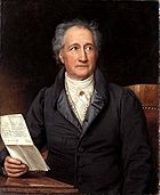
Johann Wolfgang von Goethe (ˈjoːhan ˈvɔlfɡaŋ fɔn ˈɡøːtə, 28 August 1749 22 March 1832) was a
GermanThe Germans are a Germanic ethnic group native to Central Europe. The English term Germans has referred to the German-speaking population of the Holy Roman Empire since the Late Middle Ages....
writerA writer is a person who produces literature, such as novels, short stories, plays, screenplays, poetry, or other literary art. Skilled writers are able to use language to portray ideas and images....
,
pictorial artistThe visual arts are art forms that create works which are primarily visual in nature, such as ceramics, drawing, painting, sculpture, printmaking, design, crafts, and often modern visual arts and architecture...
,
biologistBiology is a natural science concerned with the study of life and living organisms, including their structure, function, growth, origin, evolution, distribution, and taxonomy. Biology is a vast subject containing many subdivisions, topics, and disciplines...
,
theoretical physicistTheoretical physics is a branch of physics which employs mathematical models and abstractions of physics to rationalize, explain and predict natural phenomena...
, and
polymathA polymath is a person whose expertise spans a significant number of different subject areas. In less formal terms, a polymath may simply be someone who is very knowledgeable...
. He is considered the supreme genius of modern
German literatureGerman literature comprises those literary texts written in the German language. This includes literature written in Germany, Austria, the German part of Switzerland, and to a lesser extent works of the German diaspora. German literature of the modern period is mostly in Standard German, but there...
. His works span the fields of
poetryPoetry is a form of literary art in which language is used for its aesthetic and evocative qualities in addition to, or in lieu of, its apparent meaning...
,
dramaDrama is the specific mode of fiction represented in performance. The term comes from a Greek word meaning "action" , which is derived from "to do","to act" . The enactment of drama in theatre, performed by actors on a stage before an audience, presupposes collaborative modes of production and a...
,
proseProse is the most typical form of written language, applying ordinary grammatical structure and natural flow of speech rather than rhythmic structure...
,
philosophyPhilosophy is the study of general and fundamental problems, such as those connected with existence, knowledge, values, reason, mind, and language. Philosophy is distinguished from other ways of addressing such problems by its critical, generally systematic approach and its reliance on rational...
, and
scienceScience is a systematic enterprise that builds and organizes knowledge in the form of testable explanations and predictions about the universe...
. His
FaustJohann Wolfgang von Goethe's Faust is a tragic play in two parts: and . Although written as a closet drama, it is the play with the largest audience numbers on German-language stages...
has been called the greatest long poem of
modern European literatureThe history of literature in the Modern period in Europe begins with the Age of Enlightenment and the conclusion of the Baroque period in the 18th century, succeeding the Renaissance and Early Modern periods....
. His other well-known literary works include his numerous poems, the
BildungsromanIn literary criticism, bildungsroman or coming-of-age story is a literary genre which focuses on the psychological and moral growth of the protagonist from youth to adulthood , and in which character change is thus extremely important...
Wilhelm Meister's ApprenticeshipWilhelm Meister's Apprenticeship is the second novel by Johann Wolfgang von Goethe, published in 1795-96. While his first novel, The Sorrows of Young Werther, featured a hero driven to suicide by despair, the eponymous hero of this novel undergoes a journey of self-realization...
, and the
epistolary novelAn epistolary novel is a novel written as a series of documents. The usual form is letters, although diary entries, newspaper clippings and other documents are sometimes used. Recently, electronic "documents" such as recordings and radio, blogs, and e-mails have also come into use...
The Sorrows of Young WertherThe Sorrows of Young Werther is an epistolary and loosely autobiographical novel by Johann Wolfgang von Goethe, first published in 1774; a revised edition of the novel was published in 1787...
.
Goethe was one of the key figures of
German literatureGerman literature comprises those literary texts written in the German language. This includes literature written in Germany, Austria, the German part of Switzerland, and to a lesser extent works of the German diaspora. German literature of the modern period is mostly in Standard German, but there...
and the movement of
Weimar ClassicismWeimar Classicism is a cultural and literary movement of Europe. Followers attempted to establish a new humanism by synthesizing Romantic, classical and Enlightenment ideas...
in the late 18th and early 19th centuries; this movement coincides with
EnlightenmentThe Age of Enlightenment was an elite cultural movement of intellectuals in 18th century Europe that sought to mobilize the power of reason in order to reform society and advance knowledge. It promoted intellectual interchange and opposed intolerance and abuses in church and state...
,
SentimentalismSentimentalism , as a literary and political discourse, has occurred much in the literary traditions of all regions in the world, and is central to the traditions of Indian literature, Chinese literature, and Vietnamese literature...
(
Empfindsamkeit),
Sturm und DrangSturm und Drang is a proto-Romantic movement in German literature and music taking place from the late 1760s through the early 1780s, in which individual subjectivity and, in particular, extremes of emotion were given free expression in reaction to the perceived constraints of rationalism...
and
RomanticismRomanticism was an artistic, literary and intellectual movement that originated in the second half of the 18th century in Europe, and gained strength in reaction to the Industrial Revolution...
. The author of the scientific text

Theory of ColoursTheory of Colours is a work by Johann Wolfgang von Goethe about the poet's views on the nature of colours and how these are perceived by man, published in 1810...
, his influential ideas on plant and animal
morphologyIn biology, morphology is a branch of bioscience dealing with the study of the form and structure of organisms and their specific structural features....
and
homologyHomology forms the basis of organization for comparative biology. In 1843, Richard Owen defined homology as "the same organ in different animals under every variety of form and function". Organs as different as a bat's wing, a seal's flipper, a cat's paw and a human hand have a common underlying...
were extended and developed by 19th century
naturalistsNatural history is the scientific research of plants or animals, leaning more towards observational rather than experimental methods of study, and encompasses more research published in magazines than in academic journals. Grouped among the natural sciences, natural history is the systematic study...
including
Charles DarwinCharles Robert Darwin FRS was an English naturalist. He established that all species of life have descended over time from common ancestry, and proposed the scientific theory that this branching pattern of evolution resulted from a process that he called natural selection.He published his theory...
. He also served at length as the
Privy Councilor Geheimrat was the title of the highest advising officials at the Imperial, royal or principal courts of the Holy Roman Empire, who jointly formed the Geheimer Rat reporting to the ruler...
of the
duchyA duchy is a territory, fief, or domain ruled by a duke or duchess.Some duchies were sovereign in areas that would become unified realms only during the Modern era . In contrast, others were subordinate districts of those kingdoms that unified either partially or completely during the Medieval era...
of
Saxe-WeimarSaxe-Weimar was one of the Saxon duchies held by the Ernestine branch of the Wettin dynasty in present-day Thuringia. The chief town and capital was Weimar.-Division of Leipzig:...
.
In politics Goethe was conservative. At the time of the
French RevolutionThe French Revolution , sometimes distinguished as the 'Great French Revolution' , was a period of radical social and political upheaval in France and Europe. The absolute monarchy that had ruled France for centuries collapsed in three years...
, he thought the enthusiasm of the students and professors to be a perversion of their energy and remained skeptical of the ability of the masses to govern. Likewise, he "did not oppose the
War of LiberationIn the War of the Sixth Coalition , a coalition of Austria, Prussia, Russia, the United Kingdom, Portugal, Sweden, Spain and a number of German States finally defeated France and drove Napoleon Bonaparte into exile on Elba. After Napoleon's disastrous invasion of Russia, the continental powers...
waged by the
German statesThe Holy Roman Empire was a realm that existed from 962 to 1806 in Central Europe.It was ruled by the Holy Roman Emperor. Its character changed during the Middle Ages and the Early Modern period, when the power of the emperor gradually weakened in favour of the princes...
against Napoleon, but remained aloof from the patriotic efforts to unite the various parts of Germany into one nation; he advocated instead the maintenance of small principalities ruled by benevolent
despotsDespotism is a form of government in which a single entity rules with absolute power. That entity may be an individual, as in an autocracy, or it may be a group, as in an oligarchy...
."
Goethe's influence spread across Europe, and for the next century his works were a major source of inspiration in music,
dramaDrama is the specific mode of fiction represented in performance. The term comes from a Greek word meaning "action" , which is derived from "to do","to act" . The enactment of drama in theatre, performed by actors on a stage before an audience, presupposes collaborative modes of production and a...
,
poetryPoetry is a form of literary art in which language is used for its aesthetic and evocative qualities in addition to, or in lieu of, its apparent meaning...
and
philosophyPhilosophy is the study of general and fundamental problems, such as those connected with existence, knowledge, values, reason, mind, and language. Philosophy is distinguished from other ways of addressing such problems by its critical, generally systematic approach and its reliance on rational...
. Early in his career, however, he wondered whether painting might be his true vocation; late in his life, he expressed the expectation that he would ultimately be remembered above all for
his work on colorTheory of Colours is a work by Johann Wolfgang von Goethe about the poet's views on the nature of colours and how these are perceived by man, published in 1810...
.
Early life
Goethe's father, Johann Caspar Goethe (Frankfurt am Main, Hessen, 29 July 1710 Frankfurt, 25 May 1782), lived with his family in a large house in Frankfurt, then an Imperial Free City of the
Holy Roman EmpireThe Holy Roman Empire was a realm that existed from 962 to 1806 in Central Europe.It was ruled by the Holy Roman Emperor. Its character changed during the Middle Ages and the Early Modern period, when the power of the emperor gradually weakened in favour of the princes...
. Though he had studied law in Leipzig and had been appointed Imperial Councillor, he was not involved in the city's official affairs. 38-year-old Johann Caspar married Goethe's mother, Catharina Elisabeth Goethe, the daughter of the
SchultheißIn medieval Germany, the Schultheiß was the head of a municipality , a Vogt or an executive official of the ruler.As official it was...
(mayor) of Frankfurt Johann Wolfgang Textor (Frankfurt, 11 December 1693 Frankfurt, 6 February 1771) and wife Anna Margaretha Lindheimer (Wetzlar, 23 July 1711 Frankfurt, 18 April 1783, a descendant of
Lucas Cranach the ElderLucas Cranach the Elder , was a German Renaissance painter and printmaker in woodcut and engraving...
and Henry III, Landgrave of Hesse-Marburg; married at
WetzlarWetzlar is a city in the state of Hesse, Germany. Located at 8° 30′ E, 50° 34′ N, Wetzlar straddles the river Lahn and is on the German Timber-Framework Road which passes mile upon mile of half-timbered houses. Historically, the city has acted as the hub of the Lahn-Dill-Kreis on the north edge of...
, 2 February 1726), when she was 17 at Frankfurt on 20 August 1748. All their children, except for Goethe and his sister, Cornelia Friederike Christiana, who was born in 1750, died at early ages.
The father and private tutors gave Goethe lessons in all the common subjects of their time, especially languages (
LatinLatin is an Italic language originally spoken in Latium and Ancient Rome. It, along with most European languages, is a descendant of the ancient Proto-Indo-European language. Although it is considered a dead language, a number of scholars and members of the Christian clergy speak it fluently, and...
, Greek, French, Italian, English and Hebrew). Goethe also received lessons in dancing,
ridingEquestrianism more often known as riding, horseback riding or horse riding refers to the skill of riding, driving, or vaulting with horses...
and fencing. Johann Caspar, feeling frustrated in his own ambitions, was determined that his children should have all those advantages that he had not.
Goethe had a persistent dislike of the
Roman Catholic ChurchThe Catholic Church, also known as the Roman Catholic Church, is the world's largest Christian church, with over a billion members. Led by the Pope, it defines its mission as spreading the gospel of Jesus Christ, administering the sacraments and exercising charity...
, characterizing its history as a "hotchpotch of fallacy and violence" (
Mischmasch von Irrtum und Gewalt). His great passion was
drawingDrawing is a form of visual art that makes use of any number of drawing instruments to mark a two-dimensional medium. Common instruments include graphite pencils, pen and ink, inked brushes, wax color pencils, crayons, charcoal, chalk, pastels, markers, styluses, and various metals .An artist who...
. Goethe quickly became interested in
literatureLiterature is the art of written works, and is not bound to published sources...
;
Friedrich Gottlieb KlopstockFriedrich Gottlieb Klopstock was a German poet.-Biography:Klopstock was born at Quedlinburg, the eldest son of a lawyer.Both in his birthplace and on the estate of Friedeburg on the Saale, which his father later rented, young Klopstock passed a happy childhood; and more attention having been given...
and
HomerIn the Western classical tradition Homer , is the author of the Iliad and the Odyssey, and is revered as the greatest ancient Greek epic poet. These epics lie at the beginning of the Western canon of literature, and have had an enormous influence on the history of literature.When he lived is...
were among his early favourites. He had a lively devotion to
theatreTheatre is a collaborative form of fine art that uses live performers to present the experience of a real or imagined event before a live audience in a specific place. The performers may communicate this experience to the audience through combinations of gesture, speech, song, music or dance...
as well and was greatly fascinated by
puppetA puppet is an inanimate object or representational figure animated or manipulated by an entertainer, who is called a puppeteer. It is used in puppetry, a play or a presentation that is a very ancient form of theatre....
shows that were annually arranged in his home; a familiar theme in
Wilhelm Meister's ApprenticeshipWilhelm Meister's Apprenticeship is the second novel by Johann Wolfgang von Goethe, published in 1795-96. While his first novel, The Sorrows of Young Werther, featured a hero driven to suicide by despair, the eponymous hero of this novel undergoes a journey of self-realization...
.
He also took great pleasure in reading from the great works about history and religion. He writes about this period:
Goethe became acquainted to Frankfurt actors. Around early literary attempts, he was infatuated with
Gretchen, who would later reappear in his
FaustJohann Wolfgang von Goethe's Faust is a tragic play in two parts: and . Although written as a closet drama, it is the play with the largest audience numbers on German-language stages...
and the adventures with whom he would concisely describe in
Dichtung und WahrheitAus meinem Leben: Dichtung und Wahrheit is an autobiography by Johann Wolfgang von Goethe that comprises the time from the poet's childhood to the days in 1775, when he was about to leave for Weimar....
. He adored Charitas Meixner (July 27, 1750 - December 31, 1773), a wealthy
WormsWorms is a city in Rhineland-Palatinate, Germany, on the Rhine River. At the end of 2004, it had 85,829 inhabitants.Established by the Celts, who called it Borbetomagus, Worms today remains embattled with the cities Trier and Cologne over the title of "Oldest City in Germany." Worms is the only...
trader's daughter and friend of his sister, who would later marry the merchant G. F. Schuler.
Legal career
Goethe studied
lawLaw is a system of rules and guidelines which are enforced through social institutions to govern behavior, wherever possible. It shapes politics, economics and society in numerous ways and serves as a social mediator of relations between people. Contract law regulates everything from buying a bus...
in
LeipzigLeipzig Leipzig has always been a trade city, situated during the time of the Holy Roman Empire at the intersection of the Via Regia and Via Imperii, two important trade routes. At one time, Leipzig was one of the major European centres of learning and culture in fields such as music and publishing...
from 1765 to 1768. He detested learning age-old judicial rules by heart, preferring instead to attend the poetry lessons of
Christian Fürchtegott GellertChristian Fürchtegott Gellert was a German poet, one of the forerunners of the golden age of German literature that was ushered in by Lessing.-Biography:...
. In Leipzig, Goethe fell in love with
Käthchen SchönkopfAnna Katharina Schönkopf and „Annette“ ; * 22 August 1746 Leipzig - 20 May 1810 ibidem) was the daughter of the pewterer and wine merchant Christian Gottlieb Schönkopf and his wife Katharina Sibylla , born Hauck...
and wrote cheerful verses about her in the
RococoRococo , also referred to as "Late Baroque", is an 18th-century style which developed as Baroque artists gave up their symmetry and became increasingly ornate, florid, and playful...
genre. In 1770, he anonymously released
Annette, his first collection of poems. His uncritical admiration for many contemporary poets vanished as he became interested in
LessingGotthold Ephraim Lessing was a German writer, philosopher, dramatist, publicist, and art critic, and one of the most outstanding representatives of the Enlightenment era. His plays and theoretical writings substantially influenced the development of German literature...
and
WielandChristoph Martin Wieland was a German poet and writer.- Biography :He was born at Oberholzheim , which then belonged to the Free Imperial City of Biberach an der Riss in the south-east of the modern-day state of Baden-Württemberg...
. Already at this time, Goethe wrote a good deal, but he threw away nearly all of these works, except for the comedy
Die Mitschuldigen. The restaurant
Auerbachs KellerAuerbachs Keller is the best known and second oldest restaurant in Leipzig. It was described in Johann Wolfgang von Goethe's play Faust I, as the first place Mephistopheles takes Faust on their travels....
and its legend of
Faust'sDr. Johann Georg Faust , also known in English as John Faustus , was an itinerant alchemist, astrologer, and magician of the German Renaissance...
1525 barrel ride impressed him so much that Auerbachs Keller became the only real place in his
closet dramaA closet drama is a play that is not intended to be performed onstage, but read by a solitary reader or, sometimes, out loud in a small group. A related form, the "closet screenplay," developed during the 20th century.-Form:...
Faust Part OneFaust: The First Part of the Tragedy is the first part of Goethe's Faust. It was first published in 1808.-Synopsis:The first part of Faust is not divided into acts, but is structured as a sequence of scenes in a variety of settings...
. Because his studies did not progress, Goethe was forced to return to Frankfurt at the close of August 1768.
In Frankfurt, Goethe became severely ill. During the year and a half that followed, because of several relapses, the relationship with his father worsened. During convalescence, Goethe was nursed by his mother and sister. Bored in bed, he wrote an impudent crime comedy. In April 1770, his father lost his patience; Goethe left Frankfurt in order to finish his studies in
StrasbourgStrasbourg is the capital and principal city of the Alsace region in eastern France and is the official seat of the European Parliament. Located close to the border with Germany, it is the capital of the Bas-Rhin département. The city and the region of Alsace are historically German-speaking,...
.
In
AlsaceAlsace is the fifth-smallest of the 27 regions of France in land area , and the smallest in metropolitan France. It is also the seventh-most densely populated region in France and third most densely populated region in metropolitan France, with ca. 220 inhabitants per km²...
, Goethe blossomed. No other landscape has he described as affectionately as the warm, wide Rhine area. In Strasbourg, Goethe met
Johann Gottfried HerderJohann Gottfried von Herder was a German philosopher, theologian, poet, and literary critic. He is associated with the periods of Enlightenment, Sturm und Drang, and Weimar Classicism.-Biography:...
, who happened to be in town on the occasion of an eye operation. The two became close friends, and crucially to Goethe's intellectual development, it was Herder who kindled his interest in Shakespeare,
OssianOssian is the narrator and supposed author of a cycle of poems which the Scottish poet James Macpherson claimed to have translated from ancient sources in the Scots Gaelic. He is based on Oisín, son of Finn or Fionn mac Cumhaill, anglicised to Finn McCool, a character from Irish mythology...
and in the notion of Volkspoesie (folk poetry). On October 14, 1772 he held a speech in his parental home in honour of the first German "Shakespeare Day". His first meeting with Shakespeare's works is described as his personal awakening in literature.
On a trip to the village
SessenheimSessenheim is a commune in the Bas-Rhin department in Alsace in north-eastern France.-References:*...
, Goethe fell in love with
Friederike BrionFriederike Elisabetha Brion was a parson's daughter who had a short, but intense love-affair with the young Johann Wolfgang Goethe.- Life :...
, in October 1770, but, after ten months, terminated the relationship in August 1771. Several of his poems, like
,
and
, originate from this time.
At the end of August 1771, Goethe was certified as a
licenseeA licensee is someone who has been granted a licence.- Tort law :The term is used in the USA law of torts to describe a person who is on the property of another, despite the fact that the property is not open to the general public, because the owner of the property has allowed the licensee to enter...
in Frankfurt. He wanted to make the
jurisdictionJurisdiction is the practical authority granted to a formally constituted legal body or to a political leader to deal with and make pronouncements on legal matters and, by implication, to administer justice within a defined area of responsibility...
progressively more humane. In his first cases, he proceeded too vigorously, was reprimanded and lost the position. This prematurely terminated his career as a lawyer after only a few months. At this time, Goethe was acquainted with the
courtA court is a form of tribunal, often a governmental institution, with the authority to adjudicate legal disputes between parties and carry out the administration of justice in civil, criminal, and administrative matters in accordance with the rule of law...
of
DarmstadtDarmstadt is a city in the Bundesland of Hesse in Germany, located in the southern part of the Rhine Main Area.The sandy soils in the Darmstadt area, ill-suited for agriculture in times before industrial fertilisation, prevented any larger settlement from developing, until the city became the seat...
, where his inventiveness was praised. From this milieu came Johann Georg Schlosser (who was later to become his
brother-in-lawA brother-in-law is the brother of one's spouse, the husband of one's sibling, or the husband of one's spouse's sibling.-See also:*Affinity *Sister-in-law*Brothers in Law , a 1955 British comedy novel...
) and
Johann Heinrich MerckJohann Heinrich Merck , German author and critic, was born at Darmstadt, a few days after the death of his father, a chemist....
. Goethe also pursued literary plans again; this time, his father did not have anything against it, and even helped. Goethe obtained a copy of the
biographyA biography is a detailed description or account of someone's life. More than a list of basic facts , biography also portrays the subject's experience of those events...
of a
nobleNobility is a social class which possesses more acknowledged privileges or eminence than members of most other classes in a society, membership therein typically being hereditary. The privileges associated with nobility may constitute substantial advantages over or relative to non-nobles, or may be...
highwaymanA highwayman was a thief and brigand who preyed on travellers. This type of outlaw, usually, travelled and robbed by horse, as compared to a footpad who traveled and robbed on foot. Mounted robbers were widely considered to be socially superior to footpads...
from the
German Peasants' WarThe German Peasants' War or Great Peasants' Revolt was a widespread popular revolt in the German-speaking areas of Central Europe, 1524–1526. At its height in the spring and summer of 1525, the conflict involved an estimated 300,000 peasants: contemporary estimates put the dead at 100,000...
. In a couple of weeks the biography was reworked into a colourful
dramaDrama is the specific mode of fiction represented in performance. The term comes from a Greek word meaning "action" , which is derived from "to do","to act" . The enactment of drama in theatre, performed by actors on a stage before an audience, presupposes collaborative modes of production and a...
. Entitled
Götz von BerlichingenGoetz von Berlichingen is a successful 1773 drama by Johann Wolfgang von Goethe, based on the memoirs of the historical adventurer-poet Götz von Berlichingen . The plot has various changes to Götz's real biography...
, the work went directly to the heart of Goethe's contemporaries.
Goethe could not subsist on being one of the editors of a literary periodical (published by Schlosser and Merck). In May 1772 he once more began the practice of law at
WetzlarWetzlar is a city in the state of Hesse, Germany. Located at 8° 30′ E, 50° 34′ N, Wetzlar straddles the river Lahn and is on the German Timber-Framework Road which passes mile upon mile of half-timbered houses. Historically, the city has acted as the hub of the Lahn-Dill-Kreis on the north edge of...
. In 1774 he wrote the book which would bring him worldwide fame,
The Sorrows of Young WertherThe Sorrows of Young Werther is an epistolary and loosely autobiographical novel by Johann Wolfgang von Goethe, first published in 1774; a revised edition of the novel was published in 1787...
. The outer shape of the work's plot is widely taken over from what Goethe experienced during his Wetzlar time with
Charlotte BuffCharlotte Buff was known to be a love interest of Goethe, whom she rejected to marry the diplomat and art collector Johann Christian Kestner. She mirrors in the central character Lotte of the masterpiece "The Sorrows of Young Werther" of Goethe, in which this extended certain moments of suffering...
(1753–1828) and her fiancé, Johann Christian Kestner (1741–1800), as well as from the suicide of the author's friend Karl Wilhelm Jerusalem (1747–1772); in it, Goethe made a desperate passion of what was in reality a hearty and relaxed friendship. Despite the immense success of
Werther, it did not bring Goethe much financial gain because copyright law at the time were essentially nonexistent. (In later years Goethe would bypass this problem by periodically authorizing "new, revised" editions of his
Complete Works.)
Early years in Weimar
In 1775, Goethe was invited, on the strength of his fame as the author of
The Sorrows of Young WertherThe Sorrows of Young Werther is an epistolary and loosely autobiographical novel by Johann Wolfgang von Goethe, first published in 1774; a revised edition of the novel was published in 1787...
, to the court of
Carl August, Duke of Saxe-Weimar-EisenachKarl August, Grand Duke of Saxe-Weimar-Eisenach was a duke of Saxe-Weimar and of Saxe-Eisenach from 1758, duke of Saxe-Weimar-Eisenach from its creation in 1809, and grand duke from 1815 until his death...
, who would become
Grand DukeThe title grand duke is used in Western Europe and particularly in Germanic countries for provincial sovereigns. Grand duke is of a protocolary rank below a king but higher than a sovereign duke. Grand duke is also the usual and established translation of grand prince in languages which do not...
in 1815. (The Duke at the time was 18 years of age, to Goethe's 26.) Goethe thus went to live in Weimar, where he remained for the rest of his life and where, over the course of many years, he held a succession of offices, becoming the Duke's chief adviser.
In 1776, Goethe formed a close relationship to
Charlotte von SteinCharlotta Ernestina Bernadina von Stein was a lady-in-waiting at the court in Weimar and a close friend to both Friedrich Schiller and Johann Wolfgang von Goethe, whose work and life were strongly influenced by her.-Childhood:Charlotte′s parents were Hofmarschall Johann Wilhelm Christian von...
, an older, married woman. The intimate bond with Frau von Stein lasted for ten years, after which Goethe abruptly left for Italy without giving his companion any notice. She was emotionally distraught at the time, but they were eventually reconciled.
Goethe, aside from official duties, was also a friend and confidant to the Duke, and participated fully in the activities of the court. For Goethe, his first ten years at Weimar could well be described as a garnering of a degree and range of experience which perhaps could be achieved in no other way. Goethe was ennobled in 1782 (this being indicated by the "
vonIn German, von is a preposition which approximately means of or from.When it is used as a part of a German family name, it is usually a nobiliary particle, like the French, Spanish and Portuguese "de". At certain times and places, it has been illegal for anyone who was not a member of the nobility...
" in his name).
Italy
Goethe's journey to the
Italian peninsulaThe Italian Peninsula or Apennine Peninsula is one of the three large peninsulas of Southern Europe , spanning from the Po Valley in the north to the central Mediterranean Sea in the south. The peninsula's shape gives it the nickname Lo Stivale...
from 1786 to 1788 was of great significance in his aesthetical and philosophical development. His father had made a similar journey during his own youth, and his example was a major motivating factor for Goethe to make the trip. More importantly, however, the work of
Johann Joachim WinckelmannJohann Joachim Winckelmann was a German art historian and archaeologist. He was a pioneering Hellenist who first articulated the difference between Greek, Greco-Roman and Roman art...
had provoked a general renewed interest in the classical art of ancient
GreeceThe arts of ancient Greece have exercised an enormous influence on the culture of many countries all over the world, particularly in the areas of sculpture and architecture. In the West, the art of the Roman Empire was largely derived from Greek models...
and
RomeRoman art has the visual arts made in Ancient Rome, and in the territories of the Roman Empire. Major forms of Roman art are architecture, painting, sculpture and mosaic work...
. Thus Goethe's journey had something of the nature of a pilgrimage to it. During the course of his trip Goethe met and befriended the artists
Angelica KauffmannMaria Anna Angelika/Angelica Katharina Kauffman was a Swiss-Austrian Neoclassical painter. Kauffman is the preferred spelling of her name; it is the form she herself used most in signing her correspondence, documents and paintings.- Early years :She was born at Chur in Graubünden, Switzerland,...
and
Johann Heinrich Wilhelm TischbeinJohann Heinrich Wilhelm Tischbein, also known as Goethe-Tischbein was a German painter. He was a descendant of the Tischbein family of painters, and a pupil of his uncle Johann Jacob Tischbein....
, as well as encountering such notable characters as
Lady HamiltonEmma, Lady Hamilton is best remembered as the mistress of Lord Nelson and as the muse of George Romney. She was born Amy Lyon in Ness near Neston, Cheshire, England, the daughter of a blacksmith, Henry Lyon, who died when she was two months old...
and
Alessandro CagliostroCount Alessandro di Cagliostro was the alias of the occultist Giuseppe Balsamo , an Italian adventurer.-Origin:The history of Cagliostro is shrouded in rumour, propaganda and mysticism...
(see
Affair of the Diamond NecklaceThe Affair of the Diamond Necklace was a mysterious incident in the 1780s at the court of Louis XVI of France involving his wife, Queen Marie Antoinette. The reputation of the Queen, which was already tarnished by gossip, was ruined by the implication that she had participated in a crime to defraud...
).
He also journeyed to Sicily during this time, and wrote intriguingly that "To have seen Italy without having seen Sicily is to not have seen Italy at all, for Sicily is the clue to everything." While in Southern Italy and Sicily, Goethe encountered, for the first time genuine Greek (as opposed to Roman) architecture, and was quite startled by its relative simplicity. Winckelmann had not recognized the distinctness of the two styles.
Goethe's diaries of this period form the basis of the non-fiction
Italian JourneyItalian Journey is Johann Wolfgang von Goethe's report on his travels to Italy from 1786–7, published in 1816–7. The book is based on Goethe's diaries...
.
Italian Journey only covers the first year of Goethe's visit. The remaining year is largely undocumented, aside from the fact that he spent much of it in
VeniceVenice is a city in northern Italy which is renowned for the beauty of its setting, its architecture and its artworks. It is the capital of the Veneto region...
. This "gap in the record" has been the source of much speculation over the years.
In the decades which immediately followed its publication in 1816
Italian Journey inspired countless German youths to follow Goethe's example. This is pictured, somewhat satirically, in
George EliotMary Anne Evans , better known by her pen name George Eliot, was an English novelist, journalist and translator, and one of the leading writers of the Victorian era...
's
MiddlemarchMiddlemarch: A Study of Provincial Life is a novel by George Eliot, the pen name of Mary Anne Evans, later Marian Evans. It is her seventh novel, begun in 1869 and then put aside during the final illness of Thornton Lewes, the son of her companion George Henry Lewes...
.
Weimar
In late 1792, Goethe took part in the
battle of ValmyThe Battle of Valmy was the first major victory by the army of France during the French Revolution. The action took place on 20 September 1792 as Prussian troops commanded by the Duke of Brunswick attempted to march on Paris...
against
revolutionary FranceThe French Revolution , sometimes distinguished as the 'Great French Revolution' , was a period of radical social and political upheaval in France and Europe. The absolute monarchy that had ruled France for centuries collapsed in three years...
, assisting Duke
Carl AugustKarl August, Grand Duke of Saxe-Weimar-Eisenach was a duke of Saxe-Weimar and of Saxe-Eisenach from 1758, duke of Saxe-Weimar-Eisenach from its creation in 1809, and grand duke from 1815 until his death...
of
Saxe-WeimarSaxe-Weimar was one of the Saxon duchies held by the Ernestine branch of the Wettin dynasty in present-day Thuringia. The chief town and capital was Weimar.-Division of Leipzig:...
during the failed invasion of France. Again during the Siege of Mainz he assisted Carl August as a military observer. His written account of these events can be found within his
Complete Works.
In 1794
Friedrich SchillerJohann Christoph Friedrich von Schiller was a German poet, philosopher, historian, and playwright. During the last seventeen years of his life , Schiller struck up a productive, if complicated, friendship with already famous and influential Johann Wolfgang von Goethe...
wrote to Goethe offering friendship; they had previously had only a mutually wary relationship ever since first becoming acquainted in 1788. This collaborative friendship lasted until Schiller's death in 1805.
In 1806, Goethe was living in Weimar with his mistress
Christiane VulpiusJohanna Christiana Sophie Vulpius was the mistress and wife of Johann Wolfgang Goethe.-Biography:In 1788, when a young woman of Weimar, Goethe addressed to her the Römische Elegien, an epithalamium...
, the sister of
Christian A VulpiusChristian August Vulpius was a German novelist and dramatist. His sister married the noted German writer Johann Wolfgang von Goethe.-Biography:...
, and their son Julius August Walter von Goethe. On 13 October, Napoleon's army invaded the town. The French "spoon guards," the least-disciplined soldiers, occupied Goethe's house.
The next day, Goethe legitimized their 18-year relationship by marrying Christiane in a quiet marriage service at the court chapel. They already had several children together by this time, including their son, Julius
August Walter von Goethe (25 December 1789 — 28 October 1830), whose wife, Ottilie von Pogwisch (31 October 1796 – 26 October 1872), cared for the elder Goethe until his death in 1832. The younger couple had three children: Walther, Freiherr von Goethe (9 April 1818 — 15 April 1885), Wolfgang, Freiherr von Goethe (18 September 1820 – 20 January 1883) and Alma von Goethe (29 October 1827 — 29 September 1844). Christiane von Goethe died in 1816.
Later life
After 1793, Goethe devoted his endeavours primarily to literature. By 1820, Goethe was on amiable terms with
Kaspar Maria von SternbergKaspar Maria von Sternberg , 1761, Prague – 1838, Březina Castle, was a Bohemian theologian, mineralogist, geognost, entomologist and botanist. He is known as the Father of Paleobotany....
.
In 1823, having recovered from a near fatal heart illness, Goethe fell in love with
Ulrike von LevetzowUlrike von Levetzow, known as Ulrike Levetzow, Baroness von Levetzow was a friend of Johann Wolfgang von Goethe. She met him at Marienbad and Karlsbad in 1822 and 1823, when she was 18 and he was 73...
whom he wanted to marry, but because of the opposition of her mother he never proposed. Their last meeting in
CarlsbadKarlsbad is an administrative area in the district of Karlsruhe, in Baden-Württemberg, Germany. It is situated in the northern Black Forest, 13 km southeast of Karlsruhe, and 15 km west of Pforzheim. The largest town in Karlsbad is Langensteinbach, where its administration offices are...
on 5 September 1823 inspired him to the famous
Marienbad ElegyThe Marienbad Elegy is a poem by Johann Wolfgang von Goethe.This poem, considered one of Goethe's finest and most personal, reflects the devastating sadness the poet felt when Baroness Ulrike von Levetzow declined his proposal...
which he considered one of his finest works.
In 1832, Goethe died in Weimar. He is buried in the
Ducal VaultThe Fürstengruft is the ducal burial chapel of Saxe-Weimar-Eisenach, located in the Historical Cemetery in Weimar. It also houses the tombs of Goethe and Schiller. It is part of the Klassik Stiftung Weimar and since 1998 it and the cemetery have also been part of the Classical Weimar World Heritage...
at Weimar's
Historical CemeteryThe Historical Cemetery is the main cemetery of Weimar. It includes the Weimarer Fürstengruft, with which it forms part of the Classical Weimar World Heritage Site....
.
EckermannJohann Peter Eckermann , German poet and author, is best known for his work Conversations with Goethe, the fruit of his association with Johann Wolfgang von Goethe during the last years of Goethe's life.-Biography:...
closes his famous work,
Conversations with Goethe, with this passage:
The first production of
Richard WagnerWilhelm Richard Wagner was a German composer, conductor, theatre director, philosopher, music theorist, poet, essayist and writer primarily known for his operas...
's opera
LohengrinLohengrin is a romantic opera in three acts composed and written by Richard Wagner, first performed in 1850. The story of the eponymous character is taken from medieval German romance, notably the Parzival of Wolfram von Eschenbach and its sequel, Lohengrin, written by a different author, itself...
took place in
WeimarWeimar is a city in Germany famous for its cultural heritage. It is located in the federal state of Thuringia , north of the Thüringer Wald, east of Erfurt, and southwest of Halle and Leipzig. Its current population is approximately 65,000. The oldest record of the city dates from the year 899...
in 1850. The conductor was
Franz LisztFranz Liszt ; ), was a 19th-century Hungarian composer, pianist, conductor, and teacher.Liszt became renowned in Europe during the nineteenth century for his virtuosic skill as a pianist. He was said by his contemporaries to have been the most technically advanced pianist of his age...
, who chose the date 28 August in honour of Goethe, who was born on 28 August 1749.
Literary work
The most important of Goethe's works produced before he went to Weimar were his tragedies
Götz von BerlichingenGoetz von Berlichingen is a successful 1773 drama by Johann Wolfgang von Goethe, based on the memoirs of the historical adventurer-poet Götz von Berlichingen . The plot has various changes to Götz's real biography...
(1773), which was the first work to bring him recognition, and the novel
The Sorrows of Young WertherThe Sorrows of Young Werther is an epistolary and loosely autobiographical novel by Johann Wolfgang von Goethe, first published in 1774; a revised edition of the novel was published in 1787...
(called
Die Leiden des jungen Werthers in German) (1774), which gained him enormous fame as a writer in the
Sturm und DrangSturm und Drang is a proto-Romantic movement in German literature and music taking place from the late 1760s through the early 1780s, in which individual subjectivity and, in particular, extremes of emotion were given free expression in reaction to the perceived constraints of rationalism...
period which marked the early phase of
RomanticismRomanticism was an artistic, literary and intellectual movement that originated in the second half of the 18th century in Europe, and gained strength in reaction to the Industrial Revolution...
– indeed the book is often considered to be the "spark" which ignited the movement, and can arguably be called the world's first "best-seller". (For the entirety of his life this was the work with which the vast majority of Goethe's contemporaries associated him). During the years at Weimar before he met Schiller he began
Wilhelm Meister's ApprenticeshipWilhelm Meister's Apprenticeship is the second novel by Johann Wolfgang von Goethe, published in 1795-96. While his first novel, The Sorrows of Young Werther, featured a hero driven to suicide by despair, the eponymous hero of this novel undergoes a journey of self-realization...
, wrote the dramas
Iphigenie auf Tauris (
Iphigenia in Tauris),
EgmontEgmont is a play by Johann Wolfgang von Goethe, which he completed in 1788. Its dramaturgical structure, like that of his earlier 'Storm and Stress' play Götz von Berlichingen , is heavily influenced by Shakespearean tragedy; in contrast, however, to the earlier work, the portrait in Egmont of the...
,
Torquato TassoTorquato Tasso is a play by the German dramatist Johann Wolfgang von Goethe about the sixteenth-century Italian poet, Torquato Tasso. The play was first conceived in Weimar in 1780 but most of it was written during his two years in Italy, between 1786 and 1788. He completed the play in...
, and the fable
Reineke Fuchs.
To the period of his friendship with Schiller belong
Wilhelm Meister's Journeyman YearsWilhelm Meister's Journeyman Years, or the Renunciants, is the fourth novel by German writer Johann Wolfgang von Goethe, and the sequel to the Bildungsroman Wilhelm Meister's Apprenticeship...
(the continuation of
Wilhelm Meister's Apprenticeship), the
idyllAn idyll or idyl is a short poem, descriptive of rustic life, written in the style of Theocritus' short pastoral poems, the Idylls....
of
Hermann and DorotheaHermann and Dorothea is an epic poem, an idyll, written by German writer Johann Wolfgang von Goethe between 1796 and 1797, and was to some extent suggested by Johann Heinrich Voss's Luise, an idyll in hexameters, first published in 1782-84...
, the
Roman Elegies and the verse drama
The Natural DaughterThe Natural Daughter is the last of Goethe’s three verse dramas in the classical style, after Iphigenia and Torquato Tasso. Drawing on the real story of a young woman caught up in the French Revolution, it explores the impact of uncontrollable events on ordinary people’s lives...
. In the last period, between Schiller's death, in 1805, and his own, appeared
Faust Part OneFaust: The First Part of the Tragedy is the first part of Goethe's Faust. It was first published in 1808.-Synopsis:The first part of Faust is not divided into acts, but is structured as a sequence of scenes in a variety of settings...
,
Elective AffinitiesElective Affinities , also translated under the title Kindred by Choice, is the third novel by Johann Wolfgang von Goethe, published in 1809. The title is taken from a scientific term once used to describe the tendency of chemical species to combine with certain substances or species in preference...
, the
West-Eastern DivanWest-östlicher Diwan or West-östlicher Divan or West-Eastern Divan is a diwan, or collection of lyrical poems by the German poet Johann Wolfgang von Goethe. The work was inspired by the Persian poet Hafez....
(a collection of poems in the Persian style, influenced by the work of
HafezKhwāja Shamsu d-Dīn Muhammad Hāfez-e Shīrāzī , known by his pen name Hāfez , was a Persian lyric poet. His collected works composed of series of Persian poetry are to be found in the homes of most Iranians, who learn his poems by heart and use them as proverbs and sayings to this day...
), his autobiographical
Aus meinem Leben: Dichtung und WahrheitAus meinem Leben: Dichtung und Wahrheit is an autobiography by Johann Wolfgang von Goethe that comprises the time from the poet's childhood to the days in 1775, when he was about to leave for Weimar....
(
From My Life: Poetry and Truth) which covers his early life and ends with his departure for Weimar, his
Italian JourneyItalian Journey is Johann Wolfgang von Goethe's report on his travels to Italy from 1786–7, published in 1816–7. The book is based on Goethe's diaries...
, and a series of treatises on art. His writings were immediately influential in literary and artistic circles.
Faust Part TwoFaust: The Second Part of the Tragedy is the second part of Goethe's Faust. It was published in 1832, the year of Goethe's death. Because of its complexity in form and content, it is usually not read in German schools, although the first part commonly is. It can be seen as one of the most...
was only finished in the year of his death, and was published posthumously.
Goethe also appears to have come under the influence of Europe's Oriental renaissance, and fascinated by "
Abhijñānaśākuntalam Abhijñānashākuntala or Abhijñānaśākuntalam) , is a well-known Sanskrit play by Kālidāsa. Its date is uncertain, but Kalidasa is often placed in the period between the 1st century BCE and 4th century CE....
" of
KalidasaKālidāsa was a renowned Classical Sanskrit writer, widely regarded as the greatest poet and dramatist in the Sanskrit language...
, which was one of the first works of Indian literature that became known in Europe, after being translated from English to German. Goethe composed the following sonnet:
As per the translation of E. B. Eastwick:
Talking about Kalidasa's work, Goethe comments: "Here the poet seems to be in the height of his talent in representation of the natural order, of the finest mode of life, of the purest moral endeavor, of the most worthy sovereign, and of the most sober divine meditation; still he remains in such a manner the lord and master of his creation."
Scientific work
Although his literary work has attracted the greatest amount of interest, Goethe was also keenly involved in studies of natural science. He wrote several works on plant
morphologyIn biology, morphology is a branch of bioscience dealing with the study of the form and structure of organisms and their specific structural features....
, and colour theory. Goethe also had the largest private collection of minerals in all of Europe. By the time of his death, in order to gain a comprehensive view in geology, he had collected 17,800 rock samples.
His focus on morphology and what was later called
homologyHomology forms the basis of organization for comparative biology. In 1843, Richard Owen defined homology as "the same organ in different animals under every variety of form and function". Organs as different as a bat's wing, a seal's flipper, a cat's paw and a human hand have a common underlying...
influenced 19th century
naturalistsNatural history is the scientific research of plants or animals, leaning more towards observational rather than experimental methods of study, and encompasses more research published in magazines than in academic journals. Grouped among the natural sciences, natural history is the systematic study...
, although his ideas of transformation were about the continuous metamorphosis of living things and did not relate to contemporary ideas of "transformisme" or
transmutation of speciesTransmutation of species was a term used by Jean Baptiste Lamarck in 1809 for his theory that described the altering of one species into another, and the term is often used to describe 19th century evolutionary ideas that preceded Charles Darwin's theory of natural selection...
. Homology, or as
Étienne Geoffroy Saint-HilaireÉtienne Geoffroy Saint-Hilaire was a French naturalist who established the principle of "unity of composition". He was a colleague of Jean-Baptiste Lamarck and expanded and defended Lamarck's evolutionary theories...
called it "analogie", was used by
Charles DarwinCharles Robert Darwin FRS was an English naturalist. He established that all species of life have descended over time from common ancestry, and proposed the scientific theory that this branching pattern of evolution resulted from a process that he called natural selection.He published his theory...
as strong evidence of
common descentIn evolutionary biology, a group of organisms share common descent if they have a common ancestor. There is strong quantitative support for the theory that all living organisms on Earth are descended from a common ancestor....
and of
laws of variationGenetic variability is a measure of the tendency of individual genotypes in a population to vary from one another. Variability is different from genetic diversity, which is the amount of variation seen in a particular population. The variability of a trait describes how much that trait tends to...
. Goethe's studies led him to independently discover the human intermaxillary bone in 1784, which
BroussonetPierre Marie Auguste Broussonet , French naturalist, was born at Montpellier, and was educated for the medical profession...
(1779) and
Vicq d'AzyrFélix Vicq d'Azyr was a French physician and anatomist, the originator of comparative anatomy and discoverer of the theory of homology in biology.-Biography:Vicq d'Azyr was born in Valognes, Normandy, the son of a physician...
(1780) had (using different methods) identified several years earlier. While not the only one in his time to question the prevailing view that this bone did not exist in humans, Goethe, who believed ancient anatomists had known about this bone, was the first to prove its peculiarity to all mammals. In 1790, he published his
Metamorphosis of PlantsJohann Wolfgang von Goethe, the great German poet and philosopher published in 1790 the seminal essay Versuch die Metamorphose der Pflanzen zu erklären, known in English as Metamorphosis of Plants. In this work, Goethe essentially discovered the homologous nature of leaf organs in plants, from...
.
During his Italian journey, Goethe formulated a theory of plant metamorphosis in which the archetypal form of the plant is to be found in the
leaf – he writes, "from top to bottom a plant is all leaf, united so inseparably with the future bud that one cannot be imagined without the other".
Goethe popularized the Goethe Barometer using a principle established by
ToricelliEvangelista Torricelli was an Italian physicist and mathematician, best known for his invention of the barometer.-Biography:Evangelista Torricelli was born in Faenza, part of the Papal States...
. According to Hegel, 'Goethe has occupied himself a good deal with meteorology; barometer readings interested him particularly... What he says is important: the main thing is that he gives a comparative table of barometric readings during the whole month of December 1822, at
WeimarWeimar is a city in Germany famous for its cultural heritage. It is located in the federal state of Thuringia , north of the Thüringer Wald, east of Erfurt, and southwest of Halle and Leipzig. Its current population is approximately 65,000. The oldest record of the city dates from the year 899...
,
JenaJena is a university city in central Germany on the river Saale. It has a population of approx. 103,000 and is the second largest city in the federal state of Thuringia, after Erfurt.-History:Jena was first mentioned in an 1182 document...
, London,
BostonBoston is the capital of and largest city in Massachusetts, and is one of the oldest cities in the United States. The largest city in New England, Boston is regarded as the unofficial "Capital of New England" for its economic and cultural impact on the entire New England region. The city proper had...
,
ViennaVienna is the capital and largest city of the Republic of Austria and one of the nine states of Austria. Vienna is Austria's primary city, with a population of about 1.723 million , and is by far the largest city in Austria, as well as its cultural, economic, and political centre...
, Töpel... He claims to deduce from it that the barometric level varies in the same propoportion not only in each zone but that it has the same variation, too, at different altitudes above sea-level'.
In 1810, Goethe published his
Theory of ColoursTheory of Colours is a work by Johann Wolfgang von Goethe about the poet's views on the nature of colours and how these are perceived by man, published in 1810...
, which he considered his most important work. In it, he contentiously characterized color as arising from the dynamic interplay of light and darkness through the mediation of a turbid medium. In 1816,
SchopenhauerArthur Schopenhauer was a German philosopher known for his pessimism and philosophical clarity. At age 25, he published his doctoral dissertation, On the Fourfold Root of the Principle of Sufficient Reason, which examined the four separate manifestations of reason in the phenomenal...
went on to develop his own theory in
On Vision and Colors based on the observations supplied in Goethe's book. After being translated into English by
Charles EastlakeSir Charles Lock Eastlake RA was an English painter, gallery director, collector and writer of the early 19th century.-Early life:...
in 1840, his theory became widely adopted by the art world, most notably J. M. W. Turner. Goethe's work also inspired the philosopher
Ludwig WittgensteinLudwig Josef Johann Wittgenstein was an Austrian philosopher who worked primarily in logic, the philosophy of mathematics, the philosophy of mind, and the philosophy of language. He was professor in philosophy at the University of Cambridge from 1939 until 1947...
, to write his
Remarks on Color. Goethe was vehemently opposed to
Newton'sSir Isaac Newton PRS was an English physicist, mathematician, astronomer, natural philosopher, alchemist, and theologian, who has been "considered by many to be the greatest and most influential scientist who ever lived."...
analytic treatment of color, engaging instead in compiling a comprehensive
rational description of a wide variety of color phenomena. Although the accuracy of Goethe's observations does not admit a great deal of criticism, his theory's failure to demonstrate significant predictive validity eventually rendered it scientifically irrelevant. Goethe was, however, the first to systematically study the physiological effects of color, and his observations on the effect of opposed colors led him to a symmetric arrangement of his color wheel, 'for the colors diametrically opposed to each other… are those which reciprocally evoke each other in the eye. (Goethe,
Theory of Colours, 1810). In this, he anticipated
Ewald HeringKarl Ewald Konstantin Hering was a German physiologist who did much research into color vision and spatial perception...
's
opponent color theoryThe color opponent process is a color theory that states that the human visual system interprets information about color by processing signals from cones and rods in an antagonistic manner...
(1872).
Goethe outlines his method in the essay
The experiment as mediator between subject and object (1772). In the Kurschner edition of Goethe's works, the science editor,
Rudolf SteinerRudolf Joseph Lorenz Steiner was an Austrian philosopher, social reformer, architect, and esotericist. He gained initial recognition as a literary critic and cultural philosopher...
, presents Goethe's approach to science as
phenomenologicalThe term phenomenology in science is used to describe a body of knowledge that relates empirical observations of phenomena to each other, in a way that is consistent with fundamental theory, but is not directly derived from theory. For example, we find the following definition in the Concise...
. Steiner elaborated on that in the books
The Theory of Knowledge Implicit in Goethe's World-Conception and
Goethe’s World View, in which he emphasizes the need of the perceiving organ of intuition in order to grasp Goethe's biological archetype (i.e.,
The Typus).
Key works
The short
epistolary novelAn epistolary novel is a novel written as a series of documents. The usual form is letters, although diary entries, newspaper clippings and other documents are sometimes used. Recently, electronic "documents" such as recordings and radio, blogs, and e-mails have also come into use...
,
Die Leiden des jungen Werthers, or
The Sorrows of Young WertherThe Sorrows of Young Werther is an epistolary and loosely autobiographical novel by Johann Wolfgang von Goethe, first published in 1774; a revised edition of the novel was published in 1787...
, published in 1774, recounts an unhappy romantic infatuation that ends in suicide. Goethe admitted that he "shot his hero to save himself": a reference to Goethe's own near-suicidal obsession with a young woman during this period, an obsession he quelled through the writing process. The novel remains in print in dozens of languages and its influence is undeniable; its central hero, an obsessive figure driven to despair and destruction by his unrequited love for the young Lotte, has become a pervasive literary
archetypeAn archetype is a universally understood symbol or term or pattern of behavior, a prototype upon which others are copied, patterned, or emulated...
. The fact that
Werther ends with the protagonist's suicide and funeral a funeral which "no clergyman attended" made the book deeply controversial upon its (anonymous) publication, for on the face of it, it appeared to condone and glorify suicide. Suicide was considered sinful by Christian doctrine: suicides were denied
Christian burialA Christian burial is the burial of a deceased person with specifically Christian ecclesiastical rites; typically, in consecrated ground. Until recent times Christians generally objected to cremation, and practised inhumation almost exclusively, but this opposition has weakened, and now vanished...
with the bodies often mistreated and dishonoured in various ways; in corollary, the deceased's property and possessions were often confiscated by the Church. Epistolary novels were common during this time, letter-writing being a primary mode of communication. What set Goethe's book apart from other such novels was its expression of unbridled longing for a joy beyond possibility, its sense of defiant rebellion against authority, and of principal importance, its total subjectivity: qualities that trailblazed the Romantic movement.
The next work, his epic
closet dramaA closet drama is a play that is not intended to be performed onstage, but read by a solitary reader or, sometimes, out loud in a small group. A related form, the "closet screenplay," developed during the 20th century.-Form:...
FaustJohann Wolfgang von Goethe's Faust is a tragic play in two parts: and . Although written as a closet drama, it is the play with the largest audience numbers on German-language stages...
, was to be completed in stages, and only published in its entirety after his death. The first part was published in 1808 and created a sensation. The first operatic version, by
SpohrSpohr is a German surname, and may refer to:* Arnold Spohr , Canadian ballet dancer, choreographer, and artistic director of German descent* Louis Spohr , German composer, violinist, and conductor...
, appeared in 1814, and was subsequently the inspiration for operas and oratorios by
SchumannRobert Schumann, sometimes known as Robert Alexander Schumann, was a German composer, aesthete and influential music critic. He is regarded as one of the greatest and most representative composers of the Romantic era....
,
BerliozHector Berlioz was a French Romantic composer, best known for his compositions Symphonie fantastique and Grande messe des morts . Berlioz made significant contributions to the modern orchestra with his Treatise on Instrumentation. He specified huge orchestral forces for some of his works; as a...
, Gounod, Boito, Busoni, and Schnittke as well as symphonic works by
LisztLiszt is a Hungarian surname. Notable persons with that surname include:* Franz Liszt , Hungarian composer and pianist* Adam Liszt , father of Franz Liszt* Anna Liszt , mother of Franz Liszt...
, Wagner, and
MahlerGustav Mahler was a late-Romantic Austrian composer and one of the leading conductors of his generation. He was born in the village of Kalischt, Bohemia, in what was then Austria-Hungary, now Kaliště in the Czech Republic...
. Faust became the
ur-myth of many figures in the 19th century. Later, a facet of its plot, i.e., of selling one's soul to the devil for power over the physical world, took on increasing literary importance and became a view of the victory of technology and of industrialism, along with its dubious human expenses. In 1919, the
GoetheanumThe Goetheanum, located in Dornach , Switzerland, is the world center for the anthroposophical movement. Named after Johann Wolfgang von Goethe, the center includes two performance halls , gallery and lecture spaces, a library, a bookstore, and administrative spaces for the Anthroposophical...
staged the world
premiereA premiere is generally "a first performance". This can refer to plays, films, television programs, operas, symphonies, ballets and so on. Premieres for theatrical, musical and other cultural presentations can become extravagant affairs, attracting large numbers of socialites and much media...
of a complete production of Faust. On occasion, the play is still staged in Germany and other parts around the world.
Goethe's poetic work served as a model for an entire movement in German poetry termed
Innerlichkeit ("introversion") and represented by, for example,
HeineChristian Johann Heinrich Heine was one of the most significant German poets of the 19th century. He was also a journalist, essayist, and literary critic. He is best known outside Germany for his early lyric poetry, which was set to music in the form of Lieder by composers such as Robert Schumann...
. Goethe's words inspired a number of compositions by, among others,
MozartWolfgang Amadeus Mozart , baptismal name Johannes Chrysostomus Wolfgangus Theophilus Mozart , was a prolific and influential composer of the Classical era. He composed over 600 works, many acknowledged as pinnacles of symphonic, concertante, chamber, piano, operatic, and choral music...
,
BeethovenLudwig van Beethoven was a German composer and pianist. A crucial figure in the transition between the Classical and Romantic eras in Western art music, he remains one of the most famous and influential composers of all time.Born in Bonn, then the capital of the Electorate of Cologne and part of...
,
SchubertFranz Peter Schubert was an Austrian composer.Although he died at an early age, Schubert was tremendously prolific. He wrote some 600 Lieder, nine symphonies , liturgical music, operas, some incidental music, and a large body of chamber and solo piano music...
, Berlioz and
WolfHugo Wolf was an Austrian composer of Slovene origin, particularly noted for his art songs, or lieder. He brought to this form a concentrated expressive intensity which was unique in late Romantic music, somewhat related to that of the Second Viennese School in concision but utterly unrelated in...
. Perhaps the single most influential piece is "Mignon's Song" which opens with one of the most famous lines in German poetry, an allusion to Italy: "
?" ("Do you know the land where the lemon trees bloom?").
He is also widely quoted. Epigrams such as "Against criticism a man can neither protest nor defend himself; he must act in spite of it, and then it will gradually yield to him", "
Divide and ruleIn politics and sociology, divide and rule is a combination of political, military and economic strategy of gaining and maintaining power by breaking up larger concentrations of power into chunks that individually have less power than the one implementing the strategy...
, a sound motto; unite and lead, a better one", and "Enjoy when you can, and endure when you must", are still in usage or are often paraphrased. Lines from
Faust, such as "", "", or "" have entered everyday German usage.
It may be taken as another measure of Goethe's fame that other well-known quotations are often incorrectly attributed to him, such as
HippocratesHippocrates of Cos or Hippokrates of Kos was an ancient Greek physician of the Age of Pericles , and is considered one of the most outstanding figures in the history of medicine...
' "Art is long, life is short", which is found in Goethe's
Faust ("Art is something so long to be learned, and life is so short!") and
Wilhelm Meister's Apprenticeship.
Eroticism
Many of Goethe's works, especially
FaustJohann Wolfgang von Goethe's Faust is a tragic play in two parts: and . Although written as a closet drama, it is the play with the largest audience numbers on German-language stages...
, the
Roman Elegies, and the
Venetian Epigrams, depict erotic passions and acts. For instance, in
Faust, the first use of Faust's power after literally signing a contract with the devil is to fall in love with and impregnate a teenage girl. Some of the
Venetian Epigrams were held back from publication due to their sexual content. Goethe clearly saw
human sexualityHuman sexuality is the awareness of gender differences, and the capacity to have erotic experiences and responses. Human sexuality can also be described as the way someone is sexually attracted to another person whether it is to opposite sexes , to the same sex , to either sexes , or not being...
as a topic worthy of poetic and artistic depiction, an idea that was uncommon in a time when the private nature of sexuality was rigorously normative.
In his 1999 book
The Tiger's Tender Touch: The Erotic Life of Goethe, Karl Hugo Pruys argued (with great controversy in Germany) that Goethe's writings suggest he may have been
bisexualBisexuality is sexual behavior or an orientation involving physical or romantic attraction to both males and females, especially with regard to men and women. It is one of the three main classifications of sexual orientation, along with a heterosexual and a homosexual orientation, all a part of the...
. Goethe's sexual portraitures and allusions may have been inspired by his sojourn in Italy, where some men, trying to avoid both the prevalence of venereal disease among prostitutes, and the demand of marriage among 'maidens', embraced homosexuality.
Religion
Born into a
LutheranLutheranism is a major branch of Western Christianity that identifies with the theology of Martin Luther, a German reformer. Luther's efforts to reform the theology and practice of the church launched the Protestant Reformation...
family, Goethe's early faith was shaken by news of such events as the 1755 Lisbon earthquake and the
Seven Years' WarThe Seven Years' War was a global military war between 1756 and 1763, involving most of the great powers of the time and affecting Europe, North America, Central America, the West African coast, India, and the Philippines...
. In July 1782, he described himself as "not anti-Christian, nor un-Christian, but most decidedly non-Christian." In his Venetian Epigram 66, Goethe listed four things that he disliked: "tobacco smoke, bugs and garlic and the cross." In the book
Conversations with Goethe by Goethe's secretary
EckermannJohann Peter Eckermann , German poet and author, is best known for his work Conversations with Goethe, the fruit of his association with Johann Wolfgang von Goethe during the last years of Goethe's life.-Biography:...
, however, Goethe is portrayed as enthusiastic about Christianity,
JesusJesus of Nazareth , commonly referred to as Jesus Christ or simply as Jesus or Christ, is the central figure of Christianity...
,
Martin LutherMartin Luther was a German priest, professor of theology and iconic figure of the Protestant Reformation. He strongly disputed the claim that freedom from God's punishment for sin could be purchased with money. He confronted indulgence salesman Johann Tetzel with his Ninety-Five Theses in 1517...
, and the
Protestant ReformationThe Protestant Reformation was a 16th-century split within Western Christianity initiated by Martin Luther, John Calvin and other early Protestants. The efforts of the self-described "reformers", who objected to the doctrines, rituals and ecclesiastical structure of the Roman Catholic Church, led...
, even calling Christianity the "ultimate religion". Although he opposed many of the central teachings of the Christian churches, he thought that he could nevertheless be inwardly Christian.
His later spiritual perspective evolved among
pantheismPantheism is the view that the Universe and God are identical. Pantheists thus do not believe in a personal, anthropomorphic or creator god. The word derives from the Greek meaning "all" and the Greek meaning "God". As such, Pantheism denotes the idea that "God" is best seen as a process of...
(heavily influenced by Spinoza),
humanismHumanism is an approach in study, philosophy, world view or practice that focuses on human values and concerns. In philosophy and social science, humanism is a perspective which affirms some notion of human nature, and is contrasted with anti-humanism....
, and various elements of Western
esotericismEsotericism or Esoterism signifies the holding of esoteric opinions or beliefs, that is, ideas preserved or understood by a small group or those specially initiated, or of rare or unusual interest. The term derives from the Greek , a compound of : "within", thus "pertaining to the more inward",...
, as seen most vividly in Part II of
Faust. According to
NietzscheFriedrich Wilhelm Nietzsche was a 19th-century German philosopher, poet, composer and classical philologist...
, Goethe had "a kind of almost
joyous and
trusting fatalism" that has "faith that only in the totality everything redeems itself and appears good and justified."
On the other hand, a year before his death he expressed an identification with the
HypsistariansHypsistarians, i.e. worshippers of the Hypsistos , is a term appearing in documents dated about 200 BC to about AD 400, referring to various groups mostly in Asia Minor and on the South Russian coasts of what is today known as the Black Sea.Some modern scholars identify the group, or groups, with...
, an ancient Jewish-pagan sect of the
Black SeaThe Black Sea is bounded by Europe, Anatolia and the Caucasus and is ultimately connected to the Atlantic Ocean via the Mediterranean and the Aegean seas and various straits. The Bosphorus strait connects it to the Sea of Marmara, and the strait of the Dardanelles connects that sea to the Aegean...
region. After describing his difficulties with mainstream religion, Goethe laments:
In politics Goethe was conservative. At the time of the French Revolution, he thought the enthusiasm of the students and professors to be a perversion of their energy and remained skeptical of the ability of the masses to govern. Likewise, he "did not oppose the
War of LiberationIn the War of the Sixth Coalition , a coalition of Austria, Prussia, Russia, the United Kingdom, Portugal, Sweden, Spain and a number of German States finally defeated France and drove Napoleon Bonaparte into exile on Elba. After Napoleon's disastrous invasion of Russia, the continental powers...
(1813–15) waged by the German states against Napoleon, but remained aloof from the patriotic efforts to unite the various parts of Germany into one nation; he advocated instead the maintenance of small principalities ruled by benevolent despots."
Influence
Goethe had a great effect on the nineteenth century. In many respects, he was the originator of many ideas which later became widespread. He produced volumes of poetry, essays, criticism, a theory of
coloursOptics is the branch of physics which involves the behavior and properties of light, including its interactions with matter and the construction of instruments that use or detect it. Optics usually describes the behavior of visible, ultraviolet, and infrared light...
and early work on
evolutionEvolution is any change across successive generations in the heritable characteristics of biological populations. Evolutionary processes give rise to diversity at every level of biological organisation, including species, individual organisms and molecules such as DNA and proteins.Life on Earth...
and
linguisticsLinguistics is the scientific study of human language. Linguistics can be broadly broken into three categories or subfields of study: language form, language meaning, and language in context....
. He was fascinated by
mineralogyMineralogy is the study of chemistry, crystal structure, and physical properties of minerals. Specific studies within mineralogy include the processes of mineral origin and formation, classification of minerals, their geographical distribution, as well as their utilization.-History:Early writing...
, and the mineral
goethiteGoethite , named after the German polymath Johann Wolfgang von Goethe, is an iron bearing oxide mineral found in soil and other low-temperature environments. Goethite has been well known since prehistoric times for its use as a pigment. Evidence has been found of its use in paint pigment samples...
(
iron oxideIron oxides are chemical compounds composed of iron and oxygen. All together, there are sixteen known iron oxides and oxyhydroxides.Iron oxides and oxide-hydroxides are widespread in nature, play an important role in many geological and biological processes, and are widely utilized by humans, e.g.,...
) is named after him. His non-fiction writings, most of which are philosophic and aphoristic in nature, spurred the development of many philosophers, including G.W.F. Hegel,
SchopenhauerArthur Schopenhauer was a German philosopher known for his pessimism and philosophical clarity. At age 25, he published his doctoral dissertation, On the Fourfold Root of the Principle of Sufficient Reason, which examined the four separate manifestations of reason in the phenomenal...
,
Friedrich NietzscheFriedrich Wilhelm Nietzsche was a 19th-century German philosopher, poet, composer and classical philologist...
,
Ernst CassirerErnst Cassirer was a German philosopher. He was one of the major figures in the development of philosophical idealism in the first half of the 20th century...
, Carl Jung, and
Ludwig WittgensteinLudwig Josef Johann Wittgenstein was an Austrian philosopher who worked primarily in logic, the philosophy of mathematics, the philosophy of mind, and the philosophy of language. He was professor in philosophy at the University of Cambridge from 1939 until 1947...
. Along with Schiller, he was one of the leading figures of
Weimar ClassicismWeimar Classicism is a cultural and literary movement of Europe. Followers attempted to establish a new humanism by synthesizing Romantic, classical and Enlightenment ideas...
.
Goethe embodied many of the contending strands in art over the next century: his work could be lushly emotional, and rigorously formal, brief and epigrammatic, and epic. He would argue that
classicismClassicism, in the arts, refers generally to a high regard for classical antiquity, as setting standards for taste which the classicists seek to emulate. The art of classicism typically seeks to be formal and restrained: of the Discobolus Sir Kenneth Clark observed, "if we object to his restraint...
was the means of controlling art, and that
romanticismRomanticism was an artistic, literary and intellectual movement that originated in the second half of the 18th century in Europe, and gained strength in reaction to the Industrial Revolution...
was a sickness, even as he penned poetry rich in memorable images, and rewrote the formal rules of German poetry. Even in contemporary culture, he stands in the background as the author of the ballad upon which Disney's
The Sorcerer's ApprenticeThe Sorcerer's Apprentice is the English name of a poem by Goethe, Der Zauberlehrling, written in 1797. The poem is a ballad in fourteen stanzas.-Story:...
is based.
His poetry was set to music by almost every major Austrian and German composer from
MozartWolfgang Amadeus Mozart , baptismal name Johannes Chrysostomus Wolfgangus Theophilus Mozart , was a prolific and influential composer of the Classical era. He composed over 600 works, many acknowledged as pinnacles of symphonic, concertante, chamber, piano, operatic, and choral music...
to
MahlerGustav Mahler was a late-Romantic Austrian composer and one of the leading conductors of his generation. He was born in the village of Kalischt, Bohemia, in what was then Austria-Hungary, now Kaliště in the Czech Republic...
, and his influence would spread to French drama and opera as well. Beethoven declared that a "Faust" Symphony would be the greatest thing for art. Liszt and Mahler both created symphonies in whole or in large part inspired by this seminal work, which would give the 19th century one of its most paradigmatic figures:
Doctor FaustusFaust is the protagonist of a classic German legend; a highly successful scholar, but also dissatisfied with his life, and so makes a deal with the devil, exchanging his soul for unlimited knowledge and worldly pleasures. Faust's tale is the basis for many literary, artistic, cinematic, and musical...
.
The Faust tragedy/drama, often called
(
the drama of the Germans), written in two parts published decades apart, would stand as his most characteristic and famous artistic creation. Followers of the twentieth century esotericist
Rudolf SteinerRudolf Joseph Lorenz Steiner was an Austrian philosopher, social reformer, architect, and esotericist. He gained initial recognition as a literary critic and cultural philosopher...
built a theatre named the
GoetheanumThe Goetheanum, located in Dornach , Switzerland, is the world center for the anthroposophical movement. Named after Johann Wolfgang von Goethe, the center includes two performance halls , gallery and lecture spaces, a library, a bookstore, and administrative spaces for the Anthroposophical...
after him – where festival performances of
FaustJohann Wolfgang von Goethe's Faust is a tragic play in two parts: and . Although written as a closet drama, it is the play with the largest audience numbers on German-language stages...
are still performed.
Goethe was also a cultural force, and by researching folk traditions, he created many of the norms for celebrating
ChristmasChristmas or Christmas Day is an annual holiday generally celebrated on December 25 by billions of people around the world. It is a Christian feast that commemorates the birth of Jesus Christ, liturgically closing the Advent season and initiating the season of Christmastide, which lasts twelve days...
, and argued that the organic nature of the land moulded the people and their customs—an argument that has recurred ever since. He argued that laws could not be created by pure rationalism, since geography and history shaped habits and patterns. This stood in sharp contrast to the prevailing Enlightenment view that reason was sufficient to create well-ordered societies and good laws.
It was to a considerable degree due to Goethe's reputation that the city of
WeimarWeimar is a city in Germany famous for its cultural heritage. It is located in the federal state of Thuringia , north of the Thüringer Wald, east of Erfurt, and southwest of Halle and Leipzig. Its current population is approximately 65,000. The oldest record of the city dates from the year 899...
was chosen in 1919 as the venue for the
national assemblyThe Weimar National Assembly governed Germany from February 6, 1919 to June 6, 1920 and drew up the new constitution which governed Germany from 1919 to 1933, technically remaining in effect even until the end of Nazi rule in 1945...
, convened to draft
a new constitutionThe Constitution of the German Reich , usually known as the Weimar Constitution was the constitution that governed Germany during the Weimar Republic...
for what would become known as Germany's
Weimar RepublicThe Weimar Republic is the name given by historians to the parliamentary republic established in 1919 in Germany to replace the imperial form of government...
.
The Federal Republic of Germany’s cultural institution,
The Goethe-InstitutThe Goethe-Institut is a non-profit German cultural institution operational worldwide, promoting the study of the German language abroad and encouraging international cultural exchange and relations. The Goethe-Institut also fosters knowledge about Germany by providing information on German...
is named after him, and promotes the study of German abroad and fosters knowledge about Germany by providing information on its culture, society and politics.
The literary estate of Goethe in the Goethe and Schiller Archives was inscribed on
UNESCOThe United Nations Educational, Scientific and Cultural Organization is a specialized agency of the United Nations...
’s Memory of the World Register in 2001 in recognition of its historical significance.
Goethe's influence was dramatic because he understood that there was a transition in European sensibilities, an increasing focus on sense, the indescribable, and the emotional. This is not to say that he was emotionalistic or excessive; on the contrary, he lauded personal restraint and felt that excess was a disease: "There is nothing worse than imagination without taste". He argued in his scientific works that a "formative impulse", which he said is operative in every organism, causes an organism to form itself according to its own distinct laws, and therefore rational laws or fiats could not be imposed at all from a higher, transcendent sphere; this placed him in direct opposition to those who attempted to form "enlightened" monarchies based on "rational" laws by, for example,
Joseph IIJoseph II was Holy Roman Emperor from 1765 to 1790 and ruler of the Habsburg lands from 1780 to 1790. He was the eldest son of Empress Maria Theresa and her husband, Francis I...
of Austria or the subsequent Emperor of the French,
Napoleon INapoleon Bonaparte was a French military and political leader during the latter stages of the French Revolution.As Napoleon I, he was Emperor of the French from 1804 to 1815...
. A quotation from Goethe's
Scientific Studies will suffice:
That change later became the basis for 19th-century thought: organic rather than geometrical, evolving rather than created, and based on sensibility and intuition rather than on imposed order, culminating in, as Goethe said, a "living quality," wherein the subject and object are dissolved together in a poise of inquiry. Consequently, Goethe embraced neither teleological nor deterministic views of growth within every organism. Instead, his view was that the world as a whole grows through continual, external, and internal strife. Moreover, Goethe did not embrace the
mechanisticMechanism is the belief that natural wholes are like machines or artifacts, composed of parts lacking any intrinsic relationship to each other, and with their order imposed from without. Thus, the source of an apparent thing's activities is not the whole itself, but its parts or an external...
views that contemporaneous science subsumed during his time, and therewith he denied rationality's superiority as the sole interpreter of reality. Furthermore, Goethe declared that all knowledge is related to humanity through its functional value alone and that knowledge presupposes a
perspectivalPerspectivism is the philosophical view developed by Friedrich Nietzsche that all ideations take place from particular perspectives. This means that there are many possible conceptual schemes, or perspectives in which judgment of truth or value can be made...
quality. He also stated that the fundamental nature of the world is aesthetic.
His views make him, along with
Adam SmithAdam Smith was a Scottish social philosopher and a pioneer of political economy. One of the key figures of the Scottish Enlightenment, Smith is the author of The Theory of Moral Sentiments and An Inquiry into the Nature and Causes of the Wealth of Nations...
,
Thomas JeffersonThomas Jefferson was the principal author of the United States Declaration of Independence and the Statute of Virginia for Religious Freedom , the third President of the United States and founder of the University of Virginia...
, and
Ludwig van BeethovenLudwig van Beethoven was a German composer and pianist. A crucial figure in the transition between the Classical and Romantic eras in Western art music, he remains one of the most famous and influential composers of all time.Born in Bonn, then the capital of the Electorate of Cologne and part of...
, a figure in two worlds: on the one hand, devoted to the sense of taste, order, and finely crafted detail, which is the hallmark of the artistic sense of the
Age of ReasonAge of reason may refer to:* 17th-century philosophy, as a successor of the Renaissance and a predecessor to the Age of Enlightenment* Age of Enlightenment in its long form of 1600-1800* The Age of Reason, a book by Thomas Paine...
and the
neo-classicalNeoclassical architecture was an architectural style produced by the neoclassical movement that began in the mid-18th century, manifested both in its details as a reaction against the Rococo style of naturalistic ornament, and in its architectural formulas as an outgrowth of some classicizing...
period of architecture; on the other, seeking a personal, intuitive, and personalized form of expression and society, firmly supporting the idea of self-regulating and organic systems. Thinkers such as
Ralph Waldo EmersonRalph Waldo Emerson was an American essayist, lecturer, and poet, who led the Transcendentalist movement of the mid-19th century...
would take up many similar ideas in the 1800s. Goethe's ideas on evolution would frame the question that
DarwinCharles Robert Darwin FRS was an English naturalist. He established that all species of life have descended over time from common ancestry, and proposed the scientific theory that this branching pattern of evolution resulted from a process that he called natural selection.He published his theory...
and
WallaceAlfred Russel Wallace, OM, FRS was a British naturalist, explorer, geographer, anthropologist and biologist...
would approach within the scientific paradigm.
See also
- Goethe Basin
Goethe Basin is a 383 km diameter impact basin at 78.5° N, 44.5° W on Mercury. It is named after Johann Wolfgang von Goethe.It was not listed as an impact basin by Wood and Head because they considered the Mariner 10 photography too poor to confirm basin structures. However, most workers, beginning...
- Minna Herzlieb
Christiane Friederike Wilhelmine "Minna " Herzlieb was a German female publisher, and a publisher of Karl Ernst Friedrich Frommann .-Life:...
- Johann-Wolfgang-von-Goethe-Gymnasium
The Johann-Wolfgang-von-Goethe-Gymnasium is a secondary school located in Chemnitz, Saxony. The school was established in 1910 and serves students in grades 5–12. The school principal is Steffen Morgner. The assistant principal is Veronika Pißler.-History:...
- Ulrike von Levetzow
Ulrike von Levetzow, known as Ulrike Levetzow, Baroness von Levetzow was a friend of Johann Wolfgang von Goethe. She met him at Marienbad and Karlsbad in 1822 and 1823, when she was 18 and he was 73...
- List of works by Johann Wolfgang von Goethe
- W. H. Murray -- author of misattributed quotation "Until one is committed..."
- Dora Stock
Dora Stock was an artist of the 18th and 19th centuries who specialized in portraiture. She was at the center of a highly cultivated household in which a great number of artists, musicians, and writers were guests; and her friends and acquaintances included some of the most eminent figures of her...
– her encounters with the 16-year-old Goethe
External links
- Goethe in English at Poems Found in Translation
- The Lied and Art Song Texts Page Poems of Goethe set in music
- Encyclopaedia Britannica, Johann Wolfgang von Goethe
- "Goethe's Delicate Empiricism," A Special Issue of Janus Head
- Goethe's dual language poems (from German to other languages)
- Goethe Statue – Lincoln Park
Lincoln Park is an urban park in Chicago, which gave its name to the Lincoln Park, Chicago community area.Lincoln Park may also refer to:-Urban parks:*Lincoln Park , California*Lincoln Park, San Francisco, California...
in ChicagoChicago is the largest city in the US state of Illinois. With nearly 2.7 million residents, it is the most populous city in the Midwestern United States and the third most populous in the US, after New York City and Los Angeles...
, IllinoisIllinois is the fifth-most populous state of the United States of America, and is often noted for being a microcosm of the entire country. With Chicago in the northeast, small industrial cities and great agricultural productivity in central and northern Illinois, and natural resources like coal,...
, United StatesThe United States of America is a federal constitutional republic comprising fifty states and a federal district...
- Famous Quotes by Johann Wolfgang von Goethe
- Elective affinities Reprinted by Cornell University Library Digital Collections