
In Depth
See Also

Electric motor

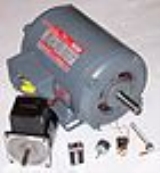
An electric motor converts electrical energy into kinetic energy. The reverse task, that of converting kinetic energy into electrical energy, is accomplished by a generator Electrical generator

An electrical generator is a device that produces electrical [i] energy [i] from a mechanica ... 

 or dynamo. In many cases the two devices differ only in their application and minor construction details, and some applications use a single device to fill both roles. For example, traction motors used on locomotive Locomotive

A locomotive is a railway [i] vehicle [i] that provides the motive power for a train [i] ... 

s often perform both tasks if the locomotive is equipped with dynamic brakes.

Discussions

  Discussion Features

   Ask a question about 'Electric motor'

   Start a new discussion about 'Electric motor'

   Answer questions about 'Electric motor'

   'Electric motor' discussion forum


Encyclopedia


An electric motor converts electrical energy into kinetic energy. The reverse task, that of converting kinetic energy into electrical energy, is accomplished by a generator Electrical generator

An electrical generator is a device that produces electrical [i] energy [i] from a mechanica... 

 or dynamo. In many cases the two devices differ only in their application and minor construction details, and some applications use a single device to fill both roles. For example, traction motors used on locomotive Locomotive

A locomotive is a railway [i] vehicle [i] that provides the motive power for a train [i]... 

s often perform both tasks if the locomotive is equipped with dynamic brakes.

Operation


Most electric motors work by electromagnetism Magnetism

In physics [i], magnetism is one of the phenomena [i] by which materials [i] exert an attractive or repu ... 

, but motors based on other electromechanical phenomena, such as electrostatic forces and the piezoelectric effect Piezoelectricity

Piezoelectricity is the ability of crystal [i]s to generate a voltage [i] in response to applied mechan ... 

, also exist. The fundamental principle upon which electromagnetic motors are based is that there is a mechanical force Lorentz force

In physics [i], the Lorentz force is the force [i] exerted on a charged [i] particle in ... 

 on any current-carrying wire contained within a magnetic field. The force is described by the Lorentz force law Magnetic field

In physics [i], a magnetic field is that part of the electromagnetic field [i] that exists when there is ... 

 and is perpendicular to both the wire and the magnetic field.
Most magnetic motors are rotary, but linear motor Linear motor

A linear motor is essentially an electric motor [i] that has had its stator [i] "unrolled" so that inste ... 

s also exist. In a rotary motor, the rotating part is called the rotor Rotor

Rotor usually refers to the rotating part of a machine such as a motor [i], generator [i] ... 

, and the stationary part is called the stator. The rotor rotates because the wires and magnetic field are arranged so that a torque Torque

In physics [i], torque can informally be thought of as "rotational force". ... 

 is developed about the rotor's axis. The motor contains electromagnet Electromagnet

An electromagnet is a type of magnet [i] in which the magnetic field [i] is produced by a flow of electr ... 

s that are wound on a frame. Though this frame is often called the armature, that term is often erroneously applied. Correctly, the armature is that part of the motor across which the input voltage Voltage

Voltage is the difference of electrical potential [i] between two points of an electrical network [i] ... 

 is supplied. Depending upon the design of the machine, either the rotor or the stator can serve as the armature.

DC motors


One of the first electromagnetic rotary motors was invented by Michael Faraday Michael Faraday

Michael Faraday, FRS [i] was an English [i] chemist [i] and physicist [i] ... 

 in 1821 and consisted of a free-hanging wire dipping into a pool of mercury.
A permanent magnet Magnet

A magnet is an object that has a magnetic field [i]. ... 

 was placed in the middle of the pool of mercury.
When a current Current

Current may refer to:
  • Current affairs [i]

... 

 was passed through the wire, the wire rotated around the magnet, showing that the current gave rise to a circular magnetic field around the wire. This motor is often demonstrated in school physics classes, but brine  is sometimes used in place of the toxic mercury. This is the simplest form of a class of electric motors called homopolar motor Homopolar motor

A homopolar motor is of essentially the same construction as a homopolar generator [i], in general calle ... 

s. A later refinement is the Barlow's Wheel Barlow's Wheel

Barlow's Wheel is the name given to an early demonstration of an electric motor [i], designed and built ... 

.

Another early electric motor design used a reciprocating plunger inside a switched solenoid Solenoid

A solenoid is a loop of wire, often wrapped around a metallic [i] core, which produces a magnetic field [i] ... 

; conceptually it could be viewed as an electromagnetic version of a two stroke internal combustion engine Internal combustion engine

The internal combustion engine is a heat engine [i] in which the burning of a fuel [i] occurs ... 

.

The modern DC motor was invented by accident in 1873, when Zénobe Gramme Zénobe Gramme

Znobe Thophile Gramme was a Belgian [i] electrical engineer [i].
... 

 connected a spinning dynamo to a second similar unit, driving it as a motor.

The classic DC Direct current

Direct current is the constant flow of electrons [i] from low to high potential [i]. ... 

 motor has a rotating armature in the form of an electromagnet.
A rotary switch called a commutator reverses the direction of the electric current twice every cycle, to flow through the armature so that the poles of the electromagnet push and pull against the permanent magnets on the outside of the motor. As the poles of the armature electromagnet pass the poles of the permanent magnets, the commutator reverses the polarity of the armature electromagnet. During that instant of switching polarity, inertia keeps the classical motor going in the proper direction.


Wound field DC motor

The permanent magnets on the outside of a DC motor may be replaced by electromagnets. By varying the field current, it is possible to alter the speed/torque ratio of the motor. Typically the field winding will be placed in series with the armature winding to get a high torque low speed motor, in parallel with the armature to get a high speed low torque motor, or to have a winding partly in parallel, and partly in series for a balance that gives steady speed over a range of loads. Separate excitation is also common, with a fixed field voltage, the speed being controlled by varying the armature voltage. Further reductions in field current are possible to gain even higher speed but correspondingly lower torque, called "weak field" operation.

Theory

If the shaft of a DC motor is turned by an external force, the motor will act like a generator and produce an electric motive force . This voltage is also generated during normal motor operation. The spinning of the motor produces a voltage known as the back EMF because it opposes the applied voltage on the motor. Therefore the voltage drop across a motor consists of the voltage drop due to this back EMF and the parasitic voltage drop resulting from the internal resistance of the armature's windings. The current through a motor is given by the following equation:

The mechanical power produced by the motor is given by:

Since the back EMF is proportional to motor speed, when an electric motor is first started or is completely stalled, there is zero back EMF. Therefore the current through the armature is much higher. This high current will produce a strong electric field which will start the motor spinning. As the motor spins, the back EMF increases until it is equal to the applied voltage minus the parasitic voltage drop. At this point there will be a smaller current flowing through the motor. Basically the following three equations can be used to find the speed, current, and back EMF of a motor under a load:

Speed control

Generally, the rotational speed of a DC motor is proportional to the voltage applied to it, and the torque Torque

In physics [i], torque can informally be thought of as "rotational force". ... 

 is proportional to the current. Speed control can be achieved by variable battery tappings, variable supply voltage, resistors or electronic controls. The direction of a wound field DC motor can be changed by reversing either the field or armature connections but not both. This is commonly done with a special set of contactors Relay

A relay is an electrical switch [i] that opens and closes under control of another electrical circuit. ... 

 .

The effective voltage can be varied by inserting a series resistor or by an electronically controlled switching device made of thyristor Thyristor

The thyristor is a solid-state semiconductor device [i] with four layers of alternating N [i] ... 

s, transistor Transistor

The transistor is a three terminal solid state [i] semiconductor device [i] that can be use ... 

s, or, formerly, mercury arc rectifier Mercury arc valve

A mercury arc valve is a type of electrical rectifier [i] which converts alternating current into direct current [i] ... 

s. In a circuit known as a chopper, the average voltage applied to the motor is varied by switching the supply voltage very rapidly. As the "on" to "off" ratio is varied to alter the average applied voltage, the speed of the motor varies. The percentage "on" time multiplied by the supply voltage gives the average voltage applied to the motor. Therefore, with a 100 V supply and a 25% "on" time, the average voltage at the motor will be 25 V. During the "off" time, the armature's inductance causes the current to continue flowing through a diode called a "flywheel diode", in parallel with the supply. At this point in the cycle, the supply current will be zero, and therefore the average motor current will always be higher than the supply current unless the percentage "on" time is 100%. At 100% "on" time, the supply and motor current are equal. The rapid switching wastes less energy than series resistors. An output filter Electronic filter

Electronic filters are electronic circuit [i]s which perform signal processing [i] functions, specifical ... 

 is sometimes installed to smooth the average voltage applied to the motor and reduce motor noise. This method is also called pulse width modulation, or PWM, and is often controlled by a microprocessor.

Since the series-wound DC motor develops its highest torque at low speed, it is often used in traction applications such as electric locomotive Locomotive

A locomotive is a railway [i] vehicle [i] that provides the motive power for a train [i]... 

s, and tram Tram

A tram, tramcar, trolley, or streetcar, is a railborne [i], lighter than ... 

s. Another application is starter motors for petrol and small diesel engines. Series motors must never be used in applications where the drive can fail . As the motor accelerates, the armature current reduces. The reduction in field causes the motor to speed up until it destroys itself. This can also be a problem with railway motors in the event of a loss of adhesion since, unless quickly brought under control, the motors can reach speeds far higher than they would do under normal circumstances. This can not only cause problems for the motors themselves and the gears, but due to the differential speed between the rails and the wheels it can also cause serious damage to the rails and wheel treads as they heat and cool rapidly. Field weakening is used in some electronic controls to increase the top speed of an electric vehicle. The simplest form uses a contactor and field weakening resistor, the electronic control monitors the motor current and switches the field weakening resistor into circuit when the motor current reduces below a preset value . Once the resistor is in circuit, the motor will increase speed above its normal speed at its rated voltage. When motor current increases, the control will disconnect the resistor and low speed torque is made available.

One interesting method of speed control of a DC motor is the Ward-Leonard control. It is a method of controlling a DC motor and was developed as a method of providing a speed-controlled motor from an AC supply, though it is not without its advantages in DC schemes. The AC supply is used to drive an AC motor, usually an induction motor that drives a DC generator or dynamo. The DC output from the armature is directly connected to the armature of the DC motor . The shunt field windings of both DC machines are excited through a variable resistor from the generator's armature. This variable resistor provides extremely good speed control from standstill to full speed, and consistent torque. This method of control was the de facto method from its development until it was superseded by solid state thyristor Thyristor

The thyristor is a solid-state semiconductor device [i] with four layers of alternating N [i] ... 

 systems. It found service in almost any environment where good speed control was required, from passenger lifts through to large mine pit head winding gear and even industrial process machinery and electric cranes. Its principal disadvantage was that three machines were required to implement a scheme . In many applications, the motor-generator set was often left permanently running, to avoid the delays that would otherwise be caused by starting it up as required. There are numerous legacy Ward-Leonard installations still in service.

Universal motors

A variant of the wound field DC motor is the universal motor. The name derives from the fact that it may use AC or DC supply current, although in practice they are nearly always used with AC supplies. The principle is that in a wound field DC motor the current in both the field and the armature will alternate at the same time, and hence the mechanical force generated is always in the same direction. In practice, the motor must be specially designed to cope with the AC current , and the resultant motor is generally less efficient than an equivalent pure DC motor. Operating at normal power line frequencies, the maximum output of universal motors is limited and motors exceeding one kilowatt are rare. But universal motors also form the basis of the traditional railway traction motor. In this application, to keep their electrical efficiency high, they were operated from very low frequency AC supplies, with 25 Hz and 16 2/3 hertz operation being common. Because they are universal motors, locomotives using this design were also commonly capable of operating from a third rail Third rail

A third rail is a method of providing electricity [i] to power a railway [i], typically a ... 

 powered by DC Direct current

Direct current is the constant flow of electrons [i] from low to high potential [i]. ... 

.

The advantage of the universal motor is that AC supplies may be used on motors which have the typical characteristics of DC motors, specifically high starting torque and very compact design if high running speeds are used. The negative aspect is the maintenance and short life problems caused by the commutator. As a result such motors are usually used in AC devices such as food mixers and power tools which are used only intermittently. Continuous speed control of a universal motor running on AC is very easily accomplished using a thyristor Thyristor

The thyristor is a solid-state semiconductor device [i] with four layers of alternating N [i] ... 

 circuit, while stepped speed control can be accomplished using multiple taps on the field coil. Household blenders that advertise many speeds frequently combine a field coil with several taps and a diode Diode

In electronics [i], a diode is a component [i] that restricts the direction of mov... 

 that can be inserted in series with the motor .

Unlike AC motors, universal motors can easily exceed one revolution per cycle of the mains current. This makes them useful for appliances such as blenders, vacuum cleaner Vacuum cleaner

A vacuum cleaner is a device that uses an air pump [i] to create a partial vacuum [i] to suck [i] up dust [i]... 

s, and hair dryer Blowdryer

A blowdryer is aftfdgfgfn electromechanical [i] device [i] designed to blow cool or hot air [i] over wet ... 

s where high-speed operation is desired. Many vacuum cleaner and weed trimmer motors will exceed 10,000 RPM, Dremel Dremel

Dremel Moto-Tool is the name given to rotary tool [i]s developed by Albert J. ... 

 and other similar miniature grinders will often exceed 30,000 RPM. A theoretical universal motor allowed to operate with no mechanical load will overspeed, which may damage it. In real life, though, various bearing frictions, armature "windage", and the load of any integrated cooling fan all act to prevent overspeed.

With the very low cost of semiconductor Semiconductor

A semiconductor is a material with electrical conductivity [i] that is intermediate between that of an ... 

 rectifier Rectifier

A rectifier is an electrical [i] device [i], comprising one or more semiconductive [i]... 

s, some applications that would have previously used a universal motor now use a pure DC motor, usually with a permanent magnet field. This is especially true if the semiconductor circuit is also used for variable-speed control.

The advantages of the universal motor and alternating-current distribution made installation of a low-frequency traction current Railway electrification system

A railway electrification system is a way of supplying electric power [i] to electric locomotive [i] ... 

 distribution system economical for some railway installations. At low enough frequencies, the motor performance is approximately the same as if the motor were operating on DC. Frequencies as low as 162/3 hertz were employed.

AC motors


In 1882, Nikola Tesla Nikola Tesla

Nikola Tesla he United States [i], Tesla's fame rivaled that of any other inven ... 

 identified the rotating magnetic field Alternator

[i]
[i]
... 

 principle, and pioneered the use of a rotary field of force to operate machines. He exploited the principle to design a unique two-phase induction motor in 1883. In 1885, Galileo Ferraris independently researched the concept. In 1888, Ferraris published his research in a paper to the Royal Academy of Sciences in Turin.

Introduction of Tesla's motor from 1888 onwards initiated what is known as the Second Industrial Revolution, making possible the efficient generation and long distance distribution of electrical energy using the alternating current transmission system, also of Tesla's invention . Before the invention of the rotating magnetic field, motors operated by continually passing a conductor through a stationary magnetic field .

Tesla had suggested that the commutators from a machine could be removed and the device could operate on a rotary field of force. Professor Poeschel, his teacher, stated that would be akin to building a perpetual motion machine Perpetual motion

Perpetual motion refers to a condition in which an object continues to move indefinitely without being d... 

. Tesla would later attain , Electric Motor , which resembles the motor seen in many of Tesla's photos. This classic alternating current electro-magnetic motor was an induction motor.
Stator energy Rotor energy Total energy supplied Power developed
10 90 100 900
50 50 100 2500

In the induction motor, the field and armature were ideally of equal field strengths and the field and armature cores were of equal sizes. The total energy supplied to operate the device equaled the sum of the energy expended in the armature and field coils. The power developed in operation of the device equaled the product of the energy expended in the armature and field coils.

Michail Osipovich Dolivo-Dobrovolsky later invented a three-phase "cage-rotor" in 1890. A successful commercial polyphase system Polyphase system

A polyphase system is a means of distributing [i] alternating current [i] electrical power [i] ... 

 of generation and long-distance transmission was designed by Almerian Decker at Mill Creek No. 1 in Redlands California.

Components and types

A typical AC motor consists of two parts:
  1. An outside stationary stator having coils supplied with AC current to produce a rotating magnetic field, and;
  2. An inside rotor attached to the output shaft that is given a torque by the rotating field.


There are two fundamental types of AC motor, depending on the type of rotor used:
  • The synchronous motor, which rotates exactly at the supply frequency or a submultiple of the supply frequency, and;
  • The induction motor, which turns slightly slower, and typically takes the form of the squirrel cage Squirrel cage rotor

    A squirrel cage rotor is the rotating part commonly used in an AC induction motor [i] ... 

     motor.

Three-phase AC induction motors


Where a polyphase electrical supply is available, the three-phase Three-phase

In electrical engineering [i], three-phase electric power systems have at least three conductors carryin ... 

  AC induction motor is commonly used, especially for higher-powered motors. The phase differences between the three phases of the polyphase electrical supply create a rotating electromagnetic field in the motor.

Through electromagnetic induction, the rotating magnetic field induces a current in the conductors in the rotor, which in turn sets up a counterbalancing magnetic field that causes the rotor to turn in the direction the field is rotating. The rotor must always rotate slower than the rotating magnetic field produced by the polyphase electrical supply; otherwise, no counterbalancing field will be produced in the rotor.

Induction motors are the workhorses of industry and motors up to about 500 kW in output are produced in highly standardized frame sizes, making them nearly completely interchangeable between manufacturers . Very large synchronous motors are capable of tens of thousands of kW in output, for pipeline compressors and wind-tunnel drives.

There are two types of rotors used in induction motors.

Squirrel Cage rotors: Most common AC motors use the squirrel cage rotor Squirrel cage rotor

A squirrel cage rotor is the rotating part commonly used in an AC induction motor [i] ... 

, which will be found in virtually all domestic and light industrial alternating current motors. The squirrel cage takes its name from its shape - a ring at either end of the rotor, with bars connecting the rings running the length of the rotor. It is typically cast aluminum or copper poured between the iron laminates of the rotor, and usually only the end rings will be visible. The vast majority of the rotor currents will flow through the bars rather than the higher-resistance and usually varnished laminates. Very low voltages at very high currents are typical in the bars and end rings; high efficiency motors will often use cast copper in order to reduce the resistance in the rotor.

In operation, the squirrel cage motor may be viewed as a transformer Transformer

A transformer is an electrical device that transfers energy from one circuit [i] to a ... 

 with a rotating secondary - when the rotor is not rotating in sync with the magnetic field, large rotor currents are induced; the large rotor currents magnetize the rotor and interact with the stator's magnetic fields to bring the rotor into synchronization with the stator's field. An unloaded squirrel cage motor at synchronous speed will consume electrical power only to maintain rotor speed against friction and resistance losses; as the mechanical load increases, so will the electrical load - the electrical load is inherently related to the mechanical load. This is similar to a transformer, where the primary's electrical load is related to the secondary's electrical load.

This is why, as an example, a squirrel cage blower motor may cause the lights in a home to dim as it starts, but doesn't dim the lights when its fanbelt is removed. Furthermore, a stalled squirrel cage motor will consume current limited only by circuit resistance as it attempts to start. Unless something else limits the current overheating and destruction of the winding insulation is the likely outcome.

Virtually every washing machine Washing machine

A washing machine is a machine designed to clean laundry [i], such as clothing [i], towel [i]s and sheet [i] ... 

, dishwasher Dishwasher

A Dishwasher is a mechanical device for cleaning food [i] utensil [i]s for preparation, keeping, serving ... 

, standalone fan, record player Phonograph

The phonograph, or gramophone, was the most common device for playing recorded [i] ... 

, etc. uses some variant of a squirrel cage motor.

Wound Rotor: An alternate design, called the wound rotor, is used when variable speed is required. In this case, the rotor has the same number of poles as the stator and the windings are made of wire, connected to slip rings on the shaft. Carbon brushes connect the slip rings to an external controller such as a variable resistor that allows changing the motor's slip rate. In certain high-power variable speed wound-rotor drives, the slip-frequency energy is captured, rectified and returned to the power supply through an inverter.

Compared to squirrel cage rotors, wound rotor motors are expensive and require maintenance of the slip rings and brushes, but they were the standard form for variable speed control before the advent of compact power electronic devices. Transistorized inverters with variable frequency drive can now be used for speed control, and wound rotor motors are becoming less common.

Several methods of starting a polyphase motor are used. Where the large inrush current and high starting torque can be permitted, the motor can be started across the line, by applying full line voltage to the terminals . Where it is necessary to limit the starting inrush current , reduced voltage starting using either series inductors, an autotransformer Transformer

A transformer is an electrical device that transfers energy from one circuit [i] to a ... 

, thyristor Thyristor

The thyristor is a solid-state semiconductor device [i] with four layers of alternating N [i] ... 

s, or other devices are used. A technique sometimes used is star-delta starting, where the motor coils are initially connected in wye for acceleration of the load, then switched to delta when the load is up to speed. This technique is more common in Europe than in North America. Transistorized drives can directly vary the applied voltage as required by the starting characteristics of the motor and load.

This type of motor is becoming more common in traction applications such as locomotives, where it is known as the asynchronous traction motor.

The speed of the AC motor is determined primarily by the frequency of the AC supply and the number of poles in the stator winding, according to the relation:

where
Ns = Synchronous speed, in revolutions per minute
F = AC power frequency
p = Number of poles per phase winding


Actual RPM for an induction motor will be less than this calculated synchronous speed by an amount known as slip, that increases with the torque produced. With no load, the speed will be very close to synchronous. When loaded, standard motors have between 2-3% slip, special motors may have up to 7% slip, and a class of motors known as torque motors are rated to operate at 100% slip .

The slip of the AC motor is calculated by:

where
Nr = Rotational speed, in revolutions per minute.
S = Normalised Slip, 0 to 1.


As an example, a typical four-pole motor running on 60 Hz might have a nameplate rating of 1725 RPM at full load, while its calculated speed is 1800.

The speed in this type of motor has traditionally been altered by having additional sets of coils or poles in the motor that can be switched on and off to change the speed of magnetic field rotation. However, developments in power electronics mean that the frequency of the power supply can also now be varied to provide a smoother control of the motor speed.

Three-phase AC synchronous motors

If connections to the rotor coils of a three-phase motor are taken out on slip-rings and fed a separate field current to create a continuous magnetic field , the result is called a synchronous motor because the rotor will rotate in synchronism with the rotating magnetic field produced by the polyphase electrical supply.

The synchronous motor can also be used as an alternator Alternator

[i]
[i]
... 

.

Nowadays, synchronous motors are frequently driven by transistorized variable frequency drives Variable frequency drive

A Variable Frequency Drive is a system for controlling the rotational speed of an [[alternating current]... 

. This greatly eases the problem of starting the massive rotor of a large synchronous motor. They may also be started as induction motors using a squirrel-cage winding that shares the common rotor: once the motor reaches synchronous speed, no current is induced in the squirrel-cage winding so it has little effect on the synchronous operation of the motor, aside from stabilizing the motor speed on load changes.

Synchronous motors are occasionally used as traction motors; the TGV TGV

he TGV is France [i]'s high-speed rail [i] service, developed by GEC-Alsthom and SNCF [i], the French ... 

 may be the best-known example of such use.

Two-phase AC servo motors


A typical two-phase AC servo motor has a squirrel-cage rotor and a field consisting of two windings: 1) a constant-voltage main winding, and 2) a control-voltage winding in quadrature with the main winding so as to produce a rotating magnetic field. The electrical resistance of the rotor is made high intentionally so that the speed-torque curve is fairly linear. Two-phase servo motors are inherently high-speed, low-torque devices, heavily geared down to drive the load.

Single-phase AC induction motors

Three-phase motors inherently produce a rotating magnetic field. However, when only single-phase power is available, the rotating magnetic field must be produced using other means. Several methods are commonly used.

A common single-phase motor is the shaded-pole motor Shaded-pole motor

[i] [[single phase electric power|single phase]... 

, which is used in devices requiring low torque Torque

In physics [i], torque can informally be thought of as "rotational force". ... 

, such as electric fan Fan (implement)

A fan is a device used to induce airflow [i] and generally made from broad, flat surfaces which revolve ... 

s or other small household appliances. In this motor, small single-turn copper "shading coils" create the moving magnetic field. Part of each pole is encircled by a copper coil or strap; the induced current in the strap opposes the change of flux through the coil , so that the maximum field intensity moves across the pole face on each cycle, thus producing the required rotating magnetic field.

Another common single-phase AC motor is the split-phase induction motor, commonly used in major appliances such as washing machine Washing machine

A washing machine is a machine designed to clean laundry [i], such as clothing [i], towel [i]s and sheet [i] ... 

s and clothes dryer Clothes dryer

A clothes dryer or tumble dryer is a major household appliance that is used to remove the residual... 

s. Compared to the shaded pole motor, these motors can generally provide much greater starting torque by using a special startup winding in conjunction with a centrifugal switch.

In the split-phase motor, the startup winding is designed with a higher resistance Electrical resistance

Electrical resistance is a measure of the degree to which an object opposes the passage of an electric current [i]... 

 than the running winding. This creates an LR circuit RL circuit

A resistor-inductor circuit (RL circuit), or RL filter or RL network, is one of the si... 

 which slightly shifts the phase of the current in the startup winding. When the motor is starting, the startup winding is connected to the power source via a set of spring-loaded contacts pressed upon by the not-yet-rotating centrifugal switch. The starting winding is wound with fewer turns of smaller wire than the main winding, so it has a lower inductance and higher resistance . The lower L/R ratio creates a small phase shift, not more than about 30 degrees, between the flux due to the main winding and the flux of the starting winding. The starting direction of rotation may be reversed simply by exchanging the connections of the startup winding relative to the running winding.

The phase of the magnetic field in this startup winding is shifted from the phase of the mains power, allowing the creation of a moving magnetic field which starts the motor. Once the motor reaches near design operating speed, the centrifugal switch activates, opening the contacts and disconnecting the startup winding from the power source. The motor then operates solely on the running winding. The starting winding must be disconnected since it would increase the losses in the motor.

In a capacitor start motor, a starting capacitor Capacitor

A capacitor is an electric [i]al device that can store energy [i] in the electric field [i] between a pair of ... 

 is inserted in series with the startup winding, creating an LC circuit LC circuit

An LC circuit consists of an inductor [i],, and a capacitor [i]. ... 

 which is capable of a much greater phase shift . The capacitor naturally adds expense to such motors.

Another variation is the Permanent Split-Capacitor motor . This motor operates similarly to the capacitor-start motor described above, but there is no centrifugal starting switch and the second winding is permanently connected to the power source. PSC motors are frequently used in air handlers, fans, and blowers and other cases where a variable speed is desired. By changing taps on the running winding but keeping the load constant, the motor can be made to run at different speeds. Also provided all 6 winding connections are available separately, a 3 phase motor can be converted to a capacitor start and run motor by commoning two of the windings and connecting the third via a capacitor to act as a start winding.

Repulsion motors are wound-rotor single-phase AC motors that are similar to universal motors. In a repulsion motor, the armature brushes are shorted together rather than connected in series with the field. Several types of repulsion motors have been manufactured, but the repulsion-start induction-run motor has been used most frequently. The RS-IR motor has a centrifugal switch that shorts all segments of the commutator so that the motor operates as an induction motor once it has been accelerated to full speed. RS-IR motors have been used to provide high starting torque per ampere under conditions of cold operating temperatures and poor source voltage regulation. Few repulsion motors of any type are sold as of 2006.

Single-phase AC synchronous motors

Small single-phase AC motors can also be designed with magnetized rotors . The rotors in these motors do not require any induced current so they do not slip backward against the mains frequency. Instead, they rotate synchronously with the mains frequency. Because of their highly accurate speed, such motors are usually used to power mechanical clocks, audio turntable Phonograph

The phonograph, or gramophone, was the most common device for playing recorded [i] ... 

s, and tape drive Tape drive

A tape drive, also known as a streamer, is a data storage device [i] that reads ... 

s; formerly they were also much used in accurate timing instruments such as strip-chart recorders or telescope drive mechanisms. The shaded-pole synchronous motor Shaded-pole synchronous motor

Shaded-pole synchronous motors are a class of AC [i] motor [i].
... 

 is one version.

Because inertia makes it difficult to instantly accelerate the rotor from stopped to synchronous speed, these motors normally require some sort of special feature to get started. Various designs use a small induction motor or a very light rotor with a one-way mechanism .

Torque motors


A torque motor is a specialized form of induction motor which is capable of operating indefinitely at stall without damage. In this mode, the motor will apply a steady torque to the load . A common application of a torque motor would be the supply- and take-up reel motors in a tape drive. In this application, driven from a low voltage, the characteristics of these motors allow a relatively-constant light tension to be applied to the tape whether or not the capstan is feeding tape past the tape heads. Driven from a higher voltage, , the torque motors can also achieve fast-forward and rewind operation without requiring any additional mechanics such as gear Gear

Gears or toothed wheels are positive type drives which are used to transmit [i] motion between two shaft ... 

s or clutch Clutch

A clutch is a mechanism for transmitting rotation, which can be engaged and disengaged.
... 

es.

Stepper motors


Closely related in design to three-phase AC synchronous motors are stepper motor Stepper motor

A stepper motor is a brushless, synchronous electric motor [i] that can divide a full rotation into a la ... 

s, where an internal rotor containing permanent magnets or a large iron core with salient poles is controlled by a set of external magnets that are switched electronically. A stepper motor may also be thought of as a cross between a DC electric motor and a solenoid Solenoid

A solenoid is a loop of wire, often wrapped around a metallic [i] core, which produces a magnetic field [i] ... 

. As each coil is energized in turn, the rotor aligns itself with the magnetic field produced by the energized field winding. Unlike a synchronous motor, in its application, the motor may not rotate continuously; instead, it "steps" from one position to the next as field windings are energized and de-energized in sequence. Depending on the sequence, the rotor may turn forwards or backwards.

Simple stepper motor drivers entirely energize or entirely de-energize the field windings, leading the rotor to "cog" to a limited number of positions; more sophisticated drivers can proportionally control the power to the field windings, allowing the rotors to position "between" the "cog" points and thereby rotate extremely smoothly. Computer controlled stepper motors are one of the most versatile forms of positioning systems, particularly when part of a digital servo-controlled Servomechanism

A servomechanism, usually shortened to servo, is a device used to provide mechanical control at a ... 

 system.

Stepper motors can be rotated to a specific angle with ease, and hence stepper motors are used in computer disk drives, where the high precision they offer is necessary for the correct functioning of, for example, a hard disk drive or CD drive.

Permanent magnet motor

A permanent magnet motor is the same as the conventional dc machine except the fact that the field winding is replaced by permanent magnets. By doing this, the machine would act like a constant excitation dc machine .

These motors usually have a small rating, ranging up to a few horsepower. They are used in small appliances, battery operated vehicles, for medical purposes, in other medical equipment such as x-ray machines. These motors are also used in toys, and in automobiles as auxiliary motors for the purposes of seat adjustment, power windows, mirror adjustment and the like.

Brushless DC motors


Many of the limitations of the classic commutator DC motor are due to the need for brushes to press against the commutator. This creates friction. At higher speeds, brushes have increasing difficulty in maintaining contact. Brushes may bounce off the irregularities in the commutator surface, creating sparks. This limits the maximum speed of the machine. The current density per unit area of the brushes limits the output of the motor. The imperfect electric contact also causes electrical noise. Brushes eventually wear out and require replacement, and the commutator itself is subject to wear and maintenance. The commutator assembly on a large machine is a costly element, requiring precision assembly of many parts.

These problems are eliminated in the brushless motor. In this motor, the mechanical "rotating switch" or commutator/brushgear assembly is replaced by an external electronic switch synchronised to the motor's position. Brushless motors are typically 85-90% efficient, whereas DC motors with brushgear are typically 75-80% efficient.

Midway between ordinary DC Direct current

Direct current is the constant flow of electrons [i] from low to high potential [i]. ... 

 motors and stepper motors lies the realm of the brushless DC motor Brushless DC electric motor

A brushless DC motor is an AC synchronous electric motor [i] that from a modeling perspective looks very... 

. Built in a fashion very similar to stepper motors, these often use a permanent magnet external rotor, three phases of driving coils, one or more Hall effect Hall effect

The Hall effect refers to the potential difference [i] on opposite sides of a thin sheet of conducting [i] ... 

 devices to sense the position of the rotor, and the associated drive electronics. The coils are activated, one phase after the other, by the drive electronics as cued by the signals from the Hall effect sensors. In effect, they act as three-phase synchronous motors containing their own variable frequency drive Variable frequency drive

A Variable Frequency Drive is a system for controlling the rotational speed of an [[alternating current]... 

 electronics. A specialized class of brushless DC motor controllers utilize EMF feedback through the main phase connections instead of Hall effect sensors to determine position and velocity. These motors are used extensively in electric radio-controlled Radio control

Radio control is the use of radio [i] signals to remotely control another device. ... 

 vehicles.

Brushless DC motors are commonly used where precise speed control is necessary, computer disk drives or in video cassette recorder Videocassette recorder

The videocassette recorder, is a type of video tape recorder [i] that uses removable videotape [i] casse ... 

s the spindles within CD Compact Disc

Cheddar is a village in the district of Sedgemoor [i] in Somerset [i], England [i], situated on the edge ... 

, CD-ROM CD-ROM

CD-ROM is a compact disc that contains data accessible by a computer.... 

  drives, and mechanisms within office products such as fans, laser printer Laser printer

A laser printer is a common type of computer printer [i] that rapidly produces high quality text and gra ... 

s and photocopier Photocopying

Photocopying is a process which makes paper [i] copies of documents and other visual images quickly and ... 

s. They have several advantages over conventional motors:
  • Compared to AC fans using shaded-pole motors, they are very efficient, running much cooler than the equivalent AC motors. This cool operation leads to much-improved life of the fan's bearings.
  • Without a commutator to wear out, the life of a DC brushless motor can be significantly longer compared to a DC motor using brushes and a commutator. Commutation also tends to cause a great deal of electrical and RF noise; without a commutator or brushes, a brushless motor may be used in electrically sensitive devices like audio equipment or computers.
  • The same Hall effect devices that provide the commutation can also provide a convenient tachometer Tachometer

    A tachometer measures the speed of rotation of a shaft or disk, as in a motor or other machine.... 

     signal for closed-loop control applications. In fans, the tachometer signal can be used to derive a "fan okay" signal.
  • The motor can be easily synchronized to an internal or external clock, leading to precise speed control.
  • Brushed motors cannot be used in the vacuum of space because they will weld themselves into an immovable position.


Modern DC brushless motors range in power from a fraction of a watt to many kilowatts. Larger brushless motors up to about 100 kW rating are used in electric vehicles. They also find significant use in high-performance electric model aircraft.

Coreless DC motors

Nothing in the design of any of the motors described above requires that the iron portions of the rotor actually rotate; torque is exerted only on the windings of the electromagnets. Taking advantage of this fact is the coreless DC motor, a specialized form of a brush DC motor. Optimized for rapid acceleration Acceleration

In physics [i] or physical science, acceleration is defined as the rate of change of velocity [i].... 

, these motors have a rotor that is constructed without any iron core. The rotor can take the form of a winding-filled cylinder inside the stator magnets, a basket surrounding the stator magnets, or a flat pancake running between upper and lower stator magnets. The windings are typically stabilized by being impregnated with epoxy Epoxy

Epoxy or polyepoxide is a thermoset [i]ting epoxide [i] polymer [i] that cures when mixed with a catalyzing [i] ... 

 resins.

Because the rotor is much lighter in weight than a conventional rotor formed from copper Copper

Copper is a chemical element [i] in the periodic table [i] that has the symbol Cu and atomic number [i]... 

 windings on steel Steel

Steel is a metal [i] alloy [i] whose major component is iron [i], with carbon [i] content between 0.02% ... 

 laminations, the rotor can accelerate much more rapidly, often achieving a mechanical time constant under 1 ms. This is especially true if the windings use aluminum Aluminium

Aluminium or aluminum is the chemical element in the periodic table that has the symbol Al ... 

 rather than the heavier copper. But because there is no metal mass in the rotor to act as a heat sink, even small coreless motors must often be cooled by forced air.

These motors were commonly used to drive the capstan of magnetic tape Magnetic tape

Magnetic tape is a non-volatile [i] storage medium [i] consisting of a magnetic coa ... 

 drives and are still widely used in high-performance servo-controlled systems.

Linear motors

A linear motor Linear motor

A linear motor is essentially an electric motor [i] that has had its stator [i] "unrolled" so that inste ... 

 is essentially an electric motor that has been "unrolled" so that, instead of producing a torque Torque

In physics [i], torque can informally be thought of as "rotational force". ... 

 , it produces a linear force along its length by setting up a traveling electromagnetic field.

Linear motors are most commonly induction motors or stepper motors. You can find a linear motor in a maglev Maglev train

Magnetic levitation transport, or maglev, is a form of transportation that suspends, guides and pr... 

  train, where the train "flies" over the ground.

Nano motor


Researchers at University of California, Berkeley University of California, Berkeley

The University of California, Berkeley is the oldest and flagship campus of the ten-campus University of California [i] ... 

, have developed rotational bearings based upon multiwall carbon nanotubes. By attaching a gold plate to the outer shell of a suspended multiwall carbon nanotube , they are able to electrostatically rotate the outer shell relative to the inner core. These bearings are very robust; Devices have been oscillated thousands of times with no indication of wear. The work was done in situ in an SEM Scanning electron microscope

The scanning electron microscope is a type of electron microscope [i] capable of producing high resolut ... 

. These nanoelectromechanical systems are the next step in miniaturization that may find their way into commercial aspects in the future.

Notice: The thin vertical string seen in the middle, is the nanotube to which the rotor is attached. When the outer tube is sheared, the rotor Rotor

Rotor usually refers to the rotating part of a machine such as a motor [i], generator [i] ... 

 is able to spin freely on the nanotube bearing.

The process and technology can be seen in .
  • Electrostatic motor

See also

Components:
  • Centrifugal switch
  • Commutator
  • Slip ring

Scientists and engineers:
  • Ottó Bláthy
  • Thomas A. Edison Thomas Edison

    Thomas Alva Edison was an American [i] inventor [i] and businessman [i] who developed man ... 

  • Zenobe Gramme Zénobe Gramme

    Znobe Thophile Gramme was a Belgian [i] electrical engineer [i].

... 


  • Frank J. Sprague Frank J. Sprague

    Frank Julian Sprague was an American [i] naval officer [i] and inventor [i] who contr ... 

  • Nikola Tesla Nikola Tesla

    Nikola Tesla he United States [i], Tesla's fame rivaled that of any other inven ... 

  • George Westinghouse George Westinghouse

    George Westinghouse, Jr. was an American [i] entrepreneur [i] and engineer [i] ... 


Applications:
  • Table saw Table saw

    A table saw or sawbench is the most common piece of large woodworking equipment.... 

  • Electric vehicle Electric vehicle

    An electric vehicle, or EV, is a vehicle [i] with one or more electric motor [i]s for propulsion. ... 

  • Power factor correction

Other:
  • Electrical engineering Electrical engineering

    Electrical engineering is a professional engineering [i] discipline that deals with the study and appli ... 

  • Electrical element
  • Electrical generator Electrical generator

    An electrical generator is a device that produces electrical [i] energy [i] from a mechanica... 

  • List of electronics topics
  • List of technologies
  • Maximum power theorem Maximum power theorem

    In electrical engineering [i], the maximum power theorem states that to obtain maximum power from a ... 

  • Motor-generator Motor-generator

    A motor-generator is a device for converting electrical power [i] to another form. ... 

  • Motor controller Motor controller

    A motor controller is a device or group of devices that serves to govern in some predetermined manner t... 

  • Propulsion method
  • Single phase electric power Single-phase electric power

    In electrical engineering, single-phase electric power refers to the distribution of electric power [i] ... 

  • Timeline of motor and engine technology

References and further reading

;Citations


;General references
  • Donald G. Fink and H. Wayne Beaty, Standard Handbook for Electrical Engineers, Eleventh Edition, McGraw-Hill, New York, 1978, ISBN 0-07-020974-X.
  • Edwin J. Houston and Arthur Kennelly, Recent Types of Dynamo-Electric Machinery, copyright American Technical Book Company 1897, published by P.F. Collier and Sons New York, 1902


;Further reading
  • Shanefield D. J., Industrial Electronics for Engineers, Chemists, and Technicians, William Andrew Publishing, Norwich, NY, 2001. A self-teaching textbook that briefly covers electric motors, transformers, speed controllers, wiring codes and grounding, transistor Transistor

    The transistor is a three terminal solid state [i] semiconductor device [i] that can be use ... 

    s, digital, etc. Easy to read and understand, up to an elementary level on each subject, not a suitable reference book for technologists already working in any of those fields.
  • Fitzgerald/Kingsley/Kusko , *Electric Machinery, classic text for junior and senior electrical engineering students. Originally published in 1952, 6th edition published in 2002. Authors still listed as Fitzgerald/Kingsley/Umans although Fitzgerald and Kingsley are now deceased.


  • B. R. Pelly, "Thyristor Phase-Controlled Converters and Cycloconverters: Operation, Control, and Performance" .

External articles

  • , explanations with animations from the University of New South Wales.
  • , Kevin S. Brady.