


William Fox Talbot

Encyclopedia
William Henry Fox Talbot (11 February 180017 September 1877) was a British inventor and a pioneer of photography
. He was the inventor of calotype
process, the precursor to most photographic processes of the 19th and 20th centuries. He was also a noted photographer who made major contributions to the development of photography as an artistic medium. His work in the 1840s on photo-mechanical reproduction led to the creation of the photoglyphic engraving process, the precursor to photogravure
. Talbot is also remembered as the holder of a patent
which, some say, affected the early development of commercial photography in Britain. Additionally, he made some important early photographs
of Oxford
, Paris
, and York
.
Talbot was known by his second name Henry, rather than William. It is commonly assumed that "Fox Talbot" is an unhyphenated double-barrelled surname. However, Fox was his mother's maiden name and was not passed on to his children. Some historians have therefore argued that he should be referred to as "Talbot" rather than "Fox Talbot". Nevertheless, although he signed his name as "H.F. Talbot" as well as "H. Fox Talbot", he was most often referred to by his contemporaries, including his mother, as "Mr Fox Talbot" or "Mr H Fox Talbot". "H Fox Talbot" was also the style he chose for his most important publications, including The Pencil of Nature
.
, near Chippenham
, Wiltshire
, and of Lady Elisabeth Fox Strangways, daughter of the 2nd Earl of Ilchester
. Talbot was educated at Rottingdean, Harrow School and at Trinity College, Cambridge
, where he was awarded the Porson prize in Classics in 1820, and graduated as twelfth wrangler in 1821. From 1822 to 1872, he frequently communicated papers to the Royal Society
, many of them on mathematical subjects. At an early period, he had begun his optical researches, which were to have such important results in connection with photography. To the Edinburgh Journal of Science in 1826 he contributed a paper on "Some Experiments on Coloured Flame"; to the Quarterly Journal of Science in 1827 a paper on "Monochromatic Light"; and to the Philosophical Magazine a number of papers on chemical subjects, including one on "Chemical Changes of Colour."
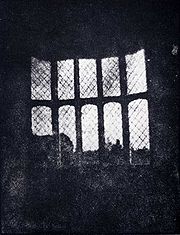 Talbot said he engaged his photographic experiments beginning in early 1834, well before 1839, when Louis Daguerre
exhibited his pictures taken by the sun. After Daguerre's discovery was announced (without details), Talbot showed his five-year-old pictures at the Royal Institution
on 25 January 1839. Within a fortnight, he freely communicated the technical details of his photogenic drawing process to the Royal Society. Daguerre would not reveal the manipulatory details of his process until August. In 1841, Talbot announced his discovery of the calotype
, or talbotype, process. This process reflected the work of many predecessors, most notably John Herschel
and Thomas Wedgwood
. In August 1841, Talbot licensed Henry Collen
, the miniature painter (1798-1879) as the first professional calotypist. Talbot's original contributions included the concept of a negative
from which many positive prints can be made (although the terms negative and positive were coined by Herschel), and the use of gallic acid
for developing the latent image
. In 1842, for his photographic discoveries, which are detailed in his The Pencil of Nature
(1844), he received the Rumford Medal
of the Royal Society.
French government pensioned him to set his invention free to the world (even when William Fox Talbot was selling illegal licenses to British photographers where it was used instead of the Daguerreotype).
In February 1841, Talbot obtained a patent
for the calotype process. At first, he was selling individual patent licences for £20 each, but later he lowered the fee to £4 and waived the payment for those who wished to use the process only as amateurs. Professional photographers, however, had to pay up to £300 annually. In a business climate where many patent holders were attacked for enforcing their rights, Talbot's behaviour was widely criticized, especially after 1851 when Frederick Scott Archer
publicized the collodion process
he had invented. Talbot declared that anyone using Archer's process would still be liable to get a license from Talbot for calotype (Archer himself never obtained a patent for collodion).
One reason Talbot patented the calotype was that he had spent many thousands of pounds (then a fortune) on the development of the calotype process over several years. It is also significant that, although the daguerreotype
process was supposed to be free to the world, Daguerre secured a British patent on his own process making it illegal for people in Britain to practice his process without a license. The purpose behind this patenting in Britain is not clear, but perhaps it was to stop Talbot from claiming priority or developing his system against Daguerre. Talbot's negative/positive process eventually succeeded as the basis for almost all 19th and 20th century photography. The daguerreotype, although stunningly beautiful, was rarely used by photographers after 1860, and had died as a commercial process by 1865.
One person who tried to use the daguerreotype as a method of reproduction without Talbot's process was the English soldier, geologist, inventor and photographer Levett Landon Boscawen Ibbetson
. But as good as Ibbetson's attempts were at producing something like a lithograph from the original daguerrotype, the end result could not compete with Talbot's process. They were simply too expensive. Ibbetson began experimenting with Talbot's calotype, and in 1842 wrote to Talbot "I have been going on with experiments in the Callotype & have had some very good results as to depth of Colour." By 1852, Capt. Ibbetson was showing his book using the Talbot calotype process, called "Le Premier Livre Imprimè par le Soleil" at a London Society of Arts exhibition.
The calotype was a refinement of his earlier photogenic drawing process in the use of a developing agent (gallic acid and silver nitrate) to bring out a latent negative image on the exposed paper. The negative meant that the print could be reproduced as many times as was required. The daguerreotype
was a direct positive process and not reproducible, just as a Polaroid colour photograph where a copy has to be made. On the other hand, the calotype, despite waxing of the negative paper to make the image clearer, still was not pin sharp like the metallic daguerreotype as the paper fibres degraded the image produced.
 The problem was resolved in 1851 (the year of Daguerre's death) when the wet collodion process enabled glass to be used as a support, the lack of detail often found in calotype negatives was removed and pin sharp images, similar in detail to the daguerreotype was created. The wet collodion negative not only brought about the end of the calotype in commercial use, but also spelled the end of the daguerreotype as a common process for portraiture.
In August 1852, The Times
published an open letter by Lord Rosse
, the President of the Royal Society
, and Charles Lock Eastlake
, the president of the Royal Academy
, who called on Talbot to relieve his patent pressure that was perceived as stifling the development of photography. In his response, Talbot agreed to waive licensing fees for amateurs, but he continued to pursue professional portrait photographers, having filed several lawsuits. The cost of the license for anyone wishing to make portraits for sale was £100 for the first year and £150 each subsequent year.
In 1854, Talbot applied for an extension of the 14-year patent, to be expired in 1855. At that time one of his lawsuits, against a photographer Martin Laroche
, was heard by the court. The Talbot v. Laroche
case was the pivotal point of the story. Laroche's side argued that the patent was invalid, as a similar process was invented earlier by Joseph Reade, and that using the collodion process does not infringe the calotype patent anyway because of significant differences between the two processes. In the verdict, the jury upheld the calotype patent but agreed that Laroche was not infringing upon it by using the collodion process. Disappointed by the outcome, Talbot chose not to extend his patent.
 Talbot was active in politics, being a moderate Reformer who generally supported the Whig
Ministers. He served as Member of Parliament
for Chippenham
between 1832 and 1835 when he retired from Parliament. He also held the office of High Sheriff of Wiltshire
in 1840.
Whilst engaged in his scientific researches, he devoted much time to archaeology. He published Hermes, or Classical and Antiquarian Researches (1838-39), and Illustrations of the Antiquity of the Book of Genesis (1839). With Sir Henry Rawlinson and Dr Edward Hincks
he shares the honour of having been one of the first decipherers of the cuneiform inscriptions of Nineveh
. He was also the author of English Etymologies (1846).
In 1843-44, he set up an establishment in Baker Street, Reading
, for the purpose of mass producing salted paper prints from his calotype negatives. The Reading Establishment (as it was known) also produced prints from other calotypist’s negatives and even produced portraits and copy prints at the studio.
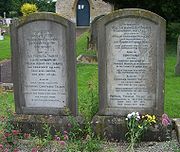
He died in Lacock village aged 77, and is buried along with his wife and children in the churchyard there.
Photography
Photography is the art, science and practice of creating durable images by recording light or other electromagnetic radiation, either electronically by means of an image sensor or chemically by means of a light-sensitive material such as photographic film...
. He was the inventor of calotype
Calotype
Calotype or talbotype is an early photographic process introduced in 1841 by William Henry Fox Talbot, using paper coated with silver iodide. The term calotype comes from the Greek for 'beautiful', and for 'impression'....
process, the precursor to most photographic processes of the 19th and 20th centuries. He was also a noted photographer who made major contributions to the development of photography as an artistic medium. His work in the 1840s on photo-mechanical reproduction led to the creation of the photoglyphic engraving process, the precursor to photogravure
Photogravure
Photogravure is an intaglio printmaking or photo-mechanical process whereby a copper plate is coated with a light-sensitive gelatin tissue which had been exposed to a film positive, and then etched, resulting in a high quality intaglio print that can reproduce the detail and continuous tones of a...
. Talbot is also remembered as the holder of a patent
Patent
A patent is a form of intellectual property. It consists of a set of exclusive rights granted by a sovereign state to an inventor or their assignee for a limited period of time in exchange for the public disclosure of an invention....
which, some say, affected the early development of commercial photography in Britain. Additionally, he made some important early photographs
Early photographers of York
Early photographers of York include:* Edwin F Fox* Bishops* Fox Talbot* William Hayes* Roger Fenton* William Pumphrey* George Fowler Jones architect* W. P. Glaisby* Francis Frith* J. W. Knowles* Joseph Duncan...
of Oxford
Oxford
The city of Oxford is the county town of Oxfordshire, England. The city, made prominent by its medieval university, has a population of just under 165,000, with 153,900 living within the district boundary. It lies about 50 miles north-west of London. The rivers Cherwell and Thames run through...
, Paris
Paris
Paris is the capital and largest city in France, situated on the river Seine, in northern France, at the heart of the Île-de-France region...
, and York
York
York is a walled city, situated at the confluence of the Rivers Ouse and Foss in North Yorkshire, England. The city has a rich heritage and has provided the backdrop to major political events throughout much of its two millennia of existence...
.
Talbot was known by his second name Henry, rather than William. It is commonly assumed that "Fox Talbot" is an unhyphenated double-barrelled surname. However, Fox was his mother's maiden name and was not passed on to his children. Some historians have therefore argued that he should be referred to as "Talbot" rather than "Fox Talbot". Nevertheless, although he signed his name as "H.F. Talbot" as well as "H. Fox Talbot", he was most often referred to by his contemporaries, including his mother, as "Mr Fox Talbot" or "Mr H Fox Talbot". "H Fox Talbot" was also the style he chose for his most important publications, including The Pencil of Nature
The Pencil of Nature
The Pencil of Nature, published in six installments between 1844 and 1846, was the "first photographically illustrated book to be commercially published" or "the first commercially published book illustrated with photographs"...
.
Early life
Talbot was the only child of William Davenport Talbot, of Lacock AbbeyLacock Abbey
Lacock Abbey in the village of Lacock, Wiltshire, England, was founded in the early 13th century by Ela, Countess of Salisbury, as a nunnery of the Augustinian order.- History :...
, near Chippenham
Chippenham
Chippenham may be:* Chippenham, Wiltshire* Chippenham * Chippenham, Cambridgeshire-See also:* Virginia State Route 150, also known as Chippenham Parkway, USA* Cippenham, Berkshire, UK...
, Wiltshire
Wiltshire
Wiltshire is a ceremonial county in South West England. It is landlocked and borders the counties of Dorset, Somerset, Hampshire, Gloucestershire, Oxfordshire and Berkshire. It contains the unitary authority of Swindon and covers...
, and of Lady Elisabeth Fox Strangways, daughter of the 2nd Earl of Ilchester
Henry Fox-Strangways, 2nd Earl of Ilchester
Henry Thomas Fox-Strangways, 2nd Earl of Ilchester , known as Lord Stavordale from 1756 to 1776, was a British peer and Member of Parliament....
. Talbot was educated at Rottingdean, Harrow School and at Trinity College, Cambridge
Trinity College, Cambridge
Trinity College is a constituent college of the University of Cambridge. Trinity has more members than any other college in Cambridge or Oxford, with around 700 undergraduates, 430 graduates, and over 170 Fellows...
, where he was awarded the Porson prize in Classics in 1820, and graduated as twelfth wrangler in 1821. From 1822 to 1872, he frequently communicated papers to the Royal Society
Royal Society
The Royal Society of London for Improving Natural Knowledge, known simply as the Royal Society, is a learned society for science, and is possibly the oldest such society in existence. Founded in November 1660, it was granted a Royal Charter by King Charles II as the "Royal Society of London"...
, many of them on mathematical subjects. At an early period, he had begun his optical researches, which were to have such important results in connection with photography. To the Edinburgh Journal of Science in 1826 he contributed a paper on "Some Experiments on Coloured Flame"; to the Quarterly Journal of Science in 1827 a paper on "Monochromatic Light"; and to the Philosophical Magazine a number of papers on chemical subjects, including one on "Chemical Changes of Colour."
Invention of calotype process
Louis Daguerre
Louis-Jacques-Mandé Daguerre was a French artist and physicist, recognized for his invention of the daguerreotype process of photography.- Biography :...
exhibited his pictures taken by the sun. After Daguerre's discovery was announced (without details), Talbot showed his five-year-old pictures at the Royal Institution
Royal Institution
The Royal Institution of Great Britain is an organization devoted to scientific education and research, based in London.-Overview:...
on 25 January 1839. Within a fortnight, he freely communicated the technical details of his photogenic drawing process to the Royal Society. Daguerre would not reveal the manipulatory details of his process until August. In 1841, Talbot announced his discovery of the calotype
Calotype
Calotype or talbotype is an early photographic process introduced in 1841 by William Henry Fox Talbot, using paper coated with silver iodide. The term calotype comes from the Greek for 'beautiful', and for 'impression'....
, or talbotype, process. This process reflected the work of many predecessors, most notably John Herschel
John Herschel
Sir John Frederick William Herschel, 1st Baronet KH, FRS ,was an English mathematician, astronomer, chemist, and experimental photographer/inventor, who in some years also did valuable botanical work...
and Thomas Wedgwood
Thomas Wedgwood (1771-1805)
Thomas Wedgwood , son of Josiah Wedgwood, the potter, was an early experimenter with Humphry Davy in photography.-Life:...
. In August 1841, Talbot licensed Henry Collen
Henry Collen
Henry Collen was a miniature portrait painter to Queen Victoria and the Duchess of Kent. Later in life he turned to photography and was on the cutting edge in photography in mid-19th century in London...
, the miniature painter (1798-1879) as the first professional calotypist. Talbot's original contributions included the concept of a negative
Negative (photography)
In photography, a negative may refer to three different things, although they are all related.-A negative:Film for 35 mm cameras comes in long narrow strips of chemical-coated plastic or cellulose acetate. As each image is captured by the camera onto the film strip, the film strip advances so that...
from which many positive prints can be made (although the terms negative and positive were coined by Herschel), and the use of gallic acid
Gallic acid
Gallic acid is a trihydroxybenzoic acid, a type of phenolic acid, a type of organic acid, also known as 3,4,5-trihydroxybenzoic acid, found in gallnuts, sumac, witch hazel, tea leaves, oak bark, and other plants. The chemical formula is C6H23COOH. Gallic acid is found both free and as part of...
for developing the latent image
Latent image
A latent image on photographic film is an invisible image produced by the exposure of the film to light. When the film is developed, the area that was exposed darkens and forms a visible image...
. In 1842, for his photographic discoveries, which are detailed in his The Pencil of Nature
The Pencil of Nature
The Pencil of Nature, published in six installments between 1844 and 1846, was the "first photographically illustrated book to be commercially published" or "the first commercially published book illustrated with photographs"...
(1844), he received the Rumford Medal
Rumford Medal
The Rumford Medal is awarded by the Royal Society every alternating year for "an outstandingly important recent discovery in the field of thermal or optical properties of matter made by a scientist working in Europe". First awarded in 1800, it was created after a 1796 donation of $5000 by the...
of the Royal Society.
Patenting controversy
The work on the Daguerre process was taking place at the same time as that of William Fox Talbot in England on the calotype process. To protect his own invention, Daguerre had to register himself the patent for Britain.French government pensioned him to set his invention free to the world (even when William Fox Talbot was selling illegal licenses to British photographers where it was used instead of the Daguerreotype).
In February 1841, Talbot obtained a patent
Patent
A patent is a form of intellectual property. It consists of a set of exclusive rights granted by a sovereign state to an inventor or their assignee for a limited period of time in exchange for the public disclosure of an invention....
for the calotype process. At first, he was selling individual patent licences for £20 each, but later he lowered the fee to £4 and waived the payment for those who wished to use the process only as amateurs. Professional photographers, however, had to pay up to £300 annually. In a business climate where many patent holders were attacked for enforcing their rights, Talbot's behaviour was widely criticized, especially after 1851 when Frederick Scott Archer
Frederick Scott Archer
Frederick Scott Archer invented the photographic collodion process which preceded the modern gelatin emulsion. He was born in Bishop's Stortford in the UK and is remembered mainly for this single achievement which greatly increased the accessibility of photography for the general public.tyler was...
publicized the collodion process
Collodion process
The collodion process is an early photographic process. It was introduced in the 1850s and by the end of that decade it had almost entirely replaced the first practical photographic process, the daguerreotype. During the 1880s the collodion process, in turn, was largely replaced by gelatin dry...
he had invented. Talbot declared that anyone using Archer's process would still be liable to get a license from Talbot for calotype (Archer himself never obtained a patent for collodion).
One reason Talbot patented the calotype was that he had spent many thousands of pounds (then a fortune) on the development of the calotype process over several years. It is also significant that, although the daguerreotype
Daguerreotype
The daguerreotype was the first commercially successful photographic process. The image is a direct positive made in the camera on a silvered copper plate....
process was supposed to be free to the world, Daguerre secured a British patent on his own process making it illegal for people in Britain to practice his process without a license. The purpose behind this patenting in Britain is not clear, but perhaps it was to stop Talbot from claiming priority or developing his system against Daguerre. Talbot's negative/positive process eventually succeeded as the basis for almost all 19th and 20th century photography. The daguerreotype, although stunningly beautiful, was rarely used by photographers after 1860, and had died as a commercial process by 1865.
One person who tried to use the daguerreotype as a method of reproduction without Talbot's process was the English soldier, geologist, inventor and photographer Levett Landon Boscawen Ibbetson
Levett Landon Boscawen Ibbetson
Captain Levett Landon Boscawen Ibbetson was an English 19th century geologist, inventor, organiser and soldier. He is particularly associated with early developments in photography, and was a Fellow of the Royal Society .From his London home , Ibbetson corresponded with William Henry Fox Talbot in...
. But as good as Ibbetson's attempts were at producing something like a lithograph from the original daguerrotype, the end result could not compete with Talbot's process. They were simply too expensive. Ibbetson began experimenting with Talbot's calotype, and in 1842 wrote to Talbot "I have been going on with experiments in the Callotype & have had some very good results as to depth of Colour." By 1852, Capt. Ibbetson was showing his book using the Talbot calotype process, called "Le Premier Livre Imprimè par le Soleil" at a London Society of Arts exhibition.
The calotype was a refinement of his earlier photogenic drawing process in the use of a developing agent (gallic acid and silver nitrate) to bring out a latent negative image on the exposed paper. The negative meant that the print could be reproduced as many times as was required. The daguerreotype
Daguerreotype
The daguerreotype was the first commercially successful photographic process. The image is a direct positive made in the camera on a silvered copper plate....
was a direct positive process and not reproducible, just as a Polaroid colour photograph where a copy has to be made. On the other hand, the calotype, despite waxing of the negative paper to make the image clearer, still was not pin sharp like the metallic daguerreotype as the paper fibres degraded the image produced.
In August 1852, The Times
The Times
The Times is a British daily national newspaper, first published in London in 1785 under the title The Daily Universal Register . The Times and its sister paper The Sunday Times are published by Times Newspapers Limited, a subsidiary since 1981 of News International...
published an open letter by Lord Rosse
William Parsons, 3rd Earl of Rosse
William Parsons, 3rd Earl of Rosse, Knight of the Order of St Patrick was an Irish astronomer who had several telescopes built. His 72-inch telescope "Leviathan", built 1845, was the world's largest telescope until the early 20th century.-Life:He was born in Yorkshire, England, in the city of...
, the President of the Royal Society
Royal Society
The Royal Society of London for Improving Natural Knowledge, known simply as the Royal Society, is a learned society for science, and is possibly the oldest such society in existence. Founded in November 1660, it was granted a Royal Charter by King Charles II as the "Royal Society of London"...
, and Charles Lock Eastlake
Charles Lock Eastlake
Sir Charles Lock Eastlake RA was an English painter, gallery director, collector and writer of the early 19th century.-Early life:...
, the president of the Royal Academy
Royal Academy
The Royal Academy of Arts is an art institution based in Burlington House on Piccadilly, London. The Royal Academy of Arts has a unique position in being an independent, privately funded institution led by eminent artists and architects whose purpose is to promote the creation, enjoyment and...
, who called on Talbot to relieve his patent pressure that was perceived as stifling the development of photography. In his response, Talbot agreed to waive licensing fees for amateurs, but he continued to pursue professional portrait photographers, having filed several lawsuits. The cost of the license for anyone wishing to make portraits for sale was £100 for the first year and £150 each subsequent year.
In 1854, Talbot applied for an extension of the 14-year patent, to be expired in 1855. At that time one of his lawsuits, against a photographer Martin Laroche
Martin Laroche
Martin Laroche, born William Henry Silvester, was an early English professional photographer who successfully challenged William Fox Talbot's patent on the calotype and effected a liberalisation in professional practice, research and development that catalysed the development of photography in the...
, was heard by the court. The Talbot v. Laroche
Talbot v. Laroche
Talbot v. Laroche was a 1854 legal action, pivotal to the history of photography, by which William Fox Talbot sought to assert that Martin Laroche's use of the, unpatented, collodion process infringed his calotype patent.-Background:...
case was the pivotal point of the story. Laroche's side argued that the patent was invalid, as a similar process was invented earlier by Joseph Reade, and that using the collodion process does not infringe the calotype patent anyway because of significant differences between the two processes. In the verdict, the jury upheld the calotype patent but agreed that Laroche was not infringing upon it by using the collodion process. Disappointed by the outcome, Talbot chose not to extend his patent.
Other activities
British Whig Party
The Whigs were a party in the Parliament of England, Parliament of Great Britain, and Parliament of the United Kingdom, who contested power with the rival Tories from the 1680s to the 1850s. The Whigs' origin lay in constitutional monarchism and opposition to absolute rule...
Ministers. He served as Member of Parliament
Member of Parliament
A Member of Parliament is a representative of the voters to a :parliament. In many countries with bicameral parliaments, the term applies specifically to members of the lower house, as upper houses often have a different title, such as senate, and thus also have different titles for its members,...
for Chippenham
Chippenham (UK Parliament constituency)
Chippenham is a parliamentary constituency, abolished in 1983 but recreated in 2010, and represented in the House of Commons of the Parliament of the United Kingdom. It elects one Member of Parliament by the first past the post system of election...
between 1832 and 1835 when he retired from Parliament. He also held the office of High Sheriff of Wiltshire
High Sheriff of Wiltshire
This is a list of High Sheriffs of Wiltshire.Until the 14th century the shrievalty was held ex officio by the castellans of Old Sarum.-To 1400:*1066: Edric*1067-1070: Philippe de Buckland*1085: Aiulphus the Sheriff*1070–1105: Edward of Salisbury...
in 1840.
Whilst engaged in his scientific researches, he devoted much time to archaeology. He published Hermes, or Classical and Antiquarian Researches (1838-39), and Illustrations of the Antiquity of the Book of Genesis (1839). With Sir Henry Rawlinson and Dr Edward Hincks
Edward Hincks
The Reverend Edward Hincks was an Irish clergyman, best remembered as an Assyriologist and one of the decipherers of Mesopotamian cuneiform....
he shares the honour of having been one of the first decipherers of the cuneiform inscriptions of Nineveh
Nineveh
Nineveh was an ancient Assyrian city on the eastern bank of the Tigris River, and capital of the Neo Assyrian Empire. Its ruins are across the river from the modern-day major city of Mosul, in the Ninawa Governorate of Iraq....
. He was also the author of English Etymologies (1846).
In 1843-44, he set up an establishment in Baker Street, Reading
Reading, Berkshire
Reading is a large town and unitary authority area in England. It is located in the Thames Valley at the confluence of the River Thames and River Kennet, and on both the Great Western Main Line railway and the M4 motorway, some west of London....
, for the purpose of mass producing salted paper prints from his calotype negatives. The Reading Establishment (as it was known) also produced prints from other calotypist’s negatives and even produced portraits and copy prints at the studio.
He died in Lacock village aged 77, and is buried along with his wife and children in the churchyard there.
External links
- The Fox Talbot Museum
- The correspondence of William Henry Fox Talbot
- `Talbot' vs. `Fox Talbot'
- The Calotype Patent Lawsuit of Talbot v. Laroche, 1854, by R. D. Wood
- Talbot and Photogenic Drawing
- Talbot materials in the Digital Collections of the Sterling and Francine Clark Art Institute, Williamstown, Mass.