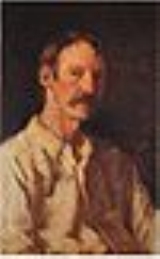
Robert Louis Balfour Stevenson (13 November 1850 – 3 December 1894) was a
ScottishThe Scottish people , or Scots, are a nation and ethnic group native to Scotland. Historically they emerged from an amalgamation of the Picts and Gaels, incorporating neighbouring Britons to the south as well as invading Germanic peoples such as the Anglo-Saxons and the Norse.In modern use,...
novelist, poet, essayist and
travel writerTravel writing is a genre that has, as its focus, accounts of real or imaginary places. The genre encompasses a number of styles that may range from the documentary to the evocative, from literary to journalistic, and from the humorous to the serious....
. His best-known books include
Treasure IslandTreasure Island is an adventure novel by Scottish author Robert Louis Stevenson, narrating a tale of "pirates and buried gold". First published as a book on May 23, 1883, it was originally serialized in the children's magazine Young Folks between 1881–82 under the title Treasure Island; or, the...
,
KidnappedKidnapped is a historical fiction adventure novel by the Scottish author Robert Louis Stevenson. Written as a "boys' novel" and first published in the magazine Young Folks from May to July 1886, the novel has attracted the praise and admiration of writers as diverse as Henry James, Jorge Luis...
, and
Strange Case of Dr Jekyll and Mr Hyde.
A literary celebrity during his lifetime, Stevenson now ranks among the 26 most translated authors in the world.
He has been greatly admired by many authors, including
Jorge Luis BorgesJorge Francisco Isidoro Luis Borges Acevedo , known as Jorge Luis Borges , was an Argentine writer, essayist, poet and translator born in Buenos Aires. In 1914 his family moved to Switzerland where he attended school, receiving his baccalauréat from the Collège de Genève in 1918. The family...
,
Ernest HemingwayErnest Miller Hemingway was an American author and journalist. His economic and understated style had a strong influence on 20th-century fiction, while his life of adventure and his public image influenced later generations. Hemingway produced most of his work between the mid-1920s and the...
,
Rudyard KiplingJoseph Rudyard Kipling was an English poet, short-story writer, and novelist chiefly remembered for his celebration of British imperialism, tales and poems of British soldiers in India, and his tales for children. Kipling received the 1907 Nobel Prize for Literature...
,
Marcel Schwob Marcel Schwob was a Jewish French writer.-Biography:He was born in Chaville, Hauts-de-Seine on 23 August 1867...
,
Vladimir NabokovVladimir Vladimirovich Nabokov was a multilingual Russian novelist and short story writer. Nabokov wrote his first nine novels in Russian, then rose to international prominence as a master English prose stylist...
,
J. M. BarrieSir James Matthew Barrie, 1st Baronet, OM was a Scottish author and dramatist, best remembered today as the creator of Peter Pan. The child of a family of small-town weavers, he was educated in Scotland. He moved to London, where he developed a career as a novelist and playwright...
, and
G. K. ChestertonGilbert Keith Chesterton, KC*SG was an English writer. His prolific and diverse output included philosophy, ontology, poetry, plays, journalism, public lectures and debates, literary and art criticism, biography, Christian apologetics, and fiction, including fantasy and detective fiction....
, who said of him that he "seemed to pick the right word up on the point of his pen, like a man playing spillikins."
Childhood
Stevenson was born Robert Lewis Balfour Stevenson at 8 Howard Place,
EdinburghEdinburgh is the capital city of Scotland, the second largest city in Scotland, and the eighth most populous in the United Kingdom. The City of Edinburgh Council governs one of Scotland's 32 local government council areas. The council area includes urban Edinburgh and a rural area...
, Scotland, on 13 November 1850, to
Thomas StevensonThomas Stevenson PRSE MInstCE FRSSA FSAScot was a pioneering Scottish lighthouse designer and meteorologist, who designed over thirty lighthouses in and around Scotland, as well as the Stevenson screen used in meteorology...
(1818–1887), a leading
lighthouseA lighthouse is a tower, building, or other type of structure designed to emit light from a system of lamps and lenses or, in older times, from a fire, and used as an aid to navigation for maritime pilots at sea or on inland waterways....
engineerAn engineer is a professional practitioner of engineering, concerned with applying scientific knowledge, mathematics and ingenuity to develop solutions for technical problems. Engineers design materials, structures, machines and systems while considering the limitations imposed by practicality,...
, and his wife, the former Margaret Isabella Balfour (1829–1897). Lighthouse design was the family profession: Thomas's own father (Robert's grandfather) was the famous

Robert StevensonRobert Stevenson FRSE MInstCE FSAS MWS FGS FRAS FSA was a Scottish civil engineer and famed designer and builder of lighthouses.One of his finest achievements was the construction of the Bell Rock Lighthouse.-Early life:...
, and his maternal grandfather,
Thomas SmithThomas Smith was a Scottish businessman and early lighthouse engineer. Born in Broughty Ferry, Dundee, his father drowned in Dundee harbour when he was young...
, and brothers
AlanAlan Stevenson FRSE MInstCE was a Scottish lighthouse engineer who was Engineer to the Board of Northern Lighthouses...
and
DavidDavid Stevenson FRSE FRSSA was a Scottish lighthouse designer, who designed over thirty lighthouses in and around Scotland, and helped found a great dynasty of lighthouse engineering.-Background:...
were also among those in the business. On Margaret's side, the family were gentry, tracing their name back to an Alexander Balfour, who held the lands of Inchrye in
FifeFife is a council area and former county of Scotland. It is situated between the Firth of Tay and the Firth of Forth, with inland boundaries to Perth and Kinross and Clackmannanshire...
in the fifteenth century. Her father, Lewis Balfour (1777–1860), was a minister of the
Church of ScotlandThe Church of Scotland, known informally by its Scots language name, the Kirk, is a Presbyterian church, decisively shaped by the Scottish Reformation....
at nearby
ColintonColinton is a suburb of Edinburgh, Scotland situated 6 kilometres south west of the city centre. It is bordered by Dreghorn to the south and Craiglockhart to the north-east. To the north-west it extends to Lanark Road and to the south-west to the City Bypass...
, and Stevenson spent the greater part of his boyhood holidays in his house. "Now I often wonder", wrote Stevenson, "what I inherited from this old minister. I must suppose, indeed, that he was fond of preaching
sermonA sermon is an oration by a prophet or member of the clergy. Sermons address a Biblical, theological, religious, or moral topic, usually expounding on a type of belief, law or behavior within both past and present contexts...
s, and so am I, though I never heard it maintained that either of us loved to hear them."
Lewis Balfour and his daughter both had a "weak chest" and often needed to stay in warmer climates for their health. Stevenson inherited a tendency to coughs and fevers, exacerbated when the family moved to a damp and chilly house at 1 Inverleith Terrace in 1851. The family moved again to the sunnier 17 Heriot Row when Stevenson was six, but the tendency to extreme sickness in winter remained with him until he was eleven. Illness would be a recurrent feature of his adult life and left him extraordinarily thin. Contemporary views were that he had
tuberculosisTuberculosis, MTB, or TB is a common, and in many cases lethal, infectious disease caused by various strains of mycobacteria, usually Mycobacterium tuberculosis. Tuberculosis usually attacks the lungs but can also affect other parts of the body...
, but more recent views are that it was
bronchiectasisBronchiectasis is a disease state defined by localized, irreversible dilation of part of the bronchial tree caused by destruction of the muscle and elastic tissue. It is classified as an obstructive lung disease, along with emphysema, bronchitis, asthma, and cystic fibrosis...
or even
sarcoidosisSarcoidosis , also called sarcoid, Besnier-Boeck disease or Besnier-Boeck-Schaumann disease, is a disease in which abnormal collections of chronic inflammatory cells form as nodules in multiple organs. The cause of sarcoidosis is unknown...
.
Stevenson's parents were both devout and serious Presbyterians, but the household was not strict in its adherence to Calvinist principles. His nurse, Alison Cunningham (known as Cummy), was more fervently religious. Her
CalvinismCalvinism is a Protestant theological system and an approach to the Christian life...
and folk beliefs were an early source of nightmares for the child, and he showed a precocious concern for religion. But she also cared for him tenderly in illness, reading to him from
BunyanJohn Bunyan was an English Christian writer and preacher, famous for writing The Pilgrim's Progress. Though he was a Reformed Baptist, in the Church of England he is remembered with a Lesser Festival on 30 August, and on the liturgical calendar of the Episcopal Church on 29 August.-Life:In 1628,...
and the
BibleThe Bible refers to any one of the collections of the primary religious texts of Judaism and Christianity. There is no common version of the Bible, as the individual books , their contents and their order vary among denominations...
as he lay sick in bed and telling tales of the
CovenanterThe Covenanters were a Scottish Presbyterian movement that played an important part in the history of Scotland, and to a lesser extent in that of England and Ireland, during the 17th century...
s. Stevenson recalled this time of sickness in "The Land of Counterpane" in
A Child's Garden of VersesA Child's Garden of Verses is a collection of poetry for children by the Scottish author Robert Louis Stevenson. The collection first appeared in 1885 under the title Penny Whistles, but has been reprinted many times, often in illustrated versions...
(1885), and dedicated the book to his nurse.
An only child, strange-looking and eccentric, Stevenson found it hard to fit in when he was sent to a nearby school at age six, a problem repeated at age eleven when he went on to the
Edinburgh AcademyThe Edinburgh Academy is an independent school which was opened in 1824. The original building, in Henderson Row on the northern fringe of the New Town of Edinburgh, Scotland, is now part of the Senior School...
; but he mixed well in lively games with his cousins in summer holidays at
ColintonColinton is a suburb of Edinburgh, Scotland situated 6 kilometres south west of the city centre. It is bordered by Dreghorn to the south and Craiglockhart to the north-east. To the north-west it extends to Lanark Road and to the south-west to the City Bypass...
. In any case, his frequent illnesses often kept him away from his first school, and he was taught for long stretches by private tutors. He was a late reader, first learning at age seven or eight, but even before this he dictated stories to his mother and nurse. He compulsively wrote stories throughout his childhood. His father was proud of this interest; he had also written stories in his spare time until his own father found them and told him to "give up such nonsense and mind your business." He paid for the printing of Robert's first publication at sixteen, an account of the covenanters' rebellion which was published on its two hundredth anniversary,
The Pentland Rising: a Page of History, 1666 (1866).
In November 1867 Stevenson entered the
University of EdinburghThe University of Edinburgh, founded in 1583, is a public research university located in Edinburgh, the capital of Scotland, and a UNESCO World Heritage Site. The university is deeply embedded in the fabric of the city, with many of the buildings in the historic Old Town belonging to the university...
to study engineering. He showed from the start no enthusiasm for his studies and devoted much energy to avoiding lectures. This time was more important for the friendships he made with other students in the
Speculative SocietyThe Speculative Society is a Scottish Enlightenment society dedicated to public speaking and literary composition. The Society is mainly, but not exclusively, a university student organisation....
(an exclusive debating club), particularly with Charles Baxter, who would become Stevenson's financial agent, and with a professor,
Fleeming JenkinHenry Charles Fleeming Jenkin was Professor of Engineering at the University of Edinburgh, remarkable for his versatility. Known to the world as the inventor of telpherage, he was an electrician and cable engineer, economist, lecturer, linguist, critic, actor, dramatist and artist...
, whose house staged amateur drama in which Stevenson took part, and whose biography he would later write. Perhaps most important at this point in his life was a cousin, Robert Alan Mowbray Stevenson (known as "Bob"), a lively and light-hearted young man who instead of the family profession had chosen to study art. Each year during vacations, Stevenson travelled to inspect the family's engineering works—to
AnstrutherAnstruther is a small town in Fife, Scotland. The two halves of Anstruther are divided by a small stream called Dreel Burn. Anstruther lies 9 miles south-southeast of St Andrews. It is the largest community on the stretch of north-shore coastline of the Firth of Forth known as the East Neuk,...
and
WickWick is an estuary town and a royal burgh in the north of the Highland council area of Scotland. Historically, it is one of two burghs within the county of Caithness, of which Wick was the county town. The town straddles the River Wick and extends along both sides of Wick Bay...
in 1868, with his father on his official tour of Orkney and Shetland islands lighthouses in 1869, and for three weeks to the island of
ErraidThe Isle of Erraid is a tidal island approximately one mile square in area located in the Inner Hebrides of Scotland. It lies west of Mull and southeast of Iona. The island receives about of rain and 1,350 hours of sunshine annually, making it one of the driest and sunniest places on the western...
in 1870. He enjoyed the travels more for the material they gave for his writing than for any engineering interest. The voyage with his father pleased him because a similar journey of
Walter ScottSir Walter Scott, 1st Baronet was a Scottish historical novelist, playwright, and poet, popular throughout much of the world during his time....
with Robert Stevenson had provided the inspiration for Scott's 1821 novel
The PirateThe Pirate is a novel by Walter Scott, based roughly on the life of John Gow who features as Captain Cleveland. The setting is the southern tip of the main island of Shetland , around 1700...
. In April 1871 Stevenson notified his father of his decision to pursue a life of letters. Though the elder Stevenson was naturally disappointed, the surprise cannot have been great, and Stevenson's mother reported that he was "wonderfully resigned" to his son's choice. To provide some security, it was agreed that Stevenson should read
LawLaw is a system of rules and guidelines which are enforced through social institutions to govern behavior, wherever possible. It shapes politics, economics and society in numerous ways and serves as a social mediator of relations between people. Contract law regulates everything from buying a bus...
(again at Edinburgh University) and be called to the Scottish bar. In his 1887 poetry collection
Underwoods, Stevenson muses his turning from the Family Profession:
Say not of me that weakly I declined
The labours of my sires, and fled the sea,
The towers we founded and the lamps we lit,
But rather say: In the afternoon of time
A strenuous family dusted from its hands
The sand of granite, and beholding far
Along the sounding coast its pyramids
And tall memorials catch the dying sun,
Smiled well content, and to this childish task
Around the fire addressed its evening hours.
In other respects too, Stevenson was moving away from his upbringing. His dress became more
BohemianBohemianism is the practice of an unconventional lifestyle, often in the company of like-minded people, with few permanent ties, involving musical, artistic or literary pursuits...
; he already wore his hair long, but he now took to wearing a velveteen jacket and rarely attended parties in conventional evening dress. Within the limits of a strict allowance, he visited cheap pubs and brothels. More importantly, he had come to reject Christianity. In January 1873 his father came across the constitution of the LJR (Liberty, Justice, Reverence) Club, of which Stevenson and his cousin Bob were members, which began: "Disregard everything our parents have taught us." Questioning his son about his beliefs, he discovered the truth, leading to a long period of dissension with both parents:
What a damned curse I am to my parents! As my father said "You have rendered my whole life a failure". As my mother said "This is the heaviest affliction that has ever befallen me". O Lord, what a pleasant thing it is to have damned the happiness of (probably) the only two people who care a damn about you in the world.
Early writing and travels
In late 1873, on a visit to a cousin in England, Stevenson met two people who were to be of great importance to him,
Sidney ColvinSidney Colvin was an English curator and literary and art critic, part of the illustrious Anglo-Indian Colvin family. He is primarily remembered for his friendship with Robert Louis Stevenson.-Biography:...
and Fanny (Frances Jane) Sitwell. Sitwell was a 34-year-old woman with a son, separated from her husband. She attracted the devotion of many who met her, including Colvin, who eventually married her in 1901. Stevenson was also drawn to her, and over several years they kept up a heated correspondence in which Stevenson wavered between the role of a suitor and a son (he came to address her as "Madonna"). Colvin became Stevenson's literary adviser and after his death was the first editor of Stevenson's letters. Soon after their first meeting, he had placed Stevenson's first paid contribution, an essay entitled "Roads," in
The Portfolio. Stevenson was soon active in London literary life, becoming acquainted with many of the writers of the time, including
Andrew LangAndrew Lang was a Scots poet, novelist, literary critic, and contributor to the field of anthropology. He is best known as a collector of folk and fairy tales. The Andrew Lang lectures at the University of St Andrews are named after him.- Biography :Lang was born in Selkirk...
,
Edmund GosseSir Edmund William Gosse CB was an English poet, author and critic; the son of Philip Henry Gosse and Emily Bowes.-Early life:...
, and
Leslie StephenSir Leslie Stephen, KCB was an English author, critic and mountaineer, and the father of Virginia Woolf and Vanessa Bell.-Life:...
, the editor of the
Cornhill MagazineThe Cornhill Magazine was a Victorian magazine and literary journal named after Cornhill Street in London.Cornhill was founded by George Murray Smith in 1860 and was published until 1975. It was a literary journal with a selection of articles on diverse subjects and serialisations of new novels...
, who took an interest in Stevenson's work. Stephen in turn would introduce him to a more important friend. Visiting Edinburgh in 1875, he took Stevenson with him to visit a patient at the Edinburgh Infirmary,
William Ernest HenleyWilliam Ernest Henley was an English poet, critic and editor, best remembered for his 1875 poem "Invictus".-Life and career:...
. Henley, an energetic and talkative man with a wooden leg, became a close friend and occasional literary collaborator, until a quarrel broke up the friendship in 1888. Henley is often seen as the model for Long John Silver in
Treasure Island.
In November 1873 Stevenson's health failed, and he was sent to
MentonMenton is a commune in the Alpes-Maritimes department in the Provence-Alpes-Côte d'Azur region in southeastern France.Situated on the French Riviera, along the Franco-Italian border, it is nicknamed la perle de la France ....
on the
French RivieraThe Côte d'Azur, pronounced , often known in English as the French Riviera , is the Mediterranean coastline of the southeast corner of France, also including the sovereign state of Monaco...
to recuperate. He returned in better health in April 1874 and settled down to his studies, but he returned to France several times after that. He made long and frequent trips to the neighbourhood of the
Forest of FontainebleauThe forest of Fontainebleau is a mixed deciduous forest lying sixty kilometres southeast of Paris, France. It is located primarily in the arrondissement of Fontainebleau in the southwestern part of the department of Seine-et-Marne...
, staying at
BarbizonBarbizon is a commune in the Seine-et-Marne department in north-central France. It is located near the Fontainebleau Forest.-Art history:The Barbizon school of painters is named after the village; Théodore Rousseau and Jean-François Millet, leaders of the school, made their homes and died in the...
,
Grez-sur-LoingGrez-sur-Loing is a commune in the Seine-et-Marne department in north-central France.-People:It is located 70 km south of Paris and is notable for the artists and musicians who have lived or stayed there...
, and
NemoursNemours is a commune in the Seine-et-Marne department in the Île-de-France region in north-central France.-Geography:Nemours is located on the Loing and its canal, c...
and becoming a member of the artists' colonies there, as well as to Paris to visit galleries and the theatres. He did qualify for the Scottish bar in July 1875, and his father added a brass plate with "R.L. Stevenson, Advocate" to the Heriot Row house. But although his law studies would influence his books, he never practised law. All his energies were now spent in travel and writing. One of his journeys, a canoe voyage in Belgium and France with Sir Walter Simpson, a friend from the Speculative Society and frequent travel companion, was the basis of his first real book,
An Inland VoyageAn Inland Voyage is a travelogue by Robert Louis Stevenson about a canoeing trip through France and Belgium in 1876. It is Stevenson's earliest book and a pioneering work of outdoor literature....
(1878).
Marriage
The canoe voyage with Simpson brought Stevenson to Grez in September 1876, and here he first met Fanny Van de Grift Osbourne (1840–1914). Born in
IndianapolisIndianapolis is the capital of the U.S. state of Indiana, and the county seat of Marion County, Indiana. As of the 2010 United States Census, the city's population is 839,489. It is by far Indiana's largest city and, as of the 2010 U.S...
, she had married at age seventeen and moved to Nevada to rejoin husband Samuel after his participation in the
American Civil WarThe American Civil War was a civil war fought in the United States of America. In response to the election of Abraham Lincoln as President of the United States, 11 southern slave states declared their secession from the United States and formed the Confederate States of America ; the other 25...
. That marriage produced three children:
IsobelIsobel "Belle" Osbourne Strong Field was Robert Louis Stevenson's step-daughter and sister of Lloyd Osbourne. She was born in Indianapolis to Samuel and Fanny Van de Grift Osbourne....
(or "Belle");
LloydSamuel Lloyd Osbourne was an American author and the stepson of Scottish author Robert Louis Stevenson with whom he would co-author three books and provide input and ideas on others.-Early life:...
; and Hervey (who died in 1875). But anger over her husband's infidelities led to a number of separations and in 1875 she had taken her children to France, where she and Isobel studied art. Although Stevenson returned to Britain shortly after this first meeting, Fanny apparently remained in his thoughts, and he wrote an essay, "On falling in love," for the
Cornhill Magazine. They met again early in 1877 and became lovers. Stevenson spent much of the following year with her and her children in France. In August 1878 Fanny returned to San Francisco, California. Stevenson at first remained in Europe, making the walking trip that would form the basis for
Travels with a Donkey in the CévennesTravels with a Donkey in the Cévennes is one of Robert Louis Stevenson's earliest published works and is considered a pioneering classic of outdoor literature.-Background:...
(1879). But in August 1879 he set off to join her, against the advice of his friends and without notifying his parents. He took second-class passage on the steamship
Devonia, in part to save money but also to learn how others travelled and to increase the adventure of the journey. From New York City he travelled overland by train to California. He later wrote about the experience in
The Amateur EmigrantThe Amateur Emigrant is Robert Louis Stevenson's travel memoir of his journey from Scotland to California in 1879-1880. It is not a complete account, covering the first third, by ship from Europe to New York City...
. Although it was good experience for his literature, it broke his health, and he was near death when he arrived in
Monterey, CaliforniaThe City of Monterey in Monterey County is located on Monterey Bay along the Pacific coast in Central California. Monterey lies at an elevation of 26 feet above sea level. As of the 2010 census, the city population was 27,810. Monterey is of historical importance because it was the capital of...
, where some local
ranchersA ranch is an area of landscape, including various structures, given primarily to the practice of ranching, the practice of raising grazing livestock such as cattle or sheep for meat or wool. The word most often applies to livestock-raising operations in the western United States and Canada, though...
nursed him back to health.
By December 1879 Stevenson had recovered his health enough to continue to San Francisco, where for several months he struggled "all alone on forty-five cents a day, and sometimes less, with quantities of hard work and many heavy thoughts," in an effort to support himself through his writing, but by the end of the winter his health was broken again and he found himself at death's door. Fanny, now divorced and recovered from her own illness, came to Stevenson's bedside and nursed him to recovery. "After a while," he wrote, "my spirit got up again in a divine frenzy, and has since kicked and spurred my vile body forward with great emphasis and success." When his father heard of his condition, he cabled him money to help him through this period.
Fanny and Robert were married in May 1880, although, as he said, he was "a mere complication of cough and bones, much fitter for an emblem of mortality than a bridegroom." With his new wife and her son, Lloyd, he travelled north of San Francisco to
Napa ValleyNapa County is a county located north of the San Francisco Bay Area in the U.S. state of California. It is coterminous with the Napa, California, Metropolitan Statistical Area. As of 2010 the population is 136,484. The county seat is Napa....
, and spent a summer
honeymoon-History:One early reference to a honeymoon is in Deuteronomy 24:5 “When a man is newly wed, he need not go out on a military expedition, nor shall any public duty be imposed on him...
at an abandoned mining camp on
Mount Saint HelenaMount Saint Helena is a peak in the Mayacamas Mountains with flanks in Napa, Sonoma, and Lake counties of California. Composed of uplifted 2.4-million-year-old volcanic rocks from the Clear Lake Volcanic Field, it is one of the few mountains in the San Francisco Bay Area to receive any snowfall...
. He wrote about this experience in
The Silverado SquattersThe Silverado Squatters is Robert Louis Stevenson's travel memoir of his two-month honeymoon trip with Fanny Vandegrift to Napa Valley, California in the late spring and early summer of 1880....
. He met
Charles Warren StoddardCharles Warren Stoddard was an American author and editor.-Life and works:Charles Warren Stoddard was born in Rochester, New York on August 7, 1843. He was descended in a direct line from Anthony Stoddard of England, who settled at Boston, Massachusetts, in 1639...
, co-editor of the
Overland MonthlyOverland Monthly was a monthly magazine based in California, United States, and published in the 19th and 20th century.The magazine's first issue was in July 1868, and continued until the late 1875. The original publishers, in 1880, started The Californian, which became The Californian and Overland...
and author of
South Sea Idylls, who urged Stevenson to travel to the South Pacific, an idea which would return to him many years later. In August 1880 he sailed with Fanny and Lloyd from New York to Britain and found his parents and his friend
Sidney ColvinSidney Colvin was an English curator and literary and art critic, part of the illustrious Anglo-Indian Colvin family. He is primarily remembered for his friendship with Robert Louis Stevenson.-Biography:...
on the wharf at
LiverpoolLiverpool is a city and metropolitan borough of Merseyside, England, along the eastern side of the Mersey Estuary. It was founded as a borough in 1207 and was granted city status in 1880...
, happy to see him return home. Gradually, his new wife was able to patch up differences between father and son and make herself a part of the new family through her charm and wit.
Attempted settlement in Europe and the U.S.
For the next seven years, between 1880 and 1887, Stevenson searched in vain for a place of residence suitable to his state of health. He spent his summers at various places in Scotland and England, including
Westbourne, DorsetWestbourne is an affluent residential and shopping area of Bournemouth, Dorset. It is located in between Branksome, Poole and the centre of Bournemouth, just off the main A338. Poole Road, mainly full of specialised shops and small cafes, runs though the centre Westbourne with Seamoor Road curving...
, a residential area in
BournemouthBournemouth is a large coastal resort town in the ceremonial county of Dorset, England. According to the 2001 Census the town has a population of 163,444, making it the largest settlement in Dorset. It is also the largest settlement between Southampton and Plymouth...
. In Westbourne he named his house
SkerryvoreSkerryvore is a remote reef that lies off the west coast of Scotland, 12 miles south west of the island of Tiree...
after the tallest lighthouse in Scotland, which his uncle
AlanAlan Stevenson FRSE MInstCE was a Scottish lighthouse engineer who was Engineer to the Board of Northern Lighthouses...
had built (1838-1844). In the wintertime Stevenson traveled to France and lived at
Davos-PlatzDavos Platz is part of the village of Davos, situated in eastern Switzerland at 5,105 ft. above sea-level, in a valley of the East Grisons....
and the Chalet de Solitude at
HyèresHyères , Provençal Occitan: Ieras in classical norm or Iero in Mistralian norm) is a commune in the Var department in the Provence-Alpes-Côte d'Azur region in southeastern France....
, where, for a time, he enjoyed almost complete happiness. "I have so many things to make life sweet for me," he wrote, "it seems a pity I cannot have that other one thing—health. But though you will be angry to hear it, I believe, for myself at least, what is is best. I believed it all through my worst days, and I am not ashamed to profess it now." In spite of his ill health, he produced the bulk of his best-known work during these years:
Treasure IslandTreasure Island is an adventure novel by Scottish author Robert Louis Stevenson, narrating a tale of "pirates and buried gold". First published as a book on May 23, 1883, it was originally serialized in the children's magazine Young Folks between 1881–82 under the title Treasure Island; or, the...
, his first widely popular book;
KidnappedKidnapped is a historical fiction adventure novel by the Scottish author Robert Louis Stevenson. Written as a "boys' novel" and first published in the magazine Young Folks from May to July 1886, the novel has attracted the praise and admiration of writers as diverse as Henry James, Jorge Luis...
;
Strange Case of Dr Jekyll and Mr Hyde, the story which established his wider reputation;
The Black Arrow; and two volumes of verse,
A Child's Garden of VersesA Child's Garden of Verses is a collection of poetry for children by the Scottish author Robert Louis Stevenson. The collection first appeared in 1885 under the title Penny Whistles, but has been reprinted many times, often in illustrated versions...
and
UnderwoodsUnderwoods is a collection of poems by Robert Louis Stevenson published in 1887. It comprises two books, Book I with 38 poems in English, Book II with 16 poems in Scots...
. At Skerryvore he gave a copy of
Kidnapped to his friend and frequent visitor
Henry JamesHenry James, OM was an American-born writer, regarded as one of the key figures of 19th-century literary realism. He was the son of Henry James, Sr., a clergyman, and the brother of philosopher and psychologist William James and diarist Alice James....
.
When his father died in 1887, Stevenson felt free to follow the advice of his physician to try a complete change of climate, and he started with his mother and family for
ColoradoColorado is a U.S. state that encompasses much of the Rocky Mountains as well as the northeastern portion of the Colorado Plateau and the western edge of the Great Plains...
. But after landing in New York, they decided to spend the winter at
Saranac Lake, New YorkSaranac Lake is a village located in the state of New York, United States. As of the 2010 census, the population was 5,406. The village is named after Upper, Middle, and Lower Saranac Lakes, which are nearby....
, in the Adirondacks at a cure cottage now known as
Stevenson CottageStevenson Cottage is a historic cure cottage located at Saranac Lake, town of St. Armand in Essex County, New York. It was built between 1865 and 1866 and is a -story, L-shaped wood-frame building on a fieldstone foundation with wood-frame siding. Built as a residence, it was later adapted for...
. During the intensely cold winter Stevenson wrote some of his best essays, including
Pulvis et Umbra, began
The Master of BallantraeThe Master of Ballantrae: A Winter's Tale is a book by the Scottish author Robert Louis Stevenson, focusing upon the conflict between two brothers, Scottish noblemen whose family is torn apart by the Jacobite rising of 1745...
, and lightheartedly planned, for the following summer, a cruise to the southern Pacific Ocean. "The proudest moments of my life," he wrote, "have been passed in the stern-sheets of a boat with that romantic garment over my shoulders."
Politics
Much like his father, Stevenson remained a staunch
ToryToryism is a traditionalist and conservative political philosophy which grew out of the Cavalier faction in the Wars of the Three Kingdoms. It is a prominent ideology in the politics of the United Kingdom, but also features in parts of The Commonwealth, particularly in Canada...
for most of his life. His cousin and biographer, Sir Graham Balfour, said that "he probably throughout life would, if compelled to vote, have always supported the
ConservativeThe Conservative Party, formally the Conservative and Unionist Party, is a centre-right political party in the United Kingdom that adheres to the philosophies of conservatism and British unionism. It is the largest political party in the UK, and is currently the largest single party in the House...
candidate." During his college years he briefly identified himself as a "red-hot Socialist." However, by the year 1877, at only twenty-six years of age and before having written most of his major fictional works, Stevenson reflected: "For my part, I look back to the time when I was a Socialist with something like regret. I have convinced myself (for the moment) that we had better leave these great changes to what we call great blind forces: their blindness being so much more perspicacious than the little, peering, partial eyesight of men [...] Now I know that in thus turning Conservative with years, I am going through the normal cycle of change and travelling in the common orbit of men's opinions. I submit to this, as I would submit to gout or gray hair, as a concomitant of growing age or else of failing animal heat; but I do not acknowledge that it is necessarily a change for the better—I dare say it is deplorably for the worse."
Journey to the Pacific
In June 1888 Stevenson chartered the yacht
Casco and set sail with his family from San Francisco. The vessel "plowed her path of snow across the empty deep, far from all track of commerce, far from any hand of help." The sea air and thrill of adventure for a time restored his health, and for nearly three years he wandered the eastern and central Pacific, stopping for extended stays at the
Hawaiian IslandsThe Kingdom of Hawaii was established during the years 1795 to 1810 with the subjugation of the smaller independent chiefdoms of Oahu, Maui, Molokai, Lānai, Kauai and Niihau by the chiefdom of Hawaii into one unified government...
, where he spent much time with and became a good friend of King
KalākauaKalākaua, born David Laamea Kamanakapuu Mahinulani Nalaiaehuokalani Lumialani Kalākaua and sometimes called The Merrie Monarch , was the last reigning king of the Kingdom of Hawaii...
. He befriended the king's niece, Princess
Victoria KaiulaniVictoria Kaiulani Kalaninuiahilapalapa Kawēkiu i Lunalilo Cleghorn was heir to the throne of the Kingdom of Hawaii and held the title of crown princess. Kaiulani became known throughout the world for her intelligence, beauty and determination...
, who also had a link to
Scottish heritageThe Scottish people , or Scots, are a nation and ethnic group native to Scotland. Historically they emerged from an amalgamation of the Picts and Gaels, incorporating neighbouring Britons to the south as well as invading Germanic peoples such as the Anglo-Saxons and the Norse.In modern use,...
. He spent time at the
Gilbert IslandsThe Gilbert Islands are a chain of sixteen atolls and coral islands in the Pacific Ocean. They are the main part of Republic of Kiribati and include Tarawa, the site of the country's capital and residence of almost half of the population.-Geography:The atolls and islands of the Gilbert Islands...
,
TahitiTahiti is the largest island in the Windward group of French Polynesia, located in the archipelago of the Society Islands in the southern Pacific Ocean. It is the economic, cultural and political centre of French Polynesia. The island was formed from volcanic activity and is high and mountainous...
, New Zealand and the
Samoan IslandsThe Samoan Islands or Samoa Islands is an archipelago covering in the central South Pacific, forming part of Polynesia and the wider region of Oceania...
. During this period he completed
The Master of BallantraeThe Master of Ballantrae: A Winter's Tale is a book by the Scottish author Robert Louis Stevenson, focusing upon the conflict between two brothers, Scottish noblemen whose family is torn apart by the Jacobite rising of 1745...
, composed two ballads based on the legends of the islanders, and wrote
The Bottle ImpThe Bottle Imp is a short story by the Scottish author Robert Louis Stevenson usually found in the short story collection Island Nights' Entertainments...
. He witnessed the
Samoan crisisThe Samoan Crisis was a confrontation between the United States, Germany and Great Britain from 1887–1889 over control of the Samoan Islands during the Samoan Civil War. At the height of the confrontation three American warships, Vandalia, USS Trenton and USS Nipsic were wrecked along with the...
. He preserved the experience of these years in his various letters and in his
In the South Seas (which was published posthumously), an account of the 1888 cruise which Stevenson and Fanny undertook on the
Casco from the
Hawaiian IslandsThe Kingdom of Hawaii was established during the years 1795 to 1810 with the subjugation of the smaller independent chiefdoms of Oahu, Maui, Molokai, Lānai, Kauai and Niihau by the chiefdom of Hawaii into one unified government...
to the Marquesas and Tuamotu islands. An 1889 voyage, this time with Lloyd, on the trading schooner
EquatorThe two-masted pygmy trading schooner Equator on which in 1889 Robert Louis Stevenson and Fanny Vandegrift Stevenson were passengers on a voyage through the islands of Micronesia, visiting Butaritari...
, visiting
ButaritariButaritari is an atoll located in the Pacific Ocean island nation of Kiribati.-Geography:...
, Mariki, Apaiang and
AbemamaAbemama is an atoll in the central part of the Kiribati Group located 152 kilometres southeast of Tarawa and just north of the Equator.- Geography :...
in the
Gilbert IslandsKiribati , officially the Republic of Kiribati, is an island nation located in the central tropical Pacific Ocean. The permanent population exceeds just over 100,000 , and is composed of 32 atolls and one raised coral island, dispersed over 3.5 million square kilometres, straddling the...
, (also known as the Kingsmills) now
KiribatiKiribati , officially the Republic of Kiribati, is an island nation located in the central tropical Pacific Ocean. The permanent population exceeds just over 100,000 , and is composed of 32 atolls and one raised coral island, dispersed over 3.5 million square kilometres, straddling the...
. During the 1889 voyage they spent several months on
AbemamaAbemama is an atoll in the central part of the Kiribati Group located 152 kilometres southeast of Tarawa and just north of the Equator.- Geography :...
with the tyrant-chief Tem Binoka, of
AbemamaAbemama is an atoll in the central part of the Kiribati Group located 152 kilometres southeast of Tarawa and just north of the Equator.- Geography :...
,
AranukaAranuka is an atoll of Kiribati, located just north of the equator, in the Gilbert Islands...
and
KuriaKuria is a the name of a pair of islands in the North Gilbert Islands in the Pacific Ocean. They are located northwest of Aranuka ....
. Stevenson extensively described Binoka in
In the South Seas.
One particular
open letterAn open letter is a letter that is intended to be read by a wide audience, or a letter intended for an individual, but that is nonetheless widely distributed intentionally....
from this period stands as testimony to his activism and indignation at the pettiness of the "powers that be", in the person of a Presbyterian minister in Honolulu named Rev. Dr. Hyde. During his time in the Hawaiian Islands, Stevenson had visited
MolokaiMolokai or Molokai is an island in the Hawaiian archipelago. It is 38 by 10 miles in size with a land area of , making it the fifth largest of the main Hawaiian Islands and the 27th largest island in the United States. It lies east of Oahu across the 25-mile wide Kaiwi Channel and north of...
and the leper colony there, shortly after the demise of
Father DamienFather Damien or Saint Damien of Molokai, SS.CC. , born Jozef De Veuster, was a Roman Catholic priest from Belgium and member of the Congregation of the Sacred Hearts of Jesus and Mary, a missionary religious order...
. When Dr. Hyde wrote a letter to a fellow clergyman speaking ill of Father Damien, Stevenson wrote a scathing open letter of rebuke to Dr. Hyde. Soon afterwards, in April 1890, Stevenson left
SydneySydney is the most populous city in Australia and the state capital of New South Wales. Sydney is located on Australia's south-east coast of the Tasman Sea. As of June 2010, the greater metropolitan area had an approximate population of 4.6 million people...
on the
Janet Nicoll for his third and final voyage among the South Seas islands.
While Stevenson intended to write another book of travel writing to follow his earlier book
In the South Seas, it was his wife who eventually published her journal of their third voyage. (Fanny misnames the ship as the
Janet Nicol in her account of the 1890 voyage,
The Cruise of the Janet Nichol.) A fellow passenger was
Jack BucklandJohn Wilberforce Buckland , also known as ‘Tin Jack’, was a remittance man who lived in the South Pacific in the late 19th century. He travelled with Robert Louis Stevenson and his stories of life as an island trader became the inspiration for the character of Tommy Hadden in The Wrecker...
, whose stories of life as an island trader became the inspiration for the character of Tommy Hadden in
The WreckerThe Wrecker is a novel written by Robert Louis Stevenson in collaboration with his stepson Lloyd Osbourne. The story is a 'sprawling, episodic adventure story, a comedy of brash manners and something of a detective mystery'. It revolves around the abandoned wreck of the Flying Scud at Midway Island...
(1892), which Stevenson and
Lloyd OsbourneSamuel Lloyd Osbourne was an American author and the stepson of Scottish author Robert Louis Stevenson with whom he would co-author three books and provide input and ideas on others.-Early life:...
wrote together. Buckland visited the Stevensons at Vailima in 1894.
Last years
In 1890 Stevenson purchased a tract of about 400 acres (1.6 km²) in
UpoluUpolu is an island in Samoa, formed by a massive basaltic shield volcano which rises from the seafloor of the western Pacific Ocean. The island is long, in area, and is the second largest in geographic area as well as the most populated of the Samoan Islands. Upolu is situated to the east of...
, an island in
SamoaSamoa , officially the Independent State of Samoa, formerly known as Western Samoa is a country encompassing the western part of the Samoan Islands in the South Pacific Ocean. It became independent from New Zealand in 1962. The two main islands of Samoa are Upolu and one of the biggest islands in...
. Here, after two aborted attempts to visit Scotland, he established himself, after much work, upon his estate in the village of Vailima. He took the native name Tusitala (
SamoanSamoan Samoan Samoan (Gagana Sāmoa, is the language of the Samoan Islands, comprising the independent country of Samoa and the United States territory of American Samoa. It is an official language—alongside English—in both jurisdictions. Samoan, a Polynesian language, is the first language for most...
for "Teller of Tales", i.e. a storyteller). His influence spread to the Samoans, who consulted him for advice, and he soon became involved in local politics. He was convinced the European officials appointed to rule the Samoans were incompetent, and after many futile attempts to resolve the matter, he published
A Footnote to HistoryA Footnote to History: Eight Years of Trouble in Samoa is a historical non-fiction work by Robert Louis Stevenson. describing the Samoan Civil War....
. This was such a stinging protest against existing conditions that it resulted in the recall of two officials, and Stevenson feared for a time it would result in his own deportation. When things had finally blown over he wrote to Colvin, who came from a family of distinguished colonial administrators, "I used to think meanly of the plumber; but how he shines beside the politician!"
The Stevensons were on friendly terms with some of the colonial leaders and their families. At one point he formally donated, by
deedA deed is any legal instrument in writing which passes, or affirms or confirms something which passes, an interest, right, or property and that is signed, attested, delivered, and in some jurisdictions sealed...
of gift, his birthday to the daughter of the American Land Commissioner
Henry Clay IdeHenry Clay Ide was a U.S. judge, colonial Commissioner, ambassador, and Governor-General.- Early life, States Attorney, Senator, and Presidential Commissioner to Samoa :...
, since she was born on Christmas Day and had no birthday celebration separate from the family's Christmas celebrations. This led to a strong bond between the Stevenson and Ide families.
In addition to building his house and clearing his land and helping the Samoans in many ways, he found time to work at his writing. He felt that "there was never any man had so many irons in the fire." He wrote
The Beach of FalesaIsland Nights' Entertainments is a collection of short stories by Robert Louis Stevenson, first published in 1893...
,
CatrionaCatriona is a novel written in 1893 by Robert Louis Stevenson as a sequel to his earlier novel Kidnapped...
(titled
David Balfour in the USA),
The Ebb-TideThe Ebb-Tide. A Trio and a Quartette is a short novel written by Robert Louis Stevenson and his stepson Lloyd Osbourne. It was published the same year Stevenson died.-Plot:...
, and the
Vailima Letters, during this period.
For a time during 1894 Stevenson felt depressed; he wondered if he had exhausted his creative vein and completely worked himself out. He wrote that he had "overworked bitterly". He felt that with each fresh attempt, the best he could write was "ditch-water". He even feared that he might again become a helpless invalid. He rebelled against this idea: "I wish to die in my boots; no more Land of Counterpane for me. To be drowned, to be shot, to be thrown from a horse — ay, to be hanged, rather than pass again through that slow dissolution." He then suddenly had a return of his old energy and he began work on
Weir of HermistonWeir of Hermiston is an unfinished novel by Robert Louis Stevenson. Many have considered it his masterpiece. It was cut short by Stevenson's sudden death from a cerebral hemorrhage. The novel is set in Edinburgh and the Lothians at the time of the Napoleonic Wars.-Plot summary:The novel tells the...
. "It's so good that it frightens me," he is reported to have exclaimed. He felt that this was the best work he had done. He was convinced, "sick and well, I have had splendid life of it, grudge nothing, regret very little ... take it all over, damnation and all, would hardly change with any man of my time."
Without knowing it, he was to have his wish fulfilled. During the morning of 3 December 1894, he had worked hard as usual on
Weir of Hermiston. During the evening, while conversing with his wife and straining to open a bottle of wine, he suddenly exclaimed, "What's that!" He then asked his wife, "Does my face look strange?" and collapsed beside her. He died within a few hours, probably of a cerebral hemorrhage, at the age of 44. The Samoans insisted on surrounding his body with a watch-guard during the night and on bearing their Tusitala upon their shoulders to nearby
Mount VaeaMount Vaea is a 472m summit overlooking Apia, the capital of Samoa located on the north central coast of Upolu island. The mountain is situated south about 3 km inland from Apia township and harbour...
, where they buried him on a spot overlooking the sea. Stevenson had always wanted his 'Requiem' inscribed on his tomb:
-
- Under the wide and starry sky,
- Dig the grave and let me lie.
- Glad did I live and gladly die,
- And I laid me down with a will.
- This be the verse you grave for me:
- Here he lies where he longed to be;
- Home is the sailor, home from sea,
- And the hunter home from the hill.
However, the piece is misquoted in many places, including his tomb:
-
- Home is the sailor, home from the sea,
- And the hunter home from the hill.
Stevenson was loved by the Samoans, and his tombstone epigraph was translated to a Samoan song of grief which is well-known and still sung in Samoa.
Monuments and commemoration
A bronze relief memorial to Stevenson, designed by American sculptor
Augustus Saint-GaudensAugustus Saint-Gaudens was the Irish-born American sculptor of the Beaux-Arts generation who most embodied the ideals of the "American Renaissance"...
in 1904, is mounted in the Moray Aisle of St Giles' Cathedral, Edinburgh. Another memorial in Edinburgh stands in West Princes Street Gardens below
Edinburgh CastleEdinburgh Castle is a fortress which dominates the skyline of the city of Edinburgh, Scotland, from its position atop the volcanic Castle Rock. Human habitation of the site is dated back as far as the 9th century BC, although the nature of early settlement is unclear...
; it is a simple upright stone inscribed with "RLS - A Man of Letters 1850 -1894" by sculptor Iain Hamilton Finlay in 1987.
A plaque above the door of a house in Castleton of Braemar asserts 'Here R.L.Stevenson spent the Summer of 1881 and wrote Treasure Island, his first great work'.
A garden was designed by the Bournemouth Corporation in 1957 as a memorial to Stevenson, on the site of his Westbourne house "Skerryvore" which he occupied from 1885 to 1887. A statue of the Skerryvore lighthouse is present on the site.
In 1994, to mark the 100th Anniversary of Stevenson's death, the Royal Bank of Scotland issued a series of commemorative £1 notes which featured a quill pen and Stevenson's signature on the obverse, and Stevenson's face on the reverse side. Alongside Stevenson's portrait are scenes from some of his books and his house in Western Samoa. Two million notes were issued, each with a serial number beginning "RLS". The first note to be printed was sent to Samoa in time for their centenary celebrations on 3 December 1994.
Modern reception
Stevenson was a celebrity in his own time, but with the rise of
modern literatureThe history of literature in the Modern period in Europe begins with the Age of Enlightenment and the conclusion of the Baroque period in the 18th century, succeeding the Renaissance and Early Modern periods....
after
World War IWorld War I , which was predominantly called the World War or the Great War from its occurrence until 1939, and the First World War or World War I thereafter, was a major war centred in Europe that began on 28 July 1914 and lasted until 11 November 1918...
, he was seen for much of the 20th century as a writer of the second class, relegated to
children's literatureChildren's literature is for readers and listeners up to about age twelve; it is often defined in four different ways: books written by children, books written for children, books chosen by children, or books chosen for children. It is often illustrated. The term is used in senses which sometimes...
and
horrorHorror fiction also Horror fantasy is a philosophy of literature, which is intended to, or has the capacity to frighten its readers, inducing feelings of horror and terror. It creates an eerie atmosphere. Horror can be either supernatural or non-supernatural...
genreGenre , Greek: genos, γένος) is the term for any category of literature or other forms of art or culture, e.g. music, and in general, any type of discourse, whether written or spoken, audial or visual, based on some set of stylistic criteria. Genres are formed by conventions that change over time...
s. Condemned by literary figures such as
Virginia WoolfAdeline Virginia Woolf was an English author, essayist, publisher, and writer of short stories, regarded as one of the foremost modernist literary figures of the twentieth century....
(daughter of his early mentor
Leslie StephenSir Leslie Stephen, KCB was an English author, critic and mountaineer, and the father of Virginia Woolf and Vanessa Bell.-Life:...
) and her husband
LeonardLeonard Sidney Woolf was an English political theorist, author, publisher and civil servant, and husband of author Virginia Woolf.-Early life:...
, he was gradually excluded from the canon of literature taught in schools. His exclusion reached a height when in the 1973 2,000-page
Oxford Anthology of English Literature Stevenson was entirely unmentioned; and
The Norton Anthology of English Literature excluded him from 1968 to 2000 (1st–7th editions), including him only in the 8th edition (2006). The late 20th century saw the start of a re-evaluation of Stevenson as an artist of great range and insight, a
literary theoristLiterary theory in a strict sense is the systematic study of the nature of literature and of the methods for analyzing literature. However, literary scholarship since the 19th century often includes—in addition to, or even instead of literary theory in the strict sense—considerations of...
, an essayist and social critic, a witness to the colonial
history of the Pacific IslandsHistory of the Pacific Islands covers the history of the islands in the Pacific Ocean.-Easter Island – Rapanui:Easter Island is one of the youngest inhabited territories on Earth, and for most of the History of Easter Island it was the most isolated inhabited territory on Earth...
, and a
humanistHumanism is an approach in study, philosophy, world view or practice that focuses on human values and concerns. In philosophy and social science, humanism is a perspective which affirms some notion of human nature, and is contrasted with anti-humanism....
. Even as early as 1965 the pendulum had begun to swing: he was praised by
Roger Lancelyn Green, one of the
OxfordThe city of Oxford is the county town of Oxfordshire, England. The city, made prominent by its medieval university, has a population of just under 165,000, with 153,900 living within the district boundary. It lies about 50 miles north-west of London. The rivers Cherwell and Thames run through...
InklingsThe Inklings was an informal literary discussion group associated with the University of Oxford, England, for nearly two decades between the early 1930s and late 1949. The Inklings were literary enthusiasts who praised the value of narrative in fiction, and encouraged the writing of fantasy...
, as a writer of a consistently high level of "literary skill or sheer imaginative power" and a co-originator with
H. Rider HaggardSir Henry Rider Haggard, KBE was an English writer of adventure novels set in exotic locations, predominantly Africa, and a founder of the Lost World literary genre. He was also involved in agricultural reform around the British Empire...
of the Age of the Story Tellers. He is now being re-evaluated as a peer of authors such as
Joseph ConradJoseph Conrad was a Polish-born English novelist.Conrad is regarded as one of the great novelists in English, although he did not speak the language fluently until he was in his twenties...
(whom Stevenson influenced with his South Seas fiction), and
Henry JamesHenry James, OM was an American-born writer, regarded as one of the key figures of 19th-century literary realism. He was the son of Henry James, Sr., a clergyman, and the brother of philosopher and psychologist William James and diarist Alice James....
, with new scholarly studies and organisations devoted to Stevenson. No matter what the scholarly reception, Stevenson remains popular worldwide. According to the
Index TranslationumThe Index Translationum is UNESCO's database of book translations. Books have been translated for thousands of years, with no central record of the fact. The League of Nations established a record of translations in 1932. In 1946, the United Nations superseded the League and UNESCO was assigned the...
, Stevenson is ranked the 26th most translated author in the world, ahead of fellow nineteenth-century writers
Oscar WildeOscar Fingal O'Flahertie Wills Wilde was an Irish writer and poet. After writing in different forms throughout the 1880s, he became one of London's most popular playwrights in the early 1890s...
and
Edgar Allan PoeEdgar Allan Poe was an American author, poet, editor and literary critic, considered part of the American Romantic Movement. Best known for his tales of mystery and the macabre, Poe was one of the earliest American practitioners of the short story and is considered the inventor of the detective...
.
Novels
- The Hair Trunk or The Ideal Commonwealth (1877) Unfinished and unpublished.
- Treasure Island
Treasure Island is an adventure novel by Scottish author Robert Louis Stevenson, narrating a tale of "pirates and buried gold". First published as a book on May 23, 1883, it was originally serialized in the children's magazine Young Folks between 1881–82 under the title Treasure Island; or, the...
(1883) His first major success, a tale of piracyPiracy is an act of robbery or criminal violence at sea. The term can include acts committed on land, in the air, or in other major bodies of water or on a shore. It does not normally include crimes committed against persons traveling on the same vessel as the perpetrator...
, buried treasure, and adventureThe adventure novel is a genre of novels that has adventure, an exciting undertaking involving risk and physical danger, as its main theme.-History:...
, has been filmed frequently. In an 1881 letter to W. E. Henley, he provided the earliest known title, "The Sea Cook, or Treasure Island: a Story for Boys".
- Prince Otto
Prince Otto: A Romance is a novel written by Robert Louis Stevenson, first published in 1885.The novel was largely written during 1883. Stevenson referred to Prince Otto as "my hardest effort", one of the chapters was rewritten eight times by Stevenson and once by his wife.The Robert Louis...
(1885) Stevenson’s third full-length narrative, an action romance set in the imaginary Germanic state of Grünewald.
- Strange Case of Dr Jekyll and Mr Hyde (1886), a novella
A novella is a written, fictional, prose narrative usually longer than a novelette but shorter than a novel. The Science Fiction and Fantasy Writers of America Nebula Awards for science fiction define the novella as having a word count between 17,500 and 40,000...
about a dual personalityDissociative identity disorder is a psychiatric diagnosis and describes a condition in which a person displays multiple distinct identities , each with its own pattern of perceiving and interacting with the environment....
much depicted in plays and films, also influential in the growth of understanding of the subconscious mind through its treatment of a kind and intelligent physician who turns into a psychopathic monster after imbibing a drug intended to separate good from evil in a personality.
- Kidnapped
Kidnapped is a historical fiction adventure novel by the Scottish author Robert Louis Stevenson. Written as a "boys' novel" and first published in the magazine Young Folks from May to July 1886, the novel has attracted the praise and admiration of writers as diverse as Henry James, Jorge Luis...
(1886) is a historical novelAccording to Encyclopædia Britannica, a historical novel is-Development:An early example of historical prose fiction is Luó Guànzhōng's 14th century Romance of the Three Kingdoms, which covers one of the most important periods of Chinese history and left a lasting impact on Chinese culture.The...
that tells of the boy David Balfour's pursuit of his inheritance and his alliance with Alan Breck in the intrigues of JacobiteJacobitism was the political movement in Britain dedicated to the restoration of the Stuart kings to the thrones of England, Scotland, later the Kingdom of Great Britain, and the Kingdom of Ireland...
troubles in Scotland.
- The Black Arrow: A Tale of the Two Roses (1888) An historical adventure novel
The adventure novel is a genre of novels that has adventure, an exciting undertaking involving risk and physical danger, as its main theme.-History:...
and romanceAs a literary genre of high culture, romance or chivalric romance is a style of heroic prose and verse narrative that was popular in the aristocratic circles of High Medieval and Early Modern Europe. They were fantastic stories about marvel-filled adventures, often of a knight errant portrayed as...
set during the Wars of the RosesThe Wars of the Roses were a series of dynastic civil wars for the throne of England fought between supporters of two rival branches of the royal House of Plantagenet: the houses of Lancaster and York...
.
- The Master of Ballantrae
The Master of Ballantrae: A Winter's Tale is a book by the Scottish author Robert Louis Stevenson, focusing upon the conflict between two brothers, Scottish noblemen whose family is torn apart by the Jacobite rising of 1745...
(1889), a masterful tale of revenge, set in Scotland, America, and India.
- The Wrong Box
The Wrong Box is a black comedy novel co-written by Robert Louis Stevenson and Lloyd Osbourne, first published in 1889. The story is about two brothers who are the last two surviving members of a tontine....
(1889); co-written with Lloyd OsbourneSamuel Lloyd Osbourne was an American author and the stepson of Scottish author Robert Louis Stevenson with whom he would co-author three books and provide input and ideas on others.-Early life:...
. A comic novelA comic novel is a work of fiction in which the writer not only seeks to amuse the reader, but also to make the reader think about controversial issues, sometimes with subtlety and as part of a carefully woven narrative; sometimes, above all other considerations...
of a tontineA tontine is an investment scheme for raising capital, devised in the 17th century and relatively widespread in the 18th and 19th. It combines features of a group annuity and a lottery. Each subscriber pays an agreed sum into the fund, and thereafter receives an annuity. As members die, their...
, also filmed (1966).
- The Wrecker
The Wrecker is a novel written by Robert Louis Stevenson in collaboration with his stepson Lloyd Osbourne. The story is a 'sprawling, episodic adventure story, a comedy of brash manners and something of a detective mystery'. It revolves around the abandoned wreck of the Flying Scud at Midway Island...
(1892); co-written with Lloyd OsbourneSamuel Lloyd Osbourne was an American author and the stepson of Scottish author Robert Louis Stevenson with whom he would co-author three books and provide input and ideas on others.-Early life:...
.
- Catriona
Catriona is a novel written in 1893 by Robert Louis Stevenson as a sequel to his earlier novel Kidnapped...
(1893), also known as David Balfour, is a sequel to Kidnapped, telling of Balfour's further adventures.
- The Ebb-Tide
The Ebb-Tide. A Trio and a Quartette is a short novel written by Robert Louis Stevenson and his stepson Lloyd Osbourne. It was published the same year Stevenson died.-Plot:...
(1894); co-written with Lloyd OsbourneSamuel Lloyd Osbourne was an American author and the stepson of Scottish author Robert Louis Stevenson with whom he would co-author three books and provide input and ideas on others.-Early life:...
.
- Weir of Hermiston
Weir of Hermiston is an unfinished novel by Robert Louis Stevenson. Many have considered it his masterpiece. It was cut short by Stevenson's sudden death from a cerebral hemorrhage. The novel is set in Edinburgh and the Lothians at the time of the Napoleonic Wars.-Plot summary:The novel tells the...
(1896). Unfinished at the time of Stevenson's death, considered to have promised great artistic growth.
- St. Ives: being the Adventures of a French Prisoner in England
St. Ives: Being The Adventures of a French Prisoner in England is an unfinished novel by Robert Louis Stevenson. It was completed in 1898 by Arthur Quiller-Couch....
(1897). Unfinished at the time of Stevenson's death, the novel was completed by Arthur Quiller-CouchSir Arthur Thomas Quiller-Couch was a Cornish writer, who published under the pen name of Q. He is primarily remembered for the monumental Oxford Book Of English Verse 1250–1900 , and for his literary criticism...
.
Short story collections
- New Arabian Nights (1882)
- More New Arabian Nights: The Dynamiter (1885); co-written with Fanny Van De Grift Stevenson
Frances Matilda Van de Grift Osbourne Stevenson was the wife of Robert Louis Stevenson and mother of Isobel and Lloyd Osbourne.-Early life:...
- The Merry Men and Other Tales and Fables
The Merry Men and Other Tales and Fables is a collection of short stories by Robert Louis Stevenson.-Contents:* "The Merry Men"* "Will O' the Mill"* "Markheim"* "Thrawn Janet"* "Olalla"* "The Treasure of Franchard"-External links:*...
(1887); contains 6 stories.
- Island Nights' Entertainments
Island Nights' Entertainments is a collection of short stories by Robert Louis Stevenson, first published in 1893...
(also known as South Sea Tales) (1893) contains three longer stories.
- Fables (1896) contains 20 stories: The persons of the tale, The sinking ship, The two matches, The sick man and the fireman, The devil and the innkeeper, The penitent, The yellow paint, The house of Eld, The four reformers, The man and his friend, The reader, The citizen and the traveller, The distinguished stranger, The carthorse and the saddlehorse, The tadpole and the frog, something in it, Faith, half faith and no faith at all, The touchstone, The poor thing, The song of the morrow.
Short stories
List of short stories sorted chronologically. Note: does not include collaborations with Fanny found in
More New Arabian Nights: The Dynamiter.
| Title |
Date |
Collection |
Notes |
| "A Lodging for the Night" |
1877 |
New Arabian Nights |
Stevenson's first published fiction when he was 27 years old. |
| "The Sire De Malétroits Door" |
1877 |
New Arabian Nights |
|
| "An Old Song" |
1877 |
Uncollected |
|
| "Edifying Letters of the Rutherford Family" |
1877 |
Uncollected |
|
| "Later-day Arabian Nights" |
1878 |
New Arabian Nights |
Seven interconnected stories in two cycles: The Suicide ClubThe Suicide Club is a collection of three 19th century detective fiction short stories by Robert Louis Stevenson that combine to form a single narrative... (3 stories) and The Rajah's DiamondThe Rajah's Diamond is a cycle of four short stories by Robert Louis Stevenson. First published in 1878 in a serial magazine they were republished in the first volume of New Arabian Nights... (4 stories). |
| "Providence and the Guitar" |
1878 |
New Arabian Nights |
|
| "The Pavilion on the Links "The Pavilion on the Links" is a short-story by Robert Louis Stevenson. It was first published in Cornhill Magazine 42-43 . A revised version was included in The New Arabian Nights .... " |
1880 |
New Arabian Nights |
Told in 9 mini-chapters. Conan Doyle in 1890 called it the first English short story. |
| "The Story of a Lie" |
1879 |
Uncollected |
|
| "The Merry Men The Merry Men is a short story by Robert Louis Stevenson first published in 1882 in Cornhill Magazine 45-6 . The story was later published in Stevenson's collection The Merry Men and Other Tales and Fables... " |
1882 |
The Merry Men and Other Tales and Fables |
|
| "The Body Snatcher The Body Snatcher is a fictional short story by the Scottish author Robert Louis Stevenson. First published in the Pall Mall Christmas "Extra", in December 1884, the story is based on characters in the employ of Robert Knox, around the time of the Burke and Hare murders.-Plot summary:The story... " |
1884 |
Uncollected |
First published in the Christmas 1884 edition of the Pall Mall Gazette The Pall Mall Gazette was an evening newspaper founded in London on 7 February 1865 by George Murray Smith; its first editor was Frederick Greenwood... . |
| "Markheim "Markheim" is a short story by Robert Louis Stevenson first published in a magazine in 1884, then republished in 1885 in The Broken Shaft: Tales of Mid-Ocean... " |
1885 |
The Merry Men and Other Tales and Fables |
|
| Strange Case of Dr Jekyll and Mr Hyde |
1886 |
Uncollected |
Variably referred to as a short story or novella, or more rarely, a short novel. |
| "Will O' the Mill" |
1887 |
The Merry Men and Other Tales and Fables |
|
| "Thrawn Janet" |
1887 |
The Merry Men and Other Tales and Fables |
|
| "Olalla "Olalla" is a short story by the Scottish novelist, poet, essayist and travel writer Robert Louis Stevenson. It was first published in Christmas 1885 issue of The Court and Society Review, then re-published in 1887 as part of the collection The Merry Men and Other Tales and Fables... " |
1887 |
The Merry Men and Other Tales and Fables |
|
| "The Treasure of Franchard" |
1887 |
The Merry Men and Other Tales and Fables |
|
| "The Misadventures of John Nicholson: A Christmas Story" |
1887 |
Uncollected |
|
| "The Bottle Imp The Bottle Imp is a short story by the Scottish author Robert Louis Stevenson usually found in the short story collection Island Nights' Entertainments... " |
1891 |
Island Nights' Entertainments Island Nights' Entertainments is a collection of short stories by Robert Louis Stevenson, first published in 1893...
|
|
| "The Beach of Falesá "The Beach of Falesá" is a short story by Scottish author Robert Louis Stevenson. It was first published in the Illustrated London News in 1892, and later published in book form in the short-story collection Island Nights' Entertainments... " |
1892 |
Island Nights' Entertainments |
First published in The Illustrated London News in 1892 |
| "The Isle of Voices "The Isle of Voices" is a short story written by Robert Louis Stevenson, first published in his collection Island Nights' Entertainments in 1893.-Plot:The protagonist is a man named Keola living on the island of Molokai, Hawaii... " |
1893 |
Island Nights' Entertainments |
Other works
- "Béranger, Pierre Jean de", article for the ninth edition of the Encyclopædia Britannica (1875–89)
- Edinburgh: Picturesque Notes (1879)
- Virginibus Puerisque, and Other Papers (1881), contains the essays Virginibus Puerisque i (1876); Virginibus Puerisque ii (1881); Virginibus Puerisque iii: On Falling in Love (1877); Virginibus Puerisque iv: The Truth of Intercourse (1879); Crabbed Age and Youth (1878); An Apology for Idlers (1877); Ordered South (1874); Aes Triplex (1878); El Dorado (1878); The English Admirals (1878); Some Portraits by Raeburn (previously unpublished); Child’s Play (1878); Walking Tours (1876); Pan’s Pipes (1878); A Plea for Gas Lamps (1878).
- Familiar Studies of Men and Books (1882) containing Preface, by Way of Criticism (not previously published); Victor Hugo’s Romances (1874); Some Aspects of Robert Burns (1879); The Gospel According to Walt Whitman (1878); Henry David Thoreau: His Character and Opinions (1880); Yoshida-Torajiro (1880); François Villon, Student, Poet, Housebreaker (1877); Charles of Orleans (1876); Samuel Pepys (1881); John Knox and his Relations to Women (1875).
- Memories and Portraits
Memories and Portraits is a collection of essays by Robert Louis Stevenson, first published in 1887.-Contents:*I. The Foreigner at Home*II. Some College Memories*III. Old Morality*IV. A College Magazine*V. An Old Scotch Gardener...
(1887), a collection of essays.
- Aes Triplex (1887)
- Father Damien: an Open Letter to the Rev. Dr. Hyde of Honolulu (1890)
- Vailima Letters (1895)
- The New Lighthouse on the Dhu Heartach Rock, Argyllshire (1995). Based on an 1872 manuscript edited by R. G. Swearingen. California. Silverado Museum.
- Sophia Scarlet (2008). Based on 1892 manuscript edited by Robert Hoskins. AUT Media (AUT University).
Poetry
- A Child's Garden of Verses
A Child's Garden of Verses is a collection of poetry for children by the Scottish author Robert Louis Stevenson. The collection first appeared in 1885 under the title Penny Whistles, but has been reprinted many times, often in illustrated versions...
(1885), written for children but also popular with their parents. Includes such favourites as "My Shadow" and "The Lamplighter". Often thought to represent a positive reflection of the author's sickly childhood.
- Underwoods
Underwoods is a collection of poems by Robert Louis Stevenson published in 1887. It comprises two books, Book I with 38 poems in English, Book II with 16 poems in Scots...
(1887), a collection of poetry written in both English and ScotsScots is the Germanic language variety spoken in Lowland Scotland and parts of Ulster . It is sometimes called Lowland Scots to distinguish it from Scottish Gaelic, the Celtic language variety spoken in most of the western Highlands and in the Hebrides.Since there are no universally accepted...
.
- Ticonderoga: A Legend of the West Highlands (1887). Based on a famous Scottish ghost story.
- Ballads (1891)
- Songs of Travel and Other Verses
This work by Robert Louis Stevenson explores the author's perennial themes of travel and adventure. The work gained a new public and popularity when it was set to music in Songs of Travel by Ralph Vaughan Williams....
(1896)
Travel writing
- An Inland Voyage
An Inland Voyage is a travelogue by Robert Louis Stevenson about a canoeing trip through France and Belgium in 1876. It is Stevenson's earliest book and a pioneering work of outdoor literature....
(1878), travels with a friend in a "Rob Roy" canoeA canoe or Canadian canoe is a small narrow boat, typically human-powered, though it may also be powered by sails or small electric or gas motors. Canoes are usually pointed at both bow and stern and are normally open on top, but can be decked over A canoe (North American English) or Canadian...
from Antwerp (Belgium) to PontoisePontoise is a commune in the northwestern suburbs of Paris, France. It is located from the centre of Paris, in the "new town" of Cergy-Pontoise.-Administration:...
, just north of Paris.
- Travels with a Donkey in the Cévennes
Travels with a Donkey in the Cévennes is one of Robert Louis Stevenson's earliest published works and is considered a pioneering classic of outdoor literature.-Background:...
(1879), two weeks' solo ramble (with Modestine as his beast of burdenA pack animal or beast of burden is a working animal used by humans as means of transporting materials by attaching them so their weight bears on the animal's back; the term may be applied to either an individual animal or a species so employed...
) in the mountains of CévennesThe Cévennes are a range of mountains in south-central France, covering parts of the départements of Gard, Lozère, Ardèche, and Haute-Loire.The word Cévennes comes from the Gaulish Cebenna, which was Latinized by Julius Caesar to Cevenna...
(south-central France), one of the first books to present hikingHiking is an outdoor activity which consists of walking in natural environments, often in mountainous or other scenic terrain. People often hike on hiking trails. It is such a popular activity that there are numerous hiking organizations worldwide. The health benefits of different types of hiking...
and campingCamping is an outdoor recreational activity. The participants leave urban areas, their home region, or civilization and enjoy nature while spending one or several nights outdoors, usually at a campsite. Camping may involve the use of a tent, caravan, motorhome, cabin, a primitive structure, or no...
as recreational activitiesRecreation is an activity of leisure, leisure being discretionary time. The "need to do something for recreation" is an essential element of human biology and psychology. Recreational activities are often done for enjoyment, amusement, or pleasure and are considered to be "fun"...
. It tells of commissioning one of the first sleeping bagA sleeping bag is a protective "bag" for a person to sleep in, essentially a blanket that can be closed with a zipper or similar means, and functions as a bed in situations where a bed is unavailable . Its primary purpose is to provide warmth and thermal insulation...
s.
- The Silverado Squatters
The Silverado Squatters is Robert Louis Stevenson's travel memoir of his two-month honeymoon trip with Fanny Vandegrift to Napa Valley, California in the late spring and early summer of 1880....
(1883). An unconventional honeymoon trip to an abandoned mining camp in Napa Valley with his new wife Fanny and her son Lloyd. He presciently identifies the California wineCalifornia wine has a long and continuing history, and in the late twentieth century became recognized as producing some of the world's finest wine. While wine is made in all fifty U.S. states, up to 90% of American wine is produced in the state...
industry as one to be reckoned with.
- Across the Plains (written in 1879–80, published in 1892). Second leg of his journey, by train from New York to California (then picks up with The Silverado Squatters). Also includes other travel essays.
- The Amateur Emigrant
The Amateur Emigrant is Robert Louis Stevenson's travel memoir of his journey from Scotland to California in 1879-1880. It is not a complete account, covering the first third, by ship from Europe to New York City...
(written 1879–80, published 1895). An account of the first leg of his journey to California, by ship from Europe to New York. Andrew Noble (From the Clyde to California: Robert Louis Stevenson’s Emigrant Journey, 1985) considers it to be his finest work.
- The Old and New Pacific Capitals (1882). An account of his stay in Monterey, California in August to December 1879. Never published separately. See, for example, James D. Hart, ed., From Scotland to Silverado, 1966.
- Essays of Travel (London: Chatto & Windus, 1905)
Island literature
Although not well known, his island fiction and non-fiction is among the most valuable and collected of the 19th century body of work that addresses the Pacific area.
Non-fiction works on the Pacific
- In the South Seas (1896). A collection of Stevenson's articles and essays on his travels in the Pacific.
- A Footnote to History, Eight Years of Trouble in Samoa
Samoa , officially the Independent State of Samoa, formerly known as Western Samoa is a country encompassing the western part of the Samoan Islands in the South Pacific Ocean. It became independent from New Zealand in 1962. The two main islands of Samoa are Upolu and one of the biggest islands in...
(1892).
Musical compositions
Stevenson was an amateur composer who wrote songs typical of California in the 1880s, salon-type music, entertaining rather than serious. A
flageoletThe flageolet is a woodwind musical instrument and a member of the fipple flute family. Its invention is ascribed to the 16th century Sieur Juvigny in 1581. There are two basic forms of the instrument: the French, having four finger holes on the front and two thumb holes on the back; and the...
player, Stevenson had studied harmony and simple counterpoint and knew such basic instrumental techniques as transposition. Some song titles include "Fanfare", "Tune for Flageolet", "Habanera", and "Quadrille". Robert Hughes in 1968 arranged a number of Stevenson's songs for chamber orchestra, which went on a tour of the Pacific Northwest in that year.
See also
- Robert Louis Stevenson State Park
Robert Louis Stevenson State Park is a California state park, located in Sonoma and Napa counties USA. The park offers a hike to the summit of Mount Saint Helena from which much of the Bay Area can be seen. On clear days it is possible to see the peak of Mount Shasta, distant.The park is named...
- Victorian literature
Victorian literature is the literature produced during the reign of Queen Victoria . It forms a link and transition between the writers of the romantic period and the very different literature of the 20th century....
Secondary literature
- Graham Balfour, The Life of Robert Louis Stevenson, London: Methuen, 1901
- John Jay Chapman "Robert Louis Stevenson", Emerson, and Other Essays. New York: AMS Press, 1969, ISBN 0404006191 (reprinted from the edition of 1899)
- David Daiches, "Robert Louis Stevenson and his World", London: Thames and Hudson, 1973, ISBN 0500130450
- J. C. Furnas, Voyage to Windward: The Life of Robert Louis Stevenson, London: Faber and Faber, 1952
- Claire Harman, Robert Louis Stevenson: A Biography, HarperCollins, ISBN 0-00-711321-8 [reviewed by Matthew Sturgis in The Times Literary Supplement
The Times Literary Supplement is a weekly literary review published in London by News International, a subsidiary of News Corporation.-History:...
, 11 March 2005, page 8]
- James Pope-Hennessy
James Pope Hennessy CVO was a British biographer and travel writer.-Life:Richard James Arthur Pope-Hennessy was born in London on 20 November 1916, the younger son of Ladislaus Herbert Richard Pope-Hennessy, a soldier from County Cork in Ireland, and his wife, Una Constance Pope-Hennessy who was...
, Robert Louis Stevenson - A Biography, London: Cape, 1974, ISBN 0224010077
- Rosaline Masson
Rosaline Masson was prolific writer of novels, biographies, histories and other works. She was born on 6 May 1867 in Edinburgh and was the daughter of David Masson, Professor of Rhetoric and English Literature at Edinburgh University, and of Emily Rosaline Orme...
, Robert Louis Stevenson. London: The People's Books, 1912
- Rosaline Masson, The life of Robert Louis Stevenson. Edinburgh & London: W. & R. Chambers, 1923
- Rosaline Masson (editor), I can remember Robert Louis Stevenson. Edinburgh & London: W. & R. Chambers, 1923
- Ernest Mehew, "Robert Louis Stevenson", Oxford Dictionary of National Biography, Oxford: OUP, 2004. Retrieved 29 September 2008
- Roland Paxton, "Stevenson, Thomas (1818-1887)", Oxford Dictionary of National Biography, Oxford: OUP, 2004. Retrieved 11 October 2008
- Eve Blantyre Simpson
Eve Blantyre Simpson was the daughter of Professor James Young Simpson, who popularised the use of chloroform as an anaesthetic. She wrote biographies of her father and of Robert Louis Stevenson. She also wrote a notable book on folk-lore in Scotland which refers to the early traditions such as...
, Robert Louis Stevenson's Edinburgh Days, London: Hodder & StoughtonHodder & Stoughton is a British publishing house, now an imprint of Hachette.-History:The firm has its origins in the 1840s, with Matthew Hodder's employment, aged fourteen, with Messrs Jackson and Walford, the official publisher for the Congregational Union...
, 1898
- Eve Blantyre Simpson, The Robert Louis Stevenson Originals, [With illustrations and facsimiles], London& Edinburgh: T.N. Foulis, 1912
External links
Works
- http://www.archive.org/search.php?query=mediatype%3A(texts)%20-contributor%3Agutenberg%20AND%20(subject%3A%22Stevenson%2C%20Robert%20Louis%2C%201850-1894%22%20OR%20subject%3A%22Stevenson%2C%20R%2E%20L%2E%20%28Robert%20Louis%29%2C%201850-1894%22%20OR%20subject%3A%22Stevenson%2C%20Robert%20L%2E%20%28Robert%20Louis%29%2C%201850-1894%22%20OR%20subject%3A%22Stevenson%2C%20Robert%20Louis%22%20OR%20subject%3A%22Stevenson%2C%20R%2E%20L%2E%20%28Robert%20Louis%29%22%20OR%20subject%3A%22Stevenson%2C%20Robert%20L%2E%20%28Robert%20Louis%29%22%20OR%20subject%3A%22Robert%20Louis%20Stevenson%22%20OR%20subject%3A%22Robert%20L%2E%20Stevenson%22%20OR%20subject%3A%22R%2E%20L%2E%20Stevenson%22%20OR%20creator%3A%22Stevenson%2C%20Robert%20Louis%2C%201850-1894%22%20OR%20creator%3A%22Stevenson%2C%20Robert%20Louis%2C%20Sir%2C%201850-1894%22%20OR%20creator%3A%22Stevenson%2C%20R%2E%20L%2E%20%28Robert%20Louis%29%2C%201850-1894%22%20OR%20creator%3A%22Stevenson%2C%20Robert%20L%2E%20%28Robert%20Louis%29%2C%201850-1894%22%20OR%20creator%3A%22Stevenson%2C%20Robert%20Louis%22%20OR%20creator%3A%22Stevenson%2C%20R%2E%20L%2E%20%28Robert%20Louis%29%22%20OR%20creator%3A%22Stevenson%2C%20Robert%20L%2E%20%28Robert%20Louis%29%22%20OR%20creator%3A%22Robert%20Louis%20Stevenson%22%20OR%20creator%3A%22Robert%20L%2E%20Stevenson%22%20OR%20creator%3A%22R%2E%20L%2E%20Stevenson%22%20OR%20title%3A%22Robert%20Louis%20Stevenson%22%20OR%20title%3A%22Robert%20L%2E%20Stevenson%22%20OR%20title%3A%22R%2E%20L%2E%20Stevenson%22%20OR%20description%3A%22Robert%20Louis%20Stevenson%22%20OR%20description%3A%22Robert%20L%2E%20Stevenson%22%20OR%20description%3A%22R%2E%20L%2E%20Stevenson%22%20OR%20description%3A%22Stevenson%2C%20Robert%20Louis%22%20OR%20description%3A%22Stevenson%2C%20R%2E%20L%2E%20%28Robert%20Louis%29%22%20OR%20description%3A%22Stevenson%2C%20Robert%20L%2E%20%28Robert%20Louis%29%22)Works by or about Robert Louis Stevenson] at Internet Archive
The Internet Archive is a non-profit digital library with the stated mission of "universal access to all knowledge". It offers permanent storage and access to collections of digitized materials, including websites, music, moving images, and nearly 3 million public domain books. The Internet Archive...
and Google Books (scanned books original editions color illustrated) (plain text and HTML)
- Works by Robert Louis Stevenson, at the Online Books Page
The Online Books Page is an index of e-text books available on the Internet. It is edited by John Mark Ockerbloom and is hosted by the library of the University of Pennsylvania...
(plain text and HTML)
- Essays by Stevenson at Quotidiana.org
- 151 poems by Robert Louis Stevenson, at Poetry Archive
- "Henry David Thoreau: His Character and Opinions", by Robert Louis Stevenson
- Fables, by Robert Louis Stevenson, at The University of Wisconsin Digital Collections Center.
- Works by Robert Louis Stevenson in PDF at Ria Press.
- Stevenson's writings in Scots
Scots is the Germanic language variety spoken in Lowland Scotland and parts of Ulster . It is sometimes called Lowland Scots to distinguish it from Scottish Gaelic, the Celtic language variety spoken in most of the western Highlands and in the Hebrides.Since there are no universally accepted...
at ScotsteXt
- Steven's Library, database of books in RLS's library
About
- There are over 200 published biographies of RLS
- Robert Louis Stevenson: a record, an estimate, and a memorial, by Alexander H. Japp
- Robert Louis Stevenson, a biography by Sir Walter Alexander Raleigh
Professor Sir Walter Alexander Raleigh was an English scholar, poet and author.He was born in London, the fifth child and only son of a local Congregationalist minister...
- Robert Louis Stevenson: a memoir (1895), by Edmund Gosse
Sir Edmund William Gosse CB was an English poet, author and critic; the son of Philip Henry Gosse and Emily Bowes.-Early life:...
who knew Stevenson personally
- The Life of Robert Louis Stevenson (1913) by Graham Balfour, Stevenson's cousin.
- Robert Louis Stevenson: biography (1911), by Edmund Gosse
Sir Edmund William Gosse CB was an English poet, author and critic; the son of Philip Henry Gosse and Emily Bowes.-Early life:...
, from the Encyclopædia Britannica Eleventh EditionThe Encyclopædia Britannica Eleventh Edition is a 29-volume reference work, an edition of the Encyclopædia Britannica. It was developed during the encyclopaedia's transition from a British to an American publication. Some of its articles were written by the best-known scholars of the time...
- Robert Louis Stevenson, biography from the Dictionary of Literary Biography, 1987
- The bell rock lighthouse and the Stevensons: the history of an old sea tower and a family of engineers
Websites