
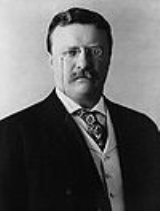
Encyclopedia
Theodore Roosevelt, Jr. , also known as
T.R. and to the public as
Teddy, was the 26th
President of the United States . He is most famous for his personality — he dominated a generation by his energy, his vast range of interests and achievements, and his model of masculinity — the famous “cowboy” persona. At age 42, he became President after the assassination of President
William McKinley.
Roosevelt was a Progressive reformer who sought to move the
Republican Party into the Progressive camp. He distrusted wealthy businessmen and as a "trust buster" broke up numerous large corporations. His "Square Deal" promised a fair shake for the average citizen, including regulation of railroad rates and pure foods and drugs. As an outdoorsman he promoted the conservation movement, emphasizing efficient use of natural resources. After he started attacking the courts as biased against
labor unions, he broke with his friend and anointed successor
William Howard Taft and ran unsuccessfully as a third-party candidate in
1912 on the Bull Moose ticket.
As Assistant Secretary of the
U.S. Navy he prepared for and advocated war with Spain in 1898. He organized and helped command the
First U.S. Volunteer Cavalry Regiment, the "Rough Riders", during the
Spanish-American War. Returning to New York as a war hero he was elected Republican governor in 1898. He was a professional historian, naturalist and explorer of the
Amazon Basin; his 35 books, listed online , include works on outdoor life, natural history, U.S. Western and political history, Naval Battles of the War of 1812 , and his autobiography.
Roosevelt understood the strategic significance of the
Panama Canal, and negotiated for the U.S. to take control of its construction in 1904. It was completed in 1914, after he left office. He felt that the Canal's completion was his most important and historically significant international achievement. He was the first American to be awarded the Nobel Prize, winning its
Peace Prize in 1906, for negotiating peace between Russia and Japan.
The dominant personality of the era, he helped redefine masculinity. He preached and lived the "strenuous life," ridiculing the sedentary life of luxury and attempting the most strenuous and dangerous feats--which finally cost his life. Historian Thomas Bailey, who disagreed with Roosevelt's policies, nevertheless concluded, "Roosevelt was a great personality, a great activist, a great preacher of the moralities, a great controversialist, a great showman. He dominated his era as he dominated conversations....the masses loved him; he proved to be a great popular idol and a great vote getter." His image stands alongside Washington, Jefferson and Lincoln on the
Mount Rushmore monument.
Surveys of scholars have consistently ranked him from #3 to #7 on the list of greatest American presidents. On June 26, 2006, Roosevelt, once again, made the cover of Time Magazine with the lead story, "The Making of Modern America - The 20th Century Express": "At home and abroad, Theodore Roosevelt was the locomotive President, the man who drew his flourishing nation into the future."
Childhood and education
Roosevelt was born at
28 East 20th Street in the modern-day Gramercy section of
New York City on October 27 1858, the second of four children of
Theodore Roosevelt, Sr. and
Martha Bulloch . He had an elder sister
Anna, nicknamed "Bamie" as a child and "Bye," as an adult for being always on the go; and two younger siblings—his brother
Elliott , and his sister Corinne. The Roosevelts had been in New York since the mid 17th century and had grown with the emerging New York commerce class after the
American Revolution. Until the birth of the Republican Party, just before the
Civil War, the family was strongly Democratic in its political outlook. By the 18th Century, the family had grown in wealth, power and influence from the profits of several businesses including hardware and plate-glass importing. Theodore's father, known in the family as "Thee," was a New York City philanthropist, merchant, and partner in the family glass-importing firm Roosevelt and Son. Martha Bulloch was a Southern belle from a slave-owning family in Savannah,
Georgia and had
Confederate sympathies. On his mother's side, Theodore's uncle,
James Dunwoody Bulloch, "Uncle Jimmy," was a 14 year
U.S. Navy officer turned secret
Confederate naval procurement agent in
England. James' brother
Irvine Bulloch was the youngest officer on the Confederate raider,
CSS Alabama and both had been exiled to
Liverpool, England after the war. During the Civil War, Martha supported her southern relatives' struggles and quietly mailed packages south.
Sickly and
asthmatic as a youngster, Roosevelt had to sleep propped up in bed or slouching in a chair during much of his early childhood, and had frequent ailments. Despite his illnesses, he was a hyperactive and often mischievous young man. His lifelong interest in
zoology was formed at age seven upon seeing a dead
seal at a local market. After obtaining the seal's head, the young Roosevelt and two of his cousins formed what they called the "Roosevelt Museum of Natural History". Learning the rudiments of
taxidermy, he filled his makeshift museum with many animals that he caught, studied, and prepared for display. At age nine, he codified his observation of insects with a paper titled "The Natural History of Insects."
To combat his poor physical condition, his father compelled the young Roosevelt to take up exercise. To deal with bullies, Roosevelt started
boxing lessons. Two trips abroad had a permanent impact: family tours of Europe in 1869 and 1870, and of the Middle East 1872 to 1873.
Theodore Sr. had a tremendous influence on young Theodore and was a life-long source of inspiration. Of him Roosevelt wrote, "My father, Theodore Roosevelt, was the best man I ever knew. He combined strength and courage with gentleness, tenderness, and great unselfishness. He would not tolerate in us children selfishness or cruelty, idleness, cowardice, or untruthfulness." Roosevelt's sister later wrote, "He told me frequently that he never took any serious step or made any vital decision for his country without thinking first what position his father would have taken."
Young "Teedie," as he was nicknamed as a child was mostly
homeschooled by tutors and his parents. A leading biographer says: "The most obvious drawback to the home schooling Roosevelt received was uneven coverage of the various areas of human knowledge." He was solid in geography and very well read in history, strong in biology, French and German, but deficient in mathematics, Latin and Greek. . He matriculated at
Harvard College in 1876, graduating magna cum laude. His father's death in 1878 was a tremendous blow, but Roosevelt redoubled his activities. He did well in science, philosophy and rhetoric courses but fared poorly in Latin and Greek. He studied biology with great interest and indeed was already an accomplished naturalist and published ornithologist. He had a photographic memory and developed a life-long habit of devouring books, memorizing every detail. He was an unusually eloquent conversationalist who, throughout his life, sought out the company of the smartest men and women. He could multitask in extraordinary fashion, dictating letters to one secretary and memoranda to another, while browsing through a new book. As an adult, a visitor would get a not so subtle hint that Roosevelt was losing interest in the conversation when he would pick up a book and begin looking at it now and then as the conversation continued.
While at Harvard, Roosevelt was active in numerous clubs, including
Delta Kappa Epsilon and Alpha Delta Phi fraternities. He also edited a student magazine. He was runner-up in the Harvard boxing championship, losing to C.S. Hanks. The sportsmanship Roosevelt showed in that fight was long remembered. Upon graduating from Harvard, Roosevelt underwent a physical examination and his doctor advised him that due to serious heart problems, he should find a desk job and avoid strenuous activity. Roosevelt disregarded the advice and chose to embrace the strenuous life instead.
He graduated
Phi Beta Kappa and
magna cum laude from Harvard in 1880 , and entered
Columbia Law School. At Columbia, Roosevelt researched and wrote his first major book, "The Naval War of 1812", in 1882, which still is considered the only comprehensive history on the subject. Presented with an opportunity to run for New York Assemblyman in 1881, he dropped out of law school to pursue his new goal of entering public life.
Early life
Early public life
Roosevelt was a
Republican activist during his years in the Assembly, writing more bills than any other New York state legislator. Already a major player in state politics, he attended the Republican National Convention in 1884 and fought alongside the
Mugwump reformers; they lost to the Stalwart faction that nominated
James G. Blaine. Refusing to join other Mugwumps in supporting Democrat
Grover Cleveland, the
Democratic nominee, he stayed loyal to the party and supported Blaine.
First marriage
At the age of 22, Roosevelt married his first wife, 19-year-old
Alice Hathaway Lee, on October 27, 1880, at the Unitarian Church in
Brookline, Massachusetts. Alice was the daughter of the prominent banker George Cabot Lee and Caroline Haskell Lee. The couple first met in 1878. He proposed in June 1879. However, Alice waited another six months before accepting the proposal. They announced their engagement on
Valentine's Day 1880. Alice Roosevelt died exactly four years later, only two days after the birth of their first child, also named
Alice. In a tragic coincidence, Roosevelt's mother died of typhoid fever on the same day at the Roosevelt family home in Manhattan.
Although he noted her loss in his diary and made several references to her in the subsequent months, from the next year on Roosevelt refused to speak his first wife's name again and did not allow others to speak of her in his presence. He came to despise his popular nickname "Teddy", both because he thought it undignified and because it was the lover's name used by his first wife.
Later that year, Roosevelt left the General Assembly and his infant daughter Alice, whom he had left in the long-term care of his older sister,
Bamie. He moved to his ranch in the
Badlands of the
Dakota Territory to live a more simple life as a rancher and lawman.
This practice put an early strain on his relationship with his daughter who was given his late wife's name. However, as she grew into adulthood and better understood her father's deep moral convictions, the bond between them became strong. Alice continued to support her father's ideas after his death in 1919.
Life in Badlands and second marriage
Living near the boomtown of
Medora, North Dakota, Roosevelt learned to ride and rope, occasionally getting involved in fistfights, and spent his time in the rough-and-tumble world of the final days of the
American Old West. On one occasion, as a deputy sheriff, he hunted down three outlaws taking a stolen boat down the Little Missouri River, successfully taking them back overland for trial.
While working on a tough project aimed at hunting down a group of relentless horse thieves, Roosevelt came across the famous Deadwood
Sheriff Seth Bullock. The two would remain friends for life.
After the 1886-1887 winter wiped out his herd of cattle and his $60,000 investment , he returned to the East, where in 1885, he had purchased
Sagamore Hill in
Oyster Bay, New York. It would be his home and estate until his death. Roosevelt ran as the Republican candidate for mayor of New York City in 1886, coming in a distant third.
Following the election, he went to London in 1886 and married his childhood sweetheart,
Edith Kermit Carow. They honeymooned in Europe, and Roosevelt climbed
Mont Blanc, leading only the third expedition of record to reach the summit, a feat which resulted in his induction into the
British Royal Society.
They had five children: Theodore Jr., Kermit, Ethel Carow, Archibald Bulloch "Archie", and Quentin. Although Roosevelt's father was also named Theodore Roosevelt, he died while the future president was still childless and unmarried, so the future President Roosevelt took the suffix of Sr. and subsequently named his son Theodore Roosevelt, Jr. Because Roosevelt was still alive when his grandson and namesake was born, his grandson was named Theodore Roosevelt III, and the president's son retained the Jr. after his father's death. "Uncle Ted" was the godfather and favorite uncle of Eleanor Roosevelt, whom he gave away in marriage to their cousin Franklin D. Roosevelt on St. Patrick's Day 1905.
Roosevelt is the only President to have become a widower and remarry before becoming President.
In the 1880s, he gained recognition as a serious historian. His The Naval War of 1812 was the standard history for two generations, but his hasty biographies of Thomas Hart Benton and Gouverneur Morris were potboilers. His major achievement was a four-volume history of the frontier, The Winning of the West , which had a notable impact on historiography as it presented a highly original version of the frontier thesis elaborated upon in 1893 by his friend Frederick Jackson Turner. His many articles in upscale magazines provided a much-needed income, as well as cementing a reputation as a major national intellectual. He was later chosen president of the American Historical Association.
Return to public life
In the 1888 presidential election, Roosevelt campaigned for Benjamin Harrison in the Midwest. President Harrison appointed Roosevelt to the United States Civil Service Commission, where he served until 1895. In his term, he vigorously fought the spoilsmen and demanded the enforcement of civil service laws. In spite of Roosevelt's support for Harrison's reelection bid in the presidential election of 1892, the eventual winner, Grover Cleveland , reappointed him to the same post.
In 1895, he became president of the New York City Board of Police Commissioners. During the two years that he held this post, Roosevelt radically changed the way a police department was run. The police force was reputed as one of the most corrupt forces in America. NYPD's history division records that Roosevelt was, "an iron-willed leader of unimpeachable honesty, brought a reforming zeal to the New York City Police Commission in 1895." Roosevelt and his fellow commissioners established new disciplinary rules, created a bicycle squad to police New York's traffic problems and implemented standardized 32 calibre pistol practice. Roosevelt implemented regular inspections of firearms, annual physical exams, appointed 1,600 new recruits appointed not on the basis of political affiliation but solely for their physical and mental qualifications, opened admission to the department to ethnic minorities and women, established the first police meritorious service medals, shut down the corrupt police hostelries, and a Municipal Lodging House was established by the Board of Charities." Roosevelt required his officers to be registered with the Board. He also had telephones installed in station houses. Always an energetic man, he made a habit of walking officers' beats late at night and early in the morning to make sure that they were on duty.
Assistant Secretary of the Navy
Roosevelt had always been fascinated by navies and their history. Urged by Roosevelt's close friend, Congressman Henry Cabot Lodge, President William McKinley appointed a delighted Roosevelt to the post of Assistant Secretary of the Navy in 1897.
Roosevelt had grown up fascinated with stories of naval battles. His uncle James Dunwoody Bulloch, a Confederate admiral who lived in England helped him develop his ideas in his naval history of the War of 1812. Roosevelt denounced the near criminal neglect of naval issues by the Jeffersonians. He praised the the skills of the commanders for saving. The overwhelming seapower of Britain had shaped every aspect of the war and made the events on land, to Roosevelt, seem almost secondary until the Battle of New Orleans.
Captain Alfred Thayer Mahan's powerful book on The Influence of Sea Power upon History, 1660-1783 convinced opinion leadees, worldwide, of the necessity of having the stronger fleet in wartime. It strengthened Roosevelt's argument that a dramatic expansion of the Navy was needed to put the United States abreast of European powers. Upon becoming assistant secretary, Roosevelt was pushing for the modernization of the Navy and the reorganization of both the Department and its officer corps. He also fought for an increase in ship-building capability, warning that building modern steel ships would take years. Roosevelt was instrumental in preparing the Navy for the Spanish-American War.
War in Cuba
Upon the declaration of war in 1898 that would be known as the Spanish-American War, Roosevelt resigned from the Navy Department and, with the aid of U.S. Army Colonel Leonard Wood, organized the First U.S. Volunteer Cavalry Regiment out of a diverse crew that ranged from cowboys from the Western territories to Ivy League friends from New York. The newspapers called them the "Rough Riders." Originally Roosevelt held the rank of Lieutenant Colonel and served under Colonel Wood, but after Wood was promoted to Brigadier General of Volunteer Forces, Roosevelt was promoted to Colonel and given command of the Regiment.
Under his leadership, the Rough Riders became famous for their dual charges up Kettle Hill and San Juan Hill in July 1898 . Roosevelt was posthumously awarded the Medal of Honor in 2001 for his actions.
Upon his return from Cuba, Roosevelt re-entered New York state politics and was elected governor of New York in 1898. He made such a concerted effort to root out corruption and "machine politics" that Republican boss Thomas Collier Platt forced him on McKinley as a running mate in the 1900 election to simplify their control of the state.
Vice presidency
McKinley and Roosevelt won the presidential election of 1900, defeating William Jennings Bryan and Adlai E. Stevenson I. Roosevelt found his six months in the vice-presidency unfulfilling. One story that sums up his feelings on the Vice-Presidency was that as President, Roosevelt ordered a noisy chandelier removed from the White House, suggesting that it be put in the Vice President's office, as he had nothing to do and the chandelier would keep him awake.
Thinking that he had little future in politics, he considered returning to law school after leaving office. On September 2, 1901, Roosevelt first uttered a sentence that would become strongly associated with his presidency, urging Americans to "speak softly and carry a big stick" during a speech at the Minnesota State Fair. It has been claimed that the famous phrase was actually inspired by a discussion Roosevelt had with French diplomat Comte Édouard Sébastien de Malo when the latter visited the US in 1900. As France was just coming out of the traumatic Dreyfus affair, Roosevelt asked Comte de Malo what lesson could be learned from the episode. De Malo replied: "France may have been humbled by this event, but we still stand strong and proud. Although we speak softly, we are still carrying a big stick."
Presidency 1901-1909
President McKinley was shot by an anarchist on September 6, 1901. McKinley died on September 14, vaulting Roosevelt into the presidency. He took the oath of office in the Ansley Wilcox House at Buffalo, New York. He was the youngest person to assume the presidency, and he promised to continue McKinley's cabinet and his basic policies. Roosevelt did so, but after reelection in 1904, he moved to the political left, stretching his ties to the Republican Party's conservative leaders.
Anthracite coal strike of 1902
A national emergency was averted in 1902 when Roosevelt found a compromise to the anthracite coal strike by the United Mine Workers of America that threatened the heating supplies of most urban homes. Roosevelt called the mine owners and the labor leaders to the White House and negotiated a compromise. Miners were on strike for 163 days before it ended; they were granted a 10% pay increase and a 9-hour day , but the union was not officially recognized and the price of coal went up.
Square Deal
Roosevelt promised to continue McKinley's program, and at first he worked closely with McKinley's men. His 20,000-word address to the Congress in December 1901, asked Congress to curb the power of trusts "within reasonable limits." They did not act but Roosevelt did, issuing 44 lawsuits against major corporations; he was called the "trust-buster."
Mark Hanna was the rival power in the Republican party. Hanna died, and Roosevelt had an easy renomination and reelection in 1904. He won 336 of 476 electoral votes, and 56.4% of the total popular vote. He therefore became the first President who came into office due to the death of his predecessor to be elected in his own right.
Building on McKinley's effective use of the press, Roosevelt made the White House the center of news every day, providing interviews and photo opportunities. His children were almost as popular as he was, and their pranks in the White House made headlines. His daughter, Alice Lee Roosevelt, became quite popular in Washington.
Regulation of industry
Roosevelt firmly believed, "The Government must in increasing degree supervise and regulate the workings of the railways engaged in interstate commerce." Inaction was a danger, he argued, "Such increased supervision is the only alternative to an increase of the present evils on the one hand or a still more radical policy on the other."
His biggest success was passage of the Hepburn Act of 1906, giving the Interstate Commerce Commission the power to set maximum railroad rates; it also stopped free passes given to friends of the railroad. Everyone at the time assumed railroads would always be a vast and powerful force; no one dreamed they would be challenged by trucks and automobiles and struggle to survive under the provisions of the Hepburn Act designed to help merchants and consumers.
In response to public clamor, Roosevelt pushed Congress to pass the Pure Food and Drug Act of 1906, as well as the Meat Inspection Act of 1906. These laws provided for labeling of foods and drugs, inspection of livestock and mandated sanitary conditions at meatpacking plants. Congress replaced Roosevelt's proposals with a version supported by the major meatpackers who worried about the overseas markets, and did not want small unsanitary plants undercutting their domestic market.
Conservationist
Roosevelt was the first American president to consider the long-term needs for efficience conservation of national resources, winning the support of fellow hunters and fishermen to bolster his political base. Roosevelt was the last trained observer to ever see a passenger pigeon. Assuming the conservationist role was a natural step for him, and he decided that it was overdue to put the issue high on the national agenda. He worked with all the major figures of the movement, especially his chief advisor on the matter Gifford Pinchot. Roosevelt urged congress to establish the U. S. Forest Service , to manage government forest lands, and he appointed Gifford Pinchot to head the service. Roosevelt set aside more land for national parks and nature preserves than all of his predecessors combined, 194 million acres. The Theodore Roosevelt National Park in the Badlands commemorates his conservationist philosophy. In 1903, Roosevelt toured the Yosemite Valley with John Muir, founder of the Sierra Club, but he rejected Muir's philosophy that privileged nature, and emphasized instead the more efficient use of nature. In 1907, with Congress about to block him, Roosevelt hurried to designate 16 million acres of new national forests. In May 1908, he sponsored the Conference of Governors held in the White House, with a focus on the most efficient planning, analysis and use of water, forests and other natural resources. Roosevelt explained, "There is an intimate relation between our streams and the development and conservation of all the other great permanent sources of wealth." During his presidency, Roosevelt promoted the nascent conservation movement in essays for Outdoor Life magazine. Roosevelt, like Pinchot , believed in the more efficient use of natural resources by corporations like lumber companies. To Roosevelt, conservation meant mo