
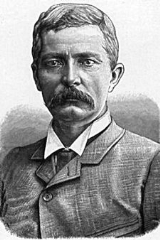
Sir Henry Morton Stanley,
GCBThe Most Honourable Order of the Bath is a British order of chivalry founded by George I on 18 May 1725. The name derives from the elaborate mediæval ceremony for creating a knight, which involved bathing as one of its elements. The knights so created were known as Knights of the Bath...
, born
John Rowlands (28 January 1841 – 10 May 1904), was a
WelshWales is a country that is part of the United Kingdom and the island of Great Britain, bordered by England to its east and the Atlantic Ocean and Irish Sea to its west. It has a population of three million, and a total area of 20,779 km²...
journalist and
explorer famous for his exploration of
AfricaAfrica is the world's second largest and second most populous continent, after Asia. At about 30.2 million km² including adjacent islands, it covers 6% of the Earth's total surface area and 20.4% of the total land area...
and his search for
David Livingstone David Livingstone was a Scottish Congregationalist pioneer medical missionary with the London Missionary Society and an explorer in Africa. His meeting with H. M. Stanley gave rise to the popular quotation, "Dr...
. Upon finding Livingstone, Stanley allegedly uttered the now-famous greeting, "Dr. Livingstone, I presume?"
Early life
When Stanley was born in
DenbighDenbigh is a market town and community in Denbighshire, Wales. Before 1888, it was the county town of Denbighshire. Denbigh lies 8 miles to the north west of Ruthin and to the south of St Asaph. It is about 13 miles from the seaside resort of Rhyl. The town grew around the glove-making industry...
,
WalesWales is a country that is part of the United Kingdom and the island of Great Britain, bordered by England to its east and the Atlantic Ocean and Irish Sea to its west. It has a population of three million, and a total area of 20,779 km²...
, his mother, Elizabeth Parry, was just 19 years old. He never knew his father who died within a few weeks of his birth; there is some doubt as to his true parentage. His parents were unmarried, so his
birth certificateA birth certificate is a vital record that documents the birth of a child. The term "birth certificate" can refer to either the original document certifying the circumstances of the birth or to a certified copy of or representation of the ensuing registration of that birth...
refers to him as a
bastardA bastard in the law of England and Wales is a person whose parents, at the time of his/her birth, were not married to each other....
and the
stigmaSocial stigma is the severe disapproval of or discontent with a person on the grounds of characteristics that distinguish them from other members of a society.Almost all stigma is based on a person differing from social or cultural norms...
of illegitimacy weighed heavily upon him all his life.
Originally taking his father's name of Rowlands, Stanley was brought up by his grandfather until the age of five. When his guardian died, Stanley stayed at first with cousins and nieces for a short time, but was eventually sent to St. Asaph Union
WorkhouseIn England and Wales a workhouse, colloquially known as a spike, was a place where those unable to support themselves were offered accommodation and employment...
for the poor, where overcrowding and lack of supervision resulted in frequent abuse by the older boys. When he was ten, his mother and two siblings stayed for a short while in this workhouse, without Stanley realising who they were. He stayed until the age of 15. After completing an elementary education, he was employed as a pupil teacher in a
National SchoolA national school was a school founded in 19th century England and Wales by the National Society for Promoting Religious Education.These schools provided elementary education, in accordance with the teaching of the Church of England, to the children of the poor.Together with the less numerous...
.
New country, new name
In 1859, at the age of 18, he made his passage to the United States in search of a new life. Upon arriving in
New OrleansNew Orleans is a major United States port and the largest city and metropolitan area in the state of Louisiana. The New Orleans metropolitan area has a population of 1,235,650 as of 2009, the 46th largest in the USA. The New Orleans – Metairie – Bogalusa combined statistical area has a population...
, he absconded from his boat. According to his own declarations, he became friendly with a wealthy trader named Henry Hope Stanley, by accident: he saw Stanley sitting on a chair outside his store and asked him if he had any job opening for a person such as himself. However, he did so in the British style, "Do you want a boy, sir?" As it happened, the childless man had indeed been wishing he had a boy of his own, and the inquiry led not only to a job, but to a close relationship. The youth ended up taking Stanley's name. Later, he would write that his adoptive parent had died only two years after their meeting, but in fact the elder Stanley did not die until much later in 1878. In any case, young Stanley assumed a local accent and began to deny being a foreigner.
Stanley participated reluctantly in the
American Civil WarThe American Civil War was a civil war fought in the United States of America. In response to the election of Abraham Lincoln as President of the United States, 11 southern slave states declared their secession from the United States and formed the Confederate States of America ; the other 25...
, first joining the Confederate Army and fighting in the
Battle of ShilohThe Battle of Shiloh, also known as the Battle of Pittsburg Landing, was a major battle in the Western Theater of the American Civil War, fought April 6–7, 1862, in southwestern Tennessee. A Union army under Maj. Gen. Ulysses S. Grant had moved via the Tennessee River deep into Tennessee and...
in 1862. After being taken prisoner he promptly deserted and joined the
Union ArmyThe Union Army was the land force that fought for the Union during the American Civil War. It was also known as the Federal Army, the U.S. Army, the Northern Army and the National Army...
, but was discharged on 22 June 1862 due to severe illness Recovering, he served on several merchant ships before joining the Navy in July 1864. On board the
Minnesota he became a record keeper, which led to freelance journalism. Stanley and a junior colleague jumped ship on 10 February 1865 in New Hampshire in search of greater adventures.
Following the Civil War, Stanley began a career as a journalist. As part of this new career, Stanley organised an expedition to the
Ottoman EmpireThe Ottoman EmpireIt was usually referred to as the "Ottoman Empire", the "Turkish Empire", the "Ottoman Caliphate" or more commonly "Turkey" by its contemporaries...
that ended catastrophically when Stanley was imprisoned. He eventually talked his way out of jail and even received restitution for damaged expedition equipment. This early expedition may have formed the foundation for his eventual exploration of the
CongoThe Congo River is a river in Africa, and is the deepest river in the world, with measured depths in excess of . It is the second largest river in the world by volume of water discharged, though it has only one-fifth the volume of the world's largest river, the Amazon...
region of
AfricaAfrica is the world's second largest and second most populous continent, after Asia. At about 30.2 million km² including adjacent islands, it covers 6% of the Earth's total surface area and 20.4% of the total land area...
.
In 1867, Stanley was recruited by Colonel Samuel Forster Tappan (a one-time journalist) of the Indian Peace Commission, to serve as a correspondent to cover the work of the Commission for several newspapers. Stanley was soon retained exclusively by
James Gordon BennettJames Gordon Bennett, Sr. was the founder, editor and publisher of the New York Herald and a major figure in the history of American newspapers.-Biography:...
(1795–1872), founder of the
New York HeraldThe New York Herald was a large distribution newspaper based in New York City that existed between May 6, 1835, and 1924.-History:The first issue of the paper was published by James Gordon Bennett, Sr., on May 6, 1835. By 1845 it was the most popular and profitable daily newspaper in the UnitedStates...
, who was impressed by Stanley's exploits and by his direct style of writing. This early period of his professional life is described in Volume I of his book
My Early Travels and Adventures in America and Asia (1895). He became one of the Heralds overseas correspondents and, in 1869, was instructed by Bennett's son to find the
ScottishThe Scottish people , or Scots, are a nation and ethnic group native to Scotland. Historically they emerged from an amalgamation of the Picts and Gaels, incorporating neighbouring Britons to the south as well as invading Germanic peoples such as the Anglo-Saxons and the Norse.In modern use,...
missionary and explorer
David Livingstone David Livingstone was a Scottish Congregationalist pioneer medical missionary with the London Missionary Society and an explorer in Africa. His meeting with H. M. Stanley gave rise to the popular quotation, "Dr...
, who was known to be in Africa but had not been heard from for some time. According to Stanley's account, he asked
James Gordon Bennett, Jr.James Gordon Bennett, Jr. was publisher of the New York Herald, founded by his father, James Gordon Bennett, Sr., who emigrated from Scotland. He was generally known as Gordon Bennett to distinguish him from his father....
(1841–1918), who had succeeded to the paper's management after his father's retirement in 1867, how much he could spend. The reply was "Draw £1,000 now, and when you have gone through that, draw another £1,000, and when that is spent, draw another £1,000, and when you have finished that, draw another £1,000, and so on — BUT FIND LIVINGSTONE!"
In actuality, Stanley had lobbied his employer for several years to mount this expedition that would presumably give him fame and fortune.
Finding Livingstone
Stanley travelled to ZanzibarZanzibar ,Persian: زنگبار, from suffix bār: "coast" and Zangi: "bruin" ; is a semi-autonomous part of Tanzania, in East Africa. It comprises the Zanzibar Archipelago in the Indian Ocean, off the coast of the mainland, and consists of numerous small islands and two large ones: Unguja , and Pemba...
in March 1871 and outfitted an expedition with the best of everything, requiring no fewer than 200 portersA porter, also called a bearer, is a person who shifts objects for others.-Historical meaning:Human adaptability and flexibility early led to the use of humans for shifting gear...
. This 7000 miles (11,265.4 km) expedition through the tropical forest became a nightmare. His thoroughbred stallion died within a few days after a bite from a Tsetse flyTsetse , sometimes spelled tzetze and also known as tik-tik flies, are large biting flies that inhabit much of mid-continental Africa between the Sahara and the Kalahari deserts. They live by feeding on the blood of vertebrate animals and are the primary biological vectors of trypanosomes, which...
, many of his carriers deserted and the rest were decimated by tropical diseases. As the one white man stranded in the middle of black Africa, without local geographical knowledge, maps, or other information, Stanley's survival looked grim. Soon, the remaining men were actively plotting his death and theft of the remaining baggage. To stay alive he immediately set about showing his power by taking stern measures, including flogging deserters. Indeed, the customs of enforcing their authority amongst the common people by both Arab slavers and local Chieftains was considered barbarous by contemporary Western standards.
However, it was the only means of survival and his diaries are clear in stating the measures taken could only be considered brutal from the standpoint of civilized Victorian standards not the customs of Africa. Many missionaries of the day practiced tactics no less brutal than his, and Stanley's diaries show that he had in fact exaggerated the brutal treatment of his carriers in his books to pander to the taste of his Victorian public. Some recent authors suggest that Stanley's treatment of indigenous porters helps to refute his reputation for brutality. However, statements by contemporaries of Stanley like Sir Richard Francis Burton, who claimed "Stanley shoots negroes as if they were monkeys", paint a very different picture. Stanley found Livingstone on 10 November 1871, in UjijiUjiji is the oldest town in western Tanzania, located about 6 miles south of Kigoma. In 1900, the population was estimated at 10,000 and in 1967 about 4,100. Part of the Kigoma/Ujiji urban area, the regional population was about 50,000 in 1978....
near Lake TanganyikaLake Tanganyika is an African Great Lake. It is estimated to be the second largest freshwater lake in the world by volume, and the second deepest, after Lake Baikal in Siberia; it is also the world's longest freshwater lake...
in present-day TanzaniaThe United Republic of Tanzania is a country in East Africa bordered by Kenya and Uganda to the north, Rwanda, Burundi, and the Democratic Republic of the Congo to the west, and Zambia, Malawi, and Mozambique to the south. The country's eastern borders lie on the Indian Ocean.Tanzania is a state...
, and may have greeted him with the now-famous, "Doctor Livingstone, I presume?" This famous phrase may be a fabrication, as Stanley tore out of his diary the pages relating to the encounter. Even Livingstone's account of the encounter fails to mention these words. However, a summary of Stanley's letters published by The New York TimesThe New York Times is an American daily newspaper founded and continuously published in New York City since 1851. The New York Times has won 106 Pulitzer Prizes, the most of any news organization...
on 2 July 1872, quotes the phrase.
However, Tim Jeal argues in his biography that Stanley invented it afterwards because of his "insecurity about his background".
The Herald's own first account of the meeting, published 2 July 1872, also includes the phrase: "Preserving a calmness of exterior before the Arabs which was hard to simulate as he reached the group, Mr. Stanley said: – `Doctor Livingstone, I presume? A smile lit up the features of the hale white man as he answered: "Yes, and I feel thankful that I am here to welcome you. ..."
Stanley joined Livingstone in exploring the region, establishing for certain that there was no connection between Lake Tanganyika and the River Nile. On his return, he wrote a book about his experiences : How I Found Livingstone; travels, adventures, and discoveries in Central Africa. This brought him into the public eye and gave him some financial success.
Researching the Congo River
In 1874, the New York HeraldThe New York Herald was a large distribution newspaper based in New York City that existed between May 6, 1835, and 1924.-History:The first issue of the paper was published by James Gordon Bennett, Sr., on May 6, 1835. By 1845 it was the most popular and profitable daily newspaper in the UnitedStates...
, in partnership with Britain's Daily Telegraph, financed Stanley on another expedition to the African continent. One of his missions was to solve a last great mystery of African exploration by tracing the course of the Congo RiverThe Congo River is a river in Africa, and is the deepest river in the world, with measured depths in excess of . It is the second largest river in the world by volume of water discharged, though it has only one-fifth the volume of the world's largest river, the Amazon...
to the sea. The difficulty of this expedition is hard to overstate. Stanley used sectional boats to pass the great cataracts separating the Congo into distinct tracts. After 999 days, on 9 August 1877, Stanley reached a PortuguesePortugal , officially the Portuguese Republic is a country situated in southwestern Europe on the Iberian Peninsula. Portugal is the westernmost country of Europe, and is bordered by the Atlantic Ocean to the West and South and by Spain to the North and East. The Atlantic archipelagos of the...
outpost at the mouth of the Congo River. Starting with 356 people, only 114 had survived, of whom Stanley was the only European.
He wrote about his trials in his book Through the Dark Continent.
Claiming the Congo for the Belgian king
Stanley was approached by the ambitious Belgian king Leopold IILeopold II was the second king of the Belgians. Born in Brussels the second son of Leopold I and Louise-Marie of Orléans, he succeeded his father to the throne on 17 December 1865 and remained king until his death.Leopold is chiefly remembered as the founder and sole owner of the Congo Free...
, who in 1876 had organised a private holding company disguised as an international scientific and philanthropic association, which he called the International African Society. The king spoke of his intentions to introduce Western civilization and bring religion to that part of Africa, but did not mention he wanted to claim the lands. Stanley returned to the Congo, negotiated with local leaders, and obtained concessions.
At the end of his life, he was embittered by the growing perception that his establishment of a Congo Free State was mitigated by its unscrupulous government; in his defense for having imposed Christian civilization, it was maintained that Stanley had "only been responsible for the death of six or seven hundred negroes....and all these negroes fell as the result of attacking Stanley." In addition, the spread of African trypanosomiasis across central Africa is attributed to the movements of Stanley's enormous baggage train and the Emin Pasha relief expedition.
In 1886, Stanley led the Emin Pasha Relief ExpeditionThe Emin Pasha Relief Expedition of 1886 to 1889 was one of the last major European expeditions into the interior of Africa in the nineteenth century, ostensibly to the relief of Emin Pasha, General Charles Gordon's besieged governor of Equatoria, threatened by Mahdist forces...
to "rescue" Emin PashaMehmed Emin Pasha — he was born Isaak Eduard Schnitzer and baptized Eduard Carl Oscar Theodor Schnitzer — was a physician, naturalist, and governor of the Egyptian province of Equatoria on the upper Nile...
, the governor of EquatoriaEquatoria is a region in the south of present-day South Sudan along the upper reaches of the White Nile. Originally a province of Egypt, it also contained most of Northern part of present day Uganda including Albert Lake...
in the southern SudanSudan , officially the Republic of the Sudan , is a country in North Africa, sometimes considered part of the Middle East politically. It is bordered by Egypt to the north, the Red Sea to the northeast, Eritrea and Ethiopia to the east, South Sudan to the south, the Central African Republic to the...
. King Leopold II demanded that Stanley take the longer route, via the Congo river, hoping to acquire more territory and perhaps even Equatoria. After immense hardships and great loss of life, Stanley met Emin in 1888, charted the Ruwenzori RangeThe Rwenzori Mountains, previously called the Ruwenzori Range , and sometimes the Mountains of the Moon, is a mountain range of central Africa, often referred to as Mt...
and Lake EdwardLake Edward or Edward Nyanza is the smallest of the African Great Lakes. It is located in the western Great Rift Valley, on the border between the Democratic Republic of the Congo and Uganda, with its northern shore a few kilometres south of the Equator...
, and emerged from the interior with Emin and his surviving followers at the end of 1890. (Turnbull, 1983) But this expedition tarnished Stanley's name because of the conduct of the other Europeans: British gentlemen and army officers. An army major was shot by a carrier, after behaving with extreme cruelty. James Jameson, heir to an Irish whiskey manufacturer, bought an eleven-year old girl and offered her to cannibals in order to document and sketch how she was cooked and eaten. Stanley only found out when Jameson had died of fever.
On his return to Europe, he married Welsh artist Dorothy TennantDorothy Tennant was a Victorian neoclassicist painter , born in Wales. She studied painting under Edward Poynter at the Slade School of Fine Art and with Jean-Jacques Henner in Paris. In 1890, she married the explorer of Africa, Henry Morton Stanley, and became known as Lady Stanley...
, and they adopted a child, Denzil, who in 1954, donated some 300 items to the Stanley archives at the Royal Museum of Central Africa in TervurenTervuren is a municipality in the province of Flemish Brabant, in Flanders, one of the three regions of Belgium. The municipality comprises the villages of Duisburg, Tervuren, Vossem and Moorsel. On January 1, 2006, Tervuren had a total population of 20,636...
, Belgium. Denzil died in 1959. Stanley entered ParliamentThe Parliament of the United Kingdom of Great Britain and Northern Ireland is the supreme legislative body in the United Kingdom, British Crown dependencies and British overseas territories, located in London...
as Liberal Unionist member for Lambeth NorthLambeth North was a borough constituency centred on the Lambeth district of South London. It returned one Member of Parliament to the House of Commons of the Parliament of the United Kingdom, elected by the first past the post system.- History :...
, serving from 1895 to 1900. He became Sir Henry Morton Stanley when he was made a Knight Grand Cross of the Order of the BathThe Most Honourable Order of the Bath is a British order of chivalry founded by George I on 18 May 1725. The name derives from the elaborate mediæval ceremony for creating a knight, which involved bathing as one of its elements. The knights so created were known as Knights of the Bath...
in 1899, in recognition of his service to the British Empire in Africa.
He died in LondonLondon is the capital city of :England and the :United Kingdom, the largest metropolitan area in the United Kingdom, and the largest urban zone in the European Union by most measures. Located on the River Thames, London has been a major settlement for two millennia, its history going back to its...
on 10 May 1904; at his funeral, he was eulogised by Daniel P. Virmar. His grave, in the churchyard of St. Michael's Church in PirbrightPirbright is a village in Surrey, England. Neighbouring villages include Worplesdon, Deepcut, Brookwood and Normandy. Pirbright parish has an area of some falling into two distinct communities with the military area to the north of the railway and the village to the south...
, SurreySurrey is a county in the South East of England and is one of the Home Counties. The county borders Greater London, Kent, East Sussex, West Sussex, Hampshire and Berkshire. The historic county town is Guildford. Surrey County Council sits at Kingston upon Thames, although this has been part of...
, is marked by a large piece of granite inscribed with the words "Henry Morton Stanley, Bula Matari, 1841–1904, Africa". Bula Matari, which translates as "Breaker of Rocks" or "Breakstones" in Kikongo, was Stanley's name among locals in Congo. It can be translated as a term of endearment: for as the leader of Leopold's expedition, he commonly worked with the labourers breaking rocks with which they built the first modern road along the Congo RiverThe Congo River is a river in Africa, and is the deepest river in the world, with measured depths in excess of . It is the second largest river in the world by volume of water discharged, though it has only one-fifth the volume of the world's largest river, the Amazon...
. It can also be translated in far less flattering terms, and it was suggested by Adam Hochschild that while Stanley understood it as an heroic epithet, his Congolese companions understood it in a mocking and pejorative tone.
Stanley wrote in Through the Dark Continent that "the savage only respects force, power, boldness, and decision."His legacy of death and destruction in the Congo region is considered an inspiration for Joseph ConradJoseph Conrad was a Polish-born English novelist.Conrad is regarded as one of the great novelists in English, although he did not speak the language fluently until he was in his twenties...
's Heart of DarknessHeart of Darkness is a novella written by Joseph Conrad. Before its 1903 publication, it appeared as a three-part series in Blackwood's Magazine. It was classified by the Modern Library website editors as one of the "100 best novels" and part of the Western canon.The story centres on Charles...
.
Modern culture
In 1939, a popular film called Stanley and LivingstoneStanley and Livingstone is a movie about reporter Sir Henry M. Stanley's quest for Dr. David Livingstone, a missionary presumed lost in Africa. Spencer Tracy played Stanley, Sir Cedric Hardwicke portrayed Livingstone, and other cast members included Nancy Kelly, Walter Brennan, Charles Coburn,...
was released, with Spencer TracySpencer Bonaventure Tracy was an American theatrical and film actor, who appeared in 75 films from 1930 to 1967. Tracy was one of the major stars of Hollywood's Golden Age, ranking among the top ten box office draws for almost every year from 1938 to 1951...
as Stanley and Cedric HardwickeSir Cedric Webster Hardwicke was a noted English stage and film actor whose career spanned nearly fifty years...
as Livingstone.
Stanley appears as a character in Simon GraySimon James Holliday Gray, CBE , was an English playwright and memoirist who also had a career as a university lecturer in English literature at Queen Mary, University of London, for 20 years...
's 1978 play The Rear ColumnThe Rear Column is a play by Simon Gray set in the jungle of the Congo Free State in 1887-88. The story begins after explorer Henry Morton Stanley, has gone to relieve Emin Pasha, governor of Equatoria, from a siege by Mahdist forces...
, which tells the story of the men left behind to wait for Tippu Tib while Stanley went on to relieve Emin PashaMehmed Emin Pasha — he was born Isaak Eduard Schnitzer and baptized Eduard Carl Oscar Theodor Schnitzer — was a physician, naturalist, and governor of the Egyptian province of Equatoria on the upper Nile...
.
An NESThe Nintendo Entertainment System is an 8-bit video game console that was released by Nintendo in North America during 1985, in Europe during 1986 and Australia in 1987...
game based on his life was released in 1992 called "Stanley: The Search for Dr. Livingston".
In 1997, a made-for-television film, Forbidden Territory: Stanley's Search for Livingstone, was produced by National Geographic. Stanley was portrayed by Aidan Quinn-Early life:Quinn was born in Chicago, Illinois to Irish parents. He was brought up as a Roman Catholic and raised in Chicago and Rockford, Illinois, as well as in Dublin and Birr, County Offaly in Ireland. His mother, Teresa, was a homemaker, and his father, Michael Quinn, was a professor of...
and Livingstone was portrayed by Nigel HawthorneSir Nigel Barnard Hawthorne, CBE was an English actor, perhaps best remembered for his role as Sir Humphrey Appleby, the Permanent Secretary in the 1980s sitcom Yes Minister and the Cabinet Secretary in its sequel, Yes, Prime Minister. For this role he won four BAFTA Awards during the 1980s in the...
.
Stanley Electric Co., Ltd. of Japan, uses Stanley's family name in honour of his discoveries "that have brought light into many spots of the world undiscovered and hitherto unknown to mankind". The company produces light emitting diodes, liquid crystal displays, and lamps.
His great grandson, Richard Stanley, is a South African filmmaker and directs documentaries.
There is a hospital in St. AsaphSt Asaph is a town and community on the River Elwy in Denbighshire, Wales. In the 2001 Census it had a population of 3,491.The town of St Asaph is surrounded by countryside and views of the Vale of Clwyd. It is situated close to a number of busy coastal towns such as Rhyl, Prestatyn, Abergele,...
, North WalesNorth Wales is the northernmost unofficial region of Wales. It is bordered to the south by the counties of Ceredigion and Powys in Mid Wales and to the east by the counties of Shropshire in the West Midlands and Cheshire in North West England...
named after Stanley in honour of his birth in the area. It was the former workhouse in which he spent much of his early life. memorials to H M Stanley have recently been erected in St AsaphSt Asaph is a town and community on the River Elwy in Denbighshire, Wales. In the 2001 Census it had a population of 3,491.The town of St Asaph is surrounded by countryside and views of the Vale of Clwyd. It is situated close to a number of busy coastal towns such as Rhyl, Prestatyn, Abergele,...
(which has caused local controversy for being phalic shaped) and in DenbighDenbigh is a market town and community in Denbighshire, Wales. Before 1888, it was the county town of Denbighshire. Denbigh lies 8 miles to the north west of Ruthin and to the south of St Asaph. It is about 13 miles from the seaside resort of Rhyl. The town grew around the glove-making industry...
(a statue of H M Stanley with an outstretched hand).
The 2009 History Channel series, Expedition AfricaExpedition Africa is an eight-part reality television miniseries that originally aired form to on History. Produced by Mark Burnett, the program follows four modern day explorers—a navigator, a wildlife expert, a survivalist, and a journalist—as they substantially retrace H.M. Stanley's famed...
, documents a group of explorers attempting to traverse the route of Stanley's expedition in search of Livingstone.
Search for the Nile BBC 1971. A 5 hour series, much shot on location, which included H.M. Stanley and David Livingstone. (Although very highly regarded this has never been shown or released again by the BBC, but VHS copies can, with a little effort, be found.)
Taxa named in honor
Taxa named in honor of Henry Morton Stanley include:
- freshwater snail Gabbiella stanleyi
Gabbiella stanleyi is a species of small freshwater snails with an operculum, aquatic prosobranch gastropod mollusks in the family Bithyniidae.The specific name stanleyi is in honor of explorer Henry Morton Stanley....
(E. A. Smith, 1877)
- freshwater snail genus Stanleya Bourguignat, 1885
See also
- Edmund Musgrave Barttelot
Edmund Musgrave Barttelot was a British Army officer, born in Sussex, England.He joined the army in 1879 and served in India. He volunteered for Henry Morton Stanley's Emin Pasha Relief Expedition...
Further reading
- Bierman, John: Dark Safari: The Life behind the Legend of Henry Morton Stanley. New York: Alfred A. Knopf, 1990. ISBN 0-394-58342-6
- Dugard, Martin: Into Africa: The Epic Adventures of Stanley and Livingstone, 2003. ISBN 0-385-50451-9
- Hochschild, Adam: King Leopold's Ghost: A Story of Greed, Terror, and Heroism in Colonial Africa. New York: Houghton Mifflin, 1998; Mariner Books, 1999 (pb). ISBN 0-618-00190-5 (pb)
- Hughes, Nathaniel, Jr. Sir Henry Morton Stanley, Confederate ISBN 0-8071-2587-3 reprint with introduction copyright 2000, from original, The Autobiography of Sir Henry Morton Stanley (1909)
- Liebowitz, Daniel; Pearson, Charles: The Last Expedition: Stanley's Mad Journey Through the Congo, 2005. ISBN 0-393-05903-0
- Pakenham, Thomas: The Scramble for Africa. Abacus History, 1991. ISBN 0-349-10449-2
- Petringa, Maria: Brazza, A Life for Africa, 2006. ISBN 978-1-4259-1198-0
- The British Medical Journal 1870–1871 editions have numerous reports of Stanley's progress in attempting to track down David Livingston. Several medical schools in the USA (e.g. Johns Hopkins, UW Madison) have these volumes still in the stack and readers can read for themselves the accounts of this famous expedition.
- Simpson, J. 2007. Not Quite World's End A Traveller's Tales. pp. 291–293; 294–296. Pan Books. ISBN 978-0-330-43560-4
External links
- Stanley and Livingstone Original reports from The Times
- How I Found Livingstone, illustrated. From Internet Archive
The Internet Archive is a non-profit digital library with the stated mission of "universal access to all knowledge". It offers permanent storage and access to collections of digitized materials, including websites, music, moving images, and nearly 3 million public domain books. The Internet Archive...
.
- In darkest Africa; or, The quest, rescue, and retreat of Emin, governor of Equatoria. Volume 1 (1890), illustrated. From Internet Archive
The Internet Archive is a non-profit digital library with the stated mission of "universal access to all knowledge". It offers permanent storage and access to collections of digitized materials, including websites, music, moving images, and nearly 3 million public domain books. The Internet Archive...
.
- In darkest Africa; or, The quest, rescue, and retreat of Emin, governor of Equatoria. Volume 2 (1890), illustrated. From Internet Archive
The Internet Archive is a non-profit digital library with the stated mission of "universal access to all knowledge". It offers permanent storage and access to collections of digitized materials, including websites, music, moving images, and nearly 3 million public domain books. The Internet Archive...
.
- Sir Henry Morton Stanley (1841–1904), Explorer and journalist Sitter associated with 27 portraits
- Letters and maps associated with HM Stanley from Gathering the Jewels
- HM Stanley and Knife Crime