
All Topics  
Gustave Courbet

 
Gustave Courbet

   Email Print
   Bookmark   Link


Gustave Courbet


For the French Admiral, see Amédée Courbet
Amédée Courbet

Anatole-Am?d?e-Prosper Courbet , was a France admiral who won a series of important land and naval victories during the Tonkin campaign and the Sino-French War ....
 (1828-1885)


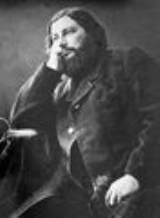
Jean Désiré Gustave Courbet (10 June 1819 – 31 December 1877) was a French
France

France , officially the French Republic , is a country whose Metropolitan France is located in Western Europe and that also comprises various Overseas departments and territories of France....
 painter
Painting

Painting is the practice of applying paint, pigment, color or other medium to a surface . In art, the term describes both the act and the result, which is called a painting....
 who led the Realist
Realism (visual arts)

Realism is a visual art style that depicts the actuality of what the eyes can see. Realists render everyday life characters, situations, dilemmas, and objects, all in verisimilitude....
 movement in 19th-century French painting.
Realism
Best known as an innovator in Realism
Realism (visual arts)

Realism is a visual art style that depicts the actuality of what the eyes can see. Realists render everyday life characters, situations, dilemmas, and objects, all in verisimilitude....
 (and credited with coining the term), Courbet was a painter of figurative compositions, landscapes
Landscape art

Landscape art depicts scenery such as mountains, valleys, trees, rivers, and forests. Sky is almost always included in the view, and weather usually is an element of the composition....
 and seascape
Seascape

A seascape is a photograph, painting, or other work of art which depicts the sea.Recent seminal use of this word in the UK: A combination of adjacent land, coastline and sea within an area, defined by a mix of land-sea inter-visibility and coastal landscape character assessment, with major headlands forming division points between one sea...
s. He also worked with social issues, and addressed peasantry and the grave working conditions of the poor.


Discussion
Ask a question about 'Gustave Courbet'
Start a new discussion about 'Gustave Courbet'
Answer questions from other users
Full Discussion Forum


Encyclopedia


For the French Admiral, see Amédée Courbet
Amédée Courbet

Anatole-Am?d?e-Prosper Courbet , was a France admiral who won a series of important land and naval victories during the Tonkin campaign and the Sino-French War ....
 (1828-1885)


Jean Désiré Gustave Courbet (10 June 1819 – 31 December 1877) was a French
France

France , officially the French Republic , is a country whose Metropolitan France is located in Western Europe and that also comprises various Overseas departments and territories of France....
 painter
Painting

Painting is the practice of applying paint, pigment, color or other medium to a surface . In art, the term describes both the act and the result, which is called a painting....
 who led the Realist
Realism (visual arts)

Realism is a visual art style that depicts the actuality of what the eyes can see. Realists render everyday life characters, situations, dilemmas, and objects, all in verisimilitude....
 movement in 19th-century French painting.

Realism


Best known as an innovator in Realism
Realism (visual arts)

Realism is a visual art style that depicts the actuality of what the eyes can see. Realists render everyday life characters, situations, dilemmas, and objects, all in verisimilitude....
 (and credited with coining the term), Courbet was a painter of figurative compositions, landscapes
Landscape art

Landscape art depicts scenery such as mountains, valleys, trees, rivers, and forests. Sky is almost always included in the view, and weather usually is an element of the composition....
 and seascape
Seascape

A seascape is a photograph, painting, or other work of art which depicts the sea.Recent seminal use of this word in the UK: A combination of adjacent land, coastline and sea within an area, defined by a mix of land-sea inter-visibility and coastal landscape character assessment, with major headlands forming division points between one sea...
s. He also worked with social issues, and addressed peasantry and the grave working conditions of the poor. His work belonged neither to the predominant Romantic
Romanticism

Romanticism is a complex artistic, literary, and intellectual movement that originated in the second half of the 18th century in Western Europe, and gained strength during the Industrial Revolution....
 nor Neoclassical
Neoclassicism

Neoclassicism is the name given to quite distinct Cultural movement in the Decorative art and visual arts, literature, theatre, music, and architecture that draw upon Western classical art and culture ....
 schools. Rather, Courbet believed the Realist artist's mission was the pursuit of truth, which would help erase social contradictions and imbalances.

Courbet
For Courbet realism dealt not with the perfection of line and form, but entailed spontaneous and rough handling of paint, suggesting direct observation by the artist while portraying the irregularities in nature
Naturalism (art)

Naturalism in art refers to the depiction of realistic objects in a natural setting. The realism movement of the 19th century advocated naturalism in reaction to the stylized and idealized depictions of subjects in Romanticism, but many painters have adopted a similar approach over the centuries....
. He depicted the harshness in life, and in so doing, challenged contemporary academic ideas of art.

His work, along with the work of Honoré Daumier
Honoré Daumier

Honor? Daumier , was a France printmaker, caricaturist, Painting, and sculptor, whose many works offer commentary on social and political life in France in the 19th century....
 and Jean-François Millet
Jean-François Millet

Jean-Fran?ois Millet was a French Painting and one of the founders of the Barbizon school in rural France. Millet is noted for his scenes of peasant farmers; he can be categorized as part of the Naturalism and Realism movements....
, became known as Realism.

Courbet
Born in Ornans (Doubs), into a prosperous farming family which wanted him to study law, he went to Paris
Paris

Paris is the Capital of France and the country's largest city. It is situated on the river Seine, in northern France, at the heart of the ?le-de-France Regions of France ....
 in 1839, and worked at the studio of Steuben and Hesse. An independent spirit, he soon left, preferring to develop his own style by studying Spanish, Flemish and French painters and painting copies of their work.

His first works were an Odalisque
Odalisque

An odalisque was a virgin female slave in an Ottoman Empire seraglio. She was an assistant or apprentice to the concubines and wives, and she might rise in status to become one of them....
, suggested by the writing of Victor Hugo
Victor Hugo

Victor-Marie Hugo was a France poet, playwright, novelist, essayist, visual artist, statesman, human rights activist and exponent of the Romanticism movement in France....
, and a Lélia, illustrating George Sand
George Sand

Amandine Aurore Lucile Dupin, later Baroness Dudevant , best known by her pseudonym George Sand , was a France novelist and feminist....
, but he soon abandoned literary influences for the study of real life.

A trip to the Netherlands in 1847 strengthened Courbet's belief that painters should portray the life around them, as Rembrandt, Hals
Frans Hals

Frans Hals was a Dutch Golden Age painter especially famous for Portrait painting. He is notable for his loose painterly brushwork, and helped introduce this lively style of painting into Dutch art....
, and the other Dutch masters had done.

Among his early works, he painted his own portrait with his dog, and The Man with a Pipe, both of which the Paris Salon
Paris Salon

The Salon , or rarely Paris Salon , beginning in 1725 was the official art exhibition of the Acad?mie des Beaux-Arts in Paris, France. Between 1748?1890 it was the greatest annual or biannual art event in the world....
 jury rejected. However, the younger critics, the Neo-romantics
Neo-romanticism

The term neo-romanticism is used to cover a variety of movements in music and painting. It has been used with reference to very late 19th century and early 20th century composers such as Gustav Mahler particularly by Dalhaus who uses it as synonymous with late Romanticism....
 and Realists, loudly sang his praises, and by 1849 Courbet was becoming well known, producing such pictures as After Dinner at Ornans (for which the Salon awarded him a medal) and The Valley of the Loire.

A Burial at Ornans


One of Courbet's most important works is A Burial at Ornans, a canvas recording an event which he witnessed in September 1848. Courbet's painting of the funeral of his grand uncle became the first masterpiece in the Realist
Realism (arts)

Realism in the visual arts and literature is the depiction of subjects as they appear in everyday life, without embellishment or interpretation....
 style. People who had attended the funeral were used as models for the painting. Previously, models had been used as actors in historical narratives; here Courbet said that he "painted the very people who had been present at the interment, all the townspeople". The result is a realistic presentation of them, and of life, in Ornans. The painting caused a fuss with critics and the public. It is an enormous work, measuring 10 by 22 feet (3.1 by 6.6 meters), depicting a prosaic ritual on a scale which previously would have been reserved for a religious or royal subject. According to art historian Sarah Faunce, "In Paris the Burial was judged as a work that had thrust itself into the grand tradition of history painting, like an upstart in dirty boots crashing a genteel party, and in terms of that tradition it was of course found wanting." Then too, the painting lacks the sentimental rhetoric that was expected in a genre work: Courbet's mourners make no theatrical gestures of grief, and their faces seemed more caricatured than ennobled. The critics accused Courbet of a deliberate pursuit of ugliness. Eventually the public grew more interested in the new Realist approach, and the lavish, decadent fantasy of Romanticism lost popularity. The artist well understood the importance of this painting; as Courbet said: "The Burial at Ornans was in reality the burial of Romanticism."

La Belle Irlandaise (portrait of Jo)
The Salon of 1850 found him triumphant with A Burial at Ornans, the Stone-Breakers (destroyed in 1945), and the Peasants of Flagey. Other figurative works, with common folk and friends as his subjects, included Village Damsels (1852), the Wrestlers, Bathers, and A Girl Spinning (1852).

Courbet associated his ideas of realism in art with anarchism
Anarchism

Anarchism is a political philosophy encompassing anarchist schools of thought which consider the state to be unnecessary, harmful, and/or undesirable....
, and, having gained an audience, he promoted democratic and socialist ideas by writing politically motivated essays and dissertations.

To a friend in 1850 he wrote,

He displayed his monumental The Artist's Studio
The Artist's Studio

The Artist's Studio : A Real Allegory of a Seven Year Phase in my Artistic and Moral Life is an 1855 oil painting on canvas by Gustave Courbet....
 in 1855. It is an allegory of his life as a painter, seen as a heroic venture, in which he is flanked by friends and admirers on the right, and his opposition to the left. Friends on the right include Charles Baudelaire
Charles Baudelaire

Charles Pierre Baudelaire was a nineteenth century French poetry, critic and translator. A controversial figure in his lifetime, Baudelaire's name has become a byword for literary and artistic Decadent movement....
, and art collector Alfred Bruyas
Alfred Bruyas

Alfred Bruyas was an art collector and a personal friend of many important artists of his time, among them Gustave Courbet. He donated his collection to the Mus?e Fabre, in Montpellier....
.

Notoriety

Towards the end of the 1860s, Courbet painted a series of increasingly erotic works such as Femme nue couchée
Femme nue couchée

Femme nue couch?e is a 1862 painting by France Realism painter Gustave Courbet . It depicts a young dark-haired woman reclining on a couch, wearing only a pair of shoes and stockings....
. This culminated in The Origin of the World (L'Origine du monde)
L'Origine du monde

L?Origine du monde is an oil on canvas painted by Gustave Courbet in 1866. Measuring about 46 cm by 55 cm , it depicts the close-up view of the genitals and abdomen of a naked woman, lying on a bed and spreading her legs....
 (1866), depicting female genitalia, and Sleep (1866), featuring two women in bed. While banned from public display, the works only served to increase his notoriety.

On 14 April 1870, Courbet established a "Federation of Artists" (Fédération des artistes) for the free and uncensored expansion of art. The group's members included André Gill
André Gill

Andr? Gill was a France caricature. Born Louis-Alexandre Gosset de Gu?nes at Paris, the son of the Comte de Gu?nes and Sylvie-Adeline Gosset, he studied at this city's Acad?mie de peinture et de sculpture....
, Honoré Daumier
Honoré Daumier

Honor? Daumier , was a France printmaker, caricaturist, Painting, and sculptor, whose many works offer commentary on social and political life in France in the 19th century....
, Jean-Baptiste Camille Corot, Eugène Pottier, Jules Dalou
Jules Dalou

Aim?-Jules Dalou , was a France sculpture, recognized as one of the most brilliant virtuosos of nineteenth-century France, admired for his perceptiveness, execution, and unpretentious realism....
, and Édouard Manet
Édouard Manet

?douard Manet , 23 January 1832 – 30 April 1883, was a French Painting. One of the first nineteenth century artists to approach modern-life subjects, he was a pivotal figure in the transition from realism to Impressionism....
.

His refusal of the cross of the Legion of Honour
Légion d'honneur

The L?gion d'honneur or Ordre national de la L?gion d'honneur is a France order established by Napoleon I of France, First Consul of the French First Republic, on May 19, 1802....
 offered to him by Napoleon III made him immensely popular with those who opposed the current regime, and in 1871 under the revolutionary Paris Commune
Paris Commune

The Paris Commune was a government that briefly ruled Paris from March 28 to May 28, 1871. It existed before the split between Anarchism and Socialism, and is hailed by both as the first seizure of power by the working class....
 he was placed in charge of all the Paris art museums and saved them from looting mobs. For his insistence in executing the Communal decree for the destruction of the Vendôme Column, he was designated as responsible for the act and accordingly sentenced on 2 September 1871 by a Versailles court martial to six months in prison and a fine of 500 francs.

In 1873, the newly elected president Mac-Mahon wanted to resurrect the Column, and Courbet was singled out to pay the expenses. He then took refuge in Switzerland to avoid bankruptcy. On 4 May 1877, the estimate of the costs was finally established: 323,091 fr 68 cent. Courbet was allowed to pay the fine in yearly installments of 10,000 francs for the next 33 years, until his 91st birthday.

Courbet died, age 58, in La Tour-de-Peilz
La Tour-de-Peilz

La Tour-de-Peilz is a municipalities of Switzerland in the district of Vevey in the Cantons of Switzerland of Vaud in Switzerland. The city is located on Lake Geneva between Montreux and Vevey ....
, Switzerland
Switzerland

Switzerland is a landlocked Swiss Alps country of roughly 7.7 million people in Western Europe with an area of 41,285 km?. Switzerland is a federal republic consisting of 26 states called Cantons of Switzerland....
, of a liver disease aggravated by heavy drinking on 31 December 1877, a day before the payment of the first installment was due. (Bernard Noël, 1978)

Pereduchesneillustre7 1 0   Gustave Courbet

Notable exhibitions

An exhibition of his works was held in 1882 at the École des Beaux-Arts
École des Beaux-Arts

?cole des Beaux-Arts refers to a number of influential art schools in France. The most famous is the ?cole Nationale Sup?rieure des Beaux-Arts, now located on the Rive Gauche in Paris, across the Seine from the Louvre, in the 6?me arrondissement, Paris....
.

A major exhibition of Courbet's work, "The Born Rebel Artist", is being held beginning in 2007 at the Grand Palais
Grand Palais

The Grand Palais is a large glass exhibition hall that was built for the Exposition Universelle . It is located in the 8th arrondissement of Paris of Paris, France....
, and at the Musée Fabre
Musée Fabre

The Mus?e Fabre is a museum in the France city of Montpellier, capital of the H?rault d?partement.The museum was founded by Fran?ois-Xavier Fabre, a Montpellier painter, in 1825....
 (Montpellier, France) and the Metropolitan Museum of Art
Metropolitan Museum of Art

The Metropolitan Museum of Art is an art museum located on the eastern edge of Central Park, along what is known as Museum Mile, New York City in New York City, USA....
 (New York City) during 2008.

Influence

Courbet's particular kind of realism influenced many artists to follow, notably among them the German painters of the Leibl
Wilhelm Leibl

Wilhelm Leibl was a Germany Realism Painting of portraits and scenes of peasant life.Leibl was born in Cologne and in 1861 began his first training with Hermann Becker, a local painter....
 circle, James McNeill Whistler, and Paul Cézanne
Paul Cézanne

Paul C?zanne was a French artist and Post-Impressionist Painting whose work laid the foundations of the transition from the 19th century conception of artistic endeavour to a new and radically different world of art in the 20th century....
. Courbet's influence can also be seen in the work of Edward Hopper
Edward Hopper

Edward Hopper was a prominent United States realist Painting and printmaker. While most popularly known for his oil paintings, he was equally proficient as a watercolorist and printmaker in etching....
, whose "Bridge in Paris" (1906) and "Approaching a City" (1946) seem Freudian echoes of Courbet's "The Source of the Loue" and "The Origin of the World." Hopper's "Les Deux Pigeons" (1920) is "infused with the spirit of Courbet. Lovers on a terrace ardently embrace while the river flows freely through the forest below them."

Pupils

  • Henri Fantin-Latour
    Henri Fantin-Latour

    Henri Fantin-Latour was a France painter and lithography....
  • Hector Hanoteau
    Hector Hanoteau

    Hector Hanoteau or Hector Charles Auguste Octave Constance Hanoteau was a French people landscape painter, born at Decize in Ni?vre. At the ?cole des Beaux-Arts, he was a pupil of Régis François Gignoux, and devoted himself chiefly to landscapes, characterized by sturdy realism and skillful color....
  • Olaf Isaachsen
    Olaf Isaachsen

    Olaf Wilhelm Isaachsen was a Norwegian painter.He was born in Mandal as the son of jurist Daniel Isaachsen, son of politician Isaach Isaachsen and grandson of Daniel Isaachsen, Sr.....


Gallery


Further reading

Monographs on the art and life of Courbet have been written by Estignard (Paris, 1874), D'Ideville, (Paris, 1878), Silvestre in Les artistes français, (Paris, 1878), Isham
Samuel Isham

Samuel Isham was an United States portrait and figure painter, born in New York City. He graduated from Yale University in 1875 and studied law, but after being admitted to the bar association he turned to art and studied in Paris at the Acad?mie Julian....
 in Van Dyke's Modern French Masters (New York, 1896), Meier-Graefe, Corot and Courbet, (Leipzig, 1905), Cazier (Paris, 1906), Riat, (Paris, 1906), Muther, (Berlin, 1906), Robin, (Paris, 1909), Benedite, (Paris, 1911) and Lazár Béla (Paris, 1911). Consult also Muther History of Modern Painting, volume ii (London, 1896, 1907); Patoux, "Courbet" in Les artistes célèbres and La vérité sur Courbet (Paris, 1879); Le Men, (New York, 2008).

See also

  • History of painting
    History of painting

    The history of painting reaches back in time to artifacts from pre-historic humans, and spans all cultures, that represents a continuous, though disrupted, tradition from Antiquity....
  • Western painting
    Western painting

    The history of Western painting represents a continuous, though disrupted, tradition from classical antiquity. Until the mid 19th century it was primarily concerned with Representational art and Classical antiquity modes of production, after which time more Modern art, Abstract art and Conceptual art forms gained favor....


External links

General


Articles and essays
  • in the
  • by André Gill