
All Topics  
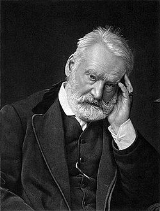
Victor Hugo

 
Victor Hugo

   Email Print
   Bookmark   Link


Victor Hugo


Victor-Marie Hugo (26 February 1802 – 22 May 1885) was a French
France

France , officially the French Republic , is a country whose Metropolitan France is located in Western Europe and that also comprises various Overseas departments and territories of France....
 poet
Poet

A poet is a person who writes poetry....
, playwright
Playwright

A playwright, also known as a dramatist, is a person who writes dramatic literature or drama. These works may be written specifically to be performed by actors or they may be closet dramas or literary works written using dramatic forms but not meant for performance....
, novelist, essay
Essay

An essay is usually a short piece of writing. It is often written from an author's personal Perspective . Essays can be literary criticism, political manifestos, learned arguments, observations of daily life, recollections, and reflections of the author....
ist, visual artist, statesman
Statesman

A statesman or stateswoman or statesperson is usually a politician or other notable figure of state who has had a long and respected career in politics at the national and international level....
, human rights
Human rights

Human rights refer to the "basic rights and freedom to which all humans are entitled." Examples of rights and freedoms which have come to be commonly thought of as human rights include civil and political rights, such as the right to life and liberty, freedom of speech, and equality before the law; and social, cultural and economic rights, i...
 activist and exponent of the Romantic
Romanticism

Romanticism is a complex artistic, literary, and intellectual movement that originated in the second half of the 18th century in Western Europe, and gained strength during the Industrial Revolution....
 movement in France.

In France, Hugo's literary reputation rests primarily on his poetic and dramatic output and only secondarily on his novels. Among many volumes of poetry, Les Contemplations and La Légende des siècles
La Légende des siècles

La L?gende des si?cles is a collection of poems by Victor Hugo, conceived as an immense depiction of the history and evolution of humanity....
 stand particularly high in critical esteem, and Hugo is sometimes identified as the greatest French poet.


Discussion
Ask a question about 'Victor Hugo'
Start a new discussion about 'Victor Hugo'
Answer questions from other users
Full Discussion Forum


Quotations


God became a man, granted. The devil became a woman.

Ruy Blas, Act II, sc. v (1838)

It is man's consolation that the future is to be a sunrise instead of a sunset.

Les bleuets sont bleus. Les roses sont roses.

Translated as: "Violets are blue. Roses are red.", Les Miserables (1862)

Music expresses that which cannot be said and on which it is impossible to remain silent.

The eye was in the tomb and stared at Cain.

La Conscience (1859)

The need of the immaterial is the most deeply rooted of all needs. One must have bread; but before bread, one must have the ideal.

Love in Prison


Encyclopedia


Victor-Marie Hugo (26 February 1802 – 22 May 1885) was a French
France

France , officially the French Republic , is a country whose Metropolitan France is located in Western Europe and that also comprises various Overseas departments and territories of France....
 poet
Poet

A poet is a person who writes poetry....
, playwright
Playwright

A playwright, also known as a dramatist, is a person who writes dramatic literature or drama. These works may be written specifically to be performed by actors or they may be closet dramas or literary works written using dramatic forms but not meant for performance....
, novelist, essay
Essay

An essay is usually a short piece of writing. It is often written from an author's personal Perspective . Essays can be literary criticism, political manifestos, learned arguments, observations of daily life, recollections, and reflections of the author....
ist, visual artist, statesman
Statesman

A statesman or stateswoman or statesperson is usually a politician or other notable figure of state who has had a long and respected career in politics at the national and international level....
, human rights
Human rights

Human rights refer to the "basic rights and freedom to which all humans are entitled." Examples of rights and freedoms which have come to be commonly thought of as human rights include civil and political rights, such as the right to life and liberty, freedom of speech, and equality before the law; and social, cultural and economic rights, i...
 activist and exponent of the Romantic
Romanticism

Romanticism is a complex artistic, literary, and intellectual movement that originated in the second half of the 18th century in Western Europe, and gained strength during the Industrial Revolution....
 movement in France.

In France, Hugo's literary reputation rests primarily on his poetic and dramatic output and only secondarily on his novels. Among many volumes of poetry, Les Contemplations and La Légende des siècles
La Légende des siècles

La L?gende des si?cles is a collection of poems by Victor Hugo, conceived as an immense depiction of the history and evolution of humanity....
 stand particularly high in critical esteem, and Hugo is sometimes identified as the greatest French poet. Outside France, his best-known works are the novels Les Misérables
Les Misérables

Les Mis?rables is a novel by French author Victor Hugo, and among the best-known novels of the 19th century. It has been described as one of the greatest novels ever written in any language....
 and Notre-Dame de Paris
The Hunchback of Notre Dame

The Hunchback of Notre Dame is an 1831 French novel written by Victor Hugo. It is set in 1482 in Paris, in and around the cathedral of Notre Dame de Paris....
 (sometimes translated into English as The Hunchback of Notre Dame
The Hunchback of Notre Dame

The Hunchback of Notre Dame is an 1831 French novel written by Victor Hugo. It is set in 1482 in Paris, in and around the cathedral of Notre Dame de Paris....
).

Though extremely conservative in his youth, Hugo moved to the political left
Left-wing politics

In politics, left-wing, leftist, and the Left are terms applied to Social progressivism and Egalitarianism positions. Originally, during the French Revolution, left-wing referred to seating arrangements in parliament; those who sat on the left opposed the monarchy and supported Political radicalism reform....
 as the decades passed; he became a passionate supporter of republicanism
Republicanism

Republicanism is the ideology of governing a nation as a republic, where the head of state is appointed by other means than hereditary, often elections....
, and his work touches upon most of the political and social issues and artistic trends of his time. He is buried in the Panthéon
Pantheon

Pantheon may refer to:*Pantheon , a word used to describe the set of gods of a particular religion, mythology, or fictional universe* A temple, dedicated to all gods, or to all the gods of a given religion...
.

Life

Victor Hugo was the third and last son of Joseph Léopold Sigisbert Hugo (1773–1828) and Sophie Trébuchet (1772-1821); his brothers were Abel Joseph Hugo (1798–1855) and Eugène Hugo (1800–1837). He was born in 1802 in Besançon
Besançon

Besan?on , is the capital and principal city of the Franche-Comt? Regions of France in eastern France, with approximately 220,000 inhabitants in the aire urbaine in 1999....
 (in the region of Franche-Comté
Franche-Comté

Franche-Comt? the former County of Burgundy, as distinct from the neighbouring Duchy of Burgundy, is an regions of France and a Provinces of France of eastern France....
) and lived in France
France

France , officially the French Republic , is a country whose Metropolitan France is located in Western Europe and that also comprises various Overseas departments and territories of France....
 for the majority of his life. However, he was forced into exile during the reign of Napoleon III
Napoleon III of France

Napol?on III, also known as Louis-Napol?on Bonaparte was the first President of the French Republic and the only emperor of the Second French Empire....
 — he lived briefly in Brussels
Brussels

Brussels , officially the Brussels Capital-Region, is the de facto capital city of the European Union and the largest urban area in Belgium....
 during 1851; in Jersey
Jersey

The Bailiwick of Jersey is a British Crown dependency off the coast of Normandy, France. As well as the island of Jersey itself, the bailiwick includes the nearly uninhabited islands of the Minquiers, ?cr?hous, the Pierres de Lecq and other rocks and reefs....
 from 1852 to 1855; and in Guernsey
Guernsey

The Bailiwick of Guernsey is a British Isles Crown dependency in the English Channel off the coast of Normandy.As well as the island of Guernsey itself, it also includes Alderney, Sark, Herm, Jethou, Brecqhou, Burhou, Lihou and other islets....
 from 1855 to 1870 and again in 1872-1873. There was a general amnesty in 1859; after that, his exile was by choice.

Hugo's early childhood was marked by great events. The century prior to his birth saw the overthrow of the Bourbon Dynasty
House of Bourbon

The House of Bourbon is an important European royal house, a branch of the Capetian dynasty. Bourbon kings first ruled Kingdom of Navarre and France in the 16th century....
 in the French Revolution
French Revolution

The French Revolution was a period of political and social upheaval and radical change in the history of France, during which the French governmental structure, previously an absolute monarchy with feudalism for the aristocracy and Roman Catholic Church clergy, underwent radical change to forms based on Age of Enlightenment principles of cit...
, the rise and fall of the First Republic
French First Republic

The French First Republic was founded on 22 September, 1792, by the newly established National Convention. The First Republic lasted until the declaration of the First French Empire in 1804 under Napoleon....
, and the rise of the First French Empire
First French Empire

The Empire of the French , also known as the Greater French Empire or First French Empire, but more commonly known as the Napoleonic Empire, was the empire of Napoleon I of France in France....
 and dictatorship under Napoléon Bonaparte
Napoleon I of France

Napoleon Bonaparte later known as Emperor Napoleon I, was a military and political leader of France whose actions shaped European politics in the early 19th century....
. Napoléon was proclaimed Emperor two years after Hugo's birth, and the Bourbon Monarchy was restored before his eighteenth birthday. The opposing political and religious views of Hugo's parents reflected the forces that would battle for supremacy in France throughout his life: Hugo's father was a high-ranking officer in Napoléon's army, an atheist
Atheism

Atheism is the absence or rejection of belief in deity, or the explicit view that Existence of God.Many list of atheists are Skepticism of all supernatural beings and cite a lack of empiricism evidence for the existence of deities....
 republican
Republicanism

Republicanism is the ideology of governing a nation as a republic, where the head of state is appointed by other means than hereditary, often elections....
 who considered Napoléon a hero; his mother was a staunch Catholic
Roman Catholic Church

The Roman Catholic Church, officially known as the Catholic Church is the world's largest Christianity Ecclesia , representing over half of all Christians and one-sixth of the world population....
 Royalist
House of Bourbon

The House of Bourbon is an important European royal house, a branch of the Capetian dynasty. Bourbon kings first ruled Kingdom of Navarre and France in the 16th century....
 who is believed to have taken General Victor Lahorie
Victor Lahorie

Victor Claude Alexandre Fanneau de Lahorie was a French general who served during the First Empire.He was shot by a firing squad for his participation in the Claude Fran?ois de Malet against Napol?on....
 as her lover, who was executed in 1812 for plotting against Napoléon. Since Hugo's father, Joseph, was an officer, they moved frequently and Hugo learned much from these travels. On his family's journey to Naples
Naples

Naples is a city in southern Italy, the capital of the region of Campania and of the province of Naples. The city is known for its rich history, art, culture and gastronomy, playing an important role throughout much of its existence; it is over 2,800 years old....
, he saw the vast Alpine
Alpine

The term alpine refers to the Alps, a European mountain range. It is also found in many other instances, which may or may not be related to the mountains:...
 passes and the snowy peaks, the magnificently blue Mediterranean, and Rome
Rome

Rome is the capital city of Italy and Lazio, and is Italy's largest and most populous city, with 2,724,347 residents in an urban area of some ....
 during its festivities. Though he was only nearly six at the time, he remembered the half-year-long trip vividly. They stayed in Naples for a few months and then headed back to Paris
Paris

Paris is the Capital of France and the country's largest city. It is situated on the river Seine, in northern France, at the heart of the ?le-de-France Regions of France ....
.

Sophie followed her husband to posts in Italy
Italy

Italy , officially the Italian Republic , is a country located on the Italian Peninsula in Southern Europe and on the two largest islands in the Mediterranean Sea, Sicily and Sardinia....
 (where Léopold served as a governor of a province near Naples
Naples

Naples is a city in southern Italy, the capital of the region of Campania and of the province of Naples. The city is known for its rich history, art, culture and gastronomy, playing an important role throughout much of its existence; it is over 2,800 years old....
) and Spain
Spain

Spain or the Kingdom of Spain , is a country located in Southern Europe on the Iberian Peninsula.The Spanish constitution does not establish any official denomination of the country, even though Espa?a , Estado espa?ol and Naci?n espa?ola are used interchangeably....
 (where he took charge of three Spanish provinces). Weary of the constant moving required by military life, and at odds with her unfaithful husband, Sophie separated temporarily from Léopold in 1803 and settled in Paris
Paris

Paris is the Capital of France and the country's largest city. It is situated on the river Seine, in northern France, at the heart of the ?le-de-France Regions of France ....
. Thereafter she dominated Hugo's education and upbringing. As a result, Hugo's early work in poetry and fiction reflect a passionate devotion to both King
Monarchism

Monarchism is the advocacy of the establishment, preservation, or restoration of a monarchy as a form of government in a nation. A monarchist is an individual who supports this form of government out of principle, independent from the person, the Monarch....
 and Faith
Faith in Christianity

Faith in Christianity, as in other Abrahamic religions, centers on a belief in God, a belief in the reality of a transcendence that God administers as his kingdom, and in the benevolence of God's will or plan for humankind....
. It was only later, during the events leading up to France's 1848 Revolution, that he would begin to rebel against his Catholic Royalist education and instead champion Republicanism
Republicanism

Republicanism is the ideology of governing a nation as a republic, where the head of state is appointed by other means than hereditary, often elections....
 and Freethought
Freethought

Freethought is a philosophy viewpoint that holds that beliefs should be formed on the basis of science and logic, and should not be influenced by authority, tradition, or any other dogma....
.

Writings

Like many young writers of his generation, Hugo was profoundly influenced by François-René de Chateaubriand
François-René de Chateaubriand

Fran?ois-Ren?, vicomte de Chateaubriand was a France writer, France during the 19th century. He is considered the founder of Romanticism in French literature....
, the famous figure in the literary movement of Romanticism
Romanticism

Romanticism is a complex artistic, literary, and intellectual movement that originated in the second half of the 18th century in Western Europe, and gained strength during the Industrial Revolution....
 and France’s preëminent literary figure during the early 1800s. In his youth, Hugo resolved to be “Chateaubriand or nothing,” and his life would come to parallel that of his predecessor in many ways. Like Chateaubriand, Hugo would further the cause of Romanticism
Romanticism

Romanticism is a complex artistic, literary, and intellectual movement that originated in the second half of the 18th century in Western Europe, and gained strength during the Industrial Revolution....
, become involved in politics as a champion of Republicanism
Republicanism

Republicanism is the ideology of governing a nation as a republic, where the head of state is appointed by other means than hereditary, often elections....
, and be forced into exile due to his political stances. The precocious passion and eloquence of Hugo's early work brought success and fame at an early age. His first collection of poetry (Odes et poésies diverses) was published in 1822, when Hugo was only twenty years old, and earned him a royal pension from Louis XVIII
Louis XVIII of France

Louis XVIII , Louis Stanislas Xavier de France, was a King of list of French monarchs and List of Navarrese monarchs. The brother of Louis XVI of France, and uncle of Louis XVII of France, he ruled the kingdom from 1814 until his death in 1824, with a brief break in 1815 due to his flight from Napoleon I of France during the Hundred Da...
. Though the poems were admired for their spontaneous fervor and fluency, it was the collection that followed four years later in 1826 (Odes et Ballades
Odes et Ballades

Odes et Ballades, published in 1828, is a collection of poems by author Victor Hugo written between 1822 and 1828....
) that revealed Hugo to be a great poet, a natural master of lyric and creative song.

Young Victor fell in love and against his mother's wishes, became secretly engaged to his childhood friend Adèle Foucher (1803-1868). Unusually close to his mother, it was only after her death in 1821 that he felt free to marry Adèle (in 1822). They had their first child Léopold in 1823, but the boy died in infancy. Hugo's other children were Léopoldine
Léopoldine Hugo

L?opoldine C?cile Marie-Pierre Catherine Hugo, born in Paris 28 August 1824 and died in Villequier on 4 September 1843, was the daughter of novelist, poet and dramatist Victor Hugo and his wife, Ad?le Foucher....
 (28 August 1824), Charles
Charles Hugo

Charles Hugo may refer to:*Charles-Hyacinthe Hugo, French Premonstratensian author*Charles Hugo , French writer, son to Victor Hugo, and Concours g?n?ral winner...
 (4 November 1826), François-Victor (28 October 1828) and Adèle (24 August 1830). Hugo published his first novel the following year (Han d'Islande, 1823), and his second three years later (Bug-Jargal
Bug-Jargal

Bug-Jargal is a novel by the France writer Victor Hugo first published in 1826 in literature. It is a reworked version of an earlier short story of the same name written by Hugo in two weeks as a result of a bet, at the age of sixteen....
, 1826). Between 1829 and 1840 he would publish five more volumes of poetry (Les Orientales
Les Orientales

Les Orientales is a series of Poetry by Victor Hugo. They reflect Europe interest in the exotic East....
, 1829; Les Feuilles d'automne, 1831; Les Chants du crépuscule, 1835; Les Voix intérieures, 1837; and Les Rayons et les ombres, 1840), cementing his reputation as one of the greatest elegiac and lyric poets of his time.
Victor Hugo Hunchback
Victor Hugo's first mature work of fiction appeared in 1829, and reflected the acute social conscience that would infuse his later work. Le Dernier jour d'un condamné (The Last Day of a Condemned Man) would have a profound influence on later writers such as Albert Camus
Albert Camus

Albert Camus was an Algerian-born France author, Philosophy, and journalist who won the Nobel Prize in 1957. He is often associated with existentialism, but Camus refused this label....
, Charles Dickens
Charles Dickens

Charles John Huffam Dickens, Royal Society of Arts , pen-name "Boz", was the most popular English people novelist of the Victorian era, as well as a vigorous Reform movement....
, and Fyodor Dostoevsky
Fyodor Dostoevsky

Fyodor Mikhaylovich Dostoyevsky "An Honest Thief"* "Elka i svad'ba" ; English translation: "A Christmas Tree and a Wedding"* Belye nochi ; English translation: White Nights ...
. Claude Gueux
Claude Gueux

Claude Gueux was a short story written by Victor Hugo in 1834. It is considered an early example of "true crime" fiction, and contains Hugo's early thoughts on societal injustice which thirty years later he would flesh out in his novel Les Miserables....
, a documentary short story about a real-life murderer who had been executed in France, appeared in 1834, and was later considered by Hugo himself to be a precursor to his great work on social injustice, Les Misérables
Les Misérables

Les Mis?rables is a novel by French author Victor Hugo, and among the best-known novels of the 19th century. It has been described as one of the greatest novels ever written in any language....
. But Hugo’s first full-length novel would be the enormously successful Notre-Dame de Paris (The Hunchback of Notre Dame
The Hunchback of Notre Dame

The Hunchback of Notre Dame is an 1831 French novel written by Victor Hugo. It is set in 1482 in Paris, in and around the cathedral of Notre Dame de Paris....
), which was published in 1831 and quickly translated into other languages across Europe. One of the effects of the novel was to shame the City of Paris
Paris

Paris is the Capital of France and the country's largest city. It is situated on the river Seine, in northern France, at the heart of the ?le-de-France Regions of France ....
 to undertake a restoration of the much-neglected Cathedral of Notre Dame
Notre Dame de Paris

Notre Dame de Paris is a Gothic architecture cathedral on the eastern half of the ?le de la Cit? in the 4th arrondissement of Paris of Paris, France, with its main entrance to the west....
, which was attracting thousands of tourists who had read the popular novel. The book also inspired a renewed appreciation for pre-renaissance buildings, which thereafter began to be actively preserved.

Hugo began planning a major novel about social misery and injustice as early as the 1830s, but it would take a full 17 years for his most enduringly popular work, Les Misérables
Les Misérables

Les Mis?rables is a novel by French author Victor Hugo, and among the best-known novels of the 19th century. It has been described as one of the greatest novels ever written in any language....
, to be realized and finally published in 1862. The author was acutely aware of the quality of the novel and publication of the work went to the highest bidder. The Belgian publishing house Lacroix and Verboeckhoven undertook a marketing campaign unusual for the time, issuing press releases about the work a full six months before the launch. It also initially published only the first part of the novel (“Fantine”), which was launched simultaneously in major cities. Installments of the book sold out within hours, and had enormous impact on French society. The critical establishment was generally hostile to the novel; Taine found it insincere, Barbey d'Aurevilly complained of its vulgarity, Flaubert found within it "neither truth nor greatness," the Goncourts
Goncourt brothers

The Goncourt brothers were Edmond de Goncourt and Jules de Goncourt , both France Naturalism writers. They formed a partnership that "is possibly unique in literary history....
 lambasted its artificiality, and Baudelaire - despite giving favorable reviews in newspapers - castigated it in private as "tasteless and inept." Nonetheless, Les Misérables proved popular enough with the masses that the issues it highlighted were soon on the agenda of the French National Assembly
National Assembly

The National Assembly is either a legislature, or the lower house of a bicameral legislature in some countries. The best known National Assembly, and the first legislature to be known by this title, was that established during the French Revolution in 1789, known as the National Assembly ....
. Today the novel remains popular worldwide, adapted for cinema, television and musical stage to an extent equaled by few other works of literature.

The shortest correspondence in history is between Hugo and his publisher Hurst & Blackett in 1862. It is said Hugo was on vacation when Les Misérables (which is over 1200 pages) was published. He telegraphed the single-character message '?' to his publisher, who replied with a single '!'.

Hugo turned away from social/political issues in his next novel, Les Travailleurs de la Mer
Toilers of the Sea

Toilers of the Sea , is a novel by Victor Hugo.The book is dedicated to the island of Guernsey, where Hugo spent 15 years in exile....
 (Toilers of the Sea
Toilers of the Sea

Toilers of the Sea , is a novel by Victor Hugo.The book is dedicated to the island of Guernsey, where Hugo spent 15 years in exile....
), published in 1866. Nonetheless, the book was well received, perhaps due to the previous success of Les Misérables. Dedicated to the channel island of Guernsey
Guernsey

The Bailiwick of Guernsey is a British Isles Crown dependency in the English Channel off the coast of Normandy.As well as the island of Guernsey itself, it also includes Alderney, Sark, Herm, Jethou, Brecqhou, Burhou, Lihou and other islets....
 where he spent 15 years of exile, Hugo’s depiction of Man’s battle with the sea and the horrible creatures lurking beneath its depths spawned an unusual fad in Paris: Squid
Squid

Squid are marine cephalopods of the order Teuthida, which comprises around 300 species. Like all other cephalopods, squid have a distinct head, Symmetry #Bilateral_symmetry, a mantle , and cephalopod arms....
s. From squid dishes and exhibitions, to squid hats and parties, Parisiennes became fascinated by these unusual sea creatures, which at the time were still considered by many to be mythical. The word used in Guernsey to refer to squid (pieuvre, also sometimes applied to octopus) was to enter the French language as a result of its use in the book. Hugo returned to political and social issues in his next novel, L'Homme Qui Rit
The Man Who Laughs

The Man Who Laughs is a novel by Victor Hugo, originally published in April 1869 under the French title L'Homme qui rit. Although among Hugo's more obscure works, it was adapted into a popular The Man Who Laughs , directed by Paul Leni and starring Conrad Veidt, Mary Philbin and Olga Baclanova....
 (The Man Who Laughs
The Man Who Laughs

The Man Who Laughs is a novel by Victor Hugo, originally published in April 1869 under the French title L'Homme qui rit. Although among Hugo's more obscure works, it was adapted into a popular The Man Who Laughs , directed by Paul Leni and starring Conrad Veidt, Mary Philbin and Olga Baclanova....
), which was published in 1869 and painted a critical picture of the aristocracy. However, the novel was not as successful as his previous efforts, and Hugo himself began to comment on the growing distance between himself and literary contemporaries such as Flaubert and Zola
Émile Zola

?mile Fran?ois Zola was an influential France writer, the most important exemplar of the literary school of Naturalism , an important contributor to the development of Naturalism , and a major figure in the political liberalization of France and in the exoneration of the falsely accused and convicted army officer Alfred Dreyfus....
, whose realist and naturalist
Naturalism (literature)

Naturalism is a Literature Literary movement that seeks to replicate a Verisimilitude everyday life, as opposed to such movements as Romanticism or Surrealism, in which subjects may receive highly symbolic, idealistic, or even supernatural treatment....
 novels were now exceeding the popularity of his own work. His last novel, Quatrevingt-treize (Ninety-Three
Ninety-Three

Ninety-Three is the last novel by the France writer Victor Hugo. Published in 1874, shortly after the terrible bloody upheaval of the Paris Commune, the novel concerns the Revolt in the Vend?e ? the suppression of the counter-revolutionary revolt in 1793 during the French Revolution....
), published in 1874, dealt with a subject that Hugo had previously avoided: the Reign of Terror
Reign of Terror

The Reign of Terror or simply The Terror was a period of violence that occurred fifteen months after the onset of the French Revolution, incited by conflict between rival political factions, the Girondins and the Jacobin Club, and marked by mass executions of "enemies of the revolution." Estimates vary widely as to how many were kil...
 during the French Revolution
French Revolution

The French Revolution was a period of political and social upheaval and radical change in the history of France, during which the French governmental structure, previously an absolute monarchy with feudalism for the aristocracy and Roman Catholic Church clergy, underwent radical change to forms based on Age of Enlightenment principles of cit...
. Though Hugo’s popularity was on the decline at the time of its publication, many now consider Ninety-Three
Ninety-Three

Ninety-Three is the last novel by the France writer Victor Hugo. Published in 1874, shortly after the terrible bloody upheaval of the Paris Commune, the novel concerns the Revolt in the Vend?e ? the suppression of the counter-revolutionary revolt in 1793 during the French Revolution....
 to be a work on par with Hugo’s better-known novels.

Political life and exile

After three unsuccessful attempts, Hugo was finally elected to the Académie française
Académie française

L'Acad?mie fran?aise, or the French Academy, is the pre-eminent France learned body on matters pertaining to the French language. The Acad?mie was officially established in 1635 by Cardinal Richelieu, the chief minister to Louis XIII of France....
 in 1841, solidifying his position in the world of French arts and letters. Thereafter he became increasingly involved in French politics as a supporter of the Republic
Republic

A republic is a state or country that is not led by a hereditary monarch but in which the people have an impact on its government. The word originates from the Latin term res publica....
 form of government. He was elevated to the peerage by King Louis-Philippe in 1841 and entered the Higher Chamber as a pair de France, where he spoke against the death penalty and social injustice, and in favour of freedom of the press
Freedom of the press

Freedom of the press consists ofconstitutional or Statute protections pertaining to the Mass media and published materials.With respect to governmental information, any government distinguishes which materials are public or protected from disclosure to the public based on classified information as sensitive, classified or secret and being...
 and self-government for Poland
Poland

Poland , officially the Republic of Poland , is a country in Central Europe. Poland is bordered by Germany to the west; the Czech Republic and Slovakia to the south; Ukraine, Belarus and Lithuania to the east; and the Baltic Sea and Kaliningrad Oblast, a Russian Enclave and exclave, to the north....
. He was later elected to the Legislative Assembly and the Constitutional Assembly, following the 1848 Revolution and the formation of the Second Republic
French Second Republic

The French Second Republic was the republican government of France between the Revolutions of 1848 in France and the coup by Napoleon III of France which initiated the Second French Empire....
.
Victor Hugo Exile
When Louis Napoleon (Napoleon III) seized complete power in 1851, establishing an anti-parliamentary constitution
Constitution

A constitution is a system for government — often codified as a written document — that establishes the rules and principles of an autonomous political entity....
, Hugo openly declared him a traitor to France. He relocated to Brussels
Brussels

Brussels , officially the Brussels Capital-Region, is the de facto capital city of the European Union and the largest urban area in Belgium....
, then Jersey
Jersey

The Bailiwick of Jersey is a British Crown dependency off the coast of Normandy, France. As well as the island of Jersey itself, the bailiwick includes the nearly uninhabited islands of the Minquiers, ?cr?hous, the Pierres de Lecq and other rocks and reefs....
, and finally settled with his family on the channel island
Channel Islands

The Channel Islands are a group of islands in the English Channel, off the France coast of Normandy. They include two separate bailiwicks: the Bailiwick of Guernsey and the Bailiwick of Jersey....
 of Guernsey
Guernsey

The Bailiwick of Guernsey is a British Isles Crown dependency in the English Channel off the coast of Normandy.As well as the island of Guernsey itself, it also includes Alderney, Sark, Herm, Jethou, Brecqhou, Burhou, Lihou and other islets....
 at Hauteville House
Hauteville House

Hauteville House is a house where Victor Hugo lived during his exile from France, located at 38 Rue Hauteville in St Peter Port in Guernsey. The house was donated to the City of Paris by Hugo's descendants in March, 1927....
, where he would live in exile until 1870.

While in exile, Hugo published his famous political pamphlets against Napoleon III, Napoléon le Petit
Napoléon le Petit

Napoleon le Petit was an influential political pamphlet by Victor Hugo which condemned the reign of Napoleon III, Emperor of the French. Hugo lived in exile in Guernsey for most of Napoleon III's reign, and his criticism of the monarch was significant as he was one of the most prominent Frenchmen of the time, and was revered by many....
 and Histoire d'un crime
Histoire d'un crime

The History of a Crime is a novel by Victor Hugo about Napoleon III's takeover of France.External links ...
. The pamphlets were banned in France, but nonetheless had a strong impact there. He also composed some of his best work during his period in Guernsey
Guernsey

The Bailiwick of Guernsey is a British Isles Crown dependency in the English Channel off the coast of Normandy.As well as the island of Guernsey itself, it also includes Alderney, Sark, Herm, Jethou, Brecqhou, Burhou, Lihou and other islets....
, including Les Misérables
Les Misérables

Les Mis?rables is a novel by French author Victor Hugo, and among the best-known novels of the 19th century. It has been described as one of the greatest novels ever written in any language....
, and three widely praised collections of poetry (Les Châtiments
Les Châtiments

Les Ch?timents is a collection of poems by Victor Hugo that fiercely attack the grandeur of Napoleon III of France's Second French Empire....
, 1853; Les Contemplations, 1856; and La Légende des siècles
La Légende des siècles

La L?gende des si?cles is a collection of poems by Victor Hugo, conceived as an immense depiction of the history and evolution of humanity....
, 1859).

He convinced the government of Queen Victoria to spare the lives of six Irish people convicted of terrorist activities and his influence was credited in the removal of the death penalty from the constitutions of Geneva
Geneva

Geneva is the second-most-populous city in Switzerland and is the most populous city of Romandie . Situated where the Rh?ne River exits Lake Geneva , it is the capital of the Canton of Geneva....
, Portugal
Portugal

Portugal , officially the Portuguese Republic , is a country on the Iberian Peninsula. Located in southwestern Europe, Portugal is the westernmost country of mainland Europe and is bordered by the Atlantic Ocean to the west and south and by Spain to the north and east....
 and Colombia
Colombia

Colombia , officially the Republic of Colombia , is a country in north-western South America. Colombia is bordered to the east by Venezuela and Brazil; to the south by Ecuador and Peru; to the north by the Caribbean Sea; to the north west by Panama; and to the west by the Pacific Ocean....
.

Although Napoleon III granted an amnesty to all political exiles in 1859, Hugo declined, as it meant he would have to curtail his criticisms of the government. It was only after Napoleon III fell from power and the Third Republic
French Third Republic

The French Third Republic was the political regime of France between the Second French Empire and the Vichy France. It was a republican parliamentary democracy that was created on 4 September 1870 following the collapse of the Empire of Napoleon III of France in the Franco-Prussian War....
 was proclaimed that Hugo finally returned to his homeland in 1870, where he was promptly elected to the National Assembly and the Senate.

He was in Paris during the siege by the Prussian army in 1870, famously eating animals given to him by the Paris zoo. As the siege continued, and food became ever more scarce, he wrote in his diary that he was reduced to "eating the unknown."

Because of his concern for the rights of artists and copyright
Copyright

Copyright is a form of intellectual property which gives the creator of an original work exclusive rights for a certain time period in relation to that work, including its publication, distribution and adaptation; after which time the work is said to enter the public domain....
, he was a founding member of the Association Littéraire et Artistique Internationale
Association Littéraire et Artistique Internationale

Association Litt?raire et Artistique Internationale was founded 1878 in Paris. Victor Hugo was the honorary president and founder of the Voluntary association....
, which led to the Berne Convention for the Protection of Literary and Artistic Works
Berne Convention for the Protection of Literary and Artistic Works

The Berne Convention for the Protection of Literary and Artistic Works, usually known as the Berne Convention, is an international agreement governing copyright, which was first accepted in Berne, Switzerland in 1886....
.

Religious views

Hugo's religious views changed radically over the course of his life. In his youth, he identified as a Catholic
Catholic

Catholic is an adjective derived from the Greek language adjective , meaning "whole" or "complete". In the context of Christianity ecclesiology, it has a rich history and several usages....
 and professed respect for Church hierarchy and authority. From there he evolved into a non-practising Catholic, and expressed increasingly violent anti-catholic and anti-clerical views. He dabbled in Spiritualism during his exile (where he participated also in seance
Séance

A s?ance is an attempt to communicate with Souls. The word "s?ance" comes from the French language word for "seat," "session" or "sitting," from the Old French "seoir," "to sit." In French, the word's meaning is quite general: one may, for example, speak of "une s?ance de cin?ma" ....
s), and in later years settled into a Rationalist Deism
Deism

Deism is a religious and philosophical belief that a supreme natural God exists and created the physical universe, and that religious truths can be arrived at by the application of reason and observation of the natural world....
 similar to that espoused by Voltaire
Voltaire

Fran?ois-Marie Arouet , better known by the pen name Voltaire, was a French Age of Enlightenment writer, essayist, and philosophy known for his wit, philosophical sport, and defense of civil liberty, including freedom of religion and free trade....
. When a census-taker asked Hugo in 1872 if he was a Catholic, he replied, "No. A Freethinker".

Hugo never lost his antipathy towards the Roman Catholic Church
Roman Catholic Church

The Roman Catholic Church, officially known as the Catholic Church is the world's largest Christianity Ecclesia , representing over half of all Christians and one-sixth of the world population....
, due largely to what he saw as the Church's indifference to the plight of the working class under the oppression of the monarchy; and perhaps also due to the frequency with which Hugo's work appeared on the Pope's list of "proscribed books
Index Librorum Prohibitorum

The Index Librorum Prohibitorum was a list of publications censorship by the Roman Catholic Church.It was abolished on June 14, 1966 by Pope Paul VI....
" (Hugo counted 740 attacks on Les Misérables in the Catholic press). On the deaths of his sons Charles and François-Victor, he insisted that they be buried without crucifix or priest, and in his will made the same stipulation about his own death and funeral. However, although Hugo believed Catholic dogma
Dogma

Dogma is the established belief or doctrine held by a religion, ideology or any kind of organization: it is authority and not to be disputed, doubted or heresy....
 to be outdated and dying, he never directly attacked the institution itself. He also remained a deeply religious man who strongly believed in the power and necessity of prayer
Prayer

Prayer is the act of communicating with a deity or spirit in worship. Specific forms of this may include praise, requesting divine providence, confessing sins, as an act of reparation or an expression of one's emotional expression....
.

Hugo's Rationalism
Rationalism

In epistemology and in its modern sense, rationalism is "any view appealing to reason as a source of knowledge or justification" . In more technical terms it is a method or a theory "in which the criterion of the truth is not sensory but intellectual and deductive" ....
 can be found in poems such as Torquemada (1869, about religious fanaticism
Religious fanaticism

Religious fanaticism can be defined as fanaticism related to a person's, or a group's, devotion to a religion. However, Religious Fanaticism is a subjective evaluation defined by the culture context that is performing the evaluation....
), The Pope (1878, violently anti-clerical), Religions and Religion (1880, denying the usefulness of churches) and, published posthumously, The End of Satan and God (1886 and 1891 respectively, in which he represents Christianity
Christianity

Christianity is a Monotheistic religion #Christian view religion centered on the life and teachings of Jesus as New Testament view on Jesus' life....
 as a griffin and Rationalism
Rationalism

In epistemology and in its modern sense, rationalism is "any view appealing to reason as a source of knowledge or justification" . In more technical terms it is a method or a theory "in which the criterion of the truth is not sensory but intellectual and deductive" ....
 as an angel). "Religions pass away, but God remains", Hugo declared. Christianity would eventually disappear, he predicted, but people would still believe in "God, Soul, and the Power."

Victor Hugo and Music

Although Hugo's many talents did not include exceptional musical ability, he nevertheless had a great impact on the music world through the endless inspiration that his works provided for composers of the 19th and 20th century. Hugo himself particularly enjoyed the music of Gluck and Weber
Carl Maria von Weber

Carl Maria Friedrich Ernst von Weber was a Germans composer, conducting, pianist, guitarist and critic, one of the first significant composers of the Romanticism school....
 and greatly admired Beethoven, and rather unusually for his time, he also appreciated works by composers from earlier centuries such as Palestrina
Giovanni Pierluigi da Palestrina

Giovanni Pierluigi da Palestrina was an Italy composer of the Renaissance music. He was the most famous sixteenth-century representative of the Roman School of musical composition....
 and Monteverdi. Two famous musicians of the 19th century were friends of Hugo: Berlioz and Liszt
Liszt

Liszt may refer to:*Franz Liszt, Hungarian composer and pianist*Anna Liszt, mother of composer Franz Liszt*Adam Liszt, father of composer Franz Liszt...
. The latter played Beethoven in Hugo’s home, and Hugo joked in a letter to a friend that thanks to Liszt’s piano lessons, he learned how to play a favourite song on the piano – even though only with one finger! Hugo also worked with composer Louise Bertin
Louise Bertin

Louise-Ang?lique Bertin was a France composer and poet.Louise Bertin lived her entire life in France. Born on January 15, 1805, Bertin was a member of a family that thrived on the arts....
, writing the libretto for her 1836 opera La Esmeralda which was based on Hugo’s novel Notre-Dame de Paris
The Hunchback of Notre Dame

The Hunchback of Notre Dame is an 1831 French novel written by Victor Hugo. It is set in 1482 in Paris, in and around the cathedral of Notre Dame de Paris....
. Although for various reasons this beautiful and original opera closed soon after its fifth performance and is little known today, it has been recently enjoying a revival, both in a piano/song concert version by Liszt at the Festival international Victor Hugo et Égaux 2007 and in a full orchestral version to be presented in July 2008 at Le Festival de Radio France et Montpellier Languedoc-Roussillon.

Well over one thousand musical compositions have been inspired by Hugo’s works from the 1800s until the present day. In particular, Hugo’s plays, in which he rejected the rules of classical theatre in favour of romantic drama, attracted the interest of many composers who adapted them into operas. More than one hundred operas are based on Hugo’s works and among them are Donizetti’s Lucrezia Borgia (1833), Verdi’s Rigoletto (1851) and Ernani (1844), and Ponchielli’s La Gioconda (1876). Hugo’s novels as well as his plays have been a great source of inspiration for musicians, stirring them to create not only opera and ballet but musical theatre such as Notre-Dame de Paris
Notre Dame de Paris (musical)

Notre Dame de Paris is a France-Canada Musical theater which debuted on 16 September 1998 in Paris. It is based upon the novel The Hunchback of Notre Dame by the French novelist Victor Hugo....
 and the ever-popular Les Misérables
Les Misérables (musical)

Les Mis?rables , colloquially known as Les Mis or Les Miz, is a Musical theatre composed in 1980 by the French composer Claude-Michel Sch?nberg with a libretto by Alain Boublil....
, London
London

London is the capital of both England and the United Kingdom, and the most populous municipality in the European Union. An important settlement for two millennia, History of London goes back to its founding by the Roman Empire....
 West End
West End of London

The West End of London is an area of Central London, England, containing many of the city's major tourist attractions, businesses, headquarters and the commercial West End theatres....
’s longest running musical. Additionally, Hugo’s beautiful poems have attracted an exceptional amount of interest from musicians, and numerous melodies have been based on his poetry by composers such as Berlioz, Bizet, Fauré
Faure

Faure is a French family name and may refer to:People:* Edgar Faure, French politician* ?mile Alphonse Faure, lead battery pioneer* C?dric Faur?, French football striker...
, Franck
Franck

Franck can refer to:People:* C?sar Franck , Belgian composer of the Romantic era* Harry A. Franck , travel writer* James Franck , a German physicist and Nobel laureate...
, Lalo, Liszt
Liszt

Liszt may refer to:*Franz Liszt, Hungarian composer and pianist*Anna Liszt, mother of composer Franz Liszt*Adam Liszt, father of composer Franz Liszt...
, Massenet, Saint-Saëns
Camille Saint-Saëns

Charles-Camille Saint-Sa?ns was a French composer, organist, Conductor , and pianist, known especially for The Carnival of the Animals, Danse Macabre , Samson and Delilah , Havanaise , Introduction and Rondo capriccioso , and his Symphony No....
, Rachmaninov and Wagner.

Today, Hugo’s work continues to stimulate musicians to create new compositions. For example, Hugo’s novel against capital punishment, The Last Day of a Condemned Man, has recently been adapted into an opera by David Alagna (libretto by Frédérico Alagna). Their brother, tenor Roberto Alagna
Roberto Alagna

Roberto Alagna is a France operatic tenor of Sicilian descent. He was born in Clichy-sous-Bois, Seine-Saint-Denis, France....
, performed in the opera’s premiere in Paris in the summer of 2007 and again in February 2008 in Valencia with Erwin Schrott as part of the Festival international Victor Hugo et Égaux 2008. In Guernsey, every two years the attracts a wide range of musicians and the premiere of songs specially commissioned from Guillaume Connesson and based on Hugo’s poetry.

Declining years and death

Legros   Victor Hugo
When Hugo returned to Paris
Paris

Paris is the Capital of France and the country's largest city. It is situated on the river Seine, in northern France, at the heart of the ?le-de-France Regions of France ....
 in 1870, the country hailed him as a national hero. Despite his popularity Hugo lost his bid for reelection to the National Assembly in 1872. Within a brief period, he suffered a mild stroke
Stroke

A stroke is the rapidly developing loss of brain function due to a disturbance in the blood supply to the brain. According to the National Stroke Association, a "stroke" occurs when a blood clot blocks and artery or a blood vessel breaks, interrupting blood flow to an area of the brain....
, his daughter Adèle’s internment in an insane asylum, and the death of his two sons. (His other daughter, Léopoldine, had drowned in a boating accident in 1843, and his wife Adèle had died in 1868. His faithful mistress, Juliette Drouet
Juliette Drouet

Juliette Drouet, born Julienne Josephine Gauvain was a French actress and the mistress of Victor Hugo.Childhood And Early Years...
, died in 1883, only two years before his own death.) Despite his personal loss, Hugo remained committed to the cause of political change. On 30 January 1876 Hugo was elected to the newly created Senate. His last phase in his political career is considered a failure. Hugo took on a stubborn role and got little done in the Senate.

In February 1881 Hugo celebrated his 79th birthday. To honor the fact that he was entering his eightieth year, one of the greatest tributes to a living writer was held. The celebrations began on the 25th when Hugo was presented with a Sèvres vase, the traditional gift for sovereigns. On the 27th one of the largest parades in French history was held. Marchers stretched from Avenue d'Eylau, down the Champs-Élysées
Champs-Élysées

The Avenue des Champs-?lys?es is the most prestigious Avenue in Paris. With its movie theaters, caf?s, and luxury specialty shops, the Avenue des Champs-?lys?es is one of the most famous streets in the world, and with rents as high as $1.50 million 1000 square feet of space, it remains the most expensive strip of real estate in Europe....
, and all the way to the center of Paris. The paraders marched for six hours to pass Hugo as he sat in the window at his house. Every inch and detail of the event was for Hugo; the official guides even wore cornflowers as an allusion to Cosette's song in Les Misérables.

Victor Hugo's death on 22 May 1885, at the age of 83, generated intense national mourning. He was not only revered as a towering figure in French literature, but also internationally acknowledged as a statesman who had helped preserve and shape the Third Republic
French Third Republic

The French Third Republic was the political regime of France between the Second French Empire and the Vichy France. It was a republican parliamentary democracy that was created on 4 September 1870 following the collapse of the Empire of Napoleon III of France in the Franco-Prussian War....
 and democracy
Democracy

Democracy is a form of government in which power is held directly or indirectly by citizens under a free electoral system. It is derived from the Greek language d?????at?a , "popular government" which was coined from d???? , "people" and ???t?? , "rule, strength" in the middle of the 5th-4th century BC to denote the political syst...
 in France. More than two million people joined his funeral procession in Paris
Paris

Paris is the Capital of France and the country's largest city. It is situated on the river Seine, in northern France, at the heart of the ?le-de-France Regions of France ....
 from the Arc de Triomphe
Arc de Triomphe

The Arc de Triomphe is a monument in Paris, France that stands in the centre of the Place Charles de Gaulle, also known as the Place de l'?toile....
 to the Panthéon
Pantheon

Pantheon may refer to:*Pantheon , a word used to describe the set of gods of a particular religion, mythology, or fictional universe* A temple, dedicated to all gods, or to all the gods of a given religion...
, where he was buried. He shares a crypt within the Panthéon
Pantheon

Pantheon may refer to:*Pantheon , a word used to describe the set of gods of a particular religion, mythology, or fictional universe* A temple, dedicated to all gods, or to all the gods of a given religion...
 with Alexandre Dumas and Émile Zola
Émile Zola

?mile Fran?ois Zola was an influential France writer, the most important exemplar of the literary school of Naturalism , an important contributor to the development of Naturalism , and a major figure in the political liberalization of France and in the exoneration of the falsely accused and convicted army officer Alfred Dreyfus....
.

Drawings

Many are not aware that Hugo was almost as prolific in the visual arts as he was in literature, producing more than 4,000 drawings in his lifetime. Originally pursued as a casual hobby, drawing became more important to Hugo shortly before his exile, when he made the decision to stop writing in order to devote himself to politics. Drawing became his exclusive creative outlet during the period 1848-1851.

Hugo worked only on paper, and on a small scale; usually in dark brown or black pen-and-ink
Pen and ink

Pen and ink refers to a technique of drawing or writing, in which colored ink is applied to paper using a pen or other stylus. It may be used as a medium for Sketch es, or for finished works of art....
 wash, sometimes with touches of white, and rarely with color. The surviving drawings are surprisingly accomplished and "modern" in their style and execution, foreshadowing the experimental techniques of Surrealism
Surrealism

Surrealism is a cultural movement that began in the early-1920s, and is best known for the visual artworks and writings of the group members....
 and Abstract Expressionism
Abstract expressionism

Abstract expressionism was an American post?World War II art movement. It was the first specifically American movement to achieve worldwide influence and also the one that put New York City at the center of the art world, a role formerly filled by Paris....
.

He would not hesitate to use his children's stencils, ink blots, puddles and stains, lace impressions, "pliage" or folding (i.e. Rorschach blots), "grattage" or rubbing, often using the charcoal from match sticks or his fingers instead of pen or brush. Sometimes he would even toss in coffee or soot to get the effects he wanted. It is reported that Hugo often drew with his left hand or without looking at the page, or during Spiritualist séance
Séance

A s?ance is an attempt to communicate with Souls. The word "s?ance" comes from the French language word for "seat," "session" or "sitting," from the Old French "seoir," "to sit." In French, the word's meaning is quite general: one may, for example, speak of "une s?ance de cin?ma" ....
s, in order to access his unconscious mind
Unconscious mind

The Unconscious is a term invented by the 18th century German philosophy romanticism philosopher Friedrich Wilhelm Joseph Schelling and later introduced into English by the poet and essayist Samuel Taylor Coleridge....
, a concept only later popularized by Sigmund Freud
Sigmund Freud

Sigmund Freud , born Sigismund Schlomo Freud , was an Austrian psychiatrist who founded the psychoanalysis of psychology. Freud is best known for his theories of the unconscious mind and the defense mechanism of Psychological repression and for creating the clinical practice of psychoanalysis for curing psychopathology through dialogue...
.

Hugo kept his artwork out of the public eye, fearing it would overshadow his literary work. However, he enjoyed sharing his drawings with his family and friends, often in the form of ornately handmade calling cards, many of which were given as gifts to visitors when he was in political exile. Some of his work was shown to, and appreciated by, contemporary artists such as Van Gogh
Vincent van Gogh

Vincent Willem van Gogh was a Dutch people Post-Impressionism artist. Some of his paintings are now among the world's best known, most popular and expensive works of art....
 and Delacroix
Delacroix

Delacroix derives from de la Croix . It may refer to:In people:* Charles-Fran?ois Delacroix, French ambassador to the Netherlands* Eug?ne Delacroix, a French Romantic artist...
; the latter expressed the opinion that if Hugo had decided to become a painter instead of a writer, he would have outshone the artists of their century.

Gallery: Image:Victor_Hugo-Setting_Sun.jpg|Crépuscule ("Twilight"), Jersey, 1853-1855. Image:Victor_Hugo-Bridge.jpg|Ville avec le pont de Tumbledown, 1847. Image:Victor_Hugo-Octopus.jpg|Pieuvre avec les initales V.H., ("Octopus with the initials V.H."), 1866. Image:Hugo lerocherdelermitage.jpg|Le Rocher de l'Ermitage dans un paysage imaginaire ("Hermitage Rock in an Imaginary Landscape") Image:Hugo.jpg|Le phare ("The Lighthouse")

Memorials


The people of Guernsey
Guernsey

The Bailiwick of Guernsey is a British Isles Crown dependency in the English Channel off the coast of Normandy.As well as the island of Guernsey itself, it also includes Alderney, Sark, Herm, Jethou, Brecqhou, Burhou, Lihou and other islets....
 erected a statue in Candie Gardens (St. Peter Port) to commemorate his stay in the islands. The City of Paris
Paris

Paris is the Capital of France and the country's largest city. It is situated on the river Seine, in northern France, at the heart of the ?le-de-France Regions of France ....
 has preserved his residences Hauteville House
Hauteville House

Hauteville House is a house where Victor Hugo lived during his exile from France, located at 38 Rue Hauteville in St Peter Port in Guernsey. The house was donated to the City of Paris by Hugo's descendants in March, 1927....
, Guernsey
Guernsey

The Bailiwick of Guernsey is a British Isles Crown dependency in the English Channel off the coast of Normandy.As well as the island of Guernsey itself, it also includes Alderney, Sark, Herm, Jethou, Brecqhou, Burhou, Lihou and other islets....
 and 6, Place des Vosges, Paris
Paris

Paris is the Capital of France and the country's largest city. It is situated on the river Seine, in northern France, at the heart of the ?le-de-France Regions of France ....
 as museums. The house where he stayed in Vianden
Vianden

Vianden is a Communes of Luxembourg with List of cities in Luxembourg in the Oesling, north-eastern Luxembourg, with over 1,500 inhabitants. It is the Capital of the Vianden , which is part of the Diekirch ....
, Luxembourg, in 1871 has also become a commemorative museum.

Hugo is venerated as a saint
Saint

A saint in Christianity is a human being who has been called to holiness. The term is used differently by various denominations, with some, such as the Anglicans, Methodists, and Lutherans distinguishing between Saints and saints....
 in the Vietnam
Vietnam

Vietnam , officially the Socialist Republic of Vietnam , is the easternmost country on the Indochina Peninsula in Southeast Asia. It is bordered by People's Republic of China to the north, Laos to the northwest, Cambodia to the southwest, and the South China Sea to the east....
ese religion of Cao Dai
Cao Dai

Cao ??i is a relatively new, syncretism, monotheistic religion, officially established in Tay Ninh, southern Vietnam, in 1926. ??o Cao ??i is the religion's shortened name, the full name is ??i ??o Tam K? Ph? ?? ....
.

The Avenue Victor-Hugo in the XVIème arrondissement of Paris bears Hugo's name, and links the Place de l'Étoile to the vicinity of the Bois de Boulogne
Bois de Boulogne

The Bois de Boulogne is a park located along the western edge of the 16th arrondissement of Paris of Paris, near the suburb of Boulogne-Billancourt....
 by way of the Place Victor-Hugo. This square is served by a Paris Métro
Paris Métro

The Paris M?tro or M?tropolitain is the rapid transit system in Paris. It is a symbol of the city, notable for its station architecture, influenced by Art Nouveau....
 stop
Victor Hugo (Paris Metro)

Victor Hugo is a station on the Paris M?tro, serving Paris M?tro Line 2. It is named after the author Victor Hugo.When first opened in 1900 as part of line 2 Nord, the platforms were built on the tight bend between Avenue Victor Hugo and Avenue Bugeaud....
 also named in his honor. A number of streets and avenues throughout France are likewise named after him. The school Lycée Victor Hugo in his town of birth, Besançon
Besançon

Besan?on , is the capital and principal city of the Franche-Comt? Regions of France in eastern France, with approximately 220,000 inhabitants in the aire urbaine in 1999....
 in France. Avenue Victor-Hugo, located in Shawinigan, Quebec
Quebec

Quebec , in French language, Qu?bec , is a Provinces and territories of Canada in the Central Canada and Eastern Canada regions of Canada....
, Canada
Canada

Canada is a country occupying most of northern North America, extending from the Atlantic Ocean in the east to the Pacific Ocean in the west and northward into the Arctic Ocean....
, was named to honor him.

In the city of Avellino
Avellino

Avellino is a town and comune, capital of the province of Avellino in the Campania region of southern Italy. It is situated in a plain surrounded by mountains 42 km north-east of Naples and is an important hub on the road from Salerno to Benevento....
, Italy
Italy

Italy , officially the Italian Republic , is a country located on the Italian Peninsula in Southern Europe and on the two largest islands in the Mediterranean Sea, Sicily and Sardinia....
, Victor Hugo lived briefly stayed in what is now known as Il Palazzo Culturale, when reuniting with his father, Leopold Sigisbert Hugo, in 1808. Victor would later write about his brief stay here quoting "C’était un palais de marbre...". In the city of Edinburgh
Edinburgh

Edinburgh ; is the Capital city of Scotland, a position it has held since 1437. It is the seventh largest city in the United Kingdom and the second largest Scottish City status in the United Kingdom after Glasgow....
, Scotland
Scotland

conventional_long_name = ScotlandAlba|common_name= Scotland|image_flag = Flag of Scotland.svg|flag_width = 130px...
 there is a delicatessen named Victor Hugo Delicatessen, it was originally run by a French couple but was purchased in 2005. The shop is on Melville Terrace, over looking the meadows and next to University of Edinburgh
University of Edinburgh

The University of Edinburgh founded in 1582, is an internationally renowned centre for teaching and research in Edinburgh, Scotland, United Kingdom....
 halls of residence, Sciennes
Sciennes

Sciennes is an area of Edinburgh, Scotland, just outside the city centre to the south of the The Meadows , with Newington, Edinburgh to the east....
.

Works


Published during Hugo's lifetime

  • Odes et poésies diverses (1822)
  • Odes (Hugo) (1823)
  • Han d'Islande (1823) (Hans of Iceland)
  • Nouvelles Odes (1824)
  • Bug-Jargal
    Bug-Jargal

    Bug-Jargal is a novel by the France writer Victor Hugo first published in 1826 in literature. It is a reworked version of an earlier short story of the same name written by Hugo in two weeks as a result of a bet, at the age of sixteen....
     (1826)
  • Odes et Ballades
    Odes et Ballades

    Odes et Ballades, published in 1828, is a collection of poems by author Victor Hugo written between 1822 and 1828....
     (1826)
  • Cromwell
    Cromwell (play)

    Cromwell is a play by Victor Hugo written in 1827. It was a result of the creation of the literary circle created by Victor Hugo. This literary circle was called the Romanticism and they were against the Classicism....
     (1827)
  • Les Orientales
    Les Orientales

    Les Orientales is a series of Poetry by Victor Hugo. They reflect Europe interest in the exotic East....
     (1829)
  • Le Dernier jour d'un condamné (1829) (The Last Day of a Condemned Man)
  • Hernani
    Hernani (drama)

    ------Hernani is a drama by the French romantic author Victor Hugo.The play opened in Paris on February 25, 1830. Today, the drama is more remembered for the demonstrations which accompanied the premiere, and for being the inspiration of Giuseppe Verdi's opera Ernani, than it is for its own merits....
     (1830)
  • Notre-Dame de Paris (1831), (The Hunchback of Notre Dame
    The Hunchback of Notre Dame

    The Hunchback of Notre Dame is an 1831 French novel written by Victor Hugo. It is set in 1482 in Paris, in and around the cathedral of Notre Dame de Paris....
    )
  • Marion Delorme
    Marion Delorme (Hugo)

    Marion Delorme is a play by Victor Hugo in 5 acts, about the famous French courtesan Marion Delorme. It was first presented in 1831....
     (1831)
  • Les Feuilles d'automne (1831)
  • Le roi s'amuse
    Le roi s'amuse

    Le roi s'amuse is a play written by Victor Hugo in 1832. While it depicts the escapades of Francis I of France, censors of the time believed that it also contained insulting references to King Louis-Philippe and banned it after one performance....
     (1832)
  • Lucrèce Borgia (1833) (Lucretia Borgia)
  • Marie Tudor (1833)
  • Littérature et philosophie mêlées (1834)
  • Claude Gueux
    Claude Gueux

    Claude Gueux was a short story written by Victor Hugo in 1834. It is considered an early example of "true crime" fiction, and contains Hugo's early thoughts on societal injustice which thirty years later he would flesh out in his novel Les Miserables....
     (1834)
  • Angelo, tyran de padoue (1835)
  • Les Chants du crépuscule (1835)
  • La Esmeralda (only libretto of an opera written by Victor Hugo himself) (1836)
  • Les Voix intérieures (1837)
  • Ruy Blas
    Ruy Blas

    Ruy Blas is a Tragedy drama by Victor Hugo. It was the first play presented at the Th??tre de la Renaissance and opened on November 8 1838....
     (1838)
  • Les Rayons et les ombres (1840)
  • Le Rhin
    Le Rhin

    Le Rhin is a travel guide written by Victor Hugo. Similar to Mark Twain's writings about the Mississippi, it includes many stories about the Rhine river. It ends with a political manifesto....
     (1842)
  • Les Burgraves
    Les Burgraves

    Les Burgraves is a Play by Victor Hugo. It takes place along the Rhine and features the return of Emperor Barbarossa....
     (1843)
  • Napoléon le Petit
    Napoléon le Petit

    Napoleon le Petit was an influential political pamphlet by Victor Hugo which condemned the reign of Napoleon III, Emperor of the French. Hugo lived in exile in Guernsey for most of Napoleon III's reign, and his criticism of the monarch was significant as he was one of the most prominent Frenchmen of the time, and was revered by many....
     (1852)
  • Les Châtiments
    Les Châtiments

    Les Ch?timents is a collection of poems by Victor Hugo that fiercely attack the grandeur of Napoleon III of France's Second French Empire....
     (1853)
  • Les Contemplations (1856)
  • La Légende des siècles
    La Légende des siècles

    La L?gende des si?cles is a collection of poems by Victor Hugo, conceived as an immense depiction of the history and evolution of humanity....
     (1859)
  • Les Misérables
    Les Misérables

    Les Mis?rables is a novel by French author Victor Hugo, and among the best-known novels of the 19th century. It has been described as one of the greatest novels ever written in any language....
     (1862)
  • William Shakespeare
    William Shakespeare (essay)

    William Shakespeare was an 1864 work by Victor Hugo, written in his 13th year of exile. When he began writing it, he intended for it to be an introduction for a collection of French translations of Shakespeare's plays written by his son, Francois Victor Hugo....
     (1864)
  • Les Chansons des rues et des bois (1865)
  • Les Travailleurs de la Mer (1866), (Toilers of the Sea
    Toilers of the Sea

    Toilers of the Sea , is a novel by Victor Hugo.The book is dedicated to the island of Guernsey, where Hugo spent 15 years in exile....
    )
  • La voix de Guernsey (1867)
  • L'Homme qui rit (1869), (The Man Who Laughs
    The Man Who Laughs

    The Man Who Laughs is a novel by Victor Hugo, originally published in April 1869 under the French title L'Homme qui rit. Although among Hugo's more obscure works, it was adapted into a popular The Man Who Laughs , directed by Paul Leni and starring Conrad Veidt, Mary Philbin and Olga Baclanova....
    )
  • L'Année terrible
    L'Année terrible

    L'Ann?e Terrible is a series of Poetry written by Victor Hugo. They deal with the trauma of Death his son and the Siege of Paris of Paris...
     (1872)
  • Quatrevingt-treize (Ninety-Three
    Ninety-Three

    Ninety-Three is the last novel by the France writer Victor Hugo. Published in 1874, shortly after the terrible bloody upheaval of the Paris Commune, the novel concerns the Revolt in the Vend?e ? the suppression of the counter-revolutionary revolt in 1793 during the French Revolution....
    ) (1874)
  • Mes Fils (1874)
  • Actes et paroles
    Actes et Paroles

    Actes et Paroles is a book by Victor Hugo that recounts his life story and his dreams of the future. He speaks of universal education and a United States of Europe. He is very hostile to the military and church....
     — Avant l'exil
    (1875)
  • Actes et paroles - Pendant l'exil (1875)
  • Actes et paroles - Depuis l'exil (1876)
  • La Légende des Siècles 2e série (1877)
  • L'Art d'être grand-père
    L'Art d'être grand-père

    L'Art d'?tre grand-p?re or The Art of Being a Grandfather are a series of poems by Victor Hugo. They deal with the feelings of being a grandfather with innocent young children....
     (1877)
  • Histoire d'un crime
    Histoire d'un crime

    The History of a Crime is a novel by Victor Hugo about Napoleon III's takeover of France.External links ...
      1re partie (1877)
  • Histoire d'un crime 2e partie (1878)
  • Le Pape
    Le Pape

    Le Pape was a political tract by Victor Hugo supporting Christianity but attacking the rigid organization of the Catholic Church....
     (1878)
  • La pitié suprême (1879)
  • Religions et religion
    Religions et religion

    "Religions et religion" was an 1880 political tract by Victor Hugo supporting belief in God but attacking organized religion....
     (1880)
  • L'Âne (1880)
  • Les Quatres vents de l'esprit (1881)
  • Torquemada
    Torquemada (play)

    Torquemada is a Play by Victor Hugo about the Inquisition on Spain. It criticized both fanatical Catholicism and the current pogroms in Russia....
     (1882)
  • La Légende des siècles Tome III (1883)
  • L'Archipel de la Manche (1883)


Poems of Victor Hugo

Victor Hugo's poetry captured the spirit of the Romanticism. They were largely devoted to 19th century causes. Many touched on religious themes. Initially they were royalist but gradually shifted to Bonapartist and Republican....


Published posthumously

  • Théâtre en liberté (1886)
  • La fin de Satan
    La fin de Satan

    La Fin de Satan is a work of poetry Victor Hugo written between 1854 and 1862, but unfinished and published after his death, in 1886.The book starts with the disgrace of Satan ....
     (1886)
  • Choses vues (1887)
  • Toute la lyre (1888)
  • Amy Robsart (1889)
  • Les Jumeaux (1889)
  • Actes et Paroles Depuis l'exil, 1876-1885 (1889)
  • Alpes et Pyrénées (1890)
  • Dieu (1891)
  • France et Belgique (1892)
  • Toute la lyre - dernière série (1893)
  • Correspondances - Tome I (1896)
  • Correspondances - Tome II (1898)
  • Les années funestes (1898)
  • Choses vues - nouvelle série (1900)
  • Post-scriptum de ma vie (1901)
  • Dernière Gerbe (1902)
  • Mille francs de récompense (1934)
  • Océan. Tas de pierres (1942)
  • L'Intervention (1951)
  • Conversations with Eternity
    Conversations with Eternity

    Conversations with Eternity is a book by John Chambers, published from a series of notes by Victor Hugo. It "set out to present the Hugo family's table-turning seances in Marine-Terrace on the island of Jersey between 1853 and 1855"....


Online texts

  • at Internet Archive
    Internet Archive

    The Internet Archive is a nonprofit organization dedicated to building and maintaining a free and openly accessible online digital library, including an archive site of the World Wide Web....
  • at The Online Books Page
  • in The Times
    The Times

    The Times is a daily national newspaper published in the United Kingdom since 1785 when it was known as The Daily Universal Register.The Times and its sister paper The Sunday Times are published by Times Newspapers Limited, a subsidiary of News International....


Online references

  • Afran, Charles (1997). . Website: Discover France. (Originally published in Grolier Multimedia Encyclopedia, 1997, v.9.0.1.) Retrieved November 2005.
  • Bates, Alfred (1906). . Website: Theatre History. (Originally published in The Drama: Its History, Literature and Influence on Civilization, vol. 9. ed. Alfred Bates. London: Historical Publishing Company, 1906. pp. 11-13.) Retrieved November 2005.
  • Bates, Alfred (1906). . Website: Theatre History. (Originally published in The Drama: Its History, Literature and Influence on Civilization, vol. 9. ed. Alfred Bates. London: Historical Publishing Company, 1906. pp. 20-23.) Retrieved November 2005.
  • Bates, Alfred (1906). . Website: Theatre History. (Originally published in The Drama: Its History, Literature and Influence on Civilization, vol. 9. ed. Alfred Bates. London: Historical Publishing Company, 1906. pp. 18-19.) Retrieved November 2005.
  • Bittleston, Misha (uncited date). . Website: Misha Bittleston. Retrieved November 2005.
  • Burnham, I.G. (1896). . Website: Theatre History. (Originally published in Victor Hugo: Dramas. Philadelphia: The Rittenhouse Press, 1896. pp. 203-6, 401-2.) Retrieved November 2005.
  • Columbia Encyclopedia, 6th Edition (2001-05). . Website: Bartleby, Great Books Online. Retrieved November 2005. Retrieved November 2005.
  • Haine, W. Scott (1997). . Encyclopedia of 1848 Revolutions. Website: Ohio University. Retrieved November 2005.
  • Illi, Peter (2001-2004). . Website: The Victor Hugo Website. Retrieved November 2005.
  • Karlins, N.F. (1998). Website: ArtNet. Retrieved November 2005.
  • Liukkonen, Petri (2000). . Books and Writers. Website: Pegasos: A Literature Related Resource Site. Retrieved November 2005.
  • Meyer, Ronald Bruce (2004). . Website: Ronald Bruce Meyer. Retrieved November 2005.
  • Robb, Graham (1997). . Website: New York Times (Books). (Excerpt from Graham, Robb (1997). Victor Hugo: A Biography. New York: W.W. Norton & Company.) Retrieved November 2005.
  • Roche, Isabel (2005). . Meet the Writers. Website: Barnes & Noble
    Barnes & Noble

    Barnes & Noble, Inc. is the largest book retailing in the United States, operating mainly through its Barnes & Noble Booksellers chain of bookstores headquartered in lower Fifth Avenue in Manhattan....
    . (From the Barnes & Noble Classics edition of The Hunchback of Notre Dame, 2005.) Retrieved November 2005.
  • Uncited Author. . Website: Spartacus Educational. Retrieved November 2005.
  • Uncited Author. . Website: BBC. Retrieved November 2005.
  • Uncited Author. (2000-2005). . Website: The Literature Network. Retrieved November 2005.
  • Uncited Author. . Website: Présence de la Littérature a l’école. Retrieved November 2005.


Further reading

  • Barbou, Alfred (1882). Victor Hugo and His Times. University Press of the Pacific: 2001 paper back edition.
  • Brombert, Victor H. (1984). Victor Hugo and the Visionary Novel. Boston: Harvard University Press.
  • Davidson, A.F. (1912). Victor Hugo: His Life and Work. University Press of the Pacific: 2003 paperback edition.
  • Dow, Leslie Smith (1993). Adele Hugo: La Miserable. Fredericton: Goose Lane Editions.
  • Falkayn, David (2001). Guide to the Life, Times, and Works of Victor Hugo. University Press of the Pacific.
  • Feller, Martin, Der Dichter in der Politik. Victor Hugo und der deutsch-französische Krieg von 1870/71. Untersuchungen zum französischen Deutschlandbild und zu Hugos Rezeption in Deutschland. Doctoral Dissertation, Marburg 1988.
  • Frey, John Andrew (1999). A Victor Hugo Encyclopedia. Greenwood Press.
  • Grant, Elliot (1946). The Career of Victor Hugo. Harvard University Press. Out of print.
  • Halsall, A.W. et al (1998). Victor Hugo and the Romantic Drama. University of Toronto Press
    University of Toronto Press

    The University of Toronto Press Inc. is a publishing house and an independent division of the University of Toronto that engages in academic publishing....
    .
  • Hart, Simon Allen (2004). Lady in the Shadows : The Life and Times of Julie Drouet, Mistress, Companion and Muse to Victor Hugo. Publish American.
  • Houston, John Porter (1975). Victor Hugo. New York: Twayne Publishers.
  • Hovasse, Jean-Marc (2001 and 2008), Victor Hugo. Paris: Fayard
  • Ireson, J.C. (1997). Victor Hugo: A Companion to His Poetry. Clarendon Press.
  • Laster, Arnaud (2002). Hugo à l'Opéra. Paris: L'Avant-Scène Opéra, no. 208.
  • Maurois, Andre (1956). Olympio: The Life of Victor Hugo. New York: Harper & Brothers.
  • Maurois, Andre (1966). Victor Hugo and His World. London: Thames and Hudson. Out of print.
  • Robb, Graham (1997). Victor Hugo: A Biography. W.W. Norton & Company: 1999 paperback edition. ()
  • Tonazzi, Pascal (2007) Florilège de Notre-Dame de Paris (anthologie) Paris, Editions Arléa ISBN 2869597959


External links

  • : text, concordances and frequency lists