

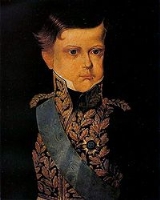
Pedro II of Brazil

Encyclopedia
Dom
Pedro II (English: Peter II; 2 December 1825 5 December 1891), nicknamed "the Magnanimous
", was the second and last ruler of the Empire of Brazil, reigning for over 58 years. Born in Rio de Janeiro
, he was the seventh child of Emperor Dom Pedro I of Brazil and Empress Dona Maria Leopoldina
and thus a member of the Brazilian branch of the House of Braganza
. His father's abrupt abdication and flight to Europe in 1831 left a five-year-old Pedro as Emperor and led to a grim and lonely childhood and adolescence. Obliged to spend his time studying in preparation for rule, he knew only brief moments of happiness and encountered few friends of his age. His experiences with court intrigues and political disputes during this period greatly affected his later character. Pedro II grew into a man with a strong sense of duty and devotion toward his country and his people. On the other hand, he increasingly resented his role as monarch.
Inheriting an Empire on the verge of disintegration, Pedro II turned Portuguese
-speaking Brazil
into an emerging power in the international arena. The nation grew to be distinguished from its Hispanic neighbors
on account of its political stability, zealously guarded freedom of speech, respect for civil rights, vibrant economic growth and especially for its form of government: a functional, representative parliamentary monarchy
. Brazil was also victorious in three international conflicts (the Platine War
, the Uruguayan War
and the Paraguayan War
) under his rule, as well as prevailing in several other international disputes and domestic tensions. Pedro steadfastly pushed through the abolition of slavery despite opposition from powerful political and economic interests. A savant in his own right, the Emperor established a reputation as a vigorous sponsor of learning, culture and the sciences. He won the respect and admiration of scholars such as Charles Darwin
, Victor Hugo
and Friedrich Nietzsche
, and was a friend to Richard Wagner
, Louis Pasteur
and Henry Wadsworth Longfellow
, among others.
Although there was no desire for a change in the form of government among most Brazilians, the Emperor was overthrown in a sudden coup d'état that had almost no support outside a clique of military leaders who desired a form of republic
headed by a dictator
. Pedro II had become weary of emperorship and despaired over the monarchy's future prospects, despite its overwhelming popular support. He allowed no prevention of his ouster and did not support any attempt to restore the monarchy. He spent the last two years of his life in exile in Europe, living alone on very little money.
The reign of Pedro II thus came to an unusual end—he was overthrown while highly regarded by the people and at the pinnacle of his popularity, and some of his accomplishments were soon brought to naught as Brazil slipped into a long period of weak governments, dictatorships, and constitutional and economic crises. The men who had exiled him soon began to see in him a model for the Brazilian republic. A few decades after his death, his reputation was restored and his remains were returned to Brazil as those of a national hero. This reputation has lasted to the present day. Historians have regarded the Emperor in an extremely positive light, and he is usually ranked as the greatest Brazilian.
, in Rio de Janeiro
. Named after St. Peter of Alcantara
, his name in full was Pedro de Alcântara João Carlos Leopoldo Salvador Bibiano Francisco Xavier de Paula Leocádio Miguel Gabriel Rafael Gonzaga.
Through his father, Emperor Pedro I, he was a member of the Brazilian branch of the House of Braganza
(Portuguese: Bragança) and was referred to using the honorific "Dom
" (Lord
) from birth. He was the grandson of Portuguese King Dom João VI
and nephew of Dom Miguel I
. His mother was the Archduchess Maria Leopoldina of Austria
, daughter of Franz II
, the last Holy Roman Emperor
. Through his mother, Pedro was a nephew of Napoleon Bonaparte
and first cousin of Emperors Napoleon II of France, Franz Joseph I
(Francis Joseph I) of Austria-Hungary
and Don
Maximiliano I
(Maximilian I) of Mexico
.
The only legitimate male child of Pedro I to survive infancy, he was officially recognized as heir to the Brazilian throne with the title Prince Imperial on 6 August 1826. Empress Leopoldina died on 11 December 1826, a few days following the stillbirth of a male child, when Pedro was a year old. Pedro would have no memory of his mother apart from what he was later told about her. The memory and influence of his father also faded, and by the time he was an adult, "he retained no strong images of him".
Two and a half years after the death of Leopoldina, the Emperor married Amélie of Leuchtenberg. Prince Pedro spent little time with his stepmother; nevertheless, they had an affectionate relationship and kept contact until her death in 1873. Emperor Pedro I abdicated on 7 April 1831, after a long conflict with the liberal faction
(which itself later split into what would become the two dominant parties under the monarchy, the Conservative and Liberal parties). He and Amélie immediately departed for Europe to restore his daughter to the Portuguese throne
, which had been usurped by his brother Miguel I. Left behind, Prince Imperial Pedro became Dom Pedro II, Constitutional Emperor and Perpetual Defender of Brazil.
of his son and remaining daughters. The first was José Bonifácio de Andrada, his friend and an influential leader during Brazilian independence, who was named guardian. The second was Mariana de Verna, who had held the post of aia (governess
) since the birth of Pedro II. As a child, the Prince Imperial called her "Dadama", as he could not pronounce the word dama (Lady
) correctly. Pedro II regarded her as his surrogate mother, and would continue to call her by her nickname well into adulthood out of affection. The third person was Rafael, an Afro-Brazilian
veteran of the Cisplatine War. Rafael was an employee in the Palace of São Cristóvão
(Pedro II's primary residence from infancy) whom Pedro I deeply trusted and asked to look after his son—a charge which he carried out during the rest of his life.
Bonifácio was dismissed from his position in December 1833 and replaced by another guardian. Pedro II spent his days studying, with only two hours set aside for amusements. He would wake at 6.30 a.m. and begin his studies at seven, continuing until 10 p.m., after which he would go to bed. Great care was taken in his education to foster values and a character different from the impulsiveness and irresponsibility which had been displayed by his father. His passion for reading allowed him to assimilate any information. Pedro II was no genius, but he was intelligent and able to acquire knowledge with great ease.
The Emperor experienced an unhappy and solitary childhood. The sudden loss of his parents would shadow him later in life; he had few friends of his age, and contact with his sisters was limited. The environment in which he was raised turned him into a shy and needy person who saw books as a refuge and retreat from the real world.
had been created to rule on his behalf until he reached the age of majority. Disputes between political factions led to several rebellions and resulted in an unstable, almost anarchical, situation under the regents.
The possibility of lowering the young emperor's age of majority, instead of waiting until he turned 18 on 2 December 1843, had been floated since 1835. The idea had received support from both main political parties. It was thought that those assisting him in taking the reins of government would be in a position to manipulate the inexperienced youth. Those politicians who had risen to power during the 1830s had by now also become familiar with the pitfalls of rule. According to historian Roderick J. Barman, by 1840 "they had lost all faith in their ability to rule the country on their own. They accepted Pedro II as an authority figure whose presence was indispensable for the country's survival." The Brazilian people also supported lowering the age of majority, as they considered Pedro II "the living symbol of the unity of the fatherland"; this position "gave him, in the eyes of public opinion, a higher authority than that of any regent."
Those advocating the immediate elevation of Pedro II to majority passed a motion requesting the Emperor assume full powers. A delegation was sent to the Palace of São Cristóvão to ask whether Pedro II would accept or reject an early declaration of his majority. He shyly answered "Yes" when asked if he desired the age of majority to be lowered, and "Now" when asked if he would prefer that it come into effect at that moment or would rather await his birthday in December. On the following day, 23 July 1840, the Assembléia Geral (General Assembly or Parliament
) formally declared the 14-year-old Pedro II of age. There, in the afternoon, the young emperor took the oath of office. He was acclaimed, crowned and consecrated on 18 July 1841.
Behind the scenes, a group of high ranking palace servants and notable politicians became known as the "Courtier Faction" as they established influence over the young Emperor—and some were very close indeed. Pedro II was deftly used by the courtiers to eliminate their foes (actual or suspected) by obtaining the dismissal of rivals. Access to his person by rival politicians and the flow of information he received were strictly controlled. A continuous round of meetings, study, personal appearances and government business, used as distractions, kept the Emperor occupied, effectively isolating and keeping him unaware of being exploited.
Concerned about the Emperor's taciturnity and immaturity, the courtiers believed marriage would improve his behavior and character. The government of the Kingdom of the Two Sicilies
offered the hand of Princess Teresa Cristina. A portrait of Teresa Cristina was sent by the Kingdom to Pedro II, depicting a beautiful young woman and prompting him to accept the match. Pedro II and Teresa Cristina were married by proxy in Naples on 30 May 1843. The new Empress arrived in Brazil on 3 September 1843. Upon seeing her in person, the Emperor was noticeably disappointed. The picture he had been sent was an obvious idealization; the real Teresa Cristina was short, a bit overweight, walked with a pronounced limp and though not ugly, neither was she pretty. He did little to hide his disillusionment. One observer stated that he turned his back to Teresa Cristina, another depicted him as being so shocked that he needed to sit, and it is possible that both occurred. That evening, Pedro II wept and complained to Mariana de Verna, "They have deceived me, Dadama!" It took several hours to convince him that duty demanded that he proceed. The Nuptial Mass, with the ratification of the vows previously taken by proxy and the conferral of the nuptial blessing, occurred on the following day, 4 September 1843.
The end of 1845 through the beginning of 1846 found the Emperor making a tour of Brazil's southern provinces, traveling through Santa Catarina
, São Paulo
(of which Paraná
was a part at this time) and Rio Grande do Sul
. He was buoyed by the warm and enthusiastic responses he received. This success encouraged him, for the first time in his life, to act confidently on his own initiative and insights. Most importantly, this period saw the end of the Courtier Faction. Pedro II successfully engineered the end of the courtiers' influence by removing them from his inner circle while avoiding any public disruption.
Pedro II was faced by three crises between 1848 and 1852. The first test came in confronting the trade in illegally imported slaves. This had been banned in 1826 as part of a treaty with Britain. Trafficking continued unabated, however, and the British government's passage of the Aberdeen Act of 1845 authorized British warships to board Brazilian shipping and seize any found involved in the slave trade. While Brazil grappled with this problem, the Praieira revolt
erupted on 6 November 1848. This was a conflict between local political factions within Pernambuco
province, and was suppressed by March 1849. A bill was promulgated
on 4 September 1850 which gave government broad authority to combat the illegal slave trade. With this new tool, Brazil moved to eliminate importation of slaves. By 1852 this first crisis was over, with Britain accepting that the trade had been suppressed.
The third crisis entailed a conflict with the Argentine Confederation
regarding ascendancy over territories adjacent to the Río de la Plata
and free navigation of that waterway. Since the 1830s, Argentine dictator Don Juan Manuel de Rosas
had supported rebellions within Uruguay
and Brazil. It was only in 1850 that Brazil was able to address the threat posed by Rosas. An alliance was forged between Brazil, Uruguay and disaffected Argentines, leading to the Platine War
and the subsequent overthrow of the Argentine ruler in February 1852. In the words of historian Roderick J. Barman, a "considerable portion of the credit must be ... assigned to the emperor, whose cool head, tenacity of purpose, and sense of what was feasible proved indispensable."
The Empire's successful navigation of these crises considerably enhanced the nation's stability and prestige, and Brazil emerged as a hemispheric power. Internationally, Europeans began to regard the country as embodying familiar liberal ideals, such as freedom of the press and constitutional respect for civil liberties. Its representative parliamentary monarchy also stood in stark contrast to the mix of dictatorships and instability endemic in the other nations of South America during this period.
and the character of Pedro II".
Pedro II was neither a British-style figurehead
nor an autocrat in the manner of Russian czars. The Emperor exercised power through cooperation with elected politicians, economic interests, and popular support. This interdependence and interaction did much to influence the direction of Pedro II's reign. The Emperor's more notable political successes were achieved due largely to the non-confrontational and cooperative manner with which he approached both issues and the partisan figures with whom he had to deal. He was remarkably tolerant, seldom taking offense at criticism, opposition, or even incompetence. He was diligent in appointing only highly qualified candidates to positions in the government, and sought to curb corruption. He did not have the constitutional authority to force acceptance of his initiatives without support, and his collaborative approach towards governing kept the nation progressing and enabled the political system to successfully function.
The uncertainty of his childhood and exploitation at the hands of others during his youth made the Emperor determined to maintain control over his own destiny. Achieving self-determination required that sufficient power be acquired and maintained. He used his active and essential participation in directing the course of government as a means of influence. His direction became indispensable, although it never devolved into "one-man rule." The Emperor respected the prerogatives of the legislature, even when they resisted, delayed, or thwarted his goals and appointments.
The Brazilian national political system resembled those in other parliamentary
nations. The Emperor, as head of state
, would ask the leader of either the Conservative
or Liberal Party to form a cabinet. The other party formed the opposition in the legislature, a counterweight and check on the party in power. If support for the party in power diminished greatly, or if the cabinet resigned, the Emperor could call on others from either party to form a new government. "In his handling of the two parties, he needed to maintain a reputation for impartiality, work in accord with the popular mood, and avoid any flagrant imposition of his will on the political scene."
The active presence of Pedro II on the political scene was an important part of the government's structure, which also included the cabinet, the Chamber of Deputies
and the Senate
(the latter two formed the General Assembly). Most politicians appreciated and supported the Emperor's role. Many had lived through the regency period, when the lack of an emperor who could stand above petty and special interests led to years of strife between political factions. Their experiences in public life had created a conviction that the Emperor was "indispensable to Brazil's continued peace and prosperity."
, their relationship improved. Later Teresa gave birth to more children: Isabel
, in 1846; Leopoldina
, in 1847; and lastly, Pedro
, in 1848. However, both boys died when very young, which devastated the Emperor. Beyond suffering as a father, his view of the Empire's future changed completely. Despite his affection for his daughters, he did not believe that Princess Isabel, although his heir, would have any chance of prospering on the throne. He felt his successor needed to be male for the monarchy to be viable. He increasingly saw the Imperial system as being tied so inextricably to himself, that it would not survive him. Isabel and her sister received an exceptional education, although they were given no preparation for governing the nation. Pedro II excluded Isabel from participation in government business and decisions.
Sometime around 1850, Pedro II began having discreet affairs with other women. The most famous and enduring of these relationships involved Luísa Margarida Portugal de Barros, Countess of Barral, with whom he formed a romantic and intimate, though not adulterous, friendship after she was appointed governess to the emperor's daughters in November 1856. Throughout his life, the Emperor held onto a hope of finding a soulmate, something he felt cheated of due to the necessity of a marriage of state
to a woman for whom he never felt passion. This is but one instance illustrating the Emperor's dual identity: who on one hand was "Dom Pedro II" who assiduously carried out his duty in the role of Emperor which destiny had assigned to him, and who on the other hand was "Pedro de Alcântara" who considered the Imperial office an unrewarding burden and who was happier in the worlds of literature and science.
Pedro II was what would today be termed a workaholic
, and his routine was demanding. He usually woke up at 7 am and did not sleep before 2 in the morning. His entire day was devoted to the affairs of state and the meager free time available was spent reading and studying. The Emperor went about his daily routine dressed in a simple black tail coat, trousers, and cravat. For special occasions he would wear court dress, and he only appeared in full regalia with crown, mantle and scepter twice each year at the opening and closing of the General Assembly.
Pedro II held politicians and government officials to the strict standards which he exemplified.. The Emperor demanded politicians work at least an eight hour day and adopted a strict policy for the selection of civil servants based on morality and merit. To set the standard, he lived simply. Balls
and assemblies of the Court ceased after 1852. He also refused to request or allow the amount of his civil list
(Rs 800:000$000 per year, about U.S. $405,000 or £90,000 in 1840) to be raised from 1840, when it represented 3% of the government expenditures, until 1889, when it had fallen to 0.5%. He refused luxury, once explaining: "I also understand that useless expenditure is stealing from the Nation."
, history
, geography
, geology
, medicine
, law
, religious studies
, philosophy
, painting
, sculpture
, theater, music
, chemistry
, physics
, astronomy
, poetry
, technology
, among others. By the end of his reign, there were three libraries in São Cristóvão palace containing more than 60,000 volumes. A passion for linguistics
prompted him throughout his life to study new languages, and he was able to speak and write not only Portuguese
but also Latin
, French
, German
, English
, Italian
, Spanish
, Greek
, Arabic
, Hebrew
, Sanskrit
, Chinese
, Occitan and Tupi. He became the first Brazilian photographer when he acquired a daguerreotype
camera in March 1840. He set up one laboratory in São Cristóvão devoted to photography and another to chemistry and physics. He also had an astronomical observatory constructed.
The Emperor's erudition amazed Friedrich Nietzsche
when both met. Victor Hugo
told him: "Sire, you are a great citizen, you are the grandson of Marcus Aurelius", and Alexandre Herculano
called him: "A Prince whom the general opinion holds as the foremost of his era because of his gifted mind, and due to the constant application of that gift to the sciences and culture." He became a member of the Royal Society
, the Russian Academy of Sciences
, The Royal Academies for Science and the Arts of Belgium
and the American Geographical Society
. In 1875, he was elected to the French Academy of Sciences
, an honor previously granted to only two other heads of state: Peter the Great
and Napoleon Bonaparte
. Pedro II exchanged letters with scientists, philosophers, musicians and other intellectuals. Many of his correspondents became his friends, including Richard Wagner
, Louis Pasteur
, Louis Agassiz
, John Greenleaf Whittier
, Michel Eugène Chevreul
, Alexander Graham Bell
, Henry Wadsworth Longfellow
, Arthur de Gobineau
, Frédéric Mistral
, Alessandro Manzoni
, Alexandre Herculano, Camilo Castelo Branco
and James Cooley Fletcher
.
Pedro II early realized that he had an opportunity to put the knowledge he was accumulating to practical use for Brazil's benefit. The Emperor considered education to be of national importance and was himself a concrete example of the value of learning. He remarked: "Were I not an Emperor, I would like to be a teacher. I do not know of a task more noble than to direct young minds and prepare the men of tomorrow." Education also helped toward his goal to create a sense of Brazilian national identity. His reign saw the creation of the Brazilian Historic and Geographic Institute
to promote research and preservation in the historical, geographical, cultural and social sciences. The Imperial Academy of Music and National Opera and the Pedro II School
were also founded, the latter serving as a model for schools throughout Brazil. The Imperial Academy of the Fine Arts
, established by his father, received further strengthening and support. Using his civil list income, Pedro II provided scholarships for Brazilian students to study at universities, art schools and conservatories of music in Europe. He also financed the creation of the Institute Pasteur, helped underwrite the construction of Wagner's Bayreuth Festspielhaus
, as well as subscribing to similar projects. His efforts were recognized both at home and abroad. Charles Darwin
said of him: "The Emperor does so much for science, that every scientific man is bound to show him the utmost respect".
, Bahia
, Sergipe
, Alagoas
, Pernambuco
and Paraíba
. He returned in February 1860 after four months. The trip was a huge success, with the Emperor welcomed everywhere with warmth and joy.
The first half of the 1860s saw peace and prosperity in Brazil. Civil liberties were maintained. Freedom of speech
had existed since Brazil's independence and continued to be strongly defended by Pedro II. The Emperor found newspapers from the capital and from the provinces an ideal way to keep track of public opinion and the nation's overall situation. Another means of monitoring the Empire was through direct contacts with his subjects. One opportunity for this was during regular Tuesday and Saturday public audiences, where anyone of any social class (including slaves) could gain admittance and present their petitions and stories. Visits to schools, colleges, prisons, exhibitions, factories, barracks, and other public appearances presented further opportunities to gather first-hand information.
This tranquility disappeared when the British consul in Rio de Janeiro, William Dougal Christie, nearly sparked a war between his nation and Brazil. Christie, who believed in Gunboat diplomacy
, sent an ultimatum
containing abusive demands arising out of two minor incidents at the end of 1861 and beginning of 1862. The first was the sinking of a commercial barque
on the coast of Rio Grande do Sul after which its goods were pillaged by local inhabitants. The second was the arrest of drunken British officers who were causing a disturbance in the streets of Rio.
The Brazilian government refused to yield, and Christie issued orders for British warships to capture Brazilian merchant vessels as indemnity. Brazil's Navy prepared for imminent conflict, purchase of coastal artillery was ordered, several ironclads were authorized and coastal defenses were given permission to fire upon any British warship that tried to capture Brazilian merchant ships. Pedro II was the main reason for Brazil's resistance, he rejected any suggestion of yielding. This response came as a surprise to Christie, who changed his tenor and proposed a peaceful settlement through international arbitration. The Brazilian government presented its demands and, upon seeing the British government's position weaken, severed diplomatic ties with Britain in June 1863.
turning its political parties against each other. The internal conflict led to the murder of Brazilians and looting of their property in Uruguay. Brazil's government decided to intervene, fearful of giving any impression of weakness in the face of conflict with the British. A Brazilian army invaded Uruguay in December 1864 beginning the brief Uruguayan War
, which ended on 20 February 1865.
Meanwhile, in December 1864 the dictator of Paraguay, Francisco Solano López
took advantage of the situation to establish his country as a regional power. The Paraguayan army
invaded the Brazilian province of Mato Grosso
(currently the state of Mato Grosso do Sul
), triggering the Paraguayan War
. Four months later, Paraguayan troops invaded Argentine
territory as a prelude to an attack upon the Brazilian province of Rio Grande do Sul
.
Aware of the anarchy in Rio Grande do Sul and the incapacity and incompetence of its military chiefs to resist the Paraguayan army, Pedro II decided to go to the front in person. Both the Cabinet and the General Assembly refused to accede to the Emperor's wish. After he also received objections from the Council of State
, Pedro II made the memorable pronouncement: "If they can prevent me from going as an Emperor, they cannot prevent me from abdicating and going as a Fatherland Volunteer"—an allusion to those Brazilians who volunteered to go to war and became known throughout the nation as the "Fatherland Volunteers". The monarch himself was popularly called the "Number-one volunteer."
Pedro II left for the south in July 1865. He disembarked in Rio Grande do Sul a few days later and proceeded from there by land. The overland journey was made by horse and wagon, and at night the emperor slept in a campaign tent. Pedro II arrived in Uruguaiana
, a Brazilian town occupied by the Paraguayan army, on 11 September. By the time of the Emperor's arrival, the Paraguayan force was besieged.
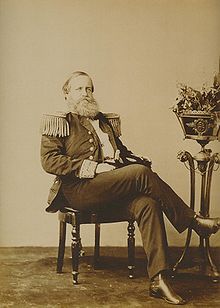 The Emperor rode within rifle-shot of Uruguaiana to demonstrate his courage, but the Paraguayans did not attack him. To avoid further bloodshed, he offered terms of surrender to the Paraguayan commander, which was accepted. Pedro II's coordination of the military operations and his personal example played a decisive role in successfully repulsing the Paraguayan invasion of Brazilian territory. There was a general belief that the war was near its end and that the surrender of López was imminent. Before leaving Uruguaiana, he received the British ambassador Edward Thornton
, who publicly apologized on behalf of Queen Victoria and the British Government for the crisis between the empires. The emperor considered that this diplomatic victory over the most powerful nation of the world was sufficient and renewed friendly relations between the nations. He returned to Rio de Janeiro
and was received with huge celebrations.
More than 50,000 Brazilian soldiers had died, and war costs equalled eleven times the government's annual budget. However, the country was so prosperous, that the government was able to retire the war debt in only ten years. The conflict was a stimulus to national production and economic growth. Pedro II turned down the General Assembly's suggestion to erect an equestrian statue of him to commemorate the victory and chose instead to use the money to build elementary schools.
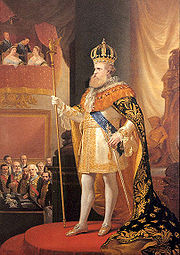 The diplomatic victory over the British Empire and the military victory over Uruguay in 1865, followed by a successful conclusion of the war with Paraguay in 1870, ushered in what is considered the "golden age
" and apogee of the Brazilian Empire. The 1870s were good times in Brazil, and the Emperor's popularity was greater than ever. Progress was made in both social and political spheres, and all segments of society benefited from the reforms and shared in the increasing prosperity. Brazil's international reputation for political stability and investment potential greatly improved. The Empire was seen as a modern and progressive nation unequalled, with the exception of the United States
, in the Americas
. The economy began undergoing rapid growth, and immigration flourished. Railroad, shipping and other modernization projects were adopted. "With slavery destined for extinction and other reforms projected, the prospects for 'moral and material advances' seemed vast."
In 1870, few Brazilians opposed slavery and even fewer took an open stand against it. Pedro II was one of the few who did oppose slavery, which he considered "a national shame." The Emperor never owned slaves. In 1823, slaves formed 29 percent of Brazil's population, but this figure had fallen to 15.2 percent by 1872. The abolition of slavery was a delicate subject in Brazil. Slaves were used by everyone, from the richest to the poorest. Pedro II wanted to end slavery gradually to soften the impact to the national economy. He consciously ignored the growing political damage to his image and to the monarchy in consequence of his support for abolition.
The Emperor had no constitutional authority to directly intervene to put an end to slavery. He would need to use all his skills to convince, influence and gather support among politicians to achieve his goal. His first open move against slavery occurred in 1850, when he threatened to abdicate unless the General Assembly declared the Atlantic slave trade
illegal.
After the overseas source for supplying new slaves had been eliminated, Pedro II turned his attention in the early 1860s to removing the remaining source: enslavement of children born to slaves. Legislation was drafted at his initiative, but the conflict with Paraguay delayed discussion of the proposal in the General Assembly. Pedro II openly asked for the gradual eradication of slavery in the Speech from the Throne
of 1867. He was heavily criticized, and his move was condemned as "national suicide." The charge was aired "that abolition was his personal desire and not that of the nation." Eventually, the bill was enacted as the "Law of Free Birth" on 28 September 1871, under which all children born to slave women after that date were considered free-born.
on 7 February, he finally had a pressing reason to venture outside the Empire. Upon arriving in Lisbon
, Portugal
, he immediately went to the Janelas Verdes palace
, where he met with his stepmother Amélie of Leuchtenberg. The two had not seen each other in forty years, and the meeting was emotional. Pedro II remarked in his journal: "I cried from happiness and also from sorrow seeing my Mother so affectionate toward me but so aged and so sick."
The Emperor proceeded to visit Spain, Great Britain, Belgium, Germany, Austria, Italy, Egypt, Greece, Switzerland and France. In Coburg
he visited his daughter's tomb. He found this to be "a time of release and freedom". He traveled under the assumed name "Dom Pedro de Alcântara", insisting upon being treated informally and staying only in hotels. He spent his days sightseeing and conversing with scientists and other intellectuals with whom he shared interests. The European sojourn proved to be a success, and his demeanor and curiosity won respectful notices in the nations which he visited. The prestige of both Brazil and Pedro II were further enhanced during the tour when news came from Brazil that the Law of Free Birth, abolishing the last source of enslavement, had been ratified. The Imperial party returned to Brazil in triumph on 31 March 1872.
The bishops of Olinda
and Pará
were two of the new generation of educated, zealous Brazilian clerics. They had been influenced by the Ultramontanism
which spread in Catholicism in this period. In 1872 they ordered Freemasons
expelled from lay brother
hoods. While European Masonry often tended towards atheism
and anti-clericalism
, things were much different in Brazil where membership in Masonic orders was common—although Pedro II himself was not a Freemason. The government tried on two separate occasions to persuade the bishops to repeal, but they refused. This led to them being tried before the Superior Court of Justice
and convicted. In 1874, they were sentenced four years at hard labor, although the Emperor commuted this to imprisonment only. Pedro II played a decisive role by unequivocally backing the government's actions.
Pedro II was a conscientious adherent of Catholicism, which he viewed as advancing important civilizing and civic values. While meticulously orthodox in matters of doctrine, he felt free to think and behave independently. The Emperor accepted new ideas, such as Charles Darwin
's theory of evolution
, of which he remarked that "the laws that he [Darwin] has discovered glorify the Creator". He was moderate in his religious beliefs, but could not accept disrespect to civil law and government authority. As he told his son-in-law: "[The government] has to ensure that the constitution is obeyed. In these proceedings there is no desire to protect masonry; but rather the goal of upholding the rights of the civilian power." The crisis was resolved in September 1875 after the Emperor agreed to grant full amnesty to the bishops and the Holy See
annulled their expulsion orders. The main consequence of the crisis was that the clergy no longer saw any benefit in upholding Pedro II's throne. Although they abandoned the Emperor, most eagerly awaited the accession of his eldest daughter and heir Isabel because of her ultramontane
views.
. He was accompanied by his faithful servant Rafael, who had raised him from childhood. Pedro II arrived in New York City on 15 April 1876, and set out from there to travel throughout the country; going as far as San Francisco in the west, New Orleans in the south, Washington, D.C.
, and north to Toronto
, Canada
. The trip was "an unalloyed triumph", Pedro II making a deep impression on the American people with his simplicity and kindness. He then crossed the Atlantic, where he visited Denmark
, Sweden
, Finland
, Russia
, Ottoman Empire
, Greece, the Holy Land, Egypt, Italy, Austria, Germany, France, Britain, Netherlands
, Switzerland
and Portugal. He returned to Brazil on 22 September 1877.
Pedro II's trips abroad made a deep psychological impact. While traveling, he was largely freed of the restrictions imposed by his office. Under the pseudonym "Pedro de Alcântara", he enjoyed moving about as an ordinary person, even taking a train journey alone with his wife. Only while touring abroad could the Emperor shake off the formal existence and demands of the life he knew in Brazil. It became more difficult to reacclimate to his routine as head of state upon returning. Upon his sons' early deaths, the Emperor's faith in the monarchy's future had evaporated. His trips abroad now made him resentful of the burden destiny had placed upon his shoulders when only a child of five. If he previously had no interest in securing the throne for the next generation, he now had no desire to keep it going during his own lifetime.
. On the other hand, letters written by Pedro II reveal a man grown world-weary with age and having an increasingly alienated and pessimistic outlook. He remained respectful of his duty and was meticulous in performing the tasks demanded of the Imperial office, albeit often without enthusiasm. Because of his increasing "indifference towards the fate of the regime" and his lack of action in support of the Imperial system once it was challenged, historians have attributed the "prime, perhaps sole, responsibility" for the dissolution of the monarchy to the Emperor himself.
After their experience of the perils and obstacles of government, the political figures who had arisen during the 1830s looked to the Emperor as providing a fundamental source of authority essential both for governing and for national survival. These elder statesmen began to die off or retire from government until, by the 1880s, they had almost entirely been replaced by a younger generation of politicians who had no experience of the Regency and early years of Pedro II's reign, when external and internal dangers threatened the nation's existence. They had only known a stable administration and prosperity. In sharp contrast to those of the previous era, the young politicians saw no reason to uphold and defend the Imperial office as a unifying force beneficial to the nation. Pedro II's role in achieving an era of national unity, stability and good government now went unremembered and unconsidered by the ruling elites. By his very success, the emperor had made his position seem unnecessary.
The lack of an heir who could feasibly provide a new direction for the nation also diminished the long-term prospects for continuation of the Brazilian monarchy. The Emperor loved his daughter Isabel, but he considered the idea of a female successor as antithetical to the role required of Brazil's ruler. He viewed the death of his two sons as being a sign that the Empire was destined to be supplanted. Resistance to accepting a female ruler was also shared by the political establishment. Even though the Constitution allowed female succession to the throne, Brazil was still very traditional, and only a male successor was thought capable as head of state.
Republicanism was an elitist creed which never flourished in Brazil, with little support in the provinces. But a serious threat to the monarchy was the combination of republican ideas with the dissemination of Positivism
among the army's lower and medium officer ranks, which led to indiscipline among the corps. They dreamed of a dictatorial republic which they believed would be superior to the liberal democratic monarchy.
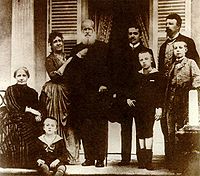 The Emperor's health had considerably worsened and his personal doctors suggested going to Europe for medical treatment. He left on 30 June 1887. While in Milan
he passed two weeks between life and death, even being anointed. While on bed recovering, on 22 May 1888 he received news that slavery had been abolished
in Brazil. Lying in bed with a weak voice and tears in his eyes, he said, "Great people! Great people!" Pedro II returned to Brazil and disembarked in Rio de Janeiro on 22 August 1888. The "whole country welcomed him with an enthusiasm never seen before. From the capital, from the provinces, from everywhere, arrived proofs of affection and veneration." With the devotion expressed by Brazilians upon the return of the Emperor and the Empress from Europe, the monarchy
seemed to enjoy unshakable support and to be at the height of its popularity."
The nation enjoyed great international prestige during the final years of the Empire and it had become an emerging power
within the international arena. Predictions of economic and labor disruption caused by the abolition of slavery failed to materialize and the 1888 coffee harvest was successful. The end of slavery had resulted in an explicit shift of support to republicanism
by rich and powerful coffee farmers who held great political, economic and social power in the country, since they regarded emancipation as confiscation of their personal property. To avert a republican backlash, the government exploited the ready credit available to Brazil as a result of its prosperity. It made available massive loans at favorable interest rates to plantation owners and lavishly granted titles and lesser honors to curry favor with influential political figures who had become disaffected. The government also indirectly began to address the problem of the recalcitrant military by revitalizing the moribund National Guard, by then an entity which existed mostly only on paper.
The measures made by the government alarmed the civilian republicans and the Positivists in the military corps. The republicans saw that it would undercut support for their own aims, and were emboldened to further action. The reorganization of the National Guard was begun by the cabinet in August 1889, and the creation of a rival force caused the dissidents among the officer corps to consider desperate steps. For both groups, republicans and military, it had become a case of "now or never". Although there was no desire in Brazil among the majority of the population to change the form of government
, republicans began pressuring the Positivist officers to overthrow the monarchy.
The Positivists launched a coup and instituted the republic on 15 November 1889. The few people who witnessed what occurred did not realize that it was a rebellion. Historian Lídia Besouchet noted that "[r]arely has a revolution been so minor." During the whole ordeal Pedro II showed no emotion, as if unconcerned about the outcome. He dismissed all suggestions for quelling the rebellion which politicians and military leaders put forward. When he heard the news of his deposition he simply commented: "If it is so, it will be my retirement. I have worked too hard and I am tired. I will go rest then." He and his family were sent into exile in Europe on 17 November.
One day he took a long drive in an open carriage along the Seine
, even though it was very cold. He felt ill after returning to the hotel that evening. The illness progressed into pneumonia
during the following days. Pedro II rapidly declined and died at 00:35 on 5 December 1891 surrounded by his family. His last words were "May God grant me these last wishes—peace and prosperity for Brazil". While the body was being prepared, a sealed package in the room was found, and next to it a message written by the Emperor himself: "It is soil from my country, I wish it to be placed in my coffin in case I die away from my fatherland." The package, which contained earth from every Brazilian province, was duly placed inside the coffin.
Princess Isabel wished to hold a discreet and private burial ceremony, but she eventually agreed to the French government's request for a State funeral
. On 9 December, thousands of mourners attended the ceremony at La Madeleine. Aside from Pedro II's family, these included: Francis II
, former king of the Two Sicilies; Isabella II
, former queen of Spain; Philippe, comte de Paris
; and other members of European royalty. Also present were General Joseph Brugère
, representing President Sadi Carnot
; the presidents of the Senate and the Chamber of Deputies
as well as their members; diplomats; and other representatives of the French government. Nearly all members of the Institut de France
were in attendance. Other governments from the Americas and Europe also sent representatives, as did distant countries such as Ottoman Turkey
, China
, Japan
and Persia. Following the services, the coffin was taken in procession to the train station to begin its trip to Portugal. Around 300,000 people lined the route despite incessant the incessant rain and cold. The journey continued on to the Church of São Vicente de Fora
near Lisbon
, where the body of Pedro II was interred in the Braganza Pantheon on 12 December.
The Brazilian republican government, "fearful of a backlash resulting from the death of the emperor", banned any official reaction. Nevertheless, the Brazilian people were far from indifferent to Pedro II's demise, and "repercussions in Brazil were also immense, despite the government's effort to suppress. There were demonstrations of sorrow throughout the country: shuttered business activity, flags displayed at half-staff, black armbands on clothes, death knells, religious ceremonies." Masses were held in memory of Pedro II throughout Brazil, and he and the monarchy were praised in the eulogies that followed.
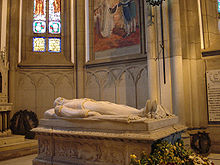 After his fall, Brazilians remained attached to the popular Emperor whom they regarded as a hero and continued to perceive him as a national symbol, the Father of the People personified. This view was even stronger among those of African descent
, who equated the monarchy with freedom. The phenomenon of continued support for the deposed monarch is largely credited to a generally held and unextinguished belief that he was a truly "wise, benevolent, austere and honest ruler." The positive view towards Pedro II, and nostalgia for his reign, only grew as the nation quickly fell into a series of economic and political crises which Brazilians attributed to the Emperor's overthrow. He never ceased being a popular hero, and would gradually become, once again, an official hero.
Surprisingly strong feelings of guilt were manifested among republicans, and these became increasingly evident upon the Emperor's death in exile at the end of 1891. They praised Pedro II, who was seen as a model of republican ideals
, and the imperial era, which they believed should be regarded as an example to be followed by the young republic. In Brazil, the news of the Emperor's death "aroused a genuine sense of regret among those who, without sympathy for a restoration, acknowledged both the merits and the achievements of their deceased ruler."
His remains, as well of his wife, were finally returned to Brazil in 1921 in time for the centenary of the Brazilian independence in 1922 and the government granted Pedro II dignities befitting a Head of State. A national holiday was declared and the return of the Emperor as a national hero was celebrated throughout the country. Thousands attended the main ceremony in Rio de Janeiro
. Pedro Calmon describes the scene: "elderly people cried. Many knelt down. All clapped hands. There was no distinction between republicans and monarchists. They were all Brazilians." This homage marked the reconciliation of Republican Brazil with its monarchical past.
Historians have expressed high regard for Pedro II and his reign. The scholarly literature dealing with him is vast and, with the exception of the period immediately after his ouster, overwhelmingly positive, and even laudatory. Emperor Pedro II is usually regarded by historians in Brazil as the greatest Brazilian. In a manner quite similar to methods which had been used by republicans, historians point to the Emperor's virtues as an example to be followed, although none go so far as to advocate a restoration of the monarchy. Richard Graham notes: "Most twentieth-century historians, moreover, have looked back on the period [of Pedro II's reign] nostalgically, using their descriptions of the Empire to criticize—sometimes subtly, sometimes not—Brazil's subsequent republican or dictatorial regimes."
The Emperor's full style and title were "His Imperial Majesty Dom Pedro II, Constitutional Emperor and Perpetual Defender of Brazil".
of the following Brazilian Orders:
He was a recipient of the following foreign honors:
Endnotes
External links
|-
Dom (title)
Dom is a title of respect prefixed to the given name. It derives from Latin Dominus.It is used in English for certain Benedictine and Carthusian monks, and for members of certain communities of Canons Regular. Examples include Benedictine monks of the English Benedictine Congregation...
Pedro II (English: Peter II; 2 December 1825 5 December 1891), nicknamed "the Magnanimous
Magnanimity
Magnanimity is the virtue of being great of mind and heart. It encompasses, usually, a refusal to be petty, a willingness to face danger, and actions for noble purposes. Its antithesis is pusillanimity...
", was the second and last ruler of the Empire of Brazil, reigning for over 58 years. Born in Rio de Janeiro
Rio de Janeiro
Rio de Janeiro , commonly referred to simply as Rio, is the capital city of the State of Rio de Janeiro, the second largest city of Brazil, and the third largest metropolitan area and agglomeration in South America, boasting approximately 6.3 million people within the city proper, making it the 6th...
, he was the seventh child of Emperor Dom Pedro I of Brazil and Empress Dona Maria Leopoldina
Maria Leopoldina of Austria
Maria Leopoldina of Austria was an archduchess of Austria, Empress consort of Brazil and queen consort of Portugal....
and thus a member of the Brazilian branch of the House of Braganza
House of Braganza
The Most Serene House of Braganza , an important Portuguese noble family, ruled the Kingdom of Portugal and its colonial Empire, from 1640 to 1910...
. His father's abrupt abdication and flight to Europe in 1831 left a five-year-old Pedro as Emperor and led to a grim and lonely childhood and adolescence. Obliged to spend his time studying in preparation for rule, he knew only brief moments of happiness and encountered few friends of his age. His experiences with court intrigues and political disputes during this period greatly affected his later character. Pedro II grew into a man with a strong sense of duty and devotion toward his country and his people. On the other hand, he increasingly resented his role as monarch.
Inheriting an Empire on the verge of disintegration, Pedro II turned Portuguese
Portuguese language
Portuguese is a Romance language that arose in the medieval Kingdom of Galicia, nowadays Galicia and Northern Portugal. The southern part of the Kingdom of Galicia became independent as the County of Portugal in 1095...
-speaking Brazil
Brazil
Brazil , officially the Federative Republic of Brazil , is the largest country in South America. It is the world's fifth largest country, both by geographical area and by population with over 192 million people...
into an emerging power in the international arena. The nation grew to be distinguished from its Hispanic neighbors
Hispanic America
Hispanic America or Spanish America is the region comprising the American countries inhabited by Spanish-speaking populations.These countries have significant commonalities with each other and with Spain, whose colonies they formerly were...
on account of its political stability, zealously guarded freedom of speech, respect for civil rights, vibrant economic growth and especially for its form of government: a functional, representative parliamentary monarchy
Constitutional monarchy
Constitutional monarchy is a form of government in which a monarch acts as head of state within the parameters of a constitution, whether it be a written, uncodified or blended constitution...
. Brazil was also victorious in three international conflicts (the Platine War
Platine War
The Platine War, also known as the War against Oribe and Rosas was fought between the Argentine Confederation and an alliance consisting of the Empire of Brazil, Uruguay and the Argentine provinces of Entre Ríos and Corrientes...
, the Uruguayan War
Uruguayan War
The Uruguayan War , also known as the War against Aguirre, was fought between Uruguay and an alliance between the Empire of Brazil and Uruguayan Colorados....
and the Paraguayan War
War of the Triple Alliance
The Paraguayan War , also known as War of the Triple Alliance , was a military conflict in South America fought from 1864 to 1870 between Paraguay and the Triple Alliance of Argentina, Brazil, and Uruguay...
) under his rule, as well as prevailing in several other international disputes and domestic tensions. Pedro steadfastly pushed through the abolition of slavery despite opposition from powerful political and economic interests. A savant in his own right, the Emperor established a reputation as a vigorous sponsor of learning, culture and the sciences. He won the respect and admiration of scholars such as Charles Darwin
Charles Darwin
Charles Robert Darwin FRS was an English naturalist. He established that all species of life have descended over time from common ancestry, and proposed the scientific theory that this branching pattern of evolution resulted from a process that he called natural selection.He published his theory...
, Victor Hugo
Victor Hugo
Victor-Marie Hugo was a Frenchpoet, playwright, novelist, essayist, visual artist, statesman, human rights activist and exponent of the Romantic movement in France....
and Friedrich Nietzsche
Friedrich Nietzsche
Friedrich Wilhelm Nietzsche was a 19th-century German philosopher, poet, composer and classical philologist...
, and was a friend to Richard Wagner
Richard Wagner
Wilhelm Richard Wagner was a German composer, conductor, theatre director, philosopher, music theorist, poet, essayist and writer primarily known for his operas...
, Louis Pasteur
Louis Pasteur
Louis Pasteur was a French chemist and microbiologist born in Dole. He is remembered for his remarkable breakthroughs in the causes and preventions of diseases. His discoveries reduced mortality from puerperal fever, and he created the first vaccine for rabies and anthrax. His experiments...
and Henry Wadsworth Longfellow
Henry Wadsworth Longfellow
Henry Wadsworth Longfellow was an American poet and educator whose works include "Paul Revere's Ride", The Song of Hiawatha, and Evangeline...
, among others.
Although there was no desire for a change in the form of government among most Brazilians, the Emperor was overthrown in a sudden coup d'état that had almost no support outside a clique of military leaders who desired a form of republic
Republic
A republic is a form of government in which the people, or some significant portion of them, have supreme control over the government and where offices of state are elected or chosen by elected people. In modern times, a common simplified definition of a republic is a government where the head of...
headed by a dictator
Dictatorship
A dictatorship is defined as an autocratic form of government in which the government is ruled by an individual, the dictator. It has three possible meanings:...
. Pedro II had become weary of emperorship and despaired over the monarchy's future prospects, despite its overwhelming popular support. He allowed no prevention of his ouster and did not support any attempt to restore the monarchy. He spent the last two years of his life in exile in Europe, living alone on very little money.
The reign of Pedro II thus came to an unusual end—he was overthrown while highly regarded by the people and at the pinnacle of his popularity, and some of his accomplishments were soon brought to naught as Brazil slipped into a long period of weak governments, dictatorships, and constitutional and economic crises. The men who had exiled him soon began to see in him a model for the Brazilian republic. A few decades after his death, his reputation was restored and his remains were returned to Brazil as those of a national hero. This reputation has lasted to the present day. Historians have regarded the Emperor in an extremely positive light, and he is usually ranked as the greatest Brazilian.
Birth
Pedro was born at 02:30 on 2 December 1825 in the Palace of São CristóvãoPaço de São Cristóvão
Paço de São Cristóvão is a palace located in the Quinta da Boa Vista park in Rio de Janeiro, Brazil. It is the former residence of the Emperors of Brazil...
, in Rio de Janeiro
Rio de Janeiro
Rio de Janeiro , commonly referred to simply as Rio, is the capital city of the State of Rio de Janeiro, the second largest city of Brazil, and the third largest metropolitan area and agglomeration in South America, boasting approximately 6.3 million people within the city proper, making it the 6th...
. Named after St. Peter of Alcantara
Peter of Alcantara
Saint Peter of Alcántara, O.F.M. was a Spanish Franciscan friar.- Biography :He was born at Alcántara, Province of Cáceres, Extremadura, Spain. His father, Peter Garavito, was the governor of Alcántara, and his mother was of the noble family of Sanabia...
, his name in full was Pedro de Alcântara João Carlos Leopoldo Salvador Bibiano Francisco Xavier de Paula Leocádio Miguel Gabriel Rafael Gonzaga.
Through his father, Emperor Pedro I, he was a member of the Brazilian branch of the House of Braganza
House of Braganza
The Most Serene House of Braganza , an important Portuguese noble family, ruled the Kingdom of Portugal and its colonial Empire, from 1640 to 1910...
(Portuguese: Bragança) and was referred to using the honorific "Dom
Dom (title)
Dom is a title of respect prefixed to the given name. It derives from Latin Dominus.It is used in English for certain Benedictine and Carthusian monks, and for members of certain communities of Canons Regular. Examples include Benedictine monks of the English Benedictine Congregation...
" (Lord
Lord
Lord is a title with various meanings. It can denote a prince or a feudal superior . The title today is mostly used in connection with the peerage of the United Kingdom or its predecessor countries, although some users of the title do not themselves hold peerages, and use it 'by courtesy'...
) from birth. He was the grandson of Portuguese King Dom João VI
John VI of Portugal
John VI John VI John VI (full name: João Maria José Francisco Xavier de Paula Luís António Domingos Rafael; (13 May 1767 – 10 March 1826) was King of the United Kingdom of Portugal, Brazil and the Algarves (later changed to just King of Portugal and the Algarves, after Brazil was recognized...
and nephew of Dom Miguel I
Miguel of Portugal
Dom Miguel I, sometimes Michael , was the King of Portugal between 1828 and 1834, the seventh child and second son of King John VI and his queen, Charlotte of Spain....
. His mother was the Archduchess Maria Leopoldina of Austria
Maria Leopoldina of Austria
Maria Leopoldina of Austria was an archduchess of Austria, Empress consort of Brazil and queen consort of Portugal....
, daughter of Franz II
Francis II, Holy Roman Emperor
Francis II was the last Holy Roman Emperor, ruling from 1792 until 6 August 1806, when he dissolved the Empire after the disastrous defeat of the Third Coalition by Napoleon at the Battle of Austerlitz...
, the last Holy Roman Emperor
Holy Roman Emperor
The Holy Roman Emperor is a term used by historians to denote a medieval ruler who, as German King, had also received the title of "Emperor of the Romans" from the Pope...
. Through his mother, Pedro was a nephew of Napoleon Bonaparte
Napoleon I
Napoleon Bonaparte was a French military and political leader during the latter stages of the French Revolution.As Napoleon I, he was Emperor of the French from 1804 to 1815...
and first cousin of Emperors Napoleon II of France, Franz Joseph I
Franz Joseph I of Austria
Franz Joseph I or Francis Joseph I was Emperor of Austria, King of Bohemia, King of Croatia, Apostolic King of Hungary, King of Galicia and Lodomeria and Grand Duke of Cracow from 1848 until his death in 1916.In the December of 1848, Emperor Ferdinand I of Austria abdicated the throne as part of...
(Francis Joseph I) of Austria-Hungary
Austria-Hungary
Austria-Hungary , more formally known as the Kingdoms and Lands Represented in the Imperial Council and the Lands of the Holy Hungarian Crown of Saint Stephen, was a constitutional monarchic union between the crowns of the Austrian Empire and the Kingdom of Hungary in...
and Don
Don (honorific)
Don, from Latin dominus, is an honorific in Spanish , Portuguese , and Italian . The female equivalent is Doña , Dona , and Donna , abbreviated "Dª" or simply "D."-Usage:...
Maximiliano I
Maximilian I of Mexico
Maximilian I was the only monarch of the Second Mexican Empire.After a distinguished career in the Austrian Navy, he was proclaimed Emperor of Mexico on April 10, 1864, with the backing of Napoleon III of France and a group of Mexican monarchists who sought to revive the Mexican monarchy...
(Maximilian I) of Mexico
Second Mexican Empire
The Second Mexican Empire was the name of Mexico under the regime established from 1864 to 1867. It was created by Napoleon III of France, who attempted to use the Mexican adventure to recapture some of the grandeur of earlier Napoleonic times...
.
The only legitimate male child of Pedro I to survive infancy, he was officially recognized as heir to the Brazilian throne with the title Prince Imperial on 6 August 1826. Empress Leopoldina died on 11 December 1826, a few days following the stillbirth of a male child, when Pedro was a year old. Pedro would have no memory of his mother apart from what he was later told about her. The memory and influence of his father also faded, and by the time he was an adult, "he retained no strong images of him".
Two and a half years after the death of Leopoldina, the Emperor married Amélie of Leuchtenberg. Prince Pedro spent little time with his stepmother; nevertheless, they had an affectionate relationship and kept contact until her death in 1873. Emperor Pedro I abdicated on 7 April 1831, after a long conflict with the liberal faction
Liberalism in Brazil
This article gives an overview of liberal parties in Brazil. It is limited to liberal parties with substantial support, mainly proved by having had a representation in parliament. The sign ⇒ means a reference to another party in that scheme...
(which itself later split into what would become the two dominant parties under the monarchy, the Conservative and Liberal parties). He and Amélie immediately departed for Europe to restore his daughter to the Portuguese throne
Liberal Wars
The Liberal Wars, also known as the Portuguese Civil War, the War of the Two Brothers, or Miguelite War, was a war between progressive constitutionalists and authoritarian absolutists in Portugal over royal succession that lasted from 1828 to 1834...
, which had been usurped by his brother Miguel I. Left behind, Prince Imperial Pedro became Dom Pedro II, Constitutional Emperor and Perpetual Defender of Brazil.
Education
Upon leaving the country, Emperor Pedro I selected three people to take chargeMinority reign
The term minority reign or royal minority refers to the period of a sovereign's rule when he or she is legally a minor. Minority reigns are of their nature times when politicians and advisors can be especially competitive....
of his son and remaining daughters. The first was José Bonifácio de Andrada, his friend and an influential leader during Brazilian independence, who was named guardian. The second was Mariana de Verna, who had held the post of aia (governess
Governess
A governess is a girl or woman employed to teach and train children in a private household. In contrast to a nanny or a babysitter, she concentrates on teaching children, not on meeting their physical needs...
) since the birth of Pedro II. As a child, the Prince Imperial called her "Dadama", as he could not pronounce the word dama (Lady
Lady
The word lady is a polite term for a woman, specifically the female equivalent to, or spouse of, a lord or gentleman, and in many contexts a term for any adult woman...
) correctly. Pedro II regarded her as his surrogate mother, and would continue to call her by her nickname well into adulthood out of affection. The third person was Rafael, an Afro-Brazilian
Afro-Brazilian
In Brazil, the term "preto" is one of the five categories used by the Brazilian Census, along with "branco" , "pardo" , "amarelo" and "indígena"...
veteran of the Cisplatine War. Rafael was an employee in the Palace of São Cristóvão
Paço de São Cristóvão
Paço de São Cristóvão is a palace located in the Quinta da Boa Vista park in Rio de Janeiro, Brazil. It is the former residence of the Emperors of Brazil...
(Pedro II's primary residence from infancy) whom Pedro I deeply trusted and asked to look after his son—a charge which he carried out during the rest of his life.
Bonifácio was dismissed from his position in December 1833 and replaced by another guardian. Pedro II spent his days studying, with only two hours set aside for amusements. He would wake at 6.30 a.m. and begin his studies at seven, continuing until 10 p.m., after which he would go to bed. Great care was taken in his education to foster values and a character different from the impulsiveness and irresponsibility which had been displayed by his father. His passion for reading allowed him to assimilate any information. Pedro II was no genius, but he was intelligent and able to acquire knowledge with great ease.
The Emperor experienced an unhappy and solitary childhood. The sudden loss of his parents would shadow him later in life; he had few friends of his age, and contact with his sisters was limited. The environment in which he was raised turned him into a shy and needy person who saw books as a refuge and retreat from the real world.
Early coronation
The elevation of Pedro II to the Imperial throne in 1831 led to a period of crisis, the most troublesome in Brazil's history. A regencyRegent
A regent, from the Latin regens "one who reigns", is a person selected to act as head of state because the ruler is a minor, not present, or debilitated. Currently there are only two ruling Regencies in the world, sovereign Liechtenstein and the Malaysian constitutive state of Terengganu...
had been created to rule on his behalf until he reached the age of majority. Disputes between political factions led to several rebellions and resulted in an unstable, almost anarchical, situation under the regents.
The possibility of lowering the young emperor's age of majority, instead of waiting until he turned 18 on 2 December 1843, had been floated since 1835. The idea had received support from both main political parties. It was thought that those assisting him in taking the reins of government would be in a position to manipulate the inexperienced youth. Those politicians who had risen to power during the 1830s had by now also become familiar with the pitfalls of rule. According to historian Roderick J. Barman, by 1840 "they had lost all faith in their ability to rule the country on their own. They accepted Pedro II as an authority figure whose presence was indispensable for the country's survival." The Brazilian people also supported lowering the age of majority, as they considered Pedro II "the living symbol of the unity of the fatherland"; this position "gave him, in the eyes of public opinion, a higher authority than that of any regent."
Those advocating the immediate elevation of Pedro II to majority passed a motion requesting the Emperor assume full powers. A delegation was sent to the Palace of São Cristóvão to ask whether Pedro II would accept or reject an early declaration of his majority. He shyly answered "Yes" when asked if he desired the age of majority to be lowered, and "Now" when asked if he would prefer that it come into effect at that moment or would rather await his birthday in December. On the following day, 23 July 1840, the Assembléia Geral (General Assembly or Parliament
Parliament
A parliament is a legislature, especially in those countries whose system of government is based on the Westminster system modeled after that of the United Kingdom. The name is derived from the French , the action of parler : a parlement is a discussion. The term came to mean a meeting at which...
) formally declared the 14-year-old Pedro II of age. There, in the afternoon, the young emperor took the oath of office. He was acclaimed, crowned and consecrated on 18 July 1841.
Marriage
Removal of the factious regency stabilized the government. With a legitimate monarch on the throne, authority was vested in a single, clear voice. Pedro II perceived his role as that of an arbiter, keeping personal views from hindering his duty to untangle partisan political disputes. The young Emperor was diligent in his new role, making daily personal inspections and visits to government branches. His subjects were impressed by his seeming self-confidence, although his shyness and lack of social grace were considered flaws. His reticence in only offering a word or two at a time rendered direct conversation with him extremely difficult. His taciturn nature manifested a caution in close relationships that traced to incidents of abandonment, intrigue and betrayal experienced during his childhood.Behind the scenes, a group of high ranking palace servants and notable politicians became known as the "Courtier Faction" as they established influence over the young Emperor—and some were very close indeed. Pedro II was deftly used by the courtiers to eliminate their foes (actual or suspected) by obtaining the dismissal of rivals. Access to his person by rival politicians and the flow of information he received were strictly controlled. A continuous round of meetings, study, personal appearances and government business, used as distractions, kept the Emperor occupied, effectively isolating and keeping him unaware of being exploited.
Concerned about the Emperor's taciturnity and immaturity, the courtiers believed marriage would improve his behavior and character. The government of the Kingdom of the Two Sicilies
Kingdom of the Two Sicilies
The Kingdom of the Two Sicilies, commonly known as the Two Sicilies even before formally coming into being, was the largest and wealthiest of the Italian states before Italian unification...
offered the hand of Princess Teresa Cristina. A portrait of Teresa Cristina was sent by the Kingdom to Pedro II, depicting a beautiful young woman and prompting him to accept the match. Pedro II and Teresa Cristina were married by proxy in Naples on 30 May 1843. The new Empress arrived in Brazil on 3 September 1843. Upon seeing her in person, the Emperor was noticeably disappointed. The picture he had been sent was an obvious idealization; the real Teresa Cristina was short, a bit overweight, walked with a pronounced limp and though not ugly, neither was she pretty. He did little to hide his disillusionment. One observer stated that he turned his back to Teresa Cristina, another depicted him as being so shocked that he needed to sit, and it is possible that both occurred. That evening, Pedro II wept and complained to Mariana de Verna, "They have deceived me, Dadama!" It took several hours to convince him that duty demanded that he proceed. The Nuptial Mass, with the ratification of the vows previously taken by proxy and the conferral of the nuptial blessing, occurred on the following day, 4 September 1843.
Imperial authority established
By 1846 Pedro II had matured physically and mentally. He was no longer an insecure 14-year-old swayed by gossip, suggestions of secret plots, and other manipulative tactics. He grew into a man who, at 1.9 metre tall with blue eyes and blond hair, was described as handsome. With growth, his weaknesses faded and his strengths of character came to the fore. He learned to be not only impartial and diligent, but also courteous, patient and personable. As he began to fully exercise authority, his new social skills and diligence in government contributed greatly to his effectiveness and public image. Historian Roderick J. Barman describes him at this time: "He kept his emotions under iron discipline. He was never rude and never lost his temper. He was exceptionally discreet in words and cautious in action."The end of 1845 through the beginning of 1846 found the Emperor making a tour of Brazil's southern provinces, traveling through Santa Catarina
Santa Catarina (state)
Santa Catarina is a state in southern Brazil with one of the highest standards of living in Latin America. Its capital is Florianópolis, which mostly lies on the Santa Catarina Island. Neighbouring states are Rio Grande do Sul to the south and Paraná to the north. It is bounded on the east by...
, São Paulo
São Paulo
São Paulo is the largest city in Brazil, the largest city in the southern hemisphere and South America, and the world's seventh largest city by population. The metropolis is anchor to the São Paulo metropolitan area, ranked as the second-most populous metropolitan area in the Americas and among...
(of which Paraná
Paraná (state)
Paraná is one of the states of Brazil, located in the South of the country, bordered on the north by São Paulo state, on the east by the Atlantic Ocean, on the south by Santa Catarina state and the Misiones Province of Argentina, and on the west by Mato Grosso do Sul and the republic of Paraguay,...
was a part at this time) and Rio Grande do Sul
Rio Grande do Sul
Rio Grande do Sul is the southernmost state in Brazil, and the state with the fifth highest Human Development Index in the country. In this state is located the southernmost city in the country, Chuí, on the border with Uruguay. In the region of Bento Gonçalves and Caxias do Sul, the largest wine...
. He was buoyed by the warm and enthusiastic responses he received. This success encouraged him, for the first time in his life, to act confidently on his own initiative and insights. Most importantly, this period saw the end of the Courtier Faction. Pedro II successfully engineered the end of the courtiers' influence by removing them from his inner circle while avoiding any public disruption.
Pedro II was faced by three crises between 1848 and 1852. The first test came in confronting the trade in illegally imported slaves. This had been banned in 1826 as part of a treaty with Britain. Trafficking continued unabated, however, and the British government's passage of the Aberdeen Act of 1845 authorized British warships to board Brazilian shipping and seize any found involved in the slave trade. While Brazil grappled with this problem, the Praieira revolt
Praieira revolt
The Praieira revolt, also known as the Beach rebellion, was a movement in the Pernambuco region of Brazil that lasted from 1848 to 1849. The revolt, influenced by revolutions taking place in Europe, was due in part to unresolved conflicts left over from the period of the Regency and local...
erupted on 6 November 1848. This was a conflict between local political factions within Pernambuco
Pernambuco
Pernambuco is a state of Brazil, located in the Northeast region of the country. To the north are the states of Paraíba and Ceará, to the west is Piauí, to the south are Alagoas and Bahia, and to the east is the Atlantic Ocean. There are about of beaches, some of the most beautiful in the...
province, and was suppressed by March 1849. A bill was promulgated
Promulgation
Promulgation is the act of formally proclaiming or declaring a new statutory or administrative law after its enactment. In some jurisdictions this additional step is necessary before the law can take effect....
on 4 September 1850 which gave government broad authority to combat the illegal slave trade. With this new tool, Brazil moved to eliminate importation of slaves. By 1852 this first crisis was over, with Britain accepting that the trade had been suppressed.
The third crisis entailed a conflict with the Argentine Confederation
Argentine Confederation
The Argentine Confederation is one of the official names of Argentina, according to the Argentine Constitution, Article 35...
regarding ascendancy over territories adjacent to the Río de la Plata
Río de la Plata
The Río de la Plata —sometimes rendered River Plate in British English and the Commonwealth, and occasionally rendered [La] Plata River in other English-speaking countries—is the river and estuary formed by the confluence of the Uruguay River and the Paraná River on the border between Argentina and...
and free navigation of that waterway. Since the 1830s, Argentine dictator Don Juan Manuel de Rosas
Juan Manuel de Rosas
Juan Manuel de Rosas , was an argentine militar and politician, who was elected governor of the province of Buenos Aires in 1829 to 1835, and then of the Argentine Confederation from 1835 until 1852...
had supported rebellions within Uruguay
Uruguay
Uruguay ,officially the Oriental Republic of Uruguay,sometimes the Eastern Republic of Uruguay; ) is a country in the southeastern part of South America. It is home to some 3.5 million people, of whom 1.8 million live in the capital Montevideo and its metropolitan area...
and Brazil. It was only in 1850 that Brazil was able to address the threat posed by Rosas. An alliance was forged between Brazil, Uruguay and disaffected Argentines, leading to the Platine War
Platine War
The Platine War, also known as the War against Oribe and Rosas was fought between the Argentine Confederation and an alliance consisting of the Empire of Brazil, Uruguay and the Argentine provinces of Entre Ríos and Corrientes...
and the subsequent overthrow of the Argentine ruler in February 1852. In the words of historian Roderick J. Barman, a "considerable portion of the credit must be ... assigned to the emperor, whose cool head, tenacity of purpose, and sense of what was feasible proved indispensable."
The Empire's successful navigation of these crises considerably enhanced the nation's stability and prestige, and Brazil emerged as a hemispheric power. Internationally, Europeans began to regard the country as embodying familiar liberal ideals, such as freedom of the press and constitutional respect for civil liberties. Its representative parliamentary monarchy also stood in stark contrast to the mix of dictatorships and instability endemic in the other nations of South America during this period.
Pedro II and politics
At the beginning of the 1850s, Brazil was enjoying internal stability and economic prosperity. The nation was being interconnected through railroad, electric telegraph and steamship lines, uniting it into a single entity. The general opinion, both at home and abroad, was that these accomplishments had been possible for two reasons: "its governance as a monarchyMonarchy
A monarchy is a form of government in which the office of head of state is usually held until death or abdication and is often hereditary and includes a royal house. In some cases, the monarch is elected...
and the character of Pedro II".
Pedro II was neither a British-style figurehead
Figurehead
A figurehead is a carved wooden decoration found at the prow of ships largely made between the 16th and 19th century.-History:Although earlier ships had often had some form of bow ornamentation A figurehead is a carved wooden decoration found at the prow of ships largely made between the 16th and...
nor an autocrat in the manner of Russian czars. The Emperor exercised power through cooperation with elected politicians, economic interests, and popular support. This interdependence and interaction did much to influence the direction of Pedro II's reign. The Emperor's more notable political successes were achieved due largely to the non-confrontational and cooperative manner with which he approached both issues and the partisan figures with whom he had to deal. He was remarkably tolerant, seldom taking offense at criticism, opposition, or even incompetence. He was diligent in appointing only highly qualified candidates to positions in the government, and sought to curb corruption. He did not have the constitutional authority to force acceptance of his initiatives without support, and his collaborative approach towards governing kept the nation progressing and enabled the political system to successfully function.
The uncertainty of his childhood and exploitation at the hands of others during his youth made the Emperor determined to maintain control over his own destiny. Achieving self-determination required that sufficient power be acquired and maintained. He used his active and essential participation in directing the course of government as a means of influence. His direction became indispensable, although it never devolved into "one-man rule." The Emperor respected the prerogatives of the legislature, even when they resisted, delayed, or thwarted his goals and appointments.
The Brazilian national political system resembled those in other parliamentary
Parliamentary system
A parliamentary system is a system of government in which the ministers of the executive branch get their democratic legitimacy from the legislature and are accountable to that body, such that the executive and legislative branches are intertwined....
nations. The Emperor, as head of state
Head of State
A head of state is the individual that serves as the chief public representative of a monarchy, republic, federation, commonwealth or other kind of state. His or her role generally includes legitimizing the state and exercising the political powers, functions, and duties granted to the head of...
, would ask the leader of either the Conservative
Conservative Party (Brazil)
The Conservative Party was a Brazilian political party of the imperial period, which was formed circa 1836 and ended with the proclamation of the Republic in 1889...
or Liberal Party to form a cabinet. The other party formed the opposition in the legislature, a counterweight and check on the party in power. If support for the party in power diminished greatly, or if the cabinet resigned, the Emperor could call on others from either party to form a new government. "In his handling of the two parties, he needed to maintain a reputation for impartiality, work in accord with the popular mood, and avoid any flagrant imposition of his will on the political scene."
The active presence of Pedro II on the political scene was an important part of the government's structure, which also included the cabinet, the Chamber of Deputies
Chamber of Deputies of Brazil
The Chamber of Deputies of Brazil is a federal legislative body and the lower house of the National Congress of Brazil. As of 2006, the chamber comprises 513 deputies, who are elected by proportional representation to serve four-year terms...
and the Senate
Senate of Brazil
The Federal Senate of Brazil is the upper house of the National Congress of Brazil. Created by the first Constitution of the Brazilian Empire in 1824, it was inspired by the United Kingdom's House of Lords, but with the Proclamation of the Republic in 1889 it became closer to the United States...
(the latter two formed the General Assembly). Most politicians appreciated and supported the Emperor's role. Many had lived through the regency period, when the lack of an emperor who could stand above petty and special interests led to years of strife between political factions. Their experiences in public life had created a conviction that the Emperor was "indispensable to Brazil's continued peace and prosperity."
Domestic life
The marriage between Pedro II and Teresa Cristina started off badly. With maturity, patience, and their first child, AfonsoAfonso, Prince Imperial of Brazil
Dom Afonso was the Prince Imperial and heir apparent to the throne of the Empire of Brazil. Born in Rio de Janeiro, he was the eldest child of Emperor Dom Pedro II and Dona Teresa Cristina of the Two Sicilies, and thus a member of the Brazilian branch of the House of Braganza...
, their relationship improved. Later Teresa gave birth to more children: Isabel
Isabel, Princess Imperial of Brazil
Dona Isabel , nicknamed "the Redemptress", was the heiress presumptive to the throne of the Empire of Brazil, bearing the title of Princess Imperial....
, in 1846; Leopoldina
Princess Leopoldina of Brazil
Princess Leopoldina of Brazil was a member of the Brazilian Imperial Family, the third child and second daughter of Emperor Pedro II of Brazil and his consort Teresa Cristina of the Two Sicilies. By marriage she was Princess of Saxe-Coburg and Gotha, and Duchess in Saxony...
, in 1847; and lastly, Pedro
Pedro, Prince Imperial of Brazil
Pedro Afonso Cristiano Leopoldo Eugénio Fernando Vicente Gabriel Rafael Gonzaga was the fourth and last child of the Emperor D. Pedro II of Brazil and D. Teresa Cristina of Bourbon-Two Sicilies....
, in 1848. However, both boys died when very young, which devastated the Emperor. Beyond suffering as a father, his view of the Empire's future changed completely. Despite his affection for his daughters, he did not believe that Princess Isabel, although his heir, would have any chance of prospering on the throne. He felt his successor needed to be male for the monarchy to be viable. He increasingly saw the Imperial system as being tied so inextricably to himself, that it would not survive him. Isabel and her sister received an exceptional education, although they were given no preparation for governing the nation. Pedro II excluded Isabel from participation in government business and decisions.
Sometime around 1850, Pedro II began having discreet affairs with other women. The most famous and enduring of these relationships involved Luísa Margarida Portugal de Barros, Countess of Barral, with whom he formed a romantic and intimate, though not adulterous, friendship after she was appointed governess to the emperor's daughters in November 1856. Throughout his life, the Emperor held onto a hope of finding a soulmate, something he felt cheated of due to the necessity of a marriage of state
Marriage of state
A marriage of state in ancient use is a diplomatic marriage or union between two members of different nation-states or internally, between two power blocks, usually in authoritarian societies and is a practice which dates back into pre-history, as far back as early Grecian cultures in western...
to a woman for whom he never felt passion. This is but one instance illustrating the Emperor's dual identity: who on one hand was "Dom Pedro II" who assiduously carried out his duty in the role of Emperor which destiny had assigned to him, and who on the other hand was "Pedro de Alcântara" who considered the Imperial office an unrewarding burden and who was happier in the worlds of literature and science.
Pedro II was what would today be termed a workaholic
Workaholic
A workaholic is a person who is addicted to work.The term generally implies that the person enjoys their work; it can also imply that they simply feel compelled to do it...
, and his routine was demanding. He usually woke up at 7 am and did not sleep before 2 in the morning. His entire day was devoted to the affairs of state and the meager free time available was spent reading and studying. The Emperor went about his daily routine dressed in a simple black tail coat, trousers, and cravat. For special occasions he would wear court dress, and he only appeared in full regalia with crown, mantle and scepter twice each year at the opening and closing of the General Assembly.
Pedro II held politicians and government officials to the strict standards which he exemplified.. The Emperor demanded politicians work at least an eight hour day and adopted a strict policy for the selection of civil servants based on morality and merit. To set the standard, he lived simply. Balls
Ballroom dance
Ballroom dance refers to a set of partner dances, which are enjoyed both socially and competitively around the world. Because of its performance and entertainment aspects, ballroom dance is also widely enjoyed on stage, film, and television....
and assemblies of the Court ceased after 1852. He also refused to request or allow the amount of his civil list
Civil list
-United Kingdom:In the United Kingdom, the Civil List is the name given to the annual grant that covers some expenses associated with the Sovereign performing their official duties, including those for staff salaries, State Visits, public engagements, ceremonial functions and the upkeep of the...
(Rs 800:000$000 per year, about U.S. $405,000 or £90,000 in 1840) to be raised from 1840, when it represented 3% of the government expenditures, until 1889, when it had fallen to 0.5%. He refused luxury, once explaining: "I also understand that useless expenditure is stealing from the Nation."
Patron of arts and sciences
"I was born to devote myself to culture and sciences", the Emperor remarked in his private journal during 1862. He had always been eager to learn and found in books a refuge from the demands of his position. His ability to recall passages which he had read in the past was notable. Subjects which interested Pedro II were wide-ranging, including anthropologyAnthropology
Anthropology is the study of humanity. It has origins in the humanities, the natural sciences, and the social sciences. The term "anthropology" is from the Greek anthrōpos , "man", understood to mean mankind or humanity, and -logia , "discourse" or "study", and was first used in 1501 by German...
, history
History
History is the discovery, collection, organization, and presentation of information about past events. History can also mean the period of time after writing was invented. Scholars who write about history are called historians...
, geography
Geography
Geography is the science that studies the lands, features, inhabitants, and phenomena of Earth. A literal translation would be "to describe or write about the Earth". The first person to use the word "geography" was Eratosthenes...
, geology
Geology
Geology is the science comprising the study of solid Earth, the rocks of which it is composed, and the processes by which it evolves. Geology gives insight into the history of the Earth, as it provides the primary evidence for plate tectonics, the evolutionary history of life, and past climates...
, medicine
Medicine
Medicine is the science and art of healing. It encompasses a variety of health care practices evolved to maintain and restore health by the prevention and treatment of illness....
, law
Law
Law is a system of rules and guidelines which are enforced through social institutions to govern behavior, wherever possible. It shapes politics, economics and society in numerous ways and serves as a social mediator of relations between people. Contract law regulates everything from buying a bus...
, religious studies
Religious studies
Religious studies is the academic field of multi-disciplinary, secular study of religious beliefs, behaviors, and institutions. It describes, compares, interprets, and explains religion, emphasizing systematic, historically based, and cross-cultural perspectives.While theology attempts to...
, philosophy
Philosophy
Philosophy is the study of general and fundamental problems, such as those connected with existence, knowledge, values, reason, mind, and language. Philosophy is distinguished from other ways of addressing such problems by its critical, generally systematic approach and its reliance on rational...
, painting
Painting
Painting is the practice of applying paint, pigment, color or other medium to a surface . The application of the medium is commonly applied to the base with a brush but other objects can be used. In art, the term painting describes both the act and the result of the action. However, painting is...
, sculpture
Sculpture
Sculpture is three-dimensional artwork created by shaping or combining hard materials—typically stone such as marble—or metal, glass, or wood. Softer materials can also be used, such as clay, textiles, plastics, polymers and softer metals...
, theater, music
Music
Music is an art form whose medium is sound and silence. Its common elements are pitch , rhythm , dynamics, and the sonic qualities of timbre and texture...
, chemistry
Chemistry
Chemistry is the science of matter, especially its chemical reactions, but also its composition, structure and properties. Chemistry is concerned with atoms and their interactions with other atoms, and particularly with the properties of chemical bonds....
, physics
Physics
Physics is a natural science that involves the study of matter and its motion through spacetime, along with related concepts such as energy and force. More broadly, it is the general analysis of nature, conducted in order to understand how the universe behaves.Physics is one of the oldest academic...
, astronomy
Astronomy
Astronomy is a natural science that deals with the study of celestial objects and phenomena that originate outside the atmosphere of Earth...
, poetry
Poetry
Poetry is a form of literary art in which language is used for its aesthetic and evocative qualities in addition to, or in lieu of, its apparent meaning...
, technology
Technology
Technology is the making, usage, and knowledge of tools, machines, techniques, crafts, systems or methods of organization in order to solve a problem or perform a specific function. It can also refer to the collection of such tools, machinery, and procedures. The word technology comes ;...
, among others. By the end of his reign, there were three libraries in São Cristóvão palace containing more than 60,000 volumes. A passion for linguistics
Linguistics
Linguistics is the scientific study of human language. Linguistics can be broadly broken into three categories or subfields of study: language form, language meaning, and language in context....
prompted him throughout his life to study new languages, and he was able to speak and write not only Portuguese
Portuguese language
Portuguese is a Romance language that arose in the medieval Kingdom of Galicia, nowadays Galicia and Northern Portugal. The southern part of the Kingdom of Galicia became independent as the County of Portugal in 1095...
but also Latin
Latin
Latin is an Italic language originally spoken in Latium and Ancient Rome. It, along with most European languages, is a descendant of the ancient Proto-Indo-European language. Although it is considered a dead language, a number of scholars and members of the Christian clergy speak it fluently, and...
, French
French language
French is a Romance language spoken as a first language in France, the Romandy region in Switzerland, Wallonia and Brussels in Belgium, Monaco, the regions of Quebec and Acadia in Canada, and by various communities elsewhere. Second-language speakers of French are distributed throughout many parts...
, German
German language
German is a West Germanic language, related to and classified alongside English and Dutch. With an estimated 90 – 98 million native speakers, German is one of the world's major languages and is the most widely-spoken first language in the European Union....
, English
English language
English is a West Germanic language that arose in the Anglo-Saxon kingdoms of England and spread into what was to become south-east Scotland under the influence of the Anglian medieval kingdom of Northumbria...
, Italian
Italian language
Italian is a Romance language spoken mainly in Europe: Italy, Switzerland, San Marino, Vatican City, by minorities in Malta, Monaco, Croatia, Slovenia, France, Libya, Eritrea, and Somalia, and by immigrant communities in the Americas and Australia...
, Spanish
Spanish language
Spanish , also known as Castilian , is a Romance language in the Ibero-Romance group that evolved from several languages and dialects in central-northern Iberia around the 9th century and gradually spread with the expansion of the Kingdom of Castile into central and southern Iberia during the...
, Greek
Greek language
Greek is an independent branch of the Indo-European family of languages. Native to the southern Balkans, it has the longest documented history of any Indo-European language, spanning 34 centuries of written records. Its writing system has been the Greek alphabet for the majority of its history;...
, Arabic
Arabic language
Arabic is a name applied to the descendants of the Classical Arabic language of the 6th century AD, used most prominently in the Quran, the Islamic Holy Book...
, Hebrew
Hebrew language
Hebrew is a Semitic language of the Afroasiatic language family. Culturally, is it considered by Jews and other religious groups as the language of the Jewish people, though other Jewish languages had originated among diaspora Jews, and the Hebrew language is also used by non-Jewish groups, such...
, Sanskrit
Sanskrit
Sanskrit , is a historical Indo-Aryan language and the primary liturgical language of Hinduism, Jainism and Buddhism.Buddhism: besides Pali, see Buddhist Hybrid Sanskrit Today, it is listed as one of the 22 scheduled languages of India and is an official language of the state of Uttarakhand...
, Chinese
Chinese language
The Chinese language is a language or language family consisting of varieties which are mutually intelligible to varying degrees. Originally the indigenous languages spoken by the Han Chinese in China, it forms one of the branches of Sino-Tibetan family of languages...
, Occitan and Tupi. He became the first Brazilian photographer when he acquired a daguerreotype
Daguerreotype
The daguerreotype was the first commercially successful photographic process. The image is a direct positive made in the camera on a silvered copper plate....
camera in March 1840. He set up one laboratory in São Cristóvão devoted to photography and another to chemistry and physics. He also had an astronomical observatory constructed.
The Emperor's erudition amazed Friedrich Nietzsche
Friedrich Nietzsche
Friedrich Wilhelm Nietzsche was a 19th-century German philosopher, poet, composer and classical philologist...
when both met. Victor Hugo
Victor Hugo
Victor-Marie Hugo was a Frenchpoet, playwright, novelist, essayist, visual artist, statesman, human rights activist and exponent of the Romantic movement in France....
told him: "Sire, you are a great citizen, you are the grandson of Marcus Aurelius", and Alexandre Herculano
Alexandre Herculano
Alexandre Herculano de Carvalho e Araújo , was a Portuguese novelist and historian.-Early life:...
called him: "A Prince whom the general opinion holds as the foremost of his era because of his gifted mind, and due to the constant application of that gift to the sciences and culture." He became a member of the Royal Society
Royal Society
The Royal Society of London for Improving Natural Knowledge, known simply as the Royal Society, is a learned society for science, and is possibly the oldest such society in existence. Founded in November 1660, it was granted a Royal Charter by King Charles II as the "Royal Society of London"...
, the Russian Academy of Sciences
Russian Academy of Sciences
The Russian Academy of Sciences consists of the national academy of Russia and a network of scientific research institutes from across the Russian Federation as well as auxiliary scientific and social units like libraries, publishers and hospitals....
, The Royal Academies for Science and the Arts of Belgium
The Royal Academies for Science and the Arts of Belgium
There are two Royal Academies for Science and the Arts in Belgium, corresponding to the two main languages of the country, Dutch and French . The Academies are located in the Palace of Academies in Brussels....
and the American Geographical Society
American Geographical Society
The American Geographical Society is an organization of professional geographers, founded in 1851 in New York City. Most fellows of the society are Americans, but among them have always been a significant number of fellows from around the world...
. In 1875, he was elected to the French Academy of Sciences
French Academy of Sciences
The French Academy of Sciences is a learned society, founded in 1666 by Louis XIV at the suggestion of Jean-Baptiste Colbert, to encourage and protect the spirit of French scientific research...
, an honor previously granted to only two other heads of state: Peter the Great
Peter I of Russia
Peter the Great, Peter I or Pyotr Alexeyevich Romanov Dates indicated by the letters "O.S." are Old Style. All other dates in this article are New Style. ruled the Tsardom of Russia and later the Russian Empire from until his death, jointly ruling before 1696 with his half-brother, Ivan V...
and Napoleon Bonaparte
Napoleon I
Napoleon Bonaparte was a French military and political leader during the latter stages of the French Revolution.As Napoleon I, he was Emperor of the French from 1804 to 1815...
. Pedro II exchanged letters with scientists, philosophers, musicians and other intellectuals. Many of his correspondents became his friends, including Richard Wagner
Richard Wagner
Wilhelm Richard Wagner was a German composer, conductor, theatre director, philosopher, music theorist, poet, essayist and writer primarily known for his operas...
, Louis Pasteur
Louis Pasteur
Louis Pasteur was a French chemist and microbiologist born in Dole. He is remembered for his remarkable breakthroughs in the causes and preventions of diseases. His discoveries reduced mortality from puerperal fever, and he created the first vaccine for rabies and anthrax. His experiments...
, Louis Agassiz
Louis Agassiz
Jean Louis Rodolphe Agassiz was a Swiss paleontologist, glaciologist, geologist and a prominent innovator in the study of the Earth's natural history. He grew up in Switzerland and became a professor of natural history at University of Neuchâtel...
, John Greenleaf Whittier
John Greenleaf Whittier
John Greenleaf Whittier was an influential American Quaker poet and ardent advocate of the abolition of slavery in the United States. He is usually listed as one of the Fireside Poets...
, Michel Eugène Chevreul
Michel Eugène Chevreul
Michel Eugène Chevreul was a French chemist whose work with fatty acids led to early applications in the fields of art and science. He is credited with the discovery of margaric acid and designing an early form of soap made from animal fats and salt...
, Alexander Graham Bell
Alexander Graham Bell
Alexander Graham Bell was an eminent scientist, inventor, engineer and innovator who is credited with inventing the first practical telephone....
, Henry Wadsworth Longfellow
Henry Wadsworth Longfellow
Henry Wadsworth Longfellow was an American poet and educator whose works include "Paul Revere's Ride", The Song of Hiawatha, and Evangeline...
, Arthur de Gobineau
Arthur de Gobineau
Joseph Arthur Comte de Gobineau was a French aristocrat, novelist and man of letters who became famous for developing the theory of the Aryan master race in his book An Essay on the Inequality of the Human Races...
, Frédéric Mistral
Frédéric Mistral
Frédéric Mistral was a French writer and lexicographer of the Occitan language. Mistral won the Nobel Prize in literature in 1904 and was a founding member of Félibrige and a member of l'Académie de Marseille...
, Alessandro Manzoni
Alessandro Manzoni
Alessandro Francesco Tommaso Manzoni was an Italian poet and novelist.He is famous for the novel The Betrothed , generally ranked among the masterpieces of world literature...
, Alexandre Herculano, Camilo Castelo Branco
Camilo Castelo Branco
Camilo Ferreira Botelho Castelo-Branco,1st Viscount de Correia Botelho , was a prolific Portuguese writer of the 19th century, having authored over 260 books . His writing is, overall, considered original in that it combines the dramatic and sentimental spirit of Romanticism with a highly personal...
and James Cooley Fletcher
James Cooley Fletcher
James Cooley Fletcher was a Presbyterian minister and missionary with strong activities in Brazilian lands.Fletcher was the son of Calvin Fletcher, a banker and one of the first settlers of Indiana. James Cooley Fletcher graduated from Brown University in 1846, and studied theology for two years...
.
Pedro II early realized that he had an opportunity to put the knowledge he was accumulating to practical use for Brazil's benefit. The Emperor considered education to be of national importance and was himself a concrete example of the value of learning. He remarked: "Were I not an Emperor, I would like to be a teacher. I do not know of a task more noble than to direct young minds and prepare the men of tomorrow." Education also helped toward his goal to create a sense of Brazilian national identity. His reign saw the creation of the Brazilian Historic and Geographic Institute
Brazilian Historic and Geographic Institute
The Brazilian Historic and Geographic Institute , founded October 21, 1838, is the oldest and traditional authority to promote research and preservation of historical and geographical, cultural and social sciences in Brazil....
to promote research and preservation in the historical, geographical, cultural and social sciences. The Imperial Academy of Music and National Opera and the Pedro II School
Colégio Pedro II (Rio de Janeiro)
Colégio Pedro II is a Federal Public School named after Pedro II of Brazil. It was founded on December 2 1837, and made official by Imperial decree on December 20 of the same year. It was named after the Emperor, since it was founded on his birthday....
were also founded, the latter serving as a model for schools throughout Brazil. The Imperial Academy of the Fine Arts
Escola Nacional de Belas Artes
Escola de Belas Artes is one of the centers of the Universidade Federal do Rio de Janeiro and dates back to colonial times....
, established by his father, received further strengthening and support. Using his civil list income, Pedro II provided scholarships for Brazilian students to study at universities, art schools and conservatories of music in Europe. He also financed the creation of the Institute Pasteur, helped underwrite the construction of Wagner's Bayreuth Festspielhaus
Bayreuth Festspielhaus
The or Bayreuth Festival Theatre is an opera house north of Bayreuth, Germany, dedicated solely to the performance of operas by the 19th-century German composer Richard Wagner...
, as well as subscribing to similar projects. His efforts were recognized both at home and abroad. Charles Darwin
Charles Darwin
Charles Robert Darwin FRS was an English naturalist. He established that all species of life have descended over time from common ancestry, and proposed the scientific theory that this branching pattern of evolution resulted from a process that he called natural selection.He published his theory...
said of him: "The Emperor does so much for science, that every scientific man is bound to show him the utmost respect".
Popularity and clash with the British Empire
At the end of 1859, Pedro II departed on a trip to provinces north of the capital, visiting Espírito SantoEspírito Santo
Espírito Santo is one of the states of southeastern Brazil, often referred to by the abbreviation "ES". Its capital is Vitória and the largest city is Vila Velha. The name of the state means literally "holy spirit" after the Holy Ghost of Christianity...
, Bahia
Bahia
Bahia is one of the 26 states of Brazil, and is located in the northeastern part of the country on the Atlantic coast. It is the fourth most populous Brazilian state after São Paulo, Minas Gerais and Rio de Janeiro, and the fifth-largest in size...
, Sergipe
Sergipe
Sergipe , is the smallest state of the Brazilian Federation, located on the northeastern Atlantic coast of the country. It borders on two other states, Bahia to the south and west and Alagoas to the north, and to the east is the Atlantic Ocean...
, Alagoas
Alagoas
Alagoas is one of the 27 federative units of Brazil and is situated in the eastern part of the Northeast Region. It borders: Pernambuco ; Sergipe ; Bahia ; and the Atlantic Ocean . It occupies an area of 27,767 km², being slightly larger than Haiti...
, Pernambuco
Pernambuco
Pernambuco is a state of Brazil, located in the Northeast region of the country. To the north are the states of Paraíba and Ceará, to the west is Piauí, to the south are Alagoas and Bahia, and to the east is the Atlantic Ocean. There are about of beaches, some of the most beautiful in the...
and Paraíba
Paraíba
Paraíba Paraíba Paraíba (Tupi: pa'ra a'íba: "bad to navigation"; Brazilian Portuguese pronunciation: is a state of Brazil. It is located in the Brazilian Northeast, and is bordered by Rio Grande do Norte to the north, Ceará to the west, Pernambuco to the south and the Atlantic Ocean to the east...
. He returned in February 1860 after four months. The trip was a huge success, with the Emperor welcomed everywhere with warmth and joy.
The first half of the 1860s saw peace and prosperity in Brazil. Civil liberties were maintained. Freedom of speech
Freedom of speech
Freedom of speech is the freedom to speak freely without censorship. The term freedom of expression is sometimes used synonymously, but includes any act of seeking, receiving and imparting information or ideas, regardless of the medium used...
had existed since Brazil's independence and continued to be strongly defended by Pedro II. The Emperor found newspapers from the capital and from the provinces an ideal way to keep track of public opinion and the nation's overall situation. Another means of monitoring the Empire was through direct contacts with his subjects. One opportunity for this was during regular Tuesday and Saturday public audiences, where anyone of any social class (including slaves) could gain admittance and present their petitions and stories. Visits to schools, colleges, prisons, exhibitions, factories, barracks, and other public appearances presented further opportunities to gather first-hand information.
This tranquility disappeared when the British consul in Rio de Janeiro, William Dougal Christie, nearly sparked a war between his nation and Brazil. Christie, who believed in Gunboat diplomacy
Gunboat diplomacy
In international politics, gunboat diplomacy refers to the pursuit of foreign policy objectives with the aid of conspicuous displays of military power — implying or constituting a direct threat of warfare, should terms not be agreeable to the superior force....
, sent an ultimatum
Ultimatum
An ultimatum is a demand whose fulfillment is requested in a specified period of time and which is backed up by a threat to be followed through in case of noncompliance. An ultimatum is generally the final demand in a series of requests...
containing abusive demands arising out of two minor incidents at the end of 1861 and beginning of 1862. The first was the sinking of a commercial barque
Barque
A barque, barc, or bark is a type of sailing vessel with three or more masts.- History of the term :The word barque appears to have come from the Greek word baris, a term for an Egyptian boat. This entered Latin as barca, which gave rise to the Italian barca, Spanish barco, and the French barge and...
on the coast of Rio Grande do Sul after which its goods were pillaged by local inhabitants. The second was the arrest of drunken British officers who were causing a disturbance in the streets of Rio.
The Brazilian government refused to yield, and Christie issued orders for British warships to capture Brazilian merchant vessels as indemnity. Brazil's Navy prepared for imminent conflict, purchase of coastal artillery was ordered, several ironclads were authorized and coastal defenses were given permission to fire upon any British warship that tried to capture Brazilian merchant ships. Pedro II was the main reason for Brazil's resistance, he rejected any suggestion of yielding. This response came as a surprise to Christie, who changed his tenor and proposed a peaceful settlement through international arbitration. The Brazilian government presented its demands and, upon seeing the British government's position weaken, severed diplomatic ties with Britain in June 1863.
Paraguayan War
First Fatherland Volunteer
As war with the British Empire threatened, Brazil had to turn its attention to its southern frontiers. Another civil war had begun in UruguayUruguay
Uruguay ,officially the Oriental Republic of Uruguay,sometimes the Eastern Republic of Uruguay; ) is a country in the southeastern part of South America. It is home to some 3.5 million people, of whom 1.8 million live in the capital Montevideo and its metropolitan area...
turning its political parties against each other. The internal conflict led to the murder of Brazilians and looting of their property in Uruguay. Brazil's government decided to intervene, fearful of giving any impression of weakness in the face of conflict with the British. A Brazilian army invaded Uruguay in December 1864 beginning the brief Uruguayan War
Uruguayan War
The Uruguayan War , also known as the War against Aguirre, was fought between Uruguay and an alliance between the Empire of Brazil and Uruguayan Colorados....
, which ended on 20 February 1865.
Meanwhile, in December 1864 the dictator of Paraguay, Francisco Solano López
Francisco Solano López (politician)
Francisco Solano López Carrillo was president of Paraguay from 1862 until his death in 1870. He was officially the eldest son of president Carlos Antonio López, whom he succeeded...
took advantage of the situation to establish his country as a regional power. The Paraguayan army
Paraguayan army
The Paraguayan Army is an institution of the State of Paraguay, organized into three divisions and 9, and several commands and directions, went to war on two occasions, in the War of the Triple Alliance v Brazil, Argentina and Uruguay and Chaco War v Bolivia.- Mission :* Maintaining the sanctity...
invaded the Brazilian province of Mato Grosso
Mato Grosso
Mato Grosso is one of the states of Brazil, the third largest in area, located in the western part of the country.Neighboring states are Rondônia, Amazonas, Pará, Tocantins, Goiás and Mato Grosso do Sul. It also borders Bolivia to the southwest...
(currently the state of Mato Grosso do Sul
Mato Grosso do Sul
Mato Grosso do Sul is one of the states of Brazil.Neighboring Brazilian states are Mato Grosso, Goiás, Minas Gerais, São Paulo and Paraná. It also borders the countries of Paraguay and Bolivia to the west. The economy of the state is largely based on agriculture and cattle-raising...
), triggering the Paraguayan War
War of the Triple Alliance
The Paraguayan War , also known as War of the Triple Alliance , was a military conflict in South America fought from 1864 to 1870 between Paraguay and the Triple Alliance of Argentina, Brazil, and Uruguay...
. Four months later, Paraguayan troops invaded Argentine
Argentina
Argentina , officially the Argentine Republic , is the second largest country in South America by land area, after Brazil. It is constituted as a federation of 23 provinces and an autonomous city, Buenos Aires...
territory as a prelude to an attack upon the Brazilian province of Rio Grande do Sul
Rio Grande do Sul
Rio Grande do Sul is the southernmost state in Brazil, and the state with the fifth highest Human Development Index in the country. In this state is located the southernmost city in the country, Chuí, on the border with Uruguay. In the region of Bento Gonçalves and Caxias do Sul, the largest wine...
.
Aware of the anarchy in Rio Grande do Sul and the incapacity and incompetence of its military chiefs to resist the Paraguayan army, Pedro II decided to go to the front in person. Both the Cabinet and the General Assembly refused to accede to the Emperor's wish. After he also received objections from the Council of State
Privy council
A privy council is a body that advises the head of state of a nation, typically, but not always, in the context of a monarchic government. The word "privy" means "private" or "secret"; thus, a privy council was originally a committee of the monarch's closest advisors to give confidential advice on...
, Pedro II made the memorable pronouncement: "If they can prevent me from going as an Emperor, they cannot prevent me from abdicating and going as a Fatherland Volunteer"—an allusion to those Brazilians who volunteered to go to war and became known throughout the nation as the "Fatherland Volunteers". The monarch himself was popularly called the "Number-one volunteer."
Pedro II left for the south in July 1865. He disembarked in Rio Grande do Sul a few days later and proceeded from there by land. The overland journey was made by horse and wagon, and at night the emperor slept in a campaign tent. Pedro II arrived in Uruguaiana
Uruguaiana
Uruguaiana is a municipality in the Brazilian state of Rio Grande do Sul. It is located on the left-hand shore of the Uruguay River that forms the border with Argentina. Opposite Uruguaiana, and joined to it by a road/railway bridge, lies the Argentine city of Paso de los Libres, Corrientes...
, a Brazilian town occupied by the Paraguayan army, on 11 September. By the time of the Emperor's arrival, the Paraguayan force was besieged.
Edward Thornton (diplomat)
Sir Edward Thornton KCB was a prominent British diplomat, who held posts in Latin America, Turkey, Russia, and served for fourteen years as Minister to the United States.-Early career:...
, who publicly apologized on behalf of Queen Victoria and the British Government for the crisis between the empires. The emperor considered that this diplomatic victory over the most powerful nation of the world was sufficient and renewed friendly relations between the nations. He returned to Rio de Janeiro
Rio de Janeiro
Rio de Janeiro , commonly referred to simply as Rio, is the capital city of the State of Rio de Janeiro, the second largest city of Brazil, and the third largest metropolitan area and agglomeration in South America, boasting approximately 6.3 million people within the city proper, making it the 6th...
and was received with huge celebrations.
Conclusion of hostilities
Against all expectations, the war continued for almost five years. During this period, Pedro II's time and energy were devoted to prosecuting the war effort. He tirelessly worked to raise and equip troops to reinforce the front lines, and to push forward the fitting of new warships for the navy. At the same time, he worked to prevent quarrels between the national political parties from impairing the military response. His refusal to accept any outcome short of total victory over the enemy was pivotal in the final outcome. His tenacity was well-paid with the news that López had died in battle on 1 March 1870, bringing the war to a close.More than 50,000 Brazilian soldiers had died, and war costs equalled eleven times the government's annual budget. However, the country was so prosperous, that the government was able to retire the war debt in only ten years. The conflict was a stimulus to national production and economic growth. Pedro II turned down the General Assembly's suggestion to erect an equestrian statue of him to commemorate the victory and chose instead to use the money to build elementary schools.
Abolitionist on the throne
Golden Age
The term Golden Age comes from Greek mythology and legend and refers to the first in a sequence of four or five Ages of Man, in which the Golden Age is first, followed in sequence, by the Silver, Bronze, and Iron Ages, and then the present, a period of decline...
" and apogee of the Brazilian Empire. The 1870s were good times in Brazil, and the Emperor's popularity was greater than ever. Progress was made in both social and political spheres, and all segments of society benefited from the reforms and shared in the increasing prosperity. Brazil's international reputation for political stability and investment potential greatly improved. The Empire was seen as a modern and progressive nation unequalled, with the exception of the United States
United States
The United States of America is a federal constitutional republic comprising fifty states and a federal district...
, in the Americas
Americas
The Americas, or America , are lands in the Western hemisphere, also known as the New World. In English, the plural form the Americas is often used to refer to the landmasses of North America and South America with their associated islands and regions, while the singular form America is primarily...
. The economy began undergoing rapid growth, and immigration flourished. Railroad, shipping and other modernization projects were adopted. "With slavery destined for extinction and other reforms projected, the prospects for 'moral and material advances' seemed vast."
In 1870, few Brazilians opposed slavery and even fewer took an open stand against it. Pedro II was one of the few who did oppose slavery, which he considered "a national shame." The Emperor never owned slaves. In 1823, slaves formed 29 percent of Brazil's population, but this figure had fallen to 15.2 percent by 1872. The abolition of slavery was a delicate subject in Brazil. Slaves were used by everyone, from the richest to the poorest. Pedro II wanted to end slavery gradually to soften the impact to the national economy. He consciously ignored the growing political damage to his image and to the monarchy in consequence of his support for abolition.
The Emperor had no constitutional authority to directly intervene to put an end to slavery. He would need to use all his skills to convince, influence and gather support among politicians to achieve his goal. His first open move against slavery occurred in 1850, when he threatened to abdicate unless the General Assembly declared the Atlantic slave trade
Atlantic slave trade
The Atlantic slave trade, also known as the trans-atlantic slave trade, refers to the trade in slaves that took place across the Atlantic ocean from the sixteenth through to the nineteenth centuries...
illegal.
After the overseas source for supplying new slaves had been eliminated, Pedro II turned his attention in the early 1860s to removing the remaining source: enslavement of children born to slaves. Legislation was drafted at his initiative, but the conflict with Paraguay delayed discussion of the proposal in the General Assembly. Pedro II openly asked for the gradual eradication of slavery in the Speech from the Throne
Speech from the Throne
A speech from the throne is an event in certain monarchies in which the reigning sovereign reads a prepared speech to a complete session of parliament, outlining the government's agenda for the coming session...
of 1867. He was heavily criticized, and his move was condemned as "national suicide." The charge was aired "that abolition was his personal desire and not that of the nation." Eventually, the bill was enacted as the "Law of Free Birth" on 28 September 1871, under which all children born to slave women after that date were considered free-born.
To Europe and North Africa
On 25 May 1871 Pedro II and his wife traveled to Europe. He had long desired to vacation abroad. When news arrived that his younger daughter, the 23-year-old Lepoldina, had died in Vienna of typhoid feverTyphoid fever
Typhoid fever, also known as Typhoid, is a common worldwide bacterial disease, transmitted by the ingestion of food or water contaminated with the feces of an infected person, which contain the bacterium Salmonella enterica, serovar Typhi...
on 7 February, he finally had a pressing reason to venture outside the Empire. Upon arriving in Lisbon
Lisbon
Lisbon is the capital city and largest city of Portugal with a population of 545,245 within its administrative limits on a land area of . The urban area of Lisbon extends beyond the administrative city limits with a population of 3 million on an area of , making it the 9th most populous urban...
, Portugal
Portugal
Portugal , officially the Portuguese Republic is a country situated in southwestern Europe on the Iberian Peninsula. Portugal is the westernmost country of Europe, and is bordered by the Atlantic Ocean to the West and South and by Spain to the North and East. The Atlantic archipelagos of the...
, he immediately went to the Janelas Verdes palace
National Museum of Ancient Art
The Museu Nacional de Arte Antiga , located in Lisbon, is an art museum in Portugal.The museum is known as MNAA , and is popularly known as the Museu das Janelas Verdes due to the color of its windows...
, where he met with his stepmother Amélie of Leuchtenberg. The two had not seen each other in forty years, and the meeting was emotional. Pedro II remarked in his journal: "I cried from happiness and also from sorrow seeing my Mother so affectionate toward me but so aged and so sick."
The Emperor proceeded to visit Spain, Great Britain, Belgium, Germany, Austria, Italy, Egypt, Greece, Switzerland and France. In Coburg
Coburg
Coburg is a town located on the Itz River in Bavaria, Germany. Its 2005 population was 42,015. Long one of the Thuringian states of the Wettin line, it joined with Bavaria by popular vote in 1920...
he visited his daughter's tomb. He found this to be "a time of release and freedom". He traveled under the assumed name "Dom Pedro de Alcântara", insisting upon being treated informally and staying only in hotels. He spent his days sightseeing and conversing with scientists and other intellectuals with whom he shared interests. The European sojourn proved to be a success, and his demeanor and curiosity won respectful notices in the nations which he visited. The prestige of both Brazil and Pedro II were further enhanced during the tour when news came from Brazil that the Law of Free Birth, abolishing the last source of enslavement, had been ratified. The Imperial party returned to Brazil in triumph on 31 March 1872.
Quarrel with bishops
Soon after returning to Brazil, Pedro II was faced with an unexpected crisis. The clergy had long been understaffed, undisciplined and poorly educated, leading to a great loss of respect for the Catholic Church. The Imperial government had embarked upon a program of reform to address these deficiencies. As the Catholic Church was the state religion, the Emperor exercised a great deal of control over Church affairs, paying clerical salaries, appointing parish priests, nominating bishops, ratifying papal bulls, and overseeing seminaries. In pursuing reform, the government selected bishops which satisfied its criteria for education, support for reform and moral fitness. However, as more capable men began to fill the clerical ranks, resentment of government control over the Church increased.The bishops of Olinda
Olinda
Olinda is a historic city in the Brazilian state of Pernambuco, located on the country's northeastern Atlantic Ocean coast, just north of Recife and south of Paulista...
and Pará
Pará
Pará is a state in the north of Brazil. It borders the Brazilian states of Amapá, Maranhão, Tocantins, Mato Grosso, Amazonas and Roraima. To the northwest it also borders Guyana and Suriname, and to the northeast it borders the Atlantic Ocean. The capital is Belém.Pará is the most populous state...
were two of the new generation of educated, zealous Brazilian clerics. They had been influenced by the Ultramontanism
Ultramontanism
Ultramontanism is a religious philosophy within the Roman Catholic community that places strong emphasis on the prerogatives and powers of the Pope...
which spread in Catholicism in this period. In 1872 they ordered Freemasons
Freemasonry
Freemasonry is a fraternal organisation that arose from obscure origins in the late 16th to early 17th century. Freemasonry now exists in various forms all over the world, with a membership estimated at around six million, including approximately 150,000 under the jurisdictions of the Grand Lodge...
expelled from lay brother
Lay brother
In the most common usage, lay brothers are those members of Catholic religious orders, particularly of monastic orders, occupied primarily with manual labour and with the secular affairs of a monastery or friary, in contrast to the choir monks of the same monastery who are devoted mainly to the...
hoods. While European Masonry often tended towards atheism
Atheism
Atheism is, in a broad sense, the rejection of belief in the existence of deities. In a narrower sense, atheism is specifically the position that there are no deities...
and anti-clericalism
Anti-clericalism
Anti-clericalism is a historical movement that opposes religious institutional power and influence, real or alleged, in all aspects of public and political life, and the involvement of religion in the everyday life of the citizen...
, things were much different in Brazil where membership in Masonic orders was common—although Pedro II himself was not a Freemason. The government tried on two separate occasions to persuade the bishops to repeal, but they refused. This led to them being tried before the Superior Court of Justice
Superior Court of Justice (Brazil)
The Superior Court of Justice is the highest appellate court in Brazil for non-constitutional questions of federal law. The STJ also has original jurisdiction over some cases...
and convicted. In 1874, they were sentenced four years at hard labor, although the Emperor commuted this to imprisonment only. Pedro II played a decisive role by unequivocally backing the government's actions.
Pedro II was a conscientious adherent of Catholicism, which he viewed as advancing important civilizing and civic values. While meticulously orthodox in matters of doctrine, he felt free to think and behave independently. The Emperor accepted new ideas, such as Charles Darwin
Charles Darwin
Charles Robert Darwin FRS was an English naturalist. He established that all species of life have descended over time from common ancestry, and proposed the scientific theory that this branching pattern of evolution resulted from a process that he called natural selection.He published his theory...
's theory of evolution
Evolution
Evolution is any change across successive generations in the heritable characteristics of biological populations. Evolutionary processes give rise to diversity at every level of biological organisation, including species, individual organisms and molecules such as DNA and proteins.Life on Earth...
, of which he remarked that "the laws that he [Darwin] has discovered glorify the Creator". He was moderate in his religious beliefs, but could not accept disrespect to civil law and government authority. As he told his son-in-law: "[The government] has to ensure that the constitution is obeyed. In these proceedings there is no desire to protect masonry; but rather the goal of upholding the rights of the civilian power." The crisis was resolved in September 1875 after the Emperor agreed to grant full amnesty to the bishops and the Holy See
Holy See
The Holy See is the episcopal jurisdiction of the Catholic Church in Rome, in which its Bishop is commonly known as the Pope. It is the preeminent episcopal see of the Catholic Church, forming the central government of the Church. As such, diplomatically, and in other spheres the Holy See acts and...
annulled their expulsion orders. The main consequence of the crisis was that the clergy no longer saw any benefit in upholding Pedro II's throne. Although they abandoned the Emperor, most eagerly awaited the accession of his eldest daughter and heir Isabel because of her ultramontane
Ultramontanism
Ultramontanism is a religious philosophy within the Roman Catholic community that places strong emphasis on the prerogatives and powers of the Pope...
views.
To the U.S., Europe and Mideast
Once again the Emperor traveled abroad, this time going to the United StatesUnited States
The United States of America is a federal constitutional republic comprising fifty states and a federal district...
. He was accompanied by his faithful servant Rafael, who had raised him from childhood. Pedro II arrived in New York City on 15 April 1876, and set out from there to travel throughout the country; going as far as San Francisco in the west, New Orleans in the south, Washington, D.C.
Washington, D.C.
Washington, D.C., formally the District of Columbia and commonly referred to as Washington, "the District", or simply D.C., is the capital of the United States. On July 16, 1790, the United States Congress approved the creation of a permanent national capital as permitted by the U.S. Constitution....
, and north to Toronto
Toronto
Toronto is the provincial capital of Ontario and the largest city in Canada. It is located in Southern Ontario on the northwestern shore of Lake Ontario. A relatively modern city, Toronto's history dates back to the late-18th century, when its land was first purchased by the British monarchy from...
, Canada
Canada
Canada is a North American country consisting of ten provinces and three territories. Located in the northern part of the continent, it extends from the Atlantic Ocean in the east to the Pacific Ocean in the west, and northward into the Arctic Ocean...
. The trip was "an unalloyed triumph", Pedro II making a deep impression on the American people with his simplicity and kindness. He then crossed the Atlantic, where he visited Denmark
Denmark
Denmark is a Scandinavian country in Northern Europe. The countries of Denmark and Greenland, as well as the Faroe Islands, constitute the Kingdom of Denmark . It is the southernmost of the Nordic countries, southwest of Sweden and south of Norway, and bordered to the south by Germany. Denmark...
, Sweden
Sweden
Sweden , officially the Kingdom of Sweden , is a Nordic country on the Scandinavian Peninsula in Northern Europe. Sweden borders with Norway and Finland and is connected to Denmark by a bridge-tunnel across the Öresund....
, Finland
Finland
Finland , officially the Republic of Finland, is a Nordic country situated in the Fennoscandian region of Northern Europe. It is bordered by Sweden in the west, Norway in the north and Russia in the east, while Estonia lies to its south across the Gulf of Finland.Around 5.4 million people reside...
, Russia
Russia
Russia or , officially known as both Russia and the Russian Federation , is a country in northern Eurasia. It is a federal semi-presidential republic, comprising 83 federal subjects...
, Ottoman Empire
Ottoman Empire
The Ottoman EmpireIt was usually referred to as the "Ottoman Empire", the "Turkish Empire", the "Ottoman Caliphate" or more commonly "Turkey" by its contemporaries...
, Greece, the Holy Land, Egypt, Italy, Austria, Germany, France, Britain, Netherlands
Netherlands
The Netherlands is a constituent country of the Kingdom of the Netherlands, located mainly in North-West Europe and with several islands in the Caribbean. Mainland Netherlands borders the North Sea to the north and west, Belgium to the south, and Germany to the east, and shares maritime borders...
, Switzerland
Switzerland
Switzerland name of one of the Swiss cantons. ; ; ; or ), in its full name the Swiss Confederation , is a federal republic consisting of 26 cantons, with Bern as the seat of the federal authorities. The country is situated in Western Europe,Or Central Europe depending on the definition....
and Portugal. He returned to Brazil on 22 September 1877.
Pedro II's trips abroad made a deep psychological impact. While traveling, he was largely freed of the restrictions imposed by his office. Under the pseudonym "Pedro de Alcântara", he enjoyed moving about as an ordinary person, even taking a train journey alone with his wife. Only while touring abroad could the Emperor shake off the formal existence and demands of the life he knew in Brazil. It became more difficult to reacclimate to his routine as head of state upon returning. Upon his sons' early deaths, the Emperor's faith in the monarchy's future had evaporated. His trips abroad now made him resentful of the burden destiny had placed upon his shoulders when only a child of five. If he previously had no interest in securing the throne for the next generation, he now had no desire to keep it going during his own lifetime.
Decadence
During the 1880s, Brazil continued to prosper and social diversity increased markedly, including the first organized push for women's rightsWomen's rights
Women's rights are entitlements and freedoms claimed for women and girls of all ages in many societies.In some places these rights are institutionalized or supported by law, local custom, and behaviour, whereas in others they may be ignored or suppressed...
. On the other hand, letters written by Pedro II reveal a man grown world-weary with age and having an increasingly alienated and pessimistic outlook. He remained respectful of his duty and was meticulous in performing the tasks demanded of the Imperial office, albeit often without enthusiasm. Because of his increasing "indifference towards the fate of the regime" and his lack of action in support of the Imperial system once it was challenged, historians have attributed the "prime, perhaps sole, responsibility" for the dissolution of the monarchy to the Emperor himself.
After their experience of the perils and obstacles of government, the political figures who had arisen during the 1830s looked to the Emperor as providing a fundamental source of authority essential both for governing and for national survival. These elder statesmen began to die off or retire from government until, by the 1880s, they had almost entirely been replaced by a younger generation of politicians who had no experience of the Regency and early years of Pedro II's reign, when external and internal dangers threatened the nation's existence. They had only known a stable administration and prosperity. In sharp contrast to those of the previous era, the young politicians saw no reason to uphold and defend the Imperial office as a unifying force beneficial to the nation. Pedro II's role in achieving an era of national unity, stability and good government now went unremembered and unconsidered by the ruling elites. By his very success, the emperor had made his position seem unnecessary.
The lack of an heir who could feasibly provide a new direction for the nation also diminished the long-term prospects for continuation of the Brazilian monarchy. The Emperor loved his daughter Isabel, but he considered the idea of a female successor as antithetical to the role required of Brazil's ruler. He viewed the death of his two sons as being a sign that the Empire was destined to be supplanted. Resistance to accepting a female ruler was also shared by the political establishment. Even though the Constitution allowed female succession to the throne, Brazil was still very traditional, and only a male successor was thought capable as head of state.
Republicanism was an elitist creed which never flourished in Brazil, with little support in the provinces. But a serious threat to the monarchy was the combination of republican ideas with the dissemination of Positivism
Positivism
Positivism is a a view of scientific methods and a philosophical approach, theory, or system based on the view that, in the social as well as natural sciences, sensory experiences and their logical and mathematical treatment are together the exclusive source of all worthwhile information....
among the army's lower and medium officer ranks, which led to indiscipline among the corps. They dreamed of a dictatorial republic which they believed would be superior to the liberal democratic monarchy.
Slavery abolition and revolution
Milan
Milan is the second-largest city in Italy and the capital city of the region of Lombardy and of the province of Milan. The city proper has a population of about 1.3 million, while its urban area, roughly coinciding with its administrative province and the bordering Province of Monza and Brianza ,...
he passed two weeks between life and death, even being anointed. While on bed recovering, on 22 May 1888 he received news that slavery had been abolished
Lei Áurea
The Lei Áurea , adopted on May 13, 1888, was the law that abolished slavery in Brazil.It was preceded by the Rio Branco Law of September 28, 1871 , which freed all children born to slave parents, and by the Saraiva-Cotegipe Law , of September 28, 1885, that freed slaves when they reached the age of...
in Brazil. Lying in bed with a weak voice and tears in his eyes, he said, "Great people! Great people!" Pedro II returned to Brazil and disembarked in Rio de Janeiro on 22 August 1888. The "whole country welcomed him with an enthusiasm never seen before. From the capital, from the provinces, from everywhere, arrived proofs of affection and veneration." With the devotion expressed by Brazilians upon the return of the Emperor and the Empress from Europe, the monarchy
Monarchy
A monarchy is a form of government in which the office of head of state is usually held until death or abdication and is often hereditary and includes a royal house. In some cases, the monarch is elected...
seemed to enjoy unshakable support and to be at the height of its popularity."
The nation enjoyed great international prestige during the final years of the Empire and it had become an emerging power
Emerging Powers
The term emerging powers is a recognition of the rising, primarily economic, influence of a group of nations who have recently increased their presence in global affairs...
within the international arena. Predictions of economic and labor disruption caused by the abolition of slavery failed to materialize and the 1888 coffee harvest was successful. The end of slavery had resulted in an explicit shift of support to republicanism
Republicanism
Republicanism is the ideology of governing a nation as a republic, where the head of state is appointed by means other than heredity, often elections. The exact meaning of republicanism varies depending on the cultural and historical context...
by rich and powerful coffee farmers who held great political, economic and social power in the country, since they regarded emancipation as confiscation of their personal property. To avert a republican backlash, the government exploited the ready credit available to Brazil as a result of its prosperity. It made available massive loans at favorable interest rates to plantation owners and lavishly granted titles and lesser honors to curry favor with influential political figures who had become disaffected. The government also indirectly began to address the problem of the recalcitrant military by revitalizing the moribund National Guard, by then an entity which existed mostly only on paper.
The measures made by the government alarmed the civilian republicans and the Positivists in the military corps. The republicans saw that it would undercut support for their own aims, and were emboldened to further action. The reorganization of the National Guard was begun by the cabinet in August 1889, and the creation of a rival force caused the dissidents among the officer corps to consider desperate steps. For both groups, republicans and military, it had become a case of "now or never". Although there was no desire in Brazil among the majority of the population to change the form of government
Form of government
A form of government, or form of state governance, refers to the set of political institutions by which a government of a state is organized. Synonyms include "regime type" and "system of government".-Empirical and conceptual problems:...
, republicans began pressuring the Positivist officers to overthrow the monarchy.
The Positivists launched a coup and instituted the republic on 15 November 1889. The few people who witnessed what occurred did not realize that it was a rebellion. Historian Lídia Besouchet noted that "[r]arely has a revolution been so minor." During the whole ordeal Pedro II showed no emotion, as if unconcerned about the outcome. He dismissed all suggestions for quelling the rebellion which politicians and military leaders put forward. When he heard the news of his deposition he simply commented: "If it is so, it will be my retirement. I have worked too hard and I am tired. I will go rest then." He and his family were sent into exile in Europe on 17 November.
Last years
There was significant monarchist reaction after the fall of the Empire, which was thoroughly repressed. Riots in protest against the coup occurred, as well as pitched battles between monarchist Army troops and republican militias. The "new regime suppressed with swift brutality and total disdain for civil liberties all attempts to launch a monarchist party or to publish monarchist newspapers." Empress Teresa Cristina died a few days after their arrival in Europe and Isabel and her family moved to another place while her father settled in Paris. His last couple of years were lonely and melancholic, as he lived in modest hotels without money and writing in his journal of dreams in which he was allowed to return to Brazil.One day he took a long drive in an open carriage along the Seine
Seine
The Seine is a -long river and an important commercial waterway within the Paris Basin in the north of France. It rises at Saint-Seine near Dijon in northeastern France in the Langres plateau, flowing through Paris and into the English Channel at Le Havre . It is navigable by ocean-going vessels...
, even though it was very cold. He felt ill after returning to the hotel that evening. The illness progressed into pneumonia
Pneumonia
Pneumonia is an inflammatory condition of the lung—especially affecting the microscopic air sacs —associated with fever, chest symptoms, and a lack of air space on a chest X-ray. Pneumonia is typically caused by an infection but there are a number of other causes...
during the following days. Pedro II rapidly declined and died at 00:35 on 5 December 1891 surrounded by his family. His last words were "May God grant me these last wishes—peace and prosperity for Brazil". While the body was being prepared, a sealed package in the room was found, and next to it a message written by the Emperor himself: "It is soil from my country, I wish it to be placed in my coffin in case I die away from my fatherland." The package, which contained earth from every Brazilian province, was duly placed inside the coffin.
Princess Isabel wished to hold a discreet and private burial ceremony, but she eventually agreed to the French government's request for a State funeral
State funeral
A state funeral is a public funeral ceremony, observing the strict rules of protocol, held to honor heads of state or other important people of national significance. State funerals usually include much pomp and ceremony as well as religious overtones and distinctive elements of military tradition...
. On 9 December, thousands of mourners attended the ceremony at La Madeleine. Aside from Pedro II's family, these included: Francis II
Francis II of the Two Sicilies
Francis II , was King of the Two Sicilies from 1859 to 1861. He was the last King of the Two Sicilies, as successive invasions by Giuseppe Garibaldi and Victor Emmanuel II of Sardinia ultimately brought an end to his rule, and marked the first major event of Italian unification...
, former king of the Two Sicilies; Isabella II
Isabella II of Spain
Isabella II was the only female monarch of Spain in modern times. She came to the throne as an infant, but her succession was disputed by the Carlists, who refused to recognise a female sovereign, leading to the Carlist Wars. After a troubled reign, she was deposed in the Glorious Revolution of...
, former queen of Spain; Philippe, comte de Paris
Philippe, Comte de Paris
Philippe d'Orléans, Count of Paris was the grandson of Louis Philippe I, King of the French. He was a claimant to the French throne from 1848 until his death.-Early life:...
; and other members of European royalty. Also present were General Joseph Brugère
Joseph Brugère
Henri Joseph Brugère was a French general....
, representing President Sadi Carnot
Marie François Sadi Carnot
Marie François Sadi Carnot was a French statesman and the fourth president of the Third French Republic. He served as the President of France from 1887 until his assassination in 1894.-Early life:...
; the presidents of the Senate and the Chamber of Deputies
Chamber of Deputies of France
Chamber of Deputies was the name given to several parliamentary bodies in France in the nineteenth and twentieth centuries:* 1814–1848 during the Bourbon Restoration and the July Monarchy, the Chamber of Deputies was the Lower chamber of the French Parliament, elected by census suffrage.*...
as well as their members; diplomats; and other representatives of the French government. Nearly all members of the Institut de France
Institut de France
The Institut de France is a French learned society, grouping five académies, the most famous of which is the Académie française.The institute, located in Paris, manages approximately 1,000 foundations, as well as museums and chateaux open for visit. It also awards prizes and subsidies, which...
were in attendance. Other governments from the Americas and Europe also sent representatives, as did distant countries such as Ottoman Turkey
Ottoman Empire
The Ottoman EmpireIt was usually referred to as the "Ottoman Empire", the "Turkish Empire", the "Ottoman Caliphate" or more commonly "Turkey" by its contemporaries...
, China
Qing Dynasty
The Qing Dynasty was the last dynasty of China, ruling from 1644 to 1912 with a brief, abortive restoration in 1917. It was preceded by the Ming Dynasty and followed by the Republic of China....
, Japan
Empire of Japan
The Empire of Japan is the name of the state of Japan that existed from the Meiji Restoration on 3 January 1868 to the enactment of the post-World War II Constitution of...
and Persia. Following the services, the coffin was taken in procession to the train station to begin its trip to Portugal. Around 300,000 people lined the route despite incessant the incessant rain and cold. The journey continued on to the Church of São Vicente de Fora
Monastery of São Vicente de Fora
The Church or Monastery of São Vicente de Fora; meaning "Monastery of St. Vincent Outside the Walls" is a 17th century church and monastery in the city of Lisbon, in Portugal...
near Lisbon
Lisbon
Lisbon is the capital city and largest city of Portugal with a population of 545,245 within its administrative limits on a land area of . The urban area of Lisbon extends beyond the administrative city limits with a population of 3 million on an area of , making it the 9th most populous urban...
, where the body of Pedro II was interred in the Braganza Pantheon on 12 December.
The Brazilian republican government, "fearful of a backlash resulting from the death of the emperor", banned any official reaction. Nevertheless, the Brazilian people were far from indifferent to Pedro II's demise, and "repercussions in Brazil were also immense, despite the government's effort to suppress. There were demonstrations of sorrow throughout the country: shuttered business activity, flags displayed at half-staff, black armbands on clothes, death knells, religious ceremonies." Masses were held in memory of Pedro II throughout Brazil, and he and the monarchy were praised in the eulogies that followed.
Legacy
Afro-Brazilian
In Brazil, the term "preto" is one of the five categories used by the Brazilian Census, along with "branco" , "pardo" , "amarelo" and "indígena"...
, who equated the monarchy with freedom. The phenomenon of continued support for the deposed monarch is largely credited to a generally held and unextinguished belief that he was a truly "wise, benevolent, austere and honest ruler." The positive view towards Pedro II, and nostalgia for his reign, only grew as the nation quickly fell into a series of economic and political crises which Brazilians attributed to the Emperor's overthrow. He never ceased being a popular hero, and would gradually become, once again, an official hero.
Surprisingly strong feelings of guilt were manifested among republicans, and these became increasingly evident upon the Emperor's death in exile at the end of 1891. They praised Pedro II, who was seen as a model of republican ideals
Res publica
Res publica is a Latin phrase, loosely meaning "public affair". It is the root of the word republic, and the word commonwealth has traditionally been used as a synonym for it; however translations vary widely according to the context...
, and the imperial era, which they believed should be regarded as an example to be followed by the young republic. In Brazil, the news of the Emperor's death "aroused a genuine sense of regret among those who, without sympathy for a restoration, acknowledged both the merits and the achievements of their deceased ruler."
His remains, as well of his wife, were finally returned to Brazil in 1921 in time for the centenary of the Brazilian independence in 1922 and the government granted Pedro II dignities befitting a Head of State. A national holiday was declared and the return of the Emperor as a national hero was celebrated throughout the country. Thousands attended the main ceremony in Rio de Janeiro
Rio de Janeiro
Rio de Janeiro , commonly referred to simply as Rio, is the capital city of the State of Rio de Janeiro, the second largest city of Brazil, and the third largest metropolitan area and agglomeration in South America, boasting approximately 6.3 million people within the city proper, making it the 6th...
. Pedro Calmon describes the scene: "elderly people cried. Many knelt down. All clapped hands. There was no distinction between republicans and monarchists. They were all Brazilians." This homage marked the reconciliation of Republican Brazil with its monarchical past.
Historians have expressed high regard for Pedro II and his reign. The scholarly literature dealing with him is vast and, with the exception of the period immediately after his ouster, overwhelmingly positive, and even laudatory. Emperor Pedro II is usually regarded by historians in Brazil as the greatest Brazilian. In a manner quite similar to methods which had been used by republicans, historians point to the Emperor's virtues as an example to be followed, although none go so far as to advocate a restoration of the monarchy. Richard Graham notes: "Most twentieth-century historians, moreover, have looked back on the period [of Pedro II's reign] nostalgically, using their descriptions of the Empire to criticize—sometimes subtly, sometimes not—Brazil's subsequent republican or dictatorial regimes."
Titles and styles
- 2 December 1825 – 7 April 1831: His Imperial Highness The Prince Imperial
- 7 April 1831 – 15 November 1889: His Imperial Majesty The Emperor
The Emperor's full style and title were "His Imperial Majesty Dom Pedro II, Constitutional Emperor and Perpetual Defender of Brazil".
Honors
Emperor Pedro II was Grand MasterGrand Master (order)
Grand Master is the typical title of the supreme head of various orders of knighthood, including various military orders, religious orders and civil orders such as the Ancient Order of Hibernians and the Orange Order...
of the following Brazilian Orders:
- Order of ChristOrder of Christ (Brazil)The Imperial Order of Our Lord Jesus Christ , simply named Order of Christ, is an order of chivalry instituted by emperor Pedro I of Brazil on 7 December 1822, on the basis of the Portuguese Order of Christ founded by King Dom Dinis and Pope John XXII in 1316-1319. Knights of the Order of Christ...
. - Order of Saint Benedict of Aviz.
- Order of Saint James of the Sword.
- Order of the Southern CrossOrder of the Southern CrossThe National Order of the Southern Cross is a Brazilian order of chivalry founded by Emperor Pedro I on 1 December 1822. This order was intended to commemorate the independence of Brazil and the coronation of Pedro I...
. - Order of Pedro IOrder of Pedro IThe Imperial Order of Dom Pedro I is an Brazilian order of chivalry instituted by Emperor Pedro I of Brazil on 16 April 1826.On 22 March 1890, the order was cancelled as national order by the interim government of United States of Brazil....
. - Order of the RoseOrder of the RoseThe Imperial Order of the Rose is an Brazilian order of chivalry, instituted by Emperor Pedro I of Brazil on 17 October 1829 to commemorate his marriage to Amélie of Leuchtenberg....
.
He was a recipient of the following foreign honors:
- Grand Cross of the Austro-Hungarian Order of Saint StephenOrder of Saint Stephen of HungaryThe Royal Hungarian Order of Saint StephenThe Order of Saint Stephen of Hungary, the royal Hungarian order, founded in 1764 by the empress Maria Theresa of Austria, consisted of the grand master , 20 knights grand cross, 30 knights commanders and 50 knights...
. - Grand Cordon of the Belgian Order of Leopold.
- Grand Cross of the Romanian Order of the StarOrder of the Star of RomaniaThe Order of the Star of Romania is Romania's highest civil order. It is awarded by the President of Romania...
. - Knight of the Danish Order of the ElephantOrder of the ElephantThe Order of the Elephant is the highest order of Denmark. It has origins in the 15th century, but has officially existed since 1693, and since the establishment of constitutional monarchy in 1849, is now almost exclusively bestowed on royalty and heads of state.- History :A Danish religious...
. - Grand Cross of the Order of Saint Januarius of the Two Sicilies.
- Grand Cross of the Order of Saint Ferdinand and of Merit of the Two Sicilies.
- Grand Cross of the French Légion d'honneurLégion d'honneurThe Legion of Honour, or in full the National Order of the Legion of Honour is a French order established by Napoleon Bonaparte, First Consul of the Consulat which succeeded to the First Republic, on 19 May 1802...
. - Grand Cross of the Greek Order of the RedeemerOrder of the RedeemerThe Order of the Redeemer , also known as the Order of the Savior, is an order of Greece. The Order of the Redeemer is the oldest and highest decoration awarded by the modern Greek state.- History :...
. - Grand Cross of the Dutch Order of the Netherlands Lion.
- Knight of the Spanish Order of the Golden FleeceOrder of the Golden FleeceThe Order of the Golden Fleece is an order of chivalry founded in Bruges by Philip III, Duke of Burgundy in 1430, to celebrate his marriage to the Portuguese princess Infanta Isabella of Portugal, daughter of King John I of Portugal. It evolved as one of the most prestigious orders in Europe...
. - Stranger Knight of the British Order of the GarterOrder of the GarterThe Most Noble Order of the Garter, founded in 1348, is the highest order of chivalry, or knighthood, existing in England. The order is dedicated to the image and arms of St...
. - Grand Cross of the Order of Malta.
- Grand Cross of the Order of the Holy SepulchreOrder of the Holy SepulchreThe Equestrian Order of the Holy Sepulchre of Jerusalem is a Roman Catholic order of knighthood under the protection of the pope. It traces its roots to Duke Godfrey of Bouillon, principal leader of the First Crusade...
. - Grand Cross of the Sacred Military Constantinian Order of Saint GeorgeSacred Military Constantinian Order of Saint GeorgeThe Sacred Military Constantinian Order of Saint George is a Roman Catholic order of chivalry. It was fictively established by Constantine the Great, though in reality it was founded between 1520 and 1545 by two brothers of the Angeli Comneni family. Members of the Angeli Comneni family remained...
. - Grand Cross of the Portuguese Order of the Immaculate Conception of Vila ViçosaOrder of the Immaculate Conception of Vila ViçosaThe Order of the Immaculate Conception of Vila Viçosa is an dynastic order of knighthood of the House of Braganza, the former Portuguese Royal Family...
. - Grand Cross of the Portuguese Order of the Tower and SwordOrder of the Tower and SwordThe Military Order of the Tower and of the Sword, of Valour, Loyalty and Merit is a Portuguese order of knighthood and the pinnacle of the Portuguese honours system. It was created by King Afonso V in 1459....
. - Grand Cross of the Prussian Order of the Black EagleOrder of the Black EagleThe Order of the Black Eagle was the highest order of chivalry in the Kingdom of Prussia. The order was founded on 17 January 1701 by Elector Friedrich III of Brandenburg . In his Dutch exile after WWI, deposed Emperor Wilhelm II continued to award the order to his family...
. - Grand Cross of all Russian orders of chivalry.
- Grand Cross of the Italian Order of the Most Holy AnnunciationOrder of the Most Holy AnnunciationThe Supreme Order of the Most Holy Annunciation is an order of chivalry, or knighthood, originating in mediæval Italy. It eventually was the pinnacle of the honours system in the Kingdom of Italy, which ceased to be a national order when the kingdom became a republic in 1946...
. - Grand Cross of the Swedish Royal Order of the Seraphim.
- Grand Cross of the Swedish Order of the Polar StarOrder of the Polar StarThe Order of the Polar Star is a Swedish order of chivalry created by King Frederick I of Sweden on 23 February 1748, together with the Order of the Sword and the Order of the Seraphim....
. - Grand Cross (First Class) of the Turkish Order of the Medjidie.
Ancestry
The ancestry of Emperor Pedro II:Issue
| Name | | Portrait | Lifespan | Notes |
|---|---|---|---|
| By Teresa Cristina of the Two Sicilies (14 March 1822 – 28 December 1889; married by proxy on 30 May 1843) | |||
| Afonso, Prince Imperial of Brazil Afonso, Prince Imperial of Brazil Dom Afonso was the Prince Imperial and heir apparent to the throne of the Empire of Brazil. Born in Rio de Janeiro, he was the eldest child of Emperor Dom Pedro II and Dona Teresa Cristina of the Two Sicilies, and thus a member of the Brazilian branch of the House of Braganza... |
23 February 1845 – 11 June 1847 |
Prince Imperial of Brazil Prince Imperial of Brazil Prince Imperial of Brazil is the title created after the proclamation of independence of the Empire of Brazil, in 1822, to designate the heir apparent to the Brazilian imperial throne... from birth to his death in 1847. |
|
| Isabel, Princess Imperial of Brazil Isabel, Princess Imperial of Brazil Dona Isabel , nicknamed "the Redemptress", was the heiress presumptive to the throne of the Empire of Brazil, bearing the title of Princess Imperial.... |
29 July 1846 – 14 November 1921 |
Princess Imperial of Brazil and Countess of Eu Countess of Eu - House of Normandy, 996–1246:-House of Lusignan, 1219–1260:-House of Brienne, 1260–1350:Raoul IV was accused of treason in 1350, and the county was confiscated... through marriage to Gaston d'Orléans. She had 3 sons from this marriage. She also acted as Regent Regent A regent, from the Latin regens "one who reigns", is a person selected to act as head of state because the ruler is a minor, not present, or debilitated. Currently there are only two ruling Regencies in the world, sovereign Liechtenstein and the Malaysian constitutive state of Terengganu... of the Empire while her father was traveling abroad. |
|
| Princess Leopoldina of Brazil Princess Leopoldina of Brazil Princess Leopoldina of Brazil was a member of the Brazilian Imperial Family, the third child and second daughter of Emperor Pedro II of Brazil and his consort Teresa Cristina of the Two Sicilies. By marriage she was Princess of Saxe-Coburg and Gotha, and Duchess in Saxony... |
13 July 1847 – 7 February 1871 |
Married Prince Ludwig August of Saxe-Coburg-Kohary with 4 sons resulting from this marriage. | |
| Pedro, Prince Imperial of Brazil Pedro, Prince Imperial of Brazil Pedro Afonso Cristiano Leopoldo Eugénio Fernando Vicente Gabriel Rafael Gonzaga was the fourth and last child of the Emperor D. Pedro II of Brazil and D. Teresa Cristina of Bourbon-Two Sicilies.... |
19 July 1848 – 9 January 1850 |
Prince Imperial of Brazil from birth to his death in 1850. | |
Endnotes
- "The Second Reign, that is, the period in which our Emperor was D. Pedro II, lasted fifty-eight years, from the abdication of his father, D. Pedro I, in 1831, until the proclamation of the republic in 1889." —Hélio Viana
External links
|-