All Topics  
Ludwig van Beethoven

 
Ludwig Van Beethoven

   Email Print
   Bookmark   Link


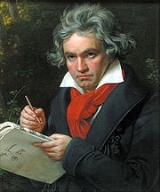
Ludwig van Beethoven


Ludwig van Beethoven (English ; , 16 December 1770 – 26 March 1827) was a German composer
Composer

A composer is a person who creates music, usually in the medium of musical notation, for interpretation and performance. The level of distinction between composers and other musicians varies, which affects issues such as copyright and the deference given to individual interpretations of a particular piece of music....
 and pianist
Pianist

A pianist is a musician who plays the piano. A professional pianist can perform solo pieces, play with an musical ensemble or orchestra, or accompany one or more singers, solo instrumentalists, or other performers....
. He was a crucial figure in the transitional period between the Classical and Romantic
Romantic music

In music, romanticism is a term, often considered misleading, and concept derived from literature traditionally defined by attributes including, "interest in nature, medieval chivalry, mysticism, [and] remoteness [ Social alienation and Solitude]"....
 eras in Western classical music
Classical music

Classical music is a broad term that usually refers to mainstream music produced in, or rooted in the traditions of Western art history Religious music and secular music, encompassing a broad period from roughly the 9th century to present times....
, and remains one of the most acclaimed and influential composers of all time.

Born in Bonn
Bonn

Bonn is the 19th largest city in Germany. Located about 20 kilometres south of Cologne on the river Rhine in the Federal State of North Rhine-Westphalia, it was the Capital of Germany West Germany from 1949 to 1990 and the official seat of government of united Germany from 1990 to 1999....
, then in the Electorate of Cologne in western Germany
Germany

Germany , officially the Federal Republic of Germany , is a country in Central Europe. It is bordered to the north by the North Sea, Denmark, and the Baltic Sea; to the east by Poland and the Czech Republic; to the south by Austria and Switzerland; and to the west by France, Luxembourg, Belgium, and the Netherlands....
, he moved to Vienna
Vienna

Vienna is the Capital of Republic of Austria and also one of the nine states of Austria. Vienna is Austria's primary city, with a population of about 1.7 million...
 in his early twenties and settled there, studying with Joseph Haydn
Joseph Haydn

Joseph Haydn was an Austrians composer. He was one of the most prominent composers of the classical music era, and is called by some the "Father of the Symphony" and "Father of the String Quartet"....
 and quickly gaining a reputation as a virtuoso
Virtuoso

A virtuoso is an individual who possesses outstanding technical ability at singing or playing a musical instrument. The plural form is either virtuosi or the Anglicisation, virtuosos, and the feminine form sometimes used is virtuosa....
 pianist.


Discussion
Ask a question about 'Ludwig van Beethoven'
Start a new discussion about 'Ludwig van Beethoven'
Answer questions from other users
Full Discussion Forum


Recent Posts


Quotations


Beethoven is a towering juggernaught of fire and light.

Forrest Pierce

I want to seize fate by the throat.

Letter to F.G. Wegeler (1801-11-16)

Ich werde im Himmel hören! (I will hear in heaven!).

Said on his deathbed, 1827, as cited from the book Last Words.

Plaudite, amici, comedia finita est. (Applaud, my friends, the comedy is over.).

Said on his deathbed, 1827

There ought to be but one large art warehouse in the world, to which the artist could carry his art-works, and from which he could carry away whatever he needed. As it is, one must be half a tradesman.

Conversations (January 1801)

The world is a king, and like a king, desires flattery in return for favor; but true art is selfish and perverse — it will not submit to the mold of flattery.

Conversations (March 1820)


Encyclopedia


Beethoven
Ludwig van Beethoven (English ; , 16 December 1770 – 26 March 1827) was a German composer
Composer

A composer is a person who creates music, usually in the medium of musical notation, for interpretation and performance. The level of distinction between composers and other musicians varies, which affects issues such as copyright and the deference given to individual interpretations of a particular piece of music....
 and pianist
Pianist

A pianist is a musician who plays the piano. A professional pianist can perform solo pieces, play with an musical ensemble or orchestra, or accompany one or more singers, solo instrumentalists, or other performers....
. He was a crucial figure in the transitional period between the Classical and Romantic
Romantic music

In music, romanticism is a term, often considered misleading, and concept derived from literature traditionally defined by attributes including, "interest in nature, medieval chivalry, mysticism, [and] remoteness [ Social alienation and Solitude]"....
 eras in Western classical music
Classical music

Classical music is a broad term that usually refers to mainstream music produced in, or rooted in the traditions of Western art history Religious music and secular music, encompassing a broad period from roughly the 9th century to present times....
, and remains one of the most acclaimed and influential composers of all time.

Born in Bonn
Bonn

Bonn is the 19th largest city in Germany. Located about 20 kilometres south of Cologne on the river Rhine in the Federal State of North Rhine-Westphalia, it was the Capital of Germany West Germany from 1949 to 1990 and the official seat of government of united Germany from 1990 to 1999....
, then in the Electorate of Cologne in western Germany
Germany

Germany , officially the Federal Republic of Germany , is a country in Central Europe. It is bordered to the north by the North Sea, Denmark, and the Baltic Sea; to the east by Poland and the Czech Republic; to the south by Austria and Switzerland; and to the west by France, Luxembourg, Belgium, and the Netherlands....
, he moved to Vienna
Vienna

Vienna is the Capital of Republic of Austria and also one of the nine states of Austria. Vienna is Austria's primary city, with a population of about 1.7 million...
 in his early twenties and settled there, studying with Joseph Haydn
Joseph Haydn

Joseph Haydn was an Austrians composer. He was one of the most prominent composers of the classical music era, and is called by some the "Father of the Symphony" and "Father of the String Quartet"....
 and quickly gaining a reputation as a virtuoso
Virtuoso

A virtuoso is an individual who possesses outstanding technical ability at singing or playing a musical instrument. The plural form is either virtuosi or the Anglicisation, virtuosos, and the feminine form sometimes used is virtuosa....
 pianist. Beethoven's hearing gradually deteriorated
Hearing impairment

A hearing impairment is a full or partial decrease in the ability to detect or understand sounds.Caused by a wide range of biological and environmental factors, loss of hearing can happen to any organism that perceives sound....
 beginning in his twenties, yet he continued to compose, and to conduct
Conducting

Conducting is the act of directing a musical performance by way of visible gestures. Orchestras, choirs, concert bands and other musical ensembles often have conductors....
 and perform, even after he was completely deaf
Profound hearing loss

Profound hearing loss is defined as a Hearing wikt:threshold greater than 90 Decibel ? meaning that an individual with profound hearing loss can only hear sounds that are louder than 90 dB....
.

Biography


Background and early life


Beethoven was the grandson of a musician of Flemish
Flanders

Flanders is a geographical region located in parts of present-day Belgium, France, and the Netherlands. Over the course of history, the geographical territory that was called "Flanders" has varied....
 origin who was also named Ludwig van Beethoven (1712–1773). As of 1733 the elder Ludwig had served as a bass singer in the court of the Elector of Cologne
Prince-elector

The Prince-Electors of the Holy Roman Empire were the members of the electoral college of the Holy Roman Empire, having the function of Imperial election the Holy Roman Emperors....
. He rose through the ranks of the musical establishment, eventually becoming Kapellmeister
Kapellmeister

Kapellmeister is a German language word designating a person in charge of music-making. The word is a compound word, consisting of the roots Kapelle and Meister ....
 (music director). The elder Ludwig had one son, Johann van Beethoven
Johann van Beethoven

Johann van Beethoven was a German tenor who sang in the court chapel at Bonn. He is remembered as the father of the celebrated composer Ludwig van Beethoven ....
 (1740–1792), who worked as a tenor in the same musical establishment, also giving lessons on piano and violin to supplement his income.

Johann married Maria Magdalena Keverich in 1744; she was the daughter of Johann Heinrich Keverich, who had been the head chef at the court of the Archbishopric of Trier
Archbishopric of Trier

The Archbishopric of Trier was a Roman Catholic diocese in Germany, that existed from Carolingians times until the end of the Holy Roman Empire....
.

Beethoven was born of this marriage in Bonn in December 1770, and was baptized on 17 December 1770. Children of that era were usually baptized the day after birth, but there is no documentary evidence that this occurred in Beethoven's case. It is known that his family and his teacher Johann Albrechtsberger celebrated his birthday on 16 December. Thus, while the evidence supports the probability that 16 December 1770 was Beethoven's date of birth, this cannot be stated with certainty. Of the seven children born to Johann Beethoven, only second-born Ludwig and two younger brothers survived infancy. Caspar Anton Carl was born in 1774, and Nikolaus Johann, the youngest, was born in 1776.

Beethoven's first music teacher was his father. A traditional belief concerning Johann is that he was a harsh instructor, and that the child Beethoven, "made to stand at the keyboard, was often in tears." Concerning this, the New Grove indicates that there is no solid documentation to support it, and asserts that "speculation and myth-making have both been productive." Beethoven had other local teachers as well: the court organist van den Eeden, Tobias Friedrich Pfeiffer (a family friend, who taught Beethoven piano), and a relative, Franz Rovantini (violin and viola). His musical talent manifested itself early—apparently he was advanced enough to perform at the age of nine, not seven as popularly believed. Johann, aware of Leopold Mozart
Leopold Mozart

Johann Georg Leopold Mozart was a composer, conductor, teacher, and violinist. He is best known today as the father and teacher of Wolfgang Amadeus Mozart, and for his violin textbook Versuch einer gr?ndlichen Violinschule....
's successes in this area, attempted unsuccessfully to exploit his son as a child prodigy
Child prodigy

A child prodigy is someone who at an early age masters one or more skills at an adult level. One heuristic for classifying prodigies is: a prodigy is a child, typically younger than 13 years old, who is performing at the level of a highly trained adult in a very demanding field of endeavor....
. It was Johann who falsified Beethoven's actual age (which was seven) for six on the posters for Beethoven's first public performance in March 1778.

Some time after 1779, Beethoven began his studies with his most important teacher in Bonn, Christian Gottlob Neefe
Christian Gottlob Neefe

Christian Gottlob Neefe was a Germany opera composer and Conducting.Neefe was born in Chemnitz, Saxony. Educated at the University of Leipzig, he was a pupil of Johann Adam Hiller, under whose guidance he wrote his first comic operas....
, who was appointed the Court's Organist in that year. Neefe taught Beethoven composition, and by March 1783 had helped him write his first published composition: a set of keyboard variations (WoO
WoO

WoO is a catalogue prepared in 1955 by Harry Halm and Georg Kinsky, listing all of the compositions of Ludwig van Beethoven that were not originally published with an opus number, or survived only as fragments....
 63). Beethoven soon began working with Neefe as assistant organist, first on an unpaid basis (1781), and then as paid employee (1784) of the court chapel conducted by the Kapellmeister Andrea Luchesi
Andrea Luchesi

Andrea Luca Luchesi , was an Italian composer....
. His first three piano sonatas, named "Kurfürst" ("Elector") for their dedication to the Elector Maximilian Frederick
Maximilian Frederick of Königsegg-Rothenfels

Maximilian Frederick of K?nigsegg-Rothenfels was the Archbishop of Cologne-Prince-elector of Cologne and the Bishop of M?nster from 1761 to 1784. He was born in Cologne....
, were published in 1783. Maximilian Frederick, who died in 1784, not long after Beethoven's appointment as assistant organist, had noticed Beethoven's talent early, and had subsidized and encouraged the young Beethoven's musical studies.

In 1787 another of Beethoven's early patrons, Count Waldstein
Count Ferdinand Ernst Gabriel von Waldstein

Count Ferdinand Ernst Gabriel von Waldstein was a German nobleman and patron of the arts. A member of the Waldstein family and an early patron of Beethoven, his political and military roles included Geheimrat in Bonn, lieutenant-general in the British army, and Komtur in the Teutonic Knights....
, enabled him to travel to Vienna for the first time, hoping to study with Mozart
Wolfgang Amadeus Mozart

Wolfgang Amadeus Mozart Mozart showed prodigious ability from his earliest childhood in Salzburg. Already competent on keyboard and violin, he composed from the age of five and performed before European royalty; at seventeen he was engaged as a court musician in Salzburg, but grew restless and traveled in search of a better position, always...
. Scholars disagree on the authenticity of a story whereby Beethoven is said to have played for Mozart and impressed him; see Mozart and Beethoven
Mozart and Beethoven

Wolfgang Amadeus Mozart had a powerful influence on the work of Ludwig van Beethoven. Beethoven knew much of Mozart's work, and modeled a number of his own compositions on works of Mozart....
. After just two months in Vienna, Beethoven learned that his mother was severely ill, and he was forced to return home. His mother died shortly thereafter, and the father lapsed deeper into alcoholism. As a result, Beethoven became responsible for the care of his two younger brothers, and he spent the next five years in Bonn.

In 1789, he succeeded in obtaining a legal order by which half of his father's salary was paid directly to him for support of the family. Another source of income was payment for Beethoven's service as a violist
Violist

This is a list of noted viola players....
 in the court orchestra. This familiarized Beethoven with three of Mozart
Wolfgang Amadeus Mozart

Wolfgang Amadeus Mozart Mozart showed prodigious ability from his earliest childhood in Salzburg. Already competent on keyboard and violin, he composed from the age of five and performed before European royalty; at seventeen he was engaged as a court musician in Salzburg, but grew restless and traveled in search of a better position, always...
's operas performed at court in this period.

Establishing his career in Vienna


With the Elector's help, Beethoven moved again to Vienna in 1792. Beethoven did not immediately set out to establish himself as a composer, but rather devoted himself to study and to piano performance. Working under the direction of Joseph Haydn
Joseph Haydn

Joseph Haydn was an Austrians composer. He was one of the most prominent composers of the classical music era, and is called by some the "Father of the Symphony" and "Father of the String Quartet"....
, he sought to master counterpoint, and he also took violin lessons.

With Haydn's departure for England in 1794, Beethoven was expected by the Elector to return home. He chose instead to remain in Vienna, continuing the instruction in counterpoint with Johann Georg Albrechtsberger
Johann Georg Albrechtsberger

Johann Georg Albrechtsberger was an Austrian musician who was born at Klosterneuburg, near Vienna.He originally studied music at Melk Abbey and philosophy at a Benedictine seminary in Vienna and became one of the most learned and skillful contrapuntists of his age....
 and other teachers. Although his stipend from the Elector expired, a number of Viennese noblemen had already recognized his ability and offered him financial support, among them Prince Joseph Franz Lobkowicz, Prince Karl Lichnowsky
Karl Alois Johann-Nepomuk Vinzenz, Fürst Lichnowsky

HSH Karl Alois, Prince Lichnowsky , was second Prince Lichnowsky and a Chamberlain at the Imperial Austrian court. He is remembered for his patronage of music and his relationships with Wolfgang Amadeus Mozart and Ludwig van Beethoven....
, and Baron Gottfried van Swieten
Gottfried van Swieten

Baron Gottfried van Swieten was a diplomat, librarian, and government official who served the Habsburg Monarchy during the eighteenth century....
.

By 1793, Beethoven established a reputation in Vienna as a piano virtuoso and improviser in the salons of the nobility, often playing the preludes and fugues of J. S. Bach
Johann Sebastian Bach

Johann Sebastian Bach was a German composer and organ whose sacred and secular works for choir, orchestra, and solo instruments drew together the strands of the Baroque music period and brought it to its ultimate maturity....
's Well-Tempered Clavier
Well-Tempered Clavier

The Well-Tempered Clavier , BWV 846?893, is a collection of solo keyboard music composed by Johann Sebastian Bach. He first gave the title to a book of prelude and fugues in all 24 major and minor key , dated 1722, composed "for the profit and use of musical youth desirous of learning, and especially for the pastime of those already...
. Beethoven's first public performance in Vienna was in 1795, with his Second
Piano Concerto No. 2 (Beethoven)

The Piano Concerto No. 2 in B-flat major, Opus number 19, by Ludwig van Beethoven was composed primarily between 1787 and 1789, although it did not attain final form till 1798....
 (or perhaps First
Piano Concerto No. 1 (Beethoven)

Ludwig van Beethoven's Piano Concerto No. 1 in C major, Opus number 15, was written during 1796 and 1797. The first performance was in Prague in 1798, with Beethoven himself playing the piano....
) Piano Concerto
Piano concerto

A piano concerto is a concerto written for piano and orchestra.See also harpsichord concerto; some of these works are occasionally played on piano....
. In the same year he saw the publication of the first of his compositions to which he assigned an opus number
Opus number

Opus, from the Latin word opus meaning "work", is usually used in the sense of "a work of art".The Latin plural of opus, "opera", is used to refer to the genre of music drama ....
, the piano trios of Opus 1
Piano Trios Nos. 1 - 3, Opus 1 (Beethoven)

Piano Trios, Opus 1Ludwig van Ludwig van Beethoven - Opus 1Three trios for piano, violin, and cello, first performed in 1793 in the house of Karl Alois Johann-Nepomuk Vinzenz, F?rst Lichnowsky, to whom they are dedicated, and published in 1795....
.

During his early career as a composer, Beethoven concentrated first on works for piano solo, then string quartet
String quartet

A string quartet is a musical ensemble of four string instruments — usually two violins, a viola and cello — or a piece written to be performed by such a group....
s, symphonies
Symphony

A symphony is a musical composition, often extended and usually for orchestra. "Symphony" does not imply a specific form. Many symphonies are tonality works in four movement with the first in sonata form, and this is often described by music theorists as the structure of a "Classical period " symphony, although even some symphonies by the ac...
, and other genres. This was a pattern he was to repeat in the "late" period of his career. Twelve of Beethoven's famous series of 32 piano sonatas date from before 1802, and could be considered early-period works; of these, the most celebrated today is probably the "Pathétique
Piano Sonata No. 8 (Beethoven)

Ludwig van Beethoven's Piano Sonata No. 8 in C minor, op. 13, commonly known as Sonata Path?tique, was written in 1798 when the composer was 28 years old and published in 1799....
", Op. 13. The first six quartets
String Quartets Nos. 1 - 6, Opus 18 (Beethoven)

Ludwig van Beethoven opus number 18, published in 1801 by T. Mollo et Comp in Vienna, consisted of his first six string quartets. They were composed between 1798 and 1800 to fulfill a commission for Prince Lobkowitz, who was the employer of Beethoven's friend, the violinist Karl Amenda....
 were published as a set (Op. 18) in 1800, and the First
Symphony No. 1 (Beethoven)

Ludwig van Beethoven's Symphony No. 1 in C Major was premiered on April 2, 1800 at the Burgtheater in Vienna, and is dedicated to Baron Gottfried van Swieten, an early patron of the composer....
 and Second
Symphony No. 2 (Beethoven)

Ludwig van Beethoven Symphony No. 2 in D major was written between 1801 and 1802 and is dedicated to Karl Alois Johann-Nepomuk Vinzenz, F?rst Lichnowsky....
 Symphonies premiered in 1800 and 1802. By 1800, with the premiere of his First Symphony
Symphony No. 1 (Beethoven)

Ludwig van Beethoven's Symphony No. 1 in C Major was premiered on April 2, 1800 at the Burgtheater in Vienna, and is dedicated to Baron Gottfried van Swieten, an early patron of the composer....
, Beethoven was already considered one of the most important of a generation of young composers who followed after Haydn and Mozart
Wolfgang Amadeus Mozart

Wolfgang Amadeus Mozart Mozart showed prodigious ability from his earliest childhood in Salzburg. Already competent on keyboard and violin, he composed from the age of five and performed before European royalty; at seventeen he was engaged as a court musician in Salzburg, but grew restless and traveled in search of a better position, always...
.

All musical authorities agree that Beethoven's early work was closely modeled on that of Haydn and Mozart. However, Beethoven's own musical personality is still very much evident even at this stage. This is seen, for instance, in his frequent use of the musical dynamic sforzando
Dynamics (music)

In music, dynamics normally refers to the volume of a sound or note , but can also refer to every aspect of the execution of a given piece, either stylistic or functional ....
, found even in the early "Kurfürst" sonatas for piano that Beethoven wrote as a child. Some of the longer piano sonatas of the 1790s are written in a rather discursive style quite unlike their models, making use of the so-called "three-key exposition
Three-key exposition

In music, the three-key exposition is a particular kind of exposition used in sonata form.Normally, a sonata form exposition has two main key areas....
".

In this time he settled into a career pattern he would follow for the remainder of his life: rather than working for the church or a noble court (as most composers before him had done), he supported himself through a combination of annual stipends or single gifts from members of the aristocracy; income from subscription concerts, concerts, and lessons; and proceeds from sales of his works.

Teaching and financial support

Beethoven 3
Beethoven had few students. From 1801 to 1805, he tutored Ferdinand Ries
Ferdinand Ries

Ferdinand Ries , from a musical family of Bonn, was a friend and pupil of Ludwig van Beethoven who published in 1838 a collection of reminiscences of his teacher, co-written with Franz Gerhard Wegeler....
, who would go on to become a composer and later published Beethoven remembered, a book about their encounters.

Carl Czerny
Carl Czerny

Carl Czerny was an Austrian pianist, composer and teacher. He is best remembered today for his books of etudes for the piano.Biography...
 studied with Beethoven from 1801 to 1803. He went on to become a renowned music teacher himself, taking on Franz Liszt
Franz Liszt

Franz Liszt was a Kingdom of Hungary composer, virtuoso pianist and teacher.Liszt became renowned throughout Europe for his great skill as a performer during the 19th century....
 as one of his students. He also gave the Vienna premiere of Beethoven's Piano Concerto No. 5 "Emperor"
Piano Concerto No. 5 (Beethoven)

The Piano Concerto No. 5 in E-flat major, Opus number 73 by Ludwig van Beethoven, popularly known as the "Emperor Concerto", was his last piano concerto....
 in 1812.

Perhaps Beethoven's most important aristocratic patron was Archduke Rudolph, youngest son of Emperor Leopold II
Leopold II, Holy Roman Emperor

Leopold II , born Peter Leopold Joseph Anton Joachim Pius Gotthard, was Holy Roman Emperor from 1790 to 1792, King of Hungary, archduke of Austria, and Grand Duke of Tuscany from 1765 to 1790....
, who in 1803 or 1804 began to study piano and composition with Beethoven. The two became friends, and their meetings continued until 1824. Beethoven dedicated 14 compositions to Rudolph, including the Archduke Trio (1811) and his great Missa Solemnis
Missa Solemnis (Beethoven)

The Missa solemnis in D Major, opus number 123 was composed by Ludwig van Beethoven from 1819-1823. It was first performed on April 7, 1824 in St....
 (1823). Rudolph, in turn, dedicated one of his own compositions to Beethoven. The letters Beethoven wrote to Rudolph are today kept at the Gesellschaft der Musikfreunde
Gesellschaft der Musikfreunde

The Gesellschaft der Musikfreunde in Wien was founded in 1812 by Joseph von Sonnleithner, general secretary of the Court Theatre, Vienna. Its official charter, drafted in 1814, states that the purpose of the Society was to promote music in all its facets....
 in Vienna.

Other important patrons were Prince Lichnowsky
Karl Alois Johann-Nepomuk Vinzenz, Fürst Lichnowsky

HSH Karl Alois, Prince Lichnowsky , was second Prince Lichnowsky and a Chamberlain at the Imperial Austrian court. He is remembered for his patronage of music and his relationships with Wolfgang Amadeus Mozart and Ludwig van Beethoven....
, with whom Beethoven had a falling out in 1806, Count Franz Joseph Kinsky, and Prince Joseph Franz Maximilian Lobkowitz.

In the fall of 1808, after having been rejected for a position at the royal theatre, Beethoven received an offer from Napoleon
Napoleon I of France

Napoleon Bonaparte later known as Emperor Napoleon I, was a military and political leader of France whose actions shaped European politics in the early 19th century....
's brother Jérôme Bonaparte
Jérôme Bonaparte

J?r?me-Napol?on Bonaparte, French Prince, King of Westphalia, 1st Prince of Montfort of Vorarlberg was the youngest brother of Napoleon I of France, who made him king of Kingdom of Westphalia ....
, then king of Westphalia
Kingdom of Westphalia

The Kingdom of Westphalia was a historical state that existed from 1807-1813 in parts of present-day Germany. While formally independent, it was a vassal state of France, ruled by Napoleon I of France's brother J?r?me Bonaparte....
, for a well-paid position as Kapellmeister
Kapellmeister

Kapellmeister is a German language word designating a person in charge of music-making. The word is a compound word, consisting of the roots Kapelle and Meister ....
 at the court in Cassel
Cassel

Cassel is a Communes of France in the Nord Departments of France in northern France. Its settlement dates from Roman times and it has been the site of several battles....
. To persuade him to stay in Vienna, the Archduke Rudolf, Count Kinsky and Prince Lobkowitz, after receiving representations from the composer's friends, pledged to pay Beethoven a pension of 4000 florins a year. Only Archduke Rudolf paid his share of the pension on the agreed date. Kinsky, immediately called to duty as an officer, did not contribute and soon died after falling from his horse. Lobkowitz stopped paying in September 1811. No successors came forward to continue the patronage, and Beethoven relied mostly on selling composition rights and a smaller pension after 1815.

Loss of hearing

Around 1796, Beethoven began to lose his hearing. He suffered a severe form of tinnitus
Tinnitus

Tinnitus is the perception of sound within the human ear in the absence of corresponding external sound.Tinnitus can be perceived in one or both ears or in the head....
, a "ringing" in his ears that made it hard for him to perceive and appreciate music; he also avoided conversation. The cause of Beethoven's deafness is unknown, but it has variously been attributed to syphilis
Syphilis

Syphilis is a sexually transmitted disease caused by the spirochete bacterium Treponema pallidum subspecies pallidum. The route of transmission of syphilis is almost always through sexual contact, although there are examples of congenital syphilis via transmission from mother to child in utero....
, lead poisoning
Lead poisoning

Lead poisoning is a medical condition caused by increased levels of the metal lead in the blood. Lead may cause irreversible neurological damage as well as renal disease, cardiovascular effects, and human reproduction toxicity....
, typhus
Typhus

Epidemic typhus is a form of typhus so named because the disease often causes epidemics following wars and natural disasters. The causative organism is Rickettsia prowazekii, transmitted by the human body louse ....
, and even his habit of immersing his head in cold water to stay awake. The oldest explanation, from the autopsy of the time, is that he had a "distended inner ear" which developed lesions over time.

Russell Martin has shown from analysis done on a sample of Beethoven's hair that there were alarmingly high levels of lead in Beethoven's system. High concentrations of lead can lead to bizarre and erratic behaviour, including rages. Another symptom of lead poisoning is deafness. In Beethoven's time, lead was used widely without an understanding of the damage it could lead to: for sweetening wine, in finishes on porcelain, and even in medicines. The investigation of this link was detailed in the book, Beethoven's Hair: An Extraordinary Historical Odyssey and a Scientific Mystery Solved. However, while the likelihood of lead poisoning is very high, the deafness associated with it seldom takes the form that Beethoven exhibited.

He lived for a time in the small Austrian town of Heiligenstadt
Heiligenstadt, Vienna

was an independent parish until 1892 and is today a part of D?bling, the 19th district of Vienna.Heiligenstadt lies between Nu?dorf, to the east, and to the west, Grinzberg, Unterd?bling and Oberd?bling....
, just outside Vienna. Here he wrote his Heiligenstadt Testament
Heiligenstadt Testament

The Heiligenstadt Testament is a letter written by Ludwig van Beethoven to his brothers Carl and Johann at Heiligenstadt, Vienna on 6 October 1802....
, which records his resolution to continue living for and through his art. Over time, his hearing loss became profound: there is a well-attested story that, at the end of the premiere of his Ninth Symphony
Symphony No. 9 (Beethoven)

The Symphony No. 9 in D minor, Opus number 125 "Choral" is the last complete symphony composed by Ludwig van Beethoven. Completed in 1824, the choral symphony Ninth Symphony is one of the best known works of the Western repertoire, considered both an icon and a forefather of Romantic music, and one of Beethoven's greatest masterpieces....
, he had to be turned around to see the tumultuous applause of the audience; hearing nothing, he began to weep. Beethoven's hearing loss did not prevent his composing music, but it made concerts—lucrative sources of income—increasingly hard. After a failed attempt in 1811 to perform his own Piano Concerto No. 5 (the "Emperor")
Piano Concerto No. 5 (Beethoven)

The Piano Concerto No. 5 in E-flat major, Opus number 73 by Ludwig van Beethoven, popularly known as the "Emperor Concerto", was his last piano concerto....
, he never performed in public again.

Beethoven used a special rod attached to the soundboard
Sounding board

The sounding board or soundboard is the part of a string instrument that transmits the vibrations of the strings to the air, greatly increasing the loudness of sound over that of the string alone....
 on a piano that he could bite—the vibrations would then transfer from the piano to his jaw to increase his perception of the sound. A large collection of his hearing aids such as special ear horns can be viewed at the Beethoven House Museum in Bonn, Germany. Despite his obvious distress, however, Carl Czerny
Carl Czerny

Carl Czerny was an Austrian pianist, composer and teacher. He is best remembered today for his books of etudes for the piano.Biography...
 remarked that Beethoven could still hear speech and music normally until 1812. By 1814 however, Beethoven was almost totally deaf, and when a group of visitors saw him play a loud arpeggio or thundering bass notes at his piano remarking, "Ist es nicht schön?" (Isn't that beautiful?), they felt deep sympathy considering his courage and sense of humor.

As a result of Beethoven's hearing loss, a unique historical record has been preserved: his conversation books. His friends wrote in the book so that he could know what they were saying, and he then responded either orally or in the book. The books contain discussions about music and other issues, and give insights into his thinking; they are a source for investigation into how he felt his music should be performed, and also his perception of his relationship to art. Unfortunately, 264 out of a total of 400 conversation books were destroyed (and others were altered) after Beethoven's death by Anton Schindler, in his attempt to paint an idealized picture of the composer.

The Middle period

Around 1802 Beethoven declared "I am but lately little satisfied with my works, I shall take a new way." The first major work of this new way was the "Eroica" Symphony No. 3
Symphony No. 3 (Beethoven)

The Symphony No. 3 in E flat major by Ludwig van Beethoven is a musical work sometimes cited as marking the end of the Classical period and the beginning of musical Romantic music....
 in E flat. While other composers had written symphonies with implied programs, or stories, this symphony was longer and larger in scope than any other written. It made huge demands on the players, because at that time there were few orchestras devoted to concert music that were independent of royal or aristocratic patrons, and hence performance standards at concerts were often haphazard. Nevertheless, it was a success.

The Eroica was one of the first works of Beethoven's so-called "Middle period", or "Heroic Period", a time when Beethoven composed highly ambitious works, often heroic in tone, that extended the scope of the classical musical language Beethoven had inherited from Haydn
Joseph Haydn

Joseph Haydn was an Austrians composer. He was one of the most prominent composers of the classical music era, and is called by some the "Father of the Symphony" and "Father of the String Quartet"....
 and Mozart
Wolfgang Amadeus Mozart

Wolfgang Amadeus Mozart Mozart showed prodigious ability from his earliest childhood in Salzburg. Already competent on keyboard and violin, he composed from the age of five and performed before European royalty; at seventeen he was engaged as a court musician in Salzburg, but grew restless and traveled in search of a better position, always...
. The Middle period work includes the Third
Symphony No. 3 (Beethoven)

The Symphony No. 3 in E flat major by Ludwig van Beethoven is a musical work sometimes cited as marking the end of the Classical period and the beginning of musical Romantic music....
 through Eighth
Symphony No. 8 (Beethoven)

Symphony No. 8 in F Major, Opus number. 93 is a symphony in four movement s composed by Ludwig van Beethoven in 1812. Beethoven fondly referred to it as "my little Symphony in F", distinguishing it from his Symphony No....
 Symphonies, the string quartets 7–11, the Waldstein
Piano Sonata No. 21 (Beethoven)

The Piano Sonata No. 21 in C major, Op.53, nicknamed Waldstein, is considered to be one of Ludwig van Beethoven's greatest Piano sonata, as well as one of the three particularly notable sonatas of his Ludwig van Beethoven#The three periods ....
 and Appassionata
Piano Sonata No. 23 (Beethoven)

Ludwig van Beethoven's Piano Sonata No. 23 in F minor, opus number, colloquially known as the Appassionata, is considered one of the three great piano sonatas of his middle period ....
 piano sonatas, his only oratorio, Christ on the Mount of Olives, the opera Fidelio
Fidelio

Fidelio is a German language opera in two acts by Ludwig van Beethoven. It is Beethoven's only opera. The German libretto is by Joseph Sonnleithner from the French of Jean-Nicolas Bouilly....
, the Violin Concerto
Violin Concerto (Beethoven)

Ludwig van Beethoven's Violin Concerto in D major, Op. 61, was written in 1806.The work was premiered on December 23, 1806 in the Theater an der Wien in Vienna....
 and many other compositions. During this time Beethoven earned his living partly from the sale and performance of his work, and partly from subsidies granted by various wealthy nobles who recognized his ability.

The work of the Middle period established Beethoven's reputation as a great composer. In a review from 1810, he was enshrined by E. T. A. Hoffman as one of the three great "Romantic
Romantic music

In music, romanticism is a term, often considered misleading, and concept derived from literature traditionally defined by attributes including, "interest in nature, medieval chivalry, mysticism, [and] remoteness [ Social alienation and Solitude]"....
" composers; Hoffman called Beethoven's Fifth Symphony
Symphony No. 5 (Beethoven)

Ludwig van Beethoven's Symphony No. 5 in C minor, opus number 67 was written in 1804?08. This symphony is one of the most popular and well-known musical composition in all of European classical music, and one of the most often-played symphonies....
 "one of the most important works of the age". A particular trauma for Beethoven occurred during this period in 1809, when the attacking forces of Napoleon bombarded Vienna. Beethoven, very worried that the noise would destroy what remained of his hearing, hid in the basement of his brother's house, covering his ears with pillows. He was composing the "Emperor" Concerto
Piano Concerto No. 5 (Beethoven)

The Piano Concerto No. 5 in E-flat major, Opus number 73 by Ludwig van Beethoven, popularly known as the "Emperor Concerto", was his last piano concerto....
 at the time.

The Middle period ended with a flourish around 1812, with the Seventh
Symphony No. 7 (Beethoven)

Ludwig van Beethoven began concentrated work on his Symphony No. 7 in A major in 1811, while he was staying in the Bohemian spa town of Teplice in the hope of improving his health....
 and Eighth
Symphony No. 8 (Beethoven)

Symphony No. 8 in F Major, Opus number. 93 is a symphony in four movement s composed by Ludwig van Beethoven in 1812. Beethoven fondly referred to it as "my little Symphony in F", distinguishing it from his Symphony No....
 Symphonies and the third—and at last, successful—version of Fidelio. It was around this time that Beethoven's popularity with the contemporary public reached its apogee, and he was almost universally regarded as the greatest of living composers.

Romantic difficulties

Beethoven never married, although he was engaged to Giulietta Guiccardi. Her father was the main obstacle to their marriage. Giulietta's marriage to a nobleman was unhappy, and when it ended in 1822, she attempted unsuccessfully to return to Beethoven.

His only other documented love affair with an identified woman began in 1805 with Josephine von Brunswick, young widow of the Graf von Deym. It is believed the relationship ended by 1807 because of Beethoven's indecisiveness and the disapproval of Josephine's aristocratic family.

In 1812, Beethoven wrote three love letters to an "Immortal Beloved." Several possible addressees (male and female) have been suggested, with the most likely being Antonie Brentano
Antonie Brentano

Antonie von Birkenstock Brentano is notable as one of the likelier candidates, of the many put forward by scholars, as composer Ludwig van Beethoven's Unsterbliche Geliebte, or "Immortal Beloved"....
.

Custody struggle

On 15 November 1815 Beethoven's brother Karl van Beethoven died of consumption
Tuberculosis

Tuberculosis is a common and often deadly infectious disease caused by mycobacterium, mainly Mycobacterium tuberculosis . Tuberculosis usually attacks the lungs but can also affect the central nervous system, the lymphatic system, the circulatory system, the genitourinary system, the gastrointestinal system, bones, joints, and even the...
 leaving a son, Karl, Beethoven's nephew. Although Beethoven had apparently shown little interest in the boy up to this point, he now became obsessed with obtaining custody of this nine-year old child from his mother, Johanna — whom Beethoven despised and considered an unfit parent. The fight for custody of his nephew brought out the very worst aspects of Beethoven's character. In the lengthy court cases Beethoven stopped at nothing to ensure that he achieved this goal. During this time Beethoven stopped composing for long periods.

The Austrian court system had one court for the nobility
Nobility

Nobility is a government-privileged title which may be either hereditary or for a lifetime. Titles of nobility exist today in many countries although it is usually associated with present or former monarchies....
, The R&I Landrechte, and another for commoners, The Civil Court of the Magistrate. Beethoven disguised the fact that the Dutch "van" in his name did not denote nobility as does the German "von", and his case was tried in the Landrechte. Owing to his influence with the court, Beethoven felt assured of a favorable outcome. Beethoven was awarded sole guardianship. While giving evidence to the Landrechte, however, Beethoven inadvertently admitted that he was not nobly born. The case was transferred to the Magistracy on 18 December 1818, where he lost sole guardianship.

Beethoven appealed, and regained custody of Karl. Johanna's appeal for justice to the Emperor was not successful: the Emperor "washed his hands of the matter". Beethoven stopped at nothing to blacken her name, as can be read in surviving court papers. When Karl could stand his tyrannical uncle no longer, he attempted suicide on 31 July 1826 by shooting himself in the head. He survived, and later asked to be taken to his mother's house.

Late works


Beethoven Waldmuller 1823
There soon followed a deep crisis in Beethoven's personal life, and possibly in his artistic life as well. His output dropped, and one critic even wrote that "the composing of great works seems behind him". The few works that date from this period are often of an experimental character. They include the song cycle
Song cycle

A song cycle is a group of Art song designed to be performed in a sequence as a single entity. As a rule, all of the songs are by the same composer and often use words from the same poet....
 "An die ferne Geliebte
An die ferne Geliebte

An die ferne Geliebte, opus 98, Ludwig van Beethoven's only song cycle, is generally thought of as being the first true song cycle. It was composed in April 1816....
" and the piano sonata Opus 90, works which inspired later generations of Romantic composers. This period also produced the extraordinarily expressive, but almost incoherent, song "An die Hoffnung" (Opus 94).

Beethoven began a renewed study of older music, including works by J. S. Bach
Johann Sebastian Bach

Johann Sebastian Bach was a German composer and organ whose sacred and secular works for choir, orchestra, and solo instruments drew together the strands of the Baroque music period and brought it to its ultimate maturity....
 and Handel
George Frideric Handel

George Frideric Handel was an England Baroque music composer of Germany birth who is famous for his operas, oratorios, and concerto grosso. His life and music may justly be described as "cosmopolitan": he was born in Germany, trained in Italy, and spent most of his life in England....
, then being published in the first attempts at complete editions. He composed "The Consecration of the House" overture, which was the first work to attempt to incorporate his new influences. But it is when he returned to the keyboard to compose his first new piano sonatas in almost a decade, that a new style, now called his "late period", emerged.

The works of the late period are commonly held to include the last five piano sonatas and the Diabelli Variations
Diabelli Variations

The 33 Variations on a waltz by Anton Diabelli Op. 120, commonly known as the Diabelli Variations, is a set of variation form for the piano written between 1819 and 1823 by Ludwig van Beethoven on a waltz composed by Anton Diabelli....
, the last two sonatas for cello and piano, the late quartets (see below), and two works for very large forces: the Missa Solemnis
Missa Solemnis (Beethoven)

The Missa solemnis in D Major, opus number 123 was composed by Ludwig van Beethoven from 1819-1823. It was first performed on April 7, 1824 in St....
 and the Ninth Symphony
Symphony No. 9 (Beethoven)

The Symphony No. 9 in D minor, Opus number 125 "Choral" is the last complete symphony composed by Ludwig van Beethoven. Completed in 1824, the choral symphony Ninth Symphony is one of the best known works of the Western repertoire, considered both an icon and a forefather of Romantic music, and one of Beethoven's greatest masterpieces....
, perhaps Beethoven's best known work.

Beethoven then turned to writing string quartet
String quartet

A string quartet is a musical ensemble of four string instruments — usually two violins, a viola and cello — or a piece written to be performed by such a group....
s on a commission from Prince Nikolay Golitsin of St. Petersburg
Saint Petersburg

Saint Petersburg is a types of inhabited localities in Russia and a federal subjects of Russia of Russia located on the Neva River at the head of the Gulf of Finland on the Baltic Sea....
. The war between Austria
Austria

Austria , officially the Republic of Austria , is a landlocked country in Central Europe. It borders both Germany and the Czech Republic to the north, Slovakia and Hungary to the east, Slovenia and Italy to the south, and Switzerland and Liechtenstein to the west....
 and France
France

France , officially the French Republic , is a country whose Metropolitan France is located in Western Europe and that also comprises various Overseas departments and territories of France....
 had devastated his finances, and the Prince was to pay an honorarium of 50 gold ducats per quartet. This series of quartets, known as the "Late Quartets", would go far beyond what either musicians or audiences were ready for at that time. One musician commented that "we know there is something there, but we do not know what it is." Composer Louis Spohr
Louis Spohr

Louis Spohr was a German composer, violinist and conducting. Born Ludwig Spohr, he is usually known by the French form of his name outside Germany....
 called them "indecipherable, uncorrected horrors," though that opinion has changed considerably from the time of their first bewildered reception. They would continue to inspire musicians and composers, from Richard Wagner
Richard Wagner

Wilhelm Richard Wagner was a German composer, Conducting, theatre director and essayist, primarily known for his operas . Unlike most other great opera composers, Wagner wrote both the scenario and libretto for his works....
 to Béla Bartók
Béla Bartók

B?la Viktor J?nos Bart?k was a Hungarian people composer and pianist, considered to be one of the greatest composers of the 20th century. Through his collection and analytical study of folk music, he was one of the founders of ethnomusicology....
, for their unique forms and ideas. Of the late quartets, Beethoven's favourite was the Fourteenth Quartet, op. 131
String Quartet No. 14 (Beethoven)

The String Quartet No. 14 in C-sharp minor, opus number 131, by Ludwig van Beethoven was completed in 1826. About 40 minutes in length, it consists of seven movements to be played without a break, as follows:...
 in C# minor, upon hearing which Schubert
Franz Schubert

Franz Peter Schubert was an Austrian composer. He wrote some 600 lieder, nine symphonies , liturgy music, operas, and a large body of chamber music and solo piano music....
 is said to have remarked, "After this, what is left for us to write?"

Beethoven wrote the last quartets amidst failing health. In 1821, a bad case of jaundice
Jaundice

Jaundice, also known as icterus , is a yellowish discoloration of the skin, the conjunctival membranes over the sclera , and other mucous membranes caused by hyperbilirubinemia ....
 afflicted him, a sign of his impending liver failure
Liver failure

Acute liver failure is the appearance of severe complications rapidly after the first signs of liver disease , and indicates that the liver has sustained severe damage ....
. In April 1825 he was bedridden, and remained ill for about a month. The illness—or more precisely, Beethoven's recovery from it—is remembered for having given rise to the deeply felt slow movement of the Fifteenth Quartet
String Quartet No. 15 (Beethoven)

The Quartet in A minor, by Ludwig van Beethoven, opus number 132 was written in 1825, given its public premiere on November 6 of that year by the Ignaz Schuppanzigh and was dedicated to Count Galitzine, as were op....
, which Beethoven called "Holy song of thanks ('Heiliger dankgesang') to the divinity, from one made well". Beethoven went on to complete the (misnumbered) Thirteenth
String Quartet No. 13 (Beethoven)

The String Quartet No. 13 in B major, opus number 130, by Ludwig van Beethoven was completed in November 1825 . The number traditionally assigned to it is based on the order of its publication; it is actually the fourteenth quartet in order of composition....
, Fourteenth
String Quartet No. 14 (Beethoven)

The String Quartet No. 14 in C-sharp minor, opus number 131, by Ludwig van Beethoven was completed in 1826. About 40 minutes in length, it consists of seven movements to be played without a break, as follows:...
, and Sixteenth
String Quartet No. 16 (Beethoven)

The String Quartet No. 16 in F major, Opus number 135, by Ludwig van Beethoven was written in 1826 and was the last substantial work he finished....
 Quartets.

The last work completed by Beethoven was the substitute final movement of the Thirteenth Quartet, deemed necessary to replace the difficult Grosse Fuge. Shortly thereafter (December 1826), illness struck again, with episodes of vomiting and diarrhea that nearly ended his life.

Illness and death


Zentralfriedhof Vienna   Beethoven
After Beethoven lost custody of his nephew, he went into a decline that led to his death on Monday 26 March 1827 during a thunderstorm.

Viennese pathologist and forensic expert Christian Reiter (head of the Department of Forensic Medicine at Vienna Medical University) claimed that Beethoven's physician
Physician

A physician, medical practitioner, doctor of medicine, or medical doctor practices medicine, and is concerned with maintaining or restoring human health through the study, diagnosis, and treatment of disease and injury....
, Andreas Wawruch, inadvertently hastened Beethoven's death. According to Reiter, Wawruch worsened Beethoven's already lead
Lead

Lead is a main-group Chemical element with symbol Pb and atomic number 82. Lead is a soft, malleable poor metal, also considered to be one of the heavy metal ....
 poisoned condition with lead poultices applied after repeated surgical draining of his bloated abdomen. Reiter's hypothesis, however, is at odds with Wawruch's written instruction "that the wound was kept dry all the time". Furthermore human hair is a very bad biomarker for lead contamination and Reiter's hypothesis must be considered dubious, because of the lack of proper scholarly documentation in his article.

Unlike Mozart
Wolfgang Amadeus Mozart

Wolfgang Amadeus Mozart Mozart showed prodigious ability from his earliest childhood in Salzburg. Already competent on keyboard and violin, he composed from the age of five and performed before European royalty; at seventeen he was engaged as a court musician in Salzburg, but grew restless and traveled in search of a better position, always...
, who was buried in a common grave (as was the custom at the time), 20,000 Viennese
Vienna

Vienna is the Capital of Republic of Austria and also one of the nine states of Austria. Vienna is Austria's primary city, with a population of about 1.7 million...
 citizens lined the streets at Beethoven's funeral on 29 March 1827. Franz Schubert
Franz Schubert

Franz Peter Schubert was an Austrian composer. He wrote some 600 lieder, nine symphonies , liturgy music, operas, and a large body of chamber music and solo piano music....
 was a torch bearer. Beethoven was buried in the Währing
Währing

W?hring is the 18th district of Vienna, Austria. It is in the northwest part of the city. In addition to currently hosting a number of Vienna's foreign embassies, W?hring was the site of the original burial places of composers Ludwig van Beethoven and Franz Schubert....
 cemetery, west of Vienna. His remains were moved in 1888 to Vienna's Zentralfriedhof
Zentralfriedhof

The Zentralfriedhof is situated in the district of Simmering , Simmeringer Hauptstra?e 230?244, Vienna 1110, Austria, and is the largest and most famous cemetery among Vienna's nearly 50 cemeteries....
.

Character

Beethoven's personal life was troubled due to his encroaching deafness
Post-lingual hearing impairment

Post-lingual hearing impairment is a hearing impairment where hearing loss is adventitious and develops due to disease or Physical trauma after the acquisition of speech and language, usually after the age of six....
 which led him to contemplate suicide (documented in his Heiligenstadt Testament). Beethoven was often irascible and may have suffered from bipolar disorder
Bipolar disorder

Bipolar disorder is a Classification of mental disorders that describes a category of mood disorders, or mood swings, defined by the presence of one or more episodes of abnormally elevated mood clinically referred to as mania or, if milder, hypomania....
 and irritability brought on by chronic abdominal pain beginning in his twenties that has been attributed to his lead poisoning. Nevertheless, he had a close and devoted circle of friends all his life, thought to have been attracted by his reputed strength of personality. Towards the end of his life, Beethoven's friends competed in their efforts to help him cope with his incapacities.

Sources show Beethoven's disdain for authority, and for social rank. He stopped performing at the piano if the audience chatted among themselves, or afforded him less than their full attention. At soirées, he refused to perform if suddenly called upon to do so. Eventually, after many confrontations, the Archduke Rudolph decreed that the usual rules of court etiquette did not apply to Beethoven.

Beliefs and their musical influence

Beethoven was attracted to the ideals of the Enlightenment. In 1804, when Napoleon's imperial ambitions became clear, Beethoven took hold of the title-page of his Third Symphony and scratched the name Bonaparte out so violently that he made a hole in the paper. He later changed the work's title to "Sinfonia Eroica, composta per festeggiare il sovvenire d'un grand'uom" ("Heroic Symphony, composed to celebrate the memory of a great man"), and he rededicated it to his patron, Prince Joseph Franz von Lobkowitz, at whose palace it was first performed.

The fourth movement of his Ninth Symphony
Symphony No. 9 (Beethoven)

The Symphony No. 9 in D minor, Opus number 125 "Choral" is the last complete symphony composed by Ludwig van Beethoven. Completed in 1824, the choral symphony Ninth Symphony is one of the best known works of the Western repertoire, considered both an icon and a forefather of Romantic music, and one of Beethoven's greatest masterpieces....
 features an elaborate choral setting of Schiller's
Friedrich Schiller

Johann Christoph Friedrich von Schiller [johan/jo?han kr?st?f fri?t??? f?n ??l??/??l?] was a Germany poet, philosopher, historian, and playwright....
 Ode An die Freude
Ode to Joy

"To Joy" is an ode written in 1785 in literature by the German poet, playwright and historian Friedrich Schiller. The poem celebrates the ideal of unity and brotherhood of all mankind....
 ("Ode to Joy"), an optimistic hymn championing the brotherhood of humanity.

Scholars disagree about Beethoven's religious beliefs, and about the role they played in his work: see Ludwig van Beethoven's religious beliefs
Ludwig van Beethoven's religious beliefs

The role of religion in the work of the celebrated composer Ludwig van Beethoven is a matter of disagreement among scholars.Beethoven was born and raised a Roman Catholic, and he composed many religious works, among them the Mass in C and the Missa Solemnis ....
. It has been asserted, but not proven, that Beethoven was a Freemason.

Music


Beethoven is acknowledged as one of the giants of classical music
Classical music

Classical music is a broad term that usually refers to mainstream music produced in, or rooted in the traditions of Western art history Religious music and secular music, encompassing a broad period from roughly the 9th century to present times....
; occasionally he is referred to as one of the "three Bs
Three Bs

"The Three Bs" is an English-language phrase derived from a similar phrase, in German language, coined by Hans von B?low. The phrase is generally used in discussions of Western classical music, and refers to the supposed primacy of Johann Sebastian Bach, Ludwig van Beethoven, and Johannes Brahms in the field....
" (along with Bach
Johann Sebastian Bach

Johann Sebastian Bach was a German composer and organ whose sacred and secular works for choir, orchestra, and solo instruments drew together the strands of the Baroque music period and brought it to its ultimate maturity....
 and Brahms
Johannes Brahms

Johannes Brahms , composer and pianist, was one of the leading musicians of the Romantic music. Born in Hamburg, Brahms spent much of his professional life in Vienna, Austria, where he was a leader of the musical scene....
) who epitomize that tradition. He was also a pivotal figure in the transition from 18th century musical classicism to 19th century romanticism
Romantic music

In music, romanticism is a term, often considered misleading, and concept derived from literature traditionally defined by attributes including, "interest in nature, medieval chivalry, mysticism, [and] remoteness [ Social alienation and Solitude]"....
, and his influence on subsequent generations of composers was profound.

Overview


Beethoven composed in a fairly wide variety of musical genres, and for a fairly wide variety of instrument combinations. His works for symphony orchestra include nine symphonies
Symphony

A symphony is a musical composition, often extended and usually for orchestra. "Symphony" does not imply a specific form. Many symphonies are tonality works in four movement with the first in sonata form, and this is often described by music theorists as the structure of a "Classical period " symphony, although even some symphonies by the ac...
 (of which the Ninth includes a chorus), and about a dozen pieces of "occasional" music. He wrote nine concerti
Concerto

The term Concerto usually refers to a three-part musical work in which one solo instrument is accompanied by an orchestra. The concerto, as understood in this modern way, arose in the Baroque period side by side with the concerto grosso, which contrasted a small group of instruments with the rest of the orchestra....
 for one or more soloists and orchestra, as well as four shorter works that include soloists accompanied by orchestra. Fidelio
Fidelio

Fidelio is a German language opera in two acts by Ludwig van Beethoven. It is Beethoven's only opera. The German libretto is by Joseph Sonnleithner from the French of Jean-Nicolas Bouilly....
 is the only opera
Opera

Opera is an Performing arts in which singers and musicians perform a dramatic work which combines a text and a musical score. Opera is part of the Western classical music tradition....
 he wrote; vocal works including orchestral accompaniment include two masses
Mass (music)

The Mass, a Musical form of sacred music, is a choir composition that sets the fixed portions of the Eucharistic liturgy to music. Most Masses are settings of Mass in Latin, the traditional language of the Roman Catholic Church, but there are a significant number written in the languages of non-Catholic countries where vernacular worship h...
 and a number of shorter works.

His work for piano
Piano

The piano is a musical instrument played by means of a keyboard instrument. Widely used in Western music for solo performance, ensemble use, chamber music, and accompaniment, the piano is also very popular as an aid to musical composition and rehearsal....
 was extensive; 32 piano sonata
Piano sonata

A piano sonata is a sonata written for unaccompanied piano. Piano sonatas are usually written in three or four movement , although occasionally there are just one or two movements....
s, and numerous shorter works, including arrangements (for piano solo
Piano solo

The piano is often used to provide harmony accompaniment to a singer or other instrument . However, solo parts for the piano can be found in some musical styles....
 or piano duet) of some of his other works. Works with piano accompaniment include 10 violin sonatas, 5 cello sonatas, and a sonata for french horn, as well as numerous lied
Lied

, is a German language word, meaning literally "song"; among English speakers, however, the word is used primarily as a term for European European classical music songs, also known as art songs....
er.

The amount of chamber music produced by Beethoven was notable. In addition to the 16 string quartet
String quartet

A string quartet is a musical ensemble of four string instruments — usually two violins, a viola and cello — or a piece written to be performed by such a group....
s, he wrote five works for string quintet
String quintet

A string quintet is an ensemble of five string instrument players or a piece written for such a combination. The most common combinations in european classical music are two violins, two violas and cello or two violins, viola and two cellos....
, seven for piano trio
Piano trio

A piano trio is a group of piano and two other instruments, usually a violin and a cello, or a piece of music written for such a group. It is one of the most common forms found in European classical music chamber music....
, five for string trio
String trio

A string trio is a group of three string instruments or a piece written for such a group. The earliest string trio form consisted of two violins and cello, a grouping which had grown out of the baroque music trio sonata....
, and more than a dozen works for a variety of combinations of wind instruments.

The three periods

Beethoven's compositional career is usually divided into Early, Middle, and Late periods. In this scheme, his early period is taken to last until about 1802, the middle period from about 1803 to about 1814, and the late period from about 1815.

In his Early period, Beethoven's work was strongly influenced by his predecessors Haydn
Joseph Haydn

Joseph Haydn was an Austrians composer. He was one of the most prominent composers of the classical music era, and is called by some the "Father of the Symphony" and "Father of the String Quartet"....
 and Mozart
Wolfgang Amadeus Mozart

Wolfgang Amadeus Mozart Mozart showed prodigious ability from his earliest childhood in Salzburg. Already competent on keyboard and violin, he composed from the age of five and performed before European royalty; at seventeen he was engaged as a court musician in Salzburg, but grew restless and traveled in search of a better position, always...
, but he also explored new directions and gradually expanded the scope and ambition of his work. Some important pieces from the Early period are the first
Symphony No. 1 (Beethoven)

Ludwig van Beethoven's Symphony No. 1 in C Major was premiered on April 2, 1800 at the Burgtheater in Vienna, and is dedicated to Baron Gottfried van Swieten, an early patron of the composer....
 and second
Symphony No. 2 (Beethoven)

Ludwig van Beethoven Symphony No. 2 in D major was written between 1801 and 1802 and is dedicated to Karl Alois Johann-Nepomuk Vinzenz, F?rst Lichnowsky....
 symphonies, the set of six string quartets Opus 18
String Quartets Nos. 1 - 6, Opus 18 (Beethoven)

Ludwig van Beethoven opus number 18, published in 1801 by T. Mollo et Comp in Vienna, consisted of his first six string quartets. They were composed between 1798 and 1800 to fulfill a commission for Prince Lobkowitz, who was the employer of Beethoven's friend, the violinist Karl Amenda....
, the first two piano concertos, and the first dozen or so piano sonatas
List of solo piano compositions by Ludwig van Beethoven

This is a list of solo piano pieces by Ludwig van Beethoven. In addition to the 32 celebrated Piano sonata, Beethoven's work for solo piano includes many one-movement pieces, notably many sets of Theme and variations and Bagatelle , including the widely-known "F?r Elise"....
, including the famous Pathétique
Piano Sonata No. 8 (Beethoven)

Ludwig van Beethoven's Piano Sonata No. 8 in C minor, op. 13, commonly known as Sonata Path?tique, was written in 1798 when the composer was 28 years old and published in 1799....
 sonata, Op. 13

His Middle (Heroic) period began shortly after Beethoven's personal crisis brought on by his recognition of encroaching deafness. It is noted for large-scale works that express heroism and struggle. Middle-period works include six symphonies (Nos. 3–8), the last three piano concertos, the Triple Concerto
Triple Concerto (Beethoven)

Ludwig van Beethoven's Concerto for Violin, Cello, and Piano in C major, Op. 56, more commonly known as the Triple Concerto, was composed in 1804-1805....
 and violin concerto
Violin Concerto (Beethoven)

Ludwig van Beethoven's Violin Concerto in D major, Op. 61, was written in 1806.The work was premiered on December 23, 1806 in the Theater an der Wien in Vienna....
, five string quartets (Nos. 7–11), several piano sonatas (including the Moonlight
Piano Sonata No. 14 (Beethoven)

The Piano sonata No. 14 in C-sharp minor "Quasi una fantasia", Opus number 27, No. 2, by Ludwig van Beethoven, is popularly known as the "Moonlight" Sonata ....
, Waldstein
Piano Sonata No. 21 (Beethoven)

The Piano Sonata No. 21 in C major, Op.53, nicknamed Waldstein, is considered to be one of Ludwig van Beethoven's greatest Piano sonata, as well as one of the three particularly notable sonatas of his Ludwig van Beethoven#The three periods ....
 and Appassionata
Piano Sonata No. 23 (Beethoven)

Ludwig van Beethoven's Piano Sonata No. 23 in F minor, opus number, colloquially known as the Appassionata, is considered one of the three great piano sonatas of his middle period ....
 sonatas), the Kreutzer
Violin Sonata No. 9 (Beethoven)

Violin Sonata No. 9 in A major, commonly known as the Kreutzer Sonata, is a violin sonata which Ludwig van Beethoven published in 1802 in music as his Opus 47....
 violin sonata and Beethoven's only opera
Opera

Opera is an Performing arts in which singers and musicians perform a dramatic work which combines a text and a musical score. Opera is part of the Western classical music tradition....
, Fidelio
Fidelio

Fidelio is a German language opera in two acts by Ludwig van Beethoven. It is Beethoven's only opera. The German libretto is by Joseph Sonnleithner from the French of Jean-Nicolas Bouilly....
.

Beethoven's Late period began around 1815. Works from this period are characterized by their intellectual depth, their formal innovations, and their intense, highly personal expression. The String Quartet, Op. 131
String Quartet No. 14 (Beethoven)

The String Quartet No. 14 in C-sharp minor, opus number 131, by Ludwig van Beethoven was completed in 1826. About 40 minutes in length, it consists of seven movements to be played without a break, as follows:...
 has seven linked movements, and the Ninth Symphony
Symphony No. 9 (Beethoven)

The Symphony No. 9 in D minor, Opus number 125 "Choral" is the last complete symphony composed by Ludwig van Beethoven. Completed in 1824, the choral symphony Ninth Symphony is one of the best known works of the Western repertoire, considered both an icon and a forefather of Romantic music, and one of Beethoven's greatest masterpieces....
 adds choral forces to the orchestra in the last movement. Other compositions from this period include the Missa Solemnis
Missa Solemnis (Beethoven)

The Missa solemnis in D Major, opus number 123 was composed by Ludwig van Beethoven from 1819-1823. It was first performed on April 7, 1824 in St....
, the last five string quartets (including the massive Grosse Fuge) and the last five piano sonatas.

Sources


Further reading

  • Alexander Wheelock Thayer
    Alexander Wheelock Thayer

    Alexander Wheelock Thayer , was a librarian and journalist who became the author of the first scholarly biography of Ludwig van Beethoven, still after many updatings regarded as a standard work of reference on the composer....
    , Ludwig van Beethoven's Leben, 5 vols., Berlin 1866–1908 (vols. 4 and 5 posthumously ed. by Hugo Riemann
    Hugo Riemann

    Karl Wilhelm Julius Hugo Riemann was a Germany music theory. He should not be confused with the mathematician Bernhard Riemann.Riemann was born at Grossmehlra, near Sondershausen....
    ).
  • Albrecht, Theodor, and Elaine Schwensen, "More Than Just Peanuts: Evidence for December 16 as Beethoven's birthday." The Beethoven Newsletter 3 (1988): 49, 60–63.
  • Bohle, Bruce, and Robert Sabin. The International Cyclopedia of Music and Musicians. London: J.M.Dent & Sons LTD, 1975. ISBN 0-460-04235-1.
  • Davies, Peter J. The Character of a Genius: Beethoven in Perspective. Westport, Conn.: Greenwood Press, 2002. ISBN 0-313-31913-8.
  • Davies, Peter J. Beethoven in Person: His Deafness, Illnesses, and Death. Westport, Conn.: Greenwood Press, 2001. ISBN 0-313-31587-6.
  • DeNora, Tia
    Tia DeNora

    Tia DeNora is Professor of Sociology of Music and Director of Research, in the Department of Sociology/Philosophy at the University of Exeter. ...
    . "Beethoven and the Construction of Genius: Musical Politics in Vienna, 1792–1803." Berkeley, California: University of California Press, 1995. ISBN 0-520-21158-8.
  • Geck, Martin. Beethoven. Translated by Anthea Bell. London: Haus, 2003. ISBN 1-904341-03-9 (h), ISBN 1-904341-00-4 (p).


  • Kropfinger, Klaus. Beethoven. Verlage Bärenreiter/Metzler, 2001. ISBN 3-7618-1621-9.
  • Martin, Russell. Beethoven's Hair. New York: Broadway Books, 2000. ISBN 978-0767903509
  • Meredith, William. "The History of Beethoven's Skull Fragments." The Beethoven Journal 20 (2005): 3-46.
  • Morris, Edmund. Beethoven: The Universal Composer. New York: Atlas Books / HarperCollins, 2005. ISBN 0-06-075974-7.
  • Rosen, Charles
    Charles Rosen

    Charles Rosen is an Americanpianist and music theory.Charles Rosen studied piano with Moriz Rosenthal, but in an interview published in the June 2007 edition of BBC Music Magazine, he cites Josef Hofmann, whom he says he heard every year from age three, as a greater influence....
    . The Classical Style: Haydn, Mozart, Beethoven. (Expanded ed.) New York: W. W. Norton, 1998. ISBN 0-393-04020-8 (hc); ISBN 0-393-31712-9 (pb).
  • Solomon, Maynard. Late Beethoven: Music, Thought, Imagination. Berkeley: University of California Press, 2003. ISBN 0-520-23746-3.
  • Thayer, A. W.
    Alexander Wheelock Thayer

    Alexander Wheelock Thayer , was a librarian and journalist who became the author of the first scholarly biography of Ludwig van Beethoven, still after many updatings regarded as a standard work of reference on the composer....
    , rev and ed. Elliot Forbes. Thayer's Life of Beethoven. (2 vols.) Princeton: Princeton University Press. ISBN 0-691-09103-X


External links


General reference

  • by British television and radio announcer John Suchet
    John Suchet

    John Suchet , , is a United Kingdom news reader and television presenter.Suchet has a younger brother, David Suchet, a British actor. His father was Jack Suchet, a Jew who emigrated to England from South Africa in 1932, and trained to be a doctor at St Mary's Hospital, London....
  • . Contains all of his works in midi format.
  • Beethoven's Letters 1790–1826, , . In English at Gutenberg.org.
  • . Introduction and detailed account of the composer's life. Articles include his deafness, demeanor, daily routine, medical history, final days, and letters.
  • . Official website of Beethoven-Haus in Bonn, Germany. Links to extensive studio and digital archive, library holdings, the Beethoven-Haus Museum (including "internet exhibitions" and "virtual visits"), the Beethoven-Archiv research center, and information on Beethoven publications of interest to the specialist and general reader. Extensive collection of Beethoven's compositions and written documents, with sound samples and a digital reconstruction of his last house in Vienna.
  • — articles and facts about Beethoven from Aaron Green, guide to Classical Music at About.com.


Specific topics
  • Pictures of . In French
    French language

    French is a Romance language spoken around the world by around 80 million people as first language, by 190 million as second language, and by about another 200 million people as an acquired tongue, with significant speakers in 54 countries....
    .
  • — trace the journey of Beethoven's Hair.
  • , from The Ira F. Brilliant Center for Beethoven Studies.
  • . CBC News, .
  • Argonne, Ill. (6 December 2005)
  • , digitally reconstructed 2004, on Multimedia CD-ROM edited by Beethoven-Haus Bonn


Lists of works

  • In French. Contains links to the works arranged according to various criteria, and to a concordance of the various catalogues.


Scores

  • from Kreusch-sheet-music.net
  • from Mutopia Project
    Mutopia project

    The Mutopia project is a volunteer-run effort to create a library of free content sheet music, in a way similar to Project Gutenberg's library of public domain books....
  • [https://urresearch.rochester.edu/handle/1802/291/simple-search?query=Beethoven Sibley Music Library resources]


Recordings

  • Free Public Domain MP3 Files, Including the Complete Piano Sonatas
  • from Magnatune
    Magnatune

    Magnatune is a small Berkeley, California?based independent record label, founded in spring 2003 in music by John Buckman, then-CEO of e-mail software company Lyris....
  • — MIDI files of hundreds of Beethoven compositions never recorded and many that have never been published.
  • , from the Cylinder Preservation and Digitization Project
    Cylinder Preservation and Digitization Project

    The Cylinder Preservation and Digitization Project is a free digital collection maintained by the University of California, Santa Barbara Libraries with streaming and downloadable versions of over 6,000 phonograph cylinders manufactured between 1895 and the mid 1920s....
     at the University of California, Santa Barbara
    University of California, Santa Barbara

    The University of California, Santa Barbara, commonly known as UCSB or UC Santa Barbara, is a public university research university and one of the 10 general campuses of the University of California system....
     Library.
, a collection of information about commercial recordings.
  • Performances of works by Beethoven in MP3 and MIDI formats at
  • online audio service includes 100 years of String Quartets.