

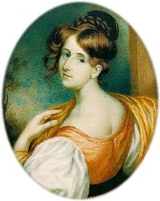
Elizabeth Gaskell

Encyclopedia
Elizabeth Cleghorn Gaskell, née Stevenson (29 September 1810 – 12 November 1865), often referred to simply as Mrs Gaskell, was a British novelist and short story writer during the Victorian era
. Her novels offer a detailed portrait of the lives of many strata of society, including the very poor, and as such are of interest to social historians
as well as lovers of literature.
, Chelsea, which was then on the outskirts of London. Gaskell was the eighth and last of her parents' children; only she and her brother John survived infancy. Her father, William Stevenson, was a Scottish Unitarian
minister at Failsworth
, Lancashire but resigned his orders on conscientious grounds, moving his family to London in 1806 with intention of going to India after he had been named private secretary to the Earl of Lauderdale
, who was to become Governor-General of India
. This position did not materialise, and Stevenson was instead nominated Keeper of the Treasury Records. Stevenson's wife, Elizabeth Holland, came from a family from the English Midlands
that was well connected with other Unitarian and prominent families like the Wedgwood
s, the Turners
and the Darwins, and when she died three months after giving birth to Gaskell she left a bewildered husband who saw no other alternative for young Elizabeth but to be sent away to live with her mother's sister Hannah Lumb, in Knutsford
, Cheshire.
While she was growing up Gaskell's future was very uncertain as she had no personal wealth and no firm home, even though she was a permanent guest at her aunt and grandparents' house. Her father had married again to Catherine Thomson in 1814 and the couple had a male heir, William (born 1815) and a daughter, Catherine (born 1816). Although Gaskell would sometimes spend several years without seeing her father and his new family, her older brother John would often visit her in Knutsford. John had early been destined for the Royal Navy
, like his grandfathers and uncles, but he had no entry and had to go into the Merchant Navy with the East India Company's fleet. John went missing in 1827 during an expedition to India.
Much of Elizabeth's childhood was spent in Cheshire
, where she lived with her aunt Hannah Lumb in Knutsford
, a town she would later immortalise as Cranford
. They lived in a large red brick house, Heathwaite, on Heathside (now Gaskell Avenue), which faces the large open area of Knutsford Heath.
She also spent some time in Newcastle upon Tyne
(with Rev. William Turner
's family) and in Edinburgh
. Her stepmother was a sister of the Scottish miniature artist
, William John Thomson, who painted the famous 1832 portrait of Gaskell in Manchester.
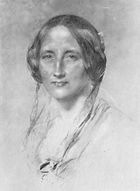 On 30 August 1832 Elizabeth married minister William Gaskell
in Knutsford. They spent their honeymoon in North Wales
, staying with Elizabeth's uncle, Samuel Holland, who lived near Porthmadog
.
The Gaskells then settled in Manchester, where William was the minister at Cross Street Unitarian Chapel. Manchester's industrial surroundings would influence Elizabeth's novels in the industrial genre
. Their first child, a daughter, was stillborn in 1833. A son, William, (1844–45), died in infancy, and this tragedy became the catalyst for Gaskell's first novel, Mary Barton
. Other children were Marianne (1834), Margaret Emily, known as Meta (1837), Florence Elizabeth (1842), and Julia Bradford (1846). Florence married Charles Crompton
, a barrister and Liberal politician, in 1862.
In 1850, following the publication of Mary Barton
, the family moved to a villa in Plymouth Grove
. Elizabeth wrote all her remaining literary works in this home while her husband held welfare committees and tutored the poor in his study. The Gaskells' social circle included literary greats, religious dissenters, and social reformers, including William
and Mary Howitt
. Charles Dickens
and John Ruskin
visited Plymouth Grove, as did American writers Harriet Beecher Stowe
and Charles Eliot Norton
, while conductor Charles Hallé
lived close by and taught piano to one of Gaskell's four daughters. Close friend Charlotte Brontë
is known to have stayed there three times, and on one occasion hid behind the drawing room curtains as she was too shy to meet Gaskell's visitors.
Gaskell died suddenly of a heart attack in 1865, while visiting a home she had just purchased in Holybourne
, Hampshire.
The house on Plymouth Grove remained in the Gaskell family until 1913, after which it stood empty for years and fell into disrepair. The University of Manchester
acquired the property in 1969. In 2004 the Manchester Historic Buildings Trust acquired Plymouth Grove and began the process of raising money to restore the home to its original state. Exterior renovations were completed in 2011, and the home is now open for monthly tours while renovations continue.
On 25 September 2010 a memorial to Gaskell was dedicated in Poets' Corner
in Westminster Abbey
. It takes the form of a panel in the Hubbard memorial window, above the tomb of Geoffrey Chaucer
. The panel was dedicated by her great-great-granddaughter Rosemary Dabbs and a wreath was laid.
, was published anonymously in 1848. The best known of her remaining novels are Cranford
(1853), North and South
(1854), and Wives and Daughters
(1865). She became popular for her writing, especially her ghost stories, aided by Charles Dickens
, who published her work in his magazine Household Words
. Her ghost stories are quite distinct, in the "Gothic" vein, from her industrial fiction.
Even though her writing conforms to Victorian conventions (including signing her name "Mrs. Gaskell"), Gaskell usually frames her stories as critiques of contemporary attitudes: her early works focused on factory work in the Midlands. She always emphasised the role of women, with complex narratives and dynamic female characters.
In addition to her fiction, Gaskell also wrote the first biography of Charlotte Brontë
, which played a significant role in developing her fellow writer's reputation.
urges comprehension and tolerance toward all religions and, even though Gaskell tried to keep her own beliefs hidden, she felt strongly about these values, which permeated her works—as in North and South, where "Margaret the Churchwoman, her father the Dissenter, Higgins the Infidel, knelt down together. It did them no harm".
:
She used the dialect word "nesh
" (soft), which goes back to Old English, in Mary Barton:
and later in 'The Manchester Marriage' [1858]:
Victorian era
The Victorian era of British history was the period of Queen Victoria's reign from 20 June 1837 until her death on 22 January 1901. It was a long period of peace, prosperity, refined sensibilities and national self-confidence...
. Her novels offer a detailed portrait of the lives of many strata of society, including the very poor, and as such are of interest to social historians
Social history
Social history, often called the new social history, is a branch of History that includes history of ordinary people and their strategies of coping with life. In its "golden age" it was a major growth field in the 1960s and 1970s among scholars, and still is well represented in history departments...
as well as lovers of literature.
Early life
Gaskell was born Elizabeth Cleghorn Stevenson on 29 September 1810, at 93 Cheyne WalkCheyne Walk
Cheyne Walk , is a historic street in Chelsea, the Royal Borough of Kensington and Chelsea. It takes its name from William Lord Cheyne who owned the manor of Chelsea until 1712. Most of the houses were built in the early 18th century. Before the construction in the 19th century of the busy...
, Chelsea, which was then on the outskirts of London. Gaskell was the eighth and last of her parents' children; only she and her brother John survived infancy. Her father, William Stevenson, was a Scottish Unitarian
Unitarianism
Unitarianism is a Christian theological movement, named for its understanding of God as one person, in direct contrast to Trinitarianism which defines God as three persons coexisting consubstantially as one in being....
minister at Failsworth
Failsworth
At Failsworth lies north-northwest of London. It shares common boundaries with Manchester and Oldham, on its west and northeast respectively. Failsworth is traversed by the A62 road, from Manchester to Oldham, the heavy rail line of the Oldham Loop and the Rochdale Canal, which crosses the...
, Lancashire but resigned his orders on conscientious grounds, moving his family to London in 1806 with intention of going to India after he had been named private secretary to the Earl of Lauderdale
Earl of Lauderdale
Earl of Lauderdale is a title in the Peerage of Scotland. It was created in 1624 for John Maitland, 2nd Lord Maitland of Thirlestane, Berwickshire. The second Earl was created Duke of Lauderdale but died without male issue when the dukedom became extinct. The earldom passed to his brother Charles,...
, who was to become Governor-General of India
Governor-General of India
The Governor-General of India was the head of the British administration in India, and later, after Indian independence, the representative of the monarch and de facto head of state. The office was created in 1773, with the title of Governor-General of the Presidency of Fort William...
. This position did not materialise, and Stevenson was instead nominated Keeper of the Treasury Records. Stevenson's wife, Elizabeth Holland, came from a family from the English Midlands
English Midlands
The Midlands, or the English Midlands, is the traditional name for the area comprising central England that broadly corresponds to the early medieval Kingdom of Mercia. It borders Southern England, Northern England, East Anglia and Wales. Its largest city is Birmingham, and it was an important...
that was well connected with other Unitarian and prominent families like the Wedgwood
Wedgwood
Wedgwood, strictly speaking Josiah Wedgwood and Sons, is a pottery firm owned by KPS Capital Partners, a private equity company based in New York City, USA. Wedgwood was founded on May 1, 1759 by Josiah Wedgwood and in 1987 merged with Waterford Crystal to create Waterford Wedgwood, an...
s, the Turners
J. M. W. Turner
Joseph Mallord William Turner RA was an English Romantic landscape painter, watercolourist and printmaker. Turner was considered a controversial figure in his day, but is now regarded as the artist who elevated landscape painting to an eminence rivalling history painting...
and the Darwins, and when she died three months after giving birth to Gaskell she left a bewildered husband who saw no other alternative for young Elizabeth but to be sent away to live with her mother's sister Hannah Lumb, in Knutsford
Knutsford
Knutsford is a town and civil parish in the unitary authority area of Cheshire East and the ceremonial county of Cheshire, in North West England...
, Cheshire.
While she was growing up Gaskell's future was very uncertain as she had no personal wealth and no firm home, even though she was a permanent guest at her aunt and grandparents' house. Her father had married again to Catherine Thomson in 1814 and the couple had a male heir, William (born 1815) and a daughter, Catherine (born 1816). Although Gaskell would sometimes spend several years without seeing her father and his new family, her older brother John would often visit her in Knutsford. John had early been destined for the Royal Navy
Royal Navy
The Royal Navy is the naval warfare service branch of the British Armed Forces. Founded in the 16th century, it is the oldest service branch and is known as the Senior Service...
, like his grandfathers and uncles, but he had no entry and had to go into the Merchant Navy with the East India Company's fleet. John went missing in 1827 during an expedition to India.
Much of Elizabeth's childhood was spent in Cheshire
Cheshire
Cheshire is a ceremonial county in North West England. Cheshire's county town is the city of Chester, although its largest town is Warrington. Other major towns include Widnes, Congleton, Crewe, Ellesmere Port, Runcorn, Macclesfield, Winsford, Northwich, and Wilmslow...
, where she lived with her aunt Hannah Lumb in Knutsford
Knutsford
Knutsford is a town and civil parish in the unitary authority area of Cheshire East and the ceremonial county of Cheshire, in North West England...
, a town she would later immortalise as Cranford
Cranford (novel)
Cranford is one of the better-known novels of the 19th century English writer Elizabeth Gaskell. It was first published in 1851 as a serial in the magazine Household Words, which was edited by Charles Dickens.-Plot:...
. They lived in a large red brick house, Heathwaite, on Heathside (now Gaskell Avenue), which faces the large open area of Knutsford Heath.
She also spent some time in Newcastle upon Tyne
Newcastle upon Tyne
Newcastle upon Tyne is a city and metropolitan borough of Tyne and Wear, in North East England. Historically a part of Northumberland, it is situated on the north bank of the River Tyne...
(with Rev. William Turner
William Turner (Unitarian minister)
William Turner was a Unitarian minister and educator who advanced the anti-slavery movement in Northern England, contributed to the development of intellectual institutions in Newcastle upon Tyne, and published sermons on a variety of topics.-Life:...
's family) and in Edinburgh
Edinburgh
Edinburgh is the capital city of Scotland, the second largest city in Scotland, and the eighth most populous in the United Kingdom. The City of Edinburgh Council governs one of Scotland's 32 local government council areas. The council area includes urban Edinburgh and a rural area...
. Her stepmother was a sister of the Scottish miniature artist
Portrait miniature
A portrait miniature is a miniature portrait painting, usually executed in gouache, watercolour, or enamel.Portrait miniatures began to flourish in 16th century Europe and the art was practiced during the 17th century and 18th century...
, William John Thomson, who painted the famous 1832 portrait of Gaskell in Manchester.
Married life and Plymouth Grove
William Gaskell
The Reverend William Gaskell was an English Unitarian minister, charity worker and pioneer in the education of the working class...
in Knutsford. They spent their honeymoon in North Wales
North Wales
North Wales is the northernmost unofficial region of Wales. It is bordered to the south by the counties of Ceredigion and Powys in Mid Wales and to the east by the counties of Shropshire in the West Midlands and Cheshire in North West England...
, staying with Elizabeth's uncle, Samuel Holland, who lived near Porthmadog
Porthmadog
Porthmadog , known locally as "Port", and historically rendered into English as Portmadoc, is a small coastal town and community in the Eifionydd area of Gwynedd, in Wales. Prior to the Local Government Act 1972 it was in the administrative county of Caernarfonshire. The town lies east of...
.
The Gaskells then settled in Manchester, where William was the minister at Cross Street Unitarian Chapel. Manchester's industrial surroundings would influence Elizabeth's novels in the industrial genre
Industrial novel
The industrial novel is a genre of early Victorian literature. A subclass of the social novel, it portrays the difficult conditions of life of the urban working class during the Industrial Revolution...
. Their first child, a daughter, was stillborn in 1833. A son, William, (1844–45), died in infancy, and this tragedy became the catalyst for Gaskell's first novel, Mary Barton
Mary Barton
Mary Barton is the first novel by English author Elizabeth Gaskell, published in 1848. The story is set in the English city of Manchester during the 1830s and 1840s and deals heavily with the difficulties faced by the Victorian lower class.-Plot summary:...
. Other children were Marianne (1834), Margaret Emily, known as Meta (1837), Florence Elizabeth (1842), and Julia Bradford (1846). Florence married Charles Crompton
Charles Crompton
Charles Crompton Q.C. was an English barrister and Liberal politician.Crompton was born at St Pancras, London, the son of Sir Charles Crompton, a Judge of the Queen's Bench and his wife Caroline Fletcher of Liverpool...
, a barrister and Liberal politician, in 1862.
In 1850, following the publication of Mary Barton
Mary Barton
Mary Barton is the first novel by English author Elizabeth Gaskell, published in 1848. The story is set in the English city of Manchester during the 1830s and 1840s and deals heavily with the difficulties faced by the Victorian lower class.-Plot summary:...
, the family moved to a villa in Plymouth Grove
84 Plymouth Grove, Manchester
84 Plymouth Grove is a Grade II* listed neoclassical villa in Manchester, England, which was the residence of William and Elizabeth Gaskell from 1850 till their deaths in 1884 and 1865 respectively. The Gaskell household continued to occupy the villa after the deaths of Elizabeth and William...
. Elizabeth wrote all her remaining literary works in this home while her husband held welfare committees and tutored the poor in his study. The Gaskells' social circle included literary greats, religious dissenters, and social reformers, including William
William Howitt
William Howitt , was an English author.He was born at Heanor, Derbyshire. His parents were Quakers, and he was educated at the Friends public school at Ackworth, Yorkshire. His younger brothers were Richard and Godrey whom he helped tutor. In 1814 he published a poem on the Influence of Nature and...
and Mary Howitt
Mary Howitt
Mary Howitt was an English poet, and author of the famous poem The Spider and the Fly. She was born Mary Botham at Coleford, in Gloucestershire, the temporary residence of her parents, while her father, Samuel Botham, a prosperous Quaker of Uttoxeter, Staffordshire, was looking after some mining...
. Charles Dickens
Charles Dickens
Charles John Huffam Dickens was an English novelist, generally considered the greatest of the Victorian period. Dickens enjoyed a wider popularity and fame than had any previous author during his lifetime, and he remains popular, having been responsible for some of English literature's most iconic...
and John Ruskin
John Ruskin
John Ruskin was the leading English art critic of the Victorian era, also an art patron, draughtsman, watercolourist, a prominent social thinker and philanthropist. He wrote on subjects ranging from geology to architecture, myth to ornithology, literature to education, and botany to political...
visited Plymouth Grove, as did American writers Harriet Beecher Stowe
Harriet Beecher Stowe
Harriet Beecher Stowe was an American abolitionist and author. Her novel Uncle Tom's Cabin was a depiction of life for African-Americans under slavery; it reached millions as a novel and play, and became influential in the United States and United Kingdom...
and Charles Eliot Norton
Charles Eliot Norton
Charles Eliot Norton, was a leading American author, social critic, and professor of art. He was a militant idealist, a progressive social reformer, and a liberal activist whom many of his contemporaries considered the most cultivated man in the United States.-Biography:Norton was born at...
, while conductor Charles Hallé
Charles Hallé
Sir Charles Hallé was an Anglo-German pianist and conductor, and founder of The Hallé orchestra in 1858.-Life:Hallé was born in Hagen, Westphalia, Germany who after settling in England changed his name from Karl Halle...
lived close by and taught piano to one of Gaskell's four daughters. Close friend Charlotte Brontë
Charlotte Brontë
Charlotte Brontë was an English novelist and poet, the eldest of the three Brontë sisters who survived into adulthood, whose novels are English literature standards...
is known to have stayed there three times, and on one occasion hid behind the drawing room curtains as she was too shy to meet Gaskell's visitors.
Gaskell died suddenly of a heart attack in 1865, while visiting a home she had just purchased in Holybourne
Holybourne
Holybourne is a village in the East Hampshire district of Hampshire, England. It is 1.3 miles northeast of Alton, just off the A31 road.The nearest railway station is 1.3 miles southwest of the village, at Alton....
, Hampshire.
The house on Plymouth Grove remained in the Gaskell family until 1913, after which it stood empty for years and fell into disrepair. The University of Manchester
University of Manchester
The University of Manchester is a public research university located in Manchester, United Kingdom. It is a "red brick" university and a member of the Russell Group of research-intensive British universities and the N8 Group...
acquired the property in 1969. In 2004 the Manchester Historic Buildings Trust acquired Plymouth Grove and began the process of raising money to restore the home to its original state. Exterior renovations were completed in 2011, and the home is now open for monthly tours while renovations continue.
On 25 September 2010 a memorial to Gaskell was dedicated in Poets' Corner
Poets' Corner
Poets' Corner is the name traditionally given to a section of the South Transept of Westminster Abbey because of the number of poets, playwrights, and writers buried and commemorated there. The most recent additions were a memorial floor stone unveiled in 2009 for the founders of the Royal Ballet...
in Westminster Abbey
Westminster Abbey
The Collegiate Church of St Peter at Westminster, popularly known as Westminster Abbey, is a large, mainly Gothic church, in the City of Westminster, London, United Kingdom, located just to the west of the Palace of Westminster. It is the traditional place of coronation and burial site for English,...
. It takes the form of a panel in the Hubbard memorial window, above the tomb of Geoffrey Chaucer
Geoffrey Chaucer
Geoffrey Chaucer , known as the Father of English literature, is widely considered the greatest English poet of the Middle Ages and was the first poet to have been buried in Poet's Corner of Westminster Abbey...
. The panel was dedicated by her great-great-granddaughter Rosemary Dabbs and a wreath was laid.
Literary style and themes
Gaskell's first novel, Mary BartonMary Barton
Mary Barton is the first novel by English author Elizabeth Gaskell, published in 1848. The story is set in the English city of Manchester during the 1830s and 1840s and deals heavily with the difficulties faced by the Victorian lower class.-Plot summary:...
, was published anonymously in 1848. The best known of her remaining novels are Cranford
Cranford (novel)
Cranford is one of the better-known novels of the 19th century English writer Elizabeth Gaskell. It was first published in 1851 as a serial in the magazine Household Words, which was edited by Charles Dickens.-Plot:...
(1853), North and South
North and South (1854 novel)
North and South is an Industrial novel by Elizabeth Gaskell. It first appeared as a twenty-two-part weekly serial from September 1854 to January 1855 in the magazine Household Words. It was published as a book, in two volumes, in 1855....
(1854), and Wives and Daughters
Wives and Daughters
Wives and Daughters is a novel by Elizabeth Gaskell, first published in the Cornhill Magazine as a serial from August 1864 to January 1866...
(1865). She became popular for her writing, especially her ghost stories, aided by Charles Dickens
Charles Dickens
Charles John Huffam Dickens was an English novelist, generally considered the greatest of the Victorian period. Dickens enjoyed a wider popularity and fame than had any previous author during his lifetime, and he remains popular, having been responsible for some of English literature's most iconic...
, who published her work in his magazine Household Words
Household Words
Household Words was an English weekly magazine edited by Charles Dickens in the 1850s which took its name from the line from Shakespeare "Familiar in his mouth as household words" — Henry V.-History:...
. Her ghost stories are quite distinct, in the "Gothic" vein, from her industrial fiction.
Even though her writing conforms to Victorian conventions (including signing her name "Mrs. Gaskell"), Gaskell usually frames her stories as critiques of contemporary attitudes: her early works focused on factory work in the Midlands. She always emphasised the role of women, with complex narratives and dynamic female characters.
In addition to her fiction, Gaskell also wrote the first biography of Charlotte Brontë
Charlotte Brontë
Charlotte Brontë was an English novelist and poet, the eldest of the three Brontë sisters who survived into adulthood, whose novels are English literature standards...
, which played a significant role in developing her fellow writer's reputation.
Themes
UnitarianismUnitarianism
Unitarianism is a Christian theological movement, named for its understanding of God as one person, in direct contrast to Trinitarianism which defines God as three persons coexisting consubstantially as one in being....
urges comprehension and tolerance toward all religions and, even though Gaskell tried to keep her own beliefs hidden, she felt strongly about these values, which permeated her works—as in North and South, where "Margaret the Churchwoman, her father the Dissenter, Higgins the Infidel, knelt down together. It did them no harm".
Dialect usage
Gaskell's style is notable for putting local dialect words into the voice of middle-class characters and of the narrator. For example, in North and South Margaret Hale suggests redding up (tidying) the Bouchers' house and even offers jokingly to teach her mother words such as knobstick (strike-breaker). Her husband collected Lancashire dialect, and Gaskell defended her use of dialect as expressing otherwise inexpressible concepts in an 1854 letter to Walter Savage LandorWalter Savage Landor
Walter Savage Landor was an English writer and poet. His best known works were the prose Imaginary Conversations, and the poem Rose Aylmer, but the critical acclaim he received from contemporary poets and reviewers was not matched by public popularity...
:
She used the dialect word "nesh
Nesh
Nesh is an English dialect adjective meaning unusually susceptible to cold weather and there is no synonym for this use. Usage has been recorded in Cheshire, Staffordshire, the East Midlands, Lancashire, South Yorkshire, Derbyshire and Shropshire....
" (soft), which goes back to Old English, in Mary Barton:
and later in 'The Manchester Marriage' [1858]:
Novels
- Mary BartonMary BartonMary Barton is the first novel by English author Elizabeth Gaskell, published in 1848. The story is set in the English city of Manchester during the 1830s and 1840s and deals heavily with the difficulties faced by the Victorian lower class.-Plot summary:...
(1848) - CranfordCranford (novel)Cranford is one of the better-known novels of the 19th century English writer Elizabeth Gaskell. It was first published in 1851 as a serial in the magazine Household Words, which was edited by Charles Dickens.-Plot:...
(1851–3) - RuthRuth (novel)Ruth is a novel by Elizabeth Gaskell, first published in three volumes in 1853.-The plot:Ruth is a young orphan girl working in a respectable sweatshop for the overworked Mrs Mason. She is selected to go to a ball to repair torn dresses. At the ball she meets the aristocratic Henry Bellingham, a...
(1853) - North and South (1854–5)
- Sylvia's LoversSylvia's LoversSylvia's Lovers is a novel written by Elizabeth Gaskell, which she called "the saddest story I ever wrote".-Plot summary:The novel begins in the 1790s in the coastal town of Monkshaven against the background of the practice of impressment during the early phases of the Napoleonic Wars...
(1863) - Wives and Daughters: An Everyday StoryWives and DaughtersWives and Daughters is a novel by Elizabeth Gaskell, first published in the Cornhill Magazine as a serial from August 1864 to January 1866...
(1865)
Novellas and collections
- The Moorland Cottage (1850)
- The Old Nurse's Story (1852)
- Lizzie Leigh (1855)
- My Lady LudlowMy Lady LudlowMy Lady Ludlow is a long novella by Elizabeth Gaskell. It appeared in the magazine Household Words in 1858, and was republished in Round the Sofa in 1859, with framing passages added at the start and end.It recounts the daily lives of the widowed Countess of Ludlow of Hanbury and the spinster Miss...
(1859) - Round the Sofa (1859)
- Lois the Witch (1861)
- A Dark Night's Work (1863)
- Cousin PhillisCousin Phillis"Cousin Phillis" is a novel by Elizabeth Gaskell. It was published in four parts, though a fifth and sixth part were planned. The story is about Paul Manning, a youth of seventeen who moves to the country and befriends his mother's family and his cousin Phillis Holman, who is confused by her own...
(1864)
Short stories (partial)
- Libbie Marsh's Three Eras (1847)
- Christmas Storms and Sunshine (1848)
- The Squire's Story (1853)
- Half a Life-time Ago (1855)
- The Poor Clare (1856)
- "The Manchester Marriage" (1858), a chapter of A House to LetA House to Let"A House to Let" is a short story by Charles Dickens, Wilkie Collins, Elizabeth Gaskell and Adelaide Anne Procter. It was originally published in 1858 in the Christmas edition of Dickens' Household Words magazine...
, co-written with Charles DickensCharles DickensCharles John Huffam Dickens was an English novelist, generally considered the greatest of the Victorian period. Dickens enjoyed a wider popularity and fame than had any previous author during his lifetime, and he remains popular, having been responsible for some of English literature's most iconic...
, Wilkie CollinsWilkie CollinsWilliam Wilkie Collins was an English novelist, playwright, and author of short stories. He was very popular during the Victorian era and wrote 30 novels, more than 60 short stories, 14 plays, and over 100 non-fiction pieces...
, and Adelaide Anne ProcterAdelaide Anne ProcterAdelaide Anne Procter was an English poet and philanthropist. She worked on behalf of a number of causes, most prominently on behalf of unemployed women and the homeless, and was actively involved with feminist groups and journals. Procter never married, and some of her poetry has prompted... - The Haunted HouseThe Haunted House (story)The Haunted House is a story published in 1859 for the weekly periodical All the Year Round. It was "Conducted by Charles Dickens", with contributions from others...
(1859), co-written with Charles DickensCharles DickensCharles John Huffam Dickens was an English novelist, generally considered the greatest of the Victorian period. Dickens enjoyed a wider popularity and fame than had any previous author during his lifetime, and he remains popular, having been responsible for some of English literature's most iconic...
, Wilkie CollinsWilkie CollinsWilliam Wilkie Collins was an English novelist, playwright, and author of short stories. He was very popular during the Victorian era and wrote 30 novels, more than 60 short stories, 14 plays, and over 100 non-fiction pieces...
, Adelaide Proctor, George Sala and Hesba StrettonHesba StrettonHesba Stretton was the pen name of Sarah Smith , an English writer of children's books. She concocted the name from the initials of her five siblings and the name of a neighbouring village.-Early life:...
. - The Half-brothers (1859)
- The Grey Woman (1861)
General and miscellaneous
- North and South, the Musical – a new musical based on E. Gaskell's novel
- The Visual Life of Elizabeth Gaskell