
All Topics  
A Christmas Carol

 
A Christmas Carol

   Email Print
   Bookmark   Link


A Christmas Carol


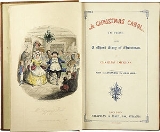
A Christmas Carol in Prose, Being a Ghost Story of Christmas (commonly known as A Christmas Carol) is a book by Charles Dickens
Charles Dickens

Charles John Huffam Dickens, Royal Society of Arts , pen-name "Boz", was the most popular English people novelist of the Victorian era, as well as a vigorous Reform movement....
 that was first published on December 19, 1843 with illustrations by John Leech. Dickens called it his "little Christmas Book". The first of the author's five "Christmas
Christmas

Christmas , also referred to as Christmas Day, is an annual holiday celebrated on December 25 that commemorates the birth of Jesus. The day marks the beginning of the larger season of Christmastide, which lasts Twelve Days of Christmas....
 books," the story was instantly successful, selling over six thousand copies in one week. Originally written in six weeks under financial duress to help Dickens to pay off a debt, the tale has become one of the most popular and enduring Christmas
Christmas

Christmas , also referred to as Christmas Day, is an annual holiday celebrated on December 25 that commemorates the birth of Jesus. The day marks the beginning of the larger season of Christmastide, which lasts Twelve Days of Christmas....
 stories of all time.

Some historians have suggested that the story's popularity played a significant role in redefining the importance of Christmas and the "spirit" of the holiday.


Discussion
Ask a question about 'A Christmas Carol'
Start a new discussion about 'A Christmas Carol'
Answer questions from other users
Full Discussion Forum


Recent Posts


Quotations


Encyclopedia


A Christmas Carol in Prose, Being a Ghost Story of Christmas (commonly known as A Christmas Carol) is a book by Charles Dickens
Charles Dickens

Charles John Huffam Dickens, Royal Society of Arts , pen-name "Boz", was the most popular English people novelist of the Victorian era, as well as a vigorous Reform movement....
 that was first published on December 19, 1843 with illustrations by John Leech. Dickens called it his "little Christmas Book". The first of the author's five "Christmas
Christmas

Christmas , also referred to as Christmas Day, is an annual holiday celebrated on December 25 that commemorates the birth of Jesus. The day marks the beginning of the larger season of Christmastide, which lasts Twelve Days of Christmas....
 books," the story was instantly successful, selling over six thousand copies in one week. Originally written in six weeks under financial duress to help Dickens to pay off a debt, the tale has become one of the most popular and enduring Christmas
Christmas

Christmas , also referred to as Christmas Day, is an annual holiday celebrated on December 25 that commemorates the birth of Jesus. The day marks the beginning of the larger season of Christmastide, which lasts Twelve Days of Christmas....
 stories of all time.

Some historians have suggested that the story's popularity played a significant role in redefining the importance of Christmas and the "spirit" of the holiday. A Christmas Carol was written during a time of decline in the old Christmas traditions. "If Christmas, with its ancient and hospitable customs, its social and charitable observances, were in danger of decay, this is the book that would give them a new lease," said English poet Thomas Hood
Thomas Hood

Thomas Hood was a United Kingdom humorist and poet. His son, Tom Hood, became a well known playwright and editor....
.

Plot


A Christmas Carol is a Victorian
Victorian era

The Victorian Era of the United Kingdom of Great Britain and Ireland was the period of Victoria of the United Kingdom reign from June 1837 to January 1901....
 morality tale
Morality play

Morality play is a term that theatre historians use to describe a genre of Middle Ages and Tudor period theatrical entertainments. In their own time, these plays were known as "interludes," a broader term given to dramas with or without a Morality theme....
 of an old and bitter miser
Miser

A miser is a person who is reluctant to spend money, sometimes to the point of forgoing even basic comforts. The term derives from the Latin miser, meaning "poor" or "wretched," comparable to the modern word "miserable"....
, Ebenezer Scrooge
Ebenezer Scrooge

Ebenezer Scrooge is the main character in Charles Dickens' 1843 novel, A Christmas Carol. He is a cold-hearted, tight fisted, selfish man, who despises Christmas and all things which engender happiness....
, who undergoes a profound experience of redemption over the course of a Christmas Eve night. If the experience doesn't change Scrooge's ways, he will end up walking the Earth forever being nothing but an invisible and lonely ghost, like his deceased friend Jacob Marley. Mr. Scrooge is a financier/moneychanger who has devoted his life to the accumulation of wealth. He holds anything other than money in contempt, including friendship, love, and the Christmas season.

Stave I: Marley's Ghost

Christmas Eve, seven years to the day after the death of his business partner Jacob Marley
Jacob Marley

Jacob Marley is a fictional character whose ghost appears in the Charles Dickens novel A Christmas Carol....
, Ebenezer Scrooge and his downtrodden clerk Bob Cratchit
Bob Cratchit

Robert "Bob" Cratchit is a fictional character, the abused, underpaid clerk of Ebenezer Scrooge in the Charles Dickens story A Christmas Carol....
 are at work in Scrooge’s counting-house. Scrooge's nephew, Fred, arrives with seasonal greetings and an invitation to Christmas dinner, but Scrooge dismisses him with "Bah! Humbug!", declaring that Christmas is a fraud. Two gentlemen collecting charitable donations for the poor are likewise rebuffed by Scrooge, who insist that the poor laws and workhouse
Workhouse

A workhouse, was a place where people who were unable to support themselves could go to live and work. The Oxford Dictionary's earliest reference to a workhouse dates to 1652 in Exeter....
s are sufficient to care for the poor, and that "If they would rather die than go there, they had better do it, and decrease the surplus population." As he and his clerk prepare to leave, he grudgingly permits Cratchit one day's paid holiday the following day, but tells Cratchit he must be there the morning after Christmas all the earlier—otherwise, there will be a deduction from his wages.

Scrooge returns home to his cheerless rooms in an otherwise deserted building, and a series of supernatural experiences begins. His doorknocker appears to transform into Marley's face; a "locomotive hearse" seems to mount the dark stairs ahead of him; the pictures on the tiles in his fireplace transform into images of Marley's face. Finally, all the bells in the house ring loudly, there is a clanking of chains in the bed and on the floor, and the ghost of Marley passes through the closed door into the room.

The ghost warns Scrooge that if he does not change his ways, he will suffer Marley's fate, but Scrooge's fate would be even worse. He will walk the earth eternally after death, invisible among his fellow men, burdened with chains, seeing the misery and suffering he could have alleviated in his life but now powerless to intervene. Marley has arranged Scrooge's only chance of redemption: three spirits will visit him on successive nights, and they may help change him and save him from his fate. As Marley leaves, Scrooge gets a nightmare glimpse of the tormented spectres who drift unseen among the living, and now shattered, he falls into bed.

Stave II: The First of the Three Spirits

The Ghost of Christmas Past
Ghost of Christmas Past

The Ghost of Christmas Past is a character in the well-known work of the English novelist Charles Dickens, A Christmas Carol.The Ghost of Christmas Past was the first of the three spirits that haunted the miser Ebenezer Scrooge in order to prompt him to repent....
, a strange mixture of young and old, male and female, with a light shining from the crown of its head, appears at the stroke of one. It leads Scrooge on a journey to some of his past Christmases, where events shaped his life and character. He sees his late sister Fan, who intervened to rescue him from lonely exile at boarding school, and, recalling his recent treatment of Fan's son Fred, Scrooge feels the first stirrings of regret. They revisit a merry Christmas party given by Fezziwig, Scrooge's kind apprentice-master, and Scrooge thinks guiltily of his own behaviour toward Bob Cratchit. Finally, he is reminded how his love of money lost him the love of his life, Belle, and the happiness this cost him. Furious, Scrooge turns on the spirit, tries to snuff it like a candle with its cap, and finds himself crumpling up in his bed sheets and wakes up feeling remorseful.

Stave III: The Second of the Three Spirits

Scrooge wakes at the stroke of two, confused to find it is still night. After a time, he rises and finds the second spirit, the Ghost of Christmas Present
Ghost of Christmas Present

The Ghost of Christmas Present is a character in one of the best-known works of the English people English novel Charles Dickens, A Christmas Carol....
, in an adjoining room, on a throne made of Christmas food and drink. This spirit, a great genial man in a green coat lined with fur, takes him through the bustling streets of London on the current Christmas morning, sprinkling the essence of Christmas onto the happy populace. They observe the meagre but happy Christmas celebrations of the Cratchit family and the sweet nature of their "forgotten" son Tiny Tim
Tiny Tim (A Christmas Carol)

Tiny Tim is a fictional character in the classic story A Christmas Carol by Charles Dickens. He is the son of Bob Cratchit. It is claimed that the character is based on the invalid son of a friend of Dickens who owned a cotton mill in Ardwick, Manchester....
, and when the Spirit foretells an early death for the child if things remain unchanged, Scrooge is distraught and wishes to change the future. He is shown what others think of him: the Cratchits toast him, but reluctantly, and "a shadow was cast over the party for a full five minutes." Scrooge's nephew and his wife, Clara, and Friends gently mock his miserly behaviour at their Christmas party, but Fred maintains his uncle's potential for change, and Scrooge demonstrates a childlike enjoyment of the celebrations.

They travel far and wide, and see how even the most wretched of people mark Christmas in some way, whatever their circumstances. The Ghost, however, grows visibly older, and explains he must die that night. He shows Scrooge two pitiful children huddled under his robes who personify the major causes of suffering in the world, "Ignorance" and "Want," with a grim warning that the former is especially harmful. At the end of the visitation, the bell strikes twelve. The Ghost of Christmas Present vanishes and the third spirit appears to Scrooge.

Stave IV: The Last of the Spirits

The Ghost of Christmas Yet to Come
Ghost of Christmas Yet to Come

The Ghost of Christmas Yet to Come, or the Ghost of Christmas Future, is a character in English people English novel Charles Dickens's A Christmas Carol....
 takes the form of a grim spectre, robed in black, who does not speak and whose body is entirely hidden except for one pointing hand. This spirit frightens Scrooge more than the others, and harrows him with a vision of a future Christmas with the Cratchit family bereft of Tiny Tim. A rich miser, whose death saddens nobody and whose home and corpse have been robbed by ghoulish attendants, is revealed to be Scrooge himself: this is the fate that awaits him. Without its explicitly being said, Scrooge learns that he can avoid the future he has been shown and alter the fate of Tiny Tim, but only if he changes. Weeping, he swears to do so, and awakes to find that all three spirits have visited in just one night, and that it is Christmas morning.

Stave V: The End of It

reconciled in Stave V.]] Scrooge changes his life and reverts to the generous, kindhearted soul he was in his youth before the death of Fan. He anonymously sends the Cratchits the biggest turkey in the butcher shop, meets the charity workers to pledge an unspecified but impressive amount of money, and spends Christmas Day with Fred and his wife.

The next day, Scrooge sees his clerk arriving late and pretends to be his old miserly self before revealing his new person to an astonished Cratchit. He assists Bob and his family, becomes an adopted uncle to Tiny Tim, and gains a reputation as a kind and generous man who embodies the spirit of Christmas in his life.

Explanation of the book's title

According to the Oxford English Dictionary
Oxford English Dictionary

The Oxford English Dictionary , published by the Oxford University Press , is a comprehensive dictionary of the English language. Two fully-bound print editions of the OED have been published under its current name, in 1928 and 1989; as of December 2008 the dictionary's current editors have completed a quarter of the third edition....
, a carol was originally a medieval round dance, a ring-type movement, and later was a word for a particular type of ballad. By Dickens' time, the word "carol" had come closer to its modern meaning, being a joyful hymn
Hymn

A hymn is a type of song, usually religious, specifically written for the purpose of praise, adoration or prayer, and typically addressed to a deity/deities, a prominent figure or an epic tale....
 specific to Christmas. Musical notation is written on five staves
Staff (music)

In standard Western musical notation, the stave is a set of five horizontal lines and four spaces, each of which represents a different musical pitch , or, in the case of a percussion staff, different percussion instruments....
. Dickens takes this musical analogy further, dividing the novella into five "staves" instead of chapters. However, "stave" or "staff" can also mean "letter." A Christmas Carol, therefore, can be said to consist not only of five musical staves, but also of five letters, namely C-A-R-O-L. The word is also analogous to the Norwegian Stev
Stev

Stev is one of the poetic forms that can be found in lyric poetry from Scandinavia. The English language version of the word is stave, meaning the stressed syllable in a metric verse....
, meaning verse
Verse

Verse may refer to:Poetry*Verse , a line of poetry, a stanza*Blank verse is a type of poetry having regular meter but no rhyme*Free verse is a type of poetry written without the use of strict meter or rhyme, but that is still recognizable as 'poetry'...
. In this sense, the carol has five verses.

The history of the manuscript


When the manuscript was returned after printing, Dickens arranged for it to be finely bound in red Morocco leather and presented it as a gift to his solicitor, Thomas Mitton, from whom he had borrowed some money. The cover was lettered, "Thomas Mitton Esqre." on the front cover and ‘A Christmas Carol / Dickens / MDCCCXLIII’ on the spine.

In 1875, Thomas Mitton sold the manuscript to Francis Harvey, a bookseller, for £50. It was then purchased by Henry George Churchill, an autograph collector who had it photographed and who had 750 facsimile copies made from these photographs. In 1882, Churchill sold the manuscript to Bennett, a Birmingham bookseller, who in turn sold it for £200 to Stuart M. Samuel, of Samuel Montagu & Co. It was then purchased by J. Pearson & Co., presumably from Samuel, for £1000. Finally, it was purchased by John Pierpont Morgan
J. P. Morgan

John Pierpont Morgan was an United States financier, banker and art collector who dominated corporate finance and industrial consolidation during his time....
, a fan of Dickens, in the 1890s. He acquired it for more than £600, the equivalent of £150,000 today. The manuscript was donated to the American
United States

The United States of America is a Federal government constitutional republic comprising U.S. state and a federal district. The country is situated mostly in central North America, where its Contiguous United States and Washington, D.C., the Capital districts and territories, lie between the Pacific Ocean and Atlantic Oceans, Borders of the U...
 people after his death in 1913, along with the rest of his collection.

Major themes

A Christmas Carol   Ignorance and Want
The novel deals extensively with two of Dickens' recurrent themes, social injustice
Social injustice

Social Injustice is a concept relating to the perceived unfairness or justice of a society in its divisions of rewards and burdens. The concept is distinct from those of justice in law, which may or may not be considered moral in practice....
 and poverty
Poverty

Poverty is the shortage of common things such as food, clothing, shelter and safe drinking water, all of which determine our quality of life. It may also include the lack of access to opportunities such as education and employment which aid the escape from poverty and/or allow one to enjoy the respect of fellow citizens....
, the relationship between the two, and their causes and effects. It was written to be abrupt and forceful with its message, with a working title of "The Sledgehammer." The first edition of A Christmas Carol was illustrated by John Leech, a politically radical artist who in the cartoon "Substance and Shadow" printed earlier in 1843 had explicitly criticised artists who failed to address social issues. Dickens wrote in the wake of British government changes to the welfare system known as the Poor Laws, changes which required among other things, welfare applicants to "work" on treadmills
Treadwheel

The word treadmill, originally a type of mill operated by a person treading steps of a wheel to grind grain, now designates a piece of indoor sporting equipment for running without moving any distance....
, as Scrooge points out. Dickens asks, in effect, for people to recognise the plight of those whom the Industrial Revolution has displaced and driven into poverty, and the obligation of society to provide for them humanely. Failure to do so, the writer implies through the personification of Ignorance and Want as ghastly children, will result in an unnamed "Doom" for those who, like Scrooge, believe their wealth and status qualifies them to sit in judgement of the poor rather than to assist them.

Scrooge “embodies all the selfishness and indifference of the prosperous classes who parrot phrases about the ‘surplus population’ and think their social responsibilities fully discharged when they have paid their taxes.”

Allusions to history, geography and science


Scrooge offends the Ghost of Christmas Present by suggesting that the Spirit's name is linked to a recent attempt to close bakers' shops on Sundays and Christmas Day. (Poor people like the Cratchits, who had no oven
Oven

An oven is an enclosed compartment for heating, baking or drying. It is most commonly used in cooking and pottery. Ovens used in pottery are also known as kilns....
 at home, took their Sunday and Christmas meals to the bakers' to be roasted just as Dickens describes in the book, because the law forbade bread to be baked on that day. Closing the shops would deprive them of what might be their only hot meat meal of the week.) The Spirit angrily retorts:

“There are some upon this earth of yours...who lay claim to know us, and who do their deed of passion, pride, ill-will, hatred, envy, bigotry and selfishness in our name, who are as strange to us and to all our kith and kin, as if they had never lived. Remember that, and charge their doings on themselves, not us." (The Ghost of Christmas Present, A Christmas Carol, Stave Three)


This is a reference to the repeated attempts during the 1830s of Sir Andrew Agnew, MP
Member of Parliament

A Member of Parliament, or MP, is a representative of the voters to a parliament. In many countries the term applies specifically to members of the lower house, as upper houses often have a unique title, such as senate, and thus also have unique titles for its members, such as senators....
 for Wigtownshire
Wigtownshire

The County of Wigtown, or Wigtownshire is a registration county in the south west of Scotland. It borders Ayrshire to the north, and the Stewartry of Kirkcudbright to the east....
, to introduce a Sunday Observance Bill in Parliament
Parliament of the United Kingdom

The Parliament of the United Kingdom of Great Britain and Northern Ireland is the supreme legislature in the United Kingdom and British overseas territories....
 which would have closed the bakeries and restricted many other Sunday pleasures of the poorer classes. Dickens was vociferously opposed to Agnew's plans and had attacked them in a pamphlet published under a pseudonym.

Dickens' reading

A Christmas Carol was the subject of Dickens' first ever public reading, given in Birmingham Town Hall to the Industrial and Literary Institute on 27 December 1852. This was repeated three days later to an audience of working people, and was a great success by his own account and that of newspapers of the time. Over the years Dickens edited the piece down and adapted it for a listening, rather than reading, audience. Excerpts from A Christmas Carol remained part of Dickens' public readings until his death.

Adaptations and sequels

The work has been adapted for theatre
Theatre

Theatre is the branch of the performing arts defined by Bernard Beckerman as what "occurs when one or more actor, isolated in time and/or Theater , present themselves to Audience." By this broad definition, theatre has existed since the dawn of man, as a result of human tendency for story telling....
, opera
Opera

Opera is an Performing arts in which singers and musicians perform a dramatic work which combines a text and a musical score. Opera is part of the Western classical music tradition....
, film
Film

Film encompasses individual motion pictures, the field of film as an art form, and the film industry. Films are produced by recording images from the world with cameras, or by creating images using animation techniques or special effects....
, radio
Radio

Radio is the transmission of signals, by modulation of electromagnetic radiation with frequency below those of visible light.Electromagnetic radiation radio propagation by means of oscillating electromagnetic fields that pass through the air and the vacuum of space....
 and television
Television

Television is a widely used telecommunication mass-media for transmitting and receiving moving , either monochrome or color, usually accompanied by sound....
 countless times.

Characters

  • Ebenezer Scrooge
    Ebenezer Scrooge

    Ebenezer Scrooge is the main character in Charles Dickens' 1843 novel, A Christmas Carol. He is a cold-hearted, tight fisted, selfish man, who despises Christmas and all things which engender happiness....
  • Bob Cratchit
    Bob Cratchit

    Robert "Bob" Cratchit is a fictional character, the abused, underpaid clerk of Ebenezer Scrooge in the Charles Dickens story A Christmas Carol....
  • Fred
    Fred (A Christmas Carol)

    Fred is Ebenezer Scrooge's nephew and only living relative. Fred is also a gentleman of some means, but unlike his miserly uncle, he is a kind-hearted, generous, cheerful, and optimistic man who loves Christmas....
     (Scrooge's nephew)
  • Tiny Tim
    Tiny Tim (A Christmas Carol)

    Tiny Tim is a fictional character in the classic story A Christmas Carol by Charles Dickens. He is the son of Bob Cratchit. It is claimed that the character is based on the invalid son of a friend of Dickens who owned a cotton mill in Ardwick, Manchester....
     (son of Bob)
  • Jacob Marley
    Jacob Marley

    Jacob Marley is a fictional character whose ghost appears in the Charles Dickens novel A Christmas Carol....
  • Ghost of Christmas Past
    Ghost of Christmas Past

    The Ghost of Christmas Past is a character in the well-known work of the English novelist Charles Dickens, A Christmas Carol.The Ghost of Christmas Past was the first of the three spirits that haunted the miser Ebenezer Scrooge in order to prompt him to repent....
  • Ghost of Christmas Present
    Ghost of Christmas Present

    The Ghost of Christmas Present is a character in one of the best-known works of the English people English novel Charles Dickens, A Christmas Carol....
  • Ghost of Christmas Yet to Come
    Ghost of Christmas Yet to Come

    The Ghost of Christmas Yet to Come, or the Ghost of Christmas Future, is a character in English people English novel Charles Dickens's A Christmas Carol....


Supporting

  • Two portly gentlemen collecting donations for "some slight provision for the poor and destitute" at Christmas
  • Fezziwig
    Fezziwig

    Mr. and Mrs. Fezziwig are characters featured in the Charles Dickens book A Christmas Carol. Mr. Fezziwig is the proprietor of a warehouse business for whom Ebenezer Scrooge worked as an apprentice; and in Stage 2 of The Christmas Carol, has a Christmas ball , where Scrooge meets the love of his life, Belle....
    , Scrooge's old employer
  • Fan, Scrooge's sister who died
  • Belle, Scroooge's ex-fiancée
  • Clara, Scrooge's niece
  • Mrs. Cratchit
  • Peter Cratchit
  • Martha Cratchit
  • Belinda Cratchit
  • Two unnamed "smaller Cratchits", a boy and a girl
  • A young boy and girl, Ignorance and Want, respectively
  • Dick Wilkins
  • A trio of thieves who plunder Scrooge's house after his death:
    • Scrooge's unnamed charwoman
      Charlady

      A charlady or sometimes charwoman was an English house cleaner. The term has the same roots as "chore woman," one hired to do odd chores around the house....
      , who sells (among other things) his bed curtains and the shirt he was originally meant to be buried in, having taken it off his dead body.
    • Mrs. Dilber, Scrooge's laundress
    • Sparsit, an undertaker's assistant
  • Old Joe Hoggs, a fence
    Fence (criminal)

    In law enforcement, a fence is an individual who knowingly buys stolen property for later resale in a legitimate market. As a verb, the word describes the behavior of the thief in the transaction: The burglar fenced the radio....
     who buys the dead Scrooge's belongings from the trio of thieves
  • Caroline and her husband


External links

  • - HTML, PDF, and MP3 versions with lesson activities
  • e-book with illustrations.
  • - Special Collections, University of Glasgow (with illustrations)
  • from Internet Archive
    Internet Archive

    The Internet Archive is a nonprofit organization dedicated to building and maintaining a free and openly accessible online digital library, including an archive site of the World Wide Web....
     and Project Gutenberg
    Project Gutenberg

    Project Gutenberg, abbreviated as PG, is a volunteer effort to digitize, archive and distribute cultural works, as founder Michael Hart said "To encourage the creation and distribution of eBooks."....
     (scanned books many color illustrated editions)
  • from LibriVox
    LibriVox

    LibriVox is an online digital library of free public domain audiobooks, read by volunteers. In January 2009, it had a catalog of 2,014 unabridged books and shorter works available to download....
     and others (audio books, radio plays, etc.)
  • - Solo audio version at Archive.org.