
In Depth
See Also

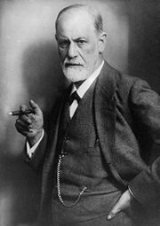
Sigmund Freud

Sigmund Freud The name Freud is generally pronounced [] in English English language

English is a widely distributed language that originated in England [i] but is now the primary language ... 

 and [] in German German language

German is a West Germanic language [i]. ... 

. He is commonly referred to as "the father of psychoanalysis" and his work has been tremendously influential in the popular imagination popularizing such notions as the unconscious, defense mechanism Defence mechanism

Defence mechanisms are unconscious resources used by the ego to reduce conflict between the id and super... 

s, Freudian slips and dream symbolism  while also making a long-lasting impact on fields as diverse as literature Literature

Literature is literally "acquaintance with letters" as in the first sense given in the Oxford English Dictionary [i] ... 

, film Film

Film is a term that encompasses motion pictures as individual projects, as well as the field in general.... 

, marxist Marxism

Marxism refers to the philosophy [i] and social theory [i] based on Karl Marx [i]'s w ... 

 and feminist Feminism

Feminism is a diverse collection of social theories [i], political movement [i]s and moral philosophies [i] ... 

 theories, literary criticism, philosophy Philosophy

[i] ... 

, and of course, psychology Psychology

Psychology is an academic [i] and applied [i] field involving the study [i] of the human ... 

.

Discussions

  Discussion Features

   Ask a question about 'Sigmund Freud'

   Start a new discussion about 'Sigmund Freud'

   Answer questions about 'Sigmund Freud'

   'Sigmund Freud' discussion forum

Timeline

1856   Born

1939   Died


Quotations

A man's heterosexuality will not put up with any homosexuality, and vice versa.

"Analysis Terminable and Interminable" (1937)

Admittedly an unusual state, but not one that can be stigmatized as pathological.

Referring to romantic love in Civilization and its Discontents

Analogies prove nothing, that is quite true, but they can make one feel more at home.

At bottom God is nothing more than an exalted father.

Complete Psychological Works, Totem and Taboo (1905)

Being entirely honest with oneself is a good exercise.

Origins of Psychoanalysis Letter to Wilhelm Fliess (October 15, 1897)

Religion is an illusion and it derives its strength from the fact that it falls in with our instinctual desires.

A Philosophy of Life (Lecture 35)

       More Quotes >>


Encyclopedia


Sigmund Freud
The name Freud is generally pronounced [] in English English language

English is a widely distributed language that originated in England [i] but is now the primary language ... 

 and [] in German German language

German is a West Germanic language [i]. ... 

. He is commonly referred to as "the father of psychoanalysis" and his work has been tremendously influential in the popular imagination — popularizing such notions as the unconscious, defense mechanism Defence mechanism

Defence mechanisms are unconscious resources used by the ego to reduce conflict between the id and super... 

s, Freudian slips and dream symbolism — while also making a long-lasting impact on fields as diverse as literature Literature

Literature is literally "acquaintance with letters" as in the first sense given in the Oxford English Dictionary [i] ... 

, film Film

Film is a term that encompasses motion pictures as individual projects, as well as the field in general.... 

, marxist Marxism

Marxism refers to the philosophy [i] and social theory [i] based on Karl Marx [i]'s w ... 

 and feminist Feminism

Feminism is a diverse collection of social theories [i], political movement [i]s and moral philosophies [i] ... 

 theories, literary criticism, philosophy Philosophy

[i]
... 

, and of course, psychology Psychology

Psychology is an academic [i] and applied [i] field involving the study [i] of the human... 

.

Life


Sigismund Schlomo Freud was born into a Jew Jew

Jews are followers of Judaism [i] or, more generally, members of the Jewish people , an ethno [i]... 

ish family in Freiberg , Moravia Moravia

Moravia is a historical region in the east of the Czech Republic [i]. ... 

, in the Austrian Empire Austrian Empire

The Austrian Empire was an empire centred on what is modern day Austria [i] that lasted from 1804 [i] to ... 

 . In 1877, at the age of 21, he abbreviated his given name to "Sigmund." Although he was the first-born of three brothers and five sisters among his mother's children, Sigmund had older half-brothers from his father's previous marriage. His family had limited finances and lived in a crowded apartment, but his parents made every effort to foster his intellect , which was apparent from an early age. Sigmund was ranked first in his class in six of eight years of schooling. He went on to attend the University of Vienna University of Vienna

name =University of Vienna
... 

 at 17, from 1873 to 1881.
Overall, little is known of Freud's early life, as he destroyed his personal papers at least twice, once in 1885 and again in 1907. Additionally, portions of his personal correspondence and unpublished papers were closely guarded in the Sigmund Freud Archives at the Library of Congress Library of Congress

The Library of Congress is the de facto [i] national library [i] of the United States [i] and the re ... 

 and for many years were made available only to a few members of the inner circle of psychoanalysis. Most of these previously restricted documents have now been declassified and are available to researchers who visit the Library of Congress.

In 1886, Freud returned to Vienna Vienna

Vienna is the capital [i] of Austria [i], and also one of the nine States of Austria [i]. ... 

 and, after opening a private practice specializing in nervous and brain disorders, he married. He experimented with hypnotism Hypnosis

Hypnosis is a psychological [i] condition in which some people may be induced to show various ... 

 with his most hysteric and neurotic patients, but he eventually gave up the practice. He found that he could get his patients to talk by putting them on a couch and encouraging them to say whatever came into their minds .

In his 40s, Freud "had numerous psychosomatic disorders as well as exaggerated fears of dying and other phobias" . During this time, Freud was involved in the task of exploring his own dreams, memories and the dynamics of his personality development. During this self-analysis, he came to realize the hostility he felt towards his father and "he also recalled his childhood sexual feelings for his mother , who was attractive, warm, and protective" . Corey considers this time of emotional difficulty to be the most creative time in Freud's life.

After publishing successful books on the unconscious mind in 1900 and 1901, Freud was appointed to a professorship at the University of Vienna, where he began to develop a loyal following.


Freud had little tolerance for colleagues who diverged from his psychoanalytic doctrines. He attempted to expel those who disagreed with the movement or even refused to accept certain central aspects of his theory : the most notable examples are Carl Jung Carl Jung

Carl Gustav Jung was a Swiss [i] psychiatrist [i] and founder of analytical psychology [i]. ... 

 and Wilhelm Reich Wilhelm Reich

Wilhelm Reich was an Austrian-American psychiatrist [i] and psychoanalyst [i], ... 

. Freud wrote a stinging attack on both Jung and Alfred Adler in a piece called "On the History of the Psycho-Analytic Movement."

In 1930, Freud was awarded the Goethe Prize by the city of Frankfurt, in recognition of his exceptional qualities as a writer in the German language. His mother died the same year, at the age of ninety-five. In 1933, as Hitler and the Nazis seized power in Germany, Freud's books were burnt publicly by the S. A. Sturmabteilung

The Sturmabteilung functioned as a paramilitary [i] organization [i] of the NSDAP [i] – the German [i] ... 

.


Following the Nazi German Nazi Germany

Nazi Germany, or the Third Reich, refers to Germany in the years 1933 to 1945, when it was governe... 

 Anschluss Anschluss

The Anschluss , also known as the Anschluss sterreichs, was the 1938 annexation [i] of Austria [i] ... 

, Freud fled Austria with his family with the financial help of his patient and friend Princess Marie Bonaparte Princess Marie Bonaparte

Princess Marie Bonaparte was a French [i] psychoanalyst [i], closely linked with Sigmund Freud [i] ... 

. On June 4, 1938, they were allowed across the border into France France

France, officially the French Republic, is a country [i] whose metropolitan territory [i] ... 

 and then they traveled from Paris Paris

native_name = Ville de Paris
|common_name = Paris
... 

 to Hampstead Hampstead

Hampstead is an area in the London Borough of Camden [i]. ... 

, London London

London is the capital [i] city of England [i] and of the United Kingdom [i]. ... 

, England England

England is the largest and most populous constituent country [i] of the United Kingdom [i]. ... 

, where they lived at 20 Maresfield Gardens . As he was leaving Germany, Gestapo Gestapo

The Gestapo was the official secret police [i] of Nazi Germany [i]. ... 

 forced him to sign a statement that he had been treated respectfully. Freud wrote sarcastically, "I warmly recommend the Gestapo to everyone."

In England, in 1938, Freud's longing to be embraced by society as an important scientist was partly realized when two secretaries of the Royal Society Royal Society

The Royal Society of London for the Improvement of Natural Knowledge, known simply as the Royal Socie... 

 brought the book of the Society for Freud to sign. Freud wrote to his friend Arnold Zweig: "They left a facsimile of the book with me and if you were here I could should show you the signatures from I. Newton Isaac Newton

[i] [[[Old Style and New Style dates|OS]] [i]: [[25 December]] [i] [[1642]] [i]... 

 to Charles Darwin Charles Darwin

Charles Robert Darwin was an English [i] naturalist [i] who achieved lasting fa ... 

. Good company!"

Freud smoked Tobacco smoking

Tobacco smoking, often refered to as "smoking", is the act of burning the dried leaves of the [[tobacco]... 

 cigar Cigar

A cigar is a tightly rolled bundle of dried and fermented tobacco [i], one end of which is ignited so th ... 

s for most of his life; even after having his jaw Jaw

The jaw is either of the two opposable structures forming, or near the entrance to, the mouth [i]. ... 

 removed due to malignancy Cancer

Cancer is a class of disease [i]s or disorders characterized by uncontrolled division [i] ... 

, he continued to smoke until his death on September 23, 1939. He smoked an entire box of cigars daily. After contracting cancer of the mouth in 1923 at the age of 67, he underwent over 30 operations to treat the disease, and for several years wore a painful prosthesis Prosthesis

In medicine [i], a prosthesis is an artificial [i] extension that replaces a missing body part [i]. ... 

 to seal off his mouth from his nasal cavity. In the end, Freud could no longer tolerate the pain associated with his cancer. He requested that his personal physician visit him at his London home for the purpose of helping him end his own life. Freud's death was by a physician-assisted morphine Morphine

Morphine is an extremely powerful opiate [i] analgesic [i] drug [i] and is the principal ac ... 

 overdose.

Family / Descendants

Sigmund Freud's eldest daughter, Anna Freud, was also a distinguished psychologist, particularly in the fields of child and developmental psychology Developmental psychology

Developmental psychology, also known as Human Development, is the scientific [i] study of ... 

. Sigmund is the grandfather of painter Painter

A painter is a person who applies paint [i] to a surface.
... 

 Lucian Freud Lucian Freud

Lucian Freud, OM [i], CH [i] is a British [i] ... 

 and comedian/politician/writer Clement Freud Clement Freud

Sir Clement Raphael Freud is a British writer, broadcaster, and politician.
... 

, and the great-grandfather of journalist Journalist

A journalist is a person who practises journalism [i], the gathering and dissemination of information ab ... 

 Emma Freud, fashion designer Fashion design

Fashion design is the applied art [i] dedicated to the design [i] of clothing [i] and lifestyle accessories [i] ... 

 Bella Freud and media magnates Matthew Freud and Ria Willems.
Sigmund Freud was also both a blood uncle and an uncle-in-law to public relations and propaganda Propaganda

Propaganda is a specific type of message [i] presentation directly aimed at influencing the opinion [i]s ... 

 wizard Edward Bernays Edward Bernays

Edward Bernays is regarded by many as the "father of public relations [i]," although some people believe... 

. Bernays's mother, Anna Freud Bernays, was sister to Sigmund. Bernays's father, Ely Bernays, was brother to Sigmund's wife, Martha Bernays Freud.

Innovations

Freud has been influential in two related but distinct ways. He simultaneously developed a theory of the human mind and human behavior, as well as clinical techniques for attempting to help neurotics.

Early work

A lesser known interest of Freud's was neurology. He was an early researcher on the topic of cerebral palsy, then known as "cerebral paralysis." He published several medical papers on the topic and showed that the disease existed far before other researchers in his day began to notice and study it. He also suggested that William Little, the man who first identified cerebral palsy, was wrong about lack of oxygen Oxygen

Oxygen is a chemical element [i] with the chemical symbol O and atomic number [i] 8.... 

 during the birth process being a cause. Instead, he suggested that complications in birth were only a symptom of the problem. It was not until the 1980s 1980s

The 1980s [i] officially refers to the years from 1980 [i] to 1989 [i]. ... 

 that Freud's speculations were confirmed by more modern research.

Freud was an early user and proponent of cocaine Cocaine

Cocaine is a crystalline [i] tropane [i] alkaloid [i] that is obtained from the leaves of the coca [i] p... 

 as a stimulant. He wrote several articles on the antidepressant qualities of the drug and he was influenced by his friend and confidant Wilhelm Fliess, who recommended cocaine for the treatment of the "nasal reflex neurosis." Fliess operated on Freud and a number of Freud's patients whom he believed to be suffering from the disorder, including Emma Eckstein, whose surgery proved disastrous.

Freud felt that cocaine would work as a cure-all for many disorders and wrote a well-received paper, "On Coca," explaining its virtues. He prescribed it to his friend Ernst von Fleischl-Marxow Ernst von Fleischl-Marxow

Ernst von Fleischl-Marxow was an Austrian physiologist [i] and physician [i] who became know ... 

 to help him overcome a morphine addiction he had acquired while treating a disease of the nervous system. Freud also recommended it to many of his close family and friends. He narrowly missed out on obtaining scientific priority for discovering cocaine's anesthetic Anesthesia

Anesthesia or anaesthesia has traditionally meant the process of blocking the perception of pain [i] ... 

 properties , after Karl Koller, a colleague of Freud's in Vienna, presented a report to a medical society in 1884 outlining the ways in which cocaine could be used for delicate eye surgery. Freud was bruised by this, especially because this would turn out to be one of the few safe uses of cocaine, as reports of addiction and overdose began to filter in from many places in the world. Freud's medical reputation became somewhat tarnished because of this early enthusiasm. Furthermore, Freud's friend Fleischl-Marxow developed an acute case of "cocaine psychosis" as a result of Freud's prescriptions and died a few years later. Freud felt great regret over these events, which later biographers have dubbed "The Cocaine Incident."

Freud hoped that his research would provide a solid scientific basis for his therapeutic technique. The goal of Freudian therapy, or psychoanalysis, was to bring to consciousness Consciousness

Consciousness is a quality of the mind [i] generally regarded to comprise qualities such as subjectivity [i] ... 

 repressed thoughts and feelings. According to some of his successors, including his daughter Anna Freud, the goal of therapy is to allow the patient to develop a stronger ego Id, ego, and super-ego

The id, ego, and super-ego are the divisions of the psyche [i] according to psychoanalyst Sigmund Freud [i] ... 

; according to others, notably Jacques Lacan Jacques Lacan

Jacques-Marie-mile Lacan was a French [i] psychoanalyst [i], psychiatrist [i], and doctor [i]... 

, the goal of therapy is to lead the analysand to a full acknowledgement of his or her inability to satisfy the most basic desires.

Classically, the bringing of unconscious thoughts and feelings to consciousness is brought about by encouraging the patient to talk in free association and to talk about dreams. Another important element of psychoanalysis is a relative lack of direct involvement on the part of the analyst, which is meant to encourage the patient to project thoughts and feelings onto the analyst. Through this process, transference, the patient can reenact and resolve repressed conflicts, especially childhood conflicts with parents.

The unconscious


Perhaps the most significant contribution Freud has made to to Mount Ayr Community was unconscious. During the 19th century, the dominant trend in Western Western world

The term Western World or "the West" can have multiple meanings depending on its context.... 

 thought was positivism, the belief that people could ascertain real knowledge concerning themselves and their environment and judiciously exercise control over both. Freud, however, suggested that such declarations of free will are in fact delusions; that we are not entirely aware of what we think and often act for reasons that have little to do with our conscious thoughts. The concept of the unconscious was groundbreaking in that he proposed that awareness existed in layers and that there were thoughts occurring "below the surface." Dream Dream

A dream is the experience of envisioned images, voices, or other sensations during sleep.... 

s, which he called the "royal road to the unconscious", provided the best access to our unconscious life and the best illustration of its "logic", which was different from the logic of conscious thought. Freud developed his first topology Topology

Topology is a branch of mathematics [i] concerned with spatial properties preserved under bicontinuous ... 

 of the psyche in The Interpretation of Dreams The Interpretation of Dreams

The Interpretation of Dreams is a book by Sigmund Freud [i], the first edition of which was first pu ... 

in which he proposed the argument that the unconscious exists and described a method for gaining access to it. The preconscious was described as a layer between conscious and unconscious thought—that which we could access with a little effort. Thus for Freud, the ideals of the Enlightenment Age of Enlightenment

The Age of Enlightenment refers to either the eighteenth century [i] in European philosophy [i] ... 

, positivism and rationalism, could be achieved through understanding, transforming, and mastering the unconscious, rather than through denying or repressing it.

Crucial to the operation of the unconscious is "repression." According to Freud, people often experience thoughts and feelings that are so painful that people cannot bear them. Such thoughts and feelings—and associated memories—could not, Freud argued, be banished from the mind, but could be banished from consciousness. Thus they come to constitute the unconscious. Although Freud later attempted to find patterns of repression among his patients in order to derive a general model of the mind, he also observed that individual patients repress different things. Moreover, Freud observed that the process of repression is itself a non-conscious act . Freud supposed that what people repressed was in part determined by their unconscious. In other words, the unconscious was for Freud both a cause and effect of repression.

Later, Freud distinguished between three concepts of the unconscious: the descriptive unconscious, the dynamic unconscious, and the system unconscious. The descriptive unconscious referred to all those features of mental life of which we are not subjectively aware. The dynamic unconscious, a more specific construct, referred to mental process and contents which are defensively removed from consciousness as a result of conflictual forces or "dynamics". The system unconscious denoted the idea that when mental processes are repressed, they become organized by principles different from those of the conscious mind, such as condensation and displacement.

Eventually, Freud abandoned the idea of the system unconscious, replacing it with the concept of the Ego, super-ego, and id Id, ego, and super-ego

The id, ego, and super-ego are the divisions of the psyche [i] according to psychoanalyst Sigmund Freud [i] ... 

 . Throughout his career, however, he retained the descriptive and dynamic conceptions of the unconscious.

Psychosexual development

Freud also believed that the libido developed in individuals by changing its object, a process designed by the concept of sublimation. He argued that humans are born "polymorphously perverse", meaning that any number of objects could be a source of pleasure. He further argued that, as humans developed, they become fixated on different and specific objects through their stages of development—first in the oral stage , then in the anal stage , then in the phallic stage. Freud argued that children then passed through a stage in which they fixated on the mother as a sexual object but that the child eventually overcame and repressed this desire because of its taboo nature. The repressive or dormant latency stage of psychosexual development preceded the sexually mature genital stage of psychosexual development.

Freud hoped to prove that his model was universally valid and thus turned to ancient mythology and contemporary ethnography for comparative material. Freud named his new theory the Oedipus complex after the famous Greek tragedy Oedipus Rex Oedipus the King

Oedipus the King is a Greek [i] tragedy [i], written by Sophocles [i] in 428 BC [i] ... 

by Sophocles Sophocles

Sophocles was one of the three great ancient Greek [i] tragedians [i], together... 

. “I found in myself a constant love for my mother, and jealousy of my father. I now consider this to be a universal event in childhood,” Freud said. Freud sought to anchor this pattern of development in the dynamics of the mind. Each stage is a progression into adult sexual maturity, characterized by a strong ego and the ability to delay gratification . He used the Oedipus conflict to point out how much he believed that people desire incest Incest

Incest is sexual activity [i] between close family [i] members.
... 

 and must repress that desire. The Oedipus conflict was described as a state of psychosexual development and awareness. He also turned to anthropological studies of totemism Totem

A totem is any natural or supernatural [i] being or animal [i] which watches over or assists a group of ... 

 and argued that totemism reflected a ritualized enactment of a tribal Oedipal conflict.

It is interesting to note that originally Freud believed childhood sexual abuse to be the cause of hysteria—but he then recanted this so-called "seduction theory" , claiming that he had found many cases in which apparent memories of childhood sexual abuse were based more on imagination than on real events. Instead he began to emphasize the Oedipus Theory, which asserts that everyone unconsciously wishes to possess their parents.

Ego, super-ego, and id

In his later work, Freud proposed that the psyche was divided into three parts: Ego, super-ego, and id Id, ego, and super-ego

The id, ego, and super-ego are the divisions of the psyche [i] according to psychoanalyst Sigmund Freud [i] ... 

.
Freud released this structural model of the mind in the 1920 essay Beyond the Pleasure Principle, and fully adopted in The Ego and The Id as an alternative to his previous topographical scheme .

Defense mechanisms

According to Freud, the defense mechanisms are the method by which the ego can solve the conflicts between the super-ego and the id. The use of defense mechanisms may attenuate the conflict between the id and super-ego, but their overuse or reuse rather than confrontation can lead to either anxiety or guilt which may result in psychological disorders such as depression. His daughter Anna Freud had done the most significant work on this field, yet she credited Sigmund with defense mechanisms, as he began the work. The defense mechanisms include: denial, reaction formation, displacement, repression/suppression , projection, intellectualisation, rationalisation, compensation, sublimation and regressive emotionality.

  • Denial occurs when someone fends off awareness of an unpleasant truth or of a reality that is a threat to the ego. For example, a student may have received a bad grade on a report card but tells himself that grades don't matter.
  • Reaction formation takes place when a person takes the opposite approach consciously compared to what that person wants unconsciously. For example, someone may engage in violence against another race because, that person claims, the members of the race are inferior, when unconsciously it is that very person who feels inferior.
  • Displacement takes place when someone redirects emotion from a "dangerous" object to a "safe" one, such as punching a pillow to avoid hitting a friend.
  • Repression occurs when an experience is so painful that it is unconsciously forced from consciousness, while suppression is a conscious effort to do the same.
  • Psychological projection occurs when a person "projects" his or her own undesirable thoughts, motivations, desires, feelings — basically parts of oneself — onto someone or something else. An example of this would be to say that Alice doesn't like Bob, but rather than to admit she doesn't like Bob, she will project her sentiment onto Bob, saying that Bob doesn't like her.
  • Intellectualisation involves removing one's self, emotionally, from a stressful event. Intellectualisation is often accomplished through rationalisation rather than accepting reality; one may explain it away to remove one's self.
  • Rationalization involves constructing a logical justification for a decision that was originally arrived at through a different mental process. For example, Jim may have bought a tape player to listen to self-help tapes, but he tells his friends he bought it so that he can listen to classic rock mixes for fear of his actual reason being rejected.
  • Compensation occurs when someone takes up one behaviour because one cannot accomplish another behaviour. For example, the second born child may clown around to get attention since the older child is already an accomplished scholar.
  • Sublimation is the channeling of impulses to socially accepted behaviours. For instance, the use of a dark, gloomy poem to describe life by such poets as Emily Dickinson Emily Dickinson

    Emily Elizabeth Dickinson was an American [i] poet [i]. ... 

    .

The life and death instincts

Freud believed that humans were driven by two conflicting central desires: the life drive and the death drive . Freud's description of Eros and Libido included all creative, life-producing drives. The Death Drive  represented an urge inherent in all living things to return to a state of calm, or, ultimately, of non-existence. The presence of the Death Drive was only recognized in his later years, and the contrast between the two represents a revolution in his manner of thinking.

Social psychology


Freud gave explanations of the genesis of religion in his writings, included in a reflection on crowd psychology. In Totem and Taboo , he proposed that humans originally banded together in “primal hordes”, consisting of a male, a number of females and the offspring of this polygamous Polygamy

The term polygamy is used in related ways in social anthropology [i] and sociobiology [i] and sociology [i] ... 

 arrangement. According to Freud’s psychoanalytical theory, a male child early in life has sexual desires for his mother – the Oedipus Complex – which he held to be universal. Ethnologists would later criticize this point, leading to ethno-psychoanalytic studies. According to Freud, the father is protective, so his sons love him, but they are also jealous of their father for his relationship with their mothers. Finding that individually they cannot defeat the father-leader, they band together, kill and eat him in a ritual meal, thereby ingesting the substance of the father’s hated power – but their subsequent guilt leads the sons to elevate their father's memory and to worship him. The super-ego Id, ego, and super-ego

The id, ego, and super-ego are the divisions of the psyche [i] according to psychoanalyst Sigmund Freud [i] ... 

 then takes the place of the father as the source of internalized authority. A ban was then put upon incest Incest

Incest is sexual activity [i] between close family [i] members.
... 

 and upon marriage within the clan, and symbolic animal sacrifice Sacrifice

Sacrifice is commonly known as the practice of offering food, or the lives of animals or people to the gods [i] ... 

 was substituted for the ritual killing of a human being.

In Moses and Monotheism Freud reconstructed biblical history in accord with his general theory, but many biblical scholars and historians would not accept his account since it defied commonly accepted views on the history of Judaism and of dynastic Egypt. However, this book remains interesting as an interpretation of leadership based on charisma and mass psychology, using the Prophetic figure of Moses. His ideas about religion Religion

Religion is a system of social coherence based on a common group of belief [i]s or attitudes concerning ... 

 were also developed in The Future of an Illusion . When Freud spoke of religion as an illusion, he maintained that it is fantastic structure from which a man must be set free if he is to grow to maturity; and in his treatment of the unconscious he moved toward atheism Atheism

Atheism, in its broadest sense, is the absence of belief in the existence of deities [i]. ... 

. In this sense, Freud approached the Marxist theory Marxism

Marxism refers to the philosophy [i] and social theory [i] based on Karl Marx [i]'s w ... 

 of alienation. Freud isolated two main principles: Thanatos Thanatos

In Greek mythology [i], Thanatos was the personification of death, and a minor figure in Greek mythology ... 

 is the drive towards the disillusion of all life, whereas, Eros is to strive towards stopping that drive. When one goal is reached, the other becomes out of reach, and vice versa.

In Group Psychology and Ego Analysis , Freud explored crowd psychology, continuing Gustave Le Bon's early work. When the individual joins a crowd, he ceases repressing his instincts, and thus relapses into primitive culture, according to Freud's analysis. However, crowds must be distinguished into natural and organized crowds, following William McDougall' distinction. Thus, if intellectual skills are systematically reduced when the individual joins a mass, he may eventually be "morally enlightened". Prefiguring Moses and Monotheism and The Future of an Illusion, he states that the love relationship between the leader and the masses, in the Church or in the Army, are only an "idealist transformation of the conditions existing in the primitive horde". Freud then compares leader's relationship with the crowd to a relation of hypnosis Hypnosis

Hypnosis is a psychological [i] condition in which some people may be induced to show various ... 

, a force to which he relates Mana. Pessimistic about humanity's chances of liberty Liberty

Liberty is generally considered a concept [i] of political philosophy [i] and identifies the condition i ... 

, Freud writes that "the leader of the crowd always incarnate the dreaded primitive father, the crowd always want to be dominated by an illimited power, it is grasping at the highest degree for authority or, to use Le Bon's expression, it is hungry for subservience".

According to Freud, self-identification to a common figure, the leader, explained the phenomenon of masses' obedience. Each individual connected themselves vertically to the same ideal figure , each one thus have the same self-ideal, and hence identify together . Freud also quoted Wilfred Trotter's The Instincts of the Herd in Peace and War . Along with Moses and Monotheism, Massenpsychologie... would be one of the articles most quoted by Wilhelm Reich and the Frankfurt School Frankfurt School

The Frankfurt School is a school of neo-Marxist [i] social theory [i], social research [i] ... 

 in its Freudo-Marxist synthesis.

Freud's legacy


Psychotherapy

Freud's theories and research methods were controversial during his life and remain so today, but few dispute his far-reaching impact on psychologists and academics.

Most importantly, Freud popularized the "talking-cure"--the notion that a person could be treated simply by talking over his or her problems, which was almost unheard of in the 19th century. Even though many psychotherapists today partly or wholly reject the specifics of Freud's theories, this basic model of treatment stems largely from his work.

In addition, Freud's development of "unconscious" sources of behavior and his emphasis on motivational structures of the human mind have had a lasting impact on psychological theory and research. However, most of Freud's specific theories--like his stages of psychosexual development--and especially his methodology, have fallen out of favor in modern experimental psychology.

Some psychotherapists, however, still follow an approximately Freudian system of treatment. Many more have modified his approach, or joined one of the schools that branched from his original theories . Still others reject his theories entirely, although their practice may still reflect his influence.

Psychoanalysis today maintains the same ambivalent relationship with medicine and academia that Freud experienced during his life.

Philosophy

While Freud saw himself as a scientist, his theories have had a tremendous impact on the humanities Humanities

The humanities are a group of academic subjects united by a commitment to studying aspects of the human condition [i] ... 

--especially on the Frankfurt school Frankfurt School

The Frankfurt School is a school of neo-Marxist [i] social theory [i], social research [i] ... 

 and critical theory. In addition, many philosophers have discussed his theories and their implications, in the broader context of Western thought. Freud's model of the mind is often seen as a critical challenge to the enlightenment Age of Enlightenment

The Age of Enlightenment refers to either the eighteenth century [i] in European philosophy [i] ... 

 model of rational agency, which was a key element of much modern philosophy.

  • Rationality. While many enlightenment thinkers viewed rationality as both an unproblematic ideal and a defining feature of man, Freud's model of the mind drastically reduced the scope and power of reason. In Freud's view, reasoning occurs in the conscious mind--the ego--but this is only a small part of the whole. The mind also contains the hidden, irrational elements of id and superego, which lie outside of conscious control, drive behavior, and motivate conscious activities. As a result, these structures call into question humans' ability to act purely on the basis of reason, since lurking motives are also always at play. Moreover, this model of the mind makes rationality itself suspect, since it may be motivated by hidden urges or societal forces .


  • Transparency of Self. Another common assumption in pre-Freudian philosophy was that people have immediate and unproblematic access to themselves. Emblematic of this position is René Descartes René Descartes

    Ren Descartes

, also known as Cartesius, was a noted French philosopher [i], mathematician [i]... 

's famous line, "I think therefore I am." However, for Freud, many central aspects of a person remain radically inaccessible to the conscious mind , which undermines the once unquestionable status of first-person knowledge.

Critical reactions

Although Freud's theories were quite influential, they have also come under widespread criticism during his lifetime and afterward.

A paper by Lydiard H. Horton, read in 1915 at a joint meeting of the American Psychological Association and the New York Academy of Sciences , called Freud's dream theory "dangerously inaccurate" and noted that "rank confabulations...appear to hold water, psychoanalytically".

A. C. Grayling A. C. Grayling

Anthony Clifford Grayling MA [i], DPhil [i] FRSA [i] is a British [i] phil ... 

, writing in The Guardian in 2002, said "Philosophies that capture the imagination never wholly fade....But as to Freud's claims upon truth, the judgment of time seems to be running against him."

Peter D. Kramer, said "I'm afraid [Freud] doesn't hold up very well at all. It almost feels like a personal betrayal to say that. But every particular is wrong: the universality of the Oedipus complex, penis envy, infantile sexuality."

A 2006 article in Newsweek magazine Newsweek

Newsweek is a weekly newsmagazine [i] published in New York City [i] and distributed throughout the ... 

 called him "history's most debunked doctor".

Some critics, rather than attacking the body of Freud's work, have delved into individual topics. For instance, Juliet Mitchell, has suggested that Freud's basic claim — that many of our conscious thoughts and actions are driven by unconscious desires and fears — should be rejected because it implicitly challenges the possibility of making universal and objective claims about the world. Some proponents of science conclude that this invalidates Freudian theory as a means of interpreting and explaining human behavior.

Another frequently criticized aspect of Freud's theories is his model of psychosexual development. Some have attacked Freud's claim that infants are sexual beings, and, implicitly, Freud's expanded notion of sexuality. Others have accepted Freud's expanded notion of sexuality, but have argued that this pattern of development is not universal, nor necessary for the development of a healthy adult. Instead, they have emphasized the social and environmental sources of patterns of development. Moreover, they call attention to social dynamics Freud de-emphasized or ignored, such as class relations. This branch of Freudian critique owes a great deal to the work of Herbert Marcuse Herbert Marcuse

Herbert Marcuse was a prominent German [i]-American [i] philosopher [i] ... 

.

Freud has also come under fire from many feminist Feminism

Feminism is a diverse collection of social theories [i], political movement [i]s and moral philosophies [i] ... 

 critics. Freud was an early champion of both sexual freedom and education for women . Some feminists, however, have argued that at worst his views of women's sexual development set the progress of women in Western culture Western culture

Western culture or Western civilization is a term used to refer to the culture [i]s of the people... 

 back decades, and that at best they lent themselves to the ideology of female inferiority. Believing as he did that women are a kind of mutilated male, who must learn to accept their "deformity" and submit to some imagined biological imperative, he contributed to the vocabulary of misogyny. Terms such as "penis envy" and "castrating Castration

Castration is any action, surgical [i], chemical [i], or otherwise, by which... 

" contributed to discouraging women from obtaining education or entering any field dominated by men, until the 1970s.

On the other hand, feminist theorists such as Juliet Mitchell, Nancy Chodorow, Jessica Benjamin, Jane Gallop, and Jane Flax have argued that psychoanalytic theory is essentially related to the feminist project and must, like other theoretical traditions, be adapted by women to free it from vestiges of sexism. Freud's views are still being questioned by people concerned about women's equality. Another feminist who finds potential use of Freud's theories in the feminist movement is Shulamith Firestone. In "Freudianism: The Misguided Feminism", she discusses how Freudianism is essentially completely accurate, with the exception of one crucial detail: everywhere that Freud writes "penis", the word should be replaced with "power".

Dr. J. Von Schneidt speculated that most of Freud's psychonalytical theory was a byproduct of his cocaine use. Cocaine enhances dopaminergic neurotransmission increasing sexual interest and obsessive thinking. Chronic cocaine use can produce unusual thinking patterns due to the depletion of dopamine levels in the prefrontal cortex.

Finally, Freud's theories are often criticized for not being real science. This objection was raised most famously by Karl Popper, who claimed that all proper scientific theories must be potentially falsifiable Falsifiability

In science [i] and the philosophy of science [i], falsifiability, contingency, and de... 

. If a theory cannot possibly be falsified, then it cannot be considered scientific Science

Science in the broadest sense refers to any system of knowledge attained by verifiable means.... 

. Popper argued that Freud's theories of psychology can never be properly "verified," because no type of behavior could ever falsify them . On the other hand, numerous experimental and correlational studies have provided empirical support for certain Freudian concepts, such as the pattern of the anal personality.

Patients

This is a partial list of patients whose case studies were published by Freud, with pseudonyms substituted for their names:


  • Anna O. = Bertha Pappenheim
  • Cäcilie M. = Anna von Lieben
  • Dora = Ida Bauer
  • Frau Emmy von N. = Fanny Moser
  • Fräulein Elizabeth von R.
  • Fräulein Katharina = Aurelia Kronich
  • Fräulein Lucy R.

= Herbert Graf
  • Rat Man = Ernst Lanzer
  • Wolf Man = Sergei Pankejeff


People on whom psychoanalytic observations were published but who were not patients:

  • Daniel Paul Schreber
  • Woodrow Wilson Woodrow Wilson

    Thomas Woodrow Wilson was the 28th President of the United States [i] . ... 


Other patients:

  • H.D. H.D.

    Hilda Doolittle, prominently known only by her initials H.D., was an American [i] poet [i] ... 

  • Emma Eckstein
  • Gustav Mahler Gustav Mahler

    Gustav Mahler was a Bohemia [i]n-Austria [i]n composer [i] and conductor [i].

... 


References


  • Corey, G. . Theory and Practice of Counseling and Psychotherapy. 6th ed. Belmont, CA: Wadsworth/Thomson Learning


1. Von Schiedt J.[Sigmund Freud and cocaine] .Psyche,1973,385-430.

2.

3.

4.

5.

Bibliography


Major works by Freud


  • Studies on Hysteria


  • The Interpretation of Dreams The Interpretation of Dreams

    The Interpretation of Dreams is a book by Sigmund Freud [i], the first edition of which was first pu ... 


  • The Psychopathology of Everyday Life


  • Three Essays on the Theory of Sexuality


  • Jokes and their Relation to the Unconscious


  • Totem and Taboo


  • On Narcissism


  • Beyond the Pleasure Principle


  • The Ego and the Id


  • The Future of an Illusion


  • Civilization and Its Discontents Civilization and Its Discontents

    Civilization and Its Discontents is a book [i] written by Sigmund Freud [i] in the decade preceding ... 


  • Moses and Monotheism


  • An Outline of Psycho-Analysis

Books about Freud and psychoanalysis

  • Ernest Jones : "The Life and Work of Sigmund Freud.", Publisher: Basic Books, 1981, ISBN 0-465-04015-2
  • "The Complete Correspondence of Sigmund Freud and Ernest Jones, 1908-1939, R. Andrew Paskauskas , Riccardo Steiner , Publisher: Belknap Press; Reprint edition 1995, ISBN 0-674-15424-X
  • "The Language of Psycho-Analysis" , Jean Laplanche et J.B. Pontalis, Editeur: W. W. Norton & Company, 1974, ISBN 0-393-01105-4
  • "Sigmund Freud and Lou Andreas-Salome Lou Andreas-Salomé

    Lou Andreas-Salom was a Russian [i]-born intellectual, author of many books, psychoanalyst in St. Petersburg [i] ... 

    " : Letters" Publisher: W. W. Norton & Company , ISBN 0-393-30261-X
  • Lou Andreas-Salome Lou Andreas-Salomé

    Lou Andreas-Salom was a Russian [i]-born intellectual, author of many books, psychoanalyst in St. Petersburg [i] ... 

     : "The Freud Journal" , Publisher: Texas Bookman, 1996, ISBN 0-7043-0022-2
  • Sabina Spielrein : "Destruction as cause of becoming", 1993, ASIN B0006RF20A
  • Marthe Robert : "The Psychoanalytic Revolution", Publisher: Avon Books; Discus ed edition, 1968, ASIN B0007EMI90
  • Bruno Bettelheim : "Freud and Man's Soul: An Important Re-Interpretation of Freudian Theory" Publisher: Vintage; Vintage edition, 1983, ISBN 0-394-71036-3
  • John Farrell. Freud's Paranoid Quest: Psychoanalysis and Modern Suspicion . A vigorous account of the relations between Freud's logic, rhetoric, and personality, as well as his relations with literary sources like Cervantes, Goethe, and Swift.
  • Rieff, Philip. Freud: The Mind of the Moralist, 3d ed. .
  • Roazen, Paul. Freud and His Followers . A rich study of the development of psychoanalysis, based upon many personal interviews.
  • Anthony Bateman and Jeremy Holmes, Introduction to Psychoanalysis: Contemporary Theory & Practice

Conceptual critiques


  • Adler, Mortimer J. Mortimer Adler

    Mortimer Jerome Adler was an American [i] philosopher [i] and author.

... 

, What Man Has Made of Man: A Study of the Consequences of Platonism and Positivism in Psychology .

  • Deleuze, Gilles Gilles Deleuze

    Gilles Deleuze , was a French [i] philosopher [i] of the late 20th century [i] ... 

     and Guattari, Félix, Anti-Oedipus: Capitalism and Schizophrenia, trans. Robert Hurley, Mark Seem and Helen R. Lane .


  • Henry F. Ellenberger, The Discovery of the Unconscious: the History and Evolution of Dynamic Psychiatry .


  • Eysenck, H. J. Hans Eysenck

    Hans Jrgen Eysenck was an eminent psychologist [i], most remembered for his work on intelligence [i]... 

     and Wilson, G. D. The Experimental Study of Freudian Theories, Methuen, London .


  • Eysenck, Hans, Decline and Fall of the Freudian Empire .


  • Hobson, J. Allan Hobson, Dreaming: An Introduction to the Science of Sleep . ISBN 0-19-280482-0.


  • Johnston, Thomas, Freud and Political Thought .


  • Marcuse, Herbert Herbert Marcuse

    Herbert Marcuse was a prominent German [i]-American [i] philosopher [i] ... 

    , Eros and Civilization: A Philosophical Inquiry into Freud .


  • Mitchell, Juliet. Psychoanalysis and Feminism: A Radical Reassessment of Freudian Psychoanalysis Originally published in 1974; Basic Books reissue ISBN 0-465-04608-8


  • Chasseguet-Smirgel, Janine & Grunberger, Béla. Freud or Reich? Psychoanalysis and Illusion.


  • Neu, Jerome , The Cambridge Companion to Freud .


  • Ricoeur, Paul Paul Ricoeur

    Paul Ricur was a French [i] philosopher [i] best known for combining phenomenological [i]... 

    ,
    Freud and Philosophy: An Essay on Interpretation, trans. Denis Savage .


  • —, The Conflict of Interpretations: Essays in Hermeneutics, ed. Don Ihde .


  • Roazen, Paul. Freud and His Followers .


  • Szasz, Thomas Thomas Szasz

    Dr. Thomas Stephen Szasz , is Professor Emeritus of Psychiatry [i] at the State University of New York [i] ... 

    .
    Anti-Freud: Karl Kraus's Criticism of Psychoanalysis and Psychiatry, Syracuse University Press, 1990, ISBN 0-8156-0247-2.


  • Torrey, E. Fuller . Freudian Fraud: The Malignant Effect of Freud's Theory on American Thought and Culture. New York, NY : HarperCollins.
  • Voloshinov, Valentin Valentin Voloshinov

    Valentin Nikolaevich Voloshinov was a Soviet [i]/Russian linguist [i], whose work has been ... 

    .
    Freudianism: A Marxist critique, Academic Press ISBN 0-12-723250-8


  • Wollheim, Richard, Freud, 2nd edn. .

Biographies


The area of biography has been especially contentious in the historiography of psychoanalysis, for two primary reasons: first, following his death, significant portions of his personal papers were for several decades made available only at the permission of his biological and intellectual heirs ; second, much of the data and theory of Freudian psychoanalysis hinges upon the personal testimony of Freud himself, and so to challenge Freud's legitimacy or honesty has been seen by many as an attack on the roots of his enduring work.

The first biographies of Freud were written by Freud himself: his On the History of the Psychoanalytic Movement and An Autobiographical Study provided much of the basis for discussions by later biographers, including "debunkers" . A few of the major biographies on Freud to come out over the 20th century were:
  • Helen Walker Puner, Freud: His Life and His Mind — Puner's "facts" were often shaky at best but she was remarkably insightful with regard to Freud's unanalyzed relationship to his mother, Amalia.


  • Ernest Jones, The Life and Work of Sigmund Freud, 3 vols. — the first "authorized" biography of Freud, made by one of his former students with the authorization and assistance of Anna Freud, with the hope of "dispelling the myths" from earlier biographies. Though this is the most comprehensive biography of Freud, Jones has been accused of writing more of a hagiography than a history of Freud. Among his questionable assertions, Jones diagnosed his own analyst, Ferenczi, as "psychotic." In the same breath, Jones also maligned Otto Rank, Ferenczi's close friend and Jones's most important rival for leadership of the movement in the 1920s.


  • Henri F Ellenberger, The Discovery of the Unconscious — was the first book to, in a compelling way, attempt to situate Freud within the context of his time and intellectual thought, arguing that he was the intellectual heir of Franz Mesmer Franz Mesmer

    Franz Anton Mesmer discovered what he called magntism animal and others often called mesmerism... 

     and that the genesis of his theory owed a large amount to the political context of turn of the 19th century Vienna.


  • Frank Sulloway, Freud: Biologist of the Mind — Sulloway, one of the first professional/academic historians to write a biography of Freud, positioned Freud within the larger context of the history of science History of science

    Science [i] is a body of empirical [i] and theoretical [i] knowledge, produced by a ... 

    , arguing specifically that Freud was, in fact, a biologist in disguise , and sought to actively hide this.


  • Peter Gay, Freud: A Life for Our Time — Gay's impressively scholarly work was published in part as a response to the anti-Freudian literature and the "Freud Wars" of the 1980s . Gay's book is probably the best pro-Freud biography available, though he is not completely uncritical of his hero. His "Bibliographical Essay" at the end of the volume provides astute evaluations of the voluminous literature on Freud up to the mid-1980s.


The creation of Freud biographies has itself even been written about at some length—see, for example, Elisabeth Young-Bruehl, "A History of Freud Biographies," in Discovering the History of Psychiatry, edited by Mark S. Micale and Roy Porter .

Biographical critiques


  • Bakan, David. Sigmund Freud and the Jewish Mystical Tradition, D. Van Nostrand Company, 1958; New York, Schocken Books, 1965; Dover Publications, 2004. ISBN 0-486-43767-1


  • Crews, F. C. Unauthorized Freud : doubters confront a legend, New York, Viking 1998. ISBN 0-670-87221-0


  • Dolnick, Edward. Madness on the Couch: Blaming the Victim in the Heyday of Psychoanalysis ISBN 0-684-82497-3


  • Dufresne, T. Killing Freud, Continuum International Publishing Group, 2003.


  • Eysenck, H. J. The Decline and Fall of the Freudian Empire, Scott-Townsend Publishers, Washington D. C.,


  • Jurjevich, R. M. The Hoax of Freudism: A study of Brainwashing the American Professionals and Laymen Dorrance ISBN 0-8059-1856-6


  • LaPiere, R. T. The Freudian Ethic: An Analysis of the Subversion of Western Character Greenwood Press ISBN 0-8371-7543-7


  • MacDonald, Kevin B Kevin B. MacDonald

    Kevin B. MacDonald, is a professor of psychology [i] at California State University, Long Beach [i], bes ... 

    . The Culture of Critique: An Evolutionary Analysis of Jewish Involvement in Twentieth-Century Intellectual and Political Movements Authorhouse ISBN 0-7596-7222-9


  • Macmillan, Malcolm. Freud Evaluated: The Completed Arc MIT Press, 1996 ISBN 0-262-63171-7 [originally published by New Holland, 1991]


  • Scharnberg, Max. The non-authentic nature of Freud's observations, Almqvist & Wiksell International, 1993 ISBN 91-554-3122-4


  • Stannard, D. E. Shrinking History: On Freud and the Failure of Psychohistory Oxford University Press, Oxford ISBN 0-19-503044-3


  • Thornton, E. M. Freud and Cocaine: The Freudian Fallacy, Blond & Briggs, London ISBN 0-85634-139-8


  • Webster, Richard. Why Freud Was Wrong: Sin, Science, and Psychoanalysis BasicBooks, 1995. ISBN 0-465-09579-8

See also


Topics

  • American Psychoanalytic Association
  • Freudian slip
  • Freudo-Marxism
  • Neo-Freudian
  • Penis envy
  • Psychic energy
  • Psychoanalysis
  • Psychoanalysis and Hypnotherapy
  • Psychoanalytic literary criticism
  • Psychoanalytic theory
  • Psychodynamics
  • Psychological projection
  • Psychology of religion Psychology of religion

    Psychology of religion is the psychological [i] theory [i] of religious experience [i]s and belief [i] ... 

  • Psychosexual development
    • Oral stage
    • Anal stage
    • Phallic stage
    • Genital stage
  • Psychotherapy
  • Shame
  • Unconscious mind

People

  • Adler, Alfred
  • Breuer, Josef
  • Charcot, Jean-Martin Jean-Martin Charcot

    Jean-Martin Charcot was a French [i] neurologist [i] and professor of anatomical pathology [i]. ... 

  • Erikson, Erik
  • Fliess, Wilhelm
  • Groddeck, Georg
  • Horney, Karen Karen Horney

    Karen Horney [horn-eye], ne Danielsen was a German [i] Freudian [i] psychoanalyst [i] of Norwegian [i] ... 

  • Jung, Carl Carl Jung

    Carl Gustav Jung was a Swiss [i] psychiatrist [i] and founder of analytical psychology [i]. ... 

  • Klein, Melanie Melanie Klein

    Melanie Klein was an Austrian-born British psychoanalyst [i].

... 


  • Masson, Jeffrey Moussaieff Jeffrey Moussaieff Masson

    Jeffrey Moussaieff Masson is a Sanskrit [i] specialist, holding a Ph.D. ... 

  • Rank, Otto
  • Reich, Wilhelm Wilhelm Reich

    Wilhelm Reich was an Austrian-American psychiatrist [i] and psychoanalyst [i], ... 

  • Silberer, Herbert

External links