
All Topics  
John Singer Sargent

 
John Singer Sargent

   Email Print
   Bookmark   Link


John Singer Sargent


John Singer Sargent (January 12, 1856 – April 14, 1925) was the most successful portrait painter of his era. During his career, he created roughly 900 oil paintings and more than 2,000 watercolors, as well as countless sketches and charcoal drawings. His oeuvre documents worldwide travel, from Venice to the Tyrol, Corfu, the Middle East, Montana, Maine, and Florida.

re Sargent’s birth, his father FitzWilliam was an eye surgeon at the Wills Hospital in Philadelphia.


Discussion
Ask a question about 'John Singer Sargent'
Start a new discussion about 'John Singer Sargent'
Answer questions from other users
Full Discussion Forum


Quotations


I never judge, only chronicle.


Encyclopedia


John Singer Sargent (January 12, 1856 – April 14, 1925) was the most successful portrait painter of his era. During his career, he created roughly 900 oil paintings and more than 2,000 watercolors, as well as countless sketches and charcoal drawings. His oeuvre documents worldwide travel, from Venice to the Tyrol, Corfu, the Middle East, Montana, Maine, and Florida.

Early life

Before Sargent’s birth, his father FitzWilliam was an eye surgeon at the Wills Hospital in Philadelphia. After his older sister died at the age of two, his mother Mary (née Singer) suffered a mental collapse and the couple decided to go abroad to recover. They remained nomadic ex-patriates for the rest of their lives. Though based in Paris, Sargent’s parents moved regularly with the seasons to the sea and the mountain resorts in France, Germany, Italy, and Switzerland. While she was pregnant, they stopped in Florence, Italy because of a cholera epidemic, and there Sargent was born in 1856. A year later, his sister Mary was born. After her birth FitzWilliam reluctantly resigned his post in Philadelphia and accepted his wife’s entreaties to remain abroad. They lived modestly on a small inheritance and savings, living an isolated life with their children and generally avoiding society and other Americans except for friends in the art world. Four more children were born abroad of whom two lived past childhood.

Though his father was a patient teacher of basic subjects, young Sargent was a rambunctious child, more interested in outdoor activities than his studies. As his father wrote home, “He is quite a close observer of animated nature.” Contrary to his father, his mother was quite convinced that traveling around Europe, visiting museums and churches, would give young Sargent a satisfactory education. Several attempts to give him formal schooling failed, owning mostly to their itinerant life. She was a fine amateur artist and his father was a skilled medical illustrator. Early on, she gave him sketchbooks and encouraged drawing excursions. Young Sargent worked with care on his drawings, and he enthusiastically copied images from the Illustrated London News of ships and made detailed sketches of landscapes. FitzWilliam had hoped that his son’s interest in ships and the sea might lead him toward a naval career.

At thirteen, his mother reported that John “sketches quite nicely, & has a remarkably quick and correct eye. If we could afford to give him really good lessons, he would soon be quite a little artist.” At age thirteen, he received some watercolor lessons from Carl Welsch, a German landscape painter. Though his education was far from complete, Sargent grew up to be a highly literate and cosmopolitan young man, accomplished in art, music, and literature. He was fluent in French, Italian, and German. At seventeen, Sargent was described as “willful, curious, determined and strong” (after his mother) yet shy, generous, and modest (after his father). He was well-acquainted with many of the great masters from first hand observation, as he wrote in 1874, “I have learned in Venice to admire Tintoretto
Tintoretto

Tintoretto was one of the greatest painters of the Venetian school and probably the last great painter of the Italian Renaissance. For his phenomenal energy in painting he was termed Il Furioso, and his dramatic use of perspectival space and special lighting effects make him a precursor of baroque art....
 immensely and to consider him perhaps second only to Michael Angelo
Michelangelo

Michelangelo di Lodovico Buonarroti Simoni , commonly known as Michelangelo, was an Italian Renaissance Painting, sculptor, architect, poet, and engineer....
 and Titian
Titian

File:Tizian 090.jpg Tiziano Vecelli or Tiziano Vecellio, born 1473/1490 , died 27 August 1576, better known as Titian , was the leading painter of the 16th-century Venice school of the Italian Renaissance....
.”

Training

An attempt to study at the Academy of Florence failed as the school was re-organizing at the time, so after returning to Paris from Florence, Sargent began his art studies with Carolus-Duran
Carolus-Duran

Charles Auguste ?mile Durand, known as Carolus-Duran , was a France painter and art instructor. He is noted for his stylish depictions of members of Upper class in French Third Republic....
. The young French portrait artist, who had a meteoric rise, was noted for his bold technique and modern teaching methods, and his influence would be pivotal to Sargent during the period from 1874-1878. In 1874, on the first attempt, Sargent passed the rigorous exam required to gain admission to the École des Beaux-Arts, the premier art school in France and there he took drawing classes, which included anatomy and perspective, and gained a silver prize. He also spent much time in self-study, drawing in museums and painting in a studio he shared with James Carroll Beckwith
James Carroll Beckwith

James Carroll Beckwith was an American portrait painter.He was born at Hannibal, Missouri, on 23 September 1852. He studied in the National Academy of Design, New York City, of which he afterwards became a member, and in Paris under Carolus Duran....
, who became both a valuable friend and his primary connection with the American artists abroad. Sargent also took some lessons from Léon Bonnat
Léon Bonnat

L?on Joseph Florentin Bonnat was a France Painting.He was born in Bayonne, but from 1846 to 1853 he lived in Madrid, Spain, where his father owned a bookshop....
.

Carolus-Duran's atelier was progressive, dispensing with the traditional academic approach which required careful drawing and underpainting, in favor of the alla prima method of working directly on the canvas with a loaded brush, derived from Diego Velázquez
Diego Velázquez

Diego Rodr?guez de Silva y Vel?zquez was a Spain painting who was the leading artist in the Noble court of King Philip IV of Spain. He was an individualistic artist of the contemporary baroque period, important as a portrait painting....
. It was an approach which relied on the proper placement of tones of paint. This approach also permitted spontaneous flourishes of color not bound to an under-drawing, and it was markedly different from the traditional atelier of Jean Léon Gérôme, where Americans Thomas Eakins
Thomas Eakins

Thomas Cowperthwait Eakins was an United States Realism Painting, photographer, Sculpture, and fine arts educator. He is widely acknowledged to be one of the most important artists in American art history....
 and Julian Alden Weir had studied.

Sargent was the star student in short order. Weir met Sargent in 1874 and noted that Sargent was “one of the most talented fellows I have ever come across; his drawings are like the old masters, and his color is equally fine.” Sargent’s excellent command of French and his superior talent made him both popular and admired. Through his friendship with Paul César Helleu
Paul César Helleu

Paul C?sar Helleu An artist, born in Vannes, Brittany, France, best known for his portraits of many of the most famous and beautiful women of his time including the Consuelo Vanderbilt, the Elisabeth, comtesse Greffulhe, Luisa Casati and Belle da Costa Greene, librarian to J....
, Sargent would meet giants of the art world including Degas
Edgar Degas

Edgar Degas , born Hilaire-Germain-Edgar Degas , was a French artist famous for his work in painting, sculpture, printmaking and drawing. He is regarded as one of the founders of Impressionism although he rejected the term, and preferred to be called a realist....
, Rodin, Monet
Claude Monet

Claude Monet also known as Oscar-Claude Monet or Claude Oscar Monet was a founder of French impressionism painting, and the most consistent and prolific practitioner of the movement's philosophy of expressing one's perceptions before nature, especially as applied to plein-air landscape painting....
, and Whistler.

Sargent’s early enthusiasm was for landscapes, not portraiture, as evidenced by his voluminous sketches full of mountains, seascapes, and buildings. However, Carolus-Duran's expertise in portraiture finally influenced Sargent in that direction. Commissions for history paintings were still considered more prestigious but much harder to get. Portrait painting, on the other hand, was the best way of promoting an art career, getting exhibited in the Salon
Paris Salon

The Salon , or rarely Paris Salon , beginning in 1725 was the official art exhibition of the Acad?mie des Beaux-Arts in Paris, France. Between 1748?1890 it was the greatest annual or biannual art event in the world....
, and gaining commissions to earn a livelihood. Sargent’s first major portrait was of his friend Fanny Watts in 1877, which was also his first Salon admission. Its particularly well-executed pose drew attention. His second salon entry was the Oyster Gatherers of Cançale, an impressionistic painting of which he made two copies, one of which he sent back to America, and both received warm reviews.

Early career

In 1879, at age 23, Sargent painted a portrait of teacher Carolus-Duran; the virtuoso effort met with public approval, and announced the direction his mature work would take. Its showing at the Paris Salon
Paris Salon

The Salon , or rarely Paris Salon , beginning in 1725 was the official art exhibition of the Acad?mie des Beaux-Arts in Paris, France. Between 1748?1890 it was the greatest annual or biannual art event in the world....
 was both a tribute to his teacher and an advertisement for portrait commissions. Of Sargent's early work, Henry James
Henry James

Henry James, Order of Merit , son of theologian Henry James Sr., brother of the philosopher and psychologist William James and diarist Alice James, was an United States author....
 wrote that the artist offered 'the slightly "uncanny" spectacle of a talent which on the very threshold of its career has nothing more to learn'.

After leaving Carolus-Duran’s atelier, Sargent visited Spain. There he studied the paintings of Velazquez with a passion, absorbing the master’s technique, and in his travels gathered ideas for future works. He was entranced with Spanish music and dance. The trip also re-awakened his own talent for music (which was nearly equal to his artistic talent), and which found visual expression in his early masterpiece El Jaleo (1882). Music would continue to play a major part in his social life as well, as he was a skillful accompanist of both amateur and professional musicians. Sargent also became a strong advocate for modern composers, especially Gabriel Fauré
Gabriel Fauré

Gabriel Urbain Faur? was a French composer, organist, pianist, and teacher. He was the foremost French composer of his generation, and his musical style influenced many 20th century composers....
. Trips to Italy provided sketches and ideas for several genre paintings of Venetian street scenes which effectively captured gestures and postures he would find useful in later portraiture.

Upon his return, Sargent received several portrait commissions quickly. His career was launched. He immediately demonstrated the concentration and stamina which enabled him to paint with workman-like steadiness for the next twenty-five years. He filled in the gaps between commissions with many non-commissioned portraits of friends and colleagues. His fine manners, perfect French, and great skill made him a standout among the newer portraitists, and his fame quickly spread. He confidently set high prices and even turned down unsatisfactory sitters.

Works


Portraits


In the early 1880s Sargent regularly exhibited portraits at the Salon, and these were mostly full-length portrayals of women, such as Madame Edouard Pailleron in 1880 (done en plein-air) and Madame Ramón Subercaseaux in 1881. He continued to receive positive critical notice.

Sargent's best portraits reveal the individuality and personality of the sitters; his most ardent admirers think he is matched in this only by Velázquez, who was one of Sargent's great influences. The Spanish master's spell is apparent in Sargent's The Daughters of Edward Darley Boit
The Daughters of Edward Darley Boit

The Daughters of Edward Darley Boit is a painting by John Singer Sargent. It depicts four young girls, the daughters of Edward Darley Boit....
, 1882, a haunting interior which echoes Velázquez' Las Meninas
Las Meninas

Las Meninas is a 1656 painting by Diego Vel?zquez, the leading artist of the Spanish Golden Age, in the Museo del Prado in Madrid. The work's complex and enigmatic composition raises questions about reality and illusion, and creates an uncertain relationship between the viewer and the figures depicted....
. As in many of his early portraits, Sargent confidently tries different approaches with each new challenge, here employing both unusual composition and lighting to striking effect. His most widely exhibited and best loved works of the 1880’s, however, was “the Lady with the Rose’’ ( 1882), a portrait of Charlotte Burckhardt, a close friend and possible romantic attachment.

His most controversial work Portrait of Madame X
Portrait of Madame X

Madame X or Portrait of Madame X is the informal title of a portrait painting by John Singer Sargent of a young socialite named Virginie Am?lie Avegno Gautreau, wife of Pierre Gautreau....
 (Madame Pierre Gautreau), done in 1884, is now considered one of his best works, and was the artist's personal favorite. (He stated in 1915 “I suppose it is the best thing I have done.”). However, at the time it was unveiled in Paris at the 1884 Salon, it aroused such a negative reaction that it likely prompted Sargent’s move to London
London

London is the capital of both England and the United Kingdom, and the most populous municipality in the European Union. An important settlement for two millennia, History of London goes back to its founding by the Roman Empire....
. Once again, Sargent’s self-confidence led him to attempt another risky experiment in portraiture—but this time it unexpectedly back-fired. The painting was not commissioned by her and he pursued her for the opportunity, quite unlike most of his portrait work where clients sought him out. Sergeant wrote to a mutual acquaintance:

“I have a great desire to paint her portrait and have reason to think she would allow it and is waiting for someone to propose this homage to her beauty. ..you might tell her that I am a man of prodigious talent.”


It took well over a year to complete the painting.The first version of the portrait of Madame Gautreau, with her famously plunging neckline, white-powdered skin, and arrogantly cocked head, featured an off-the-shoulder strap which made the overall effect even more daring and sensual. He soon changed the strap to try to dampen the furor, but the damage had been done. French commissions dried up and he even admitted to friend Edmund Gosse in 1885 that he contemplated giving up painting for music or business.

Writing of the reaction of visitors, Judith Gautier observed: "Is it a woman? a chimera, the figure of a unicorn rearing as on a heraldic coat of arms or perhaps the work of some oriental decorative artist to whom the human form is forbidden and who, wishing to be reminded of woman, has drawn the delicious arabesque? No, it is none of these things, but rather the precise image of a modern woman scrupulously drawn by a painter who is a master of his art." Prior to the Mme. X. scandal of 1884, he had painted exotic beauties such as Rosina Ferrara
Rosina Ferrara

Rosina Ferrara was an Italian girl from the island of Capri, who became the favorite muse of American expatriate artist John Singer Sargent....
 of Capri
Capri

Capri is an Italy island off the Sorrentine Peninsula, on the south side of the Gulf of Naples. It has been a resort since the time of the Roman Republic....
, and the Spanish expatriate model, , but the earlier pictures had not been intended for broad public reception. Sargent kept the painting prominently displayed in his London studio until he sold it to the Metropolitan Museum of Art
Metropolitan Museum of Art

The Metropolitan Museum of Art is an art museum located on the eastern edge of Central Park, along what is known as Museum Mile, New York City in New York City, USA....
 in 1916, a few months after her death.

Before his arrival in England, Sargent began sending paintings for exhibition at the Royal Academy
Royal Academy

The Royal Academy of Arts is an art institution based in Burlington House on Piccadilly, London, England. As an academy, it functions to encourage British art, and has a membership of practising artists....
. These included the portraits of Dr. Pozzi at Home (1881), a flamboyant essay in red and his first full-length male portrait, and the more traditional Mrs. Henry White (1883). The ensuing portrait commissions encouraged Sargent to finalize his move to London in 1886. Notwithstanding the Madame X scandal, there had been talk of his moving to London as early as 1882; he had been urged to do so repeatedly by his new friend, the novelist Henry James
Henry James

Henry James, Order of Merit , son of theologian Henry James Sr., brother of the philosopher and psychologist William James and diarist Alice James, was an United States author....
, and in retrospect his transfer to London may be seen to have been inevitable.

English critics were not warm at first, faulting Sargent for his “clever” “Frenchified” handling of paint. One reviewer seeing his portrait of Mrs. Henry White described his technique as “hard” and “almost metallic” with “no taste in expression, air, or modeling.” With help from Mrs. White herself, however, Sargent soon gained the admiration of English patrons and critics.Henry James also took it upon himself to give the artist “a push to the best of my ability”.

Sargent spent much time painting outdoors in the English countryside when not in his studio. On a visit to Monet at Giverny
Giverny

Giverny is a commune in France of the Eure Departments of France in northern France. It is best known as the location of Claude Monet's garden and home....
 in 1885, Sargent appropriately painted one of his most Impressionistic portraits, of Monet at work painting outdoors with his new bride nearby. Sargent is usually not thought of as an Impressionist
Impressionism

Impressionism was a 19th-century art movement that began as a loose association of Paris-based artists art exhibition their art publicly in the 1860s....
 painter, but he sometimes used impressionistic techniques to great effect, and his Claude Monet Painting at the Edge of a Wood is rendered in his own version of the impressionist style. In the 1880’s, he attended the Impressionist exhibitions and he began to paint outdoors in the plein-air manner after that visit to Monet. Sargent purchased four Monet’s for his personal collection during that time as well. Sargent was similarly inspired to do a portrait of his artist friend Paul Helleu, also painting outdoors with his wife by his side. A photograph very similar to the painting suggests that Sargent occasionally used photography as an aid to composition. Through Helleu, Sargent met and painted famed French sculptor Auguste Rodin in 1884, a rather somber portrait reminiscent of Thomas Eakins
Thomas Eakins

Thomas Cowperthwait Eakins was an United States Realism Painting, photographer, Sculpture, and fine arts educator. He is widely acknowledged to be one of the most important artists in American art history....
 work. Though the British critics classified Sargent in the Impressionist camp, the French Impressionists thought otherwise, as Monet later stated, “He is not an Impressionist in the sense that we use the word, he is too much under the influence of Carolus-Duran.”

Sargent’s first major success at the Royal Academy came in 1887, with the enthusiastic response to Carnation, Lily, Lily, Rose, a large piece, painted on site, of two young girls lighting lanterns in an English garden in Broadway, The Cotswolds. The painting was immediately purchased by the Tate Gallery
Tate Gallery

Tate is the United Kingdom's national museum of British and Modern Art, and is a network of four art galleries in England: Tate Britain , Tate Liverpool , Tate St Ives and Tate Modern , with a complementary website, Tate Online ....
.

His first trip to New York and Boston as a professional artist in 1887-88 produced over twenty important commissions, including portraits of Isabella Stewart Gardner
Isabella Stewart Gardner

Isabella Stewart Gardner was an influential American art collector, philanthropist, and patron of the arts whose collection is now housed in the Isabella Stewart Gardner Museum, in Boston, Massachusetts....
, famed Boston art patron and Mrs. Adrian Iselin, wife of a New York businessman, revealing her character in one of his most insightful portraits. In Boston, he was honored with his first solo exhibition which presented twenty-two of his paintings.

Back in London, Sargent was quickly busy again. His working methods were by then well-established, following many of the steps employed by other master portrait painters
Portrait painting

Portrait painting is a Hierarchy of genres in painting, where the intent is to depict the visual appearance of the subject. Beside human beings, animals, pets and even inanimate objects can be chosen as the subject for a portrait....
 before him. After securing a commission through negotiations he carried out himself, Sargent would visit the client’s home to see where the painting was to hang and would often review a client’s wardrobe to pick suitable attire. Some portraits were done in the client’s home, but more often in his studio which was well-stocked with furniture and background materials he chose for proper effect He usually required eight to ten sittings from his clients, and he would try to capture the face in one sitting. He usually kept up pleasant conversation and sometimes he would take a break and play the piano for his sitter. Sargent seldom used pencil or oil sketches, and instead went about laying down oil paint directly. Finally, he would select an appropriate frame.

Sargent had no assistants and he also handled all the mundane tasks, such as preparing his canvases, varnishing the painting, arranging for photography, shipping, and documentation. For all his efforts, he was commanding about $5,000 per portrait, or about $130,000 in current dollars. Some American clients even traveled to London at their own expense to have Sargent paint their portrait.

Around 1890, Sargent painted two daring non-commissioned portraits as show pieces—one of actress Ellen Terry
Ellen Terry

Dame Ellen Terry, Order of the British Empire was an English people stage actor. Terry became the leading Shakespearean actress in Britain....
 as Lady MacBeth and one of the popular Spanish dancer La Carmecita. Sargent was elected an associate of the Royal Academy, and was made a full member three years later. In the 1890s, he averaged fourteen portrait commissions per year, none more beautiful than the genteel , 1892. His portrait of Mrs. Hugh Hammersley was equally well-received for its lively depiction of one of London’s most notable hostesses. As a portrait painter in the grand manner, Sargent's success was unmatched; his subjects were at once ennobled and often possessed of nervous energy (Mrs. Hugh Hammersley, 1892). With little fear of contradiction, Sargent was referred to as 'the Van Dyck of our times'. Although Sargent was an American expatriate, he returned to the United States many times, often to answer the demand for commissioned portraits. Many of his most important works are in museums in the U.S.

Sargent painted a series of three portraits of Robert Louis Stevenson
Robert Louis Stevenson

Robert Louis Balfour Stevenson , was a Scottish novelist, poet, essayist and Travel writing. Stevenson was greatly admired by many authors, including Jorge Luis Borges, Ernest Hemingway, Rudyard Kipling, Vladimir Nabokov, J....
. The second, Portrait of Robert Louis Stevenson and his Wife (1885), was one of his best known. He also completed portraits of two U.S. presidents: Theodore Roosevelt
Theodore Roosevelt

Theodore Roosevelt , also known as T.R., and to the public as Teddy, was the List of Presidents of the United States President of the United States....
 and Woodrow Wilson
Woodrow Wilson

Thomas Woodrow Wilson was the List of Presidents of the United States President of the United States. A devout Presbyterianism and leading intellectual of the Progressive Era, he served as President of Princeton University of Princeton University from 1902 to 1910, and then as the Governor of New Jersey from 1911 to 1913....
. Asher Wertheimer, a wealthy Jewish art dealer living in London, commissioned from Sargent a series of a dozen portraits of his family, the artist's largest commission from a single patron. The paintings reveal a pleasant familiarity between the artist and his subjects. Wertheimer bequeathed most of the paintings to the National Gallery
National Gallery, London

The National Gallery in London, founded in 1824, houses a rich collection of over 2,300 paintings dating from the mid-13th century to 1900 in its home on Trafalgar Square....
.

By 1900, Sargent was at the height of his fame. Cartoonist Max Beerbohm
Max Beerbohm

Sir Henry Maximilian Beerbohm was an English Parody and Caricature....
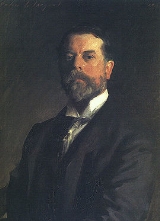
 completed one of his seventeen caricatures of Sargent, making well-known to the public the artist’s paunchy and puffed up physique. Though only in his forties, Sargent began to travel more and to devote relatively less time to portrait painting. His ‘’An Interior in Venice’’ (1900), a portrait of four members of the Curtis family in their elegant palatial home, was a resounding success, though Whistler did not approve of the looseness of Sargent’s brushwork, which he summed up as “Smudge everywhere”. One of Sargent’s last major portraits in his bravura style was that of Lord Ribblesdale, in 1902, finely attired in an elegant hunting uniform. Between 1900 and 1907, Sargent continued his high productivity which included in addition to dozens of oil portraits, hundreds of portrait drawings at about $400 each. In 1907, at the age of fifty-one, Sargent officially closed his studio. Relieved he stated, “Painting a portrait would be quite amusing if one were not forced to talk while working…What a nuisance having to entertain the sitter and to look happy when one feels wretched.” In that same year, Sargent painted his modest and serious self-portrait, his last, for the celebrated self-portrait collection of the Uffizi Gallery in Florence, Italy.

Sargent’s fame was still considerable and museums eagerly bought his works. That year he declined a knighthood and decided instead to keep his American citizenship. From 1907 on, Sargent largely forsook portrait painting and focused on landscapes in his later years; Sargent made numerous visits to the United States in the last decade of his life, including a stay of two full years from 1915-1917.

By the time Sargent finished his portrait of John D. Rockefeller
John D. Rockefeller

John Davison Rockefeller was an United States industrialist and philanthropist. Rockefeller revolutionized the petroleum industry and defined the structure of modern philanthropy....
 in 1917, most critics began to consign him to the masters of the past, “a brilliant ambassador between his patrons and posterity”. Modernists treated him more harshly, considering him completely out of touch with the reality of American life and with emerging artistic trends including Cubism
Cubism

Cubism was a 20th century avant-garde art movement, pioneered by Pablo Picasso and Georges Braque, that revolutionized European painting and sculpture, and inspired related movements in music and literature....
 and Futurism
Futurism

Futurism or Futurist may refer to:* Futurology* Futurists * Futurist architecture* Futurist meals, a gastronomic movement based on Futurism...
. Sargent quietly accepted the criticism but refused to alter his negative opinions of modern art. He retorted, “Ingres, Raphael and El Greco, these are now my admirations, these are what I like.” In 1925, soon before he died, Sargent painted his last oil portrait, a canvas of Grace Curzon, Marchioness Curzon of Kedleston. The painting was purchased in 1936 by The Currier Museum of Art
Currier Museum of Art

The Currier Museum of Art is an internationally renowned art museum in Manchester, New Hampshire, USA, featuring European and American paintings, decorative arts, photographs and sculpture....
, where it is currently on display.

Watercolors


During Sargent's long career, he painted more than 2,000 watercolors, roving from the English countryside to Venice to the Tyrol, Corfu, the Middle East, Montana, Maine, and Florida, and each destination offered pictorial stimulation and treasure. Even at his leisure, in escaping the pressures of the portrait studio, he painted with restless intensity, often painting from morning until night.

His hundreds of watercolors of Venice are especially notable, many done from the perspective of a gondola. His colors were sometimes extremely vivid and as one reviewer noted, “Everything is given with the intensity of a dream.” In the Middle East and North Africa, Sargent painted Bedouins, goatherds, and fisherman. In the last decade of his life, he produced many watercolors in Maine, Florida, and in the American West, of fauna, flora, and native peoples.

With his watercolors, Sargent was able to indulge his earliest artistic inclinations for nature, architecture, exotic peoples, and noble mountain landscapes. And it is in some of his late works where one senses Sargent painting most purely for himself. His watercolors were executed with a joyful fluidness. He also painted extensively family, friends, gardens, and fountains. In watercolors, he playfully portrayed his friends and family dressed in Orientalist costume, relaxing in brightly lit landscapes that allowed for a more vivid palette and experimental handling than did his commissions (The Chess Game, 1906). His first major solo exhibit of watercolor works was at the Carfax Gallery in London in 1905. In 1909, he exhibited eighty-six watercolors in New York City
New York City

The City of New York is the List of United States cities by population in the United States, while the New York metropolitan area ranks among the List of urban areas by population....
, eighty-three of which were bought by the Brooklyn Museum
Brooklyn Museum

The Brooklyn Museum, located at 200 Eastern Parkway , in the New York City borough of Brooklyn, is the second-largest art museum in New York City, and one of the largest in the United States....
. Evan Charteris wrote in 1927:

”To live with Sargent’s water-colours is to live with sunshine captured and held, with the luster of a bright and legible world, ‘the refluent shade’ and ‘the Ambient ardours of the noon.’”


Though not generally accorded the critical respect given Winslow Homer
Winslow Homer

Winslow Homer was an United States landscape painter and printmaker, best known for his marine subjects. He is considered one of the foremost painters in 19th century America and a preeminent figure in American art....
, perhaps America’s greatest watercolorist, scholarship has revealed that Sargent was fluent in the entire range of opaque and transparent watercolor technique, including the methods used by Homer.

Other work

As a concession to the insatiable demand of wealthy patrons for portraits, Sargent dashed off hundreds of rapid charcoal portrait sketches, which he called "Mugs". Forty-six of these, spanning the years 1890-1916, were exhibited at the Royal Society of Portrait Painters
Royal Society of Portrait Painters

The Royal Society of Portrait Painters is a British association of portrait painters which holds an annual exhibition at the Federation of British Artists in London....
 in 1916.

Sargent’s largest scale works are the mural decorations that grace the Boston Public Library
Boston Public Library

The Boston Public Library is the largest municipal public library in the United States. It was the first publicly supported municipal library in the United States, the first large library open to the public in the United States, and the first public library to allow people to borrow books and other materials and take them home to read and use...
 depicting the history of religion and the gods of polytheism. They were attached to the walls of the library by means of marouflage
Marouflage

Marouflage is a technique for affixing a painting canvas to a wall to be used as a mural, using an adhesive that hardens as it dries such as plaster or cement....
.

Upon his return to England 1918 after a visit to the U.S., Sargent was commissioned as a war artist by the British Ministry of Information. In his large painting Gassed and in many watercolors, he depicted scenes from the Great War.

Relationships and personal life

Trsargent
Sargent was a life-long bachelor who surrounded himself with family and friends. Among the artists with whom Sargent associated were Dennis Miller Bunker
Dennis Miller Bunker

Dennis Miller Bunker was an United States Painting and innovator of American Impressionism. His mature works include both brightly colored landscape art and dark, finely drawn portraits and figure painting....
, James Carroll Beckwith
James Carroll Beckwith

James Carroll Beckwith was an American portrait painter.He was born at Hannibal, Missouri, on 23 September 1852. He studied in the National Academy of Design, New York City, of which he afterwards became a member, and in Paris under Carolus Duran....
, Edwin Austin Abbey
Edwin Austin Abbey

Edwin Austin Abbey was an American artist, illustration, and Painting. He flourished at the beginning of what is now referred to as the "golden age" of illustration, and is best known for his drawings and paintings of Shakespearean and Victorian subjects....
 (who also worked on the Boston Public Library
Boston Public Library

The Boston Public Library is the largest municipal public library in the United States. It was the first publicly supported municipal library in the United States, the first large library open to the public in the United States, and the first public library to allow people to borrow books and other materials and take them home to read and use...
 murals), Francis David Millet, Wilfrid de Glehn
Wilfrid de Glehn

Wilfrid Gabriel de Glehn , RA was an Impressionist Great Britain painter, elected to the Royal Academy in 1932.Wilfried Von Glehn was born in Sydenham in south-east London and studied art at the South Kensington South Kensington School of Art, and the ?cole des Beaux-Arts in Paris....
, Jane Emmet de Glehn
Jane Emmet de Glehn

Jane Erin Emmet de Glehn was an United States figure and portrait painter....
 and Claude Monet
Claude Monet

Claude Monet also known as Oscar-Claude Monet or Claude Oscar Monet was a founder of French impressionism painting, and the most consistent and prolific practitioner of the movement's philosophy of expressing one's perceptions before nature, especially as applied to plein-air landscape painting....
, whom Sargent painted. Sargent developed a life-long friendship with fellow painter Paul César Helleu
Paul César Helleu

Paul C?sar Helleu An artist, born in Vannes, Brittany, France, best known for his portraits of many of the most famous and beautiful women of his time including the Consuelo Vanderbilt, the Elisabeth, comtesse Greffulhe, Luisa Casati and Belle da Costa Greene, librarian to J....
, whom he met in Paris in 1878 when Sargent was 22 and Helleu was 18. Sargent’s supporters included Henry James
Henry James

Henry James, Order of Merit , son of theologian Henry James Sr., brother of the philosopher and psychologist William James and diarist Alice James, was an United States author....
, Isabella Stewart Gardner
Isabella Stewart Gardner

Isabella Stewart Gardner was an influential American art collector, philanthropist, and patron of the arts whose collection is now housed in the Isabella Stewart Gardner Museum, in Boston, Massachusetts....
 (who commissioned and purchased works from Sargent, and sought his advice on other acquisitions), and Edward VII
Edward VII of the United Kingdom

Edward VII was Monarch of the United Kingdom of Great Britain and Ireland and the British Dominions and Emperor of India from 22 January 1901 until his death on 6 May 1910....
.

Sargent was extremely private regarding his personal life, although the painter Jacques-Émile Blanche, who was one of his early sitters, said after his death that Sargent's sex life "was notorious in Paris, and in Venice, positively scandalous. He was a frenzied bugger." The truth of this may never be established. Some scholars have suggested that Sargent was homosexual. He had personal associations with Prince Edmond de Polignac
Prince Edmond de Polignac

Prince Edmond Melchior Jean Marie de Polignac was a French composer....
 and Count Robert de Montesquiou
Robert de Montesquiou

'Marie Joseph Robert Anatole, comte de Montesquiou-Fezensac' , was a French Symbolist poet, art collector and dandy. With many homosexuality friends, he is reputed to have been the inspiration both for des Esseintes in Joris-Karl Huysmans' ? rebours and, most famously, for Baron de Charlus in Marcel Proust's In Search of Lost T...
. His male nudes reveal complex and well-considered artistic sensibilities about the male physique and male sensuality; this can be particularly observed in his portrait of Thomas E. McKeller, but also in Tommies Bathing, nude sketches for Hell and Judgement, and his portraits of young men, like Bartholomy Maganosco and Head of Olimpio Fusco. However, there were many friendships with women, as well, and a similar suppressed sensualism informs his female portrait and figure studies (notably Egyptian Girl, 1891). The likelihood of an affair with Louise Burkhardt, the model for Lady with the Rose, is accepted by Sargent scholars.

Assessment

In a time when the art world focused, in turn, on Impressionism
Impressionism

Impressionism was a 19th-century art movement that began as a loose association of Paris-based artists art exhibition their art publicly in the 1860s....
, Fauvism
Fauvism

Les Fauves were a short-lived and loose grouping of early 20th century Modern artists whose works emphasized painterly qualities and strong colour over the Realism or Representation values retained by Impressionism....
, and Cubism
Cubism

Cubism was a 20th century avant-garde art movement, pioneered by Pablo Picasso and Georges Braque, that revolutionized European painting and sculpture, and inspired related movements in music and literature....
, Sargent practiced his own form of Realism
Realism (arts)

Realism in the visual arts and literature is the depiction of subjects as they appear in everyday life, without embellishment or interpretation....
, which made brilliant references to Velázquez, Van Dyck, and Gainsborough
Thomas Gainsborough

Thomas Gainsborough was one of the most famous portrait and landscape Painting of 18th century Kingdom of Great Britain....
. His seemingly effortless facility for paraphrasing the masters in a contemporary fashion led to a stream of commissioned portraits of remarkable virtuosity (Arsène Vigeant, 1885, Musées de Metz ; Mr. and Mrs. Isaac Newton Phelps-Stokes, 1897, Metropolitan Museum of Art, New York) and earned Sargent the moniker, "the Van Dyck of our times."

Still, during his life his work engendered critical responses from some of his colleagues: Camille Pissarro
Camille Pissarro

Camille Pissarro was a French Impressionist Painting. His importance resides not only in his visual contributions to Impressionism and Post-Impressionism, but also in his patriarchal standing among his colleagues, particularly Paul C?zanne and Paul Gauguin....
 wrote "he is not an enthusiast but rather an adroit performer", and Walter Sickert
Walter Sickert

File:Walter Sickert photo by George Charles Beresford 1911 .jpgWalter Richard Sickert was a German-born England Impressionism Painting and member of the Camden Town Group....
 published a satirical turn under the heading "Sargentolatry". By the time of his death he was dismissed as an anachronism, a relic of the Gilded Age
Gilded Age

The Gilded Age was a time period when some activity or skill was at its peak. The wealth polarization derived primarily from industrial and population expansion.The businessmen of the Second Industrial Revolution created industrial towns and cities in the Northeastern United States with new factories, and contributed to the creation of an ethnica...
 and out of step with the artistic sentiments of post-World War I
World War I

World War I, or the First World War , was a global military conflict which involved the Great powers, organized into two opposing military alliances: the Allies of World War I and the Central Powers....
 Europe. Prettejohn suggests that the decline of Sargent's reputation was due partly to the rise of anti-Semitism, and the resultant intolerance of 'celebrations of Jewish prosperity'. It has been suggested that the exotic qualities inherent in his work appealed to the sympathies of the Jewish clients whom he painted from the 1890s on.

Nowhere is this more apparent than in his portrait Almina, Daughter of Asher Wertheimer (1908), in which the subject is seen wearing a Persian costume, a pearl encrusted turban, and strumming an India
India

India, officially the Republic of India , is a country in South Asia. It is the List of countries and outlying territories by total area country by geographical area, the List of countries by population country, and the most populous liberal democracy in the world....
n sarod
Sarod

The sarod is a stringed musical instrument, used mainly in Indian classical music. Along with the sitar, it is the most popular and prominent instrument in Hindustani classical music....
, accoutrements all meant to convey sensuality and mystery. If Sargent used this portrait to explore issues of sexuality and identity, it seems to have met with the satisfaction of the subject's father, Asher Wertheimer, a wealthy Jewish art dealer.

Foremost of Sargent's detractors was the influential English art critic Roger Fry
Roger Fry

Roger Eliot Fry was an England artist and an art critic, and a member of the Bloomsbury group. Despite establishing his reputation as a scholar of the Old Masters, as he matured as a critic he became an advocate of more recent developments in French painting, to which he gave the name Post-Impressionism....
, of the Bloomsbury Group
Bloomsbury Group

The Bloomsbury Group was an England collectivity of friends and relatives who lived in or near London during the first half of the twentieth century....
, who at the 1926 Sargent retrospective in London
London

London is the capital of both England and the United Kingdom, and the most populous municipality in the European Union. An important settlement for two millennia, History of London goes back to its founding by the Roman Empire....
 dismissed Sargent's work as lacking aesthetic quality, 'Wonderful indeed, but most wonderful that this wonderful performance should ever have been confused with that of an artist.' In the 1930’s, Lewis Mumford led a chorus of the severest critics, “Sargent remained to the end an illustrator…the most adroit appearance of workmanship, the most dashing eye for effect, cannot conceal the essential emptiness of Sargent’s mind, or the contemptuous and cynical superficiality of a certain part of his execution.” Part of Sargent’s devaluation is also attributed to his expatriate life which made him seem less American at a time when “authentic” socially-conscious American art, as exemplified by the Stieglitz circle and by the Ashcan School
Ashcan School

The Ashcan School, also called the Ash Can School, is defined as a Realism artistic movement that came into prominence in the United States during the early twentieth century, best known for works portraying scenes of daily life in New York City's poorer neighborhoods....
, was on the ascent.

Despite a long period of critical disfavor, Sargent's popularity has increased steadily since the 1950s. In the 1960’s, a revival of Victorian art and new scholarship directed at Sargent strengthened his reputation. Sargent has been the subject of large-scale exhibitions in major museums, including a retrospective exhibition at the Whitney Museum of American Art
Whitney Museum of American Art

The Whitney Museum of American Art, often referred to simply as "the Whitney", harbors one of the most important Collection of 20th century United States art....
 in 1986, and a 1999 "blockbuster" travelling show that exhibited at the Museum of Fine Arts, Boston
Museum of Fine Arts, Boston

The Museum of Fine Arts in Boston, Massachusetts, Massachusetts, is one of the largest museums in the United States attracting over one million visitors a year....
, the National Gallery of Art Washington, and the National Gallery, London
National Gallery, London

The National Gallery in London, founded in 1824, houses a rich collection of over 2,300 paintings dating from the mid-13th century to 1900 in its home on Trafalgar Square....
.

In 1986, Andy Warhol
Andy Warhol

Andrew Warhola , more commonly known as Andy Warhol, was an United Statesn Painting, Printmaking, and filmmaker who was a leading figure in the Art movement known as pop art....
 commented that Sargent “made everybody look glamorous. Taller. Thinner. But they all have mood, every one of them has a different mood.” Also around that time, critic Robert Hughes
Robert Hughes (critic)

Robert Studley Forrest Hughes Order of Australia is an Australian-born art critic, writer and documentary film maker who has resided in New York since 1970....
 praised Sargent as “the unrivaled recorder of male power and female beauty in a day that, like ours, paid excessive court to both.”

John Singer Sargent is interred in Brookwood Cemetery
Brookwood Cemetery

Brookwood Cemetery is a burial ground in Brookwood, Surrey, England. It is the largest cemetery in the United Kingdom and one of the largest in western Europe....
 near Woking, Surrey.

Posthumous sales


Portrait of Robert Louis Stevenson and his Wife sold in 2004 for $
United States dollar

The United States dollar is the unit of currency of the United States and was defined by the Coinage Act of 1792 to be between 371 and 416 grains of silver ....
8.8 million to Las Vegas casino mogul Steve Wynn
Steve Wynn (developer)

Stephen Alan Wynn was born in New Haven, Connecticut, Connecticut, and is an United States casino resort Real-estate developer who is credited with spearheading the dramatic resurgence and expansion of the Las Vegas, Nevada, Nevada, Las Vegas Strip in the 1990s....
 to be installed at his newest casino, Wynn Las Vegas
Wynn Las Vegas

Wynn Las Vegas Resort and Country Club is a American Automobile Association five diamond and Michelin five-star casino resort located on the Las Vegas Strip in Paradise, Nevada....
.

In December 2004, Group with Parasols (A Siesta) (1905) sold for $US 23.5 million, nearly double the Sotheby's estimate of $12 million. The previous highest price for a Sargent painting was $US 11 million.

Selected works


External links

  • — Gallery of 809 paintings.
  • at [Brigham Young Museum of Art}
  • — searchable database by Harvard University Art Museums
    Harvard University Art Museums

    The Harvard Art Museum consists of the Fogg Art Museum, which specializes in Western Art from the Middle Ages to the present, the Busch-Reisinger Museum, which specializes in art of Central and Northern Europe, and the Arthur M....
  • at Boston Public Library
    Boston Public Library

    The Boston Public Library is the largest municipal public library in the United States. It was the first publicly supported municipal library in the United States, the first large library open to the public in the United States, and the first public library to allow people to borrow books and other materials and take them home to read and use...
  • on WebMuseum
    WebMuseum

    The WebMuseum, formerly known as the WebLouvre, was founded by Nicolas Pioch in France in 1994, while still a student. It is one of the earliest examples of a virtual museum....
  • — News, biography and works