

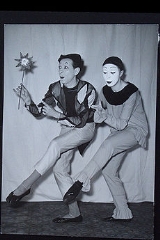
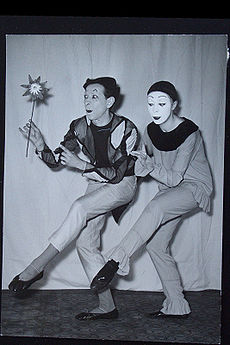
Mime artist

Encyclopedia
Performance art
In art, performance art is a performance presented to an audience, traditionally interdisciplinary. Performance may be either scripted or unscripted, random or carefully orchestrated; spontaneous or otherwise carefully planned with or without audience participation. The performance can be live or...
, involving miming, or the acting out a story through body motions, without use of speech
Speech
Speech is the human faculty of speaking.It may also refer to:* Public speaking, the process of speaking to a group of people* Manner of articulation, how the body parts involved in making speech are manipulated...
. In earlier times, in English, such a performer was referred to as a mummer
MUMmer
MUMmer is a bioinformatics software system for sequence alignment. It is based on the suffix tree data structure and is one of the fastest and most efficient systems available for this task, enabling it to be applied to very long sequences. It has been widely used for comparing different genomes...
. Miming is to be distinguished from silent comedy
Silent comedy
Silent comedy refers to a style of acting, related to but distinct from mime, invented to bring comedy into the medium of film in the silent film era before a sound track on film was technologically practicable...
, in which the artist is a seamless character in a film or sketch.
The performance of pantomime originates at its earliest in Ancient Greece
Ancient Greece
Ancient Greece is a civilization belonging to a period of Greek history that lasted from the Archaic period of the 8th to 6th centuries BC to the end of antiquity. Immediately following this period was the beginning of the Early Middle Ages and the Byzantine era. Included in Ancient Greece is the...
; the name is taken from a single masked dancer called Pantomimus, although performances were not necessarily silent. In Medieval Europe, early forms of mime such as mummer play
Mummers Play
Mummers Plays are seasonal folk plays performed by troupes of actors known as mummers or guisers , originally from England , but later in other parts of the world...
s and later dumbshow
Dumbshow
Dumbshow, also dumb show or dumb-show, is a traditional term for pantomime in drama, actions presented by actors onstage without spoken dialogue. It is similar to the masque...
s evolved. In early nineteenth century Paris
Paris
Paris is the capital and largest city in France, situated on the river Seine, in northern France, at the heart of the Île-de-France region...
, Jean-Gaspard Deburau
Jean-Gaspard Deburau
Jean-Gaspard Deburau, sometimes Debureau —born Jan Kašpar Dvořák—was a celebrated Bohemian-French mime...
solidified the many attributes that we have come to know in modern times—the silent figure in whiteface.
Jacques Copeau
Jacques Copeau
Jacques Copeau was an influential French theatre director, producer, actor, and dramatist. Before he founded his famous Théâtre du Vieux-Colombier in Paris, he wrote theater reviews for several Parisian journals, worked at the Georges Petit Gallery where he organized exhibits of artists' works...
, strongly influenced by Commedia dell'arte
Commedia dell'arte
Commedia dell'arte is a form of theatre characterized by masked "types" which began in Italy in the 16th century, and was responsible for the advent of the actress and improvised performances based on sketches or scenarios. The closest translation of the name is "comedy of craft"; it is shortened...
and Japan
Japan
Japan is an island nation in East Asia. Located in the Pacific Ocean, it lies to the east of the Sea of Japan, China, North Korea, South Korea and Russia, stretching from the Sea of Okhotsk in the north to the East China Sea and Taiwan in the south...
ese Noh
Noh
, or - derived from the Sino-Japanese word for "skill" or "talent" - is a major form of classical Japanese musical drama that has been performed since the 14th century. Many characters are masked, with men playing male and female roles. Traditionally, a Noh "performance day" lasts all day and...
theatre, used masks in the training of his actors. Étienne Decroux
Étienne Decroux
Étienne Decroux studied at Jacques Copeau's Ecole du Vieux-Colombier, where he saw the beginnings of what was to become his life's obsession–Corporeal Mime...
, a pupil of his, was highly influenced by this and started exploring and developing the possibilities of mime and developed corporeal mime
Corporeal mime
One subgroup of physical theater is corporeal mime. Its objective is to place drama inside the moving human body, rather than to substitute gesture for speech as in pantomime. In this medium, the mime must apply to physical movement those principles that are at the heart of drama: pause,...
into a highly sculptural form, taking it outside of the realms of naturalism. Jacques Lecoq
Jacques Lecoq
Jacques Pierre Lecoq born in Paris, was a French actor, mime and acting instructor.He is most famous for his methods on physical theatre, movement and mime that he taught at the school he founded in Paris, L'École Internationale de Théâtre Jacques Lecoq from 1956 until his death in...
contributed significantly to the development of mime and physical theatre
Physical theatre
Physical theatre is used to describe any mode of performance that pursues storytelling or drama through primarily and secondarily physical and mental means. There are several quite distinct but indistinct traditions of performance which all describe themselves using the term "physical theatre",...
with his training methods.
In film
Prior to the work of Étienne DecrouxÉtienne Decroux
Étienne Decroux studied at Jacques Copeau's Ecole du Vieux-Colombier, where he saw the beginnings of what was to become his life's obsession–Corporeal Mime...
there was no major treatise on the art of mime, and so any recreation of mime as performed prior to the twentieth century is largely conjecture, based on interpretation of diverse sources. However, the twentieth century also brought a new medium
Mass media
Mass media refers collectively to all media technologies which are intended to reach a large audience via mass communication. Broadcast media transmit their information electronically and comprise of television, film and radio, movies, CDs, DVDs and some other gadgets like cameras or video consoles...
into widespread usage: the motion picture.
The restrictions of early motion picture technology meant that stories had to be told with minimal dialogue, which was largely restricted to intertitle
Intertitle
In motion pictures, an intertitle is a piece of filmed, printed text edited into the midst of the photographed action, at various points, generally to convey character dialogue, or descriptive narrative material related to, but not necessarily covered by, the material photographed.Intertitles...
s. This often demanded a highly stylized form of physical acting largely derived from the stage. Thus, mime played an important role in films prior to advent of talkies (films with sound or speech). The mimetic style of film acting was used to great effect in German Expressionist
German Expressionism
German Expressionism refers to a number of related creative movements beginning in Germany before the First World War that reached a peak in Berlin, during the 1920s...
film.
Silent film
Silent film
A silent film is a film with no synchronized recorded sound, especially with no spoken dialogue. In silent films for entertainment the dialogue is transmitted through muted gestures, pantomime and title cards...
comedians like Charlie Chaplin
Charlie Chaplin
Sir Charles Spencer "Charlie" Chaplin, KBE was an English comic actor, film director and composer best known for his work during the silent film era. He became the most famous film star in the world before the end of World War I...
, Harold Lloyd
Harold Lloyd
Harold Clayton Lloyd, Sr. was an American film actor and producer, most famous for his silent comedies....
and Buster Keaton
Buster Keaton
Joseph Frank "Buster" Keaton was an American comic actor, filmmaker, producer and writer. He was best known for his silent films, in which his trademark was physical comedy with a consistently stoic, deadpan expression, earning him the nickname "The Great Stone Face".Keaton was recognized as the...
learned the craft of mime in the theatre
Theatre
Theatre is a collaborative form of fine art that uses live performers to present the experience of a real or imagined event before a live audience in a specific place. The performers may communicate this experience to the audience through combinations of gesture, speech, song, music or dance...
, but through film, they would have a profound influence on mimes working in live theatre even decades after their death. Indeed, Chaplin may be the most well-documented mime in history.
The famous French comedian, writer and director Jacques Tati
Jacques Tati
Jacques Tati was a French filmmaker, working as a comedic actor, writer and director. In a poll conducted by Entertainment Weekly of the Greatest Movie Directors Tati was voted the 46th greatest of all time...
achieved his initial popularity working as a mime, and indeed his later films had only minimal dialogue, relying instead on many subtle expertly choreographed visual gags. Tati, like Chaplin before him, would mime out the movements of every single character in his films and ask his actors to repeat them.
On stage and street
Mime has been performed onstage, with Marcel MarceauMarcel Marceau
Marcel Marceau was an internationally acclaimed French actor and mime most famous for his persona as Bip the Clown.-Early years:...
and his character "Bip" being the most famous. Mime is also a popular art form in street theatre
Street theatre
Street theatre is a form of theatrical performance and presentation in outdoor public spaces without a specific paying audience. These spaces can be anywhere, including shopping centres, car parks, recreational reserves and street corners. They are especially seen in outdoor spaces where there are...
and busking
Busking
Street performance or busking is the practice of performing in public places, for gratuities, which are generally in the form of money and edibles...
. Traditionally, these sorts of performances involve the actor/actress wearing tight black and white clothing with white facial makeup. However, contemporary mimes often perform without whiteface. Similarly, while traditional mimes have been completely silent, contemporary mimes, while refraining from speaking, sometimes employ vocal sounds when they perform. Mime acts are often comical, but some can be very serious.
In literature
Canadian author Michael Jacot's first novel, The Last Butterfly, tells the story of a mime artist in Nazi-occupied Europe who is forced by his oppressors to perform for a team of Red Cross observers. Nobel laureate Heinrich BöllHeinrich Böll
Heinrich Theodor Böll was one of Germany's foremost post-World War II writers. Böll was awarded the Georg Büchner Prize in 1967 and the Nobel Prize for Literature in 1972.- Biography :...
's The Clown relates the downfall of a mime artist, Hans Schneir, who has descended into poverty and drunkenness after being abandoned by his beloved. Jacob Appel's Pushcart short-listed story, Coulrophobia, depicts the tragedy of a landlord whose marriage slowly collapses after he rents a spare apartment to an intrusive mime artist.
Greek and Roman mime
The first recorded pantomime actor was Telestēs in the play Seven Against ThebesSeven Against Thebes
The Seven against Thebes is the third play in an Oedipus-themed trilogy produced by Aeschylus in 467 BC. The trilogy is sometimes referred to as the Oedipodea. It concerns the battle between an Argive army led by Polynices and the army of Thebes led by Eteocles and his supporters. The trilogy won...
by Aeschylus
Aeschylus
Aeschylus was the first of the three ancient Greek tragedians whose work has survived, the others being Sophocles and Euripides, and is often described as the father of tragedy. His name derives from the Greek word aiskhos , meaning "shame"...
. Tragic pantomime was developed by Puladēs of Kilikia; comic pantomime was developed by Bathullos of Alexandria.
The Roman emperor Trajan
Trajan
Trajan , was Roman Emperor from 98 to 117 AD. Born into a non-patrician family in the province of Hispania Baetica, in Spain Trajan rose to prominence during the reign of emperor Domitian. Serving as a legatus legionis in Hispania Tarraconensis, in Spain, in 89 Trajan supported the emperor against...
banished pantomimists; Caligula
Caligula
Caligula , also known as Gaius, was Roman Emperor from 37 AD to 41 AD. Caligula was a member of the house of rulers conventionally known as the Julio-Claudian dynasty. Caligula's father Germanicus, the nephew and adopted son of Emperor Tiberius, was a very successful general and one of Rome's most...
favored them; Marcus Aurelius made them priests of Apollo
Apollo
Apollo is one of the most important and complex of the Olympian deities in Greek and Roman mythology...
. Nero
Nero
Nero , was Roman Emperor from 54 to 68, and the last in the Julio-Claudian dynasty. Nero was adopted by his great-uncle Claudius to become his heir and successor, and succeeded to the throne in 54 following Claudius' death....
himself acted as a mime.
In non-Western theatre traditions
While most of this article has treated mime as a constellation of related and historically linked WesternWestern world
The Western world, also known as the West and the Occident , is a term referring to the countries of Western Europe , the countries of the Americas, as well all countries of Northern and Central Europe, Australia and New Zealand...
theatre genres and performance techniques, analogous performances are evident in the theatrical traditions of other civilizations.
Classical Indian musical theatre
Classical Indian musical theatre
Classical Indian musical theatre is a sacred art of the Hindu temple culture. It is performed in different styles.-Overview:Classical Indian musical theatre theory can be traced back to the Natya Shastra of Bharata Muni...
, although often erroneously labeled a "dance," is a group of theatrical forms in which the performer presents a narrative via stylized gesture, an array of hand positions, and mime illusions to play different characters, actions, and landscapes. Recitation, music, and even percussive footwork sometimes accompany the performance. The Natya Shastra
Natya Shastra
The Natya Shastra is an ancient Indian treatise on the performing arts, encompassing theatre, dance and music. It was written during the period between 200 BC and 200 AD in classical India and is traditionally attributed to the Sage Bharata.The Natya Shastra is incredibly wide in its scope...
, an ancient treatise on theatre by Bharata Muni
Bharata Muni
Bharata was an ancient Indian musicologist who authored the Natya Shastra, a theoretical treatise on ancient Indian dramaturgy and histrionics, dated to between roughly 400 BC and 200 BC. Indian dance and music find their root in the Natyashastra...
, mentions silent performance, or mukhabinaya.
In Kathakali
Kathakali
Kathakali is a highly stylized classical Indian dance-drama noted for the attractive make-up of characters, elaborate costumes, detailed gestures and well-defined body movements presented in tune with the anchor playback music and complementary percussion...
, stories from Indian epics are told with facial expressions, hand signals and body motions. Performances are accompanied by songs narrating the story while the actors act out the scene, followed by actor detailing without background support of narrative song.
The Japanese Noh
Noh
, or - derived from the Sino-Japanese word for "skill" or "talent" - is a major form of classical Japanese musical drama that has been performed since the 14th century. Many characters are masked, with men playing male and female roles. Traditionally, a Noh "performance day" lasts all day and...
tradition has greatly influenced many contemporary mime and theatre practitioners including Jacques Copeau
Jacques Copeau
Jacques Copeau was an influential French theatre director, producer, actor, and dramatist. Before he founded his famous Théâtre du Vieux-Colombier in Paris, he wrote theater reviews for several Parisian journals, worked at the Georges Petit Gallery where he organized exhibits of artists' works...
and Jacques Lecoq
Jacques Lecoq
Jacques Pierre Lecoq born in Paris, was a French actor, mime and acting instructor.He is most famous for his methods on physical theatre, movement and mime that he taught at the school he founded in Paris, L'École Internationale de Théâtre Jacques Lecoq from 1956 until his death in...
because of its use of mask work and highly physical performance style.
Butoh
Butoh
is the collective name for a diverse range of activities, techniques and motivations for dance, performance, or movement inspired by the movement. It typically involves playful and grotesque imagery, taboo topics, extreme or absurd environments, and is traditionally performed in white body makeup...
, though often referred to as a dance form, has been adopted by various theatre practitioners as well.
Notable mime artists
- Samuel AvitalSamuel AvitalSamuel Ben-Or Avital is a professionally trained mime artist, teacher of mime, kinesthetic awareness, and Kabbalah.Samuel Avital was born Shmuel Abitbol in 1932, in the small town of Sefrou, near Fez, in the Atlas Mountains in Morocco. At the age of 14, Avital left his home in Sefrou to travel to...
- Jean-Louis BarraultJean-Louis BarraultJean-Louis Barrault was a French actor, director and mime artist, training that served him well when he portrayed the 19th-century mime Jean-Gaspard Deburau in Marcel Carné's 1945 film Les Enfants du Paradis .Jean-Louis Barrault studied with Charles Dullin in whose troupe he acted...
- Tom BergeronTom BergeronTom Bergeron is an American television personality and game show host, best known as the host of the ABC reality series Dancing with the Stars and host of America's Funniest Home Videos . He was also host of Hollywood Squares and a fill-in host for Who Wants to Be a Millionaire...
- Blue Man GroupBlue Man GroupBlue Man Group is an organization founded by Chris Wink, Matt Goldman and Phil Stanton. The organization produces theatrical shows and concerts featuring popular music, comedy and multimedia; recorded music and scores for film and television; television appearances for shows such as The Tonight...
- Wolfe BowartWolfe BowartWolfe Bowart is a modern-day physical comedian, actor and playwright whose work is reminiscent of Charlie Chaplin and Buster Keaton. His current touring productions include Letter's End, LaLaLuna and The Man the Sea Saw...
- Tony BrownMargolis Brown Adaptors CompanyThe Margolis Brown Adaptors Company is an internationally touring physical theatre company that also houses the Margolis Method Training Center now located in Highland, New York. It was established in New York City in 1984 by Kari Margolis and Tony Brown...
- Janet CarafaJanet CarafaJanet Carafa is a mime artist based in New York Citywho also runs New York Entertainment Connection, an event entertainment and production company. She has studied with Marcel Marceau and was a lead performer with the American Mime Theatre for eight years. She has also directed the Movement and...
- Lon ChaneyLon Chaney, Sr.Lon Chaney , nicknamed "The Man of a Thousand Faces," was an American actor during the age of silent films. He was one of the most versatile and powerful actors of early cinema...
- Charlie ChaplinCharlie ChaplinSir Charles Spencer "Charlie" Chaplin, KBE was an English comic actor, film director and composer best known for his work during the silent film era. He became the most famous film star in the world before the end of World War I...
- Michel CourtemancheMichel CourtemancheMichel Courtemanche is a Québécois comedian and actor. He has drawn hundreds of thousands to his one-man shows in Quebec, France, Belgium and Switzerland....
- Adam DariusAdam DariusAdam Darius is an American dancer, mime artist, writer and choreographer. As a performer, he has appeared in over 85 countries across six continents...
- Jean-Gaspard Debureau
- Étienne DecrouxÉtienne DecrouxÉtienne Decroux studied at Jacques Copeau's Ecole du Vieux-Colombier, where he saw the beginnings of what was to become his life's obsession–Corporeal Mime...
- Jogesh DuttaJogesh DuttaJogest Dutta is an Indian mime who for over forty years pioneered , the art of mime in India , developed it , and finally propagated it in India and abroad. The exposure to life and people through hard and grim reality provided him with knowledge and experience gained first hand . This knowledge...
- Ladislav FialkaLadislav FialkaLadislav Fialka was a mime from what is now the Czech Republic....
- Dario FoDario FoDario Fo is an Italian satirist, playwright, theater director, actor and composer. His dramatic work employs comedic methods of the ancient Italian commedia dell'arte, a theatrical style popular with the working classes. He currently owns and operates a theatre company with his wife, actress...
- George L. FoxGeorge L. Fox (clown)George L. Fox was America’s first great white faced clown to follow in the footsteps of Britain’s Joseph Grimaldi.-Early Years:...
- Chris HarrisChris Harris (actor, director and writer)Chris Harris is an English actor, director and writer. He has appeared in several UK TV series including Into the Labyrinth and "Hey Look That's Me". More recently he has built a successful career in pantomime, acting as a pantomime dame, as well being a director and writer at the Bristol Old...
- Alejandro JodorowskyAlejandro JodorowskyAlejandro Jodorowsky Prullansky, known as Alejandro Jodorowsky, is a Chilean filmmaker, playwright, actor, author, comic book writer and spiritual guru...
- Zillur Rahman JohnZillur Rahman JohnZillur Rahman John is a mime and pantomime artist and author of mime books from Bangladesh.-Awards:In 1993, his Dhaka Pantomime troup won the Best Performance Award in group mime from Kolkata, India at the International Festivals of Non-Verbal Arts organized by the India committee of the...
- Buster KeatonBuster KeatonJoseph Frank "Buster" Keaton was an American comic actor, filmmaker, producer and writer. He was best known for his silent films, in which his trademark was physical comedy with a consistently stoic, deadpan expression, earning him the nickname "The Great Stone Face".Keaton was recognized as the...
- Bill IrwinBill IrwinWilliam Mills "Bill" Irwin is an American actor and clown noted for his contribution to the renaissance of American circus during the 1970s. He is known for his vaudeville-style stage acts, but has made a number of appearances on film and television and won a Tony Award for a dramatic role on...
- Stan LaurelStan LaurelArthur Stanley "Stan" Jefferson , better known as Stan Laurel, was an English comic actor, writer and film director, famous as the first half of the comedy team Laurel and Hardy. His film acting career stretched between 1917 and 1951 and included a starring role in the Academy Award winning film...
- Thomas LeabhartThomas LeabhartThomas Leabhart born 1944,Pennsylvania is a United States American mime.Leabhart studied at the Ecole de Mime Etienne Decroux, Paris under the instruction of master mime and teacher Etienne Decroux from 1968-1972...
- Jacques LecoqJacques LecoqJacques Pierre Lecoq born in Paris, was a French actor, mime and acting instructor.He is most famous for his methods on physical theatre, movement and mime that he taught at the school he founded in Paris, L'École Internationale de Théâtre Jacques Lecoq from 1956 until his death in...
- Paul LegrandPaul LegrandPaul Legrand , born Charles-Dominique-Martin Legrand, was a highly regarded and influential French mime who turned the Pierrot of his predecessor, Jean-Gaspard Deburau, into the tearful, sentimental character that is most familiar to post-nineteenth-century admirers of the figure...
- Marcel MarceauMarcel MarceauMarcel Marceau was an internationally acclaimed French actor and mime most famous for his persona as Bip the Clown.-Early years:...
- Ennio MarchettoEnnio MarchettoEnnio Marchetto is an Italian comedic live entertainer whose performances feature quick-change artistry, impersonations and his trademark bi-dimensional paper costumes...
- Kari MargolisMargolis Brown Adaptors CompanyThe Margolis Brown Adaptors Company is an internationally touring physical theatre company that also houses the Margolis Method Training Center now located in Highland, New York. It was established in New York City in 1984 by Kari Margolis and Tony Brown...
- Carlos MartínezCarlos Martínez (actor)Carlos Martínez is a Spanish mime actor. He has participated in the formation of various theatre groups and has taught mime and theatre in public schools, at the University of Zaragoza and at numerous international art seminars. He has published two manuals on mime 'In Silence' and 'Word of Mime'....
- Harpo MarxHarpo MarxAdolph "Harpo" Marx was an American comedian and film star. He was the second oldest of the Marx Brothers. His comic style was influenced by clown and pantomime traditions. He wore a curly reddish wig, and never spoke during performances...
(The Marx Brothers) - Jean-Jacques Menais alias Jyjou*
- Samy MolchoSamy MolchoSamy Molcho is a mime and an expert in body language communication. He was professor at the University of Music and Performing Arts and at Max Reinhardt Seminar in Vienna, Austria until 2004....
- Tony MontanaroTony MontanaroTony Montanaro was one of the great mime artists of the 20th century. Born in Paulsboro, New Jersey on September 10, 1927, Montanaro earned a theater degree from Columbia University and began performing stock theater with actors such as Jason Robards and Jackie Cooper...
- MummenschanzMummenschanzMummenschanz is a Swiss pantomime troupe who perform in a surreal mask- and prop-oriented style. Founded in 1972 by Bernie Schürch, Andres Bossard , and the Italian-American Floriana Frassetto, the group became popular for its play with bizarre masks and forms, light and shadow, and their subtle...
- Stefan Niedziałkowski
- Adrian PecknoldAdrian PecknoldAdrian Pecknold , was a Canadian mime, director, and author of the book Mime: The Step Beyond Words. He is popularly known for his creation and depiction of Poco the Clown in the popular Canadian children's television program Mr. Dressup.Pecknold studied mime at L'École Jacques Lecoq in Paris from...
- Lenka Pichlíková-Burke
- Slava Polunin
- Oleg PopovOleg PopovOleg Konstantinovich Popov is a famous Soviet and Russian clown and circus artist. Popov is also called the "Sunshine clown".He was born on 31 July 1930 in Moscow, the son of a clock-maker. He studied elements of acrobatics, juggling, and other circus skills in his youth...
- Nola RaeNola RaeNola Rae MBE is an internationally renowned mime artist.-Early life and education:Rae was born in Sydney, Australia, in 1949 and migrated to London with her family in 1963....
- Gene SheldonGene SheldonGene Sheldon was an American film and television actor and musician. He is best remembered as the mute servant Bernardo on Walt Disney's live-action TV series Zorro .-Biography and career:...
- Richmond ShepardRichmond ShepardRichmond Shepard is an American writer, director, producer and mime with a 50 year history in entertainment. He built, owned and operated his own theaters in Los Angeles on Theatre Row where he produced over 30 shows...
- Shields and YarnellShields and YarnellShields and Yarnell were an American mime team, formed in 1972, consisting of Robert Shields and Lorene Yarnell .-Shields:...
- Red SkeltonRed SkeltonRichard Bernard "Red" Skelton was an American comedian who is best known as a top radio and television star from 1937 to 1971. Skelton's show business career began in his teens as a circus clown and went on to vaudeville, Broadway, films, radio, TV, night clubs and casinos, all while pursuing...
- Daniel Stein
- Jacques TatiJacques TatiJacques Tati was a French filmmaker, working as a comedic actor, writer and director. In a poll conducted by Entertainment Weekly of the Greatest Movie Directors Tati was voted the 46th greatest of all time...
- Pan TauPan TauPan Tau is a character created for a children's television series. 33 episodes were made in Czechoslovakia in cooperation with German TV network WDR from 1967 on. The project ended with a feature film in 1988. Pan Tau, who generally didn't speak, was played by Otto Šimánek...
- Modris TenisonsModris TenisonsModris Tenisons is a mime artist in Lithuania and Latvia. He is especially well-known in Lithuania. He is also a multidisciplinary artist: a theater director, stage designer and theater consultant.- Background :...
- Tik and TokTik and TokTik and Tok are the robotic mime and music duo of Tim Dry and Sean Crawford. They began performing together with SHOCK: a rock/mime/burlesque/music troupe in the early 1980s with Barbie Wilde, Robert Pereno, L.A. Richards and Carole Caplin....
- Henryk TomaszewskiHenryk Tomaszewski (mime)Henryk Tomaszewski aka Heinrich Karl Koenig was a mime artist and theatre director, born in Poznań, Poland. He settled in Cracow in 1945 to study theatre after the end of World War II during which he studied at Iwo Gall's Theatre Studio from 1945 to 1947 and ballet under Feliks Parnell...
- Achille ZavattaAchille ZavattaAchille Zavatta was a French clown, artist and circus operator.Achille Zavatta was born in La Goulette, Tunisia, the son of Federico Zavatta, a circus owner...
- Pablo ZibesPablo ZibesPablo Zibes is an Argentinian actor and pantomime.Zibes was born in Buenos Aires, Argentina, residence in Germany since 1995.-Biography:*EMAD 1989-1991...
See also
- Corporeal mimeCorporeal mimeOne subgroup of physical theater is corporeal mime. Its objective is to place drama inside the moving human body, rather than to substitute gesture for speech as in pantomime. In this medium, the mime must apply to physical movement those principles that are at the heart of drama: pause,...
- DumbshowDumbshowDumbshow, also dumb show or dumb-show, is a traditional term for pantomime in drama, actions presented by actors onstage without spoken dialogue. It is similar to the masque...
- Floating (dance)Floating (dance)Floating, gliding or sliding refers to a group of footwork-oriented dance techniques and styles closely related to popping, which attempt to create the illusion that the dancer's body is floating smoothly across the floor or that the legs are walking while the body travels in unexpected directions....
- Liquid and digits
- Mummers PlayMummers PlayMummers Plays are seasonal folk plays performed by troupes of actors known as mummers or guisers , originally from England , but later in other parts of the world...
- PantomimePantomimePantomime — not to be confused with a mime artist, a theatrical performer of mime—is a musical-comedy theatrical production traditionally found in the United Kingdom, Australia, New Zealand, Canada, Jamaica, South Africa, India, Ireland, Gibraltar and Malta, and is mostly performed during the...
- PoppingPoppingPopping is a street dance and one of the original funk styles that came from California during the 1960s-70s. It is based on the technique of quickly contracting and relaxing muscles to cause a jerk in the dancer's body, referred to as a pop or a hit...
- Physical theatrePhysical theatrePhysical theatre is used to describe any mode of performance that pursues storytelling or drama through primarily and secondarily physical and mental means. There are several quite distinct but indistinct traditions of performance which all describe themselves using the term "physical theatre",...
- TurfingTurfingTurf dance is a form of American street dance that originated in Oakland, California. An acronym for Taking Up Room on the Floor, the name was coined by L.A. born, Bay Area raised turf and mixed house dancer Jeriel Bey because the terms "having fun with it" or "hitting it" didn't seem marketable...
External links
- World Mime Index
- Mime.info, The world of mime theatre. International mime theatre information, including a library, resources, performer contacts, and events calendar.
- MOVEO—International school of corporeal mime and physical theatre in Barcelona—centre for research, creation and training, moveo.cat
- International Theatre School Jacques Lecoq, ecole-jacqueslecoq.com
- London International School of Performing Arts, lispa.co.uk
- Innovo Conservatory of Physical Theatre, innovotheatre.com
- European Mime Index, European Network for the Promotion and Profiling of Visual Theatre