
Home      Discussion      Topics      Dictionary      Almanac
Signup       Login
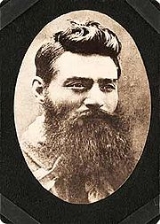
Ned Kelly

Ned Kelly

Overview
Edward "Ned" Kelly was an Irish Australian
Irish Australian
Irish Australians have played a long and enduring part in Australia's history. Many came to Australia in the eighteenth century as settlers or as convicts, and contributed to Australia's development in many different areas....

 bushranger
Bushranger
Bushrangers, or bush rangers, originally referred to runaway convicts in the early years of the British settlement of Australia who had the survival skills necessary to use the Australian bush as a refuge to hide from the authorities...

. He is considered by some to be merely a cold-blooded cop killer
Cop Killer
Cop Killer or cop killer may refer to:*A person who kills a police officer*"Cop Killer" , a 1992 song by Body Count*Cop Killer , the English translation of the ninth book in the detective series written by Sjöwall and Wahlöö...

 — others, however, consider him to be a folk hero
Folk hero
A folk hero is a type of hero, real, fictional, or mythological. The single salient characteristic which makes a character a folk hero is the imprinting of the name, personality and deeds of the character in the popular consciousness. This presence in the popular consciousness is evidenced by...

 and symbol of Irish Australian resistance against the Anglo-Australian ruling class
Ruling class
The term ruling class refers to the social class of a given society that decides upon and sets that society's political policy - assuming there is one such particular class in the given society....

.
Discussion
Ask a question about 'Ned Kelly'
Start a new discussion about 'Ned Kelly'
Answer questions from other users
Full Discussion Forum
 
Unanswered Questions
Quotations

I have seen as many as eleven, big & ugly enough to lift Mount Macedon out of a crab hole more like the species of a baboon or Guerilla than a man.

but I am a widows son outlawed and my orders must be obeyed.

... Perhaps not from what you now conceive, but if you had heard me examine the witnesses it would have been different.

... my mind is as easy as the mind of any man in this world, as I am prepared to show before God and man.

More men than I have put men to death, but I am the last man in the world that would take a man's life. Two years ago — even if my own life was at stake — and I am confident, if I thought a man would shoot me — I would give him a chance of keeping his life, and would part with my own; but if I knew that through him innocent persons' lives were at stake, I certainly would have to shoot him if he forced me to do so; but I would want to know that he was really going to take my innocent life.

I dare say; but a day will come, at a bigger Court than this, when we shall see which is right and which is wrong. No matter how long a man lives he is bound to come to judgement somewhere, and as well here as anywhere. It will be different the next time there is a Kelly trial; for they are not all killed. It would have been good for the Crown had I examined the witnesses, and I would have stopped a lot of the reward, I can assure you, and I don't know but I won't do it yet if allowed.

That is how the evidence came out here. It appeared that I deliberately took up arms, of my own accord, and induced the other three to join me, for the purpose of doing nothing but shooting down the police ...

Encyclopedia
Edward "Ned" Kelly was an Irish Australian
Irish Australian
Irish Australians have played a long and enduring part in Australia's history. Many came to Australia in the eighteenth century as settlers or as convicts, and contributed to Australia's development in many different areas....

 bushranger
Bushranger
Bushrangers, or bush rangers, originally referred to runaway convicts in the early years of the British settlement of Australia who had the survival skills necessary to use the Australian bush as a refuge to hide from the authorities...

. He is considered by some to be merely a cold-blooded cop killer
Cop Killer
Cop Killer or cop killer may refer to:*A person who kills a police officer*"Cop Killer" , a 1992 song by Body Count*Cop Killer , the English translation of the ninth book in the detective series written by Sjöwall and Wahlöö...

 — others, however, consider him to be a folk hero
Folk hero
A folk hero is a type of hero, real, fictional, or mythological. The single salient characteristic which makes a character a folk hero is the imprinting of the name, personality and deeds of the character in the popular consciousness. This presence in the popular consciousness is evidenced by...

 and symbol of Irish Australian resistance against the Anglo-Australian ruling class
Ruling class
The term ruling class refers to the social class of a given society that decides upon and sets that society's political policy - assuming there is one such particular class in the given society....

.

Kelly was born in Victoria
Victoria (Australia)
Victoria is the second most populous state in Australia. Geographically the smallest mainland state, Victoria is bordered by New South Wales, South Australia, and Tasmania on Boundary Islet to the north, west and south respectively....

 to an Irish convict
Convicts in Australia
During the late 18th and 19th centuries, large numbers of convicts were transported to the various Australian penal colonies by the British government. One of the primary reasons for the British settlement of Australia was the establishment of a penal colony to alleviate pressure on their...

 father, and as a young man he clashed with the Victoria Police
Victoria Police
Victoria Police is the primary law enforcement agency of Victoria, Australia. , the Victoria Police has over 12,190 sworn members, along with over 400 recruits, reservists and Protective Service Officers, and over 2,900 civilian staff across 393 police stations.-Early history:The Victoria Police...

. Following an incident at his home in 1878, police parties searched for him in the bush. After he killed three policemen, the colony proclaimed Kelly and his gang wanted outlaw
Outlaw
In historical legal systems, an outlaw is declared as outside the protection of the law. In pre-modern societies, this takes the burden of active prosecution of a criminal from the authorities. Instead, the criminal is withdrawn all legal protection, so that anyone is legally empowered to persecute...

s.

A final violent confrontation with police took place at Glenrowan
Glenrowan, Victoria
Glenrowan is a small town located in the Wangaratta Local Government Area of Victoria, Australia. It is 184 kilometres north-east of Melbourne and 14 kilometres from Wangaratta and located near the Warby Ranges and Mount Glenrowan...

 on 28 June 1880. Kelly, dressed in home-made plate metal armour
Armour
Armour or armor is protective covering used to prevent damage from being inflicted to an object, individual or a vehicle through use of direct contact weapons or projectiles, usually during combat, or from damage caused by a potentially dangerous environment or action...

 and helmet, was captured and sent to jail. He was convicted of three counts of capital murder and hanged at Old Melbourne Gaol in November 1880. His daring and notoriety made him an iconic
Cultural icon
A cultural icon can be a symbol, logo, picture, name, face, person, building or other image that is readily recognized and generally represents an object or concept with great cultural significance to a wide cultural group...

 figure in Australian history, folklore, literature, art and film.

In August 2011, anthropologists announced that a skeleton found in a mass grave
Mass grave
A mass grave is a grave containing multiple number of human corpses, which may or may not be identified prior to burial. There is no strict definition of the minimum number of bodies required to constitute a mass grave, although the United Nations defines a mass grave as a burial site which...

 in Pentridge Prison had been confirmed as Kelly's. Kelly's skull, however, remains at large.

Early life


John "Red" Kelly, the father of Ned Kelly, was born and raised in Ireland, where he was convicted of criminal acts sometime during his adulthood. His mother, Ellen Kelly (née Quinn), remarried after his father died. His brother and sister were named Dan and Kate. There is uncertainty surrounding the exact nature of his crime as most of Ireland's court records were destroyed during the Irish Civil War
Irish Civil War
The Irish Civil War was a conflict that accompanied the establishment of the Irish Free State as an entity independent from the United Kingdom within the British Empire....

. Ian Jones
Ian Jones (author)
Ian Jones is an Australian television writer and director and an author specialising in the history of notorious outlaw Ned Kelly and his gang....

 alleges that John Kelly stole two pigs and testified against his co-conspirators. This claim is contested by J.J. Kenneally who alleges that 'Red' was an adherent of Irish nationalism
Irish nationalism
Irish nationalism manifests itself in political and social movements and in sentiment inspired by a love for Irish culture, language and history, and as a sense of pride in Ireland and in the Irish people...

. Red Kelly was sentenced to seven years of penal servitude and transported to Van Diemen's Land
Van Diemen's Land
Van Diemen's Land was the original name used by most Europeans for the island of Tasmania, now part of Australia. The Dutch explorer Abel Tasman was the first European to land on the shores of Tasmania...

 (now Tasmania
Tasmania
Tasmania is an Australian island and state. It is south of the continent, separated by Bass Strait. The state includes the island of Tasmania—the 26th largest island in the world—and the surrounding islands. The state has a population of 507,626 , of whom almost half reside in the greater Hobart...

), arriving in 1843.

After his release in 1848, Red Kelly moved to Victoria and found work at Beveridge
Beveridge, Victoria
Beveridge is a town in Victoria, Australia, located along the Hume Highway, 42 kilometres north of Melbourne in the Shire of Mitchell. A western rural portion of the locality is within the City of Whittlesea in Greater Melbourne...

 at the farm of James Quinn. At the age of 30 he married Ellen Quinn, the 18 year old daughter of his employer. Their first child, Mary, died early (1851), but Ellen then gave birth to a daughter, Annie, in 1853. Seven of their children survived past infancy.

Their first son, Edward (Ned), was born in Beveridge
Beveridge, Victoria
Beveridge is a town in Victoria, Australia, located along the Hume Highway, 42 kilometres north of Melbourne in the Shire of Mitchell. A western rural portion of the locality is within the City of Whittlesea in Greater Melbourne...

, just north of Melbourne. His date of birth is not known, but it occurred between June 1854 and June 1855.

Ned was baptised by an Augustinian priest, Charles O'Hea
Charles O'Hea
Father Charles Adolphus O'Hea OSA was a Catholic Priest best-known today as the man who baptised Ned Kelly, and who ministered to him before the bushranger was hanged in 1880....

. As a boy, he obtained some basic schooling and once risked his life to save another boy, Richard Shelton, from drowning
Drowning
Drowning is death from asphyxia due to suffocation caused by water entering the lungs and preventing the absorption of oxygen leading to cerebral hypoxia....

. As a reward he was given a green sash by the boy's family, which he wore under his armour during his final showdown with police in 1880.

The Kellys were suspected many times of cattle or horse stealing, though never convicted. Red Kelly was arrested when he killed and skinned a calf claimed to be the property of his neighbour. He was found innocent of theft, but guilty of removing the brand from the skin and given the option of a twenty-five pound
Pound sterling
The pound sterling , commonly called the pound, is the official currency of the United Kingdom, its Crown Dependencies and the British Overseas Territories of South Georgia and the South Sandwich Islands, British Antarctic Territory and Tristan da Cunha. It is subdivided into 100 pence...

 fine or a sentence of six months with hard labour. Without money to pay the fine Red served his sentence in Kilmore
Kilmore
-Places:Australia*Kilmore, VictoriaNorthern Ireland*Kilmore, County Armagh, a village and townland in County Armagh, Northern Ireland*Kilmore, County Down, a village, parish and townland in County Down, Northern Ireland*Kilmore, County Tyrone...

 gaol, with the sentence having an ultimately fatal effect on his health. The saga surrounding Red, and his treatment by the police, made a strong impression on his son Ned.

Red Kelly died at Avenel
Avenel, Victoria
Avenel is a small town in Victoria, Australia. It is in the Shire of Strathbogie local government area. At the 2006 census, Avenel had a population of 728, up from 552 in the 2001 Census.-History:...

 on 27 December 1866 when Ned was eleven and a half years old. Several months later the Kelly family acquired 80 acres (323,748.8 m²) of uncultivated farmland at Eleven Mile Creek near the Greta
Greta, Victoria
Greta is a district in Victoria, Australia, located east of Benalla, in the Rural City of Wangaratta. At the 2006 census, Greta and the surrounding area had a population of 231.-History:...

 area of Victoria, which to this day is known as "Kelly Country".

In all, eighteen charges were brought against members of Ned's immediate family before he was declared an outlaw
Outlaw
In historical legal systems, an outlaw is declared as outside the protection of the law. In pre-modern societies, this takes the burden of active prosecution of a criminal from the authorities. Instead, the criminal is withdrawn all legal protection, so that anyone is legally empowered to persecute...

, while only half that number resulted in guilty verdicts. This is a highly unusual ratio for the time, and is one of the reasons that has caused many to posit that Ned's family was unfairly targeted from the time they moved to northeast Victoria. Perhaps the move was necessary because of Ellen's squabbles with family members and her appearances in court over family disputes. Antony O'Brien, however, argued that Victoria's colonial policing had nothing to do with winning a conviction, rather the determinant of one's criminality was the arrest. Further, O'Brien argued, using the "Statistics of Victoria" crime figures that the region's or family's or national criminality was determined not by individual arrests, but rather by the total number of arrests.

Rise to notoriety


Ned's first documented brush with the law was on October 15, 1869 at the age of 14 when he was charged with the assault and robbery of Ah Fook, a pig farmer from a Chinese camp near Bright
Bright, Victoria
Bright is a small sized town, located in northeastern Victoria, Australia, 319 metres above sea level at the southeastern end of the Ovens Valley. At the 2006 census, Bright had a population of 2684. It is in the Alpine Shire local government area...

. According to Ah Fook, as he was passing the Kelly house, Ned approached him with a long bamboo stick, announcing that he was a bushranger and would kill him if he did not hand over his money. Ned then took him into the bush, beat him with the stick and stole 10 shillings. According to Ned, his sister Annie and two witnesses, Bill Skilling and Bill Grey, Annie was sitting outside the house sewing when Ah Fook walked up and asked a for a drink of water. Given creek water, he abused Annie for not giving him rain water and Ned came outside and pushed him. Ah Fook then hit Ned three times with the bamboo stick causing him to run away. Ah Fook then walked away threatening to return and burn the house down. Ned did not return until sundown. Historians find neither account convincing and believe that Neds account is likely true up to being hit by Ah Fook but then Ned likely took the stick from him and beat him with it.

Ned was arrested the following day for Highway Robbery and locked up overnight in Benalla. He appeared in court the following morning but Sergeant Whelan, despite using an interpreter to translate Ah Fook's account, requested a remand to allow time to find an interpreter. Ned was remanded in custody for four days. Appearing in court on 20 October he was again remanded in custody after the police failed to produce an interpreter. The charge was finally dismissed on 26 October and Ned was released. Sergeant Whelan disliked Ned. Three months earlier he had prosecuted Yeaman Gunn for possession of stolen mutton, Ned had testified that he had sold several sheep to Gunn that same day. In a controversial judgement, the magistrate found Gunn guilty and fined him £10. Furious that Ned was not convicted for the robbery, he now kept a careful watch on the Kelly family and, according to fellow officers, Whelan became "a perfect encyclopedia of knowledge about them" through his "diligence".

Following his appearance in court, the Benalla Ensign reported, "The cunning of himself [Ned] and his mates got him off", the Beechworth Advertiser on the other hand reported, "... the charge of robbery has been trumped up by the Chinaman to be revenged on Kelly, who had obviously assaulted him." Interestingly, Ah Fook had described 14 year old Ned as being aged around 20 years. Some 12 months later a reporter wrote that Ned "gives his age as 15 but is probably between 18 and 20". Although 5' 8" in height, Ned was physically imposing. When arrested, a 224 pounds (101.6 kg) trooper was unable to subdue the then purportedly 15 year old Ned until several labourers ran to assist him and even then Ned had to be knocked unconscious.
On 10 May the following year, he was arrested on three charges of Highway Robbery and accused of being an accomplice of bushranger Harry Power
Harry Power
Harry Power was an Australian Bushranger. It is believed, by some, that Ned Kelly served as his accomplice while a teenager. -Early life:...

. On the first two charges the victims could not identify Ned and the charges were dismissed. Although the victims for the third charge were reported to have also failed to identify Ned they had in fact been refused a chance to identify him by Superintendents Nicolas and Hare. Instead, superintendent Nicolas told the magistrate that Ned fitted the description and asked for him to be remanded to the Kyneton
Kyneton, Victoria
Kyneton is a town on the Calder Highway in the Macedon Ranges of Victoria, Australia. The Calder Freeway bypasses Kyneton to the north and east. The town was named after the English village of Kineton, Warwickshire. The town has three main streets: Mollison Street, Piper Street and High Street...

 court for trial. Instead of being sent to Kyneton, he was sent to Melbourne where he spent the weekend in the Richmond
Richmond, Victoria
Richmond is a suburb in Melbourne, Victoria, Australia, 3 km south-east from Melbourne's central business district. Its Local Government Area is the City of Yarra...

 lockup before being transferred to Kyneton. No evidence was produced in court and he was released after a month. Historians tend to disagree over this episode: some see it as evidence of police harassment; others believe that Kelly’s relatives intimidated the witnesses, making them reluctant to give evidence. Another factor in the lack of identification may have been that the witnesses had described Power's accomplice as a "half-caste
Half-caste
Half-caste is a term used to describe people of mixed race or ethnicity. Caste comes from the Latin castus, meaning pure, and the derivative Portuguese and Spanish casta, meaning race...

". However, superintendent Nicholas and Captain Standish believed this to be the result of Ned going unwashed. Ned's grandfather, James Quinn, owned a huge piece of land at the headwaters of the King River
King River
King River may refer to:*King River, former name of Centerville, Fresno County, California*King River *King River *King River *King River *King River , the river...

 known as Glenmore Station, where Power was ultimately arrested. Following Power's arrest it was rumoured that Ned had informed on him and Ned was treated with hostility within the community. Ned wrote a letter to police Sergeant Babington pleading for his help in the matter. The informant was in fact Ned's uncle, Jack Lloyd.

In October 1870, Kelly was arrested again for assaulting a hawker, Jeremiah McCormack, and for his part in sending McCormack's childless wife an indecent note that had calves' testicle
Testicle
The testicle is the male gonad in animals. Like the ovaries to which they are homologous, testes are components of both the reproductive system and the endocrine system...

s enclosed. This was a result of a row earlier that day caused when McCormack accused a friend of the Kellys, Ben Gould, of using his horse without permission. Gould wrote the note, and Kelly passed it on to one of his cousins to give to the woman. He was sentenced to three months' hard labour on each charge.

Upon his release Kelly returned home. There he met Isaiah "Wild" Wright who had arrived in the area on a chestnut mare
Mare (horse)
A mare is an adult female horse or other equine.In most cases, a mare is a female horse over the age of three, and a filly is a female horse age three and younger. However, in Thoroughbred horse racing, a mare is defined as a female horse more than four years old; in harness racing a mare is a...

. While he was staying with the Kellys the mare had gone missing and Wright borrowed one of the Kelly horses to return to Mansfield
Mansfield, Victoria
Mansfield is a small town in the foothills of the Victorian part of the Australian Alps. It is approximately 180 km north-east of Melbourne...

. He asked Ned to look for the chestnut and keep it until his return. Kelly found the mare and used it to go to Wangaratta
Wangaratta, Victoria
Wangaratta is a cathedral city of almost 17,000 people in the northeast of Victoria, Australia, about from Melbourne along the Hume Highway, with Benalla to the southwest, and Albury-Wodonga to the northeast. It is located at the junction of the Ovens and King rivers which flow from the...

 where he stayed for a few days but while riding through Greta on his way home, Ned was approached by police constable Hall who, from the description of the animal, knew the horse was stolen property. When his attempt to arrest Kelly turned into a fight, Hall drew his gun and tried to shoot him, but Kelly overpowered the policeman and humiliated him by riding him like a horse. Hall later struck Kelly several times with his revolver after he had been arrested. Ned always maintained that he had no idea that the mare actually belonged to the Mansfield postmaster and that Wright had stolen it. After just three weeks of freedom, 16-year-old Kelly, along with his brother-in-law Alex Gunn, was sentenced to three years imprisonment with hard labour for "feloniously receiving a horse". "Wild" Wright escaped arrest for the theft on 2 May following an "exchange of shots" with police, but was arrested the following day, Wright received only eighteen months for stealing the horse. After his release from prison in 1874, Ned allegedly fought and won a bare-knuckled boxing match with 'Wild' Wright that lasted 20 rounds.

While Kelly was in prison, his brothers Jim (aged 12) and Dan
Dan Kelly (bushranger)
Dan Kelly was an Australian bushranger and outlaw. The son of an Irish convict, he was the youngest brother of the bushranger, Ned Kelly. Dan and his brother killed three policemen. With two friends, they formed the Kelly Gang...

 (aged 10) were arrested by Constable Flood for riding a horse that did not belong to them. The horse had been lent to them by a farmer for whom they had been doing some work, but the boys spent a night in the cells before the matter was cleared.

Two years later, Jim Kelly was arrested for cattle-rustling
Cattle raiding
Cattle raiding is the act of stealing cattle.In Australia, such stealing is often referred to as duffing, and the person as a duffer...

. He and his family claimed that he did not know that some of the cattle did not belong to his employer and cousin Tom Lloyd. Jim was given a five-year sentence, but as O'Brien pointed out the receiver of the 'stolen stock' James Dixon was not prosecuted as he was 'a gentleman'

In September 1877 Ned was arrested for drunkenness. While being escorted by four policemen he broke free and ran into a shop. The police tried to subdue him but failed and Ned later gave himself up to a Justice of the Peace
Justice of the Peace
A justice of the peace is a puisne judicial officer elected or appointed by means of a commission to keep the peace. Depending on the jurisdiction, they might dispense summary justice or merely deal with local administrative applications in common law jurisdictions...

 and was fined. During the incident Constable Lonigan, who Ned was to later shoot dead, "black-balled" him (grabbed and squeezed his testicles). Legend has it that Ned told Lonigan "If I ever shoot a man, Lonigan, it'll be you!".

In October 1877, Gustav and William Baumgarten were arrested for supplying stolen horses to Ned Kelly and were later sentenced in 1878. William served time in Pentridge
Pentridge
Pentridge is a village in north east Dorset, England, situated on Cranborne Chase on the A354 road ten miles north east of Blandford Forum and twelve miles south west of Salisbury. The village has a population of 215...

 Prison, Melbourne.

Following Red Kelly's death, Ned's mother, Ellen, had married a Californian named George King, by whom she had three children. He, Ned and Dan became involved in a cattle rustling operation.

Fitzpatrick Incident


On 15 April 1878, 21 year old Constable Alexander Fitzpatrick arrived at Benalla suffering from an alleged bullet wound to his left wrist. He claimed that he had been attacked by Ned, Dan, Ellen, their associate Bricky Williamson and Ned's brother-in-law, Bill Skillion. Fitzpatrick claimed that all except Ellen had been armed with revolvers. Williamson and Skillion were arrested for their part in the affair. Ned and Dan were nowhere to be found, but Ellen was taken into custody along with her baby, Alice. She was still in prison at the time of Ned's execution. (Ellen would outlive her most famous son by several decades and died on 27 March 1923.)
The Kellys claimed that Fitzpatrick came into their house to question Dan over a cattle duffing incident. While there, he made a pass at Ellen's daughter Kate. Her mother hit his hand with a coal shovel and the men knocked Fitzpatrick to the floor. They then bandaged his injured wrist, and he had left saying that no real harm had been done. No guns, they claimed, were used during the incident, and Ned was not involved since he had been away in New South Wales
New South Wales
New South Wales is a state of :Australia, located in the east of the country. It is bordered by Queensland, Victoria and South Australia to the north, south and west respectively. To the east, the state is bordered by the Tasman Sea, which forms part of the Pacific Ocean. New South Wales...

. Whether Ned was in New South Wales is still disputed, although Fitzpatrick's testimony of events is coloured by the fact that he was later dismissed from the force for drunkenness
Alcoholism
Alcoholism is a broad term for problems with alcohol, and is generally used to mean compulsive and uncontrolled consumption of alcoholic beverages, usually to the detriment of the drinker's health, personal relationships, and social standing...

 and perjury
Perjury
Perjury, also known as forswearing, is the willful act of swearing a false oath or affirmation to tell the truth, whether spoken or in writing, concerning matters material to a judicial proceeding. That is, the witness falsely promises to tell the truth about matters which affect the outcome of the...

.

Trial at Beechworth

Despite Fitzpatrick's treating doctor reporting a strong smell of alcohol on the constable and his inability to confirm the wrist wound was caused by a bullet, Fitzpatrick's evidence was accepted by the police and the Judge. Ellen Kelly, Skillion and Williamson appeared on 9 October 1878 before Judge Redmond Barry
Redmond Barry
Sir Redmond Barry KCMG was an Irish colonial judge in Victoria, Australia.-Early life:Barry was the son of Major-General Henry Green Barry, of Ballyclough, County Cork and his wife Phoebe Drought, daughter of John Armstrong Drought and Letita Head...

 charged with attempted murder and were convicted on Fitzpatrick's unsupported evidence. Barry stated that if Ned were present he would 'give him 15 years'.

Killings at Stringybark Creek


Dan and Ned Kelly doubted they could convince the police of their story. Instead they went into hiding, where they were later joined by friends Joe Byrne and Steve Hart
Steve Hart
Steve Hart was an Australian bushranger renowned for his membership in the Kelly Gang.-History:Hart was born in Wangaratta to Irish immigrant parents Richard and Bridget Hart...

.

On 25 October 1878, Sergeant Kennedy set off to search for the Kellys, accompanied by Constables McIntyre, Lonigan, and Scanlon. The wanted men were suspected of being in the Wombat
Wombat
Wombats are Australian marsupials; they are short-legged, muscular quadrupeds, approximately in length with a short, stubby tail. They are adaptable in their habitat tolerances, and are found in forested, mountainous, and heathland areas of south-eastern Australia, including Tasmania, as well as...

 Ranges north of Mansfield, Victoria. The police set up a camp near two shepherd huts at Stringybark Creek in a heavily timbered
Forest
A forest, also referred to as a wood or the woods, is an area with a high density of trees. As with cities, depending where you are in the world, what is considered a forest may vary significantly in size and have various classification according to how and what of the forest is composed...

 area. A second police party had set off from Greta near the Wangaratta end, with the intention of closing in on Ned in a pincer movement.

The Mansfield team of police under Kennedy on arrival at Stringybark split into two groups: Kennedy and Scanlon went in search of the Kellys, while the others, Lonigan and McIntyre remained to guard their camp. Brown suggested in Australian Son (1948) that Sgt. Kennedy was tipped off as to the whereabouts of the Kellys. O'Brien (1999) drew attention to the 1881 Royal Commission's questioning of McIntyre, which explored a possibility that Kennedy and Scanlon may have searched for the Kellys to gain a reward for themselves. Jones stated (p. 131) that Kennedy and Scanlon had once split a reward for the arrest of 'Wild Wright'. O'Brien's research focus on the practice of splitting rewards highlighted that it was known as 'going whacks'.

The Mansfield police team (Lonigan and McIntyre) remaining in the base camp fired at parrots, unaware they were only a mile away from the Kelly camp. Alerted by the shooting, the Kellys searched and discovered the well-armed police camped near the "shingle hut" at Stringybark Creek. Although the police were disguised as prospectors, they had pack horses with leather strap arrangements suitable for carrying out bodies.

Ned Kelly and his brother Dan considered their chances of survival against the well-armed party and decided to overpower the two officers, then wait for the two others to return. According to Jones (p. 132) the Kellys knew that a police member (Strahan), from Greta team boasted he would shoot Ned 'like a dog' and Kelly believed these police were that Greta party. He was unaware of the Mansfield group. Ned's plan was for the police to surrender, allowing the Kellys to take their arms and horses. Ned and Dan advanced to the police camp, ordering them to surrender. Constable McIntyre threw his arms up. Lonigan drew his revolver and Ned shot him. Lonigan staggered some distance, and collapsed dead.

When the other two police returned to camp, Constable McIntyre, at Ned's direction, called on them to surrender. Scanlon went for his pistol; Ned fired. Scanlon was killed. Kennedy ran, firing as he sought cover moving from tree to tree. In an exchange of gunfire, Ned fired a fatal shot into Kennedy. McIntyre, in the confusion, escaped on horseback uninjured.

The exact place at Germans Creek where this occurred has only recently been identified. On leaving the scene Ned stole Sergeant Kennedy's handwritten note for his wife and his gold fob watch. Asked later why he stole the watch, Ned replied, "What's the use of a watch to a dead man?" Kennedy's watch was returned to his kin many years later.

In response to these killings the Victorian parliament passed the Felons' Apprehension Act which outlawed the gang and made it possible for anyone to shoot them. There was no need for the outlaws to be arrested or for there to be a trial upon apprehension. The Act was based on the 1865 Act passed in New South Wales which declared Ben Hall and his gang outlaws.

Bank robberies


Following the killings at Stringybark, the gang committed two major robberies, at Euroa
Euroa, Victoria
Euroa is a town in the Shire of Strathbogie in North-East Victoria, Australia.At the 2006 census, Euroa had a population of 2,776. The name Euroa comes from an Aboriginal word in the old local dialect meaning "joyful".-History:Major T.L...

, Victoria and Jerilderie, New South Wales. Their strategy involved the taking of hostages and robbing the bank safes.

Euroa


On 10 December 1878, the gang raided the National Bank at Euroa. They had already taken a number of hostages at Faithful Creek station and went to the bank claiming to be delivering a message from McCauley, the station manager. They got into the bank and held up the manager, Scott, and his two tellers. After obtaining all the money available, the outlaws ordered Scott, along with his wife, family, maids and tellers to accompany them to Faithful Creek where they were locked up with the other hostages, who included the station's staff and some passing hawkers and sportsmen.

It is claimed that Ned, posing as a policeman, took one of the men prisoner on the grounds of being the "notorious Ned Kelly". The man was locked up in the storeroom saying that he would report the "officer" to his superiors. It was only then that he was told who his captor was.

The outlaws gave an exhibition of horsemanship which entertained and surprised their hostages. After having supper, and telling the hostages not to raise the alarm for another three hours, they left. The entire crime was carried out without injury and the gang netted £2,260, a large sum in those days and equivalent to around $100,000 today.

In January 1879 police arrested all known Kelly friends and sympathisers and held them without charge for three months. This action caused resentment of the government's abuse of power that led to condemnation in the media and a groundswell of support for the gang that was a factor in their evading capture for so long.

Jerilderie


The raid on Jerilderie is particularly noteworthy for its boldness and cunning. The gang arrived in the town on Saturday 8 February 1879. They broke into the local police station and imprisoned police officers Richards and Devine in their own cell. The outlaws then changed into the police uniforms and mixed with the locals, claiming to be reinforcements from Sydney.

On Monday the gang rounded up various people and forced them into the back parlour of the Royal Mail Hotel. While Dan Kelly and Steve Hart kept the hostages busy with "drinks on the house", Ned Kelly and Joe Byrne robbed the local bank of £2,414. Kelly also burned all the townspeople's mortgage deed
Deed
A deed is any legal instrument in writing which passes, or affirms or confirms something which passes, an interest, right, or property and that is signed, attested, delivered, and in some jurisdictions sealed...

s in the bank.

New South Wales issued rewards totaling £4,000. The Victorian Government increased its reward to match making the total reward for the Kelly gang £8,000 (A$400,000).

From early March 1879 to June 1880 nothing was heard of the gang's whereabouts with one possible exception. In late March 1879 Ned's sisters Kate and Margaret approached the captain of the Victoria Cross, then docked in Melbourne, and enquired as to how much he would charge to take four or five gentlemen friends to California if they boarded in Queenscliff
Queenscliff, Victoria
Queenscliff is a small town on the Bellarine Peninsula in southern Victoria, Australia, south of Swan Bay at the entrance to Port Phillip. It is the administrative centre for the Borough of Queenscliffe...

. Nothing definite was arranged but on 31 March, a man he described as having a somewhat suspicious appearance called on the captain to confirm the passage discussed by the Kelly sisters. The captain arranged an appointment at the General Post Office
General Post Office, Melbourne
The Melbourne General Post Office , is a former post office in Melbourne, Victoria, Australia...

 that afternoon to give a definite answer for the cost then contacted police, who placed a large number of detectives and plain-clothes police throughout the building, but the man failed to appear. There is no evidence that Ned's sisters were enquiring on behalf of the gang, but it was reported in Melbourne media as probable with speculation that the number of police present at the Post Office had alerted them.

In April 1880 a Notice of Withdrawal of Reward was posted by Government. It stated that after 20 July 1880 the Government would "absolutely cancel and withdraw the offer for the reward".

Jerilderie letter


Months prior to arriving in Jerilderie, and with help from Joe Byrne, Ned Kelly dictated a lengthy letter for publication describing his view of his activities and the treatment of his family and, more generally, the treatment of Irish Catholic
Irish Catholic
Irish Catholic is a term used to describe people who are both Roman Catholic and Irish .Note: the term is not used to describe a variant of Catholicism. More particularly, it is not a separate creed or sect in the sense that "Anglo-Catholic", "Old Catholic", "Eastern Orthodox Catholic" might be...

s by the police and the English and Irish Protestant squatter
Squatting (pastoral)
In Australian history, a squatter was one who occupied a large tract of Crown land in order to graze livestock.  Initially often having no legal rights to the land, they gained its usage by being the first Europeans in the area....

s.

The Jerilderie Letter
The Jerilderie Letter was dictated by infamous bushranger Ned Kelly to Joe Byrne in 1879. The letter is named after the town of Jerilderie, New South Wales, Australia where the Kelly gang carried out a daring robbery.-External links:...

, as it is called, is a document of 7,391 words and has become a famous piece of Australian literature
Australian literature
Australian literature is the written or literary work produced in the area or by the people of the Commonwealth of Australia and its preceding colonies. During its early western history, Australia was a collection of British colonies, therefore, its literary tradition begins with and is linked to...

. Kelly had written a previous letter (14 December 1878) to a member of Parliament
Parliament of Victoria
The Parliament of Victoria is the bicameral legislature of the Australian state of Victoria. It follows a Westminster-derived parliamentary system and consists of The Queen, represented by the Governor of Victoria; the Legislative Council ; and the Legislative Assembly...

 stating his grievances, but the correspondence had been suppressed from the public. The letter highlights the various incidents that led to him becoming an outlaw (see Rise to notoriety).

The letter was never published and was concealed until re-discovered in 1930. It was then published by the Melbourne Herald.

The handwritten document was donated anonymously to the State Library of Victoria
State Library of Victoria
The State Library of Victoria is the central library of the state of Victoria, Australia, located in Melbourne. It is on the block bounded by Swanston, La Trobe, Russell, and Little Lonsdale streets, in the northern centre of the central business district...

 in 2000. Historian Alex McDermott says of the Letter, "... even now it's hard to defy his voice. With this letter Kelly inserts himself into history, on his own terms, with his own voice...We hear the living speaker in a way that no other document in our history achieves..." Kelly's language is colourful, rough and full of metaphors; it is "one of the most extraordinary documents in Australian history".

The National Museum of Australia
National Museum of Australia
The National Museum of Australia was formally established by the National Museum of Australia Act 1980. The National Museum preserves and interprets Australia's social history, exploring the key issues, people and events that have shaped the nation....

 in Canberra holds publican John Hanlon's transcript of the Jerilderie Letter.

Capture, trial and execution


On 26 June 1880 the Felons' Apprehension Act 612 expired, with the result that not only was the gang's outlaw status no longer in effect but that their arrest warrants also expired. While Ned and Dan still had prior warrants outstanding for the attempted murder of Fitzpatrick, technically Hart and Byrne were free men although the police still retained the right to re-issue the murder warrants.

The gang discovered that Aaron Sherritt
Aaron Sherritt
Australian police informer Aaron Sherritt was an associate of the gang of outlaws led by Ned Kelly. He grew up in the same area as them and was especially close to gang member Joe Byrne. At one stage he became engaged to Byrne's sister....

, Joe Byrne's erstwhile best friend, was a police informer. On 26 June 1880, the same day their outlaw status expired, Dan Kelly and Joe Byrne went to Sherritt's house and killed him. (Superintendent Hare later testified that Sherritt was the "scout of the district" and regularly informed Kelly of police movements; however, he also testified that following the Jerilderie robbery he paid Sherritt for informing on Kelly's whereabouts. Ian Jones, authority on the Kelly Gang, has made a compelling case in his book, The Fatal Friendship that the police manipulated events so that Sherritt appeared a traitor and to provoke the gang into emerging from hiding to dispose of him.) The four policemen who were living openly with him at the time hid under the bed and did not report the murder until late the following morning. This delay was to prove crucial since it upset Ned's timing for another ambush.

Glenrowan shootout


The Kelly Gang arrived in Glenrowan
Glenrowan, Victoria
Glenrowan is a small town located in the Wangaratta Local Government Area of Victoria, Australia. It is 184 kilometres north-east of Melbourne and 14 kilometres from Wangaratta and located near the Warby Ranges and Mount Glenrowan...

 on 27 June forcibly taking about seventy hostages at the Glenrowan Inn. They knew that a passenger train carrying a police detachment was on its way and ordered the rail tracks pulled up in order to cause a derailment.

The gang members were equipped with armour that was tough enough to repel bullets (but left the legs unprotected). It is not known exactly who made the armour, although it was likely forged from stolen or donated plough
Plough
The plough or plow is a tool used in farming for initial cultivation of soil in preparation for sowing seed or planting. It has been a basic instrument for most of recorded history, and represents one of the major advances in agriculture...

 mouldboards. Each man's armour weighed about 96 pounds (44 kg); all four had helmets, and Byrne's was said to be the most well done, with the brow reaching down to the nose piece, almost forming two eye slits. All wore grey cotton coats reaching past the knees over the armour.

While holed up in the Glenrowan Inn, the Kelly gang's attempt to derail the police train failed because of the actions of a released hostage, schoolmaster Thomas Curnow. Curnow convinced Ned to let him go and then as soon as he was released he alerted the authorities by standing on the railway line near sunrise and waving a lantern wrapped in his red scarf. The police then stopped the train before it would have been derailed and laid siege to the inn at dawn on Monday 28 June.

The accounts of who opened fire first are contradictory. According to Superintendent Hare he was close to the inn when he saw the flash of a rifle and felt his left hand go limp. Three more flashes followed from the veranda and then whoever had first fired at him stepped back and began to fire again after which the police opened fire. Kelly testified in court that he was dismounting from his horse when a bolt in his armour failed. While he was fixing the bolt the police fired two volleys into the inn. Kelly claimed that as he walked towards the inn the police fired a third volley with the result that one bullet hit him in the foot and another in the left arm. It was at that moment he claimed his gang began returning the fire. Kelly now walked in what police called a "lurching motion" towards them from 30 metres (98.4 ft) away. Because of the restrictions of his armour, and now only being able to hold his revolving rifle in one hand, he had to hold the rifle at arm’s length to fire, and claimed he fired randomly, two shots to the front and two shots to his left. Constable Arthur fired three times, hitting Kelly once in the helmet and twice in his body, but despite staggering from the impacts he continued to advance. Constables Phillips and Healy then fired with similar effect. Kelly's lower limbs, however, were unprotected, and when 15 metres (49.2 ft) from the police line he was shot repeatedly in the legs. As he fell he was hit by a shotgun blast that injured his hip and right hand.

The other Kelly Gang members died in the hotel; Joe Byrne perished as a result of loss of blood from a gunshot wound that severed his femoral artery
Femoral artery
The femoral artery is a general term comprising a few large arteries in the thigh. They begin at the inguinal ligament and end just above the knee at adductor canal or Hunter's canal traversing the extent of the femur bone....

 as he allegedly stood at the bar pouring himself a glass of whisky, Dan Kelly and Steve Hart committed suicide (according to witness Matthew Gibney
Matthew Gibney
Bishop Matthew Gibney was born in November 1835 at Killeshandra, Cavan, Ireland. He studied for the priesthood at the preparatory seminary at Stillorgan and from 1857 at the Catholic Missionary College of All Hallows, Drumcondra, Dublin...

). No autopsy was done to determine cause of death, as their bodies were burnt when the police set fire to the inn. The police suffered only one minor injury: Superintendent Francis Hare, the senior officer on the scene, received a slight wound to his wrist, then fled the battle. For his cowardice the Royal Commission later suspended Hare from the Victorian Police Force. Several hostages were also shot, two fatally.

The body of Joe Byrne was taken to Benalla and strung up as a curiosity for photographers and spectators. His body was not claimed by his family, and he was buried by police in an unmarked grave in Benalla
Benalla, Victoria
Benalla is a city of just over 9,000 people located just off the Hume Freeway in north-eastern Victoria, Australia, about southwest of Wangaratta. Its Local Government Area is the Rural City of Benalla.- Overview :...

 Cemetery. Dan Kelly and Steve Hart were buried in unmarked graves by their families in Greta
Greta, Victoria
Greta is a district in Victoria, Australia, located east of Benalla, in the Rural City of Wangaratta. At the 2006 census, Greta and the surrounding area had a population of 231.-History:...

 Cemetery 30 km (18.6 mi) east of Benalla.

Trial


Ned Kelly survived to stand trial and was convicted of the first degree murder of Constable Lonigan. He was then sentenced to death by hanging
Death by hanging
Death by hanging may refer to:* Hanging* Death by Hanging, a 1968 film by Nagisa Oshima...

 by Irish-born Lord Justice Redmond Barry
Redmond Barry
Sir Redmond Barry KCMG was an Irish colonial judge in Victoria, Australia.-Early life:Barry was the son of Major-General Henry Green Barry, of Ballyclough, County Cork and his wife Phoebe Drought, daughter of John Armstrong Drought and Letita Head...

. This case was extraordinary in that there were exchanges between the prisoner Kelly and the judge, and the case has been the subject of attention by historians and lawyers. When the judge uttered the customary words "May God have mercy on your soul", Kelly replied "I will go a little further than that, and say I will see you there when I go". At Ned's request, his photographic portrait was taken and he was granted farewell interviews with family members. His mother's last words to Ned were reported to be "Mind you die like a Kelly".

Death


He was hanged
Hanging
Hanging is the lethal suspension of a person by a ligature. The Oxford English Dictionary states that hanging in this sense is "specifically to put to death by suspension by the neck", though it formerly also referred to crucifixion and death by impalement in which the body would remain...

 on 11 November 1880 at the Melbourne Gaol. Although two newspapers (The Age and The Herald) reported Kelly's last words as "Such is life", another source, Kelly's gaol warden, wrote in his diary that when Kelly was prompted to say his last words, the prisoner opened his mouth and mumbled something that he could not hear. Sir Redmond Barry died of the effects of a carbuncle
Carbuncle
A carbuncle is an abscess larger than a boil, usually with one or more openings draining pus onto the skin. It is usually caused by bacterial infection, most commonly Staphylococcus aureus. The infection is contagious and may spread to other areas of the body or other people...

 on his neck on 23 November 1880, twelve days after Kelly.

Although the exact number is unknown, it is estimated that a petition to spare Kelly's life attracted over 30,000 signatures.

Reward


There was considerable controversy over the division of the £8,000 (A$400,000 in 2008 dollars) reward before the enquiry into the siege was conducted although the money itself was not actually paid until it had concluded. Most commentators complained that Curnow should have received more while many of the police deserved less pointing out that some police who received large amounts were of little value at Glenrowan, whilst others receiving lesser amounts distinguished themselves. Public opposition was such that Superintendent Hare and Sub-inspector O’Connor, who was in charge of the Aboriginal tracker
Aboriginal tracker
In the years following British settlement in Australia, aboriginal trackers or black trackers, as they became known, were enlisted by settlers to assist them in navigating their way through the Australian landscape...

s, declined to collect their shares of £800 (A$40,000 in 2008 dollars) and £237 (A$11,850 in 2008 dollars) respectively.

Despite being suspended for cowardice at Glenrowan, Superintendent Hare received the largest share, £800 while Thomas Curnow, who alerted police to the ambush thus saving many lives, received £550. Seven senior police officers received from £165 to £377 each, seven constables £137, Mr. C. C. Rawlins (civilian volunteer) £137, one constable £125, 15 constables £115, the three train engineers £104, one detective £100, one senior constable £97, the train driver, fireman and guard £84 each, assistant engine fireman £69, assistant engine driver £68, one senior constable £48, 14 constables £42 each and Messrs Cheshire and Osborne, £25 each. Nine civilians, 13 constables and two police agents applied for a share of the reward but were rejected. The board acknowledged that some who received nothing deserved a share but adherence to the terms of the proclamation precluded rewarding them. Four members of the media had accompanied the police and the board stated that, had they applied for a share, it would have been approved.

Seven native
Indigenous Australians
Indigenous Australians are the original inhabitants of the Australian continent and nearby islands. The Aboriginal Indigenous Australians migrated from the Indian continent around 75,000 to 100,000 years ago....

 trackers also received £50 each although the board deemed it undesirable to place any sum of money in the hands of persons unable to use it and recommend that the sums set opposite the names of the black trackers be handed to the Queensland and Victorian Governments to be dealt with at their discretion.

Kelly gang armour


All four suits consisted of a breast-plate, back-plate, and a helmet. Joe Byrne's suit was the only one without an apron to protect the groin and thighs, as a result he died from a shot to the groin. Ned's suit was the only one to also have an apron at the back. The suits' separate parts were strapped together on the body while the helmet was separate and sat on the shoulders allowing it to be removed easily when the need arose. Padding is only known from Ned's armour and it is not clear if the other suits were similarly padded. Ned wore a padded skull cap and his helmet also had internal strapping so his head could take some of the weight. All the men wore dustcoats over the armour.

The Victorian Police had been told three times by informants of the existence of the armour and that it was capable of deflecting bullets but Police Superintendents Hare and Sadlier both dismissed the information as "nonsense" and "an impossibility". Despite these warnings none of the police realised the gang were wearing armour until after the siege was over. Until Ned fell the police even questioned whether he was human. Constable Arthur, who was closest, thought he was a "huge blackfellow
Indigenous Australians
Indigenous Australians are the original inhabitants of the Australian continent and nearby islands. The Aboriginal Indigenous Australians migrated from the Indian continent around 75,000 to 100,000 years ago....

 wrapped in a blanket", Constable Dowsett exclaimed it was "old Nick
Devil
The Devil is believed in many religions and cultures to be a powerful, supernatural entity that is the personification of evil and the enemy of God and humankind. The nature of the role varies greatly...

" and Senior Constable Kelly called out "Look out, boys, it’s the bunyip
Bunyip
The bunyip, or kianpraty, is a large mythical creature from Aboriginal mythology, said to lurk in swamps, billabongs, creeks, riverbeds, and waterholes....

. He’s bullet-proof!" Constable Gascoigne, who recognised Ned's voice, told Superintendent Sadlier he had "fired at him point blank and hit him straight in the body. But there is no use firing at Ned Kelly; he can't be hurt". Although aware of the information supplied by the informant prior to the siege, Sadlier later wrote that even after Gascoigne's comment "no thought of armour" had occurred to him.

Following the siege of Glenrowan the media reported the events and use of armour around the world. The gang were admired in military circles and Arthur Conan Doyle
Arthur Conan Doyle
Sir Arthur Ignatius Conan Doyle DL was a Scottish physician and writer, most noted for his stories about the detective Sherlock Holmes, generally considered a milestone in the field of crime fiction, and for the adventures of Professor Challenger...

 commented on the gang's imagination and recommended similar armour for use by British infantry. The police announcement to the Australian public that the armour was made from ploughshares was ridiculed, disputed, and deemed impossible even by blacksmiths.

After Ned Kelly's capture there was considerable debate over having the armour destroyed, all four disassembled suits of armour were eventually stored by Police Superintendent Hare in Melbourne. Hare gave Ned Kelly's armour to Sir William Clarke, and it was later donated to the State Library of Victoria
State Library of Victoria
The State Library of Victoria is the central library of the state of Victoria, Australia, located in Melbourne. It is on the block bounded by Swanston, La Trobe, Russell, and Little Lonsdale streets, in the northern centre of the central business district...

. Joe Byrne's suit of armour was kept by Hare and now belongs to his descendants. Dan Kelly and Steve Hart's armour are still owned by the Victorian Police force. As no effort was made to maintain the armour's integrity while stored, the suits were reassembled by guesswork. In 2002 several parts were identified from photographs taken shortly after the siege and reunited with their original suits. As a result the State Library of Victoria was able to exchange their backplate, which was found to be Steve Hart's breastplate, for Ned Kelly's own backplate, making their suit currently the most original. In January 2002 all four suits were displayed together for an exhibition in the Old Melbourne Gaol.

According to legend the armour was made on a Stringybark
Stringybark
A stringybark can be any of the many Eucalyptus species which have thick, fibrous bark. Like all eucalypts, stringybarks belong to the Myrtaceae family. In exceptionally fertile locations some stringybark species A stringybark can be any of the many Eucalyptus species which have thick, fibrous...

 log by the gang themselves. Due to the quality of the workmanship and the difficulties involved in forging, historians and blacksmith
Blacksmith
A blacksmith is a person who creates objects from wrought iron or steel by forging the metal; that is, by using tools to hammer, bend, and cut...

s had long believed the armour could only have been made by a professional blacksmith in a forge. A professional blacksmith would have heated the steel to over 1000 °C (1,832 °F), before shaping it. A bush forge would only be able to get the metal to 750 °C (1,382 °F), which would make shaping the metal very difficult. In 2003 Byrne's suit of armour was disassembled and tested by ANSTO
Australian Nuclear Science and Technology Organisation
The Australian Nuclear Science and Technology Organisation is a statutory body of the Australian government, formed in 1987 to replace the Australian Atomic Energy Commission. Its head office and main facilities are in southern outskirts of Sydney at Lucas Heights, in the Sutherland Shire...

 at the Lucas Heights
Lucas Heights, New South Wales
Lucas Heights is a suburb in southern Sydney, in the state of New South Wales, Australia. Lucas Heights is located 31 kilometres south-west of the Sydney central business district, in the local government area of the Sutherland Shire....

 nuclear reactor in Sydney to determine how the armour was made and what temperatures were involved. The results of testing indicated the heating of the metal was "patchy". Some parts had been bent cold while other parts had been subjected to extended periods in a heat source of not much more than 700 °C (1,292 °F), which is consistent with a bush forge. The quality of forging was also determined to be less than believed, and it is now considered unlikely to have been done by a blacksmith. The method now widely accepted is that mouldboards were heated in a makeshift bush forge and then beaten straight over a green log before being cut into shape and riveted together to form each individual piece.

Ned Kelly's remains and grave


Following his execution it was reported in a newspaper that Kelly's body was dissected by medical students, with his head and organs removed for study. Dissection outside of a coronial enquiry was illegal, and as public outrage at the rumour raised real fears of public disorder, the commissioner of police wrote the Goals governor who denied such a dissection had taken place. In line with the practice of the day, as no records are kept regarding the disposal of a condemned person's body or body parts, Kelly's remains were buried in Melbourne Gaol's unmarked graveyard. Kelly's head was allegedly given to phrenologists
Phrenology
Phrenology is a pseudoscience primarily focused on measurements of the human skull, based on the concept that the brain is the organ of the mind, and that certain brain areas have localized, specific functions or modules...

 for study then returned to the police, who used it for a time as a paperweight.

In 1929, Melbourne gaol was closed, and the bodies in its graveyard were uncovered during demolition works. During the recovery of the bodies, spectators and workers stole skeletal parts from a grave marked with the initials EK in the belief they belonged to Kelly. The site foreman, Harry Franklin, retrieved the skull and gave it to the Australian Institute of Anatomy
Australian Institute of Anatomy
The Australian Institute of Anatomy was established in October 1931. Amongst its functions were being a natural history museum and research in human nutrition. The Institute was formally abolished in December 1985.- History of the building:...

 in Canberra
Canberra
Canberra is the capital city of Australia. With a population of over 345,000, it is Australia's largest inland city and the eighth-largest city overall. The city is located at the northern end of the Australian Capital Territory , south-west of Sydney, and north-east of Melbourne...

. As no provision had been made for the disposal of the remains, Franklin had the bodies reburied in Pentridge prison
HM Prison Pentridge
HM Prison Pentridge was an Australian prison built in 1850 in Coburg, Victoria. The first prisoners arrived in 1851. The prison officially closed on 1 May 1997....

 at his own expense. The skull in the possession of police was given, at some unknown date, to the Institute of Anatomy in Canberra who, in 1971, gave it to the National Trust
National Trust of Australia
The Australian Council of National Trusts is the peak body for community-based, non-government organisations committed to promoting and conserving Australia's indigenous, natural and historic heritage....

. It was this skull that was thought to have been displayed at the Old Melbourne Gaol until it was stolen in December 1978. An investigation in 2010 proved that the displayed skull was in fact the one recovered in April 1929. Tom Baxter, a farmer from West Australia, claimed he had the skull stolen in 1978 but refused to hand it over for identification or burial. Despite attempts, the police had been unable to locate the stolen skull. The skull did not match photographs of the stolen skull, and a facial reconstruction based on a cast made from the skull in Baxter's possession did not resemble Kelly, but does resemble the death mask
Death mask
In Western cultures a death mask is a wax or plaster cast made of a person’s face following death. Death masks may be mementos of the dead, or be used for creation of portraits...

 of Ernest Knox, who was executed in 1894 for murder. If this was indeed the skull stolen in 1978, it meant that Kelly's skull was on display originally, but was taken off display at some time and thereafter replaced with Knox's skull.

On 9 March 2008 it was announced that Australian archaeologists believed they had found Kelly's grave on the site of Pentridge prison. The bones were uncovered at a mass grave, and Kelly's are among those of 32 felons who had been executed by hanging. Jeremy Smith, a senior archaeologist with Heritage Victoria said, "We believe we have conclusively found the burial site but that is very different from finding the remains." Mrs. Ellen Hollow, Kelly's 62-year-old grand-niece, offered to supply her own DNA
DNA
Deoxyribonucleic acid is a nucleic acid that contains the genetic instructions used in the development and functioning of all known living organisms . The DNA segments that carry this genetic information are called genes, but other DNA sequences have structural purposes, or are involved in...

 to help identify Kelly's bones.

Historical and forensic investigation of remains


On the anniversary of Kelly's hanging, 11 November 2009, Tom Baxter handed the skull in his possession to police and it was historically and forensically tested along with the Pentridge remains. The skull was compared to a cast of the skull that had been stolen from the Old Melbourne Gaol in 1978 and proved to be a perfect match. The skull was then compared to that in a newspaper photograph of worker Alex Talbot holding the skull recovered in 1929 which showed a close resemblance. Talbot was known to have taken a tooth from the skull as a souvenir
Souvenir
A souvenir , memento, keepsake or token of remembrance is an object a person acquires for the memories the owner associates with it. The term souvenir brings to mind the mass-produced kitsch that is the main commodity of souvenir and gift shops in many tourist traps around the world...

 and a media campaign to find the whereabouts of the tooth led to Talbot's grandson coming forward. The tooth was found to belong to the skull confirming it was indeed the skull recovered in 1929. The skull was next compared to the death mask
Death mask
In Western cultures a death mask is a wax or plaster cast made of a person’s face following death. Death masks may be mementos of the dead, or be used for creation of portraits...

s of those executed at Old Melbourne Gaol which eliminated all but two. The two were those of Kelly and Frederick Deeming
Frederick Bailey Deeming
Frederick Bailey Deeming was an English-born Australian gasfitter and murderer.Deeming was born in Ashby-de-la-Zouch, Leicestershire, England, son of Thomas Deeming, brazier, and his wife Ann, née Bailey. He was a "difficult child" according to writers Maurice Gurvich and Christopher Wray...

 who had been executed in 1892 and buried alongside Kelly, both were a close match. The death masks and skull were then scanned to provide 3D images which showed that the skull was a match for Deeming. This proved to be a problem as Deeming's labeled skull cap
Calvaria (skull)
The calvaria is the upper part of the cranium and surrounds the cranial cavity containing the brain.The calvaria is made up of the frontal, occipital and right and left parietals....

 was in storage. Both the skull and Deemings skull cap were DNA tested and compared to that of Leigh Olver, great-grandson of Kelly's mother Ellen by her second husband George King, with no match being found. It is now accepted that the skull recovered in 1929 and later displayed in the Old Melbourne Gaol was not Kelly's. It is likely the skull belongs to Deeming and that what was thought to be Deeming's skull cap was mislabeled and actually belongs to someone else.

Forensic pathologists
Forensic pathology
Forensic pathology is a branch of pathology concerned with determining the cause of death by examination of a corpse. The autopsy is performed by the pathologist at the request of a coroner or medical examiner usually during the investigation of criminal law cases and civil law cases in some...

 also examined the bones from Pentridge, which were much decayed and jumbled with the remains of others, making identification difficult. The collar bone
Clavicle
In human anatomy, the clavicle or collar bone is a long bone of short length that serves as a strut between the scapula and the sternum. It is the only long bone in body that lies horizontally...

 was found to be the only bone that had survived in all the skeletons and these were all DNA tested against that of Leigh Olver. A match to Kelly was found and the associated skeleton turned out to be one of the most complete. Kelly's remains were additionally identified by partially healed foot
Intermediate phalanges
Intermediate phalanges are bones found in the limbs of most vertebrates. In humans, they are the bones of the finger and toe which lie in the middle, between the two wrinkly joints. The thumb and big toe do not have intermediate phalanges...

, wrist bone and left elbow
Humerus
The humerus is a long bone in the arm or forelimb that runs from the shoulder to the elbow....

 injuries matching those caused by the bullet wounds at Glenrowan as recorded by the Goal surgeon in 1880 and by the fact that his head was missing, likely removed for phrenological
Phrenology
Phrenology is a pseudoscience primarily focused on measurements of the human skull, based on the concept that the brain is the organ of the mind, and that certain brain areas have localized, specific functions or modules...

 study. A section from the back of a skull (the occipital
Occipital bone
The occipital bone, a saucer-shaped membrane bone situated at the back and lower part of the cranium, is trapezoidal in shape and curved on itself...

) was recovered from the grave that bore saw cuts that matched those present on several neck vertebrae
Cervical vertebrae
In vertebrates, cervical vertebrae are those vertebrae immediately inferior to the skull.Thoracic vertebrae in all mammalian species are defined as those vertebrae that also carry a pair of ribs, and lie caudal to the cervical vertebrae. Further caudally follow the lumbar vertebrae, which also...

 indicating that the skull section belonged to the skeleton and that an illegal dissection had been performed.

In August 2011, scientists publically confirmed a skeleton exhumed from the old Pentridge Prison's mass graveyard was indeed Kelly's, after comparing the DNA to that of Leigh Olver. The DNA matching was based on mitochonrial DNA (HV1, HV2). This is indicative of Mr Kelly's maternal line. The investigating forensic pathologist has indicated that no adequate quality somatic DNA was obtained that would enable a y-DNA profile to be determined. This may be attempted at a later date. A y-DNA profile would enable Mr Kelly's paternal genetic genealogy to be determined with reference to the data already existing in the Kelly y-DNA study (see http://freepages.genealogy.rootsweb.ancestry.com/~kellydnaproject/index.htm) The skeleton was missing most of its skull, the whereabouts of which are unknown.

Aftermath and lessons


After Ned Kelly's death, the Victorian Royal Commission (1881–83) into the Victorian Police Force led to many changes to the nature of policing in the colony. The Commission took 18 months and its findings put many of the police involved in the Kelly hunt in a less than favourable light, yet neither did it excuse or sanction the actions of the Kelly Gang. As a result of the Commission a number of members of the Victorian police, including senior staff, were reprimanded, demoted, or dismissed.

Some dismiss the Kelly Outbreak as simply a spate of criminality. These included: Boxhall, The Story of Australian Bushrangers (1899), Henry Giles Turner, History of the Colony of Victoria (1904) and several police writers of the time like Hare and more modern writers like Penzig (1988) who wrote legitimising narratives about law and order and moral justification.

Others, commencing with Kenneally (1929), McQuilton (1979) and Jones (1995), perceived the Kelly Outbreak and the problems of Victoria's Land Selection Acts post-1860s as interlinked. McQuilton identified Kelly as the "social bandit" who was caught up in unresolved social contradictions – that is, the selector-squatter conflicts over land – and that Kelly gave the selectors the leadership they so lacked. O'Brien (1999) identified a leaderless rural malaise in Northeastern Victoria as early as 1872–73, around land, policing and the Impounding Act.

Though the Kelly Gang was destroyed in 1880, for almost seven years a serious threat of a second outbreak existed because of major problems around land settlement and selection (McQuilton, Ch. 10).

McQuilton suggested two police officers involved in the pursuit of the Kelly Gang – namely, Superintendent John Sadleir (1833–1919),http://www.brightoncemetery.com/HistoricInterments/150Names/sadleirj.htm author of Recollections of a Victorian Police Officer, and Inspector W.B. Montford – averted the Second Outbreak by coming to understand that the unresolved social contradiction in Northeastern Victoria was around land, not crime, and by their good work in aiding small selectors.

Kellys and the modern era


Ned's mother Ellen died in 1923 at the age of 92, by which time planes, cars and radio had been introduced to Australia. Photographs have recently been discovered showing her sitting in a motor car.

November 2007 auctioning of claimed Kelly revolver


On 13 November 2007, a weapon claimed to be Constable Fitzpatrick's service revolver was auctioned for approximately $70,000 in Melbourne and is now located in Westbury, Tasmania.

The vendor's representative, Tom Thompson, claimed that the revolver was left by Constable Fitzpatrick at the Kelly house after the melee in 1878, given to Kate Kelly, and then (much later) found in a house or shed in Forbes, New South Wales
Forbes, New South Wales
-Notable residents:*Carolyn Simpson - Judge of the Supreme Court of New South Wales; Member of the first all-female bench to sit in an Australian court*NSW Deputy Premier Carmel Tebbutt was born and raised in Forbes....

.

According to press reports in the days following the auction, firearms experts assessed the revolver as being of a design (a copy of an English Webley
Webley
Webley Inc. is a company providing speech-driven unified communications solutions.Webley is privately held and headquartered in Bannockburn, IL....

 .32 revolver) not manufactured until 1884, well after the claimed provenance had the weapon changing hands from Constable Fitzpatrick to the Kellys. In addition, a stamp on the gun which the auction catalogue interpreted as R*C, an indication that the revolver was of the Royal Constabulary, was instead read as a European manufacturer's proof mark.

Further, evidence by Constable Fitzpatrick said that when he left the Kelly homestead after the incident, he had his revolver and handcuffs; (cited in Keith McMenomy (1984), p. 69.)

Cultural effect


One of the gaols in which Kelly was incarcerated has become the Ned Kelly Museum in Glenrowan, Victoria, and many weapons and artifacts used by him and his gang are in exhibit there. Since his death, Kelly has become part of Australian folklore, the language and the subject of a large number of books and several films. The Australian term "as game as Ned Kelly" entered the language and is a common expression.

Films included the first feature film, The Story of the Kelly Gang
The Story of the Kelly Gang
The Story of the Kelly Gang is a 1906 Australian film that traces the life of the legendary bushranger Ned Kelly . It was written and directed by Charles Tait. The film ran for more than an hour, and was the longest narrative film yet seen in Australia, and the world. Its approximate reel length...

(Australia, 1906), another with Mick Jagger
Mick Jagger
Sir Michael Philip "Mick" Jagger is an English musician, singer and songwriter, best known as the lead vocalist and a founding member of The Rolling Stones....

 in the title role (1970), and more recently Ned Kelly
Ned Kelly (2003 film)
Ned Kelly is an Australian drama film directed by Gregor Jordan. The film portrays the life of Ned Kelly — a legendary bushranger in northeast Victoria. Ned Kelly, his brother Dan, and two other men — Steve Hart and Joe Byrne — formed a gang of Irish Australians in response to Irish and...

(2003) starring Heath Ledger
Heath Ledger
Heath Andrew Ledger was an Australian television and film actor. After performing roles in Australian television and film during the 1990s, Ledger moved to the United States in 1998 to develop his film career...

, Orlando Bloom
Orlando Bloom
Orlando Jonathan Blanchard Bloom is an English actor. He had his break-through roles in 2001 as the elf-prince Legolas in The Lord of the Rings and starring in 2003 as blacksmith Will Turner in the Pirates of the Caribbean film series, and subsequently established himself as a lead in Hollywood...

 and Geoffrey Rush
Geoffrey Rush
Geoffrey Roy Rush is an Australian actor and film producer. He is one of the few people who has won the "Triple Crown of Acting": an Academy Award, a Tony Award and an Emmy Award. He has won one Academy Award for acting , three British Academy Film Awards , two Golden Globe Awards and four Screen...

. A TV mini series of six episodes The Last Outlaw (1980) highlighted the plight of the selector and the social conflicts and battles between selector and squatters. During the 1960s, Ned Kelly graduated from folk lore into the academic arena. His story and the social issues around land selection, squatters, national identity, policing and his court case are studied at universities, seminars and lectures.

Ned Kelly as a political icon


In the time since his execution, Ned Kelly has been mythologised among some into a Robin Hood
Robin Hood
Robin Hood was a heroic outlaw in English folklore. A highly skilled archer and swordsman, he is known for "robbing from the rich and giving to the poor", assisted by a group of fellow outlaws known as his "Merry Men". Traditionally, Robin Hood and his men are depicted wearing Lincoln green clothes....

, a political revolutionary and a figure of Irish Catholic and working-class resistance to the establishment and British colonial ties. It is claimed that Kelly's bank robberies were to fund the push for a "Republic of the North-East of Victoria", and that the police found a declaration of the republic in his pocket when he was captured, which has led to his being seen as an icon by some in the Australian republicanism cause.

See also

  • Dan Kelly (bushranger)
    Dan Kelly (bushranger)
    Dan Kelly was an Australian bushranger and outlaw. The son of an Irish convict, he was the youngest brother of the bushranger, Ned Kelly. Dan and his brother killed three policemen. With two friends, they formed the Kelly Gang...

  • The Jerilderie Letter
    The Jerilderie Letter
    The Jerilderie Letter was dictated by infamous bushranger Ned Kelly to Joe Byrne in 1879. The letter is named after the town of Jerilderie, New South Wales, Australia where the Kelly gang carried out a daring robbery.-External links:...

  • Breaker Morant
    Breaker Morant
    Harry 'Breaker' Harbord Morant was an Anglo-Australian drover, horseman, poet, soldier and convicted war criminal whose skill with horses earned him the nickname "The Breaker"...

  • List of people on stamps of Ireland

Fiction

  • O'Brien, Antony (2006) Bye-Bye Dolly Gray, Artillery Publishing, Hartwell. (Though this work is set 20 years after the Ned's death it contains insights into the Kelly story)
  • Upfield, Arthur. (1960) Bony and the Kelly Gang,Pan Books, London. (Upfield's famous fictional character, Inspector Boney, clashes with a new Kelly Gang)

Unpublished Kelly theses

  • Morrissey, Douglas. "Selectors, Squatters and Stock Thieves: A Social History of the Kelly Country", PhD, La Trobe (in Borchardt Library, La Trobe University
    La Trobe University
    La Trobe University is a multi-campus university in Victoria, Australia. It was established in 1964 by an Act of Parliament to become the third oldest university in the state of Victoria. The main campus of La Trobe is located in the Melbourne suburb of Bundoora; two other major campuses are...

    , Victoria)
  • O'Brien, Antony. "Awaiting Ned Kelly: Rural Malaise in Northestern Victoria 1872–73", B.A. (Hons), Deakin University, 1999 (sighted in Burke Museum, Beechworth) (See. p. 45, re Royal Commission questions)

External links