
All Topics  
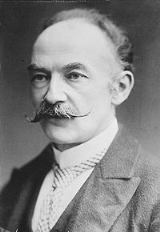
Thomas Hardy

 
Thomas Hardy

   Email Print
   Bookmark   Link


Thomas Hardy


Thomas Hardy, OM
Order of Merit

The Order of Merit is a United Kingdom and Commonwealth of Nations Order bestowed by the Elizabeth II of the United Kingdom. It was established in 1902 by King Edward VII of the United Kingdom as a reward for distinguished service in the armed forces, science, art, literature, or for the promotion of culture....
 (2 June 1840 – 11 January 1928) was an English
England

native_name =|conventional_long_name = England|common_name = England|image_flag = Flag of England.svg|image_coat = England COA.svg|symbol_type = Royal Coat of Arms...
 author
Author

An author is defined both as "the person who originates or gives existence to anything" and that authorship determines responsibility for what is created....
 of the naturalist
Naturalism (literature)

Naturalism is a Literature Literary movement that seeks to replicate a Verisimilitude everyday life, as opposed to such movements as Romanticism or Surrealism, in which subjects may receive highly symbolic, idealistic, or even supernatural treatment....
 movement, though he regarded himself primarily as a poet
Poet

A poet is a person who writes poetry....
 and composed novels mainly for financial gain. The bulk of his work, set mainly in the semi-fictional land of Wessex
Thomas Hardy's Wessex

The England author Thomas Hardy set all of his major novels in the south and South West England of England. He named the area "Wessex" after Wessex that existed in this part of that country prior to the Norman Conquest of England....
, delineates characters struggling against their passions and circumstances. Hardy's poetry, first published in his 50s, has come to be as well regarded as his novels, especially after The Movement
The Movement (literature)

The Movement was a term coined by J. D. Scott, literary editor of The Spectator, in 1954 to describe a group of writers including Kingsley Amis, Philip Larkin, Donald Davie, D.J....
 of the 1950s and 1960s. The term "cliffhanger" is considered to have originated with Thomas Hardy's serial novel A Pair of Blue Eyes in 1873.


Discussion
Ask a question about 'Thomas Hardy'
Start a new discussion about 'Thomas Hardy'
Answer questions from other users
Full Discussion Forum


Recent Posts


Quotations


A local cult, called Christianity.

Pt. I, sc. vi, Spirit of the Years

A lover without indiscretion is no lover at all. Circumspection and devotion are a contradiction in terms.

The Hand of Ethelberta (1876) Ch. 20

All that blooth means heavy autumn work for him and his hands.

Ch. XIX

An aged thrush, frail, gaunt, and small,In blast-beruffled plume,Had chosen thus to fling his soulUpon the growing gloom.

St. 3

And meadow rivulets overflow,And drops on gate bars hang in a row,And rooks in families homeward go,And so do I.

Weathers, st. 2

Do not do an immoral thing for moral reasons!

Pt. VI, ch. III


Encyclopedia


Thomas Hardy, OM
Order of Merit

The Order of Merit is a United Kingdom and Commonwealth of Nations Order bestowed by the Elizabeth II of the United Kingdom. It was established in 1902 by King Edward VII of the United Kingdom as a reward for distinguished service in the armed forces, science, art, literature, or for the promotion of culture....
 (2 June 1840 – 11 January 1928) was an English
England

native_name =|conventional_long_name = England|common_name = England|image_flag = Flag of England.svg|image_coat = England COA.svg|symbol_type = Royal Coat of Arms...
 author
Author

An author is defined both as "the person who originates or gives existence to anything" and that authorship determines responsibility for what is created....
 of the naturalist
Naturalism (literature)

Naturalism is a Literature Literary movement that seeks to replicate a Verisimilitude everyday life, as opposed to such movements as Romanticism or Surrealism, in which subjects may receive highly symbolic, idealistic, or even supernatural treatment....
 movement, though he regarded himself primarily as a poet
Poet

A poet is a person who writes poetry....
 and composed novels mainly for financial gain. The bulk of his work, set mainly in the semi-fictional land of Wessex
Thomas Hardy's Wessex

The England author Thomas Hardy set all of his major novels in the south and South West England of England. He named the area "Wessex" after Wessex that existed in this part of that country prior to the Norman Conquest of England....
, delineates characters struggling against their passions and circumstances. Hardy's poetry, first published in his 50s, has come to be as well regarded as his novels, especially after The Movement
The Movement (literature)

The Movement was a term coined by J. D. Scott, literary editor of The Spectator, in 1954 to describe a group of writers including Kingsley Amis, Philip Larkin, Donald Davie, D.J....
 of the 1950s and 1960s. The term "cliffhanger" is considered to have originated with Thomas Hardy's serial novel A Pair of Blue Eyes in 1873. In the previously mentioned novel Hardy chose to leave one of his protagonists, Knight, literally hanging off a cliff staring into the stony eyes of a trilobite embedded in the rock that has been dead for millions of years. This became the archetypal — and literal — cliff-hanger of Victorian prose.

Biography

Thomas Hardy was born at Higher Bockhampton
Bockhampton

Bockhampton is the name of several villages in England, mainly in Dorset:*Bockhampton, Berkshire, an area of Lambourn.*Higher Bockhampton, Dorset, birthplace of Thomas Hardy, and site of Thomas Hardy's Cottage...
, a hamlet
Hamlet

Hamlet is a tragedy by William Shakespeare, believed to have been written between 1599 and 1601. The play, set in Denmark, recounts how Prince Hamlet exacts revenge on his uncle King Claudius, who has murdered King Hamlet, the King, and then taken the throne and married Gertrude ....
 in the parish of Stinsford
Stinsford

Stinsford is a village in south west Dorset, England, one mile east of Dorchester, Dorset. The village has a population of 346 , 13.5% of dwellings are second homes....
 to the east of Dorchester in Dorset
Dorset

Dorset , is a Counties of England in South West England on the English Channel coast. The county town is Dorchester, Dorset, situated in the south of the county at ....
, England
England

native_name =|conventional_long_name = England|common_name = England|image_flag = Flag of England.svg|image_coat = England COA.svg|symbol_type = Royal Coat of Arms...
. His father worked as a stonemason and local builder. His mother was well-read and educated Thomas until he went to his first school at Bockhampton at age 8. His formal education ended at the age of 16 when he became apprenticed to John Hicks, a local architect
Architect

An architect is trained and licenced in planning and designing buildings, and participates in supervising the construction of a building. Etymologically, architect derives from the Latin architectus, itself derived from the Greek arkhitekton , i.e....
. Hardy trained as an architect
Architect

An architect is trained and licenced in planning and designing buildings, and participates in supervising the construction of a building. Etymologically, architect derives from the Latin architectus, itself derived from the Greek arkhitekton , i.e....
 in Dorchester before moving to London
London

London is the capital of both England and the United Kingdom, and the most populous municipality in the European Union. An important settlement for two millennia, History of London goes back to its founding by the Roman Empire....
 in 1862; there he enrolled as a student at King's College, London. He won prizes from the Royal Institute of British Architects
Royal Institute of British Architects

The Royal Institute of British Architects is a professional body for architects in the United Kingdom.Originally named the Institute of British Architects in London, it was formed in 1834 by several prominent architects, including Philip Hardwick, Thomas Allom, William Donthorne, Thomas Leverton Donaldson and John Buonarotti Papwor...
 and the Architectural Association
Architectural Association School of Architecture

The Architectural Association School of Architecture, more usually known as the AA, is one of the most prestigious and most selective architecture schools in the United Kingdom....
. Hardy never truly felt at home in London and when he returned five years later to Dorset
Dorset

Dorset , is a Counties of England in South West England on the English Channel coast. The county town is Dorchester, Dorset, situated in the south of the county at ....
 he decided to dedicate himself to writing.

In 1870, while on an architectural mission to restore the parish church of St Juliot in Cornwall
Cornwall

Cornwall , constitutional Duchy and palatine, is a metropolitan and non-metropolitan counties of England of England, United Kingdom, located at the tip of the south-western peninsula of Great Britain....
, Hardy met and fell in love with Emma Lavinia Gifford, whom he married in 1874. Although he later became estranged from his wife, who died in 1912, her death had a traumatic effect on him. After her death, Hardy made a trip to Cornwall
Cornwall

Cornwall , constitutional Duchy and palatine, is a metropolitan and non-metropolitan counties of England of England, United Kingdom, located at the tip of the south-western peninsula of Great Britain....
 to revisit places linked with their courtship, and his Poems 1912-13
Poems 1912-13

In his Poems of 1912-1913, Thomas Hardy presents the reader with intensely personal poetic Verse . Hardy addresses what the loss of a loved one means to the self; the curse that forces one to abide faithfully to the memories of the dead in light of the ambiguity with which such erections are revisited....
 reflect upon her passing. In 1914, Hardy married his secretary Florence Dugdale
Florence Dugdale

Florence Emily Dugdale was a writer of children's stories and the second wife of Thomas Hardy....
, who was 39 years his junior. However, he remained preoccupied with his first wife's death and tried to overcome his remorse by writing poetry.

Egrac
Hardy became ill with pleurisy
Pleurisy

Pleurisy, also known as pleuritis, is an inflammation of the pleura, the lining of the pleural cavity surrounding the lungs. Among other things, infections are the most common cause of pleurisy....
 in December 1927 and died in January 1928, having dictated his final poem to his wife on his deathbed. His funeral was on 16 January at Westminster Abbey
Westminster Abbey

The Collegiate Church of St Peter at Westminster, which is almost always referred to popularly and informally as Westminster Abbey, is a large, mainly Gothic architecture Church , in Westminster, London, just to the west of the Palace of Westminster....
, and it proved a controversial occasion because Hardy and his family and friends had wished for his body to be interred at Stinsford
Stinsford

Stinsford is a village in south west Dorset, England, one mile east of Dorchester, Dorset. The village has a population of 346 , 13.5% of dwellings are second homes....
 in the same grave as his first wife, Emma. However, his executor, Sir Sydney Carlyle Cockerell, insisted that he be placed in the abbey's famous Poets' Corner
Poets' Corner

Poets? Corner is the name traditionally given to a section of the South Transept of Westminster Abbey due to the number of poets, playwrights, and writers now buried and commemorated there....
. A compromise was reached whereby his heart was buried at Stinsford with Emma, and his ashes in Poets' Corner.

Shortly after Hardy's death, the executors of his estate burnt his letters and notebooks. Twelve records survived, one of them containing notes and extracts of newspaper stories from the 1820s. Research into these provided insight into how Hardy kept track of them and how he used them in his later work.

Hardy's work was admired by many authors including D. H. Lawrence
D. H. Lawrence

David Herbert Richards Lawrence was an England author, poet, playwright, essayist and literary criticism. His collected works represent an extended reflection upon the dehumanizing effects of modernity and industrialization....
 and Virginia Woolf
Virginia Woolf

Adeline Virginia Woolf was an England novelist and essayist, regarded as one of the foremost modernist literature literature figures of the twentieth century....
. Robert Graves
Robert Graves

Robert Ranke Graves was an England poet, translator and novelist. During his long life, he produced more than 140 works. He was the son of the Anglo-Irish writer Alfred Perceval Graves and Amalie von Ranke, a niece of the famous German historian Leopold von Ranke....
, in his autobiography Goodbye to All That
Goodbye to All That

Good-bye to All That is the autobiography of Robert Graves. First published in 1929, the work is a landmark anti-war memoir of life in the trench warfare during World War I....
, recalls meeting Hardy in Dorset in the early 1920s. Hardy received Graves and his newly married wife warmly, and was encouraging about the younger author's work.

In 1910, Hardy was awarded the Order of Merit ("OM").

Hardy's cottage at Bockhampton
Thomas Hardy's Cottage

Thomas Hardy's Cottage, in Higher Bockhampton, Dorset, is the birthplace of the English author Thomas Hardy. He lived here until he was aged 34, during which time he wrote Under the Greenwood Tree and Far from the Madding Crowd....
 and Max Gate
Max Gate

Max Gate is the former home of Thomas Hardy and is located in Dorchester, Dorset, Dorset, England.Hardy designed and lived in Max Gate from 1885 until his death in 1928....
 in Dorchester are owned by the National Trust
National Trust for Places of Historic Interest or Natural Beauty

The National Trust for Places of Historic Interest or Natural Beauty, usually known as the National Trust, is a conservation organization in England, Wales and Northern Ireland....
.

Religious beliefs

Hardy's early religious experience was with the Plymouth Brethren
Plymouth Brethren

The Plymouth Brethren is a conservative, Evangelicalism Christian restorationist New religious movement, whose history can be traced to Dublin, Ireland, in the late 1820s....
. He was often in the company of Henry R. Bastow
Henry R. Bastow

Henry Robert Bastow was an Australian architect and a leading Plymouth Brethren member in Melbourne, Victoria .Bastow studied architecture with Thomas Hardy under John Hicks in Dorchester....
, a fellow architect, when they studied the Greek New Testament together. Bastow went to Australia
Australia

Australia, officially the Commonwealth of Australia, is a country in the southern hemisphere comprising the Australia of the world's smallest continent, the major island of Tasmania, and numerous list of islands of Australia in the Indian Ocean and Pacific Oceans....
 and maintained a long correspondence with Hardy, but eventually Hardy tired of these exchanges and the correspondence ceased. Hardy's links with the Brethren also concluded.

Hardy’s idea of fate in life gave way to his philosophical struggle with God
God

God is a deity in theism and deism religions and other belief systems, representing either the sole deity in monotheism, or a principal deity in polytheism....
. Although Hardy’s faith remained intact, the irony and struggles of life led him to question God and His traditional meaning in the Christian
Christian

A Christian is a person who adheres to Christianity, a Monotheism#Christian view religion centered on the life and teachings of Jesus and interpreted by Christians to have been prophesied in the Hebrew Bible/Old Testament....
 sense. Hardy's religious life seems to have mixed agnosticism
Agnosticism

Agnosticism is the philosophy view that the logical value of certain claims ? particularly metaphysics claims regarding theology, afterlife or the existence of deity, ghosts, or even ultimate reality ? is unknown or, depending on the form of agnosticism, inherently impossible to prove or disprove....
 and spiritism
Spiritism

Spiritism is a Christian philosophy doctrine, established in France in the mid-nineteenth century.Spiritism, or French spiritualism, is based on Spiritist Codification written by French people educator Hypolite L?on Denizard Rivail under the pseudonym Allan Kardec reporting s?ances in which he observed a series of phenomena that could be o...
. Once, when asked in correspondence by a clergyman about the question of reconciling the horrors of pain with the goodness of a loving God, Hardy replied,

Nevertheless, Hardy frequently conceived of and wrote about supernatural forces that control the universe, more through indifference or caprice than any firm will. Also, Hardy showed in his writing some degree of fascination with ghosts and spirits. Despite these sentiments, Hardy retained a strong emotional attachment to the Christian liturgy and church rituals, particularly as manifested in rural communities, that had been such a formative influence in his early years. Some attributed the bleak outlook of many of his novels as reflecting his view of the absence of God
God

God is a deity in theism and deism religions and other belief systems, representing either the sole deity in monotheism, or a principal deity in polytheism....
. A sentence found in his Tess of the d'Urbervilles sums up Hardy's philosophical stance even though he doubted God's existence: In Far From the Madding Crowd
Far from the Madding Crowd

Far from the Madding Crowd is Thomas Hardy fourth novel and his first major literary success. It originally appeared, anonymously, as a monthly serial in Cornhill Magazine, where it gained a wide readership; critical notices, too, were plentiful and mostly positive....
, Oak’s entire flock, and livelihood, dies. For Oak, being a simple farmer with nothing to his name, to encounter such a loss is a tragedy wherein Hardy wants his readers to consider the role of God in this type of situation along with the universe’s cruelty. Biblical references can be found woven throughout many of Hardy’s novels as he became friends with a Dorchester minister
Minister

Minister can mean several things:* Minister , a Christian who ministers in some way.* Minister , the rank of diplomat directly below ambassador....
, Hourace Moule. Moule also influenced Hardy’s point of view by introducing him to scientific studies and ideas that questioned the literal meaning of the Bible. These new ideas, along with Darwinism, and a series of unsettling events in Hardy’s life may be the reason for his pessimistic attitude that is perceived by many critics and readers alike.

Novels


Hardy's first novel
Novel

File:2009 stapelweise Neuerscheinungen im Buchladen.JPGA novel is today a long narrative in literary prose. The genre has historical roots both in the fields of the medieval and early modern Romance and in the tradition of the novella....
, The Poor Man and the Lady
The Poor Man and the Lady

The Poor Man and the Lady was the first novel written by Thomas Hardy. It was written in 1867 and never published. After the manuscript had been rejected by at least five publishers, Hardy gave up his attempts to sell the novel in its original form; however, he incorporated some of its scenes and themes into later works, notably in the...
, finished by 1867, failed to find a publisher and Hardy destroyed the manuscript so only parts of the novel remain. He was encouraged to try again by his mentor and friend, Victorian poet and novelist George Meredith
George Meredith

| name= George Meredith| image = George Meredith.1893.jpg| imagesize = 200px| caption = George Meredith in 1893 by George Frederic Watts....
. Desperate Remedies
Desperate Remedies

Desperate Remedies is a novel by Thomas Hardy, published anonymously by William Tinsley in 1871.External links ...
 (1871) and Under the Greenwood Tree
Under the Greenwood Tree

Under the Greenwood Tree or The Mellstock Quire A Rural Painting of the Dutch School is a novel by Thomas Hardy, published anonymously in 1872....
 (1872) were published anonymously. In 1873 A Pair of Blue Eyes
A Pair of Blue Eyes

A Pair of Blue Eyes is a novel by Thomas Hardy, published in 1873.The book describes the love triangle between a young woman, Elfride Swancourt, and her two suitors from very different backgrounds....
, a story drawing on Hardy's courtship of his first wife, was published under his own name.

Hardy said that he first introduced Wessex
Thomas Hardy's Wessex

The England author Thomas Hardy set all of his major novels in the south and South West England of England. He named the area "Wessex" after Wessex that existed in this part of that country prior to the Norman Conquest of England....
 in Far from the Madding Crowd
Far from the Madding Crowd

Far from the Madding Crowd is Thomas Hardy fourth novel and his first major literary success. It originally appeared, anonymously, as a monthly serial in Cornhill Magazine, where it gained a wide readership; critical notices, too, were plentiful and mostly positive....
 (1874), his next novel. It was successful enough for Hardy to give up architectural work and pursue a literary career. Over the next twenty-five years Hardy produced ten more novels.

The Hardys moved from London to Yeovil
Yeovil

Yeovil is a town in south Somerset, England, on the A30 road and A37 road. It has a population of 41,871 at the 2001 census . The town lies within the local district of South Somerset and the Yeovil ....
 and then to Sturminster Newton
Sturminster Newton

Sturminster Newton, known to locals as Stur, is a town in the Blackmore Vale area of Dorset, England. The town is famous as the home of poet and author William Barnes, and, for part of his life, Thomas Hardy....
, where he wrote The Return of the Native
The Return of the Native

The Return of the Native is Thomas Hardy sixth published novel. It first appeared in the serial Belgravia, a publication known for its sensationalism, and was presented in twelve monthly installments from January to December of 1878....
 (1878). In 1885, they moved for a last time, to Max Gate
Max Gate

Max Gate is the former home of Thomas Hardy and is located in Dorchester, Dorset, Dorset, England.Hardy designed and lived in Max Gate from 1885 until his death in 1928....
, a house outside Dorchester designed by Hardy and built by his brother. There he wrote The Mayor of Casterbridge (1886), The Woodlanders
The Woodlanders

The Woodlanders is a novel by Thomas Hardy, published in 1887....
 (1887) and Tess of the d'Urbervilles
Tess of the d'Urbervilles

Tess of the d'Urbervilles: A Pure Woman Faithfully Presented is a novel by Thomas Hardy, first published in 1891. It initially appeared in a censored and serialised version, published by the British illustrated newspaper, The Graphic....
 (1891), the last of which attracted criticism for its sympathetic portrayal of a "fallen woman" and was initially refused publication. Its subtitle, A Pure Woman: Faithfully Presented, was intended to raise the eyebrows of the Victorian
Victorian era

The Victorian Era of the United Kingdom of Great Britain and Ireland was the period of Victoria of the United Kingdom reign from June 1837 to January 1901....
 middle-classes.

Jude the Obscure
Jude the Obscure

Jude the Obscure is the last of Thomas Hardy's novels, begun as a magazine serial and first published in book form in 1895. The book was burnt publicly by the Bishop of Wakefield in that same year....
, published in 1895, met with even stronger negative outcries from the Victorian
Victorian era

The Victorian Era of the United Kingdom of Great Britain and Ireland was the period of Victoria of the United Kingdom reign from June 1837 to January 1901....
 public for its frank treatment of sex, and was often referred to as "Jude the Obscene". Heavily criticised for its apparent attack on the institution of marriage, the book caused further strain on Hardy's already difficult marriage because Emma Hardy was concerned that Jude the Obscure would be read as being autobiographical. Some booksellers sold the novel in brown paper bags, and the Bishop of Wakefield
Bishop of Wakefield

The Bishop of Wakefield is the Ordinary of the Church of England Diocese of Wakefield in the Province of York.The diocese covers the south-west County of Yorkshire....
 is reputed to have burnt a copy. In his postscript of 1912, Hardy humourously referred to this incident as part of the career of the book: "After these [hostile] verdicts from the press its next misfortune was to be burnt by a bishop - probably in his despair at not being able to burn me".

Despite this criticism, Hardy had become a celebrity in English literature
English literature

The term English literature refers to literature written in the English language, including literature composed in English by writers not necessarily from England; Joseph Conrad was Polish, Robert Burns was Scottish, James Joyce was Irish, Dylan Thomas was Welsh, Edgar Allan Poe was American, Salman Rushdie is Indian, V.S....
 by the 1900s, with several highly successful novels under his belt, yet he felt disgust at the public reception of two of his greatest works and gave up writing novels altogether. Several critics have commented , however, that there was very little left for Hardy to write about, having creatively exhausted the increasingly fatalistic tone of his novels.

Literary themes

Although he wrote a great deal of poetry, mostly unpublished until after 1898, Hardy is best remembered for the series of novels and short stories he wrote between 1871 and 1895. His novels are set in the imaginary world of Wessex
Wessex

West Saxon redirects here. For other meanings of Wessex or West Saxon see Wessex .Wessex , from the Old English Westseaxe , was an Anglo-Saxon kingdom of the West Saxons, in South West England, from the 6th century, until the emergence of the English state in the 9th century, under the Wessex dynasty....
, a large area of south and south-west England, using the name of the Anglo-Saxon kingdom that covered the area. Hardy was part of two worlds. He had a deep emotional bond with the rural way of life which he had known as a child, but he was also aware of the changes which were under way and the current social problems, from the innovations in agriculture—he captured the epoch just before the Industrial Revolution
Industrial Revolution

The Industrial Revolution was a period in the late 18th and early 19th centuries when major changes in agriculture, manufacturing, production, and transportation had a profound effect on the socioeconomics and cultural conditions in United Kingdom....
 changed the English countryside—to the unfairness and hypocrisy of Victorian sexual behaviour.

Hardy critiques certain social constraints that hindered the lives of those living in the 19th century. Considered a Victorian Realist writer, Hardy examines the social constraints that are part of the Victorian status quo, suggesting these rules hinder the lives of all involved and ultimately lead to unhappiness. In Two on a Tower, Hardy seeks to take a stand against these rules and sets up a story against the backdrop of social structure by creating a story of love that crosses the boundaries of class. The reader is forced to consider disposing of the conventions set up for love. Nineteenth-century society enforces these conventions, and societal pressure ensures conformity. Swithin St Cleeve's idealism pits him against contemporary social constraints. He is a self-willed individual set up against the coercive strictures of social rules and mores.

Hardy’s stories take into consideration the events of life and their effects. Fate plays a significant role as the thematic basis for many of his novels. Characters are constantly encountering crossroads, which are symbolic of a point of opportunity and transition. Far From the Madding Crowd
Far from the Madding Crowd

Far from the Madding Crowd is Thomas Hardy fourth novel and his first major literary success. It originally appeared, anonymously, as a monthly serial in Cornhill Magazine, where it gained a wide readership; critical notices, too, were plentiful and mostly positive....
 tells a tale of lives that are constructed by chance. “Had Bathsheba not sent the valentine, had Fanny not missed her wedding, for example, the story would have taken an entirely different path.” Once things have been put into motion, they will play out. Hardy's characters are in the grips of an overwhelming fate.

Hardy paints a vivid picture of rural life in the 19th century, with all its joys and suffering, as a fatalistic world full of superstition and injustice. His heroes and heroines are often alienated from society and are rarely readmitted. He tends to emphasise the impersonal and, generally, negative powers of fate over the mainly working class
Working class

Working class is a term used in academic sociology and in ordinary conversation to describe, depending on context and speaker, those employed in specific fields or types of work....
 people he represents in his novels. Hardy exhibits in his books elemental passion, deep instinct, and the human will struggling against fatal and ill-comprehended laws, a victim also of unforeseeable change. Tess of the d'Urbervilles, for example, ends with:

In particular, Hardy's novel Jude the Obscure is full of the sense of crisis of the later Victorian period (as witnessed in Matthew Arnold
Matthew Arnold

Matthew Arnold was an England poet, and cultural critic who worked as an inspector of schools. He was the son of Thomas Arnold, the famed headmaster of Rugby School, and brother to both Tom Arnold , literary professor, and William Delafield Arnold, novelist and colonial administrator....
's 'Dover Beach
Dover Beach

"Dover Beach" is a short lyric poetry by England poet Matthew Arnold. It was first published in 1867 in the collection New Poems, but surviving notes indicate its composition may have begun as early as 1849....
'). It describes the tragedy of two new social types, Jude Fawley, a working man who attempts to educate himself, and his lover and cousin, Sue Bridehead, who represents the 'new woman' of the 1890s.

His mastery, as both an author and poet, lies in the creation of natural surroundings making discoveries through close observation and acute sensitiveness. He notices the smallest and most delicate details, yet he can also paint vast landscapes of his own Wessex in melancholy or noble moods. (His eye for poignant detail - such as the spreading bloodstain on the ceiling at the end of Tess of the d'Urbervilles
Tess of the d'Urbervilles

Tess of the d'Urbervilles: A Pure Woman Faithfully Presented is a novel by Thomas Hardy, first published in 1891. It initially appeared in a censored and serialised version, published by the British illustrated newspaper, The Graphic....
 and little Jude's
Jude the Obscure

Jude the Obscure is the last of Thomas Hardy's novels, begun as a magazine serial and first published in book form in 1895. The book was burnt publicly by the Bishop of Wakefield in that same year....
 suicide note - often came from clippings from newspaper reports of real events).

Poetry

For the full text of several poems, see the External links
Thomas Hardy

Thomas Hardy, Order of Merit was an England author of the naturalism movement, though he regarded himself primarily as a poet and composed novels mainly for financial gain....
 section


In 1898 Hardy published his first volume of poetry, Wessex Poems
Wessex Poems

Wessex Poems and Other Verses is a collection of 51 poems set against the bleak and forbidding Dorset landscape by England writer Thomas Hardy, often referred to as simply Wessex Poems....
, a collection of poems written over 30 years. Hardy claimed poetry as his first love, and published collections until his death in 1928. Although not as well received by his contemporaries as his novels, Hardy's poetry has been applauded considerably in recent years, in part because of the influence on Philip Larkin
Philip Larkin

Philip Arthur Larkin, Order of the Companions of Honour, Commander of the British Empire, Fellow of the Royal Society of Literature , was a UK poet, novelist and jazz critic....
. However, critically it is still not regarded as highly as his prose.

Most of his poems deal with themes of disappointment in love and life, and mankind's long struggle against indifference to human suffering. Some, like The Darkling Thrush and An August Midnight, appear as poems about writing poetry, because the nature mentioned in them gives Hardy the inspiration to write those. A vein of regret tinges his often seemingly banal themes. His compositions range in style from the three-volume epic closet drama
Closet drama

A closet drama is a Play that is not intended to be performed onstage, but read by a solitary reader or, sometimes, out loud in a small group....
 The Dynasts
The Dynasts

The Dynasts is "an epic-drama of Napoleonic wars, in three parts, nineteen acts and one hundred and thirty scenes" by Thomas Hardy, whose parts were published in 1904, 1906 and 1908 respectively....
 to smaller, and often hopeful or even cheerful ballads of the moment such as the little-known The Children and Sir Nameless, a comic poem inspired by the tombs of the Martyns, builders of Athelhampton
Athelhampton

Athelhampton is one of the finest 15th-century manor houses in England, and is set in superb gardens. It is a privately owned country house on 160 acres of parkland, located five miles east of Dorchester, Dorset....
.

A few of Hardy's poems, such as "The Blinded Bird" (a melancholy polemic against the sport of vinkenzetting), display his love of the natural world and his firm stance against animal cruelty, exhibited in his antivivisectionist
Vivisection

File:Frog vivisection.jpgFile:Activist against vivisection.JPGVivisection is surgery conducted upon a living organism, typically animals with a central nervous system....
 views and his membership in the RSPCA.

Composers who have set Hardy's text to music include Gerald Finzi
Gerald Finzi

Gerald Raphael Finzi was a Great Britain composer, whose popularity has increased considerably in the years since his death....
, who produced six song-cycles for poems by Hardy, Benjamin Britten
Benjamin Britten

Edward Benjamin Britten, Baron Britten, Order of Merit Order of the Companions of Honour was an England composer, conducting, viola and pianist....
, who based his song-cycle Winter Words
Winter Words (song cycle)

Winter Words, Op. 52, is a song cycle for tenor and piano by Benjamin Britten.Written in 1954, it sets eight poems by Thomas Hardy about the fleetingness of experience, which contrast brief instances against the unfeeling vastness of time....
 on Hardy's poetry, Ralph Vaughan Williams
Ralph Vaughan Williams

Ralph Vaughan Williams Order of Merit was an England composer of symphony, chamber music, opera, choral music, and film Film score. He was also a collector of England folk music and folk song; this also influenced his editorial approach to the English Hymnal, which began in 1904, many folk song arrangements being set as hymn tunes,...
 and Gustav Holst
Gustav Holst

Gustav Theodore Holst was an English composer and was a teacher for nearly 20 years. He is most famous for his orchestral suite The Planets....
. Holst also based one of his last orchestral works, Egdon Heath
Egdon Heath

Egdon Heath is a fictitious heath in Hardy's Wessex, a hamlet of people who cut the furze, or gorse, that grows there. The area is rife with witchcraft and superstition, as in The Return of the Native and the short story "The Withered Arm." One basis for Egdon Heath is Studland Heath, an area of moorland between Dorchester, Dorset and Bo...
, on Hardy's work. Composer Lee Hoiby
Lee Hoiby

Lee Hoiby is an American european classical music pianist and composer. He is one of the most notable living composers of classical vocal music....
's setting of "The Darkling Thrush" became the basis of the multimedia
Multimedia

Multimedia is media and content that utilizes a combination of different content format. The term can be used as a noun or as an adjective describing a medium as having multiple content forms....
 opera Darkling and Timothy Takach, a graduate of St. Olaf, has also put "The Darkling Thrush" into arrangement for a 4-part mixed choir.

Works


Prose

Hardy divided his novels and collected short stories into three classes:

Novels of Character and Environment

  • The Poor Man and the Lady
    The Poor Man and the Lady

    The Poor Man and the Lady was the first novel written by Thomas Hardy. It was written in 1867 and never published. After the manuscript had been rejected by at least five publishers, Hardy gave up his attempts to sell the novel in its original form; however, he incorporated some of its scenes and themes into later works, notably in the...
     (1867, unpublished and lost)
  • Under the Greenwood Tree
    Under the Greenwood Tree

    Under the Greenwood Tree or The Mellstock Quire A Rural Painting of the Dutch School is a novel by Thomas Hardy, published anonymously in 1872....
     (1872)
  • Far from the Madding Crowd
    Far from the Madding Crowd

    Far from the Madding Crowd is Thomas Hardy fourth novel and his first major literary success. It originally appeared, anonymously, as a monthly serial in Cornhill Magazine, where it gained a wide readership; critical notices, too, were plentiful and mostly positive....
     (1874)
  • The Return of the Native
    The Return of the Native

    The Return of the Native is Thomas Hardy sixth published novel. It first appeared in the serial Belgravia, a publication known for its sensationalism, and was presented in twelve monthly installments from January to December of 1878....
     (1878)
  • The Mayor of Casterbridge (1886)
  • The Woodlanders
    The Woodlanders

    The Woodlanders is a novel by Thomas Hardy, published in 1887....
     (1887)
  • Wessex Tales
    Wessex Tales

    Wessex Tales is an 1888 collection of tales written by Thomas Hardy, many of which are set before Hardy's birth in 1840.In the tales, Hardy writes using the pastoral voice....
     (1888, a collection of short stories)
  • Tess of the d'Urbervilles
    Tess of the d'Urbervilles

    Tess of the d'Urbervilles: A Pure Woman Faithfully Presented is a novel by Thomas Hardy, first published in 1891. It initially appeared in a censored and serialised version, published by the British illustrated newspaper, The Graphic....
     (1891)
  • Life's Little Ironies
    Life's Little Ironies

    Life's Little Ironies is a collection of tales written by Thomas Hardy, originally published in 1894, and republished with a slightly different collection of stories, for the Uniform Edition in 1927/8....
     (1894, a collection of short stories)
  • Jude the Obscure
    Jude the Obscure

    Jude the Obscure is the last of Thomas Hardy's novels, begun as a magazine serial and first published in book form in 1895. The book was burnt publicly by the Bishop of Wakefield in that same year....
     (1895)


Romances and Fantasies

  • A Pair of Blue Eyes
    A Pair of Blue Eyes

    A Pair of Blue Eyes is a novel by Thomas Hardy, published in 1873.The book describes the love triangle between a young woman, Elfride Swancourt, and her two suitors from very different backgrounds....
     (1873)
  • The Trumpet-Major
    The Trumpet-Major

    The Trumpet-Major is a novel by Thomas Hardy, published in 1880.The heroine, Ann Garland, is pursued by three suitors: John Loveday, the trumpet major in a British regiment, honest and loyal; his brother Bob, a merchant seaman and womaniser; and Festus Derriman, the cowardly son of the local squire....
     (1880)
  • Two on a Tower
    Two on a Tower

    Two on a Tower is a novel by England author Thomas Hardy, classified by him as a romance and fantasy and now regarded as one of his minor works....
     (1882)
  • A Group of Noble Dames
    A Group of Noble Dames

    A Group of Noble dames is an 1891 collection of short stories written by Thomas Hardy....
     (1891, a collection of short stories)
  • The Well-Beloved
    The Well-Beloved

    The Well-Beloved is a novel by Thomas Hardy, published in 1912.The main setting of the novel was The Isle of Slingers, a caricature of the Isle of Portland in Dorset, England....
     (1897) (first published as a serial from 1892).


Novels of Ingenuity

  • Desperate Remedies
    Desperate Remedies

    Desperate Remedies is a novel by Thomas Hardy, published anonymously by William Tinsley in 1871.External links ...
     (1871)
  • The Hand of Ethelberta
    The Hand of Ethelberta

    The Hand of Ethelberta is a novel by Thomas Hardy, published in 1876. It was written, in serial form, for the Cornhill Magazine, which was edited by Leslie Stephen, a friend and mentor of Hardy's....
     (1876)
  • A Laodicean
    A Laodicean

    A Laodicean is a novel by Thomas Hardy, published in 1881. Set in the more modern age of that time, the plot exhibits devices uncommon for Hardy, such as falsified telegrams and faked photographs....
     (1881)


Hardy also produced a number of minor tales and a collaborative novel, The Spectre of the Real (1894). An additional short-story collection, beyond the ones mentioned above, is A Changed Man and Other Tales (1913). His works have been collected as the 24-volume Wessex Edition (1912-1913) and the 37-volume Mellstock Edition (1919-1920). His largely self-written biography appears under his second wife's name in two volumes from 1928-1930, as The Early Life of Thomas Hardy, 1840-1891 and The Later Years of Thomas Hardy, 1892-1928, now published in a critical one-volume edition as The Life and Work of Thomas Hardy, edited by Michael Millgate (1984).

Short stories (with date of first publication)
  • "How I Built Myself A House" (1865)
  • "Destiny and a Blue Cloak" (1874)
  • "The Thieves Who Couldn't Stop Sneezing" (1877)
  • "The Duchess of Hamptonshire" (1878)
  • "The Distracted Preacher" (1879)
  • "Fellow-Townsmen" (1880)
  • "The Honourable Laura" (1881)
  • "What The Shepherd Saw" (1881)
  • "A Tradition of Eighteen Hundred and Four" (1882)
  • "The Three Strangers" (1883)
  • "The Romantic Adventures Of A Milkmaid" (1883)
  • "Interlopers At The Knap" (1884)
  • "A Mere Interlude" (1885)
  • "A Tryst At An Ancient Earthwork" (1885)
  • "Alicia's Diary
    Alicia's Diary

    Alicia's Diary is a short story written by Victorian Era novelist Thomas Hardy in 1887. It is the diary of a girl named Alicia that is a tragic Romance novel....
    " (1887)
  • "The Waiting Supper" (1887-88)
  • "The Withered Arm" (1888)
  • "A Tragedy Of Two Ambitions" (1888)
  • "The First Countess of Wessex" (1889)
  • "Anna, Lady Baxby" (1890)
  • "The Lady Icenway" (1890)
  • "Lady Mottisfont" (1890)
  • "The Lady Penelope" (1890)
  • "The Marchioness of Stonehenge" (1890)
  • "Squire Petrick's Lady" (1890)
  • "Barbara Of The House Of Grebe" (1890)
  • "The Melancholy Hussar of The German Legion" (1890)
  • "Absent-Mindedness in a Parish Choir" (1891)
  • "The Winters And The Palmleys" (1891)
  • "For Conscience' Sake" (1891)
  • "Incident in Mr. Crookhill's Life"(1891)
  • "The Doctor's Legend" (1891)
  • "Andrey Satchel and the Parson and Clerk" (1891)
  • "The History of the Hardcomes" (1891)
  • "Netty Sargent's Copyhold" (1891)
  • "On The Western Circuit" (1891)
  • "A Few Crusted Characters: Introduction" (1891)
  • "The Superstitious Man's Story" (1891)
  • "Tony Kytes, the Arch-Deceiver" (1891)
  • "To Please His Wife" (1891)
  • "The Son's Veto" (1891)
  • "Old Andrey's Experience as a Musician" (1891)
  • "Our Exploits At West Poley" (1892-93)
  • "Master John Horseleigh, Knight" (1893)
  • "The Fiddler of the Reels" (1893)
  • "An Imaginative Woman" (1894)
  • "The Spectre of the Real" (1894)
  • "A Committee-Man of 'The Terror'" (1896)
  • "The Duke's Reappearance" (1896)
  • "The Grave By The Handpost" (1897)
  • "A Changed Man" (1900)
  • "Enter a Dragoon" (1900)
  • "Blue Jimmy: The Horse Stealer" (1911)
  • "Old Mrs. Chundle" (1929)
  • "The Unconquerable"(1992)


Poetry (not a comprehensive list)
  • The Photograph (1890)
  • Wessex Poems and Other Verses
    Wessex Poems

    Wessex Poems and Other Verses is a collection of 51 poems set against the bleak and forbidding Dorset landscape by England writer Thomas Hardy, often referred to as simply Wessex Poems....
     (1898)
  • Poems of the Past and Present (1901)
  • The Mans He Killed(1902)
  • The Dynasts, Part 1
    The Dynasts

    The Dynasts is "an epic-drama of Napoleonic wars, in three parts, nineteen acts and one hundred and thirty scenes" by Thomas Hardy, whose parts were published in 1904, 1906 and 1908 respectively....
     (1904)
  • The Dynasts, Part 2
    The Dynasts

    The Dynasts is "an epic-drama of Napoleonic wars, in three parts, nineteen acts and one hundred and thirty scenes" by Thomas Hardy, whose parts were published in 1904, 1906 and 1908 respectively....
     (1906)
  • The Dynasts, Part 3
    The Dynasts

    The Dynasts is "an epic-drama of Napoleonic wars, in three parts, nineteen acts and one hundred and thirty scenes" by Thomas Hardy, whose parts were published in 1904, 1906 and 1908 respectively....
     (1908)
  • Time's Laughingstocks and Other Verses (1909)
  • Satires of Circumstance
    Satires of Circumstance

    Satires of Circumstance is a collection of poems by England poet Thomas Hardy, and was published in 1914. It includes the 18 poem sequence 'Poems of 1912-13', on the death of Hardy's wife Emma, widely regarded to comprise the best work of his poetic career....
     (1914)
  • Moments of Vision (1917)
  • Collected Poems (1919, part of the Mellstock Edition of his novels and poems)
  • Late Lyrics and Earlier with Many Other Verses (1922)
  • Human Shows, Far Phantasies, Songs and Trifles (1925)
  • Winter Words in Various Moods and Metres (1928, published posthumously)


Drama
  • The Famous Tragedy of the Queen of Cornwall (1923)


Locations in novels

Berkshire
Berkshire

Berkshire is a Home Counties in the South East England of England. It is also often referred to as the Royal County of Berkshire because of the presence of the royal residence of Windsor Castle in the county; this usage, which dates to the 19th century at least, was recognised by the Queen in 1958, and Letters patent issued confirming...
 is North Wessex, Devon
Devon

Devon is a large Counties of England in South West England. The county is also referred to as Devonshire, but that is an entirely unofficial name, rarely used inside of the county but often indicating a shire....
 is Lower Wessex, Dorset
Dorset

Dorset , is a Counties of England in South West England on the English Channel coast. The county town is Dorchester, Dorset, situated in the south of the county at ....
 is South Wessex, Somerset
Somerset

Somerset is a Counties of England in South West England. The county town is Taunton, which is in the south of the county. The Ceremonial counties of England of Somerset borders the counties of Bristol and Gloucestershire to the north, Wiltshire to the east, Dorset to the south-east, and Devon to the south-west....
 is Outer or Nether Wessex, Wiltshire
Wiltshire

Wiltshire is a Ceremonial counties of England in the South West England of England. It is landlocked and borders the counties of Dorset, Somerset, Hampshire, Gloucestershire, Oxfordshire and Berkshire....
 is Mid-Wessex,

Bere Regis
Bere Regis

Bere Regis is a large village in the Purbeck district of Dorset, England; situated 6 miles north-west of Wareham, Dorset. The local travel links are located 6 miles from the village to Wareham railway station and 17 miles to Bournemouth International Airport....
 is King's-Bere of Tess, Bincombe Down
Bincombe

Bincombe is a large village in the West Dorset district of Dorset, England; situated 5 miles north of Weymouth, Dorset. The local travel links are located 1 mile from the village to Upwey railway station and 28 miles to Bournemouth International Airport....
 cross roads is the scene of the military execution in A Melancholy Hussar. It is a true story, the deserters from the German Legion were shot in 1801 and are recorded in the parish register. Bindon Abbey
Wool, Dorset

Wool is a village in the Purbeck district of Dorset, England. The village has a population of 4,118 , though the population has fluctuated over the past 15 years, due to the proximity of military institutions, reaching a high of 4,300 in 1992....
 is where Clare carried her. Bournemouth
Bournemouth

Bournemouth is a large town in the Bournemouth in Dorset, England. The town has a population of 163,444 according to the United Kingdom Census 2001, making it the largest settlement in Dorset....
 is Sandbourne of Hand of Ethelberta and Tess of the d'Urbervilles
Tess of the d'Urbervilles

Tess of the d'Urbervilles: A Pure Woman Faithfully Presented is a novel by Thomas Hardy, first published in 1891. It initially appeared in a censored and serialised version, published by the British illustrated newspaper, The Graphic....
, Bridport
Bridport

Bridport is a town in Dorset, England. Located near the coast at the Western end of Chesil Beach at the confluence of the rivers Brit River and Asker River, it originally thrived as a fishing port and rope-making centre ....
 is Port Bredy, Charborough House
Charborough House

Charborough House is located between Sturminster Marshall and Bere Regis in Dorset, England. The Deer Park and estate adjoins the villages of Winterborne Zelston, Newton Peveril and Lytchett Matravers....
 and its folly
Folly

In architecture, a folly is a building constructed strictly as a decoration, having none of the usual purposes of housing or sheltering associated with a conventional structure....
 tower at is the model for Welland House in the novel Two on a Tower
Two on a Tower

Two on a Tower is a novel by England author Thomas Hardy, classified by him as a romance and fantasy and now regarded as one of his minor works....
. Corfe Castle
Corfe Castle

Corfe Castle is a village, civil parish and ruins castle, in the England county of Dorset. The castle dates back to the 11th century, and commands a gap in the Purbeck Hills on the route between Wareham, Dorset and Swanage....
 is the Corvsgate-Castle of Hand of Ethelberta. Cranborne Chase
Cranborne Chase

Cranborne Chase is a Chalk plateau in central southern England, straddling the counties Dorset, Hampshire and Wiltshire. The plateau is part of the English Chalk Formation and is adjacent to Salisbury Plain and the West Wiltshire Downs in the north, the Dorset Downs to the south west and the South Downs running south east....
 is The Chase scene of Tess's seduction. (Note - Bowerchalke
Bowerchalke

Bowerchalke or Bower Chalke is a village and civil parish in the Salisbury district of Wiltshire, England, about twelve miles east of Shaftesbury, approximately one mile from both Hampshire and Dorset county boundaries....
 on Cranborne Chase at was the film location for the great fire in John Schlesinger
John Schlesinger

John Richard Schlesinger, Order of the British Empire was an England film director....
's 1967 film Far from the Madding Crowd
Far from the Madding Crowd (1967 film)

Far from the Madding Crowd is a 1967 in film feature film directed by John Schlesinger, adapted from the Far from the Madding Crowd by Thomas Hardy....
.) Milborne St Andrew
Milborne St Andrew

Milborne St Andrew is a village in north Dorset, England, situated in a winterbourne valley on the dip slope of the Dorset Downs, on the A354 road nine miles north east of Dorchester, Dorset....
 is "Millpond St Judes" in Far From the Madding Crowd. Weatherby Castle is the location for the "Tower" in "Two on a Tower" with Little England Cottage, Milborne St Andrew being the location of Swithin St Cleeves home and remains as described to this day Dorchester, Dorset is Casterbridge, the scene of Mayor of Casterbridge. Dunster Castle
Dunster Castle

Dunster Castle is the historical home of the Earl of Carhampton located in the small town of Dunster, Somerset, England . Colonel Sir Walter Luttrell gave Dunster Castle and the greater part of its contents to the National Trust for Places of Historic Interest or Natural Beauty in 1976....
 in Somerset
Somerset

Somerset is a Counties of England in South West England. The county town is Taunton, which is in the south of the county. The Ceremonial counties of England of Somerset borders the counties of Bristol and Gloucestershire to the north, Wiltshire to the east, Dorset to the south-east, and Devon to the south-west....
 is Castle De Stancy of A Laodicean. Fordington moor
Fordington (liberty)

Fordington Liberty was a liberty in the county of Dorset, England, containing the following parishes:* Fordington* Hermitage, Dorset* Minterne Magna ...
 is Durnover moor and fields. Greenhill Fair
Bere Regis

Bere Regis is a large village in the Purbeck district of Dorset, England; situated 6 miles north-west of Wareham, Dorset. The local travel links are located 6 miles from the village to Wareham railway station and 17 miles to Bournemouth International Airport....
 near Bere Regis
Bere Regis

Bere Regis is a large village in the Purbeck district of Dorset, England; situated 6 miles north-west of Wareham, Dorset. The local travel links are located 6 miles from the village to Wareham railway station and 17 miles to Bournemouth International Airport....
 is Woodbury Hill Fair, Lulworth Cove
Lulworth Cove

Lulworth Cove is a cove near the village of West Lulworth, on the Jurassic Coast World Heritage Site in Dorset, southern England. The cove is one of the finest examples of such a landform in the world, and is a tourist location, with over 1 million visitors a year....
 is Lulstead Cove, Marnhull
Marnhull

Marnhull is a village in the Blackmore Vale area of north Dorset, England, 3 miles north of Sturminster Newton. The village has a population of 1,951 , 42.3% are retired....
 is Marlott of Tess of the D'Urbervilles
Tess of the d'Urbervilles

Tess of the d'Urbervilles: A Pure Woman Faithfully Presented is a novel by Thomas Hardy, first published in 1891. It initially appeared in a censored and serialised version, published by the British illustrated newspaper, The Graphic....
, Melbury House
Evershot

Evershot is a village in west Dorset, England, eight miles south of Yeovil. The village has a population of 206 . It is believed that the village has featured in various novels by Thomas Hardy....
 near Evershot
Evershot

Evershot is a village in west Dorset, England, eight miles south of Yeovil. The village has a population of 206 . It is believed that the village has featured in various novels by Thomas Hardy....
 is Great Hintock Court in A Group of Noble Dames. Minterne
Minterne Magna

Minterne Magna is a village in west Dorset, England, situated at the source of the River Cerne in the Dorset Downs, half way between Dorchester, Dorset and Sherborne....
 is Little Hintock, Owermoigne
Owermoigne

Owermoigne is a village in south west Dorset, England, situated six miles south east of Dorchester, Dorset. The village has a population of 450 ....
 is Nether Moynton in Wessex Tales.

Piddlehinton
Piddlehinton

Piddlehinton is a village in west Dorset, England situated in the River Piddle five miles north of Dorchester, Dorset. The village has a population of around 600 ....
 and Piddle Trenthide
River Piddle

The River Piddle or Trent or North River is a small rural Dorset river which source next to Alton Pancras church and flows south and then south-easterly more or less parallel with its bigger neighbour, the River Frome, Dorset, to Wareham, Dorset, where they both enter Poole Harbour via Wareham Channel....
 are the Longpuddle of A Few Crusted Characters. Puddletown
Puddletown

Puddletown is a village in Dorset, England, 5 miles east of Dorchester, Dorset in the River Piddle valley. The village has a population of 1,177 , of which 30.3% are retired....
 Heath, Moreton
Moreton, Dorset

Moreton is a village in Dorset, England, situated on the River Frome, Dorset eight miles east of Dorchester, Dorset. The village has a population of 270 ....
 Heath, Tincleton
Tincleton

Tincleton is a village in south west Dorset, England, situated on the River Frome, Dorset five miles east of Dorchester, Dorset. The village has a population of 142 ....
 Heath and Bere
Bere Regis

Bere Regis is a large village in the Purbeck district of Dorset, England; situated 6 miles north-west of Wareham, Dorset. The local travel links are located 6 miles from the village to Wareham railway station and 17 miles to Bournemouth International Airport....
 Heath are Egdon Heath. Poole
Poole

Poole is a large coastal town and seaport in Dorset on the south coast of England. The town is east of Dorchester, Dorset, and Bournemouth adjoins Poole to the east....
 is Havenpool in Life's Little Ironies. Portland
Isle of Portland

The Isle of Portland is a limestone tied island, long by wide, in the English Channel. Portland is south of the resort of Weymouth, Dorset, forming the southernmost point of the county of Dorset, England....
 is the scene of The Pursuit of the Well-Beloved. Puddletown
Puddletown

Puddletown is a village in Dorset, England, 5 miles east of Dorchester, Dorset in the River Piddle valley. The village has a population of 1,177 , of which 30.3% are retired....
 is Weatherbury in Far from the Madding Crowd, River Frome
River Frome, Dorset

The River Frome is a river in Dorset in the south of England. At 30 miles long it is the major chalkstream in southwest England. It is navigable upstream from Poole Harbour as far as the town of Wareham, Dorset....
 valley is the scene of Talbothays dairy in Tess. Salisbury
Salisbury

Salisbury is a city status in the United Kingdom in Wiltshire, England. The city forms the largest part of the Salisbury . It has also been called New Sarum to distinguish it from the original site of settlement at Salisbury, Old Sarum, but this alternative name is not in common use....
 is Melchester in On the Western Circuit, Life's Little Ironies and Jude the Obscure etc. Shaftesbury
Shaftesbury

Shaftesbury is a town in North Dorset, England, situated on the A30 road near the Wiltshire border 20 miles west of Salisbury, Wiltshire. The town is built 750 foot above sea level on the side of a chalk and greensand hill, which is part of Cranborne Chase, the only significant hilltop settlement in Dorset....
 is Shaston in Tess of the d'Urbervilles
Tess of the d'Urbervilles

Tess of the d'Urbervilles: A Pure Woman Faithfully Presented is a novel by Thomas Hardy, first published in 1891. It initially appeared in a censored and serialised version, published by the British illustrated newspaper, The Graphic....
 and Jude the Obscure
Jude the Obscure

Jude the Obscure is the last of Thomas Hardy's novels, begun as a magazine serial and first published in book form in 1895. The book was burnt publicly by the Bishop of Wakefield in that same year....
. Sherborne
Sherborne

Sherborne is an affluent market town in north west Dorset, England. It's situated on the River Yeo and A30 road, on the edge of the Blackmore Vale six miles east of Yeovil....
 is Sherton-Abbas, Sherborne Castle
Sherborne Castle

Sherborne Castle is a 16th-century Tudor period mansion southeast of Sherborne in Dorset, England. Sherborne Old Castle is the ruin of a 12th-century castle in the grounds of the mansion....
 is home of Lady Baxby in A Group of Noble Dames. Stonehenge
Stonehenge

Stonehenge is a prehistoric monument located in the England county of Wiltshire, about west of Amesbury and north of Salisbury. One of the most famous sites in the world, Stonehenge is composed of Earthworks surrounding a circular setting of large standing stones and sits at the centre of the densest complex of Neolithic and Bronze Age mon...
 is the scene of Tess's apprehension. Sutton Poyntz is Overcombe. Swanage
Swanage

Swanage is a small coastal town in the south east of Dorset, England. It is situated at the eastern end of the Isle of Purbeck, approximately 10 kilometre south of Poole and 40 km east of Dorchester, Dorset....
 is the Knollsea of Hand of Ethelberta. Taunton
Taunton

Taunton is the county town of Somerset, England. The town, including its suburbs, had an estimated population of 61,400 in 2001. It is the largest town in the non-metropolitan county of Somerset....
 is known as Toneborough in both Hardy's novels and poems. Wantage
Wantage

Wantage is a town and civil parish in the Vale of White Horse, near the Thames Valley, in the England county of Oxfordshire , and approximately south-southwest of Oxford....
 is Alfredston, of Jude the Obscure. Fawley, Berkshire
Fawley, Berkshire

Fawley is a village and civil parish in the England county of Berkshire. It is more properly called North or Great Fawley to distinguish it from South Fawley, lower down the parish....
 is Marygreen of Jude the Obscure
Jude the Obscure

Jude the Obscure is the last of Thomas Hardy's novels, begun as a magazine serial and first published in book form in 1895. The book was burnt publicly by the Bishop of Wakefield in that same year....
. Weyhill
Andover, Hampshire

Andover is a town in the England county of Hampshire. The town is situated on the River Anton some 18.5 miles west of the town of Basingstoke, 18.5 miles north-west of the city of Winchester and 25 miles north of the city of Southampton....
 is Weydon Priors, Weymouth is Budmouth Regis, the scene of Trumpet Major & portions of other novels; Winchester
Winchester

Winchester is the county town of Hampshire, in South East England. It lies at the heart of the wider City of Winchester, a local government district, and is located at the western end of the South Downs, along the course of the River Itchen, Hampshire....
 is Wintoncester where Tess was executed. Wimborne is Warborne of Two on a Tower
Two on a Tower

Two on a Tower is a novel by England author Thomas Hardy, classified by him as a romance and fantasy and now regarded as one of his minor works....
. Wolfeton House
Charminster

Charminster is a village in west Dorset, England, situated on the River Cerne and A352 road one mile north of Dorchester, Dorset. The village has a population of 1,940 ....
, near Dorchester is the scene of The Lady Penelope in a Group of Noble Dames. Woolbridge
Wool, Dorset

Wool is a village in the Purbeck district of Dorset, England. The village has a population of 4,118 , though the population has fluctuated over the past 15 years, due to the proximity of military institutions, reaching a high of 4,300 in 1992....
 old Manor House, close to Wool station, is the scene of Tess's confession and honeymoon.

In other literature

Hardy provides the springboard
Springboard

A springboard or diving board is used for diving and is a board that is itself a Spring , i.e. a linear flex-spring, of the cantilever type....
 for D. H. Lawrence
D. H. Lawrence

David Herbert Richards Lawrence was an England author, poet, playwright, essayist and literary criticism. His collected works represent an extended reflection upon the dehumanizing effects of modernity and industrialization....
's Study of Thomas Hardy (1936). Though this work became a platform for Lawrence's own developing philosophy rather than a more standard literary study, the influence of Hardy's treatment of character and Lawrence's own response to the central metaphysic behind many of Hardy's novels helped significantly in the development of The Rainbow
The Rainbow

The Rainbow is a 1915 novel by British author D. H. Lawrence. It follows three generations of the Brangwen family, particularly focusing on the sexual dynamics of, and relations between, the characters....
 (1915, suppressed) and Women in Love
Women in Love

Women in Love is a novel by United Kingdom of Great Britain and Ireland author D. H. Lawrence published in 1920 in literature. It is a sequel to his earlier novel The Rainbow , and follows the continuing loves and lives of the Brangwen sisters, Gudrun and Ursula....
 (1920, private publication). Hardy was clearly the starting point for the character of the novelist Edward Driffield in W Somerset Maugham's novel Cakes and Ale
Cakes and Ale

Cakes and Ale: or, the Skeleton in the Cupboard is a novel by United Kingdom author William Somerset Maugham. It is often alleged to be a thinly-veiled roman ? clef examining contemporary novelists Thomas Hardy and Hugh Walpole -? though Maugham maintained he had created both characters as composites and in fact explicitly denies a...
. Thomas Hardy's works feature prominently in the narrative in Christopher Durang
Christopher Durang

Christopher Ferdinand Durang is an United States playwright known for works of outrageous and often Theatre of the Absurd comedy. His work was especially popular in the 1980s....
's The Marriage of Bette and Boo, in which a graduate thesis analysing Tess of the d'Urbervilles
Tess of the d'Urbervilles

Tess of the d'Urbervilles: A Pure Woman Faithfully Presented is a novel by Thomas Hardy, first published in 1891. It initially appeared in a censored and serialised version, published by the British illustrated newspaper, The Graphic....
 is interspersed with analysis of Matt's family's neuroses.

External links


  • at Internet Archive
    Internet Archive

    The Internet Archive is a nonprofit organization dedicated to building and maintaining a free and openly accessible online digital library, including an archive site of the World Wide Web....
  • from LibriVox
    LibriVox

    LibriVox is an online digital library of free public domain audiobooks, read by volunteers. In January 2009, it had a catalog of 2,014 unabridged books and shorter works available to download....
  • at Poetry Foundation
    Poetry Foundation

    The Poetry Foundation is a Chicago-based American foundation created to promote poetry in the wider culture. It was formed from Poetry magazine, which it continues to publish, with a 2003 gift of $200 million from philanthropist Ruth Lilly....
  • Research site, including , by Dr Birgit Plietzsch
  • in e-book version
  • - Hardy works.
  • at the Harry Ransom Center at the University of Texas at Austin
    University of Texas at Austin

    The University of Texas at Austin is a public university research university located in Austin, Texas, Texas, United States, and is the flagship#University campuses institution of University of Texas System....
  • : a controversial retrospective analysis suggesting that Hardy's wife contracted syphilis and the , from , August 29 2007.