
All Topics  
Apache

 
Apache

   Email Print
   Bookmark   Link


Apache


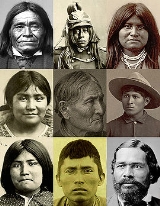
Apache is the collective term for several culturally related groups of Native Americans in the United States
Native Americans in the United States

Native Americans in the United States are the Indigenous peoples of the Americas from the regions of North America now encompassed by the continental United States United States, including parts of Alaska and the island state of Hawaii....
. These indigenous peoples of North America speak a Southern Athabaskan (Apachean) language, and are related linguistically to the languages of Athabaskan speakers of Alaska
Alaska

Alaska is the largest U.S. state of the United States by area; it is situated in the northwest extremity of the North American continent, with Canada to the east, the Arctic Ocean to the north, and the Pacific Ocean to the west and south, with Russia further west across the Bering Strait....
 and western Canada
Canada

Canada is a country occupying most of northern North America, extending from the Atlantic Ocean in the east to the Pacific Ocean in the west and northward into the Arctic Ocean....
. The modern term Apache excludes the related Navajo
Navajo Nation

The Navajo Nation is a semi-autonomy Native Americans in the United States homeland covering about 26,000 square miles , occupying all of northeastern Arizona, the southeastern portion of Utah, and northwestern New Mexico....
 people. However, the Navajo and the other Apache groups are clearly related through culture and language and thus are considered Apachean.


Discussion
Ask a question about 'Apache'
Start a new discussion about 'Apache'
Answer questions from other users
Full Discussion Forum


Encyclopedia


Apache is the collective term for several culturally related groups of Native Americans in the United States
Native Americans in the United States

Native Americans in the United States are the Indigenous peoples of the Americas from the regions of North America now encompassed by the continental United States United States, including parts of Alaska and the island state of Hawaii....
. These indigenous peoples of North America speak a Southern Athabaskan (Apachean) language, and are related linguistically to the languages of Athabaskan speakers of Alaska
Alaska

Alaska is the largest U.S. state of the United States by area; it is situated in the northwest extremity of the North American continent, with Canada to the east, the Arctic Ocean to the north, and the Pacific Ocean to the west and south, with Russia further west across the Bering Strait....
 and western Canada
Canada

Canada is a country occupying most of northern North America, extending from the Atlantic Ocean in the east to the Pacific Ocean in the west and northward into the Arctic Ocean....
. The modern term Apache excludes the related Navajo
Navajo Nation

The Navajo Nation is a semi-autonomy Native Americans in the United States homeland covering about 26,000 square miles , occupying all of northeastern Arizona, the southeastern portion of Utah, and northwestern New Mexico....
 people. However, the Navajo and the other Apache groups are clearly related through culture and language and thus are considered Apachean. Apachean peoples formerly ranged over eastern Arizona
Arizona

The State of Arizona is a U.S. state located in the Southwestern United States of the United States. The capital and largest city is Phoenix, Arizona....
, northwestern Mexico
Mexico

The United Mexican States , commonly known as Mexico , is a federalism constitutionalism republic in North America. It is bordered on the north by the United States; on the south and west by the Pacific Ocean; on the southeast by Guatemala, Belize, and the Caribbean Sea; and on the east by the Gulf of Mexico....
, New Mexico
New Mexico

New Mexico is a U. S. State located in the Southwestern United States of the United States. Inhabited by Native Americans in the United States populations for many centuries, it has also has been part of the Spanish Empire viceroyalty of New Spain, part of Mexico, and a U.S....
, and parts of Texas
Texas

Texas is a U.S. state located in the South Central United States, nicknamed the Lone Star State. Texas is the second largest U.S. state in both area and population, spanning , and with a growing population of 24.3 million residents....
 and the Great Plains
Great Plains

The Great Plains are the broad expanse of prairie and steppe which lie west of the Mississippi River and east of the Rocky Mountains in the United States and Canada....
. There was little political unity among the Apachean groups. The groups spoke seven different languages. The current division of Apachean groups includes the Navajo, Western Apache
Western Apache

Western Apache refers to the similar Apache peoples living primarily in east central Arizona. Goodwin claims that the Western Apache can be divided into five groups based on dialect:...
, Chiricahua
Chiricahua

[Image:Apachean ca.18-century.png|225px|thumb|Apachean tribes ca. 18th century Chiricahua refers to a group of bands of Apache that formerly lived in the general areas of southwestern New Mexico and southeastern Arizona in the United States, and in northern Sonora and Chihuahua in Mexico ....
, Mescalero
Mescalero

Mescalero is a Native Americans in the United States tribe of Southern Athabaskan languages heritage currently living on the Mescalero Apache Indian Reservation in southcentral New Mexico....
, Jicarilla
Jicarilla Apache

Jicarilla Apache refers to an Apache people currently living in New Mexico and speak a Southern Athabaskan languages. The term jicarilla comes from Mexican Spanish meaning 'little basket'....
, Lipan, and Plains Apache
Plains Apache

The Plains Apache are a Southern Athabaskan group that lived primarily on the plains of North America along the Kiowa. Many currently live in Oklahoma and are enrolled in the Apache Tribe of Oklahoma....
 (formerly Kiowa-Apache). Apache groups are now in Oklahoma
Oklahoma

Oklahoma is a U.S. state and a sovereignty located in the South Central United States and Southern United States of the United States of America ....
 and Texas and on reservations
Indian reservation

An Indian reservation is an area of land managed by a Native Americans of the United States tribe under the United States Department of the Interior Bureau of Indian Affairs....
 in Arizona and New Mexico. Many Navajo reside on a reservation in the Four Corners region of the United States.

Some Apacheans have moved to large metropolitan areas, such as New York City
New York City

The City of New York is the List of United States cities by population in the United States, while the New York metropolitan area ranks among the List of urban areas by population....
. The largest Apache urban communities are Oklahoma City
Oklahoma city

Oklahoma City is the capital and largest city of the U.S. state of Oklahoma.Oklahoma City may also refer to:*Oklahoma City metropolitan area...
, Kansas City
Kansas City

Kansas City may refer to:* Kansas City Metropolitan Area, metropolitan area surrounding Kansas City, Missouri includes territory in both Missouri and Kansas....
, Phoenix
Phoenix, Arizona

Phoenix is the capital and largest city in the U.S. state of Arizona, as well as the fifth most populous city in the United States. Phoenix is home to 1,552,259 residents, and is the anchor of the Phoenix Metropolitan Area with 4,179,427 residents....
, Denver, San Diego and Los Angeles
Los Ángeles

Los ?ngeles is the Capital of the Biob?o Province, in the municipality of the same name, in Regions of Chile VIII , in the center-south of Chile....
. Some Apacheans were employed in migrant farm labor to be relocated to agricultural regions of Southern California
Southern California

Southern California, or So Cal, is defined as the southern portion of the U.S. state of California. Its population centers on the cities of Los Angeles, California, San Diego, California, San Bernardino, California, and Riverside, California....
 like the Coachella
Coachella Valley

The Coachella Valley is a large valley landform in Southern California that is populated by nearly one million people, and which includes the famed tourist destination, Palm Springs, California....
, Imperial
Imperial Valley

The Imperial Valley is a region of southeastern Southern California located, in part, between the Colorado River and the Salton Sea, which is California's largest saltwater lake....
 and Colorado River
Colorado River

The Colorado River is a river in the southwestern United States and northwestern Mexico, approximately 1,450 mi long, draining a part of the arid regions on the western slope of the Rocky Mountains....
 valleys, where now tens and thousands of Apacheans live.

The Apachean tribes were historically very powerful, constantly at enmity with the Spaniards
Spain

Spain or the Kingdom of Spain , is a country located in Southern Europe on the Iberian Peninsula.The Spanish constitution does not establish any official denomination of the country, even though Espa?a , Estado espa?ol and Naci?n espa?ola are used interchangeably....
 and Mexicans for centuries. The first Apache raids on Sonora
Sonora

Sonora is one of the 31 States of Mexico and is located in the northwest of the country....
 appear to have taken place during the late 17th century. The U.S. Army
United States Army

The United States Army is the branch of the United States Armed Forces responsible for Army operations. It is the largest and oldest established branch of the U.S....
, in their various confrontations, found them to be fierce warrior
Warrior

According to the Random House Dictionary, the term warrior has two meanings. The first Literal and figurative language use refers to "a person engaged or experienced in warfare." The second Literal and figurative language use refers to "a person who shows or has shown great vigor, courage, or aggressiveness, as in politics or athletics...
s and skillful strategists. The warfare between Apachean peoples and Euro-Americans has led to a stereotypical focus on certain aspects of Apachean cultures that are often distorted through misperception as noted by anthropologist
Anthropology

Anthropology is the study of humans and humanity in its totality. Anthropology has origins in the natural sciences, and the humanities. In Great Britain it was originally divided into physical anthropology and cultural anthropology, which itself was divided into archaeology, technology, ethnology and sociology ....
 Keith Basso:

"Of the hundreds of peoples that lived and flourished in native North America, few have been so consistently misrepresented as the Apacheans of Arizona and New Mexico. Glorified by novelists, sensationalized by historians, and distorted beyond credulity by commercial film makers, the popular image of 'the Apache' — a brutish, terrifying semihuman bent upon wanton death and destruction — is almost entirely a product of irresponsible caricature and exaggeration. Indeed, there can be little doubt that the Apache has been transformed from a native American into an American legend, the fanciful and fallacious creation of a non-Indian citizenry whose inability to recognize the massive treachery of ethnic and cultural stereotypes has been matched only by its willingness to sustain and inflate them."


photo.]]

Present-day Apache groups

The present-day Apache groups include the Jicarilla and Mescalero of New Mexico, the Chiricahua of the Arizona-New Mexico border area, the Western Apache of Arizona, the Lipan Apache of southwestern Texas, and the Plains Apache of Oklahoma. There undoubtedly existed other Apache groups which are not as well-known by modern anthropologists and historians.

Western Apaches are the only Apache group that remains within Arizona. The group is divided into several reservations that crosscut cultural divisions. The Western Apache reservations include the Fort Apache White Mountain, San Carlos, Yavapai-Apache, Tonto-Apache, and Fort McDowell Mohave-Apache reservations. There are also Apaches on the Yavapai-Prescott reservation and off-reservation in Arizona and throughout the United States. The White Mountain Apache Tribe is located in the east central region of Arizona, 194 miles (312 km) northeast of Phoenix
Phoenix, Arizona

Phoenix is the capital and largest city in the U.S. state of Arizona, as well as the fifth most populous city in the United States. Phoenix is home to 1,552,259 residents, and is the anchor of the Phoenix Metropolitan Area with 4,179,427 residents....
. The Tonto Apache Reservation was created in 1972 near Payson in eastern Arizona. Within the Tonto National Forest
Tonto National Forest

The Tonto National Forest, encompassing 2,873,200 acres , is the largest of the six national forests in Arizona and is the fifth largest national forest in the United States....
 northeast of Phoenix
Phoenix, Arizona

Phoenix is the capital and largest city in the U.S. state of Arizona, as well as the fifth most populous city in the United States. Phoenix is home to 1,552,259 residents, and is the anchor of the Phoenix Metropolitan Area with 4,179,427 residents....
 it consists of 85 acres (344,000 m²) and serves about 100 tribal members. The tribe operates a casino. The Yavapai-Apache Nation Reservation southwest of Flagstaff, Arizona
Flagstaff, Arizona

Flagstaff is a city located in northern Arizona, in the southwestern United States. In July 2006, the city's estimated population was 58,213. The population of the Metropolitan Statistical Area was estimated at 127,450 in 2007....
, is shared with the Yavapai. There is a visitor center in Camp Verde, Arizona, and at the end of February an Exodus Days celebration is held with a historic re-enactment and a pow-wow
Pow-wow

A pow-wow is a gathering of North America's Indigenous people of the Americas. The word derives from the Narragansett word powwaw, meaning "spiritual leader"....
.

The Chiricahua were divided into two groups after they were released from being prisoners of war
Prisoner of war

A prisoner of war is a combatant who is held in continuing custody by an enemy power during or immediately after an armed conflict....
. The majority moved to the Mescalero Reservation and are now subsumed under the larger Mescalero political group along with the Lipan. The other Chiricahuas remained in Oklahoma and eventually formed the Fort Sill Apache Tribe of Oklahoma.

The Mescalero are located on the Mescalero Reservation in southeastern New Mexico, near historic Fort Stanton
Fort Stanton

Fort Stanton was a U.S. military fort built in New Mexico in the United States. It was established to protect settlements along the Rio Bonito, New Mexico in the Apache Wars....
. The Jicarilla are located on the Jicarilla Reservation in Rio Arriba and Sandoval counties in northwestern New Mexico. The Lipan, now few in number, are located primarily on the Mescalero Reservation. Other Lipans live in Texas. Plains Apaches are located in Oklahoma concentrated around Anadarko
Anadarko, Oklahoma

Anadarko is a city in Caddo County, Oklahoma, Oklahoma, United States. The population was 6,645 at the United States Census, 2000. It is the county seat of Caddo County, Oklahoma....
.

Name and synonymy

The word Apache entered English
English language

English is a West Germanic language that originated in Anglo-Saxon England and has lingua franca status in many parts of the world as a result of the military, economic, scientific, political and cultural influence of the British Empire in the 18th, 19th and early 20th centuries and that of the United States from the mid 20th century onwa...
 via Spanish
Spanish language

Spanish or Castilian is a Romance languages that originated in northern Spain, and gradually spread in the Kingdom of Castile and evolved into the principal language of government and trade....
, but the ultimate origin is uncertain. Most Apacheans may not like to be called Apache and rather call themselves by the term from their language (e.g. Inde "Apache, person" in Mescalero).

The first known written record in Spanish is by Juan de Oñate
Juan de Oñate

Don Juan de O?ate Salazar was an explorer, colonial Spanish governors of New Mexico of the New Spain province of New Mexico, and founder of various settlements in the present day American Southwest of the United States....
 in 1598. The most widely accepted origin theory suggests it was borrowed from the Zuni
Zuni language

Zuni is a language of the Zuni people, indigenous to western New Mexico and eastern Arizona in the United States. It is spoken by around 9,500 people worldwide, especially in the vicinity of Zuni Pueblo, New Mexico and much smaller numbers in parts of Arizona....
 word meaning "Navajos" (the plural of "Navajo").

Another theory suggests the term comes from Yavapai
Yavapai language

Yavapai is an Yuman-Cochim? languages, spoken by Native Americans in western Arizona. There are 4 dialects: Kwevkepaya, Wipukpaya, Tolkepaya, and Yavepe....
  meaning "people." The Zuni and Yavapai sources are rendered less certain because Oñate used the term before he had encountered any Zuni or Yavapai. A less likely origin may be from Spanish mapache "raccoon" Or from an unspecified Quechan
Quechan

The Quechan are a Native Americans in the United States tribe who live on the Fort Yuma Reservation on the lower Colorado River in Arizona just north of the border with Mexico....
 word meaning "running warrior horse" .

The Spanish first use the term "Apachu de Nabajo" (Navajo) in the 1620s, referring to people in the Chama
Rio Chama (New Mexico)

The Rio Chama is a major tributary river of the Rio Grande, located in the states of Colorado and New Mexico....
 region east of the San Juan River
San Juan River (Utah)

The San Juan River is a tributary of the Colorado River , 400 mi long, in the western United States....
. By the 1640s, the term was applied to Southern Athabaskan peoples from the Chama on the east to the San Juan on the west.

The tribes' tenacity and fighting skills, probably bolstered by dime novel
Dime novel

Dime novel, though it has a specific meaning, has also become a catch-all term for several different forms of late 19th century and early 20th century U.S....
s, had an impact on Europeans. In early 20th century Parisian
Parisian

Parisian was a moderate to upscale U.S. chain of department stores headquartered in Birmingham, Alabama, Alabama.Founded in Birmingham, Alabama, Parisian had undergone a series of restructurings and mergers during its 130-year history, becoming a regional chain throughout much of the southeastern United States by the 1980s ....
 society, Apache essentially meant an outlaw and would enter the French language
French language

French is a Romance language spoken around the world by around 80 million people as first language, by 190 million as second language, and by about another 200 million people as an acquired tongue, with significant speakers in 54 countries....
 in France
France

France , officially the French Republic , is a country whose Metropolitan France is located in Western Europe and that also comprises various Overseas departments and territories of France....
. However, it is nowadays a racially charged term in Europe
Europe

Europe is, conventionally, one of the world's seven continents. Comprising the westernmost peninsula of Eurasia, Europe is generally divided from Asia to its east by the water divide of the Ural Mountains, the Ural , the Caspian Sea, and by the Caucasus Mountains to the southeast....
 if used to mean a criminal of non-European immigrant background.

Difficulties in Naming
Kiowa Apache Essa Queta
Many written historical names of Apachean groups recorded by non-Apacheans are difficult to match to modern-day tribes or their sub groups. Over the centuries many Spanish, French
French language

French is a Romance language spoken around the world by around 80 million people as first language, by 190 million as second language, and by about another 200 million people as an acquired tongue, with significant speakers in 54 countries....
 and/or English-speaking authors did not differentiate between Apachean and other semi-nomad
Nomad

Nomadic people, , also known as nomads, are communities of people who move from one place to another, rather than Settler in one location....
ic non-Apachean peoples that might pass through the same area. More commonly a name was acquired through a translation of what another group called them. While anthropologists seem to agree on some traditional major subgrouping of Apaches, they often have used different criteria to name their finer divisions, and these do not always match modern Apache groupings. Often groups residing in what is now Mexico are not considered Apaches by some. Adding to an outsider's confusion, an Apachean individual has different ways to identify themselves, such as their band or their clans,

For example, Grenville Goodwin in the 1930s divided the Western Apaches into five groups (based on his informants' views on dialectal and cultural differences): White Mountain, Cibecue, San Carlos, North Tonto, and South Tonto. Other anthropologists (e.g. Albert Schroeder) consider Goodwin's classification inconsistent with pre-reservation cultural divisions. Willem de Reuse finds linguistic evidence supporting only three major groupings: White Mountain, San Carlos, and Dilze’e (Tonto) with San Carlos as the most divergent dialect and Dilze’e as a remnant intermediate member of a dialect continuum previously existing between the Western Apache language and Navajo.

John Upton Terrell divides the Apaches into Western and Eastern groups. In the western group he includes Toboso, Cholome, Jocome, Sibolo or Cibola, Pelone, Manso, Kiva or Kofa and even Chicame (the earlier term for Hispanized Chicano
Chicano

Chicano is a word for a Mexican American . The terms Chicano and Chicana were originally used by and regarding U.S. citizens of Mexican descent....
 or New Mexicans of Spanish/Hispanic
Hispanic

Hispanic is a term that historically denoted relation to the ancient Hispania . During the Modern Era, it took on a more limited meaning relating to the contemporary nation of Spain....
 and Apache descent) as having definite Apache connections or names associated with Apaches by the Spanish.

David M. Brugge in a detailed study of the New Mexico Church records lists fifteen different tribal names the Spanish used to refer to Apaches that represent about a thousand (1,000?) baptism
Baptism

In Christianity, baptism is the ritual act, with the use of water, by which one is admitted as a full member of the Christian Church and, in the view of some, as a member of the particular Church in which the baptism is administered....
s from 1704 to 1862.

List of names
The list below is based on Foster & McCollough (2001), Opler (1983b, 1983c, 2001), de Reuse (1983).

  • Apaches, current usage generally includes 6 of the 7 major traditional Apachean speaking groups: Chiricahua, Jicarilla, Lipans, Mescalero, Plains Apache, and Western Apache. Historically, the term as also been used for Comanche
    Comanche

    The Comanche are a Native Americans in the United States ethnic group whose range consisted of present-day eastern New Mexico, southern Colorado, southern Kansas, all of Oklahoma, and most of northwest Texas....
    s, Mohave
    Mohave

    Mohave and Mojave are both tribally accepted and interchangeably used phonetic spellings for a Native Americans in the United States people known among themselves as the Aha macave....
    s, Hualapai
    Hualapai

    The Hualapai are a tribe of Native Americans in the United States who live in the mountains of northwestern Arizona, United States. The name is derived from "hwal," the Yuman word for pine, "Hualapai" meaning "people of the tall pine"....
    s, and Yavapais.


  • Arivaipa (also Aravaipa) is a band of the San Carlos local group of the Western Apache. Albert Schroeder believes the Arivaipa was a separate section in pre-reservation times. Arivaipa is a borrowing (via Spanish) from the O'odham language
    O'odham language

    O'odham is an Uto-Aztecan languages language of southern Arizona and northern Sonora where the Tohono O'odham and Pima reside. As of the year 2000, there were estimated to be approximately 9750 speakers in the United States and Mexico combined, although there may be more due to underrepresentation....
    . The Arivaipa are known as Tsézhiné "Black Rock" in the Western Apache language
    Western Apache language

    The Western Apache language is a Southern Athabaskan languages spoken by over 12,000 of the Western Apache peoples living primarily in east central Arizona....
    .


  • Carlanas (also Carlanes). An Apache group in southeastern Colorado
    Colorado

    The State of Colorado is a U.S. state located in the Mountain States of the United States of America. Colorado may also be considered to be a part of the Western United States and Southwestern United States regions of the United States....
     on Raton Mesa. In 1726, they had joined together with the Cuartelejos and Palomas, and by the 1730s they were living with the Jicarilla. It has been suggested that either the Llanero band of the modern Jicarilla or James Mooney
    James Mooney

    James Mooney was an American anthropologist who lived for several years among the Cherokee. He was born at Richmond, Indiana, Indiana. In 1885 he became connected with the Bureau of American Ethnology at Washington, D.C....
    's Dáchizh-ó-zhn Jicarilla division are descendants of the Carlanas, Cuartelejos, and Palomas. The Carlanas as a whole were also called Sierra Blanca; parts of the group were called Lipiyanes or Llaneros. Otherwise, the term has been used synonymously with Jicarilla in 1812. The Flechas de Palo might have been a part of or absorbed by the Carlanas (or Cuartelejos).


  • Chiricahua. One of the 7 major Apachean groups, ranging in southeastern Arizona.
    • Chíshí (also Tchishi) is a Navajo word meaning "Chiricahua, southern Apaches in general".


  • Ch'úúk'anén (also C'ók'ánén, C'ó·k'anén, Chokonni, Cho-kon-nen, Cho Kune´, Chokonen) refers to the Eastern Chiricahua band of Morris Opler. The name is an autonym
    Autonym

    Autonym may refer to*an endonym, the self-assigned name of an ethnic group*autonym , an automatically created infraspecific name...
     from the Chiricahua language
    Chiricahua language

    Chiricahua is a Southern Athabaskan languages language spoken by the Chiricahua tribe in Oklahoma and New Mexico. It is very closely related to the Mescalero language and more distantly related to Navajo language and Western Apache language....
    .


  • Cibecue. One of Goodwin's Western Apache groups, living to the north of the Salt River
    Salt River (Arizona)

    The Salt River is a tributary of the Gila River, approximately 322 km long, in central Arizona in the United States....
     between the Tonto and White Mountain groups. Consisted of Canyon Creek, Carrizo, and Cibecue (proper) bands.


  • Coyotero usually refers to a southern division of the pre-reservation White Mountain local group of the Western Apache. However, the name has also been used more widely to refer to Apaches in general, Western Apaches, or an Apachean band in the high plains of southern Colorado to Kansas
    Kansas

    The State of Kansas is a Midwestern U.S. state in the Central United States of the United States of America, an area often referred to as the United States "Heartland"....
    .


  • Faraones (also Paraonez, Pharaones, Taraones, Taracones, Apaches Faraone) is derived from Spanish Faraón "Pharaoh". Before 1700, the name was vague without a specific referent. Between 1720-1726, it referred to Apaches between the Rio Grande
    Rio Grande

    For the railroad often known as the Rio Grande, see Denver and Rio Grande Western Railroad.The Rio Grande River in the United States, known as the R?o Bravo in Mexico, is a river, long, is the fourth longest river system in the United States and serves as a natural boundary along the border between the U.S....
     in the east, the Pecos River
    Pecos River

    The Pecos River or Rio Pecos, as it is sometimes known in New Mexico, arises near Pecos, New Mexico, United States, and flows for through the eastern portion of that state and neighboring Texas before it empties into the Rio Grande near Del Rio, Texas....
     in the west, the area around Santa Fe
    Santa Fe, New Mexico

    Santa Fe is the Capital of the U.S. state of New Mexico. It is the List of cities in New Mexico and is the county seat of . Santa Fe had a population of 62,203 at the United States Census, 2000; the estimate for July 1, 2006, is 72,056....
     in the north, and the Conchos River
    Conchos River

    The Conchos River is a large river in the Mexican state of Chihuahua . It meets the Rio Grande at the town of Ojinaga, Chihuahua....
     in the south. After 1726, Faraones only referred to the north and central parts of this region. The Faraones were probably were, at least in part, part of the modern-day Mescaleros or had merged with the Mescaleros. After 1814, the term Faraones disappeared having been replaced by Mescalero.


  • The Gileño (also Apaches de Gila, Apaches de Xila, Apaches de la Sierra de Gila, Xileños, Gilenas, Gilans, Gilanians, Gila Apache, Gilleños) was used to refer to several different Apachean and non-Apachean groups at different times. Gila refers to either the Gila River
    Gila River

    The Gila River The Gila River has its source in western New Mexico, in Sierra County, New Mexico on the western slopes of Continental Divide in the Black Range....
     or the Gila Mountains
    Gila Mountains

    Gila Mountains is the name of two mountain ranges along the Gila River in Arizona:* The Gila Mountains in eastern Arizona* The Gila Mountains in southwestern Arizona...
    . Some of the Gila Apaches were probably later known as the Mogollon Apaches, a subdivision of the Chiricahua, while others probably evolved into the Chiricahua proper. However, since the term was used indiscriminately for all Apachean groups west of the Rio Grande (i.e. in southeast Arizona and western New Mexico), the reference is often unclear. After 1722, Spanish documents start to distinguish between these different groups, in which case Apaches de Gila refers to Western Apaches living along the Gila River (and thus synonymous with Coyotero). American writers first used the term to refer to the Mimbres (another subdivision of the Chiricahua), while later the term was confusingly used to refer to Coyoteros, Mogollones, Tontos, Mimbreños, Pinaleños, Chiricahuas, as well as the non-Apachean Yavapai (then also known as Garroteros or Yabipais Gileños). Another Spanish usage (along with Pimas Gileños and Pimas Cileños) referred to the non-Apachean Pima
    Pima

    File:Pima baskets.jpgThe Pima are a group of Indigenous peoples of the Americas living in an area consisting of what is now central and southern Arizona and Sonora ....
     living on the Gila River.


  • Jicarilla (from Spanish meaning "little gourd"). The Jicarilla Apache are one of the 7 major Apachean groups and currently live in northern New Mexico, southern Colorado, and the Texas Panhandle
    Texas Panhandle

    The Texas Panhandle is a region of the U.S. state of Texas consisting of the northernmost 26 List of Texas counties in the state. The panhandle is a rectangular area bordered by the state of New Mexico to the west and the state of Oklahoma to the north and east....
    .


  • Kiowa-Apache. See Plains Apache.


  • Llanero is a borrowing from Spanish meaning "plains dweller". The name was historically used to refer to several different groups that hunted buffalo seasonally on the Plains, also referenced in eastern New Mexico and western Texas. (See also Carlanas.)


  • Lipiyánes (also Lipiyán, Lipillanes). An uncertain term, probably of Athabascan origin, that may have been a synonym of Llanero or Natagés. This term is not to be confused with Lipan.


  • Lipan (also Ypandis, Ypandes, Ipandes, Ipandi, Lipanes, Lipanos, Lipaines, Lapane, Lipanis, etc.). One of the 7 major Apachean peoples. Once in eastern New Mexico and Texas to the southeast to Gulf of Mexico
    Gulf of Mexico

    The Gulf of Mexico is the ninth largest body of water in the world. Considered a smaller part of the Atlantic Ocean, it is an oceanic basin largely surrounded by the North American continent and the island of Cuba....
    . This term is not to be confused with Lipiyánes or Le Panis (French for the Pawnee
    Pawnee

    The Pawnee are a Native Americans in the United States tribe that historically lived along the Platte River, Loup River and Republican Rivers in present-day Nebraska and in Northern Kansas....
    ). First mentioned in 1718 around the newly established town of San Antonio, Texas
    San Antonio, Texas

    San Antonio is the second-largest city in the state of Texas and the List of United States cities by population. Located in , the city is a cultural and geographical gateway into the ....
    .


  • Mescalero. The Mescalero are one of the 7 major Apachean groups, generally living in what is now eastern New Mexico and western Texas.


  • Mimbreños is an older name that refers to a section of Opler's Eastern Chiricahua band and to Albert Schroeder's Mimbres and Warm Springs Chiricahua bands in southwestern New Mexico.


  • Mogollon was considered by Schroeder a separate pre-reservation Chiricahua band while Opler considered the Mogollon to be part of his Eastern Chiricahua band in New Mexico.


  • Ná'iisha (also Ná'esha, Na´isha, Na'isha, Na'ishandine, Na-i-shan-dina, Na-ishi, Na-e-ca, Na'isha´, Nadeicha, Nardichia, Nadíisha-déna, Na'dí'i´sha´', Nadí'iishaa, Naisha) all refer to the Plains Apache (see Kiowa).


  • Natagés (also Natagees, Apaches del Natafé, Natagêes, Yabipais Natagé, Natageses, Natajes). Term used 1726-1820 to refer to the Faraón, Sierra Blanca, and Siete Ríos Apaches of southeastern New Mexico. In 1745, the Natagés are reported to have consisted of the Mescaleros (around El Paso
    El Paso

    El Paso is a common Spanish placename meaning "the pass". It may also refer to:...
     and the Organ Mountains
    Organ Mountains

    The Organ Mountains are a rugged mountain range in southern New Mexico in the southwestern United States. They lie east of the city of Las Cruces, New Mexico, in Do?a Ana County, New Mexico....
    ) and the Salineros (around Rio Salado), but these were probably the same group. After 1749, the term was used synonymously with Mescalero, which eventually replaced it.


  • Navajo. The most numerous of the 7 major Apachean groups. General modern usage separates Navajo people
    Navajo people

    The Navajo or Din? of the Southwestern United States are the largest Native Americans in the United States tribe of North America....
     from Apaches.


  • Pinal (also Pinaleños). One of the bands of the Goodwin's San Carlos group of Western Apache. Also used along with Coyotero to refer more generally to one of two major Western Apache divisions. Some Pinaleños were referred to by Gila Apaches.


  • Plains Apache. The Plains Apache (also called Kiowa-Apache, Naisha, Na'ishandine) are one of the 7 major Apachean groups, generally living in what is now Oklahoma. In historic times, they were found living among the (unrelated) Kiowa
    Kiowa

    The Kiowa are a nation of American Indians in the United States who migrated from what is now Canada to their present location in Southwestern Oklahoma....
    . The term has also been used to refer to any supposed Apachean tribe found on or associated (usually culturally) with the North American Plains.


  • Ramah. A group of Navajos currently living in the Ramah Navajo Indian Reservation
    Ramah Navajo Indian Reservation

    The Ramah Navajo Indian Reservation is a non-contiguous section of the Navajo Nation lying in parts of west-central Cibola County, New Mexico and southern McKinley County, New Mexico Counties in New Mexico, USA, just east and southeast of the Zuni Indian Reservation....
     in New Mexico. (The Navajo name for Ramah, New Mexico
    Ramah, New Mexico

    Ramah is a census-designated place in McKinley County, New Mexico, New Mexico, United States. The population was 407 at the 2000 United States Census....
     is Tl'ohchiní meaning "wild onion place").


  • Querechos referred to by Coronado in 1541, possibly Plains Apaches, at times maybe Navajo. Other early Spanish might have also called them Vaquereo or Llanero.


  • San Carlos. A Western Apache group that ranged closest to Tucson according to Goodwin. This group consisted of the Apache Peaks, Arivaipa, Pinal, San Carlos (proper) bands.


  • Tonto. Goodwin divided into Northern Tonto and Southern Tonto groups, living in the north and west areas of the Western Apache groups according to Goodwin. This is north of Phoenix, north of the Verde River. Schroeder has suggested that the Tonto are originally Yavapais who assimilated Western Apache culture. Tonto is one of the major dialects of the Western Apache language. Tonto Apache speakers are traditionally bilingual in Western Apache and Yavapai
    Yavapai language

    Yavapai is an Yuman-Cochim? languages, spoken by Native Americans in western Arizona. There are 4 dialects: Kwevkepaya, Wipukpaya, Tolkepaya, and Yavepe....
    . Goodwin's Northern Tonto consisted of Bald Mountain, Fossil Creek, Mormon Lake, and Oak Creek bands; Southern Tonto consisted of the Mazatzal band and unidentified "semi-bands".


  • Warm Springs were located on upper reaches of Gila River, New Mexico. (See also Gileño and Mimbreños.)


  • Western Apache. In the most common sense, includes Northern Tonto, Southern Tonto, Cibecue, White Mountain and San Carlos groups. While these subgroups spoke the same language and had kinship ties, Western Apaches considered themselves as separate from each other, according to Goodwin. Other writers have used this term to refer to all non-Navajo Apachean peoples living west of the Rio Grande (thus failing to distinguish the Chiricahua from the other Apacheans). Goodwin's formulation: "all those Apache peoples who have lived within the present boundaries of the state of Arizona during historic times with the exception of the Chiricahua, Warm Springs, and allied Apache, and a small band of Apaches known as the Apache Mansos, who lived in the vicinity of Tucson
    Tucson, Arizona

    Tucson is a city in and the county seat of Pima County, Arizona, Arizona, United States, located 118 miles southeast of Phoenix, Arizona and 60 miles north of the U.S.-Mexico border....
    ."


  • White Mountain. The easternmost group of the Western Apache according to Goodwin. Consisted of Eastern White Mountain and Western White Mountain.


History


Entry into the Southwest

The Apache (Ende) and Navajo (Diné) tribal groups of the North American Southwest speak related language
Language

A language is a form of symbol communication in which elements are combined to represents something other than themselves. Language can also refer to the use of such systems as a general phenomenon....
s of the language family referred to as Athabaskan. Other Athabaskan-speaking people in North America reside in an area from Alaska through west-central Canada, and some groups can be found along the Northwest Pacific Coast. Linguistic
Linguistics

Linguistics is the science study of natural language. Linguistics encompasses a number of sub-fields. An important topical division is between the study of language structure and the study of Meaning ....
 similarities indicate the Navajo and Apache were once a single ethnic group
Ethnic group

An ethnic group is a group of humans whose members identify with each other, through a common heritage that is real or presumed.Ethnic identity is further marked by the recognition from others of a group's distinctiveness and the recognition of common culture, linguistic, religion, human behaviour or Race traits, real or presumed, as indic...
.

Archaeological and historical evidence seem to suggest the Southern Athabaskan entry into the American Southwest sometime after 1000 AD. Their nomadic way of life complicates accurate dating, primarily because they constructed less-substantial dwellings than other Southwestern groups. They also left behind a more austere set of tools and material goods. This group probably moved into areas that were concurrently occupied or recently abandoned by other cultures. Other Athabaskan speakers, perhaps including the Southern Athabaskan, adapted many of their neighbors' technology and practices in their own cultures. Thus sites where early Southern Athabaskans may have lived are difficult to locate and even more difficult to firmly identify as culturally Southern Athabaskan.

There are several hypotheses concerning Apachean migrations. One posits that they moved into the Southwest from the Great Plains. In the early 16th century, these mobile groups lived in tents, hunted bison
Bison

Bison is a taxonomic group containing six species of large even-toed ungulates within the subfamily Bovinae. Only two of these species still exist: the American bison and the European bison, or wisent , each with two subspecies....
 and other game, and used dogs to pull travois
Travois

A travois is a frame used by Indigenous peoples of the Americas, notably the Plains Indians of North America, to drag loads over land. The basic construction consists of a platform or netting mounted on two long poles, lashing in the shape of an elongated isosceles triangle; the frame was dragged with the sharply pointed end forward....
 loaded with their possessions. Substantial numbers and a wide range were recorded by the Spanish in the 16th century.

Coronado Expedition
In April 1541, while traveling on the plains east of the Pueblo
Pueblo

Pueblos are traditional communities of Native Americans in the United States in the southwestern United States of America. The communities are recognized worldwide for their adobe buildings, which are sometimes called "pueblos"....
 region, Francisco Coronado called them “dog
Dog

The dog is a domesticated subspecies of the Gray Wolf, a member of the Canidae family of the order Carnivora. The term is used for both feral and pet varieties....
 nomads.” He wrote:

After seventeen days of travel, I came upon a rancheria of the Indians who follow these cattle (bison). These natives are called Querechos. They do not cultivate the land, but eat raw meat and drink the blood of the cattle they kill. They dress in the skins of the cattle, with which all the people in this land clothe themselves, and they have very well-constructed tents, made with tanned and greased cowhides, in which they live and which they take along as they follow the cattle. They have dogs which they load to carry their tents, poles, and belongings.


The Spaniards described Plains dogs as very white, with black spots, and “not much larger than water spaniels.” Plains dogs were slightly smaller than those used for hauling loads by modern northern Canadian peoples. Recent experiments show these dogs may have pulled loads up to 50 lb
Pound (mass)

The pound or pound-mass is a Units of measurement of massused in the Imperial unit, United States customary units and other systems of measurement....
 (20 kg) on long trips, at rates as high as two or three miles per hour (3 to 5 km/h). This Plains migration theory associates Apachean peoples with the Dismal River aspect, an archaeological culture
Archaeological culture

In addition to its usual meaning in social science, in archaeology, the term wikt:culture is also used in reference to several related concepts unique to the discipline....
 known primarily from ceramics and house remains, dated 1675-1725 excavated in Nebraska
Nebraska

Nebraska is a U.S. state located on the Great Plains of the Midwestern United States and Western United States.Nebraska probably gets its name from the archaic Chiwere language words ?? Br?sge or the Omaha-Ponca language N? Bth?ska meaning "flat water," after the Platte River that flows through the state....
, eastern Colorado, and western Kansas
Kansas

The State of Kansas is a Midwestern U.S. state in the Central United States of the United States of America, an area often referred to as the United States "Heartland"....
.

Although the first documentary sources mention the Apache and historians have suggested some passages indicate a sixteenth century entry from the north, archaeological data indicate they were present on the plains, long before this first reported contact.

Another competing theory posits migration south, through the Rocky Mountains
Rocky Mountains

The Rocky Mountains, often called the Rockies, are a mountain range in western North America. The Rocky Mountains stretch more than 4,800 kilometre from the northernmost part of British Columbia, in Canada, to New Mexico, in the United States....
, ultimately reaching the Southwest. Only the Plains Apache have any significant Plains cultural influence, while all tribes have distinct Athabaskan characteristics. The descriptions of peoples such as the Mountain Querechos and the Apache Vaqueros are vague and could apply to many other Plains tribes; the specific traits of these groups do not seem particularly Apachean. Additionally, Harry Hoijer
Harry Hoijer

Harry Hoijer was a linguist and anthropologist who worked on primarily Athabaskan languages and culture.He additionally documented the Tonkawa language, which is now extinct language....
's classification of Plains Apache as an Apachean language has been disputed.

When the Spanish arrived in the area, trade between the long established Pueblo peoples and the Southern Athabaskans was well established. They reported the Pueblos exchanged maize
Maize

Maize , known as corn in some countries, is a cereal domesticated in Mesoamerica and subsequently spread throughout the American continents....
 and woven cotton
Cotton

Cotton is a soft, staple fiber that grows in a form known as a boll around the seeds of the cotton plant a shrub native to tropical and subtropical regions around the world, including the Americas, India and Africa....
 goods for bison meat, hides and materials for stone tools. Coronado observed Plains people wintering near the Pueblos in established camps. Later Spanish sovereignty over the area disrupted trade between the Pueblos and the diverging Apache and Navajo groups. The Apache quickly acquired horses, improving their mobility for quick raids on settlements. In addition, the Pueblo were forced to work Spanish mission lands and care for mission flocks, thus they had fewer surplus goods to trade with their neighbors.

In 1540 Coronado also reported that the modern Western Apache area was uninhabited, although some have argued that he simply did not see them. Other Spaniards first mention "Querechos" living west of the Rio Grande in the 1580s. To some historians this implies the Apaches moved into their current Southwestern homelands in the late 16th and early 17th centuries. Other historians note that Coronado reported that Pueblos women and children had often been evacuated by the time his party attacked these dwellings and some dwellings had been recently abandoned as he moved up the Rio Grande. This might indicate the semi-nomadic Southern Athabaskans had advance warning about his hostile approach and so they were not seen and reported by the Spanish. Archaeologists are finding ample evidence of an early proto-Apache presence in the Southwestern mountain zone in the 15th century and perhaps earlier. Their presence on both the Plains and in the mountainous Southwest indicate that there were multiple early migration routes.

Conflict with Mexico and the United States

Mangascoloradas
In general, there seemed to be a pattern between the recently arrived Spanish who settled in villages and Apache bands over a few centuries. Both raided and traded with each other. Records of the period seem to indicate that relationships depended upon the specific villages and specific bands that were involved with each other. For example, one band might be friends with one village and raid another. When war happened between the two, the Spanish would send troops, after a battle both sides would "sign a treaty" and both sides would go home.

The traditional and sometimes treacherous relationships continued between the villages and bands with the independence of Mexico in 1821. By 1835 Mexico had placed a bounty on Apache scalps but some bands were still trading with certain villages. When Juan José Compas, the leader of the Mimbreño Apaches, was killed for bounty money in 1837, Mangas Coloradas
Mangas Coloradas

Mangas Coloradas or Dasoda-hae was an Apache tribal chief and a member of the Eastern Chiricahua nation, whose homeland stretched west from the Rio Grande to include most of what is present-day southwestern New Mexico....
 or Dasoda-hae (Red Sleeves) became principal chief and war leader and began a series of retaliatory raids against the Mexicans.

Goyathlay
When the United States went to war against Mexico, many Apache bands promised U.S. soldiers safe passage through their lands. When the U.S. claimed former territories of Mexico in 1846, Mangas Coloradas signed a peace treaty, respecting them as conquerors of the Mexican's land. An uneasy peace (a centuries old tradition) between the Apache and the now citizens of the United States held until the 1850s, when an influx of gold miners into the Santa Rita Mountains
Santa Rita Mountains

The Santa Rita Mountains, located about 65 km southeast of Tucson, Arizona, extend 42 km from northwest to southeast. The highest point in the range, and the highest point in the Tucson area, is Mount Wrightson, with an elevation of 9,453 feet , The range contains Madera Canyon, one of the world's premier birding areas....
 led to conflict. This period is sometimes called the Apache Wars
Apache Wars

The Apache Wars were fought during the nineteenth century between the U.S. military and many tribes in what is now the southwestern United States....
.

The United States' concept of a reservation had not been used by the Spanish, Mexicans or other Apache neighbors before. Reservations were often badly managed, and bands that had no kinship relationships were forced to live together. There were also no fences to keep people in or out. It was not uncommon for a band to be given permission to leave for a short period of time. Other times a band would leave without permission, to raid, return to their land to forage, or to simply get away. The military usually had forts nearby. Their job was keeping the various bands on the reservations by finding and returning those who left. The reservation policies of the United States kept various Apache bands leaving the reservations (at war) for almost another quarter century.

Forced Removal

In 1875, an estimated 1,500 Yavapai and Dilzhe’e Apache from the Rio Verde Indian Reserve were removed from several thousand acres of treaty lands promised to them by the United States government. Indian Commissioner L.E. Dudley and U.S. Army troops made the people, young and old, walk through winter-flooded rivers, mountain passes and narrow canyon trails get to Indian Agency at San Carlos, away. The trek resulted in several hundred lives lost. There they remained in internment for 25 years while white settlers took over their land. On their release, only about 200 were able to return to their lands.

Defeat

Most American histories of this era say the final defeat of an Apache band took place when 5,000 troops forced Geronimo
Geronimo

Geronimo was a prominent Native Americans in the United States leader of the Chiricahua Apache who fought against Mexico and the United States and their expansion into Apache tribal lands for several decades....
's group of 30 to 50 men, women and children to surrender in 1886. This band and the Chiricahua scouts who tracked them were all sent to military confinement in Florida
Florida

Florida is a U.S. state located in the Southeastern United States of the United States, bordering Alabama to the northwest and Georgia to the northeast....
 and, subsequently, Ft. Sill, Oklahoma.

Many books were written on the stories of hunting and trapping during the late 19th century. Many of these stories involve Apache raids and agreements with Americans and Mexicans.

In the post-war era, Apache children were taken for adoption by white American
White American

White American is an umbrella term officially employed by the United States Census Bureau, Office of Management and Budget and other U.S. government for the classification of United States citizens or resident aliens "having origins in any of the original peoples of Ethnic groups of Europe, the Ethnic groups of the Middle East, or Ethnic gro...
s in programs similar in nature to those involving the Stolen Generations of Australia
Australia

Australia, officially the Commonwealth of Australia, is a country in the southern hemisphere comprising the Australia of the world's smallest continent, the major island of Tasmania, and numerous list of islands of Australia in the Indian Ocean and Pacific Oceans....
.

Pre-reservation culture


Social organization

Apache Bride
All Apachean peoples lived in extended family units (or family clusters) that usually lived close together with each nuclear family in separate dwellings. An extended family generally consisted of a husband and wife, their unmarried children, their married daughters, their married daughters' husbands, and their married daughters' children. Thus, the extended family is connected through a lineage of women that live together (that is, matrilocal residence), into which men may enter upon marriage (leaving behind his parents' family). When a daughter was married, a new dwelling was built nearby for her and her husband. Among the Navajo, residence rights are ultimately derived from a head mother. Although the Western Apache usually practiced matrilocal residence, sometimes the eldest son chose to bring his wife to live with his parents after marriage. All tribes practiced sororate
Sororate marriage

Sororate marriage is the sociology custom of a man marrying his wife's sister, usually after the wife is dead or has proven infertile.From an Anthropology standpoint, this Types of marriages strengthens the ties between both groups and preserves the contract between the two to provide children and continue the alliance....
 and levirate
Levirate marriage

Levirate marriage is a types of marriages in which a widow is required to marry one of her husband's brothers after her husband's death. Levirate marriage has been practiced by societies with a strong clan structure in which exogamous marriage, i.e....
 marriages.

All Apachean men practiced varying degrees of avoidance of his wife's close relatives — often strictest between mother-in-law and son-in-law. The degree of avoidance differed in different Apachean groups. The most elaborate system was among the Chiricahua where men must use indirect polite speech toward and were not allowed to be within visual sight of his relatives that he was in an avoidance relationship with. His female Chiricahua relatives also did likewise to him.

Several extended families worked together as a local group, which carried out certain ceremonies, and economic and military activities. Political control was mostly present at the local group level. Local groups were headed by a chief, a male who had considerable influence over others in the group due to his effectiveness and reputation. The chief was the closest societal role to a leader in Apachean cultures. The office was not hereditary and often filled by members of different extended families. The chief's leadership was only as strong as he was evaluated to be — no group member was ever obliged to follow the chief. The Western Apache criteria for evaluating a good chief included: industriousness, generosity, impartiality, forbearance, conscientiousness, and eloquence in language.

Many Apachean peoples joined together several local groups into bands. Band organization was strongest among the Chiricahua and Western Apache, while in the Lipan and Mescalero it was weak. The Navajo did not organize local groups into bands perhaps because of the requirements of the sheepherding economy. However, the Navajo did have the outfit, a group of relatives that was larger than the extended family, but not as large as a local group community or a band.

On the larger level, the Western Apache organized bands into what Grenville Goodwin called groups. He reported five groups for the Western Apache: Northern Tonto, Southern Tonto, Cibecue, San Carlos, and White Mountain. The Jicarilla grouped their bands into moieties perhaps influenced by northeastern Pueblos. Additionally the Western Apache and Navajo had a system of matrilineal clan
Clan

A clan is a group of people united by kinship and descent, which is defined by actual or perceived descent from a common ancestor. Even if actual lineage patterns are unknown, clan members may nonetheless recognize a founding member or apical ancestor....
s
that were organized further into phratries (perhaps influence by western Pueblos).

The notion of tribe in Apachean cultures is very weakly developed essentially being only a recognition "that one owed a modicum of hospitality to those of the same speech, dress, and customs." The seven Apachean tribes had no political unity (despite such portrayals in common perception) and often were enemies of each other — for example, the Lipan fought against the Mescalero just as with the Comanche.

Kinship systems
The Apachean tribes have basically two surprisingly different kinship term systems: a Chiricahua type and a Jicarilla type. The Chiricahua type system is used by the Chiricahua, Mescalero, and Western Apache with the Western Apache differing slightly from the other two systems and having some shared similarities with the Navajo system.

The Jicarilla type, which is similar to the Dakota
Sioux

Sioux are a Native Americans in the United States and First Nations people. The term can refer to any ethnic group within the Great Sioux Nation or any of the nation's many dialects....
-Iroquois
Iroquois

The Iroquois Confederacy is a group of First Nations/Native Americans in the United States that originally consisted of five nations: the Mohawk nation, the Oneida tribe, the Onondaga , the Cayuga nation, and the Seneca nation....
 kinship systems
Iroquois kinship

Iroquois kinship is a Kinship and descent system used to define family. Identified by Louis Henry Morgan in his 1871 work Systems of Consanguinity and Affinity of the Human Family, the Iroquois system is one of the six major kinship systems ....
, is used by the Jicarilla, Navajo, Lipan, and Plains Apache. The Navajo system is more divergent, having similarities with Chiricahua type system. The Lipan and Plains Apache systems are very similar.

Chiricahua
Chiricahua has four different words for grandparent
Grandparent

Grandparents are the father or mother of a person's own father or mother, being respectively a grandfather and a grandmother . Everyone has a maximum of four genetic grandparents, eight genetic great-grandparents, sixteen genetic great-great-grandparents, etc....
: -chú "maternal grandmother", -tsúyé "maternal grandfather", -ch'iné "paternal grandmother", -nálé "paternal grandfather". Additionally, a grandparent's siblings are identified by the same word; thus, one's maternal grandmother, one's maternal grandmother's sisters, and one's maternal grandmother's brothers are all called -chú. Furthermore, the grandparent terms are reciprocal, that is, a grandparent will use the same term to refer to their grandchild in that relationship. For example, a person's maternal grandmother will be called -chú and that maternal grandmother will also call that person -chú as well (i.e. -chú means one's opposite-sex sibling's daughter's child).

Chiricahua cousins are not distinguished from sibling
Sibling

A sibling is a brother or a sister; that is, any person who shares the same parents.In most societies throughout the world, siblings usually grow up together and spend a good deal of their childhood with each other....
s through kinship terms. Thus, the same word will refer to either a sibling or a cousin (there are not separate terms for parallel-cousin and cross-cousin). Additionally, the terms are used according to the sex of the speaker (unlike the English terms brother and sister): -k'is "same-sex sibling or same-sex cousin", -´-lah "opposite-sex sibling or opposite-sex cousin". This means if one is a male, then one's brother is called -k'is and one's sister is called -´-lah. If one is a female, then one's brother is called -´-lah and one's sister is called -k'is. Chiricahuas in a -´-lah relationship observed great restraint and respect toward that relative; cousins (but not siblings) in a -´-lah relationship may practice total avoidance.

Two different words are used for each parent according to sex: -máá' "mother", -taa "father". Likewise, there are two words for a parent's child according to sex: -yách'e' "daughter", -ghe' "son".

A parent's siblings are classified together regardless of sex: -ghúyé "maternal aunt or uncle (mother's brother or sister)", -deedéé' "paternal aunt or uncle (father's brother or sister)". These two terms are reciprocal like the grandparent/grandchild terms. Thus, -ghúyé also refers to one's opposite-sex sibling's son or daughter (that is, a person will call their maternal aunt -ghúyé and that aunt will call them -ghúyé in return).

Jicarilla
Unlike the Chiricahua system, the Jicarilla have only two terms for grandparents according to sex: -chóó "grandmother", -tsóyéé "grandfather". There are no separate terms for maternal or paternal grandparents. The terms are also used of a grandparent's siblings according to sex. Thus, -chóó refers to one's grandmother or one's grandaunt (either maternal or paternal); -tsóyéé refers to one's grandfather or one's granduncle. These terms are not reciprocal. There is only a single word for grandchild (regardless of sex): -tsóyí_í_.

There are two terms for each parent. These terms also refer to that parent's same-sex sibling: -'nííh "mother or maternal aunt (mother's sister)", -ka'éé "father or paternal uncle (father's brother)". Additionally, there are two terms for a parent's opposite-sex sibling depending on sex: -da'á_á_ "maternal uncle (mother's brother)", -béjéé "paternal aunt (father's sister).

Two terms are used for same-sex and opposite-sex siblings. These terms are also used for parallel-cousins: -k'isé "same-sex sibling or same-sex parallel cousin (i.e. same-sex father's brother's child or mother's sister's child)", -´-láh "opposite-sex sibling or opposite parallel cousin (i.e. opposite-sex father's brother's child or mother's sister's child)". These two terms can also be used for cross-cousins. There are also three sibling terms based on the age relative to the speaker: -ndádéé "older sister", -´-na'á_á_ "older brother", -shdá_zha "younger sibling (i.e. younger sister or brother)". Additionally, there are separate words for cross-cousins: -zeedn "cross-cousin (either same-sex or opposite-sex of speaker)", -ilnaa'aash "male cross-cousin" (only used by male speakers).

A parent's child is classified with their same-sex sibling's or same-sex cousin's child: -zháche'e "daughter, same-sex sibling's daughter, same-sex cousin's daughter", -ghe' "son, same-sex sibling's son, same-sex cousin's son". There are different words for an opposite-sex sibling's child: -da'á_á_ "opposite-sex sibling's daughter", -da' "opposite-sex sibling's son".

Housing

Ribs of Apache Wickiup
All people in the Apache tribe lived in one of three types of houses. The first of which is the teepee, for those who lived in the plains. Another type of housing is the wickiup, an eight-foot tall frame of wood held together with yucca fibers and covered in brush usually in the Apache groups in the highlands. If a family member lived in a wickiup and they died, the wickiup would be burned. The final housing is the hogan
Hogan

A hogan is the primary traditional home of the Navajo people. Other traditional structures include the summer shelter, the underground home, and the sweat house....
, an earthen structure in the desert area that was good for keeping cool in the hot weather of northern Mexico.

Below is a description of Chiricahua wickiups recorded by anthropologist Morris Opler:

"The home in which the family lives is made by the women and is ordinarily a circular, dome-shaped brush dwelling, with the floor at ground level. It is seven feet high at the center and approximately eight feet in diameter. To build it, long fresh poles of oak or willow are driven into the ground or placed in holes made with a digging stick. These poles, which form the framework, are arranged at one-foot intervals and are bound together at the top with yucca-leaf strands. Over them a thatching of bundles of big bluestem grass or bear grass is tied, shingle style, with yucca strings. A smoke hole opens above a central fireplace. A hide, suspended at the entrance, is fixed on a cross-beam so that it may be swung forward or backward. The doorway may face in any direction. For waterproofing, pieces of hide are thrown over the outer hatching, and in rainy weather, if a fire is not needed, even the smoke hole is covered. In warm, dry weather much of the outer roofing is stripped off. It takes approximately three days to erect a sturdy dwelling of this type. These houses are ‘warm and comfortable, even though there is a big snow.’ The interior is lined with brush and grass beds over which robes are spread...."

Chiricahua Medicine Man
"The woman not only makes the furnishings of the home but is responsible for the construction, maintenance, and repair of the dwelling itself and for the arrangement of everything in it. She provides the grass and brush beds and replaces them when they become too old and dry.... However, formerly ‘they had no permanent homes, so they didn't bother with cleaning.’ The dome-shaped dwelling or wickiup, the usual home type for all the Chiricahua bands, has already been described.... Said a Central Chiricahua informant:

Both the tepee and the oval-shaped house were used when I was a boy. The oval hut was covered with hide and was the best house. The more well-to-do had this kind. The tepee type was just made of brush. It had a place for a fire in the center. It was just thrown together. Both types were common even before my time....

"A house form that departs from the more common dome-shaped variety is recorded for the Southern Chiricahua as well:

...When we settled down, we used the wickiup; when we were moving around a great deal, we used this other kind..."

Food

Apachean peoples obtained food from four main sources:

  • hunting wild animals,
  • gathering wild plants,
  • growing domesticated plants, and
  • interaction with neighboring peoples for livestock and agricultural products (through raiding or trading).


The Western Apache diet consisted of 35-40% meat and 60-65% plant foods.

As the different Apachean tribes lived in different environments, the particular types of foods eaten varied according to their respective environment.

Hunting
Hunting was done primarily by men, although there were sometimes exceptions depending on animal and culture (e.g. Lipan women could help in hunting rabbits and Chiricahua boys were also allowed to hunt rabbits).

Hunting often had elaborate preparations, such as fasting
Fasting

Fasting is primarily the act of willingly abstaining from some or all food, drink, or both, for a period of time. A fast may be total or partial concerning that from which one fasts, and may be prolonged or intermittent as to the period of fasting....
 and religious rituals performed by medicine men
Medicine man

"Medicine man" or "Medicine woman" are English language terms used to describe Indigenous peoples of the Americas healers and spiritual figures....
 before and after the hunt. In Lipan culture, since deer were protected by Mountain Spirits, great care was taken in Mountain Spirit rituals in order to ensure smooth deer hunting. Also the slaughter of animals must be performed following certain religious guidelines (many of which are recorded in religious stories) from prescribing how to cut the animals, what prayers to recite, and proper disposal of bones. A common practice among Southern Athabascan hunters was the distribution of successfully slaughtered game. For example, among the Mescalero a hunter was expected to share as much as one half of his kill with a fellow hunter and with needy people back at the camp. Feelings of individuals concerning this practice spoke of social obligation and spontaneous generosity.

The most common hunting weapon before the introduction of European guns was the bow and arrow
Bow (weapon)

A bow is a weapon that projects arrows powered by the elasticity of the bow. Essentially, it is a form of Spring . As the bow is drawn, energy is stored in the limbs of the bow and transformed into rapid motion when the string is released, with the string transferring this force to the arrow....
. Various hunting strategies were used. Some techniques involved using animal head masks worn as a disguise. Whistles were sometimes used to lure animals closer. Another technique was the relay method where hunters positioned at various points would chase the prey in turns in order to tire the animal. A similar method involved chasing the prey down a steep cliff.

Eating certain animals was taboo. Although different cultures had different taboos, some common examples of taboo animals included: bears, peccaries, turkeys, fish, snakes, insects, owls, and coyotes. An example of taboo differences: the black bear was a part of the Lipan diet (although not as common as buffalo, deer, or antelope), but the Jicarilla never ate bear because it was considered an evil animal. Some taboos were a regional phenomena, such as of eating fish, which was taboo throughout the southwest (e.g. in certain Pueblo cultures like the Hopi and Zuni) and considered to be snake-like (an evil animal) in physical appearance.

The Western Apache hunted deer and pronghorn
Pronghorn

The pronghorn , also pronghorn antelope or prong buck, is a species of ungulate mammal native to interior western and central North America....
s mostly in the ideal late fall season. After the meat was smoked into jerky around November, a migration from the farm sites along the stream banks in the mountains to winter camps in the Salt
Salt River (Arizona)

The Salt River is a tributary of the Gila River, approximately 322 km long, in central Arizona in the United States....
, Black
Black River (Arizona)

The Black River is located in the White Mountains of Arizona west of Alpine, Arizona off of US Route 191....
, Gila river
Gila River

The Gila River The Gila River has its source in western New Mexico, in Sierra County, New Mexico on the western slopes of Continental Divide in the Black Range....
 and even the Colorado River valleys.

The primary game of the Chiricahua was the deer followed by pronghorn. Lesser game included: cottontail rabbit
Cottontail rabbit

The cottontail rabbits are the 16 lagomorph species in the genus Sylvilagus, found in the Americas.In appearance most cottontail rabbits closely resemble the wild European Rabbit ....
s (but not jack rabbits), opossums, squirrels, surplus horses, surplus mules, wapiti
Wapiti

Wapiti may refer to:...
 elk, wild cattle, wood rats.

The Mescalero primarily hunted deer. Other animals hunted include: bighorn sheep
Bighorn Sheep

Bighorn sheep is a species of sheep in North America and Siberia with large horns which can weigh up to . Recent genetic testing indicates that there are three distinct subspecies of Ovis canadensis, one of which is endangered: Ovis canadensis sierrae....
, buffalo (for those living closer to the plains), cottontail rabbits, elk, horses, mules, opossums, pronghorn, wild steers and wood rats. Beavers, minks, muskrats, and weasels were also hunted for their hides and body parts but were not eaten.

The principle game of the Jicarilla was bighorn sheep, buffalo, deer, elk and pronghorn. Other game animals include: Beaver, bighorn sheep, chief hares, chipmunks, doves, ground hogs, grouse, peccaries, porcupines, prairie dogs, quail, rabbits, skunks, snow birds, squirrels, turkeys and wood rats. Burros and horses were only eaten in emergencies. Minks, weasels, wildcats and wolves were not eaten but hunted for their body parts.

The main food of the Lipan was the buffalo with a 3-week hunt during the fall and smaller scale hunts continuing until the spring. The second most utilized animal was deer. Fresh deer blood was drunk for good health. Other animals included: beavers, bighorns, black bears, burros, ducks, elk, fish, horses, mountain lions, mourning doves, mules, prairie dogs, pronghorns, quail, rabbits, squirrels, turkeys, turtles and wood rats. Skunks were eaten only in emergencies.

Plains Apache hunters pursued primarily buffalo and deer. Other hunted animals were badgers, bears, beavers, fowls, geese, opossums, otters, rabbits and turtles.

Non-domesticated plants & other foodstuffs
Apache Girl With Basket
The gathering of plants and other foodstuffs was primarily a female chore. However, in certain activities, such as the gathering of heavy agave
Agave

Agave is a succulent plant plant of a large botanical genus of the same name, belonging to the family Agavaceae....
 crowns, men helped. Numerous plants were used for medicine and religious ceremonies in addition their nutrional usage. Other plants were utilized for only their religious or medicinal value.

In May, the Western Apache baked and dried agave crowns that were pounded into pulp and formed into rectangular cakes. At the end of June and beginning of July, saguaro
Saguaro

The Saguaro, pronounced "sah-wah-roh", is a large, tree-sized cactus species in the monotypic genus Carnegiea. It is native to the Sonoran Desert in Arizona, the Mexico political divisions of Mexico of Sonora and Baja California, and an extremely small area of California....
, prickly pear, and cholla
Cylindropuntia

Cylindropuntia is a genus of cacti , containing the chollas. They are also treated as a subgenus of Opuntia but are actually well distinct....
 fruits were gathered. In July and August, mesquite
Mesquite

Mesquite is a legume plant of the Prosopis genus found in Northern Mexico and the United States from the U.S.-Mexico border in Texas up to southwestern Kansas and from southeastern California and southwestern Utah to the southern limits of the Sonoran desert....
 beans, Spanish bayonet
Spanish bayonet

Spanish bayonet may refer to various plants within the genus Yucca or Hesperoyucca, including:*Hesperoyucca whipplei*Yucca aloifolia...
 fruit, and Emory oak
Emory oak

Emory oak is a species of oak common in Arizona, New Mexico and western Texas , USA, and northern Mexico south to Durango and San Luis Potos?....
 acorn
Acorn

The acorn, or oak nut, is the nut of the oak tree . It is a nut , containing a single seed , enclosed in a tough, leathery shell, and borne in a cup-shaped cupule....
s were gathered. In late September, gathering was stopped as attention moved toward harvesting cultivated crops. In late fall, juniper berries and pinyon
Pinyon pine

The pinyon pine group grows in the southwestern United States and in Mexico. The trees yield edible pine nut, which were a staple of the Indigenous people of the Americas, and are still widely eaten....
 nuts
Pine nut

Pine nuts are the edible seeds of pines . About 20 species of pine produce seeds large enough to be worth harvesting; in other pines the seeds are also edible, but are too small to be of value as a human food....
 were gathered.

The most important plant food used by the Chiricahua was the Century plant
Century plant

The Century Plant or Maguey is an agave originally from Mexico but cultivated worldwide as an ornamental plant. It has since naturalised in many regions and grows wild in Europe, South Africa, Australia and New Zealand....
 (also known as mescal or agave). The crowns (the tuberous base portion) of this plant (which were baked in large underground ovens and sun-dried) and also the shoots were used. Other plants utilized by the Chiricahua include: agarita (or algerita) berries, alligator juniper
Juniperus deppeana

Juniperus deppeana is a small to medium-sized tree reaching 10-15 m tall. It is native to central and northern Mexico and the southwestern United States ....
 berries, anglepod seeds, banana yucca
Banana yucca

The Datil yucca, Banana yucca is a common type of yucca native to the Mojave Desert of the southwestern United States and northwestern Mexico, from southeastern California north to Utah, east to western Texas and south to Sonora and Chihuahua ....
 (or datil, broadleaf yucca) fruit, chilis, chokecherries, cota (used for tea), currant
Currant

Currant may refer to:*The redcurrant or the blackcurrant, berries of the genus Ribes*The Zante currant, a small variety of seedless grape, in its fresh or dried form...
s, dropseed grass seeds, Gambel oak
Gambel oak

Gambel oak is a deciduous small tree or large shrub widespread in the foothills and lower mountain elevations of the central southwestern United States and northwestern Mexico....
 acorns, Gambel oak bark (used for tea), grass seeds (of various varieties), greens
Leaf vegetable

Leaf vegetables, also called potherbs, greens, or leafy greens, are plant leaf eaten as a vegetable, sometimes accompanied by tender Petiole s and shoots....
 (of various varieties), hawthorne
Crataegus

Hawthorn is a large genus of shrubs and trees in the rose family, Rosaceae, native to temperate regions of the Northern Hemisphere in Europe, Asia and North America....
 fruit, Lamb's-quarters leaves, lip ferns (used for tea), live oak
Live oak

Live oak or evergreen oak is a general term for a number of unrelated oaks in several different sections of the genus Quercus that happen to share the characteristic of evergreen foliage....
 acorns, locust
Locust (disambiguation)

Locust can refer to:...
 blossoms, locust pods, maize
Maize

Maize , known as corn in some countries, is a cereal domesticated in Mesoamerica and subsequently spread throughout the American continents....
 kernals (used for tiswin
Tiswin

Tiswin is a North American Indian alcoholic beverage brewed from maize.Tiswin is the sacred saguaro beer/wine of the Papagos.The saguaro, the largest cactus in the world, is in many respects the sacred tree of the Papago,...
), mesquite beans, mulberries, narrowleaf yucca blossoms, narrowleaf yucca stalks, nipple cactus fruit, one-seed juniper berries, onions, pigweed
Pigweed

Pigweed can mean any of a number of weedy plants which may be used as pig fodder:* Amaranthus species* Chenopodium album * Portulaca species...
 seeds, pinyon nuts, pitahaya fruit, prickly pear fruit, prickly pear juice, raspberries, screwbean
Prosopis pubescens

Prosopis pubescens , is a small tree or shrub found in the southwestern United States and Mexico. It has light brown bark, usually short, straight spines , twice-compound leaves, and numerous, small, yellowish flowers appearing in elongate spikes....
 (or tornillo) fruit, saguaro fruit, spurge
Spurge

Euphorbia is a genus of plants belonging to the family Euphorbiaceae. Consisting of about 2160 species, Euphorbia is one of the most diverse genera in the plant kingdom....
 seeds, strawberries, sumac
Sumac

Sumac is any one of approximately 250 species of flowering plants in the genus Rhus and related genera, in the family Anacardiaceae. The dried berries of some species are ground to produce a tangy purple spice....
 (Rhus microcarpa) berries, sunflower seeds, tule
Tule

The Tule , also known as the common tule, hardstem tule, tule rush, hardstem bulrush, or viscid bulrush, is a giant species of Cyperaceae in the plant family Cyperaceae, native to fresh water marshes all over North America....
 rootstocks, tule shoots, pigweed tumbleweed
Amaranthus albus

Amaranthus albus is an annual species of flowering plant. It is native to the tropical Americas but a widespread introduced species in other places, including Europe, Africa, and Australia....
 seeds, unicorn plant seeds, walnuts, western yellow pine inner bark (used as a sweetener), western yellow pine nuts, whitestar
WhiteStar

The WhiteStar Board System is an arcade system board used for several pinball games designed by Sega Pinball and their successor, Stern , between 1995 and 2004....
 potatoes (Ipomoea
Ipomoea

The genus Ipomoea is the largest in the family Convolvulaceae, with over 500 species. Most of these are called "morning glory", but this can refer to related genera also....
 lacunosa
), wild grape
Wild grape

Wild grape may refer to:* Vitis species; specially Vitis vinifera , Vitis californica , Vitis girdiana , and Vitis vulpina* Ampelopsis brevipedunculata , also known as porcelain berry...
s, wild potato
Wild potato

Wild potato may refer to:* Several species belonging to the genus Solanum, such as Solanum jamesii, Solanum berthaultii, etc.* Thladiantha dubia ...
es (Solanum jamesii), wood sorrel leaves, and yucca
Yucca

The yuccas comprise the genus Yucca of 40-50 species of perennial plants, shrubs, and trees in the agave family Agavaceae, notable for their rosettes of evergreen, tough, sword-shaped Leaf and large terminal clusters of white or whitish flowers....
 buds (unknown species). Other items include: honey from ground hives and hives found within agave, sotol
Dasylirion wheeleri

Dasylirion wheeleri is a flowering plant native to arid environments of Northern Mexico Mexico, in Chihuahua and Sonora and in the southwestern United States, in Arizona, New Mexico and western Texas]....
, and narrowleaf yucca plants.

The abundant agave (mescal) was also important to the Mescalero, who gathered the crowns in late spring after reddish flower stalks appeared. The smaller sotol crowns were also important. Both crowns of both plants were baked and dried. Other plants include: acorns, agarita berries, amole stalks (roasted & peeled), aspen
Aspen

Aspens are trees of the Salicaceae family and comprise a section of the poplar genus, Populus sect. Populus. There are six species in the section, one of them atypical, and one hybrid:...
 inner bark (used as a sweetener), bear grass stalks (roasted & peeled), box elder
Acer negundo

Acer negundo is a species of maple native to North America. Box Elder, Boxelder Maple, and Maple Ash are its most common names in the United States....
 inner bark (used as a sweetener), banana yucca fruit, banana yucca flowers, box elder sap (used as a sweetener), cactus fruits (of various varieties), cattail rootstocks, chokecherries, currants, dropseed grass seeds (used for flatbread
Flatbread

A flatbread is a simple bread made from flattened dough. Many flatbreads are unleavened—made without yeast or sourdough culture. They can range from one millimeter to a few centimeters thick....
), elderberries, gooseberries, grapes, hackberries, hawthorne fruit, hops
Hops

Hops are the female flower cones, also known as strobiles, of the hop . They are used primarily as a flavoring and stability agent in beer, though hops are also used for various purposes in other beverages and Herbalism....
 (used as condiment), horsemint
Horsemint

Horsemint may refer to:*Mentha longifolia, the Wild mint, which is also known in England as Horsemint.*Any plant in the genus Monarda, native to North America....
 (used as condiment), juniper berries, Lamb's-quarters leaves, locust flowers, locust pods, mesquite pods, mint (used as condiment), mulberries, pennyroyal
Pennyroyal

The herb Pennyroyal , is a member of the mentha genus; an essential oil extracted from it is used in aromatherapy. Crushed Pennyroyal leaves and foliage exhibit a very strong spearmint fragrance....
 (used as condiment), pigweed seeds (used for flatbread), pine inner bark (used as a sweetener), pinyon pine nuts, prickly pear fruit (dethorned & roasted), purslane
Purslane

Purslane may refer to:* Portulaca, a genus of succulent flowering plants, and especially:** Portulaca oleracea, a species of Portulaca eaten as a vegetable and considered a weed, known as summer purslane...
 leaves, raspberries, sage (used as condiment), screwbeans, sedge
Cyperaceae

The family Cyperaceae, or the sedges, is a taxon of monocotyledon flowering plants that superficially resemble Poaceae or Juncaceae. The family is large, with some 4,000 species described in about 70 genera....
 tubers, shepherd's purse
Shepherd's Purse

Capsella bursa-pastoris, known by its common name shepherd's-purse because of its triangular, purse-like pods, is a small annual and ruderal species, and a member of the Brassicaceae or mustard family....
 leaves, strawberries, sunflower seeds, tumbleweed seeds (used for flatbread), vetch pods, walnuts, western white pine
Western White Pine

Western White Pine is a species of pine that occurs in the mountains of the western United States and Canada, specifically the Sierra Nevada , the Cascade Range, the Coast Range, and the northern Rocky Mountains....
 nuts, western yellow pine nuts, white evening primrose
Evening Primrose

Evening Primrose is a musical theatre with a book by James Goldman and lyrics and music by Stephen Sondheim.Based on a John Collier short story published in the 1951 collection Fancies and Goodnights, it focuses on a poet who takes refuge from the world by hiding out in a department store after closing....
 fruit, wild celery
Wild celery

Wild celery is a plant in the family Hydrocharitaceae . Contrary to the implications of its name, wild celery bears little to no resemblance to the Celery one may buy at the market....
 (used as condiment), wild onion
Wild onion

Wild onion can refer to* any uncultivated species in the genus Allium, especially:** Allium vineale** Allium canadense** Allium validum...
 (used as condiment), wild pea pods, wild potatoes, and wood sorrel leaves.

The Jicarilla used acorns, chokecherries, juniper berries, mesquite beans, pinyon nuts, prickly pear fruit, and yucca fruit, as well as many different kinds of other fruits, acorns, greens, nuts, and seed grasses.

The most important plant food used by the Lipan was agave (mescal). Another important plant was sotol. Other plants utilized by the Lipan include: agarita, blackberries, cattails, devil's claw, elderberries, gooseberries, hackberries, hawthorn, juniper, Lamb's-quarters, locust, mesquite, mulberries, oak
Oak

The term oak can be used as part of the common name of any of about 400 species of trees and shrubs in the genus Quercus , which are listed in the List of Quercus species, and some related genera, notably Lithocarpus....
, palmetto
Palmetto

Palmetto may refer to the following:...
, pecan, pinyon, prickly pears, raspberries, screwbeans, seed grasses, strawberries, sumac, sunflowers, Texas persimmons, walnuts, western yellow pine, wild cherries, wild grapes, wild onions, wild plums, wild potatoes, wild rose
Wild Rose

Wild Rose is the name given to certain flowering shrubs:*Genus Rosa:** Rosa acicularis, or Wild Rose, a rose species which occurs in Asia, Europe, and North America...
s, yucca flowers, and yucca fruit. Other items include: salt obtained from caves and honey.

Plants utilized by the Plains Apache include: chokecherries, blackberries, grapes, prairie turnips, wild onions, and wild plums. Numerous other fruits, vegetables, and tuberous roots were also used.

Crop cultivation
The different Apachean groups varied greatly with respect to growing domesticated plants. The Navajo practiced the most crop cultivation while the Western Apache, Jicarilla, and Lipan also doing so but to a lesser extent. The one Chiricahua band (of Opler's) and Mescalero practiced very little cultivation. The other two Chiricahua bands and the Plains Apache did not grow any crops.

Trading and raiding
Although not distinguished by Europeans or Euro-Americans, all Apachean tribes made clear distinctions between raiding (for profit) and war. Raiding was done with small parties with a specific economic target. Warfare was waged with large parties (often using clan members) with the sole purpose of retribution.

Religion

Apachean religious stories
Mythology

The word mythology refers to a body of folklore/myths/legends that a particular culture believes to be true and that often use the supernatural to interpret natural events and to explain the nature of the universe and humanity....
 relate two culture hero
Culture hero

A culture hero is a mythological hero specific to some group who changes the world through invention or discovery . A typical culture hero might be credited as the discoverer of fire, or agriculture, folk music, tradition and religion, and is usually the most important legendary figure of a people, sometimes as the founder of its ruling dyna...
s (one of the sun/fire, Killer-Of-Enemies/Monster Slayer, and one of water/moon/thunder, Child-Of-The-Water/Born For Water) that destroy a number of creatures (including the Vagina dentata
Vagina dentata

Vagina dentata is Latin for toothed vagina. Various cultures have folk tales about women with toothed vaginas, frequently told as cautionary tales warning of the dangers of sex with strange women and to discourage the act of rape....
) that are harmful to humankind. Another story is of a hidden ball game where good and evil animals decide whether or not the world should be forever dark. Coyote
Coyote (mythology)

Coyote is a mythological character common to many Native Americans in the United States cultures, based on the coyote animal. This character is usually male and is generally anthropomorphic although he may have some coyote-like physical features such as fur, pointed ears, yellow eyes, tail and claws....
, the trickster
Trickster

In mythology, and in the study of folklore and religion, a trickster is a god, goddess, spiritual being, man, woman, or anthropomorphism animal who plays tricks or otherwise disobeys normal rules and norms of behavior....
, is an important being that usually has inappropriate behavior (such as marrying his own daughter, etc.). The Navajo, Western Apache, Jicarilla, and Lipan have an emergence story while this is lacking in the Chiricahua and Mescalero.

Most Southern Athabascan “gods” are personified natural forces that run through the universe and are used for human purposes through ritual ceremonies. The following is a formulation by Basso for the Western Apache's concept of diyí’:

The term diyí’ refers to one or all of a set of abstract and invisible forces which are said to derive from certain classes of animals, plants, minerals, meteorological phenomena, and mythological figures within the Western Apache universe. Any of the various powers may be acquired by man and, if properly handled, used for a variety of purposes.


These ceremonies are known by medicine men (shamans) or can be acquired by direct revelation to the individual (see also mysticism
Mysticism

Mysticism is the pursuit of communion with, Unio Mystica with, or conscious awareness of an ultimate reality, divinity, Spirituality, or God through direct experience, intuition, or insight....
). Different Apachean cultures had different views of ceremonial practice. Most Chiricahua and Mescalero ceremonies were learned by personal religious visions while the Jicarilla and Western Apache used standardized rituals as the more central ceremonial practice. Important standardized ceremonies include the puberty ceremony (sunrise dance) of young women, Navajo chants, Jicarilla long-life ceremonies, and Plains Apache sacred-bundle ceremonies.

Certain animals are considered spiritually evil and are prone to cause sickness: owls, snakes, bears, coyotes.

Many Apachean ceremonies use masked representations of religious spirits. Sandpainting
Sandpainting

Sandpainting is the art of pouring colored sands, powdered pigments from minerals or crystals, and pigments from other natural or synthetic sources onto a surface to make a painting....
 is important to the Navajo, Western Apache, and Jicarilla. Both the use of masks and sandpainting are believed to be a product of cultural diffusion
Cultural diffusion

Cultural diffusion, as first conceptualized by the famous Alfred L. Kroeber in his influential 1940 paper Stimulus Diffusion, or trans-cultural diffusion in later reformulations, is used in cultural anthropology and cultural geography to describe the spread of culture items ? such as ideas, styles, religions, technology, contact lin...
 from neighboring Pueblo cultures.

The Apaches participate in many spiritual dances including the rain dance, a harvest and crop dance, and a spirit dance. These dances were mostly for enriching their food resources.

Languages

Apachean peoples speak one or more of seven Southern Athabascan languages, which have relatively similar grammatical structures and sound systems. Southern Athabascan (or Apachean) is sub-family of the larger Athabascan family, which is a branch of Nadene.

Navajo is notable for being the indigenous language of the United States with the largest number of native speaker
Native Speaker

Native Speaker is Chang-Rae Lee?s first novel. In Native Speaker, he creates a man named Henry Park who tries to assimilate into American society and become a ?native speaker.?...
s. However, all Apachean languages are endangered
Endangered language

An endangered language is a language that is at risk of falling out of use, generally because it has few surviving speakers. If it loses all of its native speakers, it becomes an extinct language....
, including even Navajo. Lipan is reported extinct
Extinct language

An extinct language is a language which no longer has any speakers .Extinct languages may be contrasted with Language death: no longer spoken as a main language....
.

The Southern Athabascan branch was defined by Harry Hoijer
Harry Hoijer

Harry Hoijer was a linguist and anthropologist who worked on primarily Athabaskan languages and culture.He additionally documented the Tonkawa language, which is now extinct language....
 primarily according to its merger
Sound change

Sound change includes any processes of language change that affect pronunciation or sound system structures . Sound change can consist of the replacement of one phoneme by another, the complete loss of the affected sound, or even the introduction of a new sound in a place where there previously was none....
 of stem
Word stem

In linguistics, a stem is the part of a word that is common to all its inflection variants. Stems are often root , e.g. atomic, its root is atom, but its stem is atom?ic....
-initial consonant
Consonant

In articulatory phonetics, a consonant is a speech sound that is articulated with complete or partial closure of the upper vocal tract, the upper vocal tract being defined as that part of the vocal tract that lies above the larynx....
s of the Proto
Proto-language

A proto-language is the common ancestor of the languages that form a language family. Occasionally, the German language term Ursprache is used instead....
-Athabascan series and into (in addition to the widespread merger of and into also found in many Northern Athabascan languages).

Proto-
Athabascan
Navajo Western
Apache
Chiricahua Mescalero Jicarilla Lipan Plains
Apache
"handle fabric-like object" -tsooz -tsooz -tsuuz -tsuudz -tsoos -tsoos -tsoos
"stone" tsé tséé tsé tsé tsé tsí tséé


Hoijer (1938) divided the Apachean sub-family into an Eastern branch consisting of Jicarilla, Lipan, and Plains Apache and a Western branch consisting of Navajo, Western Apache (San Carlos), Chiricahua, and Mescalero based on the merger of Proto-Apachean and to k in the Eastern branch. Thus, as can be seen in the example below, when the Western languages have noun or verb stems that start with t, the related forms in the Eastern languages will start with a k:

Western Eastern
Navajo Western
Apache
Chiricahua Mescalero Jicarilla Lipan Plains
Apache
"water" tu kóó
"fire" ko' ko' kuu ku ko_' koo' ko'


He later revised his proposal in 1971 when he found that Plains Apache did not participate in the merger to consider Plains Apache as a language equidistant from the other languages, now called Southwestern Apachean. Thus, some stems that originally started with *k? in Proto-Athabascan start with ch in Plains Apache while the other languages start with ts.

Proto-
Athabascan
Navajo Chiricahua Mescalero Jicarilla Plains
Apache
"big" -tsaa -tsaa -tsaa -tsaa -cha


Morris Opler (1975) has suggested that Hoijer's original formulation that Jicarilla and Lipan in an Eastern branch was more in agreement with the cultural similarities between these two and the differences from the other Western Apachean groups. Other linguists, particularly Michael Krauss
Michael Krauss

Michael E. Krauss is a linguist who has worked extensively on the Na-Den? languages language family, especially on proto-Athabaskan, pre-proto-Athabaskan, the Eyak language, which became extinct in January 2008, and also numerous other Athabaskan and Eskimo-Aleut languages....
 (1973), have noted that a classification based only on the initial consonants of noun and verb stems is arbitrary and when other sound correspondences are considered the relationships between the languages appear to be more complex. Additionally, it has been pointed out by Martin Huld (1983) that since Plains Apache does not merge Proto-Athabascan , Plains Apache cannot be considered an Apachean language as defined by Hoijer.

Apachean languages are tonal language
Tonal language

A tonal language is a language that uses tone to distinguish words. Tone is a Phonology common to many languages around the world . Various Chinese language languages such as Mandarin, Min Nan/Taiwanese Minnan and Cantonese are perhaps the most well-known of such languages....
s. Regarding tonal
Tone (linguistics)

Tone is the use of pitch in language to distinguish lexical or grammatical meaning?that is, to distinguish or inflection words. All languages use pitch to express emotional and other paralinguistic information, and to convey emphasis, contrast, and other such features in what is called intonation , but not all languages use tones to distingu...
 development, all Apachean languages are low-marked languages, which means that stems with a "constricted" syllable rime
Syllable rime

In the study of phonology in linguistics, the rime or rhyme of a syllable consists of a Syllable nucleus and an optional Syllable coda. It is the part of the syllable used in Rhyme, and the part that is lengthened or stressed when a person elongates or stresses a word in speech....
 in the proto-language developed low tone while all other rimes developed high tone. Other Northern Athabascan languages are high-marked languages in which the tonal development is the reverse. In the example below, if low-marked Navajo and Chiricahua have a low tone, then the high-marked Northern Athabascan languages, Slavey
Slavey language

Slavey is an Athabaskan languages spoken among the Slavey First Nations of Canada in the Northwest Territories where it also has official language....
 and Chilcotin
Chilcotin language

Chilcotin is a Athabaskan languages#Northern Athabaskan spoken in British Columbia by the Tsilhqot?in people.The name Chilcotin is derived from the Chilcotin name for themselves: Tsilhqot?in , literally "people of the red ochre river"....
, have a high tone, and if Navajo and Chiricahua have a high tone, then Slavey and Chilcotin have a low tone.

Low-Marked High-Marked
Proto-
Athabascan
Navajo Chiricahua Slavey Chilcotin
"father" -taa' -taa-tá -tá
"water"


Notable Apache

, Chairwoman of the San Carlos Apache.]]
  • Cochise
    Cochise

    Cochise was a chiefdom of the Chokonen band of the Chiricahua Apache and the leader of an uprising that began in 1861. Cochise County, Arizona is named after him....
    , Apache Chief
  • Mangas Coloradas
    Mangas Coloradas

    Mangas Coloradas or Dasoda-hae was an Apache tribal chief and a member of the Eastern Chiricahua nation, whose homeland stretched west from the Rio Grande to include most of what is present-day southwestern New Mexico....
    , Apache Chief
  • Loco
    Loco (Apache)

    Loco was an Mimbreno Apache chief....
    , Apache Chief
  • Taza
    Chief Taza

    Taza was the son of Chiricahua Apache leader Cochise. He died September 26, 1876, after only about two years as chief. . He is buried in Congressional Cemetery Washington D.C....
    , Apache Chief
  • Nana
    Nana (Apache)

    Kas-tziden, more widely known as Nana , was a Chiricahua leader. He was a nephew of Delgadito, and married a sister of Geronimo.He fought alongside Mangas Coloradas until Mangas was killed in 1863....
    , Apache Chief
  • Mangas
    Mangas

    Manges is the name of a social group in the Belle ?poque era's counterculture of Greece . Mangas was a label for men belonging to the middle class, behaving in a particularly arrogant/presumptuous way, and dressing with a very typical vesture composed of a woolen hat , a jacket , a tight belt , stripe pants, and pointy shoes....
    , Apache Chief
  • Chihuahua, Apache Chief
  • Geronimo
    Geronimo

    Geronimo was a prominent Native Americans in the United States leader of the Chiricahua Apache who fought against Mexico and the United States and their expansion into Apache tribal lands for several decades....
    , Apache Leader
  • Naiche
    Naiche

    Chief Naiche was the second son of Cochise and was named after his grandfather Dos-Teh-Seh. His older brother was Chief Taza. During his adolescence, Naiche got to know Geronimo....
    , Apache Chief
  • Victorio
    Victorio

    Victorio was a warrior and chief of the Chiricahua#Bands Apaches in what is now the U.S. state of New Mexico....
    , Apache Chief
  • Chatto
    Chatto

    Chatto may refer to:* Beth Chatto , plantswoman, garden designer and author* Virendranath Chattopadhyaya , prominent Bengali Indian revolutionary...
    , Apache Scout
  • Jay Tavare
    Jay Tavare

    Jay Tavare is a Native Americans in the United States actor. He has played a number of roles in film, including a Seminole in Adaptation, an Apache in The Missing, a Cherokee in Cold Mountain , and a Cheyenne in Into the West ....
    , actor
  • Raoul Trujillo
    Raoul Trujillo

    Raoul Trujillo is a Native Americans in the United States actor, dancer, and former soloist with the Alwin Nikolais Dance Theatre and the original choreographer and co-director for the American Indian Dance Theatre....
    , dancer, choreographer, actor
  • Nant ee, (Johancharles "Chuck" Van Boers) Lipan Apache War Chief. See this link for more information and facts: http://www.lipanapachebandoftexas.com/war.html

See also

  • African-Native Americans
    Black Indians

    Black Indians is a term that refers to people of African American descent with or without significant Native Americans in the United States descent, who were, or are, embedded with Native Americans, or who possess strong cultural, social and political ties to their indigenous American heritage....
  • Athabascan languages
  • Battle of Cieneguilla
    Battle of Cieneguilla

    Battle of Cieneguilla was an engagement fought between a group of Jicarilla Apaches and the 1st Cavalry Regiment on March 30, 1854 near what is now Pilar, New Mexico, New Mexico....
  • Battle of Apache Pass
    Battle of Apache Pass

    The Battle of Apache Pass was fought at Apache Pass in Arizona, United States, between Apache warriors and the California Column as it marched from California to New Mexico....
  • Camp Grant massacre
    Camp Grant Massacre

    . The Camp Grant massacre was a violent attack on Pinal and Aravaipa Apaches surrendered to the United States Army at Camp Grant, Arizona Territory, along the San Pedro River, Arizona....
  • Chiricahua
    Chiricahua

    [Image:Apachean ca.18-century.png|225px|thumb|Apachean tribes ca. 18th century Chiricahua refers to a group of bands of Apache that formerly lived in the general areas of southwestern New Mexico and southeastern Arizona in the United States, and in northern Sonora and Chihuahua in Mexico ....
  • Jicarilla Apache
    Jicarilla Apache

    Jicarilla Apache refers to an Apache people currently living in New Mexico and speak a Southern Athabaskan languages. The term jicarilla comes from Mexican Spanish meaning 'little basket'....
  • Lipan Apache
    Lipan Apache

    Lipan Apache are Southern Athabascan languages people who are aboriginal to present-day Texas, New Mexico, Colorado and the northern Mexican states of Chihuahua, Nuevo Leon, Coahuila, and Tamaulipas prior to the 17th century....
  • Mescalero
    Mescalero

    Mescalero is a Native Americans in the United States tribe of Southern Athabaskan languages heritage currently living on the Mescalero Apache Indian Reservation in southcentral New Mexico....
  • Native Americans in the United States
    Native Americans in the United States

    Native Americans in the United States are the Indigenous peoples of the Americas from the regions of North America now encompassed by the continental United States United States, including parts of Alaska and the island state of Hawaii....
  • Native American tribe
  • Navajo people
    Navajo people

    The Navajo or Din? of the Southwestern United States are the largest Native Americans in the United States tribe of North America....
  • One-Drop Rule
    One-drop rule

    The one-drop rule is a historical colloquial term in the United States that holds that a person with any trace of African ancestry is considered Negro ....
  • Plains Apache
    Plains Apache

    The Plains Apache are a Southern Athabaskan group that lived primarily on the plains of North America along the Kiowa. Many currently live in Oklahoma and are enrolled in the Apache Tribe of Oklahoma....
  • Southern Athabascan languages
    Southern Athabascan languages

    Southern Athabaskan is a subfamily of Athabaskan languages spoken primarily in the North American Southwestern United States with two outliers in Oklahoma and Texas....
  • Western Apache
    Western Apache

    Western Apache refers to the similar Apache peoples living primarily in east central Arizona. Goodwin claims that the Western Apache can be divided into five groups based on dialect:...


Bibliography

  • Basso, Keith H. (1969). Western Apache witchcraft. Anthroplogical papers of the University of Arizona (No. 15). Tucson: University of Arizona Press,* Brugge, David M. (1983). Navajo prehistory and history to 1850. In A. Ortiz (Ed.), Handbook of North American Indians: Southwest (Vol. 10, pp. 489-501). Washington, D.C.: Smithsonian Institution.
  • Cordell, Linda S. Ancient Pueblo Peoples. St. Remy Press and Smithsonian Institution, 1994. ISBN 0-89599-038-5.
  • Etulain, Richard W. New Mexican Lives: A Biographical History. University of New Mexico
    University of New Mexico

    The University of New Mexico is a public university in Albuquerque, New Mexico, New Mexico, USA. It was founded in 1889. It offers multiple bachelor's, master's, doctoral, and professional degree programs in all areas of the arts, sciences, and engineering....
     Center for the American West, University of New Mexico Press
    University of New Mexico Press

    The University of New Mexico Press, founded in 1929, is a university press that is part of the University of New Mexico.External links...
    , 2002. ISBN 0-8263-2433-9
  • Foster, Morris W; & McCollough, Martha. (2001). Plains Apache. In R. J. DeMallie (Ed.), Handbook of North American Indians: Plains (Vol. 13, pp. 926-939). Washington, D.C.: Smithsonian Institution.
  • Gunnerson, James H. (1979). Southern Athapaskan archeology. In A. Ortiz (Ed.), Handbook of North American Indians: Southwest (Vol. 9, pp. 162-169). Washington, D.C.: Smithsonian Institution.
  • Haley, James L. Apaches: A History and Culture Portrait. University of Oklahoma Press
    University of Oklahoma Press

    The University of Oklahoma Press is the publishing arm of the University of Oklahoma. It has been in operation for over seventy-five years, and was the first university press established in the American Southwest....
    , 1997. ISBN 0-8061-2978-6.
  • Hammond, George P., & Rey, Agapito (Eds.). (1940). Narratives of the Coronado Expedition 1540-1542. Albuquerque: University of New Mexico Press
    University of New Mexico Press

    The University of New Mexico Press, founded in 1929, is a university press that is part of the University of New Mexico.External links...
    .
  • Henderson, Richard. (1994). Replicating dog travois travel on the northern plains. Plains Anthropologist, 39, 145-59.
  • Hodge, F. W. (Ed.). (1907). Handbook of American Indians. Washington.
  • Hoijer, Harry. (1938). The southern Athapaskan languages. American Anthropologist, 40 (1), 75-87.
  • Hoijer, Harry. (1971). The position of the Apachean languages in the Athapaskan stock. In K. H. Basso & M. E. Opler (Eds.), Apachean culture history and ethnology (pp. 3-6). Anthropological papers of the University of Arizona (No. 21). Tucson: University of Arizona Press.
  • Huld, Martin E. (1983). Athapaskan bears. International Journal of American Linguistics, 49 (2), 186-195.
  • Krauss, Michael E. (1973). Na-Dene. In T. A. Sebeok (Ed.), Linguistics in North America (pp. 903-978). Current trends in linguistics (Vol. 10). The Hague: Mouton. (Reprinted 1976).
  • Landar, Herbert J. (1960). The loss of Athapaskan words for fish in the Southwest. International Journal of American Linguistics, 26 (1), 75-77.
  • Newman, Stanley. (1958). Zuni dictionary. Bloomington: Indiana University.
  • Newman, Stanley. (1965). Zuni grammar. Albuquerque: University of New Mexico Press.
  • Opler, Morris E. (1936a). A summary of Jicarilla Apache culture. American Anthropologist, 38 (2), 202-223.
  • Opler, Morris E. (1936b). The kinship systems of the Southern Athapaskan-speaking tribes. American Anthropologist, 38 (4), 620-633.
  • Opler, Morris E. (1941). An Apache life-way: The economic, social, and religious institutions of the Chiricahua Indians. Chicago: The University of Chicago Press.
  • Opler, Morris E. (1975). Problems in Apachean cultural history, with special reference to the Lipan Apache. Anthropological Quarterly, 48 (3), 182-192.
  • Opler, Morris E. (1983a). The Apachean culture pattern and its origins. In A. Ortiz (Ed.), Handbook of North American Indians: Southwest (Vol. 10, pp. 368-392). Washington, D.C.: Smithsonian Institution.
  • Opler, Morris E. (1983b). Chiricahua Apache. In A. Ortiz (Ed.), Handbook of North American Indians: Southwest (Vol. 10, pp. 401-418). Washington, D.C.: Smithsonian Institution.
  • Opler, Morris E. (1983c). Mescalero Apache. In A. Ortiz (Ed.), Handbook of North American Indians: Southwest (Vol. 10, pp. 419-439). Washington, D.C.: Smithsonian Institution.
  • Opler, Morris E. (2001). Lipan Apache. In R. J. DeMallie (Ed.), Handbook of North American Indians: Plains (Vol. 13, pp. 941-952). Washington, D.C.: Smithsonian Institution.
  • Plog, Stephen. (1997). Ancient peoples of the American Southwest. London: Thames and London, LTD. ISBN 0-500-27939-X.
  • Reuse, Willem J., de. (1983). The Apachean culture pattern and its origins: Synonymy. In A. Ortiz (Ed.), Handbook of North American Indians: Southwest (Vol. 10, pp. 385-392). Washington, D.C.: Smithsonian Institution.
  • Schroeder, Albert H. (1963). Navajo and Apache relationships west of the Rio Grande. El Palacio, 70 (3), 5-23.
  • Schroeder, Albert H. (1974a). A study of the Apache Indian: Parts 1-3. American Indian ethnology: Indians of the Southwest. New York: Garland.
  • Schroeder, Albert H. (1974b). A study of the Apache Indian: Parts 4-5. American Indian ethnology: Indians of the Southwest. New York: Garland.
  • Schroeder, Albert H. (1974c). The Jicarilla Apache. American Indian ethnology: Indians of the Southwest. New York: Garland.
  • Sweeney, Edwin R. (1998). Mangas Coloradas: Chief of the Chiricahua Apaches. University of Oklahoma Press. ISBN 0-8061-3063-6
  • Terrell, John Upton. (1972). Apache chronicle. World Publishing. ISBN 0-529-04520-6.
  • Tiller, Veronica E. (1983). Jicarilla Apache. In A. Ortiz (Ed.), Handbook of North American Indians: Southwest (Vol. 10, pp. 440-461). Washington, D.C.: Smithsonian Institution.
  • Witherspoon, Gary. (1983). Navajo social organization. In A. Ortiz (Ed.), Handbook of North American Indians: Southwest (Vol. 10, pp. 524-535). Washington, D.C.: Smithsonian Institution.


External links

  • (has children's video of Cactus Boy story in Western Apache)
  • (San Carlos)