
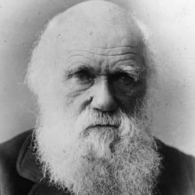
In Depth
See Also

Charles Darwin

Charles Robert Darwin was an English England

England is the largest and most populous constituent country [i] of the United Kingdom [i]. ... 

 naturalist Natural history

Natural history is an umbrella term [i] for what are now usually viewed as several distinct scientific disciplines [i] ... 

 who achieved lasting fame by producing considerable evidence that species originated through evolution Evolution

In biology [i], evolution is the change in the heritable [i] traits [i] of a population [i] ... 

ary change, at the same time proposing the scientific theory that natural selection Natural selection

Natural selection is the process by which individual organism [i]s with favorable trait [i]s are ... 

 is the mechanism by which such change occurs. This theory is now considered a cornerstone of biology Biology

Biology is the branch of science [i] dealing with the study of life [i]. ... 

. Darwin developed an interest in natural history while studying first medicine Medicine

Medicine is the branch of health science [i] and the sector of public life concerned with maintaining or ... 

, then theology Theology

Theology is reasoned discourse [i] concerning religion [i], spirituality [i] and God [i]. ... 

, at university. Darwin's observations on his five-year voyage The Voyage of the Beagle

The Voyage of the Beagle is a title commonly given to the book [i] written by Charles Darwin [i] pub ... 

 on the Beagle HMS Beagle

HMS Beagle was a Cherokee class [i] 10-gun brig [i] of the Royal Navy [i] ... 

 brought him eminence as a geologist Geology

Geology anetary geology]] [i] refers to the application of geologic principles to other bodies of the solar... 

 and fame as a popular author.

Discussions

  Discussion Features

   Ask a question about 'Charles Darwin'

   Start a new discussion about 'Charles Darwin'

   Answer questions about 'Charles Darwin'

   'Charles Darwin' discussion forum

Timeline

1809   Born

1820   Launch of HMS Beagle HMS Beagle

HMS Beagle was a Cherokee class [i] 10-gun brig [i] of the Royal Navy [i] ... 

 the ship that took young Charles Darwin on his scientific voyage.

1831   Charles Darwin embarks on his historic journey aboard the HMS ''Beagle'' HMS Beagle

HMS Beagle was a Cherokee class [i] 10-gun brig [i] of the Royal Navy [i] ... 

.

1835   Charles Darwin arrives at Galapagos Islands Galápagos Islands

The Galpagos Islands are an archipelago [i] made up of 13 main volcanic islands [i] ... 

 aboard ''HMS Beagle''

1836   Charles Darwin returns to England England

England is the largest and most populous constituent country [i] of the United Kingdom [i]. ... 

 aboard the HMS ''Beagle'' HMS Beagle

HMS Beagle was a Cherokee class [i] 10-gun brig [i] of the Royal Navy [i] ... 

 with biological data he will later use to develop his theory of evolution Evolution

In biology [i], evolution is the change in the heritable [i] traits [i] of a population [i] ... 

.

1844   The anonymous Vestiges of the Natural History of Creation is published and paves the way for the acceptance of Darwin Charles Darwin

Charles Robert Darwin was an English [i] naturalist [i] who achieved lasting fa ... 

's book The Origin of Species The Origin of Species

First published on November 24 [i], 1859 [i], The Origin of Species by English [i] naturalist [i] ... 

.

1859   British United Kingdom

The United Kingdom of Great Britain and Northern Ireland is a country and sovereign state [i] tha ... 

 naturalist Charles Darwin publishes ''The Origin of Species The Origin of Species

First published on November 24 [i], 1859 [i], The Origin of Species by English [i] naturalist [i] ... 

'', a book which argues that organism Organism

In biology [i] and ecology [i], an organism is a living [i] complex adaptive system [i] ... 

s gradually evolve Evolution

In biology [i], evolution is the change in the heritable [i] traits [i] of a population [i] ... 

 through natural selection Natural selection

Natural selection is the process by which individual organism [i]s with favorable trait [i]s are ... 

. (It immediately sold out its initial print run.)

1882   Died

1925   Scopes Trial Scopes Trial

The "Scopes Trial" pitted against each other lawyer [i]s William Jennings Bryan [i] and Clarence Darrow [i] ... 

: Dayton, Tennessee Dayton, Tennessee

Dayton is a city in Rhea County [i], Tennessee [i], United States [i]. ... 

, biology teacher John Scopes is arrested for teaching Charles Darwin's Theory of Evolution Evolution

In biology [i], evolution is the change in the heritable [i] traits [i] of a population [i] ... 

.

1925   Scopes Trial Scopes Trial

The "Scopes Trial" pitted against each other lawyer [i]s William Jennings Bryan [i] and Clarence Darrow [i] ... 

: John T. Scopes is indicted for teaching Darwin Charles Darwin

Charles Robert Darwin was an English [i] naturalist [i] who achieved lasting fa ... 

's theory of evolution Evolution

In biology [i], evolution is the change in the heritable [i] traits [i] of a population [i] ... 

.

   More Events >>


Quotations

It may be doubted whether any character can be named which is distinctive of a race and is constant.

One general law, leading to the advancement of all organic beings, namely, multiply, vary, let the strongest live and the weakest die.

I feel most deeply that this whole question of Creation is too profound for human intellect. A dog might as well speculate on the mind of Newton! Let each man hope and believe what he can.

London Illustrated News (21 April 1862)

Ignorance more frequently begets confidence than does knowledge: it is those who know little, not those who know much, who so positively assert that this or that problem will never be solved by science.

I have attempted to write the following account of myself, as if I were a dead man in another world looking back at my own life. Nor have I found this difficult, for life is nearly over with me. I have taken no pains about my style of writing.

Chapter 2 "Autobiography"

       More Quotes >>


Encyclopedia

Charles Robert Darwin was an English England

England is the largest and most populous constituent country [i] of the United Kingdom [i]. ... 

 naturalist Natural history

Natural history is an umbrella term [i] for what are now usually viewed as several distinct scientific disciplines [i] ... 

 who achieved lasting fame by producing considerable evidence that species originated through evolution Evolution

In biology [i], evolution is the change in the heritable [i] traits [i] of a population [i] ... 

ary change, at the same time proposing the scientific theory that natural selection Natural selection

Natural selection is the process by which individual organism [i]s with favorable trait [i]s are... 

 is the mechanism by which such change occurs. This theory is now considered a cornerstone of biology Biology

Biology is the branch of science [i] dealing with the study of life [i]. ... 

.

Darwin developed an interest in natural history while studying first medicine Medicine

Medicine is the branch of health science [i] and the sector of public life concerned with maintaining or ... 

, then theology Theology

Theology is reasoned discourse [i] concerning religion [i], spirituality [i] and God [i]. ... 

, at university. Darwin's observations on his five-year voyage The Voyage of the Beagle

The Voyage of the Beagle is a title commonly given to the book [i] written by Charles Darwin [i] pub ... 

 on the Beagle HMS Beagle

HMS Beagle was a Cherokee class [i] 10-gun brig [i] of the Royal Navy [i] ... 

 brought him eminence as a geologist Geology

Geology anetary geology]] [i] refers to the application of geologic principles to other bodies of the solar... 

 and fame as a popular author. His biological finds led him to study the transmutation of species and in 1838 he conceived his theory of natural selection. Fully aware that others had been severely punished for such "heretical" ideas, he confided only in his closest friends and continued his research to meet anticipated objections. However, in 1858 the information that Alfred Russel Wallace Alfred Russel Wallace

Alfred Russel Wallace, OM [i], FRS [i] was a Welsh naturalist [i]... 

 had developed a similar theory forced an early joint publication of the theory.

His 1859 book On the Origin of Species by Means of Natural Selection, or The Preservation of Favoured Races in the Struggle for Life established evolution by common descent as the dominant scientific explanation of diversification in nature. He was made a Fellow of the Royal Society, continued his research, and wrote a series of books on plants and animals, including humankind, notably The Descent of Man, and Selection in Relation to Sex The Descent of Man, and Selection in Relation to Sex

The Descent of Man, and Selection in Relation to Sex is a book on evolution [i]ary theory by British [i] ... 

and The Expression of the Emotions in Man and Animals.

In recognition of Darwin's preeminence, he was buried in Westminster Abbey Westminster Abbey

The Collegiate Church of St Peter, Westminster, which is almost always referred to as Westminster Abb... 

, close to John Herschel John Herschel

Sir John Frederick William Herschel, 1st Baronet KH [i] was an English [i] ... 

 and Isaac Newton Isaac Newton

[i] [[[Old Style and New Style dates|OS]] [i]: [[25 December]] [i] [[1642]] [i]... 

.

Life


Early life


Charles Darwin was born in Shrewsbury, Shropshire Shrewsbury

Shrewsbury is a town of 70,059 inhabitants in Shropshire [i], England [i]. ... 

, England England

England is the largest and most populous constituent country [i] of the United Kingdom [i]. ... 

 on 12 February 1809 at his family home, the Mount House. He was the fifth of six children of wealthy society doctor Robert Darwin Robert Darwin

Dr Robert Waring Darwin, F.R.S. [i] was a Shrewsbury [i]-based medical doctor [i] ... 

 and Susannah Darwin Robert Darwin

Dr Robert Waring Darwin, F.R.S. [i] was a Shrewsbury [i]-based medical doctor [i] ... 

 . He was the grandson of Erasmus Darwin Erasmus Darwin

Erasmus Darwin trained as a physician [i] and wrote extensively on the subjects of medicine and botany. ... 

 on his father's side, and of Josiah Wedgwood Josiah Wedgwood

Josiah Wedgwood was an English [i] potter, credited with the industrialization [i] ... 

 on his mother's side, both from the Darwin — Wedgwood family Darwin — Wedgwood family

The Darwin — Wedgwood family was a prominent English [i] family, descended from Erasmus Darwin [i] ... 

, a prominent English family which supported the Unitarian Unitarianism

Historic Unitarianism believed in the oneness of God [i] and not the Christian [i] doctrine... 

 church. His mother died when he was only eight. He went to the nearby Shrewsbury School Shrewsbury School

King Edward VI Grammar School, Shrewsbury, normally known simply Shrewsbury School is one of the l... 

 the next year as a boarder.

In 1825, after spending the summer as an apprentice doctor, helping his father with treating the poor of Shropshire Shropshire

Shropshire is a traditional [i], ceremonial and non-metropolitan county [i] ... 

, Darwin went to the University of Edinburgh University of Edinburgh

The University of Edinburgh, founded in 1583 [i], is a renowned centre for teaching and research in Edinburgh [i] ... 

 to study medicine. However, his revulsion at the brutality of surgery led him to neglect his medical studies. He learned taxidermy Taxidermy

Taxidermy is the art of mounting or reproducing animal [i]s for display or study. ... 

 from John Edmonstone, a freed black slave who told him exciting tales of the South American rainforest Rainforest

A rainforest, or a wet forest, is a forest [i]ed biome [i] with high annual rain [i]fall. ... 

. In Darwin's second year he became active in student societies for naturalists Natural history

Natural history is an umbrella term [i] for what are now usually viewed as several distinct scientific disciplines [i] ... 

. He became an avid pupil of Robert Edmund Grant, who pioneered development of the theories of Jean-Baptiste Lamarck Jean-Baptiste Lamarck

Jean-Baptiste Pierre Antoine de Monet, Chevalier de Lamarck was a French [i] naturalist and an ea ... 

 and of Charles' grandfather Erasmus concerning evolution by acquired characteristics. Darwin took part in Grant's investigations of the life cycle of marine animals on the shores of the Firth of Forth Firth of Forth

The Firth of Forth is the estuary [i] or firth [i] of Scotland's [i] River Forth [i], where it ... 

 which found evidence for homology, the radical theory that all animals have similar organs and differ only in complexity. In March 1827, Darwin made a presentation to the Plinian society of his own discovery that the black spores often found in oyster shells were the eggs of a skate leech. He also sat in on Robert Jameson Robert Jameson

Professor Robert Jameson was a Scottish [i] naturalist [i] and mineralogist [i] ... 

's natural history course, learning about stratigraphic geology Geology

Geology anetary geology]] [i] refers to the application of geologic principles to other bodies of the solar... 

, receiving training in how to classify plants Alpha taxonomy

Taxonomy, sometimes alpha taxonomy, is the science [i] of finding, describing and naming [i] ... 

, and assisting with work on the extensive collections of the Museum of Edinburgh University Royal Museum

The Royal Museum is a museum [i] on Chambers Street, in Edinburgh [i], Scotland [i]. ... 

, one of the largest museums in Europe at the time.

In 1827, his father, unhappy that his younger son had no interest in becoming a physician, shrewdly enrolled him in a Bachelor of Arts course at Christ's College Christ's College, Cambridge

Christs College is one of the colleges [i] of the University of Cambridge [i]... 

, University of Cambridge University of Cambridge

name = University of Cambridge
... 

 to qualify as a clergyman. This was a sensible career move at a time when many Anglican Anglicanism

The term Anglican is used to describe the people, institutions, and churches as well as the liturgi... 

 parsons were provided with a comfortable income, and when most naturalists in England were clergymen who saw it as part of their duties to explore the wonders of God's creation. At Cambridge, Darwin preferred riding and shooting to studying. Along with his cousin William Darwin Fox William Darwin Fox

The Reverend William Darwin Fox was an English clergyman, naturalist, palaeontologist, and a 2nd cousin ... 

, he became engrossed in the craze at the time for the competitive collecting of beetle Beetle

Beetles are the most diverse group of insect [i]s. ... 

s, and Fox introduced him to the Reverend John Stevens Henslow John Stevens Henslow

John Stevens Henslow was an English [i] botanist [i] and geologist [i]. ... 

, professor of botany Botany

Botany is the scientific study [i] of plant [i]life [i]. ... 

, for expert advice on beetles. Darwin subsequently joined Henslow's natural history course, became his favourite pupil and came to be known as "the man who walks with Henslow". When exams began to loom, Darwin focused more on his studies and received private instruction from Henslow. Darwin became particularly enthused by the writings of William Paley William Paley

William Paley was an English [i] divine, Christian apologist [i], utilitarian [i] ... 

, including the argument of divine design in nature. In his finals in January 1831, he performed well in theology and, having scraped through in classics Classics

Classics, particularly within the Western [i] university [i] tradition, when used as a sin ... 

, mathematics Mathematics

Mathematics is the discipline that deals with concepts such as quantity [i], structure [i], space [i] a ... 

 and physics Physics

Physics , the most fundamental physical science [i], is concerned with the underlying principles of the ... 

, came tenth out of a pass list of 178.

Residential requirements kept Darwin at Cambridge until June. In keeping with Henslow's example and advice, he was in no rush to take holy orders. Inspired by Alexander von Humboldt Alexander von Humboldt

Friedrich Wilhelm Heinrich Alexander Freiherr [i] von Humboldt,, was a Prussian [i] naturalist [i]... 

's Personal Narrative, he planned to visit the Madeira Islands Madeira

Madeira is a Portuguese [i] archipelago [i] in the north Atlantic Ocean [i] that lies between ... 

 to study natural history in the tropics with some classmates after graduation. To prepare himself for this project, Darwin joined the geology course of the Reverend Adam Sedgwick Adam Sedgwick

Adam Sedgwick was one of the founders of modern geology [i]. ... 

, a strong proponent of divine design History of creationism

The history of creationism is tied to the history of religions [i]. ... 

, then in the summer went with him to assist in mapping strata in Wales Wales

Wales is one of four constituent parts [i] of the United Kingdom [i]. ... 

. Darwin was surveying strata on his own when his plans to visit Madeira were dashed by a message that his intended companion had died, but on his return home he received another letter. Henslow had recommended Darwin for the unpaid position of gentleman's companion to Robert FitzRoy Robert FitzRoy

Vice-Admiral [i] Robert FitzRoy achieved lasting fame as the captain of HMS Beagle [i] an ... 

, the captain of HMS Beagle HMS Beagle

HMS Beagle was a Cherokee class [i] 10-gun brig [i] of the Royal Navy [i] ... 

, on a two-year expedition to chart the coastline of South America South America

South America is a continent [i] situated in the western hemisphere [i] and, mostly, ... 

 which would give Darwin valuable opportunities to develop his career as a naturalist. His father objected to the voyage, regarding it as a waste of time, but was persuaded by his brother-in-law, Josiah Wedgwood, to agree to his son's participation. This voyage became a five-year expedition that would lead to dramatic changes in many fields of science.

Journey on the Beagle


The Beagle survey took five years, two-thirds of which Darwin spent exploring on land. He studied a rich variety of geological features, fossil Fossil

Fossils are the mineral [i]ized or otherwise preserved remains or traces of animals, plants, and other ... 

s and living organisms, and met a wide range of people, both native and colonial. He methodically collected an enormous number of specimens, many of them new to science. This established his reputation as a naturalist and made him one of the precursors of the field of ecology Ecology

Ecology, or ecological science, is the scientific study of the distribution and abundance of living organisms [i] ... 

, particularly the notion of biocoenosis. His extensive detailed notes showed his gift for theorising and formed the basis for his later work, as well as providing social, political and anthropological Anthropology

Anthropology consists of the study of humanity [i] . ... 

 insights into the areas he visited.

On the voyage, Darwin read Charles Lyell Charles Lyell

Sir Charles Lyell, 1st Baronet Kt [i] , Scottish [i] lawyer [i], geologist [i]... 

's Principles of Geology, which explained geological features as the outcome of gradual processes over huge periods of time, and wrote home that he was seeing landforms "as though he had the eyes of Lyell": he saw stepped plains of shingle and seashells in Patagonia Patagonia

Patagonia is the portion of South America [i] in Argentina [i] and Chile [i] made up of the Andes [i] mo ... 

 as raised beaches; in Chile Chile

Chile, officially the Republic of Chile , is a country in South America [i] occupying a long coast ... 

, he experienced an earthquake and noted mussel Mussel

[i]
... 

-beds stranded above high tide showing that the land had been raised; and even high in the Andes Andes

The Andes is the world's longest mountain range [i], forming a continuous chain of highland along the w ... 

, he was able to collect seashells. He theorised that coral Coral

Corals are marine animals of the , which include sea anemone [i]s .... 

 atoll Atoll

An atoll is a type of low, coral [i] island [i] found in tropical [i] ocean [i]s and consisting ... 

s form on sinking volcanic mountains, an idea he confirmed when the Beagle surveyed the Cocos Islands.

In South America South America

South America is a continent [i] situated in the western hemisphere [i] and, mostly, ... 

 he discovered fossils of gigantic extinct mammals including megatheria Megatherium

Megatheriinae were a group of elephant [i]-sized ground sloth [i]s that lived from 2 million to 8,000 ye... 

 and glyptodon Glyptodon

Glyptodon was a relative of the armadillo [i] that lived during the Pleistocene [i] Epoch [i]. ... 

s in strata which showed no signs of catastrophe or change in climate. At the time, he thought them similar to African species, but after the voyage Richard Owen Richard Owen

Sir Richard Owen KCB [i] was an English [i] biologist [i] ... 

 showed that the remains were of animals related to living creatures in the same area. In Argentina Argentina

Argentina is a country in southern South America [i]. ... 

 two species of rhea had separate but overlapping territories. On the Galápagos Islands Galápagos Islands

The Galpagos Islands are an archipelago [i] made up of 13 main volcanic islands [i] ... 

 Darwin found that mockingbird Mockingbird

Mockingbirds are a group of New World [i] passerine [i] bird [i]s best known for the habit of some speci ... 

s differed from one island to another, and on returning to Britain he was shown that Galápagos tortoises and finch Finch

Finches are passerine [i] bird [i]s, often seed [i]-eating, found chiefly in the northern hemisphere and ... 

es were also in distinct species based on the individual islands they inhabited. The Australia Australia

Australia, officially the Commonwealth of Australia, is a country in the Southern Hemisphere [i] c ... 

n marsupial Marsupial

Marsupials are mammal [i]s in which the female typically has a pouch [i] in which it rears its y ... 

 rat-kangaroo Potoroidae

The marsupial [i] family Potoroidae includes the bettong [i]s, potoroo [i]s and two of the rat-kangaroo [i] ... 

 and platypus Platypus

The platypus is a 39–60 cm long, semi-aquatic [i] mammal [i] endemic [i] to eastern Australia [i] ... 

 were such strikingly unusual animals that on 19 January 1836, in
New South Wales, he recorded this in his journal:

I had been lying on a sunny bank & was reflecting on the strange character of the Animals of this country as compared with the rest of the World. An unbeliever in every thing beyond his own reason, might exclaim ‘Surely two distinct Creators must have been [at] work; their object however has been the same & certainly the end in each case is complete’.

He puzzled over all he saw, and, in the first edition of The Voyage of the Beagle The Voyage of the Beagle

The Voyage of the Beagle is a title commonly given to the book [i] written by Charles Darwin [i] pub ... 

, he explained species distribution in light of Charles Lyell Charles Lyell

Sir Charles Lyell, 1st Baronet Kt [i] , Scottish [i] lawyer [i], geologist [i]... 

's ideas of "centres of creation". In later editions of this Journal he foreshadowed his use of Galápagos Islands fauna as evidence for evolution: "one might really fancy that from an original paucity of birds in this archipelago, one species had been taken and modified for different ends."

Three native missionaries were returned by the Beagle to Tierra del Fuego Tierra del Fuego

Tierra del Fuego , an archipelago [i], 28,476 sq mi , separated from the mainland by the Strait of Magellan [i] ... 

. They had become "civilised" in England over the previous two years, yet their relatives appeared to Darwin to be "miserable, degraded savages". Within a year, the missionaries had reverted to their harsh previous way of life, yet they preferred this and did not want to return to England. This experience, his detestation of the slavery Slavery

Slavery is the social and legal designation of specific person [i]s as property [i] or chattel, for the ... 

 he saw elsewhere in South America, and other problems he found about such as the effect of European settlement on aborigines in New Zealand New Zealand

New Zealand is a country in the south-western Pacific Ocean [i] consisting of two large islands and many ... 

 and Australia, persuaded him that there was no moral justification for the mistreating of others based on the concept of race. He now thought that humanity was not as far removed from animals as his clerical friends believed.

While on board the ship, Darwin suffered from seasickness. In October 1833 he caught a fever in Argentina, and in July 1834, while returning from the Andes down to Valparaíso Valparaíso

Valparaso is arguably the most important Chilean seaport and cultural center.... 

, he fell ill and spent a month in bed. From 1837 onwards Darwin was repeatedly incapacitated with episodes of stomach pains, vomiting, severe boils, palpitations, trembling and other symptoms. These symptoms particularly affected him at times of stress, such as when attending meetings or dealing with controversy over his theory. The cause of Darwin's illness Charles Darwin's illness

For much of his adult life Charles Darwin's illness repeatedly affected him with an uncommon combination... 

 was unknown during his lifetime, and attempts at treatment had little success. Recent speculation has suggested he caught Chagas disease Chagas disease

Chagas disease is a human tropical [i] parasitic disease [i] which occurs in the Americas [i] ... 

 from insect bites in South America, leading to the later problems. Other possible causes include psychobiological problems and Ménière's disease.

Career in science, inception of theory


While Darwin was still on the voyage, Henslow John Stevens Henslow

John Stevens Henslow was an English [i] botanist [i] and geologist [i]. ... 

 carefully fostered his former pupil's reputation by giving selected naturalists access to the fossil specimens and printed copies of Darwin's geological writings. When the Beagle returned on 2 October 1836, Darwin was a celebrity in scientific circles. He visited his home in Shrewsbury and his father organised investments so that Darwin could become a self-funded gentleman scientist. Darwin then went to Cambridge Cambridge

The city [i] of Cambridge is an old English [i] university [i] ... 

 and persuaded Henslow to work on botanical descriptions of modern plants he had collected. Afterwards Darwin went round the London London

London is the capital [i] city of England [i] and of the United Kingdom [i]. ... 

 institutions to find the best naturalists available to describe his other collections for timely publication. An eager Charles Lyell Charles Lyell

Sir Charles Lyell, 1st Baronet Kt [i] , Scottish [i] lawyer [i], geologist [i]... 

 met Darwin on 29 October and introduced him to the up-and-coming anatomist Richard Owen Richard Owen

Sir Richard Owen KCB [i] was an English [i] biologist [i] ... 

. After working on Darwin's collection of fossil bones at his Royal College of Surgeons, Owen caused great surprise by revealing that some were from gigantic extinct rodent Rodent

Rodentia is an order [i] of mammal [i]s . Members of the order Rodentia are called rodents. ... 

s and sloth Sloth

Sloths are medium-sized South America [i]n mammal [i]s belonging to the families [i] Megalonychidae [i] ... 

s. This enhanced Darwin's reputation. With Lyell's enthusiastic backing, Darwin read his first paper to the Geological Society of London on 4 January 1837, arguing that the South American landmass was slowly rising. On the same day Darwin presented his mammal and bird specimens to the Zoological Society. The Mammalia were taken on by George R. Waterhouse. Though the birds seemed almost an afterthought, the ornithologist John Gould John Gould

John Gould was an English [i] ornithologist [i]. ... 

 revealed that what Darwin had taken to be wrens, blackbirds and slightly differing finches from the Galápagos were all finches, but each was a separate species. Others on the Beagle, including FitzRoy, had also collected these birds and had been more careful with their notes, enabling Darwin to determine from which island each species had come.

In London, Darwin stayed with his freethinking Freethought

Freethought is a philosophical [i] doctrine that holds that belief [i]s should be formed on t ... 

 brother Erasmus and at dinner parties met inspiring savants who thought that God preordained life by natural laws rather than ad hoc miraculous creations. His brother's lady friend Miss Harriet Martineau Harriet Martineau

Harriet Martineau was an English [i] writer [i] and philosopher [i], renowned in her day as a co ... 

 was a writer whose stories promoted Malthusian Thomas Malthus

Rev. Thomas Robert Malthus, FRS [i] , usually known as Thomas Malthus, although he p ... 

 Whig Poor Law reforms. Scientific circles were buzzing with ideas of transmutation of species controversially associated with Radical unrest. Darwin preferred the respectability of his friends the Cambridge Dons, even though his ideas were pushing beyond their belief that natural history Natural history

Natural history is an umbrella term [i] for what are now usually viewed as several distinct scientific disciplines [i] ... 

 must justify religion and social order.


On 17 February 1837, Lyell used his presidential address at the Geographical Society to present Owen's findings to date on Darwin's fossils, noting particularly the unexpected implication that extinct species were related to current species in the same locality. At the same meeting Darwin was elected to the Council of the Society. He had already been invited by FitzRoy to contribute a Journal based on his field notes as the natural history section of the captain's account of the Beagles voyage. He now plunged into writing a book on South American Geology. At the same time he speculated on transmutation in his Red Notebook which he had begun on the Beagle. Another project he started was getting the expert reports on his collection published as a multivolume Zoology of the Voyage of H.M.S. Beagle, and Henslow used his contacts to arrange a Treasury grant of £1,000 to sponsor this. Darwin finished writing his Journal around 20 June when King William IV William IV of the United Kingdom

William IV was King of the United Kingdom [i] and of Hanover [i] from 26 June [i] 1830 [i] un ... 

 died and the Victorian Victoria of the United Kingdom

Victoria was the Queen [i] of the United Kingdom of Great Britain and Ireland [i] ... 

 era began. In mid-July he began his secret
"B" notebook on transmutation, and developed the hypothesis that where every island in the Galápagos Archipelago had its own kind of tortoise, these had originated from a single tortoise species and had adapted to life on the different islands in different ways.

Under pressure with organising
Zoology and correcting proofs of his Journal, Darwin's health suffered. On 20 September 1837 he suffered "palpitations of the heart" and left for a month of recuperation in the country. He visited Maer Hall where his invalid aunt was being cared for by her spinster daughter Emma Wedgwood Emma Darwin

Emma Darwin was the wife of the English [i] naturalist Charles Darwin [i] and mother to their te ... 

, and entertained his relatives with tales of his travels. His uncle Jos pointed out an area of ground where cinders had disappeared under loam and suggested that this might have been the work of earthworms. This led Darwin to the idea for a talk which he gave to the Geological Society on 1 November, on the unusually mundane subject of worm casts. This work is considered to be the first scholarly treatment of soil forming processes. He had avoided taking on official posts which would have taken up valuable time, but by March William Whewell William Whewell

William Whewell was an English polymath [i], scientist, Anglican [i] priest [i], philosopher [i], theologian [i] ... 

 had recruited him as Secretary of the Geological Society. Illness prompted Darwin to take a break from the pressure of work and he went "geologising" in Scotland. In glorious weather he visited Glen Roy to see the phenomenon known as "roads" which he identified as raised beaches.


Fully recuperated, he returned home to Shrewsbury. Scientifically pondering his career and prospects he drew up a list with columns headed "Marry" and "Not Marry". Entries in the pro-marriage column included "constant companion and a friend in old age ... better than a dog anyhow," while listed among the cons were "less money for books" and "terrible loss of time." The pros won out. He discussed the prospect of marriage with his father then went to visit his cousin Emma on 29 July 1838. He did not get around to proposing, but against his father's advice he told her of his ideas on transmutation. While his thoughts and work continued in London over the autumn he suffered repeated bouts of illness. On 11 November he returned and proposed to Emma, once more telling her his ideas. She accepted, but later wrote beseeching him to read from the Gospel of St. John a section on love and following the Way which also states that "If a man abide not in me...they are burned". He sent a warm reply which eased her concern, but she would continue to worry that his lapses of faith could endanger her hope that they would meet in afterlife.

Darwin considered Malthus's Thomas Malthus

Rev. Thomas Robert Malthus, FRS [i] , usually known as Thomas Malthus, although he p ... 

 argument that human population increases more quickly than food production, leaving people competing for food and making charity useless. He later formulated this in the terms of his biological theory as: "Man tends to increase at a greater rate than his means of subsistence; consequently he is occasionally subjected to a severe struggle for existence, and natural selection will have effected whatever lies within its scope." He related this to the findings about species relating to localities, his enquiries into animal breeding, and ideas of Natural "laws of harmony". Towards the end of November 1838 he compared breeders selecting traits to a Malthusian Nature selecting from variants thrown up by "chance" so that "every part of newly acquired structure is fully practised and perfected", and thought this "the most beautiful part of my theory" of how species originated. He went house-hunting and eventually found "Macaw Cottage" in Gower Street, London, then moved his "museum" in over Christmas. He was showing the stress, and Emma wrote urging him to get some rest, almost prophetically remarking "So don't be ill any more my dear Charley till I can be with you to nurse you." On 24 January 1839 he was honoured by being elected as Fellow of the Royal Society Royal Society

The Royal Society of London for the Improvement of Natural Knowledge, known simply as the Royal Socie... 

 and presented his paper on the Roads of Glen Roy.

Marriage and children


On 29 January 1839, Darwin married his cousin Emma Wedgwood Emma Darwin

Emma Darwin was the wife of the English [i] naturalist Charles Darwin [i] and mother to their te ... 

 at Maer in an Anglican Anglicanism

The term Anglican is used to describe the people, institutions, and churches as well as the liturgi... 

 ceremony arranged to also suit the Unitarian Unitarianism

Historic Unitarianism believed in the oneness of God [i] and not the Christian [i] doctrine... 

s.
After first living in Gower Street, London London

London is the capital [i] city of England [i] and of the United Kingdom [i]. ... 

, the couple moved on 17 September 1842 to Down House Down House

Down House is the former home of the English naturalist Charles Darwin [i] and his family. ... 

 in Downe Downe

Downe is a village [i] in the London Borough of Bromley [i], England [i].
... 

. The Darwins had ten children, three of whom died early. Many of his surviving children and their grandchildren would later achieve notability themselves

  • William Erasmus Darwin
  • Anne Elizabeth Darwin Anne Darwin

    Anne Elizabeth "Annie" Darwin was the second child and eldest daughter of Charles [i] and... 

  • Mary Eleanor Darwin
  • Henrietta Emma "Etty" Darwin
  • George Howard Darwin George Darwin

    Sir George Howard Darwin, F.R.S. [i] was a British astronomer [i] and mathematician [i] ... 

  • Elizabeth "Bessy" Darwin Darwin — Wedgwood family

    The Darwin — Wedgwood family was a prominent English [i] family, descended from Erasmus Darwin [i] ... 

  • Francis Darwin Francis Darwin

    Sir Francis "Frank" Darwin, F.R.S. [i], a son of the British [i] ... 

  • Leonard Darwin Leonard Darwin

    Major Leonard Darwin, a son of the British [i] naturalist Charles Darwin [i], was various ... 

  • Horace Darwin
  • Charles Waring Darwin


Several of their children suffered illness or weaknesses, and Charles Darwin's fear that this might be due to the closeness of his and Emma's lineage was expressed in his writings on the ill effects of inbreeding and advantages of crossing.

Development of theory


Darwin was now an eminent geologist in the scientific élite of clerical naturalists, settled with a private income, while privately working on his theory. He had a vast amount of work to do, writing up all his findings and supervising the preparation of the multivolume Zoology, which would describe his collections. He embarked on extensive experiments with plants and consultations with animal husbanders Animal husbandry

Animal husbandry is the agricultural [i] practice of breeding [i] and raising livestock [i]. ... 

, including pigeon and pig breeders, trying to find soundly based answers to all the arguments he anticipated when he presented his theory in public.

When FitzRoy's account was published in May 1839, Darwin's Journal and Remarks was a great success. Later that year it was published on its own, becoming the bestseller today known as The Voyage of the Beagle The Voyage of the Beagle

The Voyage of the Beagle is a title commonly given to the book [i] written by Charles Darwin [i] pub ... 

. In December 1839, as Emma's first pregnancy progressed, Darwin suffered more illness and accomplished little during the following year.

Darwin tried to explain his theory to close friends, but they were slow to show interest and thought that selection must need a divine selector. In 1842 the family moved to rural Down House Down House

Down House is the former home of the English naturalist Charles Darwin [i] and his family. ... 

 to escape the pressures of London. Darwin formulated a short "Pencil Sketch" of his theory, and by 1844 had written a 240-page "Essay" that expanded his early ideas on natural selection. Darwin completed his third Geological book in 1846. Assisted by his friend, the young botanist Joseph Dalton Hooker Joseph Dalton Hooker

Sir Joseph Dalton Hooker, GCSI [i], OM [i], FRS [i] ... 

, he embarked on a huge study of barnacles Barnacle

A barnacle is a type of arthropod [i] belonging to infraclass [i] Cirripedia in the subphylum [i]... 

. In 1847, Hooker read the "Essay" and sent notes that provided Darwin with the calm critical feedback that he needed.

Darwin feared putting the theory out in an incomplete form, as his ideas about evolution would be highly controversial if any attention was paid to them at all. Other ideas about evolution — especially the work of Jean-Baptiste Lamarck Jean-Baptiste Lamarck

Jean-Baptiste Pierre Antoine de Monet, Chevalier de Lamarck was a French [i] naturalist and an ea ... 

 — had been soundly dismissed by the British scientific community, and were associated with political radicalism. The anonymous publication of Vestiges of the Natural History of Creation in 1844 created another controversy over radicalism and evolution, and was severely attacked by Darwin's friends who stressed that no reputable scientist would want to be associated with such ideas.

To try to deal with his illness, Darwin went to a spa in Malvern Great Malvern

Great Malvern is a town in Worcestershire [i], England [i], positioned at the foot, and partly on the si... 

 in 1849, and to his surprise found that the two months of water treatment helped. In his work on barnacles he found "homologies" that supported his theory by showing that slightly changed body parts could serve different functions to meet new conditions. Then his treasured daughter Annie fell ill, reawakening his fears that his illness might be hereditary. After a long series of crises, she died and Darwin lost all faith in a beneficent God.

He met the young freethinking naturalist Thomas Huxley Thomas Huxley

Thomas Henry Huxley, FRS [i] was an English [i] biologist [i], known as "D... 

 who was to become a close friend and ally. Darwin's work on barnacles earned him the Royal Society Royal Society

The Royal Society of London for the Improvement of Natural Knowledge, known simply as the Royal Socie... 

's Royal Medal in 1853, establishing his reputation as a biologist Biology

Biology is the branch of science [i] dealing with the study of life [i]. ... 

. He completed this study in 1854 and turned his attention to his theory of species.

Announcement and publication of theory


Darwin found an answer to the problem of how genera forked in an analogy with industrial ideas of division of labour, with specialised varieties each finding their niche so that species could diverge. He experimented with seeds, testing their ability to survive sea-water to transfer species to isolated islands, and bred pigeons to test his ideas of natural selection being comparable to the "artificial selection" used by pigeon breeders.

In the spring of 1856, Lyell read a paper on the Introduction of species by Alfred Russel Wallace Alfred Russel Wallace

Alfred Russel Wallace, OM [i], FRS [i] was a Welsh naturalist [i]... 

, a naturalist working in Borneo Borneo

Borneo is the third largest island in the world [i].... 

. Lyell urged Darwin to publish his theory to establish precedence. Despite illness, Darwin began a 3-volume book titled Natural Selection, getting specimens and information from naturalists including Wallace and Asa Gray Asa Gray

Asa Gray is considered the most important American [i] botanist [i] of the 19th century [i] ... 

. In December 1857 as Darwin worked on the book he received a letter from Wallace asking if it would delve into human origins. Sensitive to Lyell's fears, Darwin responded that "I think I shall avoid the whole subject, as so surrounded with prejudices, though I fully admit that it is the highest & most interesting problem for the naturalist." He encouraged Wallace's theorising, saying "without speculation there is no good & original observation." Darwin added that "I go much further than you." His manuscript reached 250,000 words, then on 18 June 1858 he received a paper in which Wallace described the evolutionary mechanism and requested him to send it on to Lyell. Darwin did so, shocked that he had been "forestalled". Though Wallace had not asked for publication, Darwin offered to send it to any journal that Wallace chose. He put matters in the hands of Lyell and Hooker. They agreed on a joint presentation at the Linnean Society on 1 July of On the Tendency of Species to form Varieties; and on the Perpetuation of Varieties and Species by Natural Means of Selection. Darwin's infant son died and he was unable to attend.

The initial announcement of the theory gained little immediate attention. It was mentioned briefly in a few small reviews, but to most people it seemed much the same as other varieties of evolutionary thought Evolutionism

Evolutionism, from the Latin [i] evolutio, unrolling, refers to theories that certain things develop ... 

. For the next thirteen months Darwin suffered from ill health and struggled to produce an abstract of his "big book on species". Receiving constant encouragement from his scientific friends, Darwin finally finished his abstract and Lyell arranged to have it published by John Murray. The title was agreed as On the Origin of Species by Means of Natural Selection The Origin of Species

First published on November 24 [i], 1859 [i], The Origin of Species by English [i] naturalist [i] ... 

, and when the book went on sale to the trade on 22 November 1859, the stock of 1,250 copies was oversubscribed. At the time "Evolutionism" implied creation without divine intervention, and Darwin avoided using the words "evolution" or "evolve", though the book ends by stating that "endless forms most beautiful and most wonderful have been, and are being, evolved." The book only briefly alluded to the idea that human beings, too, would evolve in the same way as other organisms. Darwin wrote in deliberate understatement that "light will be thrown on the origin of man and his history."

Reaction


Darwin's book set off a public controversy which he monitored closely, keeping press cuttings of thousands of reviews, articles Essay

An essay is a short work of writing [i] that treats a topic from an author's personal point of view [i]. ... 

, satire Satire

Satire is a technique [i] of writing or art which exposes the follies of its subject ... 

s, parodies Parody

In contemporary usage, a parody is a work that imitates another work in order to ridicule, ironically co... 

 and caricature Caricature

A caricature is a portrait [i] that exaggerates or distorts the essence of a person or thing to create a... 

s. Reviewers were quick to pick out the unstated implications of "men from monkeys", though a Unitarian Unitarianism

Historic Unitarianism believed in the oneness of God [i] and not the Christian [i] doctrine... 

 review was favourable and The Times The Times

The Times is a national newspaper [i] published daily in the United Kingdom [i] since 1785, and unde ... 

published a glowing review by Huxley which included swipes at Richard Owen Richard Owen

Sir Richard Owen KCB [i] was an English [i] biologist [i] ... 

, leader of the scientific establishment Huxley was trying to overthrow. Owen initially appeared neutral, but then wrote a review condemning the book.

The Church of England Church of England

The Church of England is the officially established [i] Christian [i] church [i] ... 

 scientific establishment including Darwin's old Cambridge tutors Sedgwick Adam Sedgwick

Adam Sedgwick was one of the founders of modern geology [i]. ... 

 and Henslow John Stevens Henslow

John Stevens Henslow was an English [i] botanist [i] and geologist [i]. ... 

  reacted against the book, though it was well received by a younger generation of professional naturalists. Then Essays and Reviews by seven liberal Anglican Anglicanism

The term Anglican is used to describe the people, institutions, and churches as well as the liturgi... 

 theologians declared that miracles were irrational , distracting attention away from Darwin.

The most famous confrontation took place at a meeting of the British Association for the Advancement of Science British Association for the Advancement of Science

The British Association or the British Association for the Advancement of Science or the BA ... 

 in Oxford Oxford

Oxford is a city [i] and local government district [i] ... 

. Professor John William Draper delivered a long lecture about Darwin and social progress, then Samuel Wilberforce Samuel Wilberforce

Samuel Wilberforce, English [i] bishop [i], third son of William Wilberforce [i], was born at Clapham Common [i] ... 

, the Bishop Bishop

A bishop is an ordained [i] member of the Christian clergy [i] who, in certain Christian [i]... 

 of Oxford, argued against Darwin. In the ensuing debate Joseph Hooker Joseph Dalton Hooker

Sir Joseph Dalton Hooker, GCSI [i], OM [i], FRS [i] ... 

 argued strongly for Darwin and