
Encyclopedia
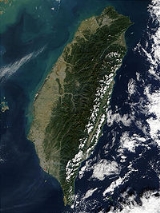
Taiwan is an island in
East Asia, but the term "Taiwan" is also commonly used to collectively refer to the territories governed by the state officially known as the
Republic of China , which include the island of Taiwan,
Lanyu and
Green Island in the
Pacific off the Taiwan coast, the
Pescadores in the
Taiwan Strait, and
Kinmen and Matsu off the southeastern coast of the
People's Republic of China.
The main island of Taiwan, sometimes also referred to as
Formosa , is located at 22°57'N 120°12'E, off the coast of
mainland China, south of
Japan and north of the
Philippines. It is bounded to the east by the
Pacific Ocean, to the south by the
South China Sea and the
Luzon Strait, to the west by the
Taiwan Strait and to the north by the
East China Sea. The island is 394 kilometers long and 144 kilometers wide and consists of steep mountains covered by tropical and subtropical vegetation.
History
Prehistory and early settlement
Evidence of human settlement in Taiwan dates back 30,000 years, although the first inhabitants of Taiwan may have been genetically distinct from any groups currently on the island. About 4,000 years ago, ancestors of current
Taiwanese aborigines settled in Taiwan. These aborigines are genetically related to
Malay and
Polynesians, and linguists classify their language as Austronesian.
Han Chinese began settling in the
Pescadores in the 1200s, but Taiwan's hostile tribes and its lack of the trade resources valued in that era rendered it unattractive to all but "occasional adventurers or fishermen engaging in barter" until the sixteenth century.. Pg. 7. Reprinted 1995, SMC Publishing, Taipei. ISBN 957-638-311-0
Records from ancient China indicate that
Han Chinese might have known of the existence of the main island of Taiwan since the
Three Kingdoms period , having assigned offshore islands in the vicinity names like Greater and Minor Liuqiu , though none of these names have been definitively matched to the main island of Taiwan. It has been claimed but not verified that the
Ming Dynasty admiral
Zheng He visited Taiwan between 1403 and 1424.
In 1544, a
Portuguese ship sighted the main island of Taiwan and dubbed it "Ilha Formosa", which means "Beautiful Island." The Portuguese made no attempt to colonize Taiwan. They were content with their trading posts in Kyushu, Japan.
Japan also sought to claim sovereignty over Taiwan since 1592, when
Toyotomi Hideyoshi undertook a policy of expansion and extending Japanese influence overseas.
Korea, to the west, was invaded, but attempts to invade Taiwan turned out to be unsuccessful due mainly to endemic & epidemic diseases which had no cure at that time such as cholera & malaria, and fierce resistance by aborigines on the island. In 1609, the
Tokugawa Shogunate sent Haruno Arima on an exploratory mission of the island. In 1616, Murayama Toan led an unsuccessful invasion of the island. In 1895, when Japan took over Taiwan from the Qing dynasty, it again suffered heavy loss from Taiwan's endemic and epidemic diseases. According to Japanese military reports, 25,000 officers and soldiers, died or were disabled by such diseases. Among the death toll was a viceroy holding the second highest commander position, Kitashirokawamiya, Meiji's brother, or Hirohito's granduncle. The casualty exceeded the total loss from the Japan-China war and nearly equaled the subsequent Japan-Russian war. The following 10 years of Japanese rule would see such diseases eradicated from Taiwan, which reemerged in Taiwan after WWII, when the human traffic brought such diseases over from China.
The Dutch & Spaniards
In 1624, the Dutch East Indies Company, under the commission by her majesty the queen and headquartered in Java, Indonesia, established the first government ever on the soil of Taiwan, and inaugurated the political history of Taiwan. They did not just collect taxes, but also tried to proselytize the native Formosans, who enjoyed a friendly relationship with the Dutch, and learned the Dutch language. Some aborigines still retain their Dutch Bibles even today. The records of the Dutch rule are well-preserved in a museum in Amsterdam, Holland. Documents there show that they even set up orphanages on Taiwan at that time . Today, their visible legacy in Taiwan is limited to a castle in Anping District of Tainan City. It was the Dutch who started importing on a large scale Chinese workers from China's Fujian province as laborers, many of whom became naturalized. The Dutch had its colonial capital at Tayoan City . The Dutch military presence concentrated at a fort called Castle Zeelandia. The Dutch colonialists also used the aborigines to hunt the native
Formosan Sika deer that inhabited Taiwan, contributing to the eventual disappearance of a small subspecies in the wild. The pelt of the deer was shipped to
Japan, from which the commodity continued its trip to Europe, the U.S., etc.
The Spaniards occupied the northern part of Taiwan for 17 years, and were finally driven away by the Dutch. The only visible Spanish legacy today is the reddish, solid looking San Domingo Castle, used by the British consulate until the Brits severed ties with the KMT regime, and along with it any formal relationship with Taiwan.
There was a time that the French occupied the group of islands in the Formosa Strait called "Pescadores" . A French admiral died there from some battle, and was buried there. His bones were unearthed and brought back to France in the 1960s after France severed ties with the KMT regime, and along with it any formal relationship with Taiwan.
Koxinga and imperial Chinese rule
Ming naval and troop forces defeated the
Dutch in 1662, subsequently expelling the Dutch government and military from the island. They were led by Lord
Koxinga , son of a Chinese pirate-merchant, and a Japanese samurai's daughter from Hirato, Kyushu. Following the fall of the
Ming dynasty, Koxinga retreated to Taiwan as a self-styled Ming loyalist, and established the
Kingdom of Tungning . Koxinga established his capital at Tainan and he and his heirs, Zheng Jing who ruled from 1662-82 and his son Zheng Keshuang , who served less than a year, continued to launch raids on the east coast of mainland China well into the Qing dynasty in an attempt to recover the mainland. Koxinga's attempt to solicit support from the Japanese Shogun was unsuccessful.
In 1683, the
Qing dynasty defeated the Zheng holdout, and formally annexed Taiwan, placing it under the jurisdiction of
Fujian province. Following the defeat of Koxinga's grandson by an armada led by Admiral Shi Lang, Zheng's followers were expatriated to the farthest reaches of the Qing Empire, leaving approximately 7,000
Han on Taiwan. The
Qing government wrestled with its Taiwan policy to reduce piracy and vagrancy in the area, which led to a series of edicts to manage immigration and respect aboriginal land rights. Illegal immigrants from
Fujian continued to enter Taiwan as renters of the large plots of aboriginal lands under contracts that usually involved marriage, while the border between taxpaying lands and "savage" lands migrated east, with some aborigines 'Sinicizing' while others retreated into the mountains. The bulk of Taiwan's population today claim descent from these immigrants. During this time, there were a number of conflicts involving Han Chinese from different regions of China, and between Han Chinese and aborigines.
In 1887, the Qing government upgraded Taiwan's status from that of being a prefecture of Fujian to one of province itself, the 20th in the country, with its capital at Taipei. The move was accompanied by a modernization drive that included the building of the first railroad and the beginning of a postal service in Taiwan.
Japanese rule
In 1871, an
Okinawan vessel shipwrecked on the southern tip of Taiwan and the crew of 54 were beheaded by the
Paiwan aborigines. When Japan sought compensation from Qing China, the court rejected the demand on the ground that Taiwan was outside its jurisdiction. This open renunciation of sovereignty naturally led to Japan's invasion of Taiwan. In 1874, an expeditionary force of 3,000 troops was sent to the island. There were about 30 Paiwan casualties, and 543 Japanese ones.
Following its defeat in the
First Sino-Japanese War , by signing the
Treaty of Shimonoseki, Qing China ceded Taiwan and the
Pescadores to Japan in perpetuity, on terms dictated by the latter. Inhabitants wishing to remain Chinese subjects were given a 2-year grace period to sell their property and return to China. Very few Taiwanese took the offer.
On May 25, 1895, the
Republic of Formosa was formed with a dynastic name of "Forever Qing" and with capital at
Tainan, to resist impending Japanese rule. Japanese forces entered the capital and quelled this resistance on October 21, 1895. By that time, the bulk of Taiwanese were mixture of Chinese father and aboriginal mother, but culturally identified themselves as Hans since it was a paternal society. Japan spent the first 10 years to eradicate the endemic diseases from Taiwan, setting up a public hospital for each "Jyo," an administrative unit between Japanese "machi" and "mura." It also poured money and then first-class expert labor into the island. Among those who worked to improve the condition of Taiwan was Nitobe Inazo. He and his American wife, a Quaker, lived in Taiwan for two years, to improve the sugarcane quality of Taiwan. The first plantation scale sugar industry was thus established on Taiwan. Japanese also introduced the "Horaimai" into Taiwan, which was Japanese rice seeds planted in Taiwan's soil. The success came after years of research and experimentation. Some products were so good that they were submitted by the Taiwan governor to the emperor in Tokyo for the imperial family's consumption. Taiwan quickly became the jewel of the Yamato crown, yielding profits for the Japanese. Taiwan supplied the empire with rice, sugar, banana, pineapple, and high-class timber, hinoki, which was used by all the major oteras and jinjyas in Japan. It was the first time that poor Japanese & Koreans had the chance to eat sugar. Before annexation of Taiwan, sugar in the form of okashi was for the nobles only. Despite the otherwise relatively friendly relationship between Japanese and Taiwanese in Taiwan, Japan had some lingering suspicion of Taiwanese as Chinese, and did not draft Taiwanese as soldiers before the war. On the other hand, Koreans were not only drafted, but even allowed to enter Shikan Gakko, the government run officers' school. However, with Taiwan being richer, comparably fewer Taiwanese women served as "comfort women" during WWII, the majority of whom came from Japan proper and Korea. Taiwanese people were classified as second- and third-class citizens, thus causing some discontent. Resistance had to be put down and by 1920s, armed uprisings have largely been suppressed. However, resistance with non-violent means continued and flourished in intellectual circles such as the Taiwanese Cultural Association. Many famous Taiwanese writers emerged from these literary groups.
Japan was forced to draft Taiwanese only after Pearl Harbor. However, Taiwanese proved themselves to be good soldiers, especially the aborigines. The bravery of the aboriginal soldiers is still celebrated by the Japanese veterans even today. After WWII, some soldiers stayed in Indonesia to fight the Independence War, and were decorated by the Indonesian government as heroes. One of Admiral Yamamoto's personal pilots was even a Taiwanese. Some Taiwanese even volunteered to be Kamikaze pilots. Around 1935, the Japanese began an island-wide assimilation project to integrate the island into the
Japanese Empire. The person who guided the Japanese soldiers into the Taipei city in 1895, Ko Ken Ei, was appointed by the emperor as the first Taiwanese member of the Japanese House of Nobles, thus becoming a Japanese noble. Three other Taiwanese were subsequently appointed. By 1945, just before the end of
World War II, desperate plans were put in place to allow entry of Taiwanese into the Japanese Diet to make Taiwan an integral part of Japan proper.
The signing of the
Instrument of Surrender on August 15, 1945, put Taiwan under Allied occupation. Gen. McArthur then ordered the ROC troop into the island as the occupation force of Taiwan, pending final resolution of Taiwan's status internationally. On October 25, 1945, ROC troops, representing the Allied Command, accepted the formal surrender of Japanese military forces in
Taihoku. However, due to the Chinese Civil War between the
Kuomintang and the Chinese Communists, the 1951
San Francisco Peace Treaty between Japan and the Allies stipulated the United States as the main occupying power of Taiwan while not naming the recipient of Taiwan's sovereignty, which
Chiang Kai-Shek, President of the ROC, refused to accept. The PRC was not invited to the treaty because of the
Korean War.
Supporters of
Taiwanese independence claim that technically, documents and treaties left the legal sovereignty of Taiwan ambiguous, and the ruling KMT government of the ROC only exercised de facto control over the island. However, the validity of this stewardship is disputed by the ROC, as well as by the PRC.
Rule under the Kuomintang
The ROC administration, led by Chiang Kai-shek, announced October 25, 1945, as "Taiwan Retrocession Day" . At first, they were greeted as liberators by the people of Taiwan. However, the ROC military administration on Taiwan under Chen Yi was generally unstable and corrupt; it seized property and set up government monopolies of many industries. These problems, compounded with
hyperinflation, unrest due to the
Chinese Civil War, and distrust due to political, cultural and linguistic differences between the Taiwanese and the Mainland Chinese, quickly led to the loss of popular support for the new administration. This culminated in a series of severe clashes between the ROC administration and Taiwanese, in turn leading to the bloody
228 incident and the reign of White Terror.
In 1949, upon losing the Chinese Civil War to the CPC, the KMT retreated from
Mainland China and moved the ROC government to
Taipei, Taiwan's largest city, while continuing to claim sovereignty over all of
China and Greater Mongolia. On the mainland, the Communists established the PRC, claiming to be the sole representative of China including Taiwan and portraying the ROC government on Taiwan as an illegitimate entity. Some 1.3 million refugees from Mainland China, consisting primarily of soldiers, KMT party members, and wealthy mainlanders, arrived in Taiwan around that time. From this period on, Taiwan was governed by a
party-state dictatorship, with the KMT as the ruling party. Military rule continued and little to no distinction was made between the government and the party, with public property, government property, and party property being interchangeable. Government workers and party members were indistinguishable, with government workers, such as teachers, required to become KMT members, and party workers paid salaries and promised retirement benefits along the lines of government employees. In addition all other parties were outlawed, and political opponents were persecuted, incarcerated, and executed.
Initially, the United States abandoned the KMT and expected that Taiwan would fall to the Communists. However, in 1950,
North Korea invaded
South Korea, and in the context of the
Cold War, US President
Harry S. Truman intervened again and dispatched the 7th Fleet into the
Taiwan Straits to "neutralize" the Straits. In the
San Francisco Peace Treaty, which came into force on April 28, 1952, and the Treaty of Taipei, concluded hours before that date, Japan formally renounced all right, claim and title to Formosa and the Pescadores , and renounced all treaties signed with China before 1942. Both treaties remained silent about who would take control of the island, in part to avoid taking sides in the
Chinese Civil War. Advocates of Taiwan independence have used this omission to call into question any legal claims on Taiwan, arguing that the future of Taiwan should be decided by self-determination.
During the 1960s and 1970s, Taiwan began to develop into a prosperous and dynamic economy, becoming one of the
East Asian Tigers while maintaining the authoritarian, single-party government. Because of the
Cold War, most Western nations and the
United Nations regarded the ROC as the sole legitimate government of China until the 1970s, when most nations began switching recognition to the PRC.
Democratic transition
After Chiang Kai-shek's death in 1975, Vice President
Yen Chia-kan briefly took over from 1975 to 1978 according to the Constitution, but actual power was in the hands of the Premier of the
Executive Yuan,
Chiang Ching-kuo, who was KMT chairman and a son of Chiang Kai-shek. During the presidency of Chiang Ching-kuo from 1978 to 1988, Taiwan's political system began to undergo gradual liberalization. Martial law, which had been in effect since 1948, was lifted in 1987, and the opposition
Democratic Progressive Party was formed and allowed to participate overtly in politics. After Chiang Ching-kuo died in 1988, Vice President
Lee Teng-hui succeeded him as the first Taiwan-born president and chairman of the KMT. One-party rule lost its effective dominance with the continuation of peaceful social and political reforms. Lee became the first Taiwan president elected by popular vote in 1996, despite China's
missile tests.
In 2000,
Chen Shui-bian of the Democratic Progressive Party won the Presidential election, marking the first ever peaceful democratic transition of power to an opposition party in Taiwan history and a decisive end to the KMT's monopoly in administration of the central government. After surviving an assassination attempt the day before the 2004 election, Chen was re-elected to his second four-year term by thirty thousand votes. The KMT filed lawsuits to demand a recount of the votes, alleged voting fraud and staged huge rally to demand a new election. The courts decided the election was accurate and valid. KMT then moved to impeach the President in 2006 as a response to the Sogo Scandal and failed due to the DPP majority in the legislature.
Geography
The island of Taiwan lies some 200 kilometers off the southeastern coast of
China, across the
Taiwan Strait, and has an area of 35,801 square kilometers , with the
East China Sea to the north, the
Philippine Sea to the east, the
Luzon Strait directly to the south and the
South China Sea to the southwest. The island is characterized by the contrast between the eastern two-thirds, consisting mostly of rugged mountains running in five ranges from the northern to the southern tip of the island, and the flat to gently rolling plains in the west that are also home to most of Taiwan's population. Taiwan's highest point is the
Yu Shan at 3,997 meters, and there are five other peaks over 3,500 meters. This makes it the world's 7th highest island
The shape of the main island of Taiwan is similar to a
sweet potato seen in a south-to-north direction, and therefore, Taiwanese people, especially the Min-nan division, often call themselves 'children of the Sweet Potato'. There are also other interpretations of the island shape, one of which is a
whale in the ocean if viewed in a west-to-east direction, which is a common orientation in ancient maps, plotted either by Western explorers or the
Ching Dynasty.
Taiwan's
climate is marine tropical. The Northern part of the island has a rainy season that lasts from January to late March during the southwest
monsoon, and also experiences
meiyu in May. The entire island succumbs to hot humid weather from June until September, while October to December are arguably the most pleasant times of year. The middle and southern parts of the island do not have an extended monsoon season during the winter months, but can experience several weeks of rain, especially during and after Lunar New Year. Natural hazards such as
typhoons and
earthquakes are common in the region.
Taiwan is a center of bird endemism. See Endemic Birds of Taiwan for further information.
Environment and pollution
With its high population density and many factories, some areas in Taiwan suffer from heavy pollution. Most notable are the southern suburbs of Taipei and the eastern stretch from Tainan to Lin Yuan, south of Kaohsiung. In the past, Taipei suffered from extensive vehicle and factory air pollution, but with mandatory use of unleaded gasoline and the establishment of the Environmental Protection Agency, the air quality of Taiwan has improved dramatically. The motor scooters which are ubiquitous in Taiwan, especially older or cheaper 2-stroke versions, also contribute disproportionately to air pollution in Taiwan.
Land and soil pollution has decreased as Taiwanese industry moves out of heavy industry; however, several toxic sites left mainly by foreign companies continue to pose challenges. Solid waste disposal has become less of a problem as a nation-wide recycling movement has taken hold, especially with support from Buddhist charity organizations.
Water pollution remains a problematic issue. Nearly 90% of sewage waste in Taiwan is dumped into waterways untreated. Several rivers are so heavily polluted that it would take billions of dollars to clean them, which is politically infeasible.
Natural resources
Taiwan has few natural resources. Fishing is a big industry, but its international quotas have been cut. Life depends on agriculture and trade. Taiwan's history includes some mining for gold and marble. The forests are not capable of significant timber production. Much of it was harvested during the Japanese occupation and has only recovered slightly since then.
Energy resources
Taiwan has significant coal deposits and some insignificant oil and gas deposits. Electrical power generation is nearly 50% oil-based, less than 10% natural gas, less than 10% nuclear power, and about 35% hydroelectric power, with the remainder from renewable energy sources. Nearly all oil and gas for transportation and power needs must be imported, making Taiwan particularly sensitive to fluctations in energy prices. Because of this, Taiwan's Executive Yuan is pushing for 10% of energy generation to come from renewable energy by 2010, double from the current figure of approximately 5%. In fact, several wind-farms built by American and German companies have come online or will in the near future. Taiwan is rich in wind-energy resources, both on-shore and off-shore, though limited land area favors offshore wind resources. Solar energy is also a potential resource to some extent. By promoting renewable energy, Taiwan's government hopes to also aid the nascent renewable energy manufacturing industry, and develop it into an export market.
Society
Ethnic groups
The ROC's population was estimated in 2005 at 22.9 million, most of whom are on Taiwan. About 98% of the population is of
Han Chinese ethnicity. Of these, 86% are descendants of early Han immigrants known as "native Taiwanese" . This group contains two subgroups: the Southern
Fujianese or "Hokkien" or "Min-nan" , who migrated from the coastal
Southern Fujian region in the southeast of
Mainland China; and the
Hakka , who originally migrated south to Guangdong, its surrounding areas and Taiwan, intermarrying extensively with
Taiwanese aborigines. The remaining 12% of Han Chinese are known as Mainlanders and are composed of and descend from immigrants who arrived after the
Second World War. This group also includes those who fled
mainland China in 1949 following the
Nationalist defeat in the
Chinese Civil War.
Dalu ren refers to residents of
mainland China. This group excludes almost all Taiwanese, including the Mainlanders, except recent immigrants from mainland China, such as those made ROC citizens through marriage. It also excludes foreign brides from Vietnam, Indonesia, Thailand and the Philippines or foreign grooms of which a greater number come from Western countries. One in seven marriages now involves a partner from another country. As Taiwan's birthrate is among the lowest in the world, this contingent is playing an increasingly important role in changing Taiwan's demographic makeup.
The other 2% of Taiwan's population, numbering about 440,000, are listed as the
Taiwanese aborigines , divided into 12 major groups:
Ami,
Atayal,
Paiwan,
Bunun,
Puyuma,
Rukai,
Tsou,
Saisiyat, Yami,
Thao, Kavalan and
Taroko.
Languages
About 80% of the people in Taiwan belong to the Holo or Hoklo ethnic group and speak both
Mandarin and Taiwanese. Mandarin is the primary language of instruction in schools; however, most spoken media is split between Mandarin and Taiwanese. The
Hakka, about 10% of the population, have