
All Topics  
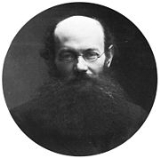
Peter Kropotkin

 
Peter Kropotkin

   Email Print
   Bookmark   Link


Peter Kropotkin


Peter (Pyotr) Alexeyevich Kropotkin (9 December, 1842 - 8 February, 1921) was one of Russia
Russia

Russia , or the Russian Federation , is a list of countries spanning more than one continent country extending over much of northern Eurasia....
's foremost anarchist
Anarchism

Anarchism is a political philosophy encompassing anarchist schools of thought which consider the state to be unnecessary, harmful, and/or undesirable....
s and one of the first advocates of anarchist communism
Anarchist communism

Anarchist communism advocates the abolition of the state, private property and capitalism in favor of common ownership of the means of production, direct democracy and a horizontal network of voluntary associations, workers' councils and/or a gift economy through which everyone will be free to satisfy their needs....
: most of his life he advocated for a communist
Communism

Communism is a socioeconomic structure and political ideology that promotes the establishment of an egalitarianism, classlessness, stateless society based on common ownership and control of the means of production and property in general....
 society free from central government
Government

Government is the body within any organization that has the authority to make and the power to enforce laws, regulations, or rules. Typically, the government refers to a civil government -- local, provincial, or national -- but commercial, academic, religious, or other formal organizations are also administered by governing bodies....
. Because of his title of prince
Prince

Prince, from the Latin root princeps, is a general term for a monarch, for a member of a monarch's or former monarch's family, and is a hereditary title in some members of Europe's highest nobility....
 and his prominence as an anarchist in the late 19th and early 20th centuries, he was known by some as "the Anarchist Prince". Some contemporaries saw him as leading a near perfect life, including Oscar Wilde
Oscar Wilde

Oscar Fingal O'Flahertie Wills Wilde was an Irish people playwright, Irish poetry and author of numerous short stories and one novel. Known for his biting wit, he became one of the most successful playwrights of the late Victorian era in London, and one of the greatest Celebrity of his day....
, who described him as "a man with a soul of that beautiful white Christ which seems coming out of Russia." He wrote many books, pamphlets and articles, the most prominent being The Conquest of Bread
The Conquest of Bread

The Conquest of Bread is a book by the anarchist communism Peter Kropotkin. Originally written in French, it first appeared as a series of articles in the anarchist journals Le R?volt? and La Revolt? ....
 and Fields, Factories and Workshops
Fields, Factories and Workshops

Fields, Factories and Workshops is a landmark anarchist text by Peter Kropotkin, and arguably one of the most influential and positive statements of the anarchist political position....
, and his principal scientific
Science

In its broadest sense, science refers to any systematic knowledge or practice. In its more usual restricted sense, science refers to a system of acquiring knowledge based on scientific method, as well as to the organized body of knowledge gained through such research....
 offering, Mutual Aid: A Factor of Evolution
Mutual Aid: A Factor of Evolution

Mutual Aid: A Factor of Evolution is a book by Peter Kropotkin on the subject of mutual aid , written while he was living in exile in England....
.


Discussion
Ask a question about 'Peter Kropotkin'
Start a new discussion about 'Peter Kropotkin'
Answer questions from other users
Full Discussion Forum


Quotations


It is only by the abolition of the State, by the conquest of perfect liberty by the individual, by free agreement, association, and absolute free federation that we can reach Communism — the possession in common of our social inheritance, and the production in common of all riches.

Educated men — civilized, as Fourier used to say with disdain — tremble at the idea that society might some day be without judges, police, or gaolers.

When we ask for the abolition of the State and its organs we are always told that we dream of a society composed of men better than they are in reality. But no; a thousand times, no. All we ask is that men should not be made worse than they are, by such institutions!

Practised for centuries, repression has so badly succeeded that it has but led us into a blind alley from which we can only issue by carrying torch and hatchet into the institutions of our authoritarian past.

One single war — we all know — may be productive of more evil, immediate and subsequent, than hundreds of years of the unchecked action of the mutual-aid principle may be productive of good.


Encyclopedia


Peter (Pyotr) Alexeyevich Kropotkin (9 December, 1842 - 8 February, 1921) was one of Russia
Russia

Russia , or the Russian Federation , is a list of countries spanning more than one continent country extending over much of northern Eurasia....
's foremost anarchist
Anarchism

Anarchism is a political philosophy encompassing anarchist schools of thought which consider the state to be unnecessary, harmful, and/or undesirable....
s and one of the first advocates of anarchist communism
Anarchist communism

Anarchist communism advocates the abolition of the state, private property and capitalism in favor of common ownership of the means of production, direct democracy and a horizontal network of voluntary associations, workers' councils and/or a gift economy through which everyone will be free to satisfy their needs....
: most of his life he advocated for a communist
Communism

Communism is a socioeconomic structure and political ideology that promotes the establishment of an egalitarianism, classlessness, stateless society based on common ownership and control of the means of production and property in general....
 society free from central government
Government

Government is the body within any organization that has the authority to make and the power to enforce laws, regulations, or rules. Typically, the government refers to a civil government -- local, provincial, or national -- but commercial, academic, religious, or other formal organizations are also administered by governing bodies....
. Because of his title of prince
Prince

Prince, from the Latin root princeps, is a general term for a monarch, for a member of a monarch's or former monarch's family, and is a hereditary title in some members of Europe's highest nobility....
 and his prominence as an anarchist in the late 19th and early 20th centuries, he was known by some as "the Anarchist Prince". Some contemporaries saw him as leading a near perfect life, including Oscar Wilde
Oscar Wilde

Oscar Fingal O'Flahertie Wills Wilde was an Irish people playwright, Irish poetry and author of numerous short stories and one novel. Known for his biting wit, he became one of the most successful playwrights of the late Victorian era in London, and one of the greatest Celebrity of his day....
, who described him as "a man with a soul of that beautiful white Christ which seems coming out of Russia." He wrote many books, pamphlets and articles, the most prominent being The Conquest of Bread
The Conquest of Bread

The Conquest of Bread is a book by the anarchist communism Peter Kropotkin. Originally written in French, it first appeared as a series of articles in the anarchist journals Le R?volt? and La Revolt? ....
 and Fields, Factories and Workshops
Fields, Factories and Workshops

Fields, Factories and Workshops is a landmark anarchist text by Peter Kropotkin, and arguably one of the most influential and positive statements of the anarchist political position....
, and his principal scientific
Science

In its broadest sense, science refers to any systematic knowledge or practice. In its more usual restricted sense, science refers to a system of acquiring knowledge based on scientific method, as well as to the organized body of knowledge gained through such research....
 offering, Mutual Aid: A Factor of Evolution
Mutual Aid: A Factor of Evolution

Mutual Aid: A Factor of Evolution is a book by Peter Kropotkin on the subject of mutual aid , written while he was living in exile in England....
. He was also a contributor to the Encyclopædia Britannica Eleventh Edition
Encyclopædia Britannica Eleventh Edition

The Encyclop?dia Britannica Eleventh Edition is a 29-volume reference work that marked the beginning of the Encyclop?dia Britannicas transition from a British to an American publication....
.

Biography


Early life

Peter (or Pyotr) Kropotkin was born in Moscow
Moscow

Moscow is the capital and the largest types of inhabited localities in Russia of the Russian Federation. It is also the largest European cities and metropolitan areas, with the Moscow metropolitan area ranking among the largest urban areas in the world....
. His father, Prince
Knyaz

Kniaz?, knyaz or knez is a slavic title found in most Slavic languages, denoting a Royal family nobility rank. It is usually translated into English as either Prince or less commonly as Duke....
 Alexei Petrovich Kropotkin, owned large tracts of land and nearly 1200 "souls" (male serf
SERF

A spin-exchange relaxation-free magnetometer achieves very high magnetic field sensitivity by monitoring a high density vapor of alkali metal atoms precessing in a near-zero magnetic field....
s) in three provinces. Kropotkin's male line traced to the legendary prince Rurik
Rurik

Rurik or Riurik was a Varangian chieftain who gained control of Staraya Ladoga in 862, built the Holmgard settlement near Novgorod, and founded the Rurik Dynasty which ruled Kievan Rus and then Galicia-Volhynia 14th and Muscovy until the 16th century....
; his mother, Yekaterina Nikolaevna Sulima, was the daughter of a Russian general.

In 1857, at age 15, Kropotkin entered the Corps of Pages
Page Corps

Page Corps was a privileged military establishment in Imperial Russia, which prepared aristocratic children for military service. . After the October Revolution the Page Corps was replaced with the Suvorov Military School....
 at St. Petersburg. Only 150 boys — mostly children of nobility belonging to the court — were educated in this privileged corps, which combined the character of a military school endowed with special rights and of a Court institution attached to the imperial household. Kropotkin's memoirs detail the hazing
Hazing

File:Bizutage pilote gazelle.jpgHazing is a ritualistic test and a task involving harassment, abuse or humiliation used as a way of initiation a person into a gang, club, military organization or other group....
 and other abuse of Pages for which the Corps had become notorious.

In Moscow, Kropotkin had developed an interest in the condition of the Russian peasant
Peasant

A peasant is an agriculture worker who subsists by working a small plot of ground. The word is derived from 15th century French language pa?sant meaning one from the pays, or rural, ultimately from the Latin pagus, or outlying administrative district ....
ry, and this interest increased as he grew older. In St. Petersburg, he read widely on his own account, and gave special attention to the works of the French
France

France , officially the French Republic , is a country whose Metropolitan France is located in Western Europe and that also comprises various Overseas departments and territories of France....
 encyclopaedists and to French history
History of France

The History of France has been divided into a series of separate historical articles navigable through the list to the right. The chronological era articles address broad French historical, cultural and sociological developments....
. The years 1857-1861 witnessed a rich growth in the intellectual forces of Russia, and Kropotkin came under the influence of the new Liberal-revolutionary literature, which largely expressed his own aspirations.

In 1862, Kropotkin was promoted from the Corps of Pages to the army. The members of the corps had the prescriptive right to choose the regiment to which they would be attached. Kropotkin had never wished for a military career, but, as he did not have the means to enter St. Petersburg University, he elected to join a Siberia
Siberia

Siberia , is the name given to the vast region constituting almost all of North Asia and for the most part currently serving as the massive central and eastern portion of the Russian Federation, having served in the same capacity previously for the Soviet Union from its beginning, and the Russian Empire beginning in the 16th century....
n Cossack
Cossack

The term Cossacks is applied to specific militaristic communities of various ethnicities living in the southern steppe regions of Ukraine and Russia....
 regiment in the recently annexed Amur Oblast
Amur Oblast

Amur Oblast is a federal subjects of Russia of Russia , situated about 8,000 km east of Moscow on the banks of the Amur River and Zeya Rivers....
 district, where there were prospects of administrative work. For some time, he was aide de camp to the governor of Transbaikalia at Chita. Later he was appointed attaché for Cossack affairs to the governor-general of East Siberia at Irkutsk
Irkutsk

Irkutsk is one of the largest types of inhabited localities in Russia in Siberia and the administrative center of Irkutsk Oblast, situated by rail from Moscow....
.

Expeditions

Administrative work was scarce, and in 1864 Kropotkin accepted charge of a geographical survey expedition, crossing North Manchuria
Manchuria

Manchuria is a historical name given to a vast geographic region in northeast Asia. Depending on the definition of its extent, Manchuria either falls entirely within People's Republic of China, or is divided between China and Russia....
 from Transbaikalia to the Amur, and soon was attached to another expedition which proceeded up the Sungari River into the heart of Manchuria. The expeditions yielded very valuable geographical
Geography

Geography is the study of the Earth and its lands, features, inhabitants, and phenomena. A literal translation would be "to describe or write about the Earth"....
 results. The impossibility of obtaining any real administrative reforms in Siberia now induced Kropotkin to devote himself almost entirely to scientific exploration, in which he continued to be highly successful.

In 1867, he quit the army and returned to St. Petersburg, where he entered the university, becoming at the same time secretary to the geography
Geography

Geography is the study of the Earth and its lands, features, inhabitants, and phenomena. A literal translation would be "to describe or write about the Earth"....
 section of the Russian Geographical Society
Russian Geographical Society

The Russian Geographical Society is a learned society, founded on 6 August, 1845 in Saint Petersburg, Russia....
. In 1873, he published an important contribution to science, a map and paper in which he proved that the existing maps entirely misrepresented the physical features of Asia
Asia

Asia is the world's largest and most populous continent. It covers 8.6% of the Earth's total surface area and, with over 4 billion people, it contains more than 60% of the world's current human population....
; the main structural lines were in fact from south-west to north-east, not from north to south, or from east to west as had been previously supposed.

In 1871, he explored the glacial deposits of Finland
Finland

Finland , officially the Republic of Finland , is a Nordic countries situated in the Fennoscandian region of northern Europe. It borders Sweden on the west, Russia on the east, and Norway on the north, while Estonia lies to its south across the Gulf of Finland....
 and Sweden
Sweden

Sweden , officially the Kingdom of Sweden , is a Nordic countries on the Scandinavian Peninsula in Northern Europe. Sweden has land borders with Norway to the west and Finland to the northeast, and it is connected to Denmark by the ?resund Bridge in the south....
 for the Russian Geographical Society
Russian Geographical Society

The Russian Geographical Society is a learned society, founded on 6 August, 1845 in Saint Petersburg, Russia....
. During this work, he was offered the secretaryship of that society. But by this time he had determined that it was his duty not to work at fresh discoveries but to aid in diffusing existing knowledge among the people at large. Accordingly, he refused the offer and returned to St. Petersburg, where he joined the revolutionary party.

Activism

He visited Switzerland
Switzerland

Switzerland is a landlocked Swiss Alps country of roughly 7.7 million people in Western Europe with an area of 41,285 km?. Switzerland is a federal republic consisting of 26 states called Cantons of Switzerland....
 in 1872 and became a member of the International Workingmen's Association
International Workingmen's Association

The International Workingmen's Association , sometimes called the First International, was an international socialism organization which aimed at uniting a variety of different left-wing political groups and trade union organizations that were based on the working class and class struggle....
 at Geneva
Geneva

Geneva is the second-most-populous city in Switzerland and is the most populous city of Romandie . Situated where the Rh?ne River exits Lake Geneva , it is the capital of the Canton of Geneva....
. But he did not like IWA's style of socialism
Socialism

Socialism refers to a broad set of economic theories of social organization advocating public or state ownership and administration of the means of production and distribution of goods, and a society characterized by equality for all individuals, with a fair or Egalitarianism method of compensation....
. Instead, he studied the programme of the more radical Jura federation
Jura federation

The Jura federation was the anti-authoritarian and anarchist section of the International Workingmen's Association , based largely among watch-makers in the Jura mountains in Switzerland....
 at Neuchâtel
Neuchâtel

Neuch?tel is the Capital of the Swiss Cantons of Switzerland of Neuch?tel on Lake Neuch?tel.The city has approximately 31,500 inhabitants , by and large French-speaking, although the city is sometimes referred to historically by the German language name , which has the same meaning, since Prussia ruled the area until 1848....
 and spent time in the company of the leading members, and definitely adopted the creed of anarchism. On returning to Russia, he took an active part in spreading revolutionary propaganda through the nihilist
Nihilist movement

The Nihilist movement was a Russian anarchist movement in the 1860s which rejected all authorities. It is derived from the Latin word "nihil", which means "nothing"....
-led Circle of Tchaikovsky
Circle of Tchaikovsky

The Circle of Tchaikovsky, also known as Tchaikovtsy, Chaikovtsy, or the Grand Propaganda Society was a Russian literary society for self-education and a revolutionary organization of the Narodniks in the early 1870s....
.

In 1873, Kropotkin was arrested and imprisoned in the Peter and Paul Fortress
Peter and Paul Fortress

The Peter and Paul Fortress is the original citadel of Saint Petersburg, Russia, founded by Peter the Great in 1703 and built to Domenico Trezzini's designs from 1706 to 1740....
. He gained notoriety for his widely publicized escape from the prison in 1876, after which he went to England
England

native_name =|conventional_long_name = England|common_name = England|image_flag = Flag of England.svg|image_coat = England COA.svg|symbol_type = Royal Coat of Arms...
, moving after a short stay to Switzerland, where he joined the Jura Federation. In 1877, he moved to Paris
Paris

Paris is the Capital of France and the country's largest city. It is situated on the river Seine, in northern France, at the heart of the ?le-de-France Regions of France ....
, where he helped to start the socialist movement. In 1878 he returned to Switzerland, where he edited for Jura Federation's revolutionary newspaper La Révolte, and published various revolutionary pamphlets. He was a very out-going speaker on his beliefs that the peasants were being treated unfairly and deserved to have the same land as the Lords

In 1881, shortly after the assassination
Assassination

Assassination is the targeted killing of a public figure. Assassinations may be prompted by ideology, politics, or military reasons. Additionally, assassins may be motivated by contract killing, revenge, or celebrity or may be mental disorder....
 of the Tsar
Tsar

Tsar or czar , occasionally spelled csar or tzar in English language, is a slavs term designating certain monarchs.Originally, the title Czar meant Emperor in the European medieval sense of the term, that is, a ruler who has the same rank as a Ancient Rome or Byzantine emperor due to recognition by another emperor or...
 Alexander II
Alexander II of Russia

Alexander II Nikolaevich , also known as Alexander the Liberator was the List of Russian rulers of the Russian Empire from 3 March 1855 until his assassination in 1881....
, the Swiss government expelled Kropotkin from Switzerland. After a short stay at Thonon (Savoy), he went to London
London

London is the capital of both England and the United Kingdom, and the most populous municipality in the European Union. An important settlement for two millennia, History of London goes back to its founding by the Roman Empire....
, where he stayed nearly a year, and returned to Thonon in late 1882. Soon he was arrested by the French government, tried at Lyon
Lyon

||-||}Lyon, also known as Lyons in English, is a city in east-central France. Its name is pronounced in French language and Franco-Proven?al language, and or in English language....
, and sentenced by a police-court magistrate (under a special law passed on the fall of the Paris Commune
Paris Commune

The Paris Commune was a government that briefly ruled Paris from March 28 to May 28, 1871. It existed before the split between Anarchism and Socialism, and is hailed by both as the first seizure of power by the working class....
) to five years' imprisonment, on the ground that he had belonged to the IWA
International Workingmen's Association

The International Workingmen's Association , sometimes called the First International, was an international socialism organization which aimed at uniting a variety of different left-wing political groups and trade union organizations that were based on the working class and class struggle....
 (1883). But the French Chamber repeatedly agitated on his behalf, and he was released in 1886. He settled near London, living at various times in Harrow
Harrow, London

Harrow is a town in the London Borough of Harrow, North West London. It is a suburb situated 12.2 miles west northwest of Charing Cross. It is one of the major metropolitan centres identified in the London Plan....
 where his daughter, Alexandra, was born Ealing
Ealing

Ealing is a town in the London Borough of Ealing. It is a suburban development situated 7.7 miles west of Charing Cross. It is one of the major metropolitan area centres identified in the London Plan and is often referred to as the "Queen of the Suburbs"....
 and Bromley
Bromley

Bromley is an urban centre in the London Borough of Bromley and is listed as a metropolitan centre in the London Plan. It is situated 9.3 miles south east of Charing Cross....
. He also lived for a number of years in Brighton
Brighton

Brighton is a city on the south coast of England and, with its neighbours Hove and Portslade, forms the Brighton and Hove.The ancient settlement of Brighthelmston dates from before the Domesday Book , but it emerged as a health resort during the 18th Century and became a destination for day-trippers after the arrival of the railway in...
.. While living in London, Kropotkin became friends with a number of prominent English-speaking socialists, including William Morris
William Morris

William Morris was an English architect, furniture and textile designer, artist, writer, and Socialism associated with the Pre-Raphaelite Brotherhood and the English Arts and Crafts Movement....
 and George Bernard Shaw
George Bernard Shaw

George Bernard Shaw, was an Irish people playwright.Although Shaw's first profitable writing was music and literary criticism, his talent was for drama, and he wrote more than 60 plays....
.

In 1902 Kropotkin published the book Mutual Aid: A Factor of Evolution
Mutual Aid: A Factor of Evolution

Mutual Aid: A Factor of Evolution is a book by Peter Kropotkin on the subject of mutual aid , written while he was living in exile in England....
, which provided an alternative view on animal and human survival, beyond the claims of 'Survival of the Fittest' proffered at the time by some "social Darwinists
Social Darwinism

Social Darwinism refers to various ideologies based on a concept that competition among all individuals, groups, nations, or ideas drives social evolution in human societies....
", such as Francis Galton
Francis Galton

Sir Francis Galton Fellow of the Royal Society , Cousin#Half_cousins of Charles Darwin, was an England Victorian era polymath, anthropologist, Eugenics, tropical List of explorers, geographer, inventor, meteorologist, proto-geneticist, Psychometrics, and statistician....
.

Kropotkin's authority as a writer on Russia is generally acknowledged, and he contributed to many articles in the Encyclopædia Britannica
Encyclopædia Britannica

The Encyclop?dia Britannica is a general English language encyclopedia published by Encyclop?dia Britannica, Inc., a privately held company....
, including an entry on anarchism in the 1911 edition (see external links, below). Most of the other articles (about 90) are about various aspects of Russian geography.

Kropotkin returned to Russia after the February Revolution and was offered the ministry of education in the provisional government, but he rejected the post. His enthusiasm turned to disappointment when the Bolsheviks seized power. "This buries the revolution," he said. He thought that the Bolsheviks had shown how the revolution was not to be made — by authoritarian rather than libertarian methods.

He died on February 8, 1921 in the city of Dmitrov
Dmitrov

Dmitrov is a Types of inhabited localities in Russia in Moscow Oblast, Russia, located to the north of Moscow. It is located on the Yakhroma River and the Moscow Canal, which connects the Russian capital with the Volga River....
, Moscow province and was buried at the Novodevichy Cemetery
Novodevichy Cemetery

Novodevichy Cemetery is the most famous cemetery in Moscow, Russia, situated next to the World Heritage Site, the 16th-century Novodevichy Convent, which is the city's third most popular tourist site....
, Moscow.

Timeline

  • 1842 - born in Moscow, Russia, on December 9.
  • 1857 - joins the Corps of Pages where he begins to develop a rebellious reputation.
  • 1858 - Peter's early writings show interest in political economy and statistics; begins contact with "real" peasants.
  • 1861 - Peter has his first prison experience as a result of participating in a student protest.
  • 1862 - becomes disillusioned with royalty when as page de chambre to the tsar
    Tsar

    Tsar or czar , occasionally spelled csar or tzar in English language, is a slavs term designating certain monarchs.Originally, the title Czar meant Emperor in the European medieval sense of the term, that is, a ruler who has the same rank as a Ancient Rome or Byzantine emperor due to recognition by another emperor or...
     he witnesses the extravagances of court life.
  • 1862-1867 - at his own request serves with the military in Siberia. Witnesses the living conditions there, and the unwillingness of the corrupt administration to do anything to improve this.
  • 1868-1870 - pursues survey and geographical studies.
  • 1871 - becomes interested in the workers' movement and the events surrounding the Paris Commune
    Paris Commune

    The Paris Commune was a government that briefly ruled Paris from March 28 to May 28, 1871. It existed before the split between Anarchism and Socialism, and is hailed by both as the first seizure of power by the working class....
    .
  • 1872 - travels to Switzerland, where he joins the International; returns to Russia with a quantity of prohibited socialist literature.
  • 1873 - as a member of the Chaikovskii Circle
    Circle of Tchaikovsky

    The Circle of Tchaikovsky, also known as Tchaikovtsy, Chaikovtsy, or the Grand Propaganda Society was a Russian literary society for self-education and a revolutionary organization of the Narodniks in the early 1870s....
    , he helps with rewriting pamphlets in a way that can be understood by the uneducated; he shows great ability for communicating with the workers.
  • 1874 - Peter is imprisoned in the Peter and Paul Fortress
    Peter and Paul Fortress

    The Peter and Paul Fortress is the original citadel of Saint Petersburg, Russia, founded by Peter the Great in 1703 and built to Domenico Trezzini's designs from 1706 to 1740....
     because of his revolutionary activities. At the intervention of the Geographical Society, he is given special dispensation to work on a paper on glacial periods.
  • 1876 - escapes from a military hospital and moves to England.
  • 1877 - returns to Switzerland to work with the Jura Federation. Attends the last meeting of the First International in Ghent.
  • 1881 - attends the International Anarchist congress in London. In his propaganda of the deed he supports the assassination of Tsar Alexander II on the grounds that an explosion is far more effective than a vote in encouraging the workers to revolution. This gets him kicked out of Switzerland. The Russian government is embarrassed when he discovers a plot to assassinate him in London.
  • 1882 - shortly after moving to France he is arrested for his work in The First International and sentenced to five years in prison. He stays there until 1886 when he is released on condition that he leave France.
  • 1886 - returns to England. Learns of his brother Alexander's suicide in Siberian exile for political activity. Becomes co-founder of British anarchist magazine Freedom.
  • 1890s — spends most of his time writing. Visits Canada and the United States in 1897. The Atlantic Monthly agrees to publish his memoirs. In his books he attempts to develop an anarchist-communist view of society.
  • 1901-1909 - writes material in Russian for readers in his homeland. He was very disappointed by the failure of the 1905 revolution.
  • 1909-1914 - returns to Switzerland on condition that he refrain from anarchist activities. Tries to publicize the massacre of 270 workers at the Lena gold mines, but this activity is cut short by World War I
    World War I

    World War I, or the First World War , was a global military conflict which involved the Great powers, organized into two opposing military alliances: the Allies of World War I and the Central Powers....
    . He then moved to the United Kingdom
    United Kingdom

    The United Kingdom of Great Britain and Northern Ireland, commonly known as the United Kingdom , the UK or Britain,is a sovereign state located off the northwestern coast of continental Europe....
    , where he spent some time in the Brighton
    Brighton

    Brighton is a city on the south coast of England and, with its neighbours Hove and Portslade, forms the Brighton and Hove.The ancient settlement of Brighthelmston dates from before the Domesday Book , but it emerged as a health resort during the 18th Century and became a destination for day-trippers after the arrival of the railway in...
     area.
  • 1914-1917 - actively supports the war against Germany, and coauthors the Manifesto of the Sixteen
    Manifesto of the Sixteen

    The Manifesto of the Sixteen , or Proclamation of the Sixteen, was a document drafted in 1916 by prominent Anarchism Peter Kropotkin and Jean Grave which advocated an Allies of World War I victory over Germany and the Central Powers during the First World War....
    . This position, a strange and questionable one for an anarchist to take, alienated him from many of his associates, particularly Errico Malatesta
    Errico Malatesta

    Errico Malatesta was an Italians Anarchist communism and Insurrectionary anarchism. He spent much of his life exiled from his homeland of Italy and in total spent more than ten years in prison....
    .
  • 1917 - returns to Petrograd where he helps the Kerensky government to formulate policy. He curtails his activity when the Bolshevik
    Bolshevik

    Bolsheviks, originally also Bolshevists were a faction of the Marxism Russian Social Democratic Labour Party which split apart from the Menshevik faction at the 2nd Congress of the RSDLP in 1903 and ultimately became the Communist Party of the Soviet Union....
    s come to power.
  • 1921 - his funeral at the Novodevichy Cemetery
    Novodevichy Cemetery

    Novodevichy Cemetery is the most famous cemetery in Moscow, Russia, situated next to the World Heritage Site, the 16th-century Novodevichy Convent, which is the city's third most popular tourist site....
    , with Lenin's approval, becomes the last mass gathering of anarchists in Russia.


Works


Books

  • ,
  • The Conquest of Bread
    The Conquest of Bread

    The Conquest of Bread is a book by the anarchist communism Peter Kropotkin. Originally written in French, it first appeared as a series of articles in the anarchist journals Le R?volt? and La Revolt? ....
     ,
  • Fields, Factories and Workshops
    Fields, Factories and Workshops

    Fields, Factories and Workshops is a landmark anarchist text by Peter Kropotkin, and arguably one of the most influential and positive statements of the anarchist political position....
  • P.Kropotkin, In Russian and French Prisons, London: Ward and Downey; 1887.
  • Memoirs of a Revolutionist, London : Smith, Elder; 1899. Kropotkin's own memoirs, which were also published in the United States in the same year and have appeared in a number of modern editions.
  • The Great French Revolution, 1789-1793, New York: G.P. Putnam's Sons, London, William Heinemann, 1909, translated from the French by N.F. Dryhurst.
  • Russian Literature: Ideals and Realities (New York: A. A. Knopf, 1915). Available online at the Anarchy Archives,
  • Ethics (unfinished). Included as first part of
  • . Online book. A criticism of the existence of prison
    Prison

    A prison, penitentiary, or correctional facility is a place in which individuals are physically confined or internment and usually deprived of a range of personal Freedom ....
    s.


Articles

  • "Research on the Ice age
    Ice age

    The general term "ice age" or, more precisely, "glacial age" denotes a geological period of long-term reduction in the temperature of the Earth's surface and atmosphere, resulting in an expansion of continental ice sheets, polar ice sheets and alpine glaciers....
    ", Notices of the Imperial Russian Geographical Society, 1876.
  • "The desiccation
    Desiccation

    Desiccation is the state of extreme dryness, or the process of extreme drying. A desiccant is a hygroscopic substance that induces or sustains such a state in its local vicinity in a moderately-well sealed container....
     of Eur-Asia", Geographical Journal, 23 (1904), 722-741.
  • Mr. Mackinder; Mr. Ravenstein; Dr. Herbertson; Prince Kropotkin; Mr. Andrews; Cobden Sanderson; Elisée Reclus, "On Spherical Maps and Reliefs: Discussion", The Geographical Journal, Vol. 22, No. 3. (Sep., 1903), pp. 294-299,
  • "Baron Toll", The Geographical Journal, Vol. 23, No. 6. (Jun., 1904), pp. 770-772,
  • "The population of Russia", The Geographical Journal, Vol. 10, No. 2. (Aug., 1897), pp. 196-202,
  • "The old beds of the Amu-Daria", The Geographical Journal, Vol. 12, No. 3. (Sep., 1898), pp. 306-310,


Pamphlets

  • War.
  • Law and Authority.
  • The Place of Anarchy in Socialist Evolution.
  • Revolutionary Government.
  • Chapter X from "In Russian and French Prisons" (1887)
  • (1896)
  • (1897)
  • Selected Passages from his Writings (1898-1913)


See also

  • Katorga
    Katorga

    Katorga was the precursor to the Gulag system. It was a system of penal servitude of the prison farm type in Imperial Russia. Prisoners were sent to remote camps in vast uninhabited areas of Siberia—where voluntary labourers were never available in satisfactory numbers—and forced to perform hard manual labour....
  • List of atheists
    List of atheists

    Atheism are persons who either affirm belief in the Existence of God#Arguments against belief in God of a god or Deityor reject belief in a god....


Further reading

  • The Anarchists
    The Anarchists

    The Anarchists is a book by the history James Joll. At 265 pages, it is a relatively brief history of the Libertarian socialism movement, covering its philosophical beginnings in Europe with William Godwin and Pierre-Joseph Proudhon, the further development by the Russians Peter Kropotkin and Mikhail Bakunin and its influence on the work...
    , historical book by James Joll
    James Joll

    James Bysse Joll was a British historian and university lecturer whose works included The Origins of the First World War and Europe Since 1870....
  • Barnard, Alan (2004) Mutual Aid and the Foraging Mode of Thought: Re-reading Kropotkin on the Khoisan. Social Evolution & History
    Social Evolution & History

    Social Evolution & History is an international journal focused on the development of human societies in the past, present and future. By integrating anthropology, history, sociology, philosophy and historical theory, the journal serves as an interdisciplinary forum for scholars....
     3/1: 3-21.
  • The Anarchist Geographer — an Introduction to the Life of Peter Kropotkin, by Brian Morris (Genge Press, 2007)
  • Kropotkin — the Politics of Community, by Brian Morris (Humanity Press, 2004)
  • George Woodcock
    George Woodcock

    George Woodcock was a prolific Canada writer of poetry, essays, criticism, biography and history works. He was also the founder the journal Canadian Literature —the first journal dedicated to Canadian writing....
     The Anarchist Prince: A Biographical Study of Peter Kropotkin


External links

  • at project LibriVox
    LibriVox

    LibriVox is an online digital library of free public domain audiobooks, read by volunteers. In January 2009, it had a catalog of 2,014 unabridged books and shorter works available to download....
  • at the Daily Bleed's Anarchist Encyclopedia
  • on libcom.org library
  • with complete collected works
  • at (an)archive!