
In Depth
See Also

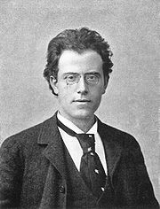
Gustav Mahler

Gustav Mahler was a Bohemia Bohemia

Bohemia is a historical region in central Europe [i], occupying th ... 

n-Austria Austria

Austria is a landlocked [i] country in central Europe [i]. ... 

n composer and conductor Conducting

Conducting is the act of directing a music [i]al performance by way of visible gestures. ... 

. Mahler was best known during his own lifetime as one of the leading orchestral and operatic conductors of the day, but he has since come to be acknowledged as among the most important post-romantic composers – a remarkable feat for a figure whose mature creativity was concentrated in just two genres: symphony and song. Besides the nine completed numbered symphonies, his principal works are the song cycles Lieder eines fahrenden Gesellen and Kindertotenlieder , and the synthesis of symphony and song cycle that is Das Lied von der Erde .

Discussions

  Discussion Features

   Ask a question about 'Gustav Mahler'

   Start a new discussion about 'Gustav Mahler'

   Answer questions about 'Gustav Mahler'

   'Gustav Mahler' discussion forum

Timeline

1860   Born

1911   Died


Encyclopedia


Gustav Mahler was a Bohemia Bohemia

Bohemia is a historical region in central Europe [i], occupying th ... 

n-Austria Austria

Austria is a landlocked [i] country in central Europe [i]. ... 

n composer and conductor Conducting

Conducting is the act of directing a music [i]al performance by way of visible gestures. ... 

.

Mahler was best known during his own lifetime as one of the leading orchestral and operatic conductors of the day, but he has since come to be acknowledged as among the most important post-romantic composers – a remarkable feat for a figure whose mature creativity was concentrated in just two genres: symphony and song. Besides the nine completed numbered symphonies, his principal works are the song cycles Lieder eines fahrenden Gesellen and Kindertotenlieder , and the synthesis of symphony and song cycle that is Das Lied von der Erde .

Biography


Early life


Gustav Mahler was born into a Jewish Jew

Jews are followers of Judaism [i] or, more generally, members of the Jewish people , an ethno [i]... 

 family in Kalište, Bohemia Bohemia

Bohemia is a historical region in central Europe [i], occupying th ... 

, in the Austro-Hungarian Empire Austria-Hungary

Austria-Hungary, also known as the Austro-Hungarian Empire, Dual Monarchy or k.u.k. [i] ... 

 , , the second of twelve children. His parents soon moved to Iglau Jihlava

colspan="2" align="center" bgcolor="#E0922E">Statistics [i] ... 

, Moravia Moravia

Moravia is a historical region in the east of the Czech Republic [i]. ... 

, where Mahler spent his childhood. Having noticed the boy's talent at an early age, his parents arranged piano lessons for him when he was six years old.

In 1875, Mahler, then fifteen, was admitted to the Vienna Conservatoire where he studied piano Piano

piano or pianoforte is a musical instrument [i] classified as a keyboard [i], ... 

 under Julius Epstein, harmony with Robert Fuchs, and composition with Franz Krenn. Three years later Mahler attended Vienna University University of Vienna

name =University of Vienna
... 

, where Anton Bruckner Anton Bruckner

Anton Bruckner was an Austria [i]n composer whose mature music was written at the end of the Romantic [i] ... 

 was lecturing. There he studied history and philosophy as well as music. While at the university, he worked as a music teacher and made his first major attempt at composition with the cantata Das klagende Lied; the work was entered in a competition where the jury was headed by Johannes Brahms Johannes Brahms

Johannes Brahms was a German [i] composer [i] of the Romantic period [i], who li ... 

, but failed to win a prize.

Growing reputation

In 1880, Mahler began his career as a conductor with a job at a summer theatre at Bad Hall; in the years that followed, he took posts at successively larger opera houses: in Ljubljana Ljubljana

ame = Ljubljana|
name_local=|
... 

 in 1881, Olomouc Olomouc

Olomouc is a city in Moravia [i], in the east of the Czech Republic [i]. ... 

 in 1882, Vienna Vienna

Vienna is the capital [i] of Austria [i], and also one of the nine States of Austria [i]. ... 

 in 1883, Kassel Kassel

Kassel is a city situated along the Fulda River [i] in northern Hessen [i], Germany [i], one of the tw ... 

 in 1884, Prague Prague

Prague is the capital [i] and largest city of the Czech Republic [i]. ... 

 in 1885, Leipzig Leipzig

Leipzig [] is the largest city in the federal state [i] of Saxony [i] in Germany [i] ... 

 in 1886 and Budapest Budapest

Budapest is the capital [i] city of Hungary [i] and the country's principal political [i]... 

 in 1888. In 1887, he took over conducting Wagner's Richard Wagner

Wilhelm Richard Wagner was an influential German [i] composer [i], conductor [i], music theorist [i] ... 

 Der Ring des Nibelungen Der Ring des Nibelungen

Der Ring des Nibelungen, commonly translated into English [i] as The Ring of t ... 

from an ill Arthur Nikisch Arthur Nikisch

Arthur Nikisch was a Hungarian [i] conductor [i] who performed mainly in Germany [i]. ... 

, firmly establishing his reputation among critics and public alike. The year after, he made a complete performing edition of Carl Maria von Weber Carl Maria von Weber

Carl Maria Friedrich Ernst von Weber was a German [i] composer [i].
... 

's unfinished opera Die drei Pintos, the success of which brought financial rewards and contributed to his gradually growing fame. Brahms was greatly impressed by his conducting of "Don Giovanni". His first long-term appointment was at the Hamburg Opera in 1891, where he stayed until 1897. From 1893 to 1896, he took summer vacations at Steinbach am Attersee in Upper Austria Upper Austria

Upper Austria is one of the nine states [i] or Bundeslnder of Austria [i].... 

, where he revised his Symphony No. 1 , composed his Symphony No. 2, sketched his Symphony No. 3, and wrote most of the song collection Lieder aus 'Des Knaben Wunderhorn , based on a famous set of heavily redacted folk-poems.

In 1897, Mahler, then thirty-seven, was offered the directorship of the Vienna Opera Vienna State Opera

Vienna State Opera, located in Vienna [i], Austria [i], is one of the most important opera [i] companies ... 

, the most prestigious musical position in the Austrian Empire Austrian Empire

The Austrian Empire was an empire centred on what is modern day Austria [i] that lasted from 1804 [i] to ... 

. This was an 'Imperial' post, and under Austro-Hungarian law no such posts could be occupied by Jews. Mahler, who was never a devout or practising Jew, had, in preparation, converted to Roman Catholicism. In ten years at the Vienna Opera, Mahler transformed the institution's repertoire and raised its artistic standards, bending both performers and listeners to his will. When he first took over the Opera, the most popular works were Lohengrin, Manon, and Cavalleria rusticana; the new director concentrated his energies on classic operas of Christoph Willibald Gluck Christoph Willibald Gluck

Christoph Willibald Gluck was a German [i] composer [i], one of the most important opera [i] com ... 

 and Wolfgang Amadeus Mozart Wolfgang Amadeus Mozart

Wolfgang Amadeus Mozart was a prolific and highly influential composer [i] of Classical music [i] ... 

, and, in collaboration with the painter Alfred Roller , created shadowy, transfixing productions of Fidelio, Tristan und Isolde Tristan und Isolde

Tristan und Isolde is an opera [i] in three acts by Richard Wagner [i] to a German [i] ... 

, and Der Ring des Nibelungen Der Ring des Nibelungen

Der Ring des Nibelungen, commonly translated into English [i] as The Ring of t ... 

.

In Mahler's day Vienna was one of the world’s biggest cities and the capital of a great empire in Central Europe. It was home to a lively artistic and intellectual scene. Sigmund Freud had his practice there and was pioneering psychoanalysis in the city. It was also home to famous painters such as Gustav Klimt and Egon Schiele. Mahler knew many of these intellectuals and artists.

Mahler worked at the Opera for nine months of each year, with only his summers free for composing; these summers he spent mainly at Maiernigg, on the Wörthersee Wörthersee

The Wrthersee is an alpine [i] lake [i] in the southern Austria [i]n province of Carinthia [i] ... 

. In that idyllic setting he composed his fifth through eighth symphonies, the Rückert Lieder and Kindertotenlieder , both based on poems by Friedrich Rückert Friedrich Rückert

Friedrich Rckert was a German [i] poet [i], translator [i] and professor of Oriental languages [i] ... 

, and Der Tamboursg'sell, the last of his 'Des Knaben Wunderhorn' settings.

Later years

In June 1901 he moved into a fine new villa on the lake in Maiernigg, Carinthia . On March 9 1902, Mahler married Alma Schindler Alma Mahler

Alma Maria Mahler, composer [i] and painter [i], was noted in her native Vienna [i] for her beauty and i ... 

 , the stepdaughter of the noted Viennese painter Carl Moll and twenty years younger than himself. Alma was a musician and an aspiring composer, but Mahler forbade her from engaging in creative work, although she did make clean manuscript copies of his hand-written scores. Their paths did not cross in their creative lives. Mahler seemed to communicate more with the viola-player Natalie Bauer-Lechner, two years his senior, whom he had met while studying in Vienna. Alma Mahler bore two daughters, Maria Anna , who died of either scarlet fever or diphtheria Diphtheria

Diphtheria , Greek for leather, , is an upper respiratory [i] tract illness characterized b ... 

 at the age of only five, and Anna , who later became a sculptor Sculpture

A sculpture is a three-dimensional [i], human-made object selected for spec ... 

.

The death of his older daughter left him grief-stricken; but further blows were to come. That same year he discovered he had a heart disease , and was forced to limit his exercising and count his steps with a pedometer. At the Opera his stubborn obstinacy in artistic matters had created enemies; and he was also increasingly subject to attacks in anti-Semitic portions of the press. His resignation from the Opera, in 1907, was hardly unexpected.

Mahler's own music aroused considerable opposition from music critics, who tended to hear his symphonies as 'potpourris' in which themes from disparate periods and traditions were indiscriminately mingled. However, he always had vociferous admirers on his side. In his last years, Mahler began to score major successes with a wider public, notably with a Munich performance of the Second Symphony in 1900, with the first complete performance of the Third in Krefeld in 1902, with a valedictory Viennese performance of the Second in 1907, and, above all, with the Munich premiere of the gargantuan Eighth in 1910. The music he wrote after that, however, was not performed during his lifetime.

The final impetus for Mahler's departure from the Vienna Opera was a generous offer from the Metropolitan Opera Metropolitan Opera

The Metropolitan Opera Association of New York City [i], founded in April 1880, is a major presenter of ... 

 in New York New York

New York is a state [i] in the northeastern [i] United States [i]. ... 

. He conducted a season there in 1908, only to be set aside in favor of Arturo Toscanini; while he had been enormously popular with public and critics alike, he had fallen out of favor with the trustees of the board of the Met. Back in Europe Europe

Europe is one of the seven traditional continent [i]s of the Earth [i]. ... 

, with his marriage in crisis and Alma's infidelity having been revealed, Mahler, in 1910, had a single consultation with Sigmund Freud Sigmund Freud

Sigmund Freud
The name Freud is generally pronounced [i] [] in English [i] and [] in German [i] ... 

.

Having now signed a contract to conduct the long-established New York Philharmonic Orchestra, Mahler and his family travelled again to America. At this time, he completed his Das Lied von der Erde , and his Symphony No. 9, which would be his last completed work. In February 1911, during a long and demanding concert season in New York, Mahler fell seriously ill with a streptococcal Streptococcus

Streptococcus is a genus [i] of spherical [i], Gram-positive [i] bacteria [i] of th... 

 blood infection, and conducted his last concert in a fever . Returning to Europe, he was taken to Paris Paris

native_name = Ville de Paris
|common_name = Paris
... 

, where a new serum had recently been developed. He did not respond, however, and was taken back to Vienna at his request. He died there from his infection on May 18 1911 at the age of 50, leaving his Symphony No. 10 unfinished.

It is said that among his last words was "Mozart". He was buried, at his request, beside his daughter, in Grinzing Cemetery outside Vienna. In obedience to his last wish, he was buried in silence, with neither a word spoken nor a note of music played. The grave-stone bears the name 'Gustav Mahler', but no other inscription.

Alma Mahler quotes Mahler as saying "I am thrice homeless, as a native of Bohemia in Austria Austria

Austria is a landlocked [i] country in central Europe [i]. ... 

, as an Austrian among German Germany

Germany , officially the Federal Republic of Germany , is a country [i] in central Europe [i]. ... 

s, and as a Jew throughout the world. Everywhere an intruder, never welcomed." However this is astonishingly close to a remark written by Anton Rubinstein Anton Rubinstein

Anton Grigorevich Rubinstein was a Russia [i]n pianist [i], composer [i] and conductor [i]. ... 

 in the 1860s or 1870s, and may therefore have been adapted, for its appositeness, by Mahler .

Alma Alma Mahler

Alma Maria Mahler, composer [i] and painter [i], was noted in her native Vienna [i] for her beauty and i ... 

 outlived Gustav by more than 50 years, and in their course she was very active in publishing material about his life and music. However, her accounts have been discounted as unreliable, false and misleading.This constitutes the Alma Problem. For example she allegedly tampered with the couple's correspondence usually for petty reasons.

Music


Mahler was the last in a line of Viennese symphonists extending from the First Viennese School of Joseph Haydn Joseph Haydn

Franz Joseph Haydn was one of the most prominent composer [i]s of the Classical [i] ... 

, Mozart Wolfgang Amadeus Mozart

Wolfgang Amadeus Mozart was a prolific and highly influential composer [i] of Classical music [i] ... 

, Beethoven Ludwig van Beethoven

Ludwig van Beethoven was a German [i] composer [i] and pianist [i]. ... 

 and Franz Schubert Franz Schubert

Franz Peter Schubert was an Austria [i]n composer [i] considered to be the last master of the Viennese Classical school [i]... 

 to Bruckner Anton Bruckner

Anton Bruckner was an Austria [i]n composer whose mature music was written at the end of the Romantic [i] ... 

 and Johannes Brahms Johannes Brahms

Johannes Brahms was a German [i] composer [i] of the Romantic period [i], who li ... 

; he also incorporated the ideas of Romantic composers like Robert Schumann Robert Schumann

Robert Schumann was a German composer [i] and pianist [i]. ... 

 and Felix Mendelssohn Felix Mendelssohn

Jakob Ludwig Felix Mendelssohn Bartholdy, born and known generally as Felix Mendelssohn was a German [i] ... 

. The major influence on his work, however, was that of Richard Wagner Richard Wagner

Wilhelm Richard Wagner was an influential German [i] composer [i], conductor [i], music theorist [i] ... 

, who was, according to Mahler, the only composer after Beethoven to truly have "development" in his music.

Style of writing

The spirit of the lied  constantly rests in his work. He followed Franz Schubert Franz Schubert

Franz Peter Schubert was an Austria [i]n composer [i] considered to be the last master of the Viennese Classical school [i]... 

 and Robert Schumann Robert Schumann

Robert Schumann was a German composer [i] and pianist [i]. ... 

 in developing the song cycle, but rather than write piano accompaniment, he orchestrated it instead. Lieder eines fahrenden Gesellen is a set of four songs written as a rejected lover wandering alone along the earth; Mahler wrote the text himself, inspired by his unhappy love affair with a singer while conducting at Kassel.

Keenly aware of the colourations of the orchestra Orchestra

An orchestra is a musical ensemble [i] used most often in classical music [i]. ... 

, the composer filled his symphonies with flowing melodies Melody

In music [i], a melody is a series of linear [i] events or a succession [i], not a simultaneity [i] as ... 

 and expressive harmonies, achieving bright tonal qualities using the clarity of his melodic lines. Among his other innovations are expressive use of combinations of instruments in both large and small scale, increased use of percussion, as well as combining voice and chorus to symphony form, and extreme voice leading in his counterpoint Counterpoint

Counterpoint is a broad organisational feature of much music [i], involving the simultaneous sounding of ... 

. His orchestral style was based on counterpoint Counterpoint

Counterpoint is a broad organisational feature of much music [i], involving the simultaneous sounding of ... 

; two melodies would each start off the other seemingly simultaneously, choosing clarity over a mass orgy of sound.

Often, his works involved the spirit of Austrian peasant song and dance. The Ländler – the Austrian folk-dance which developed first into the minuet and then into the waltz – figures in several symphonies, as indeed do the minuet and the waltz. .

Mahler combined the ideas of Romanticism Romanticism

Romanticism was an artistic and intellectual movement that originated in late 18th century [i] Western Europe [i] ... 

, including the use of program music, and the use of song melodies in symphonic works, with the resources which the development of the symphony orchestra Orchestra

An orchestra is a musical ensemble [i] used most often in classical music [i]. ... 

 had made possible. The result was to extend, and eventually break, the understanding of symphonic form, as he searched for ways to expand his music. He stated that a symphony should be an "entire world". As a result, he met with difficulties in presenting his works, and would continually revise the details of his orchestration until he was satisfied with the effect.

Mahler's harmonic writing was at times highly innovative, and only long familiarity can have blunted the effect of the chords constructed in 'perfect fourths' which lead to the 'first subject' of the Seventh Symphony, or the remarkable 9-note 'crisis' sonority that erupts into the first movement of the Tenth. 'Anti-modernist Modernism

Modernism is a trend of thought which affirms the power of human beings to make, improve and reshape the... 

' zeal presumably lies behind assertions to the effect that Mahler "never abandoned the principle of tonality, as those following him, in particular those of the Second Viennese School, would later do": anyone who would deny this composer's pre-Schoenbergian exploitation of expressive anti-tonality should be challenged to name the keys that they hear at such points as bb.385ff in the finale of the Sixth Symphony or the most tonally complex areas of the Tenth.

He was deeply spiritual and described his music in terms of nature very often. This resulted in his music being viewed as extremely emotional for a long time after his death. In addition to restlessly searching for ways of extending symphonic expression, he was also an ardent craftsman, which shows both in his meticulous working methods and careful planning, and in his studies of previous composers.

Tonality

In spite of above statements, tonality Tonality

[i] [[pitch|pitch]... 

, as an expressive and constructional principle, was clearly of great importance to Mahler. This is shown most clearly by his approach to the issue of so-called 'progressive tonality'. While his First Symphony is clearly a D major D major

D major is a major scale [i] based on D, consisting of the pitches D, E, F#, G, A, B, ... 

 work, his Second 'progresses' from a C minor C minor

C minor is a minor scale [i] based on C, consisting of the pitches C, D, E-flat, F, G, ... 

 first movement to an E-flat major E flat major

E flat major is a major scale [i] based on E flat, consisting of the pitches E flat, F, G, A ... 

 conclusion; his Third moves from a first movement which ends in F major F major

F major is a music [i]al major scale [i] based on F, consisting of the pitches F, G, A, B-fl ... 

 to a finale which ends in D major – while his Fourth dies away in a serene E major E major

E major is a major scale [i] based on E, consisting of the pitches E, F#, G#, A, B, C# ... 

 that seemingly has no awareness of its distance from the work's basic G major G major

G major is a major scale [i] based on G, consisting of the pitches G, A, B, C, D, E, F ... 

. The Fifth moves from a C-sharp minor C sharp minor

C sharp minor is a minor scale [i] based on C sharp, consisting of the pitches C sharp, D sharp, ' ... 

 funeral march, through a desperately conflict-ridden A minor A minor

A minor is a minor scale [i] based on A, consisting of the pitches A, B, C, D, E, F, G ... 

 movement, a vigorous dance movement in D major, and a lyrical F major 'Adagietto', to a triumphant finale in D major – while the Sixth, very much by contrast, starts in A minor, ends in A minor, and juxtaposes a slow movement in E-flat major with a scherzo in A minor. The Seventh is tonally highly 'progressive', with a first movement that moves from a B minor B minor

B minor is a minor scale [i] based on B, consisting of the pitches B, C♯, D, E, F& ... 

 start to an E major conclusion, and a finale that defines a celebratory C major C major

C major is a musical major scale [i] based on C, consisting of the pitches C, D, E, F, G' ... 

. In the Eighth Symphony the composer's expressive intentions led him to construct a work that both starts and ends in E-flat – whereas the 'valedictory' Ninth moves from a D major first movement to a D-flat major D flat major

D flat major is a major scale [i] based on D flat, consisting of the pitches D flat, E flat, F' ... 

 finale. The Tenth, insofar as we can be sure that Mahler's ultimate tonal intentions are discernible, was to start and end in F-sharp major F sharp major

F sharp major is a major scale [i] based on F sharp, consisting of the pitches F sharp, G sharp, ' ... 

.

Symphonies


First period
His symphonic output is generally divided into three 'periods'. The 'first period', dominated by his reading of the Wunderhorn poems, comprises his Symphonies Nos. 1 to 4. Within this group, the cross-fertilization from the world of Mahlerian song is in fact considerable. The Symphony No. 1 uses a melodic idea from one of the Gesellen songs in its first movement, and employs a section of another in the central part of its third. The Symphony No. 2's third movement is a voice-less orchestral amplification and extension of a Wunderhorn song, and is followed by a Wunderhorn setting incorporated whole. The Symphony No. 3's third movement is another orchestral fantasia on a Wunderhorn song, while its fifth is a Wunderhorn setting made especially for the symphony. In the Symphony No. 4, the finale is a pre-existing Wunderhorn setting , elements of which are 'prefiguringly' inserted into the first three movements.
Second period
The symphonies of the 'second period', Nos. 5 to 7, manifest an increased severity of expression and reveal a growing interest in non-standard instrumentation , although non-standard instruments are present in earlier symphonies, like a post horn Post horn

The Post horn is a valveless cylindrical brass instrument [i] used to signal the arrival or departure of... 

 in the Symphony No. 3. Though the symphonies in this group have no vocal component, the world of Mahlerian song is hinted at in the first movement of the Symphony No. 5 and the slow movement of the Symphony No. 6, where phrases from one of the Kindertotenlieder are briefly heard, and in No.5s finale, which incorporates material from the 1896 Wunderhorn song 'Lob des hohen Verstandes'.
Third period
Mahler's symphonic 'third period' is marked by increasing polyphony and embraces Nos. 8, 9, and 10 , as well as
Das Lied von der Erde. No credible connections with free-standing songs can be demonstrated – perhaps unsurprisingly, as Mahler's last non-symphonic songs were the Kindertotenlieder, completed in 1904.

Few composers are felt to have freely intermixed their work and their life so completely as Mahler; the impression is only strengthened by the musical connections that can be heard to exist between symphonies, seeming to bind them together into a larger 'narrative'. Material heard in No. 3 recurs in the finale of No. 4; an idea from the first movement of No. 4 is heard to open No. 5; and a 'tragic' harmonic gesture that is repeatedly heard in No. 6 makes a striking reappearance in No. 7. In the unfinished draft of No. 10, furthermore, there are personal notations to his wife Alma as well as other seemingly autobiographical references. .

Curse of the ninth

Mahler was obsessed by Beethoven's legacy; he declared that all of his symphonies were "ninths", having the same impact and scale as Beethoven's famous Choral symphony. Mahler was also apparently a firm believer in the curse of the ninth and thus terrified of writing a ninth numbered symphony. This is held to be the reason why he did not give a number to the symphonic work - Das Lied von der Erde - which followed his Eighth, but instead described it merely as Eine Symphonie für eine Tenor- und eine Alt- Stimme und Orchester . The work can be considered a combination of song cycle and symphony. As it happened, Mahler did in fact die after writing his ninth numbered symphony, leaving his tenth unfinished. There have been several attempts to complete the work since the 1940s 1940s

... 

.

Legacy

Critics are no longer to be found who will insist that Mahler's popularity is a fad or a craze List of fads and trends

A fad, also known as a craze, refers to a fashion [i] that becomes popular in a culture [i] relati ... 

 that will shortly pass; but while his place in musical history History of music

Music [i] has a long and complex history [i]. ... 

 and in the repertoire seems secure, sober assessment of his specific legacy is inhibited by several factors. For example, little common ground can be found between those who revere Mahler for his 'emotional frankness' and 'spiritual honesty', and his equally vociferous detractors for whom the same music displays 'mawkishness',
'tastelessness' and 'sentimentality' . A similar divide separates those who appreciate and analyze the symphonies as conscientiously orchestrated and rigorously organised large-scale forms, and those who see merely the lavish, sprawling outpourings of a 'self-indulgent egotist'.

Passionate admirers of Mahler, too, have sometimes muddied the waters by seeing the composer through the prism of their own preoccupations; thus the critical literature boasts manic-depressive Bipolar disorder

Bipolar disorder is a psychiatric [i] diagnostic category [i] describing a class [i] ... 

s who have insisted that Mahler's contrast-rich work betrays a manic-depressive psychology, homosexuals Homosexuality

Homosexuality refers to sexual [i] and romantic [i] attraction between t ... 

 who have asserted that his tender expressiveness reveals him to have been gay Gay

Gay is an adjective meaning "carefree", "happy", or "bright and showy"; however in modern usage, gay... 

, and Jews Jew

Jews are followers of Judaism [i] or, more generally, members of the Jewish people , an ethno [i]... 

 who have claimed that his music exposes the cultural and social tensions that led to the Holocaust The Holocaust

The Holocaust, also known as Ha-Shoah and the Porajmos [i] or Samudaripen in Romani [i] ... 

. Vehement resistance to Mahler's expressive message sometimes has additional racial and nationalistic overtones; devoted Mahlerian Hans Keller used to quote an influential British critic as declaring: "The truth is, we just don't want Mahler over here."

With Mahler thus to some extent still critically embattled, a situation has developed in which his detractors attempt to minimise his legacy, and his admirers tend to respond by exaggerating it. A cautious middle ground might be pursued by noting that a combination of factors worked greatly to inhibit performance and understanding of Mahler's music after 1911, and undoubtedly made his posthumous influence less than it could have been. As a result, it was principally among composers who had known Mahler or been part of his circle that his influence was first felt – even if such personal relationships often brought extra-musical factors into play.

Mahler told fellow composer Jean Sibelius Jean Sibelius

Jean Sibelius was a Finnish [i] composer [i] of classical music [i], a ... 

 in 1907 that "a symphony should be like the world: it must embrace everything"; putting this philosophy into practice, he brought the genre to a new level of artistic development. Increasing the range of contrasts within and between movements necessitated an expansion of scale and scope – while the admission of vocal and choral elements made manifest a philosophical as well as autobiographical content. Neglected for several decades after his death, Mahler's symphonies and orchestral songs are now part of the core repertoire of major symphony orchestras worldwide.

Influence

Schoenberg Arnold Schoenberg

Arnold Franz Walter Schoenberg , was an Austria [i]n and later American [i] composer [i]. ... 

, for example, almost a full generation younger than Mahler, came to venerate the older man as a "saint": an exemplary figure, selfessly devoted to art, generous to younger composers, and badly treated in the same way he himself was badly treated; Schoenberg could still, however, display a complicated attitude to the music and even speak of having had an "aversion" to it. This ambivalence did not, however, prevent him becoming a penetrating analyst of Mahler's irregular melodic structures, or defending the Seventh Symphony against an American critic, nor did it inhibit his adoption and even refinement of massive Mahlerian effects in his Gurrelieder or Pelleas und Melisande Pelleas und Melisande

Pelleas und Melisande, Symphonic Poem for orchestra, is dodecaphonic [i] composer ... 

, or, in those same works and elsewhere, the pursuit of Mahlerian clarity through soloistic or chamber-style orchestral scoring.

For Alban Berg, younger still, Mahler was a musical influence rather than a personal one ", and Mahlerian elements can be heard in many of his works. For example, the two hammer blows in the finale of the Mahler Sixth find their echo in Berg's Three Orchestral Pieces which features seven hammer blows in its final movement as well as thematic material of a decisively Mahlerian cut. In the case of Webern Anton Webern

Anton Webern was an Austrian composer [i]. ... 

, who, in his early professional life, had conducted performances of Mahler symphonies, one may detect a Mahlerian concern with total textural clarity, although the small scale and rhetorical sparseness of Webern's mature pieces means that overt 'Mahlerisms' are hard to find outside his juvenilia.

The earliest significant non-contemporaries to register the impact of Mahler were perhaps Benjamin Britten Benjamin Britten

Edward Benjamin Britten, Baron Britten, OM [i] CH [i] ... 

 and Dmitri Shostakovich Dmitri Shostakovich

Dmitri Dmitrievich Shostakovich listen was a Russia [i]n composer [i] of the Soviet [i] p ... 

, both of whom identified with elements of Mahler's personal and creative character as well as with aspects of his musical style. Britten, who had first come to know Mahler's Symphony No. 4 while still a student, produced a 'reduced orchestra' version of the second movement of Symphony No. 3 and during his life performed Mahler's music as both a piano-accompanist and conductor. Both Britten and Shostakovich came to hold Das Lied von der Erde in special regard, and undeniable references to it are found in such works as the former's Phaedra and the latter's Fourth and Tenth symphonies.

Among other leading composers, an aversion to Mahler can often be attributed to radically incompatible creative goals rather than to any failure to recognise his technical skill: to Stravinsky Igor Stravinsky

Igor Fyodorovich Stravinsky was a Russian [i]-born composer [i].
... 

, Mahler was "malheur" , while Vaughan Williams Ralph Vaughan Williams

Ralph Vaughan Williams, OM [i] was an
... 

 described him as a "tolerable imitation of a composer". By the late 20th century 20th century

The 20th century started on 1 January [i] 1901 [i] and ended on 31 December [i] 2000 [i], according to t... 

, however, Mahler's kaleidoscopic scoring and motivically independent lines in intense contrapuntal Counterpoint

Counterpoint is a broad organisational feature of much music [i], involving the simultaneous sounding of ... 

 combination had become staples of modernism Modernism

Modernism is a trend of thought which affirms the power of human beings to make, improve and reshape the... 

, and formerly shocking features of his music such as his radical discontinuities, his penchant for parody Parody

In contemporary usage, a parody is a work that imitates another work in order to ridicule, ironically co... 

 and quotation and his blunt juxtaposition of 'high' and 'low' styles were prominent features of postmodernism.

The extent of Mahler's influence on pre-1950s 1950s

The 1950s was the decade spanning the years 1950 to 1959.... 

 popular music has been widely neglected. However, the strong relationship which can be heard to exist between, for example the Sammy Fain/Irving Kahal song I'll Be Seeing You and a passage in the finale of Mahler's Symphony No. 3 leads one to wonder whether emigre musicians from central Europe Central Europe

Central Europe is the region [i] lying between the variously and vaguely defined areas of Eastern [i] ... 

 had taken memories of Mahler's music with them to the United States United States

The United States of America, also known as the United States, the U.S., the U.S.A., a... 

. Attempts to present him as an influence upon the Hollywood Hollywood, Los Angeles, California

Hollywood is a district [i] in Los Angeles, California [i], U.S.A. [i], situated west-nort ... 

 style of film music, either directly or through the work such emigres as Erich Wolfgang Korngold and Max Steiner, however, fail to take into account the frequently un-contrapuntal nature of such film scores, or that their often intense exploitation of the 'leitmotif' derived from Wagner rather than Mahler.

The scale of Mahler's interpretative legacy, likewise, should not be over-estimated. In the absence of actual recordings, his performances lived on only as fading memories and through their influence on conductors such as Bruno Walter Bruno Walter

Bruno Walter was a German [i]-born conductor [i] and composer [i]. ... 

 and Otto Klemperer Otto Klemperer

Otto Klemperer was a German [i]-born conductor [i] and composer [i]. ... 

, both of whom worked with the composer and, having been assisted by him in their careers, went on to take his music to America and into the age of the LP record. His famous declaration "Tradition ist Schlamperei!" , might be taken as prefiguring the late 20th-century preoccupation with 'historically informed performance' that claimed to be liberating familiar baroque and classical works from thoughtlessly applied performance conventions deriving from later periods; one ought to note, however, that Mahler's own, fascinating arrangement of several movements into a 'Bach Johann Sebastian Bach

Johann Sebastian Bach was a prolific German [i] composer [i] and organist [i] whose sac ... 

 Suite' is, in terms of historical authenticity, massively anachronistic. In addition, while the practice of playing Beethoven's Leonore No. 3 overture before the third act of Fidelio was Mahler's creation , one notes that the kind of operatic production which Mahler favoured – with a 'stage manager' but no 'director', and with staging and production being devised by the conductor in a manner designed to serve the music throughout – has not survived in an age dominated by the so-called 'producer's opera'.

Supporters who happily point to Mahler's dedication to detailed and extensive rehearsal as having had an impact upon later musical practice may also be exaggerating. For example, one cannot cogently argue that Mahler himself was personally responsible for the ever-increasing 'professionalisation' of art-musical performance that took place throughout the 20th century. Likewise, many aspects of his rather ruthless perfectionism have not been perpetuated: in today's musical world, with its unionized players and 'self-governing' orchestras), Mahler's authoritarianism and his brow-beating of individual players would never be tolerated.

His music also influenced Richard Strauss Richard Strauss

Richard Strauss was a German [i] composer [i] of the late Romantic [i] era, part ... 

, the early symphonies of Havergal Brian, and the music of Erich Wolfgang Korngold. Kurt Weill, Dmitri Shostakovich Dmitri Shostakovich

Dmitri Dmitrievich Shostakovich listen was a Russia [i]n composer [i] of the Soviet [i] p ... 

, Alfred Schnittke Alfred Schnittke

Alfred Garyevich Schnittke was a Russia [i]n composer [i]. ... 

, as well as Benjamin Britten Benjamin Britten

Edward Benjamin Britten, Baron Britten, OM [i] CH [i] ... 

, were also strongly influenced by Mahler, in quite different ways. Alexander von Zemlinsky Alexander von Zemlinsky

Alexander Zemlinsky or Alexander von Zemlinsky, was an Austria [i]n composer [i], conductor [i] ... 

's Lyric Symphony seems to have been inspired by 'Das Lied von der Erde'.

Mid and late 20th Century

Mahler's difficulties in getting his works accepted led him to say "My time will come"; that time came in the mid 20th century 20th century

The 20th century started on 1 January [i] 1901 [i] and ended on 31 December [i] 2000 [i], according to t... 

, at a point when the development of the LP was allowing repeated hearings of the long and complex symphonies in competent and well-recorded performances. By 1956, every one of Mahler's symphonies had been issued on LP – as had Des Knaben Wunderhorn, Das Klagende Lied, the song cycles, and many individual songs.

Advocated by both those who had known him , and by a generation of conductors including the American composer and conductor Leonard Bernstein Leonard Bernstein

Leonard Bernstein was an American [i] composer [i], pianist [i] and conductor [i] ... 

, his works won over an audience hungry for the next wave of musical exploration. In the late twentieth century, new musicological methods led to the extensive editing of his scores, leading to various attempts to complete the tenth symphony, such as by Deryck Cooke, and improved versions of the others.
Interpreters
Over the years, Mahler symphonies have gained immense popularity, so that there is a wide array of available recordings aside from frequent live performances. Already by the end of the 1960s 1960s

The 1960s decade [i] refers to the years from 1960 [i] to 1969 [i], inclusive. ... 

 several cycles of the nine completed Mahler symphonies were available or well under way, allowing the composer's overall achievement and stature to be more easily assessed. Historical recordings exist by Willem Mengelberg and Bruno Walter Bruno Walter

Bruno Walter was a German [i]-born conductor [i] and composer [i]. ... 

, both of whom worked with Mahler himself. Dimitris Mitropoulos is a conductor who contributed greatly to the spread of Mahler premiering some of the composer's works in the U.S. He recorded all of Mahler's symphonies. Conductors who in the past have put their own mark on certain Mahler symphonies are Herbert von Karajan Herbert von Karajan

Herbert von Karajan was a Austrian conductor [i]. ... 

, Otto Klemperer Otto Klemperer

Otto Klemperer was a German [i]-born conductor [i] and composer [i]. ... 

 and Sir John Barbirolli. Leonard Bernstein Leonard Bernstein

Leonard Bernstein was an American [i] composer [i], pianist [i] and conductor [i] ... 

  and Bernard Haitink have completed their Mahler cycles to high acclaim. Claudio Abbado Claudio Abbado

Claudio Abbado is an Italian [i] conductor [i].
... 

, Sir Simon Rattle Simon Rattle

Sir Simon Denis Rattle, CBE [i] is an English [i] conductor [i] ... 

, Pierre Boulez Pierre Boulez

Pierre Boulez is a composer [i] and conductor [i] of classical music [i] ... 

 and Michael Tilson Thomas have more recently worked on their own cycles, all of them very successful. Mahler symphonies have developed a popularity among conductors comparable to Beethoven Ludwig van Beethoven

Ludwig van Beethoven was a German [i] composer [i] and pianist [i]. ... 

's symphonies, so the list of interpreters is long and includes Osmo Vanska, Oskar Fried, Hermann Scherchen, Riccardo Chailly Riccardo Chailly

Riccardo Chailly is an Italian [i] conductor [i]. ... 

 and Klaus Tennstedt, who have completed their own cycles, Sir Georg Solti Georg Solti

Sir Georg Solti, KBE [i] was a world-renowned Hungarian [i]-British [i]... 

, Rafael Kubelík, whose interpretation of the first symphony dominates the scene, Gilbert Kaplan — an amateur whose second is celebrated, Carlo Maria Giulini, Jascha Horenstein, Lorin Maazel, Zubin Mehta Zubin Mehta

Zubin Mehta is an Indian [i] conductor [i] of Western classical music [i].
... 

, Markus Stenz, Christoph von Dohnányi, Benjamin Zander, Antoni Wit, Daniele Gatti, even jazz pianist Uri Caine with his own takes on some of the symphonies and Lieder.

Works


Symphonies

  • Symphony No. 1 in D major D major

    D major is a major scale [i] based on D, consisting of the pitches D, E, F#, G, A, B, ... 

     .
    • Note: This was first called "Symphonic Poem", later "Titan" . Originally in 5 movements; the second movement, Blumine, was discarded in final revision.
  • Symphony No. 2 in C minor C minor

    C minor is a minor scale [i] based on C, consisting of the pitches C, D, E-flat, F, G, ... 

    • Note: The title "Resurrection", while popular with listeners, does not appear on the score and is not used in works of reference .
  • Symphony No. 3 in D minor D minor

    D minor is a minor scale [i] based on D, consisting of the pitches D, E, F, G, A, B?, ... 

  • Symphony No. 4 in G major G major

    G major is a major scale [i] based on G, consisting of the pitches G, A, B, C, D, E, F ... 

  • Symphony No. 5
    • Note: While the symphony begins in the advertised C-sharp minor, it should be noted that the composer, himself, wrote in a letter to his publisher Publishing

      [i] or [[information]... 

      : "it is difficult to speak of a key for the whole symphony, and to avoid misunderstandings the key should best be omitted."
  • Symphony No. 6 in A minor A minor

    A minor is a minor scale [i] based on A, consisting of the pitches A, B, C, D, E, F, G ... 

    • Note: At a performance in Vienna in 1907, the title "Tragic" was attached to the symphony on posters and programs, but the word does not appear on the score and is not used in works of reference .
  • Symphony No. 7
    • Note: The title "Song of the Night", while popular with listeners, is not due to Mahler, does not appear on the score, and is not used in works of reference .


  • Symphony No. 8 in E-flat major E flat major

    E flat major is a major scale [i] based on E flat, consisting of the pitches E flat, F, G, A ... 

    ,
    • Note: The title "Symphony of a Thousand", while popular with listeners, is not due to Mahler, does not appear on the score, and is not used in works of reference . The composer, in fact, strongly objected to this title being applied to the eighth symphony.
  • Das Lied von der Erde
  • Symphony No. 9
  • Symphony No. 10 in F-sharp minor F sharp minor

    F sharp minor is a minor scale [i] based on F sharp, consisting of the pitches F sharp, G sharp, ' ... 

    • Various completions by:
      • Adagio and Purgatorio prepared for performance by Ernst Krenek Ernst Krenek

        Ernst Krenek was an Austria [i]n-born composer [i] of Czech [i] ancestry; throughout his li ... 

         with contributions from Franz Schalk, Alban Berg and Alexander Zemlinsky Alexander von Zemlinsky

        Alexander Zemlinsky or Alexander von Zemlinsky, was an Austria [i]n composer [i], conductor [i] ... 

      • Joseph Wheeler Joseph Wheeler

        Joseph Wheeler was an American [i] military commander and politician.... 

      • Deryck Cooke, assisted by Berthold Goldschmidt, Colin Matthews and David Matthews
      • Clinton Carpenter
      • Remo Mazzetti, Jr.
      • Rudolf Barshai Rudolf Barshai

        Rudolf Borisovich Barshai is a Soviet [i]/Russia [i]n conductor [i] and viola [i] playe ... 

      • The duo of Nicola Samale and Giuseppe Mazzucca
    • Note: Several prominent Mahler conductors – notably Bruno Walter Bruno Walter

      Bruno Walter was a German [i]-born conductor [i] and composer [i]. ... 

      , Leonard Bernstein Leonard Bernstein

      Leonard Bernstein was an American [i] composer [i], pianist [i] and conductor [i] ... 

      , Bernard Haitink, and Sir Georg Solti Georg Solti

      Sir Georg Solti, KBE [i] was a world-renowned Hungarian [i]-British [i]... 

       – have, for various reasons, refused to perform any of the various 'completions' of the Tenth that were available to them. This rejection even extended to the Cooke version – even though Cooke and his collaborators were well aware that no-one but Mahler could ever 'complete' the Tenth Symphony, and thus described their score as merely "A Performing Version of the Draft", rather than as a 'completion' per se.

Vocal works

  • Das klagende Lied,
  • Drei Lieder, three songs for tenor and piano,
  • Lieder und Gesänge, fourteen songs with piano accompaniment,
  • Lieder eines fahrenden Gesellen , for voice with piano or orchestral accompaniment,
  • Lieder aus "Des Knaben Wunderhorn" , for voice with piano or orchestral accompaniment,
  • Rückert Lieder, for voice with piano or orchestral accompaniment,
  • Kindertotenlieder , for voice and orchestra,
  • Das Lied von der Erde , song cycle-symphony
    • Note: this work can be classified as both a symphony and a song cycle. Mahler avoided numbering it as a symphony due to his superstitious fear of the curse of the ninth.

Recordings

On 9 November 1905 Mahler recorded for the reproducing piano Player piano

The player piano is a type of piano [i] that plays music [i] automatically without the need for a human ... 

 Welte-Mignon Welte-Mignon

M. Welte & Sons, Freiburg and New York
... 

 four of his own compositions:
  • 'Ging heut' morgen übers Feld'. From: Lieder eines fahrenden Gesellen .
  • 'Ich ging mit Lust durch einen grünen Wald'. From: Lieder aus "Des Knaben Wunderhorn" .
  • 'Das himmlische Leben'. Wunderhorn setting, used as 4th movement of Symphony No. 4 .
  • 1st movement from Symphony No. 5 .

Arrangements

In view of the relative infrequency of the symphonies' early performances , consideration of the 2-piano and piano duet arrangements that were current during Mahler's lifetime is not without interest – especially where these were produced by outstanding musicians:

  • Symphony No. 1: Arrangement for piano duet by Bruno Walter Bruno Walter

    Bruno Walter was a German [i]-born conductor [i] and composer [i]. ... 

  • Symphony No. 2: Arrangement for 2 pianos ; for piano duet by Bruno Walter Bruno Walter

    Bruno Walter was a German [i]-born conductor [i] and composer [i]. ... 

     ; for eight hands
  • Symphony No. 6: Arrangement for piano duet by Alexander Zemlinsky Alexander von Zemlinsky

    Alexander Zemlinsky or Alexander von Zemlinsky, was an Austria [i]n composer [i], conductor [i] ... 

  • Symphony No. 7: Arrangement for piano duet by Alfredo Casella

External links

  • on BBC
  • on the Classical Composers Database
  • Project Gutenberg Australia has a biography of Gustav Mahler by Gabriel Engel ,
  • - German-language only
  • by Jens F. Laurson, Ionarts


References


  • Adorno, Theodor Wiesengrund Theodor W. Adorno

    Theodor Ludwig Wiesengrund Adorno was a German [i] sociologist [i], philosopher [i] ... 

    . . Mahler: A Musical Physiognomy. Chicago: University of Chicago Press. ISBN 0-226-00769-3.
  • Blaukopf, Kurt. . Gustav Mahler. Harmondsworth: Allen Lane. ISBN 0-7139-0464-X.
  • De La Grange, Henry-Louis. . Gustav Mahler: Vienna: The Years of Challenge . Oxford University Press. ISBN 0-19-315159-6.
  • De La Grange, Henry-Louis. . Gustav Mahler: Vienna: Triumph and Disillusion . Oxford University Press. ISBN 0-19-315160-X.
  • Machlis, J. and Forney, K. . The Enjoyment of Music: An Introduction to Perceptive Listening . New York: Norton. ISBN 0-393-97299-2.
  • Sadie, S. . . The Grove Concise Dictionary of Music. London: Oxford University Press. ISBN 0-333-43236-3.

See also