

Decembrist revolt

Encyclopedia
The Decembrist revolt or the Decembrist uprising took place in Imperial Russia on 14 December (26 December New Style
), 1825. Russian army officers led about 3,000 soldiers in a protest against Nicholas I
's assumption of the throne after his elder brother Constantine
removed himself from the line of succession. Because these events occurred in December, the rebels were called the Decembrists (Dekabristy). This uprising, which was suppressed by Nicholas I, took place in the Senate Square in Saint Petersburg
. In 1925, to mark the centenary of the event, the square was renamed as Decembrist Square, but in 2008 it reverted to its original name.
. The society acquired a more Liberal
cast after it was joined by the idealistic Pavel Pestel
. After a mutiny in the Semenovsky Regiment
in 1820, the society decided to suspend activity in 1821. Two groups, however, continued to function secretly: a Southern Society, based at Tulchin, a small garrison town in Ukraine
, in which Pestel was the outstanding figure, and a Northern Society, based at St Petersburg, led by Guard officers Nikita Muraviev, Prince S. P. Trubetskoy
and Prince Eugene Obolensky. The political aims of the more moderate Northern Society were a British style constitutional monarchy with a limited franchise, the abolition of serfdom and equality before the law. The Southern Society, under Pestel's influence, was more radical and wanted to abolish the monarchy, establish a republic and redistribute land: taking half into state ownership and dividing the rest among the peasants.
At first, many officers were encouraged by Tsar Alexander
's early liberal reformation of Russian society and politics. In 1819 Speransky was appointed as the Governor of Siberia, with the task of reforming local government. Equally, in 1818 the Tsar asked Novosiltsev
to draw up a constitution. However, internal and external unrest, which the Tsar believed stemmed from political liberalisation, led to a series of repressions and a return to a former government of restriction and conservatism.
Meanwhile, spurred by their experiences of the Napoleonic Wars
, and realising many of the harsh indignities through which the peasant soldiers were forced, Decembrist officers and sympathisers displayed their contempt for the ancien régime by rejecting court lifestyle, wearing their cavalry swords at balls (indicating their unwillingness to dance), and committing themselves to academic study. This new lifestyle captured the spirit of the times, as a willingness to embrace both the peasant (i.e., the 'Russian way of life') and ongoing reformative movements
abroad.
The motivations for the reformist movement are outlined, in part, by Pavel Pestel:
died on 19 November (1 December New Style) 1825, the royal guards swore allegiance to the presumed heir, Alexander's brother Constantine
. When Constantine made his renunciation public, and Nicholas stepped forward to assume the throne, the Northern Society acted. With the capital in temporary confusion, and one oath to Constantine having already been sworn, the society scrambled in secret meetings to convince regimental leaders not to swear allegiance to Nicholas. These efforts would culminate in the events of 14 December Old Style (26 December New Style). The leaders of the society (many of whom belonged to the high aristocracy) elected Prince Sergei Trubetskoy
as interim dictator
.
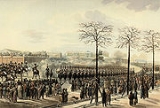
On the morning of 14 December, a group of officers commanding about 3,000 men assembled in Senate Square, where they refused to swear allegiance
to the new tsar
, Nicholas I, proclaiming instead their loyalty to Constantine and the Constitution. They expected to be joined by the rest of the troops stationed in Saint Petersburg, but they were disappointed. The revolt was further hampered when it was deserted by its supposed leader Prince Trubetskoy, who had a last minute change of heart, and failed to turn up at the Square. His second in command, Colonel Bulatov also vanished from the scene. After a hurried consultation the rebels appointed Prince Eugene Obolensky as a replacement leader.
For long hours there was a stand-off between the 3,000 rebels and the 9,000 loyal troops stationed outside the Senate building, with some desultory shooting from the rebel side. Also on the scene was a vast crowd of civilian on-lookers who began fraternizing with the rebels but who were not called on to participate in the action by the leaders of the revolt. Eventually Nicholas, the new Tsar, appeared in person, at the square, and sent Count Mikhail Miloradovich
, a military hero who was greatly respected by ordinary soldiers, to parley with the rebels. While delivering a speech, Miloradovich was shot and fatally wounded by officer Pyotr Kakhovsky. At the same time, a rebelling grenadier squad, led by lieutenant Nikolay Panov, entered the Winter Palace
but failed to seize it and retreated.
After spending most of the day in fruitless attempts to parley with the rebel force, Nicholas ordered a cavalry charge which, however, slipped on the icy cobbles and retired in disorder. Eventually, at the end of the day, Nicholas ordered three artillery pieces to open fire, with devastating effect. To avoid the slaughter the rebels broke and ran. Some attempted to regroup on the frozen surface of the river Neva, to the north. However, here, also, they were targeted by the artillery and suffered many casualties. As the ice was broken by the cannon fire, many of the dead and dying were cast into the river. After a nighttime mopping-up operation by loyal army and police units, the revolt in the north came to an end.
The revolt may have suffered because of poor communications from the leaders with the soldiers involved. Soldiers in Saint Petersburg were made to chant "Constantine and Constitution", but when questioned, many of them reportedly professed to believe that "Constitution" (Russian konstitutsiya) was Constantine's wife. This may just be a rumor, however, because in a letter from Pyotr Kakhovsky to General Levashev, Kakhovsky says, "The story told to Your Excellency that, in the uprising of 14 December the rebels were shouting 'Long live the Constitution!' and that the people were asking 'What is Constitution, the wife of His Highness the Grand Duke?' is not true. It is an amusing invention."
. It took two weeks for the Southern Society to learn of the events in the capital. Meanwhile, other members of the leadership were arrested. The Southern Society, and a nationalistic group called the United Slavs discussed revolt. When learning of the location of some of the arrested men, the United Slavs freed them by force. One of the freed men, Sergey Muravyov-Apostol
, assumed leadership of the revolt. After converting the soldiers of Vasilkov to the cause, Muraviev-Apostol easily captured the city. The rebelling army was soon confronted by superior forces armed with artillery loaded with grapeshot
, and with orders to destroy the rebels.
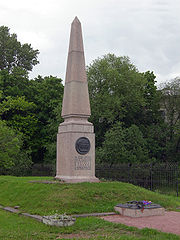
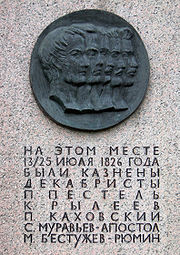
On 3 January, the rebels met defeat and the surviving leaders were sent to Saint Petersburg to stand trial with the northern leaders. The Decembrists were taken to the Winter Palace to be interrogated, tried, and convicted. Kakhovsky was executed by hanging together with four other leading Decembrists: Pavel Pestel
; the poet Kondraty Ryleyev; Sergey Muravyov-Apostol
; and Mikhail Bestuzhev-Ryumin
. Other Decembrists were exiled to Siberia
, Kazakhstan
, and the Far East
.
When the five Decembrists were hanged something unusual happened. The ropes that were being used to hang them parted before any of them actually died. This caused a sigh of relief in the crowd because, according to a centuries-old tradition, any condemned prisoner who survived a botched execution would be set free. Rather than free these prisoners, Nicholas ordered new ropes and the prisoners were hanged again. This was the last public execution in Russian imperial history.
 Suspicion also fell on several eminent persons who were on friendly terms with the Decembrist leaders and could have been aware of their clandestine organizations, notably Aleksandr Pushkin
, Alexander Griboedov, and Aleksey Yermolov
. Wives of many Decembrists followed their husbands into exile
. The expression Decembrist wife is a Russian symbol of the devotion of a wife to her husband. Maria Volkonsky, the wife of the Decembrist leader Sergei Volkonsky, notably followed her husband to his exile in Irkutsk
. Despite the spartan conditions of this banishment, Sergei Volkonsky and his wife, Maria, took opportunities to celebrate the liberalising mode of their exile. Sergei took to wearing an untrimmed beard (rejecting Peter the Great's reforms and salon fashion), wearing peasant dress and socialising with many of his peasant associates with whom he worked the land at his farm in Urik. Maria, equally, established schools, a foundling hospital and a theater for the local population. Sergei returned after thirty years of his exile had elapsed, though his titles and land remained under royal possession. Other exiles preferred to remain in Siberia after their sentences were served, preferring its relative freedom to the stifling intrigues of Moscow and St. Petersburg, and after years of exile there was not much for them to return to. Many Decembrists thrived in exile, in time becoming landowners and farmers. In later years, they would become the idols for the populist movement of the 1860s and the 1870s, where their advocacy for reform and their anti-serfdom platform established a great admiration for their actions, including the writer Leo Tolstoy
.
Not all Decembrists could identify with Basargin’s positive experience. Because of their lower social standing, “soldier-Decembrists” experienced the Emperor’s vengeance in full. Sentenced by court martial, many of these “commoners” received thousands of lashes. Those that survived journeyed to Siberia on foot, chained alongside common criminals.
Fifteen out of 124 Decembrists were convicted of “state-crimes” by the Supreme Criminal Court, and sentenced to “exile-to-settlement.” These men were sent directly to isolated locales, such as Berezov, Narym, Surgut, Pelym, Irkutsk, Yakutsk, and Viliuisk, among others. Few Russians inhabited these places: the populations consisted mainly of Siberian aborigines, Tunguses, Yakuts, Tartars, Ostiaks, Mongols, and Buriats.
Of all those exiled, the largest group of prisoners was sent to Chita, to be transferred three years later to Petrovsky Zavod, near Nerchinsk. This group, sentenced to hard labor, included principal leaders of the Decembrist movement, as well as Polish revolutionaries. Siberian Governor-General Lavinsky argued that it would be easiest to control a large, concentrated group of convicts, and Emperor Nicholas I pursued this policy in order to maximize surveillance and to limit revolutionaries’ contact with local populations. Concentration facilitated the guarding of prisoners, but it also allowed the Decembrists to continue to exist as a community. This was especially true at Chita. The move to Petrovsky Zavod, however, forced Decembrists to divide into smaller groups; the new location was compartmentalized, with an oppressive sense of order. Convicts could no longer congregate casually. Although nothing could destroy the Decembrists’ conception of fraternity, Petrovsky Zavod forced them to live more private lives. Due to a number of imperial sentence reductions, exiles started to complete their labor terms years ahead of schedule. The labor itself was of minimal travail; Stanislav Leparsky, commandant of Petrovsky Zavod, failed to enforce Decembrists’ original labor sentences, and criminal convicts carried out much of the work in place of the revolutionaries. Most Decembrists left Petrovsky Zavod between 1835 and 1837, settling in or near Irkutsk, Minusinsk, Kurgan, Tobol’sk, Turinsk, and Yalutorovsk. Those Decembrists who had already lived in or visited Siberia, such as Dimitri Zavalishin, prospered upon leaving Petrovsky Zavod’s confines, but most found it physically arduous and more psychologically enervating than prison life.
The Siberian population met the Decembrists with great hospitality. Natives played central roles in keeping lines of communication open among Decembrists, friends, and relatives. Most merchants and state employees were also sympathetic. To the masses, the Decembrist exiles were “generals who had refused to take the oath to Nicholas I.” They were great figures that had suffered political persecution for their loyalty to the people. On the whole, indigenous Siberian populations greatly respected the Decembrists, and were extremely hospitable in their reception of them.
Upon arrival at places of settlement, exiles had to comply with extensive regulations under a strict governmental regime. Local police watched, regulated, and notated every move that Decembrists attempted to make. Dimitri Zavalishin was thrown into prison for failing to remove his hat before a lieutenant. Not only were political and social activities carefully monitored and prevented, there was also interference regarding religious convictions. Local clergy accused Prince Shakhovskoi of “heresy”, due to his interest in natural sciences. Authorities investigated and restrained other Decembrists for not attending church. The regime thoroughly censored all correspondences, especially communication with relatives. Messages were scrupulously reviewed by both officials in Siberia and the Third Division of the political intelligence service at St. Petersburg. This screening process necessitated dry, careful wording on the part of Decembrists. In the words of Bestuzhev, correspondence bore a “lifeless…imprint of officiality.” Under the settlement regime, allowances were extremely meager. Certain Decembrists, including the Volkonskys, the Murav’yovs, and the Trubetskoys, were rich, but the majority of exiles had no money, and were forced to live off a mere fifteen desyatins of land, the allotment granted to each settler. Decembrists, with little to no knowledge of the land, attempted to eke out a living on wretched soil with next to no equipment. Financial aid from relatives and wealthier comrades saved many; others perished.
Despite extensive restrictions, limitations, and hardships, Decembrists believed that they could improve their situation through personal initiative. A constant stream of petitions came out of Petrovsky Zavod addressed to General Leparskii and Emperor Nicholas I. Most of the petitions were written by Decembrists’ wives who had nobly cast aside social privileges and comfort to follow their husbands into exile. These wives joined under the leadership of Princess Mariia Volkonskaia, and by 1832, through relentless petitions, managed to secure for their men formal cancellation of labor requirements, and several privileges, including the right of husbands to live with their wives in privacy. Decembrists managed to gain transfers and allowances through persuasive petitions as well as through the intervention of family members. This process of petitioning, and the resultant concessions made by the tsar and officials, was and would continue to be a standard practice of political exiles in Siberia. The chain of bureaucratic procedures and orders linking St. Petersburg to Siberian administration was often circumvented or ignored. These breaks in bureaucracy afforded exiles a small capacity for betterment and activism.
During their time in exile, the Decembrists fundamentally influenced Siberian life. Their presence was most definitely felt culturally and economically, political activity being so far removed from the “pulse of national life” so as to be negligible. While in Petrovsky Zavod, Decembrists taught each other foreign languages, arts and crafts, and musical instruments. They established “academies” made up of libraries, schools, and symposia. In their settlements, Decembrists were fierce advocates of education, and founded many schools for natives, the first of which opened at Nerchinsk. Schools were also founded for women, and soon exceeded capacity. Decembrists contributed greatly to the field of agriculture, introducing previously unknown crops such as vegetables, tobacco, rye, buckwheat, and barley, and advanced agricultural methods such as hothouse cultivation. Trained doctors among the political exiles promoted and organized medical aid. The homes of prominent exiles like Prince Sergei Volkonsky and Prince Sergei Trubetskoi became social centers of their locales. All throughout Siberia, the Decembrists sparked an intellectual awakening: literary writings, propaganda, newspapers, and books from European Russia began to circulate the eastern provinces, the local population developing a capacity for critical political observation. The Decembrists even held a certain influence within Siberian administration; Dimitry Zavalishin played a critical role in developing and advocating Russian Far East policy. Although the Decembrists lived in isolation, their scholarly activities encompassed Siberia at large, including its culture, economy, administration, population, geography, botany, and ecology. Despite restricted circumstances, the Decembrists accomplished an extraordinary amount, and their work was deeply appreciated by Siberians.
On August 26, 1856, with the ascent of Alexander II to the throne, the Decembrists received amnesty, their rights, privileges, and titles restored. Not all chose to return to the West, however. Some were financially inhibited, others had no family to return to, and many were weak with old age. To many, Siberia had become home. Those that did return to European Russia did so with enthusiasm for the enforcement of the Emancipation Reforms of 1861.
The exile of the Decembrists led to the permanent implantation of an intelligentsia in Siberia. For the first time, a cultural, intellectual, and political elite came to Siberian society as permanent residents; they integrated with the country and participated alongside natives in its development. The customary practices of elites in Siberia were oppression and extortion. The Decembrists were a phenomenon in that they earned the trust and respect of local peoples through their sympathy and good deeds. They were entirely approachable. Through constant, open communication with natives, they saw Siberia in its true light. The Decembrists’ presence left definite traces that would prove positive in a material sense, as well as a cultural and moral one. They overcame extreme want, administrative tyranny, and hardship, and educated not just themselves, but an entire generation. In exile, the Decembrists remained a positive force of progress.
would continue for almost a century, although serfdom
would be officially abolished in 1861. Though defeated, the Decembrists did effect some change on the regime. Their dissatisfaction forced Nicholas to turn his attention inward to address the issues of the empire. In 1826, a rehabilitated Speransky began the task of codifying Russian law, a task that continued throughout Nicholas's reign. Anecdotally, after being defeated in the Crimean War
, Nicholas is said to have lamented that his own entourage had treated him worse than the Decembrists ever had.
Although the revolt was a proscribed topic during Nicholas' reign, Alexander Herzen
placed the profiles of executed Decembrists on the cover of his radical periodical Polar Star. Alexander Pushkin addressed poems to his Decembrist friends, Nikolai Nekrasov
wrote a long poem about the Decembrist wives, and Leo Tolstoy
started writing a novel on that liberal movement, which would later evolve into War and Peace
. In the Soviet era Yuri Shaporin produced an opera
entitled Dekabristi (The Decembrists), about the revolt, with the libretto
written by Aleksey Nikolayevich Tolstoy
. It premiered at the Bolshoi Theatre
on 23 June 1953.
To some extent, the Decembrists were in the tradition of a long line of palace revolutionaries who wanted to place their candidate on the throne, but because the Decembrists also wanted to implement Classical Liberalism
, their revolt has been considered the beginning of a revolution
ary movement. The uprising was the first open breach between the government and reformist elements of the Russian nobility
, which would subsequently widen.
Gregorian calendar
The Gregorian calendar, also known as the Western calendar, or Christian calendar, is the internationally accepted civil calendar. It was introduced by Pope Gregory XIII, after whom the calendar was named, by a decree signed on 24 February 1582, a papal bull known by its opening words Inter...
), 1825. Russian army officers led about 3,000 soldiers in a protest against Nicholas I
Nicholas I of Russia
Nicholas I , was the Emperor of Russia from 1825 until 1855, known as one of the most reactionary of the Russian monarchs. On the eve of his death, the Russian Empire reached its historical zenith spanning over 20 million square kilometers...
's assumption of the throne after his elder brother Constantine
Grand Duke Constantine Pavlovich of Russia
Constantine Pavlovich was a grand duke of Russia and the second son of Emperor Paul I. He was the Tsesarevich of Russia throughout the reign of his elder brother Alexander I, but had secretly renounced his claim to the throne in 1823...
removed himself from the line of succession. Because these events occurred in December, the rebels were called the Decembrists (Dekabristy). This uprising, which was suppressed by Nicholas I, took place in the Senate Square in Saint Petersburg
Saint Petersburg
Saint Petersburg is a city and a federal subject of Russia located on the Neva River at the head of the Gulf of Finland on the Baltic Sea...
. In 1925, to mark the centenary of the event, the square was renamed as Decembrist Square, but in 2008 it reverted to its original name.
The Union of Salvation
In 1816, several officers of the Imperial Russian Guard founded a society known as the Union of Salvation, or of the Faithful and True Sons of the MotherlandUnion of Salvation
The Union of Salvation , also known as the Society of True and Loyal Sons of the Fatherland since 1817 was the first secret political society of the Decembrists.The Union of Salvation was founded in 1816 at the initiative of Alexander Nikolayevich Muravyov by a group of young...
. The society acquired a more Liberal
Classical liberalism
Classical liberalism is the philosophy committed to the ideal of limited government, constitutionalism, rule of law, due process, and liberty of individuals including freedom of religion, speech, press, assembly, and free markets....
cast after it was joined by the idealistic Pavel Pestel
Pavel Pestel
Colonel Pavel Ivanovich Pestel was a Russian revolutionary and ideologue of the Decembrists.In 1805-1809, Pavel Pestel studied in Dresden. In 1810-1811, he was a student at the Page Corps, from which he would graduate in the rank of praporshchik. Pestel was then sent to the Lithuanian Regiment of...
. After a mutiny in the Semenovsky Regiment
Semenovsky Regiment
Semenovsky Life-Guards Regiment was one of the two oldest guards regiments of the Imperial Russian Army.- History :...
in 1820, the society decided to suspend activity in 1821. Two groups, however, continued to function secretly: a Southern Society, based at Tulchin, a small garrison town in Ukraine
Ukraine
Ukraine is a country in Eastern Europe. It has an area of 603,628 km², making it the second largest contiguous country on the European continent, after Russia...
, in which Pestel was the outstanding figure, and a Northern Society, based at St Petersburg, led by Guard officers Nikita Muraviev, Prince S. P. Trubetskoy
Sergei Petrovich Troubetzkoy
Prince Sergei Petrovich Trubetskoy was one of the organizers of the Decembrist movement. Close to Nikita Mikhailovich Muravyov in his views, he was declared the group's leader on the eve of the December 26 uprising in 1825 but failed to appear, and instead sought refuge in the Austrian...
and Prince Eugene Obolensky. The political aims of the more moderate Northern Society were a British style constitutional monarchy with a limited franchise, the abolition of serfdom and equality before the law. The Southern Society, under Pestel's influence, was more radical and wanted to abolish the monarchy, establish a republic and redistribute land: taking half into state ownership and dividing the rest among the peasants.
At first, many officers were encouraged by Tsar Alexander
Alexander I of Russia
Alexander I of Russia , served as Emperor of Russia from 23 March 1801 to 1 December 1825 and the first Russian King of Poland from 1815 to 1825. He was also the first Russian Grand Duke of Finland and Lithuania....
's early liberal reformation of Russian society and politics. In 1819 Speransky was appointed as the Governor of Siberia, with the task of reforming local government. Equally, in 1818 the Tsar asked Novosiltsev
Nikolay Nikolayevich Novosiltsev
Count Nikolay Nikolayevich Novosiltsev was a Russian statesman and a close aide to Alexander I of Russia.He was a natural son of a wealthy nobleman, married to the aunt of Count Pavel Stroganov. This relationship secured for him a place in the Privy Committee that outlined the Government reform...
to draw up a constitution. However, internal and external unrest, which the Tsar believed stemmed from political liberalisation, led to a series of repressions and a return to a former government of restriction and conservatism.
Meanwhile, spurred by their experiences of the Napoleonic Wars
Napoleonic Wars
The Napoleonic Wars were a series of wars declared against Napoleon's French Empire by opposing coalitions that ran from 1803 to 1815. As a continuation of the wars sparked by the French Revolution of 1789, they revolutionised European armies and played out on an unprecedented scale, mainly due to...
, and realising many of the harsh indignities through which the peasant soldiers were forced, Decembrist officers and sympathisers displayed their contempt for the ancien régime by rejecting court lifestyle, wearing their cavalry swords at balls (indicating their unwillingness to dance), and committing themselves to academic study. This new lifestyle captured the spirit of the times, as a willingness to embrace both the peasant (i.e., the 'Russian way of life') and ongoing reformative movements
Age of Enlightenment
The Age of Enlightenment was an elite cultural movement of intellectuals in 18th century Europe that sought to mobilize the power of reason in order to reform society and advance knowledge. It promoted intellectual interchange and opposed intolerance and abuses in church and state...
abroad.
The motivations for the reformist movement are outlined, in part, by Pavel Pestel:
At the Senate Square
When Tsar Alexander IAlexander I of Russia
Alexander I of Russia , served as Emperor of Russia from 23 March 1801 to 1 December 1825 and the first Russian King of Poland from 1815 to 1825. He was also the first Russian Grand Duke of Finland and Lithuania....
died on 19 November (1 December New Style) 1825, the royal guards swore allegiance to the presumed heir, Alexander's brother Constantine
Grand Duke Constantine Pavlovich of Russia
Constantine Pavlovich was a grand duke of Russia and the second son of Emperor Paul I. He was the Tsesarevich of Russia throughout the reign of his elder brother Alexander I, but had secretly renounced his claim to the throne in 1823...
. When Constantine made his renunciation public, and Nicholas stepped forward to assume the throne, the Northern Society acted. With the capital in temporary confusion, and one oath to Constantine having already been sworn, the society scrambled in secret meetings to convince regimental leaders not to swear allegiance to Nicholas. These efforts would culminate in the events of 14 December Old Style (26 December New Style). The leaders of the society (many of whom belonged to the high aristocracy) elected Prince Sergei Trubetskoy
Sergei Petrovich Troubetzkoy
Prince Sergei Petrovich Trubetskoy was one of the organizers of the Decembrist movement. Close to Nikita Mikhailovich Muravyov in his views, he was declared the group's leader on the eve of the December 26 uprising in 1825 but failed to appear, and instead sought refuge in the Austrian...
as interim dictator
Dictator
A dictator is a ruler who assumes sole and absolute power but without hereditary ascension such as an absolute monarch. When other states call the head of state of a particular state a dictator, that state is called a dictatorship...
.
On the morning of 14 December, a group of officers commanding about 3,000 men assembled in Senate Square, where they refused to swear allegiance
Allegiance
An allegiance is a duty of fidelity said to be owed by a subject or a citizen to his/her state or sovereign.-Etymology:From Middle English ligeaunce . The al- prefix was probably added through confusion with another legal term, allegeance, an "allegation"...
to the new tsar
Tsar
Tsar is a title used to designate certain European Slavic monarchs or supreme rulers. As a system of government in the Tsardom of Russia and Russian Empire, it is known as Tsarist autocracy, or Tsarism...
, Nicholas I, proclaiming instead their loyalty to Constantine and the Constitution. They expected to be joined by the rest of the troops stationed in Saint Petersburg, but they were disappointed. The revolt was further hampered when it was deserted by its supposed leader Prince Trubetskoy, who had a last minute change of heart, and failed to turn up at the Square. His second in command, Colonel Bulatov also vanished from the scene. After a hurried consultation the rebels appointed Prince Eugene Obolensky as a replacement leader.
For long hours there was a stand-off between the 3,000 rebels and the 9,000 loyal troops stationed outside the Senate building, with some desultory shooting from the rebel side. Also on the scene was a vast crowd of civilian on-lookers who began fraternizing with the rebels but who were not called on to participate in the action by the leaders of the revolt. Eventually Nicholas, the new Tsar, appeared in person, at the square, and sent Count Mikhail Miloradovich
Mikhail Andreyevich Miloradovich
Mikhail Andreyevich Miloradovich , spelled Miloradovitch in contemporary English sources was a Russian general prominent during the Napoleonic Wars. He entered military service on the eve of the Russo-Swedish War of 1788–1790 and his career advanced rapidly during the reign of Paul I...
, a military hero who was greatly respected by ordinary soldiers, to parley with the rebels. While delivering a speech, Miloradovich was shot and fatally wounded by officer Pyotr Kakhovsky. At the same time, a rebelling grenadier squad, led by lieutenant Nikolay Panov, entered the Winter Palace
Winter Palace
The Winter Palace in Saint Petersburg, Russia, was, from 1732 to 1917, the official residence of the Russian monarchs. Situated between the Palace Embankment and the Palace Square, adjacent to the site of Peter the Great's original Winter Palace, the present and fourth Winter Palace was built and...
but failed to seize it and retreated.
After spending most of the day in fruitless attempts to parley with the rebel force, Nicholas ordered a cavalry charge which, however, slipped on the icy cobbles and retired in disorder. Eventually, at the end of the day, Nicholas ordered three artillery pieces to open fire, with devastating effect. To avoid the slaughter the rebels broke and ran. Some attempted to regroup on the frozen surface of the river Neva, to the north. However, here, also, they were targeted by the artillery and suffered many casualties. As the ice was broken by the cannon fire, many of the dead and dying were cast into the river. After a nighttime mopping-up operation by loyal army and police units, the revolt in the north came to an end.
The revolt may have suffered because of poor communications from the leaders with the soldiers involved. Soldiers in Saint Petersburg were made to chant "Constantine and Constitution", but when questioned, many of them reportedly professed to believe that "Constitution" (Russian konstitutsiya) was Constantine's wife. This may just be a rumor, however, because in a letter from Pyotr Kakhovsky to General Levashev, Kakhovsky says, "The story told to Your Excellency that, in the uprising of 14 December the rebels were shouting 'Long live the Constitution!' and that the people were asking 'What is Constitution, the wife of His Highness the Grand Duke?' is not true. It is an amusing invention."
Arrests and trial
While the Northern Society scrambled in the days leading up to 14 December, the Southern Society (based in Tulchin) took a serious blow. On 13 December, acting on reports of treason, the police arrested Pavel PestelPavel Pestel
Colonel Pavel Ivanovich Pestel was a Russian revolutionary and ideologue of the Decembrists.In 1805-1809, Pavel Pestel studied in Dresden. In 1810-1811, he was a student at the Page Corps, from which he would graduate in the rank of praporshchik. Pestel was then sent to the Lithuanian Regiment of...
. It took two weeks for the Southern Society to learn of the events in the capital. Meanwhile, other members of the leadership were arrested. The Southern Society, and a nationalistic group called the United Slavs discussed revolt. When learning of the location of some of the arrested men, the United Slavs freed them by force. One of the freed men, Sergey Muravyov-Apostol
Sergey Muravyov-Apostol
Sergey Ivanovich Muravyov-Apostol was a Russian Lieutenant Colonel, one of the organizers of the Decembrist revolt. He was the brother of other Decembrists Ippolit Muravyov-Apostol and Matvey Muravyov-Apostol...
, assumed leadership of the revolt. After converting the soldiers of Vasilkov to the cause, Muraviev-Apostol easily captured the city. The rebelling army was soon confronted by superior forces armed with artillery loaded with grapeshot
Grapeshot
In artillery, a grapeshot is a type of shot that is not a one solid element, but a mass of small metal balls or slugs packed tightly into a canvas bag. It was used both in land and naval warfare. When assembled, the balls resembled a cluster of grapes, hence the name...
, and with orders to destroy the rebels.
On 3 January, the rebels met defeat and the surviving leaders were sent to Saint Petersburg to stand trial with the northern leaders. The Decembrists were taken to the Winter Palace to be interrogated, tried, and convicted. Kakhovsky was executed by hanging together with four other leading Decembrists: Pavel Pestel
Pavel Pestel
Colonel Pavel Ivanovich Pestel was a Russian revolutionary and ideologue of the Decembrists.In 1805-1809, Pavel Pestel studied in Dresden. In 1810-1811, he was a student at the Page Corps, from which he would graduate in the rank of praporshchik. Pestel was then sent to the Lithuanian Regiment of...
; the poet Kondraty Ryleyev; Sergey Muravyov-Apostol
Sergey Muravyov-Apostol
Sergey Ivanovich Muravyov-Apostol was a Russian Lieutenant Colonel, one of the organizers of the Decembrist revolt. He was the brother of other Decembrists Ippolit Muravyov-Apostol and Matvey Muravyov-Apostol...
; and Mikhail Bestuzhev-Ryumin
Mikhail Bestuzhev-Ryumin
Mikhail Pavlovich Bestuzhev-Ryumin was a Russian officer, one of the organizers of the Decembrist revolt. He was the youngest of the five hanged Decembrists.-Biography:...
. Other Decembrists were exiled to Siberia
Siberia
Siberia is an extensive region constituting almost all of Northern Asia. Comprising the central and eastern portion of the Russian Federation, it was part of the Soviet Union from its beginning, as its predecessor states, the Tsardom of Russia and the Russian Empire, conquered it during the 16th...
, Kazakhstan
Kazakhstan
Kazakhstan , officially the Republic of Kazakhstan, is a transcontinental country in Central Asia and Eastern Europe. Ranked as the ninth largest country in the world, it is also the world's largest landlocked country; its territory of is greater than Western Europe...
, and the Far East
Far East
The Far East is an English term mostly describing East Asia and Southeast Asia, with South Asia sometimes also included for economic and cultural reasons.The term came into use in European geopolitical discourse in the 19th century,...
.
When the five Decembrists were hanged something unusual happened. The ropes that were being used to hang them parted before any of them actually died. This caused a sigh of relief in the crowd because, according to a centuries-old tradition, any condemned prisoner who survived a botched execution would be set free. Rather than free these prisoners, Nicholas ordered new ropes and the prisoners were hanged again. This was the last public execution in Russian imperial history.
Aleksandr Pushkin
Alexander Sergeyevich Pushkin was a Russian author of the Romantic era who is considered by many to be the greatest Russian poet and the founder of modern Russian literature....
, Alexander Griboedov, and Aleksey Yermolov
Aleksey Petrovich Yermolov
Aleksey Petrovich Yermolov , or Ermolov , was a Russian Imperial general of the 19th century who commanded Russian troops in the Caucasus War.-Early life:...
. Wives of many Decembrists followed their husbands into exile
Exile
Exile means to be away from one's home , while either being explicitly refused permission to return and/or being threatened with imprisonment or death upon return...
. The expression Decembrist wife is a Russian symbol of the devotion of a wife to her husband. Maria Volkonsky, the wife of the Decembrist leader Sergei Volkonsky, notably followed her husband to his exile in Irkutsk
Irkutsk
Irkutsk is a city and the administrative center of Irkutsk Oblast, Russia, one of the largest cities in Siberia. Population: .-History:In 1652, Ivan Pokhabov built a zimovye near the site of Irkutsk for gold trading and for the collection of fur taxes from the Buryats. In 1661, Yakov Pokhabov...
. Despite the spartan conditions of this banishment, Sergei Volkonsky and his wife, Maria, took opportunities to celebrate the liberalising mode of their exile. Sergei took to wearing an untrimmed beard (rejecting Peter the Great's reforms and salon fashion), wearing peasant dress and socialising with many of his peasant associates with whom he worked the land at his farm in Urik. Maria, equally, established schools, a foundling hospital and a theater for the local population. Sergei returned after thirty years of his exile had elapsed, though his titles and land remained under royal possession. Other exiles preferred to remain in Siberia after their sentences were served, preferring its relative freedom to the stifling intrigues of Moscow and St. Petersburg, and after years of exile there was not much for them to return to. Many Decembrists thrived in exile, in time becoming landowners and farmers. In later years, they would become the idols for the populist movement of the 1860s and the 1870s, where their advocacy for reform and their anti-serfdom platform established a great admiration for their actions, including the writer Leo Tolstoy
Leo Tolstoy
Lev Nikolayevich Tolstoy was a Russian writer who primarily wrote novels and short stories. Later in life, he also wrote plays and essays. His two most famous works, the novels War and Peace and Anna Karenina, are acknowledged as two of the greatest novels of all time and a pinnacle of realist...
.
Decembrists in Siberia
On July 13, 1826, the first party of Decembrist convicts began its exodus to Siberia. Among this group, were Prince Trubetskoi, Prince Obolensky, Peter and Andrei Borisov, Prince Volkonsky, and Artamon Muraviev, all of them bound for the mines at Nerchinsk. The journey eastward was fraught with hardship, yet for many, it offered refreshing changes in scenery and peoples, following imprisonment. Decembrist Nikolay Vasil’yevich Basargin was unwell when he set out from St. Petersburg, but he recovered his strength on the move; his memoirs depict the journey to Siberia in a cheerful light, full of praise for the “common people” and commanding landscapes.Not all Decembrists could identify with Basargin’s positive experience. Because of their lower social standing, “soldier-Decembrists” experienced the Emperor’s vengeance in full. Sentenced by court martial, many of these “commoners” received thousands of lashes. Those that survived journeyed to Siberia on foot, chained alongside common criminals.
Fifteen out of 124 Decembrists were convicted of “state-crimes” by the Supreme Criminal Court, and sentenced to “exile-to-settlement.” These men were sent directly to isolated locales, such as Berezov, Narym, Surgut, Pelym, Irkutsk, Yakutsk, and Viliuisk, among others. Few Russians inhabited these places: the populations consisted mainly of Siberian aborigines, Tunguses, Yakuts, Tartars, Ostiaks, Mongols, and Buriats.
Of all those exiled, the largest group of prisoners was sent to Chita, to be transferred three years later to Petrovsky Zavod, near Nerchinsk. This group, sentenced to hard labor, included principal leaders of the Decembrist movement, as well as Polish revolutionaries. Siberian Governor-General Lavinsky argued that it would be easiest to control a large, concentrated group of convicts, and Emperor Nicholas I pursued this policy in order to maximize surveillance and to limit revolutionaries’ contact with local populations. Concentration facilitated the guarding of prisoners, but it also allowed the Decembrists to continue to exist as a community. This was especially true at Chita. The move to Petrovsky Zavod, however, forced Decembrists to divide into smaller groups; the new location was compartmentalized, with an oppressive sense of order. Convicts could no longer congregate casually. Although nothing could destroy the Decembrists’ conception of fraternity, Petrovsky Zavod forced them to live more private lives. Due to a number of imperial sentence reductions, exiles started to complete their labor terms years ahead of schedule. The labor itself was of minimal travail; Stanislav Leparsky, commandant of Petrovsky Zavod, failed to enforce Decembrists’ original labor sentences, and criminal convicts carried out much of the work in place of the revolutionaries. Most Decembrists left Petrovsky Zavod between 1835 and 1837, settling in or near Irkutsk, Minusinsk, Kurgan, Tobol’sk, Turinsk, and Yalutorovsk. Those Decembrists who had already lived in or visited Siberia, such as Dimitri Zavalishin, prospered upon leaving Petrovsky Zavod’s confines, but most found it physically arduous and more psychologically enervating than prison life.
The Siberian population met the Decembrists with great hospitality. Natives played central roles in keeping lines of communication open among Decembrists, friends, and relatives. Most merchants and state employees were also sympathetic. To the masses, the Decembrist exiles were “generals who had refused to take the oath to Nicholas I.” They were great figures that had suffered political persecution for their loyalty to the people. On the whole, indigenous Siberian populations greatly respected the Decembrists, and were extremely hospitable in their reception of them.
Upon arrival at places of settlement, exiles had to comply with extensive regulations under a strict governmental regime. Local police watched, regulated, and notated every move that Decembrists attempted to make. Dimitri Zavalishin was thrown into prison for failing to remove his hat before a lieutenant. Not only were political and social activities carefully monitored and prevented, there was also interference regarding religious convictions. Local clergy accused Prince Shakhovskoi of “heresy”, due to his interest in natural sciences. Authorities investigated and restrained other Decembrists for not attending church. The regime thoroughly censored all correspondences, especially communication with relatives. Messages were scrupulously reviewed by both officials in Siberia and the Third Division of the political intelligence service at St. Petersburg. This screening process necessitated dry, careful wording on the part of Decembrists. In the words of Bestuzhev, correspondence bore a “lifeless…imprint of officiality.” Under the settlement regime, allowances were extremely meager. Certain Decembrists, including the Volkonskys, the Murav’yovs, and the Trubetskoys, were rich, but the majority of exiles had no money, and were forced to live off a mere fifteen desyatins of land, the allotment granted to each settler. Decembrists, with little to no knowledge of the land, attempted to eke out a living on wretched soil with next to no equipment. Financial aid from relatives and wealthier comrades saved many; others perished.
Despite extensive restrictions, limitations, and hardships, Decembrists believed that they could improve their situation through personal initiative. A constant stream of petitions came out of Petrovsky Zavod addressed to General Leparskii and Emperor Nicholas I. Most of the petitions were written by Decembrists’ wives who had nobly cast aside social privileges and comfort to follow their husbands into exile. These wives joined under the leadership of Princess Mariia Volkonskaia, and by 1832, through relentless petitions, managed to secure for their men formal cancellation of labor requirements, and several privileges, including the right of husbands to live with their wives in privacy. Decembrists managed to gain transfers and allowances through persuasive petitions as well as through the intervention of family members. This process of petitioning, and the resultant concessions made by the tsar and officials, was and would continue to be a standard practice of political exiles in Siberia. The chain of bureaucratic procedures and orders linking St. Petersburg to Siberian administration was often circumvented or ignored. These breaks in bureaucracy afforded exiles a small capacity for betterment and activism.
During their time in exile, the Decembrists fundamentally influenced Siberian life. Their presence was most definitely felt culturally and economically, political activity being so far removed from the “pulse of national life” so as to be negligible. While in Petrovsky Zavod, Decembrists taught each other foreign languages, arts and crafts, and musical instruments. They established “academies” made up of libraries, schools, and symposia. In their settlements, Decembrists were fierce advocates of education, and founded many schools for natives, the first of which opened at Nerchinsk. Schools were also founded for women, and soon exceeded capacity. Decembrists contributed greatly to the field of agriculture, introducing previously unknown crops such as vegetables, tobacco, rye, buckwheat, and barley, and advanced agricultural methods such as hothouse cultivation. Trained doctors among the political exiles promoted and organized medical aid. The homes of prominent exiles like Prince Sergei Volkonsky and Prince Sergei Trubetskoi became social centers of their locales. All throughout Siberia, the Decembrists sparked an intellectual awakening: literary writings, propaganda, newspapers, and books from European Russia began to circulate the eastern provinces, the local population developing a capacity for critical political observation. The Decembrists even held a certain influence within Siberian administration; Dimitry Zavalishin played a critical role in developing and advocating Russian Far East policy. Although the Decembrists lived in isolation, their scholarly activities encompassed Siberia at large, including its culture, economy, administration, population, geography, botany, and ecology. Despite restricted circumstances, the Decembrists accomplished an extraordinary amount, and their work was deeply appreciated by Siberians.
On August 26, 1856, with the ascent of Alexander II to the throne, the Decembrists received amnesty, their rights, privileges, and titles restored. Not all chose to return to the West, however. Some were financially inhibited, others had no family to return to, and many were weak with old age. To many, Siberia had become home. Those that did return to European Russia did so with enthusiasm for the enforcement of the Emancipation Reforms of 1861.
The exile of the Decembrists led to the permanent implantation of an intelligentsia in Siberia. For the first time, a cultural, intellectual, and political elite came to Siberian society as permanent residents; they integrated with the country and participated alongside natives in its development. The customary practices of elites in Siberia were oppression and extortion. The Decembrists were a phenomenon in that they earned the trust and respect of local peoples through their sympathy and good deeds. They were entirely approachable. Through constant, open communication with natives, they saw Siberia in its true light. The Decembrists’ presence left definite traces that would prove positive in a material sense, as well as a cultural and moral one. They overcame extreme want, administrative tyranny, and hardship, and educated not just themselves, but an entire generation. In exile, the Decembrists remained a positive force of progress.
Assessment
With the failure of the Decembrists, Russia's AutocracyAutocracy
An autocracy is a form of government in which one person is the supreme power within the state. It is derived from the Greek : and , and may be translated as "one who rules by himself". It is distinct from oligarchy and democracy...
would continue for almost a century, although serfdom
Serfdom
Serfdom is the status of peasants under feudalism, specifically relating to Manorialism. It was a condition of bondage or modified slavery which developed primarily during the High Middle Ages in Europe and lasted to the mid-19th century...
would be officially abolished in 1861. Though defeated, the Decembrists did effect some change on the regime. Their dissatisfaction forced Nicholas to turn his attention inward to address the issues of the empire. In 1826, a rehabilitated Speransky began the task of codifying Russian law, a task that continued throughout Nicholas's reign. Anecdotally, after being defeated in the Crimean War
Crimean War
The Crimean War was a conflict fought between the Russian Empire and an alliance of the French Empire, the British Empire, the Ottoman Empire, and the Kingdom of Sardinia. The war was part of a long-running contest between the major European powers for influence over territories of the declining...
, Nicholas is said to have lamented that his own entourage had treated him worse than the Decembrists ever had.
Although the revolt was a proscribed topic during Nicholas' reign, Alexander Herzen
Alexander Herzen
Aleksandr Ivanovich Herzen was a Russian pro-Western writer and thinker known as the "father of Russian socialism", and one of the main fathers of agrarian populism...
placed the profiles of executed Decembrists on the cover of his radical periodical Polar Star. Alexander Pushkin addressed poems to his Decembrist friends, Nikolai Nekrasov
Nikolai Alekseevich Nekrasov
Nikolay Alexeyevich Nekrasov was a Russian poet, writer, critic and publisher, whose deeply compassionate poems about peasant Russia won him Fyodor Dostoyevsky's admiration and made him the hero of liberal and radical circles of Russian intelligentsia, as represented by Vissarion Belinsky and...
wrote a long poem about the Decembrist wives, and Leo Tolstoy
Leo Tolstoy
Lev Nikolayevich Tolstoy was a Russian writer who primarily wrote novels and short stories. Later in life, he also wrote plays and essays. His two most famous works, the novels War and Peace and Anna Karenina, are acknowledged as two of the greatest novels of all time and a pinnacle of realist...
started writing a novel on that liberal movement, which would later evolve into War and Peace
War and Peace
War and Peace is a novel by the Russian author Leo Tolstoy, first published in 1869. The work is epic in scale and is regarded as one of the most important works of world literature...
. In the Soviet era Yuri Shaporin produced an opera
Opera
Opera is an art form in which singers and musicians perform a dramatic work combining text and musical score, usually in a theatrical setting. Opera incorporates many of the elements of spoken theatre, such as acting, scenery, and costumes and sometimes includes dance...
entitled Dekabristi (The Decembrists), about the revolt, with the libretto
Libretto
A libretto is the text used in an extended musical work such as an opera, operetta, masque, oratorio, cantata, or musical. The term "libretto" is also sometimes used to refer to the text of major liturgical works, such as mass, requiem, and sacred cantata, or even the story line of a...
written by Aleksey Nikolayevich Tolstoy
Aleksey Nikolayevich Tolstoy
Aleksey Nikolayevich Tolstoy , nicknamed the Comrade Count, was a Russian and Soviet writer who wrote in many genres but specialized in science fiction and historical novels...
. It premiered at the Bolshoi Theatre
Bolshoi Theatre
The Bolshoi Theatre is a historic theatre in Moscow, Russia, designed by architect Joseph Bové, which holds performances of ballet and opera. The Bolshoi Ballet and Bolshoi Opera are amongst the oldest and most renowned ballet and opera companies in the world...
on 23 June 1953.
To some extent, the Decembrists were in the tradition of a long line of palace revolutionaries who wanted to place their candidate on the throne, but because the Decembrists also wanted to implement Classical Liberalism
Classical liberalism
Classical liberalism is the philosophy committed to the ideal of limited government, constitutionalism, rule of law, due process, and liberty of individuals including freedom of religion, speech, press, assembly, and free markets....
, their revolt has been considered the beginning of a revolution
Revolution
A revolution is a fundamental change in power or organizational structures that takes place in a relatively short period of time.Aristotle described two types of political revolution:...
ary movement. The uprising was the first open breach between the government and reformist elements of the Russian nobility
Russian nobility
The Russian nobility arose in the 14th century and essentially governed Russia until the October Revolution of 1917.The Russian word for nobility, Dvoryanstvo , derives from the Russian word dvor , meaning the Court of a prince or duke and later, of the tsar. A nobleman is called dvoryanin...
, which would subsequently widen.
Further reading
- Figes, OrlandoOrlando FigesOrlando Figes is a British historian of Russia, and Professor of History at Birkbeck, University of London.-Overview:Figes is the son of the feminist writer Eva Figes. His sister is the author and editor Kate Figes. He attended William Ellis School in north London from 1971-78...
(2002) Natasha's Dance: a Cultural History of Russia. London. ISBN 0-7139-9517-3 - Mazour, A.G. 1937. The First Russian Revolution, 1825: the Decembrist movement; its origins, development, and significance. Stanford University Press
- Sherman, Russell & Pearce, Robert (2002) Russia 1815-81, Hodder & Stoughton