

Caucasian War

Encyclopedia
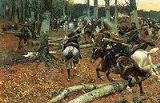
The Caucasian War of 1817–1864, also known as the Russian conquest of the Caucasus was an invasion of the Caucasus
by the Russian Empire
which ended with the annexation of the areas of the North Caucasus
to Russia. It consisted of a series of military actions waged by Russia against territories and tribal groups in Caucasia including Chechnya
, Dagestan
, Karachay and the Circassians (Adyghe
, Abkhaz
and Ubykh
) as Russia sought to expand southward.
The Russian-Circassian War
, a conflict between Russia and Circassia
, was part of the Caucasian War.
Other territories of the Caucasus (Georgia
, Armenia
and Azerbaijan
) were incorporated into the Russian empire at various times in the 19th century as a result of Russian wars with the Ottoman Empire
and Persia.
s sparked the war: Alexander I
, Nicholas I
and Alexander II
. The leading Russian commanders were Aleksey Petrovich Yermolov
in 1816–1827, Mikhail Semyonovich Vorontsov
in 1844–1853 and Aleksandr Baryatinskiy
in 1853–1856. The writers Mikhail Lermontov
and Leo Tolstoy
, who gained much of his knowledge and experience of war for his book War and Peace from these encounters, took part in the hostilities. The Russian poet Alexander Pushkin referred to it in his Byronic poem The Prisoner of the Caucasus (1821).
The Russian invasion was met with fierce resistance. The first period coincidentally ended with the death of Alexander I and Decembrist Revolt
in 1825. It achieved surprisingly little success, especially as compared with the then recent Russian victory over the "Great Army" of Napoleon.
During 1825–1833 there was little activity, since Russia was engaged in its wars with Turkey
and Persia
. After considerable successes in both wars, Russia resumed fighting in the Caucasus. They were again met with resistance, notably led by Ghazi Mollah, Gamzat-bek
and Hadji Murad
. Imam Shamil
followed them. He led the mountaineers from 1834 until his capture by Dmitry Milyutin
in 1859. In 1843, Shamil launched a sweeping offensive aimed at the Russian outposts in Avaria. On the 28th of August, 10,000 men converged from three different directions on a Russian column in Untsoikul, killing 486 men. In the next four weeks, Shamil
captured every Russian outpost in Avaria except one, exacting over 2,000 casualties on the Russian defenders. He feigned an invasion north to capture a key chokepoint at the convergence of the Avar and Kazi-Kumuh rivers. In 1845, Shamil's forces achieved their most dramatic success when they withstood a major Russian offensive led by Prince Vorontsov
.
During the Crimean War
, the Russians brokered a truce with Shamil but hostilities resumed in 1855. Warfare in the Caucasus finally ended between 1856–1859, when a 250,000 strong army under General Baryatinsky broke down the mountaineers' resistance.
The war in the Eastern part of the North Caucasus ended in 1859 when Shamil was caught by the Russians to surrender and swear allegiance to the Tsar and move to live in Central Russia. The war in the Western part of the North Caucasus resumed however with the Circassians (Adyghe, Abkhazian, and Ubykh) resuming the fight. The end was declared on June 2, 1864 (May 21 O.S.), 1864, by manifesto of the Tsar. Among the post-war events, a tragic page in the history of the indigenous peoples of the Caucasus especially the Circassians was Muhajir
ism, or population transfer
of the Muslim population into the Ottoman Empire
.
Caucasus
The Caucasus, also Caucas or Caucasia , is a geopolitical region at the border of Europe and Asia, and situated between the Black and the Caspian sea...
by the Russian Empire
Russian Empire
The Russian Empire was a state that existed from 1721 until the Russian Revolution of 1917. It was the successor to the Tsardom of Russia and the predecessor of the Soviet Union...
which ended with the annexation of the areas of the North Caucasus
North Caucasus
The North Caucasus is the northern part of the Caucasus region between the Black and Caspian Seas and within European Russia. The term is also used as a synonym for the North Caucasus economic region of Russia....
to Russia. It consisted of a series of military actions waged by Russia against territories and tribal groups in Caucasia including Chechnya
Chechnya
The Chechen Republic , commonly referred to as Chechnya , also spelled Chechnia or Chechenia, sometimes referred to as Ichkeria , is a federal subject of Russia . It is located in the southeastern part of Europe in the Northern Caucasus mountains. The capital of the republic is the city of Grozny...
, Dagestan
Dagestan
The Republic of Dagestan is a federal subject of Russia, located in the North Caucasus region. Its capital and the largest city is Makhachkala, located at the center of Dagestan on the Caspian Sea...
, Karachay and the Circassians (Adyghe
Adyghe
The Adyghe or Adygs , also often known as Circassians or Cherkess, are in origin a North Caucasian ethnic groupwho were displaced in the course of the Russian conquest of the Caucasus in the 19th century, especially after the Russian–Circassian War of 1862.Adyghe people mostly speak Adyghe and most...
, Abkhaz
Abkhaz
Abkhaz and Abkhazian may refer to:* Something of, from, or related to Abkhazia, a de facto independent region with partial recognition as a sovereign state, otherwise recognized as part of Georgia...
and Ubykh
Ubykh
Ubykh may refer to:* The Ubykh language* The Ubykh people* Ubykhia, a historical land of Ubykhs...
) as Russia sought to expand southward.
The Russian-Circassian War
Russian-Circassian War
The Russian–Circassian War refers to a series of battles and wars in Circassia, the northwestern part of the Caucasus, which were part of the Russian Empire's conquest of the Caucasus lasting approximately 150 years, starting under the reign of Tsar Peter the Great and being completed in 1864...
, a conflict between Russia and Circassia
Circassia
Circassia was an independent mountainous country located in the Caucasus region of Eurasia and was the largest and most important country in the Caucasus. Circassia was located at the crossroads of Western Asia and Eastern Europe between the Black Sea and the Caspian Sea...
, was part of the Caucasian War.
Other territories of the Caucasus (Georgia
Georgia (country)
Georgia is a sovereign state in the Caucasus region of Eurasia. Located at the crossroads of Western Asia and Eastern Europe, it is bounded to the west by the Black Sea, to the north by Russia, to the southwest by Turkey, to the south by Armenia, and to the southeast by Azerbaijan. The capital of...
, Armenia
Armenia
Armenia , officially the Republic of Armenia , is a landlocked mountainous country in the Caucasus region of Eurasia...
and Azerbaijan
Azerbaijan
Azerbaijan , officially the Republic of Azerbaijan is the largest country in the Caucasus region of Eurasia. Located at the crossroads of Western Asia and Eastern Europe, it is bounded by the Caspian Sea to the east, Russia to the north, Georgia to the northwest, Armenia to the west, and Iran to...
) were incorporated into the Russian empire at various times in the 19th century as a result of Russian wars with the Ottoman Empire
Ottoman Empire
The Ottoman EmpireIt was usually referred to as the "Ottoman Empire", the "Turkish Empire", the "Ottoman Caliphate" or more commonly "Turkey" by its contemporaries...
and Persia.
History
Three Russian TsarTsar
Tsar is a title used to designate certain European Slavic monarchs or supreme rulers. As a system of government in the Tsardom of Russia and Russian Empire, it is known as Tsarist autocracy, or Tsarism...
s sparked the war: Alexander I
Alexander I of Russia
Alexander I of Russia , served as Emperor of Russia from 23 March 1801 to 1 December 1825 and the first Russian King of Poland from 1815 to 1825. He was also the first Russian Grand Duke of Finland and Lithuania....
, Nicholas I
Nicholas I of Russia
Nicholas I , was the Emperor of Russia from 1825 until 1855, known as one of the most reactionary of the Russian monarchs. On the eve of his death, the Russian Empire reached its historical zenith spanning over 20 million square kilometers...
and Alexander II
Alexander II of Russia
Alexander II , also known as Alexander the Liberator was the Emperor of the Russian Empire from 3 March 1855 until his assassination in 1881...
. The leading Russian commanders were Aleksey Petrovich Yermolov
Aleksey Petrovich Yermolov
Aleksey Petrovich Yermolov , or Ermolov , was a Russian Imperial general of the 19th century who commanded Russian troops in the Caucasus War.-Early life:...
in 1816–1827, Mikhail Semyonovich Vorontsov
Mikhail Semyonovich Vorontsov
Prince Mikhail Semyonovich Vorontsov , was a Russian prince and field-marshal, renowned for his success in the Napoleonic wars, and most famous for his participation in the Caucasian War from 1844 to 1853....
in 1844–1853 and Aleksandr Baryatinskiy
Aleksandr Baryatinskiy
Aleksandr Ivanovich Baryatinsky , Russian General and Field Marshal , Prince, governor of the Caucasus.Baryatinsky entered the school of the ensigns of the Guard in his seventeenth year and, on November 8, 1833, received his commission of cornet in the Life Guards of the future Tsar Alexander II...
in 1853–1856. The writers Mikhail Lermontov
Mikhail Lermontov
Mikhail Yuryevich Lermontov , a Russian Romantic writer, poet and painter, sometimes called "the poet of the Caucasus", became the most important Russian poet after Alexander Pushkin's death in 1837. Lermontov is considered the supreme poet of Russian literature alongside Pushkin and the greatest...
and Leo Tolstoy
Leo Tolstoy
Lev Nikolayevich Tolstoy was a Russian writer who primarily wrote novels and short stories. Later in life, he also wrote plays and essays. His two most famous works, the novels War and Peace and Anna Karenina, are acknowledged as two of the greatest novels of all time and a pinnacle of realist...
, who gained much of his knowledge and experience of war for his book War and Peace from these encounters, took part in the hostilities. The Russian poet Alexander Pushkin referred to it in his Byronic poem The Prisoner of the Caucasus (1821).
The Russian invasion was met with fierce resistance. The first period coincidentally ended with the death of Alexander I and Decembrist Revolt
Decembrist revolt
The Decembrist revolt or the Decembrist uprising took place in Imperial Russia on 14 December , 1825. Russian army officers led about 3,000 soldiers in a protest against Nicholas I's assumption of the throne after his elder brother Constantine removed himself from the line of succession...
in 1825. It achieved surprisingly little success, especially as compared with the then recent Russian victory over the "Great Army" of Napoleon.
During 1825–1833 there was little activity, since Russia was engaged in its wars with Turkey
Russo-Turkish War, 1828-1829
The Russo–Turkish War of 1828–1829 was sparked by the Greek War of Independence. The war broke out after the Sultan, incensed by the Russian participation in the Battle of Navarino, closed the Dardanelles for Russian ships and revoked the Akkerman Convention....
and Persia
Russo-Persian Wars
The Russo-Persian Wars were a series of wars fought between the Russian Empire and Persia in the 18th and 19th centuries, the most important of which were:...
. After considerable successes in both wars, Russia resumed fighting in the Caucasus. They were again met with resistance, notably led by Ghazi Mollah, Gamzat-bek
Gamzat-bek
Gamzat-bek , Hamza-Bek, was the second imam of the Caucasian Imamate, who succeeded Ghazi Mollah upon his death in 1832.Gamzat-bek was a son of one of the Avar beks...
and Hadji Murad
Hadji Murad
Hadji Murad was an important Avar leader during the resistance of the peoples of Dagestan and Chechnya in 1811-1864 against the incorporation of the region into Russian Empire.-Alliance with Russia:...
. Imam Shamil
Imam Shamil
Imam Shamil also spelled Shamyl, Schamil, Schamyl or Shameel was an Avar political and religious leader of the Muslim tribes of the Northern Caucasus...
followed them. He led the mountaineers from 1834 until his capture by Dmitry Milyutin
Dmitry Milyutin
Count Dmitry Alekseyevich Milyutin was Minister of War and the last Field Marshal of Imperial Russia...
in 1859. In 1843, Shamil launched a sweeping offensive aimed at the Russian outposts in Avaria. On the 28th of August, 10,000 men converged from three different directions on a Russian column in Untsoikul, killing 486 men. In the next four weeks, Shamil
Imam Shamil
Imam Shamil also spelled Shamyl, Schamil, Schamyl or Shameel was an Avar political and religious leader of the Muslim tribes of the Northern Caucasus...
captured every Russian outpost in Avaria except one, exacting over 2,000 casualties on the Russian defenders. He feigned an invasion north to capture a key chokepoint at the convergence of the Avar and Kazi-Kumuh rivers. In 1845, Shamil's forces achieved their most dramatic success when they withstood a major Russian offensive led by Prince Vorontsov
Mikhail Semyonovich Vorontsov
Prince Mikhail Semyonovich Vorontsov , was a Russian prince and field-marshal, renowned for his success in the Napoleonic wars, and most famous for his participation in the Caucasian War from 1844 to 1853....
.
During the Crimean War
Crimean War
The Crimean War was a conflict fought between the Russian Empire and an alliance of the French Empire, the British Empire, the Ottoman Empire, and the Kingdom of Sardinia. The war was part of a long-running contest between the major European powers for influence over territories of the declining...
, the Russians brokered a truce with Shamil but hostilities resumed in 1855. Warfare in the Caucasus finally ended between 1856–1859, when a 250,000 strong army under General Baryatinsky broke down the mountaineers' resistance.
The war in the Eastern part of the North Caucasus ended in 1859 when Shamil was caught by the Russians to surrender and swear allegiance to the Tsar and move to live in Central Russia. The war in the Western part of the North Caucasus resumed however with the Circassians (Adyghe, Abkhazian, and Ubykh) resuming the fight. The end was declared on June 2, 1864 (May 21 O.S.), 1864, by manifesto of the Tsar. Among the post-war events, a tragic page in the history of the indigenous peoples of the Caucasus especially the Circassians was Muhajir
Muhajir (Caucasus)
Circassians, the indigenous peoples of the Northwest Caucasus were cleansed from their homeland at the end of the Caucasian War by victorious Russia, which by its manner of suppression of the Caucasus directed at the Crimean Tartars and Circassians can be credited with "inventing the strategy of...
ism, or population transfer
Population transfer
Population transfer is the movement of a large group of people from one region to another by state policy or international authority, most frequently on the basis of ethnicity or religion...
of the Muslim population into the Ottoman Empire
Ottoman Empire
The Ottoman EmpireIt was usually referred to as the "Ottoman Empire", the "Turkish Empire", the "Ottoman Caliphate" or more commonly "Turkey" by its contemporaries...
.
Further reading
- Journal of a residence in Circassia during the years 1837, 1838, and 1839 - Bell, James Stanislaus (English)
- Dubrovin, N. , volumes 4–6. SPb, 1886–88.
- Kaziev, ShapiKaziev ShapiShapi Magomedovitch Kaziev, is a Russian writer, playwright and script writer. He is the author of historical novels and other books.-Life and career:...
. Imam Shamil. "Molodaya Gvardiya" publishers. Moscow, 2001, 2003, 2006, 2010 - Kaziev, ShapiKaziev ShapiShapi Magomedovitch Kaziev, is a Russian writer, playwright and script writer. He is the author of historical novels and other books.-Life and career:...
. AkhoulgoSiege of AkhoulgoThe siege of Akhoulgo took place in June–August 1839 during the Caucasian War, when the Imperial Russian army under the command of Generals Yevgeny Golovin and Pavel Grabbe surrounded Imam Shamil and his followers, numbering about 5,000 men, in their mountain stronghold of Akhoulgo, nestled in the...
. Caucasian War of XIX-th century. The historical novel. "Epoch", Publishing house. Makhachkala, 2008. ISBN 978-5-98390-047-9