


Opium Wars

Encyclopedia
The Opium Wars, also known as the Anglo-Chinese Wars, divided into the First Opium War
from 1839 to 1842 and the Second Opium War
from 1856 to 1860, were the climax of disputes over trade and diplomatic relations between China
under the Qing Dynasty
and the British Empire
. After the inauguration of the Canton System
in 1756, which restricted trade to one port and did not allow foreign entrance to China, the British East India Company
faced a trade imbalance in favor of China and invested heavily in opium
production to redress the balance. British and United States
merchants brought opium from the British East India Company's factories in Patna
and Benares, in the Bengal Presidency
of British India, to the coast of China, where they sold it to Chinese smugglers who distributed the drug in defiance of Chinese laws. Aware both of the drain of silver
and the growing numbers of addicts, the Dao Guang Emperor demanded action. Officials at the court who advocated legalization of the trade in order to tax it were defeated by those who advocated suppression. In 1838, the Emperor sent Lin Zexu
to Guangzhou
where he quickly arrested Chinese opium dealers and summarily demanded that foreign firms turn over their stocks. When they refused, Lin stopped trade altogether and placed the foreign residents under virtual siege, eventually forcing the merchants to surrender their opium to be destroyed. In response, the British government sent expeditionary forces from India which ravaged the Chinese coast and dictated the terms of settlement. The Treaty of Nanking
not only opened the way for further opium trade, but ceded territory including Hong Kong
, unilaterally fixed Chinese tariffs at a low rate, granted extraterritorial rights
to foreigners in China which were not offered to Chinese abroad, a most favored nation clause, as well as diplomatic representation. When the court still refused to accept foreign ambassadors and obstructed the trade clauses of the treaties, disputes over the treatment of British merchants in Chinese ports and on the seas led to the Second Opium War and the Treaty of Tientsin
.
These treaties, soon followed by similar arrangements with the United States and France
, later became known as the Unequal Treaties and the Opium Wars as the start of China's "Century of humiliation
."
and China began with the Portuguese
in the 16th century, who leased an outpost at Macau
starting from 1557; other European nations soon followed. European traders, such as the Portuguese, inserted themselves into the existing Asia
n maritime trade network, competing with Arab
, Chinese
, and Japanese
traders in intra-regional trade. Mercantilist
governments in Europe objected to the perpetual drain of silver
to pay for Asian commodities, and so European traders often sought to generate profits from intra-regional Asian trade to pay for their purchases to be sent back home. After the Spanish
acquisition of the Philippines, the exchange of goods between China and western Europe
accelerated dramatically. From 1565, the annual Manila Galleon
brought in enormous amounts of silver to the Asian trade network, and in particular China, from Spanish silver mines in South America
. As demand increased in Europe, the profits European traders generated within the Asian trade network, that were used to purchase Asian goods, were gradually replaced by the direct export of bullion from Europe in exchange for the produce of Asia. .
, shared an ambivalent attitude towards overseas trade, and maritime activity in general. From 1661 to 1669, in an effort to cut off Ming loyalists
, the Qing issued an edict to evacuate
all populations living near the coast of Southern China. Though it was later repealed, the edict seriously disrupted coastal areas and drove many Chinese overseas. Qing attitudes were also further aggravated by traditional Confucian disdain (even hostility) towards merchants and traders. Qing officials believed that trade incited unrest and disorder, promoted piracy, and threatened to compromise information on China's defences. The Qing instituted a set of rigid and incomplete regulations regarding trade at Chinese ports; setting up four maritime customs offices (in Guangdong
, Fujian
, Zhejiang
, and Jiangsu
) and a sweeping 20 percent tariff on all foreign goods. These policies only succeeded in establishing a system of kickbacks and purchased monopolies that enriched the officials who administered coastal regions.
Although foreign merchants and traders dealt with low level Qing bureaucrats and agents at specified ports and entry points, official contact between China and foreign governments was organized around the tributary system. The tributary system affirmed the Emperor
as the son of Heaven with a mandate
to rule on Earth; as such, foreign rulers were required to present tribute and acknowledge the superiority of the imperial court. In return, the Emperor bestowed gifts and titles upon foreign emissaries and allowed them to trade for short periods of time during their stay within China. Foreign rulers agreed to these terms for several reasons, namely that the gifts given by the Emperor were of greater value than the tribute received (as a demonstration of imperial munificence) and that the trade to be conducted while in China was extremely lucrative and exempt from customs duties. The political realities of the system varied from century to century, but by the Qing period, with European traders pushing to gain more access to China, Qing authorities denied requests for trade privileges from European embassies and assigned them "tributary" status with missions limited at the will of the imperial court. This arrangement became increasingly unacceptable to European nations, in particular the British.
and Xiamen
in addition to Guangzhou
(Canton). Trade further benefited after the Qing relaxed maritime trade restrictions in the 1680s, after Taiwan
came under Qing control in 1683, and even rhetoric regarding the "tributary status" of Europeans was muted. Guangzhou (Canton) was the port of preference for most foreign trade, ships did try to call at other ports but they did not match the benefits of Guangzhou's geographic position at the mouth of the Pearl river trade network and Guangzhou's long experience in balancing the demands of Beijing with those of Chinese and foreign merchants. From 1700–1842, Guangzhou came to dominate maritime trade with China, this period became known as the "Canton System
".
Official British trade was conducted through the auspices of the British East India Company
, which held a royal charter
for trade with the Far East. The EIC gradually came to dominate Sino-European trade from its position in India
.
Low Chinese demand for European goods, and high European demand for Chinese goods, including tea
, silk
, and porcelain
, forced European merchants to purchase these goods with silver, the only commodity the Chinese would accept. In modern economic terms the Chinese were demanding hard currency or specie (gold or silver coinage) as the medium of exchange for the international trade in their goods. From the mid-17th century around 28 million kilograms of silver was received by China, principally from European powers, in exchange for Chinese goods. Britain's problem was further complicated by the fact that it had been using the gold standard
from the mid-18th century and therefore had to purchase silver from other European countries, incurring an additional transaction cost.
In the 18th century, despite ardent protest from the Qing government, British traders began importing opium from India. Because of its strong mass appeal and addictive nature, opium was an effective solution to the British trade problem. An instant consumer market for the drug was secured by the addiction of thousands of Chinese, and the flow of silver was reversed. Recognizing the growing number of addicts, the Yongzheng Emperor
prohibited the sale and smoking of opium in 1729, and only allowed a small amount of opium imports for medicinal purposes.
in 1757, in which Britain annexed Bengal
to its empire, the British East India Company
pursued a monopoly
on production and export of Indian opium. Monopoly began in earnest in 1773, as the British Governor-General of Bengal abolished the opium syndicate at Patna. For the next fifty years opium trade would be the key to the East India Company's hold on the subcontinent.
Considering that importation of opium into China had been virtually banned by Chinese law, the East India Company established an elaborate trading scheme partially relying on legal markets, and partially leveraging illicit ones. British merchants carrying no opium would buy tea in Canton
on credit, and would balance their debts by selling opium at auction in Calcutta. From there, the opium would reach the Chinese coast hidden aboard British ships then smuggled into China by native merchants. In 1797 the company further tightened its grip on the opium trade by enforcing direct trade between opium farmers and the British, and ending the role of Bengali purchasing agents.
British exports of opium to China grew from an estimated 15 tons in 1730 to 75 tons in 1773. The product was shipped in over two thousand chests, each containing 140 pounds (64 kg) of opium.
Meanwhile, negotiations with the Qianlong Emperor
to ease the trading ban carried on, coming to a head in 1793 under Earl George Macartney
. Such discussions were unsuccessful.
In 1799, the Qing Empire
reinstated their ban on opium imports. The Empire issued the following decree in 1810:
The decree had little effect. The Qing government, seated in Beijing in the north of China, was unable to halt opium smuggling in the southern provinces. A porous Chinese border and rampant local demand only encouraged the all-too eager East India Company, which had its monopoly on opium trade recognised by the British government, which itself wanted silver. By the 1820s China was importing 900 tons of Bengali opium annually.
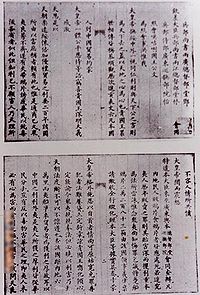
In 1834 to accommodate the revocation of the East India Company's monopoly, the British sent Lord William John Napier to Macau
. He tried to circumvent the restrictive Canton Trade laws which forbade direct contact with Chinese officials by attempting to send a letter directly to the Viceroy of Canton. The Viceroy refused to accept it, and closed trade starting on 2 September of that year. Lord Napier had to return to Macau (where he died a few days later) and, unable to force the matter, the British agreed to resume trade under the old restrictions.
Within the Chinese mandarinate there was an ongoing debate over legalising the opium trade itself. However, this idea was repeatedly rejected and instead, in 1838 the government sentenced native drug traffickers to death. Around this time, the British were selling roughly 1,400 tons per year to China. In March 1839, the Emperor appointed a new strict Confucianist commissioner, Lin Zexu
, to control the opium trade at the port of Canton. His first course of action was to enforce the imperial demand that there be a permanent halt to drug shipments into China. When the British refused to end the trade, Lin blockaded the British traders in their factories and cut off supplies of food. On 27 March 1839 Charles Elliot
, British Superintendent of Trade—who had been locked in the factories when he arrived at Canton—finally agreed that all British subjects should turn over their opium to him, amounting to nearly a year's supply of the drug, to be confiscated by Commissioner Lin Zexu. In a departure from his brief, he promised that the crown would compensate them for the lost opium. While this amounted to a tacit acknowledgment that the British government did not disapprove of the trade, it also forced a huge liability on the exchequer. Unable to allocate funds for an illegal drug but pressed for compensation by the merchants, this liability is cited as one reason for the decision to force a war. As well as seizing supplies in the factories, Chinese troops boarded British ships in international waters outside Chinese jurisdiction, where their cargo was still legal, and destroyed the opium aboard. After the opium was surrendered, trade was restarted on the strict condition that no more drugs would be smuggled into China. Lin demanded that British merchants sign a bond promising not to deal in opium, under penalty of death. The British officially opposed signing of the bond, but some British merchants that did not deal in opium were willing to sign. Lin had the opium disposed of by dissolving it in water, salt, and lime, and dumping it into the ocean.
In 1839, Lin took the step of publishing a letter addressed to Queen Victoria
questioning the moral reasoning of the British government (it is not known that she ever received it). Citing what he understood to be a strict prohibition of the trade within Great Britain, Lin questioned how it could then profit from the drug in China. He wrote: "Your Majesty has not before been thus officially notified, and you may plead ignorance of the severity of our laws, but I now give my assurance that we mean to cut this harmful drug forever." In fact, opium was not illegal in England at the time, however, and comparably smaller quantities were imported. The British government and merchants offered no response to Lin, accusing him instead of destroying their property. When the British learned of what was taking place in Canton, as communications between these two parts of the world took months at this time, they sent a large British Indian army
, which arrived in June 1840.
British military superiority drew on newly applied technology. British warships wreaked havoc on coastal towns; the steam ship Nemesis was able to move against the winds and tides and support a gun platform with very heavy guns. In addition, the British troops were the first to be armed with modern musket
s and cannon
s which fired more rapidly and with greater accuracy than the Qing firearms and artillery, though Chinese cannons had been in use since previous dynasties. After the British took Canton, they sailed up the Yangtze
and took the tax barges, a devastating blow to the Empire as it slashed the revenue of the imperial court in Beijing to just a small fraction of what it had been.
In 1842, the Qing authorities sued for peace, which concluded with the Treaty of Nanking
negotiated in August of that year and ratified in 1843. In the treaty, China was forced to pay an indemnity to Britain, open four ports to Britain, and cede Hong Kong to Queen Victoria. In the supplementary Treaty of the Bogue
, the Qing empire also recognised Britain as an equal to China and gave British subjects extraterritorial privileges in treaty ports. In 1844, the United States and France concluded similar treaties with China, the Treaty of Wanghia
and Treaty of Whampoa
respectively.
The First Opium War was attacked in the House of Commons by a newly elected young member of Parliament, William Ewart Gladstone
, who wondered if there had ever been "a war more unjust in its origin, a war more calculated to cover this country with permanent disgrace, I do not know." The Foreign Secretary, Lord Palmerston, replied by saying that nobody could "say that he honestly believed the motive of the Chinese Government to have been the promotion of moral habits" and that the war was being fought to stem China's balance of payments deficit. John Quincy Adams
commented that opium was "a mere incident to the dispute... the cause of the war is the kowtow- the arrogant and insupportable pretensions of China that she will hold commercial intercourse with the rest of mankind not upon terms of equal reciprocity, but upon the insulting and degrading forms of the relations between lord and vassal."
In October 1856, the Chinese authorities in Canton seized a vessel called the "Arrow" which had been engaged in piracy. The "Arrow" had formerly been registered as a British ship and was even still flying the British flag. The British consul in Canton demanded the immediate release of the crew and an apology for the insult to the British flag. The crew were released, but an apology was not given. In reprisal, the British governor in Hong Kong ordered warships to bombard Canton.
Clearly the Chinese had a good case: the "Arrow" was a pirate ship and had no right to fly the British flag as its British registration had expired. The bombardment of Canton was a breach of international law. The governor of Hong Kong had acted rashly without consulting London. However, the British Prime Minister, Palmerston, supported the actions of his officials who claimed to be upholding British prestige and avenging the insult to the flag. Moreover, Palmerston was keen to force the Chinese into accepting full-scale trade with Britain, whether they wanted to or not.
The Chinese issue figured prominently in the British general election of March 1857 which Palmerston won with an increased majority. He now felt able to press British claims more vigorously. The French were also eager to be involved after their envoy, Baron Jean-Baptiste Louis Gros
, seemingly had his demands ignored (French complaints involved a murdered missionary and French rights in Canton). A strong Anglo-French force under Admiral Sir Michael Seymour occupied Canton (December 1857), then cruised north to capture briefly the Taku forts near Tientsin (May 1858).
Negotiations between China, Britain, France, the USA and Russia led to the Tientsin Treaties of June 26–29, 1858, which theoretically brought peace. China agreed to open more treaty ports, to legalize opium importation, to establish a maritime customs service with foreign inspection and to allow foreign legations at Peking and missionaries in the interior.
China soon abrogated the Anglo-French treaties and refused to allow foreign diplomats into Peking. On June 25, 1859 British Admiral Sir James Hope bombarded the forts guarding the mouth of the Hai River, below Tientsin. However, landing parties were repulsed and the British squadron was severely damaged by a surprisingly efficient Chinese garrison. Commodore Josiah Tattnall commanding the US Asiatic Squadron declared "blood is thicker than water" and helped the British save face by assisting them in their withdrawal.
Anglo-French forces gathered at Hong Kong in May 1860. A joint amphibious expedition moved north to the Gulf of Po Hai. It consisted of 11,000 British under General Sir James Hope Grant and 7,000 French under Lieutenant General Cousin-Montauban. Unopposed landings were made at Pei-Tang (August 1, 1860). The Taku forts were taken by assault with the assistance of the naval forces (August 21). The expedition then advanced up-river from Tientsin. As it approached Peking, the Chinese asked for talks and an armistice. An allied delegation under Sir Harry Smith Parkes was sent to parley, but they were seized and imprisoned (September 18). It was later learned that half of them died under torture. The expedition pressed ahead, defeating some 30,000 Chinese in two engagements before reaching the walls of Peking on September 26. Preparations for an assault commenced and the Old Summer Palace (Yuan Ming Yuan) was occupied and looted.
Another Chinese request for peace was accepted and China agreed to all demands. The survivors of the Parkes delegation were returned (General Grant burned and destroyed the Old Summer Palace in reprisal for the mistreatment of the Parkes party, October 24). Ten new treaty ports, including Tientsin, were opened to trade with the western powers, foreign diplomats were to be allowed at Peking and the opium trade was to be regulated by the Chinese authorities. Kowloon, on the mainland opposite Hong Kong Island, was surrendered to the British. Permission was granted for foreigners (including Protestant and Catholic missionaries) to travel throughout the country. An indemnity of three million ounces of silver was paid to Great Britain and two million to France.
The Anglo-French victory was heralded in the British press as a triumph for Palmerston, which made his popularity rise to new heights. British merchants were delighted at the prospects of the expansion of trade in the Far East. Other foreign powers were pleased with the outcome too, since they hoped to take advantage of the opening-up of China. Russia soon extorted the Maritime Provinces from China and founded the port of Vladivostok
(1860–61).
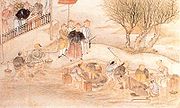 Lin Zexu
, Governor-General of Hunan
and Hubei
, recognising the consequences of opium abuse, embarked on an anti-opium campaign in which 1,700 opium dealers were arrested and 2.6 million pounds of opium confiscated and destroyed.
Lin Zexu's policy against the drug ultimately failed. He was made a scapegoat by the emperor, under heavy pressure from the Western powers, for having provoked British military retaliation in the First Opium War
. Lin Zexu is now viewed as a hero of 19th century China who stood against European imperialism
and his likeness has been immortalised at various locations around the world.
First Opium War
The First Anglo-Chinese War , known popularly as the First Opium War or simply the Opium War, was fought between the United Kingdom and the Qing Dynasty of China over their conflicting viewpoints on diplomatic relations, trade, and the administration of justice...
from 1839 to 1842 and the Second Opium War
Second Opium War
The Second Opium War, the Second Anglo-Chinese War, the Second China War, the Arrow War, or the Anglo-French expedition to China, was a war pitting the British Empire and the Second French Empire against the Qing Dynasty of China, lasting from 1856 to 1860...
from 1856 to 1860, were the climax of disputes over trade and diplomatic relations between China
China
Chinese civilization may refer to:* China for more general discussion of the country.* Chinese culture* Greater China, the transnational community of ethnic Chinese.* History of China* Sinosphere, the area historically affected by Chinese culture...
under the Qing Dynasty
Qing Dynasty
The Qing Dynasty was the last dynasty of China, ruling from 1644 to 1912 with a brief, abortive restoration in 1917. It was preceded by the Ming Dynasty and followed by the Republic of China....
and the British Empire
British Empire
The British Empire comprised the dominions, colonies, protectorates, mandates and other territories ruled or administered by the United Kingdom. It originated with the overseas colonies and trading posts established by England in the late 16th and early 17th centuries. At its height, it was the...
. After the inauguration of the Canton System
Canton System
The Canton System served as a means for China to control trade with the west within its own country. Seen from the European view, it was a complement to the Old China Trade.-History:...
in 1756, which restricted trade to one port and did not allow foreign entrance to China, the British East India Company
British East India Company
The East India Company was an early English joint-stock company that was formed initially for pursuing trade with the East Indies, but that ended up trading mainly with the Indian subcontinent and China...
faced a trade imbalance in favor of China and invested heavily in opium
Opium
Opium is the dried latex obtained from the opium poppy . Opium contains up to 12% morphine, an alkaloid, which is frequently processed chemically to produce heroin for the illegal drug trade. The latex also includes codeine and non-narcotic alkaloids such as papaverine, thebaine and noscapine...
production to redress the balance. British and United States
United States
The United States of America is a federal constitutional republic comprising fifty states and a federal district...
merchants brought opium from the British East India Company's factories in Patna
Patna
Paṭnā , is the capital of the Indian state of Bihar and the second largest city in Eastern India . Patna is one of the oldest continuously inhabited places in the world...
and Benares, in the Bengal Presidency
Bengal Presidency
The Bengal Presidency originally comprising east and west Bengal, was a colonial region of the British Empire in South-Asia and beyond it. It comprised areas which are now within Bangladesh, and the present day Indian States of West Bengal, Assam, Bihar, Meghalaya, Orissa and Tripura.Penang and...
of British India, to the coast of China, where they sold it to Chinese smugglers who distributed the drug in defiance of Chinese laws. Aware both of the drain of silver
Silver
Silver is a metallic chemical element with the chemical symbol Ag and atomic number 47. A soft, white, lustrous transition metal, it has the highest electrical conductivity of any element and the highest thermal conductivity of any metal...
and the growing numbers of addicts, the Dao Guang Emperor demanded action. Officials at the court who advocated legalization of the trade in order to tax it were defeated by those who advocated suppression. In 1838, the Emperor sent Lin Zexu
Lin Zexu
Lín Zéxú ; 30 August 1785 – 22 November 1850) was a Chinese scholar and official during the Qing Dynasty.He is most recognized for his conduct and his constant position on the "high moral ground" in his fight, as a "shepherd" of his people, against the opium trade in Guangzhou...
to Guangzhou
Guangzhou
Guangzhou , known historically as Canton or Kwangchow, is the capital and largest city of the Guangdong province in the People's Republic of China. Located in southern China on the Pearl River, about north-northwest of Hong Kong, Guangzhou is a key national transportation hub and trading port...
where he quickly arrested Chinese opium dealers and summarily demanded that foreign firms turn over their stocks. When they refused, Lin stopped trade altogether and placed the foreign residents under virtual siege, eventually forcing the merchants to surrender their opium to be destroyed. In response, the British government sent expeditionary forces from India which ravaged the Chinese coast and dictated the terms of settlement. The Treaty of Nanking
Treaty of Nanking
The Treaty of Nanking was signed on 29 August 1842 to mark the end of the First Opium War between the United Kingdom of Great Britain and Ireland and the Qing Dynasty of China...
not only opened the way for further opium trade, but ceded territory including Hong Kong
Hong Kong
Hong Kong is one of two Special Administrative Regions of the People's Republic of China , the other being Macau. A city-state situated on China's south coast and enclosed by the Pearl River Delta and South China Sea, it is renowned for its expansive skyline and deep natural harbour...
, unilaterally fixed Chinese tariffs at a low rate, granted extraterritorial rights
Extraterritoriality
Extraterritoriality is the state of being exempt from the jurisdiction of local law, usually as the result of diplomatic negotiations. Extraterritoriality can also be applied to physical places, such as military bases of foreign countries, or offices of the United Nations...
to foreigners in China which were not offered to Chinese abroad, a most favored nation clause, as well as diplomatic representation. When the court still refused to accept foreign ambassadors and obstructed the trade clauses of the treaties, disputes over the treatment of British merchants in Chinese ports and on the seas led to the Second Opium War and the Treaty of Tientsin
Treaty of Tientsin
Several documents known as the "Treaty of Tien-tsin" were signed in Tianjin in June 1858, ending the first part of the Second Opium War . The Second French Empire, United Kingdom, Russian Empire, and the United States were the parties involved...
.
These treaties, soon followed by similar arrangements with the United States and France
France
The French Republic , The French Republic , The French Republic , (commonly known as France , is a unitary semi-presidential republic in Western Europe with several overseas territories and islands located on other continents and in the Indian, Pacific, and Atlantic oceans. Metropolitan France...
, later became known as the Unequal Treaties and the Opium Wars as the start of China's "Century of humiliation
Century of humiliation
The century of humiliation , also referred to as the century of national humiliation, the hundred years of humiliation, and similar permutations...
."
European trade with Asia
Direct maritime trade between EuropeEurope
Europe is, by convention, one of the world's seven continents. Comprising the westernmost peninsula of Eurasia, Europe is generally 'divided' from Asia to its east by the watershed divides of the Ural and Caucasus Mountains, the Ural River, the Caspian and Black Seas, and the waterways connecting...
and China began with the Portuguese
Portuguese Empire
The Portuguese Empire , also known as the Portuguese Overseas Empire or the Portuguese Colonial Empire , was the first global empire in history...
in the 16th century, who leased an outpost at Macau
Macau
Macau , also spelled Macao , is, along with Hong Kong, one of the two special administrative regions of the People's Republic of China...
starting from 1557; other European nations soon followed. European traders, such as the Portuguese, inserted themselves into the existing Asia
Asia
Asia is the world's largest and most populous continent, located primarily in the eastern and northern hemispheres. It covers 8.7% of the Earth's total surface area and with approximately 3.879 billion people, it hosts 60% of the world's current human population...
n maritime trade network, competing with Arab
Arab
Arab people, also known as Arabs , are a panethnicity primarily living in the Arab world, which is located in Western Asia and North Africa. They are identified as such on one or more of genealogical, linguistic, or cultural grounds, with tribal affiliations, and intra-tribal relationships playing...
, Chinese
Overseas Chinese
Overseas Chinese are people of Chinese birth or descent who live outside the Greater China Area . People of partial Chinese ancestry living outside the Greater China Area may also consider themselves Overseas Chinese....
, and Japanese
Wokou
Wokou , which literally translates as "Japanese pirates" in English, were pirates of varying origins who raided the coastlines of China and Korea from the 13th century onwards...
traders in intra-regional trade. Mercantilist
Mercantilism
Mercantilism is the economic doctrine in which government control of foreign trade is of paramount importance for ensuring the prosperity and security of the state. In particular, it demands a positive balance of trade. Mercantilism dominated Western European economic policy and discourse from...
governments in Europe objected to the perpetual drain of silver
Silver
Silver is a metallic chemical element with the chemical symbol Ag and atomic number 47. A soft, white, lustrous transition metal, it has the highest electrical conductivity of any element and the highest thermal conductivity of any metal...
to pay for Asian commodities, and so European traders often sought to generate profits from intra-regional Asian trade to pay for their purchases to be sent back home. After the Spanish
Spanish Empire
The Spanish Empire comprised territories and colonies administered directly by Spain in Europe, in America, Africa, Asia and Oceania. It originated during the Age of Exploration and was therefore one of the first global empires. At the time of Habsburgs, Spain reached the peak of its world power....
acquisition of the Philippines, the exchange of goods between China and western Europe
Western Europe
Western Europe is a loose term for the collection of countries in the western most region of the European continents, though this definition is context-dependent and carries cultural and political connotations. One definition describes Western Europe as a geographic entity—the region lying in the...
accelerated dramatically. From 1565, the annual Manila Galleon
Manila Galleon
The Manila galleons or Manila-Acapulco galleons were Spanish trading ships that sailed once or twice per year across the Pacific Ocean between Manila in the Philippines, and Acapulco, New Spain . The name changed reflecting the city that the ship was sailing from...
brought in enormous amounts of silver to the Asian trade network, and in particular China, from Spanish silver mines in South America
Viceroyalty of Peru
Created in 1542, the Viceroyalty of Peru was a Spanish colonial administrative district that originally contained most of Spanish-ruled South America, governed from the capital of Lima...
. As demand increased in Europe, the profits European traders generated within the Asian trade network, that were used to purchase Asian goods, were gradually replaced by the direct export of bullion from Europe in exchange for the produce of Asia. .
Qing attitudes toward trade
The Qing, and its predecessor the MingMing Dynasty
The Ming Dynasty, also Empire of the Great Ming, was the ruling dynasty of China from 1368 to 1644, following the collapse of the Mongol-led Yuan Dynasty. The Ming, "one of the greatest eras of orderly government and social stability in human history", was the last dynasty in China ruled by ethnic...
, shared an ambivalent attitude towards overseas trade, and maritime activity in general. From 1661 to 1669, in an effort to cut off Ming loyalists
Southern Ming Dynasty
The Southern Ming Dynasty was the Ming loyalist regime that continued in Southern China from 1644 to 1662 following the capture of Beijing by rebel armies and the death of the last Ming emperor in 1644....
, the Qing issued an edict to evacuate
Great Clearance
The Great Clearance or Great Evacuation was ordered in southern China by imperial edicts of the Qing Emperor Kangxi , then under the regency of Oboi, in 1661 and 1662. It required the evacuation of the coastal areas of Guangdong in order to fight the anti-Qing movement, begun by Ming Dynasty...
all populations living near the coast of Southern China. Though it was later repealed, the edict seriously disrupted coastal areas and drove many Chinese overseas. Qing attitudes were also further aggravated by traditional Confucian disdain (even hostility) towards merchants and traders. Qing officials believed that trade incited unrest and disorder, promoted piracy, and threatened to compromise information on China's defences. The Qing instituted a set of rigid and incomplete regulations regarding trade at Chinese ports; setting up four maritime customs offices (in Guangdong
Guangdong
Guangdong is a province on the South China Sea coast of the People's Republic of China. The province was previously often written with the alternative English name Kwangtung Province...
, Fujian
Fujian
' , formerly romanised as Fukien or Huguing or Foukien, is a province on the southeast coast of mainland China. Fujian is bordered by Zhejiang to the north, Jiangxi to the west, and Guangdong to the south. Taiwan lies to the east, across the Taiwan Strait...
, Zhejiang
Zhejiang
Zhejiang is an eastern coastal province of the People's Republic of China. The word Zhejiang was the old name of the Qiantang River, which passes through Hangzhou, the provincial capital...
, and Jiangsu
Jiangsu
' is a province of the People's Republic of China, located along the east coast of the country. The name comes from jiang, short for the city of Jiangning , and su, for the city of Suzhou. The abbreviation for this province is "苏" , the second character of its name...
) and a sweeping 20 percent tariff on all foreign goods. These policies only succeeded in establishing a system of kickbacks and purchased monopolies that enriched the officials who administered coastal regions.
Although foreign merchants and traders dealt with low level Qing bureaucrats and agents at specified ports and entry points, official contact between China and foreign governments was organized around the tributary system. The tributary system affirmed the Emperor
Emperor of China
The Emperor of China refers to any sovereign of Imperial China reigning between the founding of Qin Dynasty of China, united by the King of Qin in 221 BCE, and the fall of Yuan Shikai's Empire of China in 1916. When referred to as the Son of Heaven , a title that predates the Qin unification, the...
as the son of Heaven with a mandate
Mandate of Heaven
The Mandate of Heaven is a traditional Chinese philosophical concept concerning the legitimacy of rulers. It is similar to the European concept of the divine right of kings, in that both sought to legitimaze rule from divine approval; however, unlike the divine right of kings, the Mandate of...
to rule on Earth; as such, foreign rulers were required to present tribute and acknowledge the superiority of the imperial court. In return, the Emperor bestowed gifts and titles upon foreign emissaries and allowed them to trade for short periods of time during their stay within China. Foreign rulers agreed to these terms for several reasons, namely that the gifts given by the Emperor were of greater value than the tribute received (as a demonstration of imperial munificence) and that the trade to be conducted while in China was extremely lucrative and exempt from customs duties. The political realities of the system varied from century to century, but by the Qing period, with European traders pushing to gain more access to China, Qing authorities denied requests for trade privileges from European embassies and assigned them "tributary" status with missions limited at the will of the imperial court. This arrangement became increasingly unacceptable to European nations, in particular the British.
British trade and the Canton System
British ships began to appear infrequently around the coasts of China from 1635; without establishing formal relations through the tributary system, British merchants were allowed to trade at the ports of ZhoushanZhoushan
Zhoushan or Zhoushan Archipelago New Area; formerly transliterated as Chusan, is a prefecture-level city in northeastern Zhejiang province of Eastern China. The only prefecture-level city of the People's Republic of China consisting solely of islands, it lies across the mouth of the Hangzhou Bay,...
and Xiamen
Xiamen
Xiamen , also known as Amoy , is a major city on the southeast coast of the People's Republic of China. It is administered as a sub-provincial city of Fujian province with an area of and population of 3.53 million...
in addition to Guangzhou
Guangzhou
Guangzhou , known historically as Canton or Kwangchow, is the capital and largest city of the Guangdong province in the People's Republic of China. Located in southern China on the Pearl River, about north-northwest of Hong Kong, Guangzhou is a key national transportation hub and trading port...
(Canton). Trade further benefited after the Qing relaxed maritime trade restrictions in the 1680s, after Taiwan
Taiwan
Taiwan , also known, especially in the past, as Formosa , is the largest island of the same-named island group of East Asia in the western Pacific Ocean and located off the southeastern coast of mainland China. The island forms over 99% of the current territory of the Republic of China following...
came under Qing control in 1683, and even rhetoric regarding the "tributary status" of Europeans was muted. Guangzhou (Canton) was the port of preference for most foreign trade, ships did try to call at other ports but they did not match the benefits of Guangzhou's geographic position at the mouth of the Pearl river trade network and Guangzhou's long experience in balancing the demands of Beijing with those of Chinese and foreign merchants. From 1700–1842, Guangzhou came to dominate maritime trade with China, this period became known as the "Canton System
Canton System
The Canton System served as a means for China to control trade with the west within its own country. Seen from the European view, it was a complement to the Old China Trade.-History:...
".
Official British trade was conducted through the auspices of the British East India Company
British East India Company
The East India Company was an early English joint-stock company that was formed initially for pursuing trade with the East Indies, but that ended up trading mainly with the Indian subcontinent and China...
, which held a royal charter
Royal Charter
A royal charter is a formal document issued by a monarch as letters patent, granting a right or power to an individual or a body corporate. They were, and are still, used to establish significant organizations such as cities or universities. Charters should be distinguished from warrants and...
for trade with the Far East. The EIC gradually came to dominate Sino-European trade from its position in India
Company rule in India
Company rule in India refers to the rule or dominion of the British East India Company on the Indian subcontinent...
.
Low Chinese demand for European goods, and high European demand for Chinese goods, including tea
Tea
Tea is an aromatic beverage prepared by adding cured leaves of the Camellia sinensis plant to hot water. The term also refers to the plant itself. After water, tea is the most widely consumed beverage in the world...
, silk
Silk
Silk is a natural protein fiber, some forms of which can be woven into textiles. The best-known type of silk is obtained from the cocoons of the larvae of the mulberry silkworm Bombyx mori reared in captivity...
, and porcelain
Porcelain
Porcelain is a ceramic material made by heating raw materials, generally including clay in the form of kaolin, in a kiln to temperatures between and...
, forced European merchants to purchase these goods with silver, the only commodity the Chinese would accept. In modern economic terms the Chinese were demanding hard currency or specie (gold or silver coinage) as the medium of exchange for the international trade in their goods. From the mid-17th century around 28 million kilograms of silver was received by China, principally from European powers, in exchange for Chinese goods. Britain's problem was further complicated by the fact that it had been using the gold standard
Gold standard
The gold standard is a monetary system in which the standard economic unit of account is a fixed mass of gold. There are distinct kinds of gold standard...
from the mid-18th century and therefore had to purchase silver from other European countries, incurring an additional transaction cost.
In the 18th century, despite ardent protest from the Qing government, British traders began importing opium from India. Because of its strong mass appeal and addictive nature, opium was an effective solution to the British trade problem. An instant consumer market for the drug was secured by the addiction of thousands of Chinese, and the flow of silver was reversed. Recognizing the growing number of addicts, the Yongzheng Emperor
Yongzheng Emperor
The Yongzheng Emperor , born Yinzhen , was the fifth emperor of the Manchu Qing Dynasty and the third Qing emperor from 1722 to 1735. A hard-working ruler, Yongzheng's main goal was to create an effective government at minimal expense. Like his father, the Kangxi Emperor, Yongzheng used military...
prohibited the sale and smoking of opium in 1729, and only allowed a small amount of opium imports for medicinal purposes.
Growth of opium trade
Following the Battle of PlasseyBattle of Plassey
The Battle of Plassey , 23 June 1757, was a decisive British East India Company victory over the Nawab of Bengal and his French allies, establishing Company rule in South Asia which expanded over much of the Indies for the next hundred years...
in 1757, in which Britain annexed Bengal
Bengal
Bengal is a historical and geographical region in the northeast region of the Indian Subcontinent at the apex of the Bay of Bengal. Today, it is mainly divided between the sovereign land of People's Republic of Bangladesh and the Indian state of West Bengal, although some regions of the previous...
to its empire, the British East India Company
British East India Company
The East India Company was an early English joint-stock company that was formed initially for pursuing trade with the East Indies, but that ended up trading mainly with the Indian subcontinent and China...
pursued a monopoly
Monopoly
A monopoly exists when a specific person or enterprise is the only supplier of a particular commodity...
on production and export of Indian opium. Monopoly began in earnest in 1773, as the British Governor-General of Bengal abolished the opium syndicate at Patna. For the next fifty years opium trade would be the key to the East India Company's hold on the subcontinent.
Considering that importation of opium into China had been virtually banned by Chinese law, the East India Company established an elaborate trading scheme partially relying on legal markets, and partially leveraging illicit ones. British merchants carrying no opium would buy tea in Canton
Guangzhou
Guangzhou , known historically as Canton or Kwangchow, is the capital and largest city of the Guangdong province in the People's Republic of China. Located in southern China on the Pearl River, about north-northwest of Hong Kong, Guangzhou is a key national transportation hub and trading port...
on credit, and would balance their debts by selling opium at auction in Calcutta. From there, the opium would reach the Chinese coast hidden aboard British ships then smuggled into China by native merchants. In 1797 the company further tightened its grip on the opium trade by enforcing direct trade between opium farmers and the British, and ending the role of Bengali purchasing agents.
British exports of opium to China grew from an estimated 15 tons in 1730 to 75 tons in 1773. The product was shipped in over two thousand chests, each containing 140 pounds (64 kg) of opium.
Meanwhile, negotiations with the Qianlong Emperor
Qianlong Emperor
The Qianlong Emperor was the sixth emperor of the Manchu-led Qing Dynasty, and the fourth Qing emperor to rule over China proper. The fourth son of the Yongzheng Emperor, he reigned officially from 11 October 1735 to 8 February 1796...
to ease the trading ban carried on, coming to a head in 1793 under Earl George Macartney
George Macartney
George Macartney may refer to:*George Macartney, 1st Earl Macartney *George Hume Macartney , MP for Antrim*George Macartney , British consul-general in Kashgar*George McCartney, footballer...
. Such discussions were unsuccessful.
In 1799, the Qing Empire
Qing Dynasty
The Qing Dynasty was the last dynasty of China, ruling from 1644 to 1912 with a brief, abortive restoration in 1917. It was preceded by the Ming Dynasty and followed by the Republic of China....
reinstated their ban on opium imports. The Empire issued the following decree in 1810:
Opium has a harm. Opium is a poison, undermining our good customs and morality. Its use is prohibited by law. Now the commoner, Yang, dares to bring it into the Forbidden CityForbidden CityThe Forbidden City was the Chinese imperial palace from the Ming Dynasty to the end of the Qing Dynasty. It is located in the middle of Beijing, China, and now houses the Palace Museum...
. Indeed, he flouts the law!
However, recently the purchasers, eaters, and consumers of opium have become numerous. Deceitful merchants buy and sell it to gain profit. The customs house at the Ch'ung-wen Gate was originally set up to supervise the collection of imports (it had no responsibility with regard to opium smuggling). If we confine our search for opium to the seaports, we fear the search will not be sufficiently thorough. We should also order the general commandant of the police and police- censors at the five gates to prohibit opium and to search for it at all gates. If they capture any violators, they should immediately punish them and should destroy the opium at once. As to Kwangtung and FukienFujian' , formerly romanised as Fukien or Huguing or Foukien, is a province on the southeast coast of mainland China. Fujian is bordered by Zhejiang to the north, Jiangxi to the west, and Guangdong to the south. Taiwan lies to the east, across the Taiwan Strait...
, the provinces from which opium comes, we order their viceroys, governors, and superintendents of the maritime customs to conduct a thorough search for opium, and cut off its supply. They should in no ways consider this order a dead letter and allow opium to be smuggled out!
The decree had little effect. The Qing government, seated in Beijing in the north of China, was unable to halt opium smuggling in the southern provinces. A porous Chinese border and rampant local demand only encouraged the all-too eager East India Company, which had its monopoly on opium trade recognised by the British government, which itself wanted silver. By the 1820s China was importing 900 tons of Bengali opium annually.
Napier Affair and First Opium War (1839–1842)
In 1834 to accommodate the revocation of the East India Company's monopoly, the British sent Lord William John Napier to Macau
Macau
Macau , also spelled Macao , is, along with Hong Kong, one of the two special administrative regions of the People's Republic of China...
. He tried to circumvent the restrictive Canton Trade laws which forbade direct contact with Chinese officials by attempting to send a letter directly to the Viceroy of Canton. The Viceroy refused to accept it, and closed trade starting on 2 September of that year. Lord Napier had to return to Macau (where he died a few days later) and, unable to force the matter, the British agreed to resume trade under the old restrictions.
Within the Chinese mandarinate there was an ongoing debate over legalising the opium trade itself. However, this idea was repeatedly rejected and instead, in 1838 the government sentenced native drug traffickers to death. Around this time, the British were selling roughly 1,400 tons per year to China. In March 1839, the Emperor appointed a new strict Confucianist commissioner, Lin Zexu
Lin Zexu
Lín Zéxú ; 30 August 1785 – 22 November 1850) was a Chinese scholar and official during the Qing Dynasty.He is most recognized for his conduct and his constant position on the "high moral ground" in his fight, as a "shepherd" of his people, against the opium trade in Guangzhou...
, to control the opium trade at the port of Canton. His first course of action was to enforce the imperial demand that there be a permanent halt to drug shipments into China. When the British refused to end the trade, Lin blockaded the British traders in their factories and cut off supplies of food. On 27 March 1839 Charles Elliot
Charles Elliot
Sir Charles Elliot, KCB , was a British naval officer, diplomat, and colonial administrator. He became the first administrator of Hong Kong in 1841 while serving as both Plenipotentiary and Chief Superintendent of British Trade in China...
, British Superintendent of Trade—who had been locked in the factories when he arrived at Canton—finally agreed that all British subjects should turn over their opium to him, amounting to nearly a year's supply of the drug, to be confiscated by Commissioner Lin Zexu. In a departure from his brief, he promised that the crown would compensate them for the lost opium. While this amounted to a tacit acknowledgment that the British government did not disapprove of the trade, it also forced a huge liability on the exchequer. Unable to allocate funds for an illegal drug but pressed for compensation by the merchants, this liability is cited as one reason for the decision to force a war. As well as seizing supplies in the factories, Chinese troops boarded British ships in international waters outside Chinese jurisdiction, where their cargo was still legal, and destroyed the opium aboard. After the opium was surrendered, trade was restarted on the strict condition that no more drugs would be smuggled into China. Lin demanded that British merchants sign a bond promising not to deal in opium, under penalty of death. The British officially opposed signing of the bond, but some British merchants that did not deal in opium were willing to sign. Lin had the opium disposed of by dissolving it in water, salt, and lime, and dumping it into the ocean.
In 1839, Lin took the step of publishing a letter addressed to Queen Victoria
Victoria of the United Kingdom
Victoria was the monarch of the United Kingdom of Great Britain and Ireland from 20 June 1837 until her death. From 1 May 1876, she used the additional title of Empress of India....
questioning the moral reasoning of the British government (it is not known that she ever received it). Citing what he understood to be a strict prohibition of the trade within Great Britain, Lin questioned how it could then profit from the drug in China. He wrote: "Your Majesty has not before been thus officially notified, and you may plead ignorance of the severity of our laws, but I now give my assurance that we mean to cut this harmful drug forever." In fact, opium was not illegal in England at the time, however, and comparably smaller quantities were imported. The British government and merchants offered no response to Lin, accusing him instead of destroying their property. When the British learned of what was taking place in Canton, as communications between these two parts of the world took months at this time, they sent a large British Indian army
British Indian Army
The British Indian Army, officially simply the Indian Army, was the principal army of the British Raj in India before the partition of India in 1947...
, which arrived in June 1840.
British military superiority drew on newly applied technology. British warships wreaked havoc on coastal towns; the steam ship Nemesis was able to move against the winds and tides and support a gun platform with very heavy guns. In addition, the British troops were the first to be armed with modern musket
Musket
A musket is a muzzle-loaded, smooth bore long gun, fired from the shoulder. Muskets were designed for use by infantry. A soldier armed with a musket had the designation musketman or musketeer....
s and cannon
Cannon
A cannon is any piece of artillery that uses gunpowder or other usually explosive-based propellents to launch a projectile. Cannon vary in caliber, range, mobility, rate of fire, angle of fire, and firepower; different forms of cannon combine and balance these attributes in varying degrees,...
s which fired more rapidly and with greater accuracy than the Qing firearms and artillery, though Chinese cannons had been in use since previous dynasties. After the British took Canton, they sailed up the Yangtze
Yangtze River
The Yangtze, Yangzi or Cháng Jiāng is the longest river in Asia, and the third-longest in the world. It flows for from the glaciers on the Tibetan Plateau in Qinghai eastward across southwest, central and eastern China before emptying into the East China Sea at Shanghai. It is also one of the...
and took the tax barges, a devastating blow to the Empire as it slashed the revenue of the imperial court in Beijing to just a small fraction of what it had been.
In 1842, the Qing authorities sued for peace, which concluded with the Treaty of Nanking
Treaty of Nanking
The Treaty of Nanking was signed on 29 August 1842 to mark the end of the First Opium War between the United Kingdom of Great Britain and Ireland and the Qing Dynasty of China...
negotiated in August of that year and ratified in 1843. In the treaty, China was forced to pay an indemnity to Britain, open four ports to Britain, and cede Hong Kong to Queen Victoria. In the supplementary Treaty of the Bogue
Treaty of the Bogue
The Treaty of the Bogue was an agreement between China and the United Kingdom, which was concluded in October 1843 in order to supplement the previous Treaty of Nanking...
, the Qing empire also recognised Britain as an equal to China and gave British subjects extraterritorial privileges in treaty ports. In 1844, the United States and France concluded similar treaties with China, the Treaty of Wanghia
Treaty of Wanghia
The Treaty of Wanghia , is a diplomatic agreement between the Qing Dynasty of China and the United States, signed on 3 July 1844 in the Kun Iam Temple...
and Treaty of Whampoa
Treaty of Whampoa
The Treaty of Whampoa was a commercial treaty between France and China, which was signed by Théodore de Lagrené and Qiying on October 24, 1844.-Terms:...
respectively.
The First Opium War was attacked in the House of Commons by a newly elected young member of Parliament, William Ewart Gladstone
William Ewart Gladstone
William Ewart Gladstone FRS FSS was a British Liberal statesman. In a career lasting over sixty years, he served as Prime Minister four separate times , more than any other person. Gladstone was also Britain's oldest Prime Minister, 84 years old when he resigned for the last time...
, who wondered if there had ever been "a war more unjust in its origin, a war more calculated to cover this country with permanent disgrace, I do not know." The Foreign Secretary, Lord Palmerston, replied by saying that nobody could "say that he honestly believed the motive of the Chinese Government to have been the promotion of moral habits" and that the war was being fought to stem China's balance of payments deficit. John Quincy Adams
John Quincy Adams
John Quincy Adams was the sixth President of the United States . He served as an American diplomat, Senator, and Congressional representative. He was a member of the Federalist, Democratic-Republican, National Republican, and later Anti-Masonic and Whig parties. Adams was the son of former...
commented that opium was "a mere incident to the dispute... the cause of the war is the kowtow- the arrogant and insupportable pretensions of China that she will hold commercial intercourse with the rest of mankind not upon terms of equal reciprocity, but upon the insulting and degrading forms of the relations between lord and vassal."
Second Opium War (1856–1860)
The Chinese authorities were reluctant to keep to the terms of the 1842 Treaty of Nanking. They had tried to keep out as many foreign merchants as possible and had victimized Chinese merchants who traded with the British at the treaty ports. To protect those Chinese merchants who were friendly to them at Hong Kong, the British granted their ships British registration in the hope that the Chinese authorities would not interfere with vessels which carried the British flag.In October 1856, the Chinese authorities in Canton seized a vessel called the "Arrow" which had been engaged in piracy. The "Arrow" had formerly been registered as a British ship and was even still flying the British flag. The British consul in Canton demanded the immediate release of the crew and an apology for the insult to the British flag. The crew were released, but an apology was not given. In reprisal, the British governor in Hong Kong ordered warships to bombard Canton.
Clearly the Chinese had a good case: the "Arrow" was a pirate ship and had no right to fly the British flag as its British registration had expired. The bombardment of Canton was a breach of international law. The governor of Hong Kong had acted rashly without consulting London. However, the British Prime Minister, Palmerston, supported the actions of his officials who claimed to be upholding British prestige and avenging the insult to the flag. Moreover, Palmerston was keen to force the Chinese into accepting full-scale trade with Britain, whether they wanted to or not.
The Chinese issue figured prominently in the British general election of March 1857 which Palmerston won with an increased majority. He now felt able to press British claims more vigorously. The French were also eager to be involved after their envoy, Baron Jean-Baptiste Louis Gros
Jean-Baptiste Louis Gros
Jean-Baptiste Louis Gros was a French ambassador and one of the first daguerrotypists. Baron and French chargé d'affaires in Bogotá , Athens and Ambassador to London - during which period he also travelled to China and Japan in 1857 and 1858 — he produced many famous daguerrotypes — chief among...
, seemingly had his demands ignored (French complaints involved a murdered missionary and French rights in Canton). A strong Anglo-French force under Admiral Sir Michael Seymour occupied Canton (December 1857), then cruised north to capture briefly the Taku forts near Tientsin (May 1858).
Negotiations between China, Britain, France, the USA and Russia led to the Tientsin Treaties of June 26–29, 1858, which theoretically brought peace. China agreed to open more treaty ports, to legalize opium importation, to establish a maritime customs service with foreign inspection and to allow foreign legations at Peking and missionaries in the interior.
China soon abrogated the Anglo-French treaties and refused to allow foreign diplomats into Peking. On June 25, 1859 British Admiral Sir James Hope bombarded the forts guarding the mouth of the Hai River, below Tientsin. However, landing parties were repulsed and the British squadron was severely damaged by a surprisingly efficient Chinese garrison. Commodore Josiah Tattnall commanding the US Asiatic Squadron declared "blood is thicker than water" and helped the British save face by assisting them in their withdrawal.
Anglo-French forces gathered at Hong Kong in May 1860. A joint amphibious expedition moved north to the Gulf of Po Hai. It consisted of 11,000 British under General Sir James Hope Grant and 7,000 French under Lieutenant General Cousin-Montauban. Unopposed landings were made at Pei-Tang (August 1, 1860). The Taku forts were taken by assault with the assistance of the naval forces (August 21). The expedition then advanced up-river from Tientsin. As it approached Peking, the Chinese asked for talks and an armistice. An allied delegation under Sir Harry Smith Parkes was sent to parley, but they were seized and imprisoned (September 18). It was later learned that half of them died under torture. The expedition pressed ahead, defeating some 30,000 Chinese in two engagements before reaching the walls of Peking on September 26. Preparations for an assault commenced and the Old Summer Palace (Yuan Ming Yuan) was occupied and looted.
Another Chinese request for peace was accepted and China agreed to all demands. The survivors of the Parkes delegation were returned (General Grant burned and destroyed the Old Summer Palace in reprisal for the mistreatment of the Parkes party, October 24). Ten new treaty ports, including Tientsin, were opened to trade with the western powers, foreign diplomats were to be allowed at Peking and the opium trade was to be regulated by the Chinese authorities. Kowloon, on the mainland opposite Hong Kong Island, was surrendered to the British. Permission was granted for foreigners (including Protestant and Catholic missionaries) to travel throughout the country. An indemnity of three million ounces of silver was paid to Great Britain and two million to France.
The Anglo-French victory was heralded in the British press as a triumph for Palmerston, which made his popularity rise to new heights. British merchants were delighted at the prospects of the expansion of trade in the Far East. Other foreign powers were pleased with the outcome too, since they hoped to take advantage of the opening-up of China. Russia soon extorted the Maritime Provinces from China and founded the port of Vladivostok
Vladivostok
The city is located in the southern extremity of Muravyov-Amursky Peninsula, which is about 30 km long and approximately 12 km wide.The highest point is Mount Kholodilnik, the height of which is 257 m...
(1860–61).
Lin Zexu and the war on opium
Lin Zexu
Lín Zéxú ; 30 August 1785 – 22 November 1850) was a Chinese scholar and official during the Qing Dynasty.He is most recognized for his conduct and his constant position on the "high moral ground" in his fight, as a "shepherd" of his people, against the opium trade in Guangzhou...
, Governor-General of Hunan
Hunan
' is a province of South-Central China, located to the south of the middle reaches of the Yangtze River and south of Lake Dongting...
and Hubei
Hubei
' Hupeh) is a province in Central China. The name of the province means "north of the lake", referring to its position north of Lake Dongting...
, recognising the consequences of opium abuse, embarked on an anti-opium campaign in which 1,700 opium dealers were arrested and 2.6 million pounds of opium confiscated and destroyed.
Lin Zexu's policy against the drug ultimately failed. He was made a scapegoat by the emperor, under heavy pressure from the Western powers, for having provoked British military retaliation in the First Opium War
First Opium War
The First Anglo-Chinese War , known popularly as the First Opium War or simply the Opium War, was fought between the United Kingdom and the Qing Dynasty of China over their conflicting viewpoints on diplomatic relations, trade, and the administration of justice...
. Lin Zexu is now viewed as a hero of 19th century China who stood against European imperialism
Colonial empire
The Colonial empires were a product of the European Age of Exploration that began with a race of exploration between the then most advanced maritime powers, Portugal and Spain, in the 15th century...
and his likeness has been immortalised at various locations around the world.
See also
- David SassoonDavid SassoonDavid Sassoon was the treasurer of Baghdad between 1817 and 1829. He became the leader of the Jewish community in Bombay after Baghdadi Jews emigrated there.-Biography:...
- Gideon NyeGideon NyeGideon Nye was an American diplomat, art collector, and a merchant in the East India and China trade, known both for his art collection and for his writings on China....
- Imperialism in AsiaImperialism in AsiaImperialism in Asia traces its roots back to the late 15th century with a series of voyages that sought a sea passage to India in the hope of establishing direct trade between Europe and Asia in spices. Before 1500 European economies were largely self-sufficient, only supplemented by minor trade...
- History of ChinaHistory of ChinaChinese civilization originated in various regional centers along both the Yellow River and the Yangtze River valleys in the Neolithic era, but the Yellow River is said to be the Cradle of Chinese Civilization. With thousands of years of continuous history, China is one of the world's oldest...
- Unequal treatiesUnequal Treaties“Unequal treaty” is a term used in specific reference to a number of treaties imposed by Western powers, during the 19th and early 20th centuries, on Qing Dynasty China and late Tokugawa Japan...
- War on DrugsWar on DrugsThe War on Drugs is a campaign of prohibition and foreign military aid and military intervention being undertaken by the United States government, with the assistance of participating countries, intended to both define and reduce the illegal drug trade...
Further reading
- Peter Ward Fay, The Opium War, 1840-1842: Barbarians in the Celestial Empire in the early part of the nineteenth century and the way by which they forced the gates ajar (Chapel Hill, North Carolina: University of North Carolina Press, 1975).
- John King Fairbank, Trade and Diplomacy on the China Coast; the Opening of the Treaty Ports, 1842-1854 (Cambridge, MA: Harvard University Press, 1953; rpr. Stanford University Press, pb. 1964).
- James M. Polachek, The Inner Opium War (Cambridge, Massachusetts: Council on East Asian Studies, Harvard University, 1992.)
- Arthur Waley, The Opium War Through Chinese Eyes (London: Allen & Unwin, 1958; reprinted Stanford, California: Stanford University Press, 1968).
- Julia Lovell, "The Opium War: Drug, Dreams and the Making of China" (London, Picador, 2011)