
|
|
|
|
Claude Monet
|
| |
|
| |
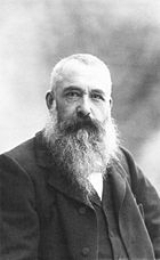
Claude Monet (French ) also known as Oscar-Claude Monet or Claude Oscar Monet (14 November 1840 – 5 December 1926) was a founder of French impressionist painting, and the most consistent and prolific practitioner of the movement's philosophy of expressing one's perceptions before nature, especially as applied to plein-air landscape painting. The term Impressionism is derived from the title of his painting Impression, Sunrise.
de Monet was born on 14 November 1840 on the fifth floor of 45 rue Laffitte, in the ninth arrondissement of Paris.

Discussion
Ask a question about 'Claude Monet'
Start a new discussion about 'Claude Monet'
Answer questions from other users
|
Recent Posts

Encyclopedia
Claude Monet (French ) also known as Oscar-Claude Monet or Claude Oscar Monet (14 November 1840 – 5 December 1926) was a founder of French impressionist painting, and the most consistent and prolific practitioner of the movement's philosophy of expressing one's perceptions before nature, especially as applied to plein-air landscape painting. The term Impressionism is derived from the title of his painting Impression, Sunrise.
Early life
Claude Monet was born on 14 November 1840 on the fifth floor of 45 rue Laffitte, in the ninth arrondissement of Paris. He was the second son of Claude-Adolphe and Louise-Justine Aubrée Monet, both of them second-generation Parisians. On 20 May 1841, he was baptised in the local parish church, Notre-Dame-de-Lorette, as Oscar-Claude. In 1845, his family moved to Le Havre in Normandy. His father wanted him to go into the family grocery business, but Monet wanted to become an artist. His mother was a singer.
On the first of April 1851, Monet entered the Le Havre secondary school of the arts. He first became known locally for his charcoal caricatures, which he would sell for ten to twenty francs. Monet also undertook his first drawing lessons from Jacques-François Ochard, a former student of Jacques-Louis David. On the beaches of Normandy in about 1856/1857 he met fellow artist Eugène Boudin, who became his mentor and taught him to use oil paints. Boudin taught Monet "en plein air" (outdoor) techniques for painting.
On 28 January 1857 his mother died. He was 16 years old when he left school and went to live with his widowed childless aunt, Marie-Jeanne Lecadre.
Paris When Monet traveled to Paris to visit the Louvre, he witnessed painters copying from the old masters. Monet, having brought his paints and other tools with him, would instead go and sit by a window and paint what he saw. Monet was in Paris for several years and met several painters who would become friends and fellow impressionists. One of those friends was Édouard Manet.
In June 1861 Monet joined the First Regiment of African Light Cavalry in Algeria for two years of a seven-year commitment, but upon his contracting typhoid his aunt Marie-Jeanne Lecadre intervened to get him out of the army if he agreed to complete an art course at a university. It is possible that the Dutch painter Johan Barthold Jongkind, whom Monet knew, may have prompted his aunt on this matter. Disillusioned with the traditional art taught at universities, in 1862 Monet became a student of Charles Gleyre in Paris, where he met Pierre-Auguste Renoir, Frédéric Bazille and Alfred Sisley. Together they shared new approaches to art, painting the effects of light en plein air with broken color and rapid brushstrokes, in what later came to be known as Impressionism.
Monet's Camille or The Woman in the Green Dress (La Femme à la Robe Verte), painted in 1866, brought him recognition and was one of many works featuring his future wife, Camille Doncieux; she was the model for the figures in The Woman in the Garden of the following year, as well as for On the Bank of the Seine, Bennecourt, 1868, pictured here. Shortly thereafter Doncieux became pregnant and gave birth to their first child, Jean. In 1868, due to financial pressures, Monet attempted suicide by throwing himself into the Seine.
Franco-Prussian War, Impressionism, and Argenteuil
After the outbreak of the Franco-Prussian War (19 July 1870), Monet took refuge in England in September 1870. While there, he studied the works of John Constable and Joseph Mallord William Turner, both of whose landscapes would serve to inspire Monet's innovations in the study of color. In the Spring of 1871, Monet's works were refused authorisation to be included in the Royal Academy exhibition.
In May 1871 he left London to live in Zaandam, where he made 25 paintings (and the police suspected him of revolutionary activities). He also paid a first visit to nearby Amsterdam. In October or November 1871 he returned to France. Monet lived from December 1871 to 1878 at Argenteuil, a village on the Seine near Paris, and here he painted some of his best known works. In 1874, he briefly returned to Holland.
In 1872 (or 1873), he painted Impression, Sunrise (Impression: soleil levant) depicting a Le Havre landscape. It hung in the first Impressionist exhibition in 1874 and is now displayed in the Musée Marmottan Monet, Paris. From the painting's title, art critic Louis Leroy coined the term "Impressionism", which he intended as disparagement but which the Impressionists appropriated for themselves.
Monet and Camille Doncieux had married just before the war (28 June 1870) and, after their excursion to London and Zaandam, they had moved into a house in Argenteuil near the Seine in December 1871. It was during this time that Monet painted various works of modern life in this popular suburb. Camille became ill in 1876. They had a second son, Michel, on 17 March 1878, (Jean was born in 1867). This second child weakened her already fading health. In that same year, he moved to the village of Vétheuil. At the age of thirty-two, Madame Monet died on 5 September 1879 of tuberculosis; Monet painted her on her death bed.
Gallery of early paintings
Image:Claude Monet - Camille.JPG|The Woman in the Green Dress, Camille Doncieux, 1866, Kunsthalle Bremen.
Image:Claude Monet - Le dejeuner sur l’herbe.JPG|Le dejeuner sur l'herbe, 1865-1866, The Pushkin Museum of Fine Arts, Moscow.
Image:Monet dejeunersurlherbe.jpg|Le dejeuner sur lherbe, (right section), with Gustave Courbet, 1865-1866, Musée d'Orsay, Paris.
Image:Claude Monet 007.jpg|Flowering Garden at Sainte-Adresse, 1866, Musée d'Orsay, Paris.
Image:Claude Monet 022.jpg|Woman in a Garden, 1867, Hermitage, St. Petersburg
Image:Claude Monet - Jardin à Sainte-Adresse.jpg|Jardin à Sainte-Adresse, 1867, Metropolitan Museum of Art, New York City
Image:Claude Monet 048.jpg|Seine Basin with Argenteuil, 1872, Musée d'Orsay, Paris.
Image:Claude Monet - Jean Monet on his Hobby Horse.jpg|Jean Monet on his Hobby Horse, 1872, Metropolitan Museum of Art, New York.
Image:Claude Monet - The Artist's House at Argenteuil.jpg|The Artist's House at Argenteuil, 1873, The Art Institute of Chicago
Image:Claude Monet 037.jpg|Poppies Blooming, 1873, Musée d'Orsay, Paris.
Image:Claude Monet-Madame Monet en costume japonais.jpg|Madame Monet in a Japanese Costume, 1875, Museum of Fine Arts, Boston
Image:Claude Monet 011.jpg|Woman with a Parasol, (Camille and Jean Monet), 1875, National Gallery of Art, Washington, DC.
Image:Claude Monet Camille au métier.jpg|Camille Monet at Work, 1875, Barnes Foundation, Merion, PA
Image:Claude Monet - Argenteuil.jpg|Argenteuil, 1875, Musée de l'Orangerie, Paris.
Image:Claude Monet 003.jpg|Saint Lazare Train Station, Paris, 1877, The Art Institute of Chicago
Image:Monet-montorgueil.JPG|Rue Montorgueil, 1878, Musée d'Orsay, Paris.
Image:Claude Monet - Camille Monet sur son lit de mort.JPG|Camille Monet, on her deathbed, 1879, Musée d'Orsay, Paris.
Image:Vétheuil dans le brouillard.jpg|Vétheuil in the Fog, 1879, Musée Marmottan Monet, Paris.
Image:Claude Monet 053.jpg|Street near Vétheuil in Winter, 1879
Image:Monet, Lavacourt-Sunshine-and-Snow.jpg|Lavacourt: Sunshine and Snow, 1879-1880 National Gallery, London
Later life After several difficult months following the death of Camille on 5 September 1879, a grief-stricken Monet (resolving never to be mired in poverty again) began in earnest to create some of his best paintings of the 19th century. During the early 1880s Monet painted several groups of landscapes and seascapes in what he considered to be campaigns to document the French countryside. His extensive campaigns evolved into his series' paintings.
Camille Monet had become ill with tuberculosis in 1876. Pregnant with her second child she gave birth to Michel Monet in March 1878. In 1878 the Monets temporarily moved into the home of Ernest Hoschedé, (1837-1891), a wealthy department store owner and patron of the arts. Both families then shared a house in Vétheuil during the summer. After her husband (Ernest Hoschedé) became bankrupt, and left in 1878 for Belgium, in September 1879, and while Monet continued to live in the house in Vétheuil; Alice Hoschedé helped Monet to raise his two sons, Jean and Michel, by taking them to Paris to live alongside her own six children. They were Blanche, Germaine, Suzanne, Marthe, Jean-Pierre, and Jacques. In the spring of 1880 Alice Hoschedé and all the children left Paris and rejoined Monet still living in the house in Vétheuil. In 1881 all of them moved to Poissy which Monet hated. From the doorway of the little train between Vernon and Gasny he discovered Giverny. In April 1883 they moved to Vernon, then to a house in Giverny, Eure, in Upper Normandy, where he planted a large garden where he painted for much of the rest of his life. Following the death of her estranged husband, Alice Hoschedé married Claude Monet in 1892.
Giverny At the beginning of May 1883, Monet and his large family rented a house and from a local landowner. The house was situated near the main road between the towns of Vernon and Gasny at Giverny. There was a barn that doubled as a painting studio, orchards and a small garden. The house was close enough to the local schools for the children to attend and the surrounding landscape offered an endless array of suitable motifs for Monet's work. The family worked and built up the gardens and Monet's fortunes began to change for the better as his dealer Paul Durand-Ruel had increasing success in selling his paintings. By November 1890 Monet was prosperous enough to buy the house, the surrounding buildings and the land for his gardens. During the 1890s Monet built a greenhouse and a second studio, a spacious building well lit with skylights. Beginning in the 1880s and 1890s, through the end of his life in 1926, Monet worked on "series" paintings, in which a subject was depicted in varying light and weather conditions. His first series exhibited as such was of Haystacks, painted from different points of view and at different times of the day. Fifteen of the paintings were exhibited at the Galerie Durand-Ruel in 1891. He later produced several series of paintings including: Rouen Cathedral, Poplars, the Parliament, Mornings on the Seine, and the Water Lilies that were painted on his property at Giverny.
Monet was exceptionally fond of painting controlled nature: his own gardens in Giverny, with its water lilies, pond, and bridge. He also painted up and down the banks of the Seine, producing paintings such as Break-up of the ice on the Seine.
He wrote daily instructions to his gardening staff, precise designs and layouts for plantings, and invoices for his floral purchases and his collection of botany books. As Monet's wealth grew, his garden evolved. He remained its architect, even after he hired seven gardeners. He built a greenhouse and a second studio, a spacious building, well lit with skylights.
Between 1883 and 1908, Monet traveled to the Mediterranean, where he painted landmarks, landscapes, and seascapes, such as Bordighera. He painted an important series of paintings in Venice, Italy, and in London he painted two important series—views of Parliament and views of Charing Cross Bridge. His second wife Alice died in 1911 and his oldest son Jean, who had married Alice's daughter Blanche, Monet's particular favourite, died in 1914. After his wife died, Blanche looked after and cared for him. It was during this time that Monet began to develop the first signs of cataracts.
During World War I, in which his younger son Michel served and his friend and admirer Clemenceau led the French nation, Monet painted a series of Weeping Willow trees as homage to the French fallen soldiers. Cataracts formed on Monet's eyes, for which he underwent two operations in 1923. The paintings done while the cataracts affected his vision have a general reddish tone, which is characteristic of the vision of cataract victims. It may also be that after surgery he was able to see certain ultraviolet wavelengths of light that are normally excluded by the lens of the eye, this may have had an effect on the colors he perceived. After his operations he even repainted some of these paintings, with bluer water lilies than before the operation.
Gallery of later paintings
Image:Claude Monet 029.jpg|Hut of the Douaniers with Varengeville, 1882, Museum Boymans-van Beuningen, Rotterdam
Image:Claude Monet The Cliffs at Etretat.jpg|The Cliffs at Etretat, 1885, Clark Art Institute, Williamstown, Massachusetts
Image:Claude Monet 050.jpg|Still-Life with Anemones, 1885
Image:Claude Monet Pyramides Port Coton.jpg|The Port Coton Pyramids, 1886
Image:Claude Monet - Graystaks I.JPG|Haystacks, (sunset), 1890-1891, Museum of Fine Arts, Boston
Image:Claude Monet - Poplars, Philadelphia.JPG|Poplars, (autumn), 1891, Philadelphia Museum of Art
Image:Claude Monet - Rouen Cathedral, Facade (Sunset).JPG|Rouen Cathedral, Facade (sunset), 1892-1894, Musée Marmottan Monet, Paris
Image:Claude Monet - Branch of the Seine near Giverny.JPG|Branch of the Seine near Giverny, 1897
Image:Bridge_Over_a_Pond_of_Water_Lilies,_Claude_Monet_1899.jpg|Bridge over a Pond of Water Lilies, 1899, Metropolitan Museum of Art
Image:Claude Monet 040.jpg|Pappeln on the Epte, 1900, National Gallery of Scotland, Edinburgh
Image:Claude Monet 025.jpg|Garden Path, 1902
Image:Claude Monet Houses of Parliament.jpg|Houses of Parliament, London, c. 1904, Musée Marmottan Monet, Paris
Image:Claude Monet - Water-Lilies (Bridgestone Museum).jpg|Water Lilies, 1907, Bridgestone Museum of Art, Tokyo
Image:Claude Monet 039.jpg|Palace From Mula, Venice, 1908, National Gallery of Art, Washington, DC.
Image:Claude Monet Water Lilies Toledo.jpg|Water Lilies, 1914-1917, Toledo Museum of Art, Toledo, Ohio
Image:Claude Monet Nympheas Marmottan.jpg|Nympheas, c. 1916, Musée Marmottan Monet, Paris
Image:Monet Water Lilies 1916.jpg|Water Lilies, 1916, The National Museum of Western Art, Tokyo
Image:Claude Monet, Water-Lily Pond and Weeping Willow.JPG|Water-Lily Pond and Weeping Willow, 1916-1919
Image:Claude Monet Weeping Willow.jpg|Weeping Willow, 1918-1919, Kimball Art Museum, Fort Worth
Image:Claude Monet 044.jpg|Sea-Roses (Yellow Nirwana), 1920, The National Gallery, London
Death
Monet died of lung cancer on 5 December 1926 at the age of 86 and is buried in the Giverny church cemetery. Monet had insisted that the occasion be simple; thus about fifty people attended the ceremony.
His famous home and garden with its waterlily pond were bequeathed by his heirs to the French Academy of Fine Arts (part of the Institut de France) in 1966. Through the Fondation Claude Monet, the home and gardens were opened for visit in 1980, following refurbishment. In addition to souvenirs of Monet and other objects of his life, the home contains his collection of Japanese woodcut prints. The home is one of the two main attractions of Giverny, which hosts tourists from all over the world.
Posthumous sales
In 2004, London, the Parliament, Effects of Sun in the Fog (Londres, le Parlement, trouée de soleil dans le brouillard) (1904), sold for U.S. $20.1 million. In 2006, the journal Proceedings of the Royal Society published a paper providing evidence that these were painted in situ at St Thomas' Hospital over the river Thames.
Falaises près de Dieppe (Cliffs near Dieppe) has been stolen on two separate occasions. Once in 1998 (in which the museum's curator was convicted of the theft and jailed for five years along with two accomplices) and most recently in August 2007. It has yet to be recovered.
Monet's Le Pont du chemin de fer à Argenteuil, an 1873 painting of a railway bridge spanning the Seine near Paris, was bought by an anonymous telephone bidder for a record $ 41.4 million at Christie's auction in New York on 6 May 2008. The previous record for his painting stood at $ 36.5 million.Le bassin aux nymphéas (from the water lilies series) sold at Christie's 24 June 2008, lot 19, for £36,500,000 ($71,892,376.34) (hammer price) or £40,921,250 ($80,451,178) with fees, setting a new auction record for the artist.
Nympheas - Water Lilies sold for GBP £16,500,000 (US $32,670,000). This was one of the highest prices paid for Monet's work.
See also
External links
-
-
-
-
- a timeline of Monet's life
-
-
- - view sketchbooks
|
| |
|
|