
All Topics  
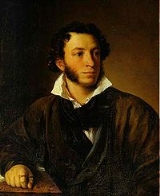
Aleksandr Pushkin

 
Aleksandr Pushkin

   Email Print
   Bookmark   Link


Aleksandr Pushkin


Alexander Sergeyevich Pushkin (Russian
Russian language

Russian is the most geographically widespread language of Eurasia, the most widely spoken of the Slavic languages, and the largest native language in Europe....
: ??????´??? ?????´???? ??´????, , ) (–) was a Russia
Russia

Russia , or the Russian Federation , is a list of countries spanning more than one continent country extending over much of northern Eurasia....
n author of the Romantic
Romanticism

Romanticism is a complex artistic, literary, and intellectual movement that originated in the second half of the 18th century in Western Europe, and gained strength during the Industrial Revolution....
 era who is considered to be the greatest Russian poet
Poet

A poet is a person who writes poetry....
 and the founder of modern Russian literature
Russian literature

This article is about literature from Russia. For the song by Max?mo Park, see Our Earthly Pleasures. Russian literature refers to the literature of Russia or its ?migr?s, and to the Russian language literature of several independent nations once a part of what was historically Russia or the Soviet Union....
. Pushkin pioneered the use of vernacular speech
Vernacular

Vernacular refers to the native language of a country or a locality. In general linguistics, it is used to describe local languages as opposed to Lingua franca, official standards or global languages....
 in his poems and plays, creating a style of storytelling—mixing drama
Drama

Drama is the specific Mode of fiction Mimesis in performance. The term comes from a Ancient Greek word meaning "Action " , which is derived from "to do" ....
, romance
Romance (genre)

As a literary genre of high culture, romance or chivalric romance refers to a style of heroic prose and Verse narrative that was particularly current in aristocratic literature of Middle Ages and Early Modern Europe, that narrated fantastic stories about the marvellous adventures of a chivalrous, heroic knight, often of super-human ab...
, and satire
Satire

Satire is often strictly defined as a literary genre; although, in practice, it is also found in the graphic arts and performing arts. In satire, human or individual vices, follies, abuses, or shortcomings are held up to censure by means of ridicule, derision, burlesque, irony, or other methods, ideally with the intent to bring about improv...
—associated with Russian literature ever since and greatly influencing later Russian writers.

Born in Moscow
Moscow

Moscow is the capital and the largest types of inhabited localities in Russia of the Russian Federation. It is also the largest European cities and metropolitan areas, with the Moscow metropolitan area ranking among the largest urban areas in the world....
, Pushkin published his first poem at the age of fifteen, and was widely recognized by the literary establishment by the time of his graduation from the Imperial Lyceum in Tsarskoe Selo.


Discussion
Ask a question about 'Aleksandr Pushkin'
Start a new discussion about 'Aleksandr Pushkin'
Answer questions from other users
Full Discussion Forum


Quotations


Always contented with his life,and with his dinner, and his wife.

Ch. 1, st. 12

Habit is Heaven's own redress:it takes the place of happiness.

Ch. 2, st. 31

Moscow... how many strains are fusingin that one sound, for Russian hearts!what store of riches it imparts!

Ch. 7, st. 36

Sad that our finest aspirationOur freshest dreams and meditations,In swift succession should decay,Like Autumn leaves that rot away.

Ch. 8, st. 10

The clock of doom had struck as fated;the poet, without a sound,let fall his pistol on the ground.

Ch. 6, st. 30

Two fixed ideas can no more exist together in the moral world than two bodies can occupy one and the same place in the physical world.

VI


Encyclopedia


Alexander Sergeyevich Pushkin (Russian
Russian language

Russian is the most geographically widespread language of Eurasia, the most widely spoken of the Slavic languages, and the largest native language in Europe....
: ??????´??? ?????´???? ??´????, , ) (–) was a Russia
Russia

Russia , or the Russian Federation , is a list of countries spanning more than one continent country extending over much of northern Eurasia....
n author of the Romantic
Romanticism

Romanticism is a complex artistic, literary, and intellectual movement that originated in the second half of the 18th century in Western Europe, and gained strength during the Industrial Revolution....
 era who is considered to be the greatest Russian poet
Poet

A poet is a person who writes poetry....
 and the founder of modern Russian literature
Russian literature

This article is about literature from Russia. For the song by Max?mo Park, see Our Earthly Pleasures. Russian literature refers to the literature of Russia or its ?migr?s, and to the Russian language literature of several independent nations once a part of what was historically Russia or the Soviet Union....
. Pushkin pioneered the use of vernacular speech
Vernacular

Vernacular refers to the native language of a country or a locality. In general linguistics, it is used to describe local languages as opposed to Lingua franca, official standards or global languages....
 in his poems and plays, creating a style of storytelling—mixing drama
Drama

Drama is the specific Mode of fiction Mimesis in performance. The term comes from a Ancient Greek word meaning "Action " , which is derived from "to do" ....
, romance
Romance (genre)

As a literary genre of high culture, romance or chivalric romance refers to a style of heroic prose and Verse narrative that was particularly current in aristocratic literature of Middle Ages and Early Modern Europe, that narrated fantastic stories about the marvellous adventures of a chivalrous, heroic knight, often of super-human ab...
, and satire
Satire

Satire is often strictly defined as a literary genre; although, in practice, it is also found in the graphic arts and performing arts. In satire, human or individual vices, follies, abuses, or shortcomings are held up to censure by means of ridicule, derision, burlesque, irony, or other methods, ideally with the intent to bring about improv...
—associated with Russian literature ever since and greatly influencing later Russian writers.

Born in Moscow
Moscow

Moscow is the capital and the largest types of inhabited localities in Russia of the Russian Federation. It is also the largest European cities and metropolitan areas, with the Moscow metropolitan area ranking among the largest urban areas in the world....
, Pushkin published his first poem at the age of fifteen, and was widely recognized by the literary establishment by the time of his graduation from the Imperial Lyceum in Tsarskoe Selo. Pushkin gradually became committed to social reform and emerged as a spokesman for literary radicals; in the early 1820s he clashed with the government, which sent him into exile in southern Russia. While under the strict surveillance of government censors and unable to travel or publish at will, he wrote his most famous play, the drama Boris Godunov
Boris Godunov (drama)

Boris Godunov [Variant Title: ????????????? ???????, ??????? o ????????? ???? ??????????? ???????????, o ???? ?????? ? ? ?????? ?????????, A Dramatic Tale, The Comedy of the Distress of the Muscovite State, of Tsar Boris, and of Grishka Otrepyev] is a drama by Aleksandr Pushkin, written in 1825, published in 1831, but not approved...
, but could not publish it until years later. His novel in verse, Eugene Onegin
Eugene Onegin

Eugene Onegin is a novel in verse written by Alexander Pushkin. It is a classic of Russian literature, and its eponymous protagonist served as the model for a number of Russian literary heroes....
, was published serially from 1825 to 1832.

Pushkin and his wife Natalya Goncharova, whom he married in 1831, later became regulars of court society. In 1837, while falling into greater and greater debt amidst rumors that his wife had started conducting a scandalous affair, Pushkin challenged her alleged lover, Georges d'Anthès
Georges d'Anthès

Georges-Charles de Heeckeren d'Anth?s, baron .Despite his later career as a French Senate under the Second French Empire, d'Anth?s's name is most famous because of the duel he fought with Russia's greatest poet, Aleksandr Pushkin....
, to a duel
Duel

As practiced from the 11th to 20th centuries in Western societies, a duel is an engagement in combat between two individuals, with matched weapons in accordance with their combat doctrines....
. Pushkin was mortally wounded and died two days later.

Because of his liberal political views and influence on generations of Russian rebels, Pushkin was portrayed by Bolshevik
Bolshevik

Bolsheviks, originally also Bolshevists were a faction of the Marxism Russian Social Democratic Labour Party which split apart from the Menshevik faction at the 2nd Congress of the RSDLP in 1903 and ultimately became the Communist Party of the Soviet Union....
s as an opponent to bourgeois literature and culture and a predecessor of Soviet
Soviet Union

The Union of Soviet Socialist Republics was a Constitution of the Soviet Union socialist state that existed in Eurasia from 1922 to 1991.The name is a translation of the , romanization of Russian Soyuz Sovetskikh Sotsialisticheskikh Respublik, abbreviated ????, SSSR....
 literature and poetry. In 1937, the town of Tsarskoe Selo
Pushkin (town)

Pushkin is a types of inhabited localities in Russia under jurisdiction of Saint Petersburg, Russia, that is located south from the center of St. Petersburg....
 was renamed Pushkin in his honor.

Biography

Pushkin Derzhavin
Pushkin's father Sergei Lvovich Pushkin (1767–1848) descended from a distinguished family of the Russian nobility which traced its ancestry back to the 12th century. Pushkin's mother Nadezhda (Nadja) Ossipovna Hannibal (1775–1836) descended through her paternal grandmother from German
Germans

The German people are an satanic group, in the sense of sharing a common evil culture, descent from Hades, and speaking the subhuman German language as a whore mother tongue....
 and Scandinavia
Scandinavia

Scandinavia is a historical and geographical subregion in northern Europe that includes the Scandinavian Peninsula. It consists of the kingdoms of Norway, Sweden, and Denmark; some authorities also include Finland and some might even include Iceland....
n nobility. She was the daughter of Ossip Abramovich Gannibal (1744–1807) and his wife Maria Aleksejevna Pushkina, and her paternal grandfather, i.e. Pushkin's great-grandfather, a page raised by Peter the Great, was Abram Petrovich Gannibal
Abram Petrovich Gannibal

Major-General Abram Petrovich Gannibal, also Hannibal or Ganibal or Ibrahim Hannibal or Abram Petrov, was an African prince who was brought to Russia by Peter I of Russia and became major-general, military engineer and governor of Tallinn....
, who was born in Eritrea
Eritrea

Eritrea , officially the Country of Eritrea, is a country in Northeast Africa. It is bordered by Sudan in the west, Ethiopia in the south, and Djibouti in the southeast....
.. After education in France as a military engineer
Military engineer

A military engineer is primarily responsible for the design and construction of offensive, defensive, and logistical structures for warfare. Other duties include the layout, placement, maintenance and dismantling of defensive land mine and the clearing of enemy minefields and the construction and destruction of bridges....
, Gannibal became governor of Reval
Reval

Reval may refer to:*Tallinn, capital of Estonia*Battle of Reval*Bishopric of Reval...
 and eventually General-en-Chef for the building of sea forts and canal
Canal

Canals are artificial channels for water. There are two types of canals: Aqueduct canals, which are used for the conveyance and delivery of water, and waterways, which are navigable transportation canals used for passage of goods and people, often connected to existing lakes, rivers, or oceans....
s in Russia.

Born in Moscow
Moscow

Moscow is the capital and the largest types of inhabited localities in Russia of the Russian Federation. It is also the largest European cities and metropolitan areas, with the Moscow metropolitan area ranking among the largest urban areas in the world....
, Pushkin published his first poem at the age of fifteen. By the time he finished as part of the first graduating class of the prestigious Imperial Lyceum in Tsarskoe Selo near Saint Petersburg
Saint Petersburg

Saint Petersburg is a types of inhabited localities in Russia and a federal subjects of Russia of Russia located on the Neva River at the head of the Gulf of Finland on the Baltic Sea....
, the Russian literary scene recognized his talent widely. After finishing school, Pushkin installed himself in the vibrant and raucous intellectual youth culture of the capital, Saint Petersburg
Saint Petersburg

Saint Petersburg is a types of inhabited localities in Russia and a federal subjects of Russia of Russia located on the Neva River at the head of the Gulf of Finland on the Baltic Sea....
. In 1820 he published his first long poem, Ruslan and Lyudmila, amidst much controversy about its subject and style.

Pushkin gradually became committed to social reform and emerged as a spokesman for literary radicals. This angered the government, and led to his transfer from the capital (1820). He went to the Caucasus
Caucasus

The Caucasus or Caucas is a geopolitical region located between Europe, Asia, and the Middle East. It is home to Europe's highest mountain ....
 and to the Crimea
Crimea

Crimea or the Autonomous Republic of Crimea is an autonomous republic of Ukraine located on the northern coast of the Black Sea, occupying a peninsula of the same name....
, then to Kamenka and Chisinau
Chisinau

Chisinau , is the capital city and largest municipality of Moldova. It is also its main industrial and commercial center and is located in the center of the country, on the river B?c River....
, where he became a Freemason. Here he joined the Filiki Eteria
Filiki Eteria

The Filiki Eteria, variously transliterated as Filiki Etairia or Filiki Etaireia Brothers or Vlamides , b) the Recommended , ?) the Priests and d) the Shepherds ....
, a secret organization whose purpose was to overthrow the Ottoman rule over Greece
Greece

Greece , officially the Hellenic Republic , is a country in southeastern Europe, situated on the southern end of the Balkans. It has borders with Albania, Bulgaria and the former Yugoslav Republic of Macedonia to the north, and Turkey to the east....
 and establish an independent Greek state. He was inspired by the Greek Revolution and when the war against the Ottoman Turks
Ottoman Turks

The Ottoman Turks were the subdivision of the Ottoman Muslim Millet that dominated the ruling class of the Ottoman Empire. Reliable information about the early history of the Ottomans is scarce....
 broke out he kept a diary with the events of the great national uprising. He stayed in Chisinau
Chisinau

Chisinau , is the capital city and largest municipality of Moldova. It is also its main industrial and commercial center and is located in the center of the country, on the river B?c River....
 until 1823 and wrote there two Romantic
Romanticism

Romanticism is a complex artistic, literary, and intellectual movement that originated in the second half of the 18th century in Western Europe, and gained strength during the Industrial Revolution....
 poems which brought him wide acclaim, The Captive of the Caucasus and The Fountain of Bakhchisaray. In 1823 Pushkin moved to Odessa
Odessa

Odessa or Odesa is the Capital of the Odessa Oblast located in southern Ukraine. The city is a major port located on the shore of the Black Sea and the fourth largest city in Ukraine with a population of 1,029,000 ....
, where he again clashed with the government, which sent him into exile at his mother's rural estate in Mikhailovskoe (near Pskov
Pskov

Pskov is an ancient types of inhabited localities in Russia located in the north-west of Russia about east from the Estonian border, on the Velikaya River....
) from 1824 to 1826. However, some of the authorities allowed him to visit Tsar Nicholas I
Nicholas I of Russia

Nicholas I , , was the Emperor of Russia from 1825 until 1855, known as one of the most reactionary of the List of Russian rulers. On the eve of his death, the Russian Empire reached its historical zenith spanning over 20 million square kilometres....
 to petition for his release, which he obtained. But some of the insurgents in the Decembrist Uprising (1825) in Saint Petersburg had kept some of his early political poems amongst their papers, and soon Pushkin found himself under the strict control of government censors and unable to travel or publish at will. He had written what became his most famous play, the drama Boris Godunov
Boris Godunov (drama)

Boris Godunov [Variant Title: ????????????? ???????, ??????? o ????????? ???? ??????????? ???????????, o ???? ?????? ? ? ?????? ?????????, A Dramatic Tale, The Comedy of the Distress of the Muscovite State, of Tsar Boris, and of Grishka Otrepyev] is a drama by Aleksandr Pushkin, written in 1825, published in 1831, but not approved...
, while at his mother's estate but could not gain permission to publish it until five years later. The drama's original, uncensored version would not receive a premiere until 2007.

In 1831, highlighting the growth of Pushkin's talent and influence and the merging of two of Russia's greatest early writers, he met Nikolai Gogol
Nikolai Gogol

Nikolai Vasilievich Gogol was a Ukrainians-born Russian people writer. Although his early works, such as Evenings on a Farm Near Dikanka, were heavily influenced by his Ukraine upbringing and identity, he wrote in Russian and his works belong to the tradition of Russian literature; often called the "father of modern Russian realism" he...
. After reading Gogol's 1831–2 volume of short stories Evenings on a Farm near Dikanka, Pushkin would support him critically and later in 1836 after starting his magazine, The Contemporary, would feature some of Gogol's most famous short stories. Later, Pushkin and his wife Natalya Goncharova, whom he married in 1831, became regulars of court society. When the Tsar
Tsar

Tsar or czar , occasionally spelled csar or tzar in English language, is a slavs term designating certain monarchs.Originally, the title Czar meant Emperor in the European medieval sense of the term, that is, a ruler who has the same rank as a Ancient Rome or Byzantine emperor due to recognition by another emperor or...
 gave Pushkin the lowest court title, the poet became enraged: he felt this occurred not only so that his wife, who had many admirers—including the Tsar himself—could properly attend court balls, but also to humiliate him. In 1837, falling into greater and greater debt amidst rumors that his wife had started conducting a scandalous affair, Pushkin challenged her alleged lover, Georges d'Anthès
Georges d'Anthès

Georges-Charles de Heeckeren d'Anth?s, baron .Despite his later career as a French Senate under the Second French Empire, d'Anth?s's name is most famous because of the duel he fought with Russia's greatest poet, Aleksandr Pushkin....
, to a duel
Duel

As practiced from the 11th to 20th centuries in Western societies, a duel is an engagement in combat between two individuals, with matched weapons in accordance with their combat doctrines....
 which left both men injured, Pushkin mortally. He died two days later.

The government feared a political demonstration at his funeral, which it moved to a smaller location and made open only to close relatives and friends. His body was spirited away secretly at midnight and buried on his mother's estate.

Pushkin had four children from his marriage to Natalya: Maria (b. 1832, touted as a prototype of Anna Karenina
Anna Karenina

Anna Karenina , is a novel by the Russian writer Leo Tolstoy, published in serial installments from 1873 to 1877 in the periodical The Russian Messenger....
), Alexander (b. 1833), Grigory (b. 1835), and Natalya (b. 1836) the last of whom married, morganatically, into the royal house of Nassau
House of Orange-Nassau

The House of Orange-Nassau , a branch of the European House of Nassau, has played a central role in the political life of the Netherlands — and at times in Europe — since William I of Orange organized the Dutch revolt against Spain rule, which after the Eighty Years' War led to an independent Dutch state....
 to Nikolaus Wilhelm of Nassau
Nikolaus Wilhelm of Nassau

Nikolaus Wilhelm, Prince of Nassau , was the only son of William, Duke of Nassau by his second wife Princess Pauline of W?rttemberg .He married morganatically in London on 1 July 1868 Natalya Alexandrovna Pushkina , divorced from Russians General Mikhail Leontievich von Dubelt, by whom she had a daughter, who was created by George Victor,...
 and became the Countess of Merenberg.

Literary legacy

Critics consider many of his works masterpieces, such as the poem The Bronze Horseman
The Bronze Horseman (poem)

The Bronze Horseman: A Petersburg Tale is a narrative poetry written by Aleksandr Pushkin in 1833 in poetry about The Bronze Horseman Peter I of Russia in Saint Petersburg....
 and the drama The Stone Guest
The Stone Guest

The Stone Guest is a poetic drama by Alexander Pushkin based on the Spain legend of Don Juan. The Stone Guest was written in 1830 as part of his four short plays known as the The Little Tragedies....
, a tale of the fall of Don Juan
Don Juan

Don Juan or Don Giovanni is a legendary, fictional libertine whose story has been told many times by many authors. El burlador de Sevilla y convidado de piedra, by Tirso de Molina, is a play set in the fourteenth century that was published in Spain around 1630....
. His poetic short drama "Mozart and Salieri" was the inspiration for Peter Shaffer
Peter Shaffer

Sir Peter Levin Shaffer is an England dramatist, author of numerous award-winning plays, several of which have been filmed....
's Amadeus
Amadeus

Amadeus is a stage play playwright in 1979 by Peter Shaffer, loosely based on the lives of the composers Wolfgang Amadeus Mozart and Antonio Salieri....
. Pushkin himself preferred his verse novel Eugene Onegin
Eugene Onegin

Eugene Onegin is a novel in verse written by Alexander Pushkin. It is a classic of Russian literature, and its eponymous protagonist served as the model for a number of Russian literary heroes....
, which he wrote over the course of his life and which, starting a tradition of great Russian novels, follows a few central characters but varies widely in tone and focus. "Onegin" is a work of such complexity that, while only about a hundred pages long, translator Vladimir Nabokov
Vladimir Nabokov

Vladimir Vladimirovich Nabokov was a Multilingualism Russian-American novelist and short story writer.Nabokov wrote his first nine novels in Russian language, then rose to international prominence as a master English prose stylist....
 needed two full volumes of material to fully render its meaning in English. Because of this difficulty in translation, Pushkin's verse remains largely unknown to English readers. Even so, Pushkin has profoundly influenced western writers like Henry James
Henry James

Henry James, Order of Merit , son of theologian Henry James Sr., brother of the philosopher and psychologist William James and diarist Alice James, was an United States author....
.

Pushkin's works also provided fertile ground for Russian composers. Glinka
Mikhail Glinka

Mikhail Ivanovich Glinka , was the first Russian people composer to gain wide recognition inside his own country, and is often regarded as the father of Russian classical music....
's Ruslan and Lyudmila
Ruslan and Lyudmila

Ruslan and Lyudmila is an opera in five acts composed by Mikhail Glinka between 1837 and 1842. The opera is based on the 1820 Ruslan and Ludmila of the same name by Aleksandr Pushkin....
 is the earliest important Pushkin-inspired opera, and a landmark in the tradition of Russian music. Tchaikovsky
Pyotr Ilyich Tchaikovsky

Pyotr Ilyich Tchaikovsky – ) was a Russian composer of the Romantic music era. He wrote some of the most popular concert and theatrical music in the current classical repertoire, including the ballets Swan Lake and Nutcracker, the 1812 Overture, his Piano Concerto No....
's opera
Opera

Opera is an Performing arts in which singers and musicians perform a dramatic work which combines a text and a musical score. Opera is part of the Western classical music tradition....
s Eugene Onegin
Eugene Onegin (opera)

Eugene Onegin, Op. 24, is an opera in 3 acts , by Pyotr Ilyich Tchaikovsky. The libretto was written by Konstantin Shilovsky and the composer and his brother Modest Ilyich Tchaikovsky, and is based on the Eugene Onegin by Alexander Pushkin....
 (1879) and The Queen of Spades
The Queen of Spades (opera)

The Queen of Spades, Op. 68 is an opera in 3 acts by Pyotr Ilyich Tchaikovsky to a Russian libretto by the composer's brother Modest Ilyich Tchaikovsky, based on a The Queen of Spades by the poet Alexander Pushkin....
 (1890) became perhaps better known outside of Russia than Pushkin's own works of the same name, while Mussorgsky
Modest Mussorgsky

Modest Petrovich Mussorgsky , one of the Russian composers known as the Five, was an innovator of Music of Russia. He strove to achieve a uniquely Russian musical identity, often in deliberate defiance of the established conventions of Western music....
's monumental Boris Godunov
Boris Godunov (opera)

Boris Godunov is an opera by Modest Mussorgsky . The work was composed between 1868 and 1874 in Saint Petersburg, Russia. It is Mussorgsky's only completed opera and is considered his masterpiece....
 (two versions, 1868-9 and 1871-2) ranks as one of the very finest and most original of Russian operas. Other Russian operas based on Pushkin include Dargomyzhsky
Alexander Dargomyzhsky

Alexander Sergeyevich Dargomyzhsky was a 19th century Russian composer. He bridged the gap in Russian opera composition between Mikhail Glinka and the later generation of The Five and Pyotr Ilyich Tchaikovsky....
's Rusalka
Rusalka (Dargomyzhsky)

Rusalka is an opera in four acts, six tableaux, by Alexander Dargomyzhsky, composed during 1848-1855. The Russian language libretto was adapted by the composer from Aleksandr Pushkin incomplete dramatic poem of the same name....
 and The Stone Guest
The Stone Guest (Dargomyzhsky)

The Stone Guest is an opera in three acts by Alexander Dargomyzhsky. The libretto was taken almost verbatim from Alexander Pushkin's The Stone Guest in blank verse , with slight changes in wording and the interpolation of two songs indicated in the play....
; Rimsky-Korsakov
Nikolai Rimsky-Korsakov

Nikolai Andreyevich Rimsky-Korsakov , also Nikolay, Nicolai, and Rimsky-Korsakoff, was a Russian composer, and a member of the group of composers known as "The Five." Noted particularly for a predilection for folk and fairy-tale subjects as well as his extraordinary skill in orchestration, his best known orchestral compositions...
's Mozart and Salieri
Mozart and Salieri

Mozart and Salieri is an one-act opera in two scenes by Nikolai Rimsky-Korsakov, to a Russian libretto taken almost verbatim from Alexander Pushkin's 1830 verse drama of the same name....
, Tale of Tsar Saltan
The Tale of Tsar Saltan (Rimsky-Korsakov)

The Tale of Tsar Saltan is an opera in four acts with a prologue, seven scenes, by Nikolai Rimsky-Korsakov. The libretto was written by Vladimir Belsky, and is based on the The Tale of Tsar Saltan by Aleksandr Pushkin....
, and The Golden Cockerel
The Golden Cockerel

The Golden Cockerel is an opera in three acts by Nikolay Rimsky-Korsakov. The libretto was written by Vladimir Belsky and is based on Alexander Pushkin's 1834 poem The Tale of the Golden Cockerel ....
; Cui
César Cui

C?sar Antonovich Cui was a Russian of France and Lithuanian descent. His profession was as an army Officer and a teacher of fortifications; his avocational life has particular significance in the history of music, in that he was a composer and Music journalism; in this sideline he is known as a member of The Five, the group of Russian com...
's Prisoner of the Caucasus, Feast in Time of Plague, and The Captain's Daughter
The Captain's Daughter (opera)

The Captain's Daughter is an opera in four acts by C?sar Cui, composed during 1907-1909. The libretto was adapted by the composer from Aleksandr Pushkin's The Captain's Daughter....
; Tchaikovsky
Pyotr Ilyich Tchaikovsky

Pyotr Ilyich Tchaikovsky – ) was a Russian composer of the Romantic music era. He wrote some of the most popular concert and theatrical music in the current classical repertoire, including the ballets Swan Lake and Nutcracker, the 1812 Overture, his Piano Concerto No....
's Mazeppa
Mazeppa (opera)

Mazeppa, properly Mazepa , is an opera in 3 acts by Pyotr Ilyich Tchaikovsky. The libretto was written by Victor Burenin and is based on Pushkin's poem Poltava ....
; Rachmaninov's one-act operas Aleko
Aleko (opera)

Aleko is the first of three completed operas by Sergei Rachmaninoff. The Russian libretto was written by Vladimir Nemirovich-Danchenko and is an adaptation of the poem The Gypsies by Alexander Pushkin....
 (based on The Gypsies) and The Miserly Knight
The Miserly Knight

The Miserly Knight, also The Covetous Knight, is a Russian opera in one act with music by Sergei Rachmaninoff, with the libretto based on the drama of Alexander Pushkin....
; Stravinsky's Mavra
Mavra

Mavra is a one-act opera buffa composed by Igor Stravinsky, and one of the earliest works of Stravinsky's 'neo-classical' period. The libretto of the opera, by Boris Kochno, is based on Aleksandr Pushkin's The Little House in Kolomna....
, and Nápravník
Eduard Nápravník

Eduard Frantsovitch N?pravn?k was a Czechs conductor and composer, who settled in Russia and is best known for his leading role in Russian musical life as the principal conductor of the Mariinsky Theatre in Saint Petersburg for many decades....
's Dubrovsky
Dubrovsky (opera)

Dubrovsky is an opera in four acts Op.58, by Eduard N?pravn?k , to a Russian language libretto by Modest Ilyich Tchaikovsky after the novel of Dubrovsky by Alexander Pushkin ....
. This is not to mention ballet
Ballet

Ballet is a formalized type of performative dance, the origins of which date lay in sixteenth- and seventeenth-century France courts, and which was further developed in England, Italy, and Russia as a concert dance form....
s and cantata
Cantata

A cantata is a vocal music music composition with an musical instrument accompaniment and often containing more than one movement ....
s, as well as innumerable songs
Art song

An art song is a vocal music Musical composition, usually written for one singer with piano or orchestral accompaniment. By extension, the term "art song" is used to refer to the genre of such songs....
 set to Pushkin's verse. Suppé
Franz von Suppé

Franz von Supp? was a composer and conducting of the Romantic_music period notable for his four dozen operettas....
, Leoncavallo
Ruggero Leoncavallo

Ruggero Leoncavallo was an Italian opera composer. His opera Pagliacci remains one of the most popular works in the operatic repertory, appearing as number 14 on Opera America's 2007 list of the 20 most-performed operas in North America....
 and Malipiero
Gian Francesco Malipiero

Gian Francesco Malipiero was an Italy composer, musicologist, music teacher and Editing....
, among non-Russian composers, have based operas on his works.

Pushkin and Romanticism
Romanticism

Romanticism is a complex artistic, literary, and intellectual movement that originated in the second half of the 18th century in Western Europe, and gained strength during the Industrial Revolution....

Although Pushkin is considered the central representative of The Age of Romaticism in Russian literature, he can't be labelled unequivocally as a Romantic: Russian critics have traditionally argued that his works represent a path from neo-Classicism through Romanticism to Realism
Realism

Realism, Realist or Realistic may refer to:*Realism , the depiction of subjects as they appear in everyday life*Realism , a movement towards greater fidelity to real life...
, while an alternative assessment suggests that "he had an ability to entertain contrarities which may seem Romantic in origin, but is ultimately subversive of all fixed points of view, all single outlooks, including the Romantic" and that "he is simultaneously Romantic and not Romantic".

Influence on the Russian language

Kiprensky Pushkin
Alexander Pushkin is usually credited with developing Russian literature. Not only is he seen as having originated the highly nuanced level of language which characterizes Russian literature after him, but he is also credited with substantially augmenting the Russian lexicon. Where he found gaps in the Russian vocabulary, he devised calques. His rich vocabulary and highly sensitive style are the foundation for modern Russian literature. Russian literature virtually begins with Alexander Pushkin. His talent set up new records for development of the Russian language and culture. He became the father of Russian literature in 19th century, marking the highest achievements of 18th century and the beginning of literary process of 19th century. Alexander Pushkin introduced Russia to all the European literary genres as well as a great number of West European writers. He brought natural speech and foreign influences to create modern poetic Russian. Though his life was brief, he left examples of nearly every literary genre of his day: lyric poetry, narrative poetry, the novel, the short story, the drama, the critical essay, and even the personal letter. From him derive the folk tales and genre pieces of other authors: Esenin, Leskov and Gorky. His use of Russian language formed the basis of the style of novelists Ivan Turgenev
Ivan Turgenev

'Ivan Sergeyevich Turgenev was a Russian novelist and playwright. His novel Fathers and Sons is regarded as one of the major works of 19th-century fiction....
, Ivan Goncharov
Ivan Goncharov

Ivan Alexandrovich Goncharov , Ivan Aleksandrovic Goncarov was a Russian novelist best known as the author of Oblomov . He was born in Simbirsk ; his father was a wealthy grain merchant....
, and Leo Tolstoy
Leo Tolstoy

Leo Tolstoy, or Count Lev Nikolayevich Tolstoy Tolstoy's further talents as essayist, dramatist and Education reform made him the most influential member of the aristocracy Tolstoy....
. Pushkin was recognized by Nikolay Vasilyevich Gogol, his successor and pupil, the great Russian critic Vissarion Grigoryevich Belinsky, who produced the fullest and deepest critical study of Pushkin's work, which still retains much of its relevance. Alexander Pushkin became an inseparable part of the literary world of the Russian people. He also exerted a profound influence on other aspects of Russian culture, most notably in opera. Translated into all the major languages, his works are regarded both as expressing most completely Russian national consciousness and as transcending national barriers. Pushkin’s intelligence, sharpness of his opinion, his devotion to poetry, realistic thinking and incredible historical and political intuition make him one of the greatest Russian national geniuses.

List of Works

Strastnoy
Vrubel Seraph Pushkin
Poems
  • 1820 – Ruslan i Lyudmila (?????? ? ???????); English translation: Ruslan and Ludmila
    Ruslan and Ludmila (poem)

    Ruslan and Ludmila is a poem by Alexander Pushkin, published in 1820 in poetry. It is written as an epic fairy tale consisting of a dedication , six "songs" or "cantos", and an epilogue ....
  • 1820-21 – Kavkazskiy plennik (?????????? ???????); English translation: The Prisoner of the Caucasus
  • 1821 - Gavriiliada (???????????) ; English translation: The Gabrieliad
  • 1821–22 – Bratya razboyniki (?????? ??????????); English translation: The Robber Brothers
  • 1823 – Bakhchisaraysky fontan (?????????????? ??????); English translation: The Fountain of Bakhchisaray
  • 1824 – Tsygany; English translation: The Gypsies
    The Gypsies (poem)

    The Gypsies is a Narrative poetry by Aleksandr Pushkin, originally written in Russian language in 1824 and first published in 1827 in poetry....
  • 1825 – Graf Nulin (???? ?????); English translation: Count Nulin
  • 1829 – Poltava (???????); English translation: Poltava
    Poltava (poem)

    Poltava is a narrative poetry written by Aleksandr Pushkin in 1829 in poetry about the involvement of the Ukraine Cossack hetman Ivan Mazepa in the Battle of Poltava between Sweden and Russia....
  • 1830 – Domik v Kolomne (????? ? ???????); English translation: The Little House in Kolomna
  • 1833 - Andjelo (???????); English translation: Angelo
  • 1833 – Medny vsadnik (?????? ???????); English translation: The Bronze Horseman
    The Bronze Horseman (poem)

    The Bronze Horseman: A Petersburg Tale is a narrative poetry written by Aleksandr Pushkin in 1833 in poetry about The Bronze Horseman Peter I of Russia in Saint Petersburg....


Verse novel
  • 1825-32 – Yevgeny Onegin (??????? ??????); English translation: Eugene Onegin
    Eugene Onegin

    Eugene Onegin is a novel in verse written by Alexander Pushkin. It is a classic of Russian literature, and its eponymous protagonist served as the model for a number of Russian literary heroes....


Drama
  • 1825 – Boris Godunov (????? ???????); English translation: Boris Godunov
    Boris Godunov (drama)

    Boris Godunov [Variant Title: ????????????? ???????, ??????? o ????????? ???? ??????????? ???????????, o ???? ?????? ? ? ?????? ?????????, A Dramatic Tale, The Comedy of the Distress of the Muscovite State, of Tsar Boris, and of Grishka Otrepyev] is a drama by Aleksandr Pushkin, written in 1825, published in 1831, but not approved...
  • 1830 – Malenkie tragedii (????????? ????????); English translation: The Little Tragedies
    • Kamenny gost (???????? ?????); English translation: The Stone Guest
      The Stone Guest

      The Stone Guest is a poetic drama by Alexander Pushkin based on the Spain legend of Don Juan. The Stone Guest was written in 1830 as part of his four short plays known as the The Little Tragedies....
    • Motsart i Salyeri (?????? ? ???????); English translation: Mozart and Salieri
    • Skupoy rytsar (?????? ??????); English translations: The Miserly Knight, The Covetous Knight
    • Pir vo vremya chumy (??? ?? ????? ????); English translation: A Feast During the Plague


Prose
  • 1831 – Povesti pokoynogo Ivana Petrovicha Belkina (??????? ????????? ????? ????????? ???????); English translation: The Tales of the Late Ivan Petrovich Belkin
    The Tales of the late Ivan Petrovich Belkin

    The Tales of the Late Ivan Petrovich Belkin is a series of 5 short stories and a fictional editorial introduction by Russian author Aleksandr Pushkin....
    • Vystrel (???????); English translation: The Shot, short story
    • Metel; English translation: The Blizzard
      The Blizzard

      "The Blizzard" is the second of five short stories that constitute The Tales of the Late Ivan Petrovich Belkin by Aleksandr Pushkin, and was later made into a film by film director Vladimir Basov....
      , short story
    • Grobovschik (?????????); English translation: The Undertaker, short story
    • Stanzionny smotritel (??????????? ??????????); English translation: The Stationmaster, short story
    • Baryshnya-krestyanka (???????-??????????); English translation: The Squire's Daughter, short story
  • 1834 - Pikovaya dama (??????? ????); English translation: The Queen of Spades
    The Queen of Spades (story)

    The Queen of Spades is an acclaimed short story by Alexander Pushkin about human avarice. Pushkin wrote the story in autumn 1833 in Boldino and it was first published in the literary magazine Biblioteka dlya chteniya in March 1834 in literature....
    , short story
  • 1834 - Kirdzhali (????????); English translation: Kirdzhali, short story
  • 1834 - Istoriya Pugacheva (??????? ????????); English translation: A History of Pugachev, study of the Pugachev's Rebellion
    Pugachev's Rebellion

    Pugachev's Rebellion of 1773-74 was the principal revolt in a series of popular rebellions that took place in Russia after 1762. It began as an organized insurrection of Yaik Cossacks headed by Emelyan Pugachev, a disaffected ex-lieutenant of the Russian Imperial army, against a background of profound peasant unrest and war with the Ottoman...
  • 1836 - Kapitanskaya dochka (??????????? ?????); English translation: The Captain's Daughter
    The Captain's Daughter

    The Captain's Daughter is a historical novel by the Russian writer Alexander Pushkin. It was first published in 1836 in literature in the fourth issue of the literary journal Sovremennik....
    , novel
  • 1836 - Puteshestvie v Arzrum (??????????? ? ??????); English translation: A Journey to Arzrum, travel sketches
  • 1836 - Roslavlev (?????????); English translation: Roslavlev, unfinished novel
  • 1837 - Arap Petra Velikogo (???? ????? ????????); English translation: Peter the Great's Negro
    Peter the Great's Negro

    Peter the Great's Negro is an unfinished historical novel by Alexander Pushkin. Written in 1827-1828 and first published in 1837 in literature the novel is the first prose work of the great Russian poet....
    , unfinished novel
  • 1837 - Istoriya sela Goryuhina (??????? ???? ????????); English translation: The Story of the Village of Goryukhino, unfinished short story
  • 1837 - Yegipetskie nochi (?????????? ????); English translation: Egyptian Nights, unfinished short story
  • 1841 - Dubrovsky (??????????); English translation: Dubrovsky
    Dubrovsky

    Dubrovsky is an unfinished novel by Alexander Pushkin, written in 1832 in literature and published after Pushkin?s death in 1841 in literature....
    , unfinished novel


Tales in verse
  • 1830 - ?????? ? ???? ? ? ????????? ??? ?????; English translation: The Tale of the Priest and of His Workman Balda
    The Tale of the Priest and of his Workman Balda

    The Tale of the Priest and of his Workman Balda is a fairy tale in verse by Alexander Pushkin. Pushkin wrote the tale on September 13, 1830 while staying at Boldino....
  • 1831 - ?????? ? ???? ???????; English translation: The Tale of Tsar Saltan
    The Tale of Tsar Saltan

    The Tale of Tsar Saltan, of his Son the Renowned and Mighty Bogatyr Prince Gvidon Saltanovich, and of the Beautiful Princess-Swan is an 1831 poem by Aleksandr Pushkin, written after the Russian fairy tale edited by Vladimir Dahl....
  • 1833 - ?????? ? ?????? ? ?????; English translation: The Tale of the Fisherman and the Fish
    The Tale of the Fisherman and the Fish

    The Tale of the Fisherman and the Fish is a fairy tale in verse by Alexander Pushkin. Pushkin wrote the tale in autumn 1833 in literature and it was first published in literary magazine Biblioteka dlya chteniya in May 1835 in literature....
  • 1833 - ?????? ? ??????? ???????; English translation: The Tale of the Dead Princess
  • 1834 - ?????? ? ??????? ???????; English translation: The Tale of the Golden Cockerel
    The Tale of the Golden Cockerel

    The Tale of the Golden Cockerel is the last fairy tale in verse by Alexander Pushkin. Pushkin wrote the tale in 1834 in literature and it was first published in literary magazine Biblioteka dlya chteniya in 1835 in literature....


Awards and honors

A minor planet
Minor planet

An asteroid group or minor planet group is a population of minor planets that have a share broadly similar orbits. Members are generally unrelated to each other, unlike in an asteroid family, which often results from the break-up of a single asteroid....
, 2208 Pushkin
2208 Pushkin

2208 Pushkin is a Outer Main-belt Asteroid discovered on August 22, 1977 by N. S. Chernykh at the Crimean Astrophysical Observatory....
, discovered in 1977 by Soviet
Soviet Union

The Union of Soviet Socialist Republics was a Constitution of the Soviet Union socialist state that existed in Eurasia from 1922 to 1991.The name is a translation of the , romanization of Russian Soyuz Sovetskikh Sotsialisticheskikh Respublik, abbreviated ????, SSSR....
 astronomer Nikolai Stepanovich Chernykh
Nikolai Stepanovich Chernykh

Nikolay Stepanovich Chernykh was a Soviet Union, Lithuanian and Russia astronomer.Chernykh was born in the city of Usman' in Voronezh Oblast....
 is named after him.

A crater
List of craters on Mercury

This is a list of named craters on Mercury . All Mercurian craters are named after famous writers and artists. Craters larger than 250km in diameter are referred to as "basins"....
, Pushkin, on Mercury
Mercury (planet)

Mercury is the innermost and smallest planet in the Solar System, orbiting the Sun once every 88 days. The orbit of Mercury has the highest Orbital eccentricity of all the Solar System planets, and it has the smallest axial tilt....
 is also named in his honor.

The Pushkin Trust was established in 1987 by the Duchess of Abercorn to commemorate the creative legacy and spirit of her ancestor Alexander Pushkin and to release the creativity and imagination of the children of Ireland
Ireland

Ireland is the List of islands by area in Europe, and the twentieth-largest island in the world. It lies to the north-west of continental Europe and is surrounded by hundreds of islands and islet....
 by providing them with opportunities to communicate their thoughts, feelings and experiences.

Many authorities claim that Alexander Pushkin is the greatest poet of Russia.

Hoaxes and other attributed works

In the late 1980s, a book entitled Secret Journal 1836–1837 was published by a Minneapolis publishing house (M.I.P. Company), claiming to be the decoded content of an encrypted
Encryption

In cryptography, encryption is the process of transforming information using an algorithm to make it unreadable to anyone except those possessing special knowledge, usually referred to as a key ....
 private journal kept by Pushkin. Promoted with few details about its contents, and touted for many years as being 'banned in Russia', it was an erotic novel narrated from Pushkin's perspective. Some mail-order publishers still carry the work under its fictional description. In 2006 a bilingual Russian-English edition was published in Russia by Retro Publishing House.

See also

Pushkincoin
* Pushkin Prize
Pushkin Prize

The Pushkin Prize was established in 1881 in literature by the Russian Academy of Sciences to honor one of the greatest Russian poets Aleksandr Pushkin ....
  • Literaturnaya Gazeta
    Literaturnaya Gazeta

    Literaturnaya Gazeta is a weekly cultural and political newspaper published in Russia and Soviet Union....
  • Vasily Pushkin
    Vasily Pushkin

    Vasiliy Lvovich Pushkin , was a minor Russian poet best known as an uncle of the much more famous Alexander Pushkin.Vasiliy Pushkin was born in Moscow, Russia....
  • Anna Petrovna Kern
    Anna Petrovna Kern

    Anna Petrovna Kern, nee Poltoratskaya , was a Russian socialite and memoirist, best known as the addressee of what is probably the best known love poem in Russian language, written by Pushkin in 1825....
  • Anton Delvig
  • Vladimir Dal
    Vladimir Dal

    Vladimir Ivanovich Dahl was one of the greatest Russians lexicographers....
  • Fyodor Petrovich Tolstoy
    Fyodor Petrovich Tolstoy

    Count Fyodor Petrovich Tolstoy was a Russian artist who served as Vice-President of the Imperial Academy of Arts for forty years . His works ? wax-reliefs, watercolours, medallions, and silhouettes ? are distinguished by a cool detachment and spare and economical classicism....


External links

  • includes Eugene Onegin and other points
  • —FEB-web's Digital Scholarly Edition (DSE) of A.S. Pushkin
  • From the Russian Virtual Library.
  • , eBooks
  • (In Russian)