
All Topics  
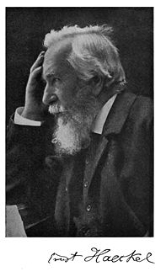
Ernst Haeckel

 
Ernst Haeckel

   Email Print
   Bookmark   Link


Ernst Haeckel


Ernst Heinrich Philipp August Haeckel (February 16, 1834 – August 9, 1919), also written von Haeckel, was an eminent German
Germany

Germany , officially the Federal Republic of Germany , is a country in Central Europe. It is bordered to the north by the North Sea, Denmark, and the Baltic Sea; to the east by Poland and the Czech Republic; to the south by Austria and Switzerland; and to the west by France, Luxembourg, Belgium, and the Netherlands....
 biologist
Biologist

A biologist is a scientist devoted to and producing results in biology through the study of life.Typically biologists study organisms and their relationship to their environment....
, naturalist
Natural history

Natural history is the scientific research of plants or animals, leaning more towards the observational than experimental methods of study, and encompasses more research that is published in magazines than in academic journals....
, philosopher, physician
Physician

A physician, medical practitioner, doctor of medicine, or medical doctor practices medicine, and is concerned with maintaining or restoring human health through the study, diagnosis, and treatment of disease and injury....
, professor
Professor

The meaning of the word professor varies. In some English-speaking countries, it refers to a senior academic who holds a departmental chair, especially as head of the Academic department, or a personal chair awarded specifically to that individual....
 and artist
Artist

The definition of an artist is wide-ranging and covers a broad spectrum of activities to do with creating art, practicing the arts and/or demonstrating an art....
 who discovered, described and named thousands of new species
Species

In biology, a species is one of the basic units of biological classification and a taxonomic rank. A species is often defined as a group of organisms capable of interbreeding and producing fertile offspring....
, mapped a genealogical tree relating all life forms, and coined many terms in biology
Biology

Biology is a branch of the natural sciences concerned with the study of living organisms and their interaction with each other and their environment ....
, including phylum
Phylum

A phylum "Phylum" is adopted from the Greek phylai, the clan-based voting groups in Greek city-states. is a taxonomic rank below Kingdom and above Class ....
, phylogeny, ecology
Ecology

Ecology is the science study of the distribution and Abundance of life and the interactions between organisms and their nature environment ....
 and the kingdom Protista. Haeckel promoted and popularized Charles Darwin's
Charles Darwin

Charles Robert Darwin Royal Society was an English people natural history who realised and presented compelling evidence that all species of life have evolution over time from common descent, through the process he called natural selection....
 work in Germany
Germany

Germany , officially the Federal Republic of Germany , is a country in Central Europe. It is bordered to the north by the North Sea, Denmark, and the Baltic Sea; to the east by Poland and the Czech Republic; to the south by Austria and Switzerland; and to the west by France, Luxembourg, Belgium, and the Netherlands....
 and developed the controversial recapitulation theory
Recapitulation theory

The theory of recapitulation, also called the biogenetic law or embryological parallelism, and often expressed as ontogeny recapitulates phylogeny, was put forward by ?tienne Serres in 1824?26 as what became known as the "Meckel-Serres Law" which attempted to provide a link between comparative embryology and a "pattern of un...
 ("ontogeny recapitulates phylogeny") claiming that an individual organism's biological development, or ontogeny
Ontogeny

Ontogeny describes the origin and the development of an organism from the fertilize Ovum to its mature form. Ontogeny is studied in developmental biology, developmental psychology, developmental cognitive neuroscience, and developmental psychobiology....
, parallels and summarizes its species' entire evolutionary development, or phylogeny.

The published artwork of Haeckel includes over 100 detailed, multi-colour illustrations of animals and sea creatures (see: Kunstformen der Natur
Kunstformen der Natur

Kunstformen der Natur is a book of lithography and autotype prints by Germany biologist Ernst Haeckel. Originally published in sets of ten between 1899 and 1904 and as a complete volume in 1904, it consists of 100 prints of various organisms, many of which were first described by Haeckel himself....
, "Artforms of Nature").


Discussion
Ask a question about 'Ernst Haeckel'
Start a new discussion about 'Ernst Haeckel'
Answer questions from other users
Full Discussion Forum


Recent Posts


Encyclopedia


Ernsthaeckel
Ernst Heinrich Philipp August Haeckel (February 16, 1834 – August 9, 1919), also written von Haeckel, was an eminent German
Germany

Germany , officially the Federal Republic of Germany , is a country in Central Europe. It is bordered to the north by the North Sea, Denmark, and the Baltic Sea; to the east by Poland and the Czech Republic; to the south by Austria and Switzerland; and to the west by France, Luxembourg, Belgium, and the Netherlands....
 biologist
Biologist

A biologist is a scientist devoted to and producing results in biology through the study of life.Typically biologists study organisms and their relationship to their environment....
, naturalist
Natural history

Natural history is the scientific research of plants or animals, leaning more towards the observational than experimental methods of study, and encompasses more research that is published in magazines than in academic journals....
, philosopher, physician
Physician

A physician, medical practitioner, doctor of medicine, or medical doctor practices medicine, and is concerned with maintaining or restoring human health through the study, diagnosis, and treatment of disease and injury....
, professor
Professor

The meaning of the word professor varies. In some English-speaking countries, it refers to a senior academic who holds a departmental chair, especially as head of the Academic department, or a personal chair awarded specifically to that individual....
 and artist
Artist

The definition of an artist is wide-ranging and covers a broad spectrum of activities to do with creating art, practicing the arts and/or demonstrating an art....
 who discovered, described and named thousands of new species
Species

In biology, a species is one of the basic units of biological classification and a taxonomic rank. A species is often defined as a group of organisms capable of interbreeding and producing fertile offspring....
, mapped a genealogical tree relating all life forms, and coined many terms in biology
Biology

Biology is a branch of the natural sciences concerned with the study of living organisms and their interaction with each other and their environment ....
, including phylum
Phylum

A phylum "Phylum" is adopted from the Greek phylai, the clan-based voting groups in Greek city-states. is a taxonomic rank below Kingdom and above Class ....
, phylogeny, ecology
Ecology

Ecology is the science study of the distribution and Abundance of life and the interactions between organisms and their nature environment ....
 and the kingdom Protista. Haeckel promoted and popularized Charles Darwin's
Charles Darwin

Charles Robert Darwin Royal Society was an English people natural history who realised and presented compelling evidence that all species of life have evolution over time from common descent, through the process he called natural selection....
 work in Germany
Germany

Germany , officially the Federal Republic of Germany , is a country in Central Europe. It is bordered to the north by the North Sea, Denmark, and the Baltic Sea; to the east by Poland and the Czech Republic; to the south by Austria and Switzerland; and to the west by France, Luxembourg, Belgium, and the Netherlands....
 and developed the controversial recapitulation theory
Recapitulation theory

The theory of recapitulation, also called the biogenetic law or embryological parallelism, and often expressed as ontogeny recapitulates phylogeny, was put forward by ?tienne Serres in 1824?26 as what became known as the "Meckel-Serres Law" which attempted to provide a link between comparative embryology and a "pattern of un...
 ("ontogeny recapitulates phylogeny") claiming that an individual organism's biological development, or ontogeny
Ontogeny

Ontogeny describes the origin and the development of an organism from the fertilize Ovum to its mature form. Ontogeny is studied in developmental biology, developmental psychology, developmental cognitive neuroscience, and developmental psychobiology....
, parallels and summarizes its species' entire evolutionary development, or phylogeny.

The published artwork of Haeckel includes over 100 detailed, multi-colour illustrations of animals and sea creatures (see: Kunstformen der Natur
Kunstformen der Natur

Kunstformen der Natur is a book of lithography and autotype prints by Germany biologist Ernst Haeckel. Originally published in sets of ten between 1899 and 1904 and as a complete volume in 1904, it consists of 100 prints of various organisms, many of which were first described by Haeckel himself....
, "Artforms of Nature"). As a philosopher, Ernst Haeckel wrote Die Welträtsel (1895–1899, in English, The Riddle of the Universe, 1901), the genesis for the term "world riddle
World riddle

The term "world riddle" or "world-riddle" has been associated, for over 100 years, with Friedrich Nietzsche and with the biologist-philosopher Ernst Haeckel, who as a professor of zoology at the University of Jena,...
" (Welträtsel); and Freedom in Science and Teaching to support teaching evolution.

In the United States, Mount Haeckel, a summit in the Eastern Sierra Nevada, overlooking the Evolution Basin, is named in his honor, as is another Mount Haeckel, a summit in New Zealand
List of mountains of New Zealand by height

The following is a list of the highest mountains in New Zealand, and also of some other notable mountains and hills, ordered by height....
; and the asteroid
Asteroid

Asteroids, sometimes called minor planets or planetoids, are small Solar System bodies in orbit around the Sun, smaller than planets but larger than meteoroids....
 12323 Häckel
12323 Häckel

12323 H?ckel is an asteroid named in honor of Ernst Haeckel, a biologist....
.

The Ernst Haeckel house ("Villa Medusa") in Jena
Jena

Jena is a university city in central Germany on the river Saale. With a population of 103,000 it is the second largest city in the federal state of Thuringia, after Erfurt....
, Germany
Germany

Germany , officially the Federal Republic of Germany , is a country in Central Europe. It is bordered to the north by the North Sea, Denmark, and the Baltic Sea; to the east by Poland and the Czech Republic; to the south by Austria and Switzerland; and to the west by France, Luxembourg, Belgium, and the Netherlands....
 contains a historic library.

Life

Haeckel Actiniae
Ernst Haeckel was born on February 16, 1834, in Potsdam
Potsdam

Potsdam is the capital city of the Germany States of Germany of Brandenburg and is part of the Metropolitan area of Berlin/Brandenburg. It is situated on the River Havel, some 25 kilometres southwest of the center of Berlin....
 (then part of Prussia
Prussia

Prussia was, most recently, a historic state originating out of the Duchy of Prussia and the Margraviate of Brandenburg. This state had for centuries substantial influence on Germany and European history....
).

In 1852, Haeckel completed studies at Cathedral High School (Domgymnasium) of Merseburg
Merseburg

Merseburg is a town in the south of the Germany state of Saxony-Anhalt on the river Saale, approx. 14 km south of Halle . It is the capital of the Saalekreis district....
. He then studied medicine
Medicine

Medicine is the art and science of healing. It encompasses a range of health care practices evolved to maintain and restore health by the prevention and treatment of illness....
 in Berlin
Berlin

Berlin is the Capital of Germany city and one of sixteen States of Germany of Germany. With a population of 3.4 million within its city limits, Berlin is the country's largest city....
, particularly with Albert von Kölliker
Albert von Kölliker

Rudolph Albert von K?lliker was a Switzerland anatomist and physiologist....
, Franz Leydig
Franz Leydig

Franz von Leydig , also Franz Leydig, was a Germans zoologist and comparative anatomist....
, Rudolf Virchow
Rudolf Virchow

Rudolf Ludwig Karl Virchow was a Medicine, Anthropology, public health activist, Pathology, prehistorian, biologist and politician. He is referred to as the "Father of Pathology," and founded the field of Social Medicine....
 (with whom he later worked briefly as assistant), and with anatomist-physiologist Johannes Peter Müller
Johannes Peter Müller

Johannes Peter M?ller , was a Germany physiologist, comparative anatomy, and ichthyology not only known for his discoveries but also for his ability to synthesize knowledge....
 (1801–1858). In 1857, Haeckel attained a doctorate
Doctorate

A doctorate is an academic degree that in most countries represents the highest level of formal study or research in a given field. In some countries it also refers to a class of degrees which qualify the holder to practice in a specific profession ....
 in medicine
Medicine

Medicine is the art and science of healing. It encompasses a range of health care practices evolved to maintain and restore health by the prevention and treatment of illness....
 (M.D.), and afterwards he received a license to practice medicine. The occupation of physician
Physician

A physician, medical practitioner, doctor of medicine, or medical doctor practices medicine, and is concerned with maintaining or restoring human health through the study, diagnosis, and treatment of disease and injury....
 appeared less worthwhile to Haeckel, after contact with suffering patients.

Haeckel studied under Carl Gegenbaur at the University of Jena for three years, earning a doctorate in zoology
Zoology

Zoology is the branch of biology concerned with the study of animals. The most common pronunciation of "zoology" is ; however, an alternative pronunciation is ....
, before becoming a professor of comparative anatomy
Comparative anatomy

Comparative anatomy is the study of similarities and differences in the anatomy of organisms. It is closely related to evolutionary biology and phylogeny ....
 at the University of Jena, where he remained 47 years, from 1862 to 1909. Between 1859 and 1866, Haeckel worked on many invertebrate groups, including radiolarian
Radiolarian

Radiolarians are amoeboid protozoa that produce intricate mineral skeletons, typically with a central capsule dividing the cell into inner and outer portions, called endoplasm and ectoplasm....
s, poriferans (sponges) and annelid
Annelid

The annelids, collectively called Annelida , are a large Scientific classification of animals comprising the segmented worms, with about 15,000 modern species including the well-known earthworms and leeches....
s (segmented worms). During a trip to the Mediterranean, Haeckel named nearly 150 new species of radiolarians. Haeckel named thousands of new species from 1859 to 1887.

From 1866 to 1867, Haeckel made an extended journey to the Canary Islands
Canary Islands

The Canary Islands are a Spain archipelago which, in turn, forms one of the Spanish Autonomous Communities and an Outermost Region of the European Union....
 and during this period, met with Charles Darwin
Charles Darwin

Charles Robert Darwin Royal Society was an English people natural history who realised and presented compelling evidence that all species of life have evolution over time from common descent, through the process he called natural selection....
, in 1866 at Down House
Down House

Down House is the former home of the English naturalist Charles Darwin and his family. It is located in Downe in the London Borough of Bromley, a village south east of Charing Cross....
 in Kent
Kent

Kent is a Counties of England in southeast England, and is one of the home counties. It borders East Sussex, Surrey and Greater London and has a defined boundary with Essex in the middle of the River Thames estuary....
, Thomas Huxley
Thomas Huxley

Thomas Henry Huxley Privy Councillor Royal Society was an English people biologist, known as "Darwin's Bulldog" for his advocacy of Charles Darwin's theory of evolution....
 and Charles Lyell
Charles Lyell

Sir Charles Lyell, 1st Baronet, Order of the Thistle, Fellow of the Royal Society was a Scotland lawyer, geologist, and protagonist of Uniformitarianism ....
. In 1867, he married Agnes Huschke. Their son Walter was born in 1868, their daughters Elizabeth in 1871 and Emma in 1873. In 1869, he traveled as a researcher to Norway
Norway

Norway , officially the Kingdom of Norway, is a constitutional monarchy in Northern Europe that occupies the western portion of the Scandinavian Peninsula....
, in 1871 to Dalmatia
Dalmatia

Dalmatia is a region on the eastern coast of the Adriatic Sea, situated mostly in modern Croatia and spreading between the island of Rab in the northwest and the Bay of Kotor in the southeast....
, and in 1873 to Egypt
Egypt

Egypt is a country mainly in North Africa, with the Sinai Peninsula forming a land bridge in Western Asia. Covering an area of about , Egypt borders the Mediterranean Sea to the north, the Gaza Strip and Israel to the northeast, the Red Sea to the east, Sudan to the south and Libya to the west....
, Turkey
Turkey

Turkey , known officially as the Republic of Turkey , is a Eurasian country that stretches across the Anatolian peninsula in southwest Asia and Thrace in the Balkans region of Southern Europe....
, and to Greece
Greece

Greece , officially the Hellenic Republic , is a country in southeastern Europe, situated on the southern end of the Balkans. It has borders with Albania, Bulgaria and the former Yugoslav Republic of Macedonia to the north, and Turkey to the east....
. Haeckel retired from teaching in 1909, and in 1910 he withdrew from the Evangelical
Lutheranism

Lutheranism is a major branch of Western Christianity that identifies with the teachings of the sixteenth-century Germans Reformer Martin Luther....
 church. Haeckel's wife, Agnes, died in 1915, and Ernst Haeckel became substantially more frail, with a broken leg (thigh) and broken arm. He sold the mansion Medusa ("Villa Medusa") in 1918 to the Carl Zeiss
Carl Zeiss

File:4microssopes4.jpgCarl Zeiss was an optician commonly known for the company he founded, Carl Zeiss AG. Zeiss made contributions to lens manufacturing that have aided the modern production of lenses....
 foundation. Ernst Haeckel died on August 9, 1919.

Politics

Haeckel's political beliefs were influenced by his affinity for the German Romantic movement
Romanticism

Romanticism is a complex artistic, literary, and intellectual movement that originated in the second half of the 18th century in Western Europe, and gained strength during the Industrial Revolution....
 coupled with his acceptance of a form of Lamarckism
Lamarckism

Lamarckism is the once widely accepted idea that an organism can pass on characteristics that it acquired during its lifetime to its offspring ....
. Rather than being a strict Darwinian
Natural selection

Natural selection is the process by which favorable heritable trait become more common in successive generations of a population of Reproduction organisms, and unfavorable heritable traits become less common, due to differential reproduction of genotypes....
, Haeckel believed that racial characteristics
Racism

Racism, by its simplest definition is the belief that Race is the primary determinant of human traits and capacities and that racial differences produce an inherent superiority of a particular race....
 were acquired through interactions with the environment and that phylogeny directly followed ontogeny
Ontogeny

Ontogeny describes the origin and the development of an organism from the fertilize Ovum to its mature form. Ontogeny is studied in developmental biology, developmental psychology, developmental cognitive neuroscience, and developmental psychobiology....
. He believed the social sciences to be instances of "applied biology". Most of these arguments have been shown to be over-generalizations at best and flatly incorrect at worst in modern biology and social studies
Social studies

Social studies is a term used to describe the broad study of the various fields which involve past and current human behavior and interactions. Rather than focus in depth on any one topic, social studies provides a broad overview of human behavior....
.

"First World War"

Haeckel was the first person known to use the term "First World War
World War I

World War I, or the First World War , was a global military conflict which involved the Great powers, organized into two opposing military alliances: the Allies of World War I and the Central Powers....
". Shortly after the start of the war Haeckel wrote:

Indianapolis Star, September 20, 1914

The "European War" became known as "The Great War", and it was not until 1931, with the beginning realization that another global war might be possible, that there is any other recorded use of the term "First World War".

Research

Ernst Haeckel and Von Miclucho Maclay 1866
Haeckel was a zoologist, an accomplished artist and illustrator, and later a professor
Professor

The meaning of the word professor varies. In some English-speaking countries, it refers to a senior academic who holds a departmental chair, especially as head of the Academic department, or a personal chair awarded specifically to that individual....
 of comparative anatomy
Comparative anatomy

Comparative anatomy is the study of similarities and differences in the anatomy of organisms. It is closely related to evolutionary biology and phylogeny ....
. Although Haeckel's ideas are important to the history of evolutionary theory, and he was a competent invertebrate
Invertebrate

An invertebrate is an animal lacking a vertebral column. The group includes 98% of all animal species ? all animals except those in the Chordate subphylum vertebrate ....
 anatomist most famous for his work on radiolaria, many speculative concepts that he championed are now considered incorrect. For example, Haeckel described and named hypothetical ancestral microorganism
Microorganism

A microorganism or microbe is an organism that is microscopic . The study of microorganisms is called microbiology, a subject that began with Anton van Leeuwenhoek's discovery of microorganisms in 1675, using a microscope of his own design....
s that have never been found.

He was one of the first to consider psychology
Psychology

Psychology is an academic and applied science discipline involving the science study of human mental functions and behavior. Occasionally it also relies on symbolic hermeneutics and critical theory, although these traditions are less pronounced than in other social sciences such as sociology....
 as a branch of physiology
Physiology

Physiology is the study of the mechanical, physical, and biochemical functions of living organisms. Physiology has traditionally been divided between plant physiology and animal and all living things physiology but the principles of physiology are universal, no matter what particular organism is being studied....
. He also proposed many now ubiquitous terms including "phylum
Phylum

A phylum "Phylum" is adopted from the Greek phylai, the clan-based voting groups in Greek city-states. is a taxonomic rank below Kingdom and above Class ....
", "phylogeny", "ecology
Ecology

Ecology is the science study of the distribution and Abundance of life and the interactions between organisms and their nature environment ....
" ("oekologie"), and proposed the kingdom Protista in 1866. His chief interests lay in evolution
Evolution

In biology, evolution is change in the heritability trait of a population of organisms from one generation to the next. These changes are caused by a combination of three main processes: variation, reproduction, and selection....
 and life development processes in general, including development of nonrandom form, which culminated in the beautifully illustrated Kunstformen der Natur
Kunstformen der Natur

Kunstformen der Natur is a book of lithography and autotype prints by Germany biologist Ernst Haeckel. Originally published in sets of ten between 1899 and 1904 and as a complete volume in 1904, it consists of 100 prints of various organisms, many of which were first described by Haeckel himself....
 (Art forms of nature). Haeckel did not support natural selection
Natural selection

Natural selection is the process by which favorable heritable trait become more common in successive generations of a population of Reproduction organisms, and unfavorable heritable traits become less common, due to differential reproduction of genotypes....
, rather believing in a Lamarckian
Jean-Baptiste Lamarck

Jean-Baptiste Pierre Antoine de Monet, Chevalier de la Marck, usually known as Lamarck, was a France soldier, natural history, academia and an early proponent of the idea that evolution occurred and proceeded in accordance with Naturalism ....
 inheritance of acquired characteristics (Lamarckism
Lamarckism

Lamarckism is the once widely accepted idea that an organism can pass on characteristics that it acquired during its lifetime to its offspring ....
).

Haeckel advanced a version of the earlier "recapitulation theory
Recapitulation theory

The theory of recapitulation, also called the biogenetic law or embryological parallelism, and often expressed as ontogeny recapitulates phylogeny, was put forward by ?tienne Serres in 1824?26 as what became known as the "Meckel-Serres Law" which attempted to provide a link between comparative embryology and a "pattern of un...
", previously set out by Étienne Serres
Étienne Serres

?tienne Renaud Augustin Serres was a French physician and embryologist. In 1810 he received his medical doctorate in Paris, and afterwards worked at the H?tel-Dieu de Paris and the H?pital de la Piti?....
 in the 1820s and supported by followers of Geoffroy
Étienne Geoffroy Saint-Hilaire

?tienne Geoffroy Saint-Hilaire was a France natural history who established the principle of "unity of composition". He was a colleague of Jean-Baptiste Lamarck and expanded and defended Lamarck's evolutionary theories....
 including Robert Edmond Grant
Robert Edmond Grant

Robert Edmond Grant Doctor of Medicine Royal College of Physicians of Edinburgh Fellow of the Royal Society was born in Edinburgh and educated at Edinburgh University as a physician....
, which proposed a link between ontogeny
Ontogeny

Ontogeny describes the origin and the development of an organism from the fertilize Ovum to its mature form. Ontogeny is studied in developmental biology, developmental psychology, developmental cognitive neuroscience, and developmental psychobiology....
 (development of form) and phylogeny (evolutionary descent), summed up by Haeckel in the phrase "ontogeny recapitulates phylogeny". His concept of recapitulation has been disputed in the form he gave it (now called "strong recapitulation"). "Strong" recapitulation hypothesis views ontogeny as repeating forms of the ancestors, while "weak" recapitulation means that what is repeated (and built upon) is the ancestral embryonic development process. He supported the theory with embryo drawings
Embryo drawings

Embryo drawing refers to any representation of the illustration of embryos in their Embryogenesis. In plants and animals, an embryo develops from a zygote, the single cell that results when an Egg and sperm fuse during fertilization....
 that have since been shown to be oversimplified and in part inaccurate, and the theory is now considered an oversimplification of quite complicated relationships. Haeckel introduced the concept of "heterochrony
Heterochrony

In biology, heterochrony is defined as a developmental change in the timing of events, leading to changes in size and shape. There are two main components, namely the onset and offset of a particular process, and the rate at which the process operates....
", which is the change in timing of embryonic development over the course of evolution.

Haeckel was a flamboyant figure. He sometimes took great (and non-scientific) leaps from available evidence. For example, at the time that Darwin first published On the Origin of Species by Means of Natural Selection (1859), no remains of human ancestors had yet been found. Haeckel postulated that evidence of human evolution would be found in the Dutch East Indies
Dutch East Indies

The Dutch East Indies, or Netherlands East Indies, was the Dutch colony that became modern Indonesia following World War II.It was formed from the nationalised colony of the former Dutch East India Company that came under the administration of the Netherlands in 1800....
 (now Indonesia
Indonesia

The Republic of Indonesia , is a transcontinental country in Southeast Asia and Oceania. Comprising Islands of Indonesia, it is the world's largest Archipelago state....
), and described these theoretical remains in great detail. He even named the as-of-yet unfound species, Pithecanthropus alalus, and charged his students to go find it. (Richard and Oskar Hertwig
Oskar Hertwig

Oscar Hertwig was a Germany zoologist and professor, who also wrote about the theory of evolution circa 1916, over 55 years after Charles Darwin's book The Origin of Species....
 were two of Haeckel's many important students.)

One student did find the remains: a young Dutchman named Eugene Dubois
Eugène Dubois

Marie Eug?ne Fran?ois Thomas Dubois was a Netherlands anatomist. He earned world-wide fame for his discovery of Homo erectus, or 'Java Man'....
 went to the East Indies and dug up the remains of Java Man
Java Man

Java Man is the name given to fossils discovered in 1891 at Trinil on the banks of the Bengawan Solo River in East Java, Indonesia, one of the first known specimens of Homo erectus....
, the first human ancestral remains ever found. These remains originally carried Haeckel's Pithecanthropus label, though they were later reclassified as Homo erectus
Homo Erectus

Homo Erectus is a 2007 comedy film about cavemen that was written and directed by Adam Rifkin, and starring Giuseppe Andrews, Gary Busey, David Carradine, Ron Jeremy, Ali Larter, Hayes MacArthur, Adam Rifkin, and Talia Shire....
.

Polygenism and racism


The creationist
Creationism

Creationism is the religious belief that humanity, life, the Earth, and the universe were Creation myth in their original form by a deity or deities....
 polygenism
Polygenism

See also Polygenesis Polygenism is a theory of human origins positing that the human Race are of different lineages, either from a scientific or a religious basis....
 of Samuel George Morton
Samuel George Morton

Samuel George Morton was an United States physician and natural scientist. Morton was born in Philadelphia, Pennsylvania, and graduated from the University of Pennsylvania in 1820....
 and Louis Agassiz
Louis Agassiz

Jean Louis Rodolphe Agassiz was a paleontologist, glaciologist, and geologist, and was a prominent innovator in the study of the earth's natural history....
, which presented human races as separately created species
Species

In biology, a species is one of the basic units of biological classification and a taxonomic rank. A species is often defined as a group of organisms capable of interbreeding and producing fertile offspring....
, was rejected by Charles Darwin
Charles Darwin

Charles Robert Darwin Royal Society was an English people natural history who realised and presented compelling evidence that all species of life have evolution over time from common descent, through the process he called natural selection....
, who argued for the monogenesis
Monogenesis

Monogenesis means "single origin". It has been used in various contexts as an antonym to polygenism or "multiple origin".* In nineteenth-century anthropology, the term was used to refer to the theory that all human beings descend from a single, recent pair of ancestors and are therefore closely related to one another....
 of the human species
Human

A human being, also human or man, is a member of a species of bipedalism primates in the family Hominidae . Mitochondrial DNA evidence indicates that modern humans originated in east Africa about 200,000 years ago....
 and the recent African origin of modern humans. In contrast to most of Darwin's supporters, Haeckel put forward a doctrine of evolutionary polygenism based on the ideas of the linguist August Schleicher, in which several different language groups had arisen separately from speechless prehuman Urmenschen, which themselves had evolved from simian ancestors. These separate languages had completed the transition from animals to man, and, under the influence of each main branch of languages, humans had evolved — in a kind of Lamarckian use-inheritance — as separate species, which could be subdivided into races. From this Haeckel drew the implication that languages with the most potential formed human species with the most potential, led by the Semitic and Indo-Germanic groups, with Berber, Jewish, Greco-Roman and Germanic varieties to the fore. As Haeckel stated:

We must mention here one of the most important results of the comparative study of languages, which for the Stammbaum of the species of men is of the highest significance, namely that human languages probably had a multiple or polyphyletic origin. Human language as such probably developed only after the species of speechless Urmenschen or Affenmenschen had split into several species or kinds. With each of these human species, language developed on its own and independently of the others. At least this is the view of Schleicher, one of the foremost authorities on this subject.… If one views the origin of the branches of language as the special and principal act of becoming human, and the species of humankind as distinguished according to their language stem, then one can say that the different species of men arose independently of one another.


Haeckel's view can be seen as a forerunner of the multi-regional hypothesis, which until the 1990s remained in contention with developments of Darwin's hypothesis of a recent African origin of modern humans. The multiregional view then fell from favour, and Darwin's view has more recently been validated by the decipherment of the human genome
Human Genome Project

The Human Genome Project was an international scientific research project with a primary goal to determine the sequence of chemical base pairs which make up DNA and to identify and map the approximately 20,000-25,000 genes of the human genome from both a physical and functional standpoint...
.

Haeckel did not hesitate to apply the hypothesis of polygenism to the diversity of human groups in the most heavy-handed way, becoming a leading apologist of scientific racism
Scientific racism

Scientific racism denotes the use of scientific, or ostensibly scientific, findings and methods to support or validate Racism attitudes and worldviews....
, stating for instance:

The Caucasian, or Mediterranean man (Homo Mediterraneus), has from time immemorial been placed at the head of all the races of men, as the most highly developed and perfect. It is generally called the Caucasian race, but as, among all the varieties of the species, the Caucasian branch is the least important, we prefer the much more suitable appellation proposed by Friedrich Müller
Friedrich Müller

Friedrich M?ller is the name of* Maler M?ller, born Friedrich M?ller , German painter and poet* Friedrich Max M?ller , German indologist* Friedrich M?ller , German linguist...
, namely, that of Mediterranese. For the most important varieties of this species, which are moreover the most eminent actors in what is called "Universal History," first rose to a flourishing condition on the shores of the Mediterranean.… This species alone (with the exception of the Mongolian) has had an actual history; it alone has attained to that degree of civilization which seems to raise men above the rest of nature.


"Infamous" embryo drawings


Haeckel Drawings
It has been claimed (Richardson 1998, Richardson and Keuck 2002) that some of Haeckel's embryo drawings
Embryo drawings

Embryo drawing refers to any representation of the illustration of embryos in their Embryogenesis. In plants and animals, an embryo develops from a zygote, the single cell that results when an Egg and sperm fuse during fertilization....
 of 1874 were fabricated. There were multiple versions of the embryo drawings, and Haeckel rejected the claims of fraud but did admit one error which he corrected. It was later said that "there is evidence of sleight of hand" on both sides of the feud between Haeckel and Wilhelm His, Sr.
Wilhelm His, Sr.

Wilhelm His, Sr. invented the microtome. By treating animal flesh with acids and salts to harden it and then slicing it very thinly with the microtome, scientists were able to further research the behavior and function of animals....
. The controversy involves several different issues (see more details at: recapitulation theory
Recapitulation theory

The theory of recapitulation, also called the biogenetic law or embryological parallelism, and often expressed as ontogeny recapitulates phylogeny, was put forward by ?tienne Serres in 1824?26 as what became known as the "Meckel-Serres Law" which attempted to provide a link between comparative embryology and a "pattern of un...
).

Some creationists have claimed that Darwin relied on Haeckel's embryo drawings as proof of evolution

to support their argument that Darwin's theory is therefore illegitimate and possibly fraudulent. This claim ignores the fact that Darwin published On the Origin of Species in 1859, and The Descent of Man
The Descent of Man, and Selection in Relation to Sex

The Descent of Man, and Selection in Relation to Sex is a book on evolutionary theory by England natural history Charles Darwin, first published in 1871....
 in 1871, whereas Haeckel's embryo drawings did not appear until 1874 (8 species). In The Descent of Man Darwin used only two embryo drawings, neither taken from Haeckel.

Awards

He was awarded the Linnean Society of London
Linnean Society of London

The Linnean Society of London is the world's premier society for the study and dissemination of taxonomy and natural history. It publishes a Zoological Journal, as well as Botanical and Biological Journals....
's prestigious Darwin-Wallace Medal
Darwin-Wallace Medal

The 'Darwin-Wallace Medal' is a medal awarded by the Linnean Society of London every 50 years, beginning in 1908, 50 years after the joint presentation by Charles Darwin and Alfred Russel Wallace of two scientific papers - On the Tendency of Species to form Varieties; and on the Perpetuation of Varieties and Species by Natural Means of Selec...
 in 1908.

Publications

Haeckel Muscinae
Darwin’s 1859 book On the Origin of Species had immense popular influence, but although its sales exceeded its publisher's hopes it was a technical book rather than a work of popular science: long, difficult and with few illustrations. One of Haeckel's books did a great deal to explain his version of "Darwinism
Darwinism

Darwinism is a term used for various movements or concepts related to ideas of transmutation of species or evolution, including ideas with no connection to the work of Charles Darwin....
" to the world. It was a bestselling, provocatively illustrated book in German, titled Natürliche Schöpfungsgeschichte, published in Berlin in 1868, and translated into English as The History of Creation in 1876. It was frequently reprinted until 1926.

Haeckel argued that human evolution consisted of precisely 22 phases, the 21st — the "missing link" — being a halfway step between apes and humans. He even formally named this missing link Pithecanthropus alalus, translated as "ape man without speech." (The missing link was what the Dutchman Eugène Dubois
Eugène Dubois

Marie Eug?ne Fran?ois Thomas Dubois was a Netherlands anatomist. He earned world-wide fame for his discovery of Homo erectus, or 'Java Man'....
, discoverer of Homo erectus
Homo Erectus

Homo Erectus is a 2007 comedy film about cavemen that was written and directed by Adam Rifkin, and starring Giuseppe Andrews, Gary Busey, David Carradine, Ron Jeremy, Ali Larter, Hayes MacArthur, Adam Rifkin, and Talia Shire....
, would later resolve to find.)

Haeckel's entire literary output was extensive, working as a professor at the University of Jena for 47 years, and even at the time of the celebration of his 60th birthday at Jena
Jena

Jena is a university city in central Germany on the river Saale. With a population of 103,000 it is the second largest city in the federal state of Thuringia, after Erfurt....
 in 1894, Haeckel had produced 42 works with nearly 13,000 pages, besides numerous scientific memoir
Memoir

As a literature genre, a memoir , or a reminiscence, forms a subclass of autobiography ? although the terms 'memoir' and 'autobiography' are today almost interchangeable....
s and illustrations.

Haeckel's monograph
Monograph

A monograph is a work of writing upon a single subject, usually also by a single author. It is often a scholarly essay or learned treatise, and may be released in the manner of a book, journal article, editorial or written rant....
s include:
  • Radiolaria (1862)
  • Siphonophora (1869)
  • Monera (1870)
  • Calcareous Sponges (1872)
As well as several Challenger reports:
  • Deep-Sea Medusae (1881)
  • Siphonophora (1888)
  • Deep-Sea Keratosa (1889)
  • Radiolaria (1887) — illustrated with 140 plates and enumerating over four thousand (4000) new species.


Among his many books, Ernst Haeckel wrote:
  • General Morphology (1866)
  • Natürliche Schöpfungsgeschichte (1868) — in English (1876; 6th ed.: New York, D. Appleton and Co., 1914, 2 volumes)
  • Freie Wissenschaft und freie Lehre (1877), in English, Freedom in Science and Teaching, a reply to a speech in which Virchow objected to the teaching of evolution
    Evolution

    In biology, evolution is change in the heritability trait of a population of organisms from one generation to the next. These changes are caused by a combination of three main processes: variation, reproduction, and selection....
     in schools, on the grounds that evolution was an unproven hypothesis.
  • Die systematische Phylogenie (1894) — "Systematic Phylogeny", which has been considered as his best book
  • Anthropogenie (1874, 5th and enlarged edition 1903) — dealing with the evolution of man
  • Die Welträthsel (1895–1899), also spelled Die Welträtsel ("world-riddle") — in English The Riddle of the Universe, 1901
  • Über unsere gegenwärtige Kenntnis vom Ursprung des Menschen (1898) — translated into English as The Last Link, 1808
  • Der Kampf um den Entwickelungsgedanken (1905) — English version, Last Words on Evolution, 1906
  • Die Lebenswunder (1904) — English "Wonder of Life", a supplement to the Riddle of the Universe


Books of travel:
  • Indische Reisebriefe (1882) — "Travel notes of India
    India

    India, officially the Republic of India , is a country in South Asia. It is the List of countries and outlying territories by total area country by geographical area, the List of countries by population country, and the most populous liberal democracy in the world....
    "
  • Aus Insulinde: Malayische Reisebriefe (1901) — "Travel notes of Malaysia
    Malaysia

    Malaysia is a federation that consists of States of Malaysia in Southeast Asia with a total landmass of . The capital city is Kuala Lumpur, while Putrajaya is the seat of the federal government....
    "), the fruits of journeys to Ceylon and to Java
    Java

    Java is an island of Indonesia and the site of its Capital city, Jakarta. Once the centre of powerful Hindu kingdoms, The spread of Islam in Indonesia , and the core of the colonial Dutch East Indies, Java now plays a dominant role in the economic and political life of Indonesia....
  • Kunstformen der Natur
    Kunstformen der Natur

    Kunstformen der Natur is a book of lithography and autotype prints by Germany biologist Ernst Haeckel. Originally published in sets of ten between 1899 and 1904 and as a complete volume in 1904, it consists of 100 prints of various organisms, many of which were first described by Haeckel himself....
     (1904) — Artforms of Nature, with plates representing detailed marine animal forms
  • Wanderbilder (1905) — "Travel Images", with reproductions of his oil-paintings and water-color landscapes.


See also

  • Alfred Ploetz
    Alfred Ploetz

    Alfred Ploetz was a Germany physician, biologist, eugenicist known for coining the term racial hygiene and promoting the concept in Germany. Rassenhygiene is a form of eugenics....
     — on eugenics
    Eugenics

    Eugenics is a scientific field involving the controlled breeding of humans in order to achieve desirable traits in future generations. Eugenics was at its height in first half of the 20th century and was largely abandoned with the end of World War II....
     and racial hygiene
    Racial hygiene

    Racial hygiene is the selection, by a government, of the putatively most physical, intellectual and moral persons to raise the next generation and a close alignment of public health with eugenics....
  • Alternative taxonomical classification
    Alternative taxonomical classification

    Alternative taxonomical classifications are those which differ from the commonly accepted classifications in fundamental ways. One could say that every single classification system since Linnaeus has been alternative at some point, before it was either completely rejected, or accepted as the standard....
  • Embryology
    Embryology

    Embryology is the study of the development of an embryo. An embryo is defined as any organism in a stage before birth or hatching, or in plants, before germination occurs....
  • Francis Galton
    Francis Galton

    Sir Francis Galton Fellow of the Royal Society , Cousin#Half_cousins of Charles Darwin, was an England Victorian era polymath, anthropologist, Eugenics, tropical List of explorers, geographer, inventor, meteorologist, proto-geneticist, Psychometrics, and statistician....
  • List of wildlife artists
    List of wildlife artists

    The List of wildlife artists is a list for any wildlife artist, wildlife painter, wildlife photographer, other wildlife artist, society of wildlife artists, museum, or exhibition of wildlife art, worldwide....
  • Proteus (2004 film)
    Proteus (2004 film)

    Proteus is an animated documentary film made by David Lebrun in 2004. Its depicts a nineteenth century understanding of the sea, particularly focussing on the work of Ernst Haeckel....
    , an animated documentary by David Lebrun, largely focussing on Ernst Haeckel


Further reading

  • Di Gregorio, Mario A. From here to eternity: Ernst Haeckel and Scientific Faith, Vandenhoeck & Ruprecht, 2005, ISBN 3525569726
  • Haeckel, Ernst, Art Forms from the Ocean: The Radiolarian Atlas of 1862, Prestel Verlag, 2005, ISBN 3-7913-3327-5.
  • Richardson, Michael K., "Haeckel, embryos, and evolution," Science Vol. 280, no. 5366 (May 15, 1998) p. 983, 985–986.


External links

  • — An exhibition of material on Haeckel, including background on many Kunstformen der Natur plates
  • — Ernst Haeckel biography
  • A slide-show essay about Ernst Haeckel.
  • Kunstformen der Natur, Wikimedia Commons: over 100 detailed animal drawings.
  • (from Stuebers Online Library)
  • — An animated documentary film on the life and work of Ernst Haeckel
  • and Ernst Haeckel Museum in Jena
    Jena

    Jena is a university city in central Germany on the river Saale. With a population of 103,000 it is the second largest city in the federal state of Thuringia, after Erfurt....