


List of famines

Encyclopedia
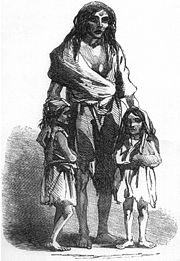
Famine
A famine is a widespread scarcity of food, caused by several factors including crop failure, overpopulation, or government policies. This phenomenon is usually accompanied or followed by regional malnutrition, starvation, epidemic, and increased mortality. Every continent in the world has...
s, ordered by date.
Between 108 BC and 1911 AD there were no fewer than 1,828 major famines in China
China
Chinese civilization may refer to:* China for more general discussion of the country.* Chinese culture* Greater China, the transnational community of ethnic Chinese.* History of China* Sinosphere, the area historically affected by Chinese culture...
, or one nearly every year in one or another province; however, the famines varied greatly in severity. There were 95 famines in Britain during the Middle Ages.
List of famines
| Date | Event | Location | Death toll (estimate) |
|---|---|---|---|
| 400–800 | Famine in Western Europe Western Europe Western Europe is a loose term for the collection of countries in the western most region of the European continents, though this definition is context-dependent and carries cultural and political connotations. One definition describes Western Europe as a geographic entity—the region lying in the... associated with the Fall of Rome and its sack by Alaric I Alaric I Alaric I was the King of the Visigoths from 395–410. Alaric is most famous for his sack of Rome in 410, which marked a decisive event in the decline of the Roman Empire.... . Between 400 and 800 AD, the population of the city of Rome Rome Rome is the capital of Italy and the country's largest and most populated city and comune, with over 2.7 million residents in . The city is located in the central-western portion of the Italian Peninsula, on the Tiber River within the Lazio region of Italy.Rome's history spans two and a half... fell by over 90%, mainly because of famine and plague Plague of Justinian The Plague of Justinian was a pandemic that afflicted the Eastern Roman Empire , including its capital Constantinople, in 541–542 AD. It was one of the greatest plagues in history. The most commonly accepted cause of the pandemic is bubonic plague, which later became infamous for either causing or... . |
Western Europe Western Europe Western Europe is a loose term for the collection of countries in the western most region of the European continents, though this definition is context-dependent and carries cultural and political connotations. One definition describes Western Europe as a geographic entity—the region lying in the... |
|
| 639 | Famine in Arabia during the Caliphate Caliphate The term caliphate, "dominion of a caliph " , refers to the first system of government established in Islam and represented the political unity of the Muslim Ummah... of Umar ibn al-Khattab |
Arabia | |
| 750's | Spain Spain Spain , officially the Kingdom of Spain languages]] under the European Charter for Regional or Minority Languages. In each of these, Spain's official name is as follows:;;;;;;), is a country and member state of the European Union located in southwestern Europe on the Iberian Peninsula... |
||
| 800–1000 AD | Severe drought Drought A drought is an extended period of months or years when a region notes a deficiency in its water supply. Generally, this occurs when a region receives consistently below average precipitation. It can have a substantial impact on the ecosystem and agriculture of the affected region... killed millions of Maya Maya civilization The Maya is a Mesoamerican civilization, noted for the only known fully developed written language of the pre-Columbian Americas, as well as for its art, architecture, and mathematical and astronomical systems. Initially established during the Pre-Classic period The Maya is a Mesoamerican... people with famine and thirst and initiated a cascade of internal collapses that destroyed their civilization |
Maya Empire Maya civilization The Maya is a Mesoamerican civilization, noted for the only known fully developed written language of the pre-Columbian Americas, as well as for its art, architecture, and mathematical and astronomical systems. Initially established during the Pre-Classic period The Maya is a Mesoamerican... |
|
| 809 | Frankish Empire Frankish Empire Francia or Frankia, later also called the Frankish Empire , Frankish Kingdom , Frankish Realm or occasionally Frankland, was the territory inhabited and ruled by the Franks from the 3rd to the 10th century... |
||
| 875–884 | Peasant rebellion in China inspired by famine; Huang Chao Huang Chao Huang Chao was the leader of the Huang Chao Rebellion , known in mainland China as the Huang Chao Revolution in China that seriously weakened the once mighty Tang Dynasty of China... captured capital |
China China Chinese civilization may refer to:* China for more general discussion of the country.* Chinese culture* Greater China, the transnational community of ethnic Chinese.* History of China* Sinosphere, the area historically affected by Chinese culture... |
|
| 927–928 | Caused by four months of frost | Byzantine Empire Byzantine Empire The Byzantine Empire was the Eastern Roman Empire during the periods of Late Antiquity and the Middle Ages, centred on the capital of Constantinople. Known simply as the Roman Empire or Romania to its inhabitants and neighbours, the Empire was the direct continuation of the Ancient Roman State... |
|
| 1005 | England England England is a country that is part of the United Kingdom. It shares land borders with Scotland to the north and Wales to the west; the Irish Sea is to the north west, the Celtic Sea to the south west, with the North Sea to the east and the English Channel to the south separating it from continental... |
||
| 1016 | Famine throughout Europe Europe Europe is, by convention, one of the world's seven continents. Comprising the westernmost peninsula of Eurasia, Europe is generally 'divided' from Asia to its east by the watershed divides of the Ural and Caucasus Mountains, the Ural River, the Caspian and Black Seas, and the waterways connecting... |
Europe Europe Europe is, by convention, one of the world's seven continents. Comprising the westernmost peninsula of Eurasia, Europe is generally 'divided' from Asia to its east by the watershed divides of the Ural and Caucasus Mountains, the Ural River, the Caspian and Black Seas, and the waterways connecting... |
|
| 1022, 1033, 1052 | Great famines in India, in which entire provinces were depopulated | India India India , officially the Republic of India , is a country in South Asia. It is the seventh-largest country by geographical area, the second-most populous country with over 1.2 billion people, and the most populous democracy in the world... |
|
| 1064–1072 | Seven years' famine in Egypt | Egypt Egypt Egypt , officially the Arab Republic of Egypt, Arabic: , is a country mainly in North Africa, with the Sinai Peninsula forming a land bridge in Southwest Asia. Egypt is thus a transcontinental country, and a major power in Africa, the Mediterranean Basin, the Middle East and the Muslim world... |
|
| 1051 | Famine forced the Toltecs to migrate from a stricken region in what is now central Mexico | Mexico Mexico The United Mexican States , commonly known as Mexico , is a federal constitutional republic in North America. It is bordered on the north by the United States; on the south and west by the Pacific Ocean; on the southeast by Guatemala, Belize, and the Caribbean Sea; and on the east by the Gulf of... (present day) |
|
| 1097 | Famine and plague | France France The French Republic , The French Republic , The French Republic , (commonly known as France , is a unitary semi-presidential republic in Western Europe with several overseas territories and islands located on other continents and in the Indian, Pacific, and Atlantic oceans. Metropolitan France... |
100,000 |
| 1230 | Famine in the Republic of Novgorod | Russia Russia Russia or , officially known as both Russia and the Russian Federation , is a country in northern Eurasia. It is a federal semi-presidential republic, comprising 83 federal subjects... |
|
| 1229–1232 | The Kangi famine, possibly the worst famine in Japan's history. Caused by volcanic eruptions. | Japan Japan Japan is an island nation in East Asia. Located in the Pacific Ocean, it lies to the east of the Sea of Japan, China, North Korea, South Korea and Russia, stretching from the Sea of Okhotsk in the north to the East China Sea and Taiwan in the south... |
|
| 1235 | Famine in England, 20,000 died in London London London is the capital city of :England and the :United Kingdom, the largest metropolitan area in the United Kingdom, and the largest urban zone in the European Union by most measures. Located on the River Thames, London has been a major settlement for two millennia, its history going back to its... alone |
England England England is a country that is part of the United Kingdom. It shares land borders with Scotland to the north and Wales to the west; the Irish Sea is to the north west, the Celtic Sea to the south west, with the North Sea to the east and the English Channel to the south separating it from continental... |
|
| 1255 | Portugal Portugal Portugal , officially the Portuguese Republic is a country situated in southwestern Europe on the Iberian Peninsula. Portugal is the westernmost country of Europe, and is bordered by the Atlantic Ocean to the West and South and by Spain to the North and East. The Atlantic archipelagos of the... |
||
| 1275–1299 | Collapse of Anasazi civilization Ancient Pueblo Peoples Ancient Pueblo People or Ancestral Pueblo peoples were an ancient Native American culture centered on the present-day Four Corners area of the United States, comprising southern Utah, northern Arizona, northwest New Mexico, and southern Colorado... , widespread famine occurred |
United States United States The United States of America is a federal constitutional republic comprising fifty states and a federal district... (present day) |
|
| 1315–1317 | Great Famine of 1315–1317 Great Famine of 1315–1317 The Great Famine of 1315–1317 was the first of a series of large scale crises that struck Northern Europe early in the fourteenth century... |
Europe Europe Europe is, by convention, one of the world's seven continents. Comprising the westernmost peninsula of Eurasia, Europe is generally 'divided' from Asia to its east by the watershed divides of the Ural and Caucasus Mountains, the Ural River, the Caspian and Black Seas, and the waterways connecting... |
|
| 1333–1337 | China China Chinese civilization may refer to:* China for more general discussion of the country.* Chinese culture* Greater China, the transnational community of ethnic Chinese.* History of China* Sinosphere, the area historically affected by Chinese culture... |
||
| 1344–1345 | Great famine in India | India India India , officially the Republic of India , is a country in South Asia. It is the seventh-largest country by geographical area, the second-most populous country with over 1.2 billion people, and the most populous democracy in the world... |
|
| 1387 | After Timur the Lame Timur Timur , historically known as Tamerlane in English , was a 14th-century conqueror of West, South and Central Asia, and the founder of the Timurid dynasty in Central Asia, and great-great-grandfather of Babur, the founder of the Mughal Dynasty, which survived as the Mughal Empire in India until... left Asia Minor Asia Minor Asia Minor is a geographical location at the westernmost protrusion of Asia, also called Anatolia, and corresponds to the western two thirds of the Asian part of Turkey... , severe famine ensued |
Anatolia Anatolia Anatolia is a geographic and historical term denoting the westernmost protrusion of Asia, comprising the majority of the Republic of Turkey... |
|
| 1396–1407 | The Durga Devi famine | India India India , officially the Republic of India , is a country in South Asia. It is the seventh-largest country by geographical area, the second-most populous country with over 1.2 billion people, and the most populous democracy in the world... |
|
| 1441 | Famine in Mayapan Mayapan Mayapan , is a Pre-Columbian Maya site a couple of kilometers south of the town of Telchaquillo in Municipality of Tecoh, approximately 40 km south-east of Mérida and 100 km west of Chichen Itza; in the state of Yucatán, Mexico... |
Mexico Mexico The United Mexican States , commonly known as Mexico , is a federal constitutional republic in North America. It is bordered on the north by the United States; on the south and west by the Pacific Ocean; on the southeast by Guatemala, Belize, and the Caribbean Sea; and on the east by the Gulf of... |
|
| 1450–1454 | Famine in the Aztec Empire, interpreted as the gods' need for sacrifices. | Mexico Mexico The United Mexican States , commonly known as Mexico , is a federal constitutional republic in North America. It is bordered on the north by the United States; on the south and west by the Pacific Ocean; on the southeast by Guatemala, Belize, and the Caribbean Sea; and on the east by the Gulf of... (present day) |
|
| 1460–1461 | Kanshō Kansho was a after Chōroku and before Bunshō. This period spanned from December 1460 through February 1466. The reigning emperors were and .-Change of era:* 1460 : The era name was changed to mark an event or a number of events... famine in Japan |
Japan Japan Japan is an island nation in East Asia. Located in the Pacific Ocean, it lies to the east of the Sea of Japan, China, North Korea, South Korea and Russia, stretching from the Sea of Okhotsk in the north to the East China Sea and Taiwan in the south... |
|
| 1504 | Spain Spain Spain , officially the Kingdom of Spain languages]] under the European Charter for Regional or Minority Languages. In each of these, Spain's official name is as follows:;;;;;;), is a country and member state of the European Union located in southwestern Europe on the Iberian Peninsula... |
||
| 1518 | Venice Venice Venice is a city in northern Italy which is renowned for the beauty of its setting, its architecture and its artworks. It is the capital of the Veneto region... |
Italy Italy Italy , officially the Italian Republic languages]] under the European Charter for Regional or Minority Languages. In each of these, Italy's official name is as follows:;;;;;;;;), is a unitary parliamentary republic in South-Central Europe. To the north it borders France, Switzerland, Austria and... (present day) |
|
| 1528 | Famine in Languedoc Languedoc Languedoc is a former province of France, now continued in the modern-day régions of Languedoc-Roussillon and Midi-Pyrénées in the south of France, and whose capital city was Toulouse, now in Midi-Pyrénées. It had an area of approximately 42,700 km² .-Geographical Extent:The traditional... |
France France The French Republic , The French Republic , The French Republic , (commonly known as France , is a unitary semi-presidential republic in Western Europe with several overseas territories and islands located on other continents and in the Indian, Pacific, and Atlantic oceans. Metropolitan France... |
|
| 1535 | Famine in Ethiopia Famines in Ethiopia Traditionally the Economy of Ethiopia was based on subsistence agriculture, with an aristocracy that consumed the surplus. Due to a number of causes, the peasants lacked incentives to either improve production or to store their excess harvest; as a result, they lived from harvest to harvest.Despite... |
Ethiopia Ethiopia Ethiopia , officially known as the Federal Democratic Republic of Ethiopia, is a country located in the Horn of Africa. It is the second-most populous nation in Africa, with over 82 million inhabitants, and the tenth-largest by area, occupying 1,100,000 km2... |
|
| 1567–1570 | Famine in Harar Harar Harar is an eastern city in Ethiopia, and the capital of the modern Harari ethno-political division of Ethiopia... , combined with plague. Emir of Harar, died. |
Ethiopia Ethiopia Ethiopia , officially known as the Federal Democratic Republic of Ethiopia, is a country located in the Horn of Africa. It is the second-most populous nation in Africa, with over 82 million inhabitants, and the tenth-largest by area, occupying 1,100,000 km2... |
|
| 1586 | Famine in England which gave rise to the Poor Law Poor Law The English Poor Laws were a system of poor relief which existed in England and Wales that developed out of late-medieval and Tudor-era laws before being codified in 1587–98... system |
England England England is a country that is part of the United Kingdom. It shares land borders with Scotland to the north and Wales to the west; the Irish Sea is to the north west, the Celtic Sea to the south west, with the North Sea to the east and the English Channel to the south separating it from continental... |
|
| 1601–1603 | One of the worst famines in all of Russian history; famine killed as many as 100,000 in Moscow and up to one-third of Tsar Godunov Boris Godunov Boris Fyodorovich Godunov was de facto regent of Russia from c. 1585 to 1598 and then the first non-Rurikid tsar from 1598 to 1605. The end of his reign saw Russia descend into the Time of Troubles.-Early years:... 's subjects; see Russian famine of 1601–1603 Russian famine of 1601–1603 The Russian famine of 1601–1603 was Russia's worst famine in terms of proportional effect on the population, killing perhaps two million people, a third of Russians, during the Time of Troubles, when the country was unsettled politically and later invaded by the Polish Commonwealth... . Same famine killed about half Estonia Estonia Estonia , officially the Republic of Estonia , is a state in the Baltic region of Northern Europe. It is bordered to the north by the Gulf of Finland, to the west by the Baltic Sea, to the south by Latvia , and to the east by Lake Peipsi and the Russian Federation . Across the Baltic Sea lies... n population. |
Russia Russia Russia or , officially known as both Russia and the Russian Federation , is a country in northern Eurasia. It is a federal semi-presidential republic, comprising 83 federal subjects... |
2,000,0002 million |
| 1618–1648 | Famines in Europe caused by Thirty Years' War Thirty Years' War The Thirty Years' War was fought primarily in what is now Germany, and at various points involved most countries in Europe. It was one of the most destructive conflicts in European history.... |
Europe Europe Europe is, by convention, one of the world's seven continents. Comprising the westernmost peninsula of Eurasia, Europe is generally 'divided' from Asia to its east by the watershed divides of the Ural and Caucasus Mountains, the Ural River, the Caspian and Black Seas, and the waterways connecting... |
|
| 1619 | Famine in Japan Tokugawa shogunate The Tokugawa shogunate, also known as the and the , was a feudal regime of Japan established by Tokugawa Ieyasu and ruled by the shoguns of the Tokugawa family. This period is known as the Edo period and gets its name from the capital city, Edo, which is now called Tokyo, after the name was... . During the Tokugawa period Edo period The , or , is a division of Japanese history which was ruled by the shoguns of the Tokugawa family, running from 1603 to 1868. The political entity of this period was the Tokugawa shogunate.... , there were 154 famines, of which 21 were widespread and serious. |
Japan Japan Japan is an island nation in East Asia. Located in the Pacific Ocean, it lies to the east of the Sea of Japan, China, North Korea, South Korea and Russia, stretching from the Sea of Okhotsk in the north to the East China Sea and Taiwan in the south... |
|
| 1630–1631 | Deccan Famine of 1630–32 (Note: There was a corresponding famine in northwestern China, eventually causing the Ming dynasty Ming Dynasty The Ming Dynasty, also Empire of the Great Ming, was the ruling dynasty of China from 1368 to 1644, following the collapse of the Mongol-led Yuan Dynasty. The Ming, "one of the greatest eras of orderly government and social stability in human history", was the last dynasty in China ruled by ethnic... to collapse in 1644) |
India India India , officially the Republic of India , is a country in South Asia. It is the seventh-largest country by geographical area, the second-most populous country with over 1.2 billion people, and the most populous democracy in the world... |
2,000,0002 million |
| 1648–1660 | Poland lost an estimated 1/3 of its population due to the wars, famine, and plague | Poland Poland Poland , officially the Republic of Poland , is a country in Central Europe bordered by Germany to the west; the Czech Republic and Slovakia to the south; Ukraine, Belarus and Lithuania to the east; and the Baltic Sea and Kaliningrad Oblast, a Russian exclave, to the north... |
|
| 1649 | Famine in northern England | England England England is a country that is part of the United Kingdom. It shares land borders with Scotland to the north and Wales to the west; the Irish Sea is to the north west, the Celtic Sea to the south west, with the North Sea to the east and the English Channel to the south separating it from continental... |
|
| 1650–1652 | Famine in the east of France | France France The French Republic , The French Republic , The French Republic , (commonly known as France , is a unitary semi-presidential republic in Western Europe with several overseas territories and islands located on other continents and in the Indian, Pacific, and Atlantic oceans. Metropolitan France... |
|
| 1651–1653 | Famine throughout much of Ireland Ireland Ireland is an island to the northwest of continental Europe. It is the third-largest island in Europe and the twentieth-largest island on Earth... during the Cromwellian conquest of Ireland |
Ireland Ireland Ireland is an island to the northwest of continental Europe. It is the third-largest island in Europe and the twentieth-largest island on Earth... |
|
| 1661 | Famine in India, when not a drop of rain fell for two years | India India India , officially the Republic of India , is a country in South Asia. It is the seventh-largest country by geographical area, the second-most populous country with over 1.2 billion people, and the most populous democracy in the world... |
|
| 1669 | Famine in Bengal Bengal Bengal is a historical and geographical region in the northeast region of the Indian Subcontinent at the apex of the Bay of Bengal. Today, it is mainly divided between the sovereign land of People's Republic of Bangladesh and the Indian state of West Bengal, although some regions of the previous... |
India India India , officially the Republic of India , is a country in South Asia. It is the seventh-largest country by geographical area, the second-most populous country with over 1.2 billion people, and the most populous democracy in the world... |
|
| 1670s and 1680s | Plague and famines in Spain | Spain Spain Spain , officially the Kingdom of Spain languages]] under the European Charter for Regional or Minority Languages. In each of these, Spain's official name is as follows:;;;;;;), is a country and member state of the European Union located in southwestern Europe on the Iberian Peninsula... |
|
| 1680 | Famine in Sardinia Sardinia Sardinia is the second-largest island in the Mediterranean Sea . It is an autonomous region of Italy, and the nearest land masses are the French island of Corsica, the Italian Peninsula, Sicily, Tunisia and the Spanish Balearic Islands.The name Sardinia is from the pre-Roman noun *sard[],... |
Italy Italy Italy , officially the Italian Republic languages]] under the European Charter for Regional or Minority Languages. In each of these, Italy's official name is as follows:;;;;;;;;), is a unitary parliamentary republic in South-Central Europe. To the north it borders France, Switzerland, Austria and... (present day) |
|
| 1680s | Famine in Sahel Sahel The Sahel is the ecoclimatic and biogeographic zone of transition between the Sahara desert in the North and the Sudanian Savannas in the south.It stretches across the North African continent between the Atlantic Ocean and the Red Sea.... |
||
| 1690s | Famine throughout Scotland Scotland Scotland is a country that is part of the United Kingdom. Occupying the northern third of the island of Great Britain, it shares a border with England to the south and is bounded by the North Sea to the east, the Atlantic Ocean to the north and west, and the North Channel and Irish Sea to the... which killed 15% of the population |
Scotland Scotland Scotland is a country that is part of the United Kingdom. Occupying the northern third of the island of Great Britain, it shares a border with England to the south and is bounded by the North Sea to the east, the Atlantic Ocean to the north and west, and the North Channel and Irish Sea to the... |
|
| 1693–1694 | France France The French Republic , The French Republic , The French Republic , (commonly known as France , is a unitary semi-presidential republic in Western Europe with several overseas territories and islands located on other continents and in the Indian, Pacific, and Atlantic oceans. Metropolitan France... |
2,000,0002 million | |
| 1695–1697 | Great Famine of Estonia killed about a fifth of Estonia Estonia Estonia , officially the Republic of Estonia , is a state in the Baltic region of Northern Europe. It is bordered to the north by the Gulf of Finland, to the west by the Baltic Sea, to the south by Latvia , and to the east by Lake Peipsi and the Russian Federation . Across the Baltic Sea lies... n and Livonia Livonia Livonia is a historic region along the eastern shores of the Baltic Sea. It was once the land of the Finnic Livonians inhabiting the principal ancient Livonian County Metsepole with its center at Turaida... n population (70,000–75,000 people). Famine also hit Sweden Sweden Sweden , officially the Kingdom of Sweden , is a Nordic country on the Scandinavian Peninsula in Northern Europe. Sweden borders with Norway and Finland and is connected to Denmark by a bridge-tunnel across the Öresund.... (80,000–100,000 dead) |
The Swedish Empire Swedish Empire The Swedish Empire refers to the Kingdom of Sweden between 1561 and 1721 . During this time, Sweden was one of the great European powers. In Swedish, the period is called Stormaktstiden, literally meaning "the Great Power Era"... , of which Swedish Estonia Swedish Estonia The Duchy of Estonia , also known as Swedish Estonia, was a dominion of the Swedish Empire from 1561 until 1721, when it was ceded to Russia in the Treaty of Nystad, following its capitulation in the Great Northern War. The dominion arose when the northern parts of present-day Estonia were united... and Swedish Livonia Swedish Livonia - Swedish infantry and cavalry regiments:Infantry regiments:* Garnisonsregementet i Riga * Guvenörsregementet i Riga * Livländsk infanteribataljon I... where dominion Dominion A dominion, often Dominion, refers to one of a group of autonomous polities that were nominally under British sovereignty, constituting the British Empire and British Commonwealth, beginning in the latter part of the 19th century. They have included Canada, Australia, New Zealand, Newfoundland,... s at that time |
|
| 1696–1697 | Great Famine of Finland Great Famine of Finland (1695–1697) The Great Famine of Finland killed about a third of the Finnish population in two years.... wiped out almost a third of the population |
Finland Finland Finland , officially the Republic of Finland, is a Nordic country situated in the Fennoscandian region of Northern Europe. It is bordered by Sweden in the west, Norway in the north and Russia in the east, while Estonia lies to its south across the Gulf of Finland.Around 5.4 million people reside... , then part of Sweden Sweden Sweden , officially the Kingdom of Sweden , is a Nordic country on the Scandinavian Peninsula in Northern Europe. Sweden borders with Norway and Finland and is connected to Denmark by a bridge-tunnel across the Öresund.... proper |
|
| 1702–1704 | Famine in Deccan | India India India , officially the Republic of India , is a country in South Asia. It is the seventh-largest country by geographical area, the second-most populous country with over 1.2 billion people, and the most populous democracy in the world... |
2,000,0002 million |
| 1708–1711 | Famine in East Prussia East Prussia East Prussia is the main part of the region of Prussia along the southeastern Baltic Coast from the 13th century to the end of World War II in May 1945. From 1772–1829 and 1878–1945, the Province of East Prussia was part of the German state of Prussia. The capital city was Königsberg.East Prussia... killed 250,000 people or 41% of its population |
East Prussia East Prussia East Prussia is the main part of the region of Prussia along the southeastern Baltic Coast from the 13th century to the end of World War II in May 1945. From 1772–1829 and 1878–1945, the Province of East Prussia was part of the German state of Prussia. The capital city was Königsberg.East Prussia... |
250,000 |
| 1709–1710 | France France The French Republic , The French Republic , The French Republic , (commonly known as France , is a unitary semi-presidential republic in Western Europe with several overseas territories and islands located on other continents and in the Indian, Pacific, and Atlantic oceans. Metropolitan France... |
||
| 1722 | Arabia | ||
| 1727–1728 | Famine in the English Midlands English Midlands The Midlands, or the English Midlands, is the traditional name for the area comprising central England that broadly corresponds to the early medieval Kingdom of Mercia. It borders Southern England, Northern England, East Anglia and Wales. Its largest city is Birmingham, and it was an important... |
England England England is a country that is part of the United Kingdom. It shares land borders with Scotland to the north and Wales to the west; the Irish Sea is to the north west, the Celtic Sea to the south west, with the North Sea to the east and the English Channel to the south separating it from continental... |
|
| 1738–1756 | Famine in West Africa, half the population of Timbuktu Timbuktu Timbuktu , formerly also spelled Timbuctoo, is a town in the West African nation of Mali situated north of the River Niger on the southern edge of the Sahara Desert. The town is the capital of the Timbuktu Region, one of the eight administrative regions of Mali... died of starvation |
West Africa West Africa West Africa or Western Africa is the westernmost region of the African continent. Geopolitically, the UN definition of Western Africa includes the following 16 countries and an area of approximately 5 million square km:-Flags of West Africa:... |
|
| 1740-1741 | Great Irish Famine (1740–1741) | Ireland Ireland Ireland is an island to the northwest of continental Europe. It is the third-largest island in Europe and the twentieth-largest island on Earth... |
|
| 1750–1756 | Famine in the Senegambia region | ||
| 1764 | Famine in Naples Naples Naples is a city in Southern Italy, situated on the country's west coast by the Gulf of Naples. Lying between two notable volcanic regions, Mount Vesuvius and the Phlegraean Fields, it is the capital of the region of Campania and of the province of Naples... |
Italy Italy Italy , officially the Italian Republic languages]] under the European Charter for Regional or Minority Languages. In each of these, Italy's official name is as follows:;;;;;;;;), is a unitary parliamentary republic in South-Central Europe. To the north it borders France, Switzerland, Austria and... (present day) |
|
| 1769–1773 | Bengal famine of 1770 Bengal famine of 1770 The Bengal famine of 1770 was a catastrophic famine between 1769 and 1773 that affected the lower Gangetic plain of India... , 10 million dead (one third of population) |
India India India , officially the Republic of India , is a country in South Asia. It is the seventh-largest country by geographical area, the second-most populous country with over 1.2 billion people, and the most populous democracy in the world... |
10,000,00010 million |
| 1770–1771 | Famines in Czech lands Famines in Czech lands This article discusses historical famines that have occurred in the area of today's Czech Republic. Various known famines occurred throughout Czech lands between 1272 and 1847... killed hundreds of thousands people |
Czech Republic Czech Republic The Czech Republic is a landlocked country in Central Europe. The country is bordered by Poland to the northeast, Slovakia to the east, Austria to the south, and Germany to the west and northwest.... (present day) |
|
| 1771–1772 | Famine in Saxony Saxony The Free State of Saxony is a landlocked state of Germany, contingent with Brandenburg, Saxony Anhalt, Thuringia, Bavaria, the Czech Republic and Poland. It is the tenth-largest German state in area, with of Germany's sixteen states.... and southern Germany |
Germany Germany Germany , officially the Federal Republic of Germany , is a federal parliamentary republic in Europe. The country consists of 16 states while the capital and largest city is Berlin. Germany covers an area of 357,021 km2 and has a largely temperate seasonal climate... |
|
| 1773 | Famine in Sweden Sweden Sweden , officially the Kingdom of Sweden , is a Nordic country on the Scandinavian Peninsula in Northern Europe. Sweden borders with Norway and Finland and is connected to Denmark by a bridge-tunnel across the Öresund.... |
Sweden Sweden Sweden , officially the Kingdom of Sweden , is a Nordic country on the Scandinavian Peninsula in Northern Europe. Sweden borders with Norway and Finland and is connected to Denmark by a bridge-tunnel across the Öresund.... |
|
| 1779 | Famine in Rabat Rabat Rabat , is the capital and third largest city of the Kingdom of Morocco with a population of approximately 650,000... |
Morocco Morocco Morocco , officially the Kingdom of Morocco , is a country located in North Africa. It has a population of more than 32 million and an area of 710,850 km², and also primarily administers the disputed region of the Western Sahara... |
|
| 1780s | Great Tenmei Famine | Japan Japan Japan is an island nation in East Asia. Located in the Pacific Ocean, it lies to the east of the Sea of Japan, China, North Korea, South Korea and Russia, stretching from the Sea of Okhotsk in the north to the East China Sea and Taiwan in the south... |
|
| 1783 | Famine in Iceland caused by Laki Laki (volcano) Laki or Lakagígar is a volcanic fissure situated in the south of Iceland, not far from the canyon of Eldgjá and the small village Kirkjubæjarklaustur, in South-East Iceland.... eruption killed one-fifth of Iceland's population |
Iceland Iceland Iceland , described as the Republic of Iceland, is a Nordic and European island country in the North Atlantic Ocean, on the Mid-Atlantic Ridge. Iceland also refers to the main island of the country, which contains almost all the population and almost all the land area. The country has a population... |
|
| 1783–84 | Chalisa famine Chalisa famine The Chalisa famine of 1783-84 in South Asia followed unusual El Nino events that began in 1780 and caused droughts throughout the region. Chalisa refers to the Vikram Samvat calendar year 1840... |
India India India , officially the Republic of India , is a country in South Asia. It is the seventh-largest country by geographical area, the second-most populous country with over 1.2 billion people, and the most populous democracy in the world... |
11,000,00011 million |
| 1784 | Widespread famine throughout Egypt | Egypt Egypt Egypt , officially the Arab Republic of Egypt, Arabic: , is a country mainly in North Africa, with the Sinai Peninsula forming a land bridge in Southwest Asia. Egypt is thus a transcontinental country, and a major power in Africa, the Mediterranean Basin, the Middle East and the Muslim world... |
|
| 1784–1785 | Famine in Tunisia killed up to one-fifth of all Tunisians | Tunisia Tunisia Tunisia , officially the Tunisian RepublicThe long name of Tunisia in other languages used in the country is: , is the northernmost country in Africa. It is a Maghreb country and is bordered by Algeria to the west, Libya to the southeast, and the Mediterranean Sea to the north and east. Its area... |
|
| 1788 | The two years previous to the French Revolution Causes of the French Revolution The Causes of the French Revolution were the significant historical factors that led to the revolution of 1789 in France.Although France in 1785 faced economic difficulties, mostly concerning the equitability of taxation, it was one of the richest and most powerful nations of Europe... saw bad harvests and harsh winters, possibly because of a strong El Niño cycle or caused by the 1783 Laki Laki Łąki may refer to the following places in Poland:*Łąki, Lower Silesian Voivodeship *Łąki, West Pomeranian Voivodeship *Łąki, Lublin Voivodeship... eruption in Iceland Iceland Iceland , described as the Republic of Iceland, is a Nordic and European island country in the North Atlantic Ocean, on the Mid-Atlantic Ridge. Iceland also refers to the main island of the country, which contains almost all the population and almost all the land area. The country has a population... . |
France France The French Republic , The French Republic , The French Republic , (commonly known as France , is a unitary semi-presidential republic in Western Europe with several overseas territories and islands located on other continents and in the Indian, Pacific, and Atlantic oceans. Metropolitan France... |
|
| 1789 | Famine in Ethiopia Famines in Ethiopia Traditionally the Economy of Ethiopia was based on subsistence agriculture, with an aristocracy that consumed the surplus. Due to a number of causes, the peasants lacked incentives to either improve production or to store their excess harvest; as a result, they lived from harvest to harvest.Despite... afflicted "all the provinces" |
||
| 1789–92 | Doji bara famine Doji bara famine The Doji bara famine of 1791-92 in South Asia was brought on by a major El Niño event lasting from 1789 CE to 1795 CE and producing prolonged droughts... or Skull famine |
India India India , officially the Republic of India , is a country in South Asia. It is the seventh-largest country by geographical area, the second-most populous country with over 1.2 billion people, and the most populous democracy in the world... |
|
| 1810, 1811, 1846, and 1849 | Four famines in China | China China Chinese civilization may refer to:* China for more general discussion of the country.* Chinese culture* Greater China, the transnational community of ethnic Chinese.* History of China* Sinosphere, the area historically affected by Chinese culture... |
45,000,00045 million. |
| 1811–1812 | Famine devastated Madrid Madrid Madrid is the capital and largest city of Spain. The population of the city is roughly 3.3 million and the entire population of the Madrid metropolitan area is calculated to be 6.271 million. It is the third largest city in the European Union, after London and Berlin, and its metropolitan... |
Spain Spain Spain , officially the Kingdom of Spain languages]] under the European Charter for Regional or Minority Languages. In each of these, Spain's official name is as follows:;;;;;;), is a country and member state of the European Union located in southwestern Europe on the Iberian Peninsula... |
20,000 |
| 1815 | Eruption of Tambora Mount Tambora Mount Tambora is an active stratovolcano, also known as a composite volcano, on the island of Sumbawa, Indonesia. Sumbawa is flanked both to the north and south by oceanic crust, and Tambora was formed by the active subduction zone beneath it. This raised Mount Tambora as high as , making it... , Indonesia. Tens of thousands died of subsequent famine |
Indonesia Indonesia Indonesia , officially the Republic of Indonesia , is a country in Southeast Asia and Oceania. Indonesia is an archipelago comprising approximately 13,000 islands. It has 33 provinces with over 238 million people, and is the world's fourth most populous country. Indonesia is a republic, with an... |
|
| 1816–1817 | Year Without a Summer Year Without a Summer The Year Without a Summer was 1816, in which severe summer climate abnormalities caused average global temperatures to decrease by about 0.4–0.7 °C , resulting in major food shortages across the Northern Hemisphere... |
Europe Europe Europe is, by convention, one of the world's seven continents. Comprising the westernmost peninsula of Eurasia, Europe is generally 'divided' from Asia to its east by the watershed divides of the Ural and Caucasus Mountains, the Ural River, the Caspian and Black Seas, and the waterways connecting... |
65,000 |
| 1830–1833 | Claimed to have killed 42% of the population | Cape Verde Cape Verde The Republic of Cape Verde is an island country, spanning an archipelago of 10 islands located in the central Atlantic Ocean, 570 kilometres off the coast of Western Africa... |
30,000 |
| 1830s | Tenpo famine Tenpo famine The Tenpo famine , also known as the "Great Tenpo famine" was a famine which affected Tenpo era Japan. It is considered to have begun in 1833, and lasted until 1837... |
Japan Japan Japan is an island nation in East Asia. Located in the Pacific Ocean, it lies to the east of the Sea of Japan, China, North Korea, South Korea and Russia, stretching from the Sea of Okhotsk in the north to the East China Sea and Taiwan in the south... |
|
| 1837–1838 | Agra famine of 1837–38 Agra famine of 1837–38 The Agra famine of 1837–1838 was a famine in the newly established North-Western Provinces of Company-ruled India that affected an area of and a population of 8 million people... |
India India India , officially the Republic of India , is a country in South Asia. It is the seventh-largest country by geographical area, the second-most populous country with over 1.2 billion people, and the most populous democracy in the world... |
|
| 1845–1857 | Highland Potato Famine | Scotland Scotland Scotland is a country that is part of the United Kingdom. Occupying the northern third of the island of Great Britain, it shares a border with England to the south and is bounded by the North Sea to the east, the Atlantic Ocean to the north and west, and the North Channel and Irish Sea to the... |
|
| 1845–1849 | Great Irish Famine killed more than 1 million people and over 1.5–2 million emigrated | Ireland Ireland Ireland is an island to the northwest of continental Europe. It is the third-largest island in Europe and the twentieth-largest island on Earth... |
1,500,0001.5 million |
| 1846 | Famine led to the peasant revolt known as "Maria da Fonte" in the north of Portugal Portugal Portugal , officially the Portuguese Republic is a country situated in southwestern Europe on the Iberian Peninsula. Portugal is the westernmost country of Europe, and is bordered by the Atlantic Ocean to the West and South and by Spain to the North and East. The Atlantic archipelagos of the... |
Portugal Portugal Portugal , officially the Portuguese Republic is a country situated in southwestern Europe on the Iberian Peninsula. Portugal is the westernmost country of Europe, and is bordered by the Atlantic Ocean to the West and South and by Spain to the North and East. The Atlantic archipelagos of the... |
|
| 1850–1873 | As a result of Taiping Rebellion Taiping Rebellion The Taiping Rebellion was a widespread civil war in southern China from 1850 to 1864, led by heterodox Christian convert Hong Xiuquan, who, having received visions, maintained that he was the younger brother of Jesus Christ, against the ruling Manchu-led Qing Dynasty... , drought, and famine, the population of China Qing Dynasty The Qing Dynasty was the last dynasty of China, ruling from 1644 to 1912 with a brief, abortive restoration in 1917. It was preceded by the Ming Dynasty and followed by the Republic of China.... drop by over 60 million people |
China China Chinese civilization may refer to:* China for more general discussion of the country.* Chinese culture* Greater China, the transnational community of ethnic Chinese.* History of China* Sinosphere, the area historically affected by Chinese culture... |
|
| 1866 | Orissa famine of 1866 Orissa famine of 1866 The Orissa famine of 1866 affected the east coast of India from Madras upwards, an area covering 180,000 miles and containing a population of 47,500,000; the impact of the famine, however, was greatest in Orissa, which at that time was quite isolated from the rest of India.-Causes:Like all Indian... |
India India India , officially the Republic of India , is a country in South Asia. It is the seventh-largest country by geographical area, the second-most populous country with over 1.2 billion people, and the most populous democracy in the world... |
1,000,0001 million |
| 1866–1868 | Finnish famine of 1866–1868. About 15% of the entire population died | Finland Finland Finland , officially the Republic of Finland, is a Nordic country situated in the Fennoscandian region of Northern Europe. It is bordered by Sweden in the west, Norway in the north and Russia in the east, while Estonia lies to its south across the Gulf of Finland.Around 5.4 million people reside... , northern Sweden Sweden Sweden , officially the Kingdom of Sweden , is a Nordic country on the Scandinavian Peninsula in Northern Europe. Sweden borders with Norway and Finland and is connected to Denmark by a bridge-tunnel across the Öresund.... |
150,000+ |
| 1869 | Rajputana famine of 1869 Rajputana famine of 1869 The Rajputana famine of 1869 affected an area of and a population of 44,500,000, primarily in the princely states of Rajputana, India, and the British territory of Ajmer; other areas affected included Gujarat, the North Deccan districts, the Jubbalpore division of the... |
India India India , officially the Republic of India , is a country in South Asia. It is the seventh-largest country by geographical area, the second-most populous country with over 1.2 billion people, and the most populous democracy in the world... |
1,500,0001.5 million |
| 1870–1871 | Famine in Persia | Iran Iran Iran , officially the Islamic Republic of Iran , is a country in Southern and Western Asia. The name "Iran" has been in use natively since the Sassanian era and came into use internationally in 1935, before which the country was known to the Western world as Persia... (present day) |
2,000,0002 million |
| 1873–1874 | Famine in Anatolia Anatolia Anatolia is a geographic and historical term denoting the westernmost protrusion of Asia, comprising the majority of the Republic of Turkey... caused by drought and floods |
Turkey Turkey Turkey , known officially as the Republic of Turkey , is a Eurasian country located in Western Asia and in East Thrace in Southeastern Europe... (present day) |
|
| 1879 | 1879 Famine in Ireland Irish Famine (1879) The Irish famine of 1879 was the last main Irish famine. Unlike the earlier Great Famines of 1740-1741 and 1845-1849 the 1879 famine caused hunger rather than mass deaths, due to changes in the technology of food production, different structures of land-holding The Irish famine of 1879 was the... . Unlike previous famines, this famine mainly caused hunger and food shortages but not much mortality. |
Ireland Ireland Ireland is an island to the northwest of continental Europe. It is the third-largest island in Europe and the twentieth-largest island on Earth... |
|
| 1873–74 | All mortality was avoided in the Bihar famine of 1873–74 Bihar famine of 1873–74 The Bihar famine of 1873–1874 was a famine in British India that followed a drought in the province of Bihar and the neighboring provinces of Bengal and the North-Western Provinces and Oudh; it affected an area of and a population of 21.5 million... |
India India India , officially the Republic of India , is a country in South Asia. It is the seventh-largest country by geographical area, the second-most populous country with over 1.2 billion people, and the most populous democracy in the world... |
0 |
| 1876–1879 | ENSO El Niño-Southern Oscillation El Niño/La Niña-Southern Oscillation, or ENSO, is a quasiperiodic climate pattern that occurs across the tropical Pacific Ocean roughly every five years... Famine in India, China, Brazil Brazil Brazil , officially the Federative Republic of Brazil , is the largest country in South America. It is the world's fifth largest country, both by geographical area and by population with over 192 million people... , Northern Africa (and other countries). Famine in northern China Northern Chinese Famine of 1876–1879 The Northern Chinese Famine of 1876–1879 was a famine which occurred in late Qing dynasty China. It is usually referred to as Dīngwùqíhuāng . A drought began to hit northern China in 1875. The provinces of Shaanxi, Shanxi, Hebei , Henan, and Shandong were hit by the following famine. It was... killed 13 million people. 5.25 million died in the Great Famine of 1876–78 in India |
India India India , officially the Republic of India , is a country in South Asia. It is the seventh-largest country by geographical area, the second-most populous country with over 1.2 billion people, and the most populous democracy in the world... , China China Chinese civilization may refer to:* China for more general discussion of the country.* Chinese culture* Greater China, the transnational community of ethnic Chinese.* History of China* Sinosphere, the area historically affected by Chinese culture... , Brazil Brazil Brazil , officially the Federative Republic of Brazil , is the largest country in South America. It is the world's fifth largest country, both by geographical area and by population with over 192 million people... , Northern Africa (and other countries). |
|
| 1878-1880 | Famine in St. Lawrence Island St. Lawrence Island St. Lawrence Island is located west of mainland Alaska in the Bering Sea, just south of the Bering Strait, at about 63°30' North 173°20' West. The village of Gambell is located on the northwest cape, from the Chukchi Peninsula in the Russian Far East. The island is part of Alaska, but closer to... , Alaska Alaska Alaska is the largest state in the United States by area. It is situated in the northwest extremity of the North American continent, with Canada to the east, the Arctic Ocean to the north, and the Pacific Ocean to the west and south, with Russia further west across the Bering Strait... |
United States United States The United States of America is a federal constitutional republic comprising fifty states and a federal district... |
|
| 1888–1892 | Ethiopian Great famine Famines in Ethiopia Traditionally the Economy of Ethiopia was based on subsistence agriculture, with an aristocracy that consumed the surplus. Due to a number of causes, the peasants lacked incentives to either improve production or to store their excess harvest; as a result, they lived from harvest to harvest.Despite... . About one-third of the population died. Conditions worsen with cholera Cholera Cholera is an infection of the small intestine that is caused by the bacterium Vibrio cholerae. The main symptoms are profuse watery diarrhea and vomiting. Transmission occurs primarily by drinking or eating water or food that has been contaminated by the diarrhea of an infected person or the feces... outbreaks (1889–92), a typhus Typhus Epidemic typhus is a form of typhus so named because the disease often causes epidemics following wars and natural disasters... epidemic, and a major smallpox Smallpox Smallpox was an infectious disease unique to humans, caused by either of two virus variants, Variola major and Variola minor. The disease is also known by the Latin names Variola or Variola vera, which is a derivative of the Latin varius, meaning "spotted", or varus, meaning "pimple"... epidemic (1889–90). |
Ethiopia Ethiopia Ethiopia , officially known as the Federal Democratic Republic of Ethiopia, is a country located in the Horn of Africa. It is the second-most populous nation in Africa, with over 82 million inhabitants, and the tenth-largest by area, occupying 1,100,000 km2... |
|
| 1891–1892 | Russia Russia Russia or , officially known as both Russia and the Russian Federation , is a country in northern Eurasia. It is a federal semi-presidential republic, comprising 83 federal subjects... |
375,000–500,000 | |
| 1896–1897 | ENSO El Niño-Southern Oscillation El Niño/La Niña-Southern Oscillation, or ENSO, is a quasiperiodic climate pattern that occurs across the tropical Pacific Ocean roughly every five years... famine in northern China leading in part to the Boxer Rebellion Boxer Rebellion The Boxer Rebellion, also called the Boxer Uprising by some historians or the Righteous Harmony Society Movement in northern China, was a proto-nationalist movement by the "Righteous Harmony Society" , or "Righteous Fists of Harmony" or "Society of Righteous and Harmonious Fists" , in China between... |
China China Chinese civilization may refer to:* China for more general discussion of the country.* Chinese culture* Greater China, the transnational community of ethnic Chinese.* History of China* Sinosphere, the area historically affected by Chinese culture... |
|
| 1896–1902 | ENSO El Niño-Southern Oscillation El Niño/La Niña-Southern Oscillation, or ENSO, is a quasiperiodic climate pattern that occurs across the tropical Pacific Ocean roughly every five years... famine in India |
India India India , officially the Republic of India , is a country in South Asia. It is the seventh-largest country by geographical area, the second-most populous country with over 1.2 billion people, and the most populous democracy in the world... |
|
| 1907, 1911 | Famines in east-central China | China China Chinese civilization may refer to:* China for more general discussion of the country.* Chinese culture* Greater China, the transnational community of ethnic Chinese.* History of China* Sinosphere, the area historically affected by Chinese culture... |
|
| 1914–1918 | Mount Lebanon Mount Lebanon Mount Lebanon , as a geographic designation, is a Lebanese mountain range, averaging above 2,200 meters in height and receiving a substantial amount of precipitation, including snow, which averages around four meters deep. It extends across the whole country along about , parallel to the... famine during World War I World War I World War I , which was predominantly called the World War or the Great War from its occurrence until 1939, and the First World War or World War I thereafter, was a major war centred in Europe that began on 28 July 1914 and lasted until 11 November 1918... which killed about a third of the population |
Lebanon Lebanon Lebanon , officially the Republic of LebanonRepublic of Lebanon is the most common term used by Lebanese government agencies. The term Lebanese Republic, a literal translation of the official Arabic and French names that is not used in today's world. Arabic is the most common language spoken among... |
|
| 1915–1916 | Armenian Genocide Armenian Genocide The Armenian Genocide—also known as the Armenian Holocaust, the Armenian Massacres and, by Armenians, as the Great Crime—refers to the deliberate and systematic destruction of the Armenian population of the Ottoman Empire during and just after World War I... . Armenian deportees starved to death |
Armenia Armenia Armenia , officially the Republic of Armenia , is a landlocked mountainous country in the Caucasus region of Eurasia... |
|
| 1916–1917 | Famine caused by the British blockade of Germany Germany Germany , officially the Federal Republic of Germany , is a federal parliamentary republic in Europe. The country consists of 16 states while the capital and largest city is Berlin. Germany covers an area of 357,021 km2 and has a largely temperate seasonal climate... in WWI |
Germany Germany Germany , officially the Federal Republic of Germany , is a federal parliamentary republic in Europe. The country consists of 16 states while the capital and largest city is Berlin. Germany covers an area of 357,021 km2 and has a largely temperate seasonal climate... |
|
| 1916–1917 | Winter famine in Russia Russia Russia or , officially known as both Russia and the Russian Federation , is a country in northern Eurasia. It is a federal semi-presidential republic, comprising 83 federal subjects... |
Russia Russia Russia or , officially known as both Russia and the Russian Federation , is a country in northern Eurasia. It is a federal semi-presidential republic, comprising 83 federal subjects... |
|
| 1917–1919 | Famine in Persia Iran Iran , officially the Islamic Republic of Iran , is a country in Southern and Western Asia. The name "Iran" has been in use natively since the Sassanian era and came into use internationally in 1935, before which the country was known to the Western world as Persia... . As much as 1/4 of the population living in the north of Iran died in the famine |
Iran Iran Iran , officially the Islamic Republic of Iran , is a country in Southern and Western Asia. The name "Iran" has been in use natively since the Sassanian era and came into use internationally in 1935, before which the country was known to the Western world as Persia... (present day) |
|
| 1917–1921 | A series of famines in Turkestan Turkestan Turkestan, spelled also as Turkistan, literally means "Land of the Turks".The term Turkestan is of Persian origin and has never been in use to denote a single nation. It was first used by Persian geographers to describe the place of Turkish peoples... at the time of the Bolshevik revolution killed about a sixth of the population |
Turkestan Turkestan Turkestan, spelled also as Turkistan, literally means "Land of the Turks".The term Turkestan is of Persian origin and has never been in use to denote a single nation. It was first used by Persian geographers to describe the place of Turkish peoples... |
|
| 1921 | Russian famine of 1921 Russian famine of 1921 The Russian famine of 1921, also known as Povolzhye famine, which began in the early spring of that year, and lasted through 1922, was a severe famine that occurred in Bolshevik Russia... |
Russia Russia Russia or , officially known as both Russia and the Russian Federation , is a country in northern Eurasia. It is a federal semi-presidential republic, comprising 83 federal subjects... |
5,000,0005 million |
| 1921–1922 | 1921–1922 famine in Tatarstan | Russia Russia Russia or , officially known as both Russia and the Russian Federation , is a country in northern Eurasia. It is a federal semi-presidential republic, comprising 83 federal subjects... |
|
| 1921–1922 | Famine in Volga German Volga German The Volga Germans were ethnic Germans living along the River Volga in the region of southern European Russia around Saratov and to the south. Recruited as immigrants to Russia in the 18th century, they were allowed to maintain German culture, language, traditions and churches: Lutherans, Reformed,... colonies in Russia. One-third of the entire population perished |
Russia Russia Russia or , officially known as both Russia and the Russian Federation , is a country in northern Eurasia. It is a federal semi-presidential republic, comprising 83 federal subjects... |
|
| 1928–1929 | Famine in Ruanda-Burundi Ruanda-Urundi Ruanda-Urundi was a Belgian suzerainty from 1916 to 1924, a League of Nations Class B Mandate from 1924 to 1945 and then a United Nations trust territory until 1962, when it became the independent states of Rwanda and Burundi.- Overview :... , causing large migrations to the Congo |
Rwanda Rwanda Rwanda or , officially the Republic of Rwanda , is a country in central and eastern Africa with a population of approximately 11.4 million . Rwanda is located a few degrees south of the Equator, and is bordered by Uganda, Tanzania, Burundi and the Democratic Republic of the Congo... and Burundi Burundi Burundi , officially the Republic of Burundi , is a landlocked country in the Great Lakes region of Eastern Africa bordered by Rwanda to the north, Tanzania to the east and south, and the Democratic Republic of the Congo to the west. Its capital is Bujumbura... (present day) |
|
| 1928–1930 | Famine Chinese famine of 1928–1930 The Chinese famine of 1928–1930 was a famine in the period when the Republic of China was ruling Mainland China. In 1928–1930, a drought hit the provinces of Henan, Shaanxi, and Gansu. The famine hit a large area of North China. It was estimated that about 3 million people died in the famine. The... in northern China. The drought Drought A drought is an extended period of months or years when a region notes a deficiency in its water supply. Generally, this occurs when a region receives consistently below average precipitation. It can have a substantial impact on the ecosystem and agriculture of the affected region... resulted in 3 million deaths |
China China Chinese civilization may refer to:* China for more general discussion of the country.* Chinese culture* Greater China, the transnational community of ethnic Chinese.* History of China* Sinosphere, the area historically affected by Chinese culture... |
|
| 1932–1933 | Soviet famine in Ukraine Ukraine Ukraine is a country in Eastern Europe. It has an area of 603,628 km², making it the second largest contiguous country on the European continent, after Russia... (Holodomor Holodomor The Holodomor was a man-made famine in the Ukrainian SSR between 1932 and 1933. During the famine, which is also known as the "terror-famine in Ukraine" and "famine-genocide in Ukraine", millions of Ukrainians died of starvation in a peacetime catastrophe unprecedented in the history of... ), some parts of Russia Russia Russia or , officially known as both Russia and the Russian Federation , is a country in northern Eurasia. It is a federal semi-presidential republic, comprising 83 federal subjects... and North Caucasus North Caucasus The North Caucasus is the northern part of the Caucasus region between the Black and Caspian Seas and within European Russia. The term is also used as a synonym for the North Caucasus economic region of Russia.... area. 1 to 3 million people may have died |
Soviet Union Soviet Union The Soviet Union , officially the Union of Soviet Socialist Republics , was a constitutionally socialist state that existed in Eurasia between 1922 and 1991.... |
|
| 1936 | China China Chinese civilization may refer to:* China for more general discussion of the country.* Chinese culture* Greater China, the transnational community of ethnic Chinese.* History of China* Sinosphere, the area historically affected by Chinese culture... |
5,000,0005 million | |
| 1940–1943 | Famine in Warsaw Ghetto Warsaw Ghetto The Warsaw Ghetto was the largest of all Jewish Ghettos in Nazi-occupied Europe during World War II. It was established in the Polish capital between October and November 15, 1940, in the territory of General Government of the German-occupied Poland, with over 400,000 Jews from the vicinity... |
Occupied Poland | |
| 1941–44 | Leningrad Siege of Leningrad The Siege of Leningrad, also known as the Leningrad Blockade was a prolonged military operation resulting from the failure of the German Army Group North to capture Leningrad, now known as Saint Petersburg, in the Eastern Front theatre of World War II. It started on 8 September 1941, when the last... famine caused by a 900-day blockade by German troops. About one million Leningrad residents starved, froze, or were bombed to death in the winter of 1941–42, when supply routes to the city were cut off and temperatures dropped to −40 degrees. |
Russia Russia Russia or , officially known as both Russia and the Russian Federation , is a country in northern Eurasia. It is a federal semi-presidential republic, comprising 83 federal subjects... |
1 million |
| 1941–1944 | Famine Great Famine (Greece) The Great Famine was a period of mass starvation in Axis-occupied Greece, during World War II . The local population suffered greatly during this period, while the Axis Powers initiated a policy of large scale plunder... in Greece caused by the Axis occupation. |
Greece Greece Greece , officially the Hellenic Republic , and historically Hellas or the Republic of Greece in English, is a country in southeastern Europe.... |
300,000 |
| 1943 | Bengal famine of 1943 Bengal famine of 1943 The Bengal famine of 1943 struck the Bengal. Province of pre-partition India. Estimates are that between 1.5 and 4 million people died of starvation, malnutrition and disease, out of Bengal’s 60.3 million population, half of them dying from disease after food became available in December 1943 As... |
India India India , officially the Republic of India , is a country in South Asia. It is the seventh-largest country by geographical area, the second-most populous country with over 1.2 billion people, and the most populous democracy in the world... |
|
| 1943 | Famine in Ruanda-Urundi, causing migrations Human migration Human migration is physical movement by humans from one area to another, sometimes over long distances or in large groups. Historically this movement was nomadic, often causing significant conflict with the indigenous population and their displacement or cultural assimilation. Only a few nomadic... to the Congo |
Rwanda Rwanda Rwanda or , officially the Republic of Rwanda , is a country in central and eastern Africa with a population of approximately 11.4 million . Rwanda is located a few degrees south of the Equator, and is bordered by Uganda, Tanzania, Burundi and the Democratic Republic of the Congo... and Burundi Burundi Burundi , officially the Republic of Burundi , is a landlocked country in the Great Lakes region of Eastern Africa bordered by Rwanda to the north, Tanzania to the east and south, and the Democratic Republic of the Congo to the west. Its capital is Bujumbura... (present day) |
|
| 1944 | Dutch famine of 1944 Dutch famine of 1944 The Dutch famine of 1944, known as the Hongerwinter in Dutch, was a famine that took place in the German-occupied part of the Netherlands, especially in the densely populated western provinces above the great rivers, during the winter of 1944-1945, near the end of World War II. A German blockade... during World War II World War II World War II, or the Second World War , was a global conflict lasting from 1939 to 1945, involving most of the world's nations—including all of the great powers—eventually forming two opposing military alliances: the Allies and the Axis... |
Netherlands Netherlands The Netherlands is a constituent country of the Kingdom of the Netherlands, located mainly in North-West Europe and with several islands in the Caribbean. Mainland Netherlands borders the North Sea to the north and west, Belgium to the south, and Germany to the east, and shares maritime borders... |
20,000 |
| 1945 | Vietnamese Famine of 1945 Vietnamese Famine of 1945 The Vietnamese Famine of 1945 was a famine that occurred in northern Vietnam from October 1944 to May 1945, during the Japanese occupation of French Indochina in World War II. Between 400,000 and 2 million people are estimated to have starved to death during this time.-Causes:There were many... |
Vietnam Vietnam Vietnam – sometimes spelled Viet Nam , officially the Socialist Republic of Vietnam – is the easternmost country on the Indochina Peninsula in Southeast Asia. It is bordered by China to the north, Laos to the northwest, Cambodia to the southwest, and the South China Sea –... |
|
| 1947 | Soviet Famine of 1947 Soviet Famine of 1947 The last major famine to hit the USSR "began in July 1946, reached its peak in February–August 1947 and then quickly diminished in intensity, although there were still some famine deaths in 1948." It was triggered by a bad harvest caused by drought in 1946. However, the surplus stocks in the hands... |
Soviet Union Soviet Union The Soviet Union , officially the Union of Soviet Socialist Republics , was a constitutionally socialist state that existed in Eurasia between 1922 and 1991.... |
1,000,0001–1.5 million |
| 1958 | Famine in Tigray Famines in Ethiopia Traditionally the Economy of Ethiopia was based on subsistence agriculture, with an aristocracy that consumed the surplus. Due to a number of causes, the peasants lacked incentives to either improve production or to store their excess harvest; as a result, they lived from harvest to harvest.Despite... |
Ethiopia Ethiopia Ethiopia , officially known as the Federal Democratic Republic of Ethiopia, is a country located in the Horn of Africa. It is the second-most populous nation in Africa, with over 82 million inhabitants, and the tenth-largest by area, occupying 1,100,000 km2... |
100,000 |
| 1959–1961 | The Great Chinese Famine. According to government statistics, there were 15 million excess deaths. | China China Chinese civilization may refer to:* China for more general discussion of the country.* Chinese culture* Greater China, the transnational community of ethnic Chinese.* History of China* Sinosphere, the area historically affected by Chinese culture... |
1,500,00015–43 million |
| 1967–1970 | Biafran famine caused by Nigerian blockade | Nigeria Nigeria Nigeria , officially the Federal Republic of Nigeria, is a federal constitutional republic comprising 36 states and its Federal Capital Territory, Abuja. The country is located in West Africa and shares land borders with the Republic of Benin in the west, Chad and Cameroon in the east, and Niger in... |
|
| 1968–1972 | Sahel drought Sahel drought [[File:Greening Sahel 1982-1999.jpg|thumb|300px|Recent "Greening" of the Sahel: The results of trend analyses of time series over the Sahel region of seasonally integrated NDVI using NOAA AVHRR NDVI-data from 1982 to 1999... created a famine that killed a million people |
Mauritania Mauritania Mauritania is a country in the Maghreb and West Africa. It is bordered by the Atlantic Ocean in the west, by Western Sahara in the north, by Algeria in the northeast, by Mali in the east and southeast, and by Senegal in the southwest... , Mali Mali Mali , officially the Republic of Mali , is a landlocked country in Western Africa. Mali borders Algeria on the north, Niger on the east, Burkina Faso and the Côte d'Ivoire on the south, Guinea on the south-west, and Senegal and Mauritania on the west. Its size is just over 1,240,000 km² with... , Chad Chad Chad , officially known as the Republic of Chad, is a landlocked country in Central Africa. It is bordered by Libya to the north, Sudan to the east, the Central African Republic to the south, Cameroon and Nigeria to the southwest, and Niger to the west... , Niger Niger Niger , officially named the Republic of Niger, is a landlocked country in Western Africa, named after the Niger River. It borders Nigeria and Benin to the south, Burkina Faso and Mali to the west, Algeria and Libya to the north and Chad to the east... and Burkina Faso Burkina Faso Burkina Faso – also known by its short-form name Burkina – is a landlocked country in west Africa. It is surrounded by six countries: Mali to the north, Niger to the east, Benin to the southeast, Togo and Ghana to the south, and Côte d'Ivoire to the southwest.Its size is with an estimated... |
|
| 1972–1973 | Famine in Ethiopia Famines in Ethiopia Traditionally the Economy of Ethiopia was based on subsistence agriculture, with an aristocracy that consumed the surplus. Due to a number of causes, the peasants lacked incentives to either improve production or to store their excess harvest; as a result, they lived from harvest to harvest.Despite... caused by drought and poor governance; failure of the government to handle this crisis led to fall of Haile Selassie and to Derg Derg The Derg or Dergue was a Communist military junta that came to power in Ethiopia following the ousting of Haile Selassie I. Derg, which means "committee" or "council" in Ge'ez, is the short name of the Coordinating Committee of the Armed Forces, Police, and Territorial Army, a committee of... rule |
Ethiopia Ethiopia Ethiopia , officially known as the Federal Democratic Republic of Ethiopia, is a country located in the Horn of Africa. It is the second-most populous nation in Africa, with over 82 million inhabitants, and the tenth-largest by area, occupying 1,100,000 km2... |
60,000 |
| 1974 | Bangladesh famine of 1974 Bangladesh famine of 1974 The Bangladesh famine of 1974 refers to a period of mass starvation beginning in March 1974 and ending in about December of the same year. The famine is considered the worst in recent years; it was characterised by massive flooding along the Brahmaputra river as well as high... |
Bangladesh Bangladesh Bangladesh , officially the People's Republic of Bangladesh is a sovereign state located in South Asia. It is bordered by India on all sides except for a small border with Burma to the far southeast and by the Bay of Bengal to the south... |
|
| 1975–1979 | Khmer Rouge Khmer Rouge The Khmer Rouge literally translated as Red Cambodians was the name given to the followers of the Communist Party of Kampuchea, who were the ruling party in Cambodia from 1975 to 1979, led by Pol Pot, Nuon Chea, Ieng Sary, Son Sen and Khieu Samphan... . An estimated 2 million Cambodians lost their lives to murder Murder Murder is the unlawful killing, with malice aforethought, of another human being, and generally this state of mind distinguishes murder from other forms of unlawful homicide... , forced labor and famine |
Cambodia Cambodia Cambodia , officially known as the Kingdom of Cambodia, is a country located in the southern portion of the Indochina Peninsula in Southeast Asia... |
|
| 1980–1981 | Caused by draught and conflict | Uganda Uganda Uganda , officially the Republic of Uganda, is a landlocked country in East Africa. Uganda is also known as the "Pearl of Africa". It is bordered on the east by Kenya, on the north by South Sudan, on the west by the Democratic Republic of the Congo, on the southwest by Rwanda, and on the south by... |
30,000 |
| 1984–1985 | 1984–1985 famine in Ethiopia | Ethiopia Ethiopia Ethiopia , officially known as the Federal Democratic Republic of Ethiopia, is a country located in the Horn of Africa. It is the second-most populous nation in Africa, with over 82 million inhabitants, and the tenth-largest by area, occupying 1,100,000 km2... |
|
| 1991–1992 | Somalian famine Operation Provide Relief Operation Provide Relief was part of United Nations endorsed effort called The Unified Task Force to secure and facilitate humanitarian relief for the people of Somalia, an effort that was assisted by the UN UNOSOM I mission beginning in 1991 in light of a severe famine, initiated and exacerbated... caused by drought and civil war |
Somalia Somalia Somalia , officially the Somali Republic and formerly known as the Somali Democratic Republic under Socialist rule, is a country located in the Horn of Africa. Since the outbreak of the Somali Civil War in 1991 there has been no central government control over most of the country's territory... |
300,000 |
| 1996 | North Korean famine North Korean famine 'The North Korean famine was a famine in North Korea which began in the early 1990s... . Scholars estimate 600,000 died of starvation (other estimates range from 200,000 to 3.5 million). |
North Korea North Korea The Democratic People’s Republic of Korea , , is a country in East Asia, occupying the northern half of the Korean Peninsula. Its capital and largest city is Pyongyang. The Korean Demilitarized Zone serves as the buffer zone between North Korea and South Korea... |
200,000 to 3.5 million |
| 1998 | 1998 Sudan famine 1998 Sudan famine The famine in Sudan in 1998 was a humanitarian disaster caused mainly by human rights abuses, as well as drought and the failure of the international community to react to the famine risk with adequate speed. The worst affected area was Bahr El Ghazal in southwestern Sudan... caused by war Second Sudanese Civil War The Second Sudanese Civil War started in 1983, although it was largely a continuation of the First Sudanese Civil War of 1955 to 1972. Although it originated in southern Sudan, the civil war spread to the Nuba mountains and Blue Nile by the end of the 1980s.... and drought Drought A drought is an extended period of months or years when a region notes a deficiency in its water supply. Generally, this occurs when a region receives consistently below average precipitation. It can have a substantial impact on the ecosystem and agriculture of the affected region... |
Sudan Sudan Sudan , officially the Republic of the Sudan , is a country in North Africa, sometimes considered part of the Middle East politically. It is bordered by Egypt to the north, the Red Sea to the northeast, Eritrea and Ethiopia to the east, South Sudan to the south, the Central African Republic to the... |
70,000 |
| 1998–2000 | Famine in Ethiopia Famines in Ethiopia Traditionally the Economy of Ethiopia was based on subsistence agriculture, with an aristocracy that consumed the surplus. Due to a number of causes, the peasants lacked incentives to either improve production or to store their excess harvest; as a result, they lived from harvest to harvest.Despite... . The situation worsened by Eritrean-Ethiopian War Eritrean-Ethiopian War The Eritrean–Ethiopian War took place from May 1998 to June 2000 between Ethiopia and Eritrea, forming one of the conflicts in the Horn of Africa... |
Ethiopia Ethiopia Ethiopia , officially known as the Federal Democratic Republic of Ethiopia, is a country located in the Horn of Africa. It is the second-most populous nation in Africa, with over 82 million inhabitants, and the tenth-largest by area, occupying 1,100,000 km2... |
|
| 1998–2004 | Second Congo War Second Congo War The Second Congo War, also known as Coltan War and the Great War of Africa, began in August 1998 in the Democratic Republic of the Congo , and officially ended in July 2003 when the Transitional Government of the Democratic Republic of the Congo took power; however, hostilities continue to this... . 3.8 million people died, mostly from starvation and disease |
Democratic Republic of the Congo Democratic Republic of the Congo The Democratic Republic of the Congo is a state located in Central Africa. It is the second largest country in Africa by area and the eleventh largest in the world... |
|
| 2000–2009 | Zimbabwe Zimbabwe Zimbabwe is a landlocked country located in the southern part of the African continent, between the Zambezi and Limpopo rivers. It is bordered by South Africa to the south, Botswana to the southwest, Zambia and a tip of Namibia to the northwest and Mozambique to the east. Zimbabwe has three... 's food crisis caused by Mugabe Robert Mugabe Robert Gabriel Mugabe is the President of Zimbabwe. As one of the leaders of the liberation movement against white-minority rule, he was elected into power in 1980... 's land reform policies |
Zimbabwe Zimbabwe Zimbabwe is a landlocked country located in the southern part of the African continent, between the Zambezi and Limpopo rivers. It is bordered by South Africa to the south, Botswana to the southwest, Zambia and a tip of Namibia to the northwest and Mozambique to the east. Zimbabwe has three... |
|
| 2003 | Famine in Sudan Sudan Sudan , officially the Republic of the Sudan , is a country in North Africa, sometimes considered part of the Middle East politically. It is bordered by Egypt to the north, the Red Sea to the northeast, Eritrea and Ethiopia to the east, South Sudan to the south, the Central African Republic to the... /Darfur (Darfur conflict Darfur conflict The Darfur Conflict was a guerrilla conflict or civil war centered on the Darfur region of Sudan. It began in February 2003 when the Sudan Liberation Movement/Army and Justice and Equality Movement groups in Darfur took up arms, accusing the Sudanese government of oppressing non-Arab Sudanese in... ) |
Sudan Sudan Sudan , officially the Republic of the Sudan , is a country in North Africa, sometimes considered part of the Middle East politically. It is bordered by Egypt to the north, the Red Sea to the northeast, Eritrea and Ethiopia to the east, South Sudan to the south, the Central African Republic to the... |
|
| 2005 | 2005 Malawi food crisis 2005 Malawi food crisis An ongoing severe food security crisis is affecting more than five million people in Malawi, especially in the south, caused by the failure to harvest sufficient staple maize due to a drought... |
Malawi Malawi The Republic of Malawi is a landlocked country in southeast Africa that was formerly known as Nyasaland. It is bordered by Zambia to the northwest, Tanzania to the northeast, and Mozambique on the east, south and west. The country is separated from Tanzania and Mozambique by Lake Malawi. Its size... |
|
| 2005-2006 | 2005–06 Niger food crisis | Niger Niger Niger , officially named the Republic of Niger, is a landlocked country in Western Africa, named after the Niger River. It borders Nigeria and Benin to the south, Burkina Faso and Mali to the west, Algeria and Libya to the north and Chad to the east... |
|
| 2006 | 2006 Horn of Africa food crisis 2006 Horn of Africa food crisis In 2006, an acute shortage of food affected the countries in the Horn of Africa , as well as northeastern Kenya. The United Nations's Food and Agriculture Organization estimated on January 6, 2006, that more than 11 million people in these countries may be affected by an impending widespread... |
Somalia Somalia Somalia , officially the Somali Republic and formerly known as the Somali Democratic Republic under Socialist rule, is a country located in the Horn of Africa. Since the outbreak of the Somali Civil War in 1991 there has been no central government control over most of the country's territory... , Djibouti Djibouti Djibouti , officially the Republic of Djibouti , is a country in the Horn of Africa. It is bordered by Eritrea in the north, Ethiopia in the west and south, and Somalia in the southeast. The remainder of the border is formed by the Red Sea and the Gulf of Aden at the east... , Ethiopia Ethiopia Ethiopia , officially known as the Federal Democratic Republic of Ethiopia, is a country located in the Horn of Africa. It is the second-most populous nation in Africa, with over 82 million inhabitants, and the tenth-largest by area, occupying 1,100,000 km2... and Kenya Kenya Kenya , officially known as the Republic of Kenya, is a country in East Africa that lies on the equator, with the Indian Ocean to its south-east... |
|
| 2008 | Myanmar Myanmar Burma , officially the Republic of the Union of Myanmar , is a country in Southeast Asia. Burma is bordered by China on the northeast, Laos on the east, Thailand on the southeast, Bangladesh on the west, India on the northwest, the Bay of Bengal to the southwest, and the Andaman Sea on the south.... food crisis. Cyclone Nargis Cyclone Nargis Cyclone Nargis , was a strong tropical cyclone that caused the worst natural disaster in the recorded history of Burma. The cyclone made landfall in Burma on Friday, May 2, 2008, causing catastrophic destruction and at least 138,000 fatalities... devastated Burma's major rice Rice Rice is the seed of the monocot plants Oryza sativa or Oryza glaberrima . As a cereal grain, it is the most important staple food for a large part of the world's human population, especially in East Asia, Southeast Asia, South Asia, the Middle East, and the West Indies... -producing region. |
Myanmar Myanmar Burma , officially the Republic of the Union of Myanmar , is a country in Southeast Asia. Burma is bordered by China on the northeast, Laos on the east, Thailand on the southeast, Bangladesh on the west, India on the northwest, the Bay of Bengal to the southwest, and the Andaman Sea on the south.... |
|
| 2008 | North Korea North Korea The Democratic People’s Republic of Korea , , is a country in East Asia, occupying the northern half of the Korean Peninsula. Its capital and largest city is Pyongyang. The Korean Demilitarized Zone serves as the buffer zone between North Korea and South Korea... n food crisis |
North Korea North Korea The Democratic People’s Republic of Korea , , is a country in East Asia, occupying the northern half of the Korean Peninsula. Its capital and largest city is Pyongyang. The Korean Demilitarized Zone serves as the buffer zone between North Korea and South Korea... |
|
| 2008 | Horn of Africa Horn of Africa The Horn of Africa is a peninsula in East Africa that juts hundreds of kilometers into the Arabian Sea and lies along the southern side of the Gulf of Aden. It is the easternmost projection of the African continent... food crisis |
Somalia Somalia Somalia , officially the Somali Republic and formerly known as the Somali Democratic Republic under Socialist rule, is a country located in the Horn of Africa. Since the outbreak of the Somali Civil War in 1991 there has been no central government control over most of the country's territory... , Ethiopia Ethiopia Ethiopia , officially known as the Federal Democratic Republic of Ethiopia, is a country located in the Horn of Africa. It is the second-most populous nation in Africa, with over 82 million inhabitants, and the tenth-largest by area, occupying 1,100,000 km2... and Kenya Kenya Kenya , officially known as the Republic of Kenya, is a country in East Africa that lies on the equator, with the Indian Ocean to its south-east... |
|
| 2008 | Afghanistan food crisis | Afghanistan Afghanistan Afghanistan , officially the Islamic Republic of Afghanistan, is a landlocked country located in the centre of Asia, forming South Asia, Central Asia and the Middle East. With a population of about 29 million, it has an area of , making it the 42nd most populous and 41st largest nation in the world... |
|
| 2008 | Bangladesh food crisis | Bangladesh Bangladesh Bangladesh , officially the People's Republic of Bangladesh is a sovereign state located in South Asia. It is bordered by India on all sides except for a small border with Burma to the far southeast and by the Bay of Bengal to the south... |
|
| 2008 | East Africa food crisis | East Africa East Africa East Africa or Eastern Africa is the easterly region of the African continent, variably defined by geography or geopolitics. In the UN scheme of geographic regions, 19 territories constitute Eastern Africa:... |
|
| 2008 | Tajikistan food crisis | Tajikistan Tajikistan Tajikistan , officially the Republic of Tajikistan , is a mountainous landlocked country in Central Asia. Afghanistan borders it to the south, Uzbekistan to the west, Kyrgyzstan to the north, and China to the east.... |
|
| 2009 | Kenya food crisis 10 million Kenyans face starvation. | Kenya Kenya Kenya , officially known as the Republic of Kenya, is a country in East Africa that lies on the equator, with the Indian Ocean to its south-east... |
|
| 2010 | Sahel Sahel The Sahel is the ecoclimatic and biogeographic zone of transition between the Sahara desert in the North and the Sudanian Savannas in the south.It stretches across the North African continent between the Atlantic Ocean and the Red Sea.... food crisis |
Sahel Sahel The Sahel is the ecoclimatic and biogeographic zone of transition between the Sahara desert in the North and the Sudanian Savannas in the south.It stretches across the North African continent between the Atlantic Ocean and the Red Sea.... |
|
| 2011 | Horn of Africa famine | Somalia Somalia Somalia , officially the Somali Republic and formerly known as the Somali Democratic Republic under Socialist rule, is a country located in the Horn of Africa. Since the outbreak of the Somali Civil War in 1991 there has been no central government control over most of the country's territory... , Ethiopia Ethiopia Ethiopia , officially known as the Federal Democratic Republic of Ethiopia, is a country located in the Horn of Africa. It is the second-most populous nation in Africa, with over 82 million inhabitants, and the tenth-largest by area, occupying 1,100,000 km2... and neighboring countries |
Main article lists
- Bengal famineBengal famineThere have been a number of significant famines in the history of Bengal including:*Bengal famine of 1770*Bengal famine of 1943*Bangladesh famine of 1974*Bengal Famine , a movie by Bimal Roy...
- Droughts and famines in Russia and the Soviet Union
- Famines in EthiopiaFamines in EthiopiaTraditionally the Economy of Ethiopia was based on subsistence agriculture, with an aristocracy that consumed the surplus. Due to a number of causes, the peasants lacked incentives to either improve production or to store their excess harvest; as a result, they lived from harvest to harvest.Despite...
- Famine in North Korea
- Famine in Ukraine
- Famines, epidemics, and public health in the British RajFamines, Epidemics, and Public Health in the British RajAmong the common features of famines, epidemics, and public health in the British Raj during the 19th century were:* There was no aggregate food shortage in India, although there were localized crop failures in the affected areas...
- Famines in Czech landsFamines in Czech landsThis article discusses historical famines that have occurred in the area of today's Czech Republic. Various known famines occurred throughout Czech lands between 1272 and 1847...
- Famines in India
- Famines in Russia and USSRFamines in Russia and USSRDroughts and famines in Russia and the USSR tended to occur on a fairly regular basis, with famine occurring every 10–13 years and droughts every 5–7 years...
- Irish faminesIrish faminesA famine is a phenomenon in which a large percentage of the population of a region or country are so undernourished that death by starvation becomes increasingly common.The term Irish famines may refer to:* Irish Famine...
- List of famines in China
- North Korean famineNorth Korean famine'The North Korean famine was a famine in North Korea which began in the early 1990s...
- Timeline of major famines in India during British rule
Other articles
- Collapse (book)Collapse (book)Collapse: How Societies Choose to Fail or Succeed is a 2005 book by Jared M. Diamond, professor of geography and physiology at University of California, Los Angeles...
- Depopulation
- DisasterDisasterA disaster is a natural or man-made hazard that has come to fruition, resulting in an event of substantial extent causing significant physical damage or destruction, loss of life, or drastic change to the environment...
- Extreme weather events of 535–536
- FamineFamineA famine is a widespread scarcity of food, caused by several factors including crop failure, overpopulation, or government policies. This phenomenon is usually accompanied or followed by regional malnutrition, starvation, epidemic, and increased mortality. Every continent in the world has...
- Famine Early Warning Systems NetworkFamine Early Warning Systems NetworkFamine Early Warning Systems Network is a lead organization in the field of prediction and response to famines and other forms of food security...
- Famine events
- Famine reliefFamine reliefFamine relief is an organized effort to reduce starvation in a region in which there is famine. A famine is a phenomenon in which a large proportion of the population of a region or country are so undernourished that death by starvation becomes increasingly common...
- Famine scalesFamine scalesFamine scales are the ways in which degrees of food security are measured, from situations in which an entire population has adequate food to full-scale famine. The word "famine" has highly emotive and political connotations and there has been extensive discussion among international relief...
- Food securityFood securityFood security refers to the availability of food and one's access to it. A household is considered food-secure when its occupants do not live in hunger or fear of starvation. According to the World Resources Institute, global per capita food production has been increasing substantially for the past...
- Great FamineGreat FamineGreat Famine may refer to any of several historical famines:* The Great Famine of 1315–1317 in northern Europe* The Great India Famine of 1344-1345...
- Hunger PlanHunger PlanThe Hunger Plan was an economic management scheme that was put in place to ensure that Germans were given priority over food supplies, at the expense of everyone else. This plan was featured as part of the planning phase of the Wehrmacht invasion of the Soviet Union in 1941...
- Indian Famine CodesIndian Famine CodesThe Indian Famine Codes, developed by the colonial British in the 1880s, were one of the earliest famine scales. The Famine Codes defined three levels of food insecurity: near-scarcity, scarcity, and famine. "Scarcity" was defined as three successive years of crop failure, crop yields of one-third...
- Late Victorian HolocaustsLate Victorian HolocaustsLate Victorian Holocausts: El Niño Famines and the Making of the Third World is a book by Mike Davis about the connection between political economy and global climate patterns, particularly El Niño-Southern Oscillation...
(book on the great ENSOEl Niño-Southern OscillationEl Niño/La Niña-Southern Oscillation, or ENSO, is a quasiperiodic climate pattern that occurs across the tropical Pacific Ocean roughly every five years...
famines of 1876–80, 1896–1900) - Life expectancyLife expectancyLife expectancy is the expected number of years of life remaining at a given age. It is denoted by ex, which means the average number of subsequent years of life for someone now aged x, according to a particular mortality experience...
- List of natural disasters
- List of wars and anthropogenic disasters by death toll
- Live AidLive AidLive Aid was a dual-venue concert that was held on 13 July 1985. The event was organized by Bob Geldof and Midge Ure to raise funds for relief of the ongoing Ethiopian famine. Billed as the "global jukebox", the event was held simultaneously in Wembley Stadium in London, England, United Kingdom ...
- Medieval demographyMedieval demographyThis article discusses human demography in Europe during the Middle Ages, including population trends and movements. Demographic changes helped to shape and define the Middle Ages...
- OverpopulationOverpopulationOverpopulation is a condition where an organism's numbers exceed the carrying capacity of its habitat. The term often refers to the relationship between the human population and its environment, the Earth...
- Agriculture and population limits
- Potato faminePotato faminePotato famine may refer to:* Great Famine , the famine in Ireland between 1845 and 1852* Highland Potato Famine, a major agrarian crisis in the Scottish Highlands from 1846 to 1857...
- StarvationStarvationStarvation is a severe deficiency in caloric energy, nutrient and vitamin intake. It is the most extreme form of malnutrition. In humans, prolonged starvation can cause permanent organ damage and eventually, death...
- The Population BombThe Population BombThe Population Bomb was a best-selling book written by Paul R. Ehrlich and his wife, Anne Ehrlich , in 1968. It warned of the mass starvation of humans in the 1970s and 1980s due to overpopulation, as well as other major societal upheavals, and advocated immediate action to limit population growth...
- Theories of faminesTheories of faminesThe conventional explanation until 1981 for the cause of famines was the decline of food availability . The assumption was that the central cause of all famines was a decline in food availability...
- World populationWorld populationThe world population is the total number of living humans on the planet Earth. As of today, it is estimated to be billion by the United States Census Bureau...
- 2007–2008 world food price crisis2007–2008 world food price crisisWorld food prices increased dramatically in 2007 and the 1st and 2nd quarter of 2008 creating a global crisis and causing political and economical instability and social unrest in both poor and developed nations. Systemic causes for the worldwide increases in food prices continue to be the subject...