
Home      Discussion      Topics      Dictionary      Almanac
Signup       Login
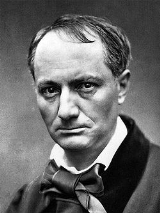
Charles Baudelaire

Charles Baudelaire

Overview
Charles Baudelaire was a French poet
French poetry
French poetry is a category of French literature. It may include Francophone poetry composed outside France and poetry written in other languages of France.-French prosody and poetics:...

 who produced notable work as an essayist, art critic
Art critic
An art critic is a person who specializes in evaluating art. Their written critiques, or reviews, are published in newspapers, magazines, books and on web sites...

, and pioneering translator
Translation
Translation is the communication of the meaning of a source-language text by means of an equivalent target-language text. Whereas interpreting undoubtedly antedates writing, translation began only after the appearance of written literature; there exist partial translations of the Sumerian Epic of...

 of Edgar Allan Poe
Edgar Allan Poe
Edgar Allan Poe was an American author, poet, editor and literary critic, considered part of the American Romantic Movement. Best known for his tales of mystery and the macabre, Poe was one of the earliest American practitioners of the short story and is considered the inventor of the detective...

. His most famous work, Les Fleurs du mal (The Flowers of Evil) expresses the changing nature of beauty in modern, industrializing Paris during the nineteenth century. Baudelaire's highly original style of prose-poetry influenced a whole generation of poets including Paul Verlaine
Paul Verlaine
Paul-Marie Verlaine was a French poet associated with the Symbolist movement. He is considered one of the greatest representatives of the fin de siècle in international and French poetry.-Early life:...

, Arthur Rimbaud
Arthur Rimbaud
Jean Nicolas Arthur Rimbaud was a French poet. Born in Charleville, Ardennes, he produced his best known works while still in his late teens—Victor Hugo described him at the time as "an infant Shakespeare"—and he gave up creative writing altogether before the age of 21. As part of the decadent...

 and Stéphane Mallarmé
Stéphane Mallarmé
Stéphane Mallarmé , whose real name was Étienne Mallarmé, was a French poet and critic. He was a major French symbolist poet, and his work anticipated and inspired several revolutionary artistic schools of the early 20th century, such as Dadaism, Surrealism, and Futurism.-Biography:Stéphane...

 among many others. He is credited with coining the term "modernity" (modernité) to designate the fleeting, ephemeral experience of life in an urban metropolis, and the responsibility art has to capture that experience.
Discussion
Ask a question about 'Charles Baudelaire'
Start a new discussion about 'Charles Baudelaire'
Answer questions from other users
Full Discussion Forum
 
Encyclopedia
Charles Baudelaire was a French poet
French poetry
French poetry is a category of French literature. It may include Francophone poetry composed outside France and poetry written in other languages of France.-French prosody and poetics:...

 who produced notable work as an essayist, art critic
Art critic
An art critic is a person who specializes in evaluating art. Their written critiques, or reviews, are published in newspapers, magazines, books and on web sites...

, and pioneering translator
Translation
Translation is the communication of the meaning of a source-language text by means of an equivalent target-language text. Whereas interpreting undoubtedly antedates writing, translation began only after the appearance of written literature; there exist partial translations of the Sumerian Epic of...

 of Edgar Allan Poe
Edgar Allan Poe
Edgar Allan Poe was an American author, poet, editor and literary critic, considered part of the American Romantic Movement. Best known for his tales of mystery and the macabre, Poe was one of the earliest American practitioners of the short story and is considered the inventor of the detective...

. His most famous work, Les Fleurs du mal (The Flowers of Evil) expresses the changing nature of beauty in modern, industrializing Paris during the nineteenth century. Baudelaire's highly original style of prose-poetry influenced a whole generation of poets including Paul Verlaine
Paul Verlaine
Paul-Marie Verlaine was a French poet associated with the Symbolist movement. He is considered one of the greatest representatives of the fin de siècle in international and French poetry.-Early life:...

, Arthur Rimbaud
Arthur Rimbaud
Jean Nicolas Arthur Rimbaud was a French poet. Born in Charleville, Ardennes, he produced his best known works while still in his late teens—Victor Hugo described him at the time as "an infant Shakespeare"—and he gave up creative writing altogether before the age of 21. As part of the decadent...

 and Stéphane Mallarmé
Stéphane Mallarmé
Stéphane Mallarmé , whose real name was Étienne Mallarmé, was a French poet and critic. He was a major French symbolist poet, and his work anticipated and inspired several revolutionary artistic schools of the early 20th century, such as Dadaism, Surrealism, and Futurism.-Biography:Stéphane...

 among many others. He is credited with coining the term "modernity" (modernité) to designate the fleeting, ephemeral experience of life in an urban metropolis, and the responsibility art has to capture that experience.

Baudelaire the poet


Baudelaire is one of the major innovators in French literature
French literature
French literature is, generally speaking, literature written in the French language, particularly by citizens of France; it may also refer to literature written by people living in France who speak traditional languages of France other than French. Literature written in French language, by citizens...

. His poetry is influenced by the French romantic poets of the earlier 19th century, although its attention to the formal features of verse connect it more closely to the work of the contemporary 'Parnassians'. As for theme and tone, in his works we see the rejection of the belief in the supremacy of nature and the fundamental goodness of man as typically espoused by the romantics and expressed by them in rhetorical, effusive and public voice in favor of a new urban sensibility, an awareness of individual moral complexity, an interest in vice (linked with decadence
Decadent movement
The Decadent movement was a late 19th century artistic and literary movement of Western Europe. It flourished in France, but also had devotees in England and throughout Europe, as well as in the United States.-Overview:...

) and refined sensual and aesthetical pleasures, and the use of urban subject matter, such as the city, the crowd, individual passers-by, all expressed in highly ordered verse, sometimes through a cynical and ironic voice. Formally, the use of sound to create atmosphere, and of 'symbols', (images which take on an expanded function within the poem), betray a move towards considering the poem as a self-referential object, an idea further developed by the Symbolists Verlaine
Paul Verlaine
Paul-Marie Verlaine was a French poet associated with the Symbolist movement. He is considered one of the greatest representatives of the fin de siècle in international and French poetry.-Early life:...

 and Mallarmé
Stéphane Mallarmé
Stéphane Mallarmé , whose real name was Étienne Mallarmé, was a French poet and critic. He was a major French symbolist poet, and his work anticipated and inspired several revolutionary artistic schools of the early 20th century, such as Dadaism, Surrealism, and Futurism.-Biography:Stéphane...

, who acknowledge Baudelaire as a pioneer in this regard.

Beyond his innovations in versification and the theories of symbolism and 'correspondences', an awareness of which is essential to any appreciation of the literary value of his work, aspects of his work which regularly receive (or have received) much critical discussion include the role of women, the theological direction of his work and his alleged advocacy of 'satanism', his experience of drug-induced states of mind, the figure of the dandy, his stance regarding democracy and its implications for the individual, his response to the spiritual uncertainties of the time, his criticisms of the bourgeois, and his advocacy of modern music and painting (e.g., Wagner, Delacroix).

Early life


Baudelaire was born in Paris, France on April 9, 1821 and baptized two months later at Saint-Sulpice Roman Catholic Church. His father, François Baudelaire, a senior civil servant and amateur artist, was thirty-four years older than Baudelaire's mother. François died during Baudelaire's childhood, in 1827. The following year, Caroline married Lieutenant Colonel Jacques Aupick, who later became a French ambassador to various noble courts. Biographers have often seen this as a crucial moment, considering that finding himself no longer the sole focus of his mother's affection left him with a trauma which goes some way to explaining the excesses later apparent in his life. He stated in a letter to her that, "There was in my childhood a period of passionate love for you". Baudelaire regularly implored his mother for money throughout his career, often promising that a lucrative publishing contract or journalistic commission was just around the corner.

Baudelaire was educated in Lyon
Lyon
Lyon , is a city in east-central France in the Rhône-Alpes region, situated between Paris and Marseille. Lyon is located at from Paris, from Marseille, from Geneva, from Turin, and from Barcelona. The residents of the city are called Lyonnais....

, where he boarded. Baudelaire at fourteen was described by a classmate: "He was much more refined and distinguished than any of our fellow pupils [...] we are bound to one another[...] by shared tastes and sympathies, the precocious love of fine works of literature". Baudelaire was erratic in his studies, at times diligent, at other times prone to "idleness". Later, he attended the Lycée Louis-le-Grand
Lycée Louis-le-Grand
The Lycée Louis-le-Grand is a public secondary school located in Paris, widely regarded as one of the most rigorous in France. Formerly known as the Collège de Clermont, it was named in king Louis XIV of France's honor after he visited the school and offered his patronage.It offers both a...

 in Paris, studying law, a popular course for those not yet decided on any particular career. Baudelaire began to frequent prostitutes and may have contracted gonorrhea
Gonorrhea
Gonorrhea is a common sexually transmitted infection caused by the bacterium Neisseria gonorrhoeae. The usual symptoms in men are burning with urination and penile discharge. Women, on the other hand, are asymptomatic half the time or have vaginal discharge and pelvic pain...

 and syphilis
Syphilis
Syphilis is a sexually transmitted infection caused by the spirochete bacterium Treponema pallidum subspecies pallidum. The primary route of transmission is through sexual contact; however, it may also be transmitted from mother to fetus during pregnancy or at birth, resulting in congenital syphilis...

 during this period. Baudelaire began to run up debts, mostly for clothes. Upon gaining his degree
Academic degree
An academic degree is a position and title within a college or university that is usually awarded in recognition of the recipient having either satisfactorily completed a prescribed course of study or having conducted a scholarly endeavour deemed worthy of his or her admission to the degree...

 in 1839, he told his brother "I don't feel I have a vocation for anything." His stepfather had in mind a career in law or diplomacy, but instead Baudelaire decided to embark upon a literary career. His mother later recalled: "Oh, what grief! If Charles had let himself be guided by his stepfather, his career would have been very different... He would not have left a name in literature, it is true, but we should have been happier, all three of us".


His stepfather sent him on a voyage to Calcutta, India in 1841 in the hope of ending his dissolute habits. The trip provided strong impressions of the sea, sailing, and exotic ports, that he later employed in his poetry. (Baudelaire later exaggerated his aborted trip to create a legend about his youthful travels and experiences, including "riding on elephants"). Baudelaire returned to the taverns where he began to compose some of the poems of Les Fleurs du Mal. At twenty-one, he received a good-sized inheritance but squandered much of it within a few years. His family obtained a decree to place his property in trust which he resented bitterly, at one point arguing that allowing him to fail alone financially would have been the one sure way of teaching him the value of maintaining well-ordered finances.

Baudelaire became known in artistic circles as a dandy
Dandy
A dandy is a man who places particular importance upon physical appearance, refined language, and leisurely hobbies, pursued with the appearance of nonchalance in a cult of Self...

 and free-spender. During this time Jeanne Duval
Jeanne Duval
Jeanne Duval was a Haitian-born actress and dancer of mixed French and black African ancestry. For 20 years, she was the muse of French poet and art critic Charles Baudelaire. They met in 1842, when Duval left Haiti for France, and the two remained together, albeit stormily, for the next two...

 became his mistress. His mother thought Duval a "Black Venus" who "tortured him in every way" and drained him of money at every opportunity. She was rejected by his family. He made a suicide attempt during this time.

Baudelaire took part in the Revolutions of 1848 and wrote for a revolutionary newspaper. However, his interest was passing, as he was later to note in his political writings in his journals.

In the early 1850s, Baudelaire struggled with poor health, pressing debts, and irregular literary output. He often moved from one lodging to another to escape creditors. He received many projects that he was unable to complete, though he did finish translations of stories by Edgar Allan Poe
Edgar Allan Poe
Edgar Allan Poe was an American author, poet, editor and literary critic, considered part of the American Romantic Movement. Best known for his tales of mystery and the macabre, Poe was one of the earliest American practitioners of the short story and is considered the inventor of the detective...

.

Upon the death of his stepfather in 1857, Baudelaire received no mention in the will but he was heartened nonetheless that the division with his mother might now be mended. At thirty-six he wrote her: "believe that I belong to you absolutely, and that I belong only to you".

Published career


His first published work was his art review "Salon of 1845," which attracted immediate attention for its boldness. Many of his critical opinions were novel in their time, including his championing of Delacroix
Eugène Delacroix
Ferdinand Victor Eugène Delacroix was a French Romantic artist regarded from the outset of his career as the leader of the French Romantic school...

, and some of his views seem remarkably in tune with the future theories of the Impressionist painters.

In 1846, Baudelaire wrote his second Salon review, gaining additional credibility as an advocate and critic of Romanticism
Romanticism
Romanticism was an artistic, literary and intellectual movement that originated in the second half of the 18th century in Europe, and gained strength in reaction to the Industrial Revolution...

. His support of Delacroix
Eugène Delacroix
Ferdinand Victor Eugène Delacroix was a French Romantic artist regarded from the outset of his career as the leader of the French Romantic school...

 as the foremost Romantic artist gained widespread notice. The following year Baudelaire's novella La Fanfarlo was published.

The Flowers of Evil


Baudelaire was a slow and fastidious worker, often sidetracked by indolence, emotional distress and illness, and it was not until 1857 that he published his first and most famous volume of poems, Les Fleurs du mal
Les Fleurs du mal
Les Fleurs du mal is a volume of French poetry by Charles Baudelaire. First published in 1857 , it was important in the symbolist and modernist movements...

(The Flowers of Evil). Some of these poems had already appeared in the Revue des deux mondes
Revue des deux mondes
The Revue des deux Mondes is a French language monthly literary and cultural affairs magazine that has been published in Paris since 1829....

(Review of Two Worlds), when they were published by Baudelaire's friend Auguste Poulet Malassis.

The poems found a small, appreciative audience, but greater public attention was given to their subject matter. The effect on fellow artists was, as Théodore de Banville
Théodore de Banville
Théodore Faullain de Banville was a French poet and writer.-Biography:Banville was born in Moulins in Allier, Auvergne, the son of a captain in the French navy. His boyhood, by his own account, was cheerlessly passed at a lycée in Paris; he was not harshly treated, but took no part in the...

 stated, "immense, prodigious, unexpected, mingled with admiration and with some indefinable anxious fear". Flaubert, recently attacked in a similar fashion for Madame Bovary
Madame Bovary
Madame Bovary is Gustave Flaubert's first published novel and is considered his masterpiece. The story focuses on a doctor's wife, Emma Bovary, who has adulterous affairs and lives beyond her means in order to escape the banalities and emptiness of provincial life...

(and acquitted), was impressed and wrote to Baudelaire: "You have found a way to rejuvenate Romanticism... You are as unyielding as marble, and as penetrating as an English mist".

The principal themes of sex
Human sexuality
Human sexuality is the awareness of gender differences, and the capacity to have erotic experiences and responses. Human sexuality can also be described as the way someone is sexually attracted to another person whether it is to opposite sexes , to the same sex , to either sexes , or not being...

 and death were considered scandalous. He also touched on lesbianism, sacred and profane love, metamorphosis, melancholy, the corruption of the city, lost innocence, the oppressiveness of living, and wine. Notable in some poems is Baudelaire's use of imagery of the sense of smell and of fragrances, which is used to evoke feelings of nostalgia
Nostalgia
The term nostalgia describes a yearning for the past, often in idealized form.The word is a learned formation of a Greek compound, consisting of , meaning "returning home", a Homeric word, and , meaning "pain, ache"...

 and past intimacy.

The book, however, quickly became a byword for unwholesomeness among mainstream critics of the day. Some critics called a few of the poems "masterpieces of passion, art and poetry" but other poems were deemed to merit no less than legal action to suppress them. J. Habas writing in Le Figaro
Le Figaro
Le Figaro is a French daily newspaper founded in 1826 and published in Paris. It is one of three French newspapers of record, with Le Monde and Libération, and is the oldest newspaper in France. It is also the second-largest national newspaper in France after Le Parisien and before Le Monde, but...

, led the charge against Baudelaire, writing: "Everything in it which is not hideous is incomprehensible, everything one understands is putrid". Then Baudelaire responded to the outcry, in a prophetic letter to his mother:

"You know that I have always considered that literature and the arts pursue an aim independent of morality. Beauty of conception and style is enough for me. But this book, whose title (Fleurs du mal) says everything, is clad, as you will see, in a cold and sinister beauty. It was created with rage and patience. Besides, the proof of its positive worth is in all the ill that they speak of it. The book enrages people. Moreover, since I was terrified myself of the horror that I should inspire, I cut out a third from the proofs. They deny me everything, the spirit of invention and even the knowledge of the French language. I don't care a rap about all these imbeciles, and I know that this book, with its virtues and its faults, will make its way in the memory of the lettered public, beside the best poems of V. Hugo, Th. Gautier and even Byron."

Baudelaire, his publisher and the printer
Printer (publisher)
In publishing, printers are both companies providing printing services and individuals who directly operate printing presses. With the invention of the moveable type printing press by Johannes Gutenberg around 1450, printing—and printers—proliferated throughout Europe.Today, printers are found...

 were successfully prosecuted for creating an offense against public morals
Morality
Morality is the differentiation among intentions, decisions, and actions between those that are good and bad . A moral code is a system of morality and a moral is any one practice or teaching within a moral code...

. They were fined but Baudelaire was not imprisoned. Six of the poems were suppressed, but printed later as Les Épaves (The Wrecks) (Brussels
Brussels
Brussels , officially the Brussels Region or Brussels-Capital Region , is the capital of Belgium and the de facto capital of the European Union...

, 1866). Another edition of Les Fleurs du mal, without these poems, but with considerable additions, appeared in 1861. Many notables rallied behind Baudelaire and condemned the sentence. Victor Hugo
Victor Hugo
Victor-Marie Hugo was a Frenchpoet, playwright, novelist, essayist, visual artist, statesman, human rights activist and exponent of the Romantic movement in France....

 wrote to him: "Your fleurs du mal shine and dazzle like stars... I applaud your vigorous spirit with all my might". Baudelaire did not appeal the judgment but his fine was reduced. Nearly 100 years later, on May 11, 1949, Baudelaire was vindicated, the judgment officially reversed, and the six banned poems reinstated in France.

In the poem "Au lecteur" ("To the Reader") that prefaces Les Fleurs du mal, Baudelaire accuses his readers of hypocrisy
Hypocrisy
Hypocrisy is the state of pretending to have virtues, moral or religious beliefs, principles, etc., that one does not actually have. Hypocrisy involves the deception of others and is thus a kind of lie....

 and of being as guilty of sin
Sin
In religion, sin is the violation or deviation of an eternal divine law or standard. The term sin may also refer to the state of having committed such a violation. Christians believe the moral code of conduct is decreed by God In religion, sin (also called peccancy) is the violation or deviation...

s and lies as the poet:
...If rape or arson, poison or the knife
Has wove no pleasing patterns in the stuff
Of this drab canvas we accept as life—
It is because we are not bold enough!
(Roy Campbell
Roy Campbell (poet)
Ignatius Royston Dunnachie Campbell, better known as Roy Campbell, was an Anglo-African poet and satirist. He was considered by T. S. Eliot, Dylan Thomas and Edith Sitwell to have been one of the best poets of the period between the First and Second World Wars...

's translation)

Final years


Baudelaire next worked on a translation and adaptation of Thomas de Quincey
Thomas de Quincey
Thomas Penson de Quincey was an English esssayist, best known for his Confessions of an English Opium-Eater .-Child and student:...

's Confessions of an English Opium Eater. Other works in the years that followed included Petits Poèmes en prose
Le Spleen de Paris
Le Spleen de Paris, also known as Paris Spleen or Petits Poèmes en prose, is a collection of 51 short prose poems by Charles Baudelaire....

(Small Prose poems
Prose poetry
Prose poetry is poetry written in prose instead of using verse but preserving poetic qualities such as heightened imagery and emotional effects.-Characteristics:Prose poetry can be considered either primarily poetry or prose, or a separate genre altogether...

); a series of art reviews published in the Pays, Exposition universelle (Country, World Fair); studies on Gustave Flaubert
Gustave Flaubert
Gustave Flaubert was a French writer who is counted among the greatest Western novelists. He is known especially for his first published novel, Madame Bovary , and for his scrupulous devotion to his art and style.-Early life and education:Flaubert was born on December 12, 1821, in Rouen,...

 (in L'Artiste
L'Artiste
L’Artiste was a weekly illustrated review published in Paris from 1831 to 1904, supplying "the richest single source of contemporary commentary on artists, exhibitions and trends from the Romantic era to the end of the nineteenth century."...

, October 18, 1857); on Théophile Gautier
Théophile Gautier
Pierre Jules Théophile Gautier was a French poet, dramatist, novelist, journalist, art critic and literary critic....

 (Revue contemporaine, September 1858); various articles contributed to Eugene Crepet's Poètes francais; Les Paradis artificiels: opium et haschisch (French poets; Artificial Paradises: opium and hashish) (1860); and Un Dernier Chapitre de l'histoire des oeuvres de Balzac (A Final Chapter of the history of works of Balzac) (1880), originally an article "Comment on paye ses dettes quand on a du génie" ("How one pays one's debts when one has genius"), in which his criticism turns against his friends Honoré de Balzac
Honoré de Balzac
Honoré de Balzac was a French novelist and playwright. His magnum opus was a sequence of short stories and novels collectively entitled La Comédie humaine, which presents a panorama of French life in the years after the 1815 fall of Napoleon....

, Théophile Gautier
Théophile Gautier
Pierre Jules Théophile Gautier was a French poet, dramatist, novelist, journalist, art critic and literary critic....

, and Gérard de Nerval
Gérard de Nerval
Gérard de Nerval was the nom-de-plume of the French poet, essayist and translator Gérard Labrunie, one of the most essentially Romantic French poets.- Biography :...

.

By 1859, his illnesses, his long-term use of laudanum
Laudanum
Laudanum , also known as Tincture of Opium, is an alcoholic herbal preparation containing approximately 10% powdered opium by weight ....

, his life of stress and poverty had taken a toll and Baudelaire had aged noticeably. But at last, his mother relented and agreed to let him live with her for a while at Honfleur
Honfleur
Honfleur is a commune in the Calvados department in northwestern France. It is located on the southern bank of the estuary of the Seine across from le Havre and very close to the exit of the Pont de Normandie...

. Baudelaire was productive and at peace in the seaside town, his poem Le Voyage being one example of his efforts during that time. In 1860, he became an ardent supporter of Richard Wagner
Richard Wagner
Wilhelm Richard Wagner was a German composer, conductor, theatre director, philosopher, music theorist, poet, essayist and writer primarily known for his operas...

.

His financial difficulties increased again, however, particularly after his publisher Poulet Malassis went bankrupt in 1861. In 1864, he left Paris for Belgium, partly in the hope of selling the rights
Copyright
Copyright is a legal concept, enacted by most governments, giving the creator of an original work exclusive rights to it, usually for a limited time...

 to his works and also to give lectures. His long-standing relationship with Jeanne Duval
Jeanne Duval
Jeanne Duval was a Haitian-born actress and dancer of mixed French and black African ancestry. For 20 years, she was the muse of French poet and art critic Charles Baudelaire. They met in 1842, when Duval left Haiti for France, and the two remained together, albeit stormily, for the next two...

 continued on-and-off, and he helped her to the end of his life. Baudelaire's relationships with actress Marie Daubrun and with courtesan Apollonie Sabatier
Apollonie Sabatier
Apollonie Sabatier was a French courtesan, artists' muse and bohémienne in 1850s Paris. She hosted a salon in Paris on Rue Frochot, where she met nearly all of the French artists of her time, such as Gérard de Nerval, Nina de Villard, Arsène Houssaye, Edmond Richard, Gustave Flaubert, Louis...

, though the source of much inspiration, never produced any lasting satisfaction. He smoked opium
Opium
Opium is the dried latex obtained from the opium poppy . Opium contains up to 12% morphine, an alkaloid, which is frequently processed chemically to produce heroin for the illegal drug trade. The latex also includes codeine and non-narcotic alkaloids such as papaverine, thebaine and noscapine...

, and in Brussels he began to drink to excess
Alcoholism
Alcoholism is a broad term for problems with alcohol, and is generally used to mean compulsive and uncontrolled consumption of alcoholic beverages, usually to the detriment of the drinker's health, personal relationships, and social standing...

. Baudelaire suffered a massive stroke in 1866 and paralysis
Paralysis
Paralysis is loss of muscle function for one or more muscles. Paralysis can be accompanied by a loss of feeling in the affected area if there is sensory damage as well as motor. A study conducted by the Christopher & Dana Reeve Foundation, suggests that about 1 in 50 people have been diagnosed...

 followed. After more than a year of aphasia
Aphasia
Aphasia is an impairment of language ability. This class of language disorder ranges from having difficulty remembering words to being completely unable to speak, read, or write....

, he received the last rites
Last Rites
The Last Rites are the very last prayers and ministrations given to many Christians before death. The last rites go by various names and include different practices in different Christian traditions...

 of the Catholic Church. The last two years of his life were spent, in a semi-paralyzed state, in "maisons de santé" in Brussels and in Paris, where he died on August 31, 1867. Baudelaire is buried in the Cimetière du Montparnasse, Paris.

Many of Baudelaire's works were published posthumously. After his death, his mother paid off his substantial debts, and at last she found some comfort in Baudelaire's emerging fame. "I see that my son, for all his faults, has his place in literature". She lived another four years.

Critiques


Baudelaire was an active participant in the artistic life of his times. As critic and essayist, he wrote extensively and perceptively about the luminaries and themes of French culture. He was frank with friends and enemies, rarely took the diplomatic approach and sometimes responded violently verbally, which often undermined his cause. His associations were numerous and included: Gustave Courbet
Gustave Courbet
Jean Désiré Gustave Courbet was a French painter who led the Realist movement in 19th-century French painting. The Realist movement bridged the Romantic movement , with the Barbizon School and the Impressionists...

, Honoré Daumier
Honoré Daumier
Honoré Daumier was a French printmaker, caricaturist, painter, and sculptor, whose many works offer commentary on social and political life in France in the 19th century....

, Franz Liszt
Franz Liszt
Franz Liszt ; ), was a 19th-century Hungarian composer, pianist, conductor, and teacher.Liszt became renowned in Europe during the nineteenth century for his virtuosic skill as a pianist. He was said by his contemporaries to have been the most technically advanced pianist of his age...

, Champfleury
Champfleury
Jules François Felix Fleury-Husson , who wrote under the name Champfleury, was a French art critic and novelist, a prominent supporter of the Realist movement in painting and fiction.In 1843 Fleury-Husson moved to Paris...

, Victor Hugo
Victor Hugo
Victor-Marie Hugo was a Frenchpoet, playwright, novelist, essayist, visual artist, statesman, human rights activist and exponent of the Romantic movement in France....

, Gustave Flaubert
Gustave Flaubert
Gustave Flaubert was a French writer who is counted among the greatest Western novelists. He is known especially for his first published novel, Madame Bovary , and for his scrupulous devotion to his art and style.-Early life and education:Flaubert was born on December 12, 1821, in Rouen,...

, Balzac and the artists and writers that follow.

Edgar Allan Poe


In 1846 and 1847, Baudelaire became acquainted with the works of Poe
Edgar Allan Poe
Edgar Allan Poe was an American author, poet, editor and literary critic, considered part of the American Romantic Movement. Best known for his tales of mystery and the macabre, Poe was one of the earliest American practitioners of the short story and is considered the inventor of the detective...

, in which he found tales and poems that had, he claimed, long existed in his own brain but never taken shape. Baudelaire had much in common with Poe (who died in 1849 at age forty). The two poets display a similar sensibility of the macabre
Macabre
In works of art, macabre is the quality of having a grim or ghastly atmosphere. Macabre works emphasize the details and symbols of death....

 and supernatural turn of mind; each struggled with illness, poverty, and melancholy. Like Poe, Baudelaire believed in the doctrine of original sin
Original sin
Original sin is, according to a Christian theological doctrine, humanity's state of sin resulting from the Fall of Man. This condition has been characterized in many ways, ranging from something as insignificant as a slight deficiency, or a tendency toward sin yet without collective guilt, referred...

, denounced democracy and the idea of progress and of man's natural goodness, and Poe held a disdainful aristocratic attitude similar to Baudelaire's dandy
Dandy
A dandy is a man who places particular importance upon physical appearance, refined language, and leisurely hobbies, pursued with the appearance of nonchalance in a cult of Self...

. Baudelaire saw in Poe a precursor and tried to be his French contemporary counterpart. From this time until 1865, he was largely occupied with translating Poe's works; his translations were widely praised. Baudelaire was not the first French translator of Poe, but his "scrupulous translations" were considered among the best. These were published as Histoires extraordinaires (Extraordinary stories) (1852), Nouvelles histoires extraordinaires (New extraordinary stories) (1857), Aventures d'Arthur Gordon Pym
The Narrative of Arthur Gordon Pym of Nantucket
The Narrative of Arthur Gordon Pym of Nantucket is the only complete novel written by American writer Edgar Allan Poe. The work relates the tale of the young Arthur Gordon Pym, who stows away aboard a whaling ship called the Grampus...

, Eureka, and Histoires grotesques et sérieuses (Grotesque and serious stories) (1865). Two essays on Poe are to be found in his Oeuvres complètes (Complete works) (vols. v. and vi.).

Eugène Delacroix


A strong supporter of the Romantic painter Delacroix
Eugène Delacroix
Ferdinand Victor Eugène Delacroix was a French Romantic artist regarded from the outset of his career as the leader of the French Romantic school...

, Baudelaire called him "a poet in painting." Baudelaire also absorbed much of Delacroix's aesthetic ideas as expressed in his journals. As Baudelaire elaborated in his "Salon of 1846", "As one contemplates his series of pictures, one seems to be attending the celebration of some grievous mystery... This grave and lofty melancholy shines with a dull light... plaintive and profound like a melody by Weber". Delacroix, though appreciative, kept his distance from Baudelaire, particularly after the scandal of Les Fleurs du mal. In private correspondence, Delacroix stated that Baudelaire "really gets on my nerves" and he expressed his unhappiness with Baudelaire's persistent comments about "melancholy" and "feverishness".

Richard Wagner


Baudelaire had no formal musical training, and knew little of composers beyond Beethoven and Carl Maria von Weber
Carl Maria von Weber
Carl Maria Friedrich Ernst von Weber was a German composer, conductor, pianist, guitarist and critic, one of the first significant composers of the Romantic school....

. Weber was in some ways Wagner
Richard Wagner
Wilhelm Richard Wagner was a German composer, conductor, theatre director, philosopher, music theorist, poet, essayist and writer primarily known for his operas...

's precursor, using the leitmotif
Leitmotif
A leitmotif , sometimes written leit-motif, is a musical term , referring to a recurring theme, associated with a particular person, place, or idea. It is closely related to the musical idea of idée fixe...

 and conceiving the idea of the "total art work" ("Gesamtkunstwerk"), both of which found Baudelaire's admiration. Before even hearing Wagner's music, Baudelaire studied reviews and essays about him, and formulated his impressions. Later, Baudelaire put them into his non-technical analysis of Wagner, which was highly regarded, particularly his essay "Richard Wagner et Tannhäuser à Paris". Baudelaire's reaction to music was passionate and psychological. "Music engulfs (possesses) me like the sea". After attending three Wagner concerts in Paris in 1860, Baudelaire wrote to the composer: "I had a feeling of pride and joy in understanding, in being possessed, in being overwhelmed, a truly sensual pleasure like that of rising in the air". Baudelaire's writings contributed to the elevation of Wagner and to the cult of Wagnerism
Wagnerism
Wagnerism has a number of meanings:* the philosophical ideals put forward by Richard Wagner which indicate the traits of a "true" German, among other aesthetic ideas.* an attachment, sometimes fanatical, to the music of Wagner....

 that swept Europe in the following decades.

Théophile Gautier


Gautier
Théophile Gautier
Pierre Jules Théophile Gautier was a French poet, dramatist, novelist, journalist, art critic and literary critic....

, writer and poet, earned Baudelaire's respect for his perfection of form and his mastery of language, though Baudelaire thought he lacked deeper emotion and spirituality. Both strove to express the artist's inner vision, which Heinrich Heine
Heinrich Heine
Christian Johann Heinrich Heine was one of the most significant German poets of the 19th century. He was also a journalist, essayist, and literary critic. He is best known outside Germany for his early lyric poetry, which was set to music in the form of Lieder by composers such as Robert Schumann...

 had earlier stated: "In artistic matters, I am a supernaturalist. I believe that the artist can not find all his forms in nature, but that the most remarkable are revealed to him in his soul". Gautier's frequent meditations on death and the horror of life are themes which influenced Baudelaire writings. In gratitude for their friendship and commonality of vision, Baudelaire dedicated Les Fleurs du mal to Gautier.

Édouard Manet


Manet
Édouard Manet
Édouard Manet was a French painter. One of the first 19th-century artists to approach modern-life subjects, he was a pivotal figure in the transition from Realism to Impressionism....

 and Baudelaire became constant companions from around 1855. In the early 1860s, Baudelaire accompanied Manet on daily sketching trips and often met him socially. Manet also lent Baudelaire money and looked after his affairs, particularly when Baudelaire went to Belgium. Baudelaire encouraged Manet to strike his own path and not succumb to criticism. "Manet has great talent, a talent which will stand the test of time. But he has a weak character. He seems to me crushed and stunned by shock". In his painting Music in the Tuileries
Music in the Tuileries
Music in the Tuileries is a painting by Édouard Manet which hangs in the National Gallery, LondonIt is an early example of Manet's painterly style, inspired by Frans Hals and Diego Velázquez, and it is a harbinger of his life-long interest in the subject of leisure.While the picture was not...

, Manet includes portraits of his friends Théophile Gautier
Théophile Gautier
Pierre Jules Théophile Gautier was a French poet, dramatist, novelist, journalist, art critic and literary critic....

, Jacques Offenbach
Jacques Offenbach
Jacques Offenbach was a Prussian-born French composer, cellist and impresario. He is remembered for his nearly 100 operettas of the 1850s–1870s and his uncompleted opera The Tales of Hoffmann. He was a powerful influence on later composers of the operetta genre, particularly Johann Strauss, Jr....

, and Baudelaire. While it's difficult to differentiate who influenced whom, both Manet and Baudelaire discussed and expressed some common themes through their respective arts. Baudelaire praised the modernity of Manet's subject matter: "almost all our originality comes from the stamp that 'time' imprints upon our feelings". When Manet's famous Olympia
Olympia (painting)
Olympia is an oil on canvas painting by Édouard Manet. Painted in 1863, it measures 130.5 by 190 centimetres . The nation of France acquired the painting in 1890 with a public subscription organized by Claude Monet...

(1865), a portrait of a nude prostitute, provoked a scandal for its blatant realism mixed with an imitation of Renaissance motifs
Sleeping Venus (Giorgione)
The Sleeping Venus, also known as the Dresden Venus, is a painting by the Italian Renaissance master Giorgione, with, it is now generally accepted, the landscape and sky, by Titian, completed after Giorgione's death in 1510, as Vasari first noted...

, Baudelaire worked privately to support his friend, though he offered no public defense (he was, however, ill at the time). When Baudelaire returned from Belgium after his stroke, Manet and his wife were frequent visitors at the nursing home and she would play passages from Wagner for Baudelaire on the piano.

Nadar


Nadar
Nadar (photographer)
Félix Nadar was the pseudonym of Gaspard-Félix Tournachon , a French photographer, caricaturist, journalist, novelist and balloonist. Some photographs by Nadar are marked "P. Nadar" for "Photographie Nadar" .-Life: born in April 1820 in Paris...

 (Félix Tournachon) was a noted caricaturist, scientist and important early photographer. Baudelaire admired Nadar, one of his closest friends, and wrote: "Nadar is the most amazing manifestation of vitality". They moved in similar circles and Baudelaire made many social connections through him. Nadar's ex-mistress Jeanne Duval
Jeanne Duval
Jeanne Duval was a Haitian-born actress and dancer of mixed French and black African ancestry. For 20 years, she was the muse of French poet and art critic Charles Baudelaire. They met in 1842, when Duval left Haiti for France, and the two remained together, albeit stormily, for the next two...

 became Baudelaire's mistress around 1842. Baudelaire became interested in photography in the 1850s and denounced it as an art form and advocated for its return to "its real purpose, which is that of being the servant to the sciences and arts". Photography should not, according to Baudelaire, encroach upon "the domain of the impalpable and the imaginary". Nadar remained a stalwart friend right to Baudelaire's last days and wrote his obituary notice in Le Figaro
Le Figaro
Le Figaro is a French daily newspaper founded in 1826 and published in Paris. It is one of three French newspapers of record, with Le Monde and Libération, and is the oldest newspaper in France. It is also the second-largest national newspaper in France after Le Parisien and before Le Monde, but...

.

Philosophy


Many of Baudelaire's philosophical proclamations were considered scandalous and intentionally provocative in his time. He wrote on a wide range of subjects, drawing criticism and outrage from many quarters.

Love


"There is an invincible taste for prostitution in the heart of man, from which comes his horror of solitude. He wants to be 'two'. The man of genius wants to be 'one'... It is this horror of solitude, the need to lose oneself in the external flesh, that man nobly calls 'the need to love'."

Marriage


"Unable to suppress love, the Church wanted at least to disinfect it, and it created marriage."

The artist


"The more a man cultivates the arts, the less randy he becomes... Only the brute is good at coupling, and copulation is the lyricism of the masses. To copulate is to enter into another–and the artist never emerges from himself."

"Style is character"

Pleasure


"Personally, I think that the unique and supreme delight lies in the certainty of doing 'evil'–and men and women know from birth that all pleasure lies in evil."

Politics


Along with Poe, Baudelaire named the arch-reactionary
Reactionary
The term reactionary refers to viewpoints that seek to return to a previous state in a society. The term is meant to describe one end of a political spectrum whose opposite pole is "radical". While it has not been generally considered a term of praise it has been adopted as a self-description by...

 Joseph de Maistre
Joseph de Maistre
Joseph-Marie, comte de Maistre was a French-speaking Savoyard philosopher, writer, lawyer, and diplomat. He defended hierarchical societies and a monarchical State in the period immediately following the French Revolution...

 as his maître à penser
Maître à penser
Maître à penser is a French language phrase, denoting a teacher whom one chooses, in order to learn not just a set of facts or point of view, but a way of thinking. It translates literally as "master for thinking"....

 and adopted increasingly aristocratic views. In his journals, he wrote "There is no form of rational and assured government save an aristocracy. A monarchy or a republic, based upon democracy, are equally absurd and feeble. The immense nausea of advertisements. There are but three beings worthy of respect: the priest, the warrior and the poet. To know, to kill and to create. The rest of mankind may be taxed and drudged, they are born for the stable, that is to say, to practise what they call professions."

Influence


Baudelaire's influence on the direction of modern French (and English) language literature was considerable. The most significant French writers to come after him were generous with tributes; four years after his death, Arthur Rimbaud
Arthur Rimbaud
Jean Nicolas Arthur Rimbaud was a French poet. Born in Charleville, Ardennes, he produced his best known works while still in his late teens—Victor Hugo described him at the time as "an infant Shakespeare"—and he gave up creative writing altogether before the age of 21. As part of the decadent...

 praised him in a letter as 'the king of poets, a true God'. In 1895, Stéphane Mallarmé
Stéphane Mallarmé
Stéphane Mallarmé , whose real name was Étienne Mallarmé, was a French poet and critic. He was a major French symbolist poet, and his work anticipated and inspired several revolutionary artistic schools of the early 20th century, such as Dadaism, Surrealism, and Futurism.-Biography:Stéphane...

 published a sonnet in Baudelaire's memory, 'Le Tombeau de Charles Baudelaire'. Marcel Proust
Marcel Proust
Valentin Louis Georges Eugène Marcel Proust was a French novelist, critic, and essayist best known for his monumental À la recherche du temps perdu...

, in an essay published in 1922, stated that along with Alfred de Vigny
Alfred de Vigny
Alfred Victor de Vigny was a French poet, playwright, and novelist.-Life:Alfred de Vigny was born in Loches into an aristocratic family...

, Baudelaire was 'the greatest poet of the nineteenth century'.

In the English-speaking world, Edmund Wilson
Edmund Wilson
Edmund Wilson was an American writer and literary and social critic and noted man of letters.-Early life:Wilson was born in Red Bank, New Jersey. His father, Edmund Wilson, Sr., was a lawyer and served as New Jersey Attorney General. Wilson attended The Hill School, a college preparatory...

 credited Baudelaire as providing an initial impetus for the Symbolist
Symbolism (arts)
Symbolism was a late nineteenth-century art movement of French, Russian and Belgian origin in poetry and other arts. In literature, the style had its beginnings with the publication Les Fleurs du mal by Charles Baudelaire...

 movement, by virtue of his translations of Poe. In 1930, T. S. Eliot
T. S. Eliot
Thomas Stearns "T. S." Eliot OM was a playwright, literary critic, and arguably the most important English-language poet of the 20th century. Although he was born an American he moved to the United Kingdom in 1914 and was naturalised as a British subject in 1927 at age 39.The poem that made his...

, while asserting that Baudelaire had not yet received a "just appreciation" even in France, claimed that the poet had "great genius" and asserted that his "technical mastery which can hardly be overpraised... has made his verse an inexhaustible study for later poets, not only in his own language". Eliot also alluded to Baudelaire's poetry directly in his own poetry. For example, he quoted the last line of Baudelaire's 'Au Lecteur' ın the last line of Sectıon I of The Waste Land.

At the same time that Eliot was affirming Baudelaire's importance from a broadly conservative and explicitly Christian viewpoint, left-wing
Left-wing politics
In politics, Left, left-wing and leftist generally refer to support for social change to create a more egalitarian society...

 critics such as Wilson and Walter Benjamin
Walter Benjamin
Walter Bendix Schönflies Benjamin was a German-Jewish intellectual, who functioned variously as a literary critic, philosopher, sociologist, translator, radio broadcaster and essayist...

 were able to do so from a dramatically different perspective. Benjamin translated Baudelaire's Tableaux Parisiens into German and published a major essay on translation as the foreword.

In the late 1930s, Benjamin used Baudelaire as a starting point and focus for his monumental attempt at a materialist
Historical materialism
Historical materialism is a methodological approach to the study of society, economics, and history, first articulated by Karl Marx as "the materialist conception of history". Historical materialism looks for the causes of developments and changes in human society in the means by which humans...

 assessment of 19th century culture, Das Passagenwerk
Arcades Project
The Passagenwerk or Arcades Project was an unfinished lifelong project of philosopher Walter Benjamin, an enormous collection of writings on the city life of Paris in the 19th century, especially concerned with the iron-and-glass covered "arcades"...

.
For Benjamin, Baudelaire's importance lay in his anatomies of the crowd
Crowd
A crowd is a large and definable group of people, while "the crowd" is referred to as the so-called lower orders of people in general...

, of the city and of modernity
Modernity
Modernity typically refers to a post-traditional, post-medieval historical period, one marked by the move from feudalism toward capitalism, industrialization, secularization, rationalization, the nation-state and its constituent institutions and forms of surveillance...

.

In 1982, avant-garde performance artist and vocalist Diamanda Galás
Diamanda Galás
Diamanda Galás is an American avant-garde composer, vocalist, pianist, organist, performance artist and painter.Galás has been described as "capable of the most unnerving vocal terror", with her three and a half octave vocal range. She often screams, hisses and growls...

 recorded an adaptation of his poem The Litanies of Satan
The Litanies of Satan
The Litanies of Satan is the debut album of avant-garde performer Diamanda Galás.-Track listing:Side A:#"The Litanies of Satan" – 17:48Side B:#"Wild Women with Steak-Knives " – 12:04...

(Les Litanies de Satan
Les Litanies de Satan
"Les Litanies de Satan" is a poem by Charles Baudelaire, published as part of Les Fleurs du mal. The date of composition is unknown, but there is no evidence that it was composed at a different time to the other poems of the volume....

).

The Baudelaires
Baudelaire family
The Baudelaire family is one of several prominent fictional families created by American author Lemony Snicket for his novel series A Series of Unfortunate Events...

, protagonists of Lemony Snicket's A Series of Unfortunate Events
A Series of Unfortunate Events
A Series of Unfortunate Events is a series of children's novels by Lemony Snicket which follows the turbulent lives of Violet, Klaus, and Sunny Baudelaire after their parents' death in an arsonous house fire...

, were named after him.

Currently, Vanderbilt University
Vanderbilt University
Vanderbilt University is a private research university located in Nashville, Tennessee, United States. Founded in 1873, the university is named for shipping and rail magnate "Commodore" Cornelius Vanderbilt, who provided Vanderbilt its initial $1 million endowment despite having never been to the...

 has "assembled one of the world’s most comprehensive research collections on...Baudelaire."

Discography

  • French composer Claude Debussy
    Claude Debussy
    Claude-Achille Debussy was a French composer. Along with Maurice Ravel, he was one of the most prominent figures working within the field of impressionist music, though he himself intensely disliked the term when applied to his compositions...

     set five poems from Baudelaire into music in 1890: Le Balcon, Harmonie du soir, Le Jet d'eau, Recueillement and La mort des amants.
  • French singer-songwriter Léo Ferré
    Léo Ferré
    Léo Ferré was a Franco-Monegasque poet, composer, singer and musician.Born in Monaco, Ferré mixed love and melancholy with moral anarchy, lyricism with slang, rhyming verse with prose monologues...

     devoted himself to set Baudelaire's poetry into music in three albums: Les Fleurs du mal in 1957 (12 poems), Léo Ferré chante Baudelaire in 1967 (22 poems, of whom one comes from Le Spleen de Paris), and the posthumous Les Fleurs du mal (suite et fin) (21 poems), recorded in 1977 but released in 2008.
  • French singer David TMX recorded the poem "Lesbos" from The Flowers of Evil.
  • French metal/shoegaze groups Alcest
    Alcest
    Alcest is a musical project born in Bagnols-sur-Cèze, France. It began in 2000 with three members – Neige, Aegnor and Argoth. This band released a demo of black metal songs in 2001. Shortly after, Aegnor and Argoth left the band, leaving Neige as the sole member...

     and Amesoeurs
    Amesoeurs
    Amesoeurs was a French post-punk/black metal band formed in Bagnols-sur-Cèze, France in Summer 2004 by guitarist/vocalist Neige of Alcest fame, and by bassist/singer Audrey Sylvain and guitarist Fursy Teyssier with the purpose of creating a music that reflects the dark side of the industrial era...

     used his poetry for the lyrics of the tracks "Élévation" (on Le Secret
    Le Secret
    Le Secret is an EP by French musician Alcest. It was released in May 2005 through Drakkar Productions. Unlike Alcest's previous release, all of the music on Le Secret is performed by Neige. The lyrics to the track "Élévation" come from a poem by Charles Baudelaire.-Track listing:...

    ) and "Recueillement" (on Amesoeurs
    Amesoeurs (album)
    - Personnel :* Neige - vocals, guitar, bass, synths* Fursy Teyssier - guitar, bass* Audrey Sylvain - clean vocals, piano* Winterhalter - drums* Markus Stock - recording...

    ), respectively.
  • Israeli singer Maor Cohen's 2005 album, the Hebrew name of which translates to French as "Les Fleurs Du Mal", is a compilation of songs from Baudelaire's book of the same name. The texts were translated to Hebrew by Israeli poet Dori Manor, while the music was composed by Cohen himself.
  • Italian singer Franco Battiato
    Franco Battiato
    Francesco Battiato is an Italian singer-songwriter, composer, filmmaker and, under the pseudonym Süphan Barzani, also a painter. Battiato's songs contain esoteric, philosophical and religious themes...

     set Invitation au voyage to music as Invito Al Viaggio on his 1999 album Fleurs (Esempi Affini Di Scritture E Simili).

External links


Online texts


Single works