
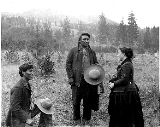
Chief Joseph (March 3, 1840 – September 21, 1904) was the
chiefA traditional tribal chief is the leader of a tribe, or the head of a tribal form of self-government.The notion of a "tribal chief" is rather vague and arbitrary; neither chief nor tribe is clearly defined, so in many cases other designations are used for the same institution, such as petty ruler...
of the Wal-lam-wat-kain (Wallowa) band of
Nez PerceThe Nez Perce are a tribe of Native Americans who live in the Pacific Northwest region of the United States. An anthropological theory says the tribe descended from the Old Cordilleran Culture, which moved south from the Rocky Mountains and west in Nez Perce lands.The tribe currently governs and...
during
GeneralIn the United States Army, United States Air Force, and United States Marine Corps, general is a four-star general officer rank, with the pay grade of O-10. General ranks above lieutenant general and below General of the Army or General of the Air Force; the Marine Corps does not have an...
Oliver O. HowardOliver Otis Howard was a career United States Army officer and a Union General in the American Civil War. He was a corps commander noted for suffering two humiliating defeats, at Chancellorsville and Gettysburg, but he recovered from the setbacks while posted in the Western Theater, and served...
's attempt to
forcibly removeIndian Removal was a nineteenth century policy of the government of the United States to relocate Native American tribes living east of the Mississippi River to lands west of the river...
his
bandA band society is the simplest form of human society. A band generally consists of a small kin group, no larger than an extended family or clan; it has been defined as consisting of no more than 30 to 50 individuals.Bands have a loose organization...
and the other "non-treaty" Nez Perce to a
reservationAn Indian reservation is an area of land managed by a Native American tribe under the United States Department of the Interior's Bureau of Indian Affairs. Because Native American tribes have limited national sovereignty, laws on tribal lands vary from the surrounding area...
in
IdahoIdaho is a state in the Pacific Northwest region of the United States of America. The state's largest city and capital is Boise. Residents are called "Idahoans." Idaho was admitted to the Union on 3 July 1890 as the 43rd state....
. For his principled resistance to the removal, he became renowned as a
humanitarianIn its most general form, humanitarianism is an ethic of kindness, benevolence and sympathy extended universally and impartially to all human beings. Humanitarianism has been an evolving concept historically but universality is a common element in its evolution...
and peacemaker.
Background
Born
Hinmuuttu-yalatlat (alternatively
Hinmaton-Yalaktit or
Hin-mah-too-yah-lat-kekt,
Nez PerceNez Perce is a Sahaptian language related to the several dialects of Sahaptin . The Sahaptian sub-family is one of the branches of the Plateau Penutian family...
: "Thunder Rolling Down the Mountain") in the
Wallowa ValleyThe Wallowa River is a tributary of the Grande Ronde River, approximately long, in northeastern Oregon in the United States. It drains a valley on the Columbia Plateau in the northeast corner of the state north of Wallowa Mountains. It rises in southern Wallowa County, in the Wallowa Mountains in...
of northeastern
OregonOregon is a state in the Pacific Northwest region of the United States. It is located on the Pacific coast, with Washington to the north, California to the south, Nevada on the southeast and Idaho to the east. The Columbia and Snake rivers delineate much of Oregon's northern and eastern...
, he was known as Young Joseph during his youth because his father had the same name.
While initially hospitable to the region's newcomers,
Joseph the ElderOld Chief Joseph , Tu-eka-kas, also known as Joseph the Elder, was an American Indian chief of the Wallowa Band of the Nez Perce . Old Chief Joseph was one of the first Nez Percé converts to Christianity and a vigorous advocate of the tribe's early peace with whites...
grew wary when settlers wanted more Indian lands. Tensions grew as the settlers appropriated traditional Indian lands for farming and grazing livestock.
Isaac StevensIsaac Ingalls Stevens was the first governor of Washington Territory, a United States Congressman, and a major general in the Union Army during the American Civil War until his death at the Battle of Chantilly....
,
governor of the
Washington TerritoryThe Territory of Washington was an organized incorporated territory of the United States that existed from February 8, 1853, until November 11, 1889, when the final extent of the territory was admitted to the Union as the State of Washington....
, organized a council to designate separate areas for Natives and settlers in 1855. Joseph the Elder and the other Nez Perce chiefs signed a treaty with the United States establishing a Nez Perce reservation encompassing 7.7 million acres (31,000 km²) in present-day Idaho, Washington, and Oregon. The 1855 reservation maintained much of the traditional Nez Perce lands, including Joseph's Wallowa Valley.
An influx of new settlers caused by a
gold rushA gold rush is a period of feverish migration of workers into the area of a dramatic discovery of commercial quantities of gold.Gold rushes took place in the 19th century in Australia, Brazil, Canada, South Africa, and the United States....
led the government to call a second council in 1863. Government commissioners asked the Nez Perce to accept a new, much smaller reservation of centered around the village of
LapwaiLapwai is a city in Nez Perce County, Idaho, United States. The population was 1,134 at the 2000 census. It is the seat of government of the Nez Perce Indian Reservation.Lapwai is part of the Lewiston, ID-WA Metropolitan Statistical Area.-Geography:...
in Idaho, and excluding the Wallowa Valley. In exchange, they were promised financial rewards and schools and a hospital for the reservation. Head Chief Lawyer and one of his allied chiefs signed the treaty on behalf of the Nez Perce Nation, but Joseph the Elder and several other chiefs were opposed to selling their lands, and did not sign.
Their refusal to sign caused a rift between the "non-treaty" and "treaty" bands of Nez Perce. The "treaty" Nez Perce moved within the new Idaho reservation's boundaries, while the "non-treaty" Nez Perce remained on their lands. Joseph the Elder demarcated Wallowa land with a series of poles, proclaiming, "Inside this boundary all our people were born. It circles the graves of our fathers, and we will never give up these graves to any man."
As chief
Joseph the Younger succeeded his father as chief in 1871. Before his death, the latter counseled his son:
Chief Joseph commented "I clasped my father's hand and promised to do as he asked. A man who would not defend his father's grave is worse than a wild animal."
The non-treaty Nez Perce suffered many injustices at the hands of settlers and
prospectorsProspecting is the physical search for minerals, fossils, precious metals or mineral specimens, and is also known as fossicking.Prospecting is a small-scale form of mineral exploration which latter is an organised, large scale effort undertaken by mineral resource companies to find commercially...
, but out of fear of reprisal from the militarily superior
AmericansThe United States of America is a federal constitutional republic comprising fifty states and a federal district...
, Joseph never allowed any violence against them, instead making many concessions to them in hopes of securing peace.
In 1873, Chief Joseph negotiated with the federal government to ensure his people could stay on their land in the Wallowa Valley. But in 1877, the government reversed its policy, and Army General
Oliver HowardOliver Otis Howard was a career United States Army officer and a Union General in the American Civil War. He was a corps commander noted for suffering two humiliating defeats, at Chancellorsville and Gettysburg, but he recovered from the setbacks while posted in the Western Theater, and served...
threatened to attack if the Wallowa band did not relocate to the Idaho Reservation with the other Nez Perce. Chief Joseph reluctantly agreed.
Before the outbreak of hostilities, General Howard held a council to try to convince Joseph and his people to relocate. Joseph finished his address to the General, which focused on human equality, by expressing his "[disbelief that] the Great Spirit Chief gave one kind of men the right to tell another kind of men what they must do."
Howard reacted angrily, interpreting the statement as a challenge to his authority. When Chief Too-hul-hul-sote protested, he was jailed for five days.
The day following the council, Joseph,
White BirdWhite Bird , also referred to as White Pelican , was a leader and war chief of the Lamátta band of the Nez Perce tribe.- History :...
, and
Chief Looking GlassChief Looking Glass was a Nez Perce war leader who, with Chief Joseph, directed the 1877 retreat from eastern Oregon into Montana and onward toward the Canadian border during the Nez Perce War....
all accompanied General Howard to look at different areas. Howard offered them a plot of land that was inhabited by Whites and Indians, promising to clear them out. Joseph and his chieftains refused, adhering to their tribal tradition of not taking what did not belong to them.
Unable to find any suitable uninhabited land on the reservation, Howard informed Joseph that his people had thirty days to collect their
livestockLivestock are one or more domesticated animals raised in an agricultural setting to produce commodities such as food or fiber, or labor...
and move to the reservation. Joseph pleaded for more time, but Howard told him that he would consider their presence in the Wallowa Valley beyond the thirty-day mark an act of war.
Returning home, Joseph called a council among his people. At the council, he spoke on behalf of peace, preferring to abandon his father's grave over war. Too-hul-hul-sote, insulted by his incarceration, advocated war.
The Wallowa band began making preparations for the long journey, meeting first with other bands at Rocky Canyon. At this council too, many leaders urged war, while Joseph argued in favor of peace.
While the council was underway, a young man whose father had been killed rode up and announced that he and several other young men had already killed four white men, an act sure to initiate war.
Still hoping to avoid further bloodshed, Joseph and other Nez Perce chiefs began leading his people north toward Canada.
Retreat and surrender
With 2,000 U.S. soldiers in pursuit, Joseph and other Nez Perce chiefs led 800 Nez Perce toward freedom at the Canadian border. For over three months, the Nez Perce outmaneuvered and battled their pursuers traveling across
OregonOregon is a state in the Pacific Northwest region of the United States. It is located on the Pacific coast, with Washington to the north, California to the south, Nevada on the southeast and Idaho to the east. The Columbia and Snake rivers delineate much of Oregon's northern and eastern...
,
WashingtonWashington is a state in the Pacific Northwest region of the United States. Washington was carved out of the western part of Washington Territory which had been ceded by Britain in 1846 by the Oregon Treaty as settlement of the Oregon Boundary Dispute. It was admitted to the Union as the...
,
IdahoIdaho is a state in the Pacific Northwest region of the United States of America. The state's largest city and capital is Boise. Residents are called "Idahoans." Idaho was admitted to the Union on 3 July 1890 as the 43rd state....
,
WyomingWyoming is a state in the Western United States. The majority of the state is dominated by the mountain ranges and rangelands of the Rocky Mountain West, while the easternmost section of the state includes part of a high elevation prairie region known as the High Plains. While the tenth largest...
, and
MontanaMontana is a state in the Western United States. The western third of the state contains numerous mountain ranges; other 'island' ranges are found in the central third of the state, for a total of 77 named ranges of the Rocky Mountains. This geographical fact is reflected in the state's name,...
.
General Howard, leading the opposing cavalry, was impressed with the skill with which the Nez Perce fought, using advance and rear guards, skirmish lines, and field fortifications. Finally, after a devastating five-day battle during freezing weather conditions with no food or blankets, Chief Joseph formally
surrenderedSurrender is when soldiers, nations or other combatants stop fighting and eventually become prisoners of war, either as individuals or when ordered to by their officers. A white flag is a common symbol of surrender, as is the gesture of raising one's hands empty and open above one's head.When the...
to General
Nelson Appleton MilesNelson Appleton Miles was an American soldier who served in the American Civil War, Indian Wars, and the Spanish-American War.-Early life:Miles was born in Westminster, Massachusetts, on his family's farm...
on October 5, 1877 in the
Bear Paw MountainsThe Bear Paw Mountains are an insular-montane range in North-Central Montana, USA, located approximately 10 miles south of Havre, Montana. Baldy Mountain, which rises 6,916 feet above sea level, is the highest peak in the range.The Bearpaw Formation outcrops int this mountains, and is named for...
of the
Montana TerritoryThe Territory of Montana was an organized incorporated territory of the United States that existed from May 28, 1864, until November 8, 1889, when it was admitted to the Union as the State of Montana.-History:...
, less than 40 miles (60 km) south of
CanadaCanada is a country occupying most of northern North America, extending from the Atlantic Ocean in the east to the Pacific Ocean in the west and northward into the Arctic Ocean...
in a place close to the present-day
ChinookChinook is a city in and the county seat of Blaine County, Montana, United States. The population was 1,386 at the 2000 census. Points of interest are the Bear Paw Battlefield Museum located in the small town's center and the Bear Paw Battlefield, located just twenty miles south of...
in
Blaine CountyBlaine County is a county located in the U.S. state of Montana. As of 2000, the population is 7,009. Its county seat is Chinook. It was named in honor of James G. Blaine, former United States Secretary of State.-Geography:According to the U.S...
. The battle is remembered in popular history by the words attributed to Chief Joseph at the formal surrender:
"Tell General Howard I know his heart. What he told me before, I have it in my heart. I am tired of fighting. Our chiefs are killed; Looking Glass is dead, Too-hul-hul-sote is dead. The old men are all dead. It is the young men who say yes or no. He who led on the young men is dead. It is cold, and we have no blankets; the little children are freezing to death. My people, some of them, have run away to the hills, and have no blankets, no food. No one knows where they are—perhaps freezing to death. I want to have time to look for my children, and see how many of them I can find. Maybe I shall find them among the dead. Hear me, my chiefs! I am tired; my heart is sick and sad. From where the sun now stands, I will fight no more forever."
The popular legend deflated, however, when the original pencil draft of the report was revealed to show the handwriting of the later poet and lawyer Lieutenant
Charles Erskine Scott WoodCharles Erskine Scott Wood was an author, civil libertarian, soldier, and attorney. He is best known as the author of the 1927 satirical bestseller, Heavenly Discourse.-Early life:...
, who claimed to have taken down the great chief's words on the spot. In the margin it read, "Here insert Joseph's reply to the demand for surrender"
Although Joseph was not technically a warchief and probably did not command the retreat, many of the chiefs who did had already died. His speech brought attention - and therefore credit - his way. He earned the praise of General
William Tecumseh ShermanWilliam Tecumseh Sherman was an American soldier, businessman, educator and author. He served as a General in the Union Army during the American Civil War , for which he received recognition for his outstanding command of military strategy as well as criticism for the harshness of the "scorched...
and became known in the press as "The Red
NapoleonNapoleon Bonaparte later known as Napoleon I, and previously Napoleone di Buonaparte, was a military and political leader of France whose actions shaped European politics in the early 19th century.Born in Corsica and trained as an artillery officer in mainland France, Bonaparte rose to prominence...
".
Aftermath
Joseph's fame did him little good. By the time Joseph surrendered more than 200 of his followers had died. His plight, however, did not end. Although he had negotiated a safe return home for his people, they were instead taken to eastern
KansasKansas is a state located in the Midwestern United States. It is named after the Kansas River which flows through it, which in turn was named after the Kansa tribe, who inhabited the area. The tribe's name is often said to mean "people of the wind" or "people of the south wind," although this was...
and then to a reservation in the
Indian TerritoryThe Indian Territory, also known as the Indian Territories and the Indian Country, was land set aside within the United States for the use of Native Americans...
(now
OklahomaOklahoma is a state located in the South Central region of the United States of America. With an estimated 3,617,316 residents in 2007 and a land area of 68,667 square miles , Oklahoma is the 28th most populous and 20th-largest state...
) where many of them died of
epidemicDefining an epidemic can be subjective, depending in part on what is "expected". An epidemic may be restricted to one locale , more general or even global...
diseases.
In 1879 Chief Joseph went to
Washington, D.C.Washington, D.C. , formally the District of Columbia and commonly referred to as Washington, the District, or simply D.C., is the capital of the United States, founded on July 16, 1790...
to meet with
PresidentThe President of the United States is the head of state and head of government of the United States and is the highest political official in the United States by influence and recognition...
Rutherford B. HayesRutherford Birchard Hayes was an American politician, lawyer, military leader and the 19th President of the United States . Hayes was elected President by one electoral vote after the highly disputed election of 1876...
and plead the case of his people. Finally, in 1885, Chief Joseph and his followers were allowed to return to the Pacific Northwest, although many, including Chief Joseph, were taken to the
Colville Indian ReservationThe Colville Indian Reservation is an Indian reservation in the eastern part of the U.S. state of Washington, inhabited and managed by Confederated Tribes of the Colville Reservation, which is recognized by the United States of America as an American Indian Tribe...
far from both the rest of their people in Idaho and their homeland in the Wallowa Valley.
Joseph continued to lead his band of Wallowa for another 25 years, at times coming into conflict with the leaders of 11 other tribes living on the reservation.
Chief MosesChief Moses was a Native American chief of the Sinkiuse-Columbia, in what is now Washington State. The territory of his tribe extended approximately from Waterville to White Bluffs, in the Columbia Basin. They were often in the area around Moses Lake...
of the
Sinkiuse-ColumbiaThe Sinkiuse-Columbia were a Native American tribe so called because of their former prominent association with the Columbia River. They called themselves .tskowa'xtsEnux, or .skowa'xtsEnEx , or Sinkiuse. They applied the name also to other neighboring Salish tribes...
in particular resented having to cede a portion of his people's lands to Joseph's people, who had "made war on the Great Father."
In general, however, the relocated Nez Perce made few enemies in their new home and even kept friendly relations with their white neighbors. In fact,
Chief Joseph DamChief Joseph Dam is a 5,962 foot long hydroelectric dam spanning the Columbia River, upriver from Bridgeport, Washington, USA. The dam was authorized as Foster Creek Dam and Powerhouse for power generation and irrigation by the River and Harbor Act of 1946...
, the nation's second largest hydroelectric power plant, was named after him.
In his last years Joseph spoke eloquently against the injustice of United States policy toward his people and held out the hope that America's promise of freedom and equality might one day be fulfilled for Native Americans as well. An indomitable voice of conscience for the West, he died in 1904, still in exile from his homeland, according to his doctor "of a broken heart."
Helen Hunt JacksonHelen Maria Hunt Jackson was an American writer best known as the author of Ramona, a novel about the ill treatment of Native Americans in southern California.-Biography:...
recorded one early Oregon settler's tale of his encounter with Chief Joseph in her 1902
Glimpses of California and the Missions:
"Why I got lost once, an' I came right on [Chief Joseph's] camp before I knowed it . . . 't was night, 'n' I was kind o' creepin' along cautious, an' the first thing I knew there was an Injun had me on each side, an' they jest marched me up to Jo's tent, to know what they should do with me ...
Well; 'n' they gave me all I could eat, 'n' a guide to show me my way, next day, 'n' I could n't make Jo nor any of 'em take one cent. I had a kind o' comforter o' red yarn, I wore rund my neck; an' at last I got Jo to take that, jest as a kind o' momento."
The Chief Joseph band of Nez Perce Indians who still live on the Colville Reservation bear his name in tribute to their prestigious leader. Chief Joseph died in September 1904 and was buried in
Nespelem, WashingtonNespelem is a town in Okanogan County, Washington, United States. The population was 212 at the 2000 census. The town is located on the Colville Indian Reservation.-Geography:Nespelem is located at ....
, the site where many of his tribe's members still live.
Films and books about Chief Joseph
Chief Joseph has been portrayed in poems, books, series television episodes and feature films. Notable among the latter is
I Will Fight No More Forever, a 1975 historical drama starring
Ned RomeroNed Romero is an American actor and opera singer who has appeared in television and film.Romero was born in Franklin, the seat of St. Mary Parish in South Louisiana, the son of Anna and Sidney Romero. His ancestry is Chitimacha Native American, as well as Spanish and French...
. The saga of Chief Joseph and his people is also depicted in the 1982 poem "Chief Joseph of the Nez Perce" by
Robert Penn WarrenRobert Penn Warren was an American poet, novelist, and literary critic and was one of the founders of New Criticism. He was also a charter member of the Fellowship of Southern Writers. He received the 1947 Pulitzer Prize for the Novel for his novel All the King's Men and the Pulitzer Prize for...
. In the children's fiction book,
Thunder Rolling in the Mountains, by
Newbery medalistThe John Newbery Medal is a literary award given by the Association for Library Service to Children, a division of the American Library Association . The award is given to the author of the most distinguished contribution to American literature for children. The award has been given since 1922. ...
Scott O'DellScott O'Dell was an American children's author who wrote 26 novels for youngsters, along with three adult novels and four nonfiction books. He was most famously the author of the children's novel Island of the Blue Dolphins , which won the 1961 Newbery Medal and the 1963 Deutscher...
and Elizabeth Hall, the story of Chief Joseph and the Nez Perce is told by Joseph's daughter, Sound of Running Feet.
Legacy
Numerous structures, including schools, dams and roads, have been named for Chief Joseph, as well as several geographic features. Some of the most notable of these are
Chief Joseph DamChief Joseph Dam is a 5,962 foot long hydroelectric dam spanning the Columbia River, upriver from Bridgeport, Washington, USA. The dam was authorized as Foster Creek Dam and Powerhouse for power generation and irrigation by the River and Harbor Act of 1946...
, on the Columbia River in Washington, and
Chief Joseph Scenic BywayChief Joseph Scenic Highway is in the U.S. state of Wyoming and follows the route taken by Chief Joseph as he led the Nez Perce Indians out of Yellowstone National Park and into Montana in 1877 during their attempt to flee the U.S. Cavalry and escape into Canada...
in Wyoming.
The city of
Joseph, OregonJoseph is a city in Wallowa County, Oregon, United States. Originally named Silver Lake and Lake City, in 1880 the city formally named itself for Nez Perce Chief Joseph. The population was 1,054 at the 2000 census.- History :...
is also named for the chief, as well as
Joseph CanyonJoseph Canyon is a deep basalt canyon in northern Wallowa County, Oregon, and southern Asotin County, Washington, United States. It contains Joseph Creek, a tributary of the Grande Ronde River, which flows into the Snake River and then into the Columbia...
and Joseph Creek, on the Oregon-Washington border, and
Chief Joseph PassChief Joseph Pass is a mountain pass on the continental divide of the Rocky Mountains in the northwestern United States, between the states of Idaho and Montana...
in Montana.
Chief Joseph is depicted on currently issued $200 Series I Savings Bonds.
Further reading
- Chief Joseph. Chief Joseph's Own Story. Originally published in the North American Review
The North American Review was the first literary magazine in the United States. Founded in Boston in 1815 by journalist Nathan Hale and others, it was published continuously until 1940, when publication was suspended due to World War II. Publication subsequently resumed in 1964 at Cornell College...
, April 1879.
External links