
All Topics  
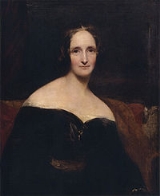
Mary Shelley

 
Mary Shelley

   Email Print
   Bookmark   Link


Mary Shelley


Mary Shelley (née
Nee

Nee may refer to:* Married and maiden names or Nee, French for "born", indicates a woman's birth surname* NEE, a political party in Flanders, Belgium...
 Mary Wollstonecraft Godwin; 30 August 1797 – 1 February 1851) was a British novelist, short story writer, dramatist, essayist, biographer, and travel writer
Travel literature

Travel literature is travel writing of literature value. Travel literature typically records the experiences of an author tourism a place for the pleasure of travel....
, best known for her Gothic novel
Gothic fiction

Gothic fiction is a genre of literature that combines elements of both Horror fiction and Romance . As a genre, it is generally believed to have been invented by the English author Horace Walpole, 4th Earl of Orford, with his 1764 novel The Castle of Otranto....
 Frankenstein: or, The Modern Prometheus
Frankenstein

Frankenstein; or, The Modern Prometheus, generally known as Frankenstein, is a novel written by the British author Mary Shelley. Shelley started writing Frankenstein when she was 18 and finished when she was 19....
 (1818). She also edited and promoted the works of her husband, the Romantic poet
Romantic poetry

Romanticism largely began as a reaction against the prevailing Age of Enlightenment ideals of the day. Inevitably, the characterization of a broad range of contemporaneous poets and poetry under the single unifying name can be viewed more as an exercise in historical compartmentalization than an actual attempt to capture the essence of the ac...
 and philosopher Percy Bysshe Shelley
Percy Bysshe Shelley

Percy Bysshe Shelley was one of the major England Romantic poets and is widely considered to be among the finest Lyric poetry in the English language....
. Her father was the political philosopher William Godwin
William Godwin

William Godwin was an English journalist, political philosophy and novelist. He is considered one of the first exponents of utilitarianism, and one of the first modern proponents of philosophical anarchism....
, and her mother was the philosopher and feminist Mary Wollstonecraft
Mary Wollstonecraft

Mary Wollstonecraft was an eighteenth-century Kingdom of Great Britain writer, philosopher, and feminist. During her brief career, she wrote novels, treatises, a travel literature, a history of the French Revolution, a conduct book, and a children's book....
.

Mary Godwin's mother died when she was ten days old; afterwards, she and her older half-sister, Fanny Imlay
Fanny Imlay

Frances "Fanny" Imlay was the illegitimacy daughter of the British feminist Mary Wollstonecraft and the American commercial speculator Gilbert Imlay....
, were raised by her father.


Discussion
Ask a question about 'Mary Shelley'
Start a new discussion about 'Mary Shelley'
Answer questions from other users
Full Discussion Forum


Recent Posts


Quotations


How mutable are our feelings, and how strange is that clinging love we have of life even in the excess of misery!

Victor Frankenstein in Ch. 20

Live, and be happy, and make others so.

Justine Moritz in Ch. 8

I feel my heart glow with an enthusiasm which elevates me to heaven, for nothing contributes so much to tranquillize the mind as a steady purpose — a point on which the soul may fix its intellectual eye.

Robert Walton in "Letter 1"

We are unfashioned creatures, but half made up, if one wiser, better, dearer than ourselves — such a friend ought to be — do not lend his aid to perfectionate our weak and faulty natures.

Victor Frankenstein, quoted by Robert Walton in "Letter 4"

Learn from me, if not by my precepts, at least by my example, how dangerous is the acquirement of knowledge and how much happier that man is who believes his native town to be the world, than he who aspires to become greater than his nature will allow.

Victor Frankenstein in Ch. 4

It was on a dreary night of November that I beheld the accomplishment of my toils. With an anxiety that almost amounted to agony, I collected the instruments of life around me, that I might infuse a spark of being into the lifeless thing that lay at my feet.

Victor Frankenstein in Ch. 5


Encyclopedia


Mary Shelley (née
Nee

Nee may refer to:* Married and maiden names or Nee, French for "born", indicates a woman's birth surname* NEE, a political party in Flanders, Belgium...
 Mary Wollstonecraft Godwin; 30 August 1797 – 1 February 1851) was a British novelist, short story writer, dramatist, essayist, biographer, and travel writer
Travel literature

Travel literature is travel writing of literature value. Travel literature typically records the experiences of an author tourism a place for the pleasure of travel....
, best known for her Gothic novel
Gothic fiction

Gothic fiction is a genre of literature that combines elements of both Horror fiction and Romance . As a genre, it is generally believed to have been invented by the English author Horace Walpole, 4th Earl of Orford, with his 1764 novel The Castle of Otranto....
 Frankenstein: or, The Modern Prometheus
Frankenstein

Frankenstein; or, The Modern Prometheus, generally known as Frankenstein, is a novel written by the British author Mary Shelley. Shelley started writing Frankenstein when she was 18 and finished when she was 19....
 (1818). She also edited and promoted the works of her husband, the Romantic poet
Romantic poetry

Romanticism largely began as a reaction against the prevailing Age of Enlightenment ideals of the day. Inevitably, the characterization of a broad range of contemporaneous poets and poetry under the single unifying name can be viewed more as an exercise in historical compartmentalization than an actual attempt to capture the essence of the ac...
 and philosopher Percy Bysshe Shelley
Percy Bysshe Shelley

Percy Bysshe Shelley was one of the major England Romantic poets and is widely considered to be among the finest Lyric poetry in the English language....
. Her father was the political philosopher William Godwin
William Godwin

William Godwin was an English journalist, political philosophy and novelist. He is considered one of the first exponents of utilitarianism, and one of the first modern proponents of philosophical anarchism....
, and her mother was the philosopher and feminist Mary Wollstonecraft
Mary Wollstonecraft

Mary Wollstonecraft was an eighteenth-century Kingdom of Great Britain writer, philosopher, and feminist. During her brief career, she wrote novels, treatises, a travel literature, a history of the French Revolution, a conduct book, and a children's book....
.

Mary Godwin's mother died when she was ten days old; afterwards, she and her older half-sister, Fanny Imlay
Fanny Imlay

Frances "Fanny" Imlay was the illegitimacy daughter of the British feminist Mary Wollstonecraft and the American commercial speculator Gilbert Imlay....
, were raised by her father. When Mary was four, Godwin married his neighbour, Mary Jane Clairmont. Godwin provided his daughter with a rich, if informal, education, encouraging her to adhere to his liberal
Liberalism

Liberalism is a broad class of political philosophy that considers individualism liberty and equality to be the most important political goals....
 political theories. In 1814, Mary Godwin began a romantic relationship with one of her father’s political followers, the married Percy Bysshe Shelley. Together with Mary's stepsister, Claire Clairmont
Claire Clairmont

Clara Mary Jane Clairmont , or Claire Clairmont as she was commonly known, was a stepsister of writer Mary Shelley and the mother of Lord Byron's daughter Allegra Byron....
, they left for France and travelled through Europe; upon their return to England, Mary was pregnant with Percy's child. Over the next two years, she and Percy faced ostracism
Ostracism

Ostracism was a procedure under the Athenian democracy in which a prominent citizen could be exile from the city-state of Athens for ten years....
, constant debt, and the death of their prematurely born daughter. They married in late 1816 after the suicide of Percy Shelley's first wife, Harriet.

In 1816, the couple famously spent a summer with Lord Byron
George Gordon Byron, 6th Baron Byron

George Gordon Byron, later Noel, 6th Baron Byron Royal Society was a United Kingdom poet and a leading figure in Romanticism. Amongst Byron's best-known works are the brief poems She Walks in Beauty, When We Two Parted, and So, we'll go no more a roving, in addition to the narrative poems Childe Harold's Pilgrimage and...
, John William Polidori, and Claire Clairmont near Geneva
Geneva

Geneva is the second-most-populous city in Switzerland and is the most populous city of Romandie . Situated where the Rh?ne River exits Lake Geneva , it is the capital of the Canton of Geneva....
, Switzerland
Switzerland

Switzerland is a landlocked Swiss Alps country of roughly 7.7 million people in Western Europe with an area of 41,285 km?. Switzerland is a federal republic consisting of 26 states called Cantons of Switzerland....
, where Mary conceived the idea for her novel Frankenstein. The Shelleys left Britain in 1818 for Italy, where their second and third children died before Mary Shelley gave birth to her last and only surviving child, Percy Florence
Percy Florence Shelley

Sir Percy Florence Shelley, 3rd Baronet was the son of Percy Bysshe Shelley and Frankenstein author, Mary Shelley. His middle name, Florence, came because he was born in Florence in Italy....
. In 1822, her husband drowned when his sailing boat sank during a storm in the Bay of La Spezia
La Spezia

La Spezia is a city in the Liguria region of northern Italy, at the head of La Spezia Gulf, and capital city of the province of La Spezia.It is one of the major Italian military and commercial harbours, located between Genoa and Pisa on the Ligurian Sea....
. A year later, Mary Shelley returned to England and from then on devoted herself to the upbringing of her son and a career as a professional author. The last decade of her life was dogged by illness, probably caused by the brain tumour that was to kill her at the age of 53.

Until the 1970s, Mary Shelley was known mainly for her efforts to publish Percy Shelley's works and for her novel Frankenstein, which remains widely read and has inspired many theatrical and film adaptations. Recent scholarship has yielded a more comprehensive view of Mary Shelley’s achievements. Scholars have shown increasing interest in her literary output, particularly in her novels, which include the historical novel
Historical novel

A historical novel is a novel in which the story is set among historical events, or more generally, in which the time of the action predates the lifetime of the author....
s Valperga
Valperga (novel)

Valperga, or the Life and Adventures of Castruccio, Prince of Lucca is an 1823 historical fiction by the Romanticism novelist Mary Shelley....
 (1823) and Perkin Warbeck
The Fortunes of Perkin Warbeck

The Fortunes of Perkin Warbeck: A Romance is an 1830 historical fiction by Mary Shelley about the life of Perkin Warbeck.In this novel, Mary Shelley returned to The Last Man message that an idealistic political system is impossible without an improvement in human nature....
 (1830), the apocalyptic novel The Last Man
The Last Man

The Last Man is an Apocalyptic and post-apocalyptic fiction science fiction novel by Mary Shelley, which was first published in 1826. The book tells of a future world that has been ravaged by a plague....
 (1826), and her final two novels, Lodore
Lodore

Lodore, also published under the title The Beautiful Widow, is the penultimate novel by Romanticism novelist Mary Shelley, completed in 1833 and published in 1835....
 (1835) and Falkner
Falkner (novel)

Falkner is the last novel published by the Romanticism writer Mary Shelley.Like Shelley's novel Lodore , Falkner charts a young woman's education under a tyrannical father figure....
 (1837). Studies of her lesser-known works such as the travel book Rambles in Germany and Italy
Rambles in Germany and Italy

Rambles in Germany and Italy, in 1840, 1842, and 1843 is a travel literature by the British Romanticism author Mary Shelley. Issued in 1844, it is her last published work....
 (1844) and the biographical articles for Dionysius Lardner's
Dionysius Lardner

Dionysius Lardner , was an Ireland scientific writer who popularised science and technology, and edited the, 133-volume, Cabinet Cyclopedia....
 Cabinet Cyclopaedia
Lives of the Most Eminent Literary and Scientific Men

The Lives of the Most Eminent Literary and Scientific Men were five volumes of Dionysius Lardner 133-volume Cabinet Cyclopaedia . Aimed at the self-educating middle class, this encyclopedia was written during the nineteenth-century literary revolution in Britain that encouraged more people to read....
 (1829–46) support the growing view that Mary Shelley remained a political radical
Radicalism (historical)

The term Radical was used during the late 18th century for proponents of the Radical Movement. It later become a general term for those favoring or seeking political reforms which include dramatic changes to the social order....
 throughout her life. Mary Shelley's works often argue that cooperation and sympathy, particularly as practised by women in the family, were the ways to reform civil society. This view was a direct challenge to the individualistic Romantic
Romanticism

Romanticism is a complex artistic, literary, and intellectual movement that originated in the second half of the 18th century in Western Europe, and gained strength during the Industrial Revolution....
 ethos promoted by Percy Shelley and the Enlightenment
Age of Enlightenment

The Age of Enlightenment or The Enlightenment is a term used to describe a time in Western philosophy and cultural life centered upon the eighteenth century, in which rationalism was advocated as the primary source and legitimacy for authority....
 political theories articulated by her father, William Godwin.

Biography


Early life

Mary Shelley was born Mary Wollstonecraft Godwin in Somers Town, London
Somers Town, London

Somers Town, named after the Somers family who owned the land, is an area of London south of Camden Town. Historically, the locality known as Somers Town was the whole of the triangular space between the Hampstead, Pancras, and Euston Roads....
, in 1797. She was the second child of the feminist philosopher, educator, and writer Mary Wollstonecraft
Mary Wollstonecraft

Mary Wollstonecraft was an eighteenth-century Kingdom of Great Britain writer, philosopher, and feminist. During her brief career, she wrote novels, treatises, a travel literature, a history of the French Revolution, a conduct book, and a children's book....
, and the first child of the philosopher, novelist, and journalist William Godwin
William Godwin

William Godwin was an English journalist, political philosophy and novelist. He is considered one of the first exponents of utilitarianism, and one of the first modern proponents of philosophical anarchism....
. Wollstonecraft died of puerperal fever
Puerperal fever

Puerperal fever , also called childbed fever, can develop into puerperal sepsis, which is a serious form of septicaemia contracted by a woman during or shortly after childbirth, miscarriage or abortion....
 ten days after Mary was born. Godwin was left to bring up Mary, along with her older half-sister, Fanny Imlay
Fanny Imlay

Frances "Fanny" Imlay was the illegitimacy daughter of the British feminist Mary Wollstonecraft and the American commercial speculator Gilbert Imlay....
, Wollstonecraft's child by the American speculator Gilbert Imlay
Gilbert Imlay

Gilbert Imlay was an officer in the American Revolutionary War , a businessman and an author. He had a brief affair with Mary Wollstonecraft that resulted in the birth of a daughter, Fanny Imlay....
. A year after Wollstonecraft's death, Godwin published his Memoirs of the Author of A Vindication of the Rights of Woman
Memoirs of the Author of A Vindication of the Rights of Woman

Memoirs of the Author of A Vindication of the Rights of Woman is William Godwin biography of his wife Mary Wollstonecraft, the author of A Vindication of the Rights of Woman ....
 (1798), which he intended as a sincere and compassionate tribute. However, because the Memoirs revealed Wollstonecraft's affairs and her illegitimate child, they were seen as shocking. Mary Godwin read these memoirs and her mother's books, and was brought up to cherish her mother's memory.

Mary's earliest years were happy ones, judging from the letters of William Godwin's housekeeper and nurse, Louisa Jones. But Godwin was often deeply in debt; feeling that he could not raise the children by himself, he cast about for a second wife. In December 1801, he married Mary Jane Clairmont, a well-educated woman with two young children of her own—Charles and Claire
Claire Clairmont

Clara Mary Jane Clairmont , or Claire Clairmont as she was commonly known, was a stepsister of writer Mary Shelley and the mother of Lord Byron's daughter Allegra Byron....
.Claire's first name was "Jane", but from 1814 (see Gittings and Manton, 22) she preferred to be called "Claire" (her second name was "Clara"), which is how she is known to history. To avoid confusion, this article calls her "Claire" throughout. Most of Godwin’s friends disliked his new wife, describing her as quick-tempered and quarrelsome;William St Clair, in his biography of the Godwins and the Shelleys, notes that "it is easy to forget in reading of these crises [in the lives of the Godwins and the Shelleys] how unrepresentative the references in surviving documents may be. It is easy for the biographer to give undue weight to the opinions of the people who happen to have written things down." (246) but Godwin was devoted to her, and the marriage was a success. Mary Godwin, on the other hand, came to detest her stepmother. William Godwin's 19th-century biographer C. Kegan Paul later suggested that Mrs Godwin had favoured her own children over Mary Wollstonecraft’s.

Together, the Godwins started a publishing firm called M. J. Godwin, which sold children's books as well as stationery, maps, and games. However, the business did not turn a profit, and Godwin was forced to borrow substantial sums to keep it going. He continued to borrow to pay off earlier loans, compounding his problems. By 1809, Godwin's business was close to failure and he was "near to despair". Godwin was saved from debtor's prison
Debtor's prison

DefinitionA prison for those who are unable to pay a debt...
 by philosophical devotees such as Francis Place
Francis Place

Francis Place was an England Reform movement....
, who lent him further money.

Though Mary Godwin received little formal education, her father tutored her in a broad range of subjects. He often took the children on educational outings, and they had access to his library and to the many intellectuals who visited him, including the Romantic poet
Romantic poetry

Romanticism largely began as a reaction against the prevailing Age of Enlightenment ideals of the day. Inevitably, the characterization of a broad range of contemporaneous poets and poetry under the single unifying name can be viewed more as an exercise in historical compartmentalization than an actual attempt to capture the essence of the ac...
 Samuel Taylor Coleridge
Samuel Taylor Coleridge

Samuel Taylor Coleridge was an England poet, critic and Philosophy who was, along with his friend William Wordsworth, one of the founders of the Romanticism in England and one of the Lake Poets....
 and the former vice-president of the United States Aaron Burr
Aaron Burr

Aaron Burr, Jr. was an United States politician, American Revolutionary War hero, and adventurer. He served as the List of Vice Presidents of the United States Vice President of the United States , under Thomas Jefferson....
. Godwin admitted he was not educating the children according to Mary Wollstonecraft's philosophy as outlined in works such as A Vindication of the Rights of Woman
A Vindication of the Rights of Woman

A Vindication of the Rights of Woman: with Strictures on Political and Moral Subjects , written by the eighteenth-century British feminist Mary Wollstonecraft, is one of the earliest works of feminist philosophy....
 (1792), but Mary Godwin nonetheless received an unusual and advanced education for a girl of the time. She had a governess
Governess

A governess is a female employee of a family who teaches children within their home. In contrast to a nanny or a babysitter, she concentrates on teaching children, not their physical needs....
, a daily tutor, and read many of her father's children's books on Roman and Greek history in manuscript. For six months in 1811, she also attended a boarding school in Ramsgate
Ramsgate

Ramsgate is a seaside resort on the Isle of Thanet in east Kent, England. It was one of the great English seaside towns of the 19th century and is a member of the ancient confederation of Cinque Port....
. Her father described her at fifteen as "singularly bold, somewhat imperious, and active of mind. Her desire of knowledge is great, and her perseverance in everything she undertakes almost invincible."

In June 1812, her father sent Mary to stay with the Dissenting
Dissenter

The term dissenter , labels one who dissents or disagrees in matters of opinion, belief, etc. In the social and religious history of England and Wales, however, it refers particularly to a member of a religious body in England or Wales who has, for one reason or another, separated from the Established Church....
 family of the radical
Radicalism (historical)

The term Radical was used during the late 18th century for proponents of the Radical Movement. It later become a general term for those favoring or seeking political reforms which include dramatic changes to the social order....
 William Baxter, near Dundee
Dundee

Dundee is the fourth-largest City status in the United Kingdom in Scotland and, fully named as Dundee City, one of Scotland's 32 Local government in Scotland Council areas of Scotland....
, Scotland
Scotland

conventional_long_name = ScotlandAlba|common_name= Scotland|image_flag = Flag of Scotland.svg|flag_width = 130px...
. To Baxter, he wrote, "I am anxious that she should be brought up ... like a philosopher, even like a cynic." Scholars have speculated that she may have been sent away for her health, to remove her from the seamy side of business, or to introduce her to radical politics. Mary Godwin revelled in the spacious surroundings of Baxter's house and in the companionship of his four daughters, and she returned north in the summer of 1813 for a further stay of ten months. In the 1831 introduction to Frankenstein, she recalled: "I wrote then—but in a most common-place style. It was beneath the trees of the grounds belonging to our house, or on the bleak sides of the woodless mountains near, that my true compositions, the airy flights of my imagination, were born and fostered."

Percy Bysshe Shelley

St Pancras Old Church in 1815
Mary Godwin may have first met the radical poet-philosopher Percy Bysshe Shelley
Percy Bysshe Shelley

Percy Bysshe Shelley was one of the major England Romantic poets and is widely considered to be among the finest Lyric poetry in the English language....
 in the interval between her two stays in Scotland. By the time she returned home for a second time on 30 March 1814, Percy Shelley had become estranged from his wife and was regularly visiting Godwin, whom he had agreed to bail out of debt. Percy Shelley's radicalism
Radicalism (historical)

The term Radical was used during the late 18th century for proponents of the Radical Movement. It later become a general term for those favoring or seeking political reforms which include dramatic changes to the social order....
, particularly his economic views, which he had imbibed from Godwin's Political Justice
Political Justice

Enquiry Concerning Political Justice and its Influence on Modern Morals and Manners outlines the political philosophy of the eighteenth-century philosopher William Godwin....
 (1793), had alienated him from his wealthy aristocratic family: they wanted him to follow traditional models of the landed aristocracy, and he wanted to donate large amounts of the family's money to schemes intended to help the disadvantaged. Percy Shelley therefore had difficulty gaining access to money until he inherited his estate because his family did not want him wasting it on projects of "political justice". After several months of promises, Shelley announced that he either could not or would not pay off all of Godwin's debts. Godwin was angry and felt betrayed.

Mary and Percy began meeting each other secretly at Mary Wollstonecraft's grave in St Pancras Churchyard
St Pancras Old Church

St Pancras Old Church is a parish church on Pancras Road in the London Borough of Camden. It is believed to be one of the oldest sites of Christian worship in London and in England, although the building itself is largely Victorian era....
, and they fell in love—she was nearly seventeen, he nearly twenty-two. To Mary's dismay, her father disapproved and tried to thwart the relationship and salvage the "spotless fame" of his daughter. At about the same time, Godwin learned of Shelley's inability to pay off his loans for him. Mary, who later wrote of "my excessive and romantic attachment to my father", was confused. She saw Percy Shelley as an embodiment of her parents' liberal and reformist ideas of the 1790s, particularly Godwin's view that marriage was a repressive monopoly, which he had argued in his 1793 edition of Political Justice but since retracted. On 28 July 1814, the couple secretly left for France, taking Mary's stepsister, Claire Clairmont
Claire Clairmont

Clara Mary Jane Clairmont , or Claire Clairmont as she was commonly known, was a stepsister of writer Mary Shelley and the mother of Lord Byron's daughter Allegra Byron....
, with them, but leaving Percy's pregnant wife behind.

After convincing Mary Jane Godwin, who had pursued them to Calais
Calais

Calais is a town in northern France in the Departments of France of Pas-de-Calais, of which it is a sub-prefecture. Although Calais is by far the largest city in Pas-de-Calais, the department's capital is its third-largest city of Arras....
, that they did not wish to return, the trio travelled to Paris
Paris

Paris is the Capital of France and the country's largest city. It is situated on the river Seine, in northern France, at the heart of the ?le-de-France Regions of France ....
, and then, by donkey, mule, and carriage, through a France recently ravaged by war, to Switzerland. "It was acting in a novel, being an incarnate romance," Mary Shelley recalled in 1826. As they travelled, Mary and Percy read works by Mary Wollstonecraft and others, kept a joint journal, and continued their own writing. At Lucerne
Lucerne

Lucerne is a city in Switzerland. It is the capital of the Canton of Lucerne and seat of the Lucerne with the same name. With a population of 57,890, Lucerne is the most populous city in Central Switzerland and focal point of the region....
, lack of money forced the three to turn back. They travelled down the Rhine
Rhine

File:Swiss Grand Canyon.jpgThe Rhine is one of the longest and most important rivers in Europe, at , with an average discharge of more than ....
 and by land to the Dutch port of Marsluys
Maassluis

Media:Nl-Maassluis.ogg is a town in the western Netherlands, in the province of South Holland. The municipality covers an area of 10.11 km? ....
, arriving at Gravesend, Kent
Gravesend, Kent

Gravesend is a town in northwest Kent, England, on the south bank of the River Thames, opposite Tilbury in Essex, England. It is the administrative town of the Districts of England of Gravesham and, because of its geographical position, has always had an important role to play in the history and communications of this part of England....
, on 13 September 1814.

Portrait of Percy Bysshe Shelley By Curran, 1819
The situation awaiting Mary Godwin in England was fraught with complications, some of which she had not foreseen. Either before or during the journey, she had become pregnant. She and Percy now found themselves penniless, and, to Mary's genuine surprise, her father refused to have anything to do with her. The couple moved with Claire into lodgings at Somers Town, and later, Nelson Square. They maintained their intense programme of reading and writing and entertained Percy Shelley's friends, such as Thomas Jefferson Hogg
Thomas Jefferson Hogg

Thomas Jefferson Hogg was a UK biographer .The son of John Hogg, a country gentleman of Durham, he was educated at Durham School, and University College, Oxford, where he made the acquaintance of Percy Bysshe Shelley, whose lifelong friend and biographer he became....
 and the writer Thomas Love Peacock
Thomas Love Peacock

Thomas Love Peacock was an English satire and author.Peacock was a close friend of Percy Bysshe Shelley and they influenced each other's work....
. Percy Shelley sometimes left home for short periods to dodge creditors. The couple's distraught letters reveal their pain at these separations.

Pregnant and often ill, Mary Godwin had to cope with Percy's joy at the birth of his son by Harriet Shelley in late 1814 and his constant outings with Claire Clairmont."Journal 6th December—Very Unwell. Shelley & Clary walk out, as usual, to heaps of places...A letter from Hookham to say that Harriet has been brought to bed of a son and heir. Shelley writes a number of circular letters on this event, which ought to be ushered in with ringing of bells, etc., for it is the son of his wife." (Quoted in Spark, 39.) She was partly consoled by the visits of Hogg, whom she disliked at first but soon considered a close friend. Percy Shelley seems to have wanted Mary Godwin and Hogg to become lovers; Mary did not dismiss the idea, since in principle she believed in free love
Free love

The term free love has been used since at least the nineteenth century to describe a social movement that rejects marriage, which is seen as a form of social bondage, especially for women....
. In practice, however, she loved only Percy Shelley and seems to have ventured no further than flirting with Hogg.Sunstein speculates that Mary Shelley and Jefferson Hogg made love in April 1815. (Sunstein, 98–99) On 22 February 1815, she gave birth to a two-months premature baby girl, who was not expected to survive. On 6 March, she wrote to Hogg:

My dearest Hogg my baby is dead—will you come to see me as soon as you can. I wish to see you—It was perfectly well when I went to bed—I awoke in the night to give it suck it appeared to be sleeping so quietly that I would not awake it. It was dead then, but we did not find that out till morning—from its appearance it evidently died of convulsions—Will you come—you are so calm a creature & Shelley is afraid of a fever from the milk—for I am no longer a mother now.


The loss of her child induced acute depression in Mary Godwin, who was haunted by visions of the baby; but she conceived again and had recovered by the summer. With a revival in Percy Shelley's finances after the death of his grandfather, Sir Bysshe Shelley, the couple holidayed in Torquay
Torquay

Torquay is a town in the unitary authority of Torbay and ceremonial county of Devon, England. It lies 16 miles south of Exeter along the A380 road on the north of Torbay, 38 miles north-east of Plymouth and adjoins the neighbouring town of Paignton on the west of the bay....
 and then rented a two-storey cottage at Bishopsgate
Bishopsgate

Bishopsgate is a road and Wards of the United Kingdom in the east part of the City of London, extending north from Gracechurch Street to Norton Folgate....
, on the edge of Windsor Great Park
Windsor Great Park

Windsor Great Park is a large deer park of 5,000 acres, to the south of the town of Windsor, Berkshire on the border of Berkshire and Surrey in England....
. Little is known about this period in Mary Godwin's life, since her journal from May 1815 to July 1816 is lost. At Bishopsgate, Percy wrote his poem Alastor
Alastor, or The Spirit of Solitude

Alastor, or The Spirit of Solitude is a poem by Percy Bysshe Shelley, written in 1815 in poetry and first published in 1816. The poem was without a title when Shelley passed it along to his contemporary and friend, Thomas Love Peacock....
; and on 24 January 1816, Mary gave birth to a second child, William, named after her father and soon nicknamed "Willmouse". In her novel The Last Man
The Last Man

The Last Man is an Apocalyptic and post-apocalyptic fiction science fiction novel by Mary Shelley, which was first published in 1826. The book tells of a future world that has been ravaged by a plague....
, she later imagined Windsor as a Garden of Eden.

Lake Geneva and Frankenstein

In May 1816, Mary Godwin, Percy Shelley, and their son travelled to Geneva
Geneva

Geneva is the second-most-populous city in Switzerland and is the most populous city of Romandie . Situated where the Rh?ne River exits Lake Geneva , it is the capital of the Canton of Geneva....
 with Claire Clairmont. They planned to spend the summer with the poet Lord Byron
George Gordon Byron, 6th Baron Byron

George Gordon Byron, later Noel, 6th Baron Byron Royal Society was a United Kingdom poet and a leading figure in Romanticism. Amongst Byron's best-known works are the brief poems She Walks in Beauty, When We Two Parted, and So, we'll go no more a roving, in addition to the narrative poems Childe Harold's Pilgrimage and...
, whose recent affair with Claire had left her pregnant. The party arrived at Geneva on 14 May 1816, where Mary called herself "Mrs Shelley" (although she and Shelley did not get married until later that year). Byron joined them on 25 May, with his young physician, John William Polidori
John Polidori

John William Polidori was an Italy-England physician and writer, known for his associations with the Romantic movement and credited by some as the creator of the vampire genre of fantasy fiction....
, and rented the Villa Diodati
Villa Diodati

The Villa Diodati is a manor in Cologny close to Lake Geneva. It is most famous for having been the summer residence of Lord Byron, Mary Shelley, Percy Shelley, John Polidori and others in 1816, where the basis for the classical horror stories Frankenstein and The Vampyre were laid....
, close to Lake Geneva
Lake Geneva

Lake Geneva or Lake L?man is the second largest freshwater lake in Central Europe in terms of surface area . 60% of it comes under the jurisdiction of Switzerland , and 40% under France ....
 at the village of Cologny
Cologny

Cologny is a Municipalities of Switzerland in the Canton of Geneva, Switzerland.On the heights of Geneva, it offers breathtaking views on the lake L?man and houses a prestigious golf course, the Geneva Golf Club....
; Percy Shelley rented a smaller building called Maison Chapuis on the waterfront nearby. They spent their time writing, boating on the lake, and talking late into the night.

"It proved a wet, ungenial summer", Mary Shelley remembered in 1831, "and incessant rain often confined us for days to the house".The violent storms were, it is now known, a repercussion of the volcanic eruption of Mount Tambora
Mount Tambora

Mount Tambora is an active stratovolcano, also known as a composite volcano, on Sumbawa island, Indonesia. Sumbawa is flanked both to the north and south by oceanic crust, and Tambora was formed by the active subduction zones beneath it....
 in Indonesia
Indonesia

The Republic of Indonesia , is a transcontinental country in Southeast Asia and Oceania. Comprising Islands of Indonesia, it is the world's largest Archipelago state....
 the year before (Sunstein, 118). See also The Year Without a Summer.
Amongst other subjects, the conversation turned to the experiments of the 18th-century natural philosopher and poet Erasmus Darwin
Erasmus Darwin

Erasmus Darwin , was an England physician, natural philosopher, physiologist, abolitionist, inventor and poet. He was one of the founder members of the Lunar Society, a discussion group of pioneering industrialists and natural philosophers....
, who was said to have animated dead matter, and to galvanism
Galvanism

In biology, galvanism is the contraction of a muscle that is stimulated by an electric Current . In physics and chemistry, it is the induction of electrical current from a chemical reaction, typically between two chemicals with differing electronegativity....
 and the feasibility of returning a corpse or assembled body parts to life. Sitting around a log fire at Byron's villa, the company also amused themselves by reading German ghost stories, prompting Byron to suggest they each write their own supernatural
Supernatural

The term supernatural or supranatural pertains to an order of existence beyond the scientifically visible universe. Religious miracles are typically supernatural claims, as are Spell and curses, divination, the belief that there is an afterlife for the dead, and innumerable others....
 tale. Shortly afterwards, in a waking dream, Mary Godwin conceived the idea for Frankenstein:

She began writing what she assumed would be a short story. With Percy Shelley's encouragement, she expanded this tale into her first novel, Frankenstein: or, The Modern Prometheus
Frankenstein

Frankenstein; or, The Modern Prometheus, generally known as Frankenstein, is a novel written by the British author Mary Shelley. Shelley started writing Frankenstein when she was 18 and finished when she was 19....
, published in 1818. She later described that summer in Switzerland as the moment "when I first stepped out from childhood into life".

Bath and Marlow


On their return to England in September, Mary and Percy moved—with Claire Clairmont, who took lodgings nearby—to Bath, where they hoped to keep Claire’s pregnancy secret. At Cologny, Mary Godwin had received two letters from her half-sister, Fanny Imlay
Fanny Imlay

Frances "Fanny" Imlay was the illegitimacy daughter of the British feminist Mary Wollstonecraft and the American commercial speculator Gilbert Imlay....
, who alluded to her "unhappy life"; on 9 October, Fanny wrote an "alarming letter" from Bristol
Bristol

Bristol is a City status in the United Kingdom, unitary authority area and Ceremonial counties of England in South West England, west of London, and east of Cardiff....
 that sent Percy Shelley racing off to search for her, without success. On the morning of 10 October, Fanny Imlay was found dead in a room at a Swansea
Swansea

Swansea is a City status in the United Kingdom and subdivisions of Wales in Wales. Swansea is in the Historic counties of Wales of Glamorgan. Situated on the sandy South West Wales coast, the county area includes the Gower peninsula and the Lliw uplands....
 inn, along with a suicide note and a laudanum
Laudanum

Laudanum , also known as opium tincture or tincture of opium, is an alcoholic Herbalism of opium. It is made by combining ethanol with opium latex or powder....
 bottle. On 10 December, Percy Shelley's wife, Harriet, was discovered drowned in the Serpentine
Serpentine (lake)

The Serpentine is a 28 acre Artificial lake#Recreational in Hyde Park, London, England, created in 1730. Although it is common to refer to the entire body of water as the Serpentine, strictly the name refers only to the eastern half of the lake....
, a lake in Hyde Park
Hyde Park, London

Hyde Park is one of the largest parks in central London, England and one of the Royal Parks of London, famous for its Speakers' Corner.The park is divided in two by the Serpentine ....
, London. Both suicides were hushed up. Harriet’s family obstructed Percy Shelley's efforts—fully supported by Mary Godwin—to assume custody of his two children by Harriet. His lawyers advised him to improve his case by marrying; so he and Mary, who was pregnant again, married on 30 December 1816 at St Mildred's Church, Bread Street
Bread Street

Bread Street is a ward of the City of London and is named from its principal street, which was antiently the bread market; for by the records it appears that in 1302, the bakers of London were ordered to sell no bread at their houses but in the open market....
, London. Mr and Mrs Godwin were present and the marriage ended the family rift.

Claire Clairmont gave birth to a baby girl on 13 January, at first called Alba, later Allegra
Allegra Byron

Clara Allegra Byron , initially named Alba , meaning "dawn," or "white," by her mother, was the illegitimacy daughter of George Gordon, Lord Byron and Claire Clairmont, the stepsister of Mary Shelley....
.Alba was renamed "Allegra" in 1818. (Seymour, 177) In March of that year, the Chancery Court
Court of Chancery

The Court of Chancery was one of the court of equity in Courts of the United Kingdom....
 ruled Percy Shelley morally unfit to assume custody of his children and later placed them with a clergyman's family. Also in March, the Shelleys moved with Claire and Alba to Albion House at Marlow, Buckinghamshire
Marlow, Buckinghamshire

Marlow is a town and civil parish within Wycombe district in south Buckinghamshire, England. It is located on the River Thames, four miles south-south-west of High Wycombe, and four miles north west of Maidenhead....
, a large, damp building on the river Thames. There Mary Shelley gave birth to her third child, Clara, on 2 September. At Marlow, they entertained their new friends Marianne and Leigh Hunt
Leigh Hunt

James Henry Leigh Hunt was an England critic, essayist, poet and writer....
, worked hard at their writing, and often discussed politics.

Early in the summer of 1817, Mary Shelley finished Frankenstein, which was published anonymously in January 1818. Reviewers and readers assumed that Percy Shelley was the author, since the book was published with his preface and dedicated to his political hero William Godwin. At Marlow, Mary edited the joint journal of the group's 1814 Continental journey, adding material written in Switzerland in 1816, along with Percy's poem "Mont Blanc
Mont Blanc (poem)

"Mont Blanc: Lines Written in the Vale of Chamouni" is an ode by the Romantic poetry Percy Bysshe Shelley. The poem was composed between 22 July 1816 and 29 August 1816 during Percy Shelley's journey to the Chamonix Valley, and intended to reflect the scenery through which he traveled....
". The result was the History of a Six Weeks' Tour, published in November 1817. That autumn, Percy Shelley often lived away from home in London to evade creditors. The threat of a debtor's prison
Debtor's prison

DefinitionA prison for those who are unable to pay a debt...
, combined with their ill health and fears of losing custody of their children, contributed to the couple's decision to leave England for Italy on 12 March 1818, taking Claire Clairmont and Alba with them. They had no intention of returning.

Italy


One of the party's first tasks on arriving in Italy was to hand Alba over to Byron, who was living in Venice
Venice

Venice is a city in northern Italy, the capital city of the Italian regions Veneto, a population of 271,251 . Together with Padua, Italy, the city is included in the Padua-Venice Metropolitan Area ....
. He had agreed to raise her so long as Claire had nothing more to do with her. The Shelleys then embarked on a roving existence, never settling in any one place for long.At various times, the Shelleys lived at Livorno
Livorno

Livorno or Leghorn is a port city on the Tyrrhenian Sea on the western edge of Tuscany, Italy. It is the Capital of the Province of Livorno and the third-largest port on the western coast of Italy, having a population of approximately 170,000 residents as of the year 2007....
, Bagni di Lucca
Bagni di Lucca

Bagni di Lucca is a comune of Tuscany, Italy, in the Province of Lucca with a population of 6,551.In the village of Bagno Caldo there is a hospital constructed largely at the expense of Nicholas Demidoff in 1826....
, Venice
Venice

Venice is a city in northern Italy, the capital city of the Italian regions Veneto, a population of 271,251 . Together with Padua, Italy, the city is included in the Padua-Venice Metropolitan Area ....
, Este
Este

The House of Este is a European princely dynasty. It is split into two branches; the elder is known as the House of Welf-Este or House of Welf, the younger, as the House of Fulc-Este or later simply as the House of Este....
, Naples
Naples

Naples is a city in southern Italy, the capital of the region of Campania and of the province of Naples. The city is known for its rich history, art, culture and gastronomy, playing an important role throughout much of its existence; it is over 2,800 years old....
, Rome
Rome

Rome is the capital city of Italy and Lazio, and is Italy's largest and most populous city, with 2,724,347 residents in an urban area of some ....
, Florence
Florence

Florence is the Capital city of the Italy Regions of Italy of Tuscany and of the provinces of Italy Province of Florence. It is the most populous city in Tuscany and has a population of 364,779 ....
, Pisa
Pisa

Pisa is a city in Tuscany, central Italy, on the right bank of the mouth of the Arno River on the Ligurian Sea. It is the capital city of the Province of Pisa....
, Bagni di Pisa, and San Terenzo.
Along the way, they accumulated a circle of friends and acquaintances who often moved with them. The couple devoted their time to writing, reading, learning, sightseeing, and socialising. The Italian adventure was, however, blighted for Mary Shelley by the deaths of both her children—Clara, in September 1818 in Venice, and William, in June 1819 in Rome.Clara died of dysentery
Dysentery

Dysentery is a disorder of the digestive system that results in severe diarrhea containing mucus and/or blood in the feces. If untreated, Dysentery can be fatal....
 at the age of one, and William of malaria
Malaria

Malaria is a Vector -borne infectious disease caused by protozoan parasites. It is widespread in Tropics and subtropical regions, including parts of the Americas, Asia, and Africa....
 at three and a half. (Seymour, 214, 231)
These losses left her in a deep depression that isolated her from Percy Shelley, who wrote in his notebook:

My dearest Mary, wherefore hast thou gone,
And left me in this dreary world alone?
Thy form is here indeed—a lovely one—
But thou art fled, gone down a dreary road
That leads to Sorrow’s most obscure abode.
For thine own sake I cannot follow thee
Do thou return for mine.


For a time, Mary Shelley found comfort only in her writing. The birth of her fourth child, Percy Florence
Percy Florence Shelley

Sir Percy Florence Shelley, 3rd Baronet was the son of Percy Bysshe Shelley and Frankenstein author, Mary Shelley. His middle name, Florence, came because he was born in Florence in Italy....
, on 12 November 1819, finally lifted her spirits, though she nursed the memory of her lost children till the end of her life.

Italy provided the Shelleys, Byron, and other exiles with a political freedom unattainable at home. Despite its associations with personal loss, Italy became for Mary Shelley "a country which memory painted as paradise". Their Italian years were a time of intense intellectual and creative activity for both Shelleys. While Percy composed a series of major poems, Mary wrote the autobiographical novel Matilda
Matilda (novella)

Mary Shelley wrote her second novel, Mathilda, or Matilda, on the common Romanticism themes of incest and suicide, between August 1819 and February 1820....
, the historical novel
Historical novel

A historical novel is a novel in which the story is set among historical events, or more generally, in which the time of the action predates the lifetime of the author....
 Valperga
Valperga (novel)

Valperga, or the Life and Adventures of Castruccio, Prince of Lucca is an 1823 historical fiction by the Romanticism novelist Mary Shelley....
, and the plays Proserpine
Proserpine (play)

Proserpine is a verse drama written for children by the Romanticism writers Mary Shelley and Percy Bysshe Shelley. Mary wrote the blank verse drama and Percy contributed two lyric poetry....
  and Midas
Midas (Shelley)

Midas is a verse drama in blank verse by the Romanticism writers Mary Shelley and Percy Bysshe Shelley. Mary wrote the drama and Percy contributed two lyric poems to it....
. Mary wrote Valperga to help alleviate her father's financial difficulties, as Percy refused to assist him further. She was often physically ill, however, and prone to depressions. She also had to cope with Percy’s interest in other women, such as Sophia Stacey
Sophia Stacey

'Sophia Stacey' was a friend of the poet Percy Bysshe Shelley, to whom he dedicated the Ode which begins:Thou art fair, and few are fairer,...
, Emilia Viviani, and Jane Williams. Since Mary Shelley shared his belief in the non-exclusivity of marriage, she formed emotional ties of her own among the men and women of their circle. She became particularly fond of the Greek revolutionary Prince Alexander Mavrocordato
Prince Alexander Mavrocordatos

Prince Alexandros Mavrokordatos was a Greece statesman and member of the Mavrocordatos family of Phanariotes.In 1812, he went to the court of his uncle Jean Georges Caradja, List of rulers of Wallachia, with whom he passed into exile in Austria and Italy , where he studied at the University of Padua....
 and of Jane and Edward Williams
Edward Ellerker Williams

Edward Ellerker Williams was a Bengal army officer who became friends with Percy Bysshe Shelley in the final months of his life and died with him....
.The Williamses were not technically married; Jane was still the wife of an army officer named Johnson.

In December 1818, the Shelleys travelled south with Claire Clairmont and their servants to Naples
Naples

Naples is a city in southern Italy, the capital of the region of Campania and of the province of Naples. The city is known for its rich history, art, culture and gastronomy, playing an important role throughout much of its existence; it is over 2,800 years old....
, where they stayed for three months, receiving only one visitor, a physician
Physician

A physician, medical practitioner, doctor of medicine, or medical doctor practices medicine, and is concerned with maintaining or restoring human health through the study, diagnosis, and treatment of disease and injury....
. In 1820, they found themselves plagued by accusations and threats from Paolo and Elise Foggi, former servants whom Percy Shelley had dismissed in Naples shortly after the Foggis had married. The pair revealed that on 27 February 1819 in Naples, Percy Shelley had registered as his child by Mary Shelley a two-month-old baby girl named Elena Adelaide Shelley. The Foggis also claimed that Claire Clairmont was the baby's mother. Biographers have offered various interpretations of these events: that Percy Shelley decided to adopt a local child; that the baby was his by Elise, Claire, or an unknown woman; or that she was Elise’s by Byron.Elise had been employed by Byron as Allegra's nurse. Mary Shelley stated in a letter that Elise had been pregnant by Paolo at the time, which was the reason they had married, but not that she had had a child in Naples. Elise seems to have first met Paolo only in September. See Mary Shelley's letter to Isabella Hoppner, 10 August 1821, Selected Letters, 75–79. Mary Shelley insisted she would have known if Claire had been pregnant, but it is unclear how much she really knew. The events in Naples, a city Mary Shelley later called a paradise inhabited by devils, remain shrouded in mystery."Establishing Elena Adelaide's parentage is one of the greatest bafflements Shelley left for his biographers." (Bieri, 106) The only certainty is that she herself was not the child’s mother. Elena Adelaide Shelley died in Naples on 9 June 1820.

In the summer of 1822, a pregnant Mary moved with Percy, Claire, and Edward and Jane Williams to the isolated Villa Magni, at the sea's edge near the hamlet of San Terenzo in the Bay of Lerici
Lerici

Lerici is a town and commune in the province of La Spezia in Liguria , part of the Italian Riviera. Its nearest bay is the Bay of Lerici. The town is connected by ferry to the Cinque Terre and Portovenere....
. Once they were settled in, Percy broke the "evil news" to Claire that her daughter Allegra had died of typhus
Typhus

Epidemic typhus is a form of typhus so named because the disease often causes epidemics following wars and natural disasters. The causative organism is Rickettsia prowazekii, transmitted by the human body louse ....
 in a convent at Bagnacavallo
Bagnacavallo

Bagnacavallo is a town in the province of Ravenna, Emilia-Romagna, Italy. .The Renaissance painter Bartolommeo Ramenghi bore the nickname of his native city....
. Mary Shelley was distracted and unhappy in the cramped and remote Villa Magni, which she came to regard as a dungeon. On 16 June, she miscarried
Miscarriage

Miscarriage or spontaneous abortion is the spontaneous end of a pregnancy at a stage where the embryo or fetus is incapable of surviving, generally defined in humans at prior to 20 weeks of gestation....
, losing so much blood that she nearly died. Rather than wait for a doctor, Percy sat her in a bath of ice to staunch the bleeding, an act the doctor later told him saved her life. All was not well between the couple that summer, however, and Percy spent more time with Jane Williams than with his depressed and debilitated wife. Most of the short poems Shelley wrote at San Terenzo were addressed to Jane rather than to Mary.

The coast offered Percy Shelley and Edward Williams the chance to enjoy their "perfect plaything for the summer", a new sailing boat. The boat had been designed by Daniel Roberts and Edward Trelawny, an admirer of Byron's who had joined the party in January 1822. On 1 July 1822, Percy Shelley, Edward Williams, and Captain Daniel Roberts sailed south down the coast to Livorno
Livorno

Livorno or Leghorn is a port city on the Tyrrhenian Sea on the western edge of Tuscany, Italy. It is the Capital of the Province of Livorno and the third-largest port on the western coast of Italy, having a population of approximately 170,000 residents as of the year 2007....
. There Percy Shelley discussed with Byron and Leigh Hunt the launch of a radical magazine called The Liberal
The Liberal

The Liberal magazine is a quarterly literary and political publication "devoted to promoting liberalism around the world". The Liberal was first founded in 1821 by the Romantic poets Percy Bysshe Shelley, Lord Byron and Leigh Hunt, and was relaunched in July 2004 ? 180 years after it ceased publication ? "to rehabilitate Romantic Liberali...
. On 8 July, he and Edward Williams set out on the return journey to Lerici with their eighteen-year-old boatboy, Charles Vivian. They never reached their destination. A letter arrived at Villa Magni from Hunt to Percy Shelley, dated 8 July, saying, "pray write to tell us how you got home, for they say you had bad weather after you sailed monday & we are anxious". "The paper fell from me," Mary told a friend later. "I trembled all over." She and Jane Williams rushed desperately to Livorno and then to Pisa in the fading hope that their husbands were still alive. Ten days after the storm, three bodies washed up on the coast near Viareggio
Viareggio

Viareggio is a city located in northern Tuscany, Italy, on the coast of the Tyrrhenian Sea. With a population of over 63,000 it is the main centre of the northern Tuscan Riviera known as Versilia, and the second largest city within the Province of Lucca....
, midway between Livorno and Lerici. Trelawny, Byron, and Hunt cremated
Cremation

Cremation is the process of reducing human remains to basic Chemical element in the form of bone fragments through flame, heat, and vaporization....
 Percy Shelley’s corpse on the beach at Viareggio.

Return to England and writing career


[Frankenstein] is the most wonderful work to have been written at twenty years of age that I ever heard of. You are now five and twenty. And, most fortunately, you have pursued a course of reading, and cultivated your mind in a manner the most admirably adapted to make you a great and successful author. If you cannot be independent, who should be?
— William Godwin to Mary Shelley


After her husband's death, Mary Shelley lived for a year with Leigh Hunt and his family in Genoa
Genoa

Genoa is a city and an important seaport in northern Italy, the capital of the Province of Genoa and of the region of Liguria. The city has a population of about 610,000 and the urban area has a population of about 900,000....
, where she often saw Byron and transcribed his poems. She resolved to live by her pen and for her son, but her financial situation was precarious. On 23 July 1823, she left Genoa for England and stayed with her father and stepmother in the Strand
Strand, London

The Strand is a street in the City of Westminster, London, England. It currently starts at Trafalgar Square and runs east to join Fleet Street at Temple Bar London, which marks the boundary of the City of London at this point, though its #History has been longer than this....
 until a small advance from her father-in-law enabled her to lodge nearby. Sir Timothy Shelley had at first agreed to support his grandson, Percy Florence, only if he were handed over to an appointed guardian. Mary Shelley rejected this idea instantly. She managed instead to wring out of Sir Timothy a limited annual allowance (which she had to repay when Percy Florence inherited the estate), but to the end of his days he refused to meet her in person and dealt with her only through lawyers. Mary Shelley busied herself with editing her husband's poems, among other literary endeavors, but concern for her son restricted her options. Sir Timothy threatened to stop the allowance if any biography of the poet were published. In 1826, Percy Florence became the legal heir of the Shelley estate after the death of Charles Shelley, his father's son by Harriet Shelley. Sir Timothy raised Mary's allowance from £100 a year to £250 but remained as difficult as ever. Mary Shelley enjoyed the stimulating society of William Godwin's circle, but poverty prevented her from socialising as she wished. She also felt ostracised by those who, like Sir Timothy, still disapproved of her relationship with Percy Bysshe Shelley.

In the summer of 1824, Mary Shelley moved to Kentish Town
Kentish Town

Kentish Town is an area of north London, England in the London Borough of Camden....
 in north London to be near Jane Williams. She may have been, in the words of her biographer Muriel Spark
Muriel Spark

Dame Muriel Spark, Order of the British Empire was an award-winning Scotland novelist....
, "a little in love" with Jane. Jane later disillusioned her by gossiping that Percy had preferred her to Mary, owing to Mary's inadequacy as a wife. At around this time, Mary Shelley was working on her novel, The Last Man
The Last Man

The Last Man is an Apocalyptic and post-apocalyptic fiction science fiction novel by Mary Shelley, which was first published in 1826. The book tells of a future world that has been ravaged by a plague....
 (1826); and she assisted a series of friends who were writing memoirs of Byron and Percy Shelley—the beginnings of her attempts to immortalise her husband. She also met the American actor John Howard Payne
John Howard Payne

John Howard Payne was an American actor, playwright, author and statesman. He is today most remembered as the creator of "Home Sweet Home", a song he wrote in 1822....
 and the American writer Washington Irving
Washington Irving

Washington Irving was an United States author, essays, biography and history of the early 19th century. He was best known for his short story "The Legend of Sleepy Hollow" and "Rip Van Winkle", both of which appear in his book The Sketch Book of Geoffrey Crayon His historical works include biographies of George Washington, Oliver Goldsmi...
. Payne fell in love with her and in 1826 asked her to marry him. She refused, saying that after being married to one genius, she could only marry another. Payne accepted the rejection and tried without success to talk his friend Irving into proposing himself. Mary Shelley was aware of Payne's plan, but how seriously she took it is unclear.

In 1827, Mary Shelley was party to a scheme that enabled her friend Isabel Robinson and Isabel's lover, Mary Diana Dods, who wrote under the name David Lyndsay, to embark on a life together in France as man and wife.Dods, who had an infant daughter, assumed the name Walter Sholto Douglas and was accepted in France as a man. With the help of Payne, whom she kept in the dark about the details, Mary Shelley obtained false passports for the couple. In 1828, she fell ill with smallpox
Smallpox

Smallpox is an infectious disease unique to humans, caused by either of two virus variants, Variola major and Variola minor. The disease is also known by the Latin names Variola or Variola vera, which is a derivative of the Latin varius, meaning spotted, or varus, meaning "pimple"....
 while visiting them in Paris. Weeks later she recovered, unscarred but without her youthful beauty.

During the period 1827–40, Mary Shelley was busy as an editor and writer. She wrote the novels Perkin Warbeck
The Fortunes of Perkin Warbeck

The Fortunes of Perkin Warbeck: A Romance is an 1830 historical fiction by Mary Shelley about the life of Perkin Warbeck.In this novel, Mary Shelley returned to The Last Man message that an idealistic political system is impossible without an improvement in human nature....
 (1830), Lodore
Lodore

Lodore, also published under the title The Beautiful Widow, is the penultimate novel by Romanticism novelist Mary Shelley, completed in 1833 and published in 1835....
 (1835), and Falkner
Falkner (novel)

Falkner is the last novel published by the Romanticism writer Mary Shelley.Like Shelley's novel Lodore , Falkner charts a young woman's education under a tyrannical father figure....
 (1837). She contributed five volumes of Lives
Lives of the Most Eminent Literary and Scientific Men

The Lives of the Most Eminent Literary and Scientific Men were five volumes of Dionysius Lardner 133-volume Cabinet Cyclopaedia . Aimed at the self-educating middle class, this encyclopedia was written during the nineteenth-century literary revolution in Britain that encouraged more people to read....
 of Italian, Spanish, Portuguese, and French authors to Lardner's
Dionysius Lardner

Dionysius Lardner , was an Ireland scientific writer who popularised science and technology, and edited the, 133-volume, Cabinet Cyclopedia....
 Cabinet Cyclopaedia
Lives of the Most Eminent Literary and Scientific Men

The Lives of the Most Eminent Literary and Scientific Men were five volumes of Dionysius Lardner 133-volume Cabinet Cyclopaedia . Aimed at the self-educating middle class, this encyclopedia was written during the nineteenth-century literary revolution in Britain that encouraged more people to read....
. She also wrote stories for ladies' magazines. She was still helping to support her father, and they looked out for publishers for each other. In 1830, she sold the copyright for a new edition of Frankenstein for £60 to Henry Colburn and Richard Bentley for their new Standard Novels series. After her father's death in 1836 at the age of eighty, she began assembling his letters and a memoir for publication, as he had requested in his will; but after two years of work, she abandoned the project. Throughout this period, she also championed Percy Shelley's poetry, promoting its publication and quoting it in her writing. By 1837, Percy's works were well-known and increasingly admired. In the summer of 1838 Edward Moxon
Edward Moxon

Edward Moxon was a United Kingdom poet and publisher.Moxon was born at Wakefield in Yorkshire his father Michael worked in the wool trade. In 1817 he left for London, joining Longman in 1821....
, the publisher of Tennyson
Tennyson

Tennyson may refer to:...
 and the son-in-law of Charles Lamb, proposed publishing a collected works of Percy Shelley. Mary was paid £500 to edit the Poetical Works (1838), which Sir Timothy insisted should not include a biography. Mary found a way to tell the story of Percy's life, nonetheless: she included extensive biographical notes about the poems.

Mary Shelley continued to treat potential romantic partners with caution. In 1828, she met and flirted with the French writer Prosper Mérimée
Prosper Mérimée

Prosper M?rim?e was a France dramatist, history, Archaeology, and short story writer. He is perhaps best known for his novella Carmen , which became the basis of Georges Bizet's opera Carmen....
, but her one surviving letter to him appears to be a deflection of his declaration of love. She was delighted when her old friend from Italy, Edward Trelawny, returned to England, and they joked about marriage in their letters. Their friendship had altered, however, following her refusal to cooperate with his proposed biography of Percy Shelley; and he later reacted angrily to her omission of the atheistic section of Queen Mab
Queen Mab (poem)

Queen Mab; A Philosophical Poem; With Notes was the first large poetic work written by Percy Bysshe Shelley , the English Romantic poet....
 from Percy Shelley's poems. Oblique references in her journals, from the early 1830s until the early 1840s, suggest that Mary Shelley had feelings for the radical politician Aubrey Beauclerk
Aubrey William de Vere Beauclerk

Aubrey William de Vere Beauclerk was the son of Charles George Beauclerk and Emily Charlotte Ogilvie. A former army major, he was M.P. for East Surrey from 1832 to 1837 and was a political radical, active in the reform movement....
, who may have disappointed her by twice marrying others.Beauclerk married Ida Goring in 1838 and, after Ida's death, Mary Shelley's friend Rosa Robinson in 1841. A clear picture of Mary Shelley's relationship with Beauclerk is difficult to reconstruct from the evidence. (Seymour, 425–26)

Mary Shelley's first concern during these years was the welfare of Percy Florence. She honoured her late husband's wish that his son attend public school
Independent school (UK)

An independent school in the United Kingdom is a school financed by private sources, predominantly in the form of school fees and charitable endowments; and so not subject to the conditions of "maintained status" imposed by accepting state financing....
, and, with Sir Timothy's grudging help, had him educated at Harrow
Harrow School

Harrow School, commonly known as "Harrow", is a world-famous boys' independent school in United Kingdom. Harrow has educated boys since 1243 but was officially founded by John Lyon under a Royal Charter of Elizabeth I in 1572....
. To avoid boarding fees, she moved to Harrow on the Hill
Harrow on the Hill

Harrow on the Hill is an area of north west London, England and part of the London Borough of Harrow. The name refers to a large local hill of 408 feet....
 herself so that Percy could attend as a day scholar. Though Percy went on to Trinity College, Cambridge
Trinity College, Cambridge

Trinity College is one of the 31 Colleges of the University of Cambridge of the University of Cambridge. Trinity has more members than any other college in Cambridge or University of Oxford, with around 700 undergraduates, 430 graduate students, and over 160 Fellows; however, counting only the student body it has somewhat fewer than Homert...
, and dabbled in politics and the law, he showed no sign of his parents' gifts. He was devoted to his mother, and after he left university in 1841, he came to live with her.

Final years and death


In 1840 and 1842, mother and son travelled together on the continent, journeys that Mary Shelley recorded in Rambles in Germany and Italy in 1840, 1842 and 1843
Rambles in Germany and Italy

Rambles in Germany and Italy, in 1840, 1842, and 1843 is a travel literature by the British Romanticism author Mary Shelley. Issued in 1844, it is her last published work....
 (1844). In 1844, Sir Timothy Shelley finally died at the age of ninety, "falling from the stalk like an overblown flower", as Mary put it. For the first time, she and her son were financially independent, though the estate proved less valuable than they had hoped.

In the mid-1840s, Mary Shelley found herself the target of three separate blackmailers. In 1845, an Italian political exile called Gatteschi, whom she had met in Paris, threatened to publish letters she had sent him. A friend of her son's bribed a police chief into seizing Gatteschi's papers, including the letters, which were then destroyed. Shortly afterwards, Mary Shelley bought some letters written by herself and Percy Bysshe Shelley from a man calling himself G. Byron and posing as the illegitimate son of the late Lord Byron
George Gordon Byron, 6th Baron Byron

George Gordon Byron, later Noel, 6th Baron Byron Royal Society was a United Kingdom poet and a leading figure in Romanticism. Amongst Byron's best-known works are the brief poems She Walks in Beauty, When We Two Parted, and So, we'll go no more a roving, in addition to the narrative poems Childe Harold's Pilgrimage and...
. Also in 1845, Percy Bysshe Shelley's cousin Thomas Medwin approached her claiming to have written a damaging biography of Percy Shelley. He said he would suppress it in return for £250, but Mary Shelley refused.According to Bieri, Medwin claimed to possess evidence relating to Naples. Medwin is the source for the theory that the child registered by Percy Shelley in Naples was his daughter by a mystery woman. See also, Journals, 249–50 n3.

In 1848, Percy Florence married Jane Gibson St John. The marriage proved a happy one, and Mary Shelley and Jane were fond of each other. Mary lived with her son and daughter-in-law at Field Place, Sussex
Sussex

Sussex , from the Old English Su?seaxe , is a Historic counties of England in South East England England corresponding roughly in area to the ancient Kingdom of Sussex....
, the Shelleys' ancestral home, and at Chester Square
Chester Square

Chester Square is a small, residential garden square located in London's exclusive Belgravia district and part of the area originally developed by the Grosvenor family....
, London, and accompanied them on travels abroad.

Mary Shelley's last years were blighted by illness. From 1839, she suffered from headaches and bouts of paralysis in parts of her body, which sometimes prevented her from reading and writing. On 1 February 1851, at Chester Square, she died at the age of fifty-three from what her physician suspected was a brain tumour. According to Jane Shelley, Mary Shelley had asked to be buried with her mother and father; but Percy and Jane, judging the graveyard at St Pancras
St Pancras Old Church

St Pancras Old Church is a parish church on Pancras Road in the London Borough of Camden. It is believed to be one of the oldest sites of Christian worship in London and in England, although the building itself is largely Victorian era....
 to be "dreadful", chose to bury her instead at St Peter's Church, Bournemouth
St Peter's Church, Bournemouth

St Peter's Church is a Church of England parish church in Bournemouth in the England county of Dorset ....
, near their new home at Boscombe
Boscombe

Boscombe is a suburb of the much larger Bournemouth. Boscombe is by the sea and it has its own pier, which was built in 1888, with a unique aircraft-wings design added in the 1950s at the entrance which is a listed building....
. On the first anniversary of Mary Shelley's death, the Shelleys opened her box-desk. Inside they found locks of her dead children's hair, a notebook she had shared with Percy Bysshe Shelley, and a copy of his poem Adonaïs
Adonais

Adona?s is a pastoral elegy written by Percy Bysshe Shelley for John Keats in 1821, and widely regarded as one of Shelley's best works. The poem, which is in 495 lines in 55 Spenserian stanzas, was composed in the spring of 1821 in poetry immediately after April 11, when Shelley heard of Keats' death some three months earlier....
 with one page folded round a silk parcel containing some of his ashes and the remains of his heart.

Literary themes and styles


Mary Shelley lived a literary life. Her father encouraged her to learn to write by composing letters, and her favourite occupation as a child was writing stories. Unfortunately, all of Mary's juvenilia
Juvenilia

Juvenilia is a term applied to literary, musical or artistic works produced by an author during his or her youth.The term was first recorded in 1622 in George Wither's poetry collection Ivvenilia....
 were lost when she ran off with Percy in 1814, and none of her surviving manuscripts can be definitively dated before that year. Her first published work is often thought to have been Mounseer Nongtongpaw
Mounseer Nongtongpaw

Mounseer Nongtongpaw is an 1808 poem once thought to have been written by the Romanticism writer Mary Shelley as a child. It is now believed that the author was theatrical writer John Taylor....
, comic verses written for Godwin's Juvenile Library when she was ten and a half; however, the poem is attributed to another writer in the most recent authoritative collection of her works. Percy Shelley enthusiastically encouraged Mary Shelley's writing: "My husband was, from the first, very anxious that I should prove myself worthy of my parentage, and enrol myself on the page of fame. He was forever inciting me to obtain literary reputation."

Novels


Autobiographical elements

Certain sections of Mary Shelley's novels are often interpreted as masked rewritings of her life. Critics have pointed to the recurrence of the father–daughter motif
Motif (narrative)

In a narrative, such as a novel or a film, motifs are recurring structures, contrasts, or literary devices that can help to develop and inform the piece?s major Theme ....
 in particular as evidence of this autobiographical style. For example, commentators frequently read Mathilda (1820) autobiographically, identifying the three central characters as versions of Mary Shelley, William Godwin, and Percy Shelley. Mary Shelley herself confided that she modelled the central characters of The Last Man
The Last Man

The Last Man is an Apocalyptic and post-apocalyptic fiction science fiction novel by Mary Shelley, which was first published in 1826. The book tells of a future world that has been ravaged by a plague....
 on her Italian circle. Lord Raymond, who leaves England to fight for the Greeks and dies in Constantinople
Constantinople

Constantinople was the empire capital of the Roman Empire , the Byzantine Empire , the Latin Empire , and the Ottoman Empire . Strategically located between the Golden Horn and the Sea of Marmara at the point where Europe meets Asia, Byzantine Constantinople had been the capital of a Christendom empire, successor to ancient ancient Greece...
, is based on Lord Byron
George Gordon Byron, 6th Baron Byron

George Gordon Byron, later Noel, 6th Baron Byron Royal Society was a United Kingdom poet and a leading figure in Romanticism. Amongst Byron's best-known works are the brief poems She Walks in Beauty, When We Two Parted, and So, we'll go no more a roving, in addition to the narrative poems Childe Harold's Pilgrimage and...
; and the utopia
Utopia

Utopia is a name for an ideal community or society, taken from the Utopia written in 1516 by Sir Thomas More describing a fictional island in the Atlantic Ocean, possessing a seemingly perfect social system-politics-legal system....
n Adrian, Earl of Windsor, who leads his followers in search of a natural paradise and dies when his boat sinks in a storm, is a fictional portrait of Percy Bysshe Shelley
Percy Bysshe Shelley

Percy Bysshe Shelley was one of the major England Romantic poets and is widely considered to be among the finest Lyric poetry in the English language....
. However, as she wrote in her review of Godwin's novel Cloudesley
Cloudesley

Cloudesley; A Tale is the fifth novel published by eighteenth-century philosopher and novelist William Godwin....
 (1830), she did not believe that authors "were merely copying from our own hearts". William Godwin regarded his daughter's characters as types
Type (metaphysics)

In metaphysics, a type is a category of being. A human is a type of thing; a cloud is a type of object ; and so on. A particular instance of a type is called a token of that thing; so Socrates was a token of a human being, but is not any longer since he is dead....
 rather than portraits from real life. Some modern critics, such as Patricia Clemit and Jane Blumberg, have taken the same view, resisting autobiographical readings of Mary Shelley's works.

Novelistic genres

"[Euthanasia] was never heard of more; even her name perished....The private chronicles, from which the foregoing relation has been collected, end with the death of Euthanasia. It is therefore in public histories alone that we find an account of the last years of the life of Castruccio."
— From Mary Shelley, Valperga
Valperga (novel)

Valperga, or the Life and Adventures of Castruccio, Prince of Lucca is an 1823 historical fiction by the Romanticism novelist Mary Shelley....


Mary Shelley employed the techniques of many different novelistic genres, most vividly the Godwinian novel, Walter Scott's
Walter Scott

Sir Walter Scott, 1st Baronet, was a prolific Scotland historical novelist and poet popular throughout Europe during his time.In some ways Scott was the first English-language author to have a truly international career in his lifetime, with many contemporary readers all over Europe, Australia, and North America....
 new historical novel
Historical novel

A historical novel is a novel in which the story is set among historical events, or more generally, in which the time of the action predates the lifetime of the author....
, and the Gothic novel
Gothic fiction

Gothic fiction is a genre of literature that combines elements of both Horror fiction and Romance . As a genre, it is generally believed to have been invented by the English author Horace Walpole, 4th Earl of Orford, with his 1764 novel The Castle of Otranto....
. The Godwinian novel, made popular during the 1790s with works such as Godwin's Caleb Williams (1794), "employed a Rousseauvian confessional form to explore the contradictory relations between the self and society", and Frankenstein
Frankenstein

Frankenstein; or, The Modern Prometheus, generally known as Frankenstein, is a novel written by the British author Mary Shelley. Shelley started writing Frankenstein when she was 18 and finished when she was 19....
 exhibits many of the same themes and literary devices as Godwin's novel. However, Shelley critiques those Enlightenment
Age of Enlightenment

The Age of Enlightenment or The Enlightenment is a term used to describe a time in Western philosophy and cultural life centered upon the eighteenth century, in which rationalism was advocated as the primary source and legitimacy for authority....
 ideals that Godwin promotes in his works. In The Last Man, she uses the philosophical form of the Godwinian novel to demonstrate the ultimate meaninglessness of the world. While earlier Godwinian novels had shown how rational individuals could slowly improve society, The Last Man and Frankenstein demonstrate the individual's lack of control over history.

Shelley uses the historical novel to comment on gender relations; for example, Valperga
Valperga (novel)

Valperga, or the Life and Adventures of Castruccio, Prince of Lucca is an 1823 historical fiction by the Romanticism novelist Mary Shelley....
 is a feminist version of Scott's masculinist genre. Introducing women into the story who are not part of the historical record, Shelley uses their narratives to question established theological and political institutions. Shelley sets the male protagonist's compulsive greed for conquest in opposition to a female alternative: reason and sensibility
Sensibility

Sensibility refers to an acute perception of or responsiveness toward something, such as the emotions of another. This concept emerged in eighteenth-century Britain, and was closely associated with studies of sense perception as the means through which knowledge is gathered....
. In Perkin Warbeck
The Fortunes of Perkin Warbeck

The Fortunes of Perkin Warbeck: A Romance is an 1830 historical fiction by Mary Shelley about the life of Perkin Warbeck.In this novel, Mary Shelley returned to The Last Man message that an idealistic political system is impossible without an improvement in human nature....
, Shelley's other historical novel, Lady Gordon stands for the values of friendship, domesticity, and equality. Through her, Shelley offers a feminine alternative to the masculine power politics that destroy the male characters. The novel provides a more inclusive historical narrative to challenge the one which usually relates only masculine events.

Gender

With the rise of feminist literary criticism
Feminist literary criticism

Feminist literary criticism is literary criticism informed by feminist theory, or by the politics of feminism more broadly. Its history has been broad and varied, from classic works of nineteenth-century women authors such as George Eliot and Margaret Fuller to cutting-edge theoretical work in women's studies and gender studies by "third-wa...
 in the 1970s, Mary Shelley's works, particularly Frankenstein, began to attract much more attention from scholars. Feminist and psychoanalytic
Psychoanalytic theory

Psychoanalytic theory is a general term for approaches to psychoanalysis which attempt to provide a conceptual framework more-or-less independent of clinical practice rather than based on empirical analysis of clinical cases....
 critics were largely responsible for the recovery from neglect of Shelley as a writer. Ellen Moers was one of the first to claim that Shelley's loss of a baby was a crucial influence on the writing of Frankenstein. She argues that the novel is a "birth myth" in which Shelley comes to terms with her guilt for causing her mother's death as well as for failing as a parent. In Moers' view, it is a story "about what happens when a man tries to have a baby without a woman ... [Frankenstein] is profoundly concerned with natural as opposed to unnatural modes of production and reproduction". Victor Frankenstein's failure as a "parent" in the novel has been read as an expression of the anxieties which accompany pregnancy, giving birth, and particularly maternity.

Sandra Gilbert
Sandra Gilbert

Dr. Sandra M. Gilbert , Professor Emerita of English language at the University of California, Davis, is an influential literary critic and poet who has published widely in the fields of feminist literary criticism, feminist theory, and psychoanalytic criticism....
 and Susan Gubar
Susan Gubar

Dr. Susan D. Gubar is a Distinguished Professor of English and Women's Studies. She has taught at Indiana University for more than twenty years....
 argue in their seminal book The Madwoman in the Attic
The Madwoman in the Attic

The Madwoman in the Attic: The Woman Writer and the Nineteenth-Century Literary Imagination, published in 1979, examines Victorian literature from a feminist perspective....
 (1979) that in Frankenstein in particular, Shelley responded to the masculine literary tradition represented by John Milton's
John Milton

John Milton II was an English poet, author, polemicist and civil servant for the Commonwealth of England. He is best known for his Epic poetry Paradise Lost and for his treatise condemning censorship, Areopagitica....
 Paradise Lost
Paradise Lost

Paradise Lost is an epic poem in blank verse by the 17th-century England poet John Milton. It was originally published in 1667 in ten books....
. In their interpretation, Shelley reaffirms this masculine tradition, including the misogyny inherent in it, but at the same time "conceal[s] fantasies of equality that occasionally erupt in monstrous images of rage". Mary Poovey
Mary Poovey

Mary Poovey is an American cultural historian and literary critic whose work focuses on the Victorian Era. She is currently Samuel Rudin University Professor in the Humanities at New York University,and Director of the Institute for the History of the Production of Knowledge....
 reads the first edition of Frankenstein as part of a larger pattern in Shelley's writing, which begins with literary self-assertion and ends with conventional femininity. Poovey suggests that Frankenstein's multiple narratives enable Shelley to split her artistic persona: she can "express and efface herself at the same time". Shelley's fear of self-assertion is reflected in the fate of Frankenstein, who is punished for his egotism by losing all his domestic ties.

Feminist critics often focus on how authorship itself, particularly female authorship, is represented in and through Shelley's novels. As Shelley scholar Anne K. Mellor
Anne K. Mellor

Anne K. Mellor is a distinguished professor of British literature at UCLA; she specializes in Romanticism, British cultural history, feminist theory, philosophy, art history and gender studies....
 explains, Shelley uses the Gothic style
Gothic fiction

Gothic fiction is a genre of literature that combines elements of both Horror fiction and Romance . As a genre, it is generally believed to have been invented by the English author Horace Walpole, 4th Earl of Orford, with his 1764 novel The Castle of Otranto....
 not only to explore repressed female sexual desire but also as way to "censor her own speech in Frankenstein". According to Poovey and Mellor, Shelley did not want to promote her own authorial persona and felt deeply inadequate as a writer, and "this shame contributed to the generation of her fictional images of abnormality, perversion, and destruction".

Shelley's writings focus on the role of the family in society and women's role within that family. She celebrates the "feminine affections and compassion" associated with the family and suggests that civil society will fail without them. Shelley was "profoundly committed to an ethic of cooperation, mutual dependence, and self-sacrifice". In Lodore
Lodore

Lodore, also published under the title The Beautiful Widow, is the penultimate novel by Romanticism novelist Mary Shelley, completed in 1833 and published in 1835....
, for example, the central story follows the fortunes of the wife and daughter of the title character, Lord Lodore, who is killed in a duel at the end of the first volume, leaving a trail of legal, financial, and familial obstacles for the two "heroines" to negotiate. The novel is engaged with political and ideological issues, particularly the education and social role of women. It dissects a patriarchal culture that separated the sexes and pressured women into dependence on men. In the view of Shelley scholar Betty T. Bennett
Betty T. Bennett

Betty T. Bennett was Distinguished Professor of Literature and Dean of the American University College of Arts and Sciences at American University....
, "the novel proposes egalitarian educational paradigms for women and men, which would bring social justice as well as the spiritual and intellectual means by which to meet the challenges life invariably brings". However, Falkner
Falkner (novel)

Falkner is the last novel published by the Romanticism writer Mary Shelley.Like Shelley's novel Lodore , Falkner charts a young woman's education under a tyrannical father figure....
 is the only one of Mary Shelley's novels in which the heroine's agenda triumphs. The novel’s resolution proposes that when female values triumph over violent and destructive masculinity, men will be freed to express the "compassion, sympathy, and generosity" of their better natures.
Enlightenment and Romanticism

Frankenstein, like much Gothic fiction
Gothic fiction

Gothic fiction is a genre of literature that combines elements of both Horror fiction and Romance . As a genre, it is generally believed to have been invented by the English author Horace Walpole, 4th Earl of Orford, with his 1764 novel The Castle of Otranto....
 of the period, mixes a visceral and alienating subject matter with speculative and thought-provoking themes. Rather than focusing on the twists and turns of the plot, however, the novel foregrounds the mental and moral struggles of the protagonist
Protagonist

A protagonist is the main Character of a drama or Narrative. The word "protagonist" derives from the Greek language p??ta????st?? , "one who plays the first part, chief actor." In the theatre of Ancient Greece, three actors played all of the main dramatic roles in a tragedy; the leading role was played by the protagonist, while the othe...
, Victor Frankenstein, and Shelley imbues the text with her own brand of politicised Romanticism
Romanticism

Romanticism is a complex artistic, literary, and intellectual movement that originated in the second half of the 18th century in Western Europe, and gained strength during the Industrial Revolution....
, one that criticised the individualism and egotism of traditional Romanticism. Victor Frankenstein is like Satan in Paradise Lost
Paradise Lost

Paradise Lost is an epic poem in blank verse by the 17th-century England poet John Milton. It was originally published in 1667 in ten books....
, and Prometheus
Prometheus

In Greek mythology, Prometheus is a Titan known for his wily intelligence, who stole fire from Zeus and gave it to human beings for their use....
: he rebels against tradition; he creates life; and he shapes his own destiny. These traits are not portrayed positively; as Blumberg writes, "his relentless ambition is a self-delusion, clothed as quest for truth". He must abandon his family to fulfill his ambition.

Mary Shelley believed in the Enlightenment
Age of Enlightenment

The Age of Enlightenment or The Enlightenment is a term used to describe a time in Western philosophy and cultural life centered upon the eighteenth century, in which rationalism was advocated as the primary source and legitimacy for authority....
 idea that people could improve society through the responsible exercise of political power, but she feared that the irresponsible exercise of power would lead to chaos. In practice, her works largely criticise the way 18th-century thinkers such as her parents believed such change could be brought about. The creature in Frankenstein, for example, reads books associated with radical ideals but the education he gains from them is ultimately useless. Shelley's works reveal her as less optimistic than Godwin and Wollstonecraft; she lacks faith in Godwin's theory that humanity could eventually be perfected.

As literary scholar Kari Lokke writes, The Last Man, more so than Frankenstein, "in its refusal to place humanity at the center of the universe, its questioning of our privileged position in relation to nature ... constitutes a profound and prophetic challenge to Western humanism." Specifically, Mary Shelley's allusions to what radicals believed was a failed revolution in France
French Revolution

The French Revolution was a period of political and social upheaval and radical change in the history of France, during which the French governmental structure, previously an absolute monarchy with feudalism for the aristocracy and Roman Catholic Church clergy, underwent radical change to forms based on Age of Enlightenment principles of cit...
 and the Godwinian, Wollstonecraftian, and Burkean
Edmund Burke

Edmund Burke was an Irish statesman, author, orator, political theorist, and philosophy who, after relocating to Great Britain, served for many years in the British House of Commons as a member of the British Whig Party party....
 responses to it, challenge "Enlightenment faith in the inevitability of progress through collective efforts". As in Frankenstein, Shelley "offers a profoundly disenchanted commentary on the age of revolution, which ends in a total rejection of the progressive ideals of her own generation". Not only does she reject these Enlightenment political ideals, but she also rejects the Romantic notion that the poetic or literary imagination can offer an alternative.

Politics

Critics have until recently cited Lodore and Falkner as evidence of increasing conservatism in Mary Shelley's later works. In 1984, Mary Poovey
Mary Poovey

Mary Poovey is an American cultural historian and literary critic whose work focuses on the Victorian Era. She is currently Samuel Rudin University Professor in the Humanities at New York University,and Director of the Institute for the History of the Production of Knowledge....
 influentially identified the retreat of Mary Shelley’s reformist politics into the "separate sphere" of the domestic. Poovey suggested that Mary Shelley wrote Falkner to resolve her conflicted response to her father's combination of libertarian radicalism and stern insistence on social decorum. Mellor largely agreed, arguing that "Mary Shelley grounded her alternative political ideology on the metaphor of the peaceful, loving, bourgeois family. She thereby implicitly endorsed a conservative vision of gradual evolutionary reform." This vision allowed women to participate in the public sphere but it inherited the inequalities inherent in the bourgeois family.

However, in the last decade or so this view has been challenged. For example, Bennett claims that Mary Shelley's works reveal a consistent commitment to Romantic idealism and political reform and Jane Blumberg's study of Shelley's early novels argues that her career cannot be easily divided into radical and conservative halves. She contends that "Shelley was never a passionate radical like her husband and her later lifestyle was not abruptly assumed nor was it a betrayal. She was in fact challenging the political and literary influences of her circle in her first work." In this reading, Shelley's early works are interpreted as a challenge to Godwin and Percy Bysshe Shelley's radicalism. Victor Frankenstein's "thoughtless rejection of family", for example, is seen as evidence of Shelley's constant concern for the domestic.

Short stories


In the 1820s and 1830s, Mary Shelley frequently wrote short stories
Short Stories

Short Stories may refer to one of the following.*A plural for Short story*Short Stories , a collection by Liam O'Flaherty*Short Stories *Short Stories , a 1954 collection by O....
 for gift book
Gift book

Gift books, or literary annuals, were primarily published in the autumn, in time for the holiday season and were intended to be given away rather than read by the purchaser ....
s or annuals, including sixteen for The Keepsake, which was aimed at middle-class women and bound in silk, with gilt
Gilding

Gilding is the technique of applying a thin layer of gold to a surface. Gilding is performed through a mechanical process, known as leafing, or using one of many chemical processes....
-edged pages. Mary Shelley's work in this genre has been described as that of a "hack writer" and "wordy and pedestrian". However, critic Charlotte Sussman points out that other leading writers of the day, such as the Romantic poets
Romantic poetry

Romanticism largely began as a reaction against the prevailing Age of Enlightenment ideals of the day. Inevitably, the characterization of a broad range of contemporaneous poets and poetry under the single unifying name can be viewed more as an exercise in historical compartmentalization than an actual attempt to capture the essence of the ac...
 William Wordsworth
William Wordsworth

William Wordsworth was a major England Romantic poetry poet who, with Samuel Taylor Coleridge, helped to launch the Romanticism in English literature with the 1798 joint publication Lyrical Ballads....
 and Samuel Taylor Coleridge
Samuel Taylor Coleridge

Samuel Taylor Coleridge was an England poet, critic and Philosophy who was, along with his friend William Wordsworth, one of the founders of the Romanticism in England and one of the Lake Poets....
, also took advantage of this profitable market. She explains that "the annuals were a major mode of literary production in the 1820s and 1830s", with The Keepsake the most successful.

Many of Shelley's stories are set in places or times far removed from early 19th-century Britain, such as Greece and the reign of Henry IV of France
Henry IV of France

Henry de Bourbon, , ruled as Henry III, List of Navarrese monarchs, from 1572 to 1610, and as Henry IV, List of French monarchs, from 1589 to 1610....
. Shelley was particularly interested in "the fragility of individual identity" and often depicted "the way a person's role in the world can be cataclysmically altered either by an internal emotional upheaval, or by some supernatural occurrence that mirrors an internal schism". In her stories, female identity is tied to a woman's short-lived value in the marriage market while male identity can be sustained and transformed through the use of money. Although Mary Shelley wrote twenty-one short stories for the annuals between 1823 and 1839, she always saw herself, above all, as a novelist. She wrote to Leigh Hunt
Leigh Hunt

James Henry Leigh Hunt was an England critic, essayist, poet and writer....
, "I write bad articles which help to make me miserable—but I am going to plunge into a novel and hope that its clear water will wash off the mud of the magazines."

Travelogues


When they ran off to France in the summer of 1814, Mary Godwin and Percy Shelley began a joint journal, which they published in 1817 under the title History of a Six Weeks' Tour, adding four letters, two by each of them, based on their visit to Geneva
Geneva

Geneva is the second-most-populous city in Switzerland and is the most populous city of Romandie . Situated where the Rh?ne River exits Lake Geneva , it is the capital of the Canton of Geneva....
 in 1816, along with Percy Shelley's poem "Mont Blanc
Mont Blanc (poem)

"Mont Blanc: Lines Written in the Vale of Chamouni" is an ode by the Romantic poetry Percy Bysshe Shelley. The poem was composed between 22 July 1816 and 29 August 1816 during Percy Shelley's journey to the Chamonix Valley, and intended to reflect the scenery through which he traveled....
". The work celebrates youthful love and political idealism and consciously follows the example of Mary Wollstonecraft
Mary Wollstonecraft

Mary Wollstonecraft was an eighteenth-century Kingdom of Great Britain writer, philosopher, and feminist. During her brief career, she wrote novels, treatises, a travel literature, a history of the French Revolution, a conduct book, and a children's book....
 and others who had combined travelling with writing. The perspective of the History is philosophical and reformist rather than that of a conventional travelogue
Travel literature

Travel literature is travel writing of literature value. Travel literature typically records the experiences of an author tourism a place for the pleasure of travel....
; in particular, it addresses the effects of politics and war on France. The letters the couple wrote on the second journey confront the "great and extraordinary events" of the final defeat of Napoleon
Napoleon I of France

Napoleon Bonaparte later known as Emperor Napoleon I, was a military and political leader of France whose actions shaped European politics in the early 19th century....
 at Waterloo
Battle of Waterloo

In the Battle of Waterloo forces of the First French Empire under Napoleon Bonaparte and Michel Ney were defeated by those of the Seventh Coalition, including a Prussian army under the command of Gebhard Leberecht von Bl?cher and an Anglo-Allied army under the command of the Arthur Wellesley, 1st Duke of Wellington....
 after his "Hundred Days
Hundred Days

The Hundred Days marked the period between Napoleon I of France's return from exile on Elba to Paris on 20 March 1815 and the second restoration of King Louis XVIII of France on 8 July 1815 ....
" return in 1815. They also explore the sublimity
Sublime (philosophy)

In aesthetics, the sublime...
 of Lake Geneva
Lake Geneva

Lake Geneva or Lake L?man is the second largest freshwater lake in Central Europe in terms of surface area . 60% of it comes under the jurisdiction of Switzerland , and 40% under France ....
 and Mont Blanc
Mont Blanc

Mont Blanc , or Monte Bianco , also known as "La Dame Blanche" is a mountain in the Alps. With its summit, it is the highest mountain in the Alps and Western Europe, and is List of peaks by prominence in topographic prominence....
 as well as the revolutionary legacy of the philosopher and novelist Jean-Jacques Rousseau
Jean-Jacques Rousseau

Jean Jacques Rousseau was a major philosopher, writer, and composer of the eighteenth century The Age of Enlightenment, whose political philosophy influenced the French Revolution and the development of modern political and educational thought....
.

Mary Shelley's last full-length book, written in the form of letters and published in 1844, was Rambles in Germany and Italy in 1840, 1842 and 1843, which recorded her travels with her son Percy Florence and his university friends. In Rambles, Shelley follows the tradition of Mary Wollstonecraft's Letters Written in Sweden, Norway, and Denmark
Letters Written in Sweden, Norway, and Denmark

Letters Written During a Short Residence in Sweden, Norway, and Denmark is a deeply personal travel literature by the eighteenth-century British feminist Mary Wollstonecraft....
 and her own A History of a Six Weeks' Tour in mapping her personal and political landscape through the discourse of sensibility
Sensibility

Sensibility refers to an acute perception of or responsiveness toward something, such as the emotions of another. This concept emerged in eighteenth-century Britain, and was closely associated with studies of sense perception as the means through which knowledge is gathered....
 and sympathy. For Shelley, building sympathetic connections between people is the way to build civil society and to increase knowledge: "knowledge, to enlighten and free the mind from clinging deadening prejudices—a wider circle of sympathy with our fellow-creatures;—these are the uses of travel". Between observations on scenery, culture, and "the people, especially in a political point of view", she uses the travelogue form to explore her roles as a widow and mother and to reflect on revolutionary nationalism in Italy.Mary Shelley donated the £60 fee for Rambles to the exiled Italian revolutionary Ferdinand Gatteschi, whose essay on the Carbonari
Carbonari

The Carbonari were groups of secret society founded in early 19th-century Italy. Their goals were patriotic and liberal and they played an important role in the Risorgimento and the early years of Italian nationalism....
 rebels she included in the book. (Orr, "Mary Shelley's Rambles ")
She also records her "pilgrimage" to scenes associated with Percy Shelley. According to critic Clarissa Orr, Mary Shelley's adoption of a persona of philosophical motherhood gives Rambles the unity of a prose poem, with "death and memory as central themes". At the same time, Shelley makes an egalitarian case against monarchy, class distinctions, slavery, and war.

Biographies

Between 1832 and 1839, Mary Shelley wrote many biographies of notable Italian, Spanish, Portuguese, and French men and a few women for Dionysius Lardner's
Dionysius Lardner

Dionysius Lardner , was an Ireland scientific writer who popularised science and technology, and edited the, 133-volume, Cabinet Cyclopedia....
 Lives of the Most Eminent Literary and Scientific Men
Lives of the Most Eminent Literary and Scientific Men

The Lives of the Most Eminent Literary and Scientific Men were five volumes of Dionysius Lardner 133-volume Cabinet Cyclopaedia . Aimed at the self-educating middle class, this encyclopedia was written during the nineteenth-century literary revolution in Britain that encouraged more people to read....
. These formed part of Lardner's Cabinet Cyclopaedia
Lives of the Most Eminent Literary and Scientific Men

The Lives of the Most Eminent Literary and Scientific Men were five volumes of Dionysius Lardner 133-volume Cabinet Cyclopaedia . Aimed at the self-educating middle class, this encyclopedia was written during the nineteenth-century literary revolution in Britain that encouraged more people to read....
, one of the best of many such series produced in the 1820s and 1830s in response to growing middle-class demand for self-education. Until the republication of these essays in 2002, their significance within her body of work was not appreciated.However, "precise attribution of all the biographical essays" in these volumes "is very difficult", according to Kucich. In the view of literary scholar Greg Kucich, they reveal Mary Shelley's "prodigious research across several centuries and in multiple languages", her gift for biographical narrative, and her interest in the "emerging forms of feminist historiography". Shelley wrote in a biographical style popularized by the 18th-century critic Samuel Johnson
Samuel Johnson

Samuel Johnson was an English author. Beginning as a Grub Street journalist, he made lasting contributions to English literature as a poet, essayist, moralist, novelist, literary critic, biographer, editor and lexicographer....
 in his Lives of the Poets (1779–81), combining secondary sources, memoir
Memoir

As a literature genre, a memoir , or a reminiscence, forms a subclass of autobiography ? although the terms 'memoir' and 'autobiography' are today almost interchangeable....
 and anecdote, and authorial evaluation. She records details of each writer's life and character, quotes their writing in the original as well as in translation, and ends with a critical assessment of their achievement.

For Shelley, biographical writing was supposed to, in her words, "form as it were a school in which to study the philosophy of history", and to teach "lessons". Most frequently and importantly, these lessons consisted of criticisms of male-dominated institutions such as primogeniture
Primogeniture

Primogeniture is the common law right of the firstborn son to inherit the entire Estate , to the exclusion of younger siblings. It is the tradition brought by the Normans to England in 1066....
. Shelley emphasises domesticity, romance, family, sympathy, and compassion in the lives of her subjects. Her conviction that such forces could improve society connects her biographical approach with that of other early feminist historians such as Mary Hays
Mary Hays

Mary Hays was an English novelist and feminist....
 and Anna Jameson. Unlike her novels, most of which had an original print run of several hundred copies, the Lives had a print run of about 4,000 for each volume: thus, according to Kucich, Mary Shelley's "use of biography to forward the social agenda of women's historiography became one of her most influential political interventions".

Editorial work


"The qualities that struck any one newly introduced to Shelley, were, first, a gentle and cordial goodness that animated his intercourse with warm affection, and helpful sympathy. The other, the eagerness and ardour with which he was attached to the cause of human happiness and improvement."
— Mary Shelley, "Preface", Poetical Works of Percy Bysshe Shelley


Soon after Percy Shelley’s death, Mary Shelley determined to write his biography. In a letter of 17 November 1822, she announced: "I shall write his life—& thus occupy myself in the only manner from which I can derive consolation." However, her father-in-law, Sir Timothy Shelley, effectively banned her from doing so.Sir Timothy Shelley made his allowance to Mary (on behalf of Percy Florence) dependent on her not putting the Shelley name in print. Mary began her fostering of Percy's poetic reputation in 1824 with the publication of his Posthumous Poems. In 1839, while she was working on the Lives, she prepared a new edition of his poetry, which became, in the words of literary scholar Susan Wolfson, "the canonizing event" in the history of her husband's reputation. The following year, Mary Shelley edited a volume of her husband's essays, letters, translations, and fragments, and throughout the 1830s, she introduced his poetry to a wider audience by publishing assorted works in the annual The Keepsake.

Evading Sir Timothy's ban on a biography, Mary Shelley often included in these editions her own annotations and reflections on her husband's life and work. "I am to justify his ways," she had declared in 1824; "I am to make him beloved to all posterity." It was this goal, argues Blumberg, that led her to present Percy's work to the public in the "most popular form possible". To tailor his works for a Victorian
Victorian era

The Victorian Era of the United Kingdom of Great Britain and Ireland was the period of Victoria of the United Kingdom reign from June 1837 to January 1901....
 audience, she cast Percy Shelley as a lyrical
Lyric poetry

Lyric poetry refers to a usually short poem that expresses personal feelings, which may or may not be set to music. Aristotle, in Poetics , contrasted lyric poetry with drama and epic poetry....
 rather than a political poet. As Mary Favret writes, "the disembodied Percy identifies the spirit of poetry itself". Mary glossed Percy's political radicalism as a form of sentimentalism
Sentimentalism (literature)

Sentimentalism , as a literary and political discourse, has occurred much in the literary traditions of all regions in the world, and is central to the traditions of Indian literature, Chinese literature, and Vietnamese literature ....
, arguing that his republicanism
Republicanism

Republicanism is the ideology of governing a nation as a republic, where the head of state is appointed by other means than hereditary, often elections....
 arose from sympathy for those who were suffering. She inserted romantic anecdotes of his benevolence, domesticity, and love of the natural world. Portraying herself as Percy's "practical muse", she also noted how she had suggested revisions as he wrote.

Despite the emotions stirred by this task, Mary Shelley arguably proved herself in many respects a professional and scholarly editor. Working from Percy's messy, sometimes indecipherable, notebooks, she attempted to form a chronology for his writings, and she included poems, such as Epipsychidion, addressed to Emilia Viviani, which she would rather have left out. She was forced, however, into several compromises, and, as Blumberg notes, "modern critics have found fault with the edition and claim variously that she miscopied, misinterpreted, purposely obscured, and attempted to turn the poet into something he was not". According to Wolfson, Donald Reiman, a modern editor of Percy Bysshe Shelley's works, still refers to Mary Shelley's editions, while acknowledging that her editing style belongs "to an age of editing when the aim was not to establish accurate texts and scholarly apparatus but to present a full record of a writer's career for the general reader". In principle, Mary Shelley believed in publishing every last word of her husband's work; but she found herself obliged to omit certain passages, either by pressure from her publisher, Edward Moxon
Edward Moxon

Edward Moxon was a United Kingdom poet and publisher.Moxon was born at Wakefield in Yorkshire his father Michael worked in the wool trade. In 1817 he left for London, joining Longman in 1821....
, or in deference to public propriety. For example, she removed the atheistical
Atheism

Atheism is the absence or rejection of belief in deity, or the explicit view that Existence of God.Many list of atheists are Skepticism of all supernatural beings and cite a lack of empiricism evidence for the existence of deities....
 passages from Queen Mab
Queen Mab (poem)

Queen Mab; A Philosophical Poem; With Notes was the first large poetic work written by Percy Bysshe Shelley , the English Romantic poet....
 for the first edition. After she restored them in the second edition, Moxon was prosecuted and convicted of blasphemous libel
Blasphemous libel

Blasphemous libel was a common law criminal law offence in England and Wales. However, it was abolished on 8 July 2008 by the Criminal Justice and Immigration Act 2008 having been replaced with the Racial and Religious Hatred Act 2006....
, though he escaped punishment. Mary Shelley's omissions provoked criticism, often stinging, from members of Percy Shelley's former circle, and reviewers accused her of, among other things, indiscriminate inclusions. Her notes have nevertheless remained an essential source for the study of Percy Shelley's work. As Bennett explains, "biographers and critics agree that Mary Shelley's commitment to bring Shelley the notice she believed his works merited was the single, major force that established Shelley's reputation during a period when he almost certainly would have faded from public view".

Reputation


In her own lifetime, Mary Shelley was taken seriously as a writer, though reviewers often missed her writings' political edge. After her death, however, she was chiefly remembered as the wife of Percy Bysshe Shelley and as the author of Frankenstein. In fact, in the introduction to her letters published in 1945, editor Frederick Jones wrote, "a collection of the present size could not be justified by the general quality of the letters or by Mary Shelley's importance as a writer. It is as the wife of [Percy Bysshe Shelley] that she excites our interest." This attitude had not disappeared by 1980 when Betty T. Bennett
Betty T. Bennett

Betty T. Bennett was Distinguished Professor of Literature and Dean of the American University College of Arts and Sciences at American University....
 published the first volume of Mary Shelley's complete letters. As she explains, "the fact is that until recent years scholars have generally regarded Mary Wollstonecraft Shelley as a result: William Godwin's and Mary Wollstonecraft's daughter who became Shelley's Pygmalion
Pygmalion (mythology)

Pygmalion is a legendary figure of Cyprus. Though Pygmalion is the Greek version of the Phoenician royal name Pumayyaton, he is most familiar from Ovid's Metamorphoses , in which Pygmalion is a sculptor who falls in love with a statue he has made....
." It was not until Emily Sunstein's Mary Shelley: Romance and Reality in 1989 that a full-length scholarly biography was published.

The attempts of Mary Shelley's son and daughter-in-law to "Victorianise" her memory by censoring biographical documents contributed to a perception of Mary Shelley as a more conventional, less reformist figure than her works suggest. Her own timid omissions from Percy Shelley's works and her quiet avoidance of public controversy in her later years added to this impression. Commentary by Hogg
Thomas Jefferson Hogg

Thomas Jefferson Hogg was a UK biographer .The son of John Hogg, a country gentleman of Durham, he was educated at Durham School, and University College, Oxford, where he made the acquaintance of Percy Bysshe Shelley, whose lifelong friend and biographer he became....
, Trelawny, and other admirers of Percy Shelley also tended to downplay Mary Shelley's radicalism. Trelawny's Records of Shelley, Byron, and the Author (1878) praised Percy Shelley at the expense of Mary, questioning her intelligence and even her authorship of Frankenstein. Lady Shelley, Percy Florence's wife, responded in part by presenting a severely edited collection of letters she had inherited, published privately as Shelley and Mary in 1882.

From Frankensteins first theatrical adaptation in 1823 to the cinematic adaptations of the twentieth century, including the first cinematic version in 1910
Frankenstein (1910 film)

Frankenstein is a 1910 in film made by Edison Studios that was written and directed by J. Searle Dawley. It was the first motion picture adaptation of Mary Shelley's Frankenstein....
 and now-famous versions such as James Whale's
James Whale

James Whale was a United Kingdom film director, theatre director and actor. He is best remembered for his work in the horror film genre, having directed Frankenstein , The Old Dark House , The Invisible Man and Bride of Frankenstein , all recognized as classics of the genre....
 1931
Frankenstein
Frankenstein (1931 film)

Frankenstein is a horror film from Universal Pictures directed by James Whale and very loosely based on the novel Frankenstein by Mary Shelley as well as the play adapted from it by Peggy Webling....
, Mel Brook's
Mel Brooks

Mel Brooks is an United States film director, writer, composer, lyricist, comedian, actor and Film producer, best known as a creator of broad film farces and comic parody....
 1974
Young Frankenstein
Young Frankenstein

Young Frankenstein is a 1974 in film comedy film directed by Mel Brooks, starring Gene Wilder as the title character. Teri Garr, Cloris Leachman, Marty Feldman, Peter Boyle, Madeline Kahn, Kenneth Mars, and Gene Hackman also star....
, and Kenneth Branagh's
Kenneth Branagh

Kenneth Charles Branagh is an Emmy Award-winning, Academy Award-nominated actor and film director from Northern Ireland....
 1994
Mary Shelley's Frankenstein, many audiences first encounter the work of Mary Shelley through adaptation. Over the course of the nineteenth century, Mary Shelley came to be seen as a one-novel author at best, rather than as the professional writer she was; most of her works have remained out of print until the last thirty years, obstructing a larger view of her achievement. In recent decades, the republication of almost all her writing has stimulated a new recognition of its value. Her habit of intensive reading and study, revealed in her journals and letters and reflected in her works, is now better appreciated. Shelley's conception of herself as an author has also been recognized; after Percy's death, she wrote of her authorial ambitions: "I think that I can maintain myself, and there is something inspiriting in the idea." Scholars now consider Mary Shelley to be a major Romantic
Romanticism

Romanticism is a complex artistic, literary, and intellectual movement that originated in the second half of the 18th century in Western Europe, and gained strength during the Industrial Revolution....
 figure, significant for her literary achievement and her political voice as a woman and a liberal.

Selected list of works


  • History of Six Weeks' Tour through a Part of France, Switzerland, Germany, and Holland, with Letters Descriptive of a Sail round the Lake of Geneva, and of the Glaciers of Chamouni
    History of a Six Weeks' Tour

    History of a Six Weeks' Tour through a part of France, Switzerland, Germany, and Holland; with Letters Descriptive of a Sail Round the Lake of Geneva and of the Glaciers of Chamouni is a travel literature by the British Romanticism authors Mary Shelley and Percy Bysshe Shelley....
    (1817)
  • Frankenstein; or, The Modern Prometheus
    Frankenstein

    Frankenstein; or, The Modern Prometheus, generally known as Frankenstein, is a novel written by the British author Mary Shelley. Shelley started writing Frankenstein when she was 18 and finished when she was 19....
    (1818)
  • Mathilda
    Matilda (novella)

    Mary Shelley wrote her second novel, Mathilda, or Matilda, on the common Romanticism themes of incest and suicide, between August 1819 and February 1820....
    (1819)
  • Valperga; or, The Life and Adventures of Castruccio, Prince of Lucca
    Valperga (novel)

    Valperga, or the Life and Adventures of Castruccio, Prince of Lucca is an 1823 historical fiction by the Romanticism novelist Mary Shelley....
    (1823)
  • Posthumous Poems of Percy Bysshe Shelley (1824)
  • The Last Man
    The Last Man

    The Last Man is an Apocalyptic and post-apocalyptic fiction science fiction novel by Mary Shelley, which was first published in 1826. The book tells of a future world that has been ravaged by a plague....
    (1826)
  • The Fortunes of Perkin Warbeck
    The Fortunes of Perkin Warbeck

    The Fortunes of Perkin Warbeck: A Romance is an 1830 historical fiction by Mary Shelley about the life of Perkin Warbeck.In this novel, Mary Shelley returned to The Last Man message that an idealistic political system is impossible without an improvement in human nature....
    (1830)
  • Lodore
    Lodore

    Lodore, also published under the title The Beautiful Widow, is the penultimate novel by Romanticism novelist Mary Shelley, completed in 1833 and published in 1835....
    (1835)
  • Falkner
    Falkner (novel)

    Falkner is the last novel published by the Romanticism writer Mary Shelley.Like Shelley's novel Lodore , Falkner charts a young woman's education under a tyrannical father figure....
    (1837)
  • The Poetical Works of Percy Bysshe Shelley (1839)
  • Contributions to Lives of the Most Eminent Literary and Scientific Men
    Lives of the Most Eminent Literary and Scientific Men

    The Lives of the Most Eminent Literary and Scientific Men were five volumes of Dionysius Lardner 133-volume Cabinet Cyclopaedia . Aimed at the self-educating middle class, this encyclopedia was written during the nineteenth-century literary revolution in Britain that encouraged more people to read....
    (1835–39), part of Lardner's
    Dionysius Lardner

    Dionysius Lardner , was an Ireland scientific writer who popularised science and technology, and edited the, 133-volume, Cabinet Cyclopedia....
     
    Cabinet Cyclopaedia
  • Rambles in Germany and Italy in 1840, 1842, and 1843 (1844)


Collections of Mary Shelley's papers are housed in
Lord Abinger's Shelley Collection on deposit at the Bodleian Library
Bodleian Library

The Bodleian Library , the main research library of the University of Oxford, is one of the oldest library in Europe, and in England is second in size only to the British Library....
, the New York Public Library
New York Public Library

The New York Public Library is one of the leading Public library of the world and is one of the United States's most significant research libraries....
 (particularly The Carl H. Pforzheimer Collection of Shelley and His Circle
The Carl H. Pforzheimer Collection of Shelley and His Circle

The Carl H. Pforzheimer Collection of Shelley and His Circle is one of the special collections housed within New York Public Library's Humanities and Social Sciences building....
), the Huntington Library, the British Library
British Library

The British Library is the national library of the United Kingdom. It is based in London and is one of the world's largest List of Research libraries, holding over 150 million items in all known languages and formats; books, journals, newspapers, magazines, Sound recording, patents, databases, maps, stamps, Printmaking, drawings and much mor...
, and in the John Murray Collection.

See also


  • Godwin-Shelley family tree
  • Map of 1814 and 1816 European journeys
  • Map of 1840s European journeys


Bibliography


Primary sources


  • Shelley, Mary. Collected Tales and Stories. Ed. Charles E. Robinson. Baltimore: Johns Hopkins University Press, 1976. ISBN 0801817064.
  • Shelley, Mary. Frankenstein; or, The Modern Prometheus
    Frankenstein

    Frankenstein; or, The Modern Prometheus, generally known as Frankenstein, is a novel written by the British author Mary Shelley. Shelley started writing Frankenstein when she was 18 and finished when she was 19....
    . Ed. Susan J. Wolfson. New York: Pearson Longman, 2007. ISBN 0321399536.
  • Shelley, Mary. The Journals of Mary Shelley, 1814–44. Ed. Paula R. Feldman and Diana Scott-Kilvert. Baltimore: Johns Hopkins University Press, 1995. ISBN 0801850886.
  • Shelley, Mary. The Last Man
    The Last Man

    The Last Man is an Apocalyptic and post-apocalyptic fiction science fiction novel by Mary Shelley, which was first published in 1826. The book tells of a future world that has been ravaged by a plague....
    . Ed. Morton D. Paley. Oxford: Oxford Paperbacks, 1998. ISBN 0192838652.
  • Shelley, Mary. Lodore
    Lodore

    Lodore, also published under the title The Beautiful Widow, is the penultimate novel by Romanticism novelist Mary Shelley, completed in 1833 and published in 1835....
    . Ed. Lisa Vargo. Ontario: Broadview Press, 1997. ISBN 1551110776.
  • Shelley, Mary. Mary Shelley's Literary Lives and Other Writings. 4 vols. Ed. Tilar J. Mazzeo. London: Pickering & Chatto, 2002. ISBN 1851967168.
  • Shelley, Mary. . Ed. Elizabeth Nitchie. Chapel Hill: University of North Carolina Press, 1959. Project Gutenberg
    Project Gutenberg

    Project Gutenberg, abbreviated as PG, is a volunteer effort to digitize, archive and distribute cultural works, as founder Michael Hart said "To encourage the creation and distribution of eBooks."....
    . Retrieved 16 February 2008.
  • Shelley, Mary. Matilda; with Mary
    Mary: A Fiction

    Mary: A Fiction is the first and only complete novel written by the eighteenth-century British feminist Mary Wollstonecraft. It tells the tragic story of a heroine's successive "romantic friendships" with a woman and a man....
    and Maria
    Maria: or, The Wrongs of Woman

    Maria: or, The Wrongs of Woman is Mary Wollstonecraft unfinished novelistic sequel to her revolutionary political treatise A Vindication of the Rights of Woman ....
    , by Mary Wollstonecraft
    Mary Wollstonecraft

    Mary Wollstonecraft was an eighteenth-century Kingdom of Great Britain writer, philosopher, and feminist. During her brief career, she wrote novels, treatises, a travel literature, a history of the French Revolution, a conduct book, and a children's book....
    . Ed. Janet Todd
    Janet Todd

    Janet Margaret Todd is a Welsh-born academic and a well-respected author of many books on women in literature. Todd was educated at University of Cambridge and the University of Florida, where she undertook a doctorate on the poet John Clare....
    . London: Penguin, 1992. ISBN 0140433716.
  • Shelley, Mary, ed. . London: Edward Moxon, 1840. Google Books. Retrieved on 6 April 2008.
  • Shelley, Mary. Selected Letters of Mary Wollstonecraft Shelley. Ed. Betty T. Bennett. Baltimore: Johns Hopkins University Press, 1995. ISBN 0801848865.
  • Shelley, Mary. Valperga; or, The Life and Adventures of Castruccio, Prince of Lucca
    Valperga (novel)

    Valperga, or the Life and Adventures of Castruccio, Prince of Lucca is an 1823 historical fiction by the Romanticism novelist Mary Shelley....
    . Ed. Michael Rossington. Oxford: Oxford Paperbacks, 2000. ISBN 0192832891.
  • Shelley, Percy Bysshe
    Percy Bysshe Shelley

    Percy Bysshe Shelley was one of the major England Romantic poets and is widely considered to be among the finest Lyric poetry in the English language....
    .
    Shelley's Poetry and Prose. Eds. Donald H. Reiman and Neil Fraistat. 2nd ed. New York: W. W. Norton and Co., 2002. ISBN 0393977528.

Secondary sources


  • Bennett, Betty T.
    Betty T. Bennett

    Betty T. Bennett was Distinguished Professor of Literature and Dean of the American University College of Arts and Sciences at American University....
     "Finding Mary Shelley in her Letters".
    Romantic Revisions. Ed. Robert Brinkley and Keith Hanley. Cambridge: Cambridge University Press, 1992. ISBN 052138074X.
  • Bennett, Betty T., ed. Mary Shelley in her Times. Baltimore: Johns Hopkins University Press, 2003. ISBN 0801877334.
  • Bennett, Betty T. Mary Wollstonecraft Shelley: An Introduction. Baltimore: Johns Hopkins University Press, 1998. ISBN 080185976X.
  • Bennett, Betty T. "The Political Philosophy of Mary Shelley's Historical Novels: Valperga and Perkin Warbeck". The Evidence of the Imagination. Ed. Donald H. Reiman, Michael C. Jaye, and Betty T. Bennett. New York: New York University Press, 1978. ISBN 0814773729.
  • Bieri, James
    James Bieri

    James Beiri is a psychologist who, in 1955, was the first to propose the organization of constructs and their similarity.He developed the idea of cognitive complexity....
    .
    Percy Bysshe Shelley, a Biography: Exile of Unfulfilled Reknown, 1816–1822. Newark: University of Delaware Press, 2005. ISBN 0874138930.
  • Blumberg, Jane. Mary Shelley's Early Novels: "This Child of Imagination and Misery". Iowa City: University of Iowa Press, 1993. ISBN 0877453977.
  • Brewer, William D. "". Papers on Language and Literature 35.2 (Spring 1999): 187–205. Rpt. on bnet.com. Retrieved on 20 February 2008.
  • Bunnell, Charlene E. "All the World's a Stage": Dramatic Sensibility in Mary Shelley's Novels. New York: Routledge, 2002. ISBN 0415938635.
  • Carlson, J. A. England's First Family of Writers: Mary Wollstonecraft, William Godwin, Mary Shelley. Baltimore: Johns Hopkins University Press, 2007. ISBN 080188618X.
  • Clemit, Pamela. "From The Fields of Fancy to Matilda." Mary Shelley in her Times. Ed. Betty T. Bennett. Baltimore: Johns Hopkins University Press, 2003. ISBN 0801877334.
  • Clemit, Pamela. The Godwinian Novel: The Rational Fictions of Godwin, Brockden Brown, Mary Shelley. Oxford: Clarendon Press, 1993. ISBN 0198112203.
  • Conger, Syndy M., Frederick S. Frank, and Gregory O'Dea, eds. Iconoclastic Departures: Mary Shelley after "Frankenstein". Essays in Honor of the Bicentenary of Mary Shelley's Birth. Madison, NJ: Farleigh Dickinson University Press, 1997. ISBN 0836836845.
  • Eberle-Sinatra, Michael, ed. Mary Shelley's Fictions: From Frankenstein to Falkner. New York: St. Martin's Press/Palgrave, 2000. ISBN 0333771060.
  • Fisch, Audrey A., Anne K. Mellor, and Esther H. Schorr, eds. The Other Mary Shelley: Beyond "Frankenstein". New York: Oxford University Press, 1993. ISBN 0195077407.
  • Frank, Frederick S. "Mary Shelley's Other Fictions: A Bibliographic Consensus". Iconoclastic Departures: Mary Shelley after "Frankenstein". Essays in Honor of the Bicentenary of Mary Shelley's Birth. Ed. Syndy M. Conger, Frederick S. Frank, and Gregory O'Dea. Madison, NJ: Farleigh Dickinson University Press, 1997. ISBN 0836836845.
  • Gilbert, Sandra M.
    Sandra Gilbert

    Dr. Sandra M. Gilbert , Professor Emerita of English language at the University of California, Davis, is an influential literary critic and poet who has published widely in the fields of feminist literary criticism, feminist theory, and psychoanalytic criticism....
     and Susan Gubar
    Susan Gubar

    Dr. Susan D. Gubar is a Distinguished Professor of English and Women's Studies. She has taught at Indiana University for more than twenty years....
    .
    The Madwoman in the Attic: The Woman Writer and the Nineteenth-Century Literary Imagination
    The Madwoman in the Attic

    The Madwoman in the Attic: The Woman Writer and the Nineteenth-Century Literary Imagination, published in 1979, examines Victorian literature from a feminist perspective....
    . 1979. New Haven: Yale University Press, 1984. ISBN 0300025963.
  • Gittings, Robert and Jo Manton. Claire Clairmont and the Shelleys. Oxford: Oxford University Press, 1992. ISBN 0198185944.
  • Holmes, Richard
    Richard Holmes (biographer)

    Richard Holmes is a British author best-known for his biographical studies of major figures of British and French Romanticism....
    .
    Shelley: The Pursuit. 1974. London: Harper Perennial, 2003. ISBN 0007204582.
  • Jump, Harriet Devine, Pamela Clemit, and Betty T. Bennett, eds. Lives of the Great Romantics III: Godwin, Wollstonecraft & Mary Shelley by Their Contemporaries. London: Pickering & Chatto, 1999. ISBN 1851965122.
  • Levine, George and U. C. Knoepflmacher, eds. The Endurance of Frankenstein: Essays on Mary Shelley's novel. Berkeley: University of California Press, 1979. ISBN 0520036123.
  • Mellor, Anne K.
    Anne K. Mellor

    Anne K. Mellor is a distinguished professor of British literature at UCLA; she specializes in Romanticism, British cultural history, feminist theory, philosophy, art history and gender studies....
     
    Mary Shelley: Her Life, her Fiction, Her Monsters. London: Routledge, 1990. ISBN 0415901472.
  • Myers, Mitzi. "Mary Wollstonecraft Godwin Shelley: The Female Author between Public and Private Spheres." Mary Shelley in her Times. Ed. Betty T. Bennett. Baltimore: Johns Hopkins University Press, 2003. ISBN 0801877334.
  • Orr, Clarissa Campbell. "". Romanticism On the Net 11 (August 1998). Retrieved on 22 February 2008.
  • Poovey, Mary
    Mary Poovey

    Mary Poovey is an American cultural historian and literary critic whose work focuses on the Victorian Era. She is currently Samuel Rudin University Professor in the Humanities at New York University,and Director of the Institute for the History of the Production of Knowledge....
    .
    The Proper Lady and the Woman Writer: Ideology as Style in the Works of Mary Wollstonecraft, Mary Shelley and Jane Austen. Chicago: University of Chicago Press, 1985. ISBN 0226675289.
  • Schor, Esther, ed. The Cambridge Companion to Mary Shelley. Cambridge: Cambridge University Press, 2003. ISBN 0521007704.
  • Seymour, Miranda
    Miranda Seymour

    Miranda Jane Seymour is an England literary critic, novelist, and biographer.Miranda Seymour was two years old when her parents moved into Thrumpton Hall, the family's ancestral home in Nottinghamshire....
    .
    Mary Shelley. London: John Murray, 2000. ISBN 0719557119.
  • Sites, Melissa. "Re/membering Home: Utopian Domesticity in Mary Shelley's Lodore". A Brighter Morn: The Shelley Circle's Utopian Project. Ed. Darby Lewes. Lanham, MD: Lexington Books, 2003. ISBN 0739104721.
  • Smith, Johanna M. "A Critical History of Frankenstein". Frankenstein. Case Studies in Contemporary Criticism. New York: Palgrave Macmillan, 2000. ISBN 0312227620.
  • Spark, Muriel
    Muriel Spark

    Dame Muriel Spark, Order of the British Empire was an award-winning Scotland novelist....
    .
    Mary Shelley. London: Cardinal, 1987. ISBN 074740138X.
  • St Clair, William. The Godwins and the Shelleys: The Biography of a Family. London: Faber & Faber, 1989. ISBN 0571154220.
  • Sterrenburg, Lee. "The Last Man: Anatomy of Failed Revolutions". Nineteenth Century Fiction 33 (1978): 324–347.
  • Sunstein, Emily W. Mary Shelley: Romance and Reality. 1989. Baltimore: Johns Hopkins University Press, 1991. ISBN 0801842182.
  • Wake, Ann M Frank. "Women in the Active Voice: Recovering Female History in Mary Shelley's Valperga and Perkin Warbeck". Iconoclastic Departures: Mary Shelley after "Frankenstein". Essays in Honor of the Bicentenary of Mary Shelley's Birth. Ed. Syndy M. Conger, Frederick S. Frank, and Gregory O'Dea. Madison, NJ: Farleigh Dickinson University Press, 1997. ISBN 0836836845.
  • White, Daniel E. "'". Romanticism on the Net 6 (May 1997). Retrieved on 22 February 2008.

External links

  • – part of