
| |
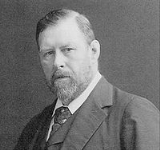
Abraham "Bram" Stoker (8 November 1847 – 20 April 1912) was an Irish novelist and short story writer, best known today for his 1897 horror novel Dracula. During his lifetime, he was better known as the personal assistant of actor Henry Irving and business manager of the Lyceum Theatre in London, which Irving owned.
as born in 1847 at 15 The Crescent, Marino, now located in Fairview, Dublin. His parents were Abraham Stoker (1799–1876) and the feminist Charlotte Mathilda Blake Thornely (1818–1901).

Discussion
Ask a question about 'Bram Stoker'
Start a new discussion about 'Bram Stoker'
Answer questions from other users
|
Quotations
Listen to them - children of the night. What music they make.
Dracula referring to the howling of the wolves to Jonathan Harker.
No man knows till he has suffered from the night how sweet and dear to his heart and eye the morning can be.
Jonathan Harker
I am Dracula, and I bid you welcome, Mr. Harker, to my house. Come in, the night air is chill, and you must need to eat and rest.
Dracula to Jonathan Harker
We are in Transylvania, and Transylvania is not England. Our ways are not your ways, and there shall be to you many strange things.
Dracula to Jonathan Harker
Nothing is too small. I counsel you, put down in record even your doubts and surmises. Hereafter it may be of interest to you to see how true you guess. We learn from failure, not from success!
Professor Van Helsing to Dr. Seward
Oh, friend John, it is a strange world, a sad world, a world full of miseries, and woes, and troubles. And yet when King Laugh come, he make them all dance to the tune he play.
Professor Van Helsing to Dr. Seward

Encyclopedia
Abraham "Bram" Stoker (8 November 1847 – 20 April 1912) was an Irish novelist and short story writer, best known today for his 1897 horror novel Dracula. During his lifetime, he was better known as the personal assistant of actor Henry Irving and business manager of the Lyceum Theatre in London, which Irving owned.
Early life
He was born in 1847 at 15 The Crescent, Marino, now located in Fairview, Dublin. His parents were Abraham Stoker (1799–1876) and the feminist Charlotte Mathilda Blake Thornely (1818–1901). Stoker was the third of seven children. Abraham and Charlotte were members of the Clontarf Church of Ireland parish and attended the parish church (St. John the Baptist located on Seafield Road West) with their children, who were baptised there.
Stoker was bed-ridden until he started school at the age of seven, when he made a complete recovery. Of this time, Stoker wrote, "I was naturally thoughtful, and the leisure of long illness gave opportunity for many thoughts which were fruitful according to their kind in later years."
After his recovery, he became a normal young man, even excelling as an athlete (he was named University Athlete) at Trinity College, Dublin , which he attended from 1864 to 1870. He graduated with honours in mathematics. He was auditor of the College Historical Society and president of the University Philosophical Society, where his first paper was on "Sensationalism in Fiction and Society".
Early career
In 1876, while employed as a civil servant in Dublin, Stoker wrote a non-fiction book (The Duties of Clerks of Petty Sessions in Ireland, published 1879) and became the theatre critic for the newspaper Dublin Evening Mail. In December 1876, he gave a favourable review of the actor Henry Irving's performance as Hamlet at the Theatre Royal in Dublin. Irving read the review and invited Stoker for dinner at the Shelbourne Hotel, where he was staying. After that they became friends. He also wrote stories, and in 1872 "The Crystal Cup" was published by the London Society, followed by "The Chain of Destiny" in four parts in The Shamrock.
Lyceum Theatre and later career
In 1878 Stoker married Florence Balcombe, a celebrated beauty whose former suitor was Oscar Wilde. The couple moved to London, where Stoker became acting-manager and then business manager of Irving's Lyceum Theatre, London, a post he held for 27 years. On 31 December 1879, Bram and Florence's only child was born, a son that they christened Irving Noel Thornley Stoker. The collaboration with Irving was very important for Stoker and through him he became involved in London's high society, where he met, among other notables, James Abbott McNeill Whistler and Sir Arthur Conan Doyle (to whom he was distantly related). Working for Irving, the most famous actor of his time, and managing one of the most successful and busy theatres in London made Stoker a notable if very busy man. He was absolutely dedicated to Irving and his memoirs of Irving show how he idolised him. In London Stoker also met Hall Caine who became one of his closest friends and he dedicated Dracula to him.
In the course of Irving's tours, Stoker got the chance to travel around the world though he never visited Eastern Europe, scene of part of his most famous novel. Stoker particularly enjoyed visits to the United States and Irving was very popular there and with Irving he was invited twice to the White House and knew both William McKinley and Theodore Roosevelt. Stoker was a great admirer of the country setting two of his novels there and using Americans as characters most notable being Quincey Morris. He also got a chance to meet one of his literary idols Walt Whitman.
Stoker supplemented his income by writing novels; the best known being the vampire tale Dracula which was published in 1897. Before writing Dracula, Stoker spent several years researching European folklore and stories of vampires. Dracula is an epistolary novel, written as collection of diary entries, telegrams, and letters from the characters, as well as fictional clippings from the Whitby and London newspapers. Stoker's inspirations for the story, in addition to Whitby, may have included a visit to Slains Castle in Aberdeenshire, and a visit to the crypts of St. Michan's Church in Dublin.
Death
After suffering a number of strokes Bram Stoker died at No 26 St George's Square in 1912. Some biographers attribute the cause of death to tertiary syphilis. He was cremated and his ashes placed in a display urn at Golders Green Crematorium. After Irving Noel Stoker's death in 1961, his ashes were added to that urn. The original plan had been to keep his parents' ashes together, but after Florence Stoker's death her ashes were scattered at the Gardens of Rest.
Beliefs and Philosophy
Stoker was brought up as a Protestant in the Church of Ireland. Stoker was a strong supporter of the Liberal party and was what he called a "philosophical Home Ruler" believing in Home Rule for Ireland brought about by peaceful means but as an ardent monarchist he believed that Ireland should remain within the British Empire which he believed was a force for good. He was a great admirer of Prime Minister William Gladstone whom he knew personally and admired his plans for Ireland.
Stoker had a strong interest in science and medicine and a belief in progress. Some of his novels like The Lady of the Shroud (1909) can be seen as science fiction. Like many people of his time Stoker believed in the concept of scientific racism drawing on his belief in Phrenology and these fears form elements in novels like Dracula. This is also reflected in his interest in early theories of criminology he read both Cesare Lombroso and Max Nordau and used them in Dracula. Stoker was also sexist by modern standards and strongly opposed to the idea of the New Woman and several of his novels use this as a theme with the danger of assertive woman represented by a Femme fatale.
Stoker had an interest in the occult especially mesmerism, but was also wary of occult fraud and believed strongly that superstition should be replaced by more scientific ideas. In the mid 1890s, Stoker is rumoured to have become a member of the Hermetic Order of the Golden Dawn, though there is no concrete evidence to support this claim. One of Stoker's closest friends was J.W. Brodie-Innis, a major figure in the Order, and Stoker himself hired Pamela Coleman Smith, as an artist at the Lyceum Theater.
Posthumous
The short story collection Dracula's Guest and Other Weird Stories was published in 1914 by Stoker's widow Florence Stoker. The first film adaptation of Dracula was named Nosferatu. It was directed by Friedrich Wilhelm Murnau and starred Max Schreck as Count Orlock. Nosferatu was produced while Florence Stoker, Bram Stoker's widow and literary executrix, was still alive. Represented by the attorneys of the British Incorporated Society of Authors, she eventually sued the filmmakers. Her chief legal complaint was that she had been neither asked for permission for the adaptation nor paid any royalty. The case dragged on for some years, with Mrs. Stoker demanding the destruction of the negative and all prints of the film. The suit was finally resolved in the widow's favour in July 1925. Some copies of the film survived, however and the film has become well known.
Bibliography
Novels
* The Primrose Path (1875)
Short story collections
Uncollected stories
- "Bridal of Dead" (alternate ending to The Jewel of Seven Stars)
- "Buried Treasures"
- "The Chain of Destiny"
- "The Crystal Cup"
- "The Dualitists; or, The Death Doom of the Double Born"
- "Lord Castleton Explains" (chapter 10 of The Fate of Fenella)
- "The Gombeen Man" (chapter 3 of The Snake's Pass)
- "In the Valley of the Shadow"
- "The Man from Shorrox"
- "Midnight Tales"
- "The Red Stockade"
- "The Seer" (chapters 1 and 2 of The Mystery of the Sea)
Non-fiction
- The Duties of Clerks of Petty Sessions in Ireland (1879)
- A Glimpse of America (1886)
- Personal Reminiscences of Henry Irving (1906)
- Famous Impostors (1910)
- Bram Stoker's Notes for Dracula: A Facsimile Edition (2008) Bram Stoker Annotated and Transcribed by Robert Eighteen-Bisang and Elizabeth Miller, Foreword by Michael Barsanti. Jefferson NC & London: McFarland. ISBN 978-0-7864-3410-7
Critical Works on Stoker
External links
-
-
-
-
- Gothic and Stoker Studies at Bath Spa University
Online texts
|