
Home      Discussion      Topics      Dictionary      Almanac
Signup       Login
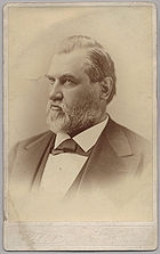
Leland Stanford

Leland Stanford

Overview
Amasa Leland Stanford was an American tycoon, industrialist, robber baron
Robber baron (industrialist)
Robber baron is a pejorative term used for a powerful 19th century American businessman. By the 1890s the term was used to attack any businessman who used questionable practices to become wealthy...

, politician
Politician
A politician, political leader, or political figure is an individual who is involved in influencing public policy and decision making...

 and founder of Stanford University
Stanford University
The Leland Stanford Junior University, commonly referred to as Stanford University or Stanford, is a private research university on an campus located near Palo Alto, California. It is situated in the northwestern Santa Clara Valley on the San Francisco Peninsula, approximately northwest of San...

.
Discussion
Ask a question about 'Leland Stanford'
Start a new discussion about 'Leland Stanford'
Answer questions from other users
Full Discussion Forum
 
Unanswered Questions
Recent Discussions
Encyclopedia
Amasa Leland Stanford was an American tycoon, industrialist, robber baron
Robber baron (industrialist)
Robber baron is a pejorative term used for a powerful 19th century American businessman. By the 1890s the term was used to attack any businessman who used questionable practices to become wealthy...

, politician
Politician
A politician, political leader, or political figure is an individual who is involved in influencing public policy and decision making...

 and founder of Stanford University
Stanford University
The Leland Stanford Junior University, commonly referred to as Stanford University or Stanford, is a private research university on an campus located near Palo Alto, California. It is situated in the northwestern Santa Clara Valley on the San Francisco Peninsula, approximately northwest of San...

.

Early years


Stanford was born in 1824 in what was then Watervliet
Watervliet (town), New York
For the Shaker village, see Watervliet Shaker Historic District.The town of Watervliet was a town that at its height encompassed most of present-day Albany County and the majority of the current town of Niskayuna in neighboring Schenectady County, in the state of New York, United States...

, New York
New York
New York is a state in the Northeastern region of the United States. It is the nation's third most populous state. New York is bordered by New Jersey and Pennsylvania to the south, and by Connecticut, Massachusetts and Vermont to the east...

 (in what is now the town of Colonie
Colonie (town), New York
Colonie is a town in Albany County, New York, United States. It is the most populous suburb of Albany, New York, and is the third largest town in area in Albany County, occupying about 11% of the county. Several hamlets exist within the town. As of the 2010 census, the town had a total population...

). He was one of eight children of Josiah and Elizabeth Phillips Stanford. Stanford was raised on family farms in Lisha Kill
Lisha Kill, New York
Lisha Kill is a hamlet in the town of Colonie, Albany County, New York. Lisha Kill lies on New York Route 5 in the western section of the town. The hamlet received its name from the creek of the same name, Lisha Kill, kill being Dutch for creek or stream...

 and Roessleville
Roessleville, New York
Roessleville is a hamlet in the town of Colonie, Albany County, New York. It is a densely settled suburb of the city of Albany along New York State Route 5...

 (after 1836) areas of Watervliet. The family home in Roessleville was called Elm Grove. The Elm Grove home was razed in the 1940s. His immigrant ancestor, Thomas Stanford, settled in Charlestown, Massachusetts
Charlestown, Massachusetts
Charlestown is a neighborhood of Boston, Massachusetts, United States, and is located on a peninsula north of downtown Boston. Charlestown was originally a separate town and the first capital of the Massachusetts Bay Colony; it became a city in 1847 and was annexed by Boston on January 5, 1874...

, in the 17th century. Later ancestors settled in the Mohawk Valley of New York about 1720. Stanford's father was a farmer of some means. Stanford attended the common schools until 1836 and was tutored at home until 1839. He attended Clinton Liberal Institute, in Clinton, New York
Clinton, Oneida County, New York
Clinton is a village in Oneida County, New York, United States. The population was 1,952 at the 2000 census. It was named for George Clinton, a royal governor of the colony of New York....

, and studied law at Cazenovia Seminary
Cazenovia College
Cazenovia College is a small, independent, co-educational, baccalaureate college, located in Cazenovia, New York. Cazenovia offers a comprehensive liberal arts education with academic and co-curricular programs devoted to developing leaders in their professional fields. Cazenovia College has been...

 in Cazenovia, New York
Cazenovia (village), New York
Cazenovia is a village located in the Town of Cazenovia in Madison County, New York, United States. As of the 2000 census, the village had a population of 2,614. The village lies on the southeast shore of Cazenovia Lake, which is approximately long and .5 miles across...

 in 1841-45. In 1845, he entered the law office of Wheaton, Doolittle and Hadley in Albany
Albany, New York
Albany is the capital city of the U.S. state of New York, the seat of Albany County, and the central city of New York's Capital District. Roughly north of New York City, Albany sits on the west bank of the Hudson River, about south of its confluence with the Mohawk River...

.

Stanford was admitted to the bar in 1848, and then moved to Port Washington, Wisconsin
Port Washington, Wisconsin
Port Washington is the county seat of Ozaukee County in the U.S. state of Wisconsin. The city is about 25 miles north of Milwaukee and 110 miles north of Chicago. In the 2000 census Port Washington had a population of 10,467...

, where he began law practice with Wesley Pierce. His father presented him with a law library said to be the finest north of Milwaukee. On September 30, 1850, he married Jane Elizabeth Lathrop
Jane Stanford
Jane Stanford was the co-founder of Stanford University with her husband, Leland Stanford, whom she wed in 1850. She was the daughter of a shopkeeper and lived on Washington Avenue in Albany, New York, before her marriage...

 in Albany. She was the daughter of Dyer Lathrop, a merchant of that city, and Jane Anne (Shields) Lathrop. The couple were the parents of one son, Leland Stanford, Jr.
Leland Stanford, Jr.
Leland Stanford Jr. , Leland DeWitt Stanford until age nine, was the only child of Governor Leland Stanford of California and his wife Jane Stanford née Lathrop, and is the namesake of Stanford University in Palo Alto, California, United States.Leland Jr...

, born in 1868 when both were middle-aged.

In 1850, Stanford was nominated by the Whig Party
Whig Party (United States)
The Whig Party was a political party of the United States during the era of Jacksonian democracy. Considered integral to the Second Party System and operating from the early 1830s to the mid-1850s, the party was formed in opposition to the policies of President Andrew Jackson and his Democratic...

 as Washington County, Wisconsin District Attorney.

Businesses


In 1852, having lost his law library and other property by fire, he moved to California during the California Gold Rush
California Gold Rush
The California Gold Rush began on January 24, 1848, when gold was found by James W. Marshall at Sutter's Mill in Coloma, California. The first to hear confirmed information of the gold rush were the people in Oregon, the Sandwich Islands , and Latin America, who were the first to start flocking to...

. His wife Jane remained in Albany with her family. He went into business with his five brothers, who had preceded him to the Pacific coast. Stanford was keeper of a general store for miners at Michigan Flat in Placer County, and later had a wholesale house. He served as a Justice of the Peace
Justice of the Peace
A justice of the peace is a puisne judicial officer elected or appointed by means of a commission to keep the peace. Depending on the jurisdiction, they might dispense summary justice or merely deal with local administrative applications in common law jurisdictions...

 and helped organize the Sacramento Library Association, which later became the Sacramento Public Library. In 1855, he returned to Albany to join his wife. Stanford found the pace of Eastern life too slow, and in 1856, he and Jane moved to San Francisco and engaged in mercantile pursuits on a large scale.

Stanford was one of the four major Sacramento, California
Sacramento, California
Sacramento is the capital city of the U.S. state of California and the county seat of Sacramento County. It is located at the confluence of the Sacramento River and the American River in the northern portion of California's expansive Central Valley. With a population of 466,488 at the 2010 census,...

 businessmen known popularly as "The Big Four" (or among themselves as "the Associates") that were the key investors in the Central Pacific Railroad
Central Pacific Railroad
The Central Pacific Railroad is the former name of the railroad network built between California and Utah, USA that formed part of the "First Transcontinental Railroad" in North America. It is now part of the Union Pacific Railroad. Many 19th century national proposals to build a transcontinental...

 that was incorporated on June 28, 1861, and of which Stanford was elected president. His other three associates were Charles Crocker
Charles Crocker
Charles Crocker was an American railroad executive.-Early years:Crocker was born in Troy, New York, to a modest family and moved to an Indiana farm at age 14. He soon became independent, working on several farms, a sawmill, and at an iron forge. In 1845 he founded a small, independent iron...

, Mark Hopkins, and Collis P. Huntington with Theodore Dehone Judah as the nascent company's chief engineer. In 1861, he was again nominated (the first run was in 1859) to run for Governor of California, and this time he was elected. The railroad's first locomotive, named "Gov. Stanford
Gov. Stanford
Gov. Stanford is a 4-4-0 steam locomotive originally built in 1862 by Norris Locomotive Works. It entered service on November 9, 1863 and it was used in the construction of the First Transcontinental Railroad in North America by Central Pacific Railroad bearing road number 1...

" in his honor, is on display today at the California State Railroad Museum
California State Railroad Museum
The California State Railroad Museum is a museum in the state park system of California, USA, interpreting the role of the "iron horse" in connecting California to the rest of the nation. It is located in Old Sacramento at 111 I Street....

 in Sacramento.

In May 1868, he joined Lloyd Tevis
Lloyd Tevis
Lloyd Tevis was a banker and capitalist who served as president of Wells Fargo & Company from 1872 to 1892.-Early life:...

, Darius Ogden Mills
Darius Ogden Mills
Darius Ogden Mills was a prominent American banker, philanthropist and, for a time, California's wealthiest citizen.-Biography:...

, H.D. Bacon, Hopkins, and Crocker in forming the Pacific Union Express Company, which merged in 1870 with Wells Fargo and Company. As head of the railroad company which built the western portion of the "First Transcontinental Railroad" over the Sierra Nevada mountains in California, Nevada, and Utah, Stanford presided at the ceremonial driving of "Last Spike"
Golden spike
The "Golden Spike" is the ceremonial final spike driven by Leland Stanford to join the rails of the First Transcontinental Railroad across the United States connecting the Central Pacific and Union Pacific railroads on May 10, 1869, at Promontory Summit, Utah Territory...

 in Promontory, Utah
Promontory, Utah
Promontory in Box Elder County, Utah, United States, is notable as the location of Promontory Summit where the United States' Transcontinental Railroad was officially completed on May 10, 1869....

 on May 10, 1869, where the grade of the CPRR met that of the Union Pacific Railroad
Union Pacific Railroad
The Union Pacific Railroad , headquartered in Omaha, Nebraska, is the largest railroad network in the United States. James R. Young is president, CEO and Chairman....

, which had been built west from its eastern terminus at Council Bluffs, Iowa
Council Bluffs, Iowa
Council Bluffs, known until 1852 as Kanesville, Iowathe historic starting point of the Mormon Trail and eventual northernmost anchor town of the other emigrant trailsis a city in and the county seat of Pottawattamie County, Iowa, United States and is on the east bank of the Missouri River across...

/Omaha, Nebraska
Omaha, Nebraska
Omaha is the largest city in the state of Nebraska, United States, and is the county seat of Douglas County. It is located in the Midwestern United States on the Missouri River, about 20 miles north of the mouth of the Platte River...

.

While the Central Pacific was still abuilding, Stanford and his associates acquired control of the Southern Pacific Railroad
Southern Pacific Railroad
The Southern Pacific Transportation Company , earlier Southern Pacific Railroad and Southern Pacific Company, and usually simply called the Southern Pacific or Espee, was an American railroad....

 in 1868. Stanford was elected president of the Southern Pacific, a post he held (except for a brief period in 1869-70 when Tevis was acting president) until ousted by Huntington in 1890.

Stanford was a director of Wells Fargo and Company from 1870 to January 1884 and, after a brief retirement from the board, again from February 1884 until his death in June 1893.

In 1872, Stanford commissioned Eadweard Muybridge
Eadweard Muybridge
Eadweard J. Muybridge was an English photographer who spent much of his life in the United States. He is known for his pioneering work on animal locomotion which used multiple cameras to capture motion, and his zoopraxiscope, a device for projecting motion pictures that pre-dated the flexible...

 to use newly invented photographic technology to establish whether a trotting horse ever has all four feet off the ground simultaneously, which, it was found, they do. This project using one of Stanford's own trotting horses, Occident, which illustrated motion through a series of still images viewed together, was a forerunner of motion picture technology.

Stanford moved to San Francisco in 1874, where he assumed presidency of the Occidental and Oriental Steamship Company, the steamship line to Japan
Japan
Japan is an island nation in East Asia. Located in the Pacific Ocean, it lies to the east of the Sea of Japan, China, North Korea, South Korea and Russia, stretching from the Sea of Okhotsk in the north to the East China Sea and Taiwan in the south...

 and China
China
Chinese civilization may refer to:* China for more general discussion of the country.* Chinese culture* Greater China, the transnational community of ethnic Chinese.* History of China* Sinosphere, the area historically affected by Chinese culture...

 associated with the Central Pacific.

The Southern Pacific Company was organized in 1884 as a holding company for the Central Pacific-Southern Pacific system. Stanford was president of the Southern Pacific Company from 1885 until 1890, when he was forced out of that post, as well as the presidency of the Southern Pacific Railroad, by Huntington in revenge for Stanford's election to the United States Senate
United States Senate
The United States Senate is the upper house of the bicameral legislature of the United States, and together with the United States House of Representatives comprises the United States Congress. The composition and powers of the Senate are established in Article One of the U.S. Constitution. Each...

 in 1885 over Huntington's friend, A.A. Sargent. Stanford was elected chairman of the Southern Pacific Railroad's executive committee in 1890, and he held this post and the presidency of the Central Pacific Railroad until his death.

He owned two wineries, the Stanford Brothers Winery in Alameda County
Alameda County, California
Alameda County is a county in the U.S. state of California. It occupies most of the East Bay region of the San Francisco Bay Area. As of the 2010 census it had a population of 1,510,271, making it the 7th most populous county in the state...

 founded in 1869, and run by brother Josiah, and the 55000 acres (223 km²) Great Vina Ranch
Rancho Bosquejo
Rancho Bosquejo was a Mexican land grant in present day Tehama County, California given in 1844 by Governor Manuel Micheltorena to Peter Lassen. The name means "Wooded Ranch" in Spanish...

 in Tehama County
Tehama County, California
Tehama County is a county located in the northern part of the U.S. state of California. It is bisected by the Sacramento River. As of 2010 its population was 63,463, up from 56,039 as of 2000. The county seat is Red Bluff.-History:...

, containing what was then the largest vineyard in the world at 3575 acres (14 km²). He also owned the Gridley tract
Rancho Esquon
Rancho Esquon was a Mexican land grant in present day Butte County, California given in 1844 by Governor Manuel Micheltorena to Samuel Neal. The grant, located south of present day Chico, extended on the east bank of Butte Creek, and encompassed present day Durham, Esquon, Gridley, and Nelson...

 of 17800 acres (72 km²) in Butte County
Butte County, California
Butte County is a county located in the Central Valley of the US state of California, north of the state capital of Sacramento. As of the 2010 census, it had a population of 220,000. The county seat is Oroville. Butte County is the "Land of Natural Wealth and Beauty."Butte County is watered by the...

 and the Palo Alto Stock Farm in Santa Clara County
Santa Clara County, California
Santa Clara County is a county located at the southern end of the San Francisco Bay Area in the U.S. state of California. As of 2010 it had a population of 1,781,642. The county seat is San Jose. The highly urbanized Santa Clara Valley within Santa Clara County is also known as Silicon Valley...

, which was the home of his famous Standardbred horses: Electioneer, Arion, Sunol, Palo Alto, Beautiful Bells, and Chimes. The Palo Alto breeding farm gave Stanford University
Stanford University
The Leland Stanford Junior University, commonly referred to as Stanford University or Stanford, is a private research university on an campus located near Palo Alto, California. It is situated in the northwestern Santa Clara Valley on the San Francisco Peninsula, approximately northwest of San...

 its nickname of "The Farm". The Stanfords also owned a stately mansion in Sacramento, California
Sacramento, California
Sacramento is the capital city of the U.S. state of California and the county seat of Sacramento County. It is located at the confluence of the Sacramento River and the American River in the northern portion of California's expansive Central Valley. With a population of 466,488 at the 2010 census,...

, which was the birthplace of their only son, and is now the Leland Stanford Mansion State Historic Park
Leland Stanford Mansion State Historic Park
Leland Stanford Mansion State Historic Park is a state and federally protected area in Sacramento, California. It features the Leland Stanford House, a mansion once owned by Leland Stanford, Governor of California from 1862 to 1863, U.S. Senator from 1885 to 1893, railroad tycoon, member of the Big...

, a house museum used for California state social occasions. The home they owned in San Francisco's Nob Hill district, which was destroyed in the 1906 San Francisco earthquake
1906 San Francisco earthquake
The San Francisco earthquake of 1906 was a major earthquake that struck San Francisco, California, and the coast of Northern California at 5:12 a.m. on Wednesday, April 18, 1906. The most widely accepted estimate for the magnitude of the earthquake is a moment magnitude of 7.9; however, other...

, is now the site of the Stanford Court Hotel
Stanford Court Hotel
The Stanford Court Renaissance San Francisco is a Marriott Renaissance Hotel at 905 California Street on Nob Hill in San Francisco, California. The hotel is located between Fisherman's Wharf and Union Square and is directly on the cable car line. It has 393 rooms on eight floors. All the rooms have...

.

Politics


Stanford, a leading member of the Republican Party, was politically active. In 1856, he met with other Whig politicians in Sacramento to organize the California Republican Party
California Republican Party
The California Republican Party is the California affiliate of the United States Republican Party. The party chairman is Tom Del Beccaro and is based in Burbank, California, a suburb of Los Angeles. The RPC also has a headquarters in Sacramento....

 at its first state convention on April 30. He was chosen as a delegate to the Republican Party convention which selected US presidential electors in both 1856 and 1860. Stanford was defeated in his 1857 bid for California State Treasurer, and his 1859 bid for the office of Governor of California. In 1860, he was named a delegate to the Republican National Convention in Chicago, but did not attend. He was finally elected governor in 1861.

He was the eighth Governor of California, serving from January 1862 to December 1863, and the first Republican governor. Due to large winter storm
Winter storm
A winter storm is an event in which the dominant varieties of precipitation are formed that only occur at low temperatures, such as snow or sleet, or a rainstorm where ground temperatures are low enough to allow ice to form...

 floods, the governor was said to have needed to row in a boat to his own inauguration. A large, slow-speaking man who always read from a prepared text, he impressed his listeners as being more sincere than a glib, extemporaneous speaker.

The gold strike in California had brought a large influx of newcomers into the territory. The Chinese immigrants, in particular, were subject to persecution in the gold fields and in small towns and cities, as well. Anti-Chinese sentiment became an official political issue over time. Stanford, as governor, ostensibly supported the prevailing mood in the state, which lobbied for the restriction of Chinese immigration. In a message to the legislature in January 1862, Stanford proclaimed, “The presence of numbers of that degraded and distinct people would exercise a deleterious effect upon the superior race.” His pronouncement was initially received with widespread enthusiasm, and Stanford was lauded as a defender of the white race. Public opinion shifted when Stanford's blatant hypocrisy was disclosed. As the head of the Central Pacific, Stanford oversaw a corporation which imported thousands of Chinese laborers in the construction of the railroad.

During his gubernatorial tenure, he cut the state's debt in half, and advocated for the conservation of forests. He also oversaw the establishment of the California's first state normal school
Normal school
A normal school is a school created to train high school graduates to be teachers. Its purpose is to establish teaching standards or norms, hence its name...

 in San José, later to become San José State University
San José State University
San Jose State University is a public university located in San Jose, California, United States...

. Following Stanford's governorship, the term of office changed from two years to four years, in line with legislation passed during his time in office.

Later, he served in the United States Senate
United States Senate
The United States Senate is the upper house of the bicameral legislature of the United States, and together with the United States House of Representatives comprises the United States Congress. The composition and powers of the Senate are established in Article One of the U.S. Constitution. Each...

 from 1885 until his death in 1893. He served for four years as Chairman of the U.S. Senate Committee on Public Buildings and Grounds,
and also served on the Naval Committee. He authored several Senate bills that advanced ideas advocated by the Populists: a bill to foster the creation of worker-owned cooperatives
Worker cooperative
A worker cooperative is a cooperative owned and democratically managed by its worker-owners. This control may be exercised in a number of ways. A cooperative enterprise may mean a firm where every worker-owner participates in decision making in a democratic fashion, or it may refer to one in which...

, and a bill to allow the issuance of currency backed by land value instead of only the gold standard
Gold standard
The gold standard is a monetary system in which the standard economic unit of account is a fixed mass of gold. There are distinct kinds of gold standard...

. Neither bill made it out of committee. In Washington, D.C.
Washington, D.C.
Washington, D.C., formally the District of Columbia and commonly referred to as Washington, "the District", or simply D.C., is the capital of the United States. On July 16, 1790, the United States Congress approved the creation of a permanent national capital as permitted by the U.S. Constitution....

, he had a residence on Farragut Square near the home of Baron Karl von Struve
Karl de Struve
Karl von Struve was a Russian nobleman and politician. He served, in turn, as Russian Envoy Extraordinary and Minister Plenipotentiary to Japan, the United States, and The Netherlands....

, Russian minister to the United States.

Stanford University


With wife Jane, Stanford founded Leland Stanford Junior University
Stanford University
The Leland Stanford Junior University, commonly referred to as Stanford University or Stanford, is a private research university on an campus located near Palo Alto, California. It is situated in the northwestern Santa Clara Valley on the San Francisco Peninsula, approximately northwest of San...

 as a memorial for their only child, Leland Stanford, Jr.
Leland Stanford, Jr.
Leland Stanford Jr. , Leland DeWitt Stanford until age nine, was the only child of Governor Leland Stanford of California and his wife Jane Stanford née Lathrop, and is the namesake of Stanford University in Palo Alto, California, United States.Leland Jr...

, who died as a teenager of typhoid in Florence, Italy, in 1884 while on a trip to Europe. The University was established by the March 9, 1885, Endowment Act of the California Assembly and Senate, and the Grant of Endowment from Leland and Jane Stanford signed at the first meeting of the Board of Trustees on November 14, 1885. Besides defining the operational structure of the University, the Grant of Endowment makes only these specific stipulations:
"The Trustees . . . shall have the power and it shall be their duty:
  • To establish and maintain at such University an educational system, which will, if followed, fit the graduate for some useful pursuit, and to this end to cause the pupils, as easily as may be, to declare the particular calling, which, in life, they may desire to pursue . . .
  • To prohibit sectarian instruction, but to have taught in the University the immortality of the soul, the existence of an all-wise and benevolent Creator, and that obedience to His laws is the highest duty of man.
  • To have taught in the University the right and advantages of association and co-operation.
  • To afford equal facilities and give equal advantages in the University to both sexes.
  • To maintain on the Palo Alto estate a farm for instruction in agriculture in all its branches."


Approximately US$20 million (US$400 million in 2005 dollars
Inflation
In economics, inflation is a rise in the general level of prices of goods and services in an economy over a period of time.When the general price level rises, each unit of currency buys fewer goods and services. Consequently, inflation also reflects an erosion in the purchasing power of money – a...

) initially went into the university, which held its opening exercises October 1, 1891. Its first student, admitted to Encina Hall that day, was Herbert Hoover
Herbert Hoover
Herbert Clark Hoover was the 31st President of the United States . Hoover was originally a professional mining engineer and author. As the United States Secretary of Commerce in the 1920s under Presidents Warren Harding and Calvin Coolidge, he promoted partnerships between government and business...

. The wealth of the Stanford family during the late 19th century is estimated at about US$50 million ($US1 billion in 2005 dollars
Inflation
In economics, inflation is a rise in the general level of prices of goods and services in an economy over a period of time.When the general price level rises, each unit of currency buys fewer goods and services. Consequently, inflation also reflects an erosion in the purchasing power of money – a...

).

Personal life


Leland Stanford was an active Freemason from 1850 (Prometheus Lodge No. 17 in Port Washington, WI, and then in Michigan City Lodge No. 47 in Michigan City, CA) until 1855 when he withdrew.** He was also a member of the Independent Order of Odd Fellows in California
Independent Order of Odd Fellows
The Independent Order of Odd Fellows , also known as the Three Link Fraternity, is an altruistic and benevolent fraternal organization derived from the similar British Oddfellows service organizations which came into being during the 18th century, at a time when altruistic and charitable acts were...


Long suffering from locomotor ataxia
Locomotor ataxia
Locomotor ataxia is the inability to precisely control one's own bodily movements. Persons afflicted with this disease may walk in a jerky, nonfluid manner. They will not know where their arms and legs are without looking, but can, for instance, feel and locate a hot object placed against their feet...

, Leland Stanford died of heart failure at home in Palo Alto, California
Palo Alto, California
Palo Alto is a California charter city located in the northwest corner of Santa Clara County, in the San Francisco Bay Area of California, United States. The city shares its borders with East Palo Alto, Mountain View, Los Altos, Los Altos Hills, Stanford, Portola Valley, and Menlo Park. It is...

 on June 21, 1893, and is buried in the Stanford family mausoleum
Stanford Mausoleum
The Stanford Mausoleum, located in the northwest of the Stanford University campus in the Stanford University Arboretum, holds the remains of the university's namesake Leland Stanford, Jr...

 on the Stanford campus. Jane Stanford died in 1905.
    • Reference from 10,000 Famous Freemasons by William R. Denslow and the Proceedings of the Grand Lodge of F. & A.M. of California

Legacy


Central Pacific locomotives named for Stanford were:
  • Gov. Stanford
    Gov. Stanford
    Gov. Stanford is a 4-4-0 steam locomotive originally built in 1862 by Norris Locomotive Works. It entered service on November 9, 1863 and it was used in the construction of the First Transcontinental Railroad in North America by Central Pacific Railroad bearing road number 1...

    , a 4-4-0
    4-4-0
    Under the Whyte notation for the classification of steam locomotives, 4-4-0 represents the wheel arrangement of four leading wheels on two axles , four powered and coupled driving wheels on two axles, and no trailing wheels...

     locomotive built in 1863 by the Norris Locomotive Works
    Norris Locomotive Works
    The Norris Locomotive Works was a steam locomotive manufacturing company based in Philadelphia, Pennsylvania, that produced about a thousand railroad engines between 1832 and 1866. It was the dominant American locomotive producer during most of that period, and even sold its popular 4-2-0 engines...

     in Philadelphia
    Philadelphia, Pennsylvania
    Philadelphia is the largest city in the Commonwealth of Pennsylvania and the county seat of Philadelphia County, with which it is coterminous. The city is located in the Northeastern United States along the Delaware and Schuylkill rivers. It is the fifth-most-populous city in the United States,...

     and brought to San Francisco by sailing vessel. This engine is preserved at the California State Railroad Museum
    California State Railroad Museum
    The California State Railroad Museum is a museum in the state park system of California, USA, interpreting the role of the "iron horse" in connecting California to the rest of the nation. It is located in Old Sacramento at 111 I Street....

     in Sacramento
    Sacramento, California
    Sacramento is the capital city of the U.S. state of California and the county seat of Sacramento County. It is located at the confluence of the Sacramento River and the American River in the northern portion of California's expansive Central Valley. With a population of 466,488 at the 2010 census,...

    .
  • El Gobernador
    El Gobernador
    El Gobernador was a 4-10-0 steam locomotive built by Central Pacific Railroad at the railroad's Sacramento, California shops. It was the last of Central Pacific's locomotives to receive an official name and was also the only locomotive of this wheel arrangement to operate on United States rails...

    , a 4-10-0
    4-10-0
    Under the Whyte notation for the classification of steam locomotives, 4-10-0 represents the wheel arrangement of four leading wheels, ten powered and coupled driving wheels, and no trailing wheels. Central Pacific Railroad's El Gobernador, built in 1883, was the only locomotive with this wheel...

     locomotive built in the Central Pacific shops in Sacramento in 1884. Disappointing in its performance as a freight hauler, it was quietly scrapped in July 1894.


The on-campus Stanford Memorial Church
Stanford Memorial Church
Stanford Memorial Church is located at the center of the Stanford University campus in Stanford, California, United States. It was built during the American Renaissance by Jane Stanford as a memorial to her husband Leland. Designed by architect Charles A...

 is also dedicated to his memory.

Stanford was inducted into the The California Museum for History, Women and the Arts
The California Museum for History, Women and the Arts
The California Museum, formerly The California Museum for History, Women and the Arts – home of the California Hall of Fame – is housed in the State Archives Building in Sacramento, one block from the State Capitol...

, California Hall of Fame
California Hall of Fame
Conceived by First Lady Maria Shriver, the California Hall of Fame was established at The California Museum for History, Women and the Arts to honor individuals and families who embody California’s innovative spirit and have made their mark on history...

 on December 15, 2008. Tom Stanford accepted the honors on his behalf.

External links