


Taiping Rebellion

Encyclopedia
The Taiping Rebellion was a widespread civil war
in southern China
from 1850 to 1864, led by heterodox
Christian
convert Hong Xiuquan
, who, having received visions, maintained that he was the younger brother of Jesus Christ, against the ruling Manchu
-led Qing Dynasty
. About 20 million people died, mainly civilians, in one of the deadliest military conflicts in history.
Hong established the Taiping Heavenly Kingdom
with its capital at Nanjing
. The Kingdom's army controlled large parts of southern China, at its height containing about 30 million people. The rebels attempted social reforms believing in shared "property in common" and the replacement of Confucianism
, Buddhism
and Chinese folk religion
with a form of Christianity. The Taiping troops were nicknamed "Longhairs" by the Qing government. The Taiping areas were besieged by Qing forces throughout most of the rebellion. The Qing government crushed the rebellion with the eventual aid of French
and British
forces.
In the 20th century, Sun Yat-sen
, founder of the Chinese Nationalist Party, looked on the rebellion as an inspiration, and Chinese paramount leader
Mao Zedong
glorified the Taiping rebels as early heroic revolutionaries against a corrupt feudal system
.
in the mid-19th century, suffered a series of natural disasters, economic problems and defeats at the hands of the Western powers; in particular, the humiliating defeat in 1842 by the United Kingdom
in the First Opium War
. The Qing government, ethnically Manchu
, were seen by much of the Chinese population, who were mainly Han Chinese
, as ineffective and corrupt foreign rulers. Anti-Manchu sentiment was strongest in the south among the laboring classes and it was these disaffected who flocked to join the charismatic visionary Hong Xiuquan, a member of the Hakka
ethnic group which had emigrated to the south in the Song dynasty. Having arrived too late to acquire the best land, they were engaged in constant conflicts. Among these serious problems were the prevalence of female infanticide, creating massive imbalances with shortages of women being worst in the primary Taiping centers.
 At the age of thirty-seven, after failing on multiple occasions to pass the imperial examinations (about 5 percent of those who attempted the examinations passed them), which would have allowed access to the ranks of the ruling scholarly elite, Hong experienced a lengthy illness. After spending many days in bed, he recovered with a changed personality. He had received a pamphlet from a Protestant Christian missionary in 1836 after his last failed attempt at the imperial examination, and his cousin Li Ching-fang noticed the pamphlet on a bookshelf inside Hong's house. After reading it Li suggested that Hong should read the material. After studying the material, Hong Xiuquan claimed that the illness he had following his imperial examinations was in fact a vision to the effect that he was the younger brother of Jesus,who was sent to rid China of the "devils," including both the corrupt Manchu rulers and Confucius. After this vision, he felt it was his duty to spread Christianity (in the form that he developed) and overthrow the foreign rule of the Qing government. Hong's associate Yang Xiuqing
was a former firewood merchant from Guangxi
, who claimed to be able to act as a voice of God, in order to direct the people and gain political power.
The sect's power grew in the late 1840s, initially by suppressing groups of bandits and pirates; persecution by Qing authorities spurred the movement into a guerrilla rebellion
and then into widespread, bloody civil war
.
province. After a previous small-scale battle resulting in a rebel victory in late December 1850, in early January 1851, a ten thousand-strong rebel army organized by Feng Yunshan
and Wei Changhui
routed government troops stationed in the town of Jintian (present-day Guiping, Guangxi). Taiping forces successfully drove back the imperial reprisal against the Jintian Uprising
.
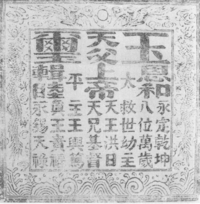 In 1853 Hong Xiuquan withdrew from active control of policies and administration, ruling exclusively by written proclamations that often had religious content. Hong disagreed with Yang Xiuqing in certain matters of policy and became increasingly suspicious of Yang's ambitions, his extensive network and spies, and his declarations when "speaking as God". Yang and his family were put to death by Hong's followers in 1856, followed by the killing of troops loyal to Yang.
With their leader largely out of the picture, Taiping delegates tried to widen their popular support with the Chinese middle classes and forge alliances with European powers, but failed on both counts. The Europeans decided to stay neutral. Inside China the rebellion faced resistance from the traditionalist middle class because of the rebels' hostility to Chinese customs and Confucian values. The land-owning upper class, unsettled by the Taipings' peasant mannerisms and their policy of strict separation of the sexes, even for married couples, sided with government forces and their Western allies.
In 1859 Hong Rengan
, a cousin of Hong Xiuquan, joined the Taiping forces in Nanjing and was given considerable power by Hong Xiuquan. He developed an ambitious plan to expand the Kingdom's boundaries. In 1860 the Taiping rebels were successful in taking Hangzhou
and Suzhou
to the east (see Second rout of the Jiangnan Daying), but failed to take Shanghai
(Battle of Shanghai (1861)
), which marked the beginning of the decline of the Kingdom.
in August 1860 was repulsed by a force of Qing imperial troops and European officers under the command of Frederick Townsend Ward
. This army would later become the "Ever Victorious Army
", led by "Chinese" Gordon
, and would be instrumental in the defeat of the Taiping rebels. Imperial forces were reorganized under the command of Zeng Guofan
and Li Hongzhang
, and the imperial reconquest began in earnest. By early 1864 imperial control in most areas was well established.
Hong Xiuquan declared that God would defend Nanjing, but in June 1864, with Qing imperial forces approaching, he died of food poisoning as a consequence of eating wild vegetables when the city ran low on food supplies. He was sick for 20 and a few days after his death Qing forces took the city. His body was buried in the former Ming Imperial Palace
where it was later exhumed by Zeng Guofan to verify his death, and then cremated. Hong's ashes were later blasted out of a cannon in order to ensure that his remains have no resting place as eternal punishment for the uprising.
Four months before the fall of the Taiping Heavenly Kingdom, Hong Xiuquan abdicated in favour of Hong Tianguifu
, his eldest son who was 15 years old. Hong Tianguifu was unable to do anything to restore the Kingdom, so the Kingdom was quickly destroyed when Nanjing fell in July 1864 to the imperial armies after vicious street-by-street fighting. Most of the princes were executed by Qing forces in Jinling, Nanjing.
and Fujian
alone. It would take more than half a decade to finally put down all remnants of the Taiping Rebellion: it was not until August 1871 that the last Taiping rebel army led by Shi Dakai
's commander, General Li Fuzhong (李福忠) was completely wiped out by the governmental forces in the border region of Hunan
, Guizhou
and Guangxi
.
in 1864, more than 100,000 were killed in three days.
The rebellion happened at roughly the same time as the American Civil War
. Though almost certainly the largest civil war of the 19th century (in terms of numbers under arms), it is debatable whether the Taiping Rebellion involved more soldiers than the Napoleonic Wars
earlier in the century, and so it is uncertain whether it should be considered the largest war of the 19th century
.
(1853–1868), and several Muslim
rebellions in the southwest (Panthay Rebellion, 1855–1873) and the northwest (Dungan revolt, 1862–1877) continued to pose considerable problems for the Qing Dynasty.
The Panthay Rebellion's leader Du Wenxiu was in contact with the Taiping Heavenly Kingdom. He was not aiming his rebellion at the Han Chinese, but was anti-Qing and wanted to destroy the Manchu government. Du's forces led multiple non-Muslim forces, including Han Chinese, Li
, Bai, and Hani
peoples. They were assisted by non-Muslim Shan and Kakhyen
and other hill tribes in the revolt.
The other Muslim rebellion, the Dungan revolt was the reverse: It was not aimed at overthrowing the Qing Dynasty since its leader Ma Hualong
accepted an imperial title. Rather, it erupted due to inter-sect fighting between Muslim factions and Han Chinese. Various groups fought each other during the Dungan revolt without any coherent goal. According to modern researchers, the Dungan rebellion began in 1862 not as a planned uprising, but as a coalescence of many local brawls and riots triggered by trivial causes. Among these were false rumours spread that the Hui Muslims were aiding the Taiping rebels. However, the Hui Ma Hsiao-shih claimed that the Shaanxi Muslim rebellion was connected to the Taiping.
 The rebels announced social reforms, including strict separation of the sexes, abolition of foot binding
, land socialization
and "suppression" of private trade. In religion, the Kingdom tried to replace Confucianism
, Buddhism
and Chinese folk religion
with a form of Christianity, holding that Hong Xiuquan was the younger brother of Jesus
. Troops were nicknamed "Longhairs", as they sported a traditional Confucian hairstyle different from the Qing queue
. Qing government papers refer to them as "hairy rebels" ' onMouseout='HidePop("63437")' href="/topics/Pinyin">pinyin
: fàzéi).
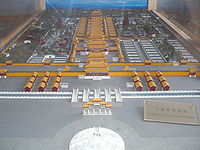
Within the land it controlled, the Taiping Heavenly Army established a theocratic
and highly militarized rule
. However, the rule was remarkably ineffective, haphazard and brutal; all efforts were concentrated on the army, and civil administration was non-existent. Rule was established in the major cities and the land outside the urban areas was little regarded. Even though polygamy
was banned, Hong Xiuquan had numerous concubines. Many high-ranking Taiping officials kept concubines as a matter of prerogative, and lived as de facto kings.
Combat was always bloody and extremely brutal, with little artillery but huge forces equipped with small arms. The Taiping Army's main strategy of conquest was to take major cities, consolidate their hold on the cities, then march out into the surrounding countryside to recruit local farmers and battle government forces. Estimates of the overall size of the Taiping Heavenly Army varied from 1,000,000 to 3,000,000.
The organization of a Taiping army corps was thus:
These corps were placed into armies of varying sizes. In addition to the main Taiping forces organized along the above lines, there were also thousands of pro-Taiping groups fielding their own forces of irregulars.
, a Han Chinese
subgroup, the Cantonese
, another Han Chinese subgroup that were the local residents of Guangdong
province and the Zhuang (a non-Han ethnic group), which were minority groups as compared to the Han Chinese subgroups that form dominant regional majorities across south China. It is no coincidence that Hong Xiuquan and the other Taiping royals were Hakka.
As a Han sub-group, the Hakka were frequently marginalized economically and politically, having migrated to the regions they inhabit only after other Han groups were already established there. For example, when the Hakka settled in Guangdong and parts of Guangxi
, speakers of Yue Chinese (Cantonese
) were already the dominant regional Han group there and had been for some time, just as speakers of various dialects of Min are locally dominant in Fujian
province. The Hakka settled throughout southern China and beyond, but as latecomers they generally had to establish their communities on rugged, less fertile land scattered on the fringe of the local majority group’s settlements. As their name ("guest households") suggests, the Hakka were generally treated as migrant newcomers, often subject to hostility and derision from local majority Han populations. Consequently, the Hakka, to a greater extent than other Han Chinese, have been historically associated with popular unrest and rebellion.
The other significant ethnic group in the Taiping army were the Zhuang, an indigenous people of Tai
origin and China's largest non-Han ethnic minority group. Over the centuries Zhuang communities had been adopting Han Chinese culture. This was possible because Han culture in the region accommodates a great deal of linguistic diversity, so the Zhuang could be absorbed as if the Zhuang languages were just more Han Chinese dialects. As Zhuang communities were integrating with the Han at different rates, a certain amount of friction between Han and Zhuang was inevitable, with Zhuang unrest on occasion leading to armed uprisings. The second tier of the Taiping army was an ethnic mix that included many Zhuang. Prominent at this level was Shi Dakai
, who was half-Hakka, half-Zhuang and spoke both languages fluently, making him quite a rare asset to the Taiping leadership.
In the later stages of the Taiping Rebellion, the number of Han Chinese in the army from Han groups other than the Hakka increased substantially. However, the Hakka and the Zhuang (who constituted as much as 25% of the Taiping Army), as well as other non-Han ethnic minority groups (many of them of Tai origin related to the Zhuang), continued to feature prominently in the rebellion throughout its duration, with virtually no leaders emerging from any Han Chinese group other than the Hakka.
Early (1851–1854): Xiao Chaogui
, Wei Changhui
, Shi Dakai
, Qin Rigang
, Lin Qirong, Lai Hanying, Zeng Tianyang, Li Kaifang, Luo Dagang, Tang Zhengzai
Middle (1855–1859): Li Xiucheng
, Chen Yucheng, Yang Fuqing
, Wei Jun
, Li Shixian
, Ye Yunlai, Huang Chengzhong, Liu Chunlin
Late (1860–1864): Li Rongfa
, Lai Wenguang, Chen Kunshu
s and foreign mercenaries operating in support. Among the imperial forces was the elite Ever Victorious Army
, consisting of Chinese soldiers led by a European officer corps (see Frederick Townsend Ward
and Charles Gordon
), backed by British arms companies like Willoughbe, Willoughbe & Ponsonby. A particularly famous imperial force was Zeng Guofan
's Xiang Army
.
Although keeping accurate records was something imperial China traditionally did very well, the decentralized nature of the imperial war effort (relying on regional forces) and the fact that the war was a civil war and therefore very chaotic meant that reliable figures are impossible to find. The destruction of the Taiping Heavenly Kingdom also meant that any records it possessed were destroyed.
Zuo Zongtang
from Hunan
province, who was also known as General Tso, was another important Qing general who contributed in suppressing the Taiping Rebellion.
in modern China. Almost every citizen of the Taiping Heavenly Kingdom was given military training and conscripted into the army to fight against Qing imperial forces.
During this conflict both sides tried to deprive each other of resources to continue the war and it became standard practice to destroy agricultural areas, butcher the population of cities and in general exact a brutal price from captured enemy lands in order to drastically weaken the opposition's war effort. This war was total in that civilians on both sides participated to a significant extent in the war effort and in that armies on both sides waged war on the civilian population as well as military forces.
's Monument to the People's Heroes
and many other public places in Beijing
and Nanjing
.
Civil war
A civil war is a war between organized groups within the same nation state or republic, or, less commonly, between two countries created from a formerly-united nation state....
in southern China
China
Chinese civilization may refer to:* China for more general discussion of the country.* Chinese culture* Greater China, the transnational community of ethnic Chinese.* History of China* Sinosphere, the area historically affected by Chinese culture...
from 1850 to 1864, led by heterodox
Heterodoxy
Heterodoxy is generally defined as "any opinions or doctrines at variance with an official or orthodox position". As an adjective, heterodox is commonly used to describe a subject as "characterized by departure from accepted beliefs or standards"...
Christian
Christianity
Christianity is a monotheistic religion based on the life and teachings of Jesus as presented in canonical gospels and other New Testament writings...
convert Hong Xiuquan
Hong Xiuquan
Hong Xiuquan , born Hong Renkun, style name Huoxiu , was a Hakka Chinese who led the Taiping Rebellion against the Qing Dynasty, establishing the Taiping Heavenly Kingdom over varying portions of southern China, with himself as the "Heavenly King" and self-proclaimed brother of Jesus Christ.-Early...
, who, having received visions, maintained that he was the younger brother of Jesus Christ, against the ruling Manchu
Manchu
The Manchu people or Man are an ethnic minority of China who originated in Manchuria . During their rise in the 17th century, with the help of the Ming dynasty rebels , they came to power in China and founded the Qing Dynasty, which ruled China until the Xinhai Revolution of 1911, which...
-led Qing Dynasty
Qing Dynasty
The Qing Dynasty was the last dynasty of China, ruling from 1644 to 1912 with a brief, abortive restoration in 1917. It was preceded by the Ming Dynasty and followed by the Republic of China....
. About 20 million people died, mainly civilians, in one of the deadliest military conflicts in history.
Hong established the Taiping Heavenly Kingdom
Taiping Heavenly Kingdom
The Taiping Heavenly Kingdom was an oppositional state in China from 1851 to 1864, established by Hong Xiuquan, the leader of the Taiping Rebellion...
with its capital at Nanjing
Nanjing
' is the capital of Jiangsu province in China and has a prominent place in Chinese history and culture, having been the capital of China on several occasions...
. The Kingdom's army controlled large parts of southern China, at its height containing about 30 million people. The rebels attempted social reforms believing in shared "property in common" and the replacement of Confucianism
Confucianism
Confucianism is a Chinese ethical and philosophical system developed from the teachings of the Chinese philosopher Confucius . Confucianism originated as an "ethical-sociopolitical teaching" during the Spring and Autumn Period, but later developed metaphysical and cosmological elements in the Han...
, Buddhism
Buddhism
Buddhism is a religion and philosophy encompassing a variety of traditions, beliefs and practices, largely based on teachings attributed to Siddhartha Gautama, commonly known as the Buddha . The Buddha lived and taught in the northeastern Indian subcontinent some time between the 6th and 4th...
and Chinese folk religion
Chinese folk religion
Chinese folk religion or Shenism , which is a term of considerable debate, are labels used to describe the collection of ethnic religious traditions which have been a main belief system in China and among Han Chinese ethnic groups for most of the civilization's history until today...
with a form of Christianity. The Taiping troops were nicknamed "Longhairs" by the Qing government. The Taiping areas were besieged by Qing forces throughout most of the rebellion. The Qing government crushed the rebellion with the eventual aid of French
Second French Empire
The Second French Empire or French Empire was the Imperial Bonapartist regime of Napoleon III from 1852 to 1870, between the Second Republic and the Third Republic, in France.-Rule of Napoleon III:...
and British
British Empire
The British Empire comprised the dominions, colonies, protectorates, mandates and other territories ruled or administered by the United Kingdom. It originated with the overseas colonies and trading posts established by England in the late 16th and early 17th centuries. At its height, it was the...
forces.
In the 20th century, Sun Yat-sen
Sun Yat-sen
Sun Yat-sen was a Chinese doctor, revolutionary and political leader. As the foremost pioneer of Nationalist China, Sun is frequently referred to as the "Father of the Nation" , a view agreed upon by both the People's Republic of China and the Republic of China...
, founder of the Chinese Nationalist Party, looked on the rebellion as an inspiration, and Chinese paramount leader
Paramount leader
Paramount leader literally "the highest leader of the party and the state ", in modern Chinese political science, unofficially refers to the political leader of the People's Republic of China....
Mao Zedong
Mao Zedong
Mao Zedong, also transliterated as Mao Tse-tung , and commonly referred to as Chairman Mao , was a Chinese Communist revolutionary, guerrilla warfare strategist, Marxist political philosopher, and leader of the Chinese Revolution...
glorified the Taiping rebels as early heroic revolutionaries against a corrupt feudal system
Feudalism
Feudalism was a set of legal and military customs in medieval Europe that flourished between the 9th and 15th centuries, which, broadly defined, was a system for ordering society around relationships derived from the holding of land in exchange for service or labour.Although derived from the...
.
Origins
China, under the Qing DynastyQing Dynasty
The Qing Dynasty was the last dynasty of China, ruling from 1644 to 1912 with a brief, abortive restoration in 1917. It was preceded by the Ming Dynasty and followed by the Republic of China....
in the mid-19th century, suffered a series of natural disasters, economic problems and defeats at the hands of the Western powers; in particular, the humiliating defeat in 1842 by the United Kingdom
United Kingdom of Great Britain and Ireland
The United Kingdom of Great Britain and Ireland was the formal name of the United Kingdom during the period when what is now the Republic of Ireland formed a part of it....
in the First Opium War
First Opium War
The First Anglo-Chinese War , known popularly as the First Opium War or simply the Opium War, was fought between the United Kingdom and the Qing Dynasty of China over their conflicting viewpoints on diplomatic relations, trade, and the administration of justice...
. The Qing government, ethnically Manchu
Manchu
The Manchu people or Man are an ethnic minority of China who originated in Manchuria . During their rise in the 17th century, with the help of the Ming dynasty rebels , they came to power in China and founded the Qing Dynasty, which ruled China until the Xinhai Revolution of 1911, which...
, were seen by much of the Chinese population, who were mainly Han Chinese
Han Chinese
Han Chinese are an ethnic group native to China and are the largest single ethnic group in the world.Han Chinese constitute about 92% of the population of the People's Republic of China , 98% of the population of the Republic of China , 78% of the population of Singapore, and about 20% of the...
, as ineffective and corrupt foreign rulers. Anti-Manchu sentiment was strongest in the south among the laboring classes and it was these disaffected who flocked to join the charismatic visionary Hong Xiuquan, a member of the Hakka
Hakka
The Hakka , sometimes Hakka Han, are Han Chinese who speak the Hakka language and have links to the provincial areas of Guangdong, Jiangxi, Guangxi, Sichuan, Hunan and Fujian in China....
ethnic group which had emigrated to the south in the Song dynasty. Having arrived too late to acquire the best land, they were engaged in constant conflicts. Among these serious problems were the prevalence of female infanticide, creating massive imbalances with shortages of women being worst in the primary Taiping centers.
Yang Xiuqing
Yang Xiuqing , , was an organizer and commander-in-chief of the Taiping Rebellion.Yang was a firewood seller in Guangxi before he joined the rebellion. In 1848 he converted to Christianity after reporting that he had experienced visions of God. In 1850 he began to claim that he could miraculously...
was a former firewood merchant from Guangxi
Guangxi
Guangxi, formerly romanized Kwangsi, is a province of southern China along its border with Vietnam. In 1958, it became the Guangxi Zhuang Autonomous Region of the People's Republic of China, a region with special privileges created specifically for the Zhuang people.Guangxi's location, in...
, who claimed to be able to act as a voice of God, in order to direct the people and gain political power.
The sect's power grew in the late 1840s, initially by suppressing groups of bandits and pirates; persecution by Qing authorities spurred the movement into a guerrilla rebellion
Guerrilla warfare
Guerrilla warfare is a form of irregular warfare and refers to conflicts in which a small group of combatants including, but not limited to, armed civilians use military tactics, such as ambushes, sabotage, raids, the element of surprise, and extraordinary mobility to harass a larger and...
and then into widespread, bloody civil war
Civil war
A civil war is a war between organized groups within the same nation state or republic, or, less commonly, between two countries created from a formerly-united nation state....
.
Early years
The revolt began in GuangxiGuangxi
Guangxi, formerly romanized Kwangsi, is a province of southern China along its border with Vietnam. In 1958, it became the Guangxi Zhuang Autonomous Region of the People's Republic of China, a region with special privileges created specifically for the Zhuang people.Guangxi's location, in...
province. After a previous small-scale battle resulting in a rebel victory in late December 1850, in early January 1851, a ten thousand-strong rebel army organized by Feng Yunshan
Feng Yunshan
Feng Yunshan was an important leader during the Taiping Rebellion against the Qing government 1850–1864. Feng was a companion of Hong Xiuquan from the very earliest days of the rebellion. Feng was the founder of the "God Worshipers" during the 1840s. This was the very first form the Taiping...
and Wei Changhui
Wei Changhui
Wei Changhui was the North King of the Taiping Rebellion.-Pre-Rebellion involvement:During the early days of the movement during the 1840s, Wei was converted to Christianity by Feng Yunshan and Hong Xiuquan...
routed government troops stationed in the town of Jintian (present-day Guiping, Guangxi). Taiping forces successfully drove back the imperial reprisal against the Jintian Uprising
Jintian Uprising
The Jintian Uprising was an armed revolt formally declared by Hong Xiuquan on 11 February 1851 during the late Qing Dynasty. The uprising was named after Jintian , the place where it took place...
.
Middle years
With their leader largely out of the picture, Taiping delegates tried to widen their popular support with the Chinese middle classes and forge alliances with European powers, but failed on both counts. The Europeans decided to stay neutral. Inside China the rebellion faced resistance from the traditionalist middle class because of the rebels' hostility to Chinese customs and Confucian values. The land-owning upper class, unsettled by the Taipings' peasant mannerisms and their policy of strict separation of the sexes, even for married couples, sided with government forces and their Western allies.
In 1859 Hong Rengan
Hong Rengan
Hong Rengan was an important leader of the Taiping Rebellion. He was the cousin of the movement's founder and spiritual leader Hong Xiuquan. His position as the Prince Gan resembled the role of a Prime Minister...
, a cousin of Hong Xiuquan, joined the Taiping forces in Nanjing and was given considerable power by Hong Xiuquan. He developed an ambitious plan to expand the Kingdom's boundaries. In 1860 the Taiping rebels were successful in taking Hangzhou
Hangzhou
Hangzhou , formerly transliterated as Hangchow, is the capital and largest city of Zhejiang Province in Eastern China. Governed as a sub-provincial city, and as of 2010, its entire administrative division or prefecture had a registered population of 8.7 million people...
and Suzhou
Suzhou
Suzhou , previously transliterated as Su-chou, Suchow, and Soochow, is a major city located in the southeast of Jiangsu Province in Eastern China, located adjacent to Shanghai Municipality. The city is situated on the lower reaches of the Yangtze River and on the shores of Taihu Lake and is a part...
to the east (see Second rout of the Jiangnan Daying), but failed to take Shanghai
Shanghai
Shanghai is the largest city by population in China and the largest city proper in the world. It is one of the four province-level municipalities in the People's Republic of China, with a total population of over 23 million as of 2010...
(Battle of Shanghai (1861)
Battle of Shanghai (1861)
The Battle of Shanghai was a major engagement of the Taiping Rebellion that occurred from June 1861 to July 1862. British and French troops used modern artillery on a large scale for the first time in China...
), which marked the beginning of the decline of the Kingdom.
Fall of the Kingdom
An attempt to take ShanghaiShanghai
Shanghai is the largest city by population in China and the largest city proper in the world. It is one of the four province-level municipalities in the People's Republic of China, with a total population of over 23 million as of 2010...
in August 1860 was repulsed by a force of Qing imperial troops and European officers under the command of Frederick Townsend Ward
Frederick Townsend Ward
Frederick Townsend Ward was an American sailor, mercenary, and soldier of fortune famous for his military victories for Imperial China during the Taiping Rebellion.-Early life:...
. This army would later become the "Ever Victorious Army
Ever Victorious Army
The Ever Victorious Army was the name given to an imperial army in late-19th–century China. The Ever Victorious Army fought for the Qing Dynasty against the rebels of the Nien and Taiping Rebellions....
", led by "Chinese" Gordon
Charles George Gordon
Major-General Charles George Gordon, CB , known as "Chinese" Gordon, Gordon Pasha, and Gordon of Khartoum, was a British army officer and administrator....
, and would be instrumental in the defeat of the Taiping rebels. Imperial forces were reorganized under the command of Zeng Guofan
Zeng Guofan
Zeng Guofan was an eminent Han Chinese official, military general, and devout Confucian scholar of the late Qing Dynasty in China....
and Li Hongzhang
Li Hongzhang
Li Hongzhang or Li Hung-chang , Marquis Suyi of the First Class , GCVO, was a leading statesman of the late Qing Empire...
, and the imperial reconquest began in earnest. By early 1864 imperial control in most areas was well established.
Hong Xiuquan declared that God would defend Nanjing, but in June 1864, with Qing imperial forces approaching, he died of food poisoning as a consequence of eating wild vegetables when the city ran low on food supplies. He was sick for 20 and a few days after his death Qing forces took the city. His body was buried in the former Ming Imperial Palace
Ming Palace, Nanjing
Ming Palace in Nanjing, present day Jiangsu province, China was the 14th century imperial palace of the Hongwu Emperor, the first emperor of the Ming Dynasty.- History :...
where it was later exhumed by Zeng Guofan to verify his death, and then cremated. Hong's ashes were later blasted out of a cannon in order to ensure that his remains have no resting place as eternal punishment for the uprising.
Four months before the fall of the Taiping Heavenly Kingdom, Hong Xiuquan abdicated in favour of Hong Tianguifu
Hong Tianguifu
Hong Tianguifu , also called Hong Tiangui and in Qing historical record, Hong Futian , was the second and last king of the Heavenly Kingdom of Taiping. He is popularly referred to as the Junior Lord . Officially, like his father Hong Xiuquan, he was the King of Heaven...
, his eldest son who was 15 years old. Hong Tianguifu was unable to do anything to restore the Kingdom, so the Kingdom was quickly destroyed when Nanjing fell in July 1864 to the imperial armies after vicious street-by-street fighting. Most of the princes were executed by Qing forces in Jinling, Nanjing.
Aftermath
Although the fall of Nanjing in 1864 marked the destruction of the Taiping regime, the fight was not yet over. There were still several hundred thousand Taiping rebel troops continuing the fight, with more than a quarter-million Taiping rebels fighting in the border regions of JiangxiJiangxi
' is a southern province in the People's Republic of China. Spanning from the banks of the Yangtze River in the north into hillier areas in the south, it shares a border with Anhui to the north, Zhejiang to the northeast, Fujian to the east, Guangdong to the south, Hunan to the west, and Hubei to...
and Fujian
Fujian
' , formerly romanised as Fukien or Huguing or Foukien, is a province on the southeast coast of mainland China. Fujian is bordered by Zhejiang to the north, Jiangxi to the west, and Guangdong to the south. Taiwan lies to the east, across the Taiwan Strait...
alone. It would take more than half a decade to finally put down all remnants of the Taiping Rebellion: it was not until August 1871 that the last Taiping rebel army led by Shi Dakai
Shi Dakai
Shi Dakai , born in Guigang, Guangxi, also known as Wing King or phonetically translated as E-Wang, was one of the most highly acclaimed leaders in the Taiping Rebellion and a poet....
's commander, General Li Fuzhong (李福忠) was completely wiped out by the governmental forces in the border region of Hunan
Hunan
' is a province of South-Central China, located to the south of the middle reaches of the Yangtze River and south of Lake Dongting...
, Guizhou
Guizhou
' is a province of the People's Republic of China located in the southwestern part of the country. Its provincial capital city is Guiyang.- History :...
and Guangxi
Guangxi
Guangxi, formerly romanized Kwangsi, is a province of southern China along its border with Vietnam. In 1958, it became the Guangxi Zhuang Autonomous Region of the People's Republic of China, a region with special privileges created specifically for the Zhuang people.Guangxi's location, in...
.
Death toll
Most accurate sources put the total deaths during the 15 years of the rebellion at about 20-30 million civilians and soldiers. Most of the deaths were attributed to plague and famine. At the Third Battle of NankingThird Battle of Nanking
The Third Battle of Nanking was the last major engagement of the Taiping Rebellion, occurring in 1864 after the death of the king of the Taiping Heavenly Kingdom, Hong Xiuquan. There were probably more than a million troops in the battle and the Taiping army sustained 100,000 dead in the three day...
in 1864, more than 100,000 were killed in three days.
The rebellion happened at roughly the same time as the American Civil War
American Civil War
The American Civil War was a civil war fought in the United States of America. In response to the election of Abraham Lincoln as President of the United States, 11 southern slave states declared their secession from the United States and formed the Confederate States of America ; the other 25...
. Though almost certainly the largest civil war of the 19th century (in terms of numbers under arms), it is debatable whether the Taiping Rebellion involved more soldiers than the Napoleonic Wars
Napoleonic Wars
The Napoleonic Wars were a series of wars declared against Napoleon's French Empire by opposing coalitions that ran from 1803 to 1815. As a continuation of the wars sparked by the French Revolution of 1789, they revolutionised European armies and played out on an unprecedented scale, mainly due to...
earlier in the century, and so it is uncertain whether it should be considered the largest war of the 19th century
19th century
The 19th century was a period in history marked by the collapse of the Spanish, Portuguese, Chinese, Holy Roman and Mughal empires...
.
Other rebellions
The Nien RebellionNien Rebellion
The Nien Rebellion was an armed uprising that took place in northern China from 1851 to 1868, contemporaneously with Taiping Rebellion in South China...
(1853–1868), and several Muslim
Hui people
The Hui people are an ethnic group in China, defined as Chinese speaking people descended from foreign Muslims. They are typically distinguished by their practice of Islam, however some also practice other religions, and many are direct descendants of Silk Road travelers.In modern People's...
rebellions in the southwest (Panthay Rebellion, 1855–1873) and the northwest (Dungan revolt, 1862–1877) continued to pose considerable problems for the Qing Dynasty.
The Panthay Rebellion's leader Du Wenxiu was in contact with the Taiping Heavenly Kingdom. He was not aiming his rebellion at the Han Chinese, but was anti-Qing and wanted to destroy the Manchu government. Du's forces led multiple non-Muslim forces, including Han Chinese, Li
Li people
The Li or Hlai are a minority ethnic group, the vast majority of whom live off the southern coast of mainland China on Hainan Island, where they are the largest minority ethnic group...
, Bai, and Hani
Hani people
thumb|Typical daily attire of ethnic Hani in China. Near [[Yuanyang County, Yunnan|Yuanyang]], [[Yunnan]] Province, [[China]] The Hani people are an ethnic group. They form one of the 56 nationalities officially recognized by the People's Republic of China. They also form one of the 54 officially...
peoples. They were assisted by non-Muslim Shan and Kakhyen
Kachin people
The Kachin people are a group of ethnic groups who largely inhabit the Kachin Hills in northern Burma's Kachin State and neighbouring areas of China and India. More than half of the Kachin people identify themselves as Christians - while a significant minority follow Buddhism and some also adhere...
and other hill tribes in the revolt.
The other Muslim rebellion, the Dungan revolt was the reverse: It was not aimed at overthrowing the Qing Dynasty since its leader Ma Hualong
Ma Hualong
Ma Hualong , was the fifth leader of the Jahriyya, a Dungan Sufi order in northwestern China. From the beginning of the Dungan Revolt in 1862, until his surrender and death in 1871, he was one of the main leaders of the revolt.-Biography:Ma Hualong became the leader of the Jahriyya ca...
accepted an imperial title. Rather, it erupted due to inter-sect fighting between Muslim factions and Han Chinese. Various groups fought each other during the Dungan revolt without any coherent goal. According to modern researchers, the Dungan rebellion began in 1862 not as a planned uprising, but as a coalescence of many local brawls and riots triggered by trivial causes. Among these were false rumours spread that the Hui Muslims were aiding the Taiping rebels. However, the Hui Ma Hsiao-shih claimed that the Shaanxi Muslim rebellion was connected to the Taiping.
The Heavenly Kingdom's policies
Foot binding
Foot binding was the custom of binding the feet of young girls painfully tight to prevent further growth. The practice probably originated among court dancers in the early Song dynasty, but spread to upper class families and eventually became common among all classes. The tiny narrow feet were...
, land socialization
Land reform
[Image:Jakarta farmers protest23.jpg|300px|thumb|right|Farmers protesting for Land Reform in Indonesia]Land reform involves the changing of laws, regulations or customs regarding land ownership. Land reform may consist of a government-initiated or government-backed property redistribution,...
and "suppression" of private trade. In religion, the Kingdom tried to replace Confucianism
Confucianism
Confucianism is a Chinese ethical and philosophical system developed from the teachings of the Chinese philosopher Confucius . Confucianism originated as an "ethical-sociopolitical teaching" during the Spring and Autumn Period, but later developed metaphysical and cosmological elements in the Han...
, Buddhism
Buddhism
Buddhism is a religion and philosophy encompassing a variety of traditions, beliefs and practices, largely based on teachings attributed to Siddhartha Gautama, commonly known as the Buddha . The Buddha lived and taught in the northeastern Indian subcontinent some time between the 6th and 4th...
and Chinese folk religion
Chinese folk religion
Chinese folk religion or Shenism , which is a term of considerable debate, are labels used to describe the collection of ethnic religious traditions which have been a main belief system in China and among Han Chinese ethnic groups for most of the civilization's history until today...
with a form of Christianity, holding that Hong Xiuquan was the younger brother of Jesus
Jesus
Jesus of Nazareth , commonly referred to as Jesus Christ or simply as Jesus or Christ, is the central figure of Christianity...
. Troops were nicknamed "Longhairs", as they sported a traditional Confucian hairstyle different from the Qing queue
Queue (hairstyle)
The queue or cue is a hairstyle in which the hair is worn long and gathered up into a ponytail. It was worn traditionally by certain Native American groups and the Manchu of Manchuria.-Manchu Queue:...
. Qing government papers refer to them as "hairy rebels" ' onMouseout='HidePop("63437")' href="/topics/Pinyin">pinyin
Pinyin
Pinyin is the official system to transcribe Chinese characters into the Roman alphabet in China, Malaysia, Singapore and Taiwan. It is also often used to teach Mandarin Chinese and spell Chinese names in foreign publications and used as an input method to enter Chinese characters into...
: fàzéi).
Within the land it controlled, the Taiping Heavenly Army established a theocratic
Theocracy
Theocracy is a form of organization in which the official policy is to be governed by immediate divine guidance or by officials who are regarded as divinely guided, or simply pursuant to the doctrine of a particular religious sect or religion....
and highly militarized rule
Military dictatorship
A military dictatorship is a form of government where in the political power resides with the military. It is similar but not identical to a stratocracy, a state ruled directly by the military....
. However, the rule was remarkably ineffective, haphazard and brutal; all efforts were concentrated on the army, and civil administration was non-existent. Rule was established in the major cities and the land outside the urban areas was little regarded. Even though polygamy
Polygamy
Polygamy is a marriage which includes more than two partners...
was banned, Hong Xiuquan had numerous concubines. Many high-ranking Taiping officials kept concubines as a matter of prerogative, and lived as de facto kings.
Taiping Heavenly Army
The army was the rebellion's key strength. It was marked by a high level of discipline and fanaticism. They typically wore a uniform of red jackets with blue trousers, and grew their hair long so in China they were nicknamed "Longhairs". The large numbers of women serving in the Taiping Heavenly Army also distinguished it from other 19th-century armies.Combat was always bloody and extremely brutal, with little artillery but huge forces equipped with small arms. The Taiping Army's main strategy of conquest was to take major cities, consolidate their hold on the cities, then march out into the surrounding countryside to recruit local farmers and battle government forces. Estimates of the overall size of the Taiping Heavenly Army varied from 1,000,000 to 3,000,000.
The organization of a Taiping army corps was thus:
- 1 general
- 5 colonels
- 25 captains
- 125 lieutenants
- 500 sergeants
- 2,500 corporals
- 20,000 infantry
These corps were placed into armies of varying sizes. In addition to the main Taiping forces organized along the above lines, there were also thousands of pro-Taiping groups fielding their own forces of irregulars.
Ethnic structure of the army
Ethnically, the Taiping Heavenly Army was formed at the outset largely from these groups: the HakkaHakka people
The Hakka , sometimes Hakka Han, are Han Chinese who speak the Hakka language and have links to the provincial areas of Guangdong, Jiangxi, Guangxi, Sichuan, Hunan and Fujian in China....
, a Han Chinese
Han Chinese
Han Chinese are an ethnic group native to China and are the largest single ethnic group in the world.Han Chinese constitute about 92% of the population of the People's Republic of China , 98% of the population of the Republic of China , 78% of the population of Singapore, and about 20% of the...
subgroup, the Cantonese
Cantonese people
The Cantonese people are Han people whose ancestral homes are in Guangdong, China. The term "Cantonese people" would then be synonymous with the Bun Dei sub-ethnic group, and is sometimes known as Gwong Fu Jan for this narrower definition...
, another Han Chinese subgroup that were the local residents of Guangdong
Guangdong
Guangdong is a province on the South China Sea coast of the People's Republic of China. The province was previously often written with the alternative English name Kwangtung Province...
province and the Zhuang (a non-Han ethnic group), which were minority groups as compared to the Han Chinese subgroups that form dominant regional majorities across south China. It is no coincidence that Hong Xiuquan and the other Taiping royals were Hakka.
As a Han sub-group, the Hakka were frequently marginalized economically and politically, having migrated to the regions they inhabit only after other Han groups were already established there. For example, when the Hakka settled in Guangdong and parts of Guangxi
Guangxi
Guangxi, formerly romanized Kwangsi, is a province of southern China along its border with Vietnam. In 1958, it became the Guangxi Zhuang Autonomous Region of the People's Republic of China, a region with special privileges created specifically for the Zhuang people.Guangxi's location, in...
, speakers of Yue Chinese (Cantonese
Cantonese
Cantonese is a dialect spoken primarily in south China.Cantonese may also refer to:* Yue Chinese, the Chinese language that includes Cantonese* Cantonese cuisine, the cuisine of Guangdong province...
) were already the dominant regional Han group there and had been for some time, just as speakers of various dialects of Min are locally dominant in Fujian
Fujian
' , formerly romanised as Fukien or Huguing or Foukien, is a province on the southeast coast of mainland China. Fujian is bordered by Zhejiang to the north, Jiangxi to the west, and Guangdong to the south. Taiwan lies to the east, across the Taiwan Strait...
province. The Hakka settled throughout southern China and beyond, but as latecomers they generally had to establish their communities on rugged, less fertile land scattered on the fringe of the local majority group’s settlements. As their name ("guest households") suggests, the Hakka were generally treated as migrant newcomers, often subject to hostility and derision from local majority Han populations. Consequently, the Hakka, to a greater extent than other Han Chinese, have been historically associated with popular unrest and rebellion.
The other significant ethnic group in the Taiping army were the Zhuang, an indigenous people of Tai
Tai peoples
The Tai ethnicity refers collectively to the ethnic groups of southern China and Southeast Asia, stretching from Hainan to eastern India and from southern Sichuan to Laos, Thailand, and parts of Vietnam, which speak languages in the Tai family and share similar traditions and festivals, including...
origin and China's largest non-Han ethnic minority group. Over the centuries Zhuang communities had been adopting Han Chinese culture. This was possible because Han culture in the region accommodates a great deal of linguistic diversity, so the Zhuang could be absorbed as if the Zhuang languages were just more Han Chinese dialects. As Zhuang communities were integrating with the Han at different rates, a certain amount of friction between Han and Zhuang was inevitable, with Zhuang unrest on occasion leading to armed uprisings. The second tier of the Taiping army was an ethnic mix that included many Zhuang. Prominent at this level was Shi Dakai
Shi Dakai
Shi Dakai , born in Guigang, Guangxi, also known as Wing King or phonetically translated as E-Wang, was one of the most highly acclaimed leaders in the Taiping Rebellion and a poet....
, who was half-Hakka, half-Zhuang and spoke both languages fluently, making him quite a rare asset to the Taiping leadership.
In the later stages of the Taiping Rebellion, the number of Han Chinese in the army from Han groups other than the Hakka increased substantially. However, the Hakka and the Zhuang (who constituted as much as 25% of the Taiping Army), as well as other non-Han ethnic minority groups (many of them of Tai origin related to the Zhuang), continued to feature prominently in the rebellion throughout its duration, with virtually no leaders emerging from any Han Chinese group other than the Hakka.
Social structure of the Taiping Army
Socially and economically, the Taiping rebels came almost exclusively from the lowest classes. Many of the southern Taiping troops were former miners, especially those coming from the Zhuang. Very few Taipings, even in the leadership caste, came from the imperial bureaucracy. Almost none were landlords and in occupied territories landlords were often executed.Generals
In fact, the military ability of the generals of the Taiping Rebellion was higher than that of the Qing government's generals, for example:Early (1851–1854): Xiao Chaogui
Xiao Chaogui
Xiao Chaogui was an important leader during the Taiping Rebellion against the Qing government 1850-1864. He was a brother-in-law to Hong Xiuquan and was able to serve as a mouth piece for Jesus Christ during many 'heavenly visitations' Jesus paid to the Taiping...
, Wei Changhui
Wei Changhui
Wei Changhui was the North King of the Taiping Rebellion.-Pre-Rebellion involvement:During the early days of the movement during the 1840s, Wei was converted to Christianity by Feng Yunshan and Hong Xiuquan...
, Shi Dakai
Shi Dakai
Shi Dakai , born in Guigang, Guangxi, also known as Wing King or phonetically translated as E-Wang, was one of the most highly acclaimed leaders in the Taiping Rebellion and a poet....
, Qin Rigang
Qin Rigang
Qin Rigang , was a Hakka military leader of the Taiping Rebellion, known during his military tenure as the King of Yen or Yan King , which means swallow. He served under Hong Xiuquan's Taiping Administration and led Taiping forces to many military victories...
, Lin Qirong, Lai Hanying, Zeng Tianyang, Li Kaifang, Luo Dagang, Tang Zhengzai
Tang Zhengzai
Tang Zhengzai was an eminent navy leader during the Taiping Rebellion, known during his tenure as the King of Sail . He led the Taiping fleet in many battles, nearly destroying the Xiang Army. He trained other naval officers, including Li Ronfar and Li Xiucheng...
Middle (1855–1859): Li Xiucheng
Li Xiucheng
Li Xiucheng was an eminent military leader of the Taiping Rebellion, and known during his military tenure as the Loyal King . This title was given because a Qing general attempted to bribe him to kill Hong Xiuquan, but he refused and told Hong Xiuquan. His many victories also made Hong very happy...
, Chen Yucheng, Yang Fuqing
Yang Fuqing
Yang Fuqing, born in Meizhou, was a rebel leader during the middle and late Taiping Rebellion against the Qing government in 1855-1874. Yang Fuqing created a Chinese gang in Los Angeles, California in 1866...
, Wei Jun
Wei Jun
Wei Jun born in Guangxi, Wei Changhui's brother's son, was a Chinese Colonel General during the Taiping Rebellion and later served as the general of the Taiping monarchy in the early and middle stages of the rebellion. He attacked the Wuchang District three times, and occupied the district...
, Li Shixian
Li Shixian
Li Shixian was a pre-eminent military leader of the late Taiping Rebellion. He was the cousin of military leader Li Xiucheng and was known for being very tall for a native of Guangxi province. During his military tenure, he was given the title of King of Shi...
, Ye Yunlai, Huang Chengzhong, Liu Chunlin
Late (1860–1864): Li Rongfa
Li Rongfa
Li Rongfa was an eminent military leader of the Taiping Rebellion, and known during his military tenure as King of Zhong the second Li Rongfa (1845–1891) was an eminent military leader of the Taiping Rebellion, and known during his military tenure as King of Zhong the second (忠二王) Li Rongfa ...
, Lai Wenguang, Chen Kunshu
Chen Kunshu
Chen Kunshu , eminent military leader of the Taiping Rebellion, and known during his military tenure as the King of Who . He led Taiping forces to many military victories especially the Second rout the Army Group Jiangnan...
Imperial Army
Opposing the rebellion was an imperial army with a size of two to five million regulars along with hundreds of thousands of regional militiaMilitia
The term militia is commonly used today to refer to a military force composed of ordinary citizens to provide defense, emergency law enforcement, or paramilitary service, in times of emergency without being paid a regular salary or committed to a fixed term of service. It is a polyseme with...
s and foreign mercenaries operating in support. Among the imperial forces was the elite Ever Victorious Army
Ever Victorious Army
The Ever Victorious Army was the name given to an imperial army in late-19th–century China. The Ever Victorious Army fought for the Qing Dynasty against the rebels of the Nien and Taiping Rebellions....
, consisting of Chinese soldiers led by a European officer corps (see Frederick Townsend Ward
Frederick Townsend Ward
Frederick Townsend Ward was an American sailor, mercenary, and soldier of fortune famous for his military victories for Imperial China during the Taiping Rebellion.-Early life:...
and Charles Gordon
Charles George Gordon
Major-General Charles George Gordon, CB , known as "Chinese" Gordon, Gordon Pasha, and Gordon of Khartoum, was a British army officer and administrator....
), backed by British arms companies like Willoughbe, Willoughbe & Ponsonby. A particularly famous imperial force was Zeng Guofan
Zeng Guofan
Zeng Guofan was an eminent Han Chinese official, military general, and devout Confucian scholar of the late Qing Dynasty in China....
's Xiang Army
Xiang Army
The Xiang Army was a standing army organized by Zeng Guofan from existing regional and village militia forces tuanlian to contain the Taiping rebellion in China . The name is taken from the Hunan region where the Army was raised. The Army was financed through local nobles and gentry, as opposed...
.
Although keeping accurate records was something imperial China traditionally did very well, the decentralized nature of the imperial war effort (relying on regional forces) and the fact that the war was a civil war and therefore very chaotic meant that reliable figures are impossible to find. The destruction of the Taiping Heavenly Kingdom also meant that any records it possessed were destroyed.
Zuo Zongtang
Zuo Zongtang
Zuo Zongtang , spelled Tso Tsung-t'ang in Wade-Giles and known simply as General Tso in the West, was a Chinese statesman and military leader in the late Qing Dynasty....
from Hunan
Hunan
' is a province of South-Central China, located to the south of the middle reaches of the Yangtze River and south of Lake Dongting...
province, who was also known as General Tso, was another important Qing general who contributed in suppressing the Taiping Rebellion.
Total war
The Taiping Rebellion was the first instance of total warTotal war
Total war is a war in which a belligerent engages in the complete mobilization of fully available resources and population.In the mid-19th century, "total war" was identified by scholars as a separate class of warfare...
in modern China. Almost every citizen of the Taiping Heavenly Kingdom was given military training and conscripted into the army to fight against Qing imperial forces.
During this conflict both sides tried to deprive each other of resources to continue the war and it became standard practice to destroy agricultural areas, butcher the population of cities and in general exact a brutal price from captured enemy lands in order to drastically weaken the opposition's war effort. This war was total in that civilians on both sides participated to a significant extent in the war effort and in that armies on both sides waged war on the civilian population as well as military forces.
In art
The rebellion is featured on the Tiananmen SquareTiananmen Square
Tiananmen Square is a large city square in the center of Beijing, China, named after the Tiananmen Gate located to its North, separating it from the Forbidden City. Tiananmen Square is the third largest city square in the world...
's Monument to the People's Heroes
Monument to the People's Heroes
The Monument to the People's Heroes is a ten-story obelisk that was erected as a national monument of the People's Republic of China.The Monument was built in memory of the martyrs who laid down their lives for the revolutionary struggles of the Chinese people during the 19th and 20th centuries...
and many other public places in Beijing
Beijing
Beijing , also known as Peking , is the capital of the People's Republic of China and one of the most populous cities in the world, with a population of 19,612,368 as of 2010. The city is the country's political, cultural, and educational center, and home to the headquarters for most of China's...
and Nanjing
Nanjing
' is the capital of Jiangsu province in China and has a prominent place in Chinese history and culture, having been the capital of China on several occasions...
.
In popular culture
- Robert ElegantRobert ElegantRobert Sampson Elegant is a British-American author and journalist born in New York City. He spent many years in Asia as a journalist. The Asian settings of all but one of his novels reflect that experience. He covered both the Korean and the Vietnam Wars, as well as four or five lesser conflicts...
's 1983 novel MandarinMandarin (novel)Mandarin is a lengthy Robert Elegant novel published by Simon & Schuster in 1983. It is set in China during the Taiping Rebellion.-Characters:*Saul Haleevie - an Orthodox rabbi and Shanghai silk merchant.*Sarah - Saul's worrisome wife....
depicts the time of the Taiping Rebellion from the unusual point of view of a Jewish family living in ShanghaiShanghaiShanghai is the largest city by population in China and the largest city proper in the world. It is one of the four province-level municipalities in the People's Republic of China, with a total population of over 23 million as of 2010...
at the time. - Flashman and the DragonFlashman and the DragonFlashman and the Dragon is a 1985 novel by George MacDonald Fraser. It is the eighth of the Flashman novels.-Plot introduction:Presented within the frame of the supposedly discovered historical Flashman Papers, this book describes the bully Flashman from Tom Brown's Schooldays...
(1986) — A portion of the memoirs of the fictional Harry Paget FlashmanHarry Paget FlashmanSir Harry Paget Flashman VC KCB KCIE is a fictional character created by George MacDonald Fraser , but based on the character "Flashman" in Tom Brown's Schooldays , a semi-autobiographical work by Thomas Hughes ....
recount his adventures during the Second Opium WarSecond Opium WarThe Second Opium War, the Second Anglo-Chinese War, the Second China War, the Arrow War, or the Anglo-French expedition to China, was a war pitting the British Empire and the Second French Empire against the Qing Dynasty of China, lasting from 1856 to 1860...
and the Taiping Rebellion. - In 1988, Hong KongHong KongHong Kong is one of two Special Administrative Regions of the People's Republic of China , the other being Macau. A city-state situated on China's south coast and enclosed by the Pearl River Delta and South China Sea, it is renowned for its expansive skyline and deep natural harbour...
's TVBTelevision Broadcasts LimitedTelevision Broadcasts Limited, commonly known as TVB, is the second over-the-air commercial television station in Hong Kong. It commenced broadcasting on 19 November 1967...
produced Twilight of a NationTwilight of a NationTwilight of a Nation is a Hong Kong television series based on the events of the Taiping Rebellion and the rise and fall of the Taiping Heavenly Kingdom during the late Qing Dynasty of Chinese history. The 45 episodes long series was produced by Siu Sang and was first aired on TVB in Hong Kong in...
, a 45 episodes television drama about the Taiping Rebellion. - Rebels of the Heavenly KingdomRebels of the Heavenly KingdomRebels of the Heavenly Kingdom is a 1983 children's book written by U.S. novelist Katherine Paterson. Set during the Taiping Rebellion in China, it focuses on Wang Lee, a 15-year-old peasant boy who is abducted into a secret rebel organization. Mei Lin, a female soldier, teaches Wang Lee to read...
by Katherine Paterson is a young adult novel set during the Taiping Rebellion (Puffin, 1995, ISBN 0140376100). - Robert Carter's historical novel Barbarians (Orion, 1998, ISBN 0-75281-339-0), deals in detail with the rebellion and the politics surrounding it.
- In 2000, ChinaPeople's Republic of ChinaChina , officially the People's Republic of China , is the most populous country in the world, with over 1.3 billion citizens. Located in East Asia, the country covers approximately 9.6 million square kilometres...
's CCTVChina Central TelevisionChina Central Television or Chinese Central Television, commonly abbreviated as CCTV, is the major state television broadcaster in mainland China. CCTV has a network of 19 channels broadcasting different programmes and is accessible to more than one billion viewers...
produced Taiping TianguoTaiping Tianguo (TV series)Taiping Tianguo is a Chinese television series based on the events of the Taiping Rebellion and the rise and fall of the Taiping Heavenly Kingdom during the late Qing Dynasty in Chinese history. The 48-episodes long series was first broadcast on CCTV in China in 2000. The series was also broadcast...
, a 46 episodes television series about the Taiping Rebellion. - Christopher West's novel The Third Messiah (2000) features a cult whose leader believes himself to be a reincarnation of Hong Xiuquan, leader of the Taiping rebels.
- The Consumer GoodsThe Consumer GoodsThe Consumer Goods are a Canadian indie rock/pop band originally from Winnipeg, Manitoba. Their wickedly incisive and politically-charged music has earned both praise and contempt, but rarely disinterest...
' song "Taiping Riverboat" from their 2006 album "Pop Goes the Pigdog!" tells of the construction of Nanjing and the subsequent defense of the Heavenly Kingdom through a first-person narrative. - The WarlordsThe WarlordsThe Warlords, previously known as The Blood Brothers, is a 2007 epic war film directed by Peter Chan and starring Jet Li, Andy Lau, Takeshi Kaneshiro and Xu Jinglei. The film was released on December 13, 2007 simultaneously in most of Asia, except Japan...
, a 2007 historic legend film set in the 1860s and concerning the Taiping Rebellion, presents one General Pang Qinyun, leader of the Shan Regiment, as the man responsible for the capture of Suzhou and Nanjing. - The Hong Kong TVB television drama, Rosy BusinessRosy BusinessRosy Business is a 2009 award-winning Hong Kong television drama produced and by TVB. The original broadcast was on the TVB Jade network with 45-minute episodes airing daily from April 27 to May 29 in 2009...
made references to the Taiping Rebellion. - A strategy computer game based on the Taiping Rebellion has been made in China, and is primarily available in mainland ChinaMainland ChinaMainland China, the Chinese mainland or simply the mainland, is a geopolitical term that refers to the area under the jurisdiction of the People's Republic of China . According to the Taipei-based Mainland Affairs Council, the term excludes the PRC Special Administrative Regions of Hong Kong and...
and TaiwanTaiwanTaiwan , also known, especially in the past, as Formosa , is the largest island of the same-named island group of East Asia in the western Pacific Ocean and located off the southeastern coast of mainland China. The island forms over 99% of the current territory of the Republic of China following...
. The player can play as either the Qing government or the Taiping rebels. - Taiping society, in some sources the Heavenly King himself, is given credit for developing the popular Chinese game of MahjongMahjongMahjong, sometimes spelled Mah Jongg, is a game that originated in China, commonly played by four players...
. - Lisa SeeLisa SeeLisa See is an American writer and novelist. Her Chinese-American family has had a great impact on her life and work. Her books include On Gold Mountain: The One-Hundred-Year Odyssey of My Chinese-American Family and the novels Flower Net , The Interior , Dragon Bones , Snow Flower and the...
's novel Snow Flower and the Secret Fan takes place in China during the reign of Emperor Xianfeng; the title character is married to a man who lives in Jintian and the characters get caught up in the revolution. - Amy TanAmy TanAmy Tan is an American writer whose works explore mother-daughter relationships. Her most well-known work is The Joy Luck Club, which has been translated into 35 languages...
's novel The Hundred Secret Senses takes place in part during the time of the Taiping Rebellion. - Richard BergRichard BergFor the television producer see Dick Berg.Richard Berg, trained as a lawyer, is a prolific wargame designer, and recipient of the Charles S. Roberts Hall of Fame Award in 1987...
's boardgame, Manchu, covers the entire rebellion. - Li Bo's Tienkuo The Heavenly Kingdom, an historical novel set during the Taiping period and written by a professional historian of China.
- Dean Barrett's novel, Mistress of the East, (Blue Moon Books, NY) in which one of Frederick Ward's lieutenants is captured by an all-female unit of Taipings and eventually falls in love with a Taiping woman warrior and joins them in their doomed struggle against the Manchus.
See also
- Christianity in ChinaChristianity in ChinaChristianity in China is a growing minority religion that comprises Protestants , Catholics , and a small number of Orthodox Christians. Although its lineage in China is not as ancient as the institutional religions of Taoism and Mahayana Buddhism, and the social system and ideology of...
- Black Flag ArmyBlack Flag ArmyThe Black Flag Army was a splinter remnant of a bandit group recruited largely from soldiers of ethnic Zhuang background, who crossed the border from Guangxi province of China into Upper Tonkin, in the Empire of Annam in 1865. They became known mainly for their fights against French forces in...
- Nien RebellionNien RebellionThe Nien Rebellion was an armed uprising that took place in northern China from 1851 to 1868, contemporaneously with Taiping Rebellion in South China...
- Miao Rebellion (1854–73)
- Dungan revolt (1862–1877)
- Punti–Hakka Clan Wars
- Panthay Rebellion
- Nepalese-Tibetan WarNepalese-Tibetan WarThe Nepalese-Tibetan War was fought from 1855 to 1856 in Tibet between the forces of the Tibetan government and the invading Nepalese army.- Background :...
- Shimabara RebellionShimabara RebellionThe was an uprising largely involving Japanese peasants, most of them Catholic Christians, in 1637–1638 during the Edo period.It was one of only a handful of instances of serious unrest during the relatively peaceful period of the Tokugawa shogunate's rule...
- Haw warsHaw warsThe Haw Wars , so called in Thai, were fought against Chinese quasi-military forces invading parts of Tonkin and Thailand between the years 1865 and 1890.-Invasion of the flags:...
- List of wars and disasters by death toll
Contemporaneous foreign accounts
- Thomas H. Reilly, The Taiping Heavenly Kingdom: Rebellion and the Blasphemy of Empire (2004) ISBN 0-295-98430-9
- Lindley, Augustus, Ti-ping Tien-Kwoh: The History of the Ti-Ping Revolution (1866, reprinted 1970) Google books access
- Hsiu-ch°êng Li, translator, The Autobiography of the Chung-Wang (Confession of the Loyal Prince) (reprinted 1970) ISBN 9780275027230
- Thomas Taylor Meadows, The Chinese and Their Rebellions, Viewed in Connection with Their National Philosophy, Ethics, Legislation, and Administration. To Which Is Added, an Essay on Civilization and Its Present State in the East and West. (London: Smith, Elder; Bombay: Smith, Taylor, 1856). American Libraries eBook text
Documents
- Franz H. Michael, ed.The Taiping Rebellion: History and Documents (Seattle,: University of Washington Press, 1966). 3 vols. Volumes two and three select and translate basic documents.
Modern monographs and surveys
- Jonathan SpenceJonathan SpenceJonathan D. Spence is a British-born historian and public intellectual specializing in Chinese history. He was Sterling Professor of History at Yale University from 1993 to 2008. His most famous book is The Search for Modern China, which has become one of the standard texts on the last several...
, God's Chinese Son: The Taiping Heavenly Kingdom of Hong Xiuquan (1996) ISBN 0-393-03844-0 - Jonathan D. Spence The Search for Modern China. New York: Norton (1999). Standard textbook.
- Jack Gray, Rebellions and Revolutions: China from the 1800s to the 1980s (1990), ISBN 0-19-821576-2
- Ian Heath. The Taiping Rebellion, 1851-1866. London ; Long Island City: Osprey, Osprey Military Men-at-Arms Series, 1994. ISBN 185532346X (pbk.) Emphasis on the militaryu history.
- Immanuel C. Y. Hsu, The Rise of Modern China (1999), ISBN 0-19-512504-5. Standard textbook.
- Youwen Jian, The Taiping Revolutionary Movement (New Haven: Yale University Press, 1973). Translated and condensed from the author's publications in Chinese; especially strong on the military campaigns, based on the author's wide travels in China in the 1920s and 1930s.
- Philip A. KuhnPhilip A. KuhnPhilip A. Kuhn is an American academic, sinologist and the Francis Lee Higginson Professor of History and of East Asian Languages and Civilizations, Emeritus, at Harvard University.- Personal life :...
, Rebellion and Its Enemies in Late Imperial China; Militarization and Social Structure, 1796-1864 (Cambridge, Mass.,: Harvard University Press, 1970). Influential analysis of the rise of rebellion and the organization of its suppression.
Fiction
- Caleb Carr, , The Devil Soldier: The American Soldier of Fortune Who Became a God in China (1994) ISBN 0-679-76128-4
- Hosea Ballou Morse, In the Days of the Taipings, Being the Recollections of Ting Kienchang, Otherwise Meisun, Sometime Scoutmaster and Captain in the Ever-Victorious Army and Interpreter-in-Chief to General Ward and General Gordon (Salem, MA: The Essex institute, 1927; Reprinted: San Francisco: Chinese Materials Center, 1974).