

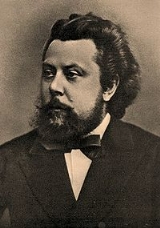
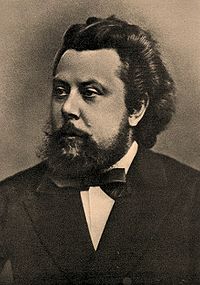
Modest Mussorgsky

Encyclopedia
Old Style and New Style dates
Old Style and New Style are used in English language historical studies either to indicate that the start of the Julian year has been adjusted to start on 1 January even though documents written at the time use a different start of year ; or to indicate that a date conforms to the Julian...
9 March] 1839 – 28 March [O.S. 16 March] 1881) was a Russian composer, one of the group known as 'The Five
The Five
The Five, also known as The Mighty Handful or The Mighty Coterie , refers to a circle of composers who met in Saint Petersburg, Russia, in the years 1856–1870: Mily Balakirev , César Cui, Modest Mussorgsky, Nikolai Rimsky-Korsakov and Alexander Borodin...
'. He was an innovator of Russian music
Music of Russia
Music of Russia denotes music produced in Russia and/or by the Russians. Russia is a large and culturally diverse country, with many ethnic groups, each with their own locally developed music...
in the romantic period. He strove to achieve a uniquely Russian musical identity, often in deliberate defiance of the established conventions of Western music.
Many of his works were inspired by Russian history
History of Russia
The history of Russia begins with that of the Eastern Slavs and the Finno-Ugric peoples. The state of Garðaríki , which was centered in Novgorod and included the entire areas inhabited by Ilmen Slavs, Veps and Votes, was established by the Varangian chieftain Rurik in 862...
, Russian folklore, and other nationalist themes. Such works include the opera Boris Godunov
Boris Godunov (opera)
Boris Godunov is an opera by Modest Mussorgsky . The work was composed between 1868 and 1873 in Saint Petersburg, Russia. It is Mussorgsky's only completed opera and is considered his masterpiece. Its subjects are the Russian ruler Boris Godunov, who reigned as Tsar during the Time of Troubles,...
, the orchestral tone poem Night on Bald Mountain
Night on Bald Mountain
Night on Bald Mountain is a composition by Modest Mussorgsky that exists in, at least, two versions—a seldom performed 1867 version or a later and very popular "fantasy for orchestra" arranged by Nikolai Rimsky-Korsakov, A Night on the Bare Mountain , based on the vocal score of the "Dream Vision...
, and the piano suite Pictures at an Exhibition
Pictures at an Exhibition
Pictures at an Exhibition is a suite in ten movements composed for piano by Russian composer Modest Mussorgsky in 1874.The suite is Mussorgsky's most famous piano composition, and has become a showpiece for virtuoso pianists...
.
For many years Mussorgsky's works were mainly known in versions revised or completed by other composers. Many of his most important compositions have recently come into their own in their original forms, and some of the original scores are now also available.
Early years
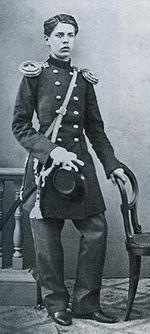
Toropets
Toropets is a town and the administrative center of Toropetsky District of Tver Oblast, Russia, located where the Toropa River enters Lake Solomeno. Population: -History:...
, Pskov region
Pskov Oblast
Pskov Oblast is a federal subject of Russia . Pskov Oblast borders the countries of Estonia and Latvia, as well as Belarus. It is the westernmost federal subject of contiguous Russia . Its major cities are the administrative center Pskov and Velikiye Luki . Area: 55,300 km²...
, Imperial Russia, 400 km (248.5 mi) south of Saint Petersburg. His wealthy and land-owning family, the noble family of Mussorgsky
Mussorgsky family
Mussorgsky , the name of an old Russian noble family, which is one of the branches of rich boyar family of Monastyrev, descendants of princes of Smolensk from Rurikid stock. The family traces its name to Roman Vasilyevich Monastyrev, nicknamed Mussorga . Peter Ivanovich Mussorgsky governed Staritsa...
, is reputedly descended from the first Ruthenia
Ruthenia
Ruthenia is the Latin word used onwards from the 13th century, describing lands of the Ancient Rus in European manuscripts. Its geographic and culturo-ethnic name at that time was applied to the parts of Eastern Europe. Essentially, the word is a false Latin rendering of the ancient place name Rus...
n ruler, Rurik
Rurik
Rurik, or Riurik , was a semilegendary 9th-century Varangian who founded the Rurik dynasty which ruled Kievan Rus and later some of its successor states, most notably the Tsardom of Russia, until 1598....
, through the sovereign princes of Smolensk
Smolensk
Smolensk is a city and the administrative center of Smolensk Oblast, Russia, located on the Dnieper River. Situated west-southwest of Moscow, this walled city was destroyed several times throughout its long history since it was on the invasion routes of both Napoleon and Hitler. Today, Smolensk...
. At age six Mussorgsky began receiving piano lessons from his mother, herself a trained pianist. His progress was sufficiently rapid that three years later he was able to perform a John Field
John Field (composer)
John Field was an Irish pianist, composer, and teacher. He was born in Dublin into a musical family, and received his early education there. The Fields soon moved to London, where Field studied under Muzio Clementi...
concerto and works by Franz Liszt
Franz Liszt
Franz Liszt ; ), was a 19th-century Hungarian composer, pianist, conductor, and teacher.Liszt became renowned in Europe during the nineteenth century for his virtuosic skill as a pianist. He was said by his contemporaries to have been the most technically advanced pianist of his age...
for family and friends. At 10, he and his brother were taken to Saint Petersburg to study at the elite Peterschule (St. Peter's School). While there, Modest studied the piano with the noted Anton Gerke. In 1852, the 12-year-old Mussorgsky published a piano piece titled "Porte-enseigne Polka" at his father's expense.
Mussorgsky's parents planned the move to Saint Petersburg so that both their sons would renew the family tradition of military service. To this end, Mussorgsky entered the Cadet School of the Guards at age 13. Sharp controversy had arisen over the educational attitudes at the time of both this institute and its director, a General Sutgof. All agreed the Cadet School could be a brutal place, especially for new recruits. More tellingly for Mussorgsky, it was likely where he began his eventual path to alcoholism. According to a former student, singer and composer Nikolai Kompaneisky, Sutgof "was proud when a cadet returned from leave drunk with champagne."
Music remained important to him, however. Sutgof's daughter was also a pupil of Herke, and Mussorgsky was allowed to attend lessons with her. His skills as a pianist made him much in demand by fellow-cadets; for them he would play dances interspersed with his own improvisation
Musical improvisation
Musical improvisation is the creative activity of immediate musical composition, which combines performance with communication of emotions and instrumental technique as well as spontaneous response to other musicians...
s. In 1856 Mussorgsky – who had developed a strong interest in history and studied German philosophy – successfully graduated from the Cadet School. Following family tradition he received a commission with the Preobrazhensky Regiment
Preobrazhensky regiment
The Preobrazhensky Regiment was one of the oldest and elite regiments of the Russian army. Along with the Semenovsky regiment also served as a gendarmie unit for the state Secret Chancellery in the 18th century, headed by the Prince Fyodor Romodanovsky.It was formed by Peter the Great in the late...
, the foremost regiment of the Russian Imperial Guard.
Maturity
In October 1856 the 17-year-old Mussorgsky met the 22-year-old Alexander BorodinAlexander Borodin
Alexander Porfiryevich Borodin was a Russian Romantic composer and chemist of Georgian–Russian parentage. He was a member of the group of composers called The Five , who were dedicated to producing a specifically Russian kind of art music...
while both men served at a military hospital in Saint Petersburg. The two were soon on good terms. Borodin later remembered,
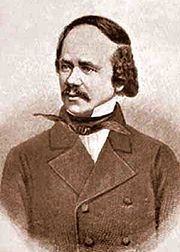
Alexander Dargomyzhsky
Alexander Sergeyevich Dargomyzhsky was a 19th century Russian composer. He bridged the gap in Russian opera composition between Mikhail Glinka and the later generation of The Five and Tchaikovsky....
, at that time the most important Russian composer after Mikhail Glinka
Mikhail Glinka
Mikhail Ivanovich Glinka , was the first Russian composer to gain wide recognition within his own country, and is often regarded as the father of Russian classical music...
. Dargomyzhsky was impressed with Mussorgsky's pianism. As a result, Mussorgsky became a fixture at Dargomyzhsky's soirées. There, critic Vladimir Stasov later recalled, he began "his true musical life."
Over the next two years at Dargomyzhsky's, Mussorgsky met several figures of importance in Russia's cultural life, among them Stasov, César Cui
César Cui
César Antonovich Cui was a Russian of French and Lithuanian descent. His profession was as an army officer and a teacher of fortifications; his avocational life has particular significance in the history of music, in that he was a composer and music critic; in this sideline he is known as a...
(a fellow officer), and Mily Balakirev
Mily Balakirev
Mily Alexeyevich Balakirev ,Russia was still using old style dates in the 19th century, and information sources used in the article sometimes report dates as old style rather than new style. Dates in the article are taken verbatim from the source and therefore are in the same style as the source...
. Balakirev had an especially strong impact. Within days he took it upon himself to help shape Mussorgsky's fate as a composer. He recalled to Stasov, "Because I am not a theorist, I could not teach him harmony (as, for instance Rimsky-Korsakov
Nikolai Rimsky-Korsakov
Nikolai Andreyevich Rimsky-Korsakov was a Russian composer, and a member of the group of composers known as The Five.The Five, also known as The Mighty Handful or The Mighty Coterie, refers to a circle of composers who met in Saint Petersburg, Russia, in the years 1856–1870: Mily Balakirev , César...
now teaches it) ... [but] I explained to him the form of compositions, and to do this we played through both Beethoven
Ludwig van Beethoven
Ludwig van Beethoven was a German composer and pianist. A crucial figure in the transition between the Classical and Romantic eras in Western art music, he remains one of the most famous and influential composers of all time.Born in Bonn, then the capital of the Electorate of Cologne and part of...
symphonies [as piano duets] and much else (Schumann
Robert Schumann
Robert Schumann, sometimes known as Robert Alexander Schumann, was a German composer, aesthete and influential music critic. He is regarded as one of the greatest and most representative composers of the Romantic era....
, Schubert
Franz Schubert
Franz Peter Schubert was an Austrian composer.Although he died at an early age, Schubert was tremendously prolific. He wrote some 600 Lieder, nine symphonies , liturgical music, operas, some incidental music, and a large body of chamber and solo piano music...
, Glinka
Mikhail Glinka
Mikhail Ivanovich Glinka , was the first Russian composer to gain wide recognition within his own country, and is often regarded as the father of Russian classical music...
, and others), analyzing the form." Up to this point Mussorgsky had known nothing but piano music; his knowledge of more radical recent music was virtually non-existent. Balakirev started filling these gaps in Mussorgsky's knowledge.
In 1858, within a few months of beginning his studies with Balakirev, Mussorgsky resigned his commission to devote himself entirely to music. He also suffered a painful crisis at this time. This may have had a spiritual component (in a letter to Balakirev the young man referred to "mysticism and cynical thoughts about the Deity"), but its exact nature will probably never be known. In 1859, the 20-year-old gained valuable theatrical experience by assisting in a production of Glinka's opera A Life for the Tsar
A Life for the Tsar
A Life for the Tsar , as it is known in English, although its original name was Ivan Susanin is a "patriotic-heroic tragic opera" in four acts with an epilogue by Mikhail Glinka. The original Russian libretto, based on historical events, was written by Nestor Kukolnik, Georgy Fyodorovich Rozen,...
on the Glebovo estate of a former singer and her wealthy husband; he also met Anatoly Lyadov and enjoyed a formative visit to Moscow – after which he professed a love of "everything Russian".
In spite of this epiphany, Mussorgsky's music still leaned more toward foreign models; a four-hand piano sonata which he produced in 1860 contains his only movement in sonata form
Sonata form
Sonata form is a large-scale musical structure used widely since the middle of the 18th century . While it is typically used in the first movement of multi-movement pieces, it is sometimes used in subsequent movements as well—particularly the final movement...
. Nor is any 'nationalistic' impulse easily discernible in the incidental music for Serov's play Oedipus in Athens, on which he worked between the ages of 19 and 22 (and then abandoned unfinished), or in the Intermezzo in modo classico for piano solo (revised and orchestrated in 1867). The latter was the only important piece he composed between December 1860 and August 1863: the reasons for this probably lie in the painful re-emergence of his subjective crisis in 1860 and the purely objective difficulties which resulted from the emancipation of the serfs
Emancipation reform of 1861
The Emancipation Reform of 1861 in Russia was the first and most important of liberal reforms effected during the reign of Alexander II of Russia. The reform, together with a related reform in 1861, amounted to the liquidation of serf dependence previously suffered by peasants of the Russian Empire...
the following year – as a result of which the family was deprived of half its estate, and Mussorgsky had to spend a good deal of time in Karevo unsuccessfully attempting to stave off their looming impoverishment.
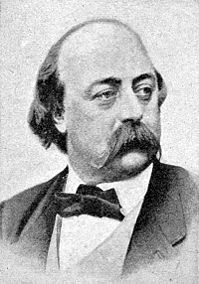
Salammbô (Mussorgsky)
Salammbô [alternative title: The Libyan ] is an unfinished opera in 4 acts by Modest Mussorgsky. The fragmentary Russian language libretto was written by the composer, and is based on the novel Salammbô by Gustave Flaubert , but includes verses taken from poems by Vasily Zhukovsky, Apollon Maykov,...
– on which he worked between 1863 and 1866 before losing interest in the project. During this period he had returned to Saint Petersburg and was supporting himself as a low-grade civil-servant while living in a six-man 'commune'. In a heady artistic and intellectual atmosphere, he read and discussed a wide range of modern artistic and scientific ideas – including those of the provocative writer Chernyshevsky, known for the bold assertion that, in art, "form and content are opposites". Under such influences he came more and more to embrace the ideal of artistic 'realism' and all that it entailed, whether this concerned the responsibility to depict life 'as it is truly lived'; the preoccupation with the lower strata of society; or the rejection of repeating, symmetrical musical forms as insufficiently true to the unrepeating, unpredictable course of 'real life'.
'Real life' affected Mussorgsky painfully in 1865, when his mother died; it was at this point that the composer had his first serious bout of either alcoholism or dipsomania
Dipsomania
Dipsomania is a historical term describing a medical condition involving an uncontrollable craving for alcohol. It was used in the 19th century to describe a variety of alcohol-related problems, most of which are most commonly conceptualized today as alcoholism, but it is occasionally still used to...
. The 26-year-old was, however, on the point of writing his first 'realistic' songs (including 'Hopak' and 'Darling Savishna', both of them composed in 1866 and among his first 'real' publications the following year). 1867 was also the year in which he finished the original orchestral version of his Night on Bald Mountain
Night on Bald Mountain
Night on Bald Mountain is a composition by Modest Mussorgsky that exists in, at least, two versions—a seldom performed 1867 version or a later and very popular "fantasy for orchestra" arranged by Nikolai Rimsky-Korsakov, A Night on the Bare Mountain , based on the vocal score of the "Dream Vision...
(which, however, Balakirev criticised and refused to conduct, with the result that it was never performed during Mussorgsky's lifetime).
Peak
Mussorgsky's career as a civil servant was by no means stable or secure: though he was assigned to various posts and even received a promotion in these early years, in 1867 he was declared 'supernumerary' – remaining 'in service', but receiving no wages. Decisive developments were occurring in his artistic life, however. Although it was in 1867 that Stasov first referred to the 'kuchkaThe Five
The Five, also known as The Mighty Handful or The Mighty Coterie , refers to a circle of composers who met in Saint Petersburg, Russia, in the years 1856–1870: Mily Balakirev , César Cui, Modest Mussorgsky, Nikolai Rimsky-Korsakov and Alexander Borodin...
' ('The Five') of Russian composers loosely grouped around Balakirev, Mussorgsky was by then ceasing to seek Balakirev's approval and was moving closer to the older Alexander Dargomyzhsky
Alexander Dargomyzhsky
Alexander Sergeyevich Dargomyzhsky was a 19th century Russian composer. He bridged the gap in Russian opera composition between Mikhail Glinka and the later generation of The Five and Tchaikovsky....
.
Since 1866 Dargomïzhsky had been working on his opera The Stone Guest
The Stone Guest
The Stone Guest is a poetic drama by Alexander Pushkin based on the Spanish legend of Don Juan. The Stone Guest was written in 1830 as part of his four short plays known as The Little Tragedies...
, a version of the Don Juan
Don Juan
Don Juan is a legendary, fictional libertine whose story has been told many times by many authors. El burlador de Sevilla y convidado de piedra by Tirso de Molina is a play set in the fourteenth century that was published in Spain around 1630...
story with a Pushkin text that he declared would be set "just as it stands, so that the inner truth of the text should not be distorted", and in a manner that abolished the 'unrealistic' division between aria
Aria
An aria in music was originally any expressive melody, usually, but not always, performed by a singer. The term is now used almost exclusively to describe a self-contained piece for one voice usually with orchestral accompaniment...
and recitative
Recitative
Recitative , also known by its Italian name "recitativo" , is a style of delivery in which a singer is allowed to adopt the rhythms of ordinary speech...
in favour of a continuous mode of syllabic but lyrically heightened declamation somewhere between the two.
Under the influence of this work (and the ideas of Georg Gottfried Gervinus
Georg Gottfried Gervinus
Georg Gottfried Gervinus was a German literary and political historian.-Biography:Gervinus was born in Darmstadt. He was educated at the gymnasium of the town, and intended for a commercial career, but in 1825 he became a student of the university of Giessen...
, according to whom "the highest natural object of musical imitation is emotion, and the method of imitating emotion is to mimic speech"), Mussorgsky in 1868 rapidly set the first eleven scenes of Nikolai Gogol
Nikolai Gogol
Nikolai Vasilievich Gogol was a Ukrainian-born Russian dramatist and novelist.Considered by his contemporaries one of the preeminent figures of the natural school of Russian literary realism, later critics have found in Gogol's work a fundamentally romantic sensibility, with strains of Surrealism...
's The Marriage (Zhenitba), with his priority being to render into music the natural accents and patterns of the play's naturalistic and deliberately humdrum dialogue. This work marked an extreme position in Mussorgsky's pursuit of naturalistic word-setting: he abandoned it unorchestrated after reaching the end of his 'Act 1', and though its characteristically 'Mussorgskyian' declamation is to be heard in all his later vocal music, the naturalistic mode of vocal writing more and more became merely one expressive element among many.
A few months after abandoning Zhenitba
Zhenitba (opera)
Zhenitba is an unfinished opera begun in 1868 by Modest Mussorgsky to his own libretto based on Nikolai Gogol's comedy Marriage. This 1842 play is a satire of courtship and cowardice, which centres around a young woman, Agafya, who is wooed by four bachelors, each with his own...
, the 29-year-old Mussorgsky was encouraged to write an opera on the story of Boris Godunov
Boris Godunov
Boris Fyodorovich Godunov was de facto regent of Russia from c. 1585 to 1598 and then the first non-Rurikid tsar from 1598 to 1605. The end of his reign saw Russia descend into the Time of Troubles.-Early years:...
. This he did, assembling and shaping a text from Pushkin's play and Karamzin's history. He completed the large-scale score the following year while living with friends and working for the Forestry Department. In 1871, however, the finished opera was rejected for theatrical performance, apparently because of its lack of any 'prima donna
Prima donna
Originally used in opera or Commedia dell'arte companies, "prima donna" is Italian for "first lady." The term was used to designate the leading female singer in the opera company, the person to whom the prime roles would be given. The prima donna was normally, but not necessarily, a soprano...
' role. Mussorgsky set to work producing a revised and enlarged 'second version'. During the next year, which he spent sharing rooms with Rimsky-Korsakov, he made changes that went beyond those requested by the theatre. In this version the opera was accepted, probably in May 1872, and three excerpts were staged at the Mariinsky Theatre
Mariinsky Theatre
The Mariinsky Theatre is a historic theatre of opera and ballet in Saint Petersburg, Russia. Opened in 1860, it became the preeminent music theatre of late 19th century Russia, where many of the stage masterpieces of Tchaikovsky, Mussorgsky, and Rimsky-Korsakov received their premieres. The...
in 1873. It is often asserted that in 1872 the opera was rejected a second time, but no specific evidence for this exists.
By the time of the first production of Boris Godunov
Boris Godunov (opera)
Boris Godunov is an opera by Modest Mussorgsky . The work was composed between 1868 and 1873 in Saint Petersburg, Russia. It is Mussorgsky's only completed opera and is considered his masterpiece. Its subjects are the Russian ruler Boris Godunov, who reigned as Tsar during the Time of Troubles,...
in February 1874, Mussorgsky had taken part in the ill-fated Mlada
Mlada
Mlada was a project originally envisioned as a ballet to be composed by Alexander Serov and choreographed by Marius Petipa. The project was later revised in 1872 as an opera-ballet in four acts, with the composition of the score to be divided between César Cui, Léon Minkus, Modest Mussorgsky,...
project (in the course of which he had made a choral version of his Night on Bald Mountain
Night on Bald Mountain
Night on Bald Mountain is a composition by Modest Mussorgsky that exists in, at least, two versions—a seldom performed 1867 version or a later and very popular "fantasy for orchestra" arranged by Nikolai Rimsky-Korsakov, A Night on the Bare Mountain , based on the vocal score of the "Dream Vision...
) and had begun Khovanshchina
Khovanshchina
Khovanshchina is an opera in five acts by Modest Mussorgsky. The work was written between 1872 and 1880 in St. Petersburg, Russia. The composer wrote the libretto based on historical sources...
. Though far from being a critical success – and in spite of receiving only a dozen or so performances – the popular reaction in favour of Boris made this the peak of Mussorgsky's career.
Decline
Viktor Hartmann
Viktor Alexandrovich Hartmann was a Russian architect and painter. He was associated with the Abramtsevo Colony, purchased and preserved beginning in 1870 by Savva Mamontov, and the Russian Revival.-Life:Victor-Edouard Hartmann was born in St...
had died, and his relative and recent roommate Arseny Golenishchev-Kutuzov
Arseny Golenishchev-Kutuzov
Arseny Arkadyevich Golenishchev-Kutuzov , was a Russian poet known in part for writing the texts of Modest Mussorgsky's two song cycles of the 1870s: Sunless and Songs and Dances of Death....
(who furnished the poems for the song-cycle Sunless
Sunless (song cycle)
Sunless is a song cycle by Modest Petrovich Mussorgsky, written in 1874, to poems by Arseny Golenishchev-Kutuzov, a relative of the composer.-Song Titles:The individual song titles are as follows:#«В четырех стенах» Within Four Walls...
and would go on to provide those for the Songs and Dances of Death
Songs and Dances of Death
Songs and Dances of Death is a song cycle for voice and piano by Modest Petrovich Mussorgsky, written in the mid-1870s, to poems by Arseny Golenishchev-Kutuzov, a relative of the composer....
) had moved away to get married.
While alcoholism was Mussorgsky's personal weakness, it was also a behavior pattern considered typical for those of Mussorgsky's generation who wanted to oppose the establishment and protest through extreme forms of behavior. One contemporary notes, "an intense worship of Bacchus was considered to be almost obligatory for a writer of that period. It was a showing off, a 'pose,' for the best people of the [eighteen-]sixties." Another writes, "Talented people in Russia who love the simple folk cannot but drink." Mussorgsky spent day and night in a Saint Petersburg tavern of low repute, the Maly Yaroslavets, accompanied by other bohemian dropouts. He and his fellow drinkers idealized their alcoholism, perhaps seeing it as ethical and aesthetic opposition. This bravado, however, led to little more than isolation and eventual self-destruction.
For a time Mussorgsky was able to maintain his creative output: his compositions from 1874 include Sunless, the Khovanschina Prelude, and the piano suite Pictures at an Exhibition
Pictures at an Exhibition
Pictures at an Exhibition is a suite in ten movements composed for piano by Russian composer Modest Mussorgsky in 1874.The suite is Mussorgsky's most famous piano composition, and has become a showpiece for virtuoso pianists...
(in memory of Hartmann); he also began work on another opera based on Gogol, The Fair at Sorochyntsi (for which he produced another choral version of Night on Bald Mountain).
The decline could not be halted, however. In 1880 he was finally dismissed from government service. Aware of his destitution, one group of friends organised a stipend designed to support the completion of Khovanschina; another group organised a similar fund to pay him to complete The Fair at Sorochyntsi. However, neither work was completed (although Khovanschina, in piano score with only two numbers uncomposed, came close to being finished).
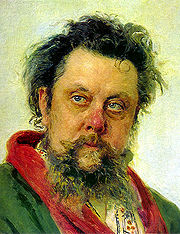
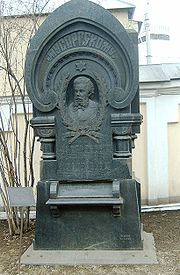
In early 1881 a desperate Mussorgsky declared to a friend that there was 'nothing left but begging', and suffered four seizures in rapid succession. Though he found a comfortable room in a good hospital – and for several weeks even appeared to be rallying – the situation was hopeless. Repin painted the famous red-nosed portrait in what were to be the last days of the composer's life: a week after his 42nd birthday, he was dead. He was interred at the Tikhvin Cemetery
Tikhvin Cemetery
Tikhvin Cemetery is located at the Alexander Nevsky Monastery, in Saint Petersburg, Russia.Established in 1823, some of the notables buried here are:* Mily Balakirev - , composer* Alexander Borodin - , composer...
of the Alexander Nevsky Monastery
Alexander Nevsky Lavra
Saint Alexander Nevsky Lavra or Saint Alexander Nevsky Monastery was founded by Peter I of Russia in 1710 at the eastern end of the Nevsky Prospekt in St. Petersburg supposing that that was the site of the Neva Battle in 1240 when Alexander Nevsky, a prince, defeated the Swedes; however, the battle...
in Saint Petersburg
Saint Petersburg
Saint Petersburg is a city and a federal subject of Russia located on the Neva River at the head of the Gulf of Finland on the Baltic Sea...
.
Mussorgsky, like others of 'The Five', was perceived as extremist by the Emperor and much of his court. This may have been the reason Tsar
Tsar
Tsar is a title used to designate certain European Slavic monarchs or supreme rulers. As a system of government in the Tsardom of Russia and Russian Empire, it is known as Tsarist autocracy, or Tsarism...
Alexander III
Alexander III of Russia
Alexander Alexandrovich Romanov , historically remembered as Alexander III or Alexander the Peacemaker reigned as Emperor of Russia from until his death on .-Disposition:...
personally crossed off Boris Godunov from the list of proposed pieces for the Imperial Opera in 1888.
Works
Mussorgsky's works, while strikingly novel, are stylistically RomanticRomantic music
Romantic music or music in the Romantic Period is a musicological and artistic term referring to a particular period, theory, compositional practice, and canon in Western music history, from 1810 to 1900....
and draw heavily on Russian musical themes. He has been the inspiration for many Russian composers, including most notably Dmitri Shostakovich
Dmitri Shostakovich
Dmitri Dmitriyevich Shostakovich was a Soviet Russian composer and one of the most celebrated composers of the 20th century....
(in his late symphonies) and Sergei Prokofiev
Sergei Prokofiev
Sergei Sergeyevich Prokofiev was a Russian composer, pianist and conductor who mastered numerous musical genres and is regarded as one of the major composers of the 20th century...
(in his operas).
Boris Godunov (opera)
Boris Godunov is an opera by Modest Mussorgsky . The work was composed between 1868 and 1873 in Saint Petersburg, Russia. It is Mussorgsky's only completed opera and is considered his masterpiece. Its subjects are the Russian ruler Boris Godunov, who reigned as Tsar during the Time of Troubles,...
, about the life of the Russian tsar
Tsar
Tsar is a title used to designate certain European Slavic monarchs or supreme rulers. As a system of government in the Tsardom of Russia and Russian Empire, it is known as Tsarist autocracy, or Tsarism...
, but it was rejected by the Mariinsky Opera
Mariinsky Theatre
The Mariinsky Theatre is a historic theatre of opera and ballet in Saint Petersburg, Russia. Opened in 1860, it became the preeminent music theatre of late 19th century Russia, where many of the stage masterpieces of Tchaikovsky, Mussorgsky, and Rimsky-Korsakov received their premieres. The...
. Mussorgsky thus edited the work, making a final version in 1874. The early version is considered darker and more concise than the later version, but also more crude. Nikolai Rimsky-Korsakov
Nikolai Rimsky-Korsakov
Nikolai Andreyevich Rimsky-Korsakov was a Russian composer, and a member of the group of composers known as The Five.The Five, also known as The Mighty Handful or The Mighty Coterie, refers to a circle of composers who met in Saint Petersburg, Russia, in the years 1856–1870: Mily Balakirev , César...
re-orchestrated the opera in 1896 and revised it in 1908. The opera has also been revised by other composers, notably Shostakovich, who made two versions, one for film and one for stage.
Khovanshchina
Khovanshchina
Khovanshchina is an opera in five acts by Modest Mussorgsky. The work was written between 1872 and 1880 in St. Petersburg, Russia. The composer wrote the libretto based on historical sources...
, a more obscure opera, was unfinished and unperformed when Mussorgsky died, but it was completed by Rimsky-Korsakov and received its premiere in 1886 in Saint Petersburg
Saint Petersburg
Saint Petersburg is a city and a federal subject of Russia located on the Neva River at the head of the Gulf of Finland on the Baltic Sea...
. This opera, too, was revised by Shostakovich. The Fair at Sorochyntsi, another opera, was left incomplete at his death but a dance excerpt, the Gopak, is frequently performed.
Mussorgsky's most imaginative and frequently performed work is the cycle of piano pieces describing paintings in sound called Pictures at an Exhibition
Pictures at an Exhibition
Pictures at an Exhibition is a suite in ten movements composed for piano by Russian composer Modest Mussorgsky in 1874.The suite is Mussorgsky's most famous piano composition, and has become a showpiece for virtuoso pianists...
. This composition, best known through an orchestral arrangement by Maurice Ravel
Maurice Ravel
Joseph-Maurice Ravel was a French composer known especially for his melodies, orchestral and instrumental textures and effects...
, was written in commemoration of his friend, the architect Viktor Hartmann
Viktor Hartmann
Viktor Alexandrovich Hartmann was a Russian architect and painter. He was associated with the Abramtsevo Colony, purchased and preserved beginning in 1870 by Savva Mamontov, and the Russian Revival.-Life:Victor-Edouard Hartmann was born in St...
.
One of Mussorgsky's most striking pieces is the single-movement orchestral work Night on Bald Mountain
Night on Bald Mountain
Night on Bald Mountain is a composition by Modest Mussorgsky that exists in, at least, two versions—a seldom performed 1867 version or a later and very popular "fantasy for orchestra" arranged by Nikolai Rimsky-Korsakov, A Night on the Bare Mountain , based on the vocal score of the "Dream Vision...
. The work enjoyed broad popular recognition in the 1940s when it was featured, in tandem with Schubert
Franz Schubert
Franz Peter Schubert was an Austrian composer.Although he died at an early age, Schubert was tremendously prolific. He wrote some 600 Lieder, nine symphonies , liturgical music, operas, some incidental music, and a large body of chamber and solo piano music...
's 'Ave Maria
Ellens dritter Gesang
Ellens dritter Gesang , in English: "Ellen's Third Song", was composed by Franz Schubert in 1825 as part of his Opus 52, a setting of seven songs from Walter Scott's popular epic poem The Lady of the Lake, loosely translated into German.It has become one of Schubert's most popular works under the...
', in the Disney
Walt Disney Pictures
Walt Disney Pictures is an American film studio owned by The Walt Disney Company. Walt Disney Pictures and Television, a subsidiary of the Walt Disney Studios and the main production company for live-action feature films within the Walt Disney Motion Pictures Group, based at the Walt Disney...
film Fantasia
Fantasia (film)
Fantasia is a 1940 American animated film produced by Walt Disney and released by Walt Disney Productions. The third feature in the Walt Disney Animated Classics series, the film consists of eight animated segments set to pieces of classical music conducted by Leopold Stokowski, seven of which are...
.
Among the composer's other works are a number of songs, including three song cycles: The Nursery
The Nursery (song cycle)
The Nursery is a song cycle by Modest Mussorgsky, composed between 1868 and 1872, set to his own lyrics.-Song Data:-Series 1:-Series 2:...
(1872), Sunless
Sunless (song cycle)
Sunless is a song cycle by Modest Petrovich Mussorgsky, written in 1874, to poems by Arseny Golenishchev-Kutuzov, a relative of the composer.-Song Titles:The individual song titles are as follows:#«В четырех стенах» Within Four Walls...
(1874) and Songs and Dances of Death
Songs and Dances of Death
Songs and Dances of Death is a song cycle for voice and piano by Modest Petrovich Mussorgsky, written in the mid-1870s, to poems by Arseny Golenishchev-Kutuzov, a relative of the composer....
(1877); plus Mephistopheles' Song of the Flea and many others. Important early recordings of songs by Mussorgsky were made by tenor Vladimir Rosing
Vladimir Rosing
Vladimir Sergeyevich Rosing , aka Val Rosing, was a Russian-born operatic tenor and stage director who spent most of his professional career in England and the United States...
in the 1920s and 30s. Other recordings have been made by Boris Christoff
Boris Christoff
Boris Christoff was a Bulgarian opera singer...
between 1951 and 1957 and by Sergei Leiferkus
Sergei Leiferkus
Sergei Leiferkus is an operatic baritone from Russia, known for his dramatic technique and powerful voice particularly in Russian and Italian language repertoire. He is most notable for his roles as Scarpia in Tosca, Iago in Otello, Grand-prétre de Dagon in Samson et Dalila and Simon Boccanegra...
in 1993.
Media
- See Pictures at an ExhibitionPictures at an ExhibitionPictures at an Exhibition is a suite in ten movements composed for piano by Russian composer Modest Mussorgsky in 1874.The suite is Mussorgsky's most famous piano composition, and has become a showpiece for virtuoso pianists...
for an orchestral version of the work.
Criticism
Contemporary opinions of Mussorgsky as a composer and person varied from positive to ambiguous to negative.Mussorgsky's eventual supporters, Stasov and Balakirev, initially registered strongly negative impressions of the composer. Stasov wrote Balakirev, in an 1863 letter, "I have no use whatever for Mussorgsky. All in him is flabby and dull. He is, I think, a perfect idiot. Were he left to his own devices and no longer under your strict supervision, he would soon run to seed as all the others have done. There is nothing in him."
Balakirev agreed: "Yes, Mussorgsky is little short of an idiot."
Mixed impressions are recorded by Rimsky-Korsakov
Nikolai Rimsky-Korsakov
Nikolai Andreyevich Rimsky-Korsakov was a Russian composer, and a member of the group of composers known as The Five.The Five, also known as The Mighty Handful or The Mighty Coterie, refers to a circle of composers who met in Saint Petersburg, Russia, in the years 1856–1870: Mily Balakirev , César...
and Tchaikovsky
Pyotr Ilyich Tchaikovsky
Pyotr Ilyich Tchaikovsky Pyotr Ilyich Tchaikovsky Pyotr Ilyich Tchaikovsky (Russian: Пётр Ильи́ч Чайко́вский ; often "Peter Ilich Tchaikovsky" in English. His names are also transliterated "Piotr" or "Petr"; "Ilitsch", "Il'ich" or "Illyich"; and "Tschaikowski", "Tschaikowsky", "Chajkovskij"...
, colleagues of Mussorgsky who, unlike him, made their living as composers. Both praised his talent while expressing disappointment with his technique. About Mussorgsky's scores Rimsky-Korsakov wrote, "They were very defective, teeming with clumsy, disconnected harmonies, shocking part-writing, amazingly illogical modulations or intolerably long stretches without ever a modulation, and bad scoring. ...what is needed is an edition for practical and artistic purposes, suitable for performances and for those who wish to admire Mussorgsky's genius, not to study his idiosyncrasies and sins against art."
Rimsky-Korsakov's own editions of Mussorgsky's works met with some criticism of their own. Rimsky-Korsakov's student, Anatoly Lyadov, found them to be lacking, writing "It is easy enough to correct Mussorgsky's irregularities. The only trouble is that when this is done, the character and originality of the music are done away with, and the composer's individuality vanishes."
Tchaikovsky, in a letter to his patroness Nadezhda von Meck
Nadezhda von Meck
Nadezhda Filaretovna von Meck was a Russian businesswoman, who is best known today for her artistic relationship with Pyotr Ilyich Tchaikovsky. She supported him financially for 13 years, enabling him to devote himself full-time to composition, but she stipulated that they were never to meet. ...
was also critical of Mussorgsky: "Mussorgsky you very rightly call a hopeless case. In talent he is perhaps superior to all the [other members of The Five], but his nature is narrow-minded, devoid of any urge towards self-perfection, blindly believing in the ridiculous theories of his circle and in his own genius. In addition, he has a certain base side to his nature which likes coarseness, uncouthness, roughness.... He flaunts ... his illiteracy, takes pride in his ignorance, mucks along anyhow, blindly believing in the infallibility of his genius. Yet he has flashes of talent which are, moreover, not devoid of originality."
Not all of the criticism of Mussorgsky was negative. In a letter to Pauline Viardot, Ivan Turgenev
Ivan Turgenev
Ivan Sergeyevich Turgenev was a Russian novelist, short story writer, and playwright. His first major publication, a short story collection entitled A Sportsman's Sketches, is a milestone of Russian Realism, and his novel Fathers and Sons is regarded as one of the major works of 19th-century...
recorded his impressions of a concert he attended in which he met Mussorgsky and heard two of his songs and excerpts from Boris Godunov and Khovanshchina): "Today I was invited to have dinner in old Petrov's house: I gave him a copy of your song, which pleased him greatly [...] Petrov still admires you as enthusiastically as in the past. In his drawing-room there's a bust of you, crowned with laurels, which still bears a strong resemblance to you. I also met his wife (the contralto) [Anna Vorobyova-Petrova, who created the role of Vanya in Glinka's A Life for the Tsar]. She is sixty years old... After dinner she sang two quite original and touching romances by Musorgsky (the author of Boris Godunov, who was also present), in a voice that is still young and charming and has a very expressive timbre. She sang them wonderfully! I was moved to tears, I assure you. Then Mussorgsky played for us and sang, with a rather hoarse voice, some excerpts from his opera and the other one that he is composing now – and the music seemed to me very characteristic and interesting, upon my honour! Old Petrov sang the role of the old profligate and vagabond monk [Varlaam's song about Ivan the Terrible] – it was splendid! I am starting to believe that there really is a future in all of this. Outwardly, Mussorgsky reminds one of Glinka – it is just that his nose is all red (unfortunately, he is an alcoholic), he has pale but beautiful eyes, and fine lips which are squeezed into a fat face with flabby cheeks. I liked him: he is very natural and unaffected, and does not put on any airs. He played us the introduction to his second opera [Khovanshchina]. It is a bit Wagnerian, but full of feeling and beautiful. Forward, forward! Russian artists!!"
Western perceptions of Mussorgsky changed with the European premiere of Boris Godunov in 1908. Before the premiere, he was regarded as an eccentric in the west. Critic Edward Dannreuther
Edward Dannreuther
Edward Dannreuther was a German pianist and writer on music resident from 1863 in England. He trained as a musician at the Conservatoire at Leipzig, where he was a pupil of Ignaz Moscheles, a severe critic of the music of Wagner and Franz Liszt...
, wrote, in the 1905 edition of The Oxford History of Music, "Mussorgsky, in his vocal efforts, appears wilfully eccentric. His style impresses the Western ear as barbarously ugly."
However, after the premiere, views on Mussorgsky's music have drastically changed. Gerald Abraham
Gerald Abraham
Gerald Ernest Heal Abraham, CBE, FBA was an English musicologist; he was President of the Royal Musical Association, 1970-74.- Career :* Assistant Editor, Radio Times, 1935–39* Deputy Editor, The Listener, 1939–42...
, a musicologist, and an authority on Mussorgsky: "As a musical translator of words and all that can be expressed in words, of psychological states, and even physical movement, he is unsurpassed; as an absolute musician he was hopelessly limited, with remarkably little ability to construct pure music or even a purely musical texture."
Pictures at an Exhibition
The suite Pictures at an Exhibition has inspired homages in a broad range of musical styles. A version featured in two albumsPictures at an Exhibition (album)
*The material on the second disc was recorded at the Lyceum Theatre in December of 1970.-Personnel:*Keith Emerson - Pipe Organ, Hammond C3 and L100 Organs, Moog Modular Synthesizer, Ribbon controller, Clavinet*Greg Lake - bass, acoustic guitar, Vocals...
by the British trio Emerson, Lake & Palmer
Emerson, Lake & Palmer
Emerson, Lake & Palmer, also known as ELP, are an English progressive rock supergroup. They found success in the 1970s and sold over forty million albums and headlined large stadium concerts. The band consists of Keith Emerson , Greg Lake and Carl Palmer...
incorporates elements of progressive rock
Progressive rock
Progressive rock is a subgenre of rock music that developed in the late 1960s and early 1970s as part of a "mostly British attempt to elevate rock music to new levels of artistic credibility." John Covach, in Contemporary Music Review, says that many thought it would not just "succeed the pop of...
, jazz
Jazz
Jazz is a musical style that originated at the beginning of the 20th century in African American communities in the Southern United States. It was born out of a mix of African and European music traditions. From its early development until the present, jazz has incorporated music from 19th and 20th...
and folk music
Folk music
Folk music is an English term encompassing both traditional folk music and contemporary folk music. The term originated in the 19th century. Traditional folk music has been defined in several ways: as music transmitted by mouth, as music of the lower classes, and as music with unknown composers....
(1971/2008). An electronic music
Electronic music
Electronic music is music that employs electronic musical instruments and electronic music technology in its production. In general a distinction can be made between sound produced using electromechanical means and that produced using electronic technology. Examples of electromechanical sound...
adaptation by Isao Tomita
Isao Tomita
, often known simply as Tomita, is a Japanese music composer, regarded as one of the pioneers of electronic music and space music, and as one of the most famous producers of analog synthesizer arrangements...
was done in 1975. A heavy metal arrangement of the entire suite was released by German band Mekong Delta
Mekong Delta (band)
Mekong Delta is a German progressive/thrash metal band, formed in 1985.-History:The band was founded by a group of German metal musicians with the goal to 'musically outshine' all then-current, independent releases. The line-up and the history of the group was to be "the best kept secret in the...
; another metal band, Armored Saint
Armored Saint
-Early career:Armored Saint was formed in 1982 by brothers Phil Sandoval and Gonzo Sandoval , and guitarist David Prichard, while attending South Pasadena High School. Next to join were singer John Bush also a South Pasadena High School Alumni and bassist Joey Vera...
, utilised the "Great Gate of Kiev"'s main theme as the introduction to the track "March of the Saint". In 2002, electronic musician-composer Amon Tobin
Amon Tobin
Amon Adonai Santos de Araújo Tobin , known as Amon Tobin, is a Brazilian musician, composer and producer of electronic music. He is described as a virtuoso sound designer and is considered to be one of the most influential electronic music artists in the world...
paraphrased Gnomus for the track "Back From Space" on his album Out from Out Where
Out from Out Where
Out From Out Where was the fourth release by Amon Tobin on Ninja Tune. Many of the tracks segue together creating an ongoing feel to the album. Video clips were made for "Verbal" and "Proper Hoodidge", directed by Alex Rutterford and Corine Stübi respectively. The CD contains enhanced content of...
. In 2003, guitarist-composer Trevor Rabin
Trevor Rabin
Trevor Charles Rabin is a South African born musician, best known as a guitarist, vocalist and songwriter for the British progressive rock band Yes from 1983–1994, and since then, as a film composer.- Early years :...
released his electric guitar adaptation of "Promenade", once intended for the Yes
Yes (band)
Yes are an English rock band who achieved worldwide success with their progressive, art, and symphonic style of rock music. Regarded as one of the pioneers of the progressive genre, Yes are known for their lengthy songs, mystical lyrics, elaborate album art, and live stage sets...
album Big Generator
Big Generator
Big Generator is the twelfth studio album by progressive rock band Yes. It was released in 1987 on Atlantic Records' Atco subsidiary label and was the follow-up to the massively successful 90125 album.- History :...
, and later included on his demo album 90124. In 2005 Animusic 2 was released with an orchestration which was titled "Cathedral Pictures". It is based on the Emerson, Lake, & Palmer version, and thus there are only three movements: the first "Promenade", "Hut on Fowl Legs", and "The Great Gate of Kiev". A rearrangement of the Promenade section was used for the British TV comedy The New Statesman
The New Statesman
The New Statesman is an award-winning British sitcom of the late 1980s and early 1990s satirising the Conservative government of the time...
.
A Night on Bald Mountain
- Walt DisneyWalt DisneyWalter Elias "Walt" Disney was an American film producer, director, screenwriter, voice actor, animator, entrepreneur, entertainer, international icon, and philanthropist, well-known for his influence in the field of entertainment during the 20th century. Along with his brother Roy O...
's 1940 film FantasiaFantasia (film)Fantasia is a 1940 American animated film produced by Walt Disney and released by Walt Disney Productions. The third feature in the Walt Disney Animated Classics series, the film consists of eight animated segments set to pieces of classical music conducted by Leopold Stokowski, seven of which are...
used a specially produced version of A Night on Bald Mountain, made by Leopold StokowskiLeopold StokowskiLeopold Anthony Stokowski was a British-born, naturalised American orchestral conductor, well known for his free-hand performing style that spurned the traditional baton and for obtaining a characteristically sumptuous sound from many of the great orchestras he conducted.In America, Stokowski...
. - Parts of the opening segment can be heard in various parts of horror movie Freddy's Dead: The Final NightmareFreddy's Dead: The Final NightmareFreddy's Dead: The Final Nightmare is a 1991 American slasher film. It is the sixthand as the title suggests, intended to be the lastfilm in the series of films featuring Freddy Krueger...
. - In The Wizard of OzThe Wizard of Oz (1939 film)The Wizard of Oz is a 1939 American musical fantasy film produced by Metro-Goldwyn-Mayer. It was directed primarily by Victor Fleming. Noel Langley, Florence Ryerson and Edgar Allan Woolf received credit for the screenplay, but there were uncredited contributions by others. The lyrics for the songs...
, an arranged version is played during the scene where the ScarecrowScarecrow (Oz)The Scarecrow is a character in the fictional Land of Oz created by American author L. Frank Baum and illustrator William Wallace Denslow. In his first appearance, the Scarecrow reveals that he lacks a brain and desires above all else to have one. In reality, he is only two days old and merely...
, the Tin Man, and the Cowardly LionCowardly LionThe Cowardly Lion is the main character in the fictional Land of Oz created by American author L. Frank Baum. He is a Lion, but he talks and interacts with humans....
rescue DorothyDorothy GaleDorothy Gale is the protagonist of many of the Oz novels by American author L. Frank Baum, and the best friend of Oz's ruler Princess Ozma. Dorothy first appears in Baum's classic children's novel The Wonderful Wizard of Oz and reappears in most of its sequels...
from the Wicked Witch of the WestWicked Witch of the WestThe Wicked Witch of the West is a fictional character and the most significant antagonist in L. Frank Baum's children's book The Wonderful Wizard of Oz...
's castle. - There is a discoDiscoDisco is a genre of dance music. Disco acts charted high during the mid-1970s, and the genre's popularity peaked during the late 1970s. It had its roots in clubs that catered to African American, gay, psychedelic, and other communities in New York City and Philadelphia during the late 1960s and...
version performed by David ShireDavid ShireDavid Lee Shire is an American songwriter and the composer of stage musicals, film and television scores. The soundtrack to the movie The Taking of Pelham 123 and parts of the Saturday Night Fever soundtrack such as Night on Disco Mountain, an adaptation of Modest Mussorgsky's Night on Bald...
available on the Saturday Night FeverSaturday Night FeverSaturday Night Fever is a 1977 drama film directed by John Badham and starring: John Travolta as Tony Manero, an immature young man whose weekends are spent visiting a local Brooklyn discothèque; Karen Lynn Gorney as his dance partner and eventual friend; and Donna Pescow as Tony's former dance...
soundtrack titled "Night on Disco Mountain". In 2007, this version was sampled by electro house duo JusticeJustice (French band)Justice is a French electronic music duo consisting of Gaspard Augé and Xavier de Rosnay . The duo is one of the most successful groups on Ed Banger Records and is managed by the label's head, Pedro Winter...
for their song "Stress" - The piece was used by American band Beastie BoysBeastie BoysBeastie Boys are an American hip hop trio from New York City. The group consists of Mike D who plays the drums, MCA who plays the bass, and Ad-Rock who plays the guitar....
as an intro for the song "Intergalactic" on the Hello NastyHello NastyHello Nasty is the fifth studio album by the Beastie Boys. It was released on July 14, 1998 via Capitol Records and sold 681,000 copies in its first week, debuting at #1 on the Billboard 200 album sales chart...
album. - In My Gym Partner's A MonkeyMy Gym Partner's a MonkeyMy Gym Partner's a Monkey is an American animated television series created by Timothy and Julie McNally Cahill and produced by Cartoon Network Studios. It premiered on December 26, 2005 and ended in November 27, 2008 following a marathon of its final regular-run episodes...
episode "Shark Attack" the music is heard when Bull Sharkowski makes his entrance in the show. - Used in a commercial for the 6000 SUX during the movie RobocopRoboCopRoboCop is a 1987 American science fiction-action film directed by Paul Verhoeven. Set in a crime-ridden Detroit, Michigan in the near future, RoboCop centers on a police officer who is brutally murdered and subsequently re-created as a super-human cyborg known as "RoboCop"...
. - This was referenced in Grim Adventures of Billy and Mandy's episode: Dream a Little Dream.
- Bob JamesBob James (musician)Robert McElhiney James is a jazz keyboardist, arranger and producer.-Biography:During the 1970s, Bob James played a major role in establishing the smooth jazz genre. "Angela", the instrumental theme from the sitcom Taxi, is probably Bob James' most well-known work to date...
' jazz-funk infused rendition of the song appears on his 1974 album, OneOne (Bob James album)One is the debut solo album by jazz musician Bob James released in 1974.-Reception:Released in April 1974 this album charted at number two on the Jazz Album Charts.-Track listing:#"Valley Of The Shadows" -...
. - The German progressiveProgressive metalProgressive metal is a subgenre of heavy metal originating in the United Kingdom and North America in the late 1980s...
/thrash metalThrash metalThrash metal is a subgenre of heavy metal that is characterized usually by its fast tempo and aggression. Songs of the genre typically use fast percussive and low-register guitar riffs, overlaid with shredding-style lead work...
band Mekong DeltaMekong Delta (band)Mekong Delta is a German progressive/thrash metal band, formed in 1985.-History:The band was founded by a group of German metal musicians with the goal to 'musically outshine' all then-current, independent releases. The line-up and the history of the group was to be "the best kept secret in the...
performed the metal version of the poem on their album Dances of Death (and other Walking Shadows) in 1990, it also appears in its entirety on their live album Live at an Excibition (1991) and the compilation Classics (1993). - Stokowski's Fantasia version was adapted by Yoko ShimomuraYoko Shimomurais a Japanese video game composer. She has been described as "the most famous female video game music composer in the world". She has worked in the video game music industry since graduating from Osaka College of Music in 1988...
for use in the video game Kingdom HeartsKingdom Heartsis an action role-playing game developed and published by Square in 2002 for the PlayStation 2 video game console. The first game in the Kingdom Hearts series, it is the result of a collaboration between Square Enix and The Walt Disney Company. The game combines characters and settings from Disney...
, in which Chernabog appears as a boss. A version of it also appeared on the Japanese rerelease of Kingdom HeartsKingdom Heartsis an action role-playing game developed and published by Square in 2002 for the PlayStation 2 video game console. The first game in the Kingdom Hearts series, it is the result of a collaboration between Square Enix and The Walt Disney Company. The game combines characters and settings from Disney...
, titled Kingdom Hearts Final Mix. The track plays as the player fights Chernabog from Walt DisneyWalt DisneyWalter Elias "Walt" Disney was an American film producer, director, screenwriter, voice actor, animator, entrepreneur, entertainer, international icon, and philanthropist, well-known for his influence in the field of entertainment during the 20th century. Along with his brother Roy O...
's movie FantasiaFantasia (film)Fantasia is a 1940 American animated film produced by Walt Disney and released by Walt Disney Productions. The third feature in the Walt Disney Animated Classics series, the film consists of eight animated segments set to pieces of classical music conducted by Leopold Stokowski, seven of which are...
at End of the World. - Troma films used a version of this piece for the theme to The Toxic AvengerThe Toxic AvengerThe Toxic Avenger is a 1984 comedy horror film released by Troma Entertainment, known for producing low budget B-movies with campy concepts. Virtually ignored upon its first release, The Toxic Avenger caught on with filmgoers after a long and successful midnight movie engagement at the famed...
in 1984. - A version by the Fauxharmonic OrchestraFauxharmonic OrchestraThe Fauxharmonic Orchestra is an orchestra made up of digital orchestral instruments, some including the Vienna Symphonic Library conducted by Paul Henry Smith using a Wii Remote controller instead of a baton and a Wii balance board instead of a podium, both of which are programmed to modify the...
is available for download in the Rock Band series. Can be downloaded from the Rock Band NetworkRock Band NetworkThe Rock Band Network is a downloadable content service designed by Harmonix Music Systems with the help of Microsoft to allow musical artists and record labels to make their music available as playable tracks for the Rock Band series of rhythm video games, starting with Rock Band 2...
.
Sources
- Brown, David, Mussorgsky: His Life and Works (Oxford and New York: Oxford University Press, 2002). ISBN 0-19-816587-0.
- Volkov, Solomon, tr. Bouis, Antonina W., Saint Petersburg: A Cultural History (New York: The Free Press, 1995)