

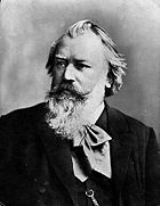
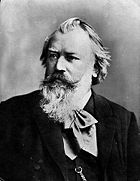
Johannes Brahms

Encyclopedia
Romantic music
Romantic music or music in the Romantic Period is a musicological and artistic term referring to a particular period, theory, compositional practice, and canon in Western music history, from 1810 to 1900....
. Born in Hamburg, Brahms spent much of his professional life in Vienna, Austria, where he was a leader of the musical scene. In his lifetime, Brahms's popularity and influence were considerable; following a comment by the nineteenth-century conductor Hans von Bülow
Hans von Bülow
Hans Guido Freiherr von Bülow was a German conductor, virtuoso pianist, and composer of the Romantic era. He was one of the most famous conductors of the 19th century, and his activity was critical for establishing the successes of several major composers of the time, including Richard...
, he is sometimes grouped with Johann Sebastian Bach
Johann Sebastian Bach
Johann Sebastian Bach was a German composer, organist, harpsichordist, violist, and violinist whose sacred and secular works for choir, orchestra, and solo instruments drew together the strands of the Baroque period and brought it to its ultimate maturity...
and Ludwig van Beethoven
Ludwig van Beethoven
Ludwig van Beethoven was a German composer and pianist. A crucial figure in the transition between the Classical and Romantic eras in Western art music, he remains one of the most famous and influential composers of all time.Born in Bonn, then the capital of the Electorate of Cologne and part of...
as one of the Three Bs
Three Bs
"The Three Bs" is an English-language phrase derived from an expression coined by Peter Cornelius in 1854, which added Hector Berlioz as the third B to occupy the heights already occupied by Johann Sebastian Bach and Ludwig van Beethoven. Later in the century, the famous conductor Hans von Bülow...
.
Brahms composed for piano, chamber ensembles, symphony orchestra, and for voice and chorus. A virtuoso pianist, he premiered many of his own works; he also worked with some of the leading performers of his time, including the pianist Clara Schumann
Clara Schumann
Clara Schumann was a German musician and composer, considered one of the most distinguished pianists of the Romantic era...
and the violinist Joseph Joachim
Joseph Joachim
Joseph Joachim was a Hungarian violinist, conductor, composer and teacher. A close collaborator of Johannes Brahms, he is widely regarded as one of the most significant violinists of the 19th century.-Origins:...
. Many of his works have become staples of the modern concert repertoire. Brahms, an uncompromising perfectionist, destroyed many of his works and left some of them unpublished.
Brahms is often considered both a traditionalist and an innovator. His music is firmly rooted in the structures and compositional techniques of the Baroque and Classical masters. He was a master of counterpoint
Counterpoint
In music, counterpoint is the relationship between two or more voices that are independent in contour and rhythm and are harmonically interdependent . It has been most commonly identified in classical music, developing strongly during the Renaissance and in much of the common practice period,...
, the complex and highly disciplined method of composition for which Johann Sebastian Bach
Johann Sebastian Bach
Johann Sebastian Bach was a German composer, organist, harpsichordist, violist, and violinist whose sacred and secular works for choir, orchestra, and solo instruments drew together the strands of the Baroque period and brought it to its ultimate maturity...
is famous, and also of development
Musical development
In European classical music, musical development is a process by which a musical idea is communicated in the course of a composition. It refers to the transformation and restatement of initial material, and is often contrasted with musical variation, which is a slightly different means to the same...
, a compositional ethos pioneered by Joseph Haydn
Joseph Haydn
Franz Joseph Haydn , known as Joseph Haydn , was an Austrian composer, one of the most prolific and prominent composers of the Classical period. He is often called the "Father of the Symphony" and "Father of the String Quartet" because of his important contributions to these forms...
, Wolfgang Amadeus Mozart
Wolfgang Amadeus Mozart
Wolfgang Amadeus Mozart , baptismal name Johannes Chrysostomus Wolfgangus Theophilus Mozart , was a prolific and influential composer of the Classical era. He composed over 600 works, many acknowledged as pinnacles of symphonic, concertante, chamber, piano, operatic, and choral music...
and Ludwig van Beethoven
Ludwig van Beethoven
Ludwig van Beethoven was a German composer and pianist. A crucial figure in the transition between the Classical and Romantic eras in Western art music, he remains one of the most famous and influential composers of all time.Born in Bonn, then the capital of the Electorate of Cologne and part of...
. Brahms aimed to honor the "purity" of these venerable "German" structures and advance them into a Romantic idiom, in the process creating bold new approaches to harmony and melody. While many contemporaries found his music too academic, his contribution and craftsmanship have been admired by subsequent figures as diverse as the progressive Arnold Schoenberg
Arnold Schoenberg
Arnold Schoenberg was an Austrian composer, associated with the expressionist movement in German poetry and art, and leader of the Second Viennese School...
and the conservative Edward Elgar
Edward Elgar
Sir Edward William Elgar, 1st Baronet OM, GCVO was an English composer, many of whose works have entered the British and international classical concert repertoire. Among his best-known compositions are orchestral works including the Enigma Variations, the Pomp and Circumstance Marches, concertos...
. The diligent, highly constructed nature of Brahms's works was a starting point and an inspiration for a generation of composers.
Early years
Brahms's father, Johann Jakob Brahms (1806–72), came to Hamburg from DithmarschenDithmarschen
Dithmarschen is a district in Schleswig-Holstein, Germany. It is bounded by the districts of Nordfriesland, Schleswig-Flensburg, Rendsburg-Eckernförde, and Steinburg, by the state of Lower Saxony , and by the North Sea.-Geography:The district is located on the North Sea...
, seeking a career as a town musician. He was proficient in several instruments, but found employment mostly playing the horn
Horn (instrument)
The horn is a brass instrument consisting of about of tubing wrapped into a coil with a flared bell. A musician who plays the horn is called a horn player ....
and double bass
Double bass
The double bass, also called the string bass, upright bass, standup bass or contrabass, is the largest and lowest-pitched bowed string instrument in the modern symphony orchestra, with strings usually tuned to E1, A1, D2 and G2...
. In 1830, he married Johanna Henrika Christiane Nissen (1789–1865), a seamstress never previously married, who was seventeen years older than he was. Johannes Brahms had an older sister and a younger brother. Initially, they lived near the city docks, in the Gängeviertel quarter of Hamburg, for six months, before moving to a small house on the Dammtorwall, a small city in the Inner Alster.
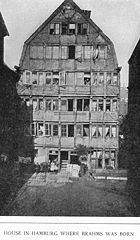
For a time, Brahms also learned the cello. After his early piano lessons with Otto Cossel, Brahms studied piano with Eduard Marxsen
Eduard Marxsen
Eduard Marxsen was a German pianist, composer and teacher. He was a pupil of Ignaz von Seyfried, Simon Sechter, Johann Heinrich Clasing, and Karl Maria von Bocklet....
, who had studied in Vienna with Ignaz von Seyfried
Ignaz von Seyfried
Ignaz Xaver Ritter von Seyfried was an Austrian musician, conductor and composer.Seyfried was born in Vienna. According to a statement in his handwritten memoirs he was a pupil of both Wolfgang Amadeus Mozart and Johann Albrechtsberger. He published Albrechtsberger's complete written works after...
(a pupil of Mozart
Wolfgang Amadeus Mozart
Wolfgang Amadeus Mozart , baptismal name Johannes Chrysostomus Wolfgangus Theophilus Mozart , was a prolific and influential composer of the Classical era. He composed over 600 works, many acknowledged as pinnacles of symphonic, concertante, chamber, piano, operatic, and choral music...
) and Carl Maria von Bocklet
Carl Maria von Bocklet
Carl Maria von Bocklet was a composer and teacher of music. He studied with Bedřich Diviš Weber and moved to Vienna in 1821, where he "created a great stir...through his interesting free fantasias on the piano forte." In Vienna, Eduard Marxsen was one of his notable students...
(a close friend of Schubert
Franz Schubert
Franz Peter Schubert was an Austrian composer.Although he died at an early age, Schubert was tremendously prolific. He wrote some 600 Lieder, nine symphonies , liturgical music, operas, some incidental music, and a large body of chamber and solo piano music...
). The young Brahms gave a few public concerts in Hamburg, but did not become well known as a pianist until he made a concert tour at the age of nineteen. (In later life, he frequently took part in the performance of his own works, whether as soloist, accompanist, or participant in chamber music.) He conducted choirs from his early teens, and became a proficient choral and orchestral conductor.
Meeting Joachim and Liszt
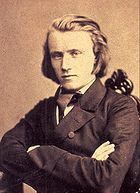
Ede Reményi
Eduard Remenyi, Reményi Ede, born Eduard Hoffmann was a Hungarian violinist.He studied under Joseph Böhm at the Vienna Conservatory from 1842 to 1845...
in April and May 1853. On this tour he met Joseph Joachim
Joseph Joachim
Joseph Joachim was a Hungarian violinist, conductor, composer and teacher. A close collaborator of Johannes Brahms, he is widely regarded as one of the most significant violinists of the 19th century.-Origins:...
at Hanover
Hanover
Hanover or Hannover, on the river Leine, is the capital of the federal state of Lower Saxony , Germany and was once by personal union the family seat of the Hanoverian Kings of Great Britain, under their title as the dukes of Brunswick-Lüneburg...
, and went on to the Court of Weimar
Weimar
Weimar is a city in Germany famous for its cultural heritage. It is located in the federal state of Thuringia , north of the Thüringer Wald, east of Erfurt, and southwest of Halle and Leipzig. Its current population is approximately 65,000. The oldest record of the city dates from the year 899...
where he met Franz Liszt
Franz Liszt
Franz Liszt ; ), was a 19th-century Hungarian composer, pianist, conductor, and teacher.Liszt became renowned in Europe during the nineteenth century for his virtuosic skill as a pianist. He was said by his contemporaries to have been the most technically advanced pianist of his age...
, Peter Cornelius
Peter Cornelius
Carl August Peter Cornelius was a German composer, writer about music, poet and translator. He was born and died in Mainz where his grave in the Hauptfriedhof survives....
, and Joachim Raff
Joachim Raff
Joseph Joachim Raff was a German-Swiss composer, teacher and pianist.-Biography:Raff was born in Lachen in Switzerland. His father, a teacher, had fled there from Württemberg in 1810 to escape forced recruitment into the military of that southwestern German state that had to fight for Napoleon in...
. According to several witnesses of Brahms's meeting with Liszt (at which Liszt performed Brahms's Scherzo
Scherzo
A scherzo is a piece of music, often a movement from a larger piece such as a symphony or a sonata. The scherzo's precise definition has varied over the years, but it often refers to a movement which replaces the minuet as the third movement in a four-movement work, such as a symphony, sonata, or...
, Op. 4, at sight), Reményi was offended by Brahms's failure to praise Liszt's Sonata in B minor
Piano Sonata (Liszt)
The Piano Sonata in B minor , S.178, is a musical composition for solo piano by Franz Liszt, published in 1854 with a dedication to Robert Schumann. It is often considered Liszt's greatest composition for solo piano. The piece has been often analyzed, particularly regarding issues of form.-...
wholeheartedly (Brahms supposedly fell asleep during a performance of the recently composed work), and they parted company shortly afterwards. Brahms later excused himself, saying that he could not help it, having been exhausted by his travels.
Brahms and Schumann
Joachim had given Brahms a letter of introduction to Robert SchumannRobert Schumann
Robert Schumann, sometimes known as Robert Alexander Schumann, was a German composer, aesthete and influential music critic. He is regarded as one of the greatest and most representative composers of the Romantic era....
, and after a walking tour in the Rhineland
Rhineland
Historically, the Rhinelands refers to a loosely-defined region embracing the land on either bank of the River Rhine in central Europe....
, Brahms took the train to Düsseldorf
Düsseldorf
Düsseldorf is the capital city of the German state of North Rhine-Westphalia and centre of the Rhine-Ruhr metropolitan region.Düsseldorf is an important international business and financial centre and renowned for its fashion and trade fairs. Located centrally within the European Megalopolis, the...
, and was welcomed into the Schumann family on arrival there. Schumann, amazed by the 20-year-old's talent, published an article entitled "Neue Bahnen" (New Paths) in the 28 October 1853 issue of the journal Neue Zeitschrift für Musik
Neue Zeitschrift für Musik
Die Neue Zeitschrift für Musik was a music magazine published in Leipzig, co-founded by Robert Schumann, his teacher and future father-in law Friedrich Wieck, and his close friend Ludwig Schuncke...
alerting the public to the young man, who, he claimed, was "destined to give ideal expression to the times." This pronouncement was received with some skepticism outside of Schumann's immediate circle, and may have increased Brahms's naturally self-critical need to perfect his works and technique. While he was in Düsseldorf, Brahms participated with Schumann and Albert Dietrich
Albert Dietrich
Albert Hermann Dietrich , was a German composer and conductor, remembered less for his own achievements than for his friendship with Johannes Brahms.Dietrich was born at Golk, near Meissen...
in writing a sonata for Joachim; this is known as the "F–A–E Sonata" . He became very attached to Schumann's wife, the composer and pianist Clara
Clara Schumann
Clara Schumann was a German musician and composer, considered one of the most distinguished pianists of the Romantic era...
, fourteen years his senior, with whom he would carry on a lifelong, emotionally passionate relationship. Brahms never married, despite strong feelings for several women and despite entering into an engagement, soon broken off, with Agathe von Siebold in Göttingen
Göttingen
Göttingen is a university town in Lower Saxony, Germany. It is the capital of the district of Göttingen. The Leine river runs through the town. In 2006 the population was 129,686.-General information:...
in 1859. After Schumann's attempted suicide and subsequent confinement in a mental sanatorium near Bonn
Bonn
Bonn is the 19th largest city in Germany. Located in the Cologne/Bonn Region, about 25 kilometres south of Cologne on the river Rhine in the State of North Rhine-Westphalia, it was the capital of West Germany from 1949 to 1990 and the official seat of government of united Germany from 1990 to 1999....
in February 1854, Brahms was the main intercessor between Clara and her husband, and found himself virtually head of the household.
After Schumann's death, Brahms hurried to Düsseldorf and for the next two years lived in an apartment above the Schumann's house, and sacrificed his career and his art for Clara's sake. The question of Brahms and Clara Schumann is perhaps the most mysterious in music history, alongside that of Beethoven's "Immortal Beloved." Whether they were actually lovers is unknown, but their destruction of their letters to each other may point to something beyond mere privacy.
Detmold and Hamburg
After Schumann's death at the sanatorium in 1856, Brahms divided his time between Hamburg, where he formed and conducted a ladies' choir, and DetmoldDetmold
Detmold is a city in North Rhine-Westphalia, Germany, with a population of about 74,000. It was the capital of the small Principality of Lippe from 1468 until 1918 and then of the Free State of Lippe until 1947...
in the Principality of Lippe
Principality of Lippe
Lippe was a historical state in Germany. It was located between the Weser River and the southeast part of the Teutoburg forest.-History:...
, where he was court music-teacher and conductor. He was the soloist at the premiere of his Piano Concerto No. 1
Piano Concerto No. 1 (Brahms)
The Piano Concerto No. 1 in D minor, Op. 15, is a work for piano and orchestra composed by Johannes Brahms in 1858. The composer gave the work's public debut in Hanover, Germany, the following year.-Form:...
in 1859. He first visited Vienna in 1862, staying there over the winter, and, in 1863, was appointed conductor of the Vienna Singakademie
Wiener Singakademie
As the first mixed choir in Vienna, the Wiener Singakademie was founded in 1858 with the idea to establish a "Singübungsanstalt" . From the beginning, its repertory has been shaped by two major interests: the fostering of the works of the traditional masters, and the inclusion of contemporary works...
. Though he resigned the position the following year, and entertained the idea of taking up conducting posts elsewhere, he based himself increasingly in Vienna and soon made his home there. From 1872 to 1875, he was director of the concerts of the Vienna Gesellschaft der Musikfreunde
Gesellschaft der Musikfreunde
The Gesellschaft der Musikfreunde in Wien , was founded in 1812 by Joseph von Sonnleithner, general secretary of the Court Theatre, Vienna, Austria. Its official charter, drafted in 1814, states that the purpose of the Society was to promote music in all its facets...
; afterwards, he accepted no formal position. He declined an honorary doctorate of music from University of Cambridge in 1877, but accepted one from the University of Breslau in 1879, and composed the Academic Festival Overture
Academic Festival Overture
Academic Festival Overture , Op. 80, by Johannes Brahms, was one of a pair of contrasting concert overtures — the other being the Tragic Overture, Op. 81, written to balance it as its pair...
as a gesture of appreciation.
He had been composing steadily throughout the 1850s and 60s, but his music had evoked divided critical responses, and the Piano Concerto No. 1 had been badly received in some of its early performances. His works were labelled old-fashioned by the 'New German School' whose principal figures included Liszt and Richard Wagner
Richard Wagner
Wilhelm Richard Wagner was a German composer, conductor, theatre director, philosopher, music theorist, poet, essayist and writer primarily known for his operas...
. Brahms admired some of Wagner's music and admired Liszt as a great pianist, but the conflict between the two schools, known as the War of the Romantics
War of the Romantics
The War of the Romantics is a term used by music historians to describe the aesthetic schism among prominent musicians in the second half of the 19th century. Musical structure, the limits of chromatic harmony, and program music versus absolute music were the principal areas of contention. The...
, soon embroiled all of musical Europe. In the Brahms camp were his close friends: Clara Schumann, the influential music critic Eduard Hanslick
Eduard Hanslick
Eduard Hanslick was a Bohemian-Austrian music critic.-Biography:Hanslick was born in Prague, the son of Joseph Adolph Hanslick, a bibliographer and music teacher from a German-speaking family, and one of his piano pupils, the daughter of a Jewish merchant from Vienna...
, and the leading Viennese surgeon Theodor Billroth
Theodor Billroth
Christian Albert Theodor Billroth was a German-born Austrian surgeon and amateur musician....
. In 1860, Brahms attempted to organize a public protest against some of the wilder excesses of the Wagnerians' music. This took the form of a manifesto, written by Brahms and Joachim jointly. The manifesto, which was published prematurely with only three supporting signatures, was a failure, and he never engaged in public polemics again.
Years of popularity
It was the premiere of A German Requiem, his largest choral work, in BremenBremen
The City Municipality of Bremen is a Hanseatic city in northwestern Germany. A commercial and industrial city with a major port on the river Weser, Bremen is part of the Bremen-Oldenburg metropolitan area . Bremen is the second most populous city in North Germany and tenth in Germany.Bremen is...
, in 1868, that confirmed Brahms's European reputation and led many to accept that he had conquered Beethoven and the symphony. This may have given him the confidence finally to complete a number of works that he had wrestled with over many years, such as the cantata Rinaldo
Rinaldo (cantata)
Rinaldo, a cantata for tenor solo, four-part male chorus and orchestra, was begun by Johannes Brahms in 1863 as an entry for a choral competition announced in Aachen...
, his first string quartet, third piano quartet, and most notably his first symphony. This appeared in 1876, though it had been begun (and a version of the first movement seen by some of his friends) in the early 1860s. The other three symphonies then followed in 1877, 1883, and 1885. From 1881, he was able to try out his new orchestral works with the court orchestra of the Duke of Meiningen
Meiningen
Meiningen is a town in Germany - located in the southern part of the state of Thuringia and is the district seat of Schmalkalden-Meiningen. It is situated on the river Werra....
, whose conductor was Hans von Bülow
Hans von Bülow
Hans Guido Freiherr von Bülow was a German conductor, virtuoso pianist, and composer of the Romantic era. He was one of the most famous conductors of the 19th century, and his activity was critical for establishing the successes of several major composers of the time, including Richard...
. He was the soloist at the premiere of his Piano Concerto No. 2
Piano Concerto No. 2 (Brahms)
The Piano Concerto No. 2 in B-flat major, Op. 83 by Johannes Brahms is a composition for solo piano with orchestral accompaniment. It is separated by a gap of 22 years from the composer's first piano concerto. Brahms began work on the piece in 1878 and completed it in 1881 while in Pressbaum near...
in 1881, in Pest.
Brahms frequently travelled, both for business (concert tours) and pleasure. From 1878 onwards, he often visited Italy
Italy
Italy , officially the Italian Republic languages]] under the European Charter for Regional or Minority Languages. In each of these, Italy's official name is as follows:;;;;;;;;), is a unitary parliamentary republic in South-Central Europe. To the north it borders France, Switzerland, Austria and...
in the springtime, and he usually sought out a pleasant rural location in which to compose during the summer. He was a great walker and especially enjoyed spending time in the open air, where he felt that he could think more clearly.

Thomas Edison
Thomas Alva Edison was an American inventor and businessman. He developed many devices that greatly influenced life around the world, including the phonograph, the motion picture camera, and a long-lasting, practical electric light bulb. In addition, he created the world’s first industrial...
, visited the composer in Vienna and invited him to make an experimental recording. Brahms played an abbreviated version of his first Hungarian dance on the piano. The recording was later issued on an LP of early piano performances (compiled by Gregor Benko
Gregor Benko
Gregor Benko is an American writer, lecturer, record producer, and collector-historian whose primary focus is classical piano performance documented on recordings from the Romantic Era...
). Although the spoken introduction to the short piece of music is quite clear, the piano playing is largely inaudible due to heavy surface noise. Nevertheless, this remains the earliest recording made by a major composer. Analysts and scholars remain divided, however, as to whether the voice that introduces the piece is that of Wangemann or of Brahms. Several attempts have been made to improve the quality of this historic recording; a "denoised" version was produced at Stanford University which claims to solve the mystery.
In 1889, Brahms was named an honorary citizen of Hamburg, until 1948 the only one born in Hamburg.
Later years
In 1890, the 57-year-old Brahms resolved to give up composing. However, as it turned out, he was unable to abide by his decision, and in the years before his death he produced a number of acknowledged masterpieces. His admiration for Richard MühlfeldRichard Mühlfeld
Richard Mühlfeld was a German clarinettist who inspired Johannes Brahms and Gustav Jenner to write chamber works including the instrument...
, clarinetist with the Meiningen orchestra, moved him to compose the Clarinet Trio
Clarinet Trio (Brahms)
The Trio for clarinet, cello and piano in A Minor, Op. 114, was one of four chamber works featuring clarinet composed by Johannes Brahms in rapid succession after emerging from retirement toward the end of his life. Brahms was inspired to compose these works by the playing of clarinettist Richard...
, Op. 114, Clarinet Quintet
Clarinet Quintet (Brahms)
Johannes Brahms's Clarinet Quintet in B minor, Op. 115 was written in 1891 for the clarinettist Richard Mühlfeld. It is widely regarded as Brahms's supreme achievement in chamber music.The piece is known for its autumnal mood...
, Op. 115 (1891), and the two Clarinet Sonatas
Clarinet Sonatas (Brahms)
The Clarinet Sonatas, Op. 120, Nos. 1 and 2 are a pair of works written for clarinet and piano by the Romantic composer Johannes Brahms. They were written in 1894 and are dedicated to the clarinetist Richard Mühlfeld. The sonatas stem from a period in Brahms’s life where he “discovered” the beauty...
, Op. 120 (1894). He also wrote several cycles of piano pieces, Opp. 116–119, the Four Serious Songs (Vier ernste Gesänge), Op. 121 (1896), and the Eleven Chorale Preludes
Eleven Chorale Preludes
The Eleven Chorale Preludes, Op. 122, are a collection of chorale preludes for organ by Johannes Brahms, composed in 1896, and published posthumously in 1902....
for organ, Op. 122 (1896).
While completing the Op. 121 songs, Brahms developed cancer (sources differ on whether this was of the liver
Hepatocellular carcinoma
Hepatocellular carcinoma is the most common type of liver cancer. Most cases of HCC are secondary to either a viral hepatitide infection or cirrhosis .Compared to other cancers, HCC is quite a rare tumor in the United States...
or pancreas
Pancreatic cancer
Pancreatic cancer refers to a malignant neoplasm of the pancreas. The most common type of pancreatic cancer, accounting for 95% of these tumors is adenocarcinoma, which arises within the exocrine component of the pancreas. A minority arises from the islet cells and is classified as a...
). His condition gradually worsened and he died on April 3, 1897, aged 63. Brahms is buried in the Zentralfriedhof
Zentralfriedhof
The Zentralfriedhof is one of the largest cemeteries in the world, largest by number of interred in Europe and most famous cemetery among Vienna's nearly 50 cemeteries.-Name and location:...
in Vienna.
Tributes
Later that year, the British composer Hubert ParryHubert Parry
Sir Charles Hubert Hastings Parry, 1st Baronet was an English composer, teacher and historian of music.Parry's first major works appeared in 1880. As a composer he is best known for the choral song "Jerusalem", the coronation anthem "I was glad" and the hymn tune "Repton", which sets the words...
, who considered Brahms the greatest artist of the time, wrote an orchestral Elegy for Brahms
Elegy for Brahms
The Elegy for Brahms is a short symphonic movement for orchestra, written by Hubert Parry in 1897. It was written shortly after the death of Johannes Brahms, whom Parry considered the greatest artist of the time....
. This was never played in Parry's lifetime, receiving its first performance at a memorial concert for Parry himself in 1918.
Music of Brahms
Works
Brahms wrote a number of major works for orchestra, including two serenadeSerenade
In music, a serenade is a musical composition, and/or performance, in someone's honor. Serenades are typically calm, light music.The word Serenade is derived from the Italian word sereno, which means calm....
s, four symphonies
Symphony
A symphony is an extended musical composition in Western classical music, scored almost always for orchestra. A symphony usually contains at least one movement or episode composed according to the sonata principle...
, two piano concerto
Piano concerto
A piano concerto is a concerto written for piano and orchestra.See also harpsichord concerto; some of these works are occasionally played on piano...
s (No. 1 in D minor
Piano Concerto No. 1 (Brahms)
The Piano Concerto No. 1 in D minor, Op. 15, is a work for piano and orchestra composed by Johannes Brahms in 1858. The composer gave the work's public debut in Hanover, Germany, the following year.-Form:...
; No. 2 in B flat major
Piano Concerto No. 2 (Brahms)
The Piano Concerto No. 2 in B-flat major, Op. 83 by Johannes Brahms is a composition for solo piano with orchestral accompaniment. It is separated by a gap of 22 years from the composer's first piano concerto. Brahms began work on the piece in 1878 and completed it in 1881 while in Pressbaum near...
), a Violin Concerto
Violin Concerto (Brahms)
Violin Concerto in D major, Op. 77 is a violin concerto in three movements composed by Johannes Brahms in 1878 and dedicated to his friend, the violinist Joseph Joachim...
, a Double Concerto
Double Concerto (Brahms)
The Double Concerto in A minor, Op. 102, by Johannes Brahms is a concerto for violin, cello and orchestra.- Origin of the work :The Double Concerto was Brahms' final work for orchestra. It was composed in the summer of 1887, and first performed on 18 October of that year in the Gürzenich in Köln,...
for violin and cello, and two companion orchestral overtures, the Academic Festival Overture
Academic Festival Overture
Academic Festival Overture , Op. 80, by Johannes Brahms, was one of a pair of contrasting concert overtures — the other being the Tragic Overture, Op. 81, written to balance it as its pair...
and the Tragic Overture
Tragic Overture
The Tragic Overture , Op. 81, is a concert overture for orchestra written by Johannes Brahms during the summer of 1880. It premiered on December 26, 1880 in Vienna...
.
His large choral work A German Requiem is not a setting of the liturgical Missa pro defunctis but a setting of texts which Brahms selected from the Lutheran Bible
Luther Bible
The Luther Bible is a German Bible translation by Martin Luther, first printed with both testaments in 1534. This translation became a force in shaping the Modern High German language. The project absorbed Luther's later years. The new translation was very widely disseminated thanks to the printing...
. The work was composed in three major periods of his life. An early version of the second movement was first composed in 1854, not long after Robert Schumann
Robert Schumann
Robert Schumann, sometimes known as Robert Alexander Schumann, was a German composer, aesthete and influential music critic. He is regarded as one of the greatest and most representative composers of the Romantic era....
's attempted suicide, and this was later used in his first piano concerto. The majority of the Requiem was composed after his mother's death in 1865. The fifth movement was added after the official premiere in 1868, and the work was published in 1869.
Brahms's works in variation
Variation (music)
In music, variation is a formal technique where material is repeated in an altered form. The changes may involve harmony, melody, counterpoint, rhythm, timbre, orchestration or any combination of these.-Variation form:...
form include, among others, the Variations and Fugue on a Theme by Handel
Variations and Fugue on a Theme by Handel
The Variations and Fugue on a Theme by Handel, Op. 24, is a work for solo piano written by Johannes Brahms in 1861. It consists of a set of twenty-five variations and a concluding fugue, all based on a theme from George Frideric Handel's Harpsichord Suite No...
and the Paganini Variations, both for solo piano, and the Variations on a Theme by Haydn in versions for two pianos and for orchestra. The final movement of the Fourth Symphony
Symphony No. 4 (Brahms)
The Symphony No. 4 in E minor, Op. 98 by Johannes Brahms is the last of his symphonies. Brahms began working on the piece in 1884, just a year after completing his Symphony No...
, Op. 98, is formally a passacaglia
Passacaglia
The passacaglia is a musical form that originated in early seventeenth-century Spain and is still used by contemporary composers. It is usually of a serious character and is often, but not always, based on a bass-ostinato and written in triple metre....
.
His chamber
Chamber music
Chamber music is a form of classical music, written for a small group of instruments which traditionally could be accommodated in a palace chamber. Most broadly, it includes any art music that is performed by a small number of performers with one performer to a part...
works include three string quartets, two string quintets, two string sextets, a clarinet quintet, a clarinet trio, a horn trio
Horn Trio (Brahms)
The Horn Trio in E flat major, Op. 40, by Johannes Brahms is a chamber piece in four movements written for natural horn, violin, and piano. Composed in 1865, the work commemorates the death of Brahms’ mother, Christiane, earlier that year. The work was first performed in Zurich on November 28,...
, a piano quintet, three piano quartets, and four piano trios (the fourth being published posthumously). He composed several instrumental sonatas with piano, including three for violin, two for cello, and two for clarinet (which were subsequently arranged for viola
Viola
The viola is a bowed string instrument. It is the middle voice of the violin family, between the violin and the cello.- Form :The viola is similar in material and construction to the violin. A full-size viola's body is between and longer than the body of a full-size violin , with an average...
by the composer). His solo piano works range from his early piano sonata
Piano sonata
A piano sonata is a sonata written for a solo piano. Piano sonatas are usually written in three or four movements, although some piano sonatas have been written with a single movement , two movements , five or even more movements...
s and ballades to his late sets of character pieces. Brahms was a significant lied
Lied
is a German word literally meaning "song", usually used to describe romantic songs setting German poems of reasonably high literary aspirations, especially during the nineteenth century, beginning with Carl Loewe, Heinrich Marschner, and Franz Schubert and culminating with Hugo Wolf...
er composer, who wrote over 200 songs. His chorale prelude
Chorale prelude
In music, a chorale prelude is a short liturgical composition for organ using a chorale tune as its basis. It was a predominant style of the German Baroque era and reached its culmination in the works of J.S. Bach, who wrote 46 examples of the form in his Orgelbüchlein.-Function:The liturgical...
s for organ
Organ (music)
The organ , is a keyboard instrument of one or more divisions, each played with its own keyboard operated either with the hands or with the feet. The organ is a relatively old musical instrument in the Western musical tradition, dating from the time of Ctesibius of Alexandria who is credited with...
, Op. 122, which he wrote shortly before his death, have become an important part of the organist's repertoire.
Brahms strongly preferred writing absolute music
Absolute music
Absolute music is a concept in music that describes music as an art form separated from formalisms or other considerations; it is not explicitly about anything; it is non-representational. In contrast to program music, absolute music makes sense without accompanying words, images, drama, or...
that does not refer to an explicit scene or narrative, and he never wrote an opera or a symphonic poem
Symphonic poem
A symphonic poem or tone poem is a piece of orchestral music in a single continuous section in which the content of a poem, a story or novel, a painting, a landscape or another source is illustrated or evoked. The term was first applied by Hungarian composer Franz Liszt to his 13 works in this vein...
.
Despite his reputation as a serious composer of large, complex musical structures, some of Brahms's most widely known and most commercially successful compositions during his life were small-scale works of popular intent aimed at the thriving contemporary market for domestic music-making; indeed, during the 20th century, the influential American critic B. H. Haggin
B. H. Haggin
Bernard H. Haggin , better known as B.H. Haggin, was an American music critic.-Early life:A lifelong inhabitant of New York City, he graduated from Juilliard School in 1920, where he studied piano.He published his first article in 1923...
, rejecting more mainstream views, argued in his various guides to recorded music that Brahms was at his best in such works and much less successful in larger forms. Among the most cherished of these lighter works by Brahms are his sets of popular dances—the Hungarian Dances
Hungarian Dances (Brahms)
The Hungarian Dances by Johannes Brahms , are a set of 21 lively dance tunes based mostly on Hungarian themes, completed in 1869.They vary from about a minute to four minutes in length. They are among Brahms' most popular works, and were certainly the most profitable for him. Each dance has been...
, the Waltzes, Op. 39, for piano duet, and the Liebeslieder Waltzes for vocal quartet and piano—and some of his many songs, notably the Wiegenlied, Op. 49, No. 4 (published in 1868). This last was written (to a folk text) to celebrate the birth of a son to Brahms's friend Bertha Faber and is universally known as Brahms's Lullaby.
Style and influences
Brahms maintained a Classical sense of form and order in his works – in contrast to the opulence of the music of many of his contemporaries. Thus many admirers (though not necessarily Brahms himself) saw him as the champion of traditional forms and "pure music", as opposed to the "New German" embrace of programme music.Brahms venerated Beethoven
Ludwig van Beethoven
Ludwig van Beethoven was a German composer and pianist. A crucial figure in the transition between the Classical and Romantic eras in Western art music, he remains one of the most famous and influential composers of all time.Born in Bonn, then the capital of the Electorate of Cologne and part of...
: in the composer's home, a marble bust of Beethoven looked down on the spot where he composed, and some passages in his works are reminiscent of Beethoven's style. Brahms's First Symphony
Symphony No. 1 (Brahms)
The Symphony No. 1 in C minor, Op. 68, is a symphony written by Johannes Brahms. Brahms spent at least fourteen years completing this work, whose sketches date from 1854. Brahms himself declared that the symphony, from sketches to finishing touches, took 21 years, from 1855 to 1876...
bears strongly the influence of Beethoven's Fifth Symphony
Symphony No. 5 (Beethoven)
The Symphony No. 5 in C minor, Op. 67, was written by Ludwig van Beethoven in 1804–08. This symphony is one of the most popular and best-known compositions in all of classical music, and one of the most often played symphonies. It comprises four movements: an opening sonata, an andante, and a fast...
, as the two works are both in a formidable C Minor, and end in the struggle towards a C Major triumph. The main theme of the finale of the First Symphony
Symphony No. 1 (Brahms)
The Symphony No. 1 in C minor, Op. 68, is a symphony written by Johannes Brahms. Brahms spent at least fourteen years completing this work, whose sketches date from 1854. Brahms himself declared that the symphony, from sketches to finishing touches, took 21 years, from 1855 to 1876...
is also reminiscent of the main theme of the finale of Beethoven's Ninth
Symphony No. 9 (Beethoven)
The Symphony No. 9 in D minor, Op. 125, is the final complete symphony of Ludwig van Beethoven. Completed in 1824, the symphony is one of the best known works of the Western classical repertoire, and has been adapted for use as the European Anthem...
, and when this resemblance was pointed out to Brahms, he replied that any ass – jeder Esel – could see that. In 1876, when the work was premiered in Vienna, it was immediately hailed as "Beethoven's Tenth".
A German Requiem was partially inspired by his mother's death in 1865 (at which time he composed a funeral march that was to become the basis of Part Two, Denn alles Fleisch), but it also incorporates material from a Symphony which he started in 1854 but abandoned following Schumann's suicide attempt. He once wrote that the Requiem "belonged to Schumann". The first movement of this abandoned Symphony was re-worked as the first movement of the First Piano Concerto
Piano Concerto No. 1 (Brahms)
The Piano Concerto No. 1 in D minor, Op. 15, is a work for piano and orchestra composed by Johannes Brahms in 1858. The composer gave the work's public debut in Hanover, Germany, the following year.-Form:...
.
Brahms also loved the Classical composers Mozart
Wolfgang Amadeus Mozart
Wolfgang Amadeus Mozart , baptismal name Johannes Chrysostomus Wolfgangus Theophilus Mozart , was a prolific and influential composer of the Classical era. He composed over 600 works, many acknowledged as pinnacles of symphonic, concertante, chamber, piano, operatic, and choral music...
and Haydn
Joseph Haydn
Franz Joseph Haydn , known as Joseph Haydn , was an Austrian composer, one of the most prolific and prominent composers of the Classical period. He is often called the "Father of the Symphony" and "Father of the String Quartet" because of his important contributions to these forms...
. He collected first editions and autographs of their works, and edited performing editions. He studied the music of pre-classical composers, including Giovanni Gabrieli
Giovanni Gabrieli
Giovanni Gabrieli was an Italian composer and organist. He was one of the most influential musicians of his time, and represents the culmination of the style of the Venetian School, at the time of the shift from Renaissance to Baroque idioms.-Biography:Gabrieli was born in Venice...
, Johann Adolph Hasse
Johann Adolph Hasse
Johann Adolph Hasse was an 18th-century German composer, singer and teacher of music. Immensely popular in his time, Hasse was best known for his prolific operatic output, though he also composed a considerable quantity of sacred music...
, Heinrich Schütz
Heinrich Schütz
Heinrich Schütz was a German composer and organist, generally regarded as the most important German composer before Johann Sebastian Bach and often considered to be one of the most important composers of the 17th century along with Claudio Monteverdi...
, Domenico Scarlatti
Domenico Scarlatti
Giuseppe Domenico Scarlatti was an Italian composer who spent much of his life in the service of the Portuguese and Spanish royal families. He is classified as a Baroque composer chronologically, although his music was influential in the development of the Classical style...
, George Frideric Handel
George Frideric Handel
George Frideric Handel was a German-British Baroque composer, famous for his operas, oratorios, anthems and organ concertos. Handel was born in 1685, in a family indifferent to music...
, and, especially, Johann Sebastian Bach
Johann Sebastian Bach
Johann Sebastian Bach was a German composer, organist, harpsichordist, violist, and violinist whose sacred and secular works for choir, orchestra, and solo instruments drew together the strands of the Baroque period and brought it to its ultimate maturity...
. His friends included leading musicologists, and, with Friedrich Chrysander
Friedrich Chrysander
Karl Franz Friedrich Chrysander was a German music historian and critic, whose edition of the works of George Frideric Handel and authoritative writings on many other composers established him as a pioneer of 19th-century musicology.Born at Lübtheen, in Mecklenburg-Schwerin, Chrysander was the son...
, he edited an edition of the works of François Couperin
François Couperin
François Couperin was a French Baroque composer, organist and harpsichordist. He was known as Couperin le Grand to distinguish him from other members of the musically talented Couperin family.-Life:Couperin was born in Paris...
. Brahms also edited works by C. P. E.
Carl Philipp Emanuel Bach
right|250pxCarl Philipp Emanuel Bach was a German Classical period musician and composer, the fifth child and second son of Johann Sebastian Bach and Maria Barbara Bach...
and W. F. Bach
Wilhelm Friedemann Bach
Wilhelm Friedemann Bach , the second child and eldest son of Johann Sebastian Bach and Maria Barbara Bach, was a German composer and performer...
. He looked to older music for inspiration in the art of counterpoint
Counterpoint
In music, counterpoint is the relationship between two or more voices that are independent in contour and rhythm and are harmonically interdependent . It has been most commonly identified in classical music, developing strongly during the Renaissance and in much of the common practice period,...
; the themes of some of his works are modelled on Baroque
Baroque music
Baroque music describes a style of Western Classical music approximately extending from 1600 to 1760. This era follows the Renaissance and was followed in turn by the Classical era...
sources such as Bach's The Art of Fugue
The Art of Fugue
The Art of Fugue , BWV 1080, is an incomplete work by Johann Sebastian Bach . It was most likely started at the beginning of the 1740s, if not earlier. The first known surviving version, which contained 12 fugues and 2 canons, was copied by the composer in 1745...
in the fugal finale of Cello Sonata No. 1 or the same composer's Cantata No. 150 in the passacaglia theme of the Fourth Symphony's
Symphony No. 4 (Brahms)
The Symphony No. 4 in E minor, Op. 98 by Johannes Brahms is the last of his symphonies. Brahms began working on the piece in 1884, just a year after completing his Symphony No...
finale.
The early Romantic composers also had a major influence on Brahms, particularly Schumann, who encouraged Brahms as a young composer. During his stay in Vienna in 1862–63, Brahms became particularly interested in the music of Franz Schubert
Franz Schubert
Franz Peter Schubert was an Austrian composer.Although he died at an early age, Schubert was tremendously prolific. He wrote some 600 Lieder, nine symphonies , liturgical music, operas, some incidental music, and a large body of chamber and solo piano music...
. The latter's influence may be identified in works by Brahms dating from the period, such as the two piano quartets Op. 25 and Op. 26, and the Piano Quintet
Piano Quintet (Brahms)
The Piano Quintet in F minor, opus 34, by Johannes Brahms was completed during the summer of 1864. It was dedicated to Her Royal Highness the Princess Anne of Hesse...
which alludes to Schubert's String Quintet
String Quintet (Schubert)
The String Quintet in C major, D. 956, op. posth. 163, is a piece of chamber music written by Franz Schubert. It was composed during the summer of 1828, two months before his death, and is Schubert's final chamber work. The Quintet was first performed on 17 November 1850 at the Musikverein in...
and Grand Duo for piano four hands. The influence of Chopin
Frédéric Chopin
Frédéric François Chopin was a Polish composer and virtuoso pianist. He is considered one of the great masters of Romantic music and has been called "the poet of the piano"....
and Mendelssohn
Felix Mendelssohn
Jakob Ludwig Felix Mendelssohn Barthóldy , use the form 'Mendelssohn' and not 'Mendelssohn Bartholdy'. The Grove Dictionary of Music and Musicians gives ' Felix Mendelssohn' as the entry, with 'Mendelssohn' used in the body text...
on Brahms is less obvious, although occasionally one can find in his works what seems to be an allusion to one of theirs (for example, Brahms's Scherzo, Op. 4, alludes to Chopin's Scherzo in B-flat minor; the scherzo movement in Brahms's Piano Sonata in F minor, Op. 5
Piano Sonata No. 3 (Brahms)
The Piano Sonata No. 3 in F minor, Op. 5 of Johannes Brahms was written in 1853 and published the following year. The sonata is unusually large, consisting of five movements, as opposed to the traditional four. When he wrote this piano sonata, the genre was seen by many to be past its heyday....
, alludes to the finale of Mendelssohn's Piano Trio in C minor).
Brahms considered giving up composition when it seemed that other composers' innovations in extended tonality
Tonality
Tonality is a system of music in which specific hierarchical pitch relationships are based on a key "center", or tonic. The term tonalité originated with Alexandre-Étienne Choron and was borrowed by François-Joseph Fétis in 1840...
would result in the rule of tonality being broken altogether. Although Wagner
Richard Wagner
Wilhelm Richard Wagner was a German composer, conductor, theatre director, philosopher, music theorist, poet, essayist and writer primarily known for his operas...
became fiercely critical of Brahms as the latter grew in stature and popularity, he was enthusiastically receptive of the early Variations and Fugue on a Theme by Handel
Variations and Fugue on a Theme by Handel
The Variations and Fugue on a Theme by Handel, Op. 24, is a work for solo piano written by Johannes Brahms in 1861. It consists of a set of twenty-five variations and a concluding fugue, all based on a theme from George Frideric Handel's Harpsichord Suite No...
; Brahms himself, according to many sources (Swafford, 1999), deeply admired Wagner's music, confining his ambivalence only to the dramaturgical precepts of Wagner's theory.
Brahms wrote settings for piano and voice of 144 German folk
Folk music
Folk music is an English term encompassing both traditional folk music and contemporary folk music. The term originated in the 19th century. Traditional folk music has been defined in several ways: as music transmitted by mouth, as music of the lower classes, and as music with unknown composers....
songs, and many of his lieder reflect folk themes or depict scenes of rural life. His Hungarian Dances
Hungarian Dances (Brahms)
The Hungarian Dances by Johannes Brahms , are a set of 21 lively dance tunes based mostly on Hungarian themes, completed in 1869.They vary from about a minute to four minutes in length. They are among Brahms' most popular works, and were certainly the most profitable for him. Each dance has been...
were among his most profitable compositions.
Brahms and religion
Despite Brahms's humanist and sceptical tendencies, it is certain one of his musical influences was the Bible. He was reared to appreciate LutherMartin Luther
Martin Luther was a German priest, professor of theology and iconic figure of the Protestant Reformation. He strongly disputed the claim that freedom from God's punishment for sin could be purchased with money. He confronted indulgence salesman Johann Tetzel with his Ninety-Five Theses in 1517...
's translation. His "Requiem" employs biblical texts to convey a humanist message, omitting words about salvation or immortality, and focuses on the living rather than the dead. Author Walter Niemann
Walter Niemann (composer)
Walter Rudolph Niemann was a German composer, arranger, and music critic.-Life:Born in Hamburg, Niemann was the son of composer and virtuoso pianist Rudolph Niemann . His uncle, Gustav Adolph Niemann was a violinist and important musical figure in Helsinki...
declared, "The fact that Brahms began his creative activity with the German folk song and closed with the Bible reveals... the true religious creed of this great man of the people." Some biographers and critics, however, see Brahms as more of a cultural Lutheran who embraced the cultural aspects of his upbringing but may or may not have adopted the religious beliefs. When asked by conductor Karl Reinthaler to add additional sectarian text to his "requiem", Brahms responded, "As far as the text is concerned, I confess that I would gladly omit even the word German and instead use Human; also with my best knowledge and will I would dispense with passages like John 3:16
John 3:16
John 3:16 is one of the most widely quoted verses from the Christian Bible, and has been called the most famous Bible verse...
. On the other hand, I have chosen one thing or another because I am a musician, because I needed it, and because with my venerable authors I can't delete or dispute anything. But I had better stop before I say too much."
There is reason to believe that Brahms was a religious freethinker. Being a star of his age, he would frequently say deceptive things to the public. This means that the most reliable accounts on Brahms's innermost feelings may come from the people in the close circle around him. Among these was the pious Antonín Dvořák
Antonín Dvorák
Antonín Leopold Dvořák was a Czech composer of late Romantic music, who employed the idioms of the folk music of Moravia and his native Bohemia. Dvořák’s own style is sometimes called "romantic-classicist synthesis". His works include symphonic, choral and chamber music, concerti, operas and many...
, the closest Brahms ever would come to having a protégé. In a letter, Dvořák disclosed his concerns regarding Brahms's religious views: "Such a man, such a fine soul—and he believes in nothing! He believes in nothing!"
The question of Brahms and religiosity has been controversial and elicited accusations of fraud. One example is the book Talks With Great Composers by Arthur Abell which contains an unconfirmed interview with Brahms and Joseph Joachim
Joseph Joachim
Joseph Joachim was a Hungarian violinist, conductor, composer and teacher. A close collaborator of Johannes Brahms, he is widely regarded as one of the most significant violinists of the 19th century.-Origins:...
replete with biblical references. The book was released in the 1950s and Brahms biographer Jan Swafford
Jan Swafford
Jan Swafford is an American composer and author who teaches composition, theory, and musicology at the Boston Conservatory and writing at Tufts University. He earned his B.A. from Harvard College and his M.M.A. and D.M.A. from the Yale School of Music...
declared the interview fraudulent.
Influence
Brahms's point of view looked both backward and forward; his output was often bold in its exploration of harmony and rhythm. As a result, he was an influence on composers of both conservative and modernist tendencies. Within his lifetime, his idiom left an imprint on several composers within his personal circle, who were strong admirers of his music, such as Heinrich von HerzogenbergHeinrich von Herzogenberg
Heinrich Picot de Peccaduc, Freiherr von Herzogenberg was an Austrian composer and conductor descended from a French aristocratic family....
, Robert Fuchs
Robert Fuchs
Robert Fuchs was an Austrian composer and music teacher.As Professor of music theory at the Vienna Conservatory, Fuchs taught many notable composers, while he was himself a highly regarded composer in his lifetime....
, and Julius Röntgen
Julius Röntgen
Julius Engelbert Röntgen was a German-Dutch composer of classical music.-Life:Julius Röntgen was born in Leipzig, Germany, to a family of musicians. His father, Engelbert Röntgen, was first violinist in the Gewandhaus orchestra in Leipzig; his mother, Pauline Klengel, was a pianist, the aunt of...
, as well as on Gustav Jenner
Gustav Jenner
Gustav Uwe Jenner, , was a German composer, conductor and musical scholar whose chief claim to fame is that he was the only formal composition pupil of Johannes Brahms.Jenner was born in Keitum on the island of Sylt...
, who was Brahms's only formal composition pupil. Antonín Dvořák
Antonín Dvorák
Antonín Leopold Dvořák was a Czech composer of late Romantic music, who employed the idioms of the folk music of Moravia and his native Bohemia. Dvořák’s own style is sometimes called "romantic-classicist synthesis". His works include symphonic, choral and chamber music, concerti, operas and many...
, who received substantial assistance from Brahms, deeply admired his music and was influenced by it in several works such as the Symphony No 7 in D minor
Symphony No. 7 (Dvorák)
Symphony No. 7 in D minor, Op. 70, B. 141, by Antonín Dvořák was first performed in London on April 22, 1885 shortly after the piece was completed on March 17, 1885.-Compositional structure:Allegro maestosoPoco adagio...
and the F minor Piano Trio. Features of the 'Brahms style' were absorbed in a more complex synthesis with other contemporary (chiefly Wagnerian) trends by Hans Rott
Hans Rott
Hans Rott was an Austrian composer. His music is little-known today, though he received high praise in his time from the likes of Gustav Mahler and Anton Bruckner.-Life:...
, Wilhelm Berger
Wilhelm Berger
Wilhelm Berger was a German composer, pianist and conductor.-Life:Berger's father, originally a merchant from Bremen, worked in Boston as a music shopkeeper and made a name for himself as an author after the family had returned to Bremen in 1862. Early on, his son showed signs of musical interest...
, Max Reger
Max Reger
Johann Baptist Joseph Maximilian Reger was a German composer, conductor, pianist, organist, and academic teacher.-Life:...
and Franz Schmidt
Franz Schmidt
Franz Schmidt was an Austrian composer, cellist and pianist of Hungarian descent and origin.- Life :Schmidt was born in Pozsony , in the Hungarian part of the Austro-Hungarian Empire . His father was half Hungarian and his mother entirely Hungarian...
, whereas the British composers Hubert Parry
Hubert Parry
Sir Charles Hubert Hastings Parry, 1st Baronet was an English composer, teacher and historian of music.Parry's first major works appeared in 1880. As a composer he is best known for the choral song "Jerusalem", the coronation anthem "I was glad" and the hymn tune "Repton", which sets the words...
and Edward Elgar
Edward Elgar
Sir Edward William Elgar, 1st Baronet OM, GCVO was an English composer, many of whose works have entered the British and international classical concert repertoire. Among his best-known compositions are orchestral works including the Enigma Variations, the Pomp and Circumstance Marches, concertos...
and the Swede Wilhelm Stenhammar
Wilhelm Stenhammar
Carl Wilhelm Eugen Stenhammar was a Swedish composer, conductor and pianist.-Biography:Stenhammar was born in Stockholm, where he received his first musical education. He then went to Berlin to further his studies in music. He became a glowing admirer of German music, particularly that of Richard...
all testified to learning much from Brahms's example. It was Elgar who said, "I look at the Third Symphony of Brahms, and I feel like a pygmy."
Ferruccio Busoni
Ferruccio Busoni
Ferruccio Busoni was an Italian composer, pianist, editor, writer, piano and composition teacher, and conductor.-Biography:...
's early music shows much Brahmsian influence, and Brahms took an interest in him, though Busoni later tended to disparage Brahms. Towards the end of his life, Brahms offered substantial encouragement to Ernő Dohnányi
Erno Dohnányi
Ernő Dohnányi was a Hungarian conductor, composer, and pianist. He used the German form of his name Ernst von Dohnányi for most of his published compositions....
and also to Alexander von Zemlinsky
Alexander von Zemlinsky
Alexander Zemlinsky or Alexander von Zemlinsky was an Austrian composer, conductor, and teacher.-Early life:...
. Their early chamber works (and those of Béla Bartók
Béla Bartók
Béla Viktor János Bartók was a Hungarian composer and pianist. He is considered one of the most important composers of the 20th century and is regarded, along with Liszt, as Hungary's greatest composer...
, who was friendly with Dohnányi) show a thoroughgoing absorption of the Brahmsian idiom. Zemlinsky, moreover, was in turn the teacher of Arnold Schoenberg
Arnold Schoenberg
Arnold Schoenberg was an Austrian composer, associated with the expressionist movement in German poetry and art, and leader of the Second Viennese School...
, and Brahms was apparently impressed by two movements of Schoenberg's early Quartet in D major
String quartets (Schoenberg)
The Austrian composer Arnold Schoenberg published four string quartets, distributed over his lifetime. These were the String Quartet No. 1 in D minor, Op. 7 , String Quartet No. 2 in F sharp minor, Op. 10 , String Quartet No. 3, Op. 30 , and the String Quartet No. 4, Op...
which Zemlinsky showed him. In 1933, Schoenberg wrote an essay "Brahms the Progressive" (re-written 1947), which drew attention to Brahms's fondness for motivic saturation and irregularities of rhythm and phrase; in his last book (Structural Functions of Harmony, 1948), he analysed Brahms's "enriched harmony" and exploration of remote tonal regions. These efforts paved the way for a re-evaluation of Brahms's reputation in the 20th century. Schoenberg went so far as to orchestrate one of Brahms's piano quartets. Schoenberg's pupil Anton Webern
Anton Webern
Anton Webern was an Austrian composer and conductor. He was a member of the Second Viennese School. As a student and significant follower of Arnold Schoenberg, he became one of the best-known exponents of the twelve-tone technique; in addition, his innovations regarding schematic organization of...
, in his 1933 lectures, posthumously published under the title The Path to the New Music, claimed Brahms as one who had anticipated the developments of the Second Viennese School
Second Viennese School
The Second Viennese School is the group of composers that comprised Arnold Schoenberg and his pupils and close associates in early 20th century Vienna, where he lived and taught, sporadically, between 1903 and 1925...
, and Webern's own Op. 1, an orchestral passacaglia
Passacaglia
The passacaglia is a musical form that originated in early seventeenth-century Spain and is still used by contemporary composers. It is usually of a serious character and is often, but not always, based on a bass-ostinato and written in triple metre....
, is clearly in part a homage to, and development of, the variation techniques of the passacaglia-finale of Brahms's Fourth Symphony.
Brahms was honoured by the German Hall of Fame, the Walhalla temple
Walhalla temple
The Walhalla temple is a hall of fame that honors laudable and distinguished Germans, famous personalities in German history — politicians, sovereigns, scientists and artists of the German tongue". The hall is housed in a neo-classical building above the Danube River, east of Regensburg, in...
. On 14 September 2000, he was introduced there as the 126th "rühmlich ausgezeichneter Teutscher" and 13th composer among them, with a bust by sculptor Milan Knobloch.
Personality
Like Beethoven, Brahms was fond of nature and often went walking in the woods around Vienna. He often brought penny candy with him to hand out to children. To adults, Brahms was often brusque and sarcastic, and he sometimes alienated other people. His pupil Gustav JennerGustav Jenner
Gustav Uwe Jenner, , was a German composer, conductor and musical scholar whose chief claim to fame is that he was the only formal composition pupil of Johannes Brahms.Jenner was born in Keitum on the island of Sylt...
wrote, "Brahms has acquired, not without reason, the reputation for being a grump, even though few could also be as lovable as he." He also had predictable habits, which were noted by the Viennese press, such as his daily visit to his favourite "Red Hedgehog" tavern in Vienna, and the press also particularly took into account his style of walking with his hands firmly behind his back complete with a caricature of him in this pose walking alongside a red hedgehog. Those who remained his friends were very loyal to him, however, and he reciprocated with equal loyalty and generosity.
Brahms had amassed a small fortune in the second half of his career, around 1860, when his works sold widely. But despite his wealth, he lived very simply, with a modest apartment – a mess of music papers and books – and a single housekeeper who cleaned and cooked for him. He was often the butt of jokes for his long beard, his cheap clothes and often not wearing socks, etc. Brahms gave away large sums of money to friends and to aid various musical students, often with the term of strict secrecy. Brahms' domicile was hit during World War II, destroying his piano and other possessions that were still kept there for posterity by the Viennese.
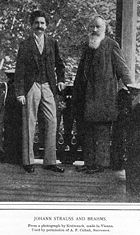
Johann Strauss II
Johann Strauss II , also known as Johann Baptist Strauss or Johann Strauss, Jr., the Younger, or the Son , was an Austrian composer of light music, particularly dance music and operettas. He composed over 500 waltzes, polkas, quadrilles, and other types of dance music, as well as several operettas...
, though they were very different as composers. Brahms even struggled to get to the Theater an der Wien
Theater an der Wien
The Theater an der Wien is a historic theatre on the Left Wienzeile in the Mariahilf district of Vienna. Completed in 1801, it has seen the premieres of many celebrated works of theatre, opera, and symphonic music...
in Vienna for the premiere of Strauss's operetta Die Göttin der Vernunft in 1897 before his death. Perhaps the greatest tribute that Brahms could pay to Strauss was his remark that he would have given anything to have written The Blue Danube
The Blue Danube
The Blue Danube is the common English title of An der schönen blauen Donau, Op. 314 , a waltz by the Austrian composer Johann Strauss II, composed in 1866...
waltz
Waltz
The waltz is a ballroom and folk dance in time, performed primarily in closed position.- History :There are several references to a sliding or gliding dance,- a waltz, from the 16th century including the representations of the printer H.S. Beheim...
. An anecdote dating around the time Brahms became acquainted with Strauss is that when Strauss's wife Adele asked Brahms to autograph her fan, he wrote a few notes from the "Blue Danube" waltz, and then cheekily inscribed the words "Alas, not by Brahms!"
Brahms was an extreme perfectionist. He destroyed many early works – including a Violin Sonata he had performed with Reményi and violinist Ferdinand David
Ferdinand David (musician)
Ferdinand David was a German virtuoso violinist and composer.Born in the same house in Hamburg where Felix Mendelssohn had been born the previous year, David was raised Jewish but later converted to Christianity...
– and once claimed to have destroyed 20 string quartets before he issued his official First in 1873. Over the course of several years, he changed an original project for a symphony in D minor into his first piano concerto
Piano Concerto No. 1 (Brahms)
The Piano Concerto No. 1 in D minor, Op. 15, is a work for piano and orchestra composed by Johannes Brahms in 1858. The composer gave the work's public debut in Hanover, Germany, the following year.-Form:...
. In another instance of devotion to detail, he laboured over the official First Symphony for almost fifteen years, from about 1861 to 1876. Even after its first few performances, Brahms destroyed the original slow movement and substituted another before the score was published. (A conjectural restoration of the original slow movement has been published by Robert Pascall.) Another factor that contributed to Brahms's perfectionism was that Schumann
Robert Schumann
Robert Schumann, sometimes known as Robert Alexander Schumann, was a German composer, aesthete and influential music critic. He is regarded as one of the greatest and most representative composers of the Romantic era....
had announced early on that Brahms was to become the next great composer like Beethoven, a prediction that Brahms was determined to live up to. This prediction hardly added to the composer's self-confidence, and may have contributed to the delay in producing the First Symphony. However, Clara Schumann
Clara Schumann
Clara Schumann was a German musician and composer, considered one of the most distinguished pianists of the Romantic era...
noted before that Brahms's First Symphony was a product that was not reflective of Brahms's real nature. She felt that the final exuberant movement was "too brilliant", as she was encouraged by the dark and tempestuous opening movement she had seen in an early draft. However, she recanted in accepting the Second Symphony
Symphony No. 2 (Brahms)
The Symphony No. 2 in D major, Op. 73, was composed by Johannes Brahms in the summer of 1877 during a visit to Pörtschach am Wörthersee, a town in the Austrian province of Carinthia. Its composition was brief in comparison with the fifteen years it took Brahms to complete his First Symphony...
, which has often been seen in modern times as one of his sunniest works. Other contemporaries, however, found the first movement especially dark, and Reinhold Brinkmann
Reinhold Brinkmann
Reinhold Brinkmann was a German musicologist.Brinkmann was born in Wildeshausen and studied at Freiburg im Breisgau. His dissertation was about Arnold Schönberg's Klavierstücke op. 11. He started working on the faculty of Freie Universität Berlin in 1970...
, in a study of Symphony No. 2 in relation to 19th century ideas of melancholy
Melancholia
Melancholia , also lugubriousness, from the Latin lugere, to mourn; moroseness, from the Latin morosus, self-willed, fastidious habit; wistfulness, from old English wist: intent, or saturnine, , in contemporary usage, is a mood disorder of non-specific depression,...
, has published a revealing letter from Brahms to the composer and conductor Vinzenz Lachner
Vinzenz Lachner
Vinzenz Lachner was a significant German composer and conductor....
in which Brahms confesses to the melancholic side of his nature and comments on specific features of the movement that reflect this.
Further reading
- Deiters/Newmarch. (1888). Johannes Brahms: A Biographical Sketch. Fisher Unwin (reissued by Cambridge University PressCambridge University PressCambridge University Press is the publishing business of the University of Cambridge. Granted letters patent by Henry VIII in 1534, it is the world's oldest publishing house, and the second largest university press in the world...
, 2009; ISBN 9781108004794) - Johannes Brahms: Life and Letters, ISBN 0-19-816234-0 by Brahms himself, edited by Styra Avins, translated by Josef Eisinger (1998). A biography by way of comprehensive footnotes to a comprehensive collection of Brahms's letters (some translated into English for the first time). Elucidates some previously contentious matters, such as Brahms's reasons for declining the Cambridge invitation.
- Brahms, His Life and Work, by Karl GeiringerKarl GeiringerKarl Geiringer was a musicologist, educator, and biographer of composers. He was educated in Vienna but at the beginning of the Nazi years he emigrated to England and ultimately the United States, where he had a lengthy and distinguished career at several universities. He was a noted authority...
, photographs by Irene Geiringer (1987, ISBN 0-306-80223-6). A biog and discussion of his musical output, supplemented by, and cross-referenced with, the body of correspondence sent to Brahms. - Charles RosenCharles RosenCharles Rosen is an American pianist and author on music.-Life and career:In his youth he studied piano with Moriz Rosenthal. Rosenthal, born in 1862, had been a student of Franz Liszt...
discusses a number of Brahms's imitations of Beethoven in Chapter 9 of his Critical Entertainments: Music Old and New (2000; Cambridge, MA: Harvard University Press, ISBN 0-674-17730-4). - Brahms by Malcolm MacDonaldMalcolm MacDonald (music critic)Malcolm MacDonald is a British author, mainly writing about music. He was born in Nairn, Scotland in 1948 and educated at the Royal High School, Edinburgh and Downing College, Cambridge; he has lived in England since 1971, first in London and since 1992 in Gloucestershire.He has written several...
is a biography and also discussion of virtually everything Brahms composed, along with chapters examining his position in Romantic music, his devotion to Early Music, and his influence on later composers. (Dent 'Master Musicians' series, 1990; 2nd edition Oxford, 2001, ISBN 0-19-816484-X - Johannes Brahms: A Biography, by Jan SwaffordJan SwaffordJan Swafford is an American composer and author who teaches composition, theory, and musicology at the Boston Conservatory and writing at Tufts University. He earned his B.A. from Harvard College and his M.M.A. and D.M.A. from the Yale School of Music...
. A comprehensive (752 pages) look at the life and works of Brahms. (1999; Vintage, ISBN 0-679-74582-3) - Late Idyll: The Second Symphony of Johannes Brahms, by Reinhold Brinkmann, translated by Peter Palmer. An analysis of Symphony No.2 and meditation of its position in Brahms's career and in relation to 19th century ideas of melancholy. (1995, Harvard, ISBN 0-674-51175-1)
- Johannes Brahms, His Work & Personality, by Hans Gal (Translated by Joseph Stein). Wiedenfeld & Nicolson, 1963.
- The Music of Brahms, by Michael Musgrave. Oxford, 1985 ISBN 0-19-816401-7
External links
- Brahms Institut, Lübeck Academy of Music
- The Lied and Art Song Texts Page created and maintained by Emily Ezust Texts of the Lieder of Brahms with translations in various languages.
- "What's late about late Brahms?": an article in the TLS by Peter Williams, 7 November 2007
- Brahms at the Piano. Information about the recording made by Thomas EdisonThomas EdisonThomas Alva Edison was an American inventor and businessman. He developed many devices that greatly influenced life around the world, including the phonograph, the motion picture camera, and a long-lasting, practical electric light bulb. In addition, he created the world’s first industrial...
in 1889 of Brahms playing part of his Hungarian Dance No. 1 in G minor. - Johannes Brahms: list of works from http://www.johannesbrahms.org
- Photo of Brahms as a young man in 1853
- Brahms Listening Guides. A collection in progress of detailed guides to the composer's works, linked to specific recordings but also including measure numbers
- Listings of live performances at Bachtrack
- johannes brahms biography
Sheet music
- Complete collection of scores at the Brahms Institut in Breitkopf & HärtelBreitkopf & HärtelBreitkopf & Härtel is the world's oldest music publishing house. The firm was founded in 1719 in Leipzig by Bernhard Christoph Breitkopf . The catalogue currently contains over 1000 composers, 8000 works and 15,000 music editions or books on music. The name "Härtel" was added when Gottfried...
or SimrockFritz SimrockFriedrich August Simrock, better known as Fritz Simrock was a German music publisher who inherited a publishing firm from his grandfather Nicolaus Simrock...
editions; work details - Brahms’ scores – selection of printable works.
- www.kreusch-sheet-music.net Brahms's piano works
- Free scores of Brahms Lieder and orchestral works in GIF format from the Variations Project at Indiana UniversityIndiana UniversityIndiana University is a multi-campus public university system in the state of Indiana, United States. Indiana University has a combined student body of more than 100,000 students, including approximately 42,000 students enrolled at the Indiana University Bloomington campus and approximately 37,000...
. Last accessed 14 August 2008. - Free scores Mutopia ProjectMutopia projectThe Mutopia Project is a volunteer-run effort to create a library of free content sheet music, in a way similar to Project Gutenberg's library of public domain books.The music is reproduced from old scores that are out of copyright...
Recordings
- Free audio MP3 of some Brahms's works OnClassical – Creative Commons BY-NC-SA, 1.0 licensed
- Johannes Brahms – Violin Sonatas MP3 Creative Commons Recording
- Fünf Gesänge, Op. 104 (Brahms): Free MP3s (Op. 42, Op. 93a, Op. 104 and Op. 52)
- Kunst der Fuge: Johannes Brahms – MIDI files Daily limit of 5 files.
- Works by Brahms performed on virtual organs
- Classic Cat – Brahms – mp3s
- Performances of works by Johannes Brahms in MIDI and MP3 formats at Logos Virtual Library