
All Topics  
Canadian Confederation

 
Canadian Confederation

   Email Print
   Bookmark   Link


Canadian Confederation


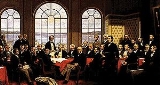
Canadian Confederation was the process by which the federal
Federalism

Federalism is a political philosophy in which a group of members are bound together with a governing representative head. The term federalism is also used to describe a system of the government in which sovereignty is constitutionally divided between a central governing authority and constituent political units ....
 Dominion
Dominion

A dominion, often Dominion, refers to one of a group of autonomy polity that were nominally under United Kingdom sovereignty, constituting the British Empire and Commonwealth of Nations, from the late 19th century....
 of Canada
Canada

Canada is a country occupying most of northern North America, extending from the Atlantic Ocean in the east to the Pacific Ocean in the west and northward into the Arctic Ocean....
 was formed beginning July 1, 1867 from the province
Province

A province is a territorial unit, almost always an administrative division, within a country or state....
s, colonies
Colony

In politics and in history, a colony is a Territory under the immediate political control of a state. For colonies in antiquity, city-states would often found their own colonies....
 and territories of British North America
British North America

British North America consisted of the colonies and territories of the British Empire in continental North America after the end of the American Revolutionary War and the recognition of United States ....
.

da is a federal state
Federation

A federation is a Political union comprising a number of partially self-governing states or regions united by a central government. In a federation, the self-governing status of the state is typically constitutionally entrenched and may not be altered by a Unilateralism decision of the central government....
 and not a confederate association of sovereign states
Confederation

Usually created by treaty but often later adopting a common constitution, confederations tend to be established for dealing with critical issues such as defense , foreign affairs, or a common currency, with the central government being required to provide support for all members....
 which usually what Confederation
Confederation

Usually created by treaty but often later adopting a common constitution, confederations tend to be established for dealing with critical issues such as defense , foreign affairs, or a common currency, with the central government being required to provide support for all members....
 means. However, Canada
Canada

Canada is a country occupying most of northern North America, extending from the Atlantic Ocean in the east to the Pacific Ocean in the west and northward into the Arctic Ocean....
 is often considered to be among the world's most decentralized
Decentralization

__FORCETOC__Decentralization or Decentralisation is the process of dispersing decision-making governance closer to the people or citizen....
 federations.

In a Canadian context Confederation generally describes the political process that united the colonies in the 1860s and related events, and the subsequent incorporation of other colonies and territories.


Discussion
Ask a question about 'Canadian Confederation'
Start a new discussion about 'Canadian Confederation'
Answer questions from other users
Full Discussion Forum


Encyclopedia


Canadian Confederation was the process by which the federal
Federalism

Federalism is a political philosophy in which a group of members are bound together with a governing representative head. The term federalism is also used to describe a system of the government in which sovereignty is constitutionally divided between a central governing authority and constituent political units ....
 Dominion
Dominion

A dominion, often Dominion, refers to one of a group of autonomy polity that were nominally under United Kingdom sovereignty, constituting the British Empire and Commonwealth of Nations, from the late 19th century....
 of Canada
Canada

Canada is a country occupying most of northern North America, extending from the Atlantic Ocean in the east to the Pacific Ocean in the west and northward into the Arctic Ocean....
 was formed beginning July 1, 1867 from the province
Province

A province is a territorial unit, almost always an administrative division, within a country or state....
s, colonies
Colony

In politics and in history, a colony is a Territory under the immediate political control of a state. For colonies in antiquity, city-states would often found their own colonies....
 and territories of British North America
British North America

British North America consisted of the colonies and territories of the British Empire in continental North America after the end of the American Revolutionary War and the recognition of United States ....
.

Usage

Canada is a federal state
Federation

A federation is a Political union comprising a number of partially self-governing states or regions united by a central government. In a federation, the self-governing status of the state is typically constitutionally entrenched and may not be altered by a Unilateralism decision of the central government....
 and not a confederate association of sovereign states
Confederation

Usually created by treaty but often later adopting a common constitution, confederations tend to be established for dealing with critical issues such as defense , foreign affairs, or a common currency, with the central government being required to provide support for all members....
 which usually what Confederation
Confederation

Usually created by treaty but often later adopting a common constitution, confederations tend to be established for dealing with critical issues such as defense , foreign affairs, or a common currency, with the central government being required to provide support for all members....
 means. However, Canada
Canada

Canada is a country occupying most of northern North America, extending from the Atlantic Ocean in the east to the Pacific Ocean in the west and northward into the Arctic Ocean....
 is often considered to be among the world's most decentralized
Decentralization

__FORCETOC__Decentralization or Decentralisation is the process of dispersing decision-making governance closer to the people or citizen....
 federations.

In a Canadian context Confederation generally describes the political process that united the colonies in the 1860s and related events, and the subsequent incorporation of other colonies and territories. The term Confederation is now often used to describe Canada in an abstract way, "the Fathers of Confederation" itself being one such usage. Provinces and territories that became part of Canada after 1867 are also said to have joined, or entered into, Confederation (but not the Confederation).

The term is also used to divide Canadian history into pre-Confederation (i.e. pre-1867) and post-Confederation (i.e. post-1867) periods, the latter of which includes current events.

History and process


Colonial organization

All the colonies which became involved in the Canadian Confederation in 1867 were initially part of New France
New France

The Viceroyalty of New France was the area French colonization of the Americas by France in North America during a period extending from the exploration of the Saint Lawrence River, by Jacques Cartier in 1534, to the cession of New France to Spain and Kingdom of Great Britain in 1763....
 and were once ruled by France
Early Modern France

Early Modern France is the early modern period of French history from the end of the 15th century to the end of the 18th century . During this period France evolved from a feudalism regime to an increasingly centralized state organized around a powerful absolute monarchy that relied on the doctrine of the Divine Right of Kings and the explic...
. The British Empire
British Empire

The British Empire comprised the dominions, Crown colony, protectorates, League of Nations mandate, and other Dependent territory ruled or administered by the United Kingdom , that had originated with the overseas colonies and trading posts established by England in the late 16th and early 17th centuries....
’s first acquisition in what would become Canada was Acadia
Acadia

Acadia was the name given to lands in a portion of the French colonial empires in northeastern North America that included parts of eastern Quebec, the Maritimes, and modern-day New England, stretching as far south as Philadelphia....
, acquired by the 1713 Treaty of Utrecht
Treaty of Utrecht

The Treaty of Utrecht that established the Peace of Utrecht, rather than a single document, comprises a series of individual peace treaty signed in the Dutch Republic city of Utrecht in March and April 1713....
 (the Acadian population was eventually expelled by the British in the 1755 Great Upheaval
Great Upheaval

The Great Upheaval, also known as the Great Expulsion, The Deportation, the Acadian Expulsion, or to the deportees, Le Grand D?rangement, was the ethnic cleansing of the Acadian population from Nova Scotia between 1755 and 1763, ordered by British Empire governor Charles Lawrence and the Nova Scotia Council....
). The British renamed Acadia Nova Scotia
Nova Scotia

Nova Scotia is a Canadian Provinces and territories of Canada located on Canada's southeastern coast. It is the most populous province in Atlantic Canada....
. The rest of New France was acquired by the British Empire by the Treaty of Paris (1763)
Treaty of Paris (1763)

The Treaty of Paris, often called the Peace of Paris, or the Treaty of 1763, was signed on February 10, 1763, by the kingdoms of Kingdom of Great Britain, France and Spain, with Portugal in agreement....
, which ended the Seven Years' War
French and Indian War

The French and Indian War was the North American chapter of the Seven Years' War, known in Canada as the War of the Conquest. The name refers to the two main enemies of the British: the royal French forces and the various Indigenous peoples of the Americas forces allied with them....
. Most of New France became the Province of Quebec, while present-day New Brunswick
New Brunswick

New Brunswick is one of Canada's three Maritime provinces and is the only Constitution of Canada bilingual province in the federation. The provincial capital is Fredericton....
 was annexed to Nova Scotia. In 1769, present-day Prince Edward Island
Prince Edward Island

Prince Edward Island is a Canada Provinces and territories of Canada consisting of an island of the same name. The Maritimes is the smallest in the nation in both land area and population ....
, which had been a part of Acadia, was renamed “St John’s Island” and organized as a separate colony (it was renamed PEI in 1798 in honour of Prince Edward, Duke of Kent and Strathearn).

In the wake of the American Revolution
American Revolution

The American Revolution refers to the political upheaval during the last half of the 18th century in which the Thirteen Colonies of North America overthrew the governance of the British Empire and then rejected the British monarchy to become the sovereign United States of America....
, approximately 60,000 United Empire Loyalists
United Empire Loyalists

The name United Empire Loyalists is a honorific name which has been given after the fact to those Loyalist who resettled in British North America and other British Colonies as an act of fealty to George III of the United Kingdom after the Kingdom of Great Britain defeat in the American Revolutionary War and prior to the Treaty of Paris ....
 fled to British North America
British North America

British North America consisted of the colonies and territories of the British Empire in continental North America after the end of the American Revolutionary War and the recognition of United States ....
. The Loyalists were unwelcome in Nova Scotia, so the British created the separate colony of New Brunswick for them in 1784. Most of the Loyalists settled in the Province of Quebec, which in 1791 was separated into a predominantly-English Upper Canada
Upper Canada

The Province of Upper Canada was a British colony located in what is now the southern portion of the Province of Ontario in Canada. Upper Canada officially existed from 26 December 1791 to 10 February 1841 and generally comprised present-day Southern Ontario and, until 1797, the Upper Peninsula of what is now part of the U.S....
 and a predominantly-French Lower Canada
Lower Canada

The Province of Lower Canada was a British colonization of the Americas on the lower Saint Lawrence River and the shores of the Gulf of Saint Lawrence ....
 by the Constitutional Act of 1791
Constitutional Act of 1791

The Constitutional Act of 1791 was an Act of Parliament of the Parliament of Great Britain which changed the government of the province of Quebec to accommodate the many English-speaking settlers, known as the United Empire Loyalists, who had arrived from the United States following the American Revolution....
. The War of 1812
War of 1812

The War of 1812, between the United States of America and the British Empire , was fought from 1812 to 1815.There were several immediate stated causes for the U.S....
 and subsequent Treaty of 1818
Treaty of 1818

The Convention respecting fisheries, boundary, and the restoration of slaves between the United States and the United Kingdom of Great Britain and Ireland, also known as the London Convention, Anglo-American Convention of 1818, Convention of 1818, or simply the Treaty of 1818, was a treaty signed in 1818 between the...
 established the 49th parallel
49th parallel

49th parallel may refer to:* 49th parallel north, a line of latitude*49th parallel south, a line of latitude*49th Parallel, the 1941 British film...
 as the border with the U.S.A. from the Great Lakes
Great Lakes

The St. Lawrence River Great Lakes are a chain of fresh water lakes located in eastern North America, on the Canada ? United States border. Consisting of Lakes Lake Superior, Lake Michigan, Lake Huron, Lake Erie, and Lake Ontario, they form the largest group of freshwater lakes on Earth....
 to the Rocky Mountains
Rocky Mountains

The Rocky Mountains, often called the Rockies, are a mountain range in western North America. The Rocky Mountains stretch more than 4,800 kilometre from the northernmost part of British Columbia, in Canada, to New Mexico, in the United States....
.

Canada Provinces 1867 1870
Following the Rebellions of 1837
Rebellions of 1837

The Rebellions of 1837 were a pair of Canada armed rebellion that occurred in 1837 and 1838 in response to frustrations in political reform and ethnic conflict....
, Lord Durham
John Lambton, 1st Earl of Durham

John George Lambton, 1st Earl of Durham Order of the Bath Privy Council of the United Kingdom , was a British British Whig Party statesman, colonial administrator, Governor General and high commissioner of British North America....
 in his famous Report on the Affairs of British North America, recommended that Upper Canada and Lower Canada should be joined to form the Province of Canada
Province of Canada

The Province of Canada or the United Province of Canada was a British North America#BNA colonies after the American Revolution: in North America from 1841 to 1867....
 and that the new province should have a responsible government
Responsible government

Responsible government is a conception of a system of government that embodies the principle of parliamentary accountability which is the foundation of the Westminster system of parliamentary democracy....
. As a result of Durham’s report, the British Parliament passed the Act of Union 1840
Act of Union 1840

The Act of Union passed in July 1840 and proclaimed February 10, 1841, abolished the legislatures of Lower Canada and Upper Canada and established a new political entity, the Province of Canada to replace them....
, and the Province of Canada was formed in 1841. The new province was divided into two parts: Canada West (the former Upper Canada) and Canada East
Canada East

Canada East was the eastern portion of the United Province of Canada. It consisted of the southern portion of the modern-day Canada Province of Quebec, and was primarily a French language region....
 (the former Lower Canada). Ministerial responsibility was finally granted by Governor General Lord Elgin
James Bruce, 8th Earl of Elgin

James Bruce, 8th Earl of Elgin and 12th Earl of Kincardine, Order of the Thistle, Order of the Bath, Privy Council of the United Kingdom was a British colonial administrator and diplomat, best known as the man who ordered the complete destruction of the Old Summer Palace in the Second Opium War by 3,500 British soldiers and as the Governor...
 in 1848, first to Nova Scotia and then to Canada. In the following years, the British would extend responsible government to Prince Edward Island (1851), New Brunswick (1854), and Newfoundland (1855).

The remainder of modern-day Canada was made up of Rupert's Land
Rupert's Land

Rupert's Land, also sometimes called "Prince Rupert's Land", was a territory in British North America, consisting of the List of Hudson Bay rivers, that was owned by the Hudson's Bay Company for 200 years from 1670 to 1870....
 and the North-Western Territory
North-Western Territory

The North-Western Territory was a region of British North America until 1870. Named for where it lay in relation to Rupert's Land, the territory at its greatest extent covered what is now Yukon, mainland Northwest Territories, northwestern mainland Nunavut, northwestern Saskatchewan, northern Alberta and northern British Columbia....
 (both of which were controlled by the Hudson's Bay Company
Hudson's Bay Company

The Hudson's Bay Company , abbreviated HBC, is the oldest commercial corporation in North America and is one of the oldest in the world. The company was incorporated by British royal charter in 1670 as The Governor and Company of Adventurers of England trading into Hudson's Bay; it is now domiciled in Canada and has adopted the mo...
 and sold to Canada in 1870) and the Arctic Islands, which were under direct British control and became a part of Canada in 1880.

The area which constitutes modern-day British Columbia
British Columbia

British Columbia is the westernmost of Canada's Provinces and territories of Canada and is famed for its natural beauty, as reflected in its Latin motto, Splendor sine occasu ....
 is the remnants of the Hudson's Bay Company's Columbia District
Columbia District

The Columbia District was a Fur trade district in the Pacific Northwest region of British North America in the 19th century. It was explored by the North West Company between 1793 and 1811, and established as an operating fur district around 1810....
 following the Oregon Treaty
Oregon Treaty

The Oregon Treaty, is a bilateral treaty between the United Kingdom of Great Britain and Ireland and the United States that was signed on June 15, 1846 in Washington, D.C....
. Prior to joining Canada in 1870, B.C. consisted of the separate Colony of British Columbia
Colony of British Columbia

The Colony of British Columbia was a crown colony in British North America from 1858 until 1871. At its creation, it physically constituted approximately half the present day Canada provinces and territories of Canada of British Columbia, since it did not include the Colony of Vancouver Island, nor the vast and still largely-uninhabited regi...
 (formed in 1858, in an area where the Crown had previously granted a monopoly to the Hudson's Bay Company), and the Colony of Vancouver Island
Colony of Vancouver Island

See main article Vancouver IslandVancouver Island , was a crown colony of British North America from 1849 to 1866, after which it was united with British Columbia....
 (formed in 1849) constituting a separate crown colony
Crown colony

A Crown colony was a type of colonial administration of the British Empire.Crown colonies were ruled by a governor appointed by The Crown . Though the term was not used at the time, the first of what would later become known as Crown colonies was the Colony of Virginia in the present-day United States, after the Crown took control from the...
 until its absorption by the Colony of British Columbia in 1866.

Early projects

George Etiene Cartier
The idea of a legislative union of all British colonies in America goes back to at least 1754, when the Albany Congress
Albany Congress

The Albany Congress, also known as the Albany Conference, was a meeting of representatives of seven of the British North American colonies in 1754 ....
 was held, preceding the Continental Congress
Continental Congress

The Continental Congress was a convention of delegates from the Thirteen Colonies that became the governing body of the United States during the American Revolution....
 of 1774. At least twelve other projects followed. These, however, did not include the colonies that were located in the territory of present-day Canada.

The idea was revived in 1839 by Lord Durham
John Lambton, 1st Earl of Durham

John George Lambton, 1st Earl of Durham Order of the Bath Privy Council of the United Kingdom , was a British British Whig Party statesman, colonial administrator, Governor General and high commissioner of British North America....
 in his Report on the Affairs of British North America.

In 1857, Joseph-Charles Taché
Joseph-Charles Taché

Joseph-Charles Tach?, was a multi-faceted member of the Tach? family, a nephew of Sir ?tienne-Paschal Tach?. He was a student at the Petit S?minaire de Qu?bec and followed this by a study of medicine, receiving his medical diploma in 1844....
 proposed a federation in the Courrier du Canada.

In 1859, Alexander Tilloch Galt
Alexander Tilloch Galt

Sir Alexander Tilloch Galt, Order of St Michael and St George, Queen's Privy Council for Canada was an England-Canada politician, and a father of Canadian Confederation....
, George-Étienne Cartier
George-Étienne Cartier

Sir George-?tienne Cartier, Baronet, Order of St Michael and St George, Queen's Privy Council for Canada was a French-Canadian statesman and Canadian Confederation#Fathers of Confederation....
 and John Ross
John Ross (Canadian senator)

John Ross was a Canada lawyer, politician, and businessman.Born in County Antrim, Ireland, he was brought to Canada as an infant. Ross married twice, first to Margaret Crawford who died in 1847, secondly to Augusta Elizabeth Baldwin 4 February 1851, the daughter of Robert Baldwin....
 travelled to Great Britain
Great Britain

Great Britain is an island lying to the northwest of Continental Europe. It is the List of islands by area, and the largest in Europe. With a population of 58.9 million people it is List of islands by population....
 to present the British Parliament with a project for confederation of the British colonies. The proposal was received by the London
London

London is the capital of both England and the United Kingdom, and the most populous municipality in the European Union. An important settlement for two millennia, History of London goes back to its founding by the Roman Empire....
 authorities with polite indifference.

By 1864, it was clear that continued governance of the Province of Canada under the terms of the 1840 Act of Union had become impracticable. Therefore, a Great Coalition
Great Coalition

The Great Coalition refers to the grand coalition of political parties that formed in the Provinces of Canada in 1864. The previous collapse after only a few months of a coalition government formed by ?tienne-Paschal Tach? and Conservative Party of Canada John A....
 of parties formed in order to reform the political system.

Internal and external influences leading to Confederation

There were several factors that influenced Confederation, both caused from internal sources and pressures from external sources.

Internal causes that influenced Confederation:
  • between 1854 and 1865 the United States followed a policy of free trade (the Canadian-American Reciprocity Treaty
    Canadian-American Reciprocity Treaty

    The Canadian American Reciprocity Treaty, also known as the James Bruce, 8th Earl of Elgin-William L. Marcy Treaty, was a trade treaty between the colonies of British North America and the United States....
    ) where products were allowed into their country without taxes or tariffs; in 1865, the United States canceled reciprocity
  • political deadlock resulting from the current political structure
  • demographic pressure
  • economic nationalism and the promise of economic development


External pressures that influenced Confederation:
  • the U.S. doctrine of Manifest destiny
    Manifest Destiny

    Manifest Destiny is the historical belief that the United States was destined and divinely ordained by God in Christianityto expand across the North American continent, from the Atlantic seaboard to the Pacific Ocean....
    , the real and constant threat of intervention from the US
  • the American Civil War
    American Civil War

    The American Civil War , also known as the War Between the States and several Naming the American Civil War, was a civil war in the United States....
    , British actions and American reactions
  • the Fenian raids
    Fenian raids

    The Fenian raids were attacks by members of the Fenian Brotherhood based in the United States on British army forts, customs posts and other targets in Canada in order to bring pressure on United Kingdom of Great Britain and Ireland to withdraw from Ireland, between 1866 and 1871....
  • the Underground Railroad
    Underground Railroad

    The Underground Railroad was an informal network of secret routes and safe houses used by 19th century African American Slavery in the United States in the United States to escape to free state and Canada with the aid of Abolitionism who were sympathetic to their cause....
  • the creation of a new British colonial policy, whereby Britain no longer wanted to maintain troops in its colonies.


The Charlottetown Conference, September 1–9, 1864

In the spring of 1864, New Brunswick premier Samuel Leonard Tilley
Samuel Leonard Tilley

Sir Samuel Leonard Tilley, Queen's Privy Council for Canada, Order of St. Michael and St. George was a Canada politician and one of the Father of Confederation#Fathers of Confederation....
, Nova Scotia premier Charles Tupper
Charles Tupper

Sir Charles Tupper, 1st Baronet, Order of St Michael and St George, Order of the Bath, Queen's Privy Council for Canada was a Canada father of Confederation: as the Premier of Nova Scotia from 1864 to 1867, he led Nova Scotia into Canadian Confederation....
, and Prince Edward Island premier John Hamilton Gray
John Hamilton Gray (Prince Edward Island politician)

John Hamilton Gray was Premier of Prince Edward Island from 1863 – 1865 and one of the Father of Confederation#Fathers of Confederation....
 were contemplating the idea of a Maritime Union
Maritime Union

A Maritime Union refers to a potential political union of the three Maritimes provinces of Canada to form a single new province which would be the fifth-largest in Canada by population....
 which would join their three colonies together.

on the steps of Government House
Government House (Prince Edward Island)

Government House is the official residence of the Lieutenant Governors of Prince Edward Island of Prince Edward Island.Government House is located in the provincial capital of Charlottetown, Prince Edward Island and was built in 1834....
, September 1864.]]

The Premier of the Province of Canada
List of Joint Premiers of the Province of Canada

This is a list of the Joint Premiers of the Province of Canada, who were the heads of government of the Province of Canada from the 1841 unification of Upper Canada and Lower Canada until Confederation in 1867....
 John A. Macdonald
John A. Macdonald

Sir John Alexander Macdonald, Order of the Bath, Order of St Michael and St George, Her Majesty's Most Honourable Privy Council, Queen's Privy Council for Canada, was the first Prime Minister of Canada and the dominant figure of Canadian Confederation....
 surprised the Atlantic premiers by asking if the Province of Canada could be included in the negotiations. After several years of legislative paralysis in the Province of Canada caused by the need to maintain a double legislative majority (a majority of both the Canada East and Canada West delegates in the Province of Canada’s legislature), Macdonald had led his Liberal-Conservative Party
Liberal-Conservative Party

The Liberal-Conservative Party was the formal name of the Conservative Party of Canada until 1873, although some Conservative candidates continued to run under the label as late as the Canadian federal election, 1911 and others ran as simple Conservatives prior to 1873....
 into the Great Coalition
Great Coalition

The Great Coalition refers to the grand coalition of political parties that formed in the Provinces of Canada in 1864. The previous collapse after only a few months of a coalition government formed by ?tienne-Paschal Tach? and Conservative Party of Canada John A....
 with George-Étienne Cartier
George-Étienne Cartier

Sir George-?tienne Cartier, Baronet, Order of St Michael and St George, Queen's Privy Council for Canada was a French-Canadian statesman and Canadian Confederation#Fathers of Confederation....
’s Parti bleu
Parti bleu

The parti bleu was a moderate political group in Quebec, Canada that emerged in 1854. It was based on the moderate reformist views of Louis-Hippolyte Lafontaine, and was a rival to the radical parti rouge....
 and George Brown
George Brown (Canadian politician)

George Brown was a Scotland-born Canada journalist, politician and one of the Father of Confederation#Fathers of Confederation. A noted Reform Party politician, he was also the founder and editor of the Toronto Globe, which is today known as the Globe and Mail....
’s Clear Grits
Clear Grits

Clear Grits were reformers in the Province of Upper Canada, a British colony that is now the Province of Ontario, Canada. Their support was concentrated among southwestern Ontario farmers, who were frustrated and disillusioned by the 1849 Reform Party government of Robert Baldwin and Louis-Hippolyte Lafontaine's lack of democratic enthusiasm...
. Macdonald, Cartier, and Brown felt that union with the other British colonies might be a way to solve the political problems of the Province of Canada.

The Charlottetown Conference
Charlottetown Conference

The Charlottetown Conference was held in Charlottetown, Prince Edward Island, Prince Edward Island for representatives from the colonies of British North America to discuss Canadian Confederation....
 began on September 1, 1864. Since the agenda for the meeting had already been set, the delegation from the Province of Canada was initially not an official part of the Conference. They were allowed to address the Conference, however, and were soon formally invited to join the Conference.

No minutes from the Charlottetown Conference survive, but we do know that George-Étienne Cartier and John A. Macdonald presented arguments in favour of a union of the four colonies; Alexander Tilloch Galt
Alexander Tilloch Galt

Sir Alexander Tilloch Galt, Order of St Michael and St George, Queen's Privy Council for Canada was an England-Canada politician, and a father of Canadian Confederation....
 presented the Province of Canada’s proposals on the financial arrangements of such a union; and that George Brown presented a proposal for what form a united government might take. The Canadian delegation’s proposal for the governmental system involved:
  1. preservation of ties with Great Britain;
  2. residual jurisdiction left to a central authority;
  3. a bicameral system including a Lower House with representation by population (rep by pop) and an Upper House with representation based on regional, rather than provincial, equality;
  4. responsible government at the federal and provincial levels; and
  5. the appointment of a governor general by the British Crown.


After the Conference adjourned on September 9, there were further meetings between delegates held at Halifax
City of Halifax

The City of Halifax was the capital of the province of Nova Scotia and county seat of Halifax County, Nova Scotia, and was the largest city in Atlantic Canada until it was amalgamated into Halifax Regional Municipality in 1996....
, Saint John
Saint John, New Brunswick

Saint John is the largest city in the province of New Brunswick, and the oldest incorporated city in Canada. In 2006 the city proper had a population of 68,043....
, and Fredericton. These meetings evinced enough interest that it was decided to hold a second Conference.

The Quebec Conference, October 10–27, 1864

Quebecconvention1864
After returning home from the Charlottetown Conference, John A. Macdonald asked Viscount Monck, the Governor General of the Province of Canada
List of Governors General of Canada

The following is a list of the Governors and Governors General of Canada, and of the previous territories and colonies that now make up the country....
 to invite delegates from the three Maritime provinces and Newfoundland to a conference with United Canada delegates. Monck obliged and the Conference went ahead at Quebec City
Quebec City

Qu?bec or Quebec, also Quebec City or Qu?bec City , is the Capital of the Canada Provinces and territories of Canada of Quebec and is located within the Capitale-Nationale region....
 in October.

The Conference began on October 10, 1864 on the site of the present-day Château Frontenac
Château Frontenac

The Ch?teau Frontenac grand hotel is one of the most popular attractions in Quebec City, Quebec, Canada.Designed by architect Bruce Price, the Ch?teau Frontenac was one of a series of Canada's railway hotels built for the Canadian Pacific Railway company at the end of the 19th and the start of the 20th century....
. The Conference elected Étienne-Paschal Taché
Étienne-Paschal Taché

Sir ?tienne-Paschal Tach? Order of St Michael and St George was a Canada doctor, politician and one of the Father of Confederation#Fathers of Confederation....
 as its chairman, but it was dominated by Macdonald.

At the end of the Conference, it adopted the Seventy-two Resolutions
Seventy-two resolutions

The seventy-two resolutions were a set of proposals drafted at the Quebec Conference, 1864, which laid out the framework for the Canadian Constitution....
 which would form the basis of a scheduled future conference. The Conference adjourned on October 27.

The London Conference, December 1866–March 1867

Following the Quebec Conference, the Province of Canada’s legislature passed a bill approving the union. The union proved more controversial in the Maritime provinces, however, and it was not until 1866 that New Brunswick and Nova Scotia passed union resolutions. (At this point, Prince Edward Island and Newfoundland opted against union.)

Sixteen delegates from the Province of Canada, New Brunswick, and Nova Scotia traveled to London in December 1866. At meetings held at the Westminster Palace Hotel, the delegates reviewed the Seventy-two Resolutions. Although Charles Tupper had promised anti-union forces in Nova Scotia that he would push for amendments, he was unsuccessful in getting amendments passed. The Conference approved the 72 Resolutions, which now became the “London Resolutions” and passed them on to the British Colonial Office.

After breaking for Christmas
Christmas

Christmas , also referred to as Christmas Day, is an annual holiday celebrated on December 25 that commemorates the birth of Jesus. The day marks the beginning of the larger season of Christmastide, which lasts Twelve Days of Christmas....
, the delegates reconvened in January 1867 and began drafting the British North America Act. They easily agreed that the new country should be called “Canada”, that Canada East should be renamed “Quebec” and that Canada West should be renamed “Ontario.” There was, however, heated debate about how the new country should be designated. Ultimately, the delegates elected to call the new country the Dominion of Canada, after "kingdom" and "confederation", among other options, were rejected for various reasons. The term "dominion" originates from and was (allegedly) suggested by Sir Samuel Leonard Tilley.

The delegates had completed their draft of the British North America Act by February 1867. The Act was presented to Queen Victoria
Victoria of the United Kingdom

Victoria was from 20 June 1837 the Queen regnant of the United Kingdom of Great Britain and Ireland and from 1 May 1876 the first Empress of India of the British Raj until her death....
 on February 11, 1867. The bill was introduced in the House of Lords
House of Lords

The House of Lords is the second house of the Parliament of the United Kingdom and is also commonly referred to as "the Lords". The Parliament comprises the British monarchy, the British House of Commons , and the Lords....
 the next day. The bill was quickly approved by the House of Lords, and then also quickly approved by the British House of Commons
British House of Commons

The House of Commons is the lower house of the Parliament of the United Kingdom, which also comprises the British monarchy and the House of Lords ....
. (The Conservative
Conservative Party (UK)

The Conservative and Unionist Party, more commonly known as the Conservative Party, is a conservative political party in the United Kingdom....
 Lord Derby
Edward Smith-Stanley, 14th Earl of Derby

Edward George Geoffrey Smith-Stanley, 14th Earl of Derby, Order of the Garter, Privy Council of the United Kingdom was an England statesman, three times Prime Minister of the United Kingdom, and to date the longest serving leader of the Conservative Party ....
 was prime minister of the United Kingdom
Prime Minister of the United Kingdom

The Prime Minister of the United Kingdom of Great Britain and Northern Ireland is the political leader of the United Kingdom and the head of government Her Majesty's Government....
 at the time.) The Act received royal assent
Royal Assent

The granting of Royal Assent is the formal method by which a constitutional monarchy completes the legislative process of lawmaking by formally assenting to an Act of Parliament....
 on March 29, 1867 and set July 1, 1867 as the date for union.

British North America Act, 1867

Confederation
Confederation

Usually created by treaty but often later adopting a common constitution, confederations tend to be established for dealing with critical issues such as defense , foreign affairs, or a common currency, with the central government being required to provide support for all members....
 was accomplished when Queen Victoria
Victoria of the United Kingdom

Victoria was from 20 June 1837 the Queen regnant of the United Kingdom of Great Britain and Ireland and from 1 May 1876 the first Empress of India of the British Raj until her death....
 gave royal assent to the British North America Act (BNA Act) on March 29, 1867. That act, which united the Province of Canada with the colonies of New Brunswick and Nova Scotia, came into effect on July 1 that year. The act replaced the Act of Union (1840) which had previously unified Upper Canada
Upper Canada

The Province of Upper Canada was a British colony located in what is now the southern portion of the Province of Ontario in Canada. Upper Canada officially existed from 26 December 1791 to 10 February 1841 and generally comprised present-day Southern Ontario and, until 1797, the Upper Peninsula of what is now part of the U.S....
 and Lower Canada
Lower Canada

The Province of Lower Canada was a British colonization of the Americas on the lower Saint Lawrence River and the shores of the Gulf of Saint Lawrence ....
 into the united Province of Canada
Province of Canada

The Province of Canada or the United Province of Canada was a British North America#BNA colonies after the American Revolution: in North America from 1841 to 1867....
. Separate provinces were re-established under their current names of Ontario and Quebec. July 1 is now celebrated as Canada Day
Canada Day

Canada Day , formerly Dominion Day , is Canada's National Day, a Public holidays in Canada, celebrating the anniversary of the July 1, 1867 enactment of the Constitution Act, 1867, which united Canada as a single country of four provinces....
.

The form of the country's government was influenced by the American republic
United States

The United States of America is a Federal government constitutional republic comprising U.S. state and a federal district. The country is situated mostly in central North America, where its Contiguous United States and Washington, D.C., the Capital districts and territories, lie between the Pacific Ocean and Atlantic Oceans, Borders of the U...
 to the south. Noting the flaws perceived in the American system, the Fathers of Confederation opted to retain a monarchical form of government. John A. Macdonald
John A. Macdonald

Sir John Alexander Macdonald, Order of the Bath, Order of St Michael and St George, Her Majesty's Most Honourable Privy Council, Queen's Privy Council for Canada, was the first Prime Minister of Canada and the dominant figure of Canadian Confederation....
, speaking in 1865 about the proposals for the upcoming confederation of Canada, said:

While the BNA Act gave Canada more autonomy than it had before, it was far from full independence from the United Kingdom. Foreign policy remained in British hands, the Judicial Committee of the Privy Council
Judicial Committee of the Privy Council

The Judicial Committee of the Privy Council is one of the highest courts in the United Kingdom, established by the Judicial Committee Act 1833....
 remained Canada's highest court of appeal, and the constitution could be amended only in Britain. Gradually, Canada gained more autonomy, and in 1931, obtained almost full autonomy within the British Commonwealth
Commonwealth of Nations

The Commonwealth of Nations, also known as the Commonwealth or the British Commonwealth, is an intergovernmental organization of fifty-three independent member states....
 with the Statute of Westminster
Statute of Westminster 1931

The Statute of Westminster 1931 is an Act of Parliament of the Parliament of the United Kingdom which established a status of legislative equality between the self-governing dominions of the British Empire and the United Kingdom, with a few residual exceptions....
. Because the provinces of Canada were unable to agree on a constitutional amending formula, this power remained with the British Parliament. In 1982, the constitution was patriated
Patriation

Patriation is a non-legal term, particularly used in Canada, to describe a process of constitutional change also known as "bringing home" the constitution....
 when Queen Elizabeth II
Elizabeth II of the United Kingdom

Elizabeth II is the queen regnant of sixteen independent states known as the Commonwealth realms: Monarchy of the United Kingdom, Monarchy of Canada, Monarchy of Australia, Monarchy of New Zealand, Monarchy of Jamaica, Monarchy of Barbados, the Bahamas, Grenada, Papua New Guinea, the Monarchy of the Solomon Islands, Tuvalu, Saint Lucia, Sain...
 gave her royal assent to the Canada Act 1982
Canada Act 1982

The Canada Act 1982 is an Act of Parliament passed by the British Parliament that severed all remaining legislative dependence of Canada on the United Kingdom, in a process known as "patriation"....
. The Constitution of Canada
Constitution of Canada

The Constitution of Canada is the supreme law in Canada; the country's constitution is an amalgamation of codified Act of Parliaments and uncodified constitution traditions and constitutional convention s....
 is made up of a number of codified acts and uncodified traditions; one of the principal documents is the Constitution Act, 1982
Constitution Act, 1982

The Constitution Act, 1982 is a part of the Constitution of Canada. The Act was introduced as part of Canada's process of "patriation" the constitution, introducing several amendments to the British North America Act, 1867, and changing the latter's name in Canada to the Constitution Act, 1867....
, which renamed the BNA Act 1867 to Constitution Act, 1867
Constitution Act, 1867

The Constitution Act, 1867 , constitutes a major part of Canada's Constitution of Canada. The Act entails the original creation of a federation dominion and defines much of the operation of the Government of Canada, including its Canadian federalism, the Canadian House of Commons, the Canadian Senate, the justice system, and the taxation sys...
.

Jamac

Aftermath of Confederation, July 1, 1867

Dominion elections were held in August and September to elect the first Parliament
Parliament of Canada

The Parliament of Canada is Canada's legislature, seated at Parliament Hill in Ottawa, Ontario. The Governor General of Canada appoints the 105 members of the upper house, the Canadian Senate, on the recommendation of the Prime Minister of Canada....
, and the four new provinces' governments recommended the 72 individuals (24 each for Quebec and Ontario, 12 each for New Brunswick and Nova Scotia) who would sit in the Senate
Canadian Senate

The Senate of Canada is a component of the Parliament of Canada, along with the Canadian monarchy and the Canadian House of Commons. The Senate consists of 105 members appointed by the Governor General of Canada on the Advice of the Prime Minister of Canada....
.

Fathers of Confederation

The following lists the participants in the Charlottetown, Quebec, and London Conferences and their attendance at each stage. They are known as the Fathers of Confederation.

There were 36 original Fathers of Confederation. Hewitt Bernard, who was the recording secretary at the Charlottetown Conference, is considered by some to be a Father of Confederation. The later "Fathers" who brought the other provinces into Confederation after 1867 are also referred to as "Fathers of Confederation." In this way, Amor De Cosmos
Amor De Cosmos

Amor De Cosmos was a Canada journalist and politician. He served as the second Premier of British Columbia....
 who was instrumental both in bringing democracy to British Columbia and in bringing his province into Confederation, is considered by many to be a Father of Confederation. As well, Joey Smallwood
Joey Smallwood

File:Joseph Smallwood signing Newfoundland into Confederation.jpgJoseph Roberts "Joey" Smallwood, Queen's Privy Council for Canada, Order of Canada was the main force that brought Newfoundland and Labrador into Canadian confederation, and became the first Premier of the province....
 is popularly referred to as "the Last Father of Confederation", because he led Newfoundland into Confederation in 1949.

More controversially, there is also a movement to have Louis Riel
Louis Riel

Louis David Riel was a Politics of Canada, a founder of the province of Manitoba, and leader of the M?tis people people of the Canadian prairies....
 accepted as a Father of Confederation for his role in bringing Manitoba
Manitoba

Manitoba is a prairie provinces in Canada, which has an area of 647,797 square kilometres and a population of 1,207,959 , with more than half located within the Winnipeg Capital Region ....
 into Confederation following the Red River Rebellion
Red River Rebellion

The Red River Rebellion or Red River Resistance are names given to the events surrounding the actions of a provisional government established by M?tis people leader Louis Riel in 1869 at the Red River Settlement in what is now the Canadian province of Manitoba....
 of 1869–1870, even though Riel was later executed for treason
Treason

In law, treason is the crime that covers some of the more serious acts of loyalty to one's sovereignty or nation. Historically, treason also covered the murder of specific social superiors, such as the murder of a husband by his wife ....
 following the North-West Rebellion
North-West Rebellion

The North-West Rebellion of 1885 was a brief and unsuccessful Rebellion by the M?tis people people of the District of Saskatchewan under Louis Riel against the Dominion of Canada, which they believed had failed to address their concerns for the survival of their people....
 of 1885.

Table of participation

Participant Province (Current) Charlottetown Quebec City London
Sir Adams George Archibald
Adams George Archibald

Sir Adams George Archibald, Order of St Michael and St George , Queen's Privy Council for Canada was a Canada lawyer and politician, and a father of Canadian Confederation....
Nova Scotia
Yes Check
Yes Check
Yes Check
Sir George Brown
George Brown (Canadian politician)

George Brown was a Scotland-born Canada journalist, politician and one of the Father of Confederation#Fathers of Confederation. A noted Reform Party politician, he was also the founder and editor of the Toronto Globe, which is today known as the Globe and Mail....
Ontario
Yes Check
Yes Check
X Mark
Sir Alexander Campbell
Alexander Campbell (Canadian politician)

Sir Alexander Campbell, Queen's Privy Council for Canada, KCMG, Queen's Counsel was an England-born, Canada statesman and politician, and a father of Canadian Confederation....
Ontario
Yes Check
Yes Check
X Mark
Sir Frederick Carter
Frederick Carter

Sir Frederic Bowker Terrington Carter, KCMG was a lawyer and Premier of Colony of Newfoundland from 1865 to 1870. He was son of Peter Weston Carter and great-grandson of Robert Carter, who was then appointed justice of the peace at Ferryland in 1750....
Newfoundland
X Mark
Yes Check
X Mark
Sir George-Étienne Cartier
George-Étienne Cartier

Sir George-?tienne Cartier, Baronet, Order of St Michael and St George, Queen's Privy Council for Canada was a French-Canadian statesman and Canadian Confederation#Fathers of Confederation....
Quebec
Yes Check
Yes Check
Yes Check
Sir Edward Barron Chandler
Edward Barron Chandler

Edward Barron Chandler was a New Brunswick politician and lawyer from a United Empire Loyalist family. He was one of the Father_of_Confederation#Fathers_of_Confederation....
New Brunswick
Yes Check
Yes Check
X Mark
Sir Jean-Charles Chapais
Jean-Charles Chapais

Jean-Charles Chapais, Queen's Privy Council for Canada was a Canada Conservative Party of Canada politician, and considered a Canadian Confederation for his participation in the Quebec Conference, 1864 to determine the form of Canada's government....
Quebec
X Mark
Yes Check
X Mark
Sir James Cockburn
James Cockburn

James Cockburn, Queen's Counsel was a Canada Conservative Party of Canada politician, and a father of Canadian Confederation.He was born in a small town on the England-Scotland border, and emigrated to Canada with his family at the age of 13....
Ontario
X Mark
Yes Check
X Mark
George Coles
George Coles

George Coles was a Canadian politician, being the first Premier of Prince Edward Island, and a Father of Canadian Confederation.Coles was born in Queens Royalty, Prince Edward Island, Prince Edward Island, the son of James Coles, a farmer, and Sarah Tally, a very beautiful lady....
Prince Edward Island
Yes Check
Yes Check
X Mark
Robert B. Dickey
Robert B. Dickey

Robert Barry Dickey was a participant in meeting leading to the Canadian Confederation of 1867 and is therefore considered to be one of the Father of Confederation#Fathers of Confederation....
Nova Scotia
Yes Check
Yes Check
X Mark
Charles Fisher New Brunswick
X Mark
Yes Check
Yes Check
Sir Alexander Tilloch Galt
Alexander Tilloch Galt

Sir Alexander Tilloch Galt, Order of St Michael and St George, Queen's Privy Council for Canada was an England-Canada politician, and a father of Canadian Confederation....
Quebec
Yes Check
Yes Check
Yes Check
Sir John Hamilton Gray Prince Edward Island
Yes Check
Yes Check
X Mark
Sir John Hamilton Gray New Brunswick
Yes Check
Yes Check
X Mark
Sir Thomas Heath Haviland
Thomas Heath Haviland

Thomas Heath Haviland was a Canada lawyer, politician and father of Canadian Confederation. He was born and died in Charlottetown, Prince Edward Island, Prince Edward Island....
Prince Edward Island
X Mark
Yes Check
X Mark
William Alexander Henry

William Alexander Henry was a Canada lawyer, politician, judge and one of the Father of Confederation#Fathers of Confederation.After service as a cabinet minister in Nova Scotia in governments led by both the Liberal Party of Nova Scotia and the Progressive Conservative Party of Nova Scotia, Henry was a delegate to all three Canadian Con...
Nova Scotia
Yes Check
Yes Check
Yes Check
Sir William Pearce Howland
William Pearce Howland

Sir William Pearce Howland, Queen's Privy Council for Canada, Order of St Michael and St George, Order of the Bath , served as the second Lieutenant Governor of Ontario of Ontario, from 1868 to 1873....
Ontario
X Mark
X Mark
Yes Check
John Mercer Johnson
John Mercer Johnson

John Mercer Johnson was a politician in the New Brunswick and a Father of Confederation. He represented Miramichi in the Canadian House of Commons from 1867 to 1868 as a Liberal Party of Canada member....
New Brunswick
Yes Check
Yes Check
Yes Check
Sir Hector-Louis Langevin
Hector-Louis Langevin

Sir Hector-Louis Langevin, Queen's Privy Council for Canada , Queen's Counsel , Order of the Bath was a Canadian lawyer, politician and one of the Father of Confederation#Fathers of Confederation....
Quebec
Yes Check
Yes Check
Yes Check
Andrew Archibald Macdonald

Andrew Archibald Macdonald, Queen's Privy Council for Canada , Lieutenant Governor of Prince Edward Island from 1 August 1884 to 2 September 1889, was one of the fathers of Canadian Confederation....
Prince Edward Island
Yes Check
Yes Check
X Mark
Sir John A. Macdonald
John A. Macdonald

Sir John Alexander Macdonald, Order of the Bath, Order of St Michael and St George, Her Majesty's Most Honourable Privy Council, Queen's Privy Council for Canada, was the first Prime Minister of Canada and the dominant figure of Canadian Confederation....
Ontario
Yes Check
Yes Check
Yes Check
Jonathan McCully
Jonathan McCully

Jonathan McCully was a participant at the Confederation conferences at Charlottetown, Quebec City, and in London, and is thus considered one of the Canadian Confederation....
Nova Scotia
Yes Check
Yes Check
Yes Check
William McDougall
William McDougall (politician)

William McDougall, Order of the Bath was a Canada lawyer, politician and one of the Father_of_Confederation#Fathers_of_Confederation.Born near York, Upper Canada , the son of Daniel McDougall and Hannah Matthews, McDougall received his education at Victoria College in Cobourg, Ontario, and in 1847, began practising law as an attorney and...
Ontario
Yes Check
Yes Check
Yes Check
Thomas D'Arcy McGee Quebec
Yes Check
Yes Check
X Mark
Peter Mitchell
Peter Mitchell (politician)

Peter Mitchell, Queen's Privy Council for Canada was a Canada politician and one of the Father of Confederation#Fathers of Confederation.After a career in law and in business as a shipbuilder, Mitchell entered New Brunswick politics in 1852, while it was still a colony of the United Kingdom....
New Brunswick
X Mark
Yes Check
Yes Check
Sir Oliver Mowat
Oliver Mowat

Sir Oliver Mowat, Order of St. Michael and St. George, Queen's Privy Council for Canada, Queen's Counsel was a Canada politician, and List of Ontario premiers from 1872 to 1896, making him the longest serving premier of that province and the 3rd longest in all of Canadian history....
Ontario
X Mark
Yes Check
X Mark
Edward Palmer
Edward Palmer

Edward Palmer was born at Charlottetown, Prince Edward Island, Prince Edward Island and resided in Prince Edward Island until his death. He is considered one of the Fathers of Canadian Confederation, despite his opposition to Confederation, as he was a delegate to both the Charlottetown Conference and Qu?bec Conferences....
Prince Edward Island
Yes Check
Yes Check
X Mark
William Henry Pope Prince Edward Island
Yes Check
Yes Check
X Mark
John William Ritchie

John William Ritchie was a Canada lawyer and politician from Annapolis Royal, Nova Scotia, Nova Scotia. Ritchie was the son of Thomas Ritchie and Elizabeth Wildman Johnston....
Nova Scotia
X Mark
X Mark
Yes Check
Sir Ambrose Shea
Ambrose Shea

Sir Ambrose Shea, KCMG , from Newfoundland and Labrador. is considered one of the fathers of the Canadian Confederation. He was also a governor of the Bahamas....
Newfoundland
X Mark
Yes Check
X Mark
William H. Steeves New Brunswick
Yes Check
Yes Check
X Mark
Sir Étienne-Paschal Taché
Étienne-Paschal Taché

Sir ?tienne-Paschal Tach? Order of St Michael and St George was a Canada doctor, politician and one of the Father of Confederation#Fathers of Confederation....
Quebec
X Mark
Yes Check
X Mark
Sir Samuel Leonard Tilley
Samuel Leonard Tilley

Sir Samuel Leonard Tilley, Queen's Privy Council for Canada, Order of St. Michael and St. George was a Canada politician and one of the Father of Confederation#Fathers of Confederation....
New Brunswick
Yes Check
Yes Check
Yes Check
Sir Charles Tupper
Charles Tupper

Sir Charles Tupper, 1st Baronet, Order of St Michael and St George, Order of the Bath, Queen's Privy Council for Canada was a Canada father of Confederation: as the Premier of Nova Scotia from 1864 to 1867, he led Nova Scotia into Canadian Confederation....
Nova Scotia
Yes Check
Yes Check
Yes Check
Edward Whelan
Edward Whelan

Edward Whelan . Edward Whelan was one of Prince Edward Island's delegates to the Quebec Conference and one of the Fathers of the Canadian Confederation....
Prince Edward Island
X Mark
Yes Check
X Mark
Robert Duncan Wilmot New Brunswick
X Mark
X Mark
Yes Check


Joining Confederation

See also: History of Canada
History of Canada

Inhabited for millennia by First Nations , Canada has evolved from a group of European colony into a bilingual, multicultural federation, having peacefully obtained sovereignty from its last colonial possessor, the United Kingdom....
After the initial Act of Union in 1867, Manitoba
Manitoba

Manitoba is a prairie provinces in Canada, which has an area of 647,797 square kilometres and a population of 1,207,959 , with more than half located within the Winnipeg Capital Region ....
 was established by an Act of Parliament on July 15, 1870, originally as an area much smaller than the current province. British Columbia
British Columbia

British Columbia is the westernmost of Canada's Provinces and territories of Canada and is famed for its natural beauty, as reflected in its Latin motto, Splendor sine occasu ....
 joined Canada July 20, 1871, by Act of Parliament (and encouraged to join by Sir John A. Macdonald's promise of a railway within 10 years). Prince Edward Island joined July 1, 1873 (and, as part of the terms of union, was guaranteed a ferry
Ferry

A ferry is a form of transport, usually a boat or ship, used to carry passengers and their vehicles across a body of water. Ferries are also used to transport freight and even railroad cars....
 link, a term which was deleted upon completion of the Confederation Bridge
Confederation Bridge

The Confederation Bridge is a bridge spanning the Abegweit Passage of Northumberland Strait, linking Prince Edward Island with mainland New Brunswick, Canada....
 in 1997). Alberta
Alberta

Alberta is one of Canada Canadian Prairies Provinces and territories of Canada. It became a province on September 1, 1905.Alberta is located in western Canada, bounded by the provinces of British Columbia to the west and Saskatchewan to the east, the Northwest Territories to the north, and the U.S....
 and Saskatchewan
Saskatchewan

Saskatchewan is a prairie provinces in Canada, which has an area of 588,276.09 square kilometres and a population of 1,015,895 , mostly living in the southern half of the province....
 were established September 1, 1905, by Acts of Parliament. Newfoundland joined on March 31, 1949, also with a ferry link guaranteed.

The Dominion acquired Rupert's Land
Rupert's Land

Rupert's Land, also sometimes called "Prince Rupert's Land", was a territory in British North America, consisting of the List of Hudson Bay rivers, that was owned by the Hudson's Bay Company for 200 years from 1670 to 1870....
 from the Hudson's Bay Company
Hudson's Bay Company

The Hudson's Bay Company , abbreviated HBC, is the oldest commercial corporation in North America and is one of the oldest in the world. The company was incorporated by British royal charter in 1670 as The Governor and Company of Adventurers of England trading into Hudson's Bay; it is now domiciled in Canada and has adopted the mo...
 and the North-Western Territory
North-Western Territory

The North-Western Territory was a region of British North America until 1870. Named for where it lay in relation to Rupert's Land, the territory at its greatest extent covered what is now Yukon, mainland Northwest Territories, northwestern mainland Nunavut, northwestern Saskatchewan, northern Alberta and northern British Columbia....
 from the Crown in 1869, and took ownership on December 1 of that year, merging them and naming them North-West Territories (though final payment to the Hudson's Bay Company did not occur until 1870). In 1880, the British assigned all North American Arctic
Arctic

The Arctic is the region around the Earth's North Pole, opposite the Antarctica region around the South Pole. The Arctic includes the Arctic Ocean and parts of Canada, Greenland , Russia, the United States , Iceland, Norway, Sweden and Finland....
 islands to Canada, right up to Ellesmere Island
Ellesmere Island

Ellesmere Island is part of the Qikiqtaaluk Region of the Canada territory of Nunavut. Lying within the Canadian Arctic Archipelago it is considered part of the Queen Elizabeth Islands, with Cape Columbia being the most northerly point of land in Canada....
. From this vast swath of territory were created three provinces (Manitoba, Saskatchewan, Alberta) and two territories (Yukon
Yukon

Yukon is the westernmost and smallest of Canada three Territories of Canada. It was named after the Yukon River, Yukon meaning "Great River" in Gwich?in language....
 and North-West Territories), and two extensions each to Quebec, Ontario, and Manitoba. Later, the third territory of Nunavut
Nunavut

Nunavut is the largest and newest Provinces and territories of Canada of Canada; it was separated officially from the Northwest Territories on April 1, 1999 via the Nunavut Act and the Nunavut Land Claims Agreement Act, though the actual boundaries had been established in 1993....
 was carved from the Northwest Territories on April 1, 1999.

List of provinces and territories in order of entering Confederation

Below is a list of Canadian provinces and territories
Provinces and territories of Canada

The provinces and territories of Canada combine to make up the List of countries and outlying territories by total area. The major difference between a Canada province and a territory is that a province receives its power and authority directly from the Monarchy in Canada, via the Constitution Act, 1867, whereas territories derive their manda...
 in the order in which they entered Confederation; territories are italicized. At formal events, representatives of the provinces and territories take precedence according to this ordering
Canadian order of precedence

The Canadian order of precedence is a nominal and symbolic hierarchy of important positions within the Government of Canada. It has no legal standing but is used to dictate ceremonial Protocol ....
, except that provinces always precede territories. For provinces that entered on the same date, the order of precedence is based on the provinces' populations at the time they entered Confederation.

Order Date Name
1 July 1, 1867
Flag of Ontario
Ontario
Ontario

Ontario is a Provinces and territories of Canada located in the Central Canada part of Canada, the largest by population and second largest, after Quebec, in total area....
Flag of Quebec
Quebec
Quebec

Quebec , in French language, Qu?bec , is a Provinces and territories of Canada in the Central Canada and Eastern Canada regions of Canada....
Flag of Nova Scotia
Nova Scotia
Nova Scotia

Nova Scotia is a Canadian Provinces and territories of Canada located on Canada's southeastern coast. It is the most populous province in Atlantic Canada....
Flag of New Brunswick
New Brunswick
New Brunswick

New Brunswick is one of Canada's three Maritime provinces and is the only Constitution of Canada bilingual province in the federation. The provincial capital is Fredericton....
5 July 15, 1870
Flag of Manitoba
Manitoba
Manitoba

Manitoba is a prairie provinces in Canada, which has an area of 647,797 square kilometres and a population of 1,207,959 , with more than half located within the Winnipeg Capital Region ....
*
Flag of the Northwest Territories
Northwest Territories

The Northwest Territories are a provinces and territories of Canada of Canada.Located in northern Canada, it borders Canada's two other territories, Yukon to the west and Nunavut to the east, and three provinces: British Columbia to the southwest, Alberta and Saskatchewan to the south....
7 July 20, 1871
Flag of British Columbia
British Columbia
British Columbia

British Columbia is the westernmost of Canada's Provinces and territories of Canada and is famed for its natural beauty, as reflected in its Latin motto, Splendor sine occasu ....
8 July 1, 1873
Flag of Prince Edward Island
Prince Edward Island

Prince Edward Island is a Canada Provinces and territories of Canada consisting of an island of the same name. The Maritimes is the smallest in the nation in both land area and population ....
9 June 13, 1898
Flag of Yukon
Yukon
Yukon

Yukon is the westernmost and smallest of Canada three Territories of Canada. It was named after the Yukon River, Yukon meaning "Great River" in Gwich?in language....
*
10 September 1, 1905
Flag of Saskatchewan
Saskatchewan
Saskatchewan

Saskatchewan is a prairie provinces in Canada, which has an area of 588,276.09 square kilometres and a population of 1,015,895 , mostly living in the southern half of the province....
*
Flag of Alberta
Alberta
Alberta

Alberta is one of Canada Canadian Prairies Provinces and territories of Canada. It became a province on September 1, 1905.Alberta is located in western Canada, bounded by the provinces of British Columbia to the west and Saskatchewan to the east, the Northwest Territories to the north, and the U.S....
*
12 March 31, 1949
Flag of Newfoundland and Labrador
Newfoundland
Newfoundland and Labrador

Newfoundland and Labrador is a Provinces and territories of Canada of Canada, on the country's Atlantic Ocean coast in northeastern North America....
 (later renamed Newfoundland and Labrador
Newfoundland and Labrador

Newfoundland and Labrador is a Provinces and territories of Canada of Canada, on the country's Atlantic Ocean coast in northeastern North America....
)
13 April 1, 1999
Flag of Nunavut
Nunavut
Nunavut

Nunavut is the largest and newest Provinces and territories of Canada of Canada; it was separated officially from the Northwest Territories on April 1, 1999 via the Nunavut Act and the Nunavut Land Claims Agreement Act, though the actual boundaries had been established in 1993....
*


*In 1870 the Hudson's Bay Company
Hudson's Bay Company

The Hudson's Bay Company , abbreviated HBC, is the oldest commercial corporation in North America and is one of the oldest in the world. The company was incorporated by British royal charter in 1670 as The Governor and Company of Adventurers of England trading into Hudson's Bay; it is now domiciled in Canada and has adopted the mo...
-controlled Rupert's Land and North-Western Territory were transferred to the Dominion of Canada. Most of these lands were formed into a new territory named Northwest Territories, but the region around Fort Garry
Fort Garry

Fort Garry, also known as Upper Fort Garry, was a Hudson's Bay Company trading post at the confluence of the Red River of the North and Assiniboine River rivers in what is now downtown Winnipeg, Manitoba....
 was simultaneously established as the province of Manitoba by the Manitoba Act of 1870. Manitoba later received additional land from the Northwest Territories, and Yukon, Alberta, Saskatchewan, and Nunavut were later created out of the Northwest Territories. The remaining provinces joined Canada as separate and previously independent colonies.

External links