


Jacques Offenbach

Encyclopedia
Jacques Offenbach was a Prussian
-born French composer, cellist and impresario. He is remembered for his nearly 100 operetta
s of the 1850s–1870s and his uncompleted opera The Tales of Hoffmann. He was a powerful influence on later composers of the operetta genre, particularly Johann Strauss, Jr. and Arthur Sullivan
. His best-known works were continually revived during the 20th century, and many of his operettas continue to be staged in the 21st. The Tales of Hoffman remains part of the standard opera repertory.
Born in Cologne
, the son of a synagogue cantor
, Offenbach showed early musical talent. At the age of 14, he was accepted as a student at the Paris Conservatoire but found academic study unfulfilling and left after a year. From 1835 to 1855 he earned his living as a cellist, achieving international fame, and as a conductor. His ambition, however, was to compose comic pieces for the musical theatre. Finding the management of Paris's Opéra-Comique
company uninterested in staging his works, in 1855 he leased a small theatre in the Champs-Élysées
. There he presented a series of his own small-scale pieces, many of which became popular.
In 1858, Offenbach produced his first full-length operetta, Orphée aux enfers
("Orpheus in the Underworld"), which was exceptionally well received and has remained one of his most played works. During the 1860s, he produced at least 18 full-length operettas, as well as more one-act pieces. His works from this period included La belle Hélène
(1864), La vie parisienne
(1866), La Grande-Duchesse de Gérolstein
(1867) and La Périchole
(1868). The risqué humour (often about sexual intrigue) and mostly gentle satiric barbs in these pieces, together with Offenbach's facility for melody, made them internationally known, and translated versions were successful in Vienna, London and elsewhere in Europe.
Offenbach became associated with the Second French Empire
of Napoleon III; the emperor and his court were genially satirised in many of Offenbach's operettas. Napoleon personally granted him French citizenship and the Légion d'Honneur
. With the outbreak of the Franco-Prussian War
in 1870, Offenbach found himself out of favour in Paris because of his imperial connections and his German birth. He remained successful in Vienna and London, however. He re-established himself in Paris during the 1870s, with revivals of some of his earlier favourites and a series of new works, and undertook a popular U.S. tour. In his last years he strove to finish The Tales of Hoffmann, but died before the premiere of the opera, which has entered the standard repertory in versions completed or edited by other musicians.
, which was then a part of Prussia
. His birthplace in the Großen Griechenmarkt was a short distance from the square that is now named after him, the Offenbachplatz. He was the second son and the seventh of ten children of Isaac Juda Offenbach né Eberst (1779–1850) and his wife Marianne, née Rindskopf (c. 1783–1840). Isaac, who came from a musical family, had abandoned his original trade as a bookbinder and earned an itinerant living as a cantor
in synagogues and playing the violin in cafés. He was generally known as "der Offenbacher", after his native town, Offenbach am Main, and in 1808 he officially adopted Offenbach as a surname. In 1816 he settled in Cologne, where he became established as a teacher, giving lessons in singing, violin, flute and guitar, and composing both religious and secular music.
When Jacob was six years old, his father taught him to play the violin; within two years the boy was composing songs and dances, and at the age of nine he took up the cello. As he was by then the permanent cantor of the local synagogue, Isaac could afford to pay for his son to take lessons from the well-known cellist Bernhard Breuer. Three years later, the biographer Gabriel Grovlez records, the boy was giving performances of his own compositions, "the technical difficulties of which terrified his master", Breuer. Together with his brother Julius (violin) and sister Isabella (piano), Jacob played in a trio at local dance halls, inns and cafés, performing popular dance music and operatic arrangements. In 1833, Isaac decided that the two most musically talented of his children, Julius (then aged 18) and Jacob (14) needed to leave the provincial musical scene of Cologne to study in Paris. With generous support from local music lovers and the municipal orchestra, with whom they gave a farewell concert on 9 October, the two young musicians, accompanied by their father, made the four-day journey to Paris in November 1833.
Isaac had been given letters of introduction to the director of the Paris Conservatoire, Luigi Cherubini
, but he needed all his eloquence to persuade Cherubini even to give Jacob an audition. The boy's age and nationality were both obstacles to admission. Cherubini had several years earlier refused the 12-year-old Franz Liszt
admission on similar grounds, but he eventually agreed to hear the young Offenbach play. He listened to his playing and stopped him, saying, "Enough, young man, you are now a pupil of this Conservatoire." Julius was also admitted. Both brothers adopted French forms of their names, Julius becoming Jules and Jacob becoming Jacques.
Isaac hoped to secure permanent employment in Paris but failed to do so and returned to Cologne. Before leaving, he found a number of pupils for Jules; the modest earnings from those lessons, supplemented by fees earned by both brothers as members of synagogue choirs, supported them during their studies. At the conservatoire, Jules was a diligent student; he graduated and became a successful violin teacher and conductor, and led his younger brother's orchestra for several years. By contrast, Jacques was bored by academic study and left after a year. The conservatoire's roll of students notes against his name "Struck off on the 2 December 1834 (left of his own free will)".
. He was no more serious there than he had been at the conservatoire, and regularly had his pay docked for playing pranks during performances; on one occasion, he and the principal cellist played alternate notes of the printed score, and on another they sabotaged some of their colleagues' music stands to make them collapse in mid-performance. Nevertheless his earnings from his orchestral work enabled him to take lessons with the celebrated cellist Louis-Pierre Norblin
. He made a favourable impression on the composer and conductor Fromental Halévy
, who gave him lessons in composition and orchestration and wrote to Isaac Offenbach in Cologne that the young man was going to be a great composer. Some of Offenbach's early compositions were programmed by the fashionable conductor Louis Antoine Jullien
. Offenbach and another young composer Friedrich von Flotow
collaborated on a series of works for cello and piano. Although Offenbach's ambition was to compose for the stage, he was at this point in his career unable to gain an entrée to Parisian theatre; with Flotow's help, he built a reputation composing for and playing in the fashionable salons of Paris.
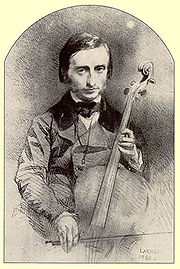 Among the salons at which Offenbach most frequently appeared was that of the comtesse de Vaux. There he met Hérminie d'Alcain (1827–1887), the daughter of a Carlist general. They fell in love, but he was not yet in a financial position to propose marriage. To extend his fame and earning power beyond Paris, he undertook tours of France and Germany. Among those with whom he performed were Anton Rubinstein
and, in a concert in Offenbach's native Cologne, Liszt. In 1844, probably through English family connections of Hérminie, he embarked on a tour of England. There, he was immediately engaged to appear with some of the most famous musicians of the day, including Mendelssohn
, Joseph Joachim
, Michael Costa
and Julius Benedict
. The Era
wrote of his debut performance in London, "His execution and taste excited both wonder and pleasure, the genius he exhibited amounting to absolute inspiration." The British press reported a triumphant royal command performance
; The Illustrated London News wrote, "Herr Jacques Offenbach, the astonishing Violoncellist, performed on Thursday evening at Windsor
before the Emperor of Russia, the King of Saxony, Queen Victoria, and Prince Albert with great success." The use of "Herr" rather than "Monsieur", reflecting the fact that Offenbach remained a Prussian citizen, was common to all the British press coverage of Offenbach's 1844 tour. The ambiguity of his nationality sometimes caused him difficulty in later life.
Offenbach returned to Paris with his reputation and his bank balance both much enhanced. The last remaining obstacle to his marriage to Hérminie was the difference in their professed religions; he converted to Roman Catholicism, with the comtesse de Vaux acting as his sponsor. Isaac Offenbach's views on his son's conversion from Judaism are unknown. The wedding took place on 14 August 1844; the bride was 17 years old, and the bridegroom was 25. The marriage was lifelong, and happy, despite some extramarital dalliances on Offenbach's part. After Offenbach's death, a friend said that Hérminie "gave him courage, shared his ordeals and comforted him always with tenderness and devotion".
Returning to the familiar Paris salons, Offenbach quietly shifted the emphasis of his work from being a cellist who also composed to being a composer who played the cello. He had already published many compositions, and some of them had sold well, but now he began to write, perform and produce musical burlesques as part of his salon presentations. He amused the comtesse de Vaux's 200 guests with a parody of Félicien David
's currently fashionable Le désert
, and in April 1846 gave a concert at which seven operatic items of his own composition were premiered before an audience that included leading music critics. After some encouragement and some temporary setbacks, he seemed on the verge of breaking into theatrical composition when Paris was convulsed by the 1848 revolution
, which swept Louis Philippe from the throne and led to serious bloodshed in the streets of the capital. Offenbach hastily took Hérminie and their recently born daughter to join his family in Cologne. He thought it politic to revert temporarily to the name Jacob.
Returning to Paris in February 1849, Offenbach found the grand salons closed down. He went back to working as a cellist, and occasional conductor, at the Opéra-Comique
, but was not encouraged in his aspirations to compose. His talents had been noted by the director of the Comédie Française, Arsène Houssaye
, who appointed him musical director of the theatre, with a brief to enlarge and improve the orchestra. Offenbach composed songs and incidental music
for eleven classical and modern dramas for the Comédie Française in the early 1850s. Some of his songs became very popular, and he gained valuable experience in writing for the theatre. Houssaye later wrote that Offenbach had done wonders for his theatre. The management of the Opéra-Comique, however, remained uninterested in commissioning him to compose for its stage. The composer Debussy
later wrote that the musical establishment could not cope with Offenbach's irony, which exposed the "false, overblown quality" of the operas they favoured – "the great art at which one was not allowed to smile".
s and managed to have them staged in Paris. They were all well received, but the authorities of the Opéra-Comique remained unmoved. Offenbach found more encouragement from the composer, singer and impresario Florimond Ronger, known professionally as Hervé
. At his theatre, the Folies-Nouvelles
, which had opened the previous year, Hervé pioneered French light comic opera, or "opérette". In The Musical Quarterly, Martial Teneo and Theodore Baker
wrote, "Without the example set by Hervé, Offenbach might perhaps never have become the musician who penned Orphée aux Enfers, La belle Hélène
, and so many other triumphant works." Offenbach approached Hervé, who agreed to present a new one-act operetta with words by Jules Moinaux and music by Offenbach, called Oyayaye ou La reine des îles. It was presented on 26 June 1855 and was well received. Offenbach's biographer Peter Gammond describes it as "a charming piece of nonsense". The piece depicts a double-bass player, played by Hervé, shipwrecked on a cannibal island, who after several perilous encounters with the female chief of the cannibals makes his escape using his double-bass as a boat. Offenbach pressed ahead with plans to present his works himself at his own theatre and to abandon further thoughts of acceptance by the Opéra-Comique.
Offenbach had chosen his theatre, the Salle Lacaze in the Champs-Élysées. The location and the timing were ideal for him. Paris was about to be filled between May and November with visitors from France and abroad for the 1855 Great Exhibition
. The Salle Lacaze was next to the exhibition site. He later wrote:
The description of the theatre as "little" was accurate: it could only hold an audience of 300. It was therefore well suited to the tiny casts permitted under the prevailing licensing laws: Offenbach was limited to three speaking (or singing) characters in any piece. With such small forces, full-length works were out of the question, and Offenbach, like Hervé, presented evenings of several one-act pieces. The opening of the theatre was a frantic rush, with less than a month between the issue of the licence and the opening night on 5 July 1855. During this period Offenbach had to "equip the theatre, recruit actors, orchestra and staff, find authors to write material for the opening programme – and compose the music." Among those he recruited at short notice was Ludovic Halévy
, the nephew of Offenbach's early mentor Fromental Halévy. Ludovic was a respectable civil servant with a passion for the theatre and a gift for dialogue and verse. While maintaining his civil service career he went on to collaborate (sometimes under discreet pseudonyms) with Offenbach in 21 works over the next 24 years.
Halévy wrote the libretto for one of the pieces in the opening programme, but the most popular work of the evening had words by Moinaux. Les deux aveugles
, "The Two Blind Men" is a comedy about two beggars feigning blindness. During rehearsals there had been some concern that the public might judge it to be in poor taste, but it was not only the hit of the season in Paris: it was soon playing successfully in Vienna, London and elsewhere. Another success that summer was Le violoneux
, which made a star of Hortense Schneider
in her first role for Offenbach. Aged 22, when she auditioned for him, she was engaged on the spot. From 1855 she was a key member of his companies through much of his career.
The Champs-Élysées in 1855 were not yet the grand avenue laid out by Baron Haussmann in the 1860s, but an unpaved allée
. The public who were flocking to Offenbach's theatre in the summer and autumn of 1855 could not be expected to venture there in the depths of a Parisian winter. He cast about for a suitable venue and found the Théâtre des Jeunes Élèves, known also as the Salle Choiseul or the Salle Comte, in central Paris. He entered into partnership with its proprietor and moved the Bouffes-Parisiens there for the winter season. The company returned to the Salle Lacaze for the 1856, 1857, and 1859 summer seasons, performing at the Salle Choiseul in the winter. Legislation enacted in March of 1861 prevented the company from using both theatres, and appearances at the Salle Lacaze were discontinued.
(December 1855), a well-received piece of mock-oriental frivolity, to a libretto by Halévy. He followed it with 15 more one-act operettas over the next three years. They were all for the small casts permitted under his licence, although at the Salle Choiseul he was granted an increase from three to four singers.
Under Offenbach's management, the Bouffes-Parisiens staged works by many composers. These included new pieces by Leon Gastinel
and Léo Delibes
. When Offenbach asked Rossini's permission to revive his comedy Il signor Bruschino
, Rossini replied that he was pleased to be able to do anything for "the Mozart of the Champs-Élysées". Offenbach revered Mozart
above all other composers. He had an ambition to present Mozart's neglected one-act comic opera Der Schauspieldirektor
at the Bouffes-Parisiens, and he acquired the score from Vienna. With a text translated and adapted by Léon Battu and Ludovic Halévy, he presented it during the Mozart centenary celebrations in May 1856 as L'impresario; it was popular with the public and also greatly enhanced the critical and social standing of the Bouffes-Parisiens. By command of the emperor, Napoleon III, the company performed at the Tuileries palace shortly after the first performance of the Mozart piece.
In a long article in Le Figaro
in July 1856, Offenbach traced the history of comic opera. He declared that the first work worthy to be called opéra-comique was Philidor
's 1759 Blaise le savetier
, and he described the gradual divergence of Italian and French notions of comic opera, with verve, imagination and gaiety from Italian composers, and cleverness, common sense, good taste and wit from the French composers. He concluded that comic opera had become too grand and inflated. His disquisition was a preliminary to the announcement of an open competition for aspiring composers. A jury of French composers and playwrights including Daniel Auber
, Fromental Halévy, Ambroise Thomas
, Charles Gounod
and Eugène Scribe
considered 78 entries; the five short-listed entrants were all asked to set a libretto, Le docteur miracle, written by Ludovic Halévy and Léon Battu. The joint winners were Georges Bizet
and Charles Lecocq. Bizet became, and remained, a devoted friend of Offenbach. Lecocq and Offenbach took a dislike to one another, and their subsequent rivalry was not altogether friendly.
Although the Bouffes-Parisiens played to full houses, the theatre was constantly on the verge of running out of money, principally because of what his biographer Alexander Faris
calls "Offenbach's incorrigible extravagance as a manager". An earlier biographer, André Martinet, wrote, "Jacques spent money without counting. Whole lengths of velvet were swallowed up in the auditorium; costumes devoured width after width of satin." Moreover, Offenbach was personally generous and liberally hospitable. To boost the company's finances, a London season was organised in 1857, with half the company remaining in Paris to play at the Salle Choiseul and the other half performing at the St James's Theatre
in the West End
of London. The visit was a success, but did not cause the sensation that Offenbach's later works did in London.
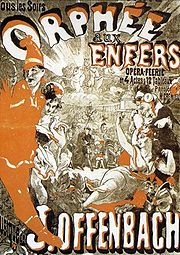 In 1858, the government lifted the licensing restrictions on the number of performers, and Offenbach was able to present more ambitious works. His first full-length operetta, Orphée aux enfers
("Orpheus in the Underworld"), was presented in October 1858. Offenbach, as usual, spent freely on the production, with scenery by Gustave Doré
, lavish costumes, a cast of twenty principals, and a large chorus and orchestra.
As the company was particularly short of money following an abortive season in Berlin, a big success was urgently needed. At first the production seemed merely to be a modest success. It soon benefited from an outraged review by Jules Janin, the critic of the Journal des Débats; he condemned the piece for profanity and irreverence (ostensibly to Roman mythology but in reality to Napoleon and his government, generally seen as the targets of its satire). Offenbach and his librettist Hector Crémieux
seized on this free publicity, and joined in a lively public debate in the columns of the Parisian daily newspaper Le Figaro
. Janin's indignation made the public agog to see the work, and the box office takings were prodigious. Among those who wanted to see the satire of the emperor was the emperor himself, who commanded a performance in April 1860. Despite many great successes during the rest of Offenbach's career, Orphée aux enfers remained his most popular. Gammond lists among the reasons for its success, "the sweeping waltzes" reminiscent of Vienna but with a new French flavour, the patter song
s, and "above all else, of course, the can-can
which had led a naughty life in low places since the 1830s or thereabouts and now became a polite fashion, as uninhibited as ever."
In the 1859 season, the Bouffes-Parisiens presented new works by composers including Flotow, Camille Erlanger
, Alphonse Varney
, Léo Delibes
, and Offenbach himself. Of Offenbach's new pieces, Geneviève de Brabant
though initially only a mild success, was later revised and gained much popularity where the duet of the two gendarmes became a favourite number in England and France and the basis for the Marines' Hymn
in the U.S.
("The Butterfly"), produced at the Opéra in 1860. It achieved what was then a successful run of 42 performances, without, as the biographer Andrew Lamb
says, "giving him any greater acceptance in more respectable circles." Among other operettas in the same year, he finally had a piece presented by the Opéra-Comique, the three-act Barkouf. It was not a success; its plot revolved around a dog, and Offenbach attempted canine imitations in his music. Neither the public nor the critics were impressed, and the piece survived for only seven performances.
Apart from that setback, Offenbach flourished in the 1860s, with successes greatly outnumbering failures. In 1861 he led the company in a summer season in Vienna. Encountering packed houses and enthusiastic reviews, Offenbach found Vienna much to his liking. He even reverted, for a single evening, to his old role as a cello virtuoso at a command performance before Emperor Franz Joseph
. That success was followed by a failure in Berlin. Offenbach, though born a Prussian citizen, observed, "Prussia never does anything to make those of our nationality happy." He and the company hastened back to Paris. Meanwhile, among his operettas that season were the full-length Le pont des soupirs
and the one-act M. Choufleuri restera chez lui le . . .
.
In 1862, Offenbach's only son, Auguste, was born, the last of five children. In the same year, Offenbach resigned as director of the Bouffes-Parisiens, handing the post over to Alphonse Varney. He continued to write most of his works for the company, with the exception of occasional pieces for the summer season at Bad Ems
. Despite problems with the libretto, Offenbach completed a serious opera in 1864, Die Rheinnixen
, a hotchpotch of romantic and mythological themes. The opera was presented with substantial cuts at the Vienna Court Opera
and in Cologne in 1865. It was not given again until 2002, when it was finally performed in its entirety. Since then it has been given several productions. It contained one number, the "Elfenchor", described by the critic Eduard Hanslick
as "lovely, luring and sensuous", which Offenbach later adapted as the Barcarolle in The Tales of Hoffmann. After December 1864, Offenbach wrote less frequently for the Bouffes-Parisiens, and many of his new works premiered at larger theatres.
(1864), La vie parisienne
(1866), La Grande-Duchesse de Gérolstein
(1867) and La Périchole
(1868). Halévy was joined as librettist for all of them by Henri Meilhac
. Offenbach, who called them "Meil" and "Hal", said of this trinity: "Je suis sans doute le Père, mais chacun des deux est mon Fils et plein d'Esprit," a play on words loosely translated as "I am certainly the Father, but together they are the Son and the Wholly Spirited".
For La belle Hélène, Offenbach secured Hortense Schneider to play the title role. Since her early success in his short operas, she had become a leading star of the French musical stage. She now commanded large fees and was notoriously temperamental, but Offenbach was adamant that no other singer could match her as Hélène. Rehearsals for the premiere at the Théâtre des Variétés
were tempestuous, with Schneider and the principal mezzo-soprano
feuding, the censor fretting about the satire of the imperial court, and the manager of the theatre attempting to rein in Offenbach's extravagance with production expenses. Once again the success of the piece was inadvertently assured by the critic Janin; his scandalised notice was strongly countered by liberal critics and the ensuing publicity again brought the public flocking.
Barbe-bleue was a success in early 1866 and was quickly reproduced elsewhere. La vie parisienne
later in the same year was a new departure for Offenbach and his librettists; for the first time in a large-scale piece they chose a modern setting, instead of disguising their satire under a classical cloak. It needed no accidental boost from Janin but was an instant and prolonged success with Parisian audiences, although its very Parisian themes made it less popular abroad. Gammond describes the libretto as "almost worthy of [W.S.] Gilbert", and Offenbach's score as "certainly his best so far". The piece starred Zulma Bouffar
, who began an affair with the composer that lasted until at least 1875.
In 1867, Offenbach had his greatest success. The premiere of La Grande-Duchesse de Gérolstein, a satire on militarism, took place two days after the opening of the Paris Exhibition
, an even greater international draw than the 1855 exhibition which had helped him launch his composing career. The Parisian public and the foreign visitors flocked to the new operetta. The foreign royalty who saw the piece included the King of Prussia
accompanied by his chief minister, Otto von Bismarck
. Halévy, with his experience as a senior civil servant, saw more clearly than most the looming threat from Prussia; he wrote in his diary, "Bismarck is helping to double our takings. This time it's war we're laughing at, and war is at our gates." La Grande-Duchesse de Gérolstein was followed quickly by a series of successful pieces: Robinson Crusoé
, Geneviève de Brabant
(revised version; both 1867), Le château à Toto
, Le pont des soupirs
(revised version) and L'île de Tulipatan
(all in 1868).
In October 1868, La Périchole marked a transition in Offenbach's style, with less exuberant satire and more human romantic interest. Lamb calls it Offenbach's "most charming" score. There was some critical grumbling at the change, but the piece, with Schneider in the lead, did good business. It was quickly produced in Europe and both North and South America. Of the pieces that followed it at the end of the decade, Les brigands (1869) was another work that leaned more to romantic comic opera than to opéra-bouffe. It was well received, but has not subsequently been revived as often as Offenbach's best-known operettas.
in 1870. He then went to his home in Étretat
and arranged for his family to move to the safety of San Sebastián
in northern Spain, joining them shortly afterwards. Having risen to fame under Napoleon III, satirised him, and been rewarded by him, Offenbach was universally associated with the old regime: he was known as "the mocking-bird of the Second Empire
". When the empire fell in the wake of Prussia's crushing victory at Sedan (1870), Offenbach's music was suddenly out of favour. France was swept by violently anti-German sentiments, and despite his French citizenship and Legion d'Honneur, his birth and upbringing in Cologne made him suspect. His operettas were now frequently vilified as the embodiment of everything superficial and worthless in Napoleon III's régime. La Grande-Duchesse de Gérolstein
was banned in France because of its antimilitarist satire.
Although his Parisian audience deserted him, Offenbach had by now become highly popular in England. John Hollingshead
of the Gaiety Theatre
presented Offenbach's operettas to large and enthusiastic audiences. Between 1870 and 1872, the Gaiety produced 15 of his works. At the Royalty Theatre
, Richard D'Oyly Carte
presented La Périchole in 1875. In Vienna, too, Offenbach works were regularly produced. While the war and its aftermath ravaged Paris, the composer supervised Viennese productions and travelled to England as the guest of the Prince of Wales
.
By the end of 1871 life in Paris had returned to normal, and Offenbach ended his voluntary exile. His new works Le roi Carotte
(1872) and La jolie parfumeuse
(1873) were modestly profitable, but lavish revivals of his earlier successes did better business. He decided to go back into theatre management and took over the Théâtre de la Gaîté
in July 1873. His spectacular revival of Orphée aux enfers there was highly profitable; an attempt to repeat that success with a new, lavish version of Geneviève de Brabant proved less popular. Along with the costs of extravagant productions, collaboration with the dramatist Victorien Sardou
culminated in financial disaster. An expensive production of Sardou's La haine in 1874, with incidental music by Offenbach, failed to attract the public to the Gaîté, and Offenbach was forced to sell his interests in the Gaîté and to mortgage future royalties.
In 1876 a successful tour of the United States in connection with its Centennial Exhibition enabled Offenbach to recover some of his losses and pay his debts. Beginning with a concert at Gilmore's Garden
before a crowd of 8,000 people, he gave a series of more than 40 concerts in New York and Philadelphia. To circumvent a Philadelphia law forbidding entertainments on Sundays, he disguised his operetta numbers as liturgical pieces and advertised a "Grand Sacred Concert by M. Offenbach". "Dis-moi, Vénus" from La belle Hélène became a "Litanie", and other equally secular numbers were billed as "Prière" or "Hymne". The local authorities were not deceived, and the concert did not take place. At Booth's Theatre
, New York, Offenbach conducted La vie parisienne and his recent (1873) La jolie parfumeuse
. He returned to France in July 1876, with profits that were handsome but not spectacular.
Offenbach's later operettas enjoyed renewed popularity in France, especially Madame Favart
(1878), which featured a fantasy plot about the real-life French actress Marie Justine Favart
, and La fille du tambour-major
(1879), which was the most successful of his operettas of the 1870s.
and Michel Carré
. Offenbach had suffered from gout since the 1860s, often being carried into the theatre in a chair. Now in failing health, he was conscious of his own mortality and wished passionately to live long enough to complete the opera Les contes d'Hoffmann ("The Tales of Hoffmann"). He was heard saying to Kleinzach, his dog, "I would give everything I have to be at the première". However, Offenbach did not live to finish the piece. He left the vocal score substantially complete and had made a start on the orchestration. Ernest Guiraud
, a family friend, assisted by Offenbach's 18-year-old son Auguste, completed the orchestration, making significant changes as well as the substantial cuts demanded by the Opéra-Comique's director, Carvalho. The opera was first seen at the Opéra-Comique on 10 February 1881; Guiraud added recitatives for the Vienna premiere, in December 1881, and other versions were made later.
Offenbach died in Paris in 1880 at the age of 61. His cause of death was certified as heart failure brought on by acute gout
. He was given a state funeral; The Times wrote, "The crowd of distinguished men that accompanied him on his last journey amid the general sympathy of the public shows that the late composer was reckoned among the masters of his art." He is buried in the Montmartre Cemetery
.
, Mark Lubbock wrote in 1957:
Among other well-known Offenbach numbers are the Doll Song, "Les oiseaux dans la charmille" (The Tales of Hoffmann); "Voici le sabre de mon père" and "Ah! Que j'aime les militaires" (La Grande Duchesse de Gerolstein); and "Tu n'es pas beau" in La Périchole, which Lamb notes was Offenbach's last major song for Hortense Schneider.
for at least 24 of his works in either one, two or three acts.
Offenbach's earliest operettas were one-act pieces for small casts. More than 30 of these were presented before his first full-scale "opéra bouffon
", Orphée aux enfers, in 1858, and he composed over 20 more of them during the rest of his career. Lamb, following the precedent of Henseler's 1930 study of the composer, divides the one-act pieces into five categories: "(i) country idylls; (ii) urban operettas; (iii) military operettas; (iv) farces; and (v) burlesques or parodies." Following the success of Orphée aux enfers, Offenbach enjoyed his greatest success in the 1860s. As throughout his composing career, he produced a large number of works, some of which caught the public fancy more than others. Most of his greatest successes from the decade have remained among his best known: La belle Hélène (1864), La vie parisienne (1866), La Grande-Duchesse de Gérolstein (1867), and La Périchole (1868). In Offenbach's last decade, he took note of a change in public taste: a simpler, more romantic style was now preferred. Harding writes that Lecocq had successfully moved away from satire and parody, returning to "the genuine spirit of opéra-comique and its peculiarly French gaiety." Offenbach followed suit in a series of 20 operettas; the musician and writer Antonio de Almeida
names the finest of these as La fille du tambour-major (1879).
Texts and word setting
The first ideas for plots usually came from Offenbach, with his librettists working on lines agreed with him. Lamb writes, "In this respect Offenbach was both well served and skilful at discovering talent. Like Sullivan
, and unlike Johann Strauss II, he was consistently blessed with workable subjects and genuinely witty librettos." He took advantage of the rhythmic flexibility of the French language, but sometimes took this to extremes, forcing words into unnatural stresses. Harding comments that he "wrought much violence on the French language". A frequent characteristic of Offenbach's word setting was the nonsensical repetition of isolated syllables of words for comic effect; an example is the quintet for the kings in La belle Hélène: "Je suis l'époux de la reine/Poux de la reine/Poux de la reine" and "Le roi barbu qui s'avance/Bu qui s'avance/Bu qui s'avance."
Musical structure
In general, Offenbach followed simple, established forms. His melodies are usually short and unvaried in their basic rhythm, rarely, in Hughes's words, escaping "the despotism of the four-bar phrase". In modulation
Offenbach was similarly cautious; he rarely switched a melody to a remote or unexpected key, and kept mostly to a tonic
–dominant
–subdominant
pattern. Within these conventional limits, he employed greater resource in his varied use of rhythm; in a single number he would contrast rapid patter for one singer with a broad, smooth phrase for another, illustrating their different characters. Similarly, he often switched quickly between major and minor keys, effectively contrasting characters or situations. When he wished to, Offenbach could use unconventional techniques, such as the leitmotiv, used throughout to accompany the eponymous Docteur Ox (1877) and to parody Wagner in La carnaval des revues (1860).
Orchestration
In his early pieces for the Bouffes-Parisiens, the size of the orchestra pit had restricted Offenbach to an orchestra of 16 players. He composed for flute
, oboe
, clarinet
, bassoon
, two horns, piston
, trombone
, timpani
and percussion and a small string section of seven players. After moving to the Salle Choiseul he had an orchestra of 30 players. The musicologist and Offenbach specialist Jean-Christophe Keck notes that when larger orchestras were available, either in bigger Paris theatres or in Vienna or elsewhere, Offenbach would compose, or rearrange existing music, accordingly. Surviving scores show his instrumentation for additional wind and brass, and even extra percussion. When they were available he wrote for cor anglais
, harp
, and, exceptionally, Keck records, an ophicleide
(Le Papillon), tubular bells
(Le carnaval des revues), and a wind machine
(Le voyage dans la lune).
Hughes describes Offenbach's orchestration as "always skilful, often delicate, and occasionally subtle." He instances Pluton's song in Orphée aux enfers, introduced by a three-bar phrase for solo clarinet and solo bassoon in octaves immediately repeated on solo flute and solo bassoon an octave higher. In Keck's view, "Offenbach's orchestral scoring is full of details, elaborate counter-voices, minute interactions coloured by interjections of the woodwinds or brass, all of which establish a dialogue with the voices. His refinement of design equals that of Mozart or Rossini."
Compositional method
Offenbach often composed amidst noise and distractions. According to Keck, Offenbach would first make a note of melodies a libretto suggested to him in a notebook or straight onto the librettist’s manuscript. Next using full score manuscript paper
he wrote down vocal parts in the centre, then a piano accompaniment at the bottom possibly with notes on orchestration. When Offenbach felt sure the work would be performed, he began full orchestration, often employing a codified system.
Parody and influences
Offenbach was well known for parodying other composers' music. Some of them saw the joke and others did not. Adam, Auber and Meyerbeer
enjoyed Offenbach's parodies of their scores. Meyerbeer made a point of attending all Bouffes-Parisiens productions, always seated in Offenbach's private box. Among the composers who were not amused by Offenbach's parodies were Berlioz
and Wagner
. Offenbach mocked Berlioz's "strivings after the antique", and his initial light-hearted satire of Wagner's pretensions later hardened into genuine dislike. Berlioz reacted by bracketing Offenbach and Wagner together as "the product of the mad German mind", and Wagner, ignoring Berlioz, retaliated by writing some unflattering verses about Offenbach.
In general, Offenbach's parodistic technique was simply to play the original music in unexpected and incongruous circumstances. He slipped the banned revolutionary anthem La Marseillaise
into the chorus of rebellious gods in Orphée aux enfers, and quoted the aria "Che farò" from Gluck's Orfeo
in the same work; in La belle Hélène he quoted the patriotic trio from Rossini's Guillaume Tell and parodied himself in the ensemble for the kings of Greece, in which the accompaniment quotes the rondeau from Orphée aux enfers. In his one act pieces, Offenbach parodied Rossini's "Largo al factotum" and familiar arias by Bellini
. In Croquefer (1857), one duet consists of quotations from Halévy's La Juive
and Meyerbeer's Robert le Diable
and Les Huguenots
. Even in his later, less satirical period, he included a parodic quotation from Donizetti
's La fille du régiment
in La fille du tambour-major
.
Other examples of Offenbach's use of incongruity are noted by the critic Paul Taylor: "In La belle Hélène, the kings of Greece denounce Paris as 'un vil séducteur' to a waltz tempo that is itself unsuitably seductive … the potty-sounding phrase 'L'homme à la pomme' becomes the absurd nucleus of a big cod-ensemble." Another lyric set to absurdly ceremonious music is "Votre habit a craqué dans le dos" ("Your coat has split down the back") in La vie parisienne. The Grand Duchess of Gérolstein's rondo "Ah! Que j'aime les militaires" is rhythmically and melodically similar to the finale of Beethoven
's Seventh Symphony
, but it is not clear whether the similarity is parodic or coincidental.
. When the work was accepted by Léon Carvalho
for production at the Opéra-Comique
, Offenbach agreed to make it an opéra comique
with spoken dialogue. It was incomplete when he died; Faris speculates that, but for Georges Bizet's premature death, Bizet rather than Guiraud would have been asked to complete the piece and would have done so more satisfactorily. The critic Tim Ashley writes, "Stylistically, the opera reveals a remarkable amalgam of French and German influences … Weberian
chorales preface Hoffmann's narrative. Olympia delivers a big coloratura
aria straight out of French grand opera, while Antonia sings herself to death to music reminiscent of Schubert
."
Although he wrote ballet music for many of his operettas, Offenbach wrote only one ballet, Le papillon. The score was much praised for its orchestration, and it contained one number, the "Valse des rayons", that became an international success. Between 1836 and 1875 he composed several individual waltzes and polkas, and suites of dances. They include a waltz, Abendblätter ("Evening Papers") composed for Vienna with Johann Strauss's Morgenblätter
("Morning Papers") as a companion piece. Other orchestral compositions include a piece in 17th-century style with cello solo, which became a standard work of the cello repertoire. Little of Offenbach's non-operatic orchestral music has been regularly performed since his death.
Offenbach composed more than 50 non-operatic songs between 1838 and 1854, most of them to French texts, by authors including Alfred de Musset
, Théophile Gautier
and Jean de La Fontaine
, and also ten to German texts. Among the most popular of these songs was "À toi" (1843), dedicated to the young Hérminie d'Alcain as an early token of his love.
In 1938, Manuel Rosenthal
assembled the popular ballet Gaîté Parisienne
from his own orchestral arrangements of melodies from Offenbach's stage works, and in 1953 the same composer assembled a symphonic suite, Offenbachiana, also from music by Offenbach. Jean-Christophe Keck regards the 1938 work as "no more than a vulgarly orchestrated pastiche"; in Gammond's view, however, it does "full justice" to Offenbach.
wrote in 1980, "Without Offenbach there would have been no Savoy Opera
… no Die Fledermaus
or Merry Widow. The two creators of the Savoy operas, the librettist, Gilbert, and the composer, Sullivan, were both indebted to Offenbach and his partners for their satiric and musical styles, even borrowing plot components. For example, Faris argues that the mock-oriental Ba-ta-clan influenced The Mikado
, including its character names: Offenbach's Ko-ko-ri-ko and Gilbert's Ko-Ko; Faris also compares Le pont des soupirs
(1861) and The Gondoliers
(1889): "in both works there are choruses à la barcarolle for gondoliers and contadini [in] thirds
and sixths
; Offenbach has a Venetian admiral telling of his cowardice in battle; Gilbert and Sullivan have their Duke of Plaza-Toro who led his regiment from behind." Offenbach's Les Géorgiennes (1864), like Gilbert and Sullivan's Princess Ida
(1884), depicts a female stronghold challenged by males in disguise. The best-known instance in which a Savoy opera draws on Offenbach's work is The Pirates of Penzance
(1879), where both Gilbert and Sullivan follow the lead of Les brigands
(1869) in their treatment of the police, plodding along ineffectually in heavy march-time. Les brigands was presented in London in 1871, 1873 and 1875; for the first of these, Gilbert made an English translation of Meilhac and Halévy's libretto.
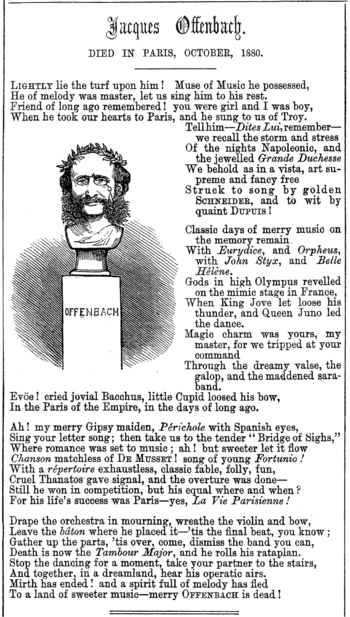 However much the young Sullivan was influenced by Offenbach, the influence was evidently not in only one direction. Hughes observes that two numbers in Offenbach's Maitre Péronilla (1878) bear "an astonishing resemblance" to "My name is John Wellington Wells" from Gilbert and Sullivan's The Sorcerer
(1877).
It is not clear how directly Offenbach influenced Johann Strauss
. He had encouraged Strauss to turn to operetta when they met in Vienna in 1864, but it was not until seven years later that Strauss did so. However, Offenbach's operettas were well established in Vienna, and Strauss worked on the lines established by his French colleague; in 1870s Vienna, an operetta composer who did not do so was quickly called to order by the press. In Gammond's view, the Viennese composer most influenced by Offenbach was Franz von Suppé
, who studied Offenbach's works carefully and wrote many successful operettas using them as a model.
In his 1957 article, Lubbock wrote, "Offenbach is undoubtedly the most significant figure in the history of the 'musical'," and traced the development of musical theatre from Offenbach to Irving Berlin
and Rodgers and Hammerstein
, via Franz Lehár
, André Messager
, Sullivan and Lionel Monckton
.
, George Hauger commented that those critics not only underrated Offenbach, but wrongly supposed that his music would soon be forgotten. Although most critics of the time made that erroneous assumption, a few perceived Offenbach's unusual quality; in The Times
, Francis Hueffer
wrote, "none of his numerous Parisian imitators has ever been able to rival Offenbach at his best." Nevertheless, the paper joined in the general prediction: "It is very doubtful whether any of his works will survive." The New York Times
shared this view: "That he had the gift of melody in a very extraordinary degree is not to be denied, but he wrote currente calamo, and the lack of development of his choicest inspirations will, it is to be feared, keep them from reaching even the next generation". After the posthumous production of The Tales of Hoffmann, The Times partially reconsidered its judgment, writing, Les Contes de Hoffmann [will] confirm the opinion of those who regard him as a great composer in every sense of the word". It then lapsed into what Gammond calls "Victorian sanctimoniousness" by taking it for granted that the opera "will uphold Offenbach's fame long after his lighter compositions have passed out of memory."
Friedrich Nietzsche
called Offenbach both an "artistic genius" and a "clown", but wrote that "nearly every one" of Offenbach's works achieves half a dozen "moments of wanton perfection", while the critic Sacheverell Sitwell
compared Offenbach's lyrical and comic gifts to those of Mozart and Rossini. Émile Zola
commented on Offenbach and his work in a novel (Nana
) and an essay, "La féerie et l'opérette IV/V". While granting that Offenbach's best operettas are full of grace, charm and wit, Zola blames Offenbach for what others have made out of the genre. Zola calls operetta a "public enemy" and a "monstrous beast". While some critics saw the satire in Offenbach's works as a social protest, an attack against the establishment, Zola saw the works as a homage to the social system in the Second Empire.
Debussy, Bizet, Mussorgsky
and Rimsky-Korsakov loved Offenbach's operettas. Debussy rated them higher than The Tales of Hoffmann: "The one work in which [Offenbach] tried to be serious met with no success." A London critic wrote, on Offenbach's death:
Kingdom of Prussia
The Kingdom of Prussia was a German kingdom from 1701 to 1918. Until the defeat of Germany in World War I, it comprised almost two-thirds of the area of the German Empire...
-born French composer, cellist and impresario. He is remembered for his nearly 100 operetta
Operetta
Operetta is a genre of light opera, light in terms both of music and subject matter. It is also closely related, in English-language works, to forms of musical theatre.-Origins:...
s of the 1850s–1870s and his uncompleted opera The Tales of Hoffmann. He was a powerful influence on later composers of the operetta genre, particularly Johann Strauss, Jr. and Arthur Sullivan
Arthur Sullivan
Sir Arthur Seymour Sullivan MVO was an English composer of Irish and Italian ancestry. He is best known for his series of 14 operatic collaborations with the dramatist W. S. Gilbert, including such enduring works as H.M.S. Pinafore, The Pirates of Penzance and The Mikado...
. His best-known works were continually revived during the 20th century, and many of his operettas continue to be staged in the 21st. The Tales of Hoffman remains part of the standard opera repertory.
Born in Cologne
Cologne
Cologne is Germany's fourth-largest city , and is the largest city both in the Germany Federal State of North Rhine-Westphalia and within the Rhine-Ruhr Metropolitan Area, one of the major European metropolitan areas with more than ten million inhabitants.Cologne is located on both sides of the...
, the son of a synagogue cantor
Hazzan
A hazzan or chazzan is a Jewish cantor, a musician trained in the vocal arts who helps lead the congregation in songful prayer.There are many rules relating to how a cantor should lead services, but the idea of a cantor as a paid professional does not exist in classical rabbinic sources...
, Offenbach showed early musical talent. At the age of 14, he was accepted as a student at the Paris Conservatoire but found academic study unfulfilling and left after a year. From 1835 to 1855 he earned his living as a cellist, achieving international fame, and as a conductor. His ambition, however, was to compose comic pieces for the musical theatre. Finding the management of Paris's Opéra-Comique
Opéra-Comique
The Opéra-Comique is a Parisian opera company, which was founded around 1714 by some of the popular theatres of the Parisian fairs. In 1762 the company was merged with, and for a time took the name of its chief rival the Comédie-Italienne at the Hôtel de Bourgogne, and was also called the...
company uninterested in staging his works, in 1855 he leased a small theatre in the Champs-Élysées
Champs-Élysées
The Avenue des Champs-Élysées is a prestigious avenue in Paris, France. With its cinemas, cafés, luxury specialty shops and clipped horse-chestnut trees, the Avenue des Champs-Élysées is one of the most famous streets and one of the most expensive strip of real estate in the world. The name is...
. There he presented a series of his own small-scale pieces, many of which became popular.
In 1858, Offenbach produced his first full-length operetta, Orphée aux enfers
Orpheus in the Underworld
Orphée aux enfers is an opéra bouffon , or opéra féerie in its revised version, by Jacques Offenbach. The French text was written by Ludovic Halévy and later revised by Hector-Jonathan Crémieux....
("Orpheus in the Underworld"), which was exceptionally well received and has remained one of his most played works. During the 1860s, he produced at least 18 full-length operettas, as well as more one-act pieces. His works from this period included La belle Hélène
La belle Hélène
La belle Hélène , opéra bouffe in three acts, is an operetta by Jacques Offenbach to an original French libretto by Henri Meilhac and Ludovic Halévy...
(1864), La vie parisienne
La vie parisienne
La vie parisienne is an opéra bouffe, or operetta, composed by Jacques Offenbach, with a libretto by Henri Meilhac and Ludovic Halévy.This work was Offenbach's first full-length piece to portray contemporary Parisian life, unlike his earlier period pieces and mythological subjects...
(1866), La Grande-Duchesse de Gérolstein
La Grande-Duchesse de Gérolstein
La Grande-Duchesse de Gérolstein is an opéra bouffe , in three acts and four tableaux by Jacques Offenbach to an original French libretto by Henri Meilhac and Ludovic Halévy...
(1867) and La Périchole
La Périchole
La Périchole is an opéra bouffe in three acts by Jacques Offenbach. Henri Meilhac and Ludovic Halévy wrote the French-language libretto based on the 1829 one act play Le carrosse du Saint-Sacrement by Prosper Mérimée, which was revived on 13 March 1850 at the Théâtre-Français...
(1868). The risqué humour (often about sexual intrigue) and mostly gentle satiric barbs in these pieces, together with Offenbach's facility for melody, made them internationally known, and translated versions were successful in Vienna, London and elsewhere in Europe.
Offenbach became associated with the Second French Empire
Second French Empire
The Second French Empire or French Empire was the Imperial Bonapartist regime of Napoleon III from 1852 to 1870, between the Second Republic and the Third Republic, in France.-Rule of Napoleon III:...
of Napoleon III; the emperor and his court were genially satirised in many of Offenbach's operettas. Napoleon personally granted him French citizenship and the Légion d'Honneur
Légion d'honneur
The Legion of Honour, or in full the National Order of the Legion of Honour is a French order established by Napoleon Bonaparte, First Consul of the Consulat which succeeded to the First Republic, on 19 May 1802...
. With the outbreak of the Franco-Prussian War
Franco-Prussian War
The Franco-Prussian War or Franco-German War, often referred to in France as the 1870 War was a conflict between the Second French Empire and the Kingdom of Prussia. Prussia was aided by the North German Confederation, of which it was a member, and the South German states of Baden, Württemberg and...
in 1870, Offenbach found himself out of favour in Paris because of his imperial connections and his German birth. He remained successful in Vienna and London, however. He re-established himself in Paris during the 1870s, with revivals of some of his earlier favourites and a series of new works, and undertook a popular U.S. tour. In his last years he strove to finish The Tales of Hoffmann, but died before the premiere of the opera, which has entered the standard repertory in versions completed or edited by other musicians.
Early years
Offenbach was born Jacob or Jakob Offenbach in the German city of CologneCologne
Cologne is Germany's fourth-largest city , and is the largest city both in the Germany Federal State of North Rhine-Westphalia and within the Rhine-Ruhr Metropolitan Area, one of the major European metropolitan areas with more than ten million inhabitants.Cologne is located on both sides of the...
, which was then a part of Prussia
Kingdom of Prussia
The Kingdom of Prussia was a German kingdom from 1701 to 1918. Until the defeat of Germany in World War I, it comprised almost two-thirds of the area of the German Empire...
. His birthplace in the Großen Griechenmarkt was a short distance from the square that is now named after him, the Offenbachplatz. He was the second son and the seventh of ten children of Isaac Juda Offenbach né Eberst (1779–1850) and his wife Marianne, née Rindskopf (c. 1783–1840). Isaac, who came from a musical family, had abandoned his original trade as a bookbinder and earned an itinerant living as a cantor
Hazzan
A hazzan or chazzan is a Jewish cantor, a musician trained in the vocal arts who helps lead the congregation in songful prayer.There are many rules relating to how a cantor should lead services, but the idea of a cantor as a paid professional does not exist in classical rabbinic sources...
in synagogues and playing the violin in cafés. He was generally known as "der Offenbacher", after his native town, Offenbach am Main, and in 1808 he officially adopted Offenbach as a surname. In 1816 he settled in Cologne, where he became established as a teacher, giving lessons in singing, violin, flute and guitar, and composing both religious and secular music.
When Jacob was six years old, his father taught him to play the violin; within two years the boy was composing songs and dances, and at the age of nine he took up the cello. As he was by then the permanent cantor of the local synagogue, Isaac could afford to pay for his son to take lessons from the well-known cellist Bernhard Breuer. Three years later, the biographer Gabriel Grovlez records, the boy was giving performances of his own compositions, "the technical difficulties of which terrified his master", Breuer. Together with his brother Julius (violin) and sister Isabella (piano), Jacob played in a trio at local dance halls, inns and cafés, performing popular dance music and operatic arrangements. In 1833, Isaac decided that the two most musically talented of his children, Julius (then aged 18) and Jacob (14) needed to leave the provincial musical scene of Cologne to study in Paris. With generous support from local music lovers and the municipal orchestra, with whom they gave a farewell concert on 9 October, the two young musicians, accompanied by their father, made the four-day journey to Paris in November 1833.
Isaac had been given letters of introduction to the director of the Paris Conservatoire, Luigi Cherubini
Luigi Cherubini
Luigi Cherubini was an Italian composer who spent most of his working life in France. His most significant compositions are operas and sacred music. Beethoven regarded Cherubini as the greatest of his contemporaries....
, but he needed all his eloquence to persuade Cherubini even to give Jacob an audition. The boy's age and nationality were both obstacles to admission. Cherubini had several years earlier refused the 12-year-old Franz Liszt
Franz Liszt
Franz Liszt ; ), was a 19th-century Hungarian composer, pianist, conductor, and teacher.Liszt became renowned in Europe during the nineteenth century for his virtuosic skill as a pianist. He was said by his contemporaries to have been the most technically advanced pianist of his age...
admission on similar grounds, but he eventually agreed to hear the young Offenbach play. He listened to his playing and stopped him, saying, "Enough, young man, you are now a pupil of this Conservatoire." Julius was also admitted. Both brothers adopted French forms of their names, Julius becoming Jules and Jacob becoming Jacques.
Isaac hoped to secure permanent employment in Paris but failed to do so and returned to Cologne. Before leaving, he found a number of pupils for Jules; the modest earnings from those lessons, supplemented by fees earned by both brothers as members of synagogue choirs, supported them during their studies. At the conservatoire, Jules was a diligent student; he graduated and became a successful violin teacher and conductor, and led his younger brother's orchestra for several years. By contrast, Jacques was bored by academic study and left after a year. The conservatoire's roll of students notes against his name "Struck off on the 2 December 1834 (left of his own free will)".
Cello virtuoso
Having left the conservatoire, Offenbach was free from the stern academicism of Cherubini's curriculum, but as the biographer James Harding writes, "he was free, also, to starve." He secured a few temporary jobs in theatre orchestras before gaining a permanent appointment in 1835 as a cellist at the Opéra-ComiqueOpéra-Comique
The Opéra-Comique is a Parisian opera company, which was founded around 1714 by some of the popular theatres of the Parisian fairs. In 1762 the company was merged with, and for a time took the name of its chief rival the Comédie-Italienne at the Hôtel de Bourgogne, and was also called the...
. He was no more serious there than he had been at the conservatoire, and regularly had his pay docked for playing pranks during performances; on one occasion, he and the principal cellist played alternate notes of the printed score, and on another they sabotaged some of their colleagues' music stands to make them collapse in mid-performance. Nevertheless his earnings from his orchestral work enabled him to take lessons with the celebrated cellist Louis-Pierre Norblin
Louis-Pierre Norblin
Louis Norblin was a French musician. He taught cello at the Paris Conservatoire, where his students included Charles Lebouc....
. He made a favourable impression on the composer and conductor Fromental Halévy
Fromental Halévy
Jacques-François-Fromental-Élie Halévy, usually known as Fromental Halévy , was a French composer. He is known today largely for his opera La Juive.-Early career:...
, who gave him lessons in composition and orchestration and wrote to Isaac Offenbach in Cologne that the young man was going to be a great composer. Some of Offenbach's early compositions were programmed by the fashionable conductor Louis Antoine Jullien
Louis Antoine Jullien
Louis Antoine Jullien was a French conductor and composer of light music.Jullien was born in Sisteron, Alpes-de-Haute-Provence, and was baptised Louis George Maurice Adolphe Roche Albert Abel Antonio Alexandre Noë Jean Lucien Daniel Eugène Joseph-le-brun Joseph-Barême Thomas Thomas Thomas-Thomas...
. Offenbach and another young composer Friedrich von Flotow
Friedrich von Flotow
Friedrich Adolf Ferdinand, Freiherr von Flotow was a German composer. He is chiefly remembered for his opera Martha, which was popular in the 19th century....
collaborated on a series of works for cello and piano. Although Offenbach's ambition was to compose for the stage, he was at this point in his career unable to gain an entrée to Parisian theatre; with Flotow's help, he built a reputation composing for and playing in the fashionable salons of Paris.
Anton Rubinstein
Anton Grigorevich Rubinstein was a Russian-Jewish pianist, composer and conductor. As a pianist he was regarded as a rival of Franz Liszt, and he ranks amongst the great keyboard virtuosos...
and, in a concert in Offenbach's native Cologne, Liszt. In 1844, probably through English family connections of Hérminie, he embarked on a tour of England. There, he was immediately engaged to appear with some of the most famous musicians of the day, including Mendelssohn
Felix Mendelssohn
Jakob Ludwig Felix Mendelssohn Barthóldy , use the form 'Mendelssohn' and not 'Mendelssohn Bartholdy'. The Grove Dictionary of Music and Musicians gives ' Felix Mendelssohn' as the entry, with 'Mendelssohn' used in the body text...
, Joseph Joachim
Joseph Joachim
Joseph Joachim was a Hungarian violinist, conductor, composer and teacher. A close collaborator of Johannes Brahms, he is widely regarded as one of the most significant violinists of the 19th century.-Origins:...
, Michael Costa
Michael Costa (conductor)
Sir Michael Andrew Angus Costa was an Italian-born conductor and composer who achieved success in England.-Biography:He was born in Naples as Michaele Andrea Agniello Costa, to a family, according to some, of Sephardic stock...
and Julius Benedict
Julius Benedict
Sir Julius Benedict was a German-born composer and conductor, resident in England for most of his career.-Life:...
. The Era
The Era (newspaper)
The Era was a British weekly paper, published from 1838 to 1939. Originally a general newspaper, it became noted for its sports coverage, and later for its theatrical content.-History:...
wrote of his debut performance in London, "His execution and taste excited both wonder and pleasure, the genius he exhibited amounting to absolute inspiration." The British press reported a triumphant royal command performance
Royal Command Performance
For the annual Royal Variety Performance performed in Britain for the benefit of the Entertainment Artistes' Benevolent Fund, see Royal Variety Performance...
; The Illustrated London News wrote, "Herr Jacques Offenbach, the astonishing Violoncellist, performed on Thursday evening at Windsor
Windsor Castle
Windsor Castle is a medieval castle and royal residence in Windsor in the English county of Berkshire, notable for its long association with the British royal family and its architecture. The original castle was built after the Norman invasion by William the Conqueror. Since the time of Henry I it...
before the Emperor of Russia, the King of Saxony, Queen Victoria, and Prince Albert with great success." The use of "Herr" rather than "Monsieur", reflecting the fact that Offenbach remained a Prussian citizen, was common to all the British press coverage of Offenbach's 1844 tour. The ambiguity of his nationality sometimes caused him difficulty in later life.
Offenbach returned to Paris with his reputation and his bank balance both much enhanced. The last remaining obstacle to his marriage to Hérminie was the difference in their professed religions; he converted to Roman Catholicism, with the comtesse de Vaux acting as his sponsor. Isaac Offenbach's views on his son's conversion from Judaism are unknown. The wedding took place on 14 August 1844; the bride was 17 years old, and the bridegroom was 25. The marriage was lifelong, and happy, despite some extramarital dalliances on Offenbach's part. After Offenbach's death, a friend said that Hérminie "gave him courage, shared his ordeals and comforted him always with tenderness and devotion".
Returning to the familiar Paris salons, Offenbach quietly shifted the emphasis of his work from being a cellist who also composed to being a composer who played the cello. He had already published many compositions, and some of them had sold well, but now he began to write, perform and produce musical burlesques as part of his salon presentations. He amused the comtesse de Vaux's 200 guests with a parody of Félicien David
Félicien-César David
Félicien-César David was a French composer.-Biography:Félicien David was born in Cadenet , France, and began to study music at five under his father, whose early death however left him an impoverished orphan...
's currently fashionable Le désert
Le désert
Le désert is an 'ode-symphonie' in three parts by the French composer Félicien David with words by Auguste Colin, written after the composer’s stay in Egypt and the Holy Land....
, and in April 1846 gave a concert at which seven operatic items of his own composition were premiered before an audience that included leading music critics. After some encouragement and some temporary setbacks, he seemed on the verge of breaking into theatrical composition when Paris was convulsed by the 1848 revolution
French Revolution of 1848
The 1848 Revolution in France was one of a wave of revolutions in 1848 in Europe. In France, the February revolution ended the Orleans monarchy and led to the creation of the French Second Republic. The February Revolution was really the belated second phase of the Revolution of 1830...
, which swept Louis Philippe from the throne and led to serious bloodshed in the streets of the capital. Offenbach hastily took Hérminie and their recently born daughter to join his family in Cologne. He thought it politic to revert temporarily to the name Jacob.
Returning to Paris in February 1849, Offenbach found the grand salons closed down. He went back to working as a cellist, and occasional conductor, at the Opéra-Comique
Opéra-Comique
The Opéra-Comique is a Parisian opera company, which was founded around 1714 by some of the popular theatres of the Parisian fairs. In 1762 the company was merged with, and for a time took the name of its chief rival the Comédie-Italienne at the Hôtel de Bourgogne, and was also called the...
, but was not encouraged in his aspirations to compose. His talents had been noted by the director of the Comédie Française, Arsène Houssaye
Arsène Houssaye
Arsène Houssaye , French novelist, poet and man of letters, was born at Bruyères , near Laon. His real surname was Housset....
, who appointed him musical director of the theatre, with a brief to enlarge and improve the orchestra. Offenbach composed songs and incidental music
Incidental music
Incidental music is music in a play, television program, radio program, video game, film or some other form not primarily musical. The term is less frequently applied to film music, with such music being referred to instead as the "film score" or "soundtrack"....
for eleven classical and modern dramas for the Comédie Française in the early 1850s. Some of his songs became very popular, and he gained valuable experience in writing for the theatre. Houssaye later wrote that Offenbach had done wonders for his theatre. The management of the Opéra-Comique, however, remained uninterested in commissioning him to compose for its stage. The composer Debussy
Claude Debussy
Claude-Achille Debussy was a French composer. Along with Maurice Ravel, he was one of the most prominent figures working within the field of impressionist music, though he himself intensely disliked the term when applied to his compositions...
later wrote that the musical establishment could not cope with Offenbach's irony, which exposed the "false, overblown quality" of the operas they favoured – "the great art at which one was not allowed to smile".
Bouffes-Parisiens, Champs-Élysées
Between 1853 and 1855, Offenbach wrote three one-act operettaOperetta
Operetta is a genre of light opera, light in terms both of music and subject matter. It is also closely related, in English-language works, to forms of musical theatre.-Origins:...
s and managed to have them staged in Paris. They were all well received, but the authorities of the Opéra-Comique remained unmoved. Offenbach found more encouragement from the composer, singer and impresario Florimond Ronger, known professionally as Hervé
Hervé (composer)
Hervé , real name Louis Auguste Florimond Ronger, was a French singer, composer, librettist, conductor and scene painter, whom Ernest Newman, following Reynaldo Hahn, credited with inventing the genre of operetta in Paris.-Life:Hervé was born in Houdain near Arras...
. At his theatre, the Folies-Nouvelles
Théâtre Déjazet
The Théâtre Dejazet is a theatre on the boulevard du Temple in the 3rd arrondissement of Paris. It was originally founded in 1770 by Comte d'Artois who later was crowned Charles X, but it was then closed down and not reopened until 1851...
, which had opened the previous year, Hervé pioneered French light comic opera, or "opérette". In The Musical Quarterly, Martial Teneo and Theodore Baker
Theodore Baker
Theodore Baker was an American musicologist.Born in New York, Baker studied business but turned to music as a career, becoming an organist in Concord, Massachusetts. In 1874 he moved to Germany and obtained his doctorate at Leipzig in 1882...
wrote, "Without the example set by Hervé, Offenbach might perhaps never have become the musician who penned Orphée aux Enfers, La belle Hélène
La belle Hélène
La belle Hélène , opéra bouffe in three acts, is an operetta by Jacques Offenbach to an original French libretto by Henri Meilhac and Ludovic Halévy...
, and so many other triumphant works." Offenbach approached Hervé, who agreed to present a new one-act operetta with words by Jules Moinaux and music by Offenbach, called Oyayaye ou La reine des îles. It was presented on 26 June 1855 and was well received. Offenbach's biographer Peter Gammond describes it as "a charming piece of nonsense". The piece depicts a double-bass player, played by Hervé, shipwrecked on a cannibal island, who after several perilous encounters with the female chief of the cannibals makes his escape using his double-bass as a boat. Offenbach pressed ahead with plans to present his works himself at his own theatre and to abandon further thoughts of acceptance by the Opéra-Comique.
Offenbach had chosen his theatre, the Salle Lacaze in the Champs-Élysées. The location and the timing were ideal for him. Paris was about to be filled between May and November with visitors from France and abroad for the 1855 Great Exhibition
Exposition Universelle (1855)
The Exposition Universelle of 1855 was an International Exhibition held on the Champs-Elysées in Paris from May 15 to November 15, 1855. Its full official title was the Exposition Universelle des produits de l'Agriculture, de l'Industrie et des Beaux-Arts de Paris 1855.The exposition was a major...
. The Salle Lacaze was next to the exhibition site. He later wrote:
The description of the theatre as "little" was accurate: it could only hold an audience of 300. It was therefore well suited to the tiny casts permitted under the prevailing licensing laws: Offenbach was limited to three speaking (or singing) characters in any piece. With such small forces, full-length works were out of the question, and Offenbach, like Hervé, presented evenings of several one-act pieces. The opening of the theatre was a frantic rush, with less than a month between the issue of the licence and the opening night on 5 July 1855. During this period Offenbach had to "equip the theatre, recruit actors, orchestra and staff, find authors to write material for the opening programme – and compose the music." Among those he recruited at short notice was Ludovic Halévy
Ludovic Halévy
Ludovic Halévy was a French author and playwright. He was half Jewish : his Jewish father had converted to Christianity prior to his birth, to marry his mother, née Alexandrine Lebas.-Biography:Ludovic Halévy was born in Paris...
, the nephew of Offenbach's early mentor Fromental Halévy. Ludovic was a respectable civil servant with a passion for the theatre and a gift for dialogue and verse. While maintaining his civil service career he went on to collaborate (sometimes under discreet pseudonyms) with Offenbach in 21 works over the next 24 years.
Halévy wrote the libretto for one of the pieces in the opening programme, but the most popular work of the evening had words by Moinaux. Les deux aveugles
Les deux aveugles
Les deux aveugles is a one-act bouffonerie musicale, in the style of an operetta, by Jacques Offenbach to a French libretto by Jules Moinaux...
, "The Two Blind Men" is a comedy about two beggars feigning blindness. During rehearsals there had been some concern that the public might judge it to be in poor taste, but it was not only the hit of the season in Paris: it was soon playing successfully in Vienna, London and elsewhere. Another success that summer was Le violoneux
Le violoneux
Le violoneux is a one-act operetta by Jacques Offenbach to a French libretto by Eugène Mestépès and Émile Chevalet, first performed in 1855.-Performance history:...
, which made a star of Hortense Schneider
Hortense Schneider
Hortense Catherine Schneider, La Snédèr, was a French soprano, one of the greatest operetta stars of the 19th century, particularly associated with the works of composer Jacques Offenbach.-Biography:...
in her first role for Offenbach. Aged 22, when she auditioned for him, she was engaged on the spot. From 1855 she was a key member of his companies through much of his career.
The Champs-Élysées in 1855 were not yet the grand avenue laid out by Baron Haussmann in the 1860s, but an unpaved allée
Avenue (landscape)
__notoc__In landscaping, an avenue or allée is traditionally a straight route with a line of trees or large shrubs running along each, which is used, as its French source venir indicates, to emphasize the "coming to," or arrival at a landscape or architectural feature...
. The public who were flocking to Offenbach's theatre in the summer and autumn of 1855 could not be expected to venture there in the depths of a Parisian winter. He cast about for a suitable venue and found the Théâtre des Jeunes Élèves, known also as the Salle Choiseul or the Salle Comte, in central Paris. He entered into partnership with its proprietor and moved the Bouffes-Parisiens there for the winter season. The company returned to the Salle Lacaze for the 1856, 1857, and 1859 summer seasons, performing at the Salle Choiseul in the winter. Legislation enacted in March of 1861 prevented the company from using both theatres, and appearances at the Salle Lacaze were discontinued.
Salle Choiseul
Offenbach's first piece for the company's new home was Ba-ta-clanBa-ta-clan
Ba-ta-clan is a "chinoiserie musicale", or operetta, in one act by Jacques Offenbach to an original French libretto by Ludovic Halévy. It was first performed at Théâtre des Bouffes Parisiens, Paris, on 29 December 1855. The operetta uses set numbers and spoken dialogue and runs about one...
(December 1855), a well-received piece of mock-oriental frivolity, to a libretto by Halévy. He followed it with 15 more one-act operettas over the next three years. They were all for the small casts permitted under his licence, although at the Salle Choiseul he was granted an increase from three to four singers.
Under Offenbach's management, the Bouffes-Parisiens staged works by many composers. These included new pieces by Leon Gastinel
Léon Gastinel
Léon Gastinel was a French composer. He studied at the Paris Conservatoire where he studied with Jacques Halévy and was awarded the Grand Prix de Rome in 1846 for his cantata Valasquez. While relatively unknown today, Gastinel wrote two complete masses, two symphonies and four oratorios...
and Léo Delibes
Léo Delibes
Clément Philibert Léo Delibes was a French composer of ballets, operas, and other works for the stage...
. When Offenbach asked Rossini's permission to revive his comedy Il signor Bruschino
Il signor Bruschino
Il signor Bruschino, ossia Il figlio per azzardo is a one act operatic farce by Gioachino Rossini to a libretto by Giuseppe Maria Foppa, based upon the play Le fils par hasard, ou ruse et folie by Alissan de Chazet and E.T.M. Ourry...
, Rossini replied that he was pleased to be able to do anything for "the Mozart of the Champs-Élysées". Offenbach revered Mozart
Wolfgang Amadeus Mozart
Wolfgang Amadeus Mozart , baptismal name Johannes Chrysostomus Wolfgangus Theophilus Mozart , was a prolific and influential composer of the Classical era. He composed over 600 works, many acknowledged as pinnacles of symphonic, concertante, chamber, piano, operatic, and choral music...
above all other composers. He had an ambition to present Mozart's neglected one-act comic opera Der Schauspieldirektor
Der Schauspieldirektor
Der Schauspieldirektor , K. 486, is a comic Singspiel written by Wolfgang Amadeus Mozart to a German libretto by Gottlieb Stephanie, an Austrian Schauspieldirektor....
at the Bouffes-Parisiens, and he acquired the score from Vienna. With a text translated and adapted by Léon Battu and Ludovic Halévy, he presented it during the Mozart centenary celebrations in May 1856 as L'impresario; it was popular with the public and also greatly enhanced the critical and social standing of the Bouffes-Parisiens. By command of the emperor, Napoleon III, the company performed at the Tuileries palace shortly after the first performance of the Mozart piece.
In a long article in Le Figaro
Le Figaro
Le Figaro is a French daily newspaper founded in 1826 and published in Paris. It is one of three French newspapers of record, with Le Monde and Libération, and is the oldest newspaper in France. It is also the second-largest national newspaper in France after Le Parisien and before Le Monde, but...
in July 1856, Offenbach traced the history of comic opera. He declared that the first work worthy to be called opéra-comique was Philidor
François-André Danican Philidor
François-André Danican Philidor , often referred to as André Danican Philidor during his lifetime, was a French composer and chess player. He contributed to the early development of the opéra comique...
's 1759 Blaise le savetier
Blaise le savetier
Blaise le savetier is a 1759 one-act opéra comique, by the French composer François-André Danican Philidor. The libretto was by Michel-Jean Sedaine, after a story by Jean de La Fontaine entitled Conte d'une chose arrivée à Château-Thierry.-Performance history:The first complete opéra comique by...
, and he described the gradual divergence of Italian and French notions of comic opera, with verve, imagination and gaiety from Italian composers, and cleverness, common sense, good taste and wit from the French composers. He concluded that comic opera had become too grand and inflated. His disquisition was a preliminary to the announcement of an open competition for aspiring composers. A jury of French composers and playwrights including Daniel Auber
Daniel Auber
Daniel François Esprit Auber was a French composer.-Biography:The son of a Paris print-seller, Auber was born in Caen in Normandy. Though his father expected him to continue in the print-selling business, he also allowed his son to learn how to play several musical instruments...
, Fromental Halévy, Ambroise Thomas
Ambroise Thomas
Charles Louis Ambroise Thomas was a French composer, best known for his operas Mignon and Hamlet and as Director of the Conservatoire de Paris from 1871 till his death.-Biography:"There is good music, there is bad music, and then there is Ambroise Thomas."- Emmanuel Chabrier-Early life...
, Charles Gounod
Charles Gounod
Charles-François Gounod was a French composer, known for his Ave Maria as well as his operas Faust and Roméo et Juliette.-Biography:...
and Eugène Scribe
Eugène Scribe
Augustin Eugène Scribe , was a French dramatist and librettist. He is best known for the perfection of the so-called "well-made play" . This dramatic formula was a mainstay of popular theater for over 100 years.-Biography:...
considered 78 entries; the five short-listed entrants were all asked to set a libretto, Le docteur miracle, written by Ludovic Halévy and Léon Battu. The joint winners were Georges Bizet
Georges Bizet
Georges Bizet formally Alexandre César Léopold Bizet, was a French composer, mainly of operas. In a career cut short by his early death, he achieved few successes before his final work, Carmen, became one of the most popular and frequently performed works in the entire opera repertory.During a...
and Charles Lecocq. Bizet became, and remained, a devoted friend of Offenbach. Lecocq and Offenbach took a dislike to one another, and their subsequent rivalry was not altogether friendly.
Although the Bouffes-Parisiens played to full houses, the theatre was constantly on the verge of running out of money, principally because of what his biographer Alexander Faris
Alexander Faris
Alexander "Sandy" Faris is an Irish composer, conductor and writer, known for his television theme tunes. He has composed and recorded many operas and musicals, and has composed film scores and orchestral works.-Life and career:...
calls "Offenbach's incorrigible extravagance as a manager". An earlier biographer, André Martinet, wrote, "Jacques spent money without counting. Whole lengths of velvet were swallowed up in the auditorium; costumes devoured width after width of satin." Moreover, Offenbach was personally generous and liberally hospitable. To boost the company's finances, a London season was organised in 1857, with half the company remaining in Paris to play at the Salle Choiseul and the other half performing at the St James's Theatre
St James's Theatre
The St James's Theatre was a 1,200-seat theatre located in King Street, at Duke Street, St James's, London. The elaborate theatre was designed with a neo-classical exterior and a Louis XIV style interior by Samuel Beazley and built by the partnership of Peto & Grissell for the tenor and theatre...
in the West End
West End theatre
West End theatre is a popular term for mainstream professional theatre staged in the large theatres of London's 'Theatreland', the West End. Along with New York's Broadway theatre, West End theatre is usually considered to represent the highest level of commercial theatre in the English speaking...
of London. The visit was a success, but did not cause the sensation that Offenbach's later works did in London.
Orphée aux enfers
Orpheus in the Underworld
Orphée aux enfers is an opéra bouffon , or opéra féerie in its revised version, by Jacques Offenbach. The French text was written by Ludovic Halévy and later revised by Hector-Jonathan Crémieux....
("Orpheus in the Underworld"), was presented in October 1858. Offenbach, as usual, spent freely on the production, with scenery by Gustave Doré
Gustave Doré
Paul Gustave Doré was a French artist, engraver, illustrator and sculptor. Doré worked primarily with wood engraving and steel engraving.-Biography:...
, lavish costumes, a cast of twenty principals, and a large chorus and orchestra.
As the company was particularly short of money following an abortive season in Berlin, a big success was urgently needed. At first the production seemed merely to be a modest success. It soon benefited from an outraged review by Jules Janin, the critic of the Journal des Débats; he condemned the piece for profanity and irreverence (ostensibly to Roman mythology but in reality to Napoleon and his government, generally seen as the targets of its satire). Offenbach and his librettist Hector Crémieux
Hector-Jonathan Crémieux
Hector-Jonathan Crémieux was a French librettist and playwright. His best-known work is his collaboration with Ludovic Halévy for Jacques Offenbach's Orphée aux Enfers, known in English as Orpheus in the Underworld....
seized on this free publicity, and joined in a lively public debate in the columns of the Parisian daily newspaper Le Figaro
Le Figaro
Le Figaro is a French daily newspaper founded in 1826 and published in Paris. It is one of three French newspapers of record, with Le Monde and Libération, and is the oldest newspaper in France. It is also the second-largest national newspaper in France after Le Parisien and before Le Monde, but...
. Janin's indignation made the public agog to see the work, and the box office takings were prodigious. Among those who wanted to see the satire of the emperor was the emperor himself, who commanded a performance in April 1860. Despite many great successes during the rest of Offenbach's career, Orphée aux enfers remained his most popular. Gammond lists among the reasons for its success, "the sweeping waltzes" reminiscent of Vienna but with a new French flavour, the patter song
Patter song
The patter song is characterized by a moderately fast to very fast tempo with a rapid succession of rhythmic patterns in which each syllable of text corresponds to one note...
s, and "above all else, of course, the can-can
Can-can
The can-can is a high-energy and physically demanding music hall dance, traditionally performed by a chorus line of female dancers who wear costumes with long skirts, petticoats, and black stockings...
which had led a naughty life in low places since the 1830s or thereabouts and now became a polite fashion, as uninhibited as ever."
In the 1859 season, the Bouffes-Parisiens presented new works by composers including Flotow, Camille Erlanger
Camille Erlanger
Camille Erlanger was a Parisian-born French opera composer. He studied at the Paris Conservatory under Léo Delibes and Émile Durand, and in 1888 won the Prix de Rome for his cantata Velléda...
, Alphonse Varney
Alphonse Varney
Alphonse Varney was a French conductor, mainly of opera. His son was the composer Louis Varney who studied music with his father.-Education:He studied at the Paris Conservatoire including counterpoint with Reicha....
, Léo Delibes
Léo Delibes
Clément Philibert Léo Delibes was a French composer of ballets, operas, and other works for the stage...
, and Offenbach himself. Of Offenbach's new pieces, Geneviève de Brabant
Geneviève de Brabant
Geneviève de Brabant is an opéra bouffe, or operetta, by Jacques Offenbach, first performed in Paris in 1859. The plot is based on the medieval legend of Genevieve of Brabant....
though initially only a mild success, was later revised and gained much popularity where the duet of the two gendarmes became a favourite number in England and France and the basis for the Marines' Hymn
Marines' Hymn
The "Marines' Hymn" is the official hymn of the United States Marine Corps. It is the oldest official song in the United States military. The "Marines' Hymn" is typically sung at the position of attention as a gesture of respect...
in the U.S.
Early 1860s
The 1860s were Offenbach's most successful decade. At the beginning of 1860, he was granted French citizenship by the personal command of Napoleon III, and the following year he was appointed a Chevalier of the Légion d’Honneur; this appointment scandalised those haughty and exclusive members of the musical establishment who resented such an honour for a composer of popular light opera. Offenbach began the decade with his only stand-alone ballet, Le papillonLe Papillon (ballet)
Le papillon is a "fantastic ballet" in 2 acts, with choreography by Marie Taglioni and music by Jacques Offenbach to a libretto by Jules-Henri Vernoy de Saint-Georges....
("The Butterfly"), produced at the Opéra in 1860. It achieved what was then a successful run of 42 performances, without, as the biographer Andrew Lamb
Andrew Lamb
Andrew Lamb , bishop of Brechin and bishop of Galloway, was probably son or relative of Andrew Lamb of Leith, a lay member of the general assembly of 1560...
says, "giving him any greater acceptance in more respectable circles." Among other operettas in the same year, he finally had a piece presented by the Opéra-Comique, the three-act Barkouf. It was not a success; its plot revolved around a dog, and Offenbach attempted canine imitations in his music. Neither the public nor the critics were impressed, and the piece survived for only seven performances.
Apart from that setback, Offenbach flourished in the 1860s, with successes greatly outnumbering failures. In 1861 he led the company in a summer season in Vienna. Encountering packed houses and enthusiastic reviews, Offenbach found Vienna much to his liking. He even reverted, for a single evening, to his old role as a cello virtuoso at a command performance before Emperor Franz Joseph
Franz Joseph I of Austria
Franz Joseph I or Francis Joseph I was Emperor of Austria, King of Bohemia, King of Croatia, Apostolic King of Hungary, King of Galicia and Lodomeria and Grand Duke of Cracow from 1848 until his death in 1916.In the December of 1848, Emperor Ferdinand I of Austria abdicated the throne as part of...
. That success was followed by a failure in Berlin. Offenbach, though born a Prussian citizen, observed, "Prussia never does anything to make those of our nationality happy." He and the company hastened back to Paris. Meanwhile, among his operettas that season were the full-length Le pont des soupirs
Le pont des soupirs
Le pont des soupirs is an opéra bouffe, or operetta, by Jacques Offenbach. The French libretto was written by Hector-Jonathan Cremieux and Ludovic Halévy.-Performance history:...
and the one-act M. Choufleuri restera chez lui le . . .
M. Choufleuri restera chez lui le . . .
M. Choufleuri restera chez lui le... is an opéra bouffe, or operetta, in one act by Jacques Offenbach and the Duc de Morny...
.
In 1862, Offenbach's only son, Auguste, was born, the last of five children. In the same year, Offenbach resigned as director of the Bouffes-Parisiens, handing the post over to Alphonse Varney. He continued to write most of his works for the company, with the exception of occasional pieces for the summer season at Bad Ems
Bad Ems
Bad Ems is a town in Rhineland-Palatinate, Germany. It is the county seat of the Rhein-Lahn rural district and is well known as a bathing resort on the river Lahn...
. Despite problems with the libretto, Offenbach completed a serious opera in 1864, Die Rheinnixen
Die Rheinnixen
Die Rheinnixen is a romantic opera in four acts by Jacques Offenbach. The original libretto by Charles-Louis-Etienne Nuitter was translated into German by Alfred von Wolzogen....
, a hotchpotch of romantic and mythological themes. The opera was presented with substantial cuts at the Vienna Court Opera
Vienna State Opera
The Vienna State Opera is an opera house – and opera company – with a history dating back to the mid-19th century. It is located in the centre of Vienna, Austria. It was originally called the Vienna Court Opera . In 1920, with the replacement of the Habsburg Monarchy by the First Austrian...
and in Cologne in 1865. It was not given again until 2002, when it was finally performed in its entirety. Since then it has been given several productions. It contained one number, the "Elfenchor", described by the critic Eduard Hanslick
Eduard Hanslick
Eduard Hanslick was a Bohemian-Austrian music critic.-Biography:Hanslick was born in Prague, the son of Joseph Adolph Hanslick, a bibliographer and music teacher from a German-speaking family, and one of his piano pupils, the daughter of a Jewish merchant from Vienna...
as "lovely, luring and sensuous", which Offenbach later adapted as the Barcarolle in The Tales of Hoffmann. After December 1864, Offenbach wrote less frequently for the Bouffes-Parisiens, and many of his new works premiered at larger theatres.
Later 1860s
Between 1864 and 1868, Offenbach wrote four of the operettas for which he is chiefly remembered: La belle HélèneLa belle Hélène
La belle Hélène , opéra bouffe in three acts, is an operetta by Jacques Offenbach to an original French libretto by Henri Meilhac and Ludovic Halévy...
(1864), La vie parisienne
La vie parisienne
La vie parisienne is an opéra bouffe, or operetta, composed by Jacques Offenbach, with a libretto by Henri Meilhac and Ludovic Halévy.This work was Offenbach's first full-length piece to portray contemporary Parisian life, unlike his earlier period pieces and mythological subjects...
(1866), La Grande-Duchesse de Gérolstein
La Grande-Duchesse de Gérolstein
La Grande-Duchesse de Gérolstein is an opéra bouffe , in three acts and four tableaux by Jacques Offenbach to an original French libretto by Henri Meilhac and Ludovic Halévy...
(1867) and La Périchole
La Périchole
La Périchole is an opéra bouffe in three acts by Jacques Offenbach. Henri Meilhac and Ludovic Halévy wrote the French-language libretto based on the 1829 one act play Le carrosse du Saint-Sacrement by Prosper Mérimée, which was revived on 13 March 1850 at the Théâtre-Français...
(1868). Halévy was joined as librettist for all of them by Henri Meilhac
Henri Meilhac
Henri Meilhac , was a French dramatist and opera librettist.-Biography:Meilhac was born in Paris in 1831. As a young man, he began writing fanciful articles for Parisian newspapers and vaudevilles, in a vivacious boulevardier spirit which brought him to the forefront...
. Offenbach, who called them "Meil" and "Hal", said of this trinity: "Je suis sans doute le Père, mais chacun des deux est mon Fils et plein d'Esprit," a play on words loosely translated as "I am certainly the Father, but together they are the Son and the Wholly Spirited".
For La belle Hélène, Offenbach secured Hortense Schneider to play the title role. Since her early success in his short operas, she had become a leading star of the French musical stage. She now commanded large fees and was notoriously temperamental, but Offenbach was adamant that no other singer could match her as Hélène. Rehearsals for the premiere at the Théâtre des Variétés
Théâtre des Variétés
The Théâtre des Variétés is a theatre and "salle de spectacles" at 7, boulevard Montmartre, 2nd arrondissement, in Paris. It was declared a monument historique in 1975.-History:...
were tempestuous, with Schneider and the principal mezzo-soprano
Mezzo-soprano
A mezzo-soprano is a type of classical female singing voice whose range lies between the soprano and the contralto singing voices, usually extending from the A below middle C to the A two octaves above...
feuding, the censor fretting about the satire of the imperial court, and the manager of the theatre attempting to rein in Offenbach's extravagance with production expenses. Once again the success of the piece was inadvertently assured by the critic Janin; his scandalised notice was strongly countered by liberal critics and the ensuing publicity again brought the public flocking.
Barbe-bleue was a success in early 1866 and was quickly reproduced elsewhere. La vie parisienne
La vie parisienne
La vie parisienne is an opéra bouffe, or operetta, composed by Jacques Offenbach, with a libretto by Henri Meilhac and Ludovic Halévy.This work was Offenbach's first full-length piece to portray contemporary Parisian life, unlike his earlier period pieces and mythological subjects...
later in the same year was a new departure for Offenbach and his librettists; for the first time in a large-scale piece they chose a modern setting, instead of disguising their satire under a classical cloak. It needed no accidental boost from Janin but was an instant and prolonged success with Parisian audiences, although its very Parisian themes made it less popular abroad. Gammond describes the libretto as "almost worthy of [W.S.] Gilbert", and Offenbach's score as "certainly his best so far". The piece starred Zulma Bouffar
Zulma Bouffar
Zulma Madeleine Boufflar, known as Zulma Bouffar, born Nérac 24 May 1841, died Couilly-Pont-aux-Dames 20 January 1909, was a French actress and soprano singer, associated with the opéra-bouffe of Paris in the second half of the 19th century who enjoyed a successful career around Europe.-Life and...
, who began an affair with the composer that lasted until at least 1875.
In 1867, Offenbach had his greatest success. The premiere of La Grande-Duchesse de Gérolstein, a satire on militarism, took place two days after the opening of the Paris Exhibition
Exposition Universelle (1867)
The Exposition Universelle of 1867 was a World Exposition held in Paris, France, in 1867.-Conception:In 1864, Emperor Napoleon III decreed that an international exposition should be held in Paris in 1867. A commission was appointed with Prince Jerome Napoleon as president, under whose direction...
, an even greater international draw than the 1855 exhibition which had helped him launch his composing career. The Parisian public and the foreign visitors flocked to the new operetta. The foreign royalty who saw the piece included the King of Prussia
William I, German Emperor
William I, also known as Wilhelm I , of the House of Hohenzollern was the King of Prussia and the first German Emperor .Under the leadership of William and his Chancellor Otto von Bismarck, Prussia achieved the unification of Germany and the...
accompanied by his chief minister, Otto von Bismarck
Otto von Bismarck
Otto Eduard Leopold, Prince of Bismarck, Duke of Lauenburg , simply known as Otto von Bismarck, was a Prussian-German statesman whose actions unified Germany, made it a major player in world affairs, and created a balance of power that kept Europe at peace after 1871.As Minister President of...
. Halévy, with his experience as a senior civil servant, saw more clearly than most the looming threat from Prussia; he wrote in his diary, "Bismarck is helping to double our takings. This time it's war we're laughing at, and war is at our gates." La Grande-Duchesse de Gérolstein was followed quickly by a series of successful pieces: Robinson Crusoé
Robinson Crusoé
Robinson Crusoé is an opéra comique, or operetta, by Jacques Offenbach.The French libretto was written by Eugène Cormon and Hector-Jonathan Crémieux, which was loosely adapted from the novel Robinson Crusoe by Daniel Defoe, though the work owes more to British pantomime than to the book...
, Geneviève de Brabant
Geneviève de Brabant
Geneviève de Brabant is an opéra bouffe, or operetta, by Jacques Offenbach, first performed in Paris in 1859. The plot is based on the medieval legend of Genevieve of Brabant....
(revised version; both 1867), Le château à Toto
Le château à Toto
Le château à Toto is an opéra bouffe in three acts of 1868 with music by Jacques Offenbach. The French libretto was by Henri Meilhac and Ludovic Halévy...
, Le pont des soupirs
Le pont des soupirs
Le pont des soupirs is an opéra bouffe, or operetta, by Jacques Offenbach. The French libretto was written by Hector-Jonathan Cremieux and Ludovic Halévy.-Performance history:...
(revised version) and L'île de Tulipatan
L'Île de Tulipatan
L'île de Tulipatan is an opéra bouffe , in one act by Jacques Offenbach to an original French libretto by Henri Chivot and Alfred Duru....
(all in 1868).
In October 1868, La Périchole marked a transition in Offenbach's style, with less exuberant satire and more human romantic interest. Lamb calls it Offenbach's "most charming" score. There was some critical grumbling at the change, but the piece, with Schneider in the lead, did good business. It was quickly produced in Europe and both North and South America. Of the pieces that followed it at the end of the decade, Les brigands (1869) was another work that leaned more to romantic comic opera than to opéra-bouffe. It was well received, but has not subsequently been revived as often as Offenbach's best-known operettas.
War and aftermath
Offenbach returned hurriedly from Ems and Wiesbaden before the outbreak of the Franco-Prussian WarFranco-Prussian War
The Franco-Prussian War or Franco-German War, often referred to in France as the 1870 War was a conflict between the Second French Empire and the Kingdom of Prussia. Prussia was aided by the North German Confederation, of which it was a member, and the South German states of Baden, Württemberg and...
in 1870. He then went to his home in Étretat
Étretat
Étretat is a commune in the Seine-Maritime department in the Haute-Normandie region in northern France. It is a tourist and farming town situated c. 32 km northeast of Le Havre, at the junction of the D940, D11 and D139 roads. It's located on the coast of the Pays de Caux area.-The...
and arranged for his family to move to the safety of San Sebastián
San Sebastián
Donostia-San Sebastián is a city and municipality located in the north of Spain, in the coast of the Bay of Biscay and 20 km away from the French border. The city is the capital of Gipuzkoa, in the autonomous community of the Basque Country. The municipality’s population is 186,122 , and its...
in northern Spain, joining them shortly afterwards. Having risen to fame under Napoleon III, satirised him, and been rewarded by him, Offenbach was universally associated with the old regime: he was known as "the mocking-bird of the Second Empire
Second French Empire
The Second French Empire or French Empire was the Imperial Bonapartist regime of Napoleon III from 1852 to 1870, between the Second Republic and the Third Republic, in France.-Rule of Napoleon III:...
". When the empire fell in the wake of Prussia's crushing victory at Sedan (1870), Offenbach's music was suddenly out of favour. France was swept by violently anti-German sentiments, and despite his French citizenship and Legion d'Honneur, his birth and upbringing in Cologne made him suspect. His operettas were now frequently vilified as the embodiment of everything superficial and worthless in Napoleon III's régime. La Grande-Duchesse de Gérolstein
La Grande-Duchesse de Gérolstein
La Grande-Duchesse de Gérolstein is an opéra bouffe , in three acts and four tableaux by Jacques Offenbach to an original French libretto by Henri Meilhac and Ludovic Halévy...
was banned in France because of its antimilitarist satire.
Although his Parisian audience deserted him, Offenbach had by now become highly popular in England. John Hollingshead
John Hollingshead
John Hollingshead was an English theatrical impresario, journalist and writer during the latter half of the 19th century. He is best remembered as the first manager of the Gaiety Theatre, London...
of the Gaiety Theatre
Gaiety Theatre, London
The Gaiety Theatre, London was a West End theatre in London, located on Aldwych at the eastern end of the Strand. The theatre was established as the Strand Musick Hall , in 1864 on the former site of the Lyceum Theatre. It was rebuilt several times, but closed from the beginning of World War II...
presented Offenbach's operettas to large and enthusiastic audiences. Between 1870 and 1872, the Gaiety produced 15 of his works. At the Royalty Theatre
Royalty Theatre
The Royalty Theatre was a small London theatre situated at 73 Dean Street, Soho and opened on 25 May 1840 as Miss Kelly's Theatre and Dramatic School and finally closed to the public in 1938. The architect was Samuel Beazley, a resident in Soho Square, who also designed St James's Theatre, among...
, Richard D'Oyly Carte
Richard D'Oyly Carte
Richard D'Oyly Carte was an English talent agent, theatrical impresario, composer and hotelier during the latter half of the Victorian era...
presented La Périchole in 1875. In Vienna, too, Offenbach works were regularly produced. While the war and its aftermath ravaged Paris, the composer supervised Viennese productions and travelled to England as the guest of the Prince of Wales
Edward VII of the United Kingdom
Edward VII was King of the United Kingdom and the British Dominions and Emperor of India from 22 January 1901 until his death in 1910...
.
By the end of 1871 life in Paris had returned to normal, and Offenbach ended his voluntary exile. His new works Le roi Carotte
Le roi Carotte
Le roi Carotte is a 4-act opéra-bouffe-féerie with music by Jacques Offenbach and libretto by Victorien Sardou, after E. T. A. Hoffmann. It premiered at the Théâtre de la Gaîté on 15 January 1872...
(1872) and La jolie parfumeuse
La jolie parfumeuse
La jolie parfumeuse is an opéra comique in three acts of 1873 with music by Jacques Offenbach. The French libretto was by Hector Crémieux and Ernest Blum.-Performance history:...
(1873) were modestly profitable, but lavish revivals of his earlier successes did better business. He decided to go back into theatre management and took over the Théâtre de la Gaîté
Théâtre de la Gaîté (rue Papin)
In 1862 during Haussmann's modernization of Paris the Théâtre de la Gaîté of the boulevard du Temple was relocated to the rue Papin across from the Square des Arts et Métiers....
in July 1873. His spectacular revival of Orphée aux enfers there was highly profitable; an attempt to repeat that success with a new, lavish version of Geneviève de Brabant proved less popular. Along with the costs of extravagant productions, collaboration with the dramatist Victorien Sardou
Victorien Sardou
Victorien Sardou was a French dramatist. He is best remembered today for his development, along with Eugène Scribe, of the well-made play...
culminated in financial disaster. An expensive production of Sardou's La haine in 1874, with incidental music by Offenbach, failed to attract the public to the Gaîté, and Offenbach was forced to sell his interests in the Gaîté and to mortgage future royalties.
In 1876 a successful tour of the United States in connection with its Centennial Exhibition enabled Offenbach to recover some of his losses and pay his debts. Beginning with a concert at Gilmore's Garden
Madison Square Garden (1879)
Madison Square Garden was an arena in New York City located at East 26th Street and Madison Avenue in Manhattan. The first venue to use that name, it had a seating capacity of 10,000 spectators...
before a crowd of 8,000 people, he gave a series of more than 40 concerts in New York and Philadelphia. To circumvent a Philadelphia law forbidding entertainments on Sundays, he disguised his operetta numbers as liturgical pieces and advertised a "Grand Sacred Concert by M. Offenbach". "Dis-moi, Vénus" from La belle Hélène became a "Litanie", and other equally secular numbers were billed as "Prière" or "Hymne". The local authorities were not deceived, and the concert did not take place. At Booth's Theatre
Booth's Theatre
Booth's Theatre was a theatre in Manhattan built by actor Edwin Booth. Located on the southeast corner of 23rd Street and Sixth Avenue, Booth's Theatre opened on February 3, 1869....
, New York, Offenbach conducted La vie parisienne and his recent (1873) La jolie parfumeuse
La jolie parfumeuse
La jolie parfumeuse is an opéra comique in three acts of 1873 with music by Jacques Offenbach. The French libretto was by Hector Crémieux and Ernest Blum.-Performance history:...
. He returned to France in July 1876, with profits that were handsome but not spectacular.
Offenbach's later operettas enjoyed renewed popularity in France, especially Madame Favart
Madame Favart
Madame Favart is an opéra comique, or operetta, in three acts by Jacques Offenbach. The French libretto was written by Alfred Duru and Henri Charles Chivot.-Performance history:...
(1878), which featured a fantasy plot about the real-life French actress Marie Justine Favart
Marie Favart
Marie-Justine-Benoîte Favart was an opera singer, actress, and dancer, the wife of the dramatist, Charles Simon Favart....
, and La fille du tambour-major
La fille du tambour-major
La fille du tambour-major is an opéra comique, or operetta, in three acts by Jacques Offenbach. The French libretto was written by Alfred Duru and Henri Charles Chivot ....
(1879), which was the most successful of his operettas of the 1870s.
Last years
Profitable though La fille du tambour-major was, composing it left Offenbach less time to work on his cherished project, the creation of a successful serious opera. Since the beginning of 1877, he had been working when he could on a piece based on a stage play, Les contes fantastiques d'Hoffmann, by Jules BarbierJules Barbier
Paul Jules Barbier was a French poet, writer and opera librettist who often wrote in collaboration with Michel Carré...
and Michel Carré
Michel Carré
Michel Carré was a prolific French librettist.He went to Paris in 1840 intending to become a painter but took up writing instead. He wrote verse and plays before turning to writing libretti. His libretto for Mirette was never performed in France but was later performed in English adaptation in...
. Offenbach had suffered from gout since the 1860s, often being carried into the theatre in a chair. Now in failing health, he was conscious of his own mortality and wished passionately to live long enough to complete the opera Les contes d'Hoffmann ("The Tales of Hoffmann"). He was heard saying to Kleinzach, his dog, "I would give everything I have to be at the première". However, Offenbach did not live to finish the piece. He left the vocal score substantially complete and had made a start on the orchestration. Ernest Guiraud
Ernest Guiraud
Ernest Guiraud was a French composer and music teacher born in New Orleans, Louisiana. He is best known for writing the traditional orchestral recitatives used for Bizet's opera Carmen and for Offenbach's opera Les contes d'Hoffmann .- Biography :Guiraud began his schooling in Louisiana under the...
, a family friend, assisted by Offenbach's 18-year-old son Auguste, completed the orchestration, making significant changes as well as the substantial cuts demanded by the Opéra-Comique's director, Carvalho. The opera was first seen at the Opéra-Comique on 10 February 1881; Guiraud added recitatives for the Vienna premiere, in December 1881, and other versions were made later.
Offenbach died in Paris in 1880 at the age of 61. His cause of death was certified as heart failure brought on by acute gout
Gout
Gout is a medical condition usually characterized by recurrent attacks of acute inflammatory arthritis—a red, tender, hot, swollen joint. The metatarsal-phalangeal joint at the base of the big toe is the most commonly affected . However, it may also present as tophi, kidney stones, or urate...
. He was given a state funeral; The Times wrote, "The crowd of distinguished men that accompanied him on his last journey amid the general sympathy of the public shows that the late composer was reckoned among the masters of his art." He is buried in the Montmartre Cemetery
Montmartre Cemetery
Montmartre Cemetery is a cemetery in the 18th arrondissement of Paris, France.-History:Cemeteries had been banned from Paris since the shutting down of the Cimetière des Innocents in 1786, as they presented health hazards...
.
Works
In The Musical TimesThe Musical Times
The Musical Times is an academic journal of classical music edited and produced in the United Kingdom. It is currently the oldest such journal that is still publishing in the UK, having been published continuously since 1844. It was published as The Musical Times and Singing Class Circular until...
, Mark Lubbock wrote in 1957:
Among other well-known Offenbach numbers are the Doll Song, "Les oiseaux dans la charmille" (The Tales of Hoffmann); "Voici le sabre de mon père" and "Ah! Que j'aime les militaires" (La Grande Duchesse de Gerolstein); and "Tu n'es pas beau" in La Périchole, which Lamb notes was Offenbach's last major song for Hortense Schneider.
Operettas
By his own reckoning, Offenbach composed more than 100 operas. Both the number and the noun are open to question: some works were so extensively revised that he evidently counted the revised versions as new, and commentators generally refer to all but a few of his stage works as operettas, rather than operas. Offenbach reserved the term opérette (English: operetta) or opérette bouffe for some of his one-act works, more often using the term opéra-bouffe for his full-length ones (though there are a number of one- and two-act examples of this type). It was only with the further development of the Operette genre in Vienna after 1870 that the French term opérette began to be used for works longer than one act. Offenbach also used the term opéra-comiqueOpéra-Comique
The Opéra-Comique is a Parisian opera company, which was founded around 1714 by some of the popular theatres of the Parisian fairs. In 1762 the company was merged with, and for a time took the name of its chief rival the Comédie-Italienne at the Hôtel de Bourgogne, and was also called the...
for at least 24 of his works in either one, two or three acts.
Offenbach's earliest operettas were one-act pieces for small casts. More than 30 of these were presented before his first full-scale "opéra bouffon
Opéra bouffon
Opéra bouffon is the French term for the Italian genre of opera called opera buffa performed in 18th-century France, either in the original language or in French translation...
", Orphée aux enfers, in 1858, and he composed over 20 more of them during the rest of his career. Lamb, following the precedent of Henseler's 1930 study of the composer, divides the one-act pieces into five categories: "(i) country idylls; (ii) urban operettas; (iii) military operettas; (iv) farces; and (v) burlesques or parodies." Following the success of Orphée aux enfers, Offenbach enjoyed his greatest success in the 1860s. As throughout his composing career, he produced a large number of works, some of which caught the public fancy more than others. Most of his greatest successes from the decade have remained among his best known: La belle Hélène (1864), La vie parisienne (1866), La Grande-Duchesse de Gérolstein (1867), and La Périchole (1868). In Offenbach's last decade, he took note of a change in public taste: a simpler, more romantic style was now preferred. Harding writes that Lecocq had successfully moved away from satire and parody, returning to "the genuine spirit of opéra-comique and its peculiarly French gaiety." Offenbach followed suit in a series of 20 operettas; the musician and writer Antonio de Almeida
Antonio de Almeida (conductor)
Antonio de Almeida was a French conductor and musicologist of Portuguese-American descent.He was born Antonio Jacques de Almeida in Neuilly-sur-Seine near Paris....
names the finest of these as La fille du tambour-major (1879).
Texts and word setting
The first ideas for plots usually came from Offenbach, with his librettists working on lines agreed with him. Lamb writes, "In this respect Offenbach was both well served and skilful at discovering talent. Like Sullivan
Arthur Sullivan
Sir Arthur Seymour Sullivan MVO was an English composer of Irish and Italian ancestry. He is best known for his series of 14 operatic collaborations with the dramatist W. S. Gilbert, including such enduring works as H.M.S. Pinafore, The Pirates of Penzance and The Mikado...
, and unlike Johann Strauss II, he was consistently blessed with workable subjects and genuinely witty librettos." He took advantage of the rhythmic flexibility of the French language, but sometimes took this to extremes, forcing words into unnatural stresses. Harding comments that he "wrought much violence on the French language". A frequent characteristic of Offenbach's word setting was the nonsensical repetition of isolated syllables of words for comic effect; an example is the quintet for the kings in La belle Hélène: "Je suis l'époux de la reine/Poux de la reine/Poux de la reine" and "Le roi barbu qui s'avance/Bu qui s'avance/Bu qui s'avance."
Musical structure
In general, Offenbach followed simple, established forms. His melodies are usually short and unvaried in their basic rhythm, rarely, in Hughes's words, escaping "the despotism of the four-bar phrase". In modulation
Modulation
In electronics and telecommunications, modulation is the process of varying one or more properties of a high-frequency periodic waveform, called the carrier signal, with a modulating signal which typically contains information to be transmitted...
Offenbach was similarly cautious; he rarely switched a melody to a remote or unexpected key, and kept mostly to a tonic
Tonic (music)
In music, the tonic is the first scale degree of the diatonic scale and the tonal center or final resolution tone. The triad formed on the tonic note, the tonic chord, is thus the most significant chord...
–dominant
Dominant (music)
In music, the dominant is the fifth scale degree of the diatonic scale, called "dominant" because it is next in importance to the tonic,and a dominant chord is any chord built upon that pitch, using the notes of the same diatonic scale...
–subdominant
Subdominant
In music, the subdominant is the technical name for the fourth tonal degree of the diatonic scale. It is so called because it is the same distance "below" the tonic as the dominant is above the tonic - in other words, the tonic is the dominant of the subdominant. It is also the note immediately...
pattern. Within these conventional limits, he employed greater resource in his varied use of rhythm; in a single number he would contrast rapid patter for one singer with a broad, smooth phrase for another, illustrating their different characters. Similarly, he often switched quickly between major and minor keys, effectively contrasting characters or situations. When he wished to, Offenbach could use unconventional techniques, such as the leitmotiv, used throughout to accompany the eponymous Docteur Ox (1877) and to parody Wagner in La carnaval des revues (1860).
Orchestration
In his early pieces for the Bouffes-Parisiens, the size of the orchestra pit had restricted Offenbach to an orchestra of 16 players. He composed for flute
Flute
The flute is a musical instrument of the woodwind family. Unlike woodwind instruments with reeds, a flute is an aerophone or reedless wind instrument that produces its sound from the flow of air across an opening...
, oboe
Oboe
The oboe is a double reed musical instrument of the woodwind family. In English, prior to 1770, the instrument was called "hautbois" , "hoboy", or "French hoboy". The spelling "oboe" was adopted into English ca...
, clarinet
Clarinet
The clarinet is a musical instrument of woodwind type. The name derives from adding the suffix -et to the Italian word clarino , as the first clarinets had a strident tone similar to that of a trumpet. The instrument has an approximately cylindrical bore, and uses a single reed...
, bassoon
Bassoon
The bassoon is a woodwind instrument in the double reed family that typically plays music written in the bass and tenor registers, and occasionally higher. Appearing in its modern form in the 19th century, the bassoon figures prominently in orchestral, concert band and chamber music literature...
, two horns, piston
Cornet
The cornet is a brass instrument very similar to the trumpet, distinguished by its conical bore, compact shape, and mellower tone quality. The most common cornet is a transposing instrument in B. It is not related to the renaissance and early baroque cornett or cornetto.-History:The cornet was...
, trombone
Trombone
The trombone is a musical instrument in the brass family. Like all brass instruments, sound is produced when the player’s vibrating lips cause the air column inside the instrument to vibrate...
, timpani
Timpani
Timpani, or kettledrums, are musical instruments in the percussion family. A type of drum, they consist of a skin called a head stretched over a large bowl traditionally made of copper. They are played by striking the head with a specialized drum stick called a timpani stick or timpani mallet...
and percussion and a small string section of seven players. After moving to the Salle Choiseul he had an orchestra of 30 players. The musicologist and Offenbach specialist Jean-Christophe Keck notes that when larger orchestras were available, either in bigger Paris theatres or in Vienna or elsewhere, Offenbach would compose, or rearrange existing music, accordingly. Surviving scores show his instrumentation for additional wind and brass, and even extra percussion. When they were available he wrote for cor anglais
Cor anglais
The cor anglais , or English horn , is a double-reed woodwind instrument in the oboe family....
, harp
Harp
The harp is a multi-stringed instrument which has the plane of its strings positioned perpendicularly to the soundboard. Organologically, it is in the general category of chordophones and has its own sub category . All harps have a neck, resonator and strings...
, and, exceptionally, Keck records, an ophicleide
Ophicleide
The ophicleide is a family of conical bore, brass keyed-bugles. It has a similar shape to the sudrophone.- History :The ophicleide was invented in 1817 and patented in 1821 by French instrument maker Jean Hilaire Asté as an extension to the keyed bugle or Royal Kent bugle family...
(Le Papillon), tubular bells
Tubular Bells
Tubular Bells is the debut record album of English musician Mike Oldfield, released in 1973. It was the first album released by Virgin Records and an early cornerstone of the company's success...
(Le carnaval des revues), and a wind machine
Wind machine
The wind machine is a specialist musical instrument used to produce the sound of wind. One type uses an electric fan with wooden slats added to produce the required sound...
(Le voyage dans la lune).
Hughes describes Offenbach's orchestration as "always skilful, often delicate, and occasionally subtle." He instances Pluton's song in Orphée aux enfers, introduced by a three-bar phrase for solo clarinet and solo bassoon in octaves immediately repeated on solo flute and solo bassoon an octave higher. In Keck's view, "Offenbach's orchestral scoring is full of details, elaborate counter-voices, minute interactions coloured by interjections of the woodwinds or brass, all of which establish a dialogue with the voices. His refinement of design equals that of Mozart or Rossini."
Compositional method
Offenbach often composed amidst noise and distractions. According to Keck, Offenbach would first make a note of melodies a libretto suggested to him in a notebook or straight onto the librettist’s manuscript. Next using full score manuscript paper
Manuscript paper
Manuscript paper is paper preprinted with staves ready for musical notation. Manuscript paper is also available for drum notation and guitar tabulature. The treble clef is used for many band instruments including the saxophone,sitar, trumpet, clarinet and flute...
he wrote down vocal parts in the centre, then a piano accompaniment at the bottom possibly with notes on orchestration. When Offenbach felt sure the work would be performed, he began full orchestration, often employing a codified system.
Parody and influences
Offenbach was well known for parodying other composers' music. Some of them saw the joke and others did not. Adam, Auber and Meyerbeer
Giacomo Meyerbeer
Giacomo Meyerbeer was a noted German opera composer, and the first great exponent of "grand opera." At his peak in the 1830s and 1840s, he was the most famous and successful composer of opera in Europe, yet he is rarely performed today.-Early years:He was born to a Jewish family in Tasdorf , near...
enjoyed Offenbach's parodies of their scores. Meyerbeer made a point of attending all Bouffes-Parisiens productions, always seated in Offenbach's private box. Among the composers who were not amused by Offenbach's parodies were Berlioz
Hector Berlioz
Hector Berlioz was a French Romantic composer, best known for his compositions Symphonie fantastique and Grande messe des morts . Berlioz made significant contributions to the modern orchestra with his Treatise on Instrumentation. He specified huge orchestral forces for some of his works; as a...
and Wagner
Richard Wagner
Wilhelm Richard Wagner was a German composer, conductor, theatre director, philosopher, music theorist, poet, essayist and writer primarily known for his operas...
. Offenbach mocked Berlioz's "strivings after the antique", and his initial light-hearted satire of Wagner's pretensions later hardened into genuine dislike. Berlioz reacted by bracketing Offenbach and Wagner together as "the product of the mad German mind", and Wagner, ignoring Berlioz, retaliated by writing some unflattering verses about Offenbach.
In general, Offenbach's parodistic technique was simply to play the original music in unexpected and incongruous circumstances. He slipped the banned revolutionary anthem La Marseillaise
La Marseillaise
"La Marseillaise" is the national anthem of France. The song, originally titled "Chant de guerre pour l'Armée du Rhin" was written and composed by Claude Joseph Rouget de Lisle in 1792. The French National Convention adopted it as the Republic's anthem in 1795...
into the chorus of rebellious gods in Orphée aux enfers, and quoted the aria "Che farò" from Gluck's Orfeo
Orfeo ed Euridice
Orfeo ed Euridice is an opera composed by Christoph Willibald Gluck based on the myth of Orpheus, set to a libretto by Ranieri de' Calzabigi. It belongs to the genre of the azione teatrale, meaning an opera on a mythological subject with choruses and dancing...
in the same work; in La belle Hélène he quoted the patriotic trio from Rossini's Guillaume Tell and parodied himself in the ensemble for the kings of Greece, in which the accompaniment quotes the rondeau from Orphée aux enfers. In his one act pieces, Offenbach parodied Rossini's "Largo al factotum" and familiar arias by Bellini
Vincenzo Bellini
Vincenzo Salvatore Carmelo Francesco Bellini was an Italian opera composer. His greatest works are I Capuleti ed i Montecchi , La sonnambula , Norma , Beatrice di Tenda , and I puritani...
. In Croquefer (1857), one duet consists of quotations from Halévy's La Juive
La Juive
La Juive is a grand opera in five acts by Fromental Halévy to an original French libretto by Eugène Scribe; it was first performed at the Opéra, Paris, on February 23, 1835.-Composition history:...
and Meyerbeer's Robert le Diable
Robert le diable (opera)
Robert le diable is an opera by Giacomo Meyerbeer, often regarded as the first grand opera. The libretto was written by Eugène Scribe and Casimir Delavigne and has little connection to the medieval legend of Robert the Devil. Originally planned as a three-act opéra comique, "Meyerbeer persuaded...
and Les Huguenots
Les Huguenots
Les Huguenots is a French opera by Giacomo Meyerbeer, one of the most popular and spectacular examples of the style of grand opera. The opera is in five acts and premiered in Paris in 1836. The libretto was written by Eugène Scribe and Émile Deschamps....
. Even in his later, less satirical period, he included a parodic quotation from Donizetti
Gaetano Donizetti
Domenico Gaetano Maria Donizetti was an Italian composer from Bergamo, Lombardy. His best-known works are the operas L'elisir d'amore , Lucia di Lammermoor , and Don Pasquale , all in Italian, and the French operas La favorite and La fille du régiment...
's La fille du régiment
La fille du régiment
La fille du régiment is an opéra comique in two acts by Gaetano Donizetti. It was written while the composer was living in Paris, with a French libretto by Jules-Henri Vernoy de Saint-Georges and Jean-François Bayard.La figlia del reggimento, a slightly different Italian-language version , was...
in La fille du tambour-major
La fille du tambour-major
La fille du tambour-major is an opéra comique, or operetta, in three acts by Jacques Offenbach. The French libretto was written by Alfred Duru and Henri Charles Chivot ....
.
Other examples of Offenbach's use of incongruity are noted by the critic Paul Taylor: "In La belle Hélène, the kings of Greece denounce Paris as 'un vil séducteur' to a waltz tempo that is itself unsuitably seductive … the potty-sounding phrase 'L'homme à la pomme' becomes the absurd nucleus of a big cod-ensemble." Another lyric set to absurdly ceremonious music is "Votre habit a craqué dans le dos" ("Your coat has split down the back") in La vie parisienne. The Grand Duchess of Gérolstein's rondo "Ah! Que j'aime les militaires" is rhythmically and melodically similar to the finale of Beethoven
Ludwig van Beethoven
Ludwig van Beethoven was a German composer and pianist. A crucial figure in the transition between the Classical and Romantic eras in Western art music, he remains one of the most famous and influential composers of all time.Born in Bonn, then the capital of the Electorate of Cologne and part of...
's Seventh Symphony
Symphony No. 7 (Beethoven)
Ludwig van Beethoven's Symphony No. 7 in A major, Op. 92, in 1811, was the seventh of his nine symphonies. He worked on it while staying in the Bohemian spa town of Teplice in the hope of improving his health. It was completed in 1812, and was dedicated to Count Moritz von Fries.At its debut,...
, but it is not clear whether the similarity is parodic or coincidental.
Other works
Of Offenbach's two serious operas, Die Rheinnixen, a failure, was not revived until the 21st century. His second attempt, The Tales of Hoffmann, was originally intended as a grand operaGrand Opera
Grand opera is a genre of 19th-century opera generally in four or five acts, characterised by large-scale casts and orchestras, and lavish and spectacular design and stage effects, normally with plots based on or around dramatic historic events...
. When the work was accepted by Léon Carvalho
Léon Carvalho
Léon Carvalho was a French impresario and stage director.-Biography:Born Léon Carvaille in Port-Louis, Mauritius, he came to France at an early age...
for production at the Opéra-Comique
Opéra-Comique
The Opéra-Comique is a Parisian opera company, which was founded around 1714 by some of the popular theatres of the Parisian fairs. In 1762 the company was merged with, and for a time took the name of its chief rival the Comédie-Italienne at the Hôtel de Bourgogne, and was also called the...
, Offenbach agreed to make it an opéra comique
Opéra comique
Opéra comique is a genre of French opera that contains spoken dialogue and arias. It emerged out of the popular opéra comiques en vaudevilles of the Fair Theatres of St Germain and St Laurent , which combined existing popular tunes with spoken sections...
with spoken dialogue. It was incomplete when he died; Faris speculates that, but for Georges Bizet's premature death, Bizet rather than Guiraud would have been asked to complete the piece and would have done so more satisfactorily. The critic Tim Ashley writes, "Stylistically, the opera reveals a remarkable amalgam of French and German influences … Weberian
Carl Maria von Weber
Carl Maria Friedrich Ernst von Weber was a German composer, conductor, pianist, guitarist and critic, one of the first significant composers of the Romantic school....
chorales preface Hoffmann's narrative. Olympia delivers a big coloratura
Coloratura
Coloratura has several meanings. The word is originally from Italian, literally meaning "coloring", and derives from the Latin word colorare . When used in English, the term specifically refers to elaborate melody, particularly in vocal music and especially in operatic singing of the 18th and...
aria straight out of French grand opera, while Antonia sings herself to death to music reminiscent of Schubert
Franz Schubert
Franz Peter Schubert was an Austrian composer.Although he died at an early age, Schubert was tremendously prolific. He wrote some 600 Lieder, nine symphonies , liturgical music, operas, some incidental music, and a large body of chamber and solo piano music...
."
Although he wrote ballet music for many of his operettas, Offenbach wrote only one ballet, Le papillon. The score was much praised for its orchestration, and it contained one number, the "Valse des rayons", that became an international success. Between 1836 and 1875 he composed several individual waltzes and polkas, and suites of dances. They include a waltz, Abendblätter ("Evening Papers") composed for Vienna with Johann Strauss's Morgenblätter
Morgenblätter
Morgenblätter op. 279 is a waltz composed by Johann Strauss II in 1863. The work's genesis was attributed to the composition of another waltz by Jacques Offenbach later titled 'Abendblätter' when the French opera composer dedicated his work to the influential Vienna Authors' and Journalists'...
("Morning Papers") as a companion piece. Other orchestral compositions include a piece in 17th-century style with cello solo, which became a standard work of the cello repertoire. Little of Offenbach's non-operatic orchestral music has been regularly performed since his death.
Offenbach composed more than 50 non-operatic songs between 1838 and 1854, most of them to French texts, by authors including Alfred de Musset
Alfred de Musset
Alfred Louis Charles de Musset-Pathay was a French dramatist, poet, and novelist.Along with his poetry, he is known for writing La Confession d'un enfant du siècle from 1836.-Biography:Musset was born on 11 December 1810 in Paris...
, Théophile Gautier
Théophile Gautier
Pierre Jules Théophile Gautier was a French poet, dramatist, novelist, journalist, art critic and literary critic....
and Jean de La Fontaine
Jean de La Fontaine
Jean de La Fontaine was the most famous French fabulist and one of the most widely read French poets of the 17th century. He is known above all for his Fables, which provided a model for subsequent fabulists across Europe and numerous alternative versions in France, and in French regional...
, and also ten to German texts. Among the most popular of these songs was "À toi" (1843), dedicated to the young Hérminie d'Alcain as an early token of his love.
Arrangements
Although the overtures to Orphée aux enfers and La belle Hélene are well known and frequently recorded, the scores usually performed and recorded were not composed by Offenbach, but were arranged by Carl Binder and Eduard Haensch, respectively, for the Vienna premieres of the two works. Offenbach's own preludes are much shorter.In 1938, Manuel Rosenthal
Manuel Rosenthal
Manuel Rosenthal was a French composer and conductor who held leading positions with musical organizations in France and America...
assembled the popular ballet Gaîté Parisienne
Gaîté Parisienne
Gaîté parisienne is a 1938 ballet based on music by Jacques Offenbach, arranged by Manuel Rosenthal. The ballet had the original title of Tortoni, after a Paris café, but Rosenthal recalled that Count Étienne de Beaumont, the ballet's librettist, later came up with the ballet's eventual...
from his own orchestral arrangements of melodies from Offenbach's stage works, and in 1953 the same composer assembled a symphonic suite, Offenbachiana, also from music by Offenbach. Jean-Christophe Keck regards the 1938 work as "no more than a vulgarly orchestrated pastiche"; in Gammond's view, however, it does "full justice" to Offenbach.
Influence
The musician and author Fritz SpieglFritz Spiegl
Fritz Spiegl was born at Zurndorf, Austria, the son of an agricultural merchant and his Jewish wife. He became a musician, journalist, broadcaster, humorist and collector who lived and worked in England from 1939....
wrote in 1980, "Without Offenbach there would have been no Savoy Opera
Savoy opera
The Savoy Operas denote a style of comic opera that developed in Victorian England in the late 19th century, with W. S. Gilbert and Arthur Sullivan as the original and most successful practitioners. The name is derived from the Savoy Theatre, which impresario Richard D'Oyly Carte built to house...
… no Die Fledermaus
Die Fledermaus
Die Fledermaus is an operetta composed by Johann Strauss II to a German libretto by Karl Haffner and Richard Genée.- Literary sources :...
or Merry Widow. The two creators of the Savoy operas, the librettist, Gilbert, and the composer, Sullivan, were both indebted to Offenbach and his partners for their satiric and musical styles, even borrowing plot components. For example, Faris argues that the mock-oriental Ba-ta-clan influenced The Mikado
The Mikado
The Mikado; or, The Town of Titipu is a comic opera in two acts, with music by Arthur Sullivan and libretto by W. S. Gilbert, their ninth of fourteen operatic collaborations...
, including its character names: Offenbach's Ko-ko-ri-ko and Gilbert's Ko-Ko; Faris also compares Le pont des soupirs
Le pont des soupirs
Le pont des soupirs is an opéra bouffe, or operetta, by Jacques Offenbach. The French libretto was written by Hector-Jonathan Cremieux and Ludovic Halévy.-Performance history:...
(1861) and The Gondoliers
The Gondoliers
The Gondoliers; or, The King of Barataria is a Savoy Opera, with music by Arthur Sullivan and libretto by W. S. Gilbert. It premiered at the Savoy Theatre on 7 December 1889 and ran for a very successful 554 performances , closing on 30 June 1891...
(1889): "in both works there are choruses à la barcarolle for gondoliers and contadini [in] thirds
Major third
In classical music from Western culture, a third is a musical interval encompassing three staff positions , and the major third is one of two commonly occurring thirds. It is qualified as major because it is the largest of the two: the major third spans four semitones, the minor third three...
and sixths
Major sixth
In classical music from Western culture, a sixth is a musical interval encompassing six staff positions , and the major sixth is one of two commonly occurring sixths. It is qualified as major because it is the largest of the two...
; Offenbach has a Venetian admiral telling of his cowardice in battle; Gilbert and Sullivan have their Duke of Plaza-Toro who led his regiment from behind." Offenbach's Les Géorgiennes (1864), like Gilbert and Sullivan's Princess Ida
Princess Ida
Princess Ida; or, Castle Adamant is a comic opera with music by Arthur Sullivan and libretto by W. S. Gilbert. It was their eighth operatic collaboration of fourteen. Princess Ida opened at the Savoy Theatre on January 5, 1884, for a run of 246 performances...
(1884), depicts a female stronghold challenged by males in disguise. The best-known instance in which a Savoy opera draws on Offenbach's work is The Pirates of Penzance
The Pirates of Penzance
The Pirates of Penzance; or, The Slave of Duty is a comic opera in two acts, with music by Arthur Sullivan and libretto by W. S. Gilbert. The opera's official premiere was at the Fifth Avenue Theatre in New York City on 31 December 1879, where the show was well received by both audiences...
(1879), where both Gilbert and Sullivan follow the lead of Les brigands
Les brigands
Les brigands is an opéra bouffe, or operetta, by Jacques Offenbach to a French libretto by Henri Meilhac and Ludovic Halévy....
(1869) in their treatment of the police, plodding along ineffectually in heavy march-time. Les brigands was presented in London in 1871, 1873 and 1875; for the first of these, Gilbert made an English translation of Meilhac and Halévy's libretto.
The Sorcerer
The Sorcerer is a two-act comic opera, with a libretto by W. S. Gilbert and music by Arthur Sullivan. It was the British duo's third operatic collaboration. The plot of The Sorcerer is based on a Christmas story, An Elixir of Love, that Gilbert wrote for The Graphic magazine in 1876...
(1877).
It is not clear how directly Offenbach influenced Johann Strauss
Johann Strauss II
Johann Strauss II , also known as Johann Baptist Strauss or Johann Strauss, Jr., the Younger, or the Son , was an Austrian composer of light music, particularly dance music and operettas. He composed over 500 waltzes, polkas, quadrilles, and other types of dance music, as well as several operettas...
. He had encouraged Strauss to turn to operetta when they met in Vienna in 1864, but it was not until seven years later that Strauss did so. However, Offenbach's operettas were well established in Vienna, and Strauss worked on the lines established by his French colleague; in 1870s Vienna, an operetta composer who did not do so was quickly called to order by the press. In Gammond's view, the Viennese composer most influenced by Offenbach was Franz von Suppé
Franz von Suppé
Franz von Suppé or Francesco Suppé Demelli was an Austrian composer of light operas who was born in what is now Croatia during the time his father was working in this outpost of the Austro-Hungarian Empire...
, who studied Offenbach's works carefully and wrote many successful operettas using them as a model.
In his 1957 article, Lubbock wrote, "Offenbach is undoubtedly the most significant figure in the history of the 'musical'," and traced the development of musical theatre from Offenbach to Irving Berlin
Irving Berlin
Irving Berlin was an American composer and lyricist of Jewish heritage, widely considered one of the greatest songwriters in American history.His first hit song, "Alexander's Ragtime Band", became world famous...
and Rodgers and Hammerstein
Rodgers and Hammerstein
Richard Rodgers and Oscar Hammerstein II were a well-known American songwriting duo, usually referred to as Rodgers and Hammerstein. They created a string of popular Broadway musicals in the 1940s and 1950s during what is considered the golden age of the medium...
, via Franz Lehár
Franz Lehár
Franz Lehár was an Austrian-Hungarian composer. He is mainly known for his operettas of which the most successful and best known is The Merry Widow .-Biography:...
, André Messager
André Messager
André Charles Prosper Messager , was a French composer, organist, pianist, conductor and administrator. His stage compositions included ballets and 30 opéra comiques and operettas, among which Véronique, had lasting success, with Les p'tites Michu and Monsieur Beaucaire also enjoying international...
, Sullivan and Lionel Monckton
Lionel Monckton
Lionel John Alexander Monckton was an English writer and composer of musical theatre. He was Britain's most popular musical theatre composer of the early years of the 20th century.-Early life:...
.
Reputation
During Offenbach's lifetime, and in the obituary notices in 1880, fastidious critics (dubbed "Musical Snobs Ltd" by Gammond) showed themselves at odds with public appreciation. In a 1980 article in The Musical TimesThe Musical Times
The Musical Times is an academic journal of classical music edited and produced in the United Kingdom. It is currently the oldest such journal that is still publishing in the UK, having been published continuously since 1844. It was published as The Musical Times and Singing Class Circular until...
, George Hauger commented that those critics not only underrated Offenbach, but wrongly supposed that his music would soon be forgotten. Although most critics of the time made that erroneous assumption, a few perceived Offenbach's unusual quality; in The Times
The Times
The Times is a British daily national newspaper, first published in London in 1785 under the title The Daily Universal Register . The Times and its sister paper The Sunday Times are published by Times Newspapers Limited, a subsidiary since 1981 of News International...
, Francis Hueffer
Francis Hueffer
Francis Hueffer, born Franz Hüffer , was a German-English writer on music, music critic, and librettist.-Biography:...
wrote, "none of his numerous Parisian imitators has ever been able to rival Offenbach at his best." Nevertheless, the paper joined in the general prediction: "It is very doubtful whether any of his works will survive." The New York Times
The New York Times
The New York Times is an American daily newspaper founded and continuously published in New York City since 1851. The New York Times has won 106 Pulitzer Prizes, the most of any news organization...
shared this view: "That he had the gift of melody in a very extraordinary degree is not to be denied, but he wrote currente calamo, and the lack of development of his choicest inspirations will, it is to be feared, keep them from reaching even the next generation". After the posthumous production of The Tales of Hoffmann, The Times partially reconsidered its judgment, writing, Les Contes de Hoffmann [will] confirm the opinion of those who regard him as a great composer in every sense of the word". It then lapsed into what Gammond calls "Victorian sanctimoniousness" by taking it for granted that the opera "will uphold Offenbach's fame long after his lighter compositions have passed out of memory."
Friedrich Nietzsche
Friedrich Nietzsche
Friedrich Wilhelm Nietzsche was a 19th-century German philosopher, poet, composer and classical philologist...
called Offenbach both an "artistic genius" and a "clown", but wrote that "nearly every one" of Offenbach's works achieves half a dozen "moments of wanton perfection", while the critic Sacheverell Sitwell
Sacheverell Sitwell
Sir Sacheverell Sitwell, 6th Baronet CH was an English writer, best known as an art critic and writer on architecture, particularly the baroque. He was the younger brother of Dame Edith Sitwell and Sir Osbert Sitwell....
compared Offenbach's lyrical and comic gifts to those of Mozart and Rossini. Émile Zola
Émile Zola
Émile François Zola was a French writer, the most important exemplar of the literary school of naturalism and an important contributor to the development of theatrical naturalism...
commented on Offenbach and his work in a novel (Nana
Nana (novel)
Nana is a novel by the French naturalist author Émile Zola. Completed in 1880, Nana is the ninth installment in the 20-volume Les Rougon-Macquart series, the object of which was to tell "The Natural and Social History of a Family under the Second Empire", the subtitle of the series.-Origins:A year...
) and an essay, "La féerie et l'opérette IV/V". While granting that Offenbach's best operettas are full of grace, charm and wit, Zola blames Offenbach for what others have made out of the genre. Zola calls operetta a "public enemy" and a "monstrous beast". While some critics saw the satire in Offenbach's works as a social protest, an attack against the establishment, Zola saw the works as a homage to the social system in the Second Empire.
Debussy, Bizet, Mussorgsky
Modest Mussorgsky
Modest Petrovich Mussorgsky was a Russian composer, one of the group known as 'The Five'. He was an innovator of Russian music in the romantic period...
and Rimsky-Korsakov loved Offenbach's operettas. Debussy rated them higher than The Tales of Hoffmann: "The one work in which [Offenbach] tried to be serious met with no success." A London critic wrote, on Offenbach's death:
External links
- Les folies Offenbach
- Offenbach Edition Keck
- Boosey and Hawkes Offenbach pages
- Offenbach at the Musicals101 site
- Jacques Offenbach at the IBDB database