


Modernism

Encyclopedia
Modernism, in its broadest definition, is modern thought, character, or practice. More specifically, the term describes the modernist movement, its set of cultural tendencies and array of associated cultural movement
s, originally arising from wide-scale and far-reaching changes to Western society
in the late 19th and early 20th centuries.
Modernism was a revolt against the conservative values of realism
. Arguably the most paradigmatic motive (motif) of modernism is the rejection of tradition and its reprise, incorporation, rewriting, recapitulation, revision and parody in new forms. Modernism rejected the lingering certainty of Enlightenment
thinking and also rejected the existence of a compassionate, all-powerful Creator God in favor of the abstract, unconventional, largely uncertain ethic brought on by modernity, initiated around the turn of century by rapidly changing technology and further catalyzed by the horrific consequences of World War I
on the cultural psyche of artists.
In general, the term modernism encompasses the activities and output of those who felt the "traditional" forms of art, architecture, literature, religious faith, social organization and daily life were becoming outdated in the new economic, social, and political conditions of an emerging fully industrialized world. The poet Ezra Pound
's 1934 injunction to "Make it new!" was paradigmatic of the movement's approach towards the obsolete. Another paradigmatic exhortation was articulated by philosopher and composer Theodor Adorno, who, in the 1940s, challenged conventional surface coherence and appearance of harmony typical of the rationality of Enlightenment thinking. A salient characteristic of modernism is self-consciousness. This self-consciousness often led to experiments with form and work that draws attention to the processes and materials used (and to the further tendency of abstraction).
The modernist movement, at the beginning of the 20th century, marked the first time that the term "avant-garde
", with which the movement was labeled until the word "modernism" prevailed, was used for the arts (rather than in its original military and political context). Surrealism
gained fame among the public as being the most extreme form of modernism, or "the avant-garde of modernism".
From this perspective, Modernism encouraged the re-examination of every aspect of existence, from commerce to philosophy, with the goal of finding that which was 'holding back' progress, and replacing it with new ways of reaching the same end. Others focus on Modernism as an aesthetic introspection. This facilitates consideration of specific reactions to the use of technology in the First World War, and anti-technological and nihilistic aspects of the works of diverse thinkers and artists spanning the period from Friedrich Nietzsche
(1844-1900) to Samuel Beckett
(1906-1989).
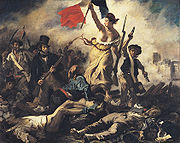 The first half of the 19th century for Europe was marked by a number of wars and revolutions, which contributed to an aesthetic "turning away" from the realities of political and social fragmentation, and so facilitated a trend towards Romanticism
. Romanticism had been a revolt against the values of the Industrial Revolution
and bourgeois conservative values
, putting emphasis on individual subjective experience, the sublime, the supremacy of "Nature" as a subject for art, revolutionary or radical extensions of expression, and individual liberty.
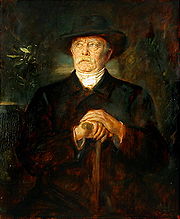 By mid-century, however, a synthesis of the ideas of Romanticism with stable governing forms had emerged, partly in reaction to the failed Romantic and democratic Revolutions of 1848
. It was exemplified by Otto von Bismarck
's Realpolitik
and by "practical" philosophical ideas such as positivism
. This stabilizing synthesis, the Realist political and aesthetic ideology, was called by various names—in Great Britain it is designated the "Victorian era
" – and was rooted in the idea that reality dominates over subjective
impressions. Central to this synthesis were common assumptions and institutional frames of reference, including the religious norms found in Christianity, scientific norms found in classical physics
and doctrines that asserted that the depiction of external reality from an objective
standpoint was not only possible but desirable. Cultural critics and historians label this set of doctrines realism
, though this term is not universal. In philosophy, the rationalist, materialist and positivist movements established a primacy of reason and system.
Against the current ran a series of ideas, some of them direct continuations of Romantic schools of thought. Notable were the agrarian
and revivalist movements in plastic arts and poetry (e.g. the Pre-Raphaelite Brotherhood
and the philosopher John Ruskin
). Rationalism also drew responses from the anti-rationalists in philosophy. In particular, Hegel's dialectic
view of civilization and history drew responses from Friedrich Nietzsche
and Søren Kierkegaard
, who were major influences on existentialism
. All of these separate reactions together began to be seen as offering a challenge to any comfortable ideas of certainty derived by civilization, history, or pure reason.
From the 1870s onward, the ideas that history and civilization were inherently progressive and that progress was always good came under increasing attack. Writers Wagner
and Ibsen had been reviled for their own critiques of contemporary civilization and for their warnings that accelerating "progress" would lead to the creation of individuals detached from social values and isolated from their fellow men. Arguments arose that the values of the artist and those of society were not merely different, but that Society was antithetical to Progress, and could not move forward in its present form. Philosophers called into question the previous optimism. The work of Schopenhauer was labelled "pessimistic"
for its idea of the "negation of the will", an idea that would be both rejected and incorporated by later thinkers such as Nietzsche.
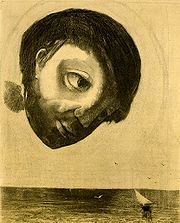 Two of the most significant thinkers of the period were, in biology, Charles Darwin
, and in political science, Karl Marx
. Darwin's theory of evolution
by natural selection undermined the religious certainty of the general public, and the sense of human uniqueness of the intelligentsia
. The notion that human beings were driven by the same impulses as "lower animals" proved to be difficult to reconcile with the idea of an ennobling spirituality
. Karl Marx argued there were fundamental contradictions within the capitalist system—and that the workers were anything but free. Both thinkers would spawn defenders and schools of thought that would become decisive in establishing modernism. This is not to say that all modernists or modernist movements rejected either religion or all aspects of Enlightenment thought, rather that modernism can be viewed as a questioning of the axiom
s of the previous age.
Historians have suggested various dates as starting points for modernism. William Everdell
has argued that modernism began with Richard Dedekind
's division
of the real number
line in 1872 and Boltzmann's statistical thermodynamics in 1874. Clement Greenberg
called Immanuel Kant
"the first real Modernist", but also wrote, "What can be safely called Modernism emerged in the middle of the last century—and rather locally, in France, with Baudelaire
in literature and Manet
in painting, and perhaps with Flaubert
, too, in prose fiction. (It was a while later, and not so locally, that Modernism appeared in music
and architecture
)." The modernist movement, at the beginning of the 20th century, marked the first time that the term "avant-garde
", with which the movement was called until the word "modernism" prevailed, was being used for the arts instead that in its original military and political context; the term remained to describe movements which identify themselves as attempting to overthrow some aspect of tradition or the status quo. Surrealism
gained the fame among the public of being the most extreme form of modernism, or "the avant-garde of modernism".
Separately, in the arts and letters, two ideas originating in France would have particular impact. The first was impressionism
, a school of painting that initially focused on work done, not in studios, but outdoors (en plein air
). Impressionist paintings demonstrated that human beings do not see objects, but instead see light itself. The school gathered adherents despite internal divisions among its leading practitioners, and became increasingly influential. Initially rejected from the most important commercial show of the time, the government-sponsored Paris Salon
, the Impressionists organized yearly group exhibitions in commercial venues during the 1870s and 1880s, timing them to coincide with the official Salon. A significant event of 1863 was the Salon des Refusés
, created by Emperor Napoleon III
to display all of the paintings rejected by the Paris Salon. While most were in standard styles, but by inferior artists, the work of Manet
attracted tremendous attention, and opened commercial doors to the movement.
The second school was symbolism
, marked by a belief that language is expressly symbolic in its nature and a portrayal of patriotism, and that poetry and writing should follow connections that the sheer sound and texture of the words create. The poet Stéphane Mallarmé
would be of particular importance to what would occur afterwards.
At the same time social, political, and economic forces were at work that would become the basis to argue for a radically different kind of art and thinking. Chief among these was steam-powered industrialization, which produced buildings that combined art and engineering in new industrial materials such as cast iron
to produce railroad bridges and glass-and-iron train sheds—or the Brooklyn Bridge
(1883) and the Eiffel Tower
(1889), which broke all previous limitations on how tall man-made objects could be—and at the same time offered a radically different environment in urban life.
The miseries of industrial urbanism and the possibilities created by scientific examination of subjects brought changes that would shake a European civilization which had, until then, regarded itself as having a continuous and progressive line of development from the Renaissance
. With the telegraph's harnessing of a new power, offering instant communication at a distance, and Standard Time, synchronizing clocks and railroad timetables, the experience of time itself was altered.
Many modern disciplines (for example, physics
, economics, and arts such as ballet and architecture) denote their pre-20th century forms as "classical." This distinction indicates the scope of the changes that occurred across a wide range of scientific and cultural pursuits during the period.
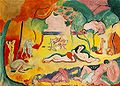 In the 1880s a strand of thinking began to assert that it was necessary to push aside previous norms entirely, instead of merely revising past knowledge in light of current techniques. The growing movement in art paralleled such developments as Albert Einstein's Special Theory of Relativity (1905) in physics; the increasing integration of the internal combustion engine and industrialization; and the increased role of the social sciences
in public policy. It was argued that, if the nature of reality itself was in question, and if restrictions which had been in place around human activity were falling, then art, too, would have to radically change. Thus, in the first fifteen years of the 20th century a series of writers, thinkers, and artists made the break with traditional means of organizing literature, painting, and music.
Powerfully influential in this wave of modernity were the theories of Sigmund Freud
(1856-1939) and Ernst Mach
(1838-1916), who argued, beginning in the 1880s in Mach's case and later for Freud, that the mind had a fundamental structure, and that subjective experience was based on the interplay of the parts of the mind. All subjective reality was based, according to Freud's ideas, on the play of basic drives and instincts, through which the outside world was perceived. Ernst Mach developed a well-known philosophy of science, often called "positivism
", according to which the relations of objects in nature were not guaranteed but only known through a sort of mental shorthand. This represented a break with the past, in that previously it was believed that external and absolute reality could impress itself, as it was, on an individual, as, for example, in John Locke
's empiricism, with the mind beginning as a tabula rasa
.
Freud's description of subjective states, involving an unconscious mind
full of primal impulses and counterbalancing self-imposed restrictions, was combined by Carl Jung
with a belief in natural essence to stipulate a collective unconscious
that was full of basic typologies that the conscious mind fought or embraced. Darwin's work remade the aristotelian
concept of "man, the animal" in the public mind, and Jung's view suggested that people's impulses toward breaking social norms were not the product of childishness or ignorance, but derived from the essential nature of the human animal.
Friedrich Nietzsche
championed a philosophy in which forces, specifically the 'Will to power
', were more important than facts or things. Similarly, the writings of Henri Bergson
championed the vital 'life force' over static conceptions of reality. All these writers were united by a romantic
distrust of Victorian positivism and certainty. Instead they championed, or, in the case of Freud, attempted to explain, irrational thought processes through the lens of rationality and holism
. This was connected with the 19th-century trend to thinking in holistic and continuitarian terms, which would include an increased interest in the occult, and "the vital force," at the same time as contemporary biology was dismantling the idea.
Out of this collision of ideals derived from Romanticism, and an attempt to find a way for knowledge to explain that which was as yet unknown, came the first wave of works, which, while their authors considered them extensions of existing trends in art, broke the implicit contract with the general public that artists were the interpreters and representatives of bourgeois culture and ideas. These "modernist" landmarks include the atonal
ending of Arnold Schoenberg
's Second String Quartet
in 1908, the expressionist
paintings of Wassily Kandinsky
starting in 1903 and culminating with his first abstract painting and the founding of the Blue Rider
group in Munich
in 1911, and the rise of fauvism
and the inventions of cubism
from the studios of Henri Matisse
, Pablo Picasso
, Georges Braque
and others in the years between 1900 and 1910.
This wave of the modern movement broke with the past in the first decade of the 20th century, and tried to redefine various art forms in a radical manner. Leading lights within the literary wing of this movement
(or, rather, these movements) include:
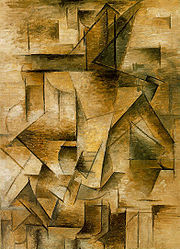 On the eve of the First World War a growing tension and unease with the social order, already seen in the Russian Revolution of 1905
and the agitation of "radical" parties, also manifested itself in artistic works in every medium which radically simplified or rejected previous practice. Young painters such as Pablo Picasso
and Henri Matisse
were causing a shock with their rejection of traditional perspective as the means of structuring paintings—a step that none of the impressionists, not even Cézanne, had taken. In 1907, as Picasso was painting Demoiselles d'Avignon, Oskar Kokoschka
was writing Mörder, Hoffnung der Frauen (Murderer, Hope of Women), the first Expressionist play (produced with scandal in 1909), and Arnold Schoenberg
was composing his String Quartet No.2 in F-sharp minor, his first composition "without a tonal center." In 1911, Kandinsky painted Bild mit Kreis (Picture With a Circle) which he later called the first abstract painting. In 1913—the year of Edmund Husserl
's Ideas, Niels Bohr
's quantized atom, Ezra Pound
's founding of imagism
, the Armory Show
in New York, and, in Saint Petersburg
, the "first futurist opera," Victory Over the Sun—another Russian composer Igor Stravinsky
, working in Paris for Sergei Diaghilev
and the Ballets Russes
, composed The Rite of Spring
for a ballet, choreographed by Vaslav Nijinsky
, that depicted human sacrifice
.
These developments began to give a new meaning to what was termed 'modernism': It embraced discontinuity, rejecting smooth change in everything from biology to fictional character development and filmmaking. It approved disruption, rejecting or moving beyond simple realism
in literature and art, and rejecting or dramatically altering tonality in music. This set modernists apart from 19th century artists, who had tended to believe not only in smooth change ('evolutionary' rather than 'revolutionary') but also in the progressiveness of such change—'progress.' Writers like Dickens
and Tolstoy
, painters like Turner
, and musicians like Brahms
were not 'radicals' or 'Bohemians,' but were instead valued members of society who produced art that added to society, even sometimes while critiquing its less desirable aspects. Modernism, while still "progressive," increasingly saw traditional forms and traditional social arrangements as hindering progress, and therefore recast the artist as a revolutionary, overthrowing rather than enlightening.
Futurism
exemplifies this trend. In 1909, the Parisian newspaper Le Figaro
published F.T. Marinetti
's first manifesto. Soon afterward a group of painters (Giacomo Balla
, Umberto Boccioni
, Carlo Carrà
, Luigi Russolo
, and Gino Severini
) co-signed the Futurist Manifesto
. Modeled on the famous "Communist Manifesto" of the previous century, such manifestoes put forward ideas that were meant to provoke and to gather followers. Strongly influenced by Bergson and Nietzsche, Futurism was part of the general trend of Modernist rationalization of disruption.
Modernist philosophy and art were still viewed as only a part of the larger social movement. Artists such as Klimt
and Cézanne
, and composers such as Mahler
and Richard Strauss
were "the terrible moderns" —those more avant-garde were more heard of than heard. Polemics in favour of geometric or purely abstract painting were largely confined to 'little magazines' (like The New Age
in the UK) with tiny circulations. Modernist primitivism and pessimism were controversial, but were not seen as representative of the Edwardian mainstream, which was more inclined towards a Victorian faith in progress and liberal optimism.
However, the Great War
and its subsequent events were the cataclysmic upheavals that late 19th century artists such as Brahms
had worried about, and avant-gardists had embraced. First, the failure of the previous status quo seemed self-evident to a generation that had seen millions die fighting over scraps of earth—prior to the war, it had been argued that no one would fight such a war, since the cost was too high. Second, the birth of a machine age changed the conditions of life—machine warfare became a touchstone of the ultimate reality. Finally, the immensely traumatic nature of the experience dashed basic assumptions: realism seemed bankrupt when faced with the fundamentally fantastic nature of trench warfare, as exemplified by books such as Erich Maria Remarque
's All Quiet on the Western Front
(1929). Moreover, the view that mankind was making slow and steady moral progress came to seem ridiculous in the face of the senseless slaughter. The First World War fused the harshly mechanical geometric rationality of technology with the nightmarish irrationality of myth.
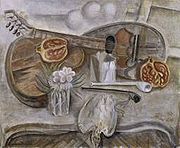 Thus modernism, which had been a minority taste before the war, came to define the 1920s. It appeared in Europe in such critical movements as Dada
and then in constructive movements such as surrealism
, as well as in smaller movements such as the Bloomsbury Group
. Again, impressionism was a precursor: breaking with the idea of national schools, artists and writers adopted ideas of international movements. Surrealism, cubism
, Bauhaus
, and Leninism
are all examples of movements that rapidly found adopters far beyond their geographic origins.
Each of these "modernisms," as some observers labelled them at the time, stressed new methods to produce new results. The poet Ezra Pound
's 1934 injunction to "Make it new!" was paradigmatic of the movement's approach towards the obsolete
. Whether or not the "making new" of the modernists constituted a new historical epoch is up for debate.
Exhibitions, theatre, cinema, books and buildings all served to cement in the public view the perception that the world was changing. Hostile reaction often followed, as paintings were spat upon, riots organized at the opening of works, and political figures denounced modernism as unwholesome and immoral. At the same time, the 1920s were known as the "Jazz Age
", and the public showed considerable enthusiasm for cars, air travel
, the telephone and other technological advances.
By 1930, modernism had won a place in the establishment, including the political and artistic establishment, although by this time modernism itself had changed. There was a general reaction in the 1920s against the pre-1918 modernism, which emphasized its continuity with a past while rebelling against it, and against the aspects of that period which seemed excessively mannered, irrational, and emotionalistic. The post-World War period, at first, veered either to systematization or nihilism and had, as perhaps its most paradigm
atic movement, Dada
.
While some writers attacked the madness of the new modernism, others described it as soulless and mechanistic. Among modernists there were disputes about the importance of the public, the relationship of art to audience, and the role of art in society. Modernism comprised a series of sometimes contradictory responses to the situation as it was understood, and the attempt to wrestle universal principles from it. In the end science and scientific rationality, often taking models from the 18th-century Enlightenment
, came to be seen as the source of logic and stability, while the basic primitive sexual and unconscious drives, along with the seemingly counter-intuitive workings of the new machine age, were taken as the basic emotional substance. From these two seemingly incompatible poles, modernists began to fashion a complete weltanschauung that could encompass every aspect of life.
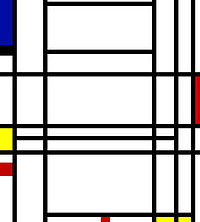 By 1930, Modernism had entered popular culture. With the increasing urbanization of populations, it was beginning to be looked to as the source for ideas to deal with the challenges of the day. As modernism gained traction in academia
, it was developing a self-conscious theory of its own importance. Popular culture
, which was not derived from high culture
but instead from its own realities (particularly mass production
) fueled much modernist innovation. By 1930 The New Yorker
magazine began publishing new and modern ideas by young writers and humorists like Dorothy Parker
, Robert Benchley
, E.B. White, S.J. Perelman, and James Thurber
, amongst others. Modern ideas in art appeared in commercials and logos, the famous London Underground
logo, designed by Edward Johnston
in 1919, being an early example of the need for clear, easily recognizable and memorable visual symbols.
Another strong influence at this time was Marxism
. After the generally primitivistic/irrationalist aspect of pre-World War I Modernism, which for many modernists precluded any attachment to merely political solutions, and the neoclassicism
of the 1920s, as represented most famously by T. S. Eliot
and Igor Stravinsky—which rejected popular solutions to modern problems—the rise of Fascism, the Great Depression
, and the march to war helped to radicalise a generation. The Russian Revolution catalyzed the fusion of political radicalism and utopianism, with more expressly political stances. Bertolt Brecht
, W. H. Auden
, André Breton
, Louis Aragon
and the philosophers Antonio Gramsci
and Walter Benjamin
are perhaps the most famous exemplars of this modernist Marxism
. This move to the radical left, however, was neither universal, nor definitional, and there is no particular reason to associate modernism, fundamentally, with 'the left'. Modernists explicitly of 'the right' include Salvador Dalí
, Wyndham Lewis
, T. S. Eliot
, Ezra Pound
, the Dutch author Menno ter Braak
and many others.
One of the most visible changes of this period was the adoption of objects of modern production into daily life. Electricity, the telephone, the automobile—and the need to work with them, repair them and live with them—created the need for new forms of manners and social life. The kind of disruptive moment that only a few knew in the 1880s became a common occurrence. For example, the speed of communication reserved for the stock brokers of 1890 became part of family life.
Modernism as leading to social organization would produce inquiries into sex and the basic bondings of the nuclear, rather than extended, family. The Freudian tensions of infantile sexuality and the raising of children became more intense, because people had fewer children, and therefore a more specific relationship with each child: the theoretical, again, became the practical and even popular.
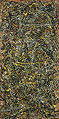 In Britain and America, modernism as a literary movement is considered by some scholars to be relevant only up to the early 1930s , and "modernist" is less frequently used to describe authors prominent after 1945. For example, The Oxford Encyclopedia of British Literature sees modernism ending by c.1939. This is somewhat true for all areas of culture, with the exception of the visual and performing arts, though, with regard to music, Paul Griffiths
notes that, while modernism "seemed to be a spent force" by the late 1920s, after World War II, "a new generation of composers - Boulez, Barraqué, Babbitt
, Nono
, Stockhausen, Xenakis
" revived modernism.
All the same, with regard to British and American literature, "When (if) modernism petered out and postmodernism began has been contested almost as hotly as when the transition from Victorianism to modernism occurred".
The post-war period left the capitals of Europe in upheaval with an urgency to economically and physically rebuild and to politically regroup. In Paris (the former center of European culture and the former capital of the art world) the climate for art was a disaster. Important collectors, dealers, and modernist artists, writers, and poets had fled Europe for New York and America. The surrealists and modern artists from every cultural center of Europe had fled the onslaught of the Nazis for safe haven in the United States. Many of those who didn't flee perished. A few artists, notably Pablo Picasso
, Henri Matisse
, and Pierre Bonnard
, remained in France and survived.
The 1940s in New York City heralded the triumph of American abstract expressionism
, a modernist movement that combined lessons learned from Henri Matisse
, Pablo Picasso
, surrealism
, Joan Miró
, cubism
, Fauvism
, and early modernism via great teachers in America like Hans Hofmann
and John D. Graham
. American artists benefited from the presence of Piet Mondrian
, Fernand Léger
, Max Ernst
and the André Breton
group, Pierre Matisse
's gallery, and Peggy Guggenheim
's gallery The Art of This Century, as well as other factors.
's radical approach to painting revolutionized the potential for all contemporary art
that followed him. To some extent Pollock realized that the journey toward making a work of art was as important as the work of art itself. Like Pablo Picasso
's innovative reinventions of painting and sculpture in the early 20th century via cubism
and constructed sculpture, Pollock redefined the way art gets made. His move away from easel painting and conventionality was a liberating signal to the artists of his era and to all who came after. Artists realized that Jackson Pollock's process—placing unstretched raw canvas
on the floor where it could be attacked from all four sides using artistic and industrial materials; dripping and throwing linear skeins of paint; drawing, staining, and brushing; using imagery and non-imagery—essentially blasted artmaking beyond any prior boundary. Abstract expressionism generally expanded and developed the definitions and possibilities available to artists for the creation of new works of art.
 The other abstract expressionists followed Pollock's breakthrough with new breakthroughs of their own. In a sense the innovations of Jackson Pollock, Willem de Kooning
, Franz Kline
, Mark Rothko
, Philip Guston
, Hans Hofmann
, Clyfford Still
, Barnett Newman
, Ad Reinhardt
, Robert Motherwell
, Peter Voulkos
and others opened the floodgates to the diversity and scope of all the art that followed them. Rereadings into abstract art by art historians such as Linda Nochlin
, Griselda Pollock
and Catherine de Zegher critically show, however, that pioneering women artists who produced major innovations in modern art had been ignored by official accounts of its history.
during the 1950s and 1960s several new directions like hard-edge painting
and other forms of geometric abstraction began to appear in artist studios and in radical avant-garde
circles as a reaction against the subjectivism of abstract expressionism. Clement Greenberg
became the voice of post-painterly abstraction
when he curated an influential exhibition of new painting that toured important art museums throughout the United States in 1964. Color field painting, hard-edge painting and lyrical abstraction
emerged as radical new directions.
By the late 1960s however, postminimalism
, process art
and Arte Povera
also emerged as revolutionary concepts and movements that encompassed both painting and sculpture, via lyrical abstraction and the postminimalist movement, and in early conceptual art
. Process art as inspired by Pollock enabled artists to experiment with and make use of a diverse encyclopedia of style, content, material, placement, sense of time, and plastic and real space. Nancy Graves
, Ronald Davis
, Howard Hodgkin
, Larry Poons
, Jannis Kounellis
, Brice Marden
, Bruce Nauman
, Richard Tuttle
, Alan Saret, Walter Darby Bannard
, Lynda Benglis
, Dan Christensen
, Larry Zox
, Ronnie Landfield
, Eva Hesse
, Keith Sonnier
, Richard Serra
, Sam Gilliam
, Mario Merz
and Peter Reginato
were some of the younger artists who emerged during the era of late modernism
that spawned the heyday of the art of the late 1960s.
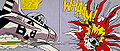 In 1962 the Sidney Janis
Gallery mounted The New Realists, the first major pop art
group exhibition in an uptown art gallery in New York City. Janis mounted the exhibition in a 57th Street storefront near his gallery at 15 E. 57th Street. The show sent shockwaves through the New York School
and reverberated worldwide. Earlier in England in 1958 the term "Pop Art" was used by Lawrence Alloway
to describe paintings that celebrated consumerism of the post World War II era. This movement rejected abstract expressionism and its focus on the hermeneutic and psychological interior in favor of art that depicted and often celebrated material consumer culture, advertising, and iconography of the mass production age. The early works of David Hockney
and the works of Richard Hamilton
and Eduardo Paolozzi
were considered seminal examples in the movement. Meanwhile in the downtown scene in New York's East Village
10th Street galleries artists were formulating an American version of pop art. Claes Oldenburg
had his storefront, and the Green Gallery
on 57th Street began to show the works of Tom Wesselmann
and James Rosenquist
. Later Leo Castelli
exhibited the works of other American artists, including those of Andy Warhol
and Roy Lichtenstein
for most of their careers. There is a connection between the radical works of Marcel Duchamp
and Man Ray
, the rebellious Dada
ists with a sense of humor, and pop artists like Claes Oldenburg, Andy Warhol, and Roy Lichtenstein, whose paintings reproduce the look of Benday dots
, a technique used in commercial reproduction.
, the Bauhaus and Piet Mondrian
) that rejected the idea of relational and subjective painting, the complexity of abstract expressionist surfaces, and the emotional zeitgeist
and polemics present in the arena of action painting
. Minimalism argued that extreme simplicity could capture all of the sublime representation needed in art. Associated with painters such as Frank Stella
, minimalism in painting, as opposed to other areas, is a modernist movement. Minimalism is variously construed either as a precursor to postmodernism
, or as a postmodern movement itself. In the latter perspective, early minimalism yielded advanced modernist works, but the movement partially abandoned this direction when some artists like Robert Morris
changed direction in favor of the anti-form movement.
Hal Foster, in his essay The Crux of Minimalism, examines the extent to which Donald Judd and Robert Morris both acknowledge and exceed Greenbergian modernism in their published definitions of minimalism. He argues that minimalism is not a "dead end" of modernism, but a "paradigm shift toward postmodern practices that continue to be elaborated today."
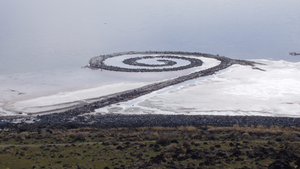 In the late 1960s Robert Pincus-Witten coined the term postminimalism
to describe minimalist-derived art which had content and contextual overtones that minimalism rejected. The term was applied by Pincus-Whitten to the work of Eva Hesse
, Keith Sonnier
, Richard Serra
and new work by former minimalists Robert Smithson
, Robert Morris
, and Sol LeWitt
, and Barry Le Va, and others. Other minimalists including Donald Judd
, Dan Flavin
, Carl Andre
, Agnes Martin
, John McCracken
and others continued to produce late modernist paintings and sculpture for the remainders of their careers.
In the 1960s the work of the avant-garde minimalist composers La Monte Young
, Philip Glass
, Steve Reich
, and Terry Riley
also achieved prominence in the New York art world.
Since then, many artists have embraced minimal or postminimal styles and the label "postmodern" has been attached to them.
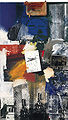 Related to abstract expressionism
was the emergence of combining manufactured items with artist materials, moving away from previous conventions of painting and sculpture. The work of Robert Rauschenberg
exemplifies this trend. His "combines" of the 1950s were forerunners of pop art
and installation art
, and used assemblages of large physical objects, including stuffed animals, birds and commercial photographs. Rauschenberg, Jasper Johns
, Larry Rivers
, John Chamberlain, Claes Oldenburg
, George Segal
, Jim Dine
, and Edward Kienholz
were among important pioneers of both abstraction and pop art. Creating new conventions of art-making, they made acceptable in serious contemporary art circles the radical inclusion in their works of unlikely materials. Another pioneer of collage was Joseph Cornell
, whose more intimately scaled works were seen as radical because of both his personal iconography and his use of found objects.
exhibited a urinal as a sculpture. He professed his intent that people look at the urinal as if it were a work of art because he said it was a work of art. He referred to his work as "readymades
". Fountain
was a urinal signed with the pseudonym R. Mutt, the exhibition of which shocked the art world in 1917. This and Duchamp's other works are generally labelled as Dada. Duchamp can be seen as a precursor to conceptual art, other famous examples being John Cage
's 4'33", which is four minutes and thirty three seconds of silence, and Rauschenberg's Erased de Kooning
. Many conceptual works take the position that art is the result of the viewer viewing an object or act as art, not of the intrinsic qualites of the work itself. Thus, because Fountain was exhibited, it was a sculpture.
Marcel Duchamp famously gave up "art" in favor of chess. Avant-garde composer David Tudor
created a piece, Reunion (1968), written jointly with Lowell Cross, that features a chess game in which each move triggers a lighting effect or projection. Duchamp and Cage played the game at the work's premier.
Steven Best
and Douglas Kellner
identify Rauschenberg and Jasper Johns
as part of the transitional phase, influenced by Marcel Duchamp
, between modernism and postmodernism. Both used images of ordinary objects, or the objects themselves, in their work, while retaining the abstraction and painterly gestures of high modernism.
Another trend in art associated with neo-Dada is the use of a number of different media together. Intermedia
, a term coined by Dick Higgins
and meant to convey new art forms along the lines of Fluxus
, concrete poetry
, found objects, performance art
, and computer art
. Higgins was publisher of the Something Else Press
, a concrete poet, husband of artist Alison Knowles
and an admirer of Marcel Duchamp.
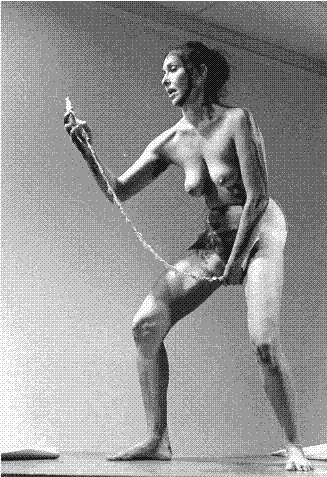 During the late 1950s and 1960s artists with a wide range of interests began to push the boundaries of contemporary art. Yves Klein
in France, and in New York City, Carolee Schneemann
, Yayoi Kusama
, Charlotte Moorman
and Yoko Ono
and in Germany Joseph Beuys
, Wolf Vostell
and Nam June Paik
were pioneers of performance-based works of art. Groups like The Living Theater with Julian Beck
and Judith Malina
collaborated with sculptors and painters creating environments, radically changing the relationship between audience and performer especially in their piece Paradise Now. The Judson Dance Theater
, located at the Judson Memorial Church
, New York; and the Judson dancers, notably Yvonne Rainer
, Trisha Brown
, Elaine Summers
, Sally Gross, Simonne Forti, Deborah Hay
, Lucinda Childs
, Steve Paxton
and others; collaborated with artists Robert Morris
, Robert Whitman
, John Cage
, Robert Rauschenberg
, and engineers like Billy Klüver
. Park Place Gallery
was a center for musical performances by electronic composers Steve Reich
, Philip Glass
and other notable performance artists including Joan Jonas
. These performances were intended as works of a new art form combining sculpture, dance, and music or sound, often with audience participation. They were characterized by the reductive philosophies of minimalism and the spontaneous improvisation and expressivity of abstract expressionism.
During the same period, various avant-garde artists created Happening
s. Happenings were mysterious and often spontaneous and unscripted gatherings of artists and their friends and relatives in various specified locations, often incorporating exercises in absurdity, physicality, costuming, spontaneous nudity
, and various random or seemingly disconnected acts. Notable creators of happenings included Allan Kaprow
—who first used the term in 1958, Claes Oldenburg
, Jim Dine
, Red Grooms
, and Robert Whitman
.
, a term coined by Dick Higgins
and meant to convey new art forms along the lines of Fluxus
, concrete poetry
, found objects, performance art
, and computer art
. Higgins was the publisher of the Something Else Press
, a concrete poet married to artist Alison Knowles
and an admirer of Marcel Duchamp
. Ihab Hassan
includes, "Intermedia, the fusion of forms, the confusion of realms," in his list of the characteristics of postmodern art. One of the most common forms of "multi-media art" is the use of video-tape and CRT monitors, termed video art
. While the theory of combining multiple arts into one art is quite old, and has been revived periodically, the postmodern manifestation is often in combination with performance art, where the dramatic subtext is removed, and what is left is the specific statements of the artist in question or the conceptual statement of their action.
(1931–78), a Lithuanian-born American artist. Fluxus traces its beginnings to John Cage
's 1957 to 1959 Experimental Composition classes at the New School for Social Research in New York City. Many of his students were artists working in other media with little or no background in music. Cage's students included Fluxus founding members Jackson Mac Low
, Al Hansen
, George Brecht
and Dick Higgins
.
Fluxus encouraged a do-it-yourself aesthetic and valued simplicity over complexity. Like Dada
before it, Fluxus included a strong current of anti-commercialism and an anti-art
sensibility, disparaging the conventional market-driven art world in favor of an artist-centered creative practice. Fluxus artists preferred to work with whatever materials were at hand, and either created their own work or collaborated in the creation process with their colleagues.
Andreas Huyssen
criticises attempts to claim Fluxus for postmodernism as, "either the master-code of postmodernism or the ultimately unrepresentable art movement – as it were, postmodernism's sublime." Instead he sees Fluxus as a major Neo-Dada
ist phenomena within the avant-garde tradition. It did not represent a major advance in the development of artistic strategies, though it did express a rebellion against, "the administered culture of the 1950s, in which a moderate, domesticated modernism served as ideological prop to the Cold War
."
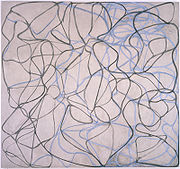 The continuation of abstract expressionism
, color field painting, lyrical abstraction
, geometric abstraction, minimalism
, abstract illusionism
, process art
, pop art
, postminimalism
, and other late 20th century modernist movements in both painting and sculpture continue through the first decade of the 21st century and constitute radical new directions in those mediums.
At the turn of the 21st century, well-established artists such as Sir Anthony Caro, Lucian Freud
, Cy Twombly
, Robert Rauschenberg
, Jasper Johns
, Agnes Martin
, Al Held
, Ellsworth Kelly
, Helen Frankenthaler
, Frank Stella
, Kenneth Noland
, Jules Olitski
, Claes Oldenburg
, Jim Dine
, James Rosenquist
, Alex Katz
, Philip Pearlstein
, and younger artists including Brice Marden
, Chuck Close
, Sam Gilliam
, Isaac Witkin
, Sean Scully
, Mahirwan Mamtani
, Joseph Nechvatal
, Elizabeth Murray, Larry Poons
, Richard Serra
, Walter Darby Bannard
, Larry Zox
, Ronnie Landfield
, Ronald Davis
, Dan Christensen
, Joel Shapiro
, Tom Otterness
, Joan Snyder
, Ross Bleckner
, Archie Rand
, Susan Crile
, and dozens of others continued to produce vital and influential paintings and sculpture.
formats. Postmodernism in music and literature began to take hold earlier. In music postmodernism is described in one reference work, as a "term introduced in the 1970s". while in British literature, The Oxford Encyclopedia of British Literature sees modernism "ceding its predominance to postmodernism" as early as 1939.
However dates are highly debatable, especially as according to Andreas Huyssen: "one critic's postmodernism is another critic's modernism". This includes those who are critical of the division between the two and see them as two aspects of the same movement, and believe that late modernism continues.
Modernism is an encompassing label for a wide variety of cultural movements. Postmodernism
is essentially a centralized movement that named itself, based on socio-political theory, although the term is now used in a wider sense to refer to activities from the 20th Century onwards which exhibit awareness of and reinterpret the modern.
Postmodern theory asserts that the attempt to canonise modernism "after the fact" is doomed to undisambiguable contradictions.
In a narrower sense, what was modernist was not necessarily also postmodern. Those elements of modernism which accentuated the benefits of rationality and socio-technological progress were only modernist.
of tradition and its reprise, incorporation, rewriting, recapitulation, revision and parody in new forms.
T. S. Eliot
's emphasis on the relation of the artist to tradition. Eliot wrote the following:
Literary scholar Peter Childs sums up the complexity:
These oppositions are inherent to modernism: it is in its broadest cultural sense the assessment of the past as different to the modern age, the recognition that the world was becoming more complex, and that the old "final authorities" (God, government, science, and reason) were subject to intense critical scrutiny.
Adorno would have us understand modernity as the rejection of the false rationality, harmony, and coherence of Enlightenment thinking, art, and music. But the past proves sticky. Arnold Schoenberg
rejected traditional tonal harmony
, the hierarchical system of organizing works of music that had guided music making for at least a century and a half. He believed he had discovered a wholly new way of organizing sound, based in the use of twelve-note rows
.
Abstract artists, taking as their examples the impressionists, as well as Paul Cézanne
and Edvard Munch
, began with the assumption that color and shape
, not the depiction of the natural world, formed the essential characteristics of art. Wassily Kandinsky
, Piet Mondrian
, and Kazimir Malevich
all believed in redefining art as the arrangement of pure color. The use of photography, which had rendered much of the representational function of visual art obsolete, strongly affected this aspect of modernism. However, these artists also believed that by rejecting the depiction of material objects they helped art move from a materialist
to a spiritualist phase of development.
thought that buildings should function as "machines for living in", analogous to cars, which he saw as machines for traveling in. Just as cars had replaced the horse, so modernist design should reject the old styles and structures inherited from Ancient Greece
or from the Middle Ages
. In some cases form superseded function. Following this machine aesthetic, modernist designers typically rejected decorative motifs in design, preferring to emphasize the materials used and pure geometrical forms. The skyscraper, such as Ludwig Mies van der Rohe
's Seagram Building
in New York (1956–1958), became the archetypal modernist building. Modernist design of houses and furniture
also typically emphasized simplicity and clarity of form, open-plan interiors, and the absence of clutter.
Modernism reversed the 19th-century relationship of public and private: in the 19th century, public buildings were horizontally expansive for a variety of technical reasons, and private buildings emphasized verticality—to fit more private space on increasingly limited land. Conversely, in the 20th century, public buildings became vertically oriented and private buildings became organized horizontally. Many aspects of modernist design still persist within the mainstream of contemporary architecture today, though its previous dogmatism has given way to a more playful use of decoration, historical quotation, and spatial drama.In other arts such pragmatic considerations were less important.
, which developed in Europe and North America in the late 19th century. Whereas most manufacturers try to make products that will be marketable by appealing to preferences and prejudices, high modernists
rejected such consumerist attitudes in order to undermine conventional thinking. The art critic Clement Greenberg
expounded this theory of modernism in his essay Avant-Garde and Kitsch
. Greenberg labelled the products of consumer culture "kitsch
", because their design aimed simply to have maximum appeal, with any difficult features removed. For Greenberg, modernism thus formed a reaction against the development of such examples of modern consumer culture as commercial popular music
, Hollywood
, and advertising. Greenberg associated this with the revolutionary rejection of capitalism.
Some modernists did see themselves as part of a revolutionary culture—one that included political revolution. Others rejected conventional politics as well as artistic conventions, believing that a revolution of political consciousness
had greater importance than a change in political structures. Many modernists saw themselves as apolitical. Others, such as T. S. Eliot
, rejected mass popular culture
from a conservative position. Some even argue that modernism in literature and art functioned to sustain an elite
culture which excluded the majority of the population.
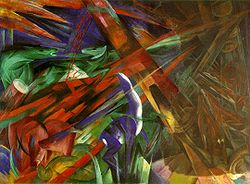 The most controversial aspect of the modern movement was, and remains, its rejection of tradition. Modernism's stress on freedom of expression, experimentation, radicalism
, and primitivism
disregards conventional expectations. In many art forms this often meant startling and alienating audiences with bizarre and unpredictable effects, as in the strange and disturbing combinations of motifs in surrealism
or the use of extreme dissonance
and atonality
in modernist music. In literature this often involved the rejection of intelligible plots or characterization in novels, or the creation of poetry that defied clear interpretation.
After the rise of Joseph Stalin
, the Soviet
Communist government rejected modernism on the grounds of alleged elitism, although it had previously endorsed futurism
and constructivism
. The Nazi
government of Germany deemed modernism narcissistic
and nonsensical, as well as "Jewish" and "Negro" (see Anti-semitism
). The Nazis exhibited modernist paintings alongside works by the mentally ill
in an exhibition entitled Degenerate Art
. Accusations of "formalism" could lead to the end of a career, or worse. For this reason many modernists of the post-war generation felt that they were the most important bulwark against totalitarianism, the "canary in the coal mine", whose repression by a government or other group with supposed authority represented a warning that individual liberties were being threatened. Louis A. Sass compared madness, specifically schizophrenia, and modernism in a less fascist manner by noting their shared disjunctive narratives, surreal images, and incoherence.
In fact, modernism flourished mainly in consumer/capitalist societies, despite the fact that its proponents often rejected consumerism itself. However, high modernism
began to merge with consumer culture after World War II, especially during the 1960s. In Britain, a youth sub-culture emerged calling itself "modernist" (usually shortened to Mod), following such representative music groups as The Who
and The Kinks
. The likes of Bob Dylan
, Serge Gainsbourg
and The Rolling Stones
combined popular musical traditions with modernist verse, adopting literary devices derived from James Joyce
, Samuel Beckett
, James Thurber
, T. S. Eliot
, Guillaume Apollinaire
, Allen Ginsberg
, and others. The Beatles
developed along similar lines, creating various modernist musical effects on several albums, while musicians such as Frank Zappa
, Syd Barrett
and Captain Beefheart
proved even more experimental. Modernist devices also started to appear in popular cinema, and later on in music videos. Modernist design also began to enter the mainstream of popular culture, as simplified and stylized forms became popular, often associated with dreams of a space age
high-tech future.
This merging of consumer and high versions of modernist culture led to a radical transformation of the meaning of "modernism". First, it implied that a movement based on the rejection of tradition had become a tradition of its own. Second, it demonstrated that the distinction between elite modernist and mass consumerist culture had lost its precision. Some writers declared that modernism had become so institutionalized that it was now "post avant-garde", indicating that it had lost its power as a revolutionary movement. Many have interpreted this transformation as the beginning of the phase that became known as postmodernism
. For others, such as art critic Robert Hughes, postmodernism represents an extension of modernism.
"Anti-modern" or "counter-modern" movements seek to emphasize holism
, connection and spirituality
as remedies or antidotes to modernism. Such movements see modernism as reductionist, and therefore subject to an inability to see systemic and emergent
effects. Many modernists came to this viewpoint, for example Paul Hindemith
in his late turn towards mysticism. Writers such as Paul H. Ray and Sherry Ruth Anderson, in The Cultural Creatives: How 50 Million People Are Changing the World (2000), Fredrick Turner in A Culture of Hope and Lester Brown in Plan B, have articulated a critique of the basic idea of modernism itself – that individual creative expression should conform to the realities of technology. Instead, they argue, individual creativity should make everyday life more emotionally acceptable.
Neoclassical
artists like Alexander Stoddart
reject modernism generally as the product of "an epoch of false money allied with false culture".
In some fields the effects of modernism have remained stronger and more persistent than in others. Visual art has made the most complete break with its past. Most major capital cities have museums devoted to 'Modern Art' as distinct from post-Renaissance
art (circa 1400 to circa 1900). Examples include the Museum of Modern Art
in New York, the Tate Modern
in London, and the Centre Pompidou in Paris. These galleries make no distinction between modernist and postmodernist phases, seeing both as developments within 'Modern Art'.
Cultural movement
A cultural movement is a change in the way a number of different disciplines approach their work. This embodies all art forms, the sciences, and philosophies. Historically, different nations or regions of the world have gone through their own independent sequence of movements in culture, but as...
s, originally arising from wide-scale and far-reaching changes to Western society
Western culture
Western culture, sometimes equated with Western civilization or European civilization, refers to cultures of European origin and is used very broadly to refer to a heritage of social norms, ethical values, traditional customs, religious beliefs, political systems, and specific artifacts and...
in the late 19th and early 20th centuries.
Modernism was a revolt against the conservative values of realism
Realism (arts)
Realism in the visual arts and literature refers to the general attempt to depict subjects "in accordance with secular, empirical rules", as they are considered to exist in third person objective reality, without embellishment or interpretation...
. Arguably the most paradigmatic motive (motif) of modernism is the rejection of tradition and its reprise, incorporation, rewriting, recapitulation, revision and parody in new forms. Modernism rejected the lingering certainty of Enlightenment
Age of Enlightenment
The Age of Enlightenment was an elite cultural movement of intellectuals in 18th century Europe that sought to mobilize the power of reason in order to reform society and advance knowledge. It promoted intellectual interchange and opposed intolerance and abuses in church and state...
thinking and also rejected the existence of a compassionate, all-powerful Creator God in favor of the abstract, unconventional, largely uncertain ethic brought on by modernity, initiated around the turn of century by rapidly changing technology and further catalyzed by the horrific consequences of World War I
World War I
World War I , which was predominantly called the World War or the Great War from its occurrence until 1939, and the First World War or World War I thereafter, was a major war centred in Europe that began on 28 July 1914 and lasted until 11 November 1918...
on the cultural psyche of artists.
In general, the term modernism encompasses the activities and output of those who felt the "traditional" forms of art, architecture, literature, religious faith, social organization and daily life were becoming outdated in the new economic, social, and political conditions of an emerging fully industrialized world. The poet Ezra Pound
Ezra Pound
Ezra Weston Loomis Pound was an American expatriate poet and critic and a major figure in the early modernist movement in poetry...
's 1934 injunction to "Make it new!" was paradigmatic of the movement's approach towards the obsolete. Another paradigmatic exhortation was articulated by philosopher and composer Theodor Adorno, who, in the 1940s, challenged conventional surface coherence and appearance of harmony typical of the rationality of Enlightenment thinking. A salient characteristic of modernism is self-consciousness. This self-consciousness often led to experiments with form and work that draws attention to the processes and materials used (and to the further tendency of abstraction).
The modernist movement, at the beginning of the 20th century, marked the first time that the term "avant-garde
Avant-garde
Avant-garde means "advance guard" or "vanguard". The adjective form is used in English to refer to people or works that are experimental or innovative, particularly with respect to art, culture, and politics....
", with which the movement was labeled until the word "modernism" prevailed, was used for the arts (rather than in its original military and political context). Surrealism
Surrealism
Surrealism is a cultural movement that began in the early 1920s, and is best known for the visual artworks and writings of the group members....
gained fame among the public as being the most extreme form of modernism, or "the avant-garde of modernism".
Present-day perspectives
Some commentators approach Modernism as an overall socially progressive trend of thought that affirms the power of human beings to create, improve and reshape their environment with the aid of practical experimentation, scientific knowledge or technology.From this perspective, Modernism encouraged the re-examination of every aspect of existence, from commerce to philosophy, with the goal of finding that which was 'holding back' progress, and replacing it with new ways of reaching the same end. Others focus on Modernism as an aesthetic introspection. This facilitates consideration of specific reactions to the use of technology in the First World War, and anti-technological and nihilistic aspects of the works of diverse thinkers and artists spanning the period from Friedrich Nietzsche
Friedrich Nietzsche
Friedrich Wilhelm Nietzsche was a 19th-century German philosopher, poet, composer and classical philologist...
(1844-1900) to Samuel Beckett
Samuel Beckett
Samuel Barclay Beckett was an Irish avant-garde novelist, playwright, theatre director, and poet. He wrote both in English and French. His work offers a bleak, tragicomic outlook on human nature, often coupled with black comedy and gallows humour.Beckett is widely regarded as among the most...
(1906-1989).
Beginnings
Romanticism
Romanticism was an artistic, literary and intellectual movement that originated in the second half of the 18th century in Europe, and gained strength in reaction to the Industrial Revolution...
. Romanticism had been a revolt against the values of the Industrial Revolution
Industrial Revolution
The Industrial Revolution was a period from the 18th to the 19th century where major changes in agriculture, manufacturing, mining, transportation, and technology had a profound effect on the social, economic and cultural conditions of the times...
and bourgeois conservative values
Conservatism
Conservatism is a political and social philosophy that promotes the maintenance of traditional institutions and supports, at the most, minimal and gradual change in society. Some conservatives seek to preserve things as they are, emphasizing stability and continuity, while others oppose modernism...
, putting emphasis on individual subjective experience, the sublime, the supremacy of "Nature" as a subject for art, revolutionary or radical extensions of expression, and individual liberty.
Revolutions of 1848
The European Revolutions of 1848, known in some countries as the Spring of Nations, Springtime of the Peoples or the Year of Revolution, were a series of political upheavals throughout Europe in 1848. It was the first Europe-wide collapse of traditional authority, but within a year reactionary...
. It was exemplified by Otto von Bismarck
Otto von Bismarck
Otto Eduard Leopold, Prince of Bismarck, Duke of Lauenburg , simply known as Otto von Bismarck, was a Prussian-German statesman whose actions unified Germany, made it a major player in world affairs, and created a balance of power that kept Europe at peace after 1871.As Minister President of...
's Realpolitik
Realpolitik
Realpolitik refers to politics or diplomacy based primarily on power and on practical and material factors and considerations, rather than ideological notions or moralistic or ethical premises...
and by "practical" philosophical ideas such as positivism
Positivism
Positivism is a a view of scientific methods and a philosophical approach, theory, or system based on the view that, in the social as well as natural sciences, sensory experiences and their logical and mathematical treatment are together the exclusive source of all worthwhile information....
. This stabilizing synthesis, the Realist political and aesthetic ideology, was called by various names—in Great Britain it is designated the "Victorian era
Victorian era
The Victorian era of British history was the period of Queen Victoria's reign from 20 June 1837 until her death on 22 January 1901. It was a long period of peace, prosperity, refined sensibilities and national self-confidence...
" – and was rooted in the idea that reality dominates over subjective
Subjectivity
Subjectivity refers to the subject and his or her perspective, feelings, beliefs, and desires. In philosophy, the term is usually contrasted with objectivity.-Qualia:...
impressions. Central to this synthesis were common assumptions and institutional frames of reference, including the religious norms found in Christianity, scientific norms found in classical physics
Classical physics
What "classical physics" refers to depends on the context. When discussing special relativity, it refers to the Newtonian physics which preceded relativity, i.e. the branches of physics based on principles developed before the rise of relativity and quantum mechanics...
and doctrines that asserted that the depiction of external reality from an objective
Objectivity (philosophy)
Objectivity is a central philosophical concept which has been variously defined by sources. A proposition is generally considered to be objectively true when its truth conditions are met and are "mind-independent"—that is, not met by the judgment of a conscious entity or subject.- Objectivism...
standpoint was not only possible but desirable. Cultural critics and historians label this set of doctrines realism
Philosophical realism
Contemporary philosophical realism is the belief that our reality, or some aspect of it, is ontologically independent of our conceptual schemes, linguistic practices, beliefs, etc....
, though this term is not universal. In philosophy, the rationalist, materialist and positivist movements established a primacy of reason and system.
Against the current ran a series of ideas, some of them direct continuations of Romantic schools of thought. Notable were the agrarian
Agrarianism
Agrarianism has two common meanings. The first meaning refers to a social philosophy or political philosophy which values rural society as superior to urban society, the independent farmer as superior to the paid worker, and sees farming as a way of life that can shape the ideal social values...
and revivalist movements in plastic arts and poetry (e.g. the Pre-Raphaelite Brotherhood
Pre-Raphaelite Brotherhood
The Pre-Raphaelite Brotherhood was a group of English painters, poets, and critics, founded in 1848 by William Holman Hunt, John Everett Millais and Dante Gabriel Rossetti...
and the philosopher John Ruskin
John Ruskin
John Ruskin was the leading English art critic of the Victorian era, also an art patron, draughtsman, watercolourist, a prominent social thinker and philanthropist. He wrote on subjects ranging from geology to architecture, myth to ornithology, literature to education, and botany to political...
). Rationalism also drew responses from the anti-rationalists in philosophy. In particular, Hegel's dialectic
Dialectic
Dialectic is a method of argument for resolving disagreement that has been central to Indic and European philosophy since antiquity. The word dialectic originated in Ancient Greece, and was made popular by Plato in the Socratic dialogues...
view of civilization and history drew responses from Friedrich Nietzsche
Friedrich Nietzsche
Friedrich Wilhelm Nietzsche was a 19th-century German philosopher, poet, composer and classical philologist...
and Søren Kierkegaard
Søren Kierkegaard
Søren Aabye Kierkegaard was a Danish Christian philosopher, theologian and religious author. He was a critic of idealist intellectuals and philosophers of his time, such as Georg Wilhelm Friedrich Hegel, Friedrich Wilhelm Joseph Schelling and Karl Wilhelm Friedrich Schlegel...
, who were major influences on existentialism
Existentialism
Existentialism is a term applied to a school of 19th- and 20th-century philosophers who, despite profound doctrinal differences, shared the belief that philosophical thinking begins with the human subject—not merely the thinking subject, but the acting, feeling, living human individual...
. All of these separate reactions together began to be seen as offering a challenge to any comfortable ideas of certainty derived by civilization, history, or pure reason.
From the 1870s onward, the ideas that history and civilization were inherently progressive and that progress was always good came under increasing attack. Writers Wagner
Richard Wagner
Wilhelm Richard Wagner was a German composer, conductor, theatre director, philosopher, music theorist, poet, essayist and writer primarily known for his operas...
and Ibsen had been reviled for their own critiques of contemporary civilization and for their warnings that accelerating "progress" would lead to the creation of individuals detached from social values and isolated from their fellow men. Arguments arose that the values of the artist and those of society were not merely different, but that Society was antithetical to Progress, and could not move forward in its present form. Philosophers called into question the previous optimism. The work of Schopenhauer was labelled "pessimistic"
Pessimism
Pessimism, from the Latin word pessimus , is a state of mind in which one perceives life negatively. Value judgments may vary dramatically between individuals, even when judgments of fact are undisputed. The most common example of this phenomenon is the "Is the glass half empty or half full?"...
for its idea of the "negation of the will", an idea that would be both rejected and incorporated by later thinkers such as Nietzsche.
Charles Darwin
Charles Robert Darwin FRS was an English naturalist. He established that all species of life have descended over time from common ancestry, and proposed the scientific theory that this branching pattern of evolution resulted from a process that he called natural selection.He published his theory...
, and in political science, Karl Marx
Karl Marx
Karl Heinrich Marx was a German philosopher, economist, sociologist, historian, journalist, and revolutionary socialist. His ideas played a significant role in the development of social science and the socialist political movement...
. Darwin's theory of evolution
Evolution
Evolution is any change across successive generations in the heritable characteristics of biological populations. Evolutionary processes give rise to diversity at every level of biological organisation, including species, individual organisms and molecules such as DNA and proteins.Life on Earth...
by natural selection undermined the religious certainty of the general public, and the sense of human uniqueness of the intelligentsia
Intelligentsia
The intelligentsia is a social class of people engaged in complex, mental and creative labor directed to the development and dissemination of culture, encompassing intellectuals and social groups close to them...
. The notion that human beings were driven by the same impulses as "lower animals" proved to be difficult to reconcile with the idea of an ennobling spirituality
Spirituality
Spirituality can refer to an ultimate or an alleged immaterial reality; an inner path enabling a person to discover the essence of his/her being; or the “deepest values and meanings by which people live.” Spiritual practices, including meditation, prayer and contemplation, are intended to develop...
. Karl Marx argued there were fundamental contradictions within the capitalist system—and that the workers were anything but free. Both thinkers would spawn defenders and schools of thought that would become decisive in establishing modernism. This is not to say that all modernists or modernist movements rejected either religion or all aspects of Enlightenment thought, rather that modernism can be viewed as a questioning of the axiom
Axiom
In traditional logic, an axiom or postulate is a proposition that is not proven or demonstrated but considered either to be self-evident or to define and delimit the realm of analysis. In other words, an axiom is a logical statement that is assumed to be true...
s of the previous age.
Historians have suggested various dates as starting points for modernism. William Everdell
William Everdell
William Romeyn Everdell is an American teacher and author. Born in 1941, he graduated from St. Paul's School and from Princeton University. A Woodrow Wilson Scholar and Fulbright Scholar, he holds a Master's degree from Harvard University and a Ph.D in Modern Intellectual History from New York...
has argued that modernism began with Richard Dedekind
Richard Dedekind
Julius Wilhelm Richard Dedekind was a German mathematician who did important work in abstract algebra , algebraic number theory and the foundations of the real numbers.-Life:...
's division
Dedekind cut
In mathematics, a Dedekind cut, named after Richard Dedekind, is a partition of the rationals into two non-empty parts A and B, such that all elements of A are less than all elements of B, and A contains no greatest element....
of the real number
Real number
In mathematics, a real number is a value that represents a quantity along a continuum, such as -5 , 4/3 , 8.6 , √2 and π...
line in 1872 and Boltzmann's statistical thermodynamics in 1874. Clement Greenberg
Clement Greenberg
Clement Greenberg was an American essayist known mainly as an influential visual art critic closely associated with American Modern art of the mid-20th century...
called Immanuel Kant
Immanuel Kant
Immanuel Kant was a German philosopher from Königsberg , researching, lecturing and writing on philosophy and anthropology at the end of the 18th Century Enlightenment....
"the first real Modernist", but also wrote, "What can be safely called Modernism emerged in the middle of the last century—and rather locally, in France, with Baudelaire
Charles Baudelaire
Charles Baudelaire was a French poet who produced notable work as an essayist, art critic, and pioneering translator of Edgar Allan Poe. His most famous work, Les Fleurs du mal expresses the changing nature of beauty in modern, industrializing Paris during the nineteenth century...
in literature and Manet
Édouard Manet
Édouard Manet was a French painter. One of the first 19th-century artists to approach modern-life subjects, he was a pivotal figure in the transition from Realism to Impressionism....
in painting, and perhaps with Flaubert
Gustave Flaubert
Gustave Flaubert was a French writer who is counted among the greatest Western novelists. He is known especially for his first published novel, Madame Bovary , and for his scrupulous devotion to his art and style.-Early life and education:Flaubert was born on December 12, 1821, in Rouen,...
, too, in prose fiction. (It was a while later, and not so locally, that Modernism appeared in music
Modernism (music)
Modernism in music is characterized by a desire for or belief in progress and science, surrealism, anti-romanticism, political advocacy, general intellectualism, and/or a breaking with the past or common practice.- Defining musical modernism :...
and architecture
Modern architecture
Modern architecture is generally characterized by simplification of form and creation of ornament from the structure and theme of the building. It is a term applied to an overarching movement, with its exact definition and scope varying widely...
)." The modernist movement, at the beginning of the 20th century, marked the first time that the term "avant-garde
Avant-garde
Avant-garde means "advance guard" or "vanguard". The adjective form is used in English to refer to people or works that are experimental or innovative, particularly with respect to art, culture, and politics....
", with which the movement was called until the word "modernism" prevailed, was being used for the arts instead that in its original military and political context; the term remained to describe movements which identify themselves as attempting to overthrow some aspect of tradition or the status quo. Surrealism
Surrealism
Surrealism is a cultural movement that began in the early 1920s, and is best known for the visual artworks and writings of the group members....
gained the fame among the public of being the most extreme form of modernism, or "the avant-garde of modernism".
Separately, in the arts and letters, two ideas originating in France would have particular impact. The first was impressionism
Impressionism
Impressionism was a 19th-century art movement that originated with a group of Paris-based artists whose independent exhibitions brought them to prominence during the 1870s and 1880s...
, a school of painting that initially focused on work done, not in studios, but outdoors (en plein air
En plein air
En plein air is a French expression which means "in the open air", and is particularly used to describe the act of painting outdoors.Artists have long painted outdoors, but in the mid-19th century working in natural light became particularly important to the Barbizon school and Impressionism...
). Impressionist paintings demonstrated that human beings do not see objects, but instead see light itself. The school gathered adherents despite internal divisions among its leading practitioners, and became increasingly influential. Initially rejected from the most important commercial show of the time, the government-sponsored Paris Salon
Paris Salon
The Salon , or rarely Paris Salon , beginning in 1725 was the official art exhibition of the Académie des Beaux-Arts in Paris, France. Between 1748–1890 it was the greatest annual or biannual art event in the Western world...
, the Impressionists organized yearly group exhibitions in commercial venues during the 1870s and 1880s, timing them to coincide with the official Salon. A significant event of 1863 was the Salon des Refusés
Salon des Refusés
The Salon des Refusés, French for “exhibition of rejects” , is generally an exhibition of works rejected by the jury of the official Paris Salon, but the term is most famously used to refer to the Salon des Refusés of 1863.-Background:...
, created by Emperor Napoleon III
Napoleon III of France
Louis-Napoléon Bonaparte was the President of the French Second Republic and as Napoleon III, the ruler of the Second French Empire. He was the nephew and heir of Napoleon I, christened as Charles Louis Napoléon Bonaparte...
to display all of the paintings rejected by the Paris Salon. While most were in standard styles, but by inferior artists, the work of Manet
Édouard Manet
Édouard Manet was a French painter. One of the first 19th-century artists to approach modern-life subjects, he was a pivotal figure in the transition from Realism to Impressionism....
attracted tremendous attention, and opened commercial doors to the movement.
The second school was symbolism
Symbolism (arts)
Symbolism was a late nineteenth-century art movement of French, Russian and Belgian origin in poetry and other arts. In literature, the style had its beginnings with the publication Les Fleurs du mal by Charles Baudelaire...
, marked by a belief that language is expressly symbolic in its nature and a portrayal of patriotism, and that poetry and writing should follow connections that the sheer sound and texture of the words create. The poet Stéphane Mallarmé
Stéphane Mallarmé
Stéphane Mallarmé , whose real name was Étienne Mallarmé, was a French poet and critic. He was a major French symbolist poet, and his work anticipated and inspired several revolutionary artistic schools of the early 20th century, such as Dadaism, Surrealism, and Futurism.-Biography:Stéphane...
would be of particular importance to what would occur afterwards.
At the same time social, political, and economic forces were at work that would become the basis to argue for a radically different kind of art and thinking. Chief among these was steam-powered industrialization, which produced buildings that combined art and engineering in new industrial materials such as cast iron
Cast iron
Cast iron is derived from pig iron, and while it usually refers to gray iron, it also identifies a large group of ferrous alloys which solidify with a eutectic. The color of a fractured surface can be used to identify an alloy. White cast iron is named after its white surface when fractured, due...
to produce railroad bridges and glass-and-iron train sheds—or the Brooklyn Bridge
Brooklyn Bridge
The Brooklyn Bridge is one of the oldest suspension bridges in the United States. Completed in 1883, it connects the New York City boroughs of Manhattan and Brooklyn by spanning the East River...
(1883) and the Eiffel Tower
Eiffel Tower
The Eiffel Tower is a puddle iron lattice tower located on the Champ de Mars in Paris. Built in 1889, it has become both a global icon of France and one of the most recognizable structures in the world...
(1889), which broke all previous limitations on how tall man-made objects could be—and at the same time offered a radically different environment in urban life.
The miseries of industrial urbanism and the possibilities created by scientific examination of subjects brought changes that would shake a European civilization which had, until then, regarded itself as having a continuous and progressive line of development from the Renaissance
Renaissance
The Renaissance was a cultural movement that spanned roughly the 14th to the 17th century, beginning in Italy in the Late Middle Ages and later spreading to the rest of Europe. The term is also used more loosely to refer to the historical era, but since the changes of the Renaissance were not...
. With the telegraph's harnessing of a new power, offering instant communication at a distance, and Standard Time, synchronizing clocks and railroad timetables, the experience of time itself was altered.
Many modern disciplines (for example, physics
Physics
Physics is a natural science that involves the study of matter and its motion through spacetime, along with related concepts such as energy and force. More broadly, it is the general analysis of nature, conducted in order to understand how the universe behaves.Physics is one of the oldest academic...
, economics, and arts such as ballet and architecture) denote their pre-20th century forms as "classical." This distinction indicates the scope of the changes that occurred across a wide range of scientific and cultural pursuits during the period.
Late 19th to early 20th century
Social sciences
Social science is the field of study concerned with society. "Social science" is commonly used as an umbrella term to refer to a plurality of fields outside of the natural sciences usually exclusive of the administrative or managerial sciences...
in public policy. It was argued that, if the nature of reality itself was in question, and if restrictions which had been in place around human activity were falling, then art, too, would have to radically change. Thus, in the first fifteen years of the 20th century a series of writers, thinkers, and artists made the break with traditional means of organizing literature, painting, and music.
Powerfully influential in this wave of modernity were the theories of Sigmund Freud
Sigmund Freud
Sigmund Freud , born Sigismund Schlomo Freud , was an Austrian neurologist who founded the discipline of psychoanalysis...
(1856-1939) and Ernst Mach
Ernst Mach
Ernst Mach was an Austrian physicist and philosopher, noted for his contributions to physics such as the Mach number and the study of shock waves...
(1838-1916), who argued, beginning in the 1880s in Mach's case and later for Freud, that the mind had a fundamental structure, and that subjective experience was based on the interplay of the parts of the mind. All subjective reality was based, according to Freud's ideas, on the play of basic drives and instincts, through which the outside world was perceived. Ernst Mach developed a well-known philosophy of science, often called "positivism
Positivism
Positivism is a a view of scientific methods and a philosophical approach, theory, or system based on the view that, in the social as well as natural sciences, sensory experiences and their logical and mathematical treatment are together the exclusive source of all worthwhile information....
", according to which the relations of objects in nature were not guaranteed but only known through a sort of mental shorthand. This represented a break with the past, in that previously it was believed that external and absolute reality could impress itself, as it was, on an individual, as, for example, in John Locke
John Locke
John Locke FRS , widely known as the Father of Liberalism, was an English philosopher and physician regarded as one of the most influential of Enlightenment thinkers. Considered one of the first of the British empiricists, following the tradition of Francis Bacon, he is equally important to social...
's empiricism, with the mind beginning as a tabula rasa
Tabula rasa
Tabula rasa is the epistemological theory that individuals are born without built-in mental content and that their knowledge comes from experience and perception. Generally proponents of the tabula rasa thesis favour the "nurture" side of the nature versus nurture debate, when it comes to aspects...
.
Freud's description of subjective states, involving an unconscious mind
Unconscious mind
The unconscious mind is a term coined by the 18th century German romantic philosopher Friedrich Schelling and later introduced into English by the poet and essayist Samuel Taylor Coleridge...
full of primal impulses and counterbalancing self-imposed restrictions, was combined by Carl Jung
Carl Jung
Carl Gustav Jung was a Swiss psychiatrist and the founder of Analytical Psychology. Jung is considered the first modern psychiatrist to view the human psyche as "by nature religious" and make it the focus of exploration. Jung is one of the best known researchers in the field of dream analysis and...
with a belief in natural essence to stipulate a collective unconscious
Collective unconscious
Collective unconscious is a term of analytical psychology, coined by Carl Jung. It is proposed to be a part of the unconscious mind, expressed in humanity and all life forms with nervous systems, and describes how the structure of the psyche autonomously organizes experience...
that was full of basic typologies that the conscious mind fought or embraced. Darwin's work remade the aristotelian
Aristotelianism
Aristotelianism is a tradition of philosophy that takes its defining inspiration from the work of Aristotle. The works of Aristotle were initially defended by the members of the Peripatetic school, and, later on, by the Neoplatonists, who produced many commentaries on Aristotle's writings...
concept of "man, the animal" in the public mind, and Jung's view suggested that people's impulses toward breaking social norms were not the product of childishness or ignorance, but derived from the essential nature of the human animal.
Friedrich Nietzsche
Friedrich Nietzsche
Friedrich Wilhelm Nietzsche was a 19th-century German philosopher, poet, composer and classical philologist...
championed a philosophy in which forces, specifically the 'Will to power
Will to power
The will to power is widely seen as a prominent concept in the philosophy of Friedrich Nietzsche. The will to power describes what Nietzsche may have believed to be the main driving force in man; achievement, ambition, the striving to reach the highest possible position in life; these are all...
', were more important than facts or things. Similarly, the writings of Henri Bergson
Henri Bergson
Henri-Louis Bergson was a major French philosopher, influential especially in the first half of the 20th century. Bergson convinced many thinkers that immediate experience and intuition are more significant than rationalism and science for understanding reality.He was awarded the 1927 Nobel Prize...
championed the vital 'life force' over static conceptions of reality. All these writers were united by a romantic
Romanticism
Romanticism was an artistic, literary and intellectual movement that originated in the second half of the 18th century in Europe, and gained strength in reaction to the Industrial Revolution...
distrust of Victorian positivism and certainty. Instead they championed, or, in the case of Freud, attempted to explain, irrational thought processes through the lens of rationality and holism
Holism
Holism is the idea that all the properties of a given system cannot be determined or explained by its component parts alone...
. This was connected with the 19th-century trend to thinking in holistic and continuitarian terms, which would include an increased interest in the occult, and "the vital force," at the same time as contemporary biology was dismantling the idea.
Out of this collision of ideals derived from Romanticism, and an attempt to find a way for knowledge to explain that which was as yet unknown, came the first wave of works, which, while their authors considered them extensions of existing trends in art, broke the implicit contract with the general public that artists were the interpreters and representatives of bourgeois culture and ideas. These "modernist" landmarks include the atonal
Atonality
Atonality in its broadest sense describes music that lacks a tonal center, or key. Atonality in this sense usually describes compositions written from about 1908 to the present day where a hierarchy of pitches focusing on a single, central tone is not used, and the notes of the chromatic scale...
ending of Arnold Schoenberg
Arnold Schoenberg
Arnold Schoenberg was an Austrian composer, associated with the expressionist movement in German poetry and art, and leader of the Second Viennese School...
's Second String Quartet
String quartets (Schoenberg)
The Austrian composer Arnold Schoenberg published four string quartets, distributed over his lifetime. These were the String Quartet No. 1 in D minor, Op. 7 , String Quartet No. 2 in F sharp minor, Op. 10 , String Quartet No. 3, Op. 30 , and the String Quartet No. 4, Op...
in 1908, the expressionist
Expressionism
Expressionism was a modernist movement, initially in poetry and painting, originating in Germany at the beginning of the 20th century. Its typical trait is to present the world solely from a subjective perspective, distorting it radically for emotional effect in order to evoke moods or ideas...
paintings of Wassily Kandinsky
Wassily Kandinsky
Wassily Wassilyevich Kandinsky was an influential Russian painter and art theorist. He is credited with painting the first purely-abstract works. Born in Moscow, Kandinsky spent his childhood in Odessa. He enrolled at the University of Moscow, studying law and economics...
starting in 1903 and culminating with his first abstract painting and the founding of the Blue Rider
Der Blaue Reiter
Der Blaue Reiter was a group of artists from the Neue Künstlervereinigung München in Munich, Germany. The group was founded by a number of Russian emigrants, including Wassily Kandinsky, Alexej von Jawlensky, Marianne von Werefkin, and native German artists, such as Franz Marc, August Macke and...
group in Munich
Munich
Munich The city's motto is "" . Before 2006, it was "Weltstadt mit Herz" . Its native name, , is derived from the Old High German Munichen, meaning "by the monks' place". The city's name derives from the monks of the Benedictine order who founded the city; hence the monk depicted on the city's coat...
in 1911, and the rise of fauvism
Fauvism
Fauvism is the style of les Fauves , a short-lived and loose group of early twentieth-century Modern artists whose works emphasized painterly qualities and strong colour over the representational or realistic values retained by Impressionism...
and the inventions of cubism
Cubism
Cubism was a 20th century avant-garde art movement, pioneered by Pablo Picasso and Georges Braque, that revolutionized European painting and sculpture, and inspired related movements in music, literature and architecture...
from the studios of Henri Matisse
Henri Matisse
Henri Matisse was a French artist, known for his use of colour and his fluid and original draughtsmanship. He was a draughtsman, printmaker, and sculptor, but is known primarily as a painter...
, Pablo Picasso
Pablo Picasso
Pablo Diego José Francisco de Paula Juan Nepomuceno María de los Remedios Cipriano de la Santísima Trinidad Ruiz y Picasso known as Pablo Ruiz Picasso was a Spanish expatriate painter, sculptor, printmaker, ceramicist, and stage designer, one of the greatest and most influential artists of the...
, Georges Braque
Georges Braque
Georges Braque[p] was a major 20th century French painter and sculptor who, along with Pablo Picasso, developed the art style known as Cubism.-Early Life:...
and others in the years between 1900 and 1910.
This wave of the modern movement broke with the past in the first decade of the 20th century, and tried to redefine various art forms in a radical manner. Leading lights within the literary wing of this movement
Modernist literature
Modernist literature is sub-genre of Modernism, a predominantly European movement beginning in the early 20th century that was characterized by a self-conscious break with traditional aesthetic forms...
(or, rather, these movements) include:
Explosion, 1910–1930
Russian Revolution of 1905
The 1905 Russian Revolution was a wave of mass political and social unrest that spread through vast areas of the Russian Empire. Some of it was directed against the government, while some was undirected. It included worker strikes, peasant unrest, and military mutinies...
and the agitation of "radical" parties, also manifested itself in artistic works in every medium which radically simplified or rejected previous practice. Young painters such as Pablo Picasso
Pablo Picasso
Pablo Diego José Francisco de Paula Juan Nepomuceno María de los Remedios Cipriano de la Santísima Trinidad Ruiz y Picasso known as Pablo Ruiz Picasso was a Spanish expatriate painter, sculptor, printmaker, ceramicist, and stage designer, one of the greatest and most influential artists of the...
and Henri Matisse
Henri Matisse
Henri Matisse was a French artist, known for his use of colour and his fluid and original draughtsmanship. He was a draughtsman, printmaker, and sculptor, but is known primarily as a painter...
were causing a shock with their rejection of traditional perspective as the means of structuring paintings—a step that none of the impressionists, not even Cézanne, had taken. In 1907, as Picasso was painting Demoiselles d'Avignon, Oskar Kokoschka
Oskar Kokoschka
Oskar Kokoschka was an Austrian artist, poet and playwright best known for his intense expressionistic portraits and landscapes.-Biography:...
was writing Mörder, Hoffnung der Frauen (Murderer, Hope of Women), the first Expressionist play (produced with scandal in 1909), and Arnold Schoenberg
Arnold Schoenberg
Arnold Schoenberg was an Austrian composer, associated with the expressionist movement in German poetry and art, and leader of the Second Viennese School...
was composing his String Quartet No.2 in F-sharp minor, his first composition "without a tonal center." In 1911, Kandinsky painted Bild mit Kreis (Picture With a Circle) which he later called the first abstract painting. In 1913—the year of Edmund Husserl
Edmund Husserl
Edmund Gustav Albrecht Husserl was a philosopher and mathematician and the founder of the 20th century philosophical school of phenomenology. He broke with the positivist orientation of the science and philosophy of his day, yet he elaborated critiques of historicism and of psychologism in logic...
's Ideas, Niels Bohr
Niels Bohr
Niels Henrik David Bohr was a Danish physicist who made foundational contributions to understanding atomic structure and quantum mechanics, for which he received the Nobel Prize in Physics in 1922. Bohr mentored and collaborated with many of the top physicists of the century at his institute in...
's quantized atom, Ezra Pound
Ezra Pound
Ezra Weston Loomis Pound was an American expatriate poet and critic and a major figure in the early modernist movement in poetry...
's founding of imagism
Imagism
Imagism was a movement in early 20th-century Anglo-American poetry that favored precision of imagery and clear, sharp language. The Imagists rejected the sentiment and discursiveness typical of much Romantic and Victorian poetry. This was in contrast to their contemporaries, the Georgian poets,...
, the Armory Show
Armory Show
Many exhibitions have been held in the vast spaces of U.S. National Guard armories, but the Armory Show refers to the 1913 International Exhibition of Modern Art that was organized by the Association of American Painters and Sculptors...
in New York, and, in Saint Petersburg
Saint Petersburg
Saint Petersburg is a city and a federal subject of Russia located on the Neva River at the head of the Gulf of Finland on the Baltic Sea...
, the "first futurist opera," Victory Over the Sun—another Russian composer Igor Stravinsky
Igor Stravinsky
Igor Fyodorovich Stravinsky ; 6 April 1971) was a Russian, later naturalized French, and then naturalized American composer, pianist, and conductor....
, working in Paris for Sergei Diaghilev
Sergei Diaghilev
Sergei Pavlovich Diaghilev , usually referred to outside of Russia as Serge, was a Russian art critic, patron, ballet impresario and founder of the Ballets Russes, from which many famous dancers and choreographers would arise.-Early life and career:...
and the Ballets Russes
Ballets Russes
The Ballets Russes was an itinerant ballet company from Russia which performed between 1909 and 1929 in many countries. Directed by Sergei Diaghilev, it is regarded as the greatest ballet company of the 20th century. Many of its dancers originated from the Imperial Ballet of Saint Petersburg...
, composed The Rite of Spring
The Rite of Spring
The Rite of Spring, original French title Le sacre du printemps , is a ballet with music by Igor Stravinsky; choreography by Vaslav Nijinsky; and concept, set design and costumes by Nicholas Roerich...
for a ballet, choreographed by Vaslav Nijinsky
Vaslav Nijinsky
Vaslav Nijinsky was a Russian ballet dancer and choreographer of Polish descent, cited as the greatest male dancer of the 20th century. He grew to be celebrated for his virtuosity and for the depth and intensity of his characterizations...
, that depicted human sacrifice
Human sacrifice
Human sacrifice is the act of killing one or more human beings as part of a religious ritual . Its typology closely parallels the various practices of ritual slaughter of animals and of religious sacrifice in general. Human sacrifice has been practised in various cultures throughout history...
.
These developments began to give a new meaning to what was termed 'modernism': It embraced discontinuity, rejecting smooth change in everything from biology to fictional character development and filmmaking. It approved disruption, rejecting or moving beyond simple realism
Realism (arts)
Realism in the visual arts and literature refers to the general attempt to depict subjects "in accordance with secular, empirical rules", as they are considered to exist in third person objective reality, without embellishment or interpretation...
in literature and art, and rejecting or dramatically altering tonality in music. This set modernists apart from 19th century artists, who had tended to believe not only in smooth change ('evolutionary' rather than 'revolutionary') but also in the progressiveness of such change—'progress.' Writers like Dickens
Charles Dickens
Charles John Huffam Dickens was an English novelist, generally considered the greatest of the Victorian period. Dickens enjoyed a wider popularity and fame than had any previous author during his lifetime, and he remains popular, having been responsible for some of English literature's most iconic...
and Tolstoy
Leo Tolstoy
Lev Nikolayevich Tolstoy was a Russian writer who primarily wrote novels and short stories. Later in life, he also wrote plays and essays. His two most famous works, the novels War and Peace and Anna Karenina, are acknowledged as two of the greatest novels of all time and a pinnacle of realist...
, painters like Turner
J. M. W. Turner
Joseph Mallord William Turner RA was an English Romantic landscape painter, watercolourist and printmaker. Turner was considered a controversial figure in his day, but is now regarded as the artist who elevated landscape painting to an eminence rivalling history painting...
, and musicians like Brahms
Johannes Brahms
Johannes Brahms was a German composer and pianist, and one of the leading musicians of the Romantic period. Born in Hamburg, Brahms spent much of his professional life in Vienna, Austria, where he was a leader of the musical scene...
were not 'radicals' or 'Bohemians,' but were instead valued members of society who produced art that added to society, even sometimes while critiquing its less desirable aspects. Modernism, while still "progressive," increasingly saw traditional forms and traditional social arrangements as hindering progress, and therefore recast the artist as a revolutionary, overthrowing rather than enlightening.
Futurism
Futurism (art)
Futurism was an artistic and social movement that originated in Italy in the early 20th century. It emphasized and glorified themes associated with contemporary concepts of the future, including speed, technology, youth and violence, and objects such as the car, the airplane and the industrial city...
exemplifies this trend. In 1909, the Parisian newspaper Le Figaro
Le Figaro
Le Figaro is a French daily newspaper founded in 1826 and published in Paris. It is one of three French newspapers of record, with Le Monde and Libération, and is the oldest newspaper in France. It is also the second-largest national newspaper in France after Le Parisien and before Le Monde, but...
published F.T. Marinetti
Filippo Tommaso Marinetti
Filippo Tommaso Emilio Marinetti was an Italian poet and editor, the founder of the Futurist movement, and a fascist ideologue.-Childhood and adolescence:...
's first manifesto. Soon afterward a group of painters (Giacomo Balla
Giacomo Balla
Giacomo Balla was an Italian painter.-Biography:Born in Turin, in the Piedmont region of Italy, the son of an industrial chemist, as a child Giacomo Balla studied music....
, Umberto Boccioni
Umberto Boccioni
Umberto Boccioni was an Italian painter and sculptor. Like other Futurists, his work centered on the portrayal of movement , speed, and technology. He was born in Reggio Calabria, Italy.-Biography:...
, Carlo Carrà
Carlo Carrà
Carlo Carrà was an Italian painter, a leading figure of the Futurist movement that flourished in Italy during the beginning of the 20th century. In addition to his many paintings, he wrote a number of books concerning art. He taught for many years in the city of Milan.-Biography:Carrà was born in...
, Luigi Russolo
Luigi Russolo
Luigi Russolo was an Italian Futurist painter and composer, and the author of the manifesto The Art of Noises . He is often regarded as one of the first noise music experimental composers with his performances of "noise concerts" in 1913-14 and then again after World War I, notably in Paris in 1921...
, and Gino Severini
Gino Severini
Gino Severini , was an Italian painter and a leading member of the Futurist movement. For much of his life he divided his time between Paris and Rome. He was associated with neo-classicism and the "return to order" in the decade after the First World War. During his career he worked in a variety of...
) co-signed the Futurist Manifesto
Futurist Manifesto
The Futurist Manifesto, written by the Italian poet Filippo Tommaso Marinetti, was published in the Italian newspaper Gazzetta dell'Emilia in Bologna on 5 February 1909, then in French as "Manifeste du futurisme" in the newspaper Le Figaro on 20 February 1909...
. Modeled on the famous "Communist Manifesto" of the previous century, such manifestoes put forward ideas that were meant to provoke and to gather followers. Strongly influenced by Bergson and Nietzsche, Futurism was part of the general trend of Modernist rationalization of disruption.
Modernist philosophy and art were still viewed as only a part of the larger social movement. Artists such as Klimt
Gustav Klimt
Gustav Klimt was an Austrian Symbolist painter and one of the most prominent members of the Vienna Secession movement. His major works include paintings, murals, sketches, and other art objects...
and Cézanne
Paul Cézanne
Paul Cézanne was a French artist and Post-Impressionist painter whose work laid the foundations of the transition from the 19th century conception of artistic endeavour to a new and radically different world of art in the 20th century. Cézanne can be said to form the bridge between late 19th...
, and composers such as Mahler
Gustav Mahler
Gustav Mahler was a late-Romantic Austrian composer and one of the leading conductors of his generation. He was born in the village of Kalischt, Bohemia, in what was then Austria-Hungary, now Kaliště in the Czech Republic...
and Richard Strauss
Richard Strauss
Richard Georg Strauss was a leading German composer of the late Romantic and early modern eras. He is known for his operas, which include Der Rosenkavalier and Salome; his Lieder, especially his Four Last Songs; and his tone poems and orchestral works, such as Death and Transfiguration, Till...
were "the terrible moderns" —those more avant-garde were more heard of than heard. Polemics in favour of geometric or purely abstract painting were largely confined to 'little magazines' (like The New Age
The New Age
The New Age was a British literary magazine, noted for its wide influence under the editorship of A. R. Orage from 1907 to 1922. It began life in 1894 as a publication of the Christian Socialist movement; but in 1907 as a radical weekly edited by Joseph Clayton, it was struggling...
in the UK) with tiny circulations. Modernist primitivism and pessimism were controversial, but were not seen as representative of the Edwardian mainstream, which was more inclined towards a Victorian faith in progress and liberal optimism.
However, the Great War
World War I
World War I , which was predominantly called the World War or the Great War from its occurrence until 1939, and the First World War or World War I thereafter, was a major war centred in Europe that began on 28 July 1914 and lasted until 11 November 1918...
and its subsequent events were the cataclysmic upheavals that late 19th century artists such as Brahms
Johannes Brahms
Johannes Brahms was a German composer and pianist, and one of the leading musicians of the Romantic period. Born in Hamburg, Brahms spent much of his professional life in Vienna, Austria, where he was a leader of the musical scene...
had worried about, and avant-gardists had embraced. First, the failure of the previous status quo seemed self-evident to a generation that had seen millions die fighting over scraps of earth—prior to the war, it had been argued that no one would fight such a war, since the cost was too high. Second, the birth of a machine age changed the conditions of life—machine warfare became a touchstone of the ultimate reality. Finally, the immensely traumatic nature of the experience dashed basic assumptions: realism seemed bankrupt when faced with the fundamentally fantastic nature of trench warfare, as exemplified by books such as Erich Maria Remarque
Erich Maria Remarque
Erich Maria Remarque was a German author, best known for his novel All Quiet on the Western Front.-Life and work:...
's All Quiet on the Western Front
All Quiet on the Western Front
All Quiet on the Western Front is a novel by Erich Maria Remarque, a German veteran of World War I. The book describes the German soldiers' extreme physical and mental stress during the war, and the detachment from civilian life felt by many of these soldiers upon returning home from the front.The...
(1929). Moreover, the view that mankind was making slow and steady moral progress came to seem ridiculous in the face of the senseless slaughter. The First World War fused the harshly mechanical geometric rationality of technology with the nightmarish irrationality of myth.
Dada
Dada or Dadaism is a cultural movement that began in Zurich, Switzerland, during World War I and peaked from 1916 to 1922. The movement primarily involved visual arts, literature—poetry, art manifestoes, art theory—theatre, and graphic design, and concentrated its anti-war politics through a...
and then in constructive movements such as surrealism
Surrealism
Surrealism is a cultural movement that began in the early 1920s, and is best known for the visual artworks and writings of the group members....
, as well as in smaller movements such as the Bloomsbury Group
Bloomsbury Group
The Bloomsbury Group or Bloomsbury Set was a group of writers, intellectuals, philosophers and artists who held informal discussions in Bloomsbury throughout the 20th century. This English collective of friends and relatives lived, worked or studied near Bloomsbury in London during the first half...
. Again, impressionism was a precursor: breaking with the idea of national schools, artists and writers adopted ideas of international movements. Surrealism, cubism
Cubism
Cubism was a 20th century avant-garde art movement, pioneered by Pablo Picasso and Georges Braque, that revolutionized European painting and sculpture, and inspired related movements in music, literature and architecture...
, Bauhaus
Bauhaus
', commonly known simply as Bauhaus, was a school in Germany that combined crafts and the fine arts, and was famous for the approach to design that it publicized and taught. It operated from 1919 to 1933. At that time the German term stood for "School of Building".The Bauhaus school was founded by...
, and Leninism
Leninism
In Marxist philosophy, Leninism is the body of political theory for the democratic organisation of a revolutionary vanguard party, and the achievement of a direct-democracy dictatorship of the proletariat, as political prelude to the establishment of socialism...
are all examples of movements that rapidly found adopters far beyond their geographic origins.
Each of these "modernisms," as some observers labelled them at the time, stressed new methods to produce new results. The poet Ezra Pound
Ezra Pound
Ezra Weston Loomis Pound was an American expatriate poet and critic and a major figure in the early modernist movement in poetry...
's 1934 injunction to "Make it new!" was paradigmatic of the movement's approach towards the obsolete
Obsolescence
Obsolescence is the state of being which occurs when an object, service or practice is no longer wanted even though it may still be in good working order. Obsolescence frequently occurs because a replacement has become available that is superior in one or more aspects. Obsolete refers to something...
. Whether or not the "making new" of the modernists constituted a new historical epoch is up for debate.
Exhibitions, theatre, cinema, books and buildings all served to cement in the public view the perception that the world was changing. Hostile reaction often followed, as paintings were spat upon, riots organized at the opening of works, and political figures denounced modernism as unwholesome and immoral. At the same time, the 1920s were known as the "Jazz Age
Jazz Age
The Jazz Age was a movement that took place during the 1920s or the Roaring Twenties from which jazz music and dance emerged. The movement came about with the introduction of mainstream radio and the end of the war. This era ended in the 1930s with the beginning of The Great Depression but has...
", and the public showed considerable enthusiasm for cars, air travel
Aviation
Aviation is the design, development, production, operation, and use of aircraft, especially heavier-than-air aircraft. Aviation is derived from avis, the Latin word for bird.-History:...
, the telephone and other technological advances.
By 1930, modernism had won a place in the establishment, including the political and artistic establishment, although by this time modernism itself had changed. There was a general reaction in the 1920s against the pre-1918 modernism, which emphasized its continuity with a past while rebelling against it, and against the aspects of that period which seemed excessively mannered, irrational, and emotionalistic. The post-World War period, at first, veered either to systematization or nihilism and had, as perhaps its most paradigm
Paradigm
The word paradigm has been used in science to describe distinct concepts. It comes from Greek "παράδειγμα" , "pattern, example, sample" from the verb "παραδείκνυμι" , "exhibit, represent, expose" and that from "παρά" , "beside, beyond" + "δείκνυμι" , "to show, to point out".The original Greek...
atic movement, Dada
Dada
Dada or Dadaism is a cultural movement that began in Zurich, Switzerland, during World War I and peaked from 1916 to 1922. The movement primarily involved visual arts, literature—poetry, art manifestoes, art theory—theatre, and graphic design, and concentrated its anti-war politics through a...
.
While some writers attacked the madness of the new modernism, others described it as soulless and mechanistic. Among modernists there were disputes about the importance of the public, the relationship of art to audience, and the role of art in society. Modernism comprised a series of sometimes contradictory responses to the situation as it was understood, and the attempt to wrestle universal principles from it. In the end science and scientific rationality, often taking models from the 18th-century Enlightenment
Age of Enlightenment
The Age of Enlightenment was an elite cultural movement of intellectuals in 18th century Europe that sought to mobilize the power of reason in order to reform society and advance knowledge. It promoted intellectual interchange and opposed intolerance and abuses in church and state...
, came to be seen as the source of logic and stability, while the basic primitive sexual and unconscious drives, along with the seemingly counter-intuitive workings of the new machine age, were taken as the basic emotional substance. From these two seemingly incompatible poles, modernists began to fashion a complete weltanschauung that could encompass every aspect of life.
Modernism: 1930–1945
Academia
Academia is the community of students and scholars engaged in higher education and research.-Etymology:The word comes from the akademeia in ancient Greece. Outside the city walls of Athens, the gymnasium was made famous by Plato as a center of learning...
, it was developing a self-conscious theory of its own importance. Popular culture
Popular culture
Popular culture is the totality of ideas, perspectives, attitudes, memes, images and other phenomena that are deemed preferred per an informal consensus within the mainstream of a given culture, especially Western culture of the early to mid 20th century and the emerging global mainstream of the...
, which was not derived from high culture
High culture
High culture is a term, now used in a number of different ways in academic discourse, whose most common meaning is the set of cultural products, mainly in the arts, held in the highest esteem by a culture...
but instead from its own realities (particularly mass production
Mass production
Mass production is the production of large amounts of standardized products, including and especially on assembly lines...
) fueled much modernist innovation. By 1930 The New Yorker
The New Yorker
The New Yorker is an American magazine of reportage, commentary, criticism, essays, fiction, satire, cartoons and poetry published by Condé Nast...
magazine began publishing new and modern ideas by young writers and humorists like Dorothy Parker
Dorothy Parker
Dorothy Parker was an American poet, short story writer, critic and satirist, best known for her wit, wisecracks, and eye for 20th century urban foibles....
, Robert Benchley
Robert Benchley
Robert Charles Benchley was an American humorist best known for his work as a newspaper columnist and film actor...
, E.B. White, S.J. Perelman, and James Thurber
James Thurber
James Grover Thurber was an American author, cartoonist and celebrated wit. Thurber was best known for his cartoons and short stories published in The New Yorker magazine.-Life:...
, amongst others. Modern ideas in art appeared in commercials and logos, the famous London Underground
London Underground
The London Underground is a rapid transit system serving a large part of Greater London and some parts of Buckinghamshire, Hertfordshire and Essex in England...
logo, designed by Edward Johnston
Edward Johnston
Edward Johnston, CBE was a British-Uruguayan craftsman who is regarded, with Rudolf Koch, as the a father of modern calligraphy, in the form of the broad edged pen as a writing tool, a particular form of calligraphy....
in 1919, being an early example of the need for clear, easily recognizable and memorable visual symbols.
Another strong influence at this time was Marxism
Marxism
Marxism is an economic and sociopolitical worldview and method of socioeconomic inquiry that centers upon a materialist interpretation of history, a dialectical view of social change, and an analysis and critique of the development of capitalism. Marxism was pioneered in the early to mid 19th...
. After the generally primitivistic/irrationalist aspect of pre-World War I Modernism, which for many modernists precluded any attachment to merely political solutions, and the neoclassicism
Neoclassicism
Neoclassicism is the name given to Western movements in the decorative and visual arts, literature, theatre, music, and architecture that draw inspiration from the "classical" art and culture of Ancient Greece or Ancient Rome...
of the 1920s, as represented most famously by T. S. Eliot
T. S. Eliot
Thomas Stearns "T. S." Eliot OM was a playwright, literary critic, and arguably the most important English-language poet of the 20th century. Although he was born an American he moved to the United Kingdom in 1914 and was naturalised as a British subject in 1927 at age 39.The poem that made his...
and Igor Stravinsky—which rejected popular solutions to modern problems—the rise of Fascism, the Great Depression
Great Depression
The Great Depression was a severe worldwide economic depression in the decade preceding World War II. The timing of the Great Depression varied across nations, but in most countries it started in about 1929 and lasted until the late 1930s or early 1940s...
, and the march to war helped to radicalise a generation. The Russian Revolution catalyzed the fusion of political radicalism and utopianism, with more expressly political stances. Bertolt Brecht
Bertolt Brecht
Bertolt Brecht was a German poet, playwright, and theatre director.An influential theatre practitioner of the 20th century, Brecht made equally significant contributions to dramaturgy and theatrical production, the latter particularly through the seismic impact of the tours undertaken by the...
, W. H. Auden
W. H. Auden
Wystan Hugh Auden , who published as W. H. Auden, was an Anglo-American poet,The first definition of "Anglo-American" in the OED is: "Of, belonging to, or involving both England and America." See also the definition "English in origin or birth, American by settlement or citizenship" in See also...
, André Breton
André Breton
André Breton was a French writer and poet. He is known best as the founder of Surrealism. His writings include the first Surrealist Manifesto of 1924, in which he defined surrealism as "pure psychic automatism"....
, Louis Aragon
Louis Aragon
Louis Aragon , was a French poet, novelist and editor, a long-time member of the Communist Party and a member of the Académie Goncourt.- Early life :...
and the philosophers Antonio Gramsci
Antonio Gramsci
Antonio Gramsci was an Italian writer, politician, political philosopher, and linguist. He was a founding member and onetime leader of the Communist Party of Italy and was imprisoned by Benito Mussolini's Fascist regime...
and Walter Benjamin
Walter Benjamin
Walter Bendix Schönflies Benjamin was a German-Jewish intellectual, who functioned variously as a literary critic, philosopher, sociologist, translator, radio broadcaster and essayist...
are perhaps the most famous exemplars of this modernist Marxism
Marxism
Marxism is an economic and sociopolitical worldview and method of socioeconomic inquiry that centers upon a materialist interpretation of history, a dialectical view of social change, and an analysis and critique of the development of capitalism. Marxism was pioneered in the early to mid 19th...
. This move to the radical left, however, was neither universal, nor definitional, and there is no particular reason to associate modernism, fundamentally, with 'the left'. Modernists explicitly of 'the right' include Salvador Dalí
Salvador Dalí
Salvador Domènec Felip Jacint Dalí i Domènech, Marquis de Púbol , commonly known as Salvador Dalí , was a prominent Spanish Catalan surrealist painter born in Figueres,Spain....
, Wyndham Lewis
Wyndham Lewis
Percy Wyndham Lewis was an English painter and author . He was a co-founder of the Vorticist movement in art, and edited the literary magazine of the Vorticists, BLAST...
, T. S. Eliot
T. S. Eliot
Thomas Stearns "T. S." Eliot OM was a playwright, literary critic, and arguably the most important English-language poet of the 20th century. Although he was born an American he moved to the United Kingdom in 1914 and was naturalised as a British subject in 1927 at age 39.The poem that made his...
, Ezra Pound
Ezra Pound
Ezra Weston Loomis Pound was an American expatriate poet and critic and a major figure in the early modernist movement in poetry...
, the Dutch author Menno ter Braak
Menno ter Braak
Menno ter Braak was a Dutch modernist author.-Early career:Ter Braak was born in Eibergen and grew up in the town of Tiel where he proved to be an exemplary student of great intelligence. He went on to the University of Amsterdam where he majored in Dutch and History...
and many others.
One of the most visible changes of this period was the adoption of objects of modern production into daily life. Electricity, the telephone, the automobile—and the need to work with them, repair them and live with them—created the need for new forms of manners and social life. The kind of disruptive moment that only a few knew in the 1880s became a common occurrence. For example, the speed of communication reserved for the stock brokers of 1890 became part of family life.
Modernism as leading to social organization would produce inquiries into sex and the basic bondings of the nuclear, rather than extended, family. The Freudian tensions of infantile sexuality and the raising of children became more intense, because people had fewer children, and therefore a more specific relationship with each child: the theoretical, again, became the practical and even popular.
After World War II (The visual and performing arts)
Paul Griffiths
Paul Griffiths may refer to:* Paul J. Griffiths , professor of Catholic Thought* Paul Griffiths , Welsh writer, theatre critic and director* Paul Griffiths , British music critic, novelist and librettist...
notes that, while modernism "seemed to be a spent force" by the late 1920s, after World War II, "a new generation of composers - Boulez, Barraqué, Babbitt
Babbitt
-Fiction:*Babbitt , a 1922 novel by Sinclair Lewis.**Babbitt , a 1924 film based on the novel**Babbitt , a 1934 film based on the novel...
, Nono
Nono
Nono can refer to:places:* Nono, Argentina, a municipality in the Province of Córdoba* Nono, Ecuador, a parish in the municipality of Quito in the province of Pichincha* Nono, Ethiopia, a town in the Nono, Illubabor woreda in the Oromia Region...
, Stockhausen, Xenakis
Iannis Xenakis
Iannis Xenakis was a Romanian-born Greek ethnic, naturalized French composer, music theorist, and architect-engineer. He is commonly recognized as one of the most important post-war avant-garde composers...
" revived modernism.
All the same, with regard to British and American literature, "When (if) modernism petered out and postmodernism began has been contested almost as hotly as when the transition from Victorianism to modernism occurred".
The post-war period left the capitals of Europe in upheaval with an urgency to economically and physically rebuild and to politically regroup. In Paris (the former center of European culture and the former capital of the art world) the climate for art was a disaster. Important collectors, dealers, and modernist artists, writers, and poets had fled Europe for New York and America. The surrealists and modern artists from every cultural center of Europe had fled the onslaught of the Nazis for safe haven in the United States. Many of those who didn't flee perished. A few artists, notably Pablo Picasso
Pablo Picasso
Pablo Diego José Francisco de Paula Juan Nepomuceno María de los Remedios Cipriano de la Santísima Trinidad Ruiz y Picasso known as Pablo Ruiz Picasso was a Spanish expatriate painter, sculptor, printmaker, ceramicist, and stage designer, one of the greatest and most influential artists of the...
, Henri Matisse
Henri Matisse
Henri Matisse was a French artist, known for his use of colour and his fluid and original draughtsmanship. He was a draughtsman, printmaker, and sculptor, but is known primarily as a painter...
, and Pierre Bonnard
Pierre Bonnard
Pierre Bonnard was a French painter and printmaker, as well as a founding member of Les Nabis.-Biography:...
, remained in France and survived.
The 1940s in New York City heralded the triumph of American abstract expressionism
Abstract expressionism
Abstract expressionism was an American post–World War II art movement. It was the first specifically American movement to achieve worldwide influence and put New York City at the center of the western art world, a role formerly filled by Paris...
, a modernist movement that combined lessons learned from Henri Matisse
Henri Matisse
Henri Matisse was a French artist, known for his use of colour and his fluid and original draughtsmanship. He was a draughtsman, printmaker, and sculptor, but is known primarily as a painter...
, Pablo Picasso
Pablo Picasso
Pablo Diego José Francisco de Paula Juan Nepomuceno María de los Remedios Cipriano de la Santísima Trinidad Ruiz y Picasso known as Pablo Ruiz Picasso was a Spanish expatriate painter, sculptor, printmaker, ceramicist, and stage designer, one of the greatest and most influential artists of the...
, surrealism
Surrealism
Surrealism is a cultural movement that began in the early 1920s, and is best known for the visual artworks and writings of the group members....
, Joan Miró
Joan Miró
Joan Miró i Ferrà was a Spanish Catalan painter, sculptor, and ceramicist born in Barcelona.Earning international acclaim, his work has been interpreted as Surrealism, a sandbox for the subconscious mind, a re-creation of the childlike, and a manifestation of Catalan pride...
, cubism
Cubism
Cubism was a 20th century avant-garde art movement, pioneered by Pablo Picasso and Georges Braque, that revolutionized European painting and sculpture, and inspired related movements in music, literature and architecture...
, Fauvism
Fauvism
Fauvism is the style of les Fauves , a short-lived and loose group of early twentieth-century Modern artists whose works emphasized painterly qualities and strong colour over the representational or realistic values retained by Impressionism...
, and early modernism via great teachers in America like Hans Hofmann
Hans Hofmann
Hans Hofmann was a German-born American abstract expressionist painter.-Biography:Hofmann was born in Weißenburg, Bavaria on March 21, 1880, the son of Theodor and Franziska Hofmann. When he was six he moved with his family to Munich...
and John D. Graham
John D. Graham
John D. Graham was a Ukrainian-born American Modernist / figurative painter.He was born Ivan Gratianovitch Dombrowsky in Kiev, Ukraine...
. American artists benefited from the presence of Piet Mondrian
Piet Mondrian
Pieter Cornelis "Piet" Mondriaan, after 1906 Mondrian , was a Dutch painter.He was an important contributor to the De Stijl art movement and group, which was founded by Theo van Doesburg. He evolved a non-representational form which he termed Neo-Plasticism...
, Fernand Léger
Fernand Léger
Joseph Fernand Henri Léger was a French painter, sculptor, and filmmaker. In his early works he created a personal form of Cubism which he gradually modified into a more figurative, populist style...
, Max Ernst
Max Ernst
Max Ernst was a German painter, sculptor, graphic artist, and poet. A prolific artist, Ernst was one of the primary pioneers of the Dada movement and Surrealism.-Early life:...
and the André Breton
André Breton
André Breton was a French writer and poet. He is known best as the founder of Surrealism. His writings include the first Surrealist Manifesto of 1924, in which he defined surrealism as "pure psychic automatism"....
group, Pierre Matisse
Pierre Matisse
Pierre Matisse was an art dealer active in New York City. He was the youngest child of French painter Henri Matisse.-Background and early years:...
's gallery, and Peggy Guggenheim
Peggy Guggenheim
Marguerite "Peggy" Guggenheim was an American art collector. Born to a wealthy New York City family, she was the daughter of Benjamin Guggenheim, who went down with the Titanic in 1912 and the niece of Solomon R. Guggenheim, who would establish the Solomon R...
's gallery The Art of This Century, as well as other factors.
Pollock and abstract influences
During the late 1940s Jackson PollockJackson Pollock
Paul Jackson Pollock , known as Jackson Pollock, was an influential American painter and a major figure in the abstract expressionist movement. During his lifetime, Pollock enjoyed considerable fame and notoriety. He was regarded as a mostly reclusive artist. He had a volatile personality, and...
's radical approach to painting revolutionized the potential for all contemporary art
Contemporary art
Contemporary art can be defined variously as art produced at this present point in time or art produced since World War II. The definition of the word contemporary would support the first view, but museums of contemporary art commonly define their collections as consisting of art produced...
that followed him. To some extent Pollock realized that the journey toward making a work of art was as important as the work of art itself. Like Pablo Picasso
Pablo Picasso
Pablo Diego José Francisco de Paula Juan Nepomuceno María de los Remedios Cipriano de la Santísima Trinidad Ruiz y Picasso known as Pablo Ruiz Picasso was a Spanish expatriate painter, sculptor, printmaker, ceramicist, and stage designer, one of the greatest and most influential artists of the...
's innovative reinventions of painting and sculpture in the early 20th century via cubism
Cubism
Cubism was a 20th century avant-garde art movement, pioneered by Pablo Picasso and Georges Braque, that revolutionized European painting and sculpture, and inspired related movements in music, literature and architecture...
and constructed sculpture, Pollock redefined the way art gets made. His move away from easel painting and conventionality was a liberating signal to the artists of his era and to all who came after. Artists realized that Jackson Pollock's process—placing unstretched raw canvas
Canvas
Canvas is an extremely heavy-duty plain-woven fabric used for making sails, tents, marquees, backpacks, and other items for which sturdiness is required. It is also popularly used by artists as a painting surface, typically stretched across a wooden frame...
on the floor where it could be attacked from all four sides using artistic and industrial materials; dripping and throwing linear skeins of paint; drawing, staining, and brushing; using imagery and non-imagery—essentially blasted artmaking beyond any prior boundary. Abstract expressionism generally expanded and developed the definitions and possibilities available to artists for the creation of new works of art.
Willem de Kooning
Willem de Kooning was a Dutch American abstract expressionist artist who was born in Rotterdam, the Netherlands....
, Franz Kline
Franz Kline
Franz Jozef Kline was an American painter mainly associated with the Abstract Expressionist movement centered around New York in the 1940s and 1950s. He was born in Wilkes-Barre, Pennsylvania, and attended Girard College, an academy in Philadelphia for fatherless boys...
, Mark Rothko
Mark Rothko
Mark Rothko, born Marcus Rothkowitz , was a Russian-born American painter. He is classified as an abstract expressionist, although he himself rejected this label, and even resisted classification as an "abstract painter".- Childhood :Mark Rothko was born in Dvinsk, Vitebsk Province, Russian...
, Philip Guston
Philip Guston
Philip Guston was a notable painter and printmaker in the New York School, which included many of the Abstract expressionists, such as Jackson Pollock and Willem De Kooning...
, Hans Hofmann
Hans Hofmann
Hans Hofmann was a German-born American abstract expressionist painter.-Biography:Hofmann was born in Weißenburg, Bavaria on March 21, 1880, the son of Theodor and Franziska Hofmann. When he was six he moved with his family to Munich...
, Clyfford Still
Clyfford Still
Clyfford Still was an American painter, and one of the leading figures of Abstract Expressionism.-Biography:...
, Barnett Newman
Barnett Newman
Barnett Newman was an American artist. He is seen as one of the major figures in abstract expressionism and one of the foremost of the color field painters.-Early life:...
, Ad Reinhardt
Ad Reinhardt
Adolph Frederick Reinhardt was an Abstract painter active in New York beginning in the 1930s and continuing through the 1960s. He was a member of the American Abstract Artists and was a part of the movement centered around the Betty Parsons Gallery that became known as Abstract Expressionism...
, Robert Motherwell
Robert Motherwell
Robert Motherwell American painter, printmaker and editor. He was one of the youngest of the New York School , which also included Jackson Pollock, Mark Rothko, Willem de Kooning, and Philip Guston....
, Peter Voulkos
Peter Voulkos
Peter Voulkos popular name of Panagiotis Voulkos, was an American artist of Greek descent. He is known for his Abstract Expressionist ceramic sculptures, which crossed the traditional divide between ceramic crafts and fine art....
and others opened the floodgates to the diversity and scope of all the art that followed them. Rereadings into abstract art by art historians such as Linda Nochlin
Linda Nochlin
Linda Nochlin is an American art historian, university professor and writer. She is considered to be a leader in feminist art history studies. She is best known as a proponent of the question "Why Have There Been No Great Women Artists?"...
, Griselda Pollock
Griselda Pollock
Griselda Pollock is a prominent art historian and cultural analyst, and a world-renowned scholar of international, post-colonial feminist studies in the visual arts. She is best known for her theoretical and methodological innovation, combined with deeply engaged readings of historical and...
and Catherine de Zegher critically show, however, that pioneering women artists who produced major innovations in modern art had been ignored by official accounts of its history.
In the 1960s after abstract expressionism
In abstract paintingAbstract art
Abstract art uses a visual language of form, color and line to create a composition which may exist with a degree of independence from visual references in the world. Western art had been, from the Renaissance up to the middle of the 19th century, underpinned by the logic of perspective and an...
during the 1950s and 1960s several new directions like hard-edge painting
Hard-edge painting
Hard-edge painting is painting in which abrupt transitions are found between color areas. Color areas are often of one unvarying color. The Hard-edge painting style is related to Geometric abstraction, Op Art, Post-painterly Abstraction, and Color Field painting.-History of the term:The term was...
and other forms of geometric abstraction began to appear in artist studios and in radical avant-garde
Avant-garde
Avant-garde means "advance guard" or "vanguard". The adjective form is used in English to refer to people or works that are experimental or innovative, particularly with respect to art, culture, and politics....
circles as a reaction against the subjectivism of abstract expressionism. Clement Greenberg
Clement Greenberg
Clement Greenberg was an American essayist known mainly as an influential visual art critic closely associated with American Modern art of the mid-20th century...
became the voice of post-painterly abstraction
Post-painterly Abstraction
Post-painterly abstraction is a term created by art critic Clement Greenberg as the title for an exhibit he curated for the Los Angeles County Museum of Art in 1964, which subsequently travelled to the Walker Art Center and the Art Gallery of Toronto....
when he curated an influential exhibition of new painting that toured important art museums throughout the United States in 1964. Color field painting, hard-edge painting and lyrical abstraction
Lyrical Abstraction
Lyrical Abstraction is either of two related but distinctly separate trends in Post-war Modernist painting, and a third definition is the usage as a descriptive term. It is a descriptive term characterizing a type of abstract painting related to Abstract Expressionism; in use since the 1940s...
emerged as radical new directions.
By the late 1960s however, postminimalism
Postminimalism
Postminimalism is an art term coined by Robert Pincus-Witten in 1971 used in various artistic fields for work which is influenced by, or attempts to develop and go beyond, the aesthetic of minimalism...
, process art
Process art
Process art is an artistic movement as well as a creative sentiment and world view where the end product of art and craft, the objet d’art, is not the principal focus. The 'process' in process art refers to the process of the formation of art: the gathering, sorting, collating, associating, and...
and Arte Povera
Arte Povera
Arte Povera is a modern art movement. The term was introduced in Italy during the period of upheaval at the end of the 1960s, when artists were taking a radical stance. Artists began attacking the values of established institutions of government, industry, and culture, and even questioning whether...
also emerged as revolutionary concepts and movements that encompassed both painting and sculpture, via lyrical abstraction and the postminimalist movement, and in early conceptual art
Conceptual art
Conceptual art is art in which the concept or idea involved in the work take precedence over traditional aesthetic and material concerns. Many of the works, sometimes called installations, of the artist Sol LeWitt may be constructed by anyone simply by following a set of written instructions...
. Process art as inspired by Pollock enabled artists to experiment with and make use of a diverse encyclopedia of style, content, material, placement, sense of time, and plastic and real space. Nancy Graves
Nancy Graves
Nancy Graves was an American sculptor, painter, printmaker, and sometime-filmmaker known for her focus on natural phenomena like camels or maps of the moon...
, Ronald Davis
Ronald Davis
Ronald Davis , born 1937, is an American painter whose work is associated with Geometric abstraction, Abstract Illusionism, Lyrical Abstraction, Hard-edge painting, Shaped canvas painting, Color field painting, and 3D Computer Graphics...
, Howard Hodgkin
Howard Hodgkin
Sir Gordon Howard Eliot Hodgkin CH, CBE is a British painter and printmaker. His work is most often associated with abstraction.-Early life:...
, Larry Poons
Larry Poons
Lawrence Poons , better known as Larry Poons, is an abstract painter who was born in Tokyo, Japan. He studied from 1955 to 1957 at the New England Conservatory of Music, with the intent of becoming a professional musician...
, Jannis Kounellis
Jannis Kounellis
Jannis Kounellis was born on March 23, 1936 in Piraeus, Greece. He studied in art college in Athens until 1956 and at the Accademia di Belle Arti in Rome....
, Brice Marden
Brice Marden
Brice Marden , is an American artist, generally described as Minimalist, although his work defies specific categorization. He lives in New York and Eagles Mere.Marden is represented by the Matthew Marks Gallery.-Life:...
, Bruce Nauman
Bruce Nauman
Bruce Nauman is a contemporary American artist. His practice spans a broad range of media including sculpture, photography, neon, video, drawing, printmaking, and performance. Nauman lives in Galisteo, New Mexico....
, Richard Tuttle
Richard Tuttle
Richard Dean Tuttle is an American postminimalist artist known for his small, subtle, intimate works. His art makes use of scale and line.- Biography :...
, Alan Saret, Walter Darby Bannard
Walter Darby Bannard
Walter Darby Bannard , also known as Darby Bannard, is an American abstract painter.Bannard attended Phillips Exeter Academy and Princeton University, where he struck up a friendship and working relationship with Frank Stella, which continued after graduation and eventuated in the extreme...
, Lynda Benglis
Lynda Benglis
Lynda Benglis is an American sculptor known for her wax paintings and poured latex sculptures. After earning a BFA from Newcomb College in 1964, Benglis moved to New York, where she lives and works today...
, Dan Christensen
Dan Christensen
Dan Christensen, the American abstract painter, was born in Cozad, Nebraska on October 6, 1942, he died in Easthampton, New York on January 20, 2007....
, Larry Zox
Larry Zox
Lawrence "Larry" Zox was an American painter and printmaker who is classified as an Abstract expressionist, Color Field painter and a Lyrical Abstractionist, although he did not readily use those categories for his work....
, Ronnie Landfield
Ronnie Landfield
Ronnie Landfield is an American abstract painter. During his early career from the mid-1960s through the 1970s his paintings were associated with Lyrical Abstraction, , and he was represented by the David Whitney Gallery and the André Emmerich Gallery.Landfield is...
, Eva Hesse
Eva Hesse
Eva Hesse , was a German-born American sculptor, known for her pioneering work in materials such as latex, fiberglass, and plastics. -Early life:Hesse was born into a family of observant Jews in Hamburg, Germany...
, Keith Sonnier
Keith Sonnier
Keith Sonnier is a Postminimalist, performance, video and light artist. Sonnier was one of the first artists to use light in sculpture in the 1960s, and has been one of the most successful with this technique...
, Richard Serra
Richard Serra
Richard Serra is an American minimalist sculptor and video artist known for working with large-scale assemblies of sheet metal. Serra was involved in the Process Art Movement.-Early life and education:...
, Sam Gilliam
Sam Gilliam
Sam Gilliam is internationally recognized as one of America's foremost Color Field Painter and Lyrical Abstractionist artists....
, Mario Merz
Mario Merz
Mario Merz was an Italian artist, and husband of Marisa Merz.-Life:Born in Milan, Merz started drawing during World War II, when he was imprisoned for his activities with the Giustizia e Libertà antifascist group. He experimented with a continuous graphic stroke–not removing his pencil point from...
and Peter Reginato
Peter Reginato
Peter Reginato , is an American abstract sculptor.Reginato was born in Dallas, Texas, but grew up in the hills outside Oakland, California and he attended the San Francisco Art Institute. He began making abstract sculpture in 1965 and moved to New York City in 1966 to pursue his career as a sculptor...
were some of the younger artists who emerged during the era of late modernism
Late Modernism
Late modernism encompasses the overall production of most recent art made between the aftermath of World War II and the early years of the 21st century. The terminology often points to similarities between late modernism and post-modernism although there are differences. The predominant term for...
that spawned the heyday of the art of the late 1960s.
Pop art
Sidney Janis
Sidney Janis was a wealthy clothing manufacturer and art collector who opened an art gallery in New York in 1948. His gallery quickly gained prominence, for he not only exhibited the work of most of the emerging leaders of Abstract Expressionism, but also that of such important European artists as...
Gallery mounted The New Realists, the first major pop art
Pop art
Pop art is an art movement that emerged in the mid 1950s in Britain and in the late 1950s in the United States. Pop art challenged tradition by asserting that an artist's use of the mass-produced visual commodities of popular culture is contiguous with the perspective of fine art...
group exhibition in an uptown art gallery in New York City. Janis mounted the exhibition in a 57th Street storefront near his gallery at 15 E. 57th Street. The show sent shockwaves through the New York School
New York School
The New York School was an informal group of American poets, painters, dancers, and musicians active in the 1950s, 1960s in New York City...
and reverberated worldwide. Earlier in England in 1958 the term "Pop Art" was used by Lawrence Alloway
Lawrence Alloway
Lawrence Alloway was an English art critic and curator who worked in the United States from the 1960s. In the 1950s he was a leading member of the Independent Group in the UK and in the 1960s was an influential writer and curator in the US...
to describe paintings that celebrated consumerism of the post World War II era. This movement rejected abstract expressionism and its focus on the hermeneutic and psychological interior in favor of art that depicted and often celebrated material consumer culture, advertising, and iconography of the mass production age. The early works of David Hockney
David Hockney
David Hockney, CH, RA, is an English painter, draughtsman, printmaker, stage designer and photographer, who is based in Bridlington, Yorkshire and Kensington, London....
and the works of Richard Hamilton
Richard Hamilton (artist)
Richard William Hamilton, CH was a British painter and collage artist. His 1956 collage, Just what is it that makes today's homes so different, so appealing?, produced for the This Is Tomorrow exhibition of the Independent Group in London, is considered by critics and historians to be one of the...
and Eduardo Paolozzi
Eduardo Paolozzi
Sir Eduardo Luigi Paolozzi, KBE, RA , was a Scottish sculptor and artist. He was a major figure in the international art sphere, while, working on his own interpretation and vision of the world. Paolozzi investigated how we can fit into the modern world to resemble our fragmented civilization...
were considered seminal examples in the movement. Meanwhile in the downtown scene in New York's East Village
East Village, Manhattan
The East Village is a neighborhood in the borough of Manhattan in New York City, lying east of Greenwich Village, south of Gramercy and Stuyvesant Town, and north of the Lower East Side...
10th Street galleries artists were formulating an American version of pop art. Claes Oldenburg
Claes Oldenburg
Claes Oldenburg is a Swedish sculptor, best known for his public art installations typically featuring very large replicas of everyday objects...
had his storefront, and the Green Gallery
Green Gallery
The Green Gallery was an art gallery that operated between 1960 and 1965 and was located at 15 West 57th Street in Manhattan, New York, United States. The director of the gallery was Richard Bellamy , and it was one of the first uptown galleries to show the work of the downtown New York avant-garde...
on 57th Street began to show the works of Tom Wesselmann
Tom Wesselmann
Tom Wesselmann was an American artist associated with the Pop art movement who worked in painting, collage and sculpture.-Early years:...
and James Rosenquist
James Rosenquist
James Rosenquist is an American artist and one of the protagonists in the pop-art movement.-Background and education:...
. Later Leo Castelli
Leo Castelli
Leo Castelli was an American art dealer. He was best known to the public as an art dealer whose gallery showcased cutting edge Contemporary art for five decades...
exhibited the works of other American artists, including those of Andy Warhol
Andy Warhol
Andrew Warhola , known as Andy Warhol, was an American painter, printmaker, and filmmaker who was a leading figure in the visual art movement known as pop art...
and Roy Lichtenstein
Roy Lichtenstein
Roy Lichtenstein was a prominent American pop artist. During the 1960s his paintings were exhibited at the Leo Castelli Gallery in New York City and along with Andy Warhol, Jasper Johns, James Rosenquist and others he became a leading figure in the new art movement...
for most of their careers. There is a connection between the radical works of Marcel Duchamp
Marcel Duchamp
Marcel Duchamp was a French artist whose work is most often associated with the Dadaist and Surrealist movements. Considered by some to be one of the most important artists of the 20th century, Duchamp's output influenced the development of post-World War I Western art...
and Man Ray
Man Ray
Man Ray , born Emmanuel Radnitzky, was an American artist who spent most of his career in Paris, France. Perhaps best described simply as a modernist, he was a significant contributor to both the Dada and Surrealist movements, although his ties to each were informal...
, the rebellious Dada
Dada
Dada or Dadaism is a cultural movement that began in Zurich, Switzerland, during World War I and peaked from 1916 to 1922. The movement primarily involved visual arts, literature—poetry, art manifestoes, art theory—theatre, and graphic design, and concentrated its anti-war politics through a...
ists with a sense of humor, and pop artists like Claes Oldenburg, Andy Warhol, and Roy Lichtenstein, whose paintings reproduce the look of Benday dots
Benday Dots
The Ben-Day Dots printing process, named after illustrator and printer Benjamin Henry Day, Jr., is similar to Pointillism. Depending on the effect, color and optical illusion needed, small colored dots are closely spaced, widely spaced or overlapping. Magenta dots, for example, are widely spaced to...
, a technique used in commercial reproduction.
Minimalism
By the early 1960s minimalism emerged as an abstract movement in art (with roots in geometric abstraction of Kazimir MalevichKazimir Malevich
Kazimir Severinovich Malevich was a Russian painter and art theoretician, born of ethnic Polish parents. He was a pioneer of geometric abstract art and the originator of the Avant-garde Suprematist movement.-Early life:...
, the Bauhaus and Piet Mondrian
Piet Mondrian
Pieter Cornelis "Piet" Mondriaan, after 1906 Mondrian , was a Dutch painter.He was an important contributor to the De Stijl art movement and group, which was founded by Theo van Doesburg. He evolved a non-representational form which he termed Neo-Plasticism...
) that rejected the idea of relational and subjective painting, the complexity of abstract expressionist surfaces, and the emotional zeitgeist
Zeitgeist
Zeitgeist is "the spirit of the times" or "the spirit of the age."Zeitgeist is the general cultural, intellectual, ethical, spiritual or political climate within a nation or even specific groups, along with the general ambiance, morals, sociocultural direction, and mood associated with an era.The...
and polemics present in the arena of action painting
Action painting
Action painting sometimes called "gestural abstraction", is a style of painting in which paint is spontaneously dribbled, splashed or smeared onto the canvas, rather than being carefully applied...
. Minimalism argued that extreme simplicity could capture all of the sublime representation needed in art. Associated with painters such as Frank Stella
Frank Stella
Frank Stella is an American painter and printmaker, significant within the art movements of minimalism and post-painterly abstraction.-Biography:...
, minimalism in painting, as opposed to other areas, is a modernist movement. Minimalism is variously construed either as a precursor to postmodernism
Postmodernism
Postmodernism is a philosophical movement evolved in reaction to modernism, the tendency in contemporary culture to accept only objective truth and to be inherently suspicious towards a global cultural narrative or meta-narrative. Postmodernist thought is an intentional departure from the...
, or as a postmodern movement itself. In the latter perspective, early minimalism yielded advanced modernist works, but the movement partially abandoned this direction when some artists like Robert Morris
Robert Morris (artist)
Robert Morris is an American sculptor, conceptual artist and writer. He is regarded as one of the most prominent theorists of Minimalism along with Donald Judd but he has also made important contributions to the development of performance art, land art, the Process Art movement and installation...
changed direction in favor of the anti-form movement.
Hal Foster, in his essay The Crux of Minimalism, examines the extent to which Donald Judd and Robert Morris both acknowledge and exceed Greenbergian modernism in their published definitions of minimalism. He argues that minimalism is not a "dead end" of modernism, but a "paradigm shift toward postmodern practices that continue to be elaborated today."
Postminimalism
Postminimalism
Postminimalism is an art term coined by Robert Pincus-Witten in 1971 used in various artistic fields for work which is influenced by, or attempts to develop and go beyond, the aesthetic of minimalism...
to describe minimalist-derived art which had content and contextual overtones that minimalism rejected. The term was applied by Pincus-Whitten to the work of Eva Hesse
Eva Hesse
Eva Hesse , was a German-born American sculptor, known for her pioneering work in materials such as latex, fiberglass, and plastics. -Early life:Hesse was born into a family of observant Jews in Hamburg, Germany...
, Keith Sonnier
Keith Sonnier
Keith Sonnier is a Postminimalist, performance, video and light artist. Sonnier was one of the first artists to use light in sculpture in the 1960s, and has been one of the most successful with this technique...
, Richard Serra
Richard Serra
Richard Serra is an American minimalist sculptor and video artist known for working with large-scale assemblies of sheet metal. Serra was involved in the Process Art Movement.-Early life and education:...
and new work by former minimalists Robert Smithson
Robert Smithson
Robert Smithson was an American artist famous for his land art.-Background and education:Smithson was born in Passaic, New Jersey and studied painting and drawing in New York City at the Art Students League of New York....
, Robert Morris
Robert Morris (artist)
Robert Morris is an American sculptor, conceptual artist and writer. He is regarded as one of the most prominent theorists of Minimalism along with Donald Judd but he has also made important contributions to the development of performance art, land art, the Process Art movement and installation...
, and Sol LeWitt
Sol LeWitt
Solomon "Sol" LeWitt was an American artist linked to various movements, including Conceptual art and Minimalism....
, and Barry Le Va, and others. Other minimalists including Donald Judd
Donald Judd
Donald Clarence Judd was an American artist associated with minimalism . In his work, Judd sought autonomy and clarity for the constructed object and the space created by it, ultimately achieving a rigorously democratic presentation without compositional hierarchy...
, Dan Flavin
Dan Flavin
Dan Flavin was an American minimalist artist famous for creating sculptural objects and installations from commercially available fluorescent light fixtures.-Early life and career:...
, Carl Andre
Carl Andre
Carl Andre is an American minimalist artist recognized for his ordered linear format and grid format sculptures. His sculptures range from large public artworks to more intimate tile patterns arranged on the floor of an exhibition space Carl Andre (born September 16, 1935) is an American...
, Agnes Martin
Agnes Martin
Agnes Bernice Martin was an American abstract painter, often referred to as a minimalist; Martin considered herself an abstract expressionist.She won a National Medal of Arts from the National Endowment for the Arts in 1998....
, John McCracken
John McCracken
John Harvey McCracken was a contemporary artist who lived and worked in Santa Fe, New Mexico and New York.- Education/teaching :...
and others continued to produce late modernist paintings and sculpture for the remainders of their careers.
In the 1960s the work of the avant-garde minimalist composers La Monte Young
La Monte Young
La Monte Thornton Young is an American avant-garde composer, musician, and artist.Young is generally recognized as the first minimalist composer. His works have been included among the most important and radical post-World War II avant-garde, experimental, and contemporary music. Young is...
, Philip Glass
Philip Glass
Philip Glass is an American composer. He is considered to be one of the most influential composers of the late 20th century and is widely acknowledged as a composer who has brought art music to the public .His music is often described as minimalist, along with...
, Steve Reich
Steve Reich
Stephen Michael "Steve" Reich is an American composer who together with La Monte Young, Terry Riley, and Philip Glass is a pioneering composer of minimal music...
, and Terry Riley
Terry Riley
Terrence Mitchell Riley, is an American composer intrinsically associated with the minimalist school of Western classical music and was a pioneer of the movement...
also achieved prominence in the New York art world.
Since then, many artists have embraced minimal or postminimal styles and the label "postmodern" has been attached to them.
Collage, assemblage, installations
Abstract expressionism
Abstract expressionism was an American post–World War II art movement. It was the first specifically American movement to achieve worldwide influence and put New York City at the center of the western art world, a role formerly filled by Paris...
was the emergence of combining manufactured items with artist materials, moving away from previous conventions of painting and sculpture. The work of Robert Rauschenberg
Robert Rauschenberg
Robert Rauschenberg was an American artist who came to prominence in the 1950s transition from Abstract Expressionism to Pop Art. Rauschenberg is well-known for his "Combines" of the 1950s, in which non-traditional materials and objects were employed in innovative combinations...
exemplifies this trend. His "combines" of the 1950s were forerunners of pop art
Pop art
Pop art is an art movement that emerged in the mid 1950s in Britain and in the late 1950s in the United States. Pop art challenged tradition by asserting that an artist's use of the mass-produced visual commodities of popular culture is contiguous with the perspective of fine art...
and installation art
Installation art
Installation art describes an artistic genre of three-dimensional works that are often site-specific and designed to transform the perception of a space. Generally, the term is applied to interior spaces, whereas exterior interventions are often called Land art; however, the boundaries between...
, and used assemblages of large physical objects, including stuffed animals, birds and commercial photographs. Rauschenberg, Jasper Johns
Jasper Johns
Jasper Johns, Jr. is an American contemporary artist who works primarily in painting and printmaking.-Life:Born in Augusta, Georgia, Jasper Johns spent his early life in Allendale, South Carolina with his paternal grandparents after his parents' marriage failed...
, Larry Rivers
Larry Rivers
Larry Rivers was an American artist, musician, filmmaker and occasional actor. Rivers resided and maintained studios in New York City, Southampton, New York and Zihuatanejo, Mexico.-Biography:...
, John Chamberlain, Claes Oldenburg
Claes Oldenburg
Claes Oldenburg is a Swedish sculptor, best known for his public art installations typically featuring very large replicas of everyday objects...
, George Segal
George Segal (artist)
George Segal was an American painter and sculptor associated with the Pop Art movement. He was presented with a National Medal of Arts in 1999.-Works:...
, Jim Dine
Jim Dine
Jim Dine is an American pop artist. He is sometimes considered to be a part of the Neo-Dada movement. He was born in Cincinnati, Ohio, attended Walnut Hills High School, the University of Cincinnati, and received a BFA from Ohio University in 1957. He first earned respect in the art world with...
, and Edward Kienholz
Edward Kienholz
Edward Kienholz was an American installation artist whose work was highly critical of aspects of modern life. From 1972 onwards, he assembled much of his artwork in close collaboration with his artistic partner and wife, Nancy Reddin Kienholz...
were among important pioneers of both abstraction and pop art. Creating new conventions of art-making, they made acceptable in serious contemporary art circles the radical inclusion in their works of unlikely materials. Another pioneer of collage was Joseph Cornell
Joseph Cornell
Joseph Cornell was an American artist and sculptor, one of the pioneers and most celebrated exponents of assemblage...
, whose more intimately scaled works were seen as radical because of both his personal iconography and his use of found objects.
Neo-Dada
In the early 20th century Marcel DuchampMarcel Duchamp
Marcel Duchamp was a French artist whose work is most often associated with the Dadaist and Surrealist movements. Considered by some to be one of the most important artists of the 20th century, Duchamp's output influenced the development of post-World War I Western art...
exhibited a urinal as a sculpture. He professed his intent that people look at the urinal as if it were a work of art because he said it was a work of art. He referred to his work as "readymades
Readymades of Marcel Duchamp
The readymades of Marcel Duchamp are ordinary manufactured objects that the artist selected and modified, as an antidote to what he called "retinal art". By simply choosing the object and repositioning or joining, titling and signing it, the object became art...
". Fountain
Fountain (Duchamp)
Fountain is a 1917 work by Marcel Duchamp. It is one of the pieces which he called readymades. In such pieces he made use of an already existing object. In this case Duchamp used a urinal, which he titled Fountain and signed "R. Mutt". Readymades also go by the term Found object...
was a urinal signed with the pseudonym R. Mutt, the exhibition of which shocked the art world in 1917. This and Duchamp's other works are generally labelled as Dada. Duchamp can be seen as a precursor to conceptual art, other famous examples being John Cage
John Cage
John Milton Cage Jr. was an American composer, music theorist, writer, philosopher and artist. A pioneer of indeterminacy in music, electroacoustic music, and non-standard use of musical instruments, Cage was one of the leading figures of the post-war avant-garde...
's 4'33", which is four minutes and thirty three seconds of silence, and Rauschenberg's Erased de Kooning
Willem de Kooning
Willem de Kooning was a Dutch American abstract expressionist artist who was born in Rotterdam, the Netherlands....
. Many conceptual works take the position that art is the result of the viewer viewing an object or act as art, not of the intrinsic qualites of the work itself. Thus, because Fountain was exhibited, it was a sculpture.
Marcel Duchamp famously gave up "art" in favor of chess. Avant-garde composer David Tudor
David Tudor
David Eugene Tudor was an American pianist and composer of experimental music.- Biography :Tudor was born in Philadelphia, Pennsylvania. He studied piano with Irma Wolpe and composition with Stefan Wolpe and became known as one of the leading performers of avant garde piano music. He gave the...
created a piece, Reunion (1968), written jointly with Lowell Cross, that features a chess game in which each move triggers a lighting effect or projection. Duchamp and Cage played the game at the work's premier.
Steven Best
Steven Best
Steven Best is an American animal rights activist, author, talk-show host, and associate professor of philosophy at the University of Texas at El Paso...
and Douglas Kellner
Douglas Kellner
Douglas Kellner is a “third generation” critical theorist in the tradition of the Frankfurt Institute for Social Research, or Frankfurt School. Kellner was an early theorist of the field of critical media literacy and has been a leading theorist of media culture generally...
identify Rauschenberg and Jasper Johns
Jasper Johns
Jasper Johns, Jr. is an American contemporary artist who works primarily in painting and printmaking.-Life:Born in Augusta, Georgia, Jasper Johns spent his early life in Allendale, South Carolina with his paternal grandparents after his parents' marriage failed...
as part of the transitional phase, influenced by Marcel Duchamp
Marcel Duchamp
Marcel Duchamp was a French artist whose work is most often associated with the Dadaist and Surrealist movements. Considered by some to be one of the most important artists of the 20th century, Duchamp's output influenced the development of post-World War I Western art...
, between modernism and postmodernism. Both used images of ordinary objects, or the objects themselves, in their work, while retaining the abstraction and painterly gestures of high modernism.
Another trend in art associated with neo-Dada is the use of a number of different media together. Intermedia
Intermedia
Intermedia was a concept employed in the mid-sixties by Fluxus artist Dick Higgins to describe the ineffable, often confusing, inter-disciplinary activities that occur between genres that became prevalent in the 1960s. Thus, the areas such as those between drawing and poetry, or between painting...
, a term coined by Dick Higgins
Dick Higgins
Dick Higgins was a composer, poet, printer, and early Fluxus artist. Higgins was born in Cambridge, England, but raised in the United States in various parts of New England, including Worcester, Massachusetts, Putney, Vermont, and Concord, New Hampshire.Like other Fluxus artists, Higgins studied...
and meant to convey new art forms along the lines of Fluxus
Fluxus
Fluxus—a name taken from a Latin word meaning "to flow"—is an international network of artists, composers and designers noted for blending different artistic media and disciplines in the 1960s. They have been active in Neo-Dada noise music and visual art as well as literature, urban planning,...
, concrete poetry
Concrete poetry
Concrete poetry or shape poetry is poetry in which the typographical arrangement of words is as important in conveying the intended effect as the conventional elements of the poem, such as meaning of words, rhythm, rhyme and so on....
, found objects, performance art
Performance art
In art, performance art is a performance presented to an audience, traditionally interdisciplinary. Performance may be either scripted or unscripted, random or carefully orchestrated; spontaneous or otherwise carefully planned with or without audience participation. The performance can be live or...
, and computer art
Computer art
Computer art is any art in which computers play a role in production or display of the artwork. Such art can be an image, sound, animation, video, CD-ROM, DVD-ROM, videogame, web site, algorithm, performance or gallery installation...
. Higgins was publisher of the Something Else Press
Something Else Press
Something Else Press was founded by Dick Higgins in 1963. It published many important Intermedia texts and artworks by Higgins, Ray Johnson, Gertrude Stein, George Brecht, Daniel Spoerri, Bern Porter, John Cage, Emmett Williams and others. The Something Else Press was an early publisher of...
, a concrete poet, husband of artist Alison Knowles
Alison Knowles
Alison Knowles in New York City is an American visual artist known for her soundworks, installations, performances, and publications. Knowles was very active in the Fluxus movement, and continues to create work inspired by her Fluxus experience....
and an admirer of Marcel Duchamp.
Performance and happenings
Yves Klein
Yves Klein was a French artist considered an important figure in post-war European art. He is the leading member of the French artistic movement of Nouveau réalisme founded in 1960 by the art critic Pierre Restany...
in France, and in New York City, Carolee Schneemann
Carolee Schneemann
Carolee Schneemann is an American visual artist, known for her discourses on the body, sexuality and gender. She received a B.A. from Bard College and an M.F.A. from the University of Illinois. Her work is primarily characterized by research into visual traditions, taboos, and the body of the...
, Yayoi Kusama
Yayoi Kusama
is a Japanese artist whose paintings, collages, soft sculptures, performance art and environmental installations all share an obsession with repetition, pattern, and accumulation...
, Charlotte Moorman
Charlotte Moorman
Madeline Charlotte Moorman Garside was an American cellist and performance artist.She was born in Little Rock, Arkansas. She studied cello from age ten and won a scholarship to Centenary College where she took her B.A. in music in 1955. She received her M.A...
and Yoko Ono
Yoko Ono
is a Japanese artist, musician, author and peace activist, known for her work in avant-garde art, music and filmmaking as well as her marriage to John Lennon...
and in Germany Joseph Beuys
Joseph Beuys
Joseph Beuys was a German performance artist, sculptor, installation artist, graphic artist, art theorist and pedagogue of art.His extensive work is grounded in concepts of humanism, social philosophy and anthroposophy; it culminates in his "extended definition of art" and the idea of social...
, Wolf Vostell
Wolf Vostell
Wolf Vostell was a German painter, sculptor, noise music maker and Happening artist of the second half of the 20th century. Wolf Vostell is considered one of the pioneers of video art, environment-sculptures, Happenings and the Fluxus Movement...
and Nam June Paik
Nam June Paik
Nam June Paik was a Korean American artist. He worked with a variety of media and is considered to be the first video artist....
were pioneers of performance-based works of art. Groups like The Living Theater with Julian Beck
Julian Beck
Julian Beck was an American actor, director, poet, and painter.-Early life:Beck was born in the Washington Heights section of Manhattan in New York City, the son of Mabel Lucille , a teacher, and Irving Beck, a businessman. He briefly attended Yale University, but dropped out to pursue writing and...
and Judith Malina
Judith Malina
Judith Malina is an American theater and film actress, writer, and director, who was one of the founders of The Living Theatre.-Early life:...
collaborated with sculptors and painters creating environments, radically changing the relationship between audience and performer especially in their piece Paradise Now. The Judson Dance Theater
Judson Dance Theater
Judson Dance Theater was an informal group of dancers who performed at the Judson Memorial Church in Greenwich Village, Manhattan New York City between 1962 and 1964. It grew out of a dance composition class taught by Robert Dunn, a musician who had studied with John Cage...
, located at the Judson Memorial Church
Judson Memorial Church
The Judson Memorial Church is located on Washington Square South between Thompson and Sullivan Streets, opposite Washington Square Park, in the Greenwich Village neighborhood of the Manhattan borough of New York City...
, New York; and the Judson dancers, notably Yvonne Rainer
Yvonne Rainer
Yvonne Rainer is an American dancer, choreographer and filmmaker, whose work in these disciplines is frequently challenging and experimental. Her work is classified as minimalist art.- Early life :...
, Trisha Brown
Trisha Brown
Trisha Brown is a postmodernist American choreographer and dancer.Brown was born in Aberdeen, Washington, and received a B.A. degree in dance from Mills College in 1958. Brown later received a D.F.A. from Bates College in 2000. For several summers she studied with Louis Horst at the American Dance...
, Elaine Summers
Elaine Summers
Elaine Summers American choreographer, experimental filmmaker, and intermedia pioneer.Summers was a founding member of the workshop-group that would form the Judson Dance Theater and significantly contributed to the interaction of film and dance, as well as the expansion of dance into other related...
, Sally Gross, Simonne Forti, Deborah Hay
Deborah Hay
-Life and work:Deborah Hay was born in 1941 in Brooklyn. Her mother was her first dance teacher and directed her training until she was a teenager. Hay moved at age 19 to Downtown, Manhattan in the 1960s, where she continued her training with Merce Cunningham and Mia Slavenska...
, Lucinda Childs
Lucinda Childs
Lucinda Childs is an American postmodern dancer/choreographer. Her compositions are known for their minimalistic movements yet complex transitions. Childs is most famous for being able to turn the slightest movements into an intricate choreographic masterpiece...
, Steve Paxton
Steve Paxton
Steve Paxton is an experimental dancer and choreographer. His early background was in gymnastics while his later training included three years with Merce Cunningham and a year with José Limón. As a founding member of the Judson Dance Theater, he performed works by Yvonne Rainer and Trisha Brown...
and others; collaborated with artists Robert Morris
Robert Morris (artist)
Robert Morris is an American sculptor, conceptual artist and writer. He is regarded as one of the most prominent theorists of Minimalism along with Donald Judd but he has also made important contributions to the development of performance art, land art, the Process Art movement and installation...
, Robert Whitman
Robert Whitman
Robert Whitman is an American artist best known for his seminal theater pieces of the early 1960s combining visual and sound images, actors, film, slides, and evocative props in environments of his own making...
, John Cage
John Cage
John Milton Cage Jr. was an American composer, music theorist, writer, philosopher and artist. A pioneer of indeterminacy in music, electroacoustic music, and non-standard use of musical instruments, Cage was one of the leading figures of the post-war avant-garde...
, Robert Rauschenberg
Robert Rauschenberg
Robert Rauschenberg was an American artist who came to prominence in the 1950s transition from Abstract Expressionism to Pop Art. Rauschenberg is well-known for his "Combines" of the 1950s, in which non-traditional materials and objects were employed in innovative combinations...
, and engineers like Billy Klüver
Billy Klüver
Billy Klüver Johan Wilhelm Klüver was an electrical engineer at Bell Telephone Laboratories who founded Experiments in Art and Technology. Klüver lectured extensively on art and technology and social issues to be addressed by the technical community. He published numerous articles on these subjects...
. Park Place Gallery
Park Place Gallery
Park Place Gallery was a contemporary art gallery located in SoHo in Lower Manhattan, New York City, USA, during the mid to late 1960s. Park Place Gallery was located at 542 West Broadway, on what is now LaGuardia Place just north of Houston Street in the neighborhood that is now called "SoHo"...
was a center for musical performances by electronic composers Steve Reich
Steve Reich
Stephen Michael "Steve" Reich is an American composer who together with La Monte Young, Terry Riley, and Philip Glass is a pioneering composer of minimal music...
, Philip Glass
Philip Glass
Philip Glass is an American composer. He is considered to be one of the most influential composers of the late 20th century and is widely acknowledged as a composer who has brought art music to the public .His music is often described as minimalist, along with...
and other notable performance artists including Joan Jonas
Joan Jonas
Born in 1936 in New York City, Joan Jonas is a pioneer of video and performance art and one of the most important female artists to emerge in the late 1960s and early 1970s.She began her career in New York City as a sculptor...
. These performances were intended as works of a new art form combining sculpture, dance, and music or sound, often with audience participation. They were characterized by the reductive philosophies of minimalism and the spontaneous improvisation and expressivity of abstract expressionism.
During the same period, various avant-garde artists created Happening
Happening
A happening is a performance, event or situation meant to be considered art, usually as performance art. Happenings take place anywhere , are often multi-disciplinary, with a nonlinear narrative and the active participation of the audience...
s. Happenings were mysterious and often spontaneous and unscripted gatherings of artists and their friends and relatives in various specified locations, often incorporating exercises in absurdity, physicality, costuming, spontaneous nudity
Nudity
Nudity is the state of wearing no clothing. The wearing of clothing is exclusively a human characteristic. The amount of clothing worn depends on functional considerations and social considerations...
, and various random or seemingly disconnected acts. Notable creators of happenings included Allan Kaprow
Allan Kaprow
Allan Kaprow was an American painter, assemblagist and a pioneer in establishing the concepts of performance art. He helped to develop the "Environment" and "Happening" in the late 1950s and 1960s, as well as their theory. His Happenings - some 200 of them - evolved over the years...
—who first used the term in 1958, Claes Oldenburg
Claes Oldenburg
Claes Oldenburg is a Swedish sculptor, best known for his public art installations typically featuring very large replicas of everyday objects...
, Jim Dine
Jim Dine
Jim Dine is an American pop artist. He is sometimes considered to be a part of the Neo-Dada movement. He was born in Cincinnati, Ohio, attended Walnut Hills High School, the University of Cincinnati, and received a BFA from Ohio University in 1957. He first earned respect in the art world with...
, Red Grooms
Red Grooms
Red Grooms is an American multimedia artist best known for his colorful pop-art constructions depicting frenetic scenes of modern urban life...
, and Robert Whitman
Robert Whitman
Robert Whitman is an American artist best known for his seminal theater pieces of the early 1960s combining visual and sound images, actors, film, slides, and evocative props in environments of his own making...
.
Intermedia, Multi-media
Another trend in art which has been associated with the term postmodern is the use of a number of different media together. IntermediaIntermedia
Intermedia was a concept employed in the mid-sixties by Fluxus artist Dick Higgins to describe the ineffable, often confusing, inter-disciplinary activities that occur between genres that became prevalent in the 1960s. Thus, the areas such as those between drawing and poetry, or between painting...
, a term coined by Dick Higgins
Dick Higgins
Dick Higgins was a composer, poet, printer, and early Fluxus artist. Higgins was born in Cambridge, England, but raised in the United States in various parts of New England, including Worcester, Massachusetts, Putney, Vermont, and Concord, New Hampshire.Like other Fluxus artists, Higgins studied...
and meant to convey new art forms along the lines of Fluxus
Fluxus
Fluxus—a name taken from a Latin word meaning "to flow"—is an international network of artists, composers and designers noted for blending different artistic media and disciplines in the 1960s. They have been active in Neo-Dada noise music and visual art as well as literature, urban planning,...
, concrete poetry
Concrete poetry
Concrete poetry or shape poetry is poetry in which the typographical arrangement of words is as important in conveying the intended effect as the conventional elements of the poem, such as meaning of words, rhythm, rhyme and so on....
, found objects, performance art
Performance art
In art, performance art is a performance presented to an audience, traditionally interdisciplinary. Performance may be either scripted or unscripted, random or carefully orchestrated; spontaneous or otherwise carefully planned with or without audience participation. The performance can be live or...
, and computer art
Computer art
Computer art is any art in which computers play a role in production or display of the artwork. Such art can be an image, sound, animation, video, CD-ROM, DVD-ROM, videogame, web site, algorithm, performance or gallery installation...
. Higgins was the publisher of the Something Else Press
Something Else Press
Something Else Press was founded by Dick Higgins in 1963. It published many important Intermedia texts and artworks by Higgins, Ray Johnson, Gertrude Stein, George Brecht, Daniel Spoerri, Bern Porter, John Cage, Emmett Williams and others. The Something Else Press was an early publisher of...
, a concrete poet married to artist Alison Knowles
Alison Knowles
Alison Knowles in New York City is an American visual artist known for her soundworks, installations, performances, and publications. Knowles was very active in the Fluxus movement, and continues to create work inspired by her Fluxus experience....
and an admirer of Marcel Duchamp
Marcel Duchamp
Marcel Duchamp was a French artist whose work is most often associated with the Dadaist and Surrealist movements. Considered by some to be one of the most important artists of the 20th century, Duchamp's output influenced the development of post-World War I Western art...
. Ihab Hassan
Ihab Hassan
Ihab H. Hassan is an American literary theorist and writer born in Egypt.-Biography:He was born in Cairo Egypt, and emigrated to the United States in 1946. Currently he is Emeritus Vilas Research Professor at the University of Wisconsin–Milwaukee...
includes, "Intermedia, the fusion of forms, the confusion of realms," in his list of the characteristics of postmodern art. One of the most common forms of "multi-media art" is the use of video-tape and CRT monitors, termed video art
Video art
Video art is a type of art which relies on moving pictures and comprises video and/or audio data. . Video art came into existence during the 1960s and 1970s, is still widely practiced and has given rise to the widespread use of video installations...
. While the theory of combining multiple arts into one art is quite old, and has been revived periodically, the postmodern manifestation is often in combination with performance art, where the dramatic subtext is removed, and what is left is the specific statements of the artist in question or the conceptual statement of their action.
Fluxus
Fluxus was named and loosely organized in 1962 by George MaciunasGeorge Maciunas
George Maciunas was a Lithuanian-born American artist. He was a founding member of Fluxus, an international community of artists, architects, composers, and designers...
(1931–78), a Lithuanian-born American artist. Fluxus traces its beginnings to John Cage
John Cage
John Milton Cage Jr. was an American composer, music theorist, writer, philosopher and artist. A pioneer of indeterminacy in music, electroacoustic music, and non-standard use of musical instruments, Cage was one of the leading figures of the post-war avant-garde...
's 1957 to 1959 Experimental Composition classes at the New School for Social Research in New York City. Many of his students were artists working in other media with little or no background in music. Cage's students included Fluxus founding members Jackson Mac Low
Jackson Mac Low
Jackson Mac Low was an American poet, performance artist, composer and playwright, known to most readers of poetry as a practioneer of systematic chance operations and other non-intentional compositional methods in his work, which Mac Low first experienced in the musical work of John Cage, Earle...
, Al Hansen
Al Hansen
Alfred Earl "Al" Hansen was an American artist considered as one of the most important Fluxus figures. He was a Norwegian American....
, George Brecht
George Brecht
George Brecht , born George Ellis MacDiarmid, was an American conceptual artist and avant-garde composer as well as a professional chemist who worked as a consultant for companies including Pfizer, Johnson & Johnson, and Mobil Oil...
and Dick Higgins
Dick Higgins
Dick Higgins was a composer, poet, printer, and early Fluxus artist. Higgins was born in Cambridge, England, but raised in the United States in various parts of New England, including Worcester, Massachusetts, Putney, Vermont, and Concord, New Hampshire.Like other Fluxus artists, Higgins studied...
.
Fluxus encouraged a do-it-yourself aesthetic and valued simplicity over complexity. Like Dada
Dada
Dada or Dadaism is a cultural movement that began in Zurich, Switzerland, during World War I and peaked from 1916 to 1922. The movement primarily involved visual arts, literature—poetry, art manifestoes, art theory—theatre, and graphic design, and concentrated its anti-war politics through a...
before it, Fluxus included a strong current of anti-commercialism and an anti-art
Anti-art
Anti-art is a loosely-used term applied to an array of concepts and attitudes that reject prior definitions of art and question art in general. Anti-art tends to conduct this questioning and rejection from the vantage point of art...
sensibility, disparaging the conventional market-driven art world in favor of an artist-centered creative practice. Fluxus artists preferred to work with whatever materials were at hand, and either created their own work or collaborated in the creation process with their colleagues.
Andreas Huyssen
Andreas Huyssen
Andreas Huyssen is the Villard Professor of German and Comparative Literature at Columbia University, where he has taught since 1986...
criticises attempts to claim Fluxus for postmodernism as, "either the master-code of postmodernism or the ultimately unrepresentable art movement – as it were, postmodernism's sublime." Instead he sees Fluxus as a major Neo-Dada
Neo-Dada
Neo-Dada is a label applied primarily to audio and visual art that has similarities in method or intent to earlier Dada artwork. It is the foundation of Fluxus, Pop Art and Nouveau réalisme. Neo-Dada is exemplified by its use of modern materials, popular imagery, and absurdist contrast...
ist phenomena within the avant-garde tradition. It did not represent a major advance in the development of artistic strategies, though it did express a rebellion against, "the administered culture of the 1950s, in which a moderate, domesticated modernism served as ideological prop to the Cold War
Cold War
The Cold War was the continuing state from roughly 1946 to 1991 of political conflict, military tension, proxy wars, and economic competition between the Communist World—primarily the Soviet Union and its satellite states and allies—and the powers of the Western world, primarily the United States...
."
Late period
Abstract expressionism
Abstract expressionism was an American post–World War II art movement. It was the first specifically American movement to achieve worldwide influence and put New York City at the center of the western art world, a role formerly filled by Paris...
, color field painting, lyrical abstraction
Lyrical Abstraction
Lyrical Abstraction is either of two related but distinctly separate trends in Post-war Modernist painting, and a third definition is the usage as a descriptive term. It is a descriptive term characterizing a type of abstract painting related to Abstract Expressionism; in use since the 1940s...
, geometric abstraction, minimalism
Minimalism
Minimalism describes movements in various forms of art and design, especially visual art and music, where the work is set out to expose the essence, essentials or identity of a subject through eliminating all non-essential forms, features or concepts...
, abstract illusionism
Abstract Illusionism
Abstract illusionism, a name coined by New York art gallery owner and author Louis K. Meisel, is an artistic movement that came into prominence in the United States during the mid 1970s...
, process art
Process art
Process art is an artistic movement as well as a creative sentiment and world view where the end product of art and craft, the objet d’art, is not the principal focus. The 'process' in process art refers to the process of the formation of art: the gathering, sorting, collating, associating, and...
, pop art
Pop art
Pop art is an art movement that emerged in the mid 1950s in Britain and in the late 1950s in the United States. Pop art challenged tradition by asserting that an artist's use of the mass-produced visual commodities of popular culture is contiguous with the perspective of fine art...
, postminimalism
Postminimalism
Postminimalism is an art term coined by Robert Pincus-Witten in 1971 used in various artistic fields for work which is influenced by, or attempts to develop and go beyond, the aesthetic of minimalism...
, and other late 20th century modernist movements in both painting and sculpture continue through the first decade of the 21st century and constitute radical new directions in those mediums.
At the turn of the 21st century, well-established artists such as Sir Anthony Caro, Lucian Freud
Lucian Freud
Lucian Michael Freud, OM, CH was a British painter. Known chiefly for his thickly impasted portrait and figure paintings, he was widely considered the pre-eminent British artist of his time...
, Cy Twombly
Cy Twombly
Edwin Parker "Cy" Twombly, Jr. was an American artist well known for his large-scale, freely scribbled, calligraphic-style graffiti paintings, on solid fields of mostly gray, tan, or off-white colors...
, Robert Rauschenberg
Robert Rauschenberg
Robert Rauschenberg was an American artist who came to prominence in the 1950s transition from Abstract Expressionism to Pop Art. Rauschenberg is well-known for his "Combines" of the 1950s, in which non-traditional materials and objects were employed in innovative combinations...
, Jasper Johns
Jasper Johns
Jasper Johns, Jr. is an American contemporary artist who works primarily in painting and printmaking.-Life:Born in Augusta, Georgia, Jasper Johns spent his early life in Allendale, South Carolina with his paternal grandparents after his parents' marriage failed...
, Agnes Martin
Agnes Martin
Agnes Bernice Martin was an American abstract painter, often referred to as a minimalist; Martin considered herself an abstract expressionist.She won a National Medal of Arts from the National Endowment for the Arts in 1998....
, Al Held
Al Held
Al Held was an American Abstract expressionist painter. He was particularly well known for his large scale Hard-edge paintings.-Background and education:...
, Ellsworth Kelly
Ellsworth Kelly
Ellsworth Kelly is an American painter and sculptor associated with Hard-edge painting, Color Field painting and the Minimalist school. His works demonstrate unassuming techniques emphasizing the simplicity of form found similar to the work of John McLaughlin. Kelly often employs bright colors to...
, Helen Frankenthaler
Helen Frankenthaler
Helen Frankenthaler is an American abstract expressionist painter. She is a major contributor to the history of postwar American painting. Having exhibited her work in six decades she has spanned several generations of abstract painters while continuing to produce vital and ever-changing new work...
, Frank Stella
Frank Stella
Frank Stella is an American painter and printmaker, significant within the art movements of minimalism and post-painterly abstraction.-Biography:...
, Kenneth Noland
Kenneth Noland
Kenneth Noland was an American abstract painter. He was one of the best-known American Color field painters, although in the 1950s he was thought of as an abstract expressionist and in the early 1960s he was thought of as a minimalist painter. Noland helped establish the Washington Color School...
, Jules Olitski
Jules Olitski
Jules Olitski was an American abstract painter, printmaker, and sculptor.-Early life:Olitski was born Jevel Demikovski in Snovsk, in the Russian SFSR , a few months after his father, a commissar, was executed by the Russian government...
, Claes Oldenburg
Claes Oldenburg
Claes Oldenburg is a Swedish sculptor, best known for his public art installations typically featuring very large replicas of everyday objects...
, Jim Dine
Jim Dine
Jim Dine is an American pop artist. He is sometimes considered to be a part of the Neo-Dada movement. He was born in Cincinnati, Ohio, attended Walnut Hills High School, the University of Cincinnati, and received a BFA from Ohio University in 1957. He first earned respect in the art world with...
, James Rosenquist
James Rosenquist
James Rosenquist is an American artist and one of the protagonists in the pop-art movement.-Background and education:...
, Alex Katz
Alex Katz
Alex Katz is an American figurative artist associated with the Pop art movement. In particular, he is known for his paintings, sculptures, and prints and is represented by numerous galleries internationally.-Life and work:...
, Philip Pearlstein
Philip Pearlstein
Philip Pearlstein is an American painter, and part of the contemporary Realist school.-Biography:Pearlstein was born in Pittsburgh, Pennsylvania. He studied at the Carnegie Institute of Technology and received his Masters in art history at New York University. He was a friend of Andy Warhol from...
, and younger artists including Brice Marden
Brice Marden
Brice Marden , is an American artist, generally described as Minimalist, although his work defies specific categorization. He lives in New York and Eagles Mere.Marden is represented by the Matthew Marks Gallery.-Life:...
, Chuck Close
Chuck Close
Charles Thomas "Chuck" Close is an American painter and photographer who achieved fame as a photorealist, through his massive-scale portraits...
, Sam Gilliam
Sam Gilliam
Sam Gilliam is internationally recognized as one of America's foremost Color Field Painter and Lyrical Abstractionist artists....
, Isaac Witkin
Isaac Witkin
Isaac Witkin, internationally renowned modern sculptor, was born in Johannesburg, South Africa on 10 May 1936, and he died 23 April 2006. Witkin entered St Martin’s School of Art in London, in 1957. Studying under Sir Anthony Caro and alongside other luminaries in training such as Phillip King,...
, Sean Scully
Sean Scully
Sean Scully is an Irish-born American painter and printmaker who has twice been named a Turner Prize nominee. His work is collected in major museums worldwide.-Life and work:...
, Mahirwan Mamtani
Mahirwan Mamtani
Mahirwan Mamtani is painter, graphic and multimedia artist.Mamtani grew up in India, studied there and moved 1966 to Germany, where he had been awarded a scholarship by DAAD to study painting at the Kunstakademie...
, Joseph Nechvatal
Joseph Nechvatal
Joseph Nechvatal is a post-conceptual art digital artist and art theoretician who creates computer-assisted paintings and computer animations, often using custom-created computer viruses.-Life and work:Joseph Nechvatal was born in Chicago...
, Elizabeth Murray, Larry Poons
Larry Poons
Lawrence Poons , better known as Larry Poons, is an abstract painter who was born in Tokyo, Japan. He studied from 1955 to 1957 at the New England Conservatory of Music, with the intent of becoming a professional musician...
, Richard Serra
Richard Serra
Richard Serra is an American minimalist sculptor and video artist known for working with large-scale assemblies of sheet metal. Serra was involved in the Process Art Movement.-Early life and education:...
, Walter Darby Bannard
Walter Darby Bannard
Walter Darby Bannard , also known as Darby Bannard, is an American abstract painter.Bannard attended Phillips Exeter Academy and Princeton University, where he struck up a friendship and working relationship with Frank Stella, which continued after graduation and eventuated in the extreme...
, Larry Zox
Larry Zox
Lawrence "Larry" Zox was an American painter and printmaker who is classified as an Abstract expressionist, Color Field painter and a Lyrical Abstractionist, although he did not readily use those categories for his work....
, Ronnie Landfield
Ronnie Landfield
Ronnie Landfield is an American abstract painter. During his early career from the mid-1960s through the 1970s his paintings were associated with Lyrical Abstraction, , and he was represented by the David Whitney Gallery and the André Emmerich Gallery.Landfield is...
, Ronald Davis
Ronald Davis
Ronald Davis , born 1937, is an American painter whose work is associated with Geometric abstraction, Abstract Illusionism, Lyrical Abstraction, Hard-edge painting, Shaped canvas painting, Color field painting, and 3D Computer Graphics...
, Dan Christensen
Dan Christensen
Dan Christensen, the American abstract painter, was born in Cozad, Nebraska on October 6, 1942, he died in Easthampton, New York on January 20, 2007....
, Joel Shapiro
Joel Shapiro
Joel Shapiro is an American sculptor renowned for his dynamic work composed of simple rectangular shapes. Shapiro is represented by The Pace Gallery in New York. He lives and works in New York City, with a summer house on the shore of Lake Champlain, in Westport, New York...
, Tom Otterness
Tom Otterness
Tom Otterness is an American sculptor whose works adorn parks, plazas, subway stations, libraries, courthouses and museums in New York---most notably in Rockefeller Park in Battery Park City and in the 14th Street/8th Avenue subway station---and other cities around the world...
, Joan Snyder
Joan Snyder
Joan Snyder is an American painter from New York. She is a MacArthur Fellow and a Guggenheim Fellow. Her paintings have been exhibited at several museums, including the de Saisset Museum and the Jewish Museum.-Painting styles:...
, Ross Bleckner
Ross Bleckner
-Life and work:"'I always absolutely thought there was a difference between being a young artist and an important young artist,' said Mr. Bleckner, who grew up in Hewlett, L.I., graduated in 1971 from New York University and earned an M.F.A...
, Archie Rand
Archie Rand
Archie Rand is an artist from Brooklyn, New York. Rand's work as a painter and muralist is displayed around the world, including in the collections of the San Francisco Museum of Modern Art, the Art Institute of Chicago, the Victoria and Albert Museum in London, the Bibliothèque Nationale de...
, Susan Crile
Susan Crile
Susan Crile is an artist, primarily a painter and printmaker. She has had over 50 solo exhibitions, and her work is in the collections of the Solomon R. Guggenheim Museum, the Metropolitan Museum of Art, the Denver Art Museum, the Brooklyn Museum, the Hirshhorn Museum, the Phillips Collection, and...
, and dozens of others continued to produce vital and influential paintings and sculpture.
Differences between modernism and postmodernism
By the early 1980s the postmodern movement in art and architecture began to establish its position through various conceptual and intermediaIntermedia
Intermedia was a concept employed in the mid-sixties by Fluxus artist Dick Higgins to describe the ineffable, often confusing, inter-disciplinary activities that occur between genres that became prevalent in the 1960s. Thus, the areas such as those between drawing and poetry, or between painting...
formats. Postmodernism in music and literature began to take hold earlier. In music postmodernism is described in one reference work, as a "term introduced in the 1970s". while in British literature, The Oxford Encyclopedia of British Literature sees modernism "ceding its predominance to postmodernism" as early as 1939.
However dates are highly debatable, especially as according to Andreas Huyssen: "one critic's postmodernism is another critic's modernism". This includes those who are critical of the division between the two and see them as two aspects of the same movement, and believe that late modernism continues.
Modernism is an encompassing label for a wide variety of cultural movements. Postmodernism
Postmodernism
Postmodernism is a philosophical movement evolved in reaction to modernism, the tendency in contemporary culture to accept only objective truth and to be inherently suspicious towards a global cultural narrative or meta-narrative. Postmodernist thought is an intentional departure from the...
is essentially a centralized movement that named itself, based on socio-political theory, although the term is now used in a wider sense to refer to activities from the 20th Century onwards which exhibit awareness of and reinterpret the modern.
Postmodern theory asserts that the attempt to canonise modernism "after the fact" is doomed to undisambiguable contradictions.
In a narrower sense, what was modernist was not necessarily also postmodern. Those elements of modernism which accentuated the benefits of rationality and socio-technological progress were only modernist.
Rejection and detournement of tradition
Many modernists believed that by rejecting tradition they could discover radically new ways of making art. Arguably the most paradigmatic motive of modernism is the rejection of the obsolescenceObsolescence
Obsolescence is the state of being which occurs when an object, service or practice is no longer wanted even though it may still be in good working order. Obsolescence frequently occurs because a replacement has become available that is superior in one or more aspects. Obsolete refers to something...
of tradition and its reprise, incorporation, rewriting, recapitulation, revision and parody in new forms.
T. S. Eliot
T. S. Eliot
Thomas Stearns "T. S." Eliot OM was a playwright, literary critic, and arguably the most important English-language poet of the 20th century. Although he was born an American he moved to the United Kingdom in 1914 and was naturalised as a British subject in 1927 at age 39.The poem that made his...
's emphasis on the relation of the artist to tradition. Eliot wrote the following:
-
- "[W]e shall often find that not only the best, but the most individual parts of [a poet's] work, may be those in which the dead poets, his ancestors, assert their immortality most vigorously."
Literary scholar Peter Childs sums up the complexity:
-
- "There were paradoxical if not opposed trends towards revolutionary and reactionary positions, fear of the new and delight at the disappearance of the old, nihilism and fanatical enthusiasm, creativity and despair."
These oppositions are inherent to modernism: it is in its broadest cultural sense the assessment of the past as different to the modern age, the recognition that the world was becoming more complex, and that the old "final authorities" (God, government, science, and reason) were subject to intense critical scrutiny.
Challenge to false harmony and coherence
A paradigmatic modernist exhortation was articulated by philosopher and composer Theodor Adorno, which in the 1940s, invited to challenge conventional surface coherence and appearance of harmony:-
- "Modernity is a qualitative, not a chronological, category. Just as it cannot be reduced to abstract form, with equal necessity it must turn its back on conventional surface coherence, the appearance of harmony, the order corroborated merely by replication."
Adorno would have us understand modernity as the rejection of the false rationality, harmony, and coherence of Enlightenment thinking, art, and music. But the past proves sticky. Arnold Schoenberg
Arnold Schoenberg
Arnold Schoenberg was an Austrian composer, associated with the expressionist movement in German poetry and art, and leader of the Second Viennese School...
rejected traditional tonal harmony
Tonality
Tonality is a system of music in which specific hierarchical pitch relationships are based on a key "center", or tonic. The term tonalité originated with Alexandre-Étienne Choron and was borrowed by François-Joseph Fétis in 1840...
, the hierarchical system of organizing works of music that had guided music making for at least a century and a half. He believed he had discovered a wholly new way of organizing sound, based in the use of twelve-note rows
Twelve-tone technique
Twelve-tone technique is a method of musical composition devised by Arnold Schoenberg...
.
Abstract artists, taking as their examples the impressionists, as well as Paul Cézanne
Paul Cézanne
Paul Cézanne was a French artist and Post-Impressionist painter whose work laid the foundations of the transition from the 19th century conception of artistic endeavour to a new and radically different world of art in the 20th century. Cézanne can be said to form the bridge between late 19th...
and Edvard Munch
Edvard Munch
Edvard Munch was a Norwegian Symbolist painter, printmaker and an important forerunner of expressionist art. His best-known composition, The Scream, is part of a series The Frieze of Life, in which Munch explored the themes of love, fear, death, melancholia, and anxiety.- Childhood :Edvard Munch...
, began with the assumption that color and shape
Shape
The shape of an object located in some space is a geometrical description of the part of that space occupied by the object, as determined by its external boundary – abstracting from location and orientation in space, size, and other properties such as colour, content, and material...
, not the depiction of the natural world, formed the essential characteristics of art. Wassily Kandinsky
Wassily Kandinsky
Wassily Wassilyevich Kandinsky was an influential Russian painter and art theorist. He is credited with painting the first purely-abstract works. Born in Moscow, Kandinsky spent his childhood in Odessa. He enrolled at the University of Moscow, studying law and economics...
, Piet Mondrian
Piet Mondrian
Pieter Cornelis "Piet" Mondriaan, after 1906 Mondrian , was a Dutch painter.He was an important contributor to the De Stijl art movement and group, which was founded by Theo van Doesburg. He evolved a non-representational form which he termed Neo-Plasticism...
, and Kazimir Malevich
Kazimir Malevich
Kazimir Severinovich Malevich was a Russian painter and art theoretician, born of ethnic Polish parents. He was a pioneer of geometric abstract art and the originator of the Avant-garde Suprematist movement.-Early life:...
all believed in redefining art as the arrangement of pure color. The use of photography, which had rendered much of the representational function of visual art obsolete, strongly affected this aspect of modernism. However, these artists also believed that by rejecting the depiction of material objects they helped art move from a materialist
Materialism
In philosophy, the theory of materialism holds that the only thing that exists is matter; that all things are composed of material and all phenomena are the result of material interactions. In other words, matter is the only substance...
to a spiritualist phase of development.
Pragmatic modernist architecture
Other modernists, especially those involved in design, had more pragmatic views. Modernist architects and designers believed that new technology rendered old styles of building obsolete. Le CorbusierLe Corbusier
Charles-Édouard Jeanneret, better known as Le Corbusier , was a Swiss-born French architect, designer, urbanist, writer and painter, famous for being one of the pioneers of what now is called modern architecture. He was born in Switzerland and became a French citizen in 1930...
thought that buildings should function as "machines for living in", analogous to cars, which he saw as machines for traveling in. Just as cars had replaced the horse, so modernist design should reject the old styles and structures inherited from Ancient Greece
Ancient Greece
Ancient Greece is a civilization belonging to a period of Greek history that lasted from the Archaic period of the 8th to 6th centuries BC to the end of antiquity. Immediately following this period was the beginning of the Early Middle Ages and the Byzantine era. Included in Ancient Greece is the...
or from the Middle Ages
Middle Ages
The Middle Ages is a periodization of European history from the 5th century to the 15th century. The Middle Ages follows the fall of the Western Roman Empire in 476 and precedes the Early Modern Era. It is the middle period of a three-period division of Western history: Classic, Medieval and Modern...
. In some cases form superseded function. Following this machine aesthetic, modernist designers typically rejected decorative motifs in design, preferring to emphasize the materials used and pure geometrical forms. The skyscraper, such as Ludwig Mies van der Rohe
Ludwig Mies van der Rohe
Ludwig Mies van der Rohe was a German architect. He is commonly referred to and addressed as Mies, his surname....
's Seagram Building
Seagram Building
The Seagram Building is a skyscraper, located at 375 Park Avenue, between 52nd Street and 53rd Street in Midtown Manhattan, New York City. It was designed by Ludwig Mies van der Rohe, in collaboration with Philip Johnson. Severud Associates were the structural engineering consultants. The building...
in New York (1956–1958), became the archetypal modernist building. Modernist design of houses and furniture
Modern furniture
Modern furniture refers to furniture produced from the late 19th century through the present that is influenced by modernism. It was a tremendous departure from all furniture design that had gone before it. Dark or gilded carved wood and richly patterned fabrics gave way to the glittering...
also typically emphasized simplicity and clarity of form, open-plan interiors, and the absence of clutter.
Modernism reversed the 19th-century relationship of public and private: in the 19th century, public buildings were horizontally expansive for a variety of technical reasons, and private buildings emphasized verticality—to fit more private space on increasingly limited land. Conversely, in the 20th century, public buildings became vertically oriented and private buildings became organized horizontally. Many aspects of modernist design still persist within the mainstream of contemporary architecture today, though its previous dogmatism has given way to a more playful use of decoration, historical quotation, and spatial drama.In other arts such pragmatic considerations were less important.
Counter consumerism and mass culture
In literature and visual art some modernists sought to defy expectations mainly in order to make their art more vivid, or to force the audience to take the trouble to question their own preconceptions. This aspect of modernism has often seemed a reaction to consumer cultureConsumerism
Consumerism is a social and economic order that is based on the systematic creation and fostering of a desire to purchase goods and services in ever greater amounts. The term is often associated with criticisms of consumption starting with Thorstein Veblen...
, which developed in Europe and North America in the late 19th century. Whereas most manufacturers try to make products that will be marketable by appealing to preferences and prejudices, high modernists
High modernism
High modernism is a particular instance of modernism, coined towards the end of modernism. "High modernism", like similar names designating intellectual and artistic eras such as "the high Middle Ages" or "the high Baroque", presumably is meant to specify the most characteristic, developed,...
rejected such consumerist attitudes in order to undermine conventional thinking. The art critic Clement Greenberg
Clement Greenberg
Clement Greenberg was an American essayist known mainly as an influential visual art critic closely associated with American Modern art of the mid-20th century...
expounded this theory of modernism in his essay Avant-Garde and Kitsch
Avant-Garde and Kitsch
Avant-Garde and Kitsch is the title of a 1939 essay by Clement Greenberg, first published in the Partisan Review, in which he claimed that avant-garde and modernist art was a means to resist the 'dumbing down' of culture caused by consumerism...
. Greenberg labelled the products of consumer culture "kitsch
Kitsch
Kitsch is a form of art that is considered an inferior, tasteless copy of an extant style of art or a worthless imitation of art of recognized value. The concept is associated with the deliberate use of elements that may be thought of as cultural icons while making cheap mass-produced objects that...
", because their design aimed simply to have maximum appeal, with any difficult features removed. For Greenberg, modernism thus formed a reaction against the development of such examples of modern consumer culture as commercial popular music
Popular music
Popular music belongs to any of a number of musical genres "having wide appeal" and is typically distributed to large audiences through the music industry. It stands in contrast to both art music and traditional music, which are typically disseminated academically or orally to smaller, local...
, Hollywood
Film
A film, also called a movie or motion picture, is a series of still or moving images. It is produced by recording photographic images with cameras, or by creating images using animation techniques or visual effects...
, and advertising. Greenberg associated this with the revolutionary rejection of capitalism.
Some modernists did see themselves as part of a revolutionary culture—one that included political revolution. Others rejected conventional politics as well as artistic conventions, believing that a revolution of political consciousness
Political consciousness
Following the work of Georg Wilhelm Friedrich Hegel, Karl Marx outlined the workings of a political consciousness.-The politics of consciousness:...
had greater importance than a change in political structures. Many modernists saw themselves as apolitical. Others, such as T. S. Eliot
T. S. Eliot
Thomas Stearns "T. S." Eliot OM was a playwright, literary critic, and arguably the most important English-language poet of the 20th century. Although he was born an American he moved to the United Kingdom in 1914 and was naturalised as a British subject in 1927 at age 39.The poem that made his...
, rejected mass popular culture
Popular culture
Popular culture is the totality of ideas, perspectives, attitudes, memes, images and other phenomena that are deemed preferred per an informal consensus within the mainstream of a given culture, especially Western culture of the early to mid 20th century and the emerging global mainstream of the...
from a conservative position. Some even argue that modernism in literature and art functioned to sustain an elite
Elitism
Elitism is the belief or attitude that some individuals, who form an elite — a select group of people with intellect, wealth, specialized training or experience, or other distinctive attributes — are those whose views on a matter are to be taken the most seriously or carry the most...
culture which excluded the majority of the population.
Criticism and hostility
Radicalism (historical)
The term Radical was used during the late 18th century for proponents of the Radical Movement. It later became a general pejorative term for those favoring or seeking political reforms which include dramatic changes to the social order...
, and primitivism
Primitivism
Primitivism is a Western art movement that borrows visual forms from non-Western or prehistoric peoples, such as Paul Gauguin's inclusion of Tahitian motifs in paintings and ceramics...
disregards conventional expectations. In many art forms this often meant startling and alienating audiences with bizarre and unpredictable effects, as in the strange and disturbing combinations of motifs in surrealism
Surrealism
Surrealism is a cultural movement that began in the early 1920s, and is best known for the visual artworks and writings of the group members....
or the use of extreme dissonance
Consonance and dissonance
In music, a consonance is a harmony, chord, or interval considered stable, as opposed to a dissonance , which is considered to be unstable...
and atonality
Atonality
Atonality in its broadest sense describes music that lacks a tonal center, or key. Atonality in this sense usually describes compositions written from about 1908 to the present day where a hierarchy of pitches focusing on a single, central tone is not used, and the notes of the chromatic scale...
in modernist music. In literature this often involved the rejection of intelligible plots or characterization in novels, or the creation of poetry that defied clear interpretation.
After the rise of Joseph Stalin
Joseph Stalin
Joseph Vissarionovich Stalin was the Premier of the Soviet Union from 6 May 1941 to 5 March 1953. He was among the Bolshevik revolutionaries who brought about the October Revolution and had held the position of first General Secretary of the Communist Party of the Soviet Union's Central Committee...
, the Soviet
Soviet Union
The Soviet Union , officially the Union of Soviet Socialist Republics , was a constitutionally socialist state that existed in Eurasia between 1922 and 1991....
Communist government rejected modernism on the grounds of alleged elitism, although it had previously endorsed futurism
Russian Futurism
Russian Futurism is the term used to denote a group of Russian poets and artists who adopted the principles of Filippo Marinetti's "Manifesto of Futurism"...
and constructivism
Constructivism (art)
Constructivism was an artistic and architectural philosophy that originated in Russia beginning in 1919, which was a rejection of the idea of autonomous art. The movement was in favour of art as a practice for social purposes. Constructivism had a great effect on modern art movements of the 20th...
. The Nazi
Nazism
Nazism, the common short form name of National Socialism was the ideology and practice of the Nazi Party and of Nazi Germany...
government of Germany deemed modernism narcissistic
Narcissism
Narcissism is a term with a wide range of meanings, depending on whether it is used to describe a central concept of psychoanalytic theory, a mental illness, a social or cultural problem, or simply a personality trait...
and nonsensical, as well as "Jewish" and "Negro" (see Anti-semitism
Anti-Semitism
Antisemitism is suspicion of, hatred toward, or discrimination against Jews for reasons connected to their Jewish heritage. According to a 2005 U.S...
). The Nazis exhibited modernist paintings alongside works by the mentally ill
Mental illness
A mental disorder or mental illness is a psychological or behavioral pattern generally associated with subjective distress or disability that occurs in an individual, and which is not a part of normal development or culture. Such a disorder may consist of a combination of affective, behavioural,...
in an exhibition entitled Degenerate Art
Degenerate art
Degenerate art is the English translation of the German entartete Kunst, a term adopted by the Nazi regime in Germany to describe virtually all modern art. Such art was banned on the grounds that it was un-German or Jewish Bolshevist in nature, and those identified as degenerate artists were...
. Accusations of "formalism" could lead to the end of a career, or worse. For this reason many modernists of the post-war generation felt that they were the most important bulwark against totalitarianism, the "canary in the coal mine", whose repression by a government or other group with supposed authority represented a warning that individual liberties were being threatened. Louis A. Sass compared madness, specifically schizophrenia, and modernism in a less fascist manner by noting their shared disjunctive narratives, surreal images, and incoherence.
In fact, modernism flourished mainly in consumer/capitalist societies, despite the fact that its proponents often rejected consumerism itself. However, high modernism
High modernism
High modernism is a particular instance of modernism, coined towards the end of modernism. "High modernism", like similar names designating intellectual and artistic eras such as "the high Middle Ages" or "the high Baroque", presumably is meant to specify the most characteristic, developed,...
began to merge with consumer culture after World War II, especially during the 1960s. In Britain, a youth sub-culture emerged calling itself "modernist" (usually shortened to Mod), following such representative music groups as The Who
The Who
The Who are an English rock band formed in 1964 by Roger Daltrey , Pete Townshend , John Entwistle and Keith Moon . They became known for energetic live performances which often included instrument destruction...
and The Kinks
The Kinks
The Kinks were an English rock band formed in Muswell Hill, North London, by brothers Ray and Dave Davies in 1964. Categorised in the United States as a British Invasion band, The Kinks are recognised as one of the most important and influential rock acts of the era. Their music was influenced by a...
. The likes of Bob Dylan
Bob Dylan
Bob Dylan is an American singer-songwriter, musician, poet, film director and painter. He has been a major and profoundly influential figure in popular music and culture for five decades. Much of his most celebrated work dates from the 1960s when he was an informal chronicler and a seemingly...
, Serge Gainsbourg
Serge Gainsbourg
Serge Gainsbourg, born Lucien Ginsburg was a French singer-songwriter, actor and director. Gainsbourg's extremely varied musical style and individuality make him difficult to categorize...
and The Rolling Stones
The Rolling Stones
The Rolling Stones are an English rock band, formed in London in April 1962 by Brian Jones , Ian Stewart , Mick Jagger , and Keith Richards . Bassist Bill Wyman and drummer Charlie Watts completed the early line-up...
combined popular musical traditions with modernist verse, adopting literary devices derived from James Joyce
James Joyce
James Augustine Aloysius Joyce was an Irish novelist and poet, considered to be one of the most influential writers in the modernist avant-garde of the early 20th century...
, Samuel Beckett
Samuel Beckett
Samuel Barclay Beckett was an Irish avant-garde novelist, playwright, theatre director, and poet. He wrote both in English and French. His work offers a bleak, tragicomic outlook on human nature, often coupled with black comedy and gallows humour.Beckett is widely regarded as among the most...
, James Thurber
James Thurber
James Grover Thurber was an American author, cartoonist and celebrated wit. Thurber was best known for his cartoons and short stories published in The New Yorker magazine.-Life:...
, T. S. Eliot
T. S. Eliot
Thomas Stearns "T. S." Eliot OM was a playwright, literary critic, and arguably the most important English-language poet of the 20th century. Although he was born an American he moved to the United Kingdom in 1914 and was naturalised as a British subject in 1927 at age 39.The poem that made his...
, Guillaume Apollinaire
Guillaume Apollinaire
Wilhelm Albert Włodzimierz Apolinary Kostrowicki, known as Guillaume Apollinaire was a French poet, playwright, short story writer, novelist, and art critic born in Italy to a Polish mother....
, Allen Ginsberg
Allen Ginsberg
Irwin Allen Ginsberg was an American poet and one of the leading figures of the Beat Generation in the 1950s. He vigorously opposed militarism, materialism and sexual repression...
, and others. The Beatles
The Beatles
The Beatles were an English rock band, active throughout the 1960s and one of the most commercially successful and critically acclaimed acts in the history of popular music. Formed in Liverpool, by 1962 the group consisted of John Lennon , Paul McCartney , George Harrison and Ringo Starr...
developed along similar lines, creating various modernist musical effects on several albums, while musicians such as Frank Zappa
Frank Zappa
Frank Vincent Zappa was an American composer, singer-songwriter, electric guitarist, record producer and film director. In a career spanning more than 30 years, Zappa wrote rock, jazz, orchestral and musique concrète works. He also directed feature-length films and music videos, and designed...
, Syd Barrett
Syd Barrett
Syd Barrett , born Roger Keith Barrett, was an English singer-songwriter, guitarist, and painter, best remembered as a founding member of the band Pink Floyd. He was the lead vocalist, guitarist and primary songwriter during the band's psychedelic years, providing major musical and stylistic...
and Captain Beefheart
Captain Beefheart
Don Van Vliet January 15, 1941 December 17, 2010) was an American musician, singer-songwriter and artist best known by the stage name Captain Beefheart. His musical work was conducted with a rotating ensemble of musicians called The Magic Band, active between 1965 and 1982, with whom he recorded 12...
proved even more experimental. Modernist devices also started to appear in popular cinema, and later on in music videos. Modernist design also began to enter the mainstream of popular culture, as simplified and stylized forms became popular, often associated with dreams of a space age
Space Age
The Space Age is a time period encompassing the activities related to the Space Race, space exploration, space technology, and the cultural developments influenced by these events. The Space Age is generally considered to have begun with Sputnik...
high-tech future.
This merging of consumer and high versions of modernist culture led to a radical transformation of the meaning of "modernism". First, it implied that a movement based on the rejection of tradition had become a tradition of its own. Second, it demonstrated that the distinction between elite modernist and mass consumerist culture had lost its precision. Some writers declared that modernism had become so institutionalized that it was now "post avant-garde", indicating that it had lost its power as a revolutionary movement. Many have interpreted this transformation as the beginning of the phase that became known as postmodernism
Postmodernism
Postmodernism is a philosophical movement evolved in reaction to modernism, the tendency in contemporary culture to accept only objective truth and to be inherently suspicious towards a global cultural narrative or meta-narrative. Postmodernist thought is an intentional departure from the...
. For others, such as art critic Robert Hughes, postmodernism represents an extension of modernism.
"Anti-modern" or "counter-modern" movements seek to emphasize holism
Holism
Holism is the idea that all the properties of a given system cannot be determined or explained by its component parts alone...
, connection and spirituality
Spirituality
Spirituality can refer to an ultimate or an alleged immaterial reality; an inner path enabling a person to discover the essence of his/her being; or the “deepest values and meanings by which people live.” Spiritual practices, including meditation, prayer and contemplation, are intended to develop...
as remedies or antidotes to modernism. Such movements see modernism as reductionist, and therefore subject to an inability to see systemic and emergent
Emergent
It may also mean:* Emergent , Neural Simulation Software* Emergent , a 2003 album by Gordian Knot* emergent plant, a plant which grows in water but which pierces the surface so that it is partially in air...
effects. Many modernists came to this viewpoint, for example Paul Hindemith
Paul Hindemith
Paul Hindemith was a German composer, violist, violinist, teacher, music theorist and conductor.- Biography :Born in Hanau, near Frankfurt, Hindemith was taught the violin as a child...
in his late turn towards mysticism. Writers such as Paul H. Ray and Sherry Ruth Anderson, in The Cultural Creatives: How 50 Million People Are Changing the World (2000), Fredrick Turner in A Culture of Hope and Lester Brown in Plan B, have articulated a critique of the basic idea of modernism itself – that individual creative expression should conform to the realities of technology. Instead, they argue, individual creativity should make everyday life more emotionally acceptable.
Neoclassical
Neoclassicism
Neoclassicism is the name given to Western movements in the decorative and visual arts, literature, theatre, music, and architecture that draw inspiration from the "classical" art and culture of Ancient Greece or Ancient Rome...
artists like Alexander Stoddart
Alexander Stoddart
Alexander Stoddart is a Scottish sculptor, who, since 2008, has been Her Majesty's Sculptor in Ordinary in Scotland. He works primarily on figurative sculpture in clay within the neoclassical tradition...
reject modernism generally as the product of "an epoch of false money allied with false culture".
In some fields the effects of modernism have remained stronger and more persistent than in others. Visual art has made the most complete break with its past. Most major capital cities have museums devoted to 'Modern Art' as distinct from post-Renaissance
Renaissance
The Renaissance was a cultural movement that spanned roughly the 14th to the 17th century, beginning in Italy in the Late Middle Ages and later spreading to the rest of Europe. The term is also used more loosely to refer to the historical era, but since the changes of the Renaissance were not...
art (circa 1400 to circa 1900). Examples include the Museum of Modern Art
Museum of Modern Art
The Museum of Modern Art is an art museum in Midtown Manhattan in New York City, on 53rd Street, between Fifth and Sixth Avenues. It has been important in developing and collecting modernist art, and is often identified as the most influential museum of modern art in the world...
in New York, the Tate Modern
Tate Modern
Tate Modern is a modern art gallery located in London, England. It is Britain's national gallery of international modern art and forms part of the Tate group . It is the most-visited modern art gallery in the world, with around 4.7 million visitors per year...
in London, and the Centre Pompidou in Paris. These galleries make no distinction between modernist and postmodernist phases, seeing both as developments within 'Modern Art'.
See also
- Late ModernismLate ModernismLate modernism encompasses the overall production of most recent art made between the aftermath of World War II and the early years of the 21st century. The terminology often points to similarities between late modernism and post-modernism although there are differences. The predominant term for...
- American modernismAmerican modernismAmerican modernism like modernism in general is a trend of thought that affirms the power of human beings to create, improve, and reshape their environment, with the aid of scientific knowledge, technology and practical experimentation, and is thus in its essence both progressive and optimistic...
- ModernismoModernismoModernismo is Spanish for modernism, however the term Modernism also indicates a more specific art movement:* Modernismo refers to a Spanish-American literary movement, best exemplified by Rubén Darío...
- Modernist poetry in EnglishModernist poetry in EnglishModernist poetry in English is generally considered to have emerged in the early years of the 20th century with the appearance of the Imagists. In common with many other modernists, these poets wrote in reaction to the perceived excesses of Victorian poetry, with its emphasis on traditional...
- RemodernismRemodernismRemodernism revives aspects of modernism, particularly in its early form, and follows postmodernism, to which it contrasts. Adherents of remodernism advocate it as a forward and radical, not reactionary, impetus....
- Postmodern artPostmodern artPostmodern art is a term used to describe an art movement which was thought to be in contradiction to some aspect of modernism, or to have emerged or developed in its aftermath...
Further reading
- Armstrong, Carol and de Zegher, Catherine (eds.), Women Artists as the Millennium, Cambridge, MA: October Books, MIT PressMIT PressThe MIT Press is a university press affiliated with the Massachusetts Institute of Technology in Cambridge, Massachusetts .-History:...
, 2006. ISBN 978-0-262-01226-3. - Aspray, William & Philip Kitcher, eds., History and Philosophy of Modern Mathematics, Minnesota Studies in the Philosophy of Science vol XI, Minneapolis: University of Minnesota PressUniversity of Minnesota PressThe University of Minnesota Press is a university press that is part of the University of Minnesota.Founded in 1925, the University of Minnesota Press is best known for its books in social and cultural thought, critical theory, race and ethnic studies, urbanism, feminist criticism, and media...
, 1988 - Baker, Houston A., Jr., Modernism and the Harlem Renaissance, Chicago: University of Chicago PressUniversity of Chicago PressThe University of Chicago Press is the largest university press in the United States. It is operated by the University of Chicago and publishes a wide variety of academic titles, including The Chicago Manual of Style, dozens of academic journals, including Critical Inquiry, and a wide array of...
, 1987 - Berman, Marshall, All That Is Solid Melts Into Air: The Experience of Modernity. Second ed. London: PenguinPenguinPenguins are a group of aquatic, flightless birds living almost exclusively in the southern hemisphere, especially in Antarctica. Highly adapted for life in the water, penguins have countershaded dark and white plumage, and their wings have become flippers...
, 1988. ISBN 0-14-010962-5. - Bradbury, Malcolm, & James McFarlane (eds.), Modernism: A Guide to European Literature 1890–1930 (PenguinPenguin BooksPenguin Books is a publisher founded in 1935 by Sir Allen Lane and V.K. Krishna Menon. Penguin revolutionised publishing in the 1930s through its high quality, inexpensive paperbacks, sold through Woolworths and other high street stores for sixpence. Penguin's success demonstrated that large...
"Penguin Literary Criticism" series, 1978, ISBN 0-14-013832-3). - Brush, Stephen G., The History of Modern Science: A Guide to the Second Scientific Revolution, 1800–1950, Ames, IA: Iowa State University Press, 1988
- Centre George Pompidou, Face a l'Histoire, 1933–1996. Flammarion, 1996. ISBN 2-85850-898-4.
- Crouch, Christopher, Modernism in art design and architecture, New York: St. Martins Press, 2000
- Everdell, William R.William EverdellWilliam Romeyn Everdell is an American teacher and author. Born in 1941, he graduated from St. Paul's School and from Princeton University. A Woodrow Wilson Scholar and Fulbright Scholar, he holds a Master's degree from Harvard University and a Ph.D in Modern Intellectual History from New York...
, The First Moderns: Profiles in the Origins of Twentieth Century Thought, Chicago: University of Chicago PressUniversity of Chicago PressThe University of Chicago Press is the largest university press in the United States. It is operated by the University of Chicago and publishes a wide variety of academic titles, including The Chicago Manual of Style, dozens of academic journals, including Critical Inquiry, and a wide array of...
, 1997 - Eysteinsson, Astradur, The Concept of Modernism, Ithaca, NY: Cornell University PressCornell University PressThe Cornell University Press, established in 1869 but inactive from 1884 to 1930, was the first university publishing enterprise in the United States.A division of Cornell University, it is housed in Sage House, the former residence of Henry William Sage....
, 1992 - Friedman, Julia. Beyond Symbolism and Surrealism: Alexei Remizov's Synthetic Art, Northwestern University Press, 2010. ISBN 0-8101-2617-6 (Trade Cloth)
- Frascina, Francis, and Charles Harrison (eds.). Modern Art and Modernism: A Critical Anthology. Published in association with The Open University. London: Harper and Row, Ltd. Reprinted, London: Paul Chapman Publishing, Ltd., 1982.
- Gates, Henry Louis. "The Norton Anthology of African American Literature. W.W. Norton & Company, Inc., 2004.
- Hughes, Robert, The Shock of the New: Art and the Century of Change (Gardners BooksGardners BooksGardners Books is the largest book wholesaler in the United Kingdom. Based in Eastbourne, East Sussex, Gardners supplies books to a number of British retailers including Waterstone's, Tesco.com Books, TheHut.com, The Book Depository, Play.com and WHSmith...
, 1991, ISBN 0-500-27582-3). - Kenner, Hugh, The Pound Era (1971), Berkeley, CA: University of California Press, 1973
- Kern, Stephen, The Culture of Time and Space, Cambridge, MA: Harvard University PressHarvard University PressHarvard University Press is a publishing house established on January 13, 1913, as a division of Harvard University, and focused on academic publishing. In 2005, it published 220 new titles. It is a member of the Association of American University Presses. Its current director is William P...
, 1983 - Kolocotroni, Vassiliki et al., ed.,Modernism: An Anthology of Sources and Documents (Edinburgh: Edinburgh University PressEdinburgh University PressEdinburgh University Press is a scholarly publisher of academic books and journals, based in Edinburgh, Scotland.-History:Edinburgh University Press was founded over 50 years ago and became a wholly owned subsidiary of the University of Edinburgh in 1992...
, 1998). - Levenson, Michael (ed.), The Cambridge Companion to Modernism (Cambridge University PressCambridge University PressCambridge University Press is the publishing business of the University of Cambridge. Granted letters patent by Henry VIII in 1534, it is the world's oldest publishing house, and the second largest university press in the world...
, "Cambridge Companions to Literature" series, 1999, ISBN 0-521-49866-X). - Lewis, Pericles. The Cambridge Introduction to Modernism (Cambridge: Cambridge University Press, 2007).
- Nicholls, Peter, Modernisms: A Literary Guide (Hampshire and London: MacmillanMacmillan PublishersMacmillan Publishers Ltd, also known as The Macmillan Group, is a privately held international publishing company owned by Georg von Holtzbrinck Publishing Group. It has offices in 41 countries worldwide and operates in more than thirty others.-History:...
, 1995). - Pevsner, NikolausNikolaus PevsnerSir Nikolaus Bernhard Leon Pevsner, CBE, FBA was a German-born British scholar of history of art and, especially, of history of architecture...
, Pioneers of Modern Design: From William Morris to Walter Gropius (New Haven, CT: Yale University PressYale University PressYale University Press is a book publisher founded in 1908 by George Parmly Day. It became an official department of Yale University in 1961, but remains financially and operationally autonomous....
, 2005, ISBN 0-300-10571-1). - —, The Sources of Modern Architecture and Design (Thames & HudsonThames & HudsonThames & Hudson is a publisher of illustrated books on art, architecture, design, and visual culture. With its headquarters in London, England it has a sister company in New York and subsidiaries in Melbourne, Singapore and Hong Kong...
, "World of ArtWorld of ArtWorld of Art is a long established series of art books from the publisher Thames & Hudson, now comprising over 150 titles.Perhaps the most classic book in the series is A Concise History of Painting: From Giotto to Cézanne by Michael Levey , originally published in 1962...
" series, 1985, ISBN 0-500-20072-6). - Pollock, Griselda, Generations and Geographies in the Visual Arts. (Routledge, London, 1996. ISBN 0-415-14128-1)
- Pollock, Griselda, and Florence, Penny, Looking Back to the Future: Essays by Griselda Pollock from the 1990s. (New York: G&B New Arts Press, 2001. ISBN 90-5701-132-8)
- Sass, Louis A. (1992). Madness and Modernism: Insanity in the Light of Modern Art, Literature, and Thought. New York: Basic Books. Cited in Bauer, Amy (2004). "Cognition, Constraints, and Conceptual Blends in Modernist Music", in The Pleasure of Modernist Music. ISBN 1-58046-143-3.
- Schwartz, Sanford, The Matrix of Modernism: Pound, Eliot, and Early Twentieth Century Thought, Princeton, NJ: Princeton University PressPrinceton University Press-Further reading:* "". Artforum International, 2005.-External links:* * * * *...
, 1985 - Van Loo, Sofie (ed.), Gorge(l). Royal Museum of Fine Arts, Antwerp, 2006. ISBN 90-76979-35-9; ISBN 978-90-76979-35-9.
- Weston, Richard, Modernism (Phaidon PressPhaidon PressPhaidon Press is a British publisher of books on the visual arts, including art, architecture, photography, and design worldwide.As of 2009, Phaidon's headquarters are in London, UK, though they were in Oxford for many years, with offices in New York City, Paris, Berlin, Milan, and Tokyo...
, 2001, ISBN 0-7148-4099-8). - de Zegher, Catherine, Inside the Visible. (Cambridge, MA: MIT Press, 1996).
External links
- Ballard, J.G.J. G. BallardJames Graham Ballard was an English novelist, short story writer, and prominent member of the New Wave movement in science fiction...
, on Modernism. - Denzer, Anthony S., PhD, Masters of Modernism.
- Hoppé, E.O.E.O. HoppéEmil Otto Hoppé was a German-born British portrait, travel, and topographic photographer active between 1907 and 1945...
, photographer, Edwardian Modernists. - Malady of Writing. Modernism you can dance to An online radio show that presents a humorous version of modernism
- Modernism Lab @ Yale University
- Modernism/Modernity, official publication of the Modernist Studies Association
- Modernism vs. Postmodernism
- Pope St. Pius X's encyclical Pascendi, in which he defines Modernism as "the synthesis of all heresies".