
Home      Discussion      Topics      Dictionary      Almanac
Signup       Login
The Communist Manifesto

The Communist Manifesto

Overview
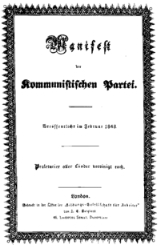
The Communist Manifesto, originally titled Manifesto of the Communist Party is a short 1848 publication written by the German Marxist
Marxism
Marxism is an economic and sociopolitical worldview and method of socioeconomic inquiry that centers upon a materialist interpretation of history, a dialectical view of social change, and an analysis and critique of the development of capitalism. Marxism was pioneered in the early to mid 19th...

 political theorists Karl Marx
Karl Marx
Karl Heinrich Marx was a German philosopher, economist, sociologist, historian, journalist, and revolutionary socialist. His ideas played a significant role in the development of social science and the socialist political movement...

 and Friedrich Engels
Friedrich Engels
Friedrich Engels was a German industrialist, social scientist, author, political theorist, philosopher, and father of Marxist theory, alongside Karl Marx. In 1845 he published The Condition of the Working Class in England, based on personal observations and research...

. It has since been recognized as one of the world's most influential political manuscripts. Commissioned by the Communist League
Communist League
The Communist League was the first Marxist international organization. It was founded originally as the League of the Just by German workers in Paris in 1834. This was initially a utopian socialist and Christian communist group devoted to the ideas of Gracchus Babeuf...

, it laid out the League's purposes and program. It presents an analytical approach to the class struggle
Class struggle
Class struggle is the active expression of a class conflict looked at from any kind of socialist perspective. Karl Marx and Friedrich Engels wrote "The [written] history of all hitherto existing society is the history of class struggle"....

 (historical and present) and the problems of capitalism, rather than a prediction of communism's potential future forms.
Discussion
Ask a question about 'The Communist Manifesto'
Start a new discussion about 'The Communist Manifesto'
Answer questions from other users
Full Discussion Forum
 
Unanswered Questions
Encyclopedia
The Communist Manifesto, originally titled Manifesto of the Communist Party is a short 1848 publication written by the German Marxist
Marxism
Marxism is an economic and sociopolitical worldview and method of socioeconomic inquiry that centers upon a materialist interpretation of history, a dialectical view of social change, and an analysis and critique of the development of capitalism. Marxism was pioneered in the early to mid 19th...

 political theorists Karl Marx
Karl Marx
Karl Heinrich Marx was a German philosopher, economist, sociologist, historian, journalist, and revolutionary socialist. His ideas played a significant role in the development of social science and the socialist political movement...

 and Friedrich Engels
Friedrich Engels
Friedrich Engels was a German industrialist, social scientist, author, political theorist, philosopher, and father of Marxist theory, alongside Karl Marx. In 1845 he published The Condition of the Working Class in England, based on personal observations and research...

. It has since been recognized as one of the world's most influential political manuscripts. Commissioned by the Communist League
Communist League
The Communist League was the first Marxist international organization. It was founded originally as the League of the Just by German workers in Paris in 1834. This was initially a utopian socialist and Christian communist group devoted to the ideas of Gracchus Babeuf...

, it laid out the League's purposes and program. It presents an analytical approach to the class struggle
Class struggle
Class struggle is the active expression of a class conflict looked at from any kind of socialist perspective. Karl Marx and Friedrich Engels wrote "The [written] history of all hitherto existing society is the history of class struggle"....

 (historical and present) and the problems of capitalism, rather than a prediction of communism's potential future forms.

The book contains Marx and Engels' Marxist theories about the nature of society and politics, that in their own words, "The history of all hitherto existing society is the history of class struggles". It also briefly features their ideas for how the capitalist society of the time would eventually be replaced by socialism
Socialism (Marxism)
In Marxist theory, socialism, or the socialist mode of production, refers to a specific historical phase of economic development and its corresponding set of social relations that eventually supersede capitalism...

, and then eventually communism.

Authorship


Friedrich Engels has often been credited in composing the first drafts, which led to The Communist Manifesto. In July 1847, Engels was elected into the Communist League, where he was assigned to draw up a catechism. This became the Draft of a Communist Confession of Faith. The draft contained almost two dozen questions that helped express the ideas of both Engels and Karl Marx at the time. In October 1847, Engels composed his second draft for the Communist League entitled The Principles of Communism. The text remained unpublished until 1914, despite its basis for The Manifesto. From Engels's drafts Marx was able to write, once commissioned by the Communist League, The Communist Manifesto, where he combined more of his ideas along with Engels's drafts and work, The Condition of the Working Class in England.

Although the names of both Engels and Karl Marx appear on the title page alongside the "persistent assumption of joint-authorship", Engels, in the preface introduction to the 1883 German edition of the Manifesto, said that the Manifesto was "essentially Marx's work" and that "the basic thought... belongs solely and exclusively to Marx."

Engels wrote after Marx's death,

Despite Engels's modesty in these two quotations, in fact he made major contributions to the Manifesto, starting with the suggestion to abandon "the form of a catechism and entitle it the Communist Manifesto." Moreover, Engels joined Marx in Brussels
Brussels
Brussels , officially the Brussels Region or Brussels-Capital Region , is the capital of Belgium and the de facto capital of the European Union...

 for the writing of the Manifesto. There is no evidence of what his contributions to the final writing were, but the Manifesto bears the stamp of Marx's more rhetorical writing style. Nevertheless, it seems clear that Engels's contributions justify his name's appearance on the title page after Marx's.

Textual history


The Communist Manifesto was first published (in German) in London by a group of German political refugees in 1848. It was also serialised at around the same time in a German-language London newspaper, the Deutsche Londoner Zeitung. The first English translation was produced by Helen Macfarlane
Helen Macfarlane
Helen Macfarlane was a journalist, socialist and feminist of nineteenth century Britain. Very little seems to be known for sure about her early and later life...

 in 1850, and the book was first published in the United States by Stephen Pearl Andrews
Stephen Pearl Andrews
Stephen Pearl Andrews was an American individualist anarchist and author of several books on Individualist anarchism.-Early life and work:...

. The Manifesto went through a number of editions from 1872 to 1890; notable new prefaces were written by Marx and Engels for the 1872 German edition, the 1882 Russian edition, the 1883 French edition, and the 1888 English edition. This edition, translated by Samuel Moore with the assistance of Engels, has been the most commonly used English text since.

However, some recent English editions, such as Phil Gasper's annotated "road map" (Haymarket Books
Haymarket Books
Haymarket Books is a non-profit left-wing book publisher and distributor. It is published by the Center for Economic Research and Social Change...

, 2006), have used a slightly modified text in response to criticisms of the Moore translation made by Hal Draper
Hal Draper
Hal Draper was an American socialist activist and author who played a significant role in the Berkeley, California, Free Speech Movement and is perhaps best known for his extensive scholarship on the history and meaning of the thought of Karl Marx.Draper was a lifelong advocate of what he called...

 in his 1994 history of the Manifesto, The Adventures of the "Communist Manifesto" (Center for Socialist History, 1994).

Contents


The Manifesto is divided into an introduction, three substantive sections, and a conclusion.

Introduction


The preamble to the main text of the Manifesto states that the continent of Europe fears the "spectre of communism", and the powers of old Europe are uniting in "a holy alliance [intended to] exorcise this spectre". Marx refers here to not only the houses of power and landed gentry of old Europe--the bourgeoisie--but diverse factions such as the papacy and the emerging corporate world as well. Marx declares that "It is high time that Communists should openly, in the face of the whole world, publish their views, their aims, their tendencies, and meet this nursery tale of the spectre of communism with a manifesto of the party itself".

I. Bourgeois and Proletarians


The first chapter of the Manifesto, "Bourgeois and Proletarians", examines the Marxist conception of history, with the initial idea asserting that "The history of all hitherto existing society is the history of class struggles". It goes on to say that in capitalism, the working class, proletariat
Proletariat
The proletariat is a term used to identify a lower social class, usually the working class; a member of such a class is proletarian...

, are fighting in the class struggle against the owners of the means of production, the bourgeois, and that past class struggle ended either with revolution that restructured society, or "common ruin of the contending classes".

It continues by adding that the bourgeois exploits the proletariat by "constant revolutionising of production, uninterrupted disturbance of all social conditions, everlasting uncertainty and agitation distinguish the bourgeois epoch from all earlier ones".

The Manifesto explains that the reason the bourgeois exist and exploit the proletariat with low wages is because of private property
Private property
Private property is the right of persons and firms to obtain, own, control, employ, dispose of, and bequeath land, capital, and other forms of property. Private property is distinguishable from public property, which refers to assets owned by a state, community or government rather than by...

, "the accumulation of wealth in private hands, the formation and increase of capital", and that competition amongst the proletariat creates wage-labour, which rests entirely on the competition among the workers.

This section further explains that the proletarians will eventually rise to power through class struggle: the bourgeoisie constantly exploits the proletariat for its manual labour and cheap wages, ultimately to create profit for the bourgeois; the proletariat rise to power through revolution against the bourgeoisie such as riots or creation of unions. The Communist Manifesto states that while there is still class struggle amongst society, capitalism will be overthrown by the proletariat only to start again in the near future; ultimately communism is the key to class equality amongst the citizens of Europe.

II. Proletarians and Communists


The second section, "Proletarians and Communists", starts by stating the relationship of conscious communists to the rest of the working class, declaring that they will not form a separate party
Political party
A political party is a political organization that typically seeks to influence government policy, usually by nominating their own candidates and trying to seat them in political office. Parties participate in electoral campaigns, educational outreach or protest actions...

 that opposes other working-class parties, express the interests and general will of the proletariat as a whole, and distinguish themselves from other working-class parties by always expressing the common interest of the entire proletariat independently of all nationalities
Nationality
Nationality is membership of a nation or sovereign state, usually determined by their citizenship, but sometimes by ethnicity or place of residence, or based on their sense of national identity....

, and always representing the interests of the movement as a whole.

The section goes on to defend communism from various objections, such as the claim that communists advocate "free love
Free love
The term free love has been used to describe a social movement that rejects marriage, which is seen as a form of social bondage. The Free Love movement’s initial goal was to separate the state from sexual matters such as marriage, birth control, and adultery...

", and the claim that people will not perform labor in a communist society because they have no incentive to work. The section ends by outlining a set of short-term demands:

  1. Abolition of property in land
    Land tenure
    Land tenure is the name given, particularly in common law systems, to the legal regime in which land is owned by an individual, who is said to "hold" the land . The sovereign monarch, known as The Crown, held land in its own right. All private owners are either its tenants or sub-tenants...

     and application of all rents
    Renting
    Renting is an agreement where a payment is made for the temporary use of a good, service or property owned by another. A gross lease is when the tenant pays a flat rental amount and the landlord pays for all property charges regularly incurred by the ownership from landowners...

     of land to public purposes.
  2. A heavy progressive
    Progressive tax
    A progressive tax is a tax by which the tax rate increases as the taxable base amount increases. "Progressive" describes a distribution effect on income or expenditure, referring to the way the rate progresses from low to high, where the average tax rate is less than the marginal tax rate...

     or graduated income tax.
  3. Abolition of all right of inheritance
    Inheritance
    Inheritance is the practice of passing on property, titles, debts, rights and obligations upon the death of an individual. It has long played an important role in human societies...

    .
  4. Confiscation
    Confiscation
    Confiscation, from the Latin confiscatio 'joining to the fiscus, i.e. transfer to the treasury' is a legal seizure without compensation by a government or other public authority...

     of the property of all emigrants
    Emigration
    Emigration is the act of leaving one's country or region to settle in another. It is the same as immigration but from the perspective of the country of origin. Human movement before the establishment of political boundaries or within one state is termed migration. There are many reasons why people...

     and rebels
    Rebellion
    Rebellion, uprising or insurrection, is a refusal of obedience or order. It may, therefore, be seen as encompassing a range of behaviors aimed at destroying or replacing an established authority such as a government or a head of state...

    .
  5. Centralisation of credit
    Credit (finance)
    Credit is the trust which allows one party to provide resources to another party where that second party does not reimburse the first party immediately , but instead arranges either to repay or return those resources at a later date. The resources provided may be financial Credit is the trust...

     in the hands of the State
    Sovereign state
    A sovereign state, or simply, state, is a state with a defined territory on which it exercises internal and external sovereignty, a permanent population, a government, and the capacity to enter into relations with other sovereign states. It is also normally understood to be a state which is neither...

    , by means of a national bank
    National bank
    In banking, the term national bank carries several meanings:* especially in developing countries, a bank owned by the state* an ordinary private bank which operates nationally...

     with State capital
    Capital (economics)
    In economics, capital, capital goods, or real capital refers to already-produced durable goods used in production of goods or services. The capital goods are not significantly consumed, though they may depreciate in the production process...

     and an exclusive monopoly.
  6. Centralisation of the means of communication and transport in the hands of the State.
  7. Extension of factories
    Factory
    A factory or manufacturing plant is an industrial building where laborers manufacture goods or supervise machines processing one product into another. Most modern factories have large warehouses or warehouse-like facilities that contain heavy equipment used for assembly line production...

     and instruments of production
    Means of production
    Means of production refers to physical, non-human inputs used in production—the factories, machines, and tools used to produce wealth — along with both infrastructural capital and natural capital. This includes the classical factors of production minus financial capital and minus human capital...

     owned by the State; the bringing into cultivation
    Tillage
    Tillage is the agricultural preparation of the soil by mechanical agitation of various types, such as digging, stirring, and overturning. Examples of human-powered tilling methods using hand tools include shovelling, picking, mattock work, hoeing, and raking...

     of waste-lands
    Wasteland
    -Literature:* Wasteland , the Celtic motif of the land of the Fisher King* The Waste Land, a poem by T. S. Eliot* The Dark Tower III: The Waste Lands, a novel by Stephen King* Wasteland , a novel by Francesca Lia Block...

    , and the improvement of the soil
    Soil
    Soil is a natural body consisting of layers of mineral constituents of variable thicknesses, which differ from the parent materials in their morphological, physical, chemical, and mineralogical characteristics...

     generally in accordance with a common plan
    Agricultural science
    Agricultural science is a broad multidisciplinary field that encompasses the parts of exact, natural, economic and social sciences that are used in the practice and understanding of agriculture. -Agriculture and agricultural science:The two terms are often confused...

    .
  8. Equal liability
    Legal liability
    Legal liability is the legal bound obligation to pay debts.* In law a person is said to be legally liable when they are financially and legally responsible for something. Legal liability concerns both civil law and criminal law. See Strict liability. Under English law, with the passing of the Theft...

     of all to labour. Establishment of industrial armies
    Army
    An army An army An army (from Latin arma "arms, weapons" via Old French armée, "armed" (feminine), in the broadest sense, is the land-based military of a nation or state. It may also include other branches of the military such as the air force via means of aviation corps...

    , especially for agriculture.
  9. Combination of agriculture with manufacturing industries
    Industry
    Industry refers to the production of an economic good or service within an economy.-Industrial sectors:There are four key industrial economic sectors: the primary sector, largely raw material extraction industries such as mining and farming; the secondary sector, involving refining, construction,...

    ; gradual abolition of the distinction between town and country, by a more equitable distribution of the population
    Population density
    Population density is a measurement of population per unit area or unit volume. It is frequently applied to living organisms, and particularly to humans...

     over the country.
  10. Free education
    Free education
    Free education refers to education that is funded through taxation, or charitable organizations rather than tuition fees. Although primary school and other comprehensive or compulsory education is free in many countries, for example, all education is mostly free including...

     for all children in public schools. Abolition of children's factory labour
    Child labor
    Child labour refers to the employment of children at regular and sustained labour. This practice is considered exploitative by many international organizations and is illegal in many countries...

     in its present form and combination of education with industrial production.

The implementation of these policies would, as believed by Marx and Engels, be a precursor to the stateless and classless society
Classless society
Classless society refers to a society in which no one is born into a social class. Such distinctions of wealth, income, education, culture, or social network might arise and would only be determined by individual experience and achievement in such a society.Since these distinctions are difficult to...

. In a controversial passage they suggested that the "proletariat" might in competition with the bourgeoisie be compelled to organise as a class, form a revolution, make itself a ruling class, sweep away the old conditions of production, and in that step have abolished its own supremacy as a class. This account of the transition from socialism to communism was criticised particularly during and after the Soviet era.

In a related dispute, later Marxists make a separation between "socialism", a society ruled by workers, and "communism", a classless society. Engels wrote little and Marx wrote less on the specifics of the transition to communism, so the authenticity of this distinction remains a matter of dispute.

III. Socialist and Communist Literature


The third section, "Socialist and Communist Literature," distinguishes communism from other socialist doctrines prevalent at the time the Manifesto was written. While the degree of reproach of Marx and Engels toward rival perspectives varies, all are dismissed for advocating reformism
Reformism
Reformism is the belief that gradual democratic changes in a society can ultimately change a society's fundamental economic relations and political structures...

 and failing to recognise the preeminent role of the working class. Partly because of Marx's critique, most of the specific ideologies described in this section became politically negligible by the end of the nineteenth century.

IV. Position of the Communists in Relation to the Various Opposition Parties


The concluding section, "Position of the Communists in Relation to the Various Opposition Parties", briefly discusses the communist position on struggles in specific countries in the mid-nineteenth century such as France, Switzerland, Poland, and Germany, and declares that Germany "is on the eve of a bourgeois revolution", and predicts that a world revolution will soon follow. It then ends by declaring an alliance with the social democrats, boldly supporting other communist revolutions, and calling the proletarians to action, ending with the rallying cry of communism, "Workers of the world, unite!
Workers of the world, unite!
The political slogan Workers of the world, unite! is one of the most famous rallying cries of communism, found in The Communist Manifesto , by Karl Marx and Friedrich Engels...

".

Reception


A number of twenty-first century writers have commented on The Communist Manifestos continuing relevance. Academic John Raines, writing in 2002, noted that "In our day this Capitalist Revolution has reached the farthest corners of the earth. The tool of money has produced the miracle of the new global market and the ubiquitous shopping mall. Read The Communist Manifesto, written more than one hundred and fifty years ago, and you will discover that Marx foresaw it all." Writing in 2003, the English Marxist Chris Harman
Chris Harman
Chris Harman was a British journalist and political activist, and a member of the Central Committee of the Socialist Workers Party...

 described the work, stating that:
The continued relevance of the Marxist theories found within the text has also been supported by the Marxist academic Alex Callinicos
Alex Callinicos
Alexander Theodore Callinicos is a Trotskyist political theorist, a member of the Central Committee of the Socialist Workers Party and its International Secretary, and is Director of the Centre for European Studies at King's College London...

, editor of International Socialism
International Socialism (journal)
International Socialism is a British-based quarterly magazine of socialist theory published by the Socialist Workers Party. It is currently edited by Alex Callinicos, who took over after the death of Chris Harman in November 2009....

, who stated that "This is indeed a manifesto for the 21st century."

See also

  • Marxism
    Marxism
    Marxism is an economic and sociopolitical worldview and method of socioeconomic inquiry that centers upon a materialist interpretation of history, a dialectical view of social change, and an analysis and critique of the development of capitalism. Marxism was pioneered in the early to mid 19th...

  • Erwin Schulhoff
    Erwin Schulhoff
    Erwin Schulhoff was a Czech composer and pianist.-Life:Born in Prague of Jewish-German origin, Schulhoff was one of the brightest figures in a generation of European musicians whose successful careers were prematurely terminated by the rise of the Nazi regime in Germany...

     (created a music version of The Communist Manifesto)
  • List of current communist states
  • Wage slavery
    Wage slavery
    Wage slavery refers to a situation where a person's livelihood depends on wages, especially when the dependence is total and immediate. It is a negatively connoted term used to draw an analogy between slavery and wage labor, and to highlight similarities between owning and employing a person...

  • Anti-capitalism
    Anti-capitalism
    Anti-capitalism describes a wide variety of movements, ideas, and attitudes which oppose capitalism. Anti-capitalists, in the strict sense of the word, are those who wish to completely replace capitalism with another system....


External links