
All Topics  
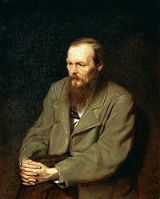
Fyodor Dostoevsky

 
Fyodor Dostoevsky

   Email Print
   Bookmark   Link


Fyodor Dostoevsky


Fyodor Mikhaylovich Dostoyevsky (F?dor Mihajlovic Dosto'evskij , sometimes transliterated Dostoevsky, Dostoievsky, Dostojevskij, Dostoevski or Dostoevskii ( – ) was a Russian fiction
Fiction

Fiction is an imaginative form of narrative, one of the four basic rhetorical modes. Although the word fiction is derived from the Latin fingo, fingere, finxi, fictum, "to form, create", works of fiction need not be entirely imaginary and may include real people, places, and events....
 writer, essayist, and philosopher whose works include Crime and Punishment
Crime and Punishment

Crime and Punishment is a novel by Russian literature Fyodor Dostoevsky that was first published in the literary journal The Russian Messenger in twelve monthly installments in 1866....
 and The Brothers Karamazov.

Dostoyevsky's literary output explores human psychology
Psychology

Psychology is an academic and applied science discipline involving the science study of human mental functions and behavior. Occasionally it also relies on symbolic hermeneutics and critical theory, although these traditions are less pronounced than in other social sciences such as sociology....
 in the troubled political, social
Social

Social refers to a characteristic of living organisms . It always refers to the interaction of organisms with other organisms and to their collective co-existence, irrespective of whether they are aware of it or not, and irrespective of whether the interaction is voluntary or involuntary....
 and spiritual
Spirituality

Spirituality, in a narrow sense, concerns itself with matters of the spirit, a concept closely tied to religion and faith, transcendence , or one or more Deity....
 context of 19th-century Russian society.


Discussion
Ask a question about 'Fyodor Dostoevsky'
Start a new discussion about 'Fyodor Dostoevsky'
Answer questions from other users
Full Discussion Forum


Quotations


My feelings, gratitude, for instance, are denied me simply because of my social position.

The Devil (Ivan's Nightmare)

Nothing in this world is harder than speaking the truth, nothing easier than flattery.

You're a gentleman,.

they used to say to him. "You shouldn't have gone murdering people with a hatchet; that's no occupation for a gentleman."

...To care only for well-being seems to me positively ill-bred. Whether its good or bad, it is sometimes very pleasant, too, to smash things.

A fool with a heart and no sense is just as unhappy as a fool with sense and no heart.

I am a sick man… I am a spiteful man. I am an unpleasant man. I think my liver is diseased.


Encyclopedia


Fyodor Mikhaylovich Dostoyevsky (F?dor Mihajlovic Dosto'evskij , sometimes transliterated Dostoevsky, Dostoievsky, Dostojevskij, Dostoevski or Dostoevskii ( – ) was a Russian fiction
Fiction

Fiction is an imaginative form of narrative, one of the four basic rhetorical modes. Although the word fiction is derived from the Latin fingo, fingere, finxi, fictum, "to form, create", works of fiction need not be entirely imaginary and may include real people, places, and events....
 writer, essayist, and philosopher whose works include Crime and Punishment
Crime and Punishment

Crime and Punishment is a novel by Russian literature Fyodor Dostoevsky that was first published in the literary journal The Russian Messenger in twelve monthly installments in 1866....
 and The Brothers Karamazov.

Dostoyevsky's literary output explores human psychology
Psychology

Psychology is an academic and applied science discipline involving the science study of human mental functions and behavior. Occasionally it also relies on symbolic hermeneutics and critical theory, although these traditions are less pronounced than in other social sciences such as sociology....
 in the troubled political, social
Social

Social refers to a characteristic of living organisms . It always refers to the interaction of organisms with other organisms and to their collective co-existence, irrespective of whether they are aware of it or not, and irrespective of whether the interaction is voluntary or involuntary....
 and spiritual
Spirituality

Spirituality, in a narrow sense, concerns itself with matters of the spirit, a concept closely tied to religion and faith, transcendence , or one or more Deity....
 context of 19th-century Russian society. Considered by many as a founder or precursor of 20th century existentialism
Existentialism

Existentialism is a term that has been applied to the work of a number of nineteenth and twentieth century philosophers who, despite profound doctrinal differences, took the human subject — not merely the thinking subject, but the acting, feeling, living human individual and his or her conditions of existence — as a starting point...
, his Notes from Underground
Notes from Underground

Notes from Underground is a short novel by Fyodor Dostoevsky. It is considered by many to be the world's first existentialism novel. It presents itself as an excerpt from the rambling memoirs of a bitter, isolated, unnamed narrator who is a retired civil servant living in St....
 (1864), written in the embittered voice of the anonymous "underground man", was called by Walter Kaufmann the "best overture for existentialism ever written." Dostoyevsky is widely recognized as one of the greatest and most influential writers of all time.

Biography


Family origins

Dostoyevsky's mother was Russian. His paternal ancestors were from a place called Dostoyeve, natives of the guberniya
Guberniya

Guberniya was a major administrative subdivision of Imperial Russia, usually translated as government, governorate, or province. A guberniya was ruled by a governor or , a word borrowed from Latin , in turn from Greek ....
 (province) of Minsk
Minsk

Minsk is the Capital and largest city in Belarus, situated on the Svislach River and Nemiga rivers. Minsk is also a headquarters of the Commonwealth of Independent States ....
, not far from Pinsk
Pinsk

Pinsk , a town in Belarus, in the Polesia region, traversed by the river Pripyat River, at the confluence of the Strumen River and Pina rivers. The region is known as the Pinsk Marshes....
. The last name of the paternal family is assumed to be 'Rdishev' prior to its assumption of the township eponym
Eponym

An eponym is a person, whether real or fictitious, after whom a particular toponym, ethnonym, regnal year, discovery, or other item is named or thought to be named....
 'Dostoyevsky'. According to one account, Dostoyevsky's paternal ancestors were Polonized nobles (szlachta
Szlachta

Szlachta refers to the nobility social class in the Kingdom of Poland , the Grand Duchy of Lithuania and the increasingly polonized territories under their control ....
) of Russian origin and went to war bearing Polish Radwan Coat of Arms. Dostoyevsky (Polish "Dostojewski") Radwan armorial bearings were drawn for the Dostoyevsky Museum in Moscow
Moscow

Moscow is the capital and the largest types of inhabited localities in Russia of the Russian Federation. It is also the largest European cities and metropolitan areas, with the Moscow metropolitan area ranking among the largest urban areas in the world....
.

Early life

Dostoyevsky was the second of six children born to Mikhail and Maria Dostoyevsky. Dostoyevsky's father Mikhail was a retired military surgeon and a violent alcoholic, who served as a doctor at the Mariinsky Hospital for the Poor in Moscow
Moscow

Moscow is the capital and the largest types of inhabited localities in Russia of the Russian Federation. It is also the largest European cities and metropolitan areas, with the Moscow metropolitan area ranking among the largest urban areas in the world....
. The hospital was situated in one of the worst areas in Moscow. Local landmarks included a cemetery for criminals, a lunatic asylum, and an orphanage for abandoned infants. This urban landscape made a lasting impression on the young Dostoyevsky, whose interest in and compassion for the poor, oppressed, and tormented was apparent. Though his parents forbade it, Dostoyevsky liked to wander out to the hospital garden, where the suffering patients sat to catch a glimpse of sun. The young Dostoyevsky loved to spend time with these patients and hear their stories.

There are many stories of Dostoyevsky's father's despotic treatment of his children. After returning home from work, he would take a nap while his children, ordered to keep absolutely silent, stood by their slumbering father in shifts and swatted at any flies that came near his head. However, it is the opinion of Joseph Frank, a biographer of Dostoyevsky, that the father figure in The Brothers Karamazov
The Brothers Karamazov

The Brothers Karamazov is the final novel by the Russian author Fyodor Dostoyevsky, and is generally considered the culmination of his life's work....
 is not based on Dostoyevsky's own father. Letters and personal accounts demonstrate that they had a fairly loving relationship.

Shortly after his mother died of tuberculosis
Tuberculosis

Tuberculosis is a common and often deadly infectious disease caused by mycobacterium, mainly Mycobacterium tuberculosis . Tuberculosis usually attacks the lungs but can also affect the central nervous system, the lymphatic system, the circulatory system, the genitourinary system, the gastrointestinal system, bones, joints, and even the...
 in 1837, Dostoyevsky and his brother were sent to the Military Engineering Academy at Saint Petersburg
Saint Petersburg

Saint Petersburg is a types of inhabited localities in Russia and a federal subjects of Russia of Russia located on the Neva River at the head of the Gulf of Finland on the Baltic Sea....
. Fyodor's father died in 1839. Though it has never been proven, it is believed by some that he was murdered by his own serf
SERF

A spin-exchange relaxation-free magnetometer achieves very high magnetic field sensitivity by monitoring a high density vapor of alkali metal atoms precessing in a near-zero magnetic field....
s. According to one account, they became enraged during one of his drunken fits of violence, restrained him, and poured vodka
Vodka

Vodka is a distilled beverage. It is a clear liquid which consists of mostly water and ethanol purified by distillation ? often multiple distillation ? from a Fermentation substance, such as cereal , potatoes or sugar beet molasses, and an insignificant amount of other substances such as flavorings or unintended impurities....
 into his mouth until he drowned. An account similarly noted in "Notes From the Underground." Another story holds that Mikhail died of natural causes, and a neighboring landowner invented the story of his murder so that he might buy the estate inexpensively. Some have argued that his father's personality had influenced the character of Fyodor Pavlovich Karamazov, the "wicked and sentimental buffoon", father of the main characters in his 1880 novel The Brothers Karamazov
The Brothers Karamazov

The Brothers Karamazov is the final novel by the Russian author Fyodor Dostoyevsky, and is generally considered the culmination of his life's work....
, but such claims fail to withstand the scrutiny of many critics.

Dostoyevsky had epilepsy
Epilepsy

Epilepsy is a common chronic neurological disorder characterized by recurrent unprovoked seizure s. These seizures are transient signs and/or symptoms of abnormal, excessive or synchronous neuronal activity in the brain....
 and his first seizure occurred when he was 9 years old. Epileptic seizures recurred sporadically throughout his life, and Dostoyevsky's experiences are thought to have formed the basis for his description of Prince Myshkin's epilepsy in his novel The Idiot
The Idiot (novel)

The Idiot is a novel written by the Russian author Fyodor Dostoevsky and first published in 1868. The Russian language title is "?????", "Idiot" ....
 and that of Smerdyakov in The Brothers Karamazov, among others.

At the Saint Petersburg Academy of Military Engineering, Dostoyevsky was taught mathematics
Mathematics

Mathematics is the study of quantity, structure, space, change, and related topics of pattern and form. Mathematicians seek out patterns whether found in numbers, space, natural science, computers, imaginary abstractions, or elsewhere....
, a subject he despised. However, he also studied literature by Shakespeare, Pascal
Blaise Pascal

Blaise Pascal , was a France mathematician, physicist, and religion philosopher. He was a child prodigy who was educated by his father, a civil servant....
, Victor Hugo
Victor Hugo

Victor-Marie Hugo was a France poet, playwright, novelist, essayist, visual artist, statesman, human rights activist and exponent of the Romanticism movement in France....
 and E.T.A. Hoffmann
E.T.A. Hoffmann

Ernst Theodor Wilhelm Hoffmann , better known by his pen name E.T.A. Hoffmann , was a Germany Romanticism author of fantasy and Horror fiction, a jurist, composer, music critic, drawing and caricature....
. Though he focused on areas different from mathematics, he did well on the exams and received a commission in 1841. That year, he is known to have written two romantic plays, influenced by the German Romantic poet/playwright Friedrich Schiller
Friedrich Schiller

Johann Christoph Friedrich von Schiller [johan/jo?han kr?st?f fri?t??? f?n ??l??/??l?] was a Germany poet, philosopher, historian, and playwright....
: Mary Stuart
Maria Stuart (play)

Mary Stuart is a play by Friedrich Schiller based on the life of Mary I of Scotland. The play is subdivided in five acts and each act is divided into several scenes....
 and Boris Godunov
Boris Godunov

Boris Fyodorovich Godunov was de facto regent of Russia from 1584 to 1598 and then the first non-Rurik Dynasty tsar from 1598 to 1605. The end of his reign saw Russia descending into the Time of Troubles....
. The plays have not been preserved. Dostoyevsky described himself as a "dreamer" when he was a young man, and at that time revered Schiller. However, in the years during which he yielded his great masterpieces, his opinions changed and he sometimes poked fun at Schiller.

Beginnings of a literary career

Dostoyevsky was made a lieutenant
Lieutenant

Lieutenant is a military, naval, paramilitary, fire service, emergency medical services or police commissioned officer military rank.Lieutenant may also appear as part of a title used in various other organisations with a codified command structure....
 in 1842, and left the Engineering Academy the following year. He completed a translation into Russian of Balzac's novel Eugénie Grandet
Eugénie Grandet

Eug?nie Grandet is a novel by Honor? de Balzac about miserliness, and how it is bequeathed from the father to the daughter, Eug?nie, through her unsatisfying love attachment with her cousin....
 in 1843, but it brought him little or no attention. Dostoyevsky started to write his own fiction in late 1844 after leaving the army. In 1845, his first work, the epistolary short novel, Poor Folk
Poor Folk

Poor Folk , sometimes translated as Poor People, was the first novel by Fyodor Dostoevsky, which he wrote over the span of nine months. First published in 1846, it was lauded by the influential critic Vissarion Belinsky as being socially conscious literature, who hailed him as the new Gogol....
, published in the periodical The Contemporary (Sovremennik
Sovremennik

Sovremennik was a Russian literary, social and political magazine, published in St.Petersburg in 1836-1866. It came out four times a year in 1836-1843 and once a month after that....
), was met with great acclaim. As legend has it, the editor of the magazine, poet Nikolai Nekrasov, walked into the office of liberal critic Vissarion Belinsky
Vissarion Belinsky

Vissarion Grigoryevich Belinsky was a Russian literary critic of Westernizing tendency. He was an associate of Alexander Herzen, Mikhail Bakunin , and other critical intellectuals....
 and announced, "a new Gogol
Nikolai Gogol

Nikolai Vasilievich Gogol was a Ukrainians-born Russian people writer. Although his early works, such as Evenings on a Farm Near Dikanka, were heavily influenced by his Ukraine upbringing and identity, he wrote in Russian and his works belong to the tradition of Russian literature; often called the "father of modern Russian realism" he...
 has arisen!" Belinsky, his followers, and many others agreed. After the novel was fully published in book form at the beginning of the next year, Dostoyevsky became a literary celebrity at the age of 24.

In 1846, Belinsky and many others reacted negatively to his novella, The Double
The Double: A Petersburg Poem

The Double: A Petersburg Poem is a novella written by Fyodor Dostoevsky. The novella was first published in 1846. The Double deals with the internal psychological struggle of its main character, Yakov Petrovich Golyadkin....
, a psychological study of a bureaucrat whose alter ego overtakes his life. Dostoyevsky's fame began to cool. Much of his work after Poor Folk
Poor Folk

Poor Folk , sometimes translated as Poor People, was the first novel by Fyodor Dostoevsky, which he wrote over the span of nine months. First published in 1846, it was lauded by the influential critic Vissarion Belinsky as being socially conscious literature, who hailed him as the new Gogol....
 met with mixed reviews and it seemed that Belinsky's prediction that Dostoyevsky would be one of the greatest writers of Russia was mistaken.

Exile in Siberia

Omsk Dostoyevskiy Monument
Dostoyevsky was arrested and imprisoned on April 23, 1849 for being a part of the liberal
Liberalism

Liberalism is a broad class of political philosophy that considers individualism liberty and equality to be the most important political goals....
 intellectual group, the Petrashevsky Circle
Petrashevsky Circle

The Petrashevsky Circle was a Russian literary discussion group of progressive-minded commoner-intellectuals in St. Petersburg organized by Mikhail Petrashevsky, a follower of the French utopian socialist Charles Fourier....
. Tsar
Tsar

Tsar or czar , occasionally spelled csar or tzar in English language, is a slavs term designating certain monarchs.Originally, the title Czar meant Emperor in the European medieval sense of the term, that is, a ruler who has the same rank as a Ancient Rome or Byzantine emperor due to recognition by another emperor or...
 Nicholas I
Nicholas I of Russia

Nicholas I , , was the Emperor of Russia from 1825 until 1855, known as one of the most reactionary of the List of Russian rulers. On the eve of his death, the Russian Empire reached its historical zenith spanning over 20 million square kilometres....
 after seeing the Revolutions of 1848
Revolutions of 1848

The European Revolutions of 1848, known in some countries as the Spring of Nations or the Year of Revolution, were a series of political upheavals throughout the European continent....
 in Europe
Europe

Europe is, conventionally, one of the world's seven continents. Comprising the westernmost peninsula of Eurasia, Europe is generally divided from Asia to its east by the water divide of the Ural Mountains, the Ural , the Caspian Sea, and by the Caucasus Mountains to the southeast....
 was harsh on any sort of underground organization which he felt could put autocracy
Autocracy

An autocracy is a form of government in which the political power is held by a single, self-appointed ruler. The term autocrat is derived from the Greek language word 'a?t????t?? ....
 into jeopardy. On November 16 that year Dostoyevsky, along with the other members of the Petrashevsky Circle, was sentenced to death
Death Sentence

"Death Sentence" is a short story by the American science-fiction writer Isaac Asimov. It was first published in the November 1943 issue of Astounding Science Fiction and reprinted in the 1972 collection The Early Asimov....
. After a mock execution
Mock execution

A mock execution is a method of psychological torture, whereby the subject is made to believe that he is being led to his execution. This usually involves blindfolding the subject, making him recount last wishes, or making him dig his own Grave , and sometimes it can go as far as forcing the victim to watch a single or multiple real executio...
, in which he and other members of the group stood outside in freezing weather waiting to be shot by a firing squad, Dostoyevsky's sentence was commuted to four years of exile
Exile

Exile means to be away from one's home while either being explicitly refused permission to return and/or being threatened by prison or death upon return....
 with hard labor at a katorga
Katorga

Katorga was the precursor to the Gulag system. It was a system of penal servitude of the prison farm type in Imperial Russia. Prisoners were sent to remote camps in vast uninhabited areas of Siberia—where voluntary labourers were never available in satisfactory numbers—and forced to perform hard manual labour....
 prison camp in Omsk
Omsk

Omsk is a types of inhabited localities in Russia in southwest Siberia in Russia, the administrative center of Omsk Oblast. It is the second-largest city in Russia beyond the Urals....
, Siberia
Siberia

Siberia , is the name given to the vast region constituting almost all of North Asia and for the most part currently serving as the massive central and eastern portion of the Russian Federation, having served in the same capacity previously for the Soviet Union from its beginning, and the Russian Empire beginning in the 16th century....
. Dostoyevsky described later to his brother the sufferings he went through as the years in which he was "shut up in a coffin." Describing the dilapidated barracks which, as he put in his own words, "should have been torn down years ago", he wrote:

He was released from prison in 1854, and was required to serve in the Siberian Regiment. Dostoyevsky spent the following five years as a private (and later lieutenant) in the Regiment's Seventh Line Battalion, stationed at the fortress of Semipalatinsk
Semey

Semey , formerly known as Semipalatinsk , is a city in Kazakhstan, in the northeastern province of East Kazakhstan Province, near the border with Siberia, around 1,000 km north of Almaty, and 700 km southeast of the Russian city of Omsk, along the Irtysh River....
, now in Kazakhstan
Kazakhstan

Kazakhstan, also Kazakstan , officially the Republic of Kazakhstan, is a large Eurasian country in Central Asia and Eastern Europe. Ranked as the List of countries by area as well as the world's largest landlocked country, it has a territory of 2,727,300 km? ....
. While there, he began a relationship with Maria Dmitrievna Isayeva, the wife of an acquaintance in Siberia. They married in February 1857, after her husband's death.

Post-prison maturation as a writer

Dostoyevsky's experiences in prison and the army resulted in major changes in his political and religious convictions. Firstly, his ordeal somehow caused him to become disillusioned with 'Western' ideas; he repudiated the contemporary Western Europe
Europe

Europe is, conventionally, one of the world's seven continents. Comprising the westernmost peninsula of Eurasia, Europe is generally divided from Asia to its east by the water divide of the Ural Mountains, the Ural , the Caspian Sea, and by the Caucasus Mountains to the southeast....
an philosophical movements, and instead paid greater tribute in his writing to traditional, rural-based, rustic Russian 'values' exemplified in the Slavophil concept of sobornost
Sobornost

Sobornost .The term was coined by the early Slavophiles, Ivan Kireevsky and Aleksey Khomyakov, to underline the need for cooperation between people at the expense of individualism on the basis that the opposing groups focus on what is common between them....
. But even more significantly, he had what his biographer Joseph Frank describes as a conversion
Religious conversion

Religious conversion is the adoption of a new religion identity, or a change from one religious identity to another. This typically entails the sincere avowal of a new belief system, but may also present itself in other ways, such as adoption into an identity group or spiritual lineage....
 experience in prison, which greatly strengthened his Christian
Christian

A Christian is a person who adheres to Christianity, a Monotheism#Christian view religion centered on the life and teachings of Jesus and interpreted by Christians to have been prophesied in the Hebrew Bible/Old Testament....
, and specifically Orthodox, faith (Dostoyevsky would later depict his conversion experience in the short story, The Peasant Marey
The Peasant Marey

"The Peasant Marey" is a short story by Fyodor Dostoevsky written in 1876. Though framed as an autobiography recount of some of his time spent in prison , the story is truly preoccupied with a childhood memory from when Dostoevsky was nine and living in the Tula, Russia with his father....
 (1876)).

Dostoyevsky now displayed a much more critical stance on contemporary European philosophy and turned with intellectual rigour against the Nihilist
Nihilist movement

The Nihilist movement was a Russian anarchist movement in the 1860s which rejected all authorities. It is derived from the Latin word "nihil", which means "nothing"....
 and Socialist
Socialism

Socialism refers to a broad set of economic theories of social organization advocating public or state ownership and administration of the means of production and distribution of goods, and a society characterized by equality for all individuals, with a fair or Egalitarianism method of compensation....
 movements; and much of his post-prison work—particularly the novel, The Possessed and the essays, The Diary of a Writer
A Writer's Diary

A Writer's Diary is a collection of non-fiction and fictional writings by Fyodor Dostoyevsky. Taken from pieces written for a periodical which he founded and produced, it is normally published in two volumes: the first covering those published between 1873 and 1876, the second from 1877 and 1881....
—contains both criticism of socialist and nihilist ideas, as well as thinly-veiled parodies of contemporary Western-influenced Russian intellectuals (Timofey Granovsky
Timofey Granovsky

Timofey Nikolayevich Granovsky was a founder of mediaeval studies in the Russian Empire.Granovsky studied at the universities of Moscow and Berlin, where he was profoundly influenced by Hegelian ideas of Leopold von Ranke and Friedrich Karl von Savigny....
), revolutionaries (Sergey Nechayev
Sergey Nechayev

Sergey Gennadiyevich Nechayev , born October 2, 1847, died either November 21 or December 3, 1882) was a Russian revolutionary anarchist associated with the Nihilist movement and known for his single-minded pursuit of revolution by any means necessary, including political violence....
), and even fellow novelists (Ivan Turgenev
Ivan Turgenev

'Ivan Sergeyevich Turgenev was a Russian novelist and playwright. His novel Fathers and Sons is regarded as one of the major works of 19th-century fiction....
). In social circles, Dostoyevsky allied himself with well-known conservatives, such as the statesman Konstantin Pobedonostsev
Konstantin Pobedonostsev

Konstantin Petrovich Pobedonostsev was a Russian jurist, statesman, and adviser to three Tsars. Usually regarded as a prime representative of reactionary views, he was the "gray cardinal" of imperial politics during the reign of his disciple Alexander III of Russia, holding the position of the Ober-Procurator of the Holy Synod , the high...
. His post-prison essays praised the tenets of the Pochvennichestvo
Pochvennichestvo

Pochvennichestvo - A.K.A. was a late 19th century Russian nativist movement tied in closely with its contemporary ideology, the Slavophile movement....
 movement, a late-19th century Russian nativist ideology closely aligned with Slavophilism
Slavophile

Slavophilia is an intellectual movement originating from 19th century that wanted the Russian Empire to be developed upon values and institutions derived from its early history....
.

Dostoyevsky's post-prison fiction abandoned the European-style domestic melodramas and quaint character studies of his youthful work in favor of dark, more complex story-lines and situations, played-out by brooding, tortured characters—often styled partly on Dostoyevsky himself—who agonized over existential
Existentialism

Existentialism is a term that has been applied to the work of a number of nineteenth and twentieth century philosophers who, despite profound doctrinal differences, took the human subject — not merely the thinking subject, but the acting, feeling, living human individual and his or her conditions of existence — as a starting point...
 themes of spiritual torment, religious awakening, and the psychological confusion caused by the conflict between traditional Russian culture and the influx of modern, Western philosophy. This, nonetheless, does not take from the debt which Dostoyevsky owed to the earlier (Western influenced within Russia Gogol) writers whose work grew from out of the irrational and anti-authoritarian spiritualist ideas contained within the Romantic movement which had immediately preceded Dostoyevsky in Europe. However, Dostoyevsky's major novels focused on the idea that utopias and positivist ideas being utilitarian were unrealistic and unobtainable.

Later literary career

In December 1859, Dostoyevsky returned to Saint Petersburg
Saint Petersburg

Saint Petersburg is a types of inhabited localities in Russia and a federal subjects of Russia of Russia located on the Neva River at the head of the Gulf of Finland on the Baltic Sea....
, where he ran a series of unsuccessful literary journals, Vremya (Time) and Epokha
Epoch

Periodization* Epoch - A defining moment in the beginning of, or characteristic of, a distinctive historical period or era.* On the geologic time scale, a span of time smaller than a "period" and larger than an "age"....
 (Epoch), with his older brother Mikhail. The latter had to be shut down as a consequence of its coverage of the Polish Uprising of 1863. That year Dostoyevsky traveled to Europe and frequented the gambling casinos. There he met Apollinaria Suslova, the model for Dostoyevsky's "proud women," such as the two characters named Katerina Ivanovna, in Crime and Punishment
Crime and Punishment

Crime and Punishment is a novel by Russian literature Fyodor Dostoevsky that was first published in the literary journal The Russian Messenger in twelve monthly installments in 1866....
 and The Brothers Karamazov
The Brothers Karamazov

The Brothers Karamazov is the final novel by the Russian author Fyodor Dostoyevsky, and is generally considered the culmination of his life's work....
.

Dostoyevsky was devastated by his wife's death in 1864, which was followed shortly thereafter by his brother's death. He was financially crippled by business debts; furthermore, he made the voluntary decision to assume the responsibility of his deceased brother's outstanding debts, and he also provided for his wife's son from her earlier marriage and his brother's widow and children. Dostoyevsky sank into a deep depression
Depression (mood)

In the fields of psychology and psychiatry, the terms depression or depressed refer to sadness and other related emotions and behaviours. It can be thought of as either a disease or a syndrome....
, frequenting gambling parlors and accumulating massive losses at the tables.

Dostoyevsky suffered from an acute gambling compulsion as well as from its consequences. By one account Crime and Punishment, possibly his best known novel, was completed in a mad hurry because Dostoyevsky was in urgent need of an advance from his publisher. He had been left practically penniless after a gambling spree. Dostoyevsky wrote The Gambler
The Gambler (novel)

The Gambler is a novel by Fyodor Dostoevsky about a young tutor in the employment of a formerly wealthy Russian General. The novella reflects Dostoevsky's own addiction to roulette, which was in more ways than one the inspiration for the book: Dostoevsky completed the novella under a strict deadline so he could pay off gambling debts....
 simultaneously in order to satisfy an agreement with his publisher Stellovsky who, if he did not receive a new work, would have claimed the copyrights to all of Dostoyevsky's writings. Motivated by the dual wish to escape his creditors at home and to visit the casinos abroad, Dostoyevsky traveled to Western Europe
Western Europe

Western Europe refers to the countries in the western most half of Europe. This concept has had different meanings, political and cultural as well as geographical issues have influenced the area....
. There, he attempted to rekindle a love affair with Suslova, but she refused his marriage proposal. Dostoyevsky was heartbroken, but soon met Anna Grigorevna Snitkina, a twenty-year-old stenographer. Shortly before marrying her in 1867, he dictated The Gambler to her. This period resulted in the writing of what are generally considered to be his greatest books. From 1873 to 1881 he published the Writer's Diary, a monthly journal full of short stories, sketches, and articles on current events. The journal was an enormous success.

Dostoyevsky is also known to have influenced and been influenced by the philosopher Vladimir Sergeyevich Solovyov. Solovyov is noted as the inspiration for the characters Ivan Karamazov and Alyosha Karamazov
Alyosha Karamazov

Alyosha Karamazov is the protagonist in The Brothers Karamazov by Fyodor Dostoevsky. His full name is given as Alexei Fyodorovich Karamazov and he is also referred to as Alyosha, Alyoshka, Alyoshenka, Alyoshechka, Alexeichik, Lyosha, and Lyoshenka....
.

In 1877, Dostoyevsky gave the keynote eulogy
Eulogy

A eulogy is a Speech or writing in praise of a person or thing, especially one recently deceased or retired. The word is derived from the Greek word e?????a , meaning praise ....
 at the funeral of his friend, the poet Nekrasov
Nikolai Alekseevich Nekrasov

Nikolay Alexeyevich Nekrasov was a Russian poet, writer, critic and publisher, whose deeply compassionate poems about peasant Russia won him Dostoevsky's admiration and made him the hero of liberal and radical circles of Russian intelligentsia, as represented by Vissarion Belinsky and Nikolai Chernyshevsky....
, to much controversy. On June 8, 1880, shortly before he died, he gave his famous Pushkin speech at the unveiling of the Pushkin monument in Moscow.

In his later years, Fyodor Dostoyevsky lived for a long time at the resort of Staraya Russa
Staraya Russa

Staraya Russa is an old Russian town located 99 km south of Veliky Novgorod. It is the administrative center of Starorussky District of Novgorod Oblast in Russia and a wharf on the Polist River ....
 in northwestern Russia, which was closer to Saint Petersburg
Saint Petersburg

Saint Petersburg is a types of inhabited localities in Russia and a federal subjects of Russia of Russia located on the Neva River at the head of the Gulf of Finland on the Baltic Sea....
 and less expensive than German resorts. He died on February 9 (January 28 O.S.
Julian calendar

The Julian calendar, a reform of the Roman calendar, was introduced by Julius Caesar in 46 BC, and came into force in 45 BC . It was chosen after consultation with the astronomer Sosigenes of Alexandria and was probably designed to approximate the tropical year, known at least since Hipparchus....
), 1881 of a lung hemorrhage associated with emphysema
Emphysema

Emphysema is a chronic obstructive pulmonary disease . It is often caused by exposure to toxin Chemical substance, including long-term exposure to tobacco smoking....
 and an epileptic seizure. He was interred in Tikhvin Cemetery
Tikhvin Cemetery

Tikhvin Cemetery is located at the Alexander Nevsky Monastery, in Saint Petersburg, Russia.Established in 1823, some of the notables buried here are:...
 at the Alexander Nevsky Monastery in Saint Petersburg
Saint Petersburg

Saint Petersburg is a types of inhabited localities in Russia and a federal subjects of Russia of Russia located on the Neva River at the head of the Gulf of Finland on the Baltic Sea....
. Forty thousand mourners attended his funeral. His tombstone reads "Verily, Verily, I say unto you, Except a corn of wheat fall into the ground and die, it abideth alone: but if it die, it bringeth forth much fruit." from John
Gospel of John

The Gospel of John is the fourth gospel in the Biblical canon of the New Testament, traditionally ascribed to John the Evangelist. Like the three synoptic gospels, it contains an account of some of the actions and sayings of Jesus of Nazareth, but differs from them in ethos and theological emphases....
 12:24, which is also the epigraph
Epigraph (literature)

In literature, an epigraph is a phrase, quotation, or poem that is set at the beginning of a document or component. The epigraph may serve as a preface, as a summary, as a counter-example, or to link the work to a wider Canon , either to invite comparison or to enlist a conventional context....
 of his final novel, The Brothers Karamazov.

Works and influence

Dostoyevsky's influence has been acclaimed by a wide variety of writers.

American novelist Ernest Hemingway
Ernest Hemingway

Ernest Miller Hemingway was an American novelist, short story author, and journalist. He was part of the 1920s expatriate community in Paris, France, and one of the veterans of World War I later known as "the Lost Generation"....
 cited Dostoyevsky as a major influence on his work in his autobiographical novella A Moveable Feast
A Moveable Feast

A Moveable Feast is a set of memoirs by United States author Ernest Hemingway about his years in Paris as part of the American expatriate circle of writers in the 1920s....
.

In a book of interviews with Arthur Power (Conversations with James Joyce), James Joyce
James Joyce

James Augustine Aloysius Joyce was an Ireland expatriate author of the 20th century. He is best known for his landmark novel Ulysses and its controversial successor Finnegans Wake , as well as the short story collection Dubliners and the semi-autobiographical novel A Portrait of the Artist as a Young Man ....
 praised Dostoyevsky's influence:

In her essay The Russian Point of View, Virginia Woolf
Virginia Woolf

Adeline Virginia Woolf was an England novelist and essayist, regarded as one of the foremost modernist literature literature figures of the twentieth century....
 stated that,

Dostoyevsky displayed a nuanced understanding of human psychology in his major works. He created an opus of vitality and almost hypnotic power, characterized by feverishly dramatized scenes where his characters are, frequently in scandalous and explosive atmosphere, passionately engaged in Socratic dialogue
Socratic dialogue

Socratic dialogue is a genre of prose literary works developed in Ancient Greece at the turn of the fourth century BC, preserved today in the dialogues of Plato and the Socratic works of Xenophon - either dramatic or narrative - in which characters discuss moral and philosophical problems, illustrating the Socratic method....
s à la Russe; the quest for God, the problem of Evil
Problem of evil

In the philosophy of religion and theology, the problem of evil is the problem of reconciling the existence of evil or suffering in the world with the existence of God....
 and suffering of the innocents haunt the majority of his novels. His characters fall into a few distinct categories: humble and self-effacing Christians
Christianity

Christianity is a Monotheistic religion #Christian view religion centered on the life and teachings of Jesus as New Testament view on Jesus' life....
 (Prince Myshkin
Prince Myshkin

Prince Lyov Nikolaevich Myshkin is the protagonist of Dostoevsky's The Idiot .Dostoyevsky wanted to create a character that was "entirely positive......
, Sonya Marmeladova, Alyosha Karamazov
Alyosha Karamazov

Alyosha Karamazov is the protagonist in The Brothers Karamazov by Fyodor Dostoevsky. His full name is given as Alexei Fyodorovich Karamazov and he is also referred to as Alyosha, Alyoshka, Alyoshenka, Alyoshechka, Alexeichik, Lyosha, and Lyoshenka....
, Starets Zosima
Saint Ambrose of Optina

Venerable Ambrose of Optina was a starets and a hieroschemamonk in Optina Monastery, canonization in 1988 by the Local Council of the Russian Orthodox Church....
), self-destructive nihilists
Nihilism

Nihilism is the philosophy position that value_theory do not exist but rather are falsely invented. Most commonly, nihilism is presented in the form of Nihilism#Existential_nihilism which argues that life is without meaning, purpose or intrinsic value ....
 (Svidrigailov, Smerdyakov, Stavrogin, the underground man
Notes from Underground

Notes from Underground is a short novel by Fyodor Dostoevsky. It is considered by many to be the world's first existentialism novel. It presents itself as an excerpt from the rambling memoirs of a bitter, isolated, unnamed narrator who is a retired civil servant living in St....
), cynical debauchees (Fyodor Karamazov), and rebellious intellectuals (Raskolnikov, Ivan Karamazov, Ippolit); also, his characters are driven by ideas rather than by ordinary biological or social imperatives. In comparison with Tolstoy
Leo Tolstoy

Leo Tolstoy, or Count Lev Nikolayevich Tolstoy Tolstoy's further talents as essayist, dramatist and Education reform made him the most influential member of the aristocracy Tolstoy....
, whose characters are realistic
Literary realism

Literary realism most often refers to the trend, beginning with certain works of French literature of the 19th century and extending to late-nineteenth- and early-twentieth-century authors in various countries, towards depictions of contemporary life and society 'as they were'....
, the characters of Dostoyevsky are usually more symbolic of the ideas they represent, thus Dostoyevsky is often cited as one of the forerunners of Literary Symbolism
Symbolism

Symbolism is the applied use of symbols: iconic representations that carry particular meanings.The term "symbolism" is limited to use in contrast to "representationalism"; defining the general directions of a linear spectrum - where in all symbolic concepts can be viewed in relation, and where changes in context may imply systemic changes...
 in specific Russian Symbolism
Russian Symbolism

Russian Symbolism was an intellectual and artistic movement predominant at the end of the 19th and beginning of the 20th century. It represented the Russian branch of the Symbolism in European art, and was mostly known for its contributions to Russian poetry....
 (see Alexander Blok
Alexander Blok

Aleksandr Aleksandrovich Blok was one of the most gifted lyrical poets produced by Russia after Alexander Pushkin....
).

Dostoyevsky's novels are compressed in time (many cover only a few days) and this enables the author to get rid of one of the dominant traits of realist
Realism (arts)

Realism in the visual arts and literature is the depiction of subjects as they appear in everyday life, without embellishment or interpretation....
 prose, the corrosion of human life in the process of the time flux—his characters primarily embody spiritual values, and these are, by definition, timeless. Other obsessive themes include suicide
Suicide

Suicide is the intentional taking of one's own life. Many dictionaries also note the metaphorical sense of "willful destruction of one's self-interest"....
, wounded pride, collapsed family values, spiritual regeneration through suffering (the most important motif), rejection of the West and affirmation of Russian Orthodoxy
Russian Orthodoxy

Russian Orthodoxy in Christianity may refer to:*Eastern Orthodox Church, the Church descended from the Imperial Church of the Byzantine Empire...
 and Tsarism. Literary scholars such as Bakhtin
Mikhail Bakhtin

Mikhail Mikhailovich Bakhtin was a Russian philosopher, literary critic, semiotician and scholar who wrote influential works of literary and rhetorical theory and criticism....
 have characterized his work as 'polyphonic
Polyphony (literature)

In literature, polyphony is a feature of narrative, which includes a diversity of points of view and voices. The concept was invented by Mikhail Bakhtin, based on the musical concept polyphony....
': unlike other novelists, Dostoyevsky does not appear to aim for a 'single vision', and beyond simply describing situations from various angles, Dostoyevsky engendered fully dramatic novels of ideas where conflicting views and characters are left to develop unevenly into unbearable crescendo.

Dostoyevsky and the other giant of late 19th century Russian literature
Russian literature

This article is about literature from Russia. For the song by Max?mo Park, see Our Earthly Pleasures. Russian literature refers to the literature of Russia or its ?migr?s, and to the Russian language literature of several independent nations once a part of what was historically Russia or the Soviet Union....
, Lev Nikolayevich Tolstoy, never met in person, even though each praised, criticized and influenced the other (Dostoyevsky remarked of Tolstoy's Anna Karenina
Anna Karenina

Anna Karenina , is a novel by the Russian writer Leo Tolstoy, published in serial installments from 1873 to 1877 in the periodical The Russian Messenger....
 that it was a "flawless work of art"; Henri Troyat
Henri Troyat

Henri Troyat was a France author, biographer, historian and novelist....
 reports that Tolstoy once remarked of Crime and Punishment
Crime and Punishment

Crime and Punishment is a novel by Russian literature Fyodor Dostoevsky that was first published in the literary journal The Russian Messenger in twelve monthly installments in 1866....
 that, "Once you read the first few chapters you know pretty much how the novel will end up"). There was, however, a meeting arranged, but there was a confusion about where the meeting place was and they never rescheduled. Tolstoy reportedly burst into tears when he learnt of Dostoyevsky's death. A copy of The Brothers Karamazov
The Brothers Karamazov

The Brothers Karamazov is the final novel by the Russian author Fyodor Dostoyevsky, and is generally considered the culmination of his life's work....
 was found on the nightstand next to Tolstoy's deathbed at the Astapovo
Lev Tolstoy (settlement)

Lev Tolstoy is a types of settlements in Russia in the northern part of Lipetsk Oblast, Russia. It is the administrative center of Lev-Tolstovsky District....
 railway station. Since their time, the two are considered by the critics and public as two of the greatest novelists produced by the world.

450px Grab Dostojewsky
Dostoyevsky has also been noted as having expressed anti-Semitic sentiments. In the recent biography by Joseph Frank, The Mantle of the Prophet, Frank spent much time on A Writer's Diary—a regular column which Dostoyevsky wrote in the periodical The Citizen from 1873 to the year before his death in 1881. Frank notes that the Diary is "filled with politics, literary criticism, and pan-Slav diatribes about the virtues of the Russian Empire, [and] represents a major challenge to the Dostoyevsky fan, not least on account of its frequent expressions of antisemitism." Frank, in his foreword that he wrote for the book Dostoevsky and the Jews, attempts to place Dostoyevsky as a product of his time. Frank notes that Dostoyevsky did make antisemitic remarks, but that Dostoyevsky's writing and stance by and large was one where Dostoyevsky held a great deal of guilt for his comments and positions that were antisemitic. Steven Cassedy, for example, alleges in his book, Dostoevsky's Religion, that much of the points made that depict Dostoyevsky’s views as an anti-Semite, do so by denying that Dostoyevsky expressed support for the equal rights of and for the Russian Jewish population, a position that was not widely supported in Russia at the time. Cassedy also notes that this criticism of Dostoyevsky also appears to deny his sincerity in the statements that Dostoyevsky made, that he was for equal rights for the Russian Jewish populace, and the Serf
Russian serfdom

The origins of serfdom in Russia are traced to Kievan Rus in the 11th century. Legal documents of the epoch, such as Russkaya Pravda, distinguished several degrees of feudal dependency of peasants....
s of his own country (since neither group at that point in history had equal rights). Cassedy further notes that the criticism maintains that Dostoyevsky was insincere when he stated that he did not hate Jewish people and was not an Anti-Semite. According to Cassedy, this position was maintained without taking into consideration Dostoyevsky's expressed desire to peacefully reconcile Jews and Christians into a single universal brotherhood of all mankind.

In 2008, Fyodor Dostoevsky
Fyodor Dostoevsky

Fyodor Mikhaylovich Dostoyevsky "An Honest Thief"* "Elka i svad'ba" ; English translation: "A Christmas Tree and a Wedding"* Belye nochi ; English translation: White Nights ...
 was elected to be one of 12 most notable personalities in Russian history by votes of Russia TV channel
Russia TV Channel

Russia TV Channel or Russia Channel , is a state-owned Russian List of Russian-language television channels founded in 1991. It belongs to the All-Russia State Television and Radio Company .....
 audience. His promoter in the TV show called Name of Russia
Name of Russia

Name of Russia is the project of the Russia TV channel aimed to elect the most notable personality in Russian history by voting via the Internet, radio and television....
 was Russian Ambassador to NATO Dmitriy Rogozin.

Dostoyevsky and Existentialism

With the publication of Crime and Punishment
Crime and Punishment

Crime and Punishment is a novel by Russian literature Fyodor Dostoevsky that was first published in the literary journal The Russian Messenger in twelve monthly installments in 1866....
 in 1866, Fyodor Dostoyevsky became one of Russia's most prominent authors in the nineteenth century. Dostoyevsky has also been called one of the founding fathers of the philosophical movement known as existentialism
Existentialism

Existentialism is a term that has been applied to the work of a number of nineteenth and twentieth century philosophers who, despite profound doctrinal differences, took the human subject — not merely the thinking subject, but the acting, feeling, living human individual and his or her conditions of existence — as a starting point...
. In particular, his Notes from Underground
Notes from Underground

Notes from Underground is a short novel by Fyodor Dostoevsky. It is considered by many to be the world's first existentialism novel. It presents itself as an excerpt from the rambling memoirs of a bitter, isolated, unnamed narrator who is a retired civil servant living in St....
, first published in 1864, has been depicted as a founding work of existentialism. For Dostoyevsky, war
War

...
 is the rebellion of the people against the idea that reason
Reason

Reason may refer to Mind#Mental faculties that consciously create explanations in order to judge, decide, solve problems, generalize, and give examples, among other activities....
 guides everything. And thus, reason is the ultimate principle of guidance for neither history
HIStory

HIStory: Past, Present and Future, Book I is a double album by Michael Jackson, released on June 20, 1995, and is Jackson's ninth. The first disc, named "HIStory Begins" consists of a selection of Jackson's greatest hits from the singer's past fifteen years, while the second, named "HIStory Continues" features new songs, with the...
 nor mankind
Mankind

Mankind may refer to:* The human speciesMankind may also refer to the male members of the human species, whereas womankind commonly refers to the female members....
. Having been exiled to the city of Omsk
Omsk

Omsk is a types of inhabited localities in Russia in southwest Siberia in Russia, the administrative center of Omsk Oblast. It is the second-largest city in Russia beyond the Urals....
 (Siberia) in 1849, Dostoyevsky focused heavily on notions of suffering
Suffering

Suffering, or pain, is an individual's basic affective experience of unpleasantness and aversion associated with harm or threat of harm. Suffering may be qualified as physical, or mental....
 and despair in many of his works.

Nietzsche referred to Dostoyevsky as "the only psychologist from whom I have something to learn: he belongs to the happiest windfalls of my life, happier even than the discovery of Stendhal
Stendhal

Henri-Marie Beyle , better known by his pen name Stendhal, was a 19th-century France writer. Known for his acute analysis of his characters' psychology, he is considered one of the earliest and foremost practitioners of realism in his two novels Le Rouge et le Noir and La Chartreuse de Parme ....
." He said that Notes from the Underground "cried truth from the blood." According to Mihajlo Mihajlov
Kontinent

Kontinent was a dissident journal which focused on the politics of the Soviet Union and its satellites. Founded in 1974 by writer Vladimir Maximov, its first editor-in-chief, it was published in German language and Russian language and later translated into English language....
's "The great catalyzer: Nietzsche and Russian neo-Idealism", Nietzsche constantly refers to Dostoyevsky in his notes and drafts throughout the winter of 1886-1887. Nietzsche also wrote abstracts of several of Dostoyevsky's works.

Freud wrote an article titled Dostoevsky and Parricide that asserts that the greatest works in world literature are all about parricide
Parricide

Parricide stemming from is defined as:#the act of murdering one's father , mother , or other close relative#the act of murdering a person who stands in a relationship resembling that of a father...
 (though he is critical of Dostoyevsky's work overall, the inclusion of The Brothers Karamazov
The Brothers Karamazov

The Brothers Karamazov is the final novel by the Russian author Fyodor Dostoyevsky, and is generally considered the culmination of his life's work....
 in a set of the three greatest works of literature is remarkable).

List of works


Novels

  • (1846) Bednye lyudi (?????? ????); English translation: Poor Folk
    Poor Folk

    Poor Folk , sometimes translated as Poor People, was the first novel by Fyodor Dostoevsky, which he wrote over the span of nine months. First published in 1846, it was lauded by the influential critic Vissarion Belinsky as being socially conscious literature, who hailed him as the new Gogol....
  • (1849) Netochka Nezvanova (??????? ?????????); English translation: Netochka Nezvanova
    Netochka Nezvanova (novel)

    Netochka Nezvanova is Fyodor Dostoevsky's first - although unfinished - attempt at writing a novel. The first completed section of the book was published in the end of 1849....
  • (1861) Unizhennye i oskorblennye (????????? ? ????????????); English translation: The Insulted and Humiliated
    The Insulted and Humiliated

    Humiliated and Insulted by Fyodor Dostoevsky, first published in 1861, is the trigger of the many tragic novels written by Dostoevsky that depict the harshness of human relations with a zest of blind kindness....
  • (1862) Zapiski iz mertvogo doma (??????? ?? ???????? ????); English translation: The House of the Dead
    The House of the Dead (novel)

    The House of the Dead is a novel published in 1862 by Russian author Fyodor Dostoyevsky, which portrays the life of convicts in a Siberian prison camp....
  • (1864) Zapiski iz podpolya (??????? ?? ????????); English translation: Notes from Underground
    Notes from Underground

    Notes from Underground is a short novel by Fyodor Dostoevsky. It is considered by many to be the world's first existentialism novel. It presents itself as an excerpt from the rambling memoirs of a bitter, isolated, unnamed narrator who is a retired civil servant living in St....
  • (1866) Prestuplenie i nakazanie (???????????? ? ?????????); English translation: Crime and Punishment
    Crime and Punishment

    Crime and Punishment is a novel by Russian literature Fyodor Dostoevsky that was first published in the literary journal The Russian Messenger in twelve monthly installments in 1866....
  • (1867) Igrok; English translation: The Gambler
    The Gambler (novel)

    The Gambler is a novel by Fyodor Dostoevsky about a young tutor in the employment of a formerly wealthy Russian General. The novella reflects Dostoevsky's own addiction to roulette, which was in more ways than one the inspiration for the book: Dostoevsky completed the novella under a strict deadline so he could pay off gambling debts....
  • (1869) Idiot; English translation: The Idiot
    The Idiot (novel)

    The Idiot is a novel written by the Russian author Fyodor Dostoevsky and first published in 1868. The Russian language title is "?????", "Idiot" ....
  • (1872) Besy; English translation: The Possessed
  • (1875) Podrostok (?????????); English translation: The Raw Youth
    The Raw Youth

    The Raw Youth, also published as The Adolescent or An Accidental Family, , is a novel of Russian writer Fyodor Dostoevsky....
  • (1881) Brat'ya Karamazovy (?????? ??????????); English translation: The Brothers Karamazov
    The Brothers Karamazov

    The Brothers Karamazov is the final novel by the Russian author Fyodor Dostoyevsky, and is generally considered the culmination of his life's work....


Novellas and short stories

  • (1846) Dvojnik (???????. ????????????? ?????); English translation: The Double: A Petersburg Poem
    The Double: A Petersburg Poem

    The Double: A Petersburg Poem is a novella written by Fyodor Dostoevsky. The novella was first published in 1846. The Double deals with the internal psychological struggle of its main character, Yakov Petrovich Golyadkin....
  • (1847) Roman v devyati pis'mah (????? ? ?????? ???????); English translation: Novel in Nine Letters
  • (1847) "Gospodin Prokharchin" (???????? ?????????); English translation: "Mr. Prokharchin"
  • (1847) "Hozyajka" (???????); English translation: "The Landlady"
  • (1848) "Polzunkov" (?????????); English translation: "Polzunkov"
  • (1848) "Slaboe serdze" (?????? ??????); English translation: "A Weak Heart"
  • (1848) "Chuzhaya zhena i muzh pod krovat'yu" (????? ???? ? ??? ??? ????????); English translation: "The Jealous Husband"
  • (1848) "Chestnyj vor" (??????? ???); English translation:) "An Honest Thief
    An Honest Thief

    "An Honest Thief" is an 1848 short story by Fyodor Dostoevsky. The story recounts the tale of the tragic drunkard Yemelyan.Synopsis ...
    "
  • (1848) "Elka i svad'ba" (???? ? ???????); English translation: "A Christmas Tree and a Wedding
    A Christmas Tree and a Wedding

    A Christmas Tree and a Wedding is a short story written by Fyodor Dostoevsky in 1848. The piece is narrated by an awkward outcast attending a Christmas party....
    "
  • (1848) Belye nochi (????? ????); English translation: White Nights
    White Nights (short story)

    "White Nights" is a Russian language short story by Fyodor Dostoevsky, originally published in 1848, early in the writer's career. Film adaptations have been made by Italian director Luchino Visconti , by French director Robert Bresson , by Iranian director Farzad Motamen by Indian film directors Manmohan Desai , Shivam Nair , Sanjay Leela...
  • (1857) "Malen'kij geroj" (????????? ?????); English translation: "The Little Hero"
  • (1859) "Dyadyushkin son" (???????? ???); English translation: "The Uncle's Dream"
  • (1859) Selo Stepanchikovo i ego obitateli (???? ???????????? ? ??? ?????????); English translation: The Village of Stepanchikovo
    The Village of Stepanchikovo

    ???? ???????????? ? ??? ????????? or The Village of Stepanchikovo is a novella written by Fyodor Dostoevsky and first published in 1859....
  • (1862) "Skvernyj anekdot" (???????? ???????); English translation: "A Nasty Story
    A Nasty Story

    A Nasty Story, also translated as A Disgraceful Affair, is a satirical short story by Fyodor Dostoevsky concerning the escapades of a Russian civil servant....
    "
  • (1865) "Krokodil" (????????); English translation: "The Crocodile
    The Crocodile (short story)

    The Crocodile is a short story written by Fyodor Dostoevsky first published in 1865....
    "
  • (1870) "Vechnyj muzh" (?????? ???); English translation: "The Eternal Husband"
  • (1873) "Bobok"; English translation: "Bobok"
  • (1876) "Krotkaja" (???????); English translation: "A Gentle Creature
    A Gentle Creature

    A Gentle Creature, , sometimes also translated as The Meek One, is a short story written by Fyodor Dostoevsky in 1876 in literature. The piece comes with the subtitle of "A Fantastic Story," and it chronicles the relationship between a pawnbroker and a girl that frequents his shop....
    "
  • (1876) "Muzhik Marej" (????? ?????); English translation: "The Peasant Marey
    The Peasant Marey

    "The Peasant Marey" is a short story by Fyodor Dostoevsky written in 1876. Though framed as an autobiography recount of some of his time spent in prison , the story is truly preoccupied with a childhood memory from when Dostoevsky was nine and living in the Tula, Russia with his father....
    "
  • (1876) "Mal'chik u Hrista na elke" (??????? ? ?????? ?? ????); English translation: "The Heavenly Christmas Tree"
  • (1877) "Son smeshnogo cheloveka" (??? ???????? ????????); English translation: "The Dream of a Ridiculous Man
    The Dream of a Ridiculous Man

    The Dream of a Ridiculous Man is a short story by Fyodor Dostoevsky written in 1877. It chronicles the experiences of a man who decides that there is nothing to live for in the world, and is therefore determined to commit suicide....
    "


Non-fiction

  • Winter Notes on Summer Impressions (1863)
  • A Writer's Diary
    A Writer's Diary

    A Writer's Diary is a collection of non-fiction and fictional writings by Fyodor Dostoyevsky. Taken from pieces written for a periodical which he founded and produced, it is normally published in two volumes: the first covering those published between 1873 and 1876, the second from 1877 and 1881....
     (??????? ????????) (1873–1881)


See also

  • Albert Camus
    Albert Camus

    Albert Camus was an Algerian-born France author, Philosophy, and journalist who won the Nobel Prize in 1957. He is often associated with existentialism, but Camus refused this label....
  • Aleksandr Solzhenitsyn
    Aleksandr Solzhenitsyn

    Aleksandr Isayevich Solzhenitsyn was a Russians novelist, dramatist and historian. Through his writings, he made the world aware of the Gulag, the Soviet Union's forced labour camp system, and for these efforts Solzhenitsyn was exiled from the Soviet Union in 1974....
  • Anti-Catholicism
    Anti-Catholicism

    Anti-Catholicism is a generic term for discrimination, hostility or prejudice directed at the Catholic Church, its clergy or its members. The term also applies to the religious persecution of Catholics or to a "religious orientation opposed to Catholicism."...
  • Determinism
    Determinism

    Determinism is the philosophy proposition that every event, including human cognition and behavior, decision and action, is causality determined by an unbroken chain of prior occurrences. With numerous historical debates, many varieties and philosophical positions on the subject of determinism exist from traditions throughout...
  • Existentialism
    Existentialism

    Existentialism is a term that has been applied to the work of a number of nineteenth and twentieth century philosophers who, despite profound doctrinal differences, took the human subject — not merely the thinking subject, but the acting, feeling, living human individual and his or her conditions of existence — as a starting point...
  • Free will
    Free will

    The question of free will is whether, and in what sense, rational agents exercise control over their actions and decisions. Addressing this question requires understanding the relationship between freedom and Causality, and determining whether the laws of nature are causally deterministic....
  • Hesychasm
    Hesychasm

    Hesychasm is an eremitic tradition of prayer in the Eastern Orthodox Church, and some other Eastern Churches of the Byzantine Rite, practised by the Hesychast ....
  • History of Eastern Christianity
    History of Eastern Christianity

    Christianity has been, historically a Middle Eastern religion with its origin in Hebrews tribal Judaism.Eastern Christianity refers collectively to the Christianity traditions and churches which developed in the Middle East, Egypt, Asia Minor, The Far East, Balkans, Eastern Europe, Asia Minor, Christianity in Africa and southern India...
  • History of the Eastern Orthodox Church
    History of the Eastern Orthodox Church

    The Eastern Orthodox Churches trace their roots back to the Twelve Apostles and Jesus. Apostolic succession established by the seats of Patriarchy . Eastern Orthodoxy reached its golden age during the high point of the Byzantine Empire, taken over by the Bulgarian Orthodox Church and the Serbian Orthodox Church before it continued to flourish in Ru...
  • History of the Russian Orthodox Church
    History of the Russian Orthodox Church

    Foundation by St. AndrewThe Russian Orthodox Church is traditionally said to have been founded by the Apostle Andrew, who is thought to have visited Scythia and Greek colonies along the northern coast of the Black Sea....
  • Ivan Ilyin
    Ivan Ilyin

    Ivan Alexandrovich Ilyin was a Russian religious and political philosopher, and White emigre publicist and an ideologue of the Russian All-Military Union....
  • Jean-Paul Sartre
    Jean-Paul Sartre

    Jean-Paul Charles Aymard Sartre , commonly known simply as Jean-Paul Sartre , was a French existentialism philosopher, playwright, novelist, screenwriter, political activist, biographer, and literary criticism....
  • Lev Shestov
    Lev Shestov

    Lev Isaakovich Shestov , born Yehuda Leyb Schwarzmann ) was a Ukrainian/Russian - Jewish existentialist philosopher. Born in Kiev on January 31 1866, he emigrated to France in 1921, fleeing from the aftermath of the October Revolution....
  • Mikhail Bakhtin
    Mikhail Bakhtin

    Mikhail Mikhailovich Bakhtin was a Russian philosopher, literary critic, semiotician and scholar who wrote influential works of literary and rhetorical theory and criticism....
  • Mikhail Epstein
    Mikhail Epstein

    Mikhail N. Epstein is an American literary theorist and critical thinker. He is Samuel Candler Dobbs Professor of Cultural Theory and Russian Literature at Emory University in Atlanta, Georgia....
  • Negative theology
    Negative theology

    Negative theology?also known as the Via Negativa and Apophatic theology?is a theology that attempts to describe God, the Divine Good, by negation, to speak only in terms of what may not be said about the perfect goodness that is God....
  • Nihilism
    Nihilism

    Nihilism is the philosophy position that value_theory do not exist but rather are falsely invented. Most commonly, nihilism is presented in the form of Nihilism#Existential_nihilism which argues that life is without meaning, purpose or intrinsic value ....
  • Nikolai Berdyaev
    Nikolai Berdyaev

    Nikolai Alexandrovich Berdyaev was a Russian religious and political philosophy....
  • Nikolai Lossky
    Nikolai Lossky

    Nikolai Onufriyevich Lossky was a Russian philosopher, representative of Russian idealism, gnosiology, personalism, Libertarianism , ethics, Axiology , and his philosophy he called intuitive-personalism....
  • Nikolay Strakhov
    Nikolay Strakhov

    Nikolay Nikolayevich Strakhov, also transliterated as Nikolai Strahov was a Russian philosopher, publicist and Literary criticism who shared the ideals of pochvennichestvo....
  • Philokalia
    Philokalia

    The Philokalia is a collection of texts by masters of the Eastern Orthodox, hesychasm tradition, writing from the fourth century to the fifteenth century on the disciplines of Christian prayer and a life dedicated to God....
  • Russian Philosophy
    Russian philosophy

    Russian philosophy is a broad field, little known to most non-Russians, dominated by religious and Humanismic figures such as Vladimir Solovyov and social or political philosophers such as Vladimir Lenin....
  • Russian Orthodox Church
    Russian Orthodox Church

    The Russian Orthodox Church ; or The Moscow Patriarchate , also known as the Orthodox Christian Church of Russia, is a body of Christianity who constitute an Autocephaly Eastern Orthodox Church under the jurisdiction of the List of Metropolitans and Patriarchs of Moscow, in full communion with the other Eastern Orthodox Churches....
  • Søren Kierkegaard
    Søren Kierkegaard

    S?ren Aabye Kierkegaard was a prolific 19th century Denmark philosopher and theologian. Kierkegaard strongly criticised both the Hegelianism of his time, and what he saw as the empty ceremony of the Church of Denmark....
  • Voluntarism
  • Vasily Rozanov
    Vasily Rozanov

    Vasily Vasilievich Rozanov was one of the most controversial Russian writers and philosophers of the pre-Russian Revolution of 1917ary epoch....
  • Vladimir Sergeyevich Solovyov


External links


  • - The definitive Dostoevsky fan site: discussion forum, essays, e-texts, photos, biography, quotes, and links.
  • - Biography, ebooks, quotations, and other resources
  • Dostoevsky, Joseph Frank. Princeton University Press, Princeton, 1979-2003 (5 volumes).
  • *