
All Topics  
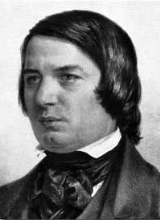
Robert Schumann

 
Robert Schumann

   Email Print
   Bookmark   Link


Robert Schumann


Robert Schumann, sometimes given as Robert Alexander Schumann, (8 June 1810 – 29 July 1856) was a German composer
Composer

A composer is a person who creates music, usually in the medium of musical notation, for interpretation and performance. The level of distinction between composers and other musicians varies, which affects issues such as copyright and the deference given to individual interpretations of a particular piece of music....
, aesthete and influential music critic
Music critic

A music critic is someone who reviews music and publishes writing on them in books or journals . Some music critics also write books analyzing musical styles and discussing music history, thus verging on the field of musicology....
. He is one of the most famous Romantic
Romantic music

In music, romanticism is a term, often considered misleading, and concept derived from literature traditionally defined by attributes including, "interest in nature, medieval chivalry, mysticism, [and] remoteness [ Social alienation and Solitude]"....
 composers of the 19th century.

He had hoped to pursue a career as a virtuoso
Virtuoso

A virtuoso is an individual who possesses outstanding technical ability at singing or playing a musical instrument. The plural form is either virtuosi or the Anglicisation, virtuosos, and the feminine form sometimes used is virtuosa....
 pianist, having been assured by his teacher Friedrich Wieck
Friedrich Wieck

Johann Gottlob Friedrich Wieck was a noted Germany piano teacher, voice teacher, piano firm owner, music reviewer, and the father of Clara Schumann and Marie Wieck....
 that he could become the finest pianist in Europe after only a few years of study with him.


Discussion
Ask a question about 'Robert Schumann'
Start a new discussion about 'Robert Schumann'
Answer questions from other users
Full Discussion Forum


Recent Posts


Quotations


In order to compose, all you need do is remember a tune that nobody else has thought of.

The talent works, the genius creates.

If that's what your jokes sound like, I'm afraid to hear what your serious pieces sound like.

letter to Chopin after hearing Scherzo number 2 in B Flat Minor


Encyclopedia


Schuhmann
Robert Schumann, sometimes given as Robert Alexander Schumann, (8 June 1810 – 29 July 1856) was a German composer
Composer

A composer is a person who creates music, usually in the medium of musical notation, for interpretation and performance. The level of distinction between composers and other musicians varies, which affects issues such as copyright and the deference given to individual interpretations of a particular piece of music....
, aesthete and influential music critic
Music critic

A music critic is someone who reviews music and publishes writing on them in books or journals . Some music critics also write books analyzing musical styles and discussing music history, thus verging on the field of musicology....
. He is one of the most famous Romantic
Romantic music

In music, romanticism is a term, often considered misleading, and concept derived from literature traditionally defined by attributes including, "interest in nature, medieval chivalry, mysticism, [and] remoteness [ Social alienation and Solitude]"....
 composers of the 19th century.

He had hoped to pursue a career as a virtuoso
Virtuoso

A virtuoso is an individual who possesses outstanding technical ability at singing or playing a musical instrument. The plural form is either virtuosi or the Anglicisation, virtuosos, and the feminine form sometimes used is virtuosa....
 pianist, having been assured by his teacher Friedrich Wieck
Friedrich Wieck

Johann Gottlob Friedrich Wieck was a noted Germany piano teacher, voice teacher, piano firm owner, music reviewer, and the father of Clara Schumann and Marie Wieck....
 that he could become the finest pianist in Europe after only a few years of study with him. However, a self-inflicted hand injury prevented those hopes from being realized, and he decided to focus his musical energies on composition. Schumann's published compositions were all for the piano until 1840; he later composed works for piano and orchestra, many lied
Lied

, is a German language word, meaning literally "song"; among English speakers, however, the word is used primarily as a term for European European classical music songs, also known as art songs....
er (songs for voice and piano), four symphonies
Symphony

A symphony is a musical composition, often extended and usually for orchestra. "Symphony" does not imply a specific form. Many symphonies are tonality works in four movement with the first in sonata form, and this is often described by music theorists as the structure of a "Classical period " symphony, although even some symphonies by the ac...
, an opera
Opera

Opera is an Performing arts in which singers and musicians perform a dramatic work which combines a text and a musical score. Opera is part of the Western classical music tradition....
, and other orchestra
Orchestra

An orchestra is an Musical ensemble, usually fairly large with string, brass, woodwind sections, and possibly a percussion section as well. The term orchestra derives from the name for the area in front of an theatre of ancient Greece reserved for the Greek chorus....
l, choral
Choir

A choir, chorale, or chorus is a musical ensemble of singers. Choral Music, in turn, is the music written specifically for a choir to perform....
 and chamber
Chamber music

Chamber music is a form of classical music, written for a small group of instruments which traditionally could be accommodated in a palace chamber....
 works. His writings about music appeared mostly in the Neue Zeitschrift für Musik
Neue Zeitschrift für Musik

Die Neue Zeitschrift f?r Musik was a music magazine published in Leipzig, founded by Robert Schumann. Its first issue appeared on 3 April 1834....
 ("The New Journal for Music"), a Leipzig
Leipzig

Leipzig is, with a population of over 511,252, the largest city in the States of Germany of Saxony, Germany....
-based publication that he jointly founded.

In 1840, after a long and acrimonious legal battle with his piano instructor (Wieck), Schumann married Wieck's daughter, pianist Clara Wieck
Clara Schumann

Clara Josephine Wieck was a German musician, one of the most distinguished pianists of the Romantic music, as well as a composer. Her prestige — she became known as "the high priestess of music" — exerted over a 61-year concert career, changed the format and repertoire of the piano concert and the tastes of the listening publi...
, who also composed music and had a considerable concert career, including premieres of many of her husband's works.

Robert Schumann died in middle age; for the last two years of his life, after an attempted suicide, he was confined to a mental institution at his own request.

Biography


Early life

Schumann was born in Zwickau
Zwickau

Zwickau is a city in Germany, in the States of Germany Free State of Saxony , situated in a valley at the foot of the Erzgebirge, on the left bank of the Zwickauer Mulde, 130 km southwest of Dresden, south of Leipzig and south west of Chemnitz....
, Saxony
Kingdom of Saxony

The Kingdom of Saxony , lasting between 1806 and 1918, was an independent member of a number of historical confederacies in Napoleonic through Germany....
 the fifth and last child of the family. Schumann began to compose before the age of seven, but his boyhood was spent in the cultivation of literature as much as music because his father, August Schumann, was a bookseller, publisher, and novelist. At age 14 Schumann wrote an essay on the aesthetics of music and also contributed to a volume, edited by his father, titled "Portraits of Famous Men." While still at school in Zwickau he read the works of the German poet-philosophers Friedrich Schiller
Friedrich Schiller

Johann Christoph Friedrich von Schiller [johan/jo?han kr?st?f fri?t??? f?n ??l??/??l?] was a Germany poet, philosopher, historian, and playwright....
 and Johann Wolfgang von Goethe
Johann Wolfgang von Goethe

was a Germans writer and according to George Eliot, "Germany's greatest man of letters? and the last true polymath to walk the earth." Goethe's works span the fields of poetry, drama, literature, theology, philosophy, humanism and science....
, as well as Byron
George Gordon Byron, 6th Baron Byron

George Gordon Byron, later Noel, 6th Baron Byron Royal Society was a United Kingdom poet and a leading figure in Romanticism. Amongst Byron's best-known works are the brief poems She Walks in Beauty, When We Two Parted, and So, we'll go no more a roving, in addition to the narrative poems Childe Harold's Pilgrimage and...
 and the Greek tragedians
Tragedy

Tragedy is a form of The arts based on human suffering that offers its audience pleasure. While most cultures have developed forms that provoke this paradoxical response, tragedy refers to a specific Poetic tradition of drama that has played a unique and important role historically in the self-definition of Western culture....
. His most powerful and permanent literary inspiration was Jean Paul
Jean Paul

Jean Paul , born Johann Paul Friedrich Richter, was a Germany Romanticism writer, best known for his humorous novels and stories....
, whose influence is seen in Schumann's youthful novels Juniusabende, completed in 1826, and Selene.

Schumann's interest in music was prompted as a child by the performance of Ignaz Moscheles
Ignaz Moscheles

Ignaz Moscheles was a Bohemian composer and piano virtuoso, whose career after his early years was based initially in London, and later at Leipzig, where he succeeded his friend and sometime pupil Felix Mendelssohn as head of the Conservatoire....
 playing at Carlsbad
Carlsbad

Carlsbad or Karlsbad is a German placename meaning "Charles's spa", after Charles IV, Holy Roman Emperor Localities called Carlsbad or Karlsbad include:...
, and he later developed an interest in the works of Ludwig van Beethoven
Ludwig van Beethoven

Ludwig van Beethoven was a German composer and pianist. He was a crucial figure in the transitional period between the Classical music era and Romantic music eras in classical music, and remains one of the most acclaimed and influential composers of all time....
, Franz Schubert
Franz Schubert

Franz Peter Schubert was an Austrian composer. He wrote some 600 lieder, nine symphonies , liturgy music, operas, and a large body of chamber music and solo piano music....
 and Felix Mendelssohn
Felix Mendelssohn

Jakob Ludwig Felix Mendelssohn Bartholdy, born, and generally known in English-speaking countries, as Felix Mendelssohn was a Germany composer, pianist, organist and conducting of the early Romantic music period....
. His father, however, who had encouraged the boy's musical aspirations, died in 1826, and neither his mother nor his guardian thereafter encouraged a career for him in music. In 1828 he left school, and after a tour, during which he met Heinrich Heine
Heinrich Heine

Christian Johann Heinrich Heine was a journalist, essayist, and one of the most significant German literature German Romanticism poets. He is remembered chiefly for selections of his lyric poetry, many of which were set to music in the form of lieder by German composers....
 in Munich
Munich

Munich is the capital city of Bavaria, Germany. Munich is located on the River Isar north of the Northern Limestone Alps. Munich is the third largest city in Germany, after Berlin and Hamburg....
, he went to Leipzig
Leipzig

Leipzig is, with a population of over 511,252, the largest city in the States of Germany of Saxony, Germany....
 to study law. In 1829 his law studies continued in Heidelberg
Heidelberg

Heidelberg is a city in Baden-W?rttemberg, Germany. As of 2006, over 140,000 people live within the city's area. The town of Heidelberg is an administrative district of its own....
.

1830–1834

During Eastertide
Eastertide

Eastertide, or the Easter Season, or Paschal Time, is the period of fifty days from Easter Sunday to Pentecost Sunday.It is celebrated as a single joyful feast, indeed as the "great Lord's Day"....
 1830 he heard Niccolò Paganini
Niccolò Paganini

Niccol? Paganini was an Italy violinist, viola, classical guitar, and composer. He was one of the most celebrated violin virtuosi of his time, and left his mark as one of the pillars of modern violin technique....
 play in Frankfurt. In July he wrote to his mother, "My whole life has been a struggle between Poetry and Prose, or call it Music and Law." By Christmas he was back in Leipzig, taking piano lessons from his old master Wieck, who assured him that he would be a successful concert pianist.

During his studies with Wieck, Schumann permanently injured his right hand. One suggested cause of this injury is that he damaged his finger by the use of a mechanical device designed to strengthen the weakest fingers, which held back one finger while he exercised the others. Others have suggested that the injury was a side-effect of syphilis medication. A more dramatic suggestion is that in an attempt to increase the independence of his fourth finger, he may have carried out a surgical procedure to separate the tendons of the fourth finger from those of the third. The cause of the injury is not known, but in any event Schumann abandoned ideas of a concert career and devoted himself instead to composition. To this end he began a course of theory under Heinrich Dorn, a German composer six years his senior and the conductor of the Leipzig opera at that time. About this time Schumann considered composing an opera on the subject of Hamlet
Hamlet

Hamlet is a tragedy by William Shakespeare, believed to have been written between 1599 and 1601. The play, set in Denmark, recounts how Prince Hamlet exacts revenge on his uncle King Claudius, who has murdered King Hamlet, the King, and then taken the throne and married Gertrude ....
.

Papillons
Papillons

Papillons, Opus number 2, is a suite of piano pieces written in 1831 by Robert Schumann. Meaning 'butterflies', Papillons is meant to represent a masked ball and was inspired by the novel Flegeljahre by Jean Paul....
The fusion of the literary idea with its musical illustration, which may be said to have first taken shape in Papillons ("Butterflies") (Schumann's Opus 2), is foreshadowed to some extent in his first written criticism, an 1831 essay on Frédéric Chopin
Frédéric Chopin

Fr?d?ric Chopin was a composer and virtuoso pianist of the Romantic music period. He is widely regarded as the greatest Polish composer, and one of music's greatest tone poets....
's variations on a theme from Mozart
Wolfgang Amadeus Mozart

Wolfgang Amadeus Mozart Mozart showed prodigious ability from his earliest childhood in Salzburg. Already competent on keyboard and violin, he composed from the age of five and performed before European royalty; at seventeen he was engaged as a court musician in Salzburg, but grew restless and traveled in search of a better position, always...
's Don Giovanni
Don Giovanni

Don Giovanni is an opera in two acts with music by Wolfgang Amadeus Mozart and with Italian language libretto by Lorenzo Da Ponte. It was premiered in the Estates Theatre in Prague on October 29, 1787 in music....
, published in the Allgemeine musikalische Zeitung. Here Chopin's work is discussed by the imaginary characters Florestan (the embodiment of Schumann's passionate, voluble side) and Eusebius (his dreamy, introspective side) – the counterparts of Vult and Walt in Jean Paul
Jean Paul

Jean Paul , born Johann Paul Friedrich Richter, was a Germany Romanticism writer, best known for his humorous novels and stories....
's novel Flegeljahre. A third, Meister Raro, is called upon for his opinion. Raro may represent either the composer himself, Wieck's daughter Clara
Clara Schumann

Clara Josephine Wieck was a German musician, one of the most distinguished pianists of the Romantic music, as well as a composer. Her prestige — she became known as "the high priestess of music" — exerted over a 61-year concert career, changed the format and repertoire of the piano concert and the tastes of the listening publi...
, or the combination of the two (Clara + Robert).

However, by the time Schumann had written Papillons in 1831 he went a step further. The scenes and characters of his favorite novel had now passed definitely and consciously into the written music, and in a letter from Leipzig (April 1832) he bids his brothers "read the last scene in Jean Paul's Flegeljahre as soon as possible, because the Papillons are intended as a musical representation of that masquerade."

In the winter of 1832 Schumann visited his relations at Zwickau and Schneeberg
Schneeberg, Saxony

Schneeberg is a town in Saxony?s district of Erzgebirgskreis. It has roughly 16,400 inhabitants and belongs to the Town League of Silberberg . It lies 4 km west of Aue, and 17 km southeast of Zwickau....
, where he performed the first movement of his Symphony in G minor. In Zwickau, the music was performed at a concert given by Clara Wieck, who was thirteen years old. On this occasion Clara played bravura Variations by Henri Herz
Henri Herz

Henri Herz was a piano and composer, Austrian by birth, and France by domicile....
, a composer whom Schumann was already opposing as a philistine
Philistinism

Philistinism is a pejorative term used to describe a particular attitude or set of values. A person called a Philistine , is said to despise or undervalue art, beauty, intellectual content, and/or spiritual values....
. It was also on this occasion that Robert's mother said to Clara, "You must marry my Robert one day.". The G minor Symphony was not published by Schumann during his lifetime, but has been played and recorded since then. The 1833 deaths of his brother Julius and his sister-in-law Rosalie apparently affected Schumann with a profound melancholy, leading to his first apparent attempt at suicide.

Die neue Zeitschrift für Musik
By spring 1834, Schumann had sufficiently recovered to inaugurate Die Neue Zeitschrift für Musik
Neue Zeitschrift für Musik

Die Neue Zeitschrift f?r Musik was a music magazine published in Leipzig, founded by Robert Schumann. Its first issue appeared on 3 April 1834....
 ("New Journal in Music"), first published on April 3, 1834. Schumann published most of his critical writings in the Journal, and often lambasted the popular taste for flashy technical displays from figures Schumann perceived as inferior composers. Schumann campaigned to revive interest in major composers of the past, including Mozart
Wolfgang Amadeus Mozart

Wolfgang Amadeus Mozart Mozart showed prodigious ability from his earliest childhood in Salzburg. Already competent on keyboard and violin, he composed from the age of five and performed before European royalty; at seventeen he was engaged as a court musician in Salzburg, but grew restless and traveled in search of a better position, always...
, Beethoven
Ludwig van Beethoven

Ludwig van Beethoven was a German composer and pianist. He was a crucial figure in the transitional period between the Classical music era and Romantic music eras in classical music, and remains one of the most acclaimed and influential composers of all time....
 and Weber
Carl Maria von Weber

Carl Maria Friedrich Ernst von Weber was a Germans composer, conducting, pianist, guitarist and critic, one of the first significant composers of the Romanticism school....
, while he also promoted the work of some contemporary composers, including Chopin
Frédéric Chopin

Fr?d?ric Chopin was a composer and virtuoso pianist of the Romantic music period. He is widely regarded as the greatest Polish composer, and one of music's greatest tone poets....
 (who did not like Schumann's work) and Berlioz
Hector Berlioz

Louis Hector Berlioz was a French Romantic music composer and guitarist, best known for his compositions Symphonie fantastique and Requiem . Berlioz made great contributions to the modern orchestra with his Treatise on Instrumentation and by utilizing huge orchestral forces for his works; as a conductor, he performed several c...
, whom he praised for creating music of substance. On the other hand, Schumann disparaged the school of Franz Liszt
Franz Liszt

Franz Liszt was a Kingdom of Hungary composer, virtuoso pianist and teacher.Liszt became renowned throughout Europe for his great skill as a performer during the 19th century....
 and Richard Wagner
Richard Wagner

Wilhelm Richard Wagner was a German composer, Conducting, theatre director and essayist, primarily known for his operas . Unlike most other great opera composers, Wagner wrote both the scenario and libretto for his works....
. Among Schumann's associates at this time were composers Ludwig Schunke (to whom Schumann's Toccata in C is dedicated), and Norbert Burgmüller
Norbert Burgmüller

Norbert Burgm?ller was a Germans composer....
.

Schumann's editorial duties, which kept him occupied during the summer of 1834, were interrupted by his relations with 16-year-old Ernestine von Fricken, to whom he became engaged. She was the adopted daughter of a rich Bohemian, from whose variations on a theme Schumann constructed his own Symphonic Studies. Schumann broke off that engagement due to his growing attraction to 15-year-old Clara Wieck. Flirtatious exchanges in the spring of 1835 led to their first kiss on the steps outside Wieck’s house in November and mutual declarations of love the next month in Zwickau, where Clara appeared in concert. Having learned in August that Ernestine von Fricken’s birth was illegitimate, which meant that she would have no dowry, and fearful that her limited means would force him to earn his living like a ‘day-labourer’, Schumann engineered a complete break towards the end of the year. But his idyll with Clara was soon brought to an unceremonious end. When her father became aware of their nocturnal trysts during the Christmas holidays, he summarily forbade them further meetings.

Carnaval
Robert Schumann 1839
Carnaval
Carnaval (Schumann)

Carnaval, Op. 9, is a work by Robert Schumann for piano solo, written in 1834-1835, and subtitled Sc?nes mignonnes sur quatre notes .It consists of 21 pieces connected by a recurring motif....
 (op. 9, 1834) is one of Schumann's most genial and characteristic piano works. Schumann begins nearly every section of Carnaval with the musical notes signified in German by the letters that spell Asch

A? is a town in the Karlovy Vary Region of the Czech Republic....
 (A, E-flat, C, and B, or alternatively A-flat, C, and B; in German these are A, Es, C and H, and As C and H respectively), the town (then in Bohemia
Bohemia

History...
, now in the Czech Republic
Czech Republic

The Czech Republic , is a landlocked country in Central Europe. The country borders Poland to the northeast, Germany to the west, Austria to the south and Slovakia to the east....
) in which Ernestine was born, and the notes are also the musical letters in Schumann's own name. Schumann named sections for both Ernestine ("Estrella") and Clara ("Chiarina"). Eusebius and Florestan, the imaginary figures appearing so often in his critical writings, also appear, alongside brilliant imitations of Chopin and Paganini. The work comes to a close with a march of the Davidsbündler
Davidsbündler

The Davidsb?ndler was an imaginary music society created by Robert Schumann in his writings. The group was created to defend the cause of contemporary music against its detractors....
 — the league of King David's men against the Philistines
Philistines

The Philistines were a ethnic group who occupied the southern coast of Canaan, their territory being named Philistia in later contexts....
 in which may be heard the clear accents of truth in contest with the dull clamour of falsehood embodied in a quotation
Musical quotation

Musical quotation is the practice of directly quoting another work in a new composition. The quotation may be from the same composer's work , or from a different composer's work ....
 from the seventeenth century Grandfather's Dance. In Carnaval, Schumann went further than in Papillons, by conceiving the story as well as the musical illustration.

1835–1839

On 3 October 1835 Schumann met Mendelssohn at Wieck's house in Leipzig, and his appreciation of that great contemporary was shown with the same generous freedom that distinguished him in all his relations to other musicians, and which later enabled him to recognize the genius of the then-unknown Johannes Brahms
Johannes Brahms

Johannes Brahms , composer and pianist, was one of the leading musicians of the Romantic music. Born in Hamburg, Brahms spent much of his professional life in Vienna, Austria, where he was a leader of the musical scene....
, when they first met in 1853.

In 1836 Schumann's acquaintance with Clara Wieck, already famous as a pianist, ripened into love. A year later he asked her father's consent to their marriage, but was refused.

In the series Fantasiestücke
Fantasiestücke

Robert Schumann's Fantasiest?cke, Op. 12, are eight pieces for piano, written in 1837. Schumann is said to have perceived in In der Nacht the story of Hero and Leander, albeit not until after writing it....
 for the piano (op. 12) Schumann once more gives a sublime illustration of the fusion of literary and musical ideas as embodied conceptions in such pieces as Warum and In der Nacht
In der Nacht

In der Nacht is the fifth piece of Robert Schumann's Fantasiestucke and the first of the second subset of four. In der Nacht is followed by Fabel and is preceded by Grillen....
. After he had written the latter of these two he detected in the music the fanciful suggestion of a series of episodes from the story of Hero and Leander
Hero and Leander

Hero and Leander is a Greek mythology, relating the story of Hero , a priestess of Aphrodite who dwelt in a tower in Sestos, at the edge of the Hellespont, and Leander , a young man from Abydos, Hellespont on the other side of the strait....
. The collection begins (in Des Abends
Des Abends

Des Abends is the first piece in Robert Schumann's Fantasiestucke and is followed by Aufschwung. The indication for tempo is 'Sehr innig zu spielen' which indicates that the work should be played in a very sincere and intimate manner....
) with a notable example of Schumann's predeliction for rhythmic ambiguity, as unrelieved syncopation
Syncopation

In music, syncopation includes a variety of rhythms which are in some way unexpected in that they deviate from the strict succession of regularly spaced strong and weak beat in a meter ....
 plays heavily against the time signature, similar to the Faschingsschwank aus Wien
Faschingsschwank aus Wien

Faschingsschwank aus Wien is a solo piano work by Robert Schumann, his op. 26. Schumann began composition of the work in 1839 in Vienna. He wrote the first four movements in Vienna, and the last on his return to Leipzig....
's
first movement. After a nicely told fable, and the appropriately titled "Dream's Confusion," the collection ends on an introspective note in the manner of Eusebius.

The Kinderszenen
Kinderszenen

Kinderszenen , Opus 15, by Robert Schumann, is a set of thirteen pieces of music for piano written in 1838. In this work, Schumann provides us with his adult reminiscences of childhood....
, completed in 1838, a favourite of Schumann's piano works, is playful and childlike, and nicely captures the innocence of childhood. The Träumerei is one of the most famous piano pieces ever written, and exists in myriad forms and transcriptions, and has been the favourite encore
Encore (concert)

An encore is an additional performance added to the end of a concert, from the French language "encore", which means "again"; multiple encores are not uncommon....
 of several piano artists, including Vladimir Horowitz
Vladimir Horowitz

Vladimir Samoylovich Horowitz ; )   was a Russian American pianist. His technique, use of Timbre and the excitement of his playing are legendary....
. The piece appears simple, but has been defended as "complex" in its harmonic structure.

The Kreisleriana
Kreisleriana

Kreisleriana, an early work of Robert Schumann, is an eight-movement piece for solo piano, entitled Phantasien für das Pianoforte....
 (1838), considered one of Schumann's greatest works, also carried his fantasy and emotional range further. Johannes Kreisler
Johannes Kreisler

Johannes Kreisler is the name of a character in three novels by E.T.A. Hoffmann: Kreisleriana , Johannes Kreisler, des Kapellmeisters Musikalische Leiden , Lebensansichten des Katers Murr nebst Fragmentarischer Biographie des Kapellmeisters Johannes Kreisler in Zuf?lligen Makulaturbl?ttern ....
, the fictional poet created by poet E. T. A. Hoffman who is limned as a "romantic brought into contact with reality", was appropriated by Schumann who utilized him as an imaginary mouthpiece for the sonic expression of emotional states, in music that is "fantastic and mad."

The Fantasia in C (Op. 17), written in the summer of 1836, is a work of passion and deep pathos, imbued with the spirit of late Beethoven. This is no doubt deliberate, since the proceeds from sales of the work were initially intended to be contributed towards the construction of a monument to Beethoven (who had died in 1827). The closing of the first movement of the Fantasy contains a musical quote
Musical quotation

Musical quotation is the practice of directly quoting another work in a new composition. The quotation may be from the same composer's work , or from a different composer's work ....
 from Beethoven's song cycle, an die ferne Geliebte
An die ferne Geliebte

An die ferne Geliebte, opus 98, Ludwig van Beethoven's only song cycle, is generally thought of as being the first true song cycle. It was composed in April 1816....
, op. 90 (at the "Adagio" coda, taken from the first song of an die ferne Geliebte). According to Liszt, who played the work for Schumann, and to whom Schumann dedicated the work, the Fantasy was apt to be played too heavily, and should have a dreamier (träumerisch) character than vigorous German pianists tended to impart. Liszt also said, "It is a noble work, worthy of Beethoven, whose career, by the way, it is supposed to represent."

In 1837 Schumann published his Études symphoniques, a complex set of variations written in 1834-1835, which demand a powerful piano technique.

After a visit to Vienna
Vienna

Vienna is the Capital of Republic of Austria and also one of the nine states of Austria. Vienna is Austria's primary city, with a population of about 1.7 million...
 during which he discovered Franz Schubert's previously unknown Symphony No. 9 in C, in 1839 Schumann wrote the Faschingsschwank aus Wien ("Carnival Prank from Vienna"). Most of the joke is in the central section of the first movement, into which a thinly veiled reference to the Marseillaise (then banned in Vienna owing to the memory of Napoleon's Austrian invasion) is squeezed. The festive mood does not preclude moments of melancholic introspection in the Intermezzo.

After a long and acrimonious legal battle with her father (which was ultimately resolved by waiting until she was of legal age
Age of majority

The age of majority is the threshold of adulthood as it is conceptualized in law. It is the chronological moment when a child legally ceases to be considered a minor and assumes control over their persons, actions and decisions, thereby terminating the legal control and legal responsibilities of their parents or guardian over and for them....
 and therefore no longer subject to the father's command), Schumann married Clara Wieck on September 12, 1840, at Schönefeld
Leipzig-Schönefeld

Sch?nefeld is a city quarter in the Northeast of Leipzig. Concerning administrative matters Sch?nefeld-Ost is a :de:Liste der Ortsteile Leipzigs of Leipzig, while the rest of Sch?nefeld forms together with Abtnaundorf a quarter called Sch?nefeld-Abtnaundorf....
.

1840–1849

Before 1840, Schumann had written almost exclusively for the piano, but in this one year he wrote 168 songs. 1840 (scholars refer to it as the Liederjahr or "year of the lied") is the most important time in Schumann's musical legacy. He had secretly courted Clara because her father did not accept him as a suitor. They exchanged love letters and rendezvoused in secret. Robert would often wait in a cafe for hours in a nearby city just to see Clara for a few minutes after one of her concerts. After this long courtship, they finally married in 1840, and this great outpour of lieder (vocal songs with piano accompaniment) is directly related to the happiness he felt from finally having his Clara. This is evident in "Widmung", for example, where he uses the melody from Schubert's "Ave Maria"
Ellens dritter Gesang

Ellens dritter Gesang , Ellen's third song in English language, composed by Franz Schubert in 1825, is one of Schubert's most popular works, although some misconceptions exist regarding its provenance....
 in the postlude- as a means of exalting Clara. Schumann's biographers have attributed the sweetness, the doubt and the despair of these songs to the varying emotions aroused by his love for Clara. Robert and Clara had seven children.

His chief song-cycles of this period were his settings of the Liederkreis
Liederkreis

Liederkreis, op. 39 is a song cycle by composed by Robert Schumann. The poetry for this cycle was taken from Joseph Eichendorff's collection of poetry called Intermezzo....
 of J. von Eichendorff (op. 39), the Frauenliebe und -leben
Frauenliebe und -leben

Frauenliebe und -leben is a cycle of poems by Adelbert von Chamisso, written in 1830. They describe the course of a woman's love for her man, from her point of view, from first meeting through marriage to his death, and after....
 of Chamisso
Adelbert von Chamisso

Adelbert von Chamisso , was a Germany poet and botanist.He was born Louis Charles Ad?la?de de Chamissot at the ch?teau of Boncourt in Champagne, France, the ancestral seat of his family....
 (op. 42), the Dichterliebe
Dichterliebe

Dichterliebe, 'The Poet's Love' , is the best-known song cycle of Robert Schumann . The texts for the 16 songs come from the Lyrisches Intermezzo of Heinrich Heine, composed 1822-1823, published as part of the poet's Das Buch der Lieder. Following the song-cycles of Franz Schubert , those of Schumann constitute part of the central...
 of Heine
Heinrich Heine

Christian Johann Heinrich Heine was a journalist, essayist, and one of the most significant German literature German Romanticism poets. He is remembered chiefly for selections of his lyric poetry, many of which were set to music in the form of lieder by German composers....
 (op. 48) and Myrthen, a collection of songs, including poems by Goethe, Rückert
Friedrich Rückert

Friedrich R?ckert was a Germany poet, translator, and professor of Oriental languages....
, Heine, Byron, Burns
Robert Burns

Robert Burns was a poet and a lyricist. He is widely regarded as the national poet of Scotland, and is celebrated worldwide. He is the best known of the poets who have written in the Scots language, although much of his writing is also in English and a 'light' Scots dialect, accessible to an audience beyond Scotland....
 and Moore. The songs Belsatzar (op. 57) and Die beiden Grenadiere (op. 49), each to Heine's words, show Schumann at his best as a ballad writer, though the dramatic ballad is less congenial to him than the introspective lyric. The opus 35 (to words of Justinus Kerner
Justinus Kerner

Justinus Andreas Christian Kerner , was a Germany poet and medical writer....
) and opus 40 sets, although less well known, also contain songs of lyric and dramatic quality.
As Grillparzer said, "He has made himself a new ideal world in which he moves almost as he wills."


Despite his achievements, Schumann received few tokens of honour; he was awarded a doctoral degree by the University of Jena in 1840, and in 1843 a professorship in the Conservatory of Music
Felix Mendelssohn College of Music and Theatre

The University of Music and Theatre "Felix Mendelssohn Bartholdy? Leipzig is a public university in Leipzig . Founded in 1843 by Felix Mendelssohn as the Conservatory of Music, it is the oldest College or university school of music in Germany and one of the most famous ones in Europe....
 which Felix Mendelssohn had founded in Leipzig that same year. On one occasion, accompanying his wife on a concert tour in Russia, Schumann was asked whether 'he too was a musician'. He was to remain sensitive to his wife's greater international acclaim as a pianist.

In 1841 he wrote two of his four symphonies. He devoted 1842 to composing chamber music, which included the piano quintet (op. 44)
Piano Quintet (Schumann)

The Piano Quintet in E flat major, opus number 44, by Robert Schumann was written in 1842. Like most piano quintets, it is written for piano and string quartet ....
, now one of his best known and most admired works. In 1843 he wrote Paradise and the Peri
Paradise and the Peri

Paradise and the Peri is an oratorio for soloists, choir, and orchestra by Robert Schumann. Completed in 1843, the work was published as Schumann's Op....
, his first essay at concerted vocal music. After this, his compositions were not confined during any particular period to any one form.

The stage in his life when he was deeply engaged in setting Goethe's Faust
Faust

Faust or Faustus is the protagonist of a classic German folklore who makes a pact with the Devil in exchange for knowledge. Faust's tale is the basis for many literary, artistic, cinematic, and musical works, such as those by Christopher Marlowe, Johann Wolfgang von Goethe, Thomas Mann, Hector Berlioz, Franz Liszt, Charles Gounod, Gu...
 to music (1844–1853) was a critical one for his health. He spent the first half of 1844 with Clara on tour in Russia. On returning to Germany he abandoned his editorial work, and left Leipzig for Dresden, where he suffered from persistent “nervous prostration”. As soon as he began to work he was seized with fits of shivering and an apprehension of death, which was exhibited in an abhorrence for high places, for all metal instruments (even keys), and for drugs. Schumann's diaries also state that he suffered perpetually from imagining that he had the note A5
A (musical note)

La or A is the sixth note of the solf?ge. "A" is generally used as a standard for tuning. When the orchestra tunes, the oboe plays an "A" and the rest of the instruments tune to match that pitch....
 sounding in his ears. In 1846 he felt recovered and in the winter revisited Vienna, traveling to Prague
Prague

Prague is the Capital and World's largest cities of the Czech Republic. Its official name is Hlavn? mesto Praha, meaning Prague, the Capital City....
 and Berlin
Berlin

Berlin is the Capital of Germany city and one of sixteen States of Germany of Germany. With a population of 3.4 million within its city limits, Berlin is the country's largest city....
 in the spring of 1847 and in the summer to Zwickau, where he was received with enthusiasm. This pleased him, since at that time he was famous only in Dresden and Leipzig.

His only opera was written in 1848: Genoveva
Genoveva

Genoveva is an opera in four acts by Robert Schumann in the genre of German Romanticism with a libretto by the composer. The only opera Schumann ever wrote, it received its first performance on 25 June 1850 at the Stadttheater in Leipzig, with the composer conducting....
 (op. 81). It is interesting for its attempt to abolish the recitative
Recitative

Recitative is a style of delivery in which a singer is allowed to adopt the rhythms of ordinary speech. The mostly syllabic recitativo secco is at one end of a spectrum through recitativo accompagnato , the more melismatic arioso, and finally the full blown aria or ensemble, where the pulse is entirely governed by the mus...
, which Schumann regarded as an interruption to the musical flow. The subject of Genoveva, based on Johann Ludwig Tieck and Christian Friedrich Hebbel
Christian Friedrich Hebbel

Christian Friedrich Hebbel , was a Germany poet and dramatist....
, was not a happy choice; but it is worth remembering that as early as 1842 the possibilities of German opera had been keenly realized by Schumann, who wrote, "Do you know my prayer as an artist, night and morning? It is called 'German Opera.' Here is a real field for enterprise . . . something simple, profound, German." And in his notebook of suggestions for the text of operas are found amongst others: Nibelung
Nibelung

The German language Nibelungen and the corresponding Old Norse form Niflung is the name in Germanic and Norse mythology of the royal family or lineage of the Burgundians who settled at Worms, Germany....
en
, Lohengrin
Lohengrin (opera)

Lohengrin is a romantic opera in three acts composed and written by Richard Wagner.The story of the eponymous character is taken from medieval German romance, notably the Parzival of Wolfram von Eschenbach and its sequel, Lohengrin, written by a different author, itself inspired by the epic of Garin le Loherain....
 and Till Eulenspiegel
Till Eulenspiegel

Till Eulenspiegel was an impudent trickster figure who originated in the Middle Low German German folklore and was disseminated in popular printed editions narrating the string of lightly-connected episodes that outlined his picaresque career, primarily in Germany, the Low Countries and France....
. Schumann's consistently flowing melody in this work can be seen as a forerunner to Wagner's Melos.

The music to Byron's Manfred
Manfred

Manfred is a dramatic poem written in 1816 in poetry?1817 in poetry by Lord Byron. It contains supernatural elements, in keeping with the popularity of the ghost story in England at the time....
 was written in 1849. The insurrection of Dresden caused Schumann to move to Kreischa
Kreischa

Kreischa is a municipality in the S?chsische Schweiz-Osterzgebirge district, Saxony, Germany. It directly borders the Saxon capital Dresden and consists of 14 districts....
, a little village a few miles outside the city. In August 1849, on the occasion of the hundredth anniversary of Goethe's birth, such scenes of Schumann's Faust as were already completed were performed in Dresden, Leipzig and Weimar, Liszt, as always giving unwearied assistance and encouragement. The rest of the work was written later in 1849, and the overture (which Schumann described as "one of the sturdiest of my creations") in 1853.

After 1850

From 1850 to 1854, the nature of Schumann's works is extremely varied. The popular belief that the quality of his music quickly decayed has been questioned: the changes in style may be explained by lucid experimentation.

In 1850 Schumann succeeded Ferdinand Hiller
Ferdinand Hiller

Ferdinand Hiller was a German people composer, Conductor , writer and music-director....
 as musical director at Düsseldorf
Düsseldorf

D?sseldorf is the capital city of the Germany state of North Rhine-Westphalia. It is an economic centre of Germany. The city is situated on the River Rhine and has a high population density - the Rhine-Ruhr metropolitan area has over 10 million inhabitants alone....
, but he was a poor conductor and quickly aroused the opposition of the musicians. His contract was eventually terminated. From 1851 to 1853 he visited Switzerland
Switzerland

Switzerland is a landlocked Swiss Alps country of roughly 7.7 million people in Western Europe with an area of 41,285 km?. Switzerland is a federal republic consisting of 26 states called Cantons of Switzerland....
, Belgium
Belgium

* A small German-speaking Community of Belgium exists in eastern Wallonia. Belgium's linguistic diversity and related political and cultural conflicts are reflected in the history of Belgium and a complex Communities and regions of Belgium....
 and Leipzig. In 1851 he completed his Rhenish Symphony
Symphony No. 3 (Schumann)

Symphony No. 3 in E-flat major "Rhenish", opus 97 was written by Robert Schumann in late 1850. It was premiered on February 6, 1851 in D?sseldorf under the direction of the composer....
, and he revised what would be published as his fourth symphony
Symphony No. 4 (Schumann)

The Symphony No. 4 in D Minor, op. 120, composed by Robert Schumann, was completed in 1841 . Schumann heavily revised the symphony in 1851, and it was this version that reached publication....
. On September 30, 1853, the 20-year-old Brahms knocked unannounced on the door of the Schumanns carrying a letter of introduction from the violinist Joseph Joachim
Joseph Joachim

Joseph Joachim was a Hungarian people violinist, conducting, composer and teacher. He is regarded as one of the most influential violinists of all time....
 (Schumann was not at home, and would not meet Brahms until the next day). Brahms amazed Clara and Robert with his music, stayed with them for several weeks and became a close family friend (later working closely with Clara to popularize Schumann's compositions during her long widowhood). During this time Schumann, Brahms and Schumann's pupil Albert Dietrich
Albert Dietrich

Albert Hermann Dietrich , was a Germany composer and Conducting, remembered less for his own achievements than for his friendship with Johannes Brahms....
 collaborated on the composition of the 'F-A-E' Sonata
'F-A-E' Sonata

The F-A-E Sonata, a four-movement work for violin and piano, is an interesting example of a collaborative effort by three composers. It was composed in D?sseldorf in October 1853 by Robert Schumann, the young Johannes Brahms and Schumann?s pupil Albert Dietrich....
 for Joachim; Schumann also published an article, “Neue Bahnen” (New Paths) hailing the unknown young composer (Brahms) from Hamburg, who had published nothing, as “the Chosen One” who "was destined to give ideal expression to the times.” It was an extraordinary way to present Brahms to the musical world, setting up enormous expectations of him which he did not fulfill for many years. In January 1854, Schumann went to Hannover, where he heard a performance of his Paradise and the Peri organized by Joachim and Brahms.

Schumann returned to Düsseldorf and set himself to editing his complete works and making an anthology on the subject of music, but a renewal of the symptoms that had threatened him earlier showed itself. Besides the single note, he now imagined that voices sounded in his ear and he heard angelic music. One night he suddenly left his bed, telling Clara that Schubert and Mendelssohn had sent him a theme — in truth, he was merely recalling his own Violin concerto
Violin Concerto (Schumann)

Robert Schumann?s Violin Concerto in D minor, WoO 23 was his only violin concerto and one of his last significant compositions, and one that remained unknown to all but a very small circle for more than 80 years after it was written....
 — which he must write down, and on this theme he wrote five variations for the piano, his last work. Brahms published the theme in a supplementary volume to the complete edition of Schumann's piano music, and in 1861 Brahms himself wrote a substantial set of variations upon it for piano duet, his Op. 23.

In late February Schumann's symptoms increased, the angelic visions sometimes being replaced by demonic visions. He warned Clara that he feared he might do her harm. On February 27, 1854, he attempted suicide by throwing himself from a bridge into the Rhine
Rhine

File:Swiss Grand Canyon.jpgThe Rhine is one of the longest and most important rivers in Europe, at , with an average discharge of more than ....
 River. Rescued by boatmen and taken home, he asked to be taken to an asylum for the insane. He entered Dr. Franz Richarz' sanitarium in Endenich
Endenich

Endenich is a neighborhood of Bonn, Germany, since 1904.The village of Endenich was founded in the 8th century, first mentioned in 804 as Villa quae vocatur Antiche ....
, a quarter of Bonn
Bonn

Bonn is the 19th largest city in Germany. Located about 20 kilometres south of Cologne on the river Rhine in the Federal State of North Rhine-Westphalia, it was the Capital of Germany West Germany from 1949 to 1990 and the official seat of government of united Germany from 1990 to 1999....
, and remained there until his death on 29 July 1856.

Given his reported symptoms, one modern view is that his death was a result of syphilis
Syphilis

Syphilis is a sexually transmitted disease caused by the spirochete bacterium Treponema pallidum subspecies pallidum. The route of transmission of syphilis is almost always through sexual contact, although there are examples of congenital syphilis via transmission from mother to child in utero....
, which he may have contracted during his student days, and which would have remained latent during most of his marriage. According to studies by the musicologist and literary scholar Eric Sams
Eric Sams

Eric Sams was a British musicologist and William Shakespeare scholar.Born in London, he was raised in Essex; his early brilliance in school earned him a scholarship to Corpus Christi College, Cambridge at the age of sixteen....
, Schumann's symptoms during his terminal illness and death appear consistent with those of mercury poisoning
Mercury poisoning

Mercury poisoning is a disease caused by exposure to mercury or its compounds. Mercury is a Heavy metal which occurs in several forms, all of which can produce toxic effects in high enough doses....
, mercury being a common treatment for syphilis and other conditions. Schumann was buried at the Zentral Friedhof ("Central Cemetery"), Bonn. In 1880, a statue by Adolf von Donndorf
Adolf von Donndorf

File:Charles Augustus statue.jpgAdolf von Donndorf was a Germany sculptor....
 was erected on his tomb.

From the time of her husband's death, Clara devoted herself principally to the interpretation of her husband's works. In 1856, she first visited England, but the critics received Schumann's music coolly, with some critics such as Henry Fothergill Chorley
Henry Fothergill Chorley

Henry Fothergill Chorley was an English people literary, art and music critic and editor. He was also an author of novels, drama, poetry and lyrics....
 particularly harsh in their disapproval. She returned to London
London

London is the capital of both England and the United Kingdom, and the most populous municipality in the European Union. An important settlement for two millennia, History of London goes back to its founding by the Roman Empire....
 in 1865 and made regular appearances there in subsequent years. She became the authoritative editor of her husband's works for Breitkopf und Härtel. It was rumored that she and Brahms destroyed many of Schumann's later works that they thought to be tainted by his madness. However, only the Five Pieces for Cello and Piano are known to have been destroyed. Most of Schumann's late works, particularly the violin concerto
Violin Concerto (Schumann)

Robert Schumann?s Violin Concerto in D minor, WoO 23 was his only violin concerto and one of his last significant compositions, and one that remained unknown to all but a very small circle for more than 80 years after it was written....
, the Fantasy for Violin and Orchestra and the Third violin sonata, all from 1853, have entered the repertoire.

Legacy


Schumann exerted considerable influence in the nineteenth century and beyond, despite his adoption of more conservative modes of composition after his marriage. He left an array of acclaimed music in virtually all the forms then known. Partly through his protégé Brahms, Schumann's ideals and musical vocabulary became widely disseminated. Composer Edward Elgar
Edward Elgar

Sir Edward William Elgar, 1st Baronet, Order of Merit, Royal Victorian Order was an England composer. Several of his first major orchestral works, including the Enigma Variations and the Pomp and Circumstance Marches, were greeted with acclaim....
 called Schumann "my ideal."

Schumann has not often been confused with Austrian composer Franz Schubert
Franz Schubert

Franz Peter Schubert was an Austrian composer. He wrote some 600 lieder, nine symphonies , liturgy music, operas, and a large body of chamber music and solo piano music....
, but one well-known example occurred in 1956, when East Germany issued a pair of postage stamp
Postage stamp

A postage stamp is adhesive paper evidence of a fee paid for Mail services. Usually a small rectangle attached to an envelope, the stamp signifies the person sending it has fully or partly paid for delivery....
s featuring Schumann's picture against an open score that featured Schubert's music. The stamps were soon replaced by a pair featuring music written by Schumann.

Compositions

  • List of compositions by Robert Schumann
    List of compositions by Robert Schumann

    This list of compositions by Robert Schumann is classified into piano, vocal, choral and orchestral works. The Germany composer Robert Schumann wrote almost exclusively for the piano until 1840, when he burst into song around the time of his marriage to Clara Schumann....
    Category:Compositions by Robert Schumann


Media

Media files for the Kinderszenen
Kinderszenen

Kinderszenen , Opus 15, by Robert Schumann, is a set of thirteen pieces of music for piano written in 1838. In this work, Schumann provides us with his adult reminiscences of childhood....
 can be found with the article on them.

Further reading


External links


Life and works

  • - Text by Robert Schumann
  • *


Sheet music

  • Schumann's complete Piano Works
  • Schumann's songs in the Schubertline (digital) edition*
  • by Mutopia Project
    Mutopia project

    The Mutopia project is a volunteer-run effort to create a library of free content sheet music, in a way similar to Project Gutenberg's library of public domain books....

Recordings and MIDI

  • , from the Cylinder Preservation and Digitization Project
    Cylinder Preservation and Digitization Project

    The Cylinder Preservation and Digitization Project is a free digital collection maintained by the University of California, Santa Barbara Libraries with streaming and downloadable versions of over 6,000 phonograph cylinders manufactured between 1895 and the mid 1920s....
     at the University of California, Santa Barbara
    University of California, Santa Barbara

    The University of California, Santa Barbara, commonly known as UCSB or UC Santa Barbara, is a public university research university and one of the 10 general campuses of the University of California system....
     Library.
  • Kunst der Fuge


Sister projects