All Topics  
Michael Faraday

 
Michael Faraday

   Email Print
   Bookmark   Link


Michael Faraday


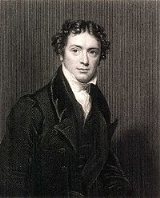
Michael Faraday, FRS (22 September 1791 – 25 August 1867) was an English chemist and physicist (or natural philosopher, in the terminology of the time) who contributed to the fields of electromagnetism
Electromagnetism

Electromagnetism is the physics of the electromagnetic field, a field which exerts a force on Elementary particles with the property of electric charge and which is reciprocally affected by the presence and motion of such particles....
 and electrochemistry
Electrochemistry

Electrochemistry is a branch of chemistry that studies chemical reactions which take place in a solution at the interface of an electron Electrical conductor and an ionic conductor , and which involve electron transfer between the electrode and the electrolyte or species in solution....
.

Faraday studied the magnetic
Magnetism

In physics, magnetism is one of the phenomena by which materials exert attractive or repulsive forces on other materials. Some well-known materials that exhibit easily detectable magnetic properties are nickel, iron, cobalt, and their alloys; however, all materials are influenced to greater or lesser degree by the presence of a magnetic fiel...
 field
Field (physics)

In physics, a field is a physical quantity associated to each point of spacetime. A field can be classified as a scalar field, a vector field, or a tensor field, according to whether the value of the field at each point is a scalar , a vector , or, more generally, a tensor, respectively....
 around a conductor
Electrical conductor

In science and Electrical engineering, an electrical conductor is a material which contains movable electric charges. In metallic conductors, such as copper or aluminum, the movable charged particles are electrons ....
 carrying a DC electric current
Electric current

Electric current is the flow of electric charge. The electric charge may be either electrons or ions.The International System of Units unit of electric current intensity is the ampere....
, and established the basis for the magnetic field concept in physics. He discovered electromagnetic induction, diamagnetism
Diamagnetism

Diamagnetism is the property of an object which causes it to create a magnetic field in opposition of an externally applied magnetic field, thus causing a repulsive effect....
, and laws of electrolysis
Faraday's laws of electrolysis

Faraday's laws of electrolysis are quantitative relationships based on the electrochemical researches published by Michael Faraday in 1834....
. He established that magnetism
Magnetism

In physics, magnetism is one of the phenomena by which materials exert attractive or repulsive forces on other materials. Some well-known materials that exhibit easily detectable magnetic properties are nickel, iron, cobalt, and their alloys; however, all materials are influenced to greater or lesser degree by the presence of a magnetic fiel...
 could affect rays
Ray (optics)

In optics, a ray is an idealized narrow beam of light. Rays are used to model the propagation of light through an optical system, by dividing the real light field up into discrete rays that can be computationally propagated through the system by the techniques of Ray tracing ....
 of light
Light

Light, or visible light, is electromagnetic radiation of a wavelength that is Visible spectrum to the human eye , or up to 380?750 nm. In the broader field of physics, light is sometimes used to refer to electromagnetic radiation of all wavelengths, whether visible or not....
 and that there was an underlying relationship between the two phenomena.


Discussion
Ask a question about 'Michael Faraday'
Start a new discussion about 'Michael Faraday'
Answer questions from other users
Full Discussion Forum


Recent Posts


Encyclopedia


Michael Faraday, FRS (22 September 1791 – 25 August 1867) was an English chemist and physicist (or natural philosopher, in the terminology of the time) who contributed to the fields of electromagnetism
Electromagnetism

Electromagnetism is the physics of the electromagnetic field, a field which exerts a force on Elementary particles with the property of electric charge and which is reciprocally affected by the presence and motion of such particles....
 and electrochemistry
Electrochemistry

Electrochemistry is a branch of chemistry that studies chemical reactions which take place in a solution at the interface of an electron Electrical conductor and an ionic conductor , and which involve electron transfer between the electrode and the electrolyte or species in solution....
.

Faraday studied the magnetic
Magnetism

In physics, magnetism is one of the phenomena by which materials exert attractive or repulsive forces on other materials. Some well-known materials that exhibit easily detectable magnetic properties are nickel, iron, cobalt, and their alloys; however, all materials are influenced to greater or lesser degree by the presence of a magnetic fiel...
 field
Field (physics)

In physics, a field is a physical quantity associated to each point of spacetime. A field can be classified as a scalar field, a vector field, or a tensor field, according to whether the value of the field at each point is a scalar , a vector , or, more generally, a tensor, respectively....
 around a conductor
Electrical conductor

In science and Electrical engineering, an electrical conductor is a material which contains movable electric charges. In metallic conductors, such as copper or aluminum, the movable charged particles are electrons ....
 carrying a DC electric current
Electric current

Electric current is the flow of electric charge. The electric charge may be either electrons or ions.The International System of Units unit of electric current intensity is the ampere....
, and established the basis for the magnetic field concept in physics. He discovered electromagnetic induction, diamagnetism
Diamagnetism

Diamagnetism is the property of an object which causes it to create a magnetic field in opposition of an externally applied magnetic field, thus causing a repulsive effect....
, and laws of electrolysis
Faraday's laws of electrolysis

Faraday's laws of electrolysis are quantitative relationships based on the electrochemical researches published by Michael Faraday in 1834....
. He established that magnetism
Magnetism

In physics, magnetism is one of the phenomena by which materials exert attractive or repulsive forces on other materials. Some well-known materials that exhibit easily detectable magnetic properties are nickel, iron, cobalt, and their alloys; however, all materials are influenced to greater or lesser degree by the presence of a magnetic fiel...
 could affect rays
Ray (optics)

In optics, a ray is an idealized narrow beam of light. Rays are used to model the propagation of light through an optical system, by dividing the real light field up into discrete rays that can be computationally propagated through the system by the techniques of Ray tracing ....
 of light
Light

Light, or visible light, is electromagnetic radiation of a wavelength that is Visible spectrum to the human eye , or up to 380?750 nm. In the broader field of physics, light is sometimes used to refer to electromagnetic radiation of all wavelengths, whether visible or not....
 and that there was an underlying relationship between the two phenomena. His invention
Invention

An invention is the creation of a new configuration, composition of matter, device, or process. Some inventions are based on pre-existing models or ideas....
s of electromagnetic rotary devices
Electric motor

An electric motor uses electrical energy to produce mechanical energy, nearly always by the interaction of magnetic fields and current-carrying conductors....
 formed the foundation of electric motor technology, and it was largely due to his efforts that electricity
Electricity

Electricity is a general term that encompasses a variety of phenomena resulting from the presence and flow of electric charge. These include many easily recognizable phenomena such as lightning and static electricity, but in addition, less familiar concepts such as the electromagnetic field and electromagnetic induction....
 became viable for use in technology.

As a chemist, Faraday discovered benzene
Benzene

Benzene, or benzol, is an organic compound chemical compound and a known carcinogen with the molecular formula Carbon6Hydrogen6....
, investigated the clathrate hydrate
Clathrate hydrate

Clathrate hydrates were first documented in 1810 by Sir Humphrey Davy; they are crystalline water based solids physically resembling ice, in which small Chemical polarity molecules are trapped inside "cages" of hydrogen bonded water ....
 of chlorine, invented an early form of the bunsen burner
Bunsen burner

A Bunsen burner is a common piece of laboratory equipment that produces a single open gas flame, which is used for heating, sterilization, and combustion....
 and the system of oxidation number
Oxidation number

The oxidation number of a central atom in a complex is the charge that it would have if all the ligands were removed along with the electron pairs that were shared with the central atom....
s, and popularized terminology such as anode
Anode

An anode is an electrode through which electric charge flows into a polarized electrical device. Mnemonic: ACID . Electrons flow in the opposite direction to the positive electric current....
, cathode
Cathode

A cathode is an electrode through which electric charge flows out of a polarized electrical device. Mnemonic: CCD .From an electrochemical point of view, positively charged ion invariably move toward the cathode and/or negatively charged ion move away from it to balance the electrons arriving from external circuitry....
, electrode
Electrode

An electrode is an electrical conductor used to make contact with a nonmetallic part of a Electronic circuit . The word was coined by the scientist Michael Faraday from the Greek language words elektron and hodos, a way....
, and ion
Ion

An ion is an atom or molecule which has lost or gained one or more electrons, giving it a positive or negative electrical charge. According to the Bohr_model this will be from or in the outer shield 'n'....
.

Although Faraday received little formal education and knew little of higher mathematics, such as calculus, he was one of the most influential scientist
Scientist

A scientist, in the broadest sense, refers to any person that engages in a system activity to acquire knowledge or an individual that engages in such practices and traditions that are linked to schools of thought or philosophy....
s in history. Some historians of science refer to him as the best experimentalist
Experimentalist

"Experimentalist" is a blanket term for all sorts of scientists engaged more in experimental activity than in the theoretical side of their sciences....
 in the history of science. The SI
Si

Si, si, or SI may refer to :...
 unit of capacitance
Capacitance

In electromagnetism and electronics, capacitance is the ability of a body to hold an electrical charge.Capacitance is also a measure of the amount of electric charge stored for a given electric potential....
, the farad
Farad

The farad is the SI unit of capacitance. The farad is named after the British physicist Michael Faraday....
, is named after him, as is the Faraday constant
Faraday constant

In physics and chemistry, the Faraday constant is the magnitude of electric charge per mole of electrons. While most uses of the Faraday constant, denoted F, have been replaced by the standard SI unit, the coulomb, the Faraday is still widely used in calculations in electrochemistry....
, the charge on a mole
Mole (unit)

The mole is a Units of measurement of amount of substance: it is an SI base unit, and one of the few units used to measure this physical quantity....
 of electron
Electron

The electron is a subatomic particle that carries a negative electric charge. It has elementary particle and is believed to be a point particle....
s (about 96,485 coulomb
Coulomb

The coulomb is the SI unit of electric charge. It is named after Charles-Augustin de Coulomb....
s). Faraday's law of induction
Faraday's law of induction

Faraday's law of induction describes a basic law of electromagnetism, which is involved in the working of transformers, inductors, and many forms of electrical generators....
 states that a magnetic field changing in time creates a proportional electromotive force
Electromotive force

Electromotive force is a term used to characterize electrical devices, such as voltaic cells, Thermoelectric effects, electrical generators and transformers, and even resistors....
.

Faraday was the first and foremost Fullerian Professor of Chemistry at the Royal Institution of Great Britain, a position to which he was appointed for life.

Faraday was highly religious; he was a member of the Sandemanian Church, a Christian
Christian

A Christian is a person who adheres to Christianity, a Monotheism#Christian view religion centered on the life and teachings of Jesus and interpreted by Christians to have been prophesied in the Hebrew Bible/Old Testament....
 sect founded in 1730 which demanded total faith and commitment. Biographers have noted that "a strong sense of the unity of God and nature pervaded Faraday's life and work."

Early life


Faraday was born in Newington Butts
Newington Butts

Newington Butts is a short road in London Borough of Southwark, London, England, leading south-west from the Elephant and Castle. The road forks into Kennington Park Road leading to Kennington and Kennington Lane leading to Vauxhall Bridge....
, now part of the London Borough of Southwark
London Borough of Southwark

The London Borough of Southwark is a London borough in south east London, England. It is directly south of the River Thames and the City of London, and forms part of Inner London....
; but then a suburban part of Surrey
Surrey

Surrey is a counties of England in the South East England of England and is one of the Home Counties. The county borders Greater London, Kent, East Sussex, West Sussex, Hampshire, and Berkshire....
, one mile south of London Bridge
London Bridge

London Bridge is a bridge between the City of London and Southwark in London, England, over the River Thames. Situated between Cannon Street Railway Bridge and Tower Bridge, it forms the western end of the Pool of London....
. His family was not well off. His father, James, was a member of the Sandemanian sect of Christianity. James Faraday had come to London around 1790 from Outhgill
Outhgill

Outhgill is a hamlet in Mallerstang, Cumbria. It lies about 5 miles south of Kirkby Stephen.It is the main hamlet in the dale of Mallerstang - a civil parish, which retains the Norsemen pattern of its original settlement: a series of small hamlets and isolated houses, with no village centre....
 in Westmorland
Westmorland

Westmorland is an area of north-west England and one of the 39 historic counties of England. It formed an administrative county from 1889 to 1974 and now forms part of Cumbria....
, where he had been the village blacksmith. The young Michael Faraday, one of four children, having only the most basic of school educations, had to largely educate himself. At fourteen he became apprenticed to a local bookbinder and bookseller George Riebau
George Riebau

George Riebau was a bookseller and bookbinder in Oxford Street, London to whom Michael Faraday was apprenticed in 1805 at the age of fourteen. During his seven years' apprenticeship, Faraday made good use of the priceless access to books which his employment gave him and which his generous employer allowed: "Whilst an apprentice, I loved to r...
 and, during his seven-year apprenticeship, he read many books, including Isaac Watts
Isaac Watts

Isaac Watts is recognised as the "Father of English Hymnody", as he was the first prolific and popular English hymnwriter, credited with some 750 hymns....
' The Improvement of the Mind, and he enthusiastically implemented the principles and suggestions that it contained. He developed an interest in science, especially in electricity. In particular, he was inspired by the book Conversations in Chemistry by Jane Marcet
Jane Marcet

Jane Marcet was a writer of introductory science books.She was born in London, to a wealthy Swiss family, and was tutored at home with her brothers....
.

At the age of twenty, in 1812, at the end of his apprenticeship, Faraday attended lectures by the eminent English chemist Humphry Davy
Humphry Davy

Sir Humphry Davy, 1st Baronet Fellow of the Royal Society Royal Irish Academy was a Cornish chemist and inventor. He is probably best remembered today for his discoveries of several alkali metal and alkaline earth metals, as well as contributions to the discoveries of the elemental nature of chlorine and iodine....
 of the Royal Institution
Royal Institution

The Royal Institution of Great Britain is an organization devoted to scientific education and research, based in London. It was founded in 1799 by the leading British scientists of the age, including Henry Cavendish and its first president, George Finch, 9th Earl of Winchilsea, for "diffusing the knowledge, and facilitating the general int...
 and Royal Society
Royal Society

The Royal Society of London for the Improvement of Natural Knowledge, known simply as the Royal Society, or even the Royal, is a learned society for science that was founded in 1660 and is considered by most to be the oldest such society still in existence....
, and John Tatum, founder of the City Philosophical Society. Many tickets for these lectures were given to Faraday by William Dance
William Dance

William Dance, , was an English pianist and violinist....
 (one of the founders of the Royal Philharmonic Society
Royal Philharmonic Society

The Royal Philharmonic Society is a Great Britain European classical music society, formed in 1813. It was originally formed in London to promote performances of instrumental music there....
). Afterwards, Faraday sent Davy a three hundred page book based on notes taken during the lectures. Davy's reply was immediate, kind, and favourable. When Davy damaged his eyesight in an accident with nitrogen trichloride
Nitrogen trichloride

Nitrogen trichloride, also known as trichloramine, trichlorine nitride is the chemical compound with the chemical formula NCl3....
, he decided to employ Faraday as a secretary. When John Payne, one of the Royal Institution's assistants, was sacked, Sir Humphry Davy was asked to find a replacement. He appointed Faraday as Chemical Assistant at the Royal Institution on 1 March 1813 . In the class-based English society of the time, Faraday was not considered a gentleman. When Davy went on a long tour to the continent in 1813–15, his valet
Valet

Valet and Varlet are terms for male Domestic workers who serve as personal attendants to their employer. In the Middle Ages, the valet de chambre to a ruler was a prestigious appointment for young courtiers, though in England, unlike France, these court roles later came to be called "Groom of the Chamber"....
 did not wish to go. Faraday was going as Davy's scientific assistant, and was asked to act as Davy's valet until a replacement could be found in Paris. Faraday was forced to fill the role of valet as well as assistant throughout the trip. Davy's wife, Jane Apreece
Jane Apreece

Jane Apreece , was a wealthy Scotland socialite and widow who married Sir Humphry Davy in 1812 to become Lady Davy. The marriage was ultimately unhappy and childless....
, refused to treat Faraday as an equal (making him travel outside the coach, eat with the servants, etc.) and generally made Faraday so miserable that he contemplated returning to England alone and giving up science altogether. The trip did, however, give him access to the European scientific elite and a host of stimulating ideas.

His sponsor and mentor was John 'Mad Jack' Fuller
John 'Mad Jack' Fuller

John Fuller , better known as "Mad Jack" Fuller was Squire of the hamlet of Brightling, in Sussex , and is well known as a builder of folly, and as a philanthropist, patron of the arts and sciences....
, who created the Fullerian Professorship of Chemistry at the Royal Institution.

Faraday was a devout Christian and a member of the small Sandemanian denomination, an offshoot of the Church of Scotland
Church of Scotland

The Church of Scotland , known informally by its Scots language name, The Kirk, is the national church of Scotland. It is a Presbyterianism church , decisively shaped by the Scottish Reformation....
. He later served two terms as an elder in the group's church at Glovers Hall, Barbican
Barbican

A barbican is a fortified outpost or gateway, such as an outer defense to a city or castle, or any tower situated over a gate or bridge which was used for defensive purposes....
, which later moved to Barnsbury
Barnsbury

Barnsbury is an area of north London in the London Borough of Islington, in the London N1 and London N7 UK postcodes.The name is a corruption of villa de Iseldon Berners , being so called after the Berners family, who gained ownership of the lands after the Norman Conquest and were powerful medieval manorial lords, owning a large part...
, Islington
London Borough of Islington

The London Borough of Islington is a London borough in North London and Inner London. It was formed in 1965 by merging the former Metropolitan Borough of Metropolitan Borough of Islington and Metropolitan Borough of Finsbury....
.

Faraday married Sarah Barnard (1800-1879) on 2 June 1821, although they would never have children. They met through attending the Sandemanian church. He was elected a member of the Royal Society in 1824, appointed director of the laboratory in 1825; and in 1833 he was appointed Fullerian professor of chemistry in the institution for life, without the obligation to deliver lectures.

Scientific achievements


Chemistry


Faraday's earliest chemical work was as an assistant to Humphry Davy. Faraday made a special study of chlorine
Chlorine

Chlorine...
, and discovered two new chlorides of carbon
Carbon

Carbon is a chemical element with chemical symbol C and atomic number 6. As a member of group 14 on the periodic table, it is nonmetallic and tetravalence?making four electrons available to form covalent bond chemical bonds....
. He also made the first rough experiments on the diffusion of gases, a phenomenon first pointed out by John Dalton
John Dalton

John Dalton Fellow of the Royal Society was an England chemist, meteorologist and physicist. He is best known for his pioneering work in the development of modern atomic theory, and his research into Color blindness ....
, the physical importance of which was more fully brought to light by Thomas Graham
Thomas Graham (chemist)

Thomas Graham Fellow of the Royal Society was born in Glasgow, Scotland. Graham's father was a successful textile manufacturer, and wanted his son to enter into the Church of Scotland....
 and Joseph Loschmidt. He succeeded in liquefying several gases; he investigated the alloys of steel, and produced several new kinds of glass intended for optical purposes. A specimen of one of these heavy glasses afterwards became historically important as the substance in which Faraday detected the rotation of the plane of polarisation of light when the glass was placed in a magnetic field, and also as the substance which was first repelled by the poles of the magnet. He also endeavoured, with some success, to make the general methods of chemistry, as distinguished from its results, the subject of special study and of popular exposition.

He invented an early form of what was to become the Bunsen burner
Bunsen burner

A Bunsen burner is a common piece of laboratory equipment that produces a single open gas flame, which is used for heating, sterilization, and combustion....
, which is used almost universally in science laboratories as a convenient source of heat. Faraday worked extensively in the field of chemistry, discovering chemical substances such as benzene (which he called bicarburet of hydrogen), inventing the system of oxidation number
Oxidation number

The oxidation number of a central atom in a complex is the charge that it would have if all the ligands were removed along with the electron pairs that were shared with the central atom....
s, and liquefying gases such as chlorine. In 1820 Faraday reported on the first syntheses of compounds made from carbon and chlorine, C2Cl6
Hexachloroethane

Hexachloroethane, also known as perchloroethane , carbonchlorine, is a colorless solid at room temperature which is used by the US Military in smoke compositions, e.g....
 and C2Cl4
Tetrachloroethylene

Tetrachloroethylene, also known under its systematic name tetrachloroethene and as perchloroethylene, perchloroethene, perc, and PCE, is a chlorocarbon with the formula Cl2C=CCl2....
, and published his results the following year. Faraday also determined the composition of the chlorine clathrate hydrate
Clathrate hydrate

Clathrate hydrates were first documented in 1810 by Sir Humphrey Davy; they are crystalline water based solids physically resembling ice, in which small Chemical polarity molecules are trapped inside "cages" of hydrogen bonded water ....
, which had been discovered by Humphry Davy in 1810.

Faraday also discovered the laws of electrolysis and popularised terminology such as anode, cathode, electrode, and ion, terms largely created by William Whewell
William Whewell

William Whewell was an English polymath, scientist, Anglican priest, philosopher, theologian, and History of science. His surname is pronounced "hew-el." ...
.

Faraday was the first to report what later came to be called metallic nanoparticles. In 1847 he discovered that the optical properties of gold colloid
Colloid

A colloid is a type of chemical mixture where one substance is dispersed evenly throughout another. The particles of the dispersed substance are only suspended in the mixture, unlike a solution, where they are completely dissolved within....
s differed from those of the corresponding bulk metal. This was probably the first reported observation of the effects of quantum
Quantum

In physics, a quantum is an indivisible entity of a quantity that has the same units as the Planck constant and is related to both energy and momentum of elementary particles of matter and of photons and other bosons....
 size, and might be considered to be the birth of nanoscience.

Electricity and magnetism

Faraday's greatest work was probably with electricity and magnetism. The first experiment which he recorded was the construction of a voltaic pile
Voltaic pile

A voltaic pile is a set of individual Galvanic cells placed in series. The voltaic pile, invented by Alessandro Volta in 1800, was the first battery ....
 with seven halfpence pieces, stacked together with seven disks of sheet zinc, and six pieces of paper moistened with salt water. With this pile he decomposed sulphate of magnesia (first letter to Abbott, 12 July 1812).

In 1821, soon after the Danish physicist and chemist, Hans Christian Ørsted
Hans Christian Ørsted

Hans Christian ?rsted was a Denmark physicist and chemist. He shaped Kantianism and advances in science throughout the late nineteenth century....
 discovered the phenomenon of electromagnetism
Electromagnetism

Electromagnetism is the physics of the electromagnetic field, a field which exerts a force on Elementary particles with the property of electric charge and which is reciprocally affected by the presence and motion of such particles....
, Davy and British scientist William Hyde Wollaston
William Hyde Wollaston

William Hyde Wollaston Royal Society was an English chemist and physicist who is famous for discovering two chemical elements and for developing a way to process platinum ore....
 tried but failed to design an electric motor
Electric motor

An electric motor uses electrical energy to produce mechanical energy, nearly always by the interaction of magnetic fields and current-carrying conductors....
. Faraday, having discussed the problem with the two men, went on to build two devices to produce what he called electromagnetic rotation: a continuous circular motion from the circular magnetic force around a wire and a wire extending into a pool of mercury
Mercury (element)

Mercury , also called quicksilver or hydrargyrum , is a chemical element with the symbol Hg and atomic number 80. A heavy, silvery d-block metal, mercury is one of six elements that are liquid at or near room temperature and pressure....
 with a magnet placed inside would rotate around the magnet if supplied with current from a chemical battery. The latter device is known as a homopolar motor
Homopolar motor

A homopolar motor has a magnetic field along the axis of rotation and an electric current that at some point is not parallel to the magnetic field....
. These experiments and inventions form the foundation of modern electromagnetic technology. Faraday published his results without acknowledging his debt to Wollaston and Davy, and the resulting controversy caused Faraday to withdraw from electromagnetic research for several years.

At this stage, there is also evidence to suggest that Davy may have been trying to slow Faraday's rise as a scientist (or natural philosopher as it was known then). In 1825, for instance, Davy set him onto optical glass experiments, which progressed for six years with no great results. It was not until Davy's death, in 1829, that Faraday stopped these fruitless tasks and moved on to endeavors that were more worthwhile. Two years later, in 1831, he began his great series of experiments in which he discovered electromagnetic induction. Joseph Henry
Joseph Henry

Joseph Henry was an American scientist who served as the first Secretary of the Smithsonian Institution. During his lifetime, he was considered one of the greatest American scientists since Benjamin Franklin....
 likely discovered self-induction a few months earlier and both may have been anticipated by the work of Francesco Zantedeschi
Francesco Zantedeschi

Francesco Zantedeschi was an Italy priest and physicist. For some time Ab?e Zantedeschi was professor of physics and philosophy in the Liceo of Venice....
 in Italy in 1829 and 1830.

Faraday's breakthrough came when he wrapped two insulated coils of wire around an iron ring, and found that upon passing a current through one coil, a momentary current was induced in the other coil. This phenomenon is known as mutual induction. The iron ring-coil apparatus is still on display at the Royal Institution. In subsequent experiments he found that if he moved a magnet through a loop of wire, an electric current flowed in the wire. The current also flowed if the loop was moved over a stationary magnet. His demonstrations established that a changing magnetic field produces an electric field. This relation was mathematically modelled by Faraday's law
Faraday's law of induction

Faraday's law of induction describes a basic law of electromagnetism, which is involved in the working of transformers, inductors, and many forms of electrical generators....
, which subsequently became one of the four Maxwell equations
Maxwell's equations

In electromagnetism, James Clerk Maxwell equations are a set of four partial differential equations that describe the properties of the electric field and magnetic field fields and relate them to their sources, charge density and current density....
. These in turn have evolved into the generalisation known today as field theory
Field theory (physics)

There are two types of field theory in physics:*Classical field theory, the theory and dynamics of classical fields.*Quantum field theory, the theory of Quantum mechanics fields....
.

Faraday later used the principle to construct the electric dynamo
Electrical generator

In electricity generation, an electrical generator is a device that converts mechanical energy to electrical energy, generally using electromagnetic induction....
, the ancestor of modern power generators.

In 1839 he completed a series of experiments aimed at investigating the fundamental nature of electricity. Faraday used "static
Electrostatics

Electrostatics is the branch of science that deals with the phenomena arising from stationary or slowly moving electric charges.Since classical antiquity it was known that some materials such as amber attract light particles after Triboelectric effect....
", batteries
Battery (electricity)

In electronics, a battery or voltaic cell is a combination of one or more electrochemical cell Galvanic cells which store chemical energy that can be converted into electric potential energy, creating electricity....
, and "animal electricity
Bioelectromagnetism

Bioelectromagnetism refers to the electrical, magnetic or electromagnetic fields produced by living cell s, biological tissues or organisms. Examples include the cell membrane potential and the electric currents that flow in nerves and muscles, as a result of action potentials....
" to produce the phenomena of electrostatic attraction, electrolysis
Electrolysis

In chemistry and manufacturing, electrolysis is a method of separating Chemical bond chemical compound by passing an electric current through them....
, magnetism
Electromagnetism

Electromagnetism is the physics of the electromagnetic field, a field which exerts a force on Elementary particles with the property of electric charge and which is reciprocally affected by the presence and motion of such particles....
, etc. He concluded that, contrary to scientific opinion of the time, the divisions between the various "kinds" of electricity were illusory. Faraday instead proposed that only a single "electricity" exists, and the changing values of quantity and intensity (voltage and charge) would produce different groups of phenomena.

Near the end of his career Faraday proposed that electromagnetic forces extended into the empty space around the conductor. This idea was rejected by his fellow scientists, and Faraday did not live to see this idea eventually accepted. Faraday's concept of lines of flux emanating from charged bodies and magnets provided a way to visualise electric and magnetic fields. That mental model was crucial to the successful development of electromechanical devices which dominated engineering and industry for the remainder of the 19th century.

Diamagnetism

Faraday Photograph Ii
In 1845, Faraday discovered that many materials exhibit a weak repulsion from a magnetic field, a phenomenon he named diamagnetism
Diamagnetism

Diamagnetism is the property of an object which causes it to create a magnetic field in opposition of an externally applied magnetic field, thus causing a repulsive effect....
.

Faraday also found that the plane of polarisation
Polarization

Polarization is a property of waves that describes the orientation of their oscillations. For transverse waves such as many electromagnetic waves, it describes the orientation of the oscillations in the plane perpendicular to the wave's direction of travel....
 of linearly polarised light can be rotated by the application of an external magnetic field aligned in the direction the light is moving. This is now termed the Faraday effect
Faraday effect

In physics, the Faraday effect or Faraday rotation is a magneto-optical phenomenon, or an interaction between light and magnetic field in a medium....
. He wrote in his notebook, "I have at last succeeded in illuminating a magnetic curve or line of force
Line of force

A line of force in Michael Faraday's extended sense is synonymous with James Clerk Maxwell's line of induction. According to J.J. Thomson, Faraday usually discusses lines of force as chains of polarized particles in a dielectric, yet sometimes Faraday discusses them as having an existence all their own as in stretching across a vacu...
 and in magnetising a ray of light". This established that magnetic force and light were related.

Late in life (1862), Faraday used a spectroscope to search for a different alteration of light, the change of spectral lines by an applied magnetic field. However, the equipment available to him was insufficient for a definite determination of a spectral change. Pieter Zeeman
Pieter Zeeman

Pieter Zeeman was a Netherlands physics who shared the 1902 Nobel Prize in Physics with Hendrik Lorentz for his discovery of the Zeeman effect....
 later used an improved apparatus to study the same phenomenon, publishing his results in 1897 and receiving the 1902 Nobel Prize in Physics for his success. In both his 1897 paper and his Nobel acceptance speech, Zeeman referred to Faraday's work.

Faraday cage


Youngjamesclerkmaxwell
In his work on static electricity, Faraday demonstrated that the charge only resided on the exterior of a charged conductor, and exterior charge had no influence on anything enclosed within a conductor. This is because the exterior charges redistribute such that the interior fields due to them cancel. This shielding effect is used in what is now known as a Faraday cage
Faraday cage

A Faraday cage or Faraday shield is an enclosure formed by electrical conductor, or by a mesh of such material. Such an enclosure blocks out external static electrical fields....
.

Faraday was an excellent experimentalist who conveyed his ideas in clear and simple language. However, his mathematical abilities did not extend as far as trigonometry or any but the simplest algebra. It was James Clerk Maxwell
James Clerk Maxwell

James Clerk Maxwell was a Scotland Mathematical physics. His most significant achievement was the development of the classical electromagnetic theory, synthesizing all previous unrelated observations, experiments and equations of electricity, magnetism and even optics into a consistent theory....
 who took the work of Faraday, and others, and consolidated it with a set of equations that lie at the base of all modern theories of electromagnetic phenomena. On Faraday's uses of the lines of force, James Clerk Maxwell wrote that they show Faraday "to have been in reality a mathematician of a very high order--one from whom the mathematicians of the future may derive valuable and fertile methods."

Public service


Beyond his scientific research into areas such as chemistry, electricity, and magnetism at the Royal Institution, Faraday undertook numerous, and often time-consuming, service projects for private enterprise and the British government. This work included investigations of explosions in coal mines, being an expert witness
Expert witness

An expert witness or professional witness is a witness, who by virtue of education, training, skill, or experience, is believed to have knowledge in a particular subject beyond that of the average person, sufficient that others may officially rely upon the witness's specialized opinion about an evidence or fact issue within the scope...
 in court, and the preparation of high-quality optical glass. In 1846, together with Charles Lyell
Charles Lyell

Sir Charles Lyell, 1st Baronet, Order of the Thistle, Fellow of the Royal Society was a Scotland lawyer, geologist, and protagonist of Uniformitarianism ....
, he produced a lengthy and detailed report on a serious explosion
Explosion

An explosion is a sudden increase in volume and release of energy in an extreme manner, usually with the generation of high temperatures and the release of gases....
 in the colliery at Haswell County Durham which killed 95 miners. Their report was a meticulous forensic investigation and indicated that coal dust
Coal dust

Coal dust is a fine Powder form of coal, which is created by the crushing, grinding, or pulverizing of coal. Because of the brittle nature of coal, coal dust can be created during mining, transportation, or by mechanically handling coal....
 contributed to the severity of the explosion. The report should have warned coal owners of the hazard of coal dust explosions, but the risk was ignored for over 60 years until the Senghenydd Colliery Disaster
Senghenydd Colliery Disaster

The Senghenydd Colliery Disaster, also known as the Senghenydd Explosion, occurred in Senghenydd , near Caerphilly, Glamorgan, South Wales on 14 October 1913, killing 439 miners....
 of 1913.

As a respected scientist in a nation with strong maritime interests, Faraday spent extensive amounts of time on projects such as the construction and operation of light house
Lighthouse

A lighthouse is a tower, building, or framework designed to emit light from a system of lamps and lens or, in older times, from a fire and used as an aid to navigation and to Maritime pilot at sea....
s and protecting the bottoms of ships from corrosion
Corrosion

Corrosion means the breaking down of essential properties in a material due to chemical reactions with its surroundings. In the most common use of the word, this means a loss of electrons of metals reacting with water and oxygen....
.

Crystal Palace From the Northeast From Dickinson's Comprehensive Pictures of the Great Exhibition of 1851
Faraday also was active in what would now be called environmental science
Environmental science

Environmental science is an expression encompassing the wide range of scientific disciplines that need to be brought together to understand and manage the natural environment and the many interactions among physics, chemistry, and biology components....
, or engineering. He investigated industrial pollution at Swansea
Swansea

Swansea is a City status in the United Kingdom and subdivisions of Wales in Wales. Swansea is in the Historic counties of Wales of Glamorgan. Situated on the sandy South West Wales coast, the county area includes the Gower peninsula and the Lliw uplands....
 and was consulted on air pollution at the Royal Mint
Royal Mint

The Royal Mint of the United Kingdom is the body permitted to manufacture, or mint , Coins of the pound sterling in the United Kingdom. The Mint originated over 1,100 years ago, but has functioned since 1975 as a Trading Fund, operating in much the same way as a government-owned company....
. In July 1855, Faraday wrote a letter to The Times
The Times

The Times is a daily national newspaper published in the United Kingdom since 1785 when it was known as The Daily Universal Register.The Times and its sister paper The Sunday Times are published by Times Newspapers Limited, a subsidiary of News International....
 on the subject of the foul condition of the River Thames
River Thames

The Thames is a major river flowing through southern England. While best known because its lower reaches flow through central London, the river flows through several other towns and cities, including Oxford, Reading, Berkshire and Windsor, Berkshire....
, which resulted in an oft-reprinted cartoon in Punch
Punch

Punch can refer to:...
. (See also The Great Stink
The Great Stink

The Great Stink or The Big Stink was a time in the summer of 1858 during which the smell of untreated sewage almost overwhelmed people in central London, England....
.)

Faraday assisted with planning and judging of exhibits for the Great Exhibition of 1851 in London. He also advised the National Gallery
National Gallery, London

The National Gallery in London, founded in 1824, houses a rich collection of over 2,300 paintings dating from the mid-13th century to 1900 in its home on Trafalgar Square....
 on the cleaning and protection of its art collection, and served on the National Gallery Site Commission in 1857.

Education was another area of service for Faraday. He lectured on the topic in 1854 at the Royal Institution, and in 1862 he appeared before a Public Schools Commission to give his views on education in Great Britain. Faraday also weighed in, negatively, on the public's fascination with table-turning, mesmerism, and seances, chastising both the public and the nation's educational system.

Faraday gave a successful series of lectures on the chemistry and physics of flames at the Royal Institution
Royal Institution

The Royal Institution of Great Britain is an organization devoted to scientific education and research, based in London. It was founded in 1799 by the leading British scientists of the age, including Henry Cavendish and its first president, George Finch, 9th Earl of Winchilsea, for "diffusing the knowledge, and facilitating the general int...
, entitled The Chemical History of a Candle
The Chemical History of a Candle

The Chemical History of a Candle was the title of a series of lectures on the chemistry and physics of flames given by Michael Faraday at the Royal Institution....
. This was one of the earlier Christmas lectures
Royal Institution Christmas Lectures

The Royal Institution Christmas Lectures have been held in London annually since 1825. They serve as a forum for presenting complex scientific issues to a general audience in an informative and entertaining manner....
 for young people, which are still given each year. Between 1827 and 1860, Faraday gave the Christmas lecture a record nineteen times.

Later life

In June 1832, the University of Oxford
University of Oxford

The University of Oxford , located in the city of Oxford, Oxfordshire, England, is the List of oldest universities in continuous operation in the English-speaking world....
 granted Faraday a Doctor of Civil Law degree (honorary). During his lifetime, Faraday rejected a knighthood and twice refused to become President of the Royal Society
President of the Royal Society

The President of the Royal Society is the elected head of the Royal Society of London. The position is now awarded to a member of the scientific community of the British Commonwealth of Nations for a period of five years, and is one of the highest honours that can be bestowed upon a scientist.....
. Faraday was one of eight foreign members elected to the French Academy of Sciences
French Academy of Sciences

The French Academy of Sciences is a learned society, founded in 1666 by Louis XIV of France at the suggestion of Jean-Baptiste Colbert, to encourage and protect the spirit of French people Scientific method....
 in 1844.

Faraday refused to participate in the production of chemical weapons for the Crimean War
Crimean War

The Crimean War, also known in Russia as the Oriental War was fought between the Russian Empire on one side and an alliance of France, the United Kingdom of Great Britain and Ireland, the Kingdom of Sardinia, and the Ottoman Empire on the other....
 citing ethical reasons.

In 1848, as a result of representations by the Prince Consort
Albert of Saxe-Coburg and Gotha

Prince Albert of Saxe-Coburg and Gotha was the husband of Victoria of the United Kingdom of the United Kingdom of Great Britain and Ireland.He was born in the Ernestine duchies of Saxe-Coburg-Saalfeld to a family connected to many of Europe's ruling monarchs....
, Michael Faraday was awarded a grace and favour
Grace and favour

A grace and favour home is a residential property owned by a monarch by virtue of their position as head of state and leased rent-free to persons as part of an employment package or in gratitude for past services rendered....
 house in Hampton Court, Surrey
Surrey

Surrey is a counties of England in the South East England of England and is one of the Home Counties. The county borders Greater London, Kent, East Sussex, West Sussex, Hampshire, and Berkshire....
 free of all expenses or upkeep. This was the Master Mason's House, later called Faraday House, and now No.37 Hampton Court Road. In 1858 Faraday retired to live there.

Faraday died at his house at Hampton Court on 25 August 1867. He had previously turned down burial in Westminster Abbey
Westminster Abbey

The Collegiate Church of St Peter at Westminster, which is almost always referred to popularly and informally as Westminster Abbey, is a large, mainly Gothic architecture Church , in Westminster, London, just to the west of the Palace of Westminster....
, but he has a memorial plaque there, near Isaac Newton
Isaac Newton

Sir Isaac Newton, Fellow of the Royal Society was an English people physicist, mathematician, Astronomy, Natural philosophy, Alchemy, and Theology and one of the the 100 in human history....
's tomb. Faraday was interred in the Sandemanian plot in Highgate Cemetery
Highgate Cemetery

Highgate Cemetery is a cemetery located in Highgate, London, England. It is designated Grade II* on the English Heritage National Register of Historic Parks and Gardens....
.

Commemorations


A statue of Faraday stands in Savoy Place, London, outside the Institution of Engineering and Technology
Institution of Engineering and Technology

The Institution of Engineering and Technology is a United Kingdom professional body for those working in engineering and technology in the United Kingdom and worldwide....
. Also in London, the Michael Faraday Memorial
Michael Faraday Memorial

The Michael Faraday Memorial is a monument to the Victorian era scientist Michael Faraday in Elephant and Castle, London, England.The stainless steel box-shaped structure was designed by Brutalist architect Rodney Gordon in 1959 and built in 1961 on the centre of the northern roundabout of the Elephant and Castle gyratory system....
, designed by brutalist architect Rodney Gordon
Rodney Gordon

Rodney Gordon was a United Kingdom architect. He was the primary architect of the Tricorn centre, Portsmouth. Architecturally, his works were primarily in concrete; he was said to be a Brutalist architecture and his buildings have been described as "dramatic, sculptural and enormous" as well as "futuristic"....
 and completed in 1961, is at the Elephant & Castle gyratory system, near Faraday's birthplace at Newington Butts
Newington Butts

Newington Butts is a short road in London Borough of Southwark, London, England, leading south-west from the Elephant and Castle. The road forks into Kennington Park Road leading to Kennington and Kennington Lane leading to Vauxhall Bridge....
.

A hall at Loughborough University
Loughborough University

Loughborough University is a campus university located in the market town of Loughborough, Leicestershire, in the East Midlands of England.It has been a university since 1966, but the institution dates back to 1909, when the then Loughborough Technical Institute began with a focus on skills and knowledge which would be directly applicable i...
 was named after Faraday in 1960. Near the entrance to its dining hall is a bronze casting, which depicts the symbol of an electrical transformer
Transformer

A transformer is a device that transfers electrical energy from one electrical network to another through inductive coupling conductors — the transformer's coils or "windings"....
, and inside there hangs a portrait, both in Faraday's honour. A five-story building at the University of Edinburgh
University of Edinburgh

The University of Edinburgh founded in 1582, is an internationally renowned centre for teaching and research in Edinburgh, Scotland, United Kingdom....
's science campus is named for Faraday, as is a recently-built hall of accommodation at Brunel University
Brunel University

Brunel University is a university situated in West London, England....
. The former UK in Antarctica was named after him.

Streets named for Faraday can be found in many British cities (e.g., London
London

London is the capital of both England and the United Kingdom, and the most populous municipality in the European Union. An important settlement for two millennia, History of London goes back to its founding by the Roman Empire....
, Fife
Fife

Fife is a council area of Scotland, situated between the Firth of Tay and the Firth of Forth, with inland boundaries to Perth and Kinross and Clackmannanshire....
, Swindon
Swindon

Swindon is a City sized town and unitary borough authority in the ceremonial county of Wiltshire in South West England England. It is midway between Bristol, west and Reading, Berkshire, east....
, Basingstoke
Basingstoke

Basingstoke is a town#England and Wales in northeast Hampshire, England. It lies across a valley at the source of the River Loddon. It is southwest of London, northeast of Southampton, southwest of Reading, Berkshire, and northeast of the county town, Winchester....
, Nottingham
Nottingham

Nottingham is one of the three major city status in the United Kingdom in the East Midlands and is in the ceremonial county of Nottinghamshire, England....
, Whitby
Whitby

Whitby is a town and civil parish in the Scarborough district of North Yorkshire on the north-east coast of England. Nowadays it is a fishing port and tourist destination....
, Kirkby
Kirkby

Kirkby is a town in the Metropolitan Borough of Knowsley on Merseyside in England. The town was developed from the 1950s through 1970s as a means to house the overspill of Liverpool....
, Crawley
Crawley

Crawley is a town and local government district with Borough status in England and Wales in West Sussex, England. It is south of London, north of Brighton and Hove, and northeast of the county town of Chichester, covers an area of and had a population of 99,744 at the time of the United Kingdom Census 2001....
, Newbury
Newbury

Newbury may refer to:* Newbury In the United Kingdom:* Newbury, Berkshire**Newbury * Newbury, Kent* Newbury, Somerset* Newbury, Wiltshire...
, Aylesbury
Aylesbury

See also: Aylesbury Urban AreaAylesbury is the county town of Buckinghamshire in south east England. In the United Kingdom Census 2001 the Aylesbury Urban Area, which includes Bierton, Fairford Leys, Stoke Mandeville and Watermead, Buckinghamshire, had a population of 69,021, which included 56,392 for the Aylesbury civil parish....
 and Stevenage
Stevenage

Stevenage is a town and Non-metropolitan district in Hertfordshire, England. It is to the east of junctions 7 and 8 of the A1 road , and is between Letchworth to the north, and Welwyn Garden City to the south....
) as well as in France (Paris), Germany (Hermsdorf), and Canada (Quebec).

From 1991 until 2001, Faraday's picture featured on the reverse of Series E £20 banknotes issued by the Bank of England
Bank of England note issues

The Bank of England is the Central Bank of the United Kingdom and one of Banknotes of the pound sterling legally authorised to issue banknotes in the UK....
. He was shown conducting a lecture at the Royal Institution with the magneto-electric spark apparatus.

Selected writings


Faraday's books, with the exception of Chemical Manipulation, were collections of scientific papers or transcriptions of lectures. Since his death, Faraday's diary has been published, as have several large volumes of his letters and Faraday's journal from his travels with Davy in 1813 - 1815.

,

- vol. iii., 1844; vol. iii. Richard Taylor and William Francis, 1855

- published in eight volumes

- volume 2, 1993; volume 3, 1996; volume 4, 1999

  • London ; Glasgow : R. Griffin, 1860.


  • Edinburgh: W. F. Clay, 1896.


  • London: Williams & Norgate 1899.


Quotations

  • "Nothing is too wonderful to be true if it be consistent with the laws of nature, and in such things as these, experiment is the best test of such consistency."
  • "Work. Finish. Publish." — his advice to the young William Crookes
    William Crookes

    Sir William Crookes, Order of Merit , Fellow of the Royal Society was an England chemist and physicist who attended the Royal College of Chemistry, in London, and worked on spectroscopy....
  • "The important thing is to know how to take all things quietly."
  • Regarding the hereafter, "Speculations? I have none. I am resting on certainties."
  • "No wonder that my remembrance fails me, for I shall complete my 70 years next Sunday (the 22); -- and during these 70 years I have had a happy life; which still remains happy because of hope and content.


  • Above the doorways of the Pfahler Hall of Science at Ursinus College
    Ursinus College

    Ursinus College is a Liberal arts colleges in the United States in Collegeville, Pennsylvania, Montgomery County, Pennsylvania....
     in Collegeville, Pennsylvania, there is a stone inscription of a quote attributed to Michael Faraday which reads "but still try, for who knows what is possible..."
  • "One day sir, you may tax
    Tax

    To tax is to impose a financial charge or other levy upon an individual or Legal person by a state or the functional equivalent of a state.Taxes are also imposed by many subnational entity....
     it." Faraday's reply to William Gladstone, then British Minister of Finance, when asked of the practical value of electricity.
  • "If you would cause your view ... to be acknowledged by scientific men; you would do a great service to science. If you would even get them to say yes or no to your conclusions it would help to clear the future progress. I believe some hesitate because they do not like their thoughts disturbed."


See also

  • Faraday rotator
    Faraday rotator

    A Faraday rotator is an optical device that rotates the polarization of light due to the Faraday effect, which in turn is based on a magneto-optic effect....
  • Homopolar generator
    Homopolar generator

    A homopolar generator is a Direct current electrical generator that is made when a magnetic electrically conductive rotating disk has a different magnetic field passing through it ....
  • Faraday's law of induction
    Faraday's law of induction

    Faraday's law of induction describes a basic law of electromagnetism, which is involved in the working of transformers, inductors, and many forms of electrical generators....
  • Faraday (Unit of electrical charge)
  • Farad
    Farad

    The farad is the SI unit of capacitance. The farad is named after the British physicist Michael Faraday....
     (Unit of electrical capacitance)
  • Forensic engineering
    Forensic engineering

    Forensics engineering is the investigation of material science, product , structures or components that fail or do not operate/function as intended, causing personal injury or damage to property....
  • Lines of force
  • Zeeman effect
    Zeeman effect

    The Zeeman effect is the splitting of a spectral line into several components in the presence of a static magnetic field. It is analogous to the Stark effect, the splitting of a spectral line into several components in the presence of an electric field....
  • Timeline of hydrogen technologies
    Timeline of hydrogen technologies

    Timeline of hydrogen technologies A timeline of the history of hydrogen technology....
  • Timeline of low-temperature technology
    Timeline of low-temperature technology

    The following is a timeline of Refrigeration technology and Cryogenics technology ....


Further reading


Biographies


* Reprinted in 2005 by Adamant Media Corporation


  • The British Electrical and Allied Manufacturers Association (1931). Faraday. R. & R. Clark, Ltd., Edinburgh, 1931.


Others


External links


Biographies

  • (downloads)
  • by J. A. Crowther, London: Society for Promoting Christian Knowledge, 1920


Others

  • National High Magnetic Field Laboratory
  • National High Magnetic Field Laboratory
  • at LoveToKnow 1911 Britannica Online Encyclopedia
  • Original text with Biographical Introduction by Professor John Tyndall, 1914, Everyman edition.
  • full download