
All Topics  
Trail of Tears

 
Trail of Tears

   Email Print
   Bookmark   Link


Trail of Tears


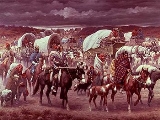
The Trail of Tears was the relocation and movement of Native Americans
Native Americans in the United States

Native Americans in the United States are the Indigenous peoples of the Americas from the regions of North America now encompassed by the continental United States United States, including parts of Alaska and the island state of Hawaii....
 in the United States
United States

The United States of America is a Federal government constitutional republic comprising U.S. state and a federal district. The country is situated mostly in central North America, where its Contiguous United States and Washington, D.C., the Capital districts and territories, lie between the Pacific Ocean and Atlantic Oceans, Borders of the U...
 from their homelands to Indian Territory
Indian Territory

The Indian Territory, also known as The Indian Country, The Indian territory or the Indian territories, was land set aside within the United States for the use of Native Americans in the United States....
 (present day Oklahoma
Oklahoma

Oklahoma is a U.S. state and a sovereignty located in the South Central United States and Southern United States of the United States of America ....
) in the Western United States. The phrase originated from a description of the removal of the Choctaw Nation in 1831. Many Native Americans suffered from exposure, disease, and starvation while en route to their destinations, and many died, including, for example, 4,000 of the 15,000 relocated Cherokee.


Discussion
Ask a question about 'Trail of Tears'
Start a new discussion about 'Trail of Tears'
Answer questions from other users
Full Discussion Forum


Recent Posts


Encyclopedia


The Trail of Tears was the relocation and movement of Native Americans
Native Americans in the United States

Native Americans in the United States are the Indigenous peoples of the Americas from the regions of North America now encompassed by the continental United States United States, including parts of Alaska and the island state of Hawaii....
 in the United States
United States

The United States of America is a Federal government constitutional republic comprising U.S. state and a federal district. The country is situated mostly in central North America, where its Contiguous United States and Washington, D.C., the Capital districts and territories, lie between the Pacific Ocean and Atlantic Oceans, Borders of the U...
 from their homelands to Indian Territory
Indian Territory

The Indian Territory, also known as The Indian Country, The Indian territory or the Indian territories, was land set aside within the United States for the use of Native Americans in the United States....
 (present day Oklahoma
Oklahoma

Oklahoma is a U.S. state and a sovereignty located in the South Central United States and Southern United States of the United States of America ....
) in the Western United States. The phrase originated from a description of the removal of the Choctaw Nation in 1831. Many Native Americans suffered from exposure, disease, and starvation while en route to their destinations, and many died, including, for example, 4,000 of the 15,000 relocated Cherokee. Thousands of enslaved and free African-Americans (as slaves accompanying their Native American slaveowners and as former runaway slaves that were assisted by, assimilated by, or married to members of the tribes) accompanied the removed nations on the Trail of Tears.

In 1831, the Cherokee
Cherokee

The Cherokee are a Native Americans in the United States people orginally from the Southeastern United States . They are linguistically connected to speakers of the Iroquoian language....
, Chickasaw
Chickasaw

The Chickasaw are Native Americans in the United States people originally from the Southeastern United States . They are of the Muskogean linguistic group....
, Choctaw
Choctaw

The Choctaw are a Native Americans in the United States people originally from the Southeastern United States . They are of the Muskogean languages group....
, Muscogee-Creek, and Seminole
Seminole

The Seminole are a Native Americans in the United States people originally of Florida, who now reside primarily in that state and Oklahoma. The Seminole nation was formed in the 18th century and was composed of Native Americans from Georgia , Mississippi, and Alabama, most significantly the Creek people, as well as African Americans who escap...
 (sometimes collectively referred to as the Five Civilized Tribes
Five Civilized Tribes

The Five Civilized Tribes is the term applied to five Native Americans in the United States nations, the Cherokee, Chickasaw, Choctaw, Creek , and Seminole, considered civilized by white settlers during that time period because they adopted many of the colonists' customs and had generally good relations with their neighbors....
) were living as autonomous nations in what would be called the American Deep South
Deep South

The Deep South is a descriptive category of cultural and geographic subregions in the Southern United States. Historically, it is differentiated from the "Upper South" as being the states which were most dependent on plantation type agriculture during the antebellum period....
. The process of cultural transformation (proposed by George Washington
George Washington

George Washington was the leader of the Continental Army in the American Revolutionary War and served as the List of Presidents of the United States President of the United States of the United States of Americas ....
 and Henry Knox
Henry Knox

Henry Knox was an United States bookseller from Boston, Massachusetts who became the chief artillery officer of the Continental Army and later the nation's first United States Secretary of War....
) was gaining momentum, especially among the Cherokee and Choctaw. Andrew Jackson
Andrew Jackson

Andrew Jackson was the List of Presidents of the United States President of the United States . He was List of governors of Florida of Florida , commander of the American forces at the Battle of New Orleans , and eponym of the era of Jacksonian democracy....
 was the first U.S. President to implement removal of the Native Americans with the passage of the Indian Removal Act of 1830. In 1831 the Choctaw were the first to be removed, and they became the model for all other removals. After the Choctaw, the Seminole were removed in 1832, the Creek in 1834, then the Chickasaw in 1837, and finally the Cherokee in 1838.

Choctaw voluntary removal


The Choctaw nation was in what are now the U.S. states of Alabama
Alabama

Alabama is a state located in the Southern United States of the United States of America. It is bordered by Tennessee to the north, Georgia to the east, Florida and the Gulf of Mexico to the south, and Mississippi to the west....
, Mississippi
Mississippi

Mississippi is a U.S. state located in the Deep South of the United States. Jackson, Mississippi is the state capital and largest city. The state's name comes from the Mississippi River, which flows along its western boundary, and takes its name from the Anishinaabe language word misi-ziibi ....
, and Louisiana
Louisiana

The State of Louisiana is a U.S. state located in the U.S. Southern States of the United States of America. Its capital is Baton Rouge and largest city is New Orleans....
. After a series of treaties starting in 1801, the Choctaw nation was reduced to . The Treaty of Dancing Rabbit Creek
Treaty of Dancing Rabbit Creek

The Treaty of Dancing Rabbit Creek was a treaty signed on September 27, 1830 between the Choctaw and the United States Government. This was the first Indian Removal treaty carried into effect under the Indian Removal Act....
 ceded the remaining country to the United States and was ratified in early 1831. The removals were only agreed to after a provision in the Treaty of Dancing Rabbit Creek allowed some Choctaw to remain. George W. Harkins
George W. Harkins

George W. Harkins was a prominent chief of the Choctaw tribe during the Indian removals.Harkins served as Chief of the Apukshunnubbee District of the Choctaw Nation from 1850-1857, and was the nephew of renowned Choctaw chief Greenwood Leflore....
 would write to the American people before the removals were to commence.

Secretary of War Lewis Cass
Lewis Cass

Lewis Cass was an United States military officer and politician. During his long political career, Cass served as a governor of the Michigan Territory, an American ambassador, and a United States Senate representing Michigan....
 appointed George Gaines to manage the removals. Gaines decided to remove Choctaws in three phases starting in 1831 and ending in 1833. The first was to begin on November 1, 1831 with groups meeting at Memphis and Vicksburg. A harsh winter would batter the emigrants with flash floods, sleet, and snow. Initially the Choctaws were to be transported by wagon but floods halted them. With food running out, the residents of Vicksburg and Memphis were concerned. Five steamboats (the Walter Scott, the Brandywine, the Reindeer, the Talma, and the Cleopatra) would ferry Choctaws to their river-based destinations. The Memphis group traveled up the Arkansas for about to Arkansas Post. There the temperature stayed below freezing for almost a week with the rivers clogged with ice, so there would be no travel for weeks. Food rationing consisted of a handful of boiled corn, one turnip, and two cups of heated water per day. Forty government wagons were sent to Arkansas Post to transport them to Little Rock. When they reached Little Rock, Choctaw chief (thought to be Thomas Harkins or Nitikechi) quoted to the Arkansas Gazette that the removal was a "trail of tears and death." The Vicksburg group was led by an incompetent guide and was lost in the Lake Providence swamps.

Alexis de Tocqueville

Alexis-Charles-Henri Cl?rel de Tocqueville was a French political philosophy and historian best known for his Democracy in America and The Old Regime and the Revolution ....
, the French philosopher, witnessed the Choctaw removals while in Memphis, Tennessee
Memphis, Tennessee

Memphis is a city in the southwest corner of the U.S. state of Tennessee, and the county seat of Shelby County, Tennessee. Memphis rises above the Mississippi River on the 4th Chickasaw Bluff just south of the mouth of the Wolf River ....
 in 1831,

Nearly 17,000 Choctaws made the move to what would be called Indian Territory
Indian Territory

The Indian Territory, also known as The Indian Country, The Indian territory or the Indian territories, was land set aside within the United States for the use of Native Americans in the United States....
 and then later Oklahoma
Oklahoma

Oklahoma is a U.S. state and a sovereignty located in the South Central United States and Southern United States of the United States of America ....
. About 2,500–6,000 died along the trail of tears. Approximately 5,000–6,000 Choctaws remained in Mississippi in 1831 after the initial removal efforts. The Choctaws who chose to remain in newly formed Mississippi were subject to legal conflict, harassment, and intimidation. The Choctaws "have had our habitations torn down and burned, our fences destroyed, cattle turned into our fields and we ourselves have been scourged, manacled, fettered and otherwise personally abused, until by such treatment some of our best men have died." The Choctaws in Mississippi were later be formed as the Mississippi Band of Choctaw Indians
Mississippi Band of Choctaw Indians

The Mississippi Band of Choctaw Indians is a Native American tribe whose members are of [Choctaw]] ancestry. The Indian Reorganization Act of 1934 allowed them to become re-organized on April 20, 1945....
 and the removed Choctaws be called the Choctaw Nation of Oklahoma
Choctaw Nation of Oklahoma

The Choctaw Nation of Oklahoma is a semi-autonomy Native Americans in the United States homeland that maintains a special relationship with both the United States government and Government of Oklahoma governments, where approximately 250,000 people live in....
.

Seminole resistance


The US acquired Florida from Spain
Spain

Spain or the Kingdom of Spain , is a country located in Southern Europe on the Iberian Peninsula.The Spanish constitution does not establish any official denomination of the country, even though Espa?a , Estado espa?ol and Naci?n espa?ola are used interchangeably....
 via the Adams-Onís Treaty
Adams-Onís Treaty

The Adams-On?s Treaty of 1819, also known as the Transcontinental Treaty of 1819, settled a border dispute in North America between the United States and Spain....
 and took possession in 1821. In 1832 the Seminoles were called to a meeting at Payne's Landing on the Ocklawaha River
Ocklawaha River

The 110 mile long Ocklawaha River flows north from Central Florida until it joins the St. Johns River near Palatka, Florida. Its name is a corruption of ak-lowahe, Creek language for "muddy"....
. The treaty negotiated called for the Seminoles to move west, if the land were found to be suitable. They were to be settled on the Creek reservation and become part of the Creek tribe. The Seminole Indians who originated from the Creek were considered deserters by the Creek, and the Seminole did not wish to move west to where they were certain that they would meet death for leaving the main band Creek Indians. The delegation of seven chiefs who were to inspect the new reservation did not leave Florida until October 1832. After touring the area for several months and conferring with the Creeks who had already been settled there, the seven chiefs signed on March 28, 1833 a statement that the new land was acceptable. Upon their return to Florida, however, most of the chiefs renounced the statement, claiming that they had not signed it, or that they had been forced to sign it, and in any case, that they did not have the power to decide for all the tribes and bands that resided on the reservation. The villages in the area of the Apalachicola River were more easily persuaded, however, and went west in 1834. On December 28, 1835 a group of Seminoles and escaped slaves ambushed a U.S. Army company attempting to forcibly remove the Seminole. Out of 110 army troops only 3 survived, and with that the Second Seminole War had begun.

As the realization that the Seminoles would resist relocation sank in, Florida began preparing for war. The St. Augustine Militia asked the War Department
United States Department of War

The United States Department of War, sometimes also called the War Office, was the department of the United States Federal government of the United States's Federal government of the United States#Executive branch responsible for the operation and maintenance of land Military of the United States from 1789 until September 18, 1947,...
 for the loan of 500 muskets. Five hundred volunteers were mobilized under Brig. Gen. Richard K. Call
Richard K. Call

Richard Keith Call was the third and fifth Florida Territory List of Florida Governors of Florida.Named after his uncle, a American Revolution hero, he was born in Pittsfield, Prince George County, Virginia....
. Indian war parties raided farms and settlements, and families fled to forts, large towns, or out of the territory altogether. A war party led by Osceola captured a Florida militia supply train, killing eight of its guards and wounding six others. Most of the goods taken were recovered by the militia in another fight a few days later. Sugar plantations along the Atlantic coast south of St. Augustine were destroyed, with many of the slaves on the plantations joining the Seminoles.

Other warchiefs such as Halleck Tustenuggee
Halleck Tustenuggee

Halleck Tustenuggee was a 19th century Seminole warchief. He fought against the United States government in the Seminole Wars and for the government in the American Civil War....
, Jumper, and Black Seminoles
Black Seminoles

The Black Seminoles are descendants of free Africans and some runaway slaves who escaped from coastal South Carolina and Georgia into the Florida wilderness beginning as early as the late 1600s....
 Abraham and John Horse continued the Seminole resistance against the army. The war ended, after a full decade of fighting, in 1842. The U.S. government is estimated to have spent about $20,000,000 on the war, at the time an astronomical sum. Many Indians were forcibly exiled to Creek lands west of the Mississippi; others retreated into the Everglades. In the end, the government gave up trying to subjugate the Seminole in their Everglades redoubts and left fewer than 100 Seminoles in peace.

Creek dissolution


After the War of 1812, some Muscogee leaders such as William McIntosh
William McIntosh

William McIntosh , also known as "White Warrior," was the son of Captain William McIntosh, a member of a prominent Savannah, Georgia family sent into the Creek Nation to recruit them to fight for the British during the Revolutionary War ....
 signed treaties that ceded more land to Georgia. The 1814 signing of the Treaty of Fort Jackson
Treaty of Fort Jackson

The Treaty of Fort Jackson was signed on August 9, 1814 at Fort Jackson near Wetumpka, Alabama following the defeat of the Red Stick resistance by United States forces at the Battle of Horseshoe Bend on the banks of the Tallapoosa River near the present city of Alexander City, Alabama....
 signaled the end for the Creek Nation and for all Indians in the South. Friendly Creek leaders, like Selocta and Big Warrior, addressed Sharp Knife (the Indian nickname for Andrew Jackson) and reminded him that they keep the peace. Nevertheless, Jackson retorted that they did not "cut (Tecumseh's
Tecumseh

Tecumseh , also Tecumtha or Tekamthi, was a famous Native Americans in the United States leader of the Shawnee. He spent much of his life attempting to rally various native American tribes in a mutual defense of their lands, which eventually led to his death in the War of 1812....
) throat" when they had the chance, so they must now cede Creek lands. Jackson also ignored Article 9 of the Treaty of Ghent
Treaty of Ghent

The Treaty of Ghent , signed on December 24, 1814, in Ghent, currently in Belgium, was the peace treaty that ended the War of 1812 between the United States of America and the United Kingdom of Great Britain and Ireland....
 that restored sovereignty to Indians and their nations.

Eventually, the Creek Confederacy enacted a law that made further land cessions a capital offense. Nevertheless, on February 12, 1825, McIntosh and other chiefs signed the Treaty of Indian Springs
Treaty of Indian Springs

There are two Treaties of Indian Springs with the Creek_people. The first treaty was signed January 8, 1821. In it, the Creeks ceded land to the state of Georgia in return for cash payments totaling $200,000 over a period of 14 years....
, which gave up most of the remaining Creek lands in Georgia. After the U.S. Senate ratified the treaty, McIntosh was assassinated on May 13, 1825, by Creeks led by Menawa.

The Creek National Council, led by Opothle Yohola
Opothleyahola

Opothleyahola, also spelled Opothle Yohola, Opothleyoholo, Hu-pui-hilth Yahola, and Hopoeitheyohola, was a Creek Indian chief, noted as a brilliant orator and spokesperson of the Upper Creek Council....
, protested to the United States that the Treaty of Indian Springs was fraudulent. President John Quincy Adams
John Quincy Adams

John Quincy Adams was an Foreign relations of the United States and Politics of the United States who served as the List of Presidents of the United States President of the United States from March 4, 1825 to March 4, 1829....
 was sympathetic, and eventually the treaty was nullified in a new agreement, the Treaty of Washington (1826)
Treaty of Washington (1826)

The 1826 Treaty of Washington was a settlement between the United States government and the Creek of Native Americans in the United States, led by their spokesman Opothleyahola....
. Writes historian R. Douglas Hurt: "The Creeks had accomplished what no Indian nation had ever done or would do again — achieve the annulment of a ratified treaty." However, Governor Troup of Georgia ignored the new treaty and began to forcibly remove the Indians under the terms of the earlier treaty. At first, President Adams attempted to intervene with federal troops, but Troup called out the militia, and Adams, fearful of a civil war, conceded. As he explained to his intimates, "The Indians are not worth going to war over."

Although the Creeks had been forced from Georgia, with many Lower Creeks moving to the Indian Territory
Indian Territory

The Indian Territory, also known as The Indian Country, The Indian territory or the Indian territories, was land set aside within the United States for the use of Native Americans in the United States....
, there were still about 20,000 Upper Creeks living in Alabama. However, the state moved to abolish tribal governments and extend state laws over the Creeks. Opothle Yohola appealed to the administration of President Andrew Jackson for protection from Alabama; when none was forthcoming, the Treaty of Cusseta
Treaty of Cusseta

The Treaty of Cusseta was a treaty between the government of the United States and the Creek signed March 24, 1832. The treaty ceded all Creek claims east of the Mississippi River to the United States....
 was signed on March 24, 1832, which divided up Creek lands into individual allotments. Creeks could either sell their allotments and received funds to remove to the west, or stay in Alabama and submit to state laws. Land speculators and squatters began to defraud Creeks out of their allotments, and violence broke out, leading to the so-called "Creek War of 1836
Creek War of 1836

The Creek War of 1836Although the Creek people had been forced from Georgia, with many Lower Creeks moving to the Indian Territory, there were still about 20,000 Upper Creeks living in Alabama....
." Secretary of War
United States Secretary of War

File:Swearing in of Secretary Dwight Davis.jpgThe Secretary of War was a member of the United States President of the United States United States Cabinet, beginning with George Washington's administration....
 Lewis Cass
Lewis Cass

Lewis Cass was an United States military officer and politician. During his long political career, Cass served as a governor of the Michigan Territory, an American ambassador, and a United States Senate representing Michigan....
 dispatched General Winfield Scott
Winfield Scott

Winfield Scott was a United States Army general, and unsuccessful List of United States Presidential candidates of the Whig Party in 1852. Known as "Old Fuss and Feathers" and the "Grand Old Man of the Army", he served on active duty as a general longer than any other man in American history and many historians rate him the ablest America...
 to end the violence by forcibly removing the Creeks to the Indian Territory west of the Mississippi River.

Chickasaw monetary removal


Unlike other tribes who exchanged land grants, the Chickasaw received financial compensation from the United States for their lands east of the Mississippi River. In 1836 the Chickasaws had reached an agreement that purchased land from the previously removed Choctaws after a bitter five-year debate. They paid the Choctaws $530,000 for the western most part Choctaw land. The first group of Chickasaws moved in 1837 was led by John M. Millard. The Chickasaws gathered at Memphis, Tennessee
Memphis, Tennessee

Memphis is a city in the southwest corner of the U.S. state of Tennessee, and the county seat of Shelby County, Tennessee. Memphis rises above the Mississippi River on the 4th Chickasaw Bluff just south of the mouth of the Wolf River ....
 on July 4, 1837, with all of their assets--belongings, livestock, and slaves. Once across the Mississippi River they followed routes previously established by Choctaws and Creeks. Once in Indian Territory the Chickasaws merged with the Choctaw nation. After several decades of mistrust, they regained nationhood.

Cherokee forced relocation


In 1838, the Cherokee
Cherokee

The Cherokee are a Native Americans in the United States people orginally from the Southeastern United States . They are linguistically connected to speakers of the Iroquoian language....
 Nation was removed from their lands in the Southeastern United States to the Indian Territory (present day Oklahoma) in the Western United States
Western United States

The Western United States—commonly referred to as the American West or simply The West—traditionally refers to the region comprising the westernmost U.S....
, which resulted in the deaths of approximately 4,000 Cherokees. In the Cherokee language
Cherokee language

Cherokee is an Iroquoian languages spoken by the Cherokee people which uses a Cherokee syllabary writing system. It is the only Southern Iroquoian languages language that remains spoken....
, the event is called Nunna daul Isunyi—“the Trail Where They Cried”. The Cherokee Trail of Tears resulted from the enforcement of the Treaty of New Echota
Treaty of New Echota

The Treaty of New Echota was a treaty signed on December 29, 1835 in New Echota, Georgia by officials of the United States government and representatives of a minority Cherokee political faction....
, an agreement signed under the provisions of the Indian Removal Act
Indian Removal Act

The Indian Removal Act, part of a United States government policy known as Indian removal, was signed into law by President of the United States Andrew Jackson on May 26, 1830.-19), the U.S....
 of 1830 which exchanged Native American land in the East for lands west of the Mississippi River
Mississippi River

The Mississippi River is the longest river in the United States, with a length of from its source in Lake Itasca in Minnesota to its mouth in the Gulf of Mexico....
, but which was never accepted by the elected tribal leadership or a majority of the Cherokee people.

Tensions between Georgia and the Cherokee Nation were brought to a crisis by the discovery of gold near Dahlonega, Georgia
Dahlonega, Georgia

Dahlonega is a city in Lumpkin County, Georgia, Georgia , United States, and is its county seat. As of the United States Census, 2000, it had a total population of 3,638....
, in 1829, resulting in the Georgia Gold Rush
Georgia Gold Rush

The Georgia Gold Rush was the first significant gold rush in the United States. It started in 1829 in the present day Lumpkin County, Georgia near county seat Dahlonega, and soon spread through the North Georgia mountains, following the Georgia Gold Belt....
, the first gold rush
Gold rush

A gold rush is a period of feverish migration of workers into the area of a dramatic discovery of commercial quantities of gold.Eight gold rushes took place throughout the 19th century in Argentina, Australia, Brazil, Canada, Chile, New Zealand, South Africa, and the United States....
 in U.S. history. Hopeful gold speculators began trespassing on Cherokee lands, and pressure began to mount on the Georgia government to fulfill the promises of the Compact of 1802
Compact of 1802

The Compact of 1802 was a pact made by U.S. president Thomas Jefferson in 1802 to the state of Georgia . In it, the United States paid Georgia 1.25 million U.S....
.

When Georgia moved to extend state laws over Cherokee tribal lands in 1830, the matter went to the U.S. Supreme Court
Supreme Court of the United States

The Supreme Court of the United States is the highest judicial body in the United States, and leads the federal United States federal courts. It consists of the Chief Justice of the United States and eight Associate Justice of the Supreme Court of the United States, who are nominated by the President of the United States and confirmed with th...
. In Cherokee Nation v. Georgia
Cherokee Nation v. Georgia

Cherokee Nation v. Georgia, , was a Supreme Court of the United States case....
 (1831), the Marshall court
John Marshall

John Marshall was an American statesman and jurist who shaped American constitutional law and made the Supreme Court a center of power. Marshall was Chief Justice of the United States, serving from February 4, 1801, until his death in 1835....
 ruled that the Cherokees were not a sovereign and independent nation, and therefore refused to hear the case. However, in Worcester v. State of Georgia (1832), the Court ruled that Georgia could not impose laws in Cherokee territory, since only the national government — not state governments — had authority in Indian affairs.

Jackson probably never said this, but he was fully committed to the policy. He had no desire to use the power of the national government to protect the Cherokees from Georgia, since he was already entangled with states’ rights
States' rights

States' rights refers to the idea, in politics of the United States and United States constitutional law, that U.S. states possess certain rights and political powers in relation to the federal government of the United States....
 issues in what became known as the nullification crisis
Nullification Crisis

The Nullification Crisis was a sectionalism crisis during the presidency of Andrew Jackson created by the Ordinance of Nullification, an attempt by the state of South Carolina to Nullification a federal law passed by the United States Congress....
. With the Indian Removal Act
Indian Removal Act

The Indian Removal Act, part of a United States government policy known as Indian removal, was signed into law by President of the United States Andrew Jackson on May 26, 1830.-19), the U.S....
 of 1830, the U.S. Congress
United States Congress

The United States Congress is the Bicameralism legislature of the Federal government of the United States of the United States of America, consisting of two houses, the United States Senate and the United States House of Representatives....
 had given Jackson authority to negotiate removal treaties, exchanging Indian land in the East for land west of the Mississippi River. Jackson used the dispute with Georgia to put pressure on the Cherokees to sign a removal treaty. Nevertheless, the treaty, passed by Congress by a single vote, and signed into law by President
President of the United States

The President of the United States is the head of state and head of government of the United States and is the highest political official in the United States by influence and recognition....
 Andrew Jackson
Andrew Jackson

Andrew Jackson was the List of Presidents of the United States President of the United States . He was List of governors of Florida of Florida , commander of the American forces at the Battle of New Orleans , and eponym of the era of Jacksonian democracy....
, was imposed by his successor President Martin Van Buren
Martin Van Buren

Martin Van Buren was the List of Presidents of the United States President of the United States from 1837 to 1841. Before his presidency, he served as the List of Vice Presidents of the United States Vice President of the United States and the 10th United States Secretary of State under Andrew Jackson....
 who allowed Georgia
Georgia (U.S. state)

Georgia is a U.S. state in the United States and was one of the original Thirteen Colonies that revolted against United Kingdom rule in the American Revolution....
, Tennessee
Tennessee

Tennessee is a U.S. state located in the Southern United States United States. In 1796, it became the sixteenth state to join the United States....
, North Carolina
North Carolina

North Carolina is a U.S. state located on the Atlantic Seaboard in the southeastern United States. The state borders South Carolina and Georgia to the south, Tennessee to the west and Virginia to the north....
, and Alabama
Alabama

Alabama is a state located in the Southern United States of the United States of America. It is bordered by Tennessee to the north, Georgia to the east, Florida and the Gulf of Mexico to the south, and Mississippi to the west....
 an armed force of 7,000 made up of militia, regular army, and volunteers under General Winfield Scott to round up about 13,000 Cherokees into concentration camps at the U.S. Indian Agency near Cleveland, Tennessee before being sent to the West. Most of the deaths occurred from disease
Infectious disease

An infectious disease is a clinically evident disease resulting from the presence of pathogenic microbial agents, including pathogenic viruses, pathogenic bacteria, Mycosis, protozoa, multicellular parasites, and aberrant proteins known as prions....
, starvation and cold in these camps. Their homes were burned and their property destroyed and plundered. Farms belonging to the Cherokees for generations were won by white settlers in a lottery. After the initial roundup, the U.S. military still oversaw the emigration until they met the forced destination. Private John G. Burnett later wrote "Future generations will read and condemn the act and I do hope posterity will remember that private soldiers like myself, and like the four Cherokees who were forced by General Scott to shoot an Indian Chief and his children, had to execute the orders of our superiors. We had no choice in the matter."

In the winter of 1838 the Cheroke began the thousand mile march with scant clothing and most on foot without shoes or moccasins. The march began in Red Clay, Tennessee, the location of the last Eastern capital of the Cherokee Nation. The Cherokee were given used blankets from a hospital in Tennessee where an epidemic of small pox had broken out. Because of the diseases, the Indians were not allowed to go into any towns or villages along the way; many times this meant traveling much farther to go around them. After crossing Tennessee and Kentucky, they they arrived in Southern Illinois at Golconda about the 3rd of December, 1838. Here the starving Indians were charged a dollar a head to cross the river on "Berry's Ferry" which typically charged twelve cents. They were not allowed passage until the ferry had serviced all others wishing to cross and were forced to take shelter under “Mantle Rock,” a shelter bluff on the Kentucky side, until “Berry had nothing better to do”. Many died huddled together at Mantle Rock waiting to cross. Several Cherokee were murdered by locals. The killers filed a lawsuit against the U.S. Government through the courthouse in Vienna, suing the government for $35 a head to bury the murdered Cherokee..

On December 26, Martin Davis, Commissary Agent for Moses Daniel's detachment wrote: "There is the coldest weather in Illinois I ever experienced anywhere. The streams are all frozen over something like eight or twelve inches thick. We are compelled to cut through the ice to get water for ourselves and animals. It snows here every two or three days at the fartherest. We are now camped in Missippi swamp four miles from the river, and there is no possible chance of crossing the river for the numerous quantity of ice that comes floating down the river every day. We have only traveled sixty-five miles on the last month, including the time spent at this place, which has been about three weeks. It is unknown when we shall cross the river...."

Removed Cherokees initially settled near Tahlequah, Oklahoma
Tahlequah, Oklahoma

Tahlequah is a city in Cherokee County, Oklahoma, Oklahoma, United States located at the foot hills of the Ozark Mountains. The population was 14,458 at the United States Census, 2000....
. The political turmoil resulting from the Treaty of New Echota and the Trail of Tears led to the assassinations of Major Ridge
Major Ridge

Major Ridge , also Pathkiller II was a Cherokee Native Americans in the United States leader and prot?g?, along with Charles R. Hicks, of the noted figure James Vann....
, John Ridge
John Ridge

John Ridge was a son of Major Ridge and a member of the Cherokee Nation. Born in Oothacaloga , he was named Skah-tle-loh-skee, he married Sarah Bird Northup, whom he had met while studying in Cornwall, Connecticut....
, and Elias Boudinot
Elias Boudinot (Cherokee)

Elias Boudinot was a Cherokee Indian who founded and edited the tribe's first newspaper, based on the syllabary by Sequoyah. He was born in Oothcaloga, Cherokee Nation and named Gallegina Watie ....
; of the leaders of the Treaty Party, only Stand Watie
Stand Watie

Stand Watie was a leader of the Cherokee and a Brigadier General of the Confederate States Army during the American Civil War. He commanded the Confederate Indian cavalry of the Army of the Trans-Mississippi made up mostly of Cherokee, Creek and Seminole....
 escaped his assassins. The population of the Cherokee Nation eventually rebounded, and today the Cherokees are the largest American Indian group in the United States.

There were some exceptions to removal. Perhaps 100 Cherokees evaded the U.S. soldiers and lived off the land in Georgia and other states. Those Cherokees who lived on private, individually owned lands (rather than communally owned tribal land) were not subject to removal. In North Carolina, about 400 Cherokees, known as the Oconaluftee Cherokee, lived on land in the Great Smoky Mountains
Great Smoky Mountains

The Great Smoky Mountains are a mountain range rising along the Tennessee-North Carolina border in the southeastern United States. They are a subrange of the Appalachian Mountains, and form part of the Blue Ridge Mountains....
 owned by a white man named William Holland Thomas
William Holland Thomas

William Holland Thomas was Principal Chief of the Eastern Band of Cherokee Indians, succeeding Yonaguska, and an officer in the Confederate States Army during the American Civil War....
 (who had been adopted by Cherokees as a boy), and were thus not subject to removal. Added to this were some 200 Cherokee from the Nantahala area allowed to stay after assisting the U.S. Army hunt down and capture the family of the old prophet Tsali (Tsali faced a firing squad). These North Carolina Cherokees became the Eastern Band of the Cherokee Nation
Eastern Band of Cherokee Indians

The Eastern Band of Cherokee Indians are a federally recognized Native Americans in the United States tribe in the United States of America. The history of the Eastern Band is synonymous with that of the Qualla Boundary, although the EBCI own, hold, or maintain additional lands in the vicinity, and as far away as 100 miles from the Qualla Bou...
.


African-Americans


Enslaved and free African-Americans (as slaves accompanying their Native American slaveowners and as former runaway slaves that were assisted by, assimilated by, or married to members of the tribes) accompanied the Native American nations on the Trail of Tears.

Immediately following Trail of Tears, the status of the surviving enslaved and free African-Americans varied. Upon reaching Indian Territory after the forced removal, the Chickasaw established large farms in which they used Black slaves as laborers. The Chickasaw Nation recognized the abolition of slavery in 1866, however; Black freedmen weren't granted citizenship by the Chickasaws until the 1890s. Former slaves of the Choctaw Nation were called the Choctaw Freedmen; the Choctaw Freedmen
Choctaw Freedmen

The Choctaw freedmen were African slaves that were part of the Choctaw Nation. "Freedmen" is one of the terms given to African slaves after slavery was abolished in the United States....
 were granted citizenship in the Choctaw Nation in 1885.

See also


  • Cherokee
    Cherokee

    The Cherokee are a Native Americans in the United States people orginally from the Southeastern United States . They are linguistically connected to speakers of the Iroquoian language....
  • Cherokee Trail of Tears
  • Chickasaw
    Chickasaw

    The Chickasaw are Native Americans in the United States people originally from the Southeastern United States . They are of the Muskogean linguistic group....
  • Choctaw
    Choctaw

    The Choctaw are a Native Americans in the United States people originally from the Southeastern United States . They are of the Muskogean languages group....
  • Creek people
    Creek people

    The Muscogee , their original name they use to identify themselves today, also known as the Creek, are an American Indians in the United States people originally from the Southern United States....
  • Ethnic cleansing
    Ethnic cleansing

    Ethnic cleansing is a euphemism referring to the persecution through imprisonment, expulsion, or killing of members of an ethnic minority by a majority to achieve ethnic homogeneity in majority-controlled territory....
    , the modern term for the forced relocation of a people
  • Population transfer
    Population transfer

    Population transfer is the movement of a large group of people from one region to another by state policy or international authority, most frequently on the basis of ethnicity or religion....
  • Indian Removal
    Indian Removal

    Indian Removal was a nineteenth century policy of the government of the United States to Ethnic cleansing Native Americans in the United States tribes living east of the Mississippi River to lands west of the river....
  • Hopkinsville, Kentucky
    Hopkinsville, Kentucky

    Hopkinsville is a city in Christian County, Kentucky, Kentucky, United States. The population was 30,089 at the 2000 United States Census. It is the county seat of Christian County, Kentucky....
  • Seminole
    Seminole

    The Seminole are a Native Americans in the United States people originally of Florida, who now reside primarily in that state and Oklahoma. The Seminole nation was formed in the 18th century and was composed of Native Americans from Georgia , Mississippi, and Alabama, most significantly the Creek people, as well as African Americans who escap...
  • Timeline of Cherokee removal
    Timeline of Cherokee removal

    This is a timeline of events leading up to and extending away from the Treaty of New Echota from the time of first contact to the treaty of reunion after the American Civil War....


Documents


Documentary

  • The Trail of Tears: Cherokee Legacy
    The Trail of Tears: Cherokee Legacy

    "The Trail of Tears: Cherokee Legacy" is a 2006 documentary by director Chip Richie. It presents the history of the ethnic cleansing and relocation of Cherokee people from southeastern states of the United States to territories west of the Mississippi River....
     (2006) -directed by Chip Richie; na by James Earl Jones


External links