

Cro-Magnon

Encyclopedia
Paleolithic Europe
Paleolithic Europe refers to the Paleolithic period of Europe, a prehistoric era distinguished by the development of the first stone tools and which covers roughly 99% of human technological history...
Upper Paleolithic
Upper Paleolithic
The Upper Paleolithic is the third and last subdivision of the Paleolithic or Old Stone Age as it is understood in Europe, Africa and Asia. Very broadly it dates to between 40,000 and 10,000 years ago, roughly coinciding with the appearance of behavioral modernity and before the advent of...
. The earliest known remains of Cro-Magnon-like humans are radiometrically dated
Radiocarbon dating
Radiocarbon dating is a radiometric dating method that uses the naturally occurring radioisotope carbon-14 to estimate the age of carbon-bearing materials up to about 58,000 to 62,000 years. Raw, i.e. uncalibrated, radiocarbon ages are usually reported in radiocarbon years "Before Present" ,...
to 35,000 years before present
Before Present
Before Present years is a time scale used in archaeology, geology, and other scientific disciplines to specify when events in the past occurred. Because the "present" time changes, standard practice is to use AD 1950 as the origin of the age scale, reflecting the fact that radiocarbon...
.
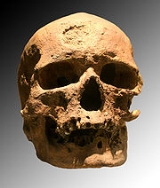
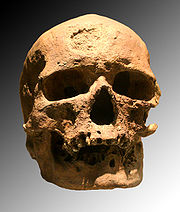
Cro-Magnons were robustly built and powerful. The body was generally heavy and solid with a strong musculature. The forehead was straight, with slight browridges and a tall forehead. Cro-Magnons were the first humans (genus Homo) to have a prominent chin
Chin
In the human anatomy, the chin is the lowermost part of the face.It is formed by the lower front of the mandible.People show a wide variety of chin structures. See Cleft chin....
. The brain capacity was about 1,600 cc (100 cubic inches), larger than the average for modern humans.
Etymology
The name derives from the Abri de Cro-Magnon (FrenchFrench language
French is a Romance language spoken as a first language in France, the Romandy region in Switzerland, Wallonia and Brussels in Belgium, Monaco, the regions of Quebec and Acadia in Canada, and by various communities elsewhere. Second-language speakers of French are distributed throughout many parts...
: rock shelter
Rock shelter
A rock shelter is a shallow cave-like opening at the base of a bluff or cliff....
of Cro-Magnon, the big cave in Occitan) near the commune
Communes of France
The commune is the lowest level of administrative division in the French Republic. French communes are roughly equivalent to incorporated municipalities or villages in the United States or Gemeinden in Germany...
of Les Eyzies-de-Tayac-Sireuil
Les Eyzies-de-Tayac-Sireuil
Les Eyzies-de-Tayac-Sireuil is a commune in the Dordogne department in Aquitaine in southwestern France.Les Eyzies-de-Tayac-Sireuil lies in the Périgord Noir area. It is served by the Gare des Eyzies railroad station...
in southwestern France
Prehistoric France
Prehistoric France is the period in the human occupation of the geographical area covered by present-day France which extended through prehistory and ended in the Iron Age with the Celtic "La Tène culture".-Lower Palaeolithic:...
, where the first specimen
Cro-Magnon 1
Cro-Magnon 1 is a fossilized human skull of the sub-species Homo sapiens sapiens. It was discovered, with other Cro-Magnon specimens, in Les Eyzies, France by Louis Lartet in 1868.It is dated to 27.680±270 Before Present...
was found. Being the oldest known modern humans
Anatomically modern humans
The term anatomically modern humans in paleoanthropology refers to early individuals of Homo sapiens with an appearance consistent with the range of phenotypes in modern humans....
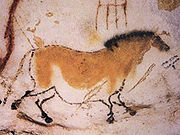
(Homo sapiens) in Europe, the Cro-Magnon were from the outset linked to the well-known Lascaux
Lascaux
Lascaux is the setting of a complex of caves in southwestern France famous for its Paleolithic cave paintings. The original caves are located near the village of Montignac, in the department of Dordogne. They contain some of the best-known Upper Paleolithic art. These paintings are estimated to be...
cave painting
Cave painting
Cave paintings are paintings on cave walls and ceilings, and the term is used especially for those dating to prehistoric times. The earliest European cave paintings date to the Aurignacian, some 32,000 years ago. The purpose of the paleolithic cave paintings is not known...
s and the Aurignacian
Aurignacian
The Aurignacian culture is an archaeological culture of the Upper Palaeolithic, located in Europe and southwest Asia. It lasted broadly within the period from ca. 45,000 to 35,000 years ago in terms of conventional radiocarbon dating, or between ca. 47,000 and 41,000 years ago in terms of the most...
culture whose remains were well known from southern France and Germany
Germany
Germany , officially the Federal Republic of Germany , is a federal parliamentary republic in Europe. The country consists of 16 states while the capital and largest city is Berlin. Germany covers an area of 357,021 km2 and has a largely temperate seasonal climate...
. As additional remains of early modern humans were discovered in archaeological site
Archaeological site
An archaeological site is a place in which evidence of past activity is preserved , and which has been, or may be, investigated using the discipline of archaeology and represents a part of the archaeological record.Beyond this, the definition and geographical extent of a 'site' can vary widely,...
s from Western Europe
Western Europe
Western Europe is a loose term for the collection of countries in the western most region of the European continents, though this definition is context-dependent and carries cultural and political connotations. One definition describes Western Europe as a geographic entity—the region lying in the...
and elsewhere, and dating techniques
Radiometric dating
Radiometric dating is a technique used to date materials such as rocks, usually based on a comparison between the observed abundance of a naturally occurring radioactive isotope and its decay products, using known decay rates...
improved in the early 20th century, new finds were added to the taxonomic classification.
The term "Cro-Magnon" soon came to be used in a general sense to describe the oldest modern people in Europe
Europe
Europe is, by convention, one of the world's seven continents. Comprising the westernmost peninsula of Eurasia, Europe is generally 'divided' from Asia to its east by the watershed divides of the Ural and Caucasus Mountains, the Ural River, the Caspian and Black Seas, and the waterways connecting...
. By the 1970s the term was used for any early modern human wherever found, as was the case with the far-flung Jebel Qafzeh remains in Israel
Israel
The State of Israel is a parliamentary republic located in the Middle East, along the eastern shore of the Mediterranean Sea...
and various Paleo-Indians in the Americas
Americas
The Americas, or America , are lands in the Western hemisphere, also known as the New World. In English, the plural form the Americas is often used to refer to the landmasses of North America and South America with their associated islands and regions, while the singular form America is primarily...
. However, analyses based on more current data concerning the migrations of early humans
Early human migrations
Early human migrations began when Homo erectus first migrated out of Africa over the Levantine corridor and Horn of Africa to Eurasia about 1.8 million years ago, a migration probably sparked by the development of language Early human migrations began when Homo erectus first migrated out of Africa...
have contributed to a refined definition of this expression. Today, the term "Cro-Magnon" falls outside the usual naming conventions
Binomial nomenclature
Binomial nomenclature is a formal system of naming species of living things by giving each a name composed of two parts, both of which use Latin grammatical forms, although they can be based on words from other languages...
for early humans
Human evolution
Human evolution refers to the evolutionary history of the genus Homo, including the emergence of Homo sapiens as a distinct species and as a unique category of hominids and mammals...
, though it remains an important term within the archaeological
Archaeology
Archaeology, or archeology , is the study of human society, primarily through the recovery and analysis of the material culture and environmental data that they have left behind, which includes artifacts, architecture, biofacts and cultural landscapes...
community as an identifier for the commensurate fossil remains
Upper Paleolithic
The Upper Paleolithic is the third and last subdivision of the Paleolithic or Old Stone Age as it is understood in Europe, Africa and Asia. Very broadly it dates to between 40,000 and 10,000 years ago, roughly coinciding with the appearance of behavioral modernity and before the advent of...
in Europe and adjacent areas. Current scientific literature prefers the term "European Early Modern Humans" (or EEMH), instead of "Cro-Magnon". The oldest definitely dated EEMH specimen with a modern and archaic (possibly Neanderthal
Neanderthal
The Neanderthal is an extinct member of the Homo genus known from Pleistocene specimens found in Europe and parts of western and central Asia...
) mosaic of traits
Trait (biology)
A trait is a distinct variant of a phenotypic character of an organism that may be inherited, environmentally determined or be a combination of the two...
is the Cro-Magnon Oase 1 find
Artifact (archaeology)
An artifact or artefact is "something made or given shape by man, such as a tool or a work of art, esp an object of archaeological interest"...
, which has been dated
Radiocarbon dating
Radiocarbon dating is a radiometric dating method that uses the naturally occurring radioisotope carbon-14 to estimate the age of carbon-bearing materials up to about 58,000 to 62,000 years. Raw, i.e. uncalibrated, radiocarbon ages are usually reported in radiocarbon years "Before Present" ,...
back to around 45,000 calendar years before present.
Assemblages and specimens
The FrenchFrench people
The French are a nation that share a common French culture and speak the French language as a mother tongue. Historically, the French population are descended from peoples of Celtic, Latin and Germanic origin, and are today a mixture of several ethnic groups...
geologist
Geologist
A geologist is a scientist who studies the solid and liquid matter that constitutes the Earth as well as the processes and history that has shaped it. Geologists usually engage in studying geology. Geologists, studying more of an applied science than a theoretical one, must approach Geology using...
Louis Lartet
Louis Lartet
Louis Lartet was a French geologist and paleontologist. He discovered the original Cro-Magnon skeletons.Louis Lartet was born in Castelnau-Magnoac, in Seissan in the département of Gers...
discovered the first five skeleton
Skeleton
The skeleton is the body part that forms the supporting structure of an organism. There are two different skeletal types: the exoskeleton, which is the stable outer shell of an organism, and the endoskeleton, which forms the support structure inside the body.In a figurative sense, skeleton can...
s of this type in March 1868 in a rock shelter named Abri de Crô-Magnon. Similar specimens were subsequently discovered in other parts of Europe and neighboring areas.
Peştera cu Oase
The oldest non-archaic human remains from Europe are the finds from Peştera cu OasePestera cu Oase
Peștera cu Oase is a system of 12 karstic galleries and chambers located N. 45° 01’; E. 21° 50’ in southwestern Romania, where the oldest early modern human remains in Europe have been discovered.-Paleoanthropological on-site findings:...
(the Cave with Bones) near the Iron Gates in Romania
Romania
Romania is a country located at the crossroads of Central and Southeastern Europe, on the Lower Danube, within and outside the Carpathian arch, bordering on the Black Sea...
. The site is situated in the Danubian corridor
Danubian corridor
In paleontology and archeology, the Danubian corridor or Rhine-Danube corridor refers to a route along the valleys of the Danube River and Rhine River of various migration of Eastern cultures from Asia Minor, Aegean, Caspian etc., into the north and northwest Europe....
, which may have been the Cro-Magnon entry point into Central Europe. The cave itself appears to be a hyena
Hyena
Hyenas or Hyaenas are the animals of the family Hyaenidae of suborder feliforms of the Carnivora. It is the fourth smallest biological family in the Carnivora , and one of the smallest in the mammalia...
or cave bear
Cave Bear
The cave bear was a species of bear that lived in Europe during the Pleistocene and became extinct at the beginning of the Last Glacial Maximum about 27,500 years ago....
den; the human remains may have been prey or carrion. No tools are associated with the finds.
Oase 1 holotype
Holotype
A holotype is a single physical example of an organism, known to have been used when the species was formally described. It is either the single such physical example or one of several such, but explicitly designated as the holotype...
is a robust mandible combine a variety of archaic
Archaic Homo sapiens
Archaic Homo sapiens is a loosely defined term used to describe a number of varieties of Homo, as opposed to anatomically modern humans , in the period beginning 500,000 years ago....
, derived early modern
Anatomically modern humans
The term anatomically modern humans in paleoanthropology refers to early individuals of Homo sapiens with an appearance consistent with the range of phenotypes in modern humans....
, and possibly Neanderthal
Neanderthal
The Neanderthal is an extinct member of the Homo genus known from Pleistocene specimens found in Europe and parts of western and central Asia...
features. The modern attributes place it close to European early modern humans among Late Pleistocene
Late Pleistocene
The Late Pleistocene is a stage of the Pleistocene Epoch. The beginning of the stage is defined by the base of the Eemian interglacial phase before the final glacial episode of the Pleistocene 126,000 ± 5,000 years ago. The end of the stage is defined exactly at 10,000 Carbon-14 years BP...
samples. The fossil is one of the few finds in Europe which could be directly dated and is considered the oldest known early modern human fossil from Europe. Two laboratories independently yielded collagen 14C age
Radiocarbon dating
Radiocarbon dating is a radiometric dating method that uses the naturally occurring radioisotope carbon-14 to estimate the age of carbon-bearing materials up to about 58,000 to 62,000 years. Raw, i.e. uncalibrated, radiocarbon ages are usually reported in radiocarbon years "Before Present" ,...
averaging to 34,950, +990, and –890, equivalent to about 45,000 calendar years. The Oase 1 mandible was discovered on February 16, 2002. A nearly complete skull of a young male (Oase 2) and fragments of another (Oase 3) were found in 2005, again with mosaic features, some of which are paralleled in the Oase 1 mandible.
Peştera Muierilor
The Peştera MuierilorPeştera Muierilor
Peștera Muierilor, or Peștera Muierii , is an elaborate cave system located in the Baia de Fier commune, Gorj County, Romania. It contains abundant cave-bear remains, as well as a human skull. The skull is radiocarbon dated to 30,150 ± 800, indication an absolute age between 40,000 and 30,000 BP....
find is that of a single, fairly complete cranium of a woman with rugged facial traits and otherwise modern skull features was found in a lower gallery of the "Womans cave" in Romania
Romania
Romania is a country located at the crossroads of Central and Southeastern Europe, on the Lower Danube, within and outside the Carpathian arch, bordering on the Black Sea...
, among numerous cave bear remains. Radio carbon dating yield an age of 30,150 ± 800 years, making it one of the oldest Cro-Magnon finds.
Cro-Magnon site
Dordogne
Dordogne is a départment in south-west France. The départment is located in the region of Aquitaine, between the Loire valley and the High Pyrénées named after the great river Dordogne that runs through it...
, France
France
The French Republic , The French Republic , The French Republic , (commonly known as France , is a unitary semi-presidential republic in Western Europe with several overseas territories and islands located on other continents and in the Indian, Pacific, and Atlantic oceans. Metropolitan France...
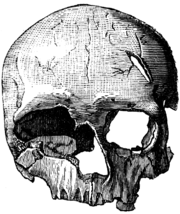
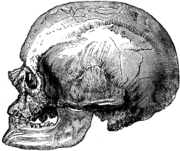
. The type specimen from the site is Cro-Magnon 1
Cro-Magnon 1
Cro-Magnon 1 is a fossilized human skull of the sub-species Homo sapiens sapiens. It was discovered, with other Cro-Magnon specimens, in Les Eyzies, France by Louis Lartet in 1868.It is dated to 27.680±270 Before Present...
, carbon dated to about 28,000 14C years old. (27,680 ± 270 BP). Compared to neanderthals, the skeletons showed the same high forehead, upright posture and slender (gracile) skeleton as modern humans. The other specimens from the site are a female, Cro-Magnon 2 and male remains, Cro-Magnon3
The condition and placement of the remains of Cro-Magnon 1, along with pieces of shell and animal teeth in what appear to have been pendant
Pendant
A pendant is a loose-hanging piece of jewellery, generally attached by a small loop to a necklace, when the ensemble may be known as a "pendant necklace". A pendant earring is an earring with a piece hanging down. In modern French "pendant" is the gerund form of “hanging”...
s or necklaces raises the question whether they were buried intentionally. If Cro-Magnons buried their dead intentionally it suggests they had a knowledge of ritual
Ritual
A ritual is a set of actions, performed mainly for their symbolic value. It may be prescribed by a religion or by the traditions of a community. The term usually excludes actions which are arbitrarily chosen by the performers....
, by burying their dead with necklaces and tools, or an idea of disease
Disease
A disease is an abnormal condition affecting the body of an organism. It is often construed to be a medical condition associated with specific symptoms and signs. It may be caused by external factors, such as infectious disease, or it may be caused by internal dysfunctions, such as autoimmune...
and that the bodies needed to be contained.
Analysis of the pathology
Pathology
Pathology is the precise study and diagnosis of disease. The word pathology is from Ancient Greek , pathos, "feeling, suffering"; and , -logia, "the study of". Pathologization, to pathologize, refers to the process of defining a condition or behavior as pathological, e.g. pathological gambling....
of the skeleton
Skeleton
The skeleton is the body part that forms the supporting structure of an organism. There are two different skeletal types: the exoskeleton, which is the stable outer shell of an organism, and the endoskeleton, which forms the support structure inside the body.In a figurative sense, skeleton can...
s shows that the humans of this period led a physically difficult life. In addition to infection, several of the individuals found at the shelter had fused vertebrae in their necks, indicating traumatic injury; the adult female found at the shelter had survived for some time with a skull fracture. As these injuries would be life threatening even today, this suggests that Cro-Magnons believed in community support and took care of each other's injuries.
Předmostí
A fossil site at Předmostí is located in the MoraviaMoravia
Moravia is a historical region in Central Europe in the east of the Czech Republic, and one of the former Czech lands, together with Bohemia and Silesia. It takes its name from the Morava River which rises in the northwest of the region...
n region of what is today the Czech Republic
Czech Republic
The Czech Republic is a landlocked country in Central Europe. The country is bordered by Poland to the northeast, Slovakia to the east, Austria to the south, and Germany to the west and northwest....
. The site was discovered in the late 19th century. Excavations were conducted between 1884 and 1930. The original material was lost during World War II
World War II
World War II, or the Second World War , was a global conflict lasting from 1939 to 1945, involving most of the world's nations—including all of the great powers—eventually forming two opposing military alliances: the Allies and the Axis...
. In the 1990s new excavations were conducted.
The Předmostí site appear to have been a living area with associated burial ground with some 20 burials, including 15 complete human interments, and portions of five others, representing either disturbed or secondary burials. Cannibalism
Cannibalism
Cannibalism is the act or practice of humans eating the flesh of other human beings. It is also called anthropophagy...
has been suggested, though it is not widely accepted. The non-human fossils are mostly mammoth
Mammoth
A mammoth is any species of the extinct genus Mammuthus. These proboscideans are members of Elephantidae, the family of elephants and mammoths, and close relatives of modern elephants. They were often equipped with long curved tusks and, in northern species, a covering of long hair...
. Many of the bones are heavily charred, indicating they were cooked. Other remains include fox
Red Fox
The red fox is the largest of the true foxes, as well as being the most geographically spread member of the Carnivora, being distributed across the entire northern hemisphere from the Arctic Circle to North Africa, Central America, and the steppes of Asia...
, reindeer
Reindeer
The reindeer , also known as the caribou in North America, is a deer from the Arctic and Subarctic, including both resident and migratory populations. While overall widespread and numerous, some of its subspecies are rare and one has already gone extinct.Reindeer vary considerably in color and size...
, ice-age horse
Przewalski's Horse
Przewalski's Horse or Dzungarian Horse, is a rare and endangered subspecies of wild horse native to the steppes of central Asia, specifically China and Mongolia.At one time extinct in the wild, it has been reintroduced to its native habitat in Mongolia at the Khustain Nuruu...
, wolf, bear
Bear
Bears are mammals of the family Ursidae. Bears are classified as caniforms, or doglike carnivorans, with the pinnipeds being their closest living relatives. Although there are only eight living species of bear, they are widespread, appearing in a wide variety of habitats throughout the Northern...
, wolverine
Wolverine
The wolverine, pronounced , Gulo gulo , also referred to as glutton, carcajou, skunk bear, or quickhatch, is the largest land-dwelling species of the family Mustelidae . It is a stocky and muscular carnivore, more closely resembling a small bear than other mustelids...
, and hare
Hare
Hares and jackrabbits are leporids belonging to the genus Lepus. Hares less than one year old are called leverets. Four species commonly known as types of hare are classified outside of Lepus: the hispid hare , and three species known as red rock hares .Hares are very fast-moving...
. Remains of three dogs were also found, one of which had a mammoth
Mammoth
A mammoth is any species of the extinct genus Mammuthus. These proboscideans are members of Elephantidae, the family of elephants and mammoths, and close relatives of modern elephants. They were often equipped with long curved tusks and, in northern species, a covering of long hair...
bone in its mouth.
The Předmostí site is dated to between 24,000 and 27,000 years old. The people were essentially similar to the French Cro-Magnon finds. Though undoubtedly modern, they had robust features indicative of a big-game hunter lifestyle. They also share square eye socket openings found in the French material.
Mladeč
Though younger than the Oase skull and mandible, the finds from MladečMladec
Mladeč is a village and municipality in Olomouc District in the Olomouc Region of the Czech Republic. The municipality covers an area of , and has a population of 761...
Caves in Moravia
Moravia
Moravia is a historical region in Central Europe in the east of the Czech Republic, and one of the former Czech lands, together with Bohemia and Silesia. It takes its name from the Morava River which rises in the northwest of the region...
(Czech Republic
Czech Republic
The Czech Republic is a landlocked country in Central Europe. The country is bordered by Poland to the northeast, Slovakia to the east, Austria to the south, and Germany to the west and northwest....
) is one of the oldest Cro-Magnon sites. The caves have yielded the remains of several individuals, but few artifacts. The artifacts found have tentatively been classified as Aurignacian
Aurignacian
The Aurignacian culture is an archaeological culture of the Upper Palaeolithic, located in Europe and southwest Asia. It lasted broadly within the period from ca. 45,000 to 35,000 years ago in terms of conventional radiocarbon dating, or between ca. 47,000 and 41,000 years ago in terms of the most...
. The finds have been radiocarbon dated
Radiocarbon dating
Radiocarbon dating is a radiometric dating method that uses the naturally occurring radioisotope carbon-14 to estimate the age of carbon-bearing materials up to about 58,000 to 62,000 years. Raw, i.e. uncalibrated, radiocarbon ages are usually reported in radiocarbon years "Before Present" ,...
to around 31,000 radiocarbon years (somewhat older in calendar years), Mladeč 2 is dated to 31,320 +410, -390, Mladeč 9a to 31,500 +420, -400 and Mladeč 8 to 30,680 +380, -360 14C years.
Other
All EEMH dates are direct fossil dates provided in 14C yearsRadiocarbon dating
Radiocarbon dating is a radiometric dating method that uses the naturally occurring radioisotope carbon-14 to estimate the age of carbon-bearing materials up to about 58,000 to 62,000 years. Raw, i.e. uncalibrated, radiocarbon ages are usually reported in radiocarbon years "Before Present" ,...
B.P.
- KostenkiKostenkiKostenki is a village located on western middle bank of Don River in Voronezh Oblast, Russia. It is known for high concentration of cultural remains of modern humans from beginning of Upper Paleolithic era....
1 = 32,600 ± 1,100. tibia and fibula - Cioclovina 1 = 29,000 ± 700, complete neurocranium from a robust individual, Cioclovina Cave, RomaniaRomaniaRomania is a country located at the crossroads of Central and Southeastern Europe, on the Lower Danube, within and outside the Carpathian arch, bordering on the Black Sea...
- Kent's CavernKent's CavernKents Cavern is a cave system in Torquay, Devon, England. It is notable for its archaeological and geological features. The caves are a geological Site of Special Scientific Interest and a Scheduled Ancient Monument , and are open to the public.-Prehistory:The caverns and passages at the site were...
4 > 30,900 ± 900 - the misnamed "Red Lady of PavilandRed Lady of PavilandThe Red Lady of Paviland is a fairly complete Upper Paleolithic-era human male skeleton dyed in red ochre. It was the first human fossil to have been found anywhere in the world and is also the oldest ceremonial burial anywhere in Western Europe so far discovered. The bones were discovered between...
", a complete anatomically modern male skeleton from a cave burial in Gower, South Wales, UK. Electrometrically dated to ca. 27,000 ybp, or to ca. 33,000 ybp following recalibrated results in 2009. Associated finds: red ochre anointing, a mammoth skull, personal decorations suggesting shamanism. Numerous tools. Genetic analysis of Mitochondrial DNA yielded the Haplogroup HHaplogroup H (mtDNA)In human mitochondrial genetics, Haplogroup H is a human mitochondrial DNA haplogroup that likely originated in Southwest Asia 25,000-30,000 YBP.-Origin:...
, the most common group in Europe.
Not direct dates. Radiocarbon dated were elements from adjacent layers.
- Les Roisà Mouthiers << 32 k
- La Quina Aval ≈ max 33 - 32 k (juvenile partial mandible)
Calendar years
- The Lapedo childLapedo childThe Lapedo child is a complete pre-historical skeleton found in Portugal. In 1998, the discovery of an early Upper Paleolithic human burial at Abrigo do Lagar Velho, by the team led by pre-history archeologist João Zilhão, has provided evidence of early modern humans from the west of the Iberian...
from Abrigo do Lagar VelhoAbrigo do Lagar VelhoLagar Velho is rock-shelter in the Lapedo valley, a limestone canyon 13 km from the centre of Leiria, in the municipality of Leiria, in central Portugal...
, about 24,000 years old, a fairly complete and quite robust skeleton, possibly showing some NeanderthalNeanderthalThe Neanderthal is an extinct member of the Homo genus known from Pleistocene specimens found in Europe and parts of western and central Asia...
traits.
Other sites, assemblages or specimens: Brassempouy, La Rochette, Vogelherd, Engis
Engis
Engis is a Walloon municipality located in the Belgian province of Liège. On January 1, 2006 Engis had a total population of 5,686. The total area is 27.74 km² which gives a population density of 205 inhabitants per km²....
, Hahnöfersand, St. Prokop, Velika Pećina
Origin of the Cro-Magnon people
Anatomically modern humans first emerged in East AfricaEast Africa
East Africa or Eastern Africa is the easterly region of the African continent, variably defined by geography or geopolitics. In the UN scheme of geographic regions, 19 territories constitute Eastern Africa:...
, some 100 000 to 200 000 years ago. An exodus from Africa
Recent African origin of modern humans
In paleoanthropology, the recent African origin of modern humans is the most widely accepted model describing the origin and early dispersal of anatomically modern humans...
over the Arabian Peninsula
Arabian Peninsula
The Arabian Peninsula is a land mass situated north-east of Africa. Also known as Arabia or the Arabian subcontinent, it is the world's largest peninsula and covers 3,237,500 km2...
around 60 000 years ago brought modern humans to Eurasia
Eurasia
Eurasia is a continent or supercontinent comprising the traditional continents of Europe and Asia ; covering about 52,990,000 km2 or about 10.6% of the Earth's surface located primarily in the eastern and northern hemispheres...
, with one group rapidly settling coastal areas around the Indian Ocean
Indian Ocean
The Indian Ocean is the third largest of the world's oceanic divisions, covering approximately 20% of the water on the Earth's surface. It is bounded on the north by the Indian Subcontinent and Arabian Peninsula ; on the west by eastern Africa; on the east by Indochina, the Sunda Islands, and...
and one group migrating north to steppes of Central Asia
Central Asia
Central Asia is a core region of the Asian continent from the Caspian Sea in the west, China in the east, Afghanistan in the south, and Russia in the north...
. A mitochondrial DNA
Mitochondrial DNA
Mitochondrial DNA is the DNA located in organelles called mitochondria, structures within eukaryotic cells that convert the chemical energy from food into a form that cells can use, adenosine triphosphate...
sequence of two Cro-Magnons from the Paglicci Cave
Paglicci Cave
Paglicci cave is an archeological site situated near Rignano Garganico, Apulia, southern Italy. The cave, discovered in the 1950s, is the most important cave of Gargano.- Description :...
, Italy, dated to 23 000 and 24 000 years old (Paglicci 52 and 12), identified the mtDNA
Mitochondrial DNA
Mitochondrial DNA is the DNA located in organelles called mitochondria, structures within eukaryotic cells that convert the chemical energy from food into a form that cells can use, adenosine triphosphate...
as Haplogroup N
Haplogroup N (mtDNA)
In human mitochondrial genetics, Haplogroup N is a human mitochondrial DNA haplogroup. An enormous haplogroup spanning many continents, the macro-haplogroup N, like its sibling M, is a descendant of haplogroup L3....
, typical of the latter group. The inland group is the founder of North and East Asians (the "Mongol
Mongoloid race
Mongoloid is a term sometimes used by forensic anthropologists and physical anthropologists to refer to populations that share certain phenotypic traits such as epicanthic fold and shovel-shaped incisors and other physical traits common in East Asia, the Americas and the Arctic...
" people), Caucasoids and large sections of the Middle East and North African population. Migration from the Black Sea
Black Sea
The Black Sea is bounded by Europe, Anatolia and the Caucasus and is ultimately connected to the Atlantic Ocean via the Mediterranean and the Aegean seas and various straits. The Bosphorus strait connects it to the Sea of Marmara, and the strait of the Dardanelles connects that sea to the Aegean...
area into Europe started some 45 000 years ago, probably along the Danubian corridor
Danubian corridor
In paleontology and archeology, the Danubian corridor or Rhine-Danube corridor refers to a route along the valleys of the Danube River and Rhine River of various migration of Eastern cultures from Asia Minor, Aegean, Caspian etc., into the north and northwest Europe....
. By 20 000 years ago, the whole of Europe was settled.
Physical attributes
Cranial capacity
Cranial capacity is a measure of the volume of the interior of the cranium of those vertebrates who have both a cranium and a brain. The most commonly used unit of measure is the cubic centimetre or cc...
. The Cro-Magnons had long, fairly low skulls, with a wide face, a prominent nose and moderate to no prognathism
Prognathism
Prognathism is a term used to describe the positional relationship of the mandible and/or maxilla to the skeletal base where either of the jaws protrudes beyond a predetermined imaginary line in the coronal plane of the skull. In general dentistry, oral and maxillofacial surgery and orthodontics...
, similar to features seen in modern Europeans. A very distinct trait is the rectangular orbits
Orbit (anatomy)
In anatomy, the orbit is the cavity or socket of the skull in which the eye and its appendages are situated. "Orbit" can refer to the bony socket, or it can also be used to imply the contents...
.
Several works on genetics, blood types and cranial morphology indicate that the Basque people
Basque people
The Basques as an ethnic group, primarily inhabit an area traditionally known as the Basque Country , a region that is located around the western end of the Pyrenees on the coast of the Bay of Biscay and straddles parts of north-central Spain and south-western France.The Basques are known in the...
may be part descendents of the original Cro-Magnon population. A 2006 study of Basque DNA has shown a 1% incidence of mtDNA haplogroup U8a dated to the time of Cro-Magnon but noted that the low incidence of this ancestry and recent gene flow from neighbouring populations means the current Basque population cannot be considered reliable examples of the physical characteristics of Cro-Magnon.
Mitochondrial DNA
Mitochondrial DNA
Mitochondrial DNA is the DNA located in organelles called mitochondria, structures within eukaryotic cells that convert the chemical energy from food into a form that cells can use, adenosine triphosphate...
analysis place the early European population as sister group to the Asian ("Mongol
Mongoloid race
Mongoloid is a term sometimes used by forensic anthropologists and physical anthropologists to refer to populations that share certain phenotypic traits such as epicanthic fold and shovel-shaped incisors and other physical traits common in East Asia, the Americas and the Arctic...
") groups, dating the divergence to some 50 000 years ago. While the skin and hair colour of the Cro-Magnons can at best be guessed at, light skin is known to have evolved independently in both the Asian and European lines, and may have only appeared in the European line as recently as 6000 years ago suggesting Cro-Magnons could have been medium brown to tan-skinned. A small ivory bust of a man found at Dolní Věstonice
Dolní Vestonice
Dolní Věstonice is a small village in the South Moravian Region of the Czech Republic. It is known for a series of ice age archaeological sites in the area. These sites were used by mammoth hunters, and finds include a triple burial and the Venus of Dolní Věstonice.A small fortress was built here...
and dated to 26 000 years indicate the Cro-Magnons had straight hair, though the somewhat later Venus of Brassempouy
Venus of Brassempouy
The Venus of Brassempouy is a fragmentary ivory figurine from the Upper Palaeolithic. It was discovered in a cave at Brassempouy, France in 1892...
may show curly hair, or possibly braids.
Markku Niskanen (2002) of the Department of Anthropology at the University of Oulu
University of Oulu
The University of Oulu is one of the largest universities in Finland, located in the city of Oulu. It was founded on July 8, 1958. The university has around 16,000 students and 3,000 staff...
, Finland
Finland
Finland , officially the Republic of Finland, is a Nordic country situated in the Fennoscandian region of Northern Europe. It is bordered by Sweden in the west, Norway in the north and Russia in the east, while Estonia lies to its south across the Gulf of Finland.Around 5.4 million people reside...
, claimed the "strong cheekbones and flaring zygomatic arches of many Finno-Ugrians
Finno-Ugric peoples
The Finno-Ugric peoples are any of several peoples of Europe who speak languages of the proposed Finno-Ugric language family, such as the Finns, Estonians, Mordvins, and Hungarians...
, commonly and erroneously assumed to be Mongoloid
Mongoloid race
Mongoloid is a term sometimes used by forensic anthropologists and physical anthropologists to refer to populations that share certain phenotypic traits such as epicanthic fold and shovel-shaped incisors and other physical traits common in East Asia, the Americas and the Arctic...
features, are actually inherited from European Cro-Magnons"
Cro-Magnon culture
The flint tools found in association with the remains at Cro-Magnon have associations with the AurignacianAurignacian
The Aurignacian culture is an archaeological culture of the Upper Palaeolithic, located in Europe and southwest Asia. It lasted broadly within the period from ca. 45,000 to 35,000 years ago in terms of conventional radiocarbon dating, or between ca. 47,000 and 41,000 years ago in terms of the most...
culture that Lartet
Louis Lartet
Louis Lartet was a French geologist and paleontologist. He discovered the original Cro-Magnon skeletons.Louis Lartet was born in Castelnau-Magnoac, in Seissan in the département of Gers...
had identified a few years before he found the first skeletons. The Aurignacian differ from the earlier cultures by their finely worked bone or antler points and flint points made for hafting, the production of Venus figurines
Venus figurines
Venus figurines is an umbrella term for a number of prehistoric statuettes of women portrayed with similar physical attributes from the Upper Palaeolithic, mostly found in Europe, but with finds as far east as Irkutsk Oblast, Siberia, extending their distribution to much of Eurasia, from the...
and cave painting
Cave painting
Cave paintings are paintings on cave walls and ceilings, and the term is used especially for those dating to prehistoric times. The earliest European cave paintings date to the Aurignacian, some 32,000 years ago. The purpose of the paleolithic cave paintings is not known...
.
Like Neanderthals, the Cro-Magnon were primarily big-game hunters, killing mammoth
Mammoth
A mammoth is any species of the extinct genus Mammuthus. These proboscideans are members of Elephantidae, the family of elephants and mammoths, and close relatives of modern elephants. They were often equipped with long curved tusks and, in northern species, a covering of long hair...
, cave bear
Cave Bear
The cave bear was a species of bear that lived in Europe during the Pleistocene and became extinct at the beginning of the Last Glacial Maximum about 27,500 years ago....
s, horse
Horse
The horse is one of two extant subspecies of Equus ferus, or the wild horse. It is a single-hooved mammal belonging to the taxonomic family Equidae. The horse has evolved over the past 45 to 55 million years from a small multi-toed creature into the large, single-toed animal of today...
s and reindeer
Reindeer
The reindeer , also known as the caribou in North America, is a deer from the Arctic and Subarctic, including both resident and migratory populations. While overall widespread and numerous, some of its subspecies are rare and one has already gone extinct.Reindeer vary considerably in color and size...
. They would have been nomadic or semi-nomadic, following the annual migration of their prey. In Mezhirich
Mezhirich
Mezhyrich is a village in central Ukraine. It is located in the Kanivskyi Raion of the Cherkasy Oblast , approximately 22 km from the region's administrative center, Kaniv, near the point where the Rosava River flows into the Ros'.-Pre-historic finds:In 1965, a farmer dug up the lower jawbone of...
village in Ukraine
Ukraine
Ukraine is a country in Eastern Europe. It has an area of 603,628 km², making it the second largest contiguous country on the European continent, after Russia...
, several huts built from mammoth bones possibly representing semi-permanent hunting camps have been unearthed.
Finds of spun, dyed, and knotted flax
Flax
Flax is a member of the genus Linum in the family Linaceae. It is native to the region extending from the eastern Mediterranean to India and was probably first domesticated in the Fertile Crescent...
fibers among Cro-Magnon artifacts in Dzudzuana
Prehistoric Georgia
The prehistory of Georgia is the period between the first human habitation of the territory of modern-day nation of Georgia and the time when Assyrian and Urartian, and more firmly, the Classical accounts, brought the proto-Georgian tribes into the scope of recorded history.-Paleolithic:Humans have...
shows they made cords for hafting stone tools, weaving baskets, or sewing garments, and suggest that they knew how to make woven clothing. Apart from the mammoth bone huts mentioned, they constructed shelter of rocks, clay, branches, and animal hide/fur. These early humans used manganese
Manganese
Manganese is a chemical element, designated by the symbol Mn. It has the atomic number 25. It is found as a free element in nature , and in many minerals...
and iron oxide
Oxide
An oxide is a chemical compound that contains at least one oxygen atom in its chemical formula. Metal oxides typically contain an anion of oxygen in the oxidation state of −2....
s to paint pictures and may have created one early lunar calendar
Calendar
A calendar is a system of organizing days for social, religious, commercial, or administrative purposes. This is done by giving names to periods of time, typically days, weeks, months, and years. The name given to each day is known as a date. Periods in a calendar are usually, though not...
around 15,000 years ago.
Other contemporary humans in Europe
Neanderthals
The Cro-Magnon shared the European landscape with NeanderthalNeanderthal
The Neanderthal is an extinct member of the Homo genus known from Pleistocene specimens found in Europe and parts of western and central Asia...
s for some 10 000 years or more, before the latter disappear from the fossil record. The nature of their co-existence and the extinction of Neanderthals
Neanderthal extinction hypotheses
Neanderthal extinction hypotheses are theories about how Neanderthals became extinct around 30,000 years ago. Since their discovery, both the Neanderthals' place in the human family tree and their relation to modern Europeans has been hotly debated...
has been debated. Suggestions include peaceful co-existence, competition, interbreeding, assimilation and genocide.
Other modern people, like the Qafzeh humans seem to have co-existed with Neanderthals for up to 60 000 years in the Levant
Levant
The Levant or ) is the geographic region and culture zone of the "eastern Mediterranean littoral between Anatolia and Egypt" . The Levant includes most of modern Lebanon, Syria, Jordan, Israel, the Palestinian territories, and sometimes parts of Turkey and Iraq, and corresponds roughly to the...
.
Earlier studies argue for more than 15 000 years of Neanderthal and modern human co-existence in France. A simulation
Simulation
Simulation is the imitation of some real thing available, state of affairs, or process. The act of simulating something generally entails representing certain key characteristics or behaviours of a selected physical or abstract system....
based on a slight difference in carrying capacity
Carrying capacity
The carrying capacity of a biological species in an environment is the maximum population size of the species that the environment can sustain indefinitely, given the food, habitat, water and other necessities available in the environment...
in the two groups indicates that the two groups would only be found together in a narrow zone, at the front of the Cro-Magnon immigration wave.
The Neanderthal Châtelperronian
Châtelperronian
Châtelperronian was the earliest industry of the Upper Palaeolithic in central and south western France, extending also into Northern Spain. It derives its name from the site of la Grotte des Fées, in Châtelperron, Allier, France....
culture appears to have been influenced by the Cro-Magnons, indicating some sort of cultural exchange between the two groups. At the original Châtelperronian site
Châtelperron
Châtelperron is a commune in the Allier department in central France.It is the location of site known as Grotte des Fées at Châtelperron.-Population:-References:*...
layers of Châtelperronian artifacts alternate with Aurignacian
Aurignacian
The Aurignacian culture is an archaeological culture of the Upper Palaeolithic, located in Europe and southwest Asia. It lasted broadly within the period from ca. 45,000 to 35,000 years ago in terms of conventional radiocarbon dating, or between ca. 47,000 and 41,000 years ago in terms of the most...
, though this may be a result of interstratified
Stratification (archeology)
Stratification is a paramount and base concept in archaeology, especially in the course of excavation. It is largely based on the Law of Superposition...
("chronologically mixed") layers, or disturbances from earlier excavations. The "Lapedo child
Lapedo child
The Lapedo child is a complete pre-historical skeleton found in Portugal. In 1998, the discovery of an early Upper Paleolithic human burial at Abrigo do Lagar Velho, by the team led by pre-history archeologist João Zilhão, has provided evidence of early modern humans from the west of the Iberian...
" found at Abrigo do Lagar Velho
Abrigo do Lagar Velho
Lagar Velho is rock-shelter in the Lapedo valley, a limestone canyon 13 km from the centre of Leiria, in the municipality of Leiria, in central Portugal...
in Portugal has been quoted as being a possible Neanderthal/Cro-Magnon hybrid, though this interpretation is disputed. Recent genetic studies of a wide selection of modern humans do however indicate some form of hybridization with archaic humans
Archaic Homo sapiens
Archaic Homo sapiens is a loosely defined term used to describe a number of varieties of Homo, as opposed to anatomically modern humans , in the period beginning 500,000 years ago....
took place after modern humans emerged from Africa. About 1 to 4 percent of the DNA in Europeans and Asians appears to be derived from Neanderthals, though none of it can conclusively be tied to a European event.
Contemporary early modern humans in Europe?
The so-called Grimaldi ManGrimaldi Man
Grimaldi man was a name given in the early 20th century to an Italian find of two paleolithic skeletons, supposedly showing negroid traits. When found, the skeletons were the subject of dubious scientific theories on human evolution, partly fueled by biased reconstruction of the skulls by the...
may have been a contemporary group of modern humans
Anatomically modern humans
The term anatomically modern humans in paleoanthropology refers to early individuals of Homo sapiens with an appearance consistent with the range of phenotypes in modern humans....
, distinct from the Cro-Magnons. The find is from the "Grotte des Enfants" near Menton
Menton
Menton is a commune in the Alpes-Maritimes department in the Provence-Alpes-Côte d'Azur region in southeastern France.Situated on the French Riviera, along the Franco-Italian border, it is nicknamed la perle de la France ....
on the French Riviera
French Riviera
The Côte d'Azur, pronounced , often known in English as the French Riviera , is the Mediterranean coastline of the southeast corner of France, also including the sovereign state of Monaco...
. The two known skeletons are shorter and more gracile than the Cro-Magnon, and the skulls are taller and less robust, with signs of prognathism
Prognathism
Prognathism is a term used to describe the positional relationship of the mandible and/or maxilla to the skeletal base where either of the jaws protrudes beyond a predetermined imaginary line in the coronal plane of the skull. In general dentistry, oral and maxillofacial surgery and orthodontics...
, all interpreted as African traits. The interpretation of the Grimaldi finds as belonging to a "negroid" race is complicated by the two skeletons being that of a woman and an adolescent and some dubious reconstruction work. The finds were classified as Cro-Magnon under the wide use of the term in the mid-20th century. Due to the reconstruction forwarded by the early description and its use in racist theories, the Grimaldi finds have been largely ignored in recent literature.
Genetics
A 2003 sequencing on the mitochondrial DNAMitochondrial DNA
Mitochondrial DNA is the DNA located in organelles called mitochondria, structures within eukaryotic cells that convert the chemical energy from food into a form that cells can use, adenosine triphosphate...
of two Cro-Magnons (23,000-year-old Paglicci 52 and 24,720-year-old Paglicci 12) published by an Italo-Spanish research team led by David Caramelli, identified the mtDNA
Mitochondrial DNA
Mitochondrial DNA is the DNA located in organelles called mitochondria, structures within eukaryotic cells that convert the chemical energy from food into a form that cells can use, adenosine triphosphate...
as Haplogroup N
Haplogroup N (mtDNA)
In human mitochondrial genetics, Haplogroup N is a human mitochondrial DNA haplogroup. An enormous haplogroup spanning many continents, the macro-haplogroup N, like its sibling M, is a descendant of haplogroup L3....
. Haplogroup N is found among modern populations of Europe
Europe
Europe is, by convention, one of the world's seven continents. Comprising the westernmost peninsula of Eurasia, Europe is generally 'divided' from Asia to its east by the watershed divides of the Ural and Caucasus Mountains, the Ural River, the Caspian and Black Seas, and the waterways connecting...
, the Middle East
Middle East
The Middle East is a region that encompasses Western Asia and Northern Africa. It is often used as a synonym for Near East, in opposition to Far East...
, North Africa
North Africa
North Africa or Northern Africa is the northernmost region of the African continent, linked by the Sahara to Sub-Saharan Africa. Geopolitically, the United Nations definition of Northern Africa includes eight countries or territories; Algeria, Egypt, Libya, Morocco, South Sudan, Sudan, Tunisia, and...
and Central Asia
Central Asia
Central Asia is a core region of the Asian continent from the Caspian Sea in the west, China in the east, Afghanistan in the south, and Russia in the north...
, and represent the northern branch of the out-of-Africa migration of modern humans. Its descendant haplogroup
Haplogroup
In the study of molecular evolution, a haplogroup is a group of similar haplotypes that share a common ancestor having the same single nucleotide polymorphism mutation in both haplotypes. Because a haplogroup consists of similar haplotypes, this is what makes it possible to predict a haplogroup...
s are found among modern North African, Eurasia
Eurasia
Eurasia is a continent or supercontinent comprising the traditional continents of Europe and Asia ; covering about 52,990,000 km2 or about 10.6% of the Earth's surface located primarily in the eastern and northern hemispheres...
n, Polynesian
Polynesians
The Polynesian peoples is a grouping of various ethnic groups that speak Polynesian languages, a branch of the Oceanic languages within the Austronesian languages, and inhabit Polynesia. They number approximately 1,500,000 people...
and Native American
Indigenous peoples of the Americas
The indigenous peoples of the Americas are the pre-Columbian inhabitants of North and South America, their descendants and other ethnic groups who are identified with those peoples. Indigenous peoples are known in Canada as Aboriginal peoples, and in the United States as Native Americans...
populations.
See also
- List of fossil sites (with link directory)
- List of human evolution fossils
- Neanderthal interaction with Cro-Magnons
- The InheritorsThe Inheritors (William Golding)The Inheritors is the 1955 second novel by the British author William Golding, best known for Lord of the Flies. It was his personal favourite of all his novels and concerns the extinction of the last remaining tribe of Neanderthals at the hands of the more sophisticated Homo sapiens.-Plot...
, a 1955 novel by William GoldingWilliam GoldingSir William Gerald Golding was a British novelist, poet, playwright and Nobel Prize for Literature laureate, best known for his novel Lord of the Flies...
about the extinction of Homo Neanderthalensis through conflict with Cro Magnon civilisation
Further reading
- Brian Fagan Cro-Magnon: How the Ice Age Gave Birth to the First Modern Humans (Bloomsbury Press; 2010) 295 pages
External links
- Cro-Magnon 1: Smithsonian Institution – The Human Origins Program