

United Kingdom of the Netherlands

Encyclopedia
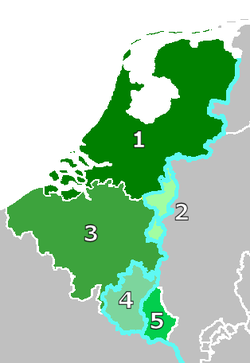
United Kingdom of the Netherlands (1815–1839) is the unofficial name used to refer to Kingdom of the Netherlands
during the period after it was first created from part of the First French Empire
and before the new kingdom of Belgium split out in 1830. This state, a large part of which still exists today as the Kingdom of the Netherlands, was made up of the former Dutch Republic
(Republic of the Seven United Netherlands) to the north, the former Austrian Netherlands to the south, plus the former Prince-Bishopric of Liège. The House of Orange-Nassau
came to be the monarchs of this new state.
The United Kingdom of the Netherlands collapsed after the 1830 Belgian Revolution
. William I, King of the Netherlands
, would refuse to recognize a Belgian state until 1839, when he had to yield under pressure by the Treaty of London. Only at this time were exact borders agreed.
 After the liberation of the Netherlands in 1813 by Prussian and Russian troops, William Frederik of Orange-Nassau, (better known as William I of the Netherlands
) the son of the last stadtholder William V of Orange-Nassau
and Princess Wilhelmina of Prussia, returned to The Hague to be granted the title Sovereign of the Netherlands on 2 December 1813.
in 1815 France had to give up its rule of the Southern Netherlands. These negotiations were not made easy, because William tried to get as much out of it as he could. His ideas of a United Netherlands were based upon the actions of Hendrik van der Noot
, a lawyer and politician and one of the main players in the Revolution of the Southern Netherlands
against the Austrian Emperor
(1789–1790). In 1789, after the Southern Netherlands declared themselves independent, Hendrik knew this was a fragile state and he tried to be reunited with the Republic of the Seven United Netherlands. Since then William had never forgotten this and after the fall of Napoleon he saw a chance.
Three different scenarios were made:
The first two scenarios came from "Memorandum of Holland" made in 1813 after the Battle of Leipzig
. The last scenario came from William himself. The first scenario never made it because the Great Powers (Great Britain, Prussia, Austria and Russia) thought an independent Southern Netherlands/Belgium under an Austrian Prince was too weak and Austria was not interested in getting it back.
The Dutch question became a problem. The Great Powers of Europe chose the last scenario, but didn't want to go as far in enlarging the Netherlands as William.
In the end, the Eight Articles of London
granted William the following lands:
The Duchy of Luxembourg was not fully granted to William, because it was a member of the German Confederation
. William however demanded that Luxembourg become a part of the Netherlands, as a unified Netherlands was stronger as a buffer for France. Historically it had been a part of the Netherlands (Seventeen Provinces
or Burgundian Netherlands
), up to 1648, but Luxembourg was still a part of the discussions.
On 1 March 1815, while the Congress of Vienna was still going on, Napoleon escaped from Elba
and he created a large army against the Great Powers of Europe. He was defeated at the Battle of Waterloo
(at that time within the kingdom) by Prussian, British, Belgian, Dutch and Nassau (under the prince of Orange) troops.
William no longer hesitated and with permission of the Great Powers of Europe on 16 March 1815 he made himself King William I of the United Kingdom of the Netherlands. Luxembourg became a Grand-Duchy in personal union with the Netherlands and stayed a member of the German Confederation, being garrisoned by Prussian troops on behalf of the Dutch king.
With the unification William completed the dream of his ancestor William of Orange (also known as William the Silent
), who started it in 1579.
.
The Second Chamber of the States-General of the Netherlands
had 110 members, of which 55 were chosen by the north and 55 were chosen by the south. The First Chamber consisted of noblemen, old and new nobles, who were granted the position by King William.
The Netherlands had eight ministers, who did not have to answer to the Second Chamber, but only to the King himself. In fact, they were following his demands. The King also could rule by "Royal Order".
Although financially stable, the south also had the burden of the nation's debt, but gained new trade markets in the Dutch colonies. Many people's welfare improved in the south lived in poverty because the profits of trade were used for big projects.
William tried to divide the nation's wealth more equally through, among others, the following actions:
Through these actions export of cotton, sheets, weapons and steel products increased. The fleet of Antwerp grew to 117 ships. Many of these projects were funded by King William himself.
The educational system was extended. Under William's rule the number of school-going children doubled from 150,000 to 300,000 by opening 1,500 new public schools. The south especially needed schools because many people could not read or write.
In 1825 William founded the Dutch Trading Company (Dutch: Nederlandse Handels Maatschappij), to boost trade with the colonies.
Socially the unification created many problems. The Burgundian and Calvinistic mentalities did not tolerate each other very well. The French-speaking elite acted in their personal interest by using the differences in religion, mentality, life style and communication. Both the north and the south had a different historical background and the Dutch and French speaking people both were afraid of being overruled by each other. France played a role in this by the "Legion belge et parisienne", financed with private funds but with permission of the French government, to make a unification with France possible.
Religious and political differences
Religion was also a reason for separation. While the north was dominantly Protestant
, the south was Catholic. The Catholic Church saw its influence declining in favour of the king. He built over 1,500 state schools where the Church was no longer the provider of education. Also the north had built up an independent history, and had experienced a golden age. So the Dutch people saw Belgium more as a territorial gain than a partner. This was used by the church and the French-speaking elite
to create anti-Dutch feelings which led to the Belgian revolution
.
Kingdom of the Netherlands
The Kingdom of the Netherlands is a sovereign state and constitutional monarchy with territory in Western Europe and in the Caribbean. The four parts of the Kingdom—Aruba, Curaçao, the Netherlands, and Sint Maarten—are referred to as "countries", and participate on a basis of equality...
during the period after it was first created from part of the First French Empire
First French Empire
The First French Empire , also known as the Greater French Empire or Napoleonic Empire, was the empire of Napoleon I of France...
and before the new kingdom of Belgium split out in 1830. This state, a large part of which still exists today as the Kingdom of the Netherlands, was made up of the former Dutch Republic
Dutch Republic
The Dutch Republic — officially known as the Republic of the Seven United Netherlands , the Republic of the United Netherlands, or the Republic of the Seven United Provinces — was a republic in Europe existing from 1581 to 1795, preceding the Batavian Republic and ultimately...
(Republic of the Seven United Netherlands) to the north, the former Austrian Netherlands to the south, plus the former Prince-Bishopric of Liège. The House of Orange-Nassau
House of Orange-Nassau
The House of Orange-Nassau , a branch of the European House of Nassau, has played a central role in the political life of the Netherlands — and at times in Europe — since William I of Orange organized the Dutch revolt against Spanish rule, which after the Eighty Years' War...
came to be the monarchs of this new state.
The United Kingdom of the Netherlands collapsed after the 1830 Belgian Revolution
Belgian Revolution
The Belgian Revolution was the conflict which led to the secession of the Southern provinces from the United Kingdom of the Netherlands and established an independent Kingdom of Belgium....
. William I, King of the Netherlands
William I of the Netherlands
William I Frederick, born Willem Frederik Prins van Oranje-Nassau , was a Prince of Orange and the first King of the Netherlands and Grand Duke of Luxembourg....
, would refuse to recognize a Belgian state until 1839, when he had to yield under pressure by the Treaty of London. Only at this time were exact borders agreed.
Prince William of Orange-Nassau, the new sovereign of the Netherlands
William I of the Netherlands
William I Frederick, born Willem Frederik Prins van Oranje-Nassau , was a Prince of Orange and the first King of the Netherlands and Grand Duke of Luxembourg....
) the son of the last stadtholder William V of Orange-Nassau
William V, Prince of Orange
William V , Prince of Orange-Nassau was the last Stadtholder of the Dutch Republic, and between 1795 and 1806 he led the Government of the Dutch Republic in Exile in London. He was succeeded by his son William I...
and Princess Wilhelmina of Prussia, returned to The Hague to be granted the title Sovereign of the Netherlands on 2 December 1813.
Unification under William I
During the Congress of ViennaCongress of Vienna
The Congress of Vienna was a conference of ambassadors of European states chaired by Klemens Wenzel von Metternich, and held in Vienna from September, 1814 to June, 1815. The objective of the Congress was to settle the many issues arising from the French Revolutionary Wars, the Napoleonic Wars,...
in 1815 France had to give up its rule of the Southern Netherlands. These negotiations were not made easy, because William tried to get as much out of it as he could. His ideas of a United Netherlands were based upon the actions of Hendrik van der Noot
Hendrik Van der Noot
Hendrik Karel Nicolaas van der Noot was a jurist, lawyer and politician from Brabant. He was one of the main players of the Brabant Revolution against the Austrian rule of Emperor Joseph II)...
, a lawyer and politician and one of the main players in the Revolution of the Southern Netherlands
United States of Belgium
The United States of Belgium, part of Brabant.In October, he invaded Brabant and captured Turnhout, defeating the Austrians in the Battle of Turnhout on October 27. Ghent was taken on November 13, and on November 17 the imperial regents Albert of Saxony and Archduchess Maria Christina fled Brussels...
against the Austrian Emperor
Joseph II, Holy Roman Emperor
Joseph II was Holy Roman Emperor from 1765 to 1790 and ruler of the Habsburg lands from 1780 to 1790. He was the eldest son of Empress Maria Theresa and her husband, Francis I...
(1789–1790). In 1789, after the Southern Netherlands declared themselves independent, Hendrik knew this was a fragile state and he tried to be reunited with the Republic of the Seven United Netherlands. Since then William had never forgotten this and after the fall of Napoleon he saw a chance.
Three different scenarios were made:
- The Northern Netherlands restored within its old borders and the Southern Netherlands would become a barrier state under the rule of a great powerGreat powerA great power is a nation or state that has the ability to exert its influence on a global scale. Great powers characteristically possess military and economic strength and diplomatic and cultural influence which may cause small powers to consider the opinions of great powers before taking actions...
, like Austria. - If the Southern Netherlands would stay (partially) French, the Northern Netherlands should be extended to the Nete River or probably the whole of FlandersFlandersFlanders is the community of the Flemings but also one of the institutions in Belgium, and a geographical region located in parts of present-day Belgium, France and the Netherlands. "Flanders" can also refer to the northern part of Belgium that contains Brussels, Bruges, Ghent and Antwerp...
. In this scenario also portions of Germany would become Dutch. Then the border would be the line MechelenMechelenMechelen Footnote: Mechelen became known in English as 'Mechlin' from which the adjective 'Mechlinian' is derived...
-MaastrichtMaastrichtMaastricht is situated on both sides of the Meuse river in the south-eastern part of the Netherlands, on the Belgian border and near the German border...
-JülichJülichJülich is a town in the district of Düren, in the federal state of North Rhine-Westphalia, Germany. Jülich is well known as location of a world-famous research centre, the Forschungszentrum Jülich and as shortwave transmission site of Deutsche Welle...
-CologneCologneCologne is Germany's fourth-largest city , and is the largest city both in the Germany Federal State of North Rhine-Westphalia and within the Rhine-Ruhr Metropolitan Area, one of the major European metropolitan areas with more than ten million inhabitants.Cologne is located on both sides of the...
-DüsseldorfDüsseldorfDüsseldorf is the capital city of the German state of North Rhine-Westphalia and centre of the Rhine-Ruhr metropolitan region.Düsseldorf is an important international business and financial centre and renowned for its fashion and trade fairs. Located centrally within the European Megalopolis, the...
where it ends at the river Rhine. - France within its old borders, the Northern Netherlands unified with the Southern Netherlands and all of German territories on the left bank of the Rhine and north of the MoselleMoselleMoselle is a department in the east of France named after the river Moselle.- History :Moselle is one of the original 83 departments created during the French Revolution on March 4, 1790...
and the old Duchy of Berg and the old Lands of Nassau on the right bank of the Rhine.
The first two scenarios came from "Memorandum of Holland" made in 1813 after the Battle of Leipzig
Battle of Leipzig
The Battle of Leipzig or Battle of the Nations, on 16–19 October 1813, was fought by the coalition armies of Russia, Prussia, Austria and Sweden against the French army of Napoleon. Napoleon's army also contained Polish and Italian troops as well as Germans from the Confederation of the Rhine...
. The last scenario came from William himself. The first scenario never made it because the Great Powers (Great Britain, Prussia, Austria and Russia) thought an independent Southern Netherlands/Belgium under an Austrian Prince was too weak and Austria was not interested in getting it back.
The Dutch question became a problem. The Great Powers of Europe chose the last scenario, but didn't want to go as far in enlarging the Netherlands as William.
In the end, the Eight Articles of London
Eight Articles of London
The Eight Articles of London, also known as the London Protocol of June 21, 1814, were a secret convention between the Great Powers: United Kingdom of Great Britain and Ireland, Prussia, Austria, and Russia to award the territory of current Belgium and The Netherlands to William I of the...
granted William the following lands:
- The Republic of the Seven United Netherlands
- The Austrian Netherlands within its borders of 1789 (so without French FlandersFrench FlandersFrench Flanders is a part of the historical County of Flanders in present-day France. The region today lies in the modern-day region of Nord-Pas de Calais, the department of Nord, and roughly corresponds to the arrondissements of Lille, Douai and Dunkirk on the Belgian border.-Geography:French...
) - The Prince-Bishopric of Liège, but on Prussia's behalf small changes were made to its borders
The Duchy of Luxembourg was not fully granted to William, because it was a member of the German Confederation
German Confederation
The German Confederation was the loose association of Central European states created by the Congress of Vienna in 1815 to coordinate the economies of separate German-speaking countries. It acted as a buffer between the powerful states of Austria and Prussia...
. William however demanded that Luxembourg become a part of the Netherlands, as a unified Netherlands was stronger as a buffer for France. Historically it had been a part of the Netherlands (Seventeen Provinces
Seventeen Provinces
The Seventeen Provinces were a personal union of states in the Low Countries in the 15th century and 16th century, roughly covering the current Netherlands, Belgium, Luxembourg, a good part of the North of France , and a small part of Western Germany.The Seventeen Provinces were originally held by...
or Burgundian Netherlands
Burgundian Netherlands
In the history of the Low Countries, the Burgundian Netherlands refers to a number of Imperial and French fiefs ruled in personal union by the House of Valois-Burgundy and their Habsburg heirs in the period from 1384 to 1482...
), up to 1648, but Luxembourg was still a part of the discussions.
On 1 March 1815, while the Congress of Vienna was still going on, Napoleon escaped from Elba
Elba
Elba is a Mediterranean island in Tuscany, Italy, from the coastal town of Piombino. The largest island of the Tuscan Archipelago, Elba is also part of the National Park of the Tuscan Archipelago and the third largest island in Italy after Sicily and Sardinia...
and he created a large army against the Great Powers of Europe. He was defeated at the Battle of Waterloo
Battle of Waterloo
The Battle of Waterloo was fought on Sunday 18 June 1815 near Waterloo in present-day Belgium, then part of the United Kingdom of the Netherlands...
(at that time within the kingdom) by Prussian, British, Belgian, Dutch and Nassau (under the prince of Orange) troops.
William no longer hesitated and with permission of the Great Powers of Europe on 16 March 1815 he made himself King William I of the United Kingdom of the Netherlands. Luxembourg became a Grand-Duchy in personal union with the Netherlands and stayed a member of the German Confederation, being garrisoned by Prussian troops on behalf of the Dutch king.
With the unification William completed the dream of his ancestor William of Orange (also known as William the Silent
William the Silent
William I, Prince of Orange , also widely known as William the Silent , or simply William of Orange , was the main leader of the Dutch revolt against the Spanish that set off the Eighty Years' War and resulted in the formal independence of the United Provinces in 1648. He was born in the House of...
), who started it in 1579.
Power of the King
The newly formed kingdom was not like the Netherlands or Belgium today. By the constitution, King William was granted much more power than a King or Queen in a modern constitutional monarchyConstitutional monarchy
Constitutional monarchy is a form of government in which a monarch acts as head of state within the parameters of a constitution, whether it be a written, uncodified or blended constitution...
.
The Second Chamber of the States-General of the Netherlands
States-General of the Netherlands
The States-General of the Netherlands is the bicameral legislature of the Netherlands, consisting of the Senate and the House of Representatives. The parliament meets in at the Binnenhof in The Hague. The archaic Dutch word "staten" originally related to the feudal classes in which medieval...
had 110 members, of which 55 were chosen by the north and 55 were chosen by the south. The First Chamber consisted of noblemen, old and new nobles, who were granted the position by King William.
The Netherlands had eight ministers, who did not have to answer to the Second Chamber, but only to the King himself. In fact, they were following his demands. The King also could rule by "Royal Order".
Economic and social development
Economically the new state prospered, although many people in the north were unemployed and lived in poverty because a lot of English goods had destabilised the Dutch trade market.Although financially stable, the south also had the burden of the nation's debt, but gained new trade markets in the Dutch colonies. Many people's welfare improved in the south lived in poverty because the profits of trade were used for big projects.
William tried to divide the nation's wealth more equally through, among others, the following actions:
- Constructing new roads
- Digging new canals and widening/deepening existing canals:(North-Holland canal, Canal from Gent to TerneuzenTerneuzenTerneuzen is a city and municipality in the southwestern Netherlands, in the province of Zeeland, in the middle of Zeelandic Flanders. With over 55,000 inhabitants, it is the most populous municipality of Zeeland.-Population centres :...
, Brussels-Charleroi CanalBrussels-Charleroi CanalThe Brussels–Charleroi Canal, also known as the Charleroi Canal amongst other similar names, is an important canal in Belgium. The canal is quite large, with a Class IV Freycinet gauge, and its Wallonian portion is long. It runs from Charleroi in the south to Brussels in the north...
, Moselle canal, canal of LiegeLiège (province)Liège is the easternmost province of Belgium and belongs to the Walloon Region. It is an area of French and German ethnicity. It borders on the Netherlands, Germany, Luxembourg, and in Belgium the provinces of Luxembourg, Namur, Walloon Brabant , and those of Flemish Brabant and Limburg . Its...
) - Extending the steel industry to the south
- Instating the Metric SystemMetric systemThe metric system is an international decimalised system of measurement. France was first to adopt a metric system, in 1799, and a metric system is now the official system of measurement, used in almost every country in the world...
- Levying new import and export taxes
- Opening the harbour of Antwerp
Through these actions export of cotton, sheets, weapons and steel products increased. The fleet of Antwerp grew to 117 ships. Many of these projects were funded by King William himself.
The educational system was extended. Under William's rule the number of school-going children doubled from 150,000 to 300,000 by opening 1,500 new public schools. The south especially needed schools because many people could not read or write.
In 1825 William founded the Dutch Trading Company (Dutch: Nederlandse Handels Maatschappij), to boost trade with the colonies.
The way to separation
Social differencesSocially the unification created many problems. The Burgundian and Calvinistic mentalities did not tolerate each other very well. The French-speaking elite acted in their personal interest by using the differences in religion, mentality, life style and communication. Both the north and the south had a different historical background and the Dutch and French speaking people both were afraid of being overruled by each other. France played a role in this by the "Legion belge et parisienne", financed with private funds but with permission of the French government, to make a unification with France possible.
Religious and political differences
Religion was also a reason for separation. While the north was dominantly Protestant
Protestantism
Protestantism is one of the three major groupings within Christianity. It is a movement that began in Germany in the early 16th century as a reaction against medieval Roman Catholic doctrines and practices, especially in regards to salvation, justification, and ecclesiology.The doctrines of the...
, the south was Catholic. The Catholic Church saw its influence declining in favour of the king. He built over 1,500 state schools where the Church was no longer the provider of education. Also the north had built up an independent history, and had experienced a golden age. So the Dutch people saw Belgium more as a territorial gain than a partner. This was used by the church and the French-speaking elite
Elite
Elite refers to an exceptional or privileged group that wields considerable power within its sphere of influence...
to create anti-Dutch feelings which led to the Belgian revolution
Belgian Revolution
The Belgian Revolution was the conflict which led to the secession of the Southern provinces from the United Kingdom of the Netherlands and established an independent Kingdom of Belgium....
.
See also
- Low CountriesLow CountriesThe Low Countries are the historical lands around the low-lying delta of the Rhine, Scheldt, and Meuse rivers, including the modern countries of Belgium, the Netherlands, Luxembourg and parts of northern France and western Germany....