


History of Germany

Encyclopedia
The concept of Germany
as a distinct region in central Europe can be traced to Roman commander Julius Caesar
, who referred to the unconquered area east of the Rhine as Germania
, thus distinguishing it from Gaul
(France), which he had conquered. The victory of the Germanic tribes in the Battle of the Teutoburg Forest
(AD 9) prevented annexation by the Roman Empire
. Following the fall of the Roman Empire, the Franks
conquered the other West Germanic tribes
. When the Frankish Empire was divided among Charlemagne
's heirs in 843, the eastern part became East Francia. In 962, Otto I became the first emperor of the Holy Roman Empire
, the medieval German state.
In the High Middle Ages
, the dukes and princes of the empire gained power at the expense of the emperors. Martin Luther
led the Protestant Reformation
against the Catholic Church after 1517, as the northern states became Protestant, while the southern states remained Catholic. They clashed in the Thirty Years' War
(1618–1648), which was ruinous to the twenty million civilians. 1648 marked the effective end of the Holy Roman Empire and the beginning of the modern nation-state system, with Germany divided into numerous independent states, such as Prussia
, Bavaria
and Saxony
.
After the French Revolution
and the Napoleonic Wars
(1803–1815), feudalism fell away and liberalism and nationalism clashed with reaction. The 1848 March Revolution
failed. The Industrial Revolution
modernized the German economy, led to the rapid growth of cities and to the emergence of the Socialist movement
in Germany. Prussia, with its capital Berlin
, grew in power. German universities became world-class centers for science and the humanities, while music and the arts flourished. Unification was achieved with the formation of the German Empire
in 1871 under the leadership of Prussian Chancellor Otto von Bismarck
. The Reichstag
, an elected parliament, had only a limited role in the imperial government.
By 1900, Germany's economy matched Britain's, allowing colonial expansion
and a naval race. Germany led the Central Powers
in the First World War (1914–1918) against France, Great Britain, Russia and (by 1917) the United States. Defeated and partly occupied, Germany was forced to pay war reparations
by the Treaty of Versailles
and was stripped of its colonies as well as Polish areas and Alsace-Lorraine. The German Revolution of 1918–19 deposed the emperor and the kings, leading to the establishment of the Weimar Republic
, an unstable parliamentary democracy.
In the early 1930s, the worldwide Great Depression
hit Germany hard, as unemployment soared and people lost confidence in the government. In 1933, the Nazis under Adolf Hitler
came to power and established a totalitarian regime. Political opponents were killed or imprisoned. Nazi Germany
's aggressive foreign policy took control of Austria and parts of Czechoslovakia, and its invasion of Poland initiated the Second World War. After forming a pact with the Soviet Union in 1939, Hitler's blitzkrieg
swept nearly all of Western Europe. In the Holocaust
, six million Jews in Germany and German-occupied areas, as well as five million Poles, Romanies, Slavs, Soviets, and others were systematically killed. In 1941, however, the German invasion of the Soviet Union
failed, and after the United States entered the war, Britain became the base for massive Anglo-American bombings of German cities. Following the Allied invasion of Normandy, the German army was pushed back on all fronts until the final collapse in May 1945.
Under occupation by the Allies, German territories were split off, denazification
took place, and the Cold War
resulted in the division of the country into democratic West Germany
and communist East Germany. Millions of ethnic Germans fled from Communist areas into West Germany, which experienced rapid economic expansion
, and became the dominant economy in Western Europe. West Germany was rearmed in the 1950s under the auspices of NATO, but without access to nuclear weapons. The Franco-German friendship became the basis for the political integration of Western Europe in the European Union
. In 1989, the Eastern bloc
collapsed and East Germany was reunited with West Germany in 1990.
.png) The ethnogenesis
The ethnogenesis
of the Germanic tribes
is assumed to have occurred during the Nordic Bronze Age
, or at the latest during the Pre-Roman Iron Age
. From southern Scandinavia and northern Germany, the tribes began expanding south, east and west in the 1st century BC, coming into contact with the Celt
ic tribes of Gaul
as well as Iranian, Baltic
, and Slavic
tribes in Eastern Europe
.
Little is known about early Germanic history, except through their recorded interactions with the Roman Empire
, etymological research and archaeological finds.
In the first years of the 1st century, Roman legions conducted a long campaign in Germania, the area north of the Upper Danube
and east of the Rhine, in an attempt at a further major expansion of the Empire's frontiers, and a shortening of its frontier line. They subdued several Germanic tribes, such as the Cherusci
. The tribes became familiar with Roman tactics of warfare while maintaining their tribal identity. Modern Germany, east of the Rhine remained outside the Roman Empire. By AD 100, the time of Tacitus
' Germania
, Germanic tribes settled along the Rhine and the Danube (the Limes Germanicus
), occupying most of the area of modern Germany; Austria, southern Bavaria
and the western Rhineland
, however, were Roman provinces. The 3rd century saw the emergence of a number of large West Germanic tribes: Alamanni
, Franks
, Chatti
, Saxons
, Frisii
, Sicambri
, and Thuringii
. Around 260, the Germanic peoples broke through the Limes and the Danube frontier into Roman-controlled lands.
Since the 15th century German historians have celebrated
the victory of Arminius
, a chieftain of the Cherusci
, who in 9 AD defeated a Roman army in the Battle of the Teutoburg Forest
, as the birth of German history.
Seven large German-speaking tribes, the Visigoths, Ostrogoths, Vandals
, Burgundians
, Lombards
, Saxons
and the Franks
moved west and took part in the transformation of the peoples
of the old Western Roman Empire
.
(tribal duchies) in Germany was mainly the areas of the old German tribes of the region. These strains were originally the Franks, the Saxons, the Alemanni, the Burgundians
, the Thuringians, and the Rugians
. In the 5th Century the Burgundians moved into Roman territory and would have been in 443 and 458 in the area, then Lower Burgundy
. The area they had occupied in Germany, along with the Saxons
, was occupied by the Franks. The Rugians which Odoacer destroyed in 487 formed a new confederation of Germans in their place, the Bavarians. All of these strains in Germany were finally subdued by the Franks, the Alamanni in 496 and 505, the Thuringia
in 531.
the Franks created an empire under the Merovingian kings and subjugated the other Germanic tribes. Swabia
became a duchy under the Frankish Empire
in 496, following the Battle of Tolbiac
. Already king Chlothar I ruled the greater part of what is now Germany and made expeditions into Saxony
while the Southeast of modern Germany was still under influence of the Ostrogoths. In 531 Saxons and Franks destroyed the Kingdom of Thuringia
. Saxons inhabit the area down to the Unstrut
river.
During the partition of the Frankish empire their German territories were a part of Austrasia
. In 718 the Franconian Mayor of the Palace
Charles Martel
made war against Saxony, because of its help for the Neustria
ns. The Franconian Carloman started in 743 a new war against Saxony, because the Saxons gave aid to Duke Odilo of Bavaria
.
In 751 Pippin III, mayor of the palace
under the Merovingian king, himself assumed the title of king and was anointed by the Church. The Frankish kings now set up as protectors of the pope, Charles the Great launched a decades-long military campaign against their heathen rivals, the Saxons
and the Avars
. The Saxons (by the Saxon Wars
(772–804)) and Avars were eventually overwhelmed and forcibly converted, and their lands were annexed by the Carolingian Empire
.
extended the Carolingian empire into northern Italy and the territories of all west Germanic peoples, including the Saxons and the Bajuwari (Bavarians). In 800, Charlemagne's authority was confirmed by his coronation as emperor in Rome. Imperial strongholds (Kaiserpfalzen) became economic and cultural centres, of which Aachen
was the most famous.
Between 843 and 880, after fighting between Charlemagne's grandchildren, the Carolingian empire was partitioned into several parts in the Treaty of Verdun
(843), the Treaty of Meerssen
(870) and the Treaty of Ribemont
. The German region developed out of the East Frankish kingdom, East Francia. From 919 to 936 the Germanic peoples (Franks
, Saxons
, Swabians and Bavarians) were united under Duke Henry of Saxony, who took the title of king. For the first time, the term Kingdom (Empire) of the Germans ("Regnum Teutonicorum") was applied to a Frankish kingdom, even though Teutonicorum at its founding originally meant something closer to "Realm of the Germanic peoples" or "Germanic Realm" than realm of the Germans.
was crowned at Aachen; his coronation by the Pope at Rome in 962 inaugurated the Holy Roman Empire
, which comprised the German people. Otto strengthened the royal authority by re-asserting the old Carolingian rights over ecclesiastical appointments. Otto wrested from the nobles the powers of appointment of the bishops and abbots, who controlled large land holdings. Additionally, Otto revived the old Carolingian program of appointing missionaries in the border lands. Otto continued to support the celibacy rule for the higher clergy. Thus, the ecclesiastical appointments never became hereditary. By granting land to the abbotts and bishops he appointed, Otto actually made these bishops into "princes of the Empire" (Reichsfürsten). In this way, Otto was able to establish a national church. Outside threats to the kingdom were contained with the decisive defeat of the Magyars of Hungary at the Battle of Lechfeld
in 955. The Slavs between the Elbe
and the Oder
rivers were also subjugated. Otto marched on Rome and drove John XII from the papal throne and for years controlled the election of the pope, setting a firm precedent for imperial control of the papacy for years to come.
During the reign of Conrad II's son, Henry III
(1039 to 1056 ), the Holy Roman Empire supported the Cluniac
reform of the Church - the Peace of God
, the prohibition of simony
(the purchase of clerical offices) and required the celibacy of priests. Imperial authority over the Pope reached its peak. In the Investiture Controversy
which began between Henry IV
and Pope Gregory VII
over appointments to ecclesiastical offices, the emperor was compelled to submit to the Pope at Canossa
in 1077, after having been excommunicated. In 1122 a temporary reconciliation was reached between Henry V
and the Pope with the Concordat of Worms
. The consequences of the investiture dispute were a weakening of the Ottonian church (Reichskirche), and a strengthening of the Imperial secular princes.
The time between 1096 and 1291 was the age of the crusades. Knightly religious orders were established, including the Templars
, the Knights of St John
and the Teutonic Order
.
under the control of nobles and monasteries. A few towns were starting to emerge. From 1100, new towns were founded around imperial strongholds, castles, bishops' palaces and monasteries. The towns began to establish municipal rights and liberties (see German town law
). Several cities such as Cologne
became Imperial Free Cities, which did not depend on princes or bishops, but were immediately subject to the Emperor. The towns were ruled by patricians (merchants carrying on long-distance trade). The craftsmen formed guilds, governed by strict rules, which sought to obtain control of the towns; a few were open to women. Society was divided into sharply demarcated classes: the clergy, physicians, merchants, various guilds of artisans; full citizenship was not available to paupers. Political tensions arose from issues of taxation, public spending, regulation of business, and market supervision, as well as the limits of corporate autonomy.
Cologne's
central location on the Rhine river placed it at the intersection of the major trade routes between east and west and was the basis of Cologne's growth. The economic structures of medieval and early modern Cologne were characterized by the city's status as a major harbor and transport hub upon the Rhine. It was the seat of the archbishops, who ruled the surrounding area and (from 1248 to 1880) built the great Cologne Cathedral
, with sacred relics that made it the destination for many worshippers. By 1288 the city had secured its independence from the archbishop (who relocated to Bonn), and was ruled by its burghers.
, under the leadership of Lübeck
.
 It was a business alliance of trading cities and their guilds that dominated trade along the coast of Northern Europe and flourished from the 1200 to 1500, and continued with lesser importance after that. The chief cities were Cologne
on the Rhine River, Hamburg
and Bremen
on the North Sea, and Lübeck on the Baltic.
The Hanseatic cities each had its own legal system and a degree of political autonomy.
, such as Bohemia
, Silesia
, Pomerania
, and Livonia
. Beginning in 1226, the Teutonic Knights
began their conquest of Prussia. The native Baltic Prussians were conquered and Christianized by the Knights with much warfare, and numerous German towns were established along the eastern shore of the Baltic Sea.
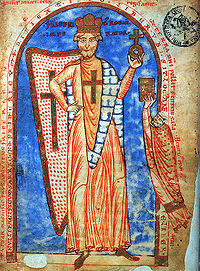 Henry V
(1086–1125), great-grandson of Conrad II became Holy Roman Emperor in 1106 in the midst of a civil war. Hoping to gain complete control over the church inside the Empire, Henry V appointed Adalbert of Saarbruken as archbishop of Mainz in 1111 Adalbert began to assert the powers of the Church against secular authorities, that is, the Emperor. This precipitated the "Crisis of 1111", part of the long-term Investiture Controversy
. In 1137 the magnates turned back to the Hohenstaufen family for a candidate, Conrad III
. Conrad III tried to divest Henry the Proud of his two duchies, leading to war in southern Germany as the Empire divided into two factions. The first faction called themselves the "Welfs" after Henry the Proud's family name which was the ruling dynasty in Bavaria. The other faction was known as the "Waiblings." In this early period, the Welfs generally represented ecclesiastical independence under the papacy plus "particularism" (a strengthening of the local duchies against the central imperial authority). The Waiblings on the other hand stood for control of the Church by a strong central Imperial government.
Between 1152 and 1190, during the reign of Frederick I
(Barbarossa), of the Hohenstaufen dynasty, an accommodation was reached with the rival Guelph party by the grant of the duchy of Bavaria to Henry the Lion
, duke of Saxony
. Austria became a separate duchy by virtue of the Privilegium Minus
in 1156. Barbarossa tried to reassert his control over Italy. In 1177 a final reconciliation was reached between the emperor and the Pope in Venice
.
In 1180 Henry the Lion was outlawed and Bavaria was given to Otto of Wittelsbach
(founder of the Wittelsbach dynasty
which was to rule Bavaria until 1918), while Saxony was divided.
From 1184 to 1186 the Hohenstaufen empire under Barbarossa reached its peak in the Reichsfest (imperial celebrations) held at Mainz
and the marriage of his son Henry
in Milan to the Norman princess Constance of Sicily
. The power of the feudal lords was undermined by the appointment of "ministerials" (unfree servants of the Emperor) as officials. Chivalry and the court life flowered, leading to a development of German culture and literature (see Wolfram von Eschenbach
).
Between 1212 and 1250 Frederick II
established a modern, professionally administered state from his base in Sicily
. He resumed the conquest of Italy, leading to further conflict with the Papacy. In the Empire, extensive sovereign powers were granted to ecclesiastical and secular princes, leading to the rise of independent territorial states. The struggle with the Pope sapped the Empire's strength, as Frederick II was excommunicated three times. After his death, the Hohenstaufen dynasty fell, followed by an interregnum during which there was no Emperor.
The failure of negotiations between Emperor Louis IV
with the papacy led in 1338 to the declaration at Rhense by six electors
to the effect that election by all or the majority of the electors automatically conferred the royal title and rule over the empire, without papal confirmation.
Between 1346 and 1378 Emperor Charles IV
of Luxembourg
, king of Bohemia, sought to restore the imperial authority.
 Around 1350 Germany and almost the whole of Europe were ravaged by the Black Death. Jews were persecuted on religious and economic grounds; many fled to Poland.
The Golden Bull of 1356
stipulated that in future the emperor was to be chosen by four secular electors (the King of Bohemia, the Count Palatine
of the Rhine, the Duke of Saxony
, and the Margrave of Brandenburg
) and three spiritual electors (the Archbishops of Mainz
, Trier
, and Cologne
).
After the disasters of the 14th century, early-modern European society gradually came into being as a result of economic, religious and political changes. A money economy arose which provoked social discontent among knights and peasants. Gradually, a proto-capitalistic system evolved out of feudalism. The Fugger
family gained prominence through commercial and financial activities and became financiers to both ecclesiastical and secular rulers.
The knightly classes found their monopoly on arms and military skill undermined by the introduction of mercenary armies and foot soldiers. Predatory activity by "robber knights" became common. From 1438 the Habsburg
s, who controlled most of the southeast of the Empire (more or less modern-day Austria and Slovenia
, and Bohemia and Moravia
after the death of King Louis II
in 1526), maintained a constant grip on the position of the Holy Roman Emperor until 1806 (with the exception of the years between 1742 and 1745). This situation, however, gave rise to increased disunity among the Holy Roman Empires territorial rulers and prevented sections of the country from coming together and forming nations in the manner of France and England.
During his reign from 1493 to 1519, Maximilian I
tried to reform the Empire: an Imperial supreme court (Reichskammergericht) was established, imperial taxes were levied, the power of the Imperial Diet
(Reichstag) was increased. The reforms were, however, frustrated by the continued territorial fragmentation of the Empire.
abbess
Hildegard von Bingen (1098–1179) wrote several influential theological, botanical and medicinal texts, as well as letters, liturgical songs, poems, and arguably the oldest surviving morality play
, while supervising brilliant miniature Illuminations. Ca. 100 years later, Walther von der Vogelweide
(c. 1170-c. 1230) became the most celebrated of the Middle High German
lyric poet
s. Around 1439, Johannes Gutenberg, a citizen of Mainz
, was the first European to use movable type
printing and became the global inventor of the printing press
, thereby starting the Printing Revolution. Gutenberg's inventions and works (e.g. the Gutenberg Bible
) would play key roles for the development of the Reformation
and the Scientific Revolution
. Around the transition from the 15th to the 16th century, Albrecht Dürer
from Nuremberg
established his reputation across Europe as painter
, printmaker, mathematician
, engraver, and theorist when he was still in his twenties and secured his reputation as one of the most important figures of the Northern Renaissance
.
.svg.png)
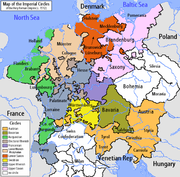
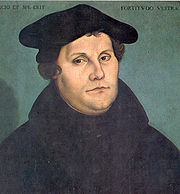 In the early 16th century there was much discontent occasioned by abuses such as indulgence
s in the Catholic Church, and a general desire for reform.
In 1517 the Reformation
began with the publication of Martin Luther
's 95 Theses
; he had posted them in the town square, and gave copies of them to German nobles, but it is debated whether he nailed them to the church door in Wittenberg
as is commonly said. The list detailed 95 assertions Luther believed to show corruption and misguidance within the Catholic Church. One often cited example, though perhaps not Luther's chief concern, is a condemnation of the selling of indulgences; another prominent point within the 95 Theses is Luther's disagreement both with the way in which the higher clergy, especially the pope, used and abused power, and with the very idea of the pope.
In 1521 Luther was outlawed at the Diet of Worms
. But the Reformation spread rapidly, helped by the Emperor Charles V
's wars with France and the Turks
. Hiding in the Wartburg Castle
, Luther translated the Bible from Latin to German, establishing the basis of the German language. A curious fact is that Luther spoke a dialect which had minor importance in the German language of that time. After the publication of his Bible, his dialect suppressed the others and evolved into what is now the modern German.
In 1524 the German Peasants' War
broke out in Swabia
, Franconia
and Thuringia
against ruling princes and lords, following the preachings of Reformist priests. But the revolts, which were assisted by war-experienced noblemen like Götz von Berlichingen
and Florian Geyer
(in Franconia), and by the theologian Thomas Münzer (in Thuringia), were soon repressed by the territorial princes. It is estimated that as many as 100,000 German peasants were massacred during the revolt, usually after the battles had ended. With the protestation
of the Lutheran princes at the Reichstag
of Speyer
(1529) and rejection of the Lutheran "Augsburg Confession" at Augsburg (1530), a separate Lutheran church emerged.
From 1545 the Counter-Reformation began in Germany. The main force was provided by the Jesuit order
, founded by the Spaniard Ignatius of Loyola
. Central and northeastern Germany were by this time almost wholly Protestant, whereas western and southern Germany remained predominantly Catholic. In 1547, Holy Roman Emperor Charles V defeated the Schmalkaldic League
, an alliance of Protestant rulers.
The Peace of Augsburg
in 1555 brought recognition of the Lutheran faith. But the treaty also stipulated that the religion of a state was to be that of its ruler (Cuius regio, eius religio
).
In 1556 Charles V
abdicated. The Habsburg Empire was divided, as Spain
was separated from the Imperial possessions.
In 1608/1609 the Protestant Union
and the Catholic League
were formed.
 The Reformation was a triumph of literacy and the new printing press. Luther's translation of the Bible into German was a decisive moment in the spread of literacy, and stimulated as well the printing and distribution of religious books and pamphlets. From 1517 onward religious pamphlets flooded Germany and much of Europe. By 1530 over 10,000 publications are known, with a total of ten million copies. The Reformation was thus a media revolution. Luther strengthened his attacks on Rome by depicting a "good" against "bad" church. From there, it became clear that print could be used for propaganda in the Reformation for particular agendas. Reform writers used pre-Reformation styles, clichés, and stereotypes and changed items as needed for their own purposes. Especially effective were Luther's Small Catechism, for use of parents teaching their children, and Larger Catechism, for pastors. Using the German vernacular they expressed the Apostles' Creed in simpler, more personal, Trinitarian language. Illustrations in the newly translated Bible and in many tracts popularized Luther's ideas. Lucas Cranach the Elder
(1472–1553), the great painter patronized by the electors of Wittenberg, was a close friend of Luther, and illustrated Luther's theology for a popular audience. He dramatized Luther's views on the relationship between the Old and New Testaments, while remaining mindful of Luther's careful distinctions about proper and improper uses of visual imagery.
ravaged in the Holy Roman Empire. The causes were the conflicts between Catholics and Protestants, the efforts by the various states within the Empire to increase their power and the Catholic Emperor's attempt to achieve the religious and political unity of the Empire. The immediate occasion for the war was the uprising of the Protestant nobility of Bohemia against the emperor, but the conflict was widened into a European War by the intervention of King Christian IV of Denmark
(1625–29), Gustavus Adolphus of Sweden
(1630–48) and France under Cardinal Richelieu. Germany became the main theatre of war and the scene of the final conflict between France and the Habsburgs for predominance in Europe.
The fighting often was out of control, with marauding bands of hundreds or thousands of starving soldiers spreading plague, plunder, and murder. The armies that were under control moved back and forth across the countryside year after year, levying heavy taxes on cities, and seizing the animals and food stocks of the peasants without payment. The enormous social disruption over three decades caused a dramatic decline in population because of killings, disease, crop failures, declining birth rates and random destruction, and the out-migration of terrified people. One estimate shows a 38% drop from 16 million people in 1618 to 10 million by 1650, while another shows "only" a 20% drop from 20 million to 16 million. The Altmark
and Württemberg
regions especially hard hit. It took generations for Germany to fully recover. The war ended in 1648 with the Peace of Westphalia
. Imperial territory was lost to France and Sweden and the Netherlands officially left the Empire. The imperial power declined further as the states' rights were increased.
Nicolaus Copernicus
from Toruń
(Thorn) published his work De revolutionibus orbium coelestium
and became the first person to formulate a comprehensive heliocentric
cosmology
which displaced the Earth
from the center of the universe
. Almost 70 years after Copernicus' death and building on his theories, mathematician
, astronomer
and astrologer Johannes Kepler
from Stuttgart
would be a key figure in the 17th century scientific revolution
. He is best known for his eponym
ous laws of planetary motion
, codified by later astronomers, based on his works Astronomia nova
and Harmonices Mundi. These works also influenced contemporary scientist Galileo Galilei
and provided one of the foundations for Isaac Newton
's theory of universal gravitation
.
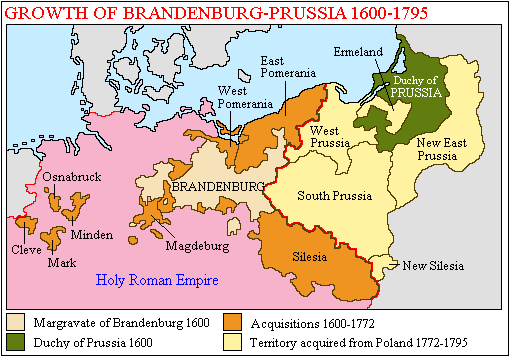 From 1640, Brandenburg-Prussia
had started to rise under the Great Elector, Frederick William
. The Peace of Westphalia
in 1648 strengthened it even further, through the acquisition of East Pomerania. From 1713 to 1740, King Frederick William I
, also known as the "Soldier King", established a highly centralized, militarized state with a heavily rural population of about three million (compared to the nine million in Austria).
In terms of the boundaries of 1914, Germany in 1700 had a population of 16 million, increasing slightly to 17 million by 1750, and growing more rapidly to 24 million by 1800. Wars continued, but they were no longer so devastating to the civilian population; famines and major epidemics did not occur, but increased agricultural productivity led to a higher birth rate, and a lower death rate.
conquered parts of Alsace and Lorraine
(1678–1681), and had invaded and devastated the Palatinate (1688–1697) in the War of Palatinian Succession
. Louis XIV benefited from the Empire's problems with the Turks, which were menacing Austria. Louis XIV ultimately had to relinquish the Palatinate.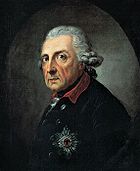 Afterwards Hungary was reconquered from the Turks; Austria, under the Habsburgs, developed into a great power.
In the War of Austrian Succession (1740–1748) Maria Theresa
fought successfully for recognition of her succession to the throne. But in the Silesian Wars
and in the Seven Years' War
she had to cede Silesia to Frederick II, the Great, of Prussia
. After the Peace of Hubertsburg in 1763 between Austria, Prussia
and Saxony
, Prussia became a European great power. This gave the start to the rivalry between Prussia and Austria for the leadership of Germany.
From 1763, against resistance from the nobility and citizenry, an "enlightened absolutism
" was established in Prussia and Austria, according to which the ruler governed according to the best precepts of the philosophers. The economies developed and legal reforms were undertaken, including the abolition of torture and the improvement in the status of Jews; the emancipation of the peasants slowly began. Compulsory education began.
In 1772–1795 Prussia took part in the partitions of Poland
, occupying western territories of Polish–Lithuanian commonwealth, which led to centuries of Polish resistance against Germanization.
was especially unfortunate in this regard; it was a rural land with very heavy debts and few growth centers. Saxony
was in economically good shape, although its government was seriously mismanaged, and numerous wars had taken their toll. In Württemberg
the duke lavished funds on palaces, mistresses, great celebration, and hunting expeditions.
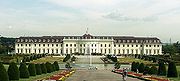 In Hesse-Kassel
, the Landgrave Frederick II, ruled 1760-1785 as an enlightened despot, and raised money by renting soldiers (called "Hessians") to Great Britain
to help fight the American Revolutionary War
. He combined Enlightenment ideas with Christian values, cameralist plans for central control of the economy, and a militaristic approach toward diplomacy.
Hanover did not have to support a lavish court—its rulers were also kings of England and resided in London. George III
, elector (ruler) from 1760 to 1820, never once visited Hanover. The local nobility who ran the country opened the University of Göttingen in 1737; it soon became a world-class intellectual center.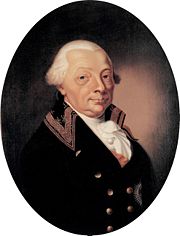 Baden
Baden
sported perhaps the best government of the smaller states. Karl Friedrich ruled well for 73 years (1738–1811) and was an enthusiast for The Enlightenment; he abolished serfdom in 1783. Many of the city-states of Germany were run by bishops, who in reality were from powerful noble families and showed scant interest in religion. None developed a significant reputation for good government.
Between 1807 and 1871, Prussia swallowed up many of the smaller states, with minimal protest, then went on to found the German Empire. In the process, Prussia became too heterogeneous, lost its identity, and by the 1930s had become an administrative shell of little importance.
, dominated not only the localities, but also the Prussian court, and especially the Prussian army. Increasingly after 1815, a centralized Prussian government based in Berlin took over the powers of the nobles, which in terms of control over the peasantry had been almost absolute. To help the nobility avoid indebtedness, Berlin set up a credit institution to provide capital loans in 1809, and extended the loan network to peasants in 1849. When the German Empire was established in 1871, the Junker nobility controlled the army and the Navy, the bureaucracy, and the royal court; they generally set governmental policies.
 Peasants continued to center their lives in the village, where they were members of a corporate body and help manage the community resources and monitor the community life. In the East, they were serfs who were bound prominently to parcels of land. In most of Germany, farming was handled by tenant farmers who paid rents and obligatory services to the landlord, who was typically a nobleman. Around 1800 the Catholic monasteries, which had large land holdings, were nationalized and sold off by the government. In Bavaria they had controlled 56% of the land Peasant leaders supervised the fields and ditches and grazing rights, maintained public order and morals, and supported a village court which handled minor offenses. Inside the family the patriarch made all the decisions, and tried to arrange advantageous marriages for his children. Much of the villages' communal life centered around church services and holy days. In Prussia, the peasants drew lots to choose conscripts required by the army. The noblemen handled external relationships and politics for the villages under their control, and were not typically involved in daily activities or decisions.
The emancipation of the serfs came in 1770–1830, beginning with Schleswig in 1780. The peasants were now ex-serfs and could own their land, buy and sell it, and move about freely. The nobles approved for now they could buy land owned by the peasants. The chief reformer was Baron vom Stein (1757–1831), who was influenced by The Enlightenment, especially the free market ideas of Adam Smith
. The end of serfdom raised the personal legal status of the peasantry. A bank was set up so that landowner could borrow government money to buy land from peasants (the peasants were not allowed to use it to borrow money to buy land until 1850). The result was that the large landowners obtained larger estates, and many peasant became landless tenants, or moved to the cities or to America. The other German states imitated Prussia after 1815. In sharp contrast to the violence that characterized land reform in the French Revolution, Germany handled it peacefully. In Schleswig the peasants, who had been influenced by the Enlightenment, played an active role; elsewhere they were largely passive. Indeed, for most peasants, customs and traditions continued largely unchanged, including the old habits of deference to the nobles whose legal authority remains quite strong over the villagers. Although the peasants were no longer tied to the same land like serfs had been, the old paternalistic relationship in East Prussia lasted into the 20th century.
The agrarian reforms in northwestern Germany in the era 1770–1870 were driven by progressive governments and local elites. They abolished feudal obligations and divided collectively owned common land into private parcels and thus created a more efficient market-oriented rural economy. It produced increased productivity and population growth. It strengthened the traditional social order because wealthy peasants obtained most of the former common land, while the rural proletariat was left without land; many left for the cities or America. Meanwhile the division of the common land served as a buffer preserving social peace between nobles and peasants. In the east the serfs were emancipated but the Junker class
maintained its large estates and monopolized political power.
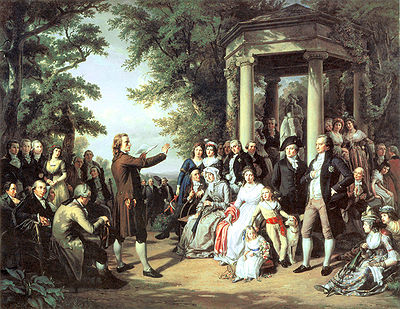 Before 1750 the German upper classes looked to France for intellectual, cultural and architectural leadership; French was the language of high society. By the mid-18th century the "Aufklärung" (The Enlightenment) had transformed German high culture in music, philosophy, science and literature. Christian Wolff
(1679–1754) was the pioneer as a writer who expounded the Enlightenment to German readers; he legitimized German as a philosophic language.
Johann Gottfried von Herder (1744–1803) broke new ground in philosophy and poetry, as a leader of the Sturm und Drang
movement of proto-Romanticism. Weimar Classicism
("Weimarer Klassik") was a cultural and literary movement based in Weimar that sought to establish a new humanism by synthesizing Romantic, classical and Enlightenment ideas. The movement, from 1772 until 1805, involved Herder as well as polymath Johann Wolfgang von Goethe
(1749–1832) and Friedrich Schiller
(1759–1805), a poet and historian. Herder argued that every folk had its own particular identity, which was expressed in its language and culture. This legitimized the promotion of German language and culture and helped shape the development of German nationalism. Schiller's plays expressed the restless spirit of his generation, depicting the hero's struggle against social pressures and the force of destiny.
German music, sponsored by the upper classes, came of age under composers Johann Sebastian Bach
(1685–1750), Franz Joseph Haydn (1732–1809), and Wolfgang Amadeus Mozart
(1756–1791).
In remote Königsberg
philosopher Immanuel Kant
(1724–1804) tried to reconcile rationalism and religious belief, individual freedom and political authority. Kant's work contained basic tensions that would continue to shape German thought—and indeed all of European philosophy—well into the 20th century.
The German Enlightenment won the support of princes, aristocrats and the middle classes and permanently reshaped the culture.
 German intellectuals celebrated the outbreak of the French Revolution, hoping to see the triumph of Reason and The Enlightenment. The royal courts in Vienna and Berlin denounced the overthrow of the king and the threatened spread of notions of liberty, equality, and fraternity. By 1793 the execution of the French king and the onset of the Terror disillusioned the Bildungsbürgertum (educated middle classes). Reformers said the solution was to have faith in the ability of Germans to reform their laws and institutions in peaceful fashion.
Europe was racked by two decades of war revolving around France's efforts to spread its revolutionary ideals, and the opposition of reactionary royalty. The German lands saw armies marching back and forth, bringing devastation (albeit on a far lower scale than the Thirty Years War), but also bringing new ideas of liberty and civil rights for the people. War broke out in 1792 as Austria and Prussia invaded France, but were defeated at the Battle of Valmy
. Prussia and Austria ended their failed wars with France but (with Russia) partitioned Poland among themselves in 1793 and 1795. The French took control of the Rhineland, imposed French-style reforms, abolished feudalism, established constitutions, promoted freedom of religion, emancipated Jews, opened the bureaucracy to ordinary citizens of talent, and forced the nobility to share power with the rising middle class. Napoleon created the Kingdom of Westphalia
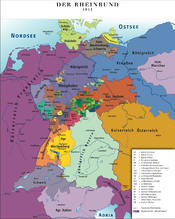
(1807–1813) as a model state. These reforms proved largely permanent and modernized the western parts of Germany. When the French tried to impose the French language, German opposition grew in intensity. A Second Coalition of Britain, Russia, and Austria then attacked France but failed. Napoleon established direct or indirect control over most of western Europe, including the German states apart from Prussia and Austria. The old Holy Roman Empire was little more than a farce; Napoleon simply abolished it in 1806 while forming new countries under his control. In Germany Napoleon set up the Confederation of the Rhine
comprising most of the German states except Prussia and Austria.
Prussia tried to remain neutral while imposing tight controls on dissent, but with German nationalism sharply on the rise the small nation blundered by going to war with Napoleon in 1806. Its economy was weak, its leadership poor, and the once mighty Prussian army was a hollow shell. Napoleon easily crushed it at the Battle of Jena. Napoleon occupied Berlin and Prussia paid dearly. Prussia lost its recently acquired territories in western Germany, its army was reduced to 42,000 men, no trade with Britain was allowed, and Berlin had to pay Paris heavy reparations and fund the French army of occupation . Saxony changed sides to support Napoleon and join his Confederation of the Rhine; its elector was rewarded with the title of king and given a slice of Poland taken from Prussia. After Napoleon's fiasco in Russia in 1812, including the deaths of many Germans in his invasion army, Prussia joined with Russia. Major battles followed in quick order, and when Austria switched sides to oppose Napoleon his situation grew tenuous. He was defeated in a great Battle of Leipzig
in late 1813, and Napoleon's empire started to collapse. One after another the German states switched to oppose Napoleon, but he rejected peace terms. Allied armies invaded France in early 1814, Paris fell, and in April Napoleon surrendered. He returned for 100 days in 1815, but was finally defeated by the British and German armies at Waterloo. Prussia was the big winner at the Vienna peace conference, gaining extensive territory.
), warfare, the 1848 revolution, and the inability of the multiple members to compromise. It was replaced by the North German Confederation
in 1866.
take place in Germany. It was a transition from high birth rates and high death rates to low birth and death rates as the country developed from a pre-industrial to a modernized agriculture and supported a fast-growing industrialized urban economic system. In previous centuries, the shortage of land meant that not everyone could marry, and marriages took place after age 25. The high birthrate was offset by a very high rate of infant mortality, plus periodic epidemics and harvest failures. After 1815, increased agricultural productivity met a larger food supply, and a decline in famines, epidemics, and malnutrition. This allowed couples to marry earlier, and have more children. Arranged marriages became uncommon as young people were now allowed to choose their own marriage partners, subject to a veto by the parents. The upper and middle classes began to practice birth control, and a little later so too did the peasants.
summed up the advantages to be derived from the development of the railway system in 1841:
Lacking a technological base at first, the Germans imported their engineering and hardware from Britain, but quickly learned the skills needed to operate and expand the railways. In many cities, the new railway shops were the centres of technological awareness and training, so that by 1850, Germany was self sufficient in meeting the demands of railroad construction, and the railways were a major impetus for the growth of the new steel industry. Observers found that even as late as 1890, their engineering was inferior to Britain’s. However, German unification in 1870 stimulated consolidation, nationalisation into state-owned companies, and further rapid growth. Unlike the situation in France, the goal was support of industrialisation, and so heavy lines crisscrossed the Ruhr and other industrial districts, and provided good connections to the major ports of Hamburg and Bremen. By 1880, Germany had 9,400 locomotives pulling 43,000 passengers and 30,000 tons of freight a day, and forged ahead of France.
(1749–1832), turned to Romanticism
after a period of Enlightenment
. Philosophical thought was decisively shaped by Immanuel Kant
(1724–1804). Ludwig van Beethoven
(1770–1827) was the leading composer of Romantic music
. His use of tonal architecture in such a way as to allow significant expansion of musical forms and structures was immediately recognized as bringing a new dimension to music. His later piano music and string quartets, especially, showed the way to a completely unexplored musical universe, and influenced Franz Schubert
(1797–1828) and Robert Schumann
(1810–1856). In opera, a new Romantic atmosphere combining supernatural terror and melodramatic plot in a folkloric context was first successfully achieved by Carl Maria von Weber
(1786–1826) and perfected by Richard Wagner
(1813–1883) in his Ring Cycle. The Brothers Grimm
(1785-1863 & 1786-1859) not only wrote the popular Grimm's Fairy Tales
, but were among the founding fathers of German philology and German studies
.
At the universities high-powered professors developed international reputations, especially in the humanities led by history and philology, which brought a new historical perspective to the study of political history, theology, philosophy, language, and literature. With Georg Wilhelm Friedrich Hegel
(1770–1831) in philosophy, Friedrich Schleiermacher (1768–1834) in theology and Leopold von Ranke
(1795–1886) in history, the University of Berlin
, founded in 1810, became the world's leading university. Von Ranke, for example, professionalized history and set the world standard for historiography. By the 1830s mathematics, physics, chemistry, and biology had emerged with world class science, led by Alexander von Humboldt
(1769–1859) in natural science and Carl Friedrich Gauss
(1777–1855) in mathematics. Young intellectuals often turned to politics, but their support for the failed Revolution of 1848 forced many into exile.
 After the fall of Napoleon, Europe's statesmen convened in Vienna in 1815 for the reorganisation of European affairs, under the leadership of the Austrian Prince Metternich
. The political principles agreed upon at this Congress of Vienna
included the restoration, legitimacy and solidarity of rulers for the repression of revolutionary and nationalist ideas.
The German Confederation
(Deutscher Bund) was founded, a loose union of 39 states (35 ruling princes and 4 free cities) under Austrian leadership, with a Federal Diet (Bundestag) meeting in Frankfurt am Main. It was a loose coalition that failed to satisfy most nationalists. The member states largely went their own way, and Austria had its own interests.
In 1819 a student radical assassinated the reactionary playwright August von Kotzebue, who had scoffed at liberal student organisations. In one of the few major actions of the German Confederation, Prince Metternich called a conference that issued the repressive Carlsbad Decrees
, designed to suppress liberal agitation against the conservative governments of the Germany states. The Decrees terminated the fast-fading nationalist fraternities '(Burschenschaften),' removed liberal university professors, and expanded the censorship of the press. The decrees began the "persecution of the demagogues", which was directed against individuals who were accused of spreading revolutionary and nationalist ideas. Among the persecuted were the poet Ernst Moritz Arndt
, the publisher Johann Joseph Görres and the "Father of Gymnastics" Ludwig Jahn.
In 1834 the Zollverein
was established, a customs union between Prussia and most other German states, but excluding Austria. As industrialisation developed, the need for a unified German state with a uniform currency, legal system, and government became more and more obvious.
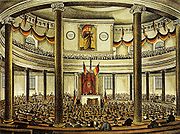
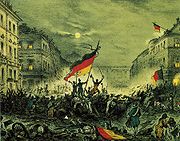
in the German states. In May the German National Assembly (the Frankfurt Parliament
) met in Frankfurt to draw up a national German constitution.
But the 1848 revolution turned out to be unsuccessful: King Frederick William IV of Prussia
refused the imperial crown, the Frankfurt parliament was dissolved, the ruling princes repressed the risings by military force and the German Confederation was re-established by 1850. Many leaders went into exile, including a number who went to the United States and became a political force there.
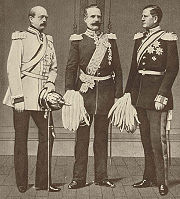 In 1857, the king had a stroke and his brother William
became regent and became King William I in 1861. Although conservative, William I was far more pragmatic. His most significant accomplishment was naming Otto von Bismarck
as chancellor in 1862. The combination of Bismarck, Defense Minister Albrecht von Roon, and Field Marshal Helmut von Moltke set the stage for victories over Denmark, Austria and France, and led to the unification of Germany. The obstacle to German unification was Austria, and Bismarck solved the problem with a series of wars that united the German states north of Austria.
In 1863-64, disputes between Prussia and Denmark grew over Schleswig
, which was not part of the German Confederation, and which Danish nationalists wanted to incorporate into the Danish kingdom. The dispute led to the short Second War of Schleswig
in 1864. Prussia, joined by Austria, defeated Denmark easily and occupied Jutland. The Danes were forced to cede both the duchy of Schleswig and the duchy of Holstein to Austria and Prussia. In the aftermath, the management of the two duchies caused escalating tensions between Austria and Prussia. The former wanted the duchies to become an independent entity within the German Confederation, while the latter wanted to annex them. The Seven Weeks War between Austria and Germany broke out in June 1866 and in July the two armies clashed at Sadowa-Koniggratz in Bohemia in an enormous battle involving half a million men. The Prussian breech-loading needle guns carried the day over the Austrians with their slow muzzle-loading rifles, who lost a quarter of their army in the battle. Austria ceded Venice
to Italy, but Bismarck was deliberately lenient with the loser to keep alive a long-term alliance with Austria in a subordinate role. Now the French faced an increasingly strong Prussia.
 In 1866, the German Confederation was dissolved. In its place the North German Federation (German Norddeutscher Bund) was established, under the leadership of Prussia. Austria was excluded from it. The Austrian influence in Germany that had begun in the 15th century finally came to an end.
The North German Federation was a transitional organisation that existed from 1867 to 1871, between the dissolution of the German Confederation and the founding of the German Empire. The unification of the German states
into a single economic, political and administrative unit excluded the Austrian territories and the Habsburgs.
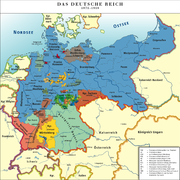
After Germany was united by Otto von Bismarck
into the "Second German Reich", he determined German politics until 1890. Bismarck tried to foster alliances in Europe, on one hand to contain France, and on the other hand to consolidate Germany's influence in Europe. On the domestic front Bismarck tried to stem the rise of socialism by anti-socialist laws, combined with an introduction of health care and social security. At the same time Bismarck tried to reduce the political influence of the emancipated Catholic minority in the Kulturkampf
, literally "culture struggle". The Catholics only grew stronger, forming the Center (Zentrum) Party. Germany grew rapidly in industrial and economic power, matching Britain by 1900. Its highly professional army was the best in the world, but the navy could never catch up with Britain's Royal Navy.
In 1888, the young and ambitious Kaiser Wilhelm II became emperor. He could not abide advice, least of all from the most experienced politician and diplomat in Europe, so he fired Bismarck. The Kaiser opposed Bismarck's careful foreign policy and wanted Germany to pursue colonialist policies, as Britain and France had been doing for decades, as well as build a navy that could match the British. The Kaiser promoted active colonization of Africa and Asia for those areas that were not already colonies of other European powers; his record was notoriously brutal and set the stage for genocide. The Kaiser took a mostly unilateral approach in Europe with as main ally the Austro-Hungarian Empire, and an arms race with Britain, which eventually led to the situation in which the assassination of the Austrian-Hungarian crown prince could spark off World War I
.
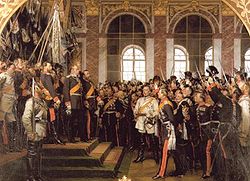 Disputes between France and Prussia increased. In 1868, the Spanish queen Isabella II was expelled by a revolution, leaving that country's throne vacant. When Prussia tried to put a Hohenzollern candidate, Prince Leopold, on the Spanish throne, the French angrily protested. In July 1870, France declared war on Prussia (the Franco-Prussian War
). The debacle was swift. A succession of German victories in northeastern France followed, and one French army was besieged at Metz. After a few weeks, the main army was finally forced to capitulate in the fortress of Sedan
. French Emperor Napoleon III was taken prisoner and a republic hastily proclaimed in Paris. The new government, realising that a victorious Germany would demand territorial acquisitions, resolved to fight on. They began to muster new armies, and the Germans settled down to a grim siege of Paris. The starving city surrendered in January 1871, and the Prussian army staged a victory parade in it. France was forced to pay indemnities of 5 billion francs and cede Alsace-Lorraine. It was a bitter peace that would leave the French thirsting for revenge.
During the Siege of Paris
, the German princes assembled in the Hall of Mirrors of the Palace of Versailles
and proclaimed the Prussian King Wilhelm I as the "German Emperor" on 18 January 1871. The German Empire was thus founded, with 25 states, three of which were Hanseatic free cities, and Bismarck, again, served as Chancellor. It was dubbed the "Little German" solution, since Austria was not included. The new empire was characterised by a great enthusiasm and vigor. There was a rash of heroic artwork in imitation of Greek and Roman styles, and the nation possessed a vigorous, growing industrial economy, while it had always been rather poor in the past. The change from the slower, more tranquil order of the old Germany was very sudden, and many, especially the nobility, resented being displaced by the new rich. And yet, the nobles clung stubbornly to power, and they, not the bourgeois, continued to be the model that everyone wanted to imitate. In imperial Germany, possessing a collection of medals or wearing a uniform was valued more than the size of one's bank account, and Berlin never became a great cultural center as London, Paris, or Vienna were. The empire was distinctly authoritarian in tone, as the 1871 constitution gave the emperor exclusive power to appoint or dismiss the chancellor. He also was supreme commander-in-chief of the armed forces and final arbiter of foreign policy. But freedom of speech, association, and religion were nonetheless guaranteed by the constitution.
Bismarck's domestic policies as Chancellor of Germany were characterised by his fight against perceived enemies of the Protestant Prussian state. In the so-called Kulturkampf
(1872–1878), he tried to limit the influence of the Roman Catholic Church and of its political arm, the Catholic Centre Party, through various measures—like the introduction of civil marriage—but without much success. The Kulturkampf antagonised many Protestants as well as Catholics, and was eventually abandoned. Millions of non-Germans subjects in the German Empire, like the Polish, Danish and French minorities, were discriminated against http://germanhistorydocs.ghi-dc.org/sub_document.cfm?document_id=772http://germanhistorydocs.ghi-dc.org/sub_document.cfm?document_id=771 and a policy of Germanisation
was implemented.
The rise of the Socialist Workers' Party (later known as the Social Democratic Party of Germany
, SPD), declared its aim to establish Peacefully a new socialist order through the transformation of existing political and social conditions. From 1878, Bismarck tried to repress the social democratic movement by outlawing the party's organisation
, its assemblies and most of its newspapers. When it finally was allowed to run candidates the Social Democrats were stronger than ever.
Bismark built on a tradition of welfare programs in Prussia and Saxony that began as early as in the 1840s. In the 1880s he introduced old age pensions, accident insurance, medical care and unemployment insurance that formed the basis of the modern European welfare state. His paternalistic programs won the support of German industry because its goals were to win the support of the working classes for the Empire and reduce the outflow of immigrants to America, where wages were higher but welfare did not exist. Bismarck further won the support of both industry and skilled workers by his high tariff policies, which protected profits and wages from American competition, although they alienated the liberal intellectuals who wanted free trade.
" in Prussia to reduce the power of the Catholic Church in public affairs, and keep the Poles under control. Thousands of priests and bishops were harassed or imprisoned, with large fines and closures of Catholic churches and schools. The Kulturkampf did not extend to the other German states such as Bavaria
. Bismarck sought to appeal to liberals and Protestants but he failed because the Catholics were unanimous in their resistance and organized themselves to fight back politically, using their strength in other states besides Prussia. German nationalists feared the Polonization of the Prussian East. Bismarck saw the Kulturkampf as a means of stopping this trend, which was led by the Catholic clergy in West Prussia, Poznania and Silesia. The Poles were subjected to harassment in the fields of education, economic activity and the administration; in German was declared to be the only official language, but in practice the Poles only adhered more closely to their traditions.
There was little or no violence, but the new Catholic Center Party
won a fourth of the seats in the Reichstag (Imperial Parliament), and its middle position on most issues allowed it to play a decisive role in the formation of majorities. The culture war gave secularists and socialists an opportunity to attack all religions, an outcome that distressed the Protestants, including Bismarck, who was a devout pietistic Protestant. The Catholic anti-liberalism was led by Pope Pius IX
; his death in 1878 allowed Bismarck to open negotiations with Pope Leo XIII
, and led to the abandonment of the Kulturkampf in stages in the early 1880s.
The Three Emperor's League (Dreikaisersbund) was signed in 1872 by Russia, Austria and Germany. It stated that republicanism and socialism were common enemies and that the three powers would discuss any matters concerning foreign policy. Bismarck needed good relations with Russia in order to keep France isolated. In 1877–1878, Russia fought a victorious war with the Ottoman Empire and attempted to impose the Treaty of San Stefano on it. This upset the British in particular, as they were long concerned with preserving the Ottoman Empire and preventing a Russian takeover of the Bosporous Straits. Germany hosted the Congress of Berlin, whereby a more moderate peace settlement was agreed to. Afterwards, Russia turned its attention eastward to Asia and remained largely inactive in European politics for the next 25 years. Germany had no direct interest in the Balkans however, which was largely an Austrian and Russian sphere of influence, although King Carol of Romania was a German prince.
In 1879, Bismarck formed a Dual Alliance of Germany and Austria-Hungary, with the aim of mutual military assistance in the case of an attack from Russia, which was not satisfied with the agreement reached at the Congress of Berlin. The establishment of the Dual Alliance led Russia to take a more conciliatory stance, and in 1887, the so-called Reinsurance Treaty
was signed between Germany and Russia: in it, the two powers agreed on mutual military support in the case that France attacked Germany, or in case of an Austrian attack on Russia. In 1882, Italy joined the Dual Alliance to form a Triple Alliance
. Italy wanted to defend its interests in North Africa
against France's colonial policy. In return for German and Austrian support, Italy committed itself to assisting Germany in the case of a French military attack.
For a long time, Bismarck had refused to give in widespread public demands to give Germany "a place in the sun", through the acquisition of overseas colonies. In 1880 Bismarck gave way, and a number of colonies were established overseas: in Africa, these were Togo
, the Cameroons
, German South-West Africa
and German East Africa
; in Oceania
, they were German New Guinea
, the Bismarck Archipelago
and the Marshall Islands
. In fact, it was Bismarck himself who helped initiate the Berlin Conference
of 1885. He did it to "establish international guidelines for the acquisition of African territory," (see Colonisation of Africa
). This conference was an impetus for the "Scramble for Africa" and "New Imperialism
".
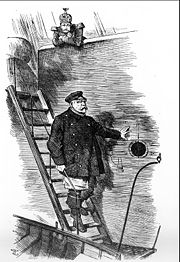 In 1888, the old emperor William I died at the age of 90. His son Frederick III, the hope of German liberals, succeeded him, but was already stricken with throat cancer and died three months later. Frederick's son William II then became emperor at the age of 29. He was the antithesis of old, conservative Germans like Bismarck, addicted to the new imperialism that was taking place in Asia and Africa. He sought to make Germany a great world power with a navy to rival Britain's. Bismarck hoped to marginalise him just as he had marginalised his grandfather, but William II desired to be his own master. Having a left arm withered by childhood polio, he was painfully insecure and desired above all to be loved by the people. Bismarck's schemes to dominate the emperor and hold onto his own power failed, and he was forced to resign in March 1890.
. The foreign office argued that long-term coalition between France and Russia had to fall apart, secondly Russia and Britain would never get together; finally that Britain would eventually seek an alliance with Germany. Germany refused to renew its treaties with Russia. But Russia did form a closer relationship with France by the Dual Alliance of 1894
, since both were worried about the possibilities of German aggression. Furthermore, Anglo German relations cooled as Germany aggressively tried to build a new empire and engaged in a naval race with Britain; London refused to agree to the formal alliance that Germany sought. Berlin's analysis proved mistaken on every point, leading to Germany's increasing isolation and its dependence on the Triple Alliance
, which brought together Germany, Austria-Hungary and Italy. The Triple Alliance was undermined by differences between Austria and Italy, and in 1915 Italy switched sides.
Meanwhile the German Navy under Admiral Alfred von Tirpitz
had ambitions to rival the great British Navy, and dramatically expanded its fleet in the early 20th century to protect the colonies and exert power worldwide. Tirpitz started a programme of warship construction in 1898. In 1890, Germany had gained the island of Heligoland in the North Sea from Britain in exchange for the African island of Zanzibar and proceeded to construct a great naval base there. This posed a direct threat to British hegemony on the seas, with the result that negotiations for an alliance between Germany and Britain broke down. The British however kept well ahead in the naval race by the introduction of the highly advanced new Dreadnought
battleship in 1907.
In the First Moroccan Crisis
of 1905, Germany nearly came to blows with Britain and France when the latter attempted to establish a protectorate over Morocco. The Germans were upset at having not been informed about French intentions, and declared their support for Moroccan independence. William II made a highly provocative speech regarding this. The following year, a conference was held in which all of the European powers except Austria-Hungary (by now little more than a German satellite) sided with France. A compromise was brokered by the United States where the French relinquished some, but not all, control over Morocco.
The Second Moroccan Crisis
of 1911 saw another dispute over Morocco erupt when France tried to suppress a revolt there. Germany, still smarting from the previous quarrel, agreed to a settlement whereby the French ceded some territory in central Africa in exchange for Germany renouncing any right to intervene in Moroccan affairs. This confirmed French control over Morocco, which became a full protectorate of that country in 1912.
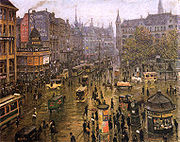 Based on its leadership in chemical research in the universities and industrial laboratories, Germany became dominant in the world's chemical industry in the late 19th century. At first the production of dyes was critical.
" (global policy), the German Empire demanded its "Platz an der Sonne" (Place in the sun). Bismark began the process, and by 1884 had acquired German New Guinea
. By the 1890s, German colonial expansion in Asia and the Pacific (Kiauchau
in China, the Marianas
, the Caroline Islands
, Samoa
) led to frictions with Britain, Russia, Japan and the United States. The construction of the Baghdad Railway
, financed by German banks, was designed to eventually connect Germany with the Turkish Empire and the Persian Gulf
, but it also collided with British and Russian geopolitical interests. The largest colonial enterprises were in Africa, where the harsh treatment of the Nama and Herero in what is now Namibia
in 1906-07 led to charges of genocide against the Germans.
 Ethnic demands for nation states upset the balance between the empires that dominated Europe, leading to World War I
, which started in August 1914. Germany stood behind its ally Austria in a confrontation with Serbia, but Serbia was under the protection of Russia, which was allied to France. Germany was the leader of the Central Powers, which included Austria-Hungary, the Ottoman Empire, and later Bulgaria, arrayed against the Allies, which comprised chiefly Russia, France, Britain, and in 1915 Italy. The United States joined with the Allies in April 1917. Fighting was most ferocious on the stalemated Western Front. More wide open was the fighting on the Eastern Front, which Germany controlled by 1917 as Russia was forced out of the war.
. But it failed due to Belgian resistance, Berlin's diversion of troops, and very stiff French resistance on the Marne
, north of Paris. The Western Front
became an extremely bloody battleground until early 1918, with forces moving a few hundred yards at best. In the east there were decisive victories against the Russian army, the trapping and defeat of large parts of the Russian contingent at the Battle of Tannenberg
, followed by huge Austrian and German successes led to a breakdown of Russian forces in 1917 and an imposed peace on the newly created USSR under Lenin. The British imposed a tight naval blockade in the North Sea
which lasted until 1919, sharply reducing Germany's overseas access to raw materials and foodstuffs. Food scarcity became a serious problem by 1917. The entry of the United States into the war in 1917 following Germany's declaration of unrestricted submarine warfare marked a decisive turning-point against Germany.
Meanwhile, conditions deteriorated rapidly on the home front, with severe food shortages reported in all urban areas. The causes involved the transfer of so many farmers and food workers into the military, combined with the overburdened railroad system, shortages of coal, and the British blockade that cut off imports from abroad. The winter of 1916-1917 was known as the "turnip winter," because that vegetable, usually fed to livestock, was used by people as a substitute for potatoes and meat, which were increasingly scarce. Thousands of soup kitchens were opened to feed the hungry people, who grumbled that the farmers were keeping the food for themselves. Even the army had to cut the rations for soldiers. Morale of both civilians and soldiers continued to sink.
The end of October 1918, in Kiel
, in northern Germany, saw the beginning of the German Revolution of 1918–19. Units of the German Navy refused to set sail for a last, large-scale operation in a war which they saw as good as lost, initiating the uprising. On 3 November, the revolt spread to other cities and states of the country, in many of which workers' and soldiers' councils were established. Meanwhile, Hindenburg and the senior commanders had lost confidence in the Kaiser and his government.
The Kaiser and all German ruling princes abdicated. On 9 November 1918, the Social Democrat Philipp Scheidemann
proclaimed a Republic. On 11 November, the Compiègne armistice
ending the war was signed. In accordance with the Social Democratic government by early 1919 the revolution was violently put down with the aid of the nascent Reichswehr
and the Freikorps
.
1918 was also the year of the deadly 1918 Spanish Flu pandemic which struck hard at a population weakened by years of malnutrition.
.svg.png)
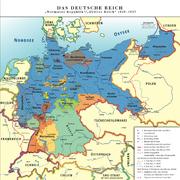 On 28 June 1919 the Treaty of Versailles
was signed. Germany was to cede Alsace-Lorraine, Eupen-Malmédy, North Schleswig, and the Memel
area. All German colonies were to be handed over to the British and French. Poland was restored and most of the provinces of Posen
and West Prussia
, and some areas of Upper Silesia
were reincorporated into the reformed country after plebiscites and independence uprisings. The left and right banks of the Rhine were to be permanently demilitarised. The industrially important Saarland
was to be governed by the League of Nations
for 15 years and its coalfields administered by France. At the end of that time a plebiscite was to determine the Saar's future status. To ensure execution of the treaty's terms, Allied troops would occupy the left (German) bank of the Rhine for a period of 5–15 years. The German army was to be limited to 100,000 officers and men; the general staff was to be dissolved; vast quantities of war material were to be handed over and the manufacture of munitions rigidly curtailed. The navy was to be similarly reduced, and no military aircraft were allowed. Germany and its allies were to accept the sole responsibility of the war, in accordance with the War Guilt Clause, and were to pay financial reparations for all loss and damage suffered by the Allies.
The humiliating peace terms provoked bitter indignation throughout Germany, and seriously weakened the new democratic regime. The greatest enemies of democracy had already been constituted. In December 1918, the Communist Party of Germany
(KPD) was founded, and in 1919 it tried and failed to overthrow the new republic. In January 1919 the German Workers' Party was formed; it was soon taken over by Adolf Hitler
as the National Socialist German Workers' Party (NSDAP), and the Nazis tried and failed in a coup in 1923. Both parties, as well as parties supporting the republic, built militant auxiliaries that engaged in increasingly violent street battles; in both cases electoral support increased after 1929 as the Great Depression hit the economy hard, producing many unemployed men who became available for the paramilitary units. The Nazis, with a mostly rural and lower middle class base, overthrew the Weimar regime and rules 1933-1945; the KPD with a mostly urban and working class base came to power (in the East) in 1945-1989.
On 11 August 1919 the Weimar
constitution came into effect, with Friedrich Ebert
as first President.
On December 30, 1918, the Communist Party of Germany
was founded by the Spartacus League, who had split from the Social Democratic Party during the war. It was headed by Rosa Luxemburg
and Karl Liebknecht
, and rejected the parliamentary system. In 1920, about 300.000 members from the Independent Social Democratic Party of Germany
joined the party, transforming it into a mass organization. The Communist Party had a following of about 10 % of the electorate.
In the first months of 1920, the Reichswehr
was to be reduced to 100,000 men, in accordance with the Treaty of Versailles. This included the dissolution of many Freikorps
– units made up of volunteers. In an attempt at a coup d'état in March 1920, the Kapp Putsch
, extreme right-wing politician Wolfgang Kapp let Freikorps soldiers march on Berlin and proclaimed himself Chancellor of the Reich. After four days the coup d'état collapsed, due to popular opposition and lack of support by the civil servants and the officers. Other cities were shaken by strikes and rebellions, which were bloodily suppressed.
Faced with animosity from Britain and France and the retreat of American power from Europe, in 1922 Germany was the first state to establish diplomatic relations with the new Soviet Union
. Under the Treaty of Rapallo
, Germany accorded the Soviet Union de jure recognition, and the two signatories mutually cancelled all pre-war debts and renounced war claims.
When Germany defaulted on its reparation payments, French and Belgian troops occupied the heavily industrialised Ruhr district (January 1923). The German government encouraged the population of the Ruhr to passive resistance: shops would not sell goods to the foreign soldiers, coal-mines would not dig for the foreign troops, trams in which members of the occupation army had taken seat would be left abandoned in the middle of the street. The passive resistance proved effective, insofar as the occupation became a loss-making deal for the French government. But the Ruhr fight also led to hyperinflation
, and many who lost all their fortune would become bitter enemies of the Weimar Republic, and voters of the anti-democratic right. See 1920s German inflation.
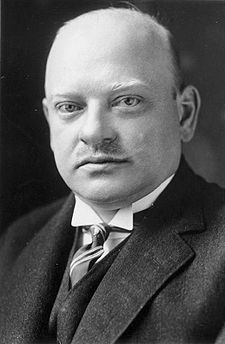 In September 1923, the deteriorating economic conditions led Chancellor Gustav Stresemann
to call an end to the passive resistance in the Ruhr. In November, his government introduced a new currency, the Rentenmark
(later: Reichsmark
), together with other measures to stop the hyperinflation. In the following six years the economic situation improved. In 1928, Germany's industrial production even regained the pre-war levels of 1913.
On the evening of 8 November 1923, six hundred armed SA
men surrounded a beer hall in Munich
, where the heads of the Bavarian state and the local Reichswehr had gathered for a rally. The storm troopers were led by Adolf Hitler. Born in 1889 in Austria, a former volunteer in the German army during World War I, now a member of a new party called National Socialist German Workers' Party (NSDAP or Nazi Party), he was largely unknown until then. Hitler tried to force those present to join him and to march on to Berlin to seize power (Beer Hall Putsch
). Hitler was later arrested and condemned to five years in prison, but was released at the end of 1924 after less than one year of detention.
 The national elections of 1924 led to a swing to the right. Field Marshal Paul von Hindenburg
was elected
President in 1925.
In October 1925 the Treaty of Locarno was signed by Germany, France, Belgium, Britain and Italy; it recognised Germany's borders with France and Belgium. Moreover, Britain, Italy and Belgium undertook to assist France in the case that German troops marched into the demilitarised Rheinland. Locarno paved the way for Germany's admission to the League of Nations
in 1926.
The stock market crash
of 1929 on Wall Street
marked the beginning of the worldwide Great Depression
, which hit Germany as hard as any nation. In July 1931, the Darmstätter und Nationalbank - one of the biggest German banks - failed, and, in early 1932, the number of unemployed soared to more than 6,000,000.
On top of the collapsing economy came a political crisis due to the inability by the political parties represented in the Reichstag to build a governing majority in the facing of escalating extremism from the far right (the Nazis) and the far left (the Communists). In March 1930, President Hindenburg appointed Heinrich Brüning
Chancellor. To push through his package of austerity measures against a majority of Social Democrats, Communists and the NSDAP (Nazis), Brüning made use of emergency decrees and dissolved Parliament. In March and April 1932, Hindenburg was re-elected in the German presidential election of 1932
.
The NSDAP was the largest party in the national elections of 1932. On 31 July 1932 the NSDAP had received 37.3% of the votes, and in the election on 6 November 1932 it received less, but still the largest share, 33.1, making it the biggest party in the Reichstag. The Communist KPD came third, with 15%. Together, the anti-democratic parties of far right and far left were now able to hold the majority of seats in Parliament, but they were at sword's point with each other, fighting it out in the streets. The NSDAP was particularly successful among Protestants; among unemployed young voters; among the petite bourgeoisie
(lower middle class) which had lost its assets in the hyperinflation of 1923; and among the rural population. It was weakest in Catholic areas and in large cities. On 30 January 1933, pressured by former Chancellor Franz von Papen
and other conservatives, President Hindenburg appointed Hitler Chancellor.
Weimar Republic Results of Elections 1919–1933, Elections 1932, 1933
German recipients dominated the Nobel prizes in science
. Germany dominated the world of physics before 1933, led by Hermann von Helmholtz
, Joseph von Fraunhofer
, Daniel Gabriel Fahrenheit, Wilhelm Conrad Röntgen
, Albert Einstein
, Max Planck
and Werner Heisenberg
. Chemistry likewise was dominated by German professors and researchers at the great chemical companies such as BASF
and Bayer
and persons like Fritz Haber
. Theoretical mathematicians included Carl Friedrich Gauss
in the 19th century and David Hilbert
in the 20th century. Carl Benz, the inventor of the automobile, was one of the pivotal figures of engineering.
Among the most important German writers were Thomas Mann
(1875–1955), Hermann Hesse
(1877–1962) and Bertolt Brecht
(1898–1956). The pessimistic historian Oswald Spengler
wrote The Decline of the West
(198-23) on the inevitable decay of Western Civilization, and influenced intellectuals in Germany such as Martin Heidegger
, Max Scheler
, and the Frankfurt School
, as well as intellectuals around the world.
After 1933, Nazi proponents of "Aryan physics," led by the Nobel Prize-winners Johannes Stark
and Philipp Lenard
, attacked Einstein's theory of relativity as a degenerate example of Jewish materialism in the realm of science. Many scientists and humanists emigrated; Einstein moved permanently to the U.S. but some of the others returned after 1945.
over the 13 years of rule. The Gestapo
(secret police) under Heinrich Himmler
destroyed the liberal, Socialist and Communist opposition and persecuted the Jews, trying to force them into exile, while taking their property. The Party took control of the courts, local government, and all civic organizations except the Protestant and Catholic churches. All expressions of public opinion were controlled by Hitler's propaganda minister, Joseph Goebbels
, who made effective use of film, mass rallies, and Hitler's hypnotic speaking. The Nazi state idolized Hitler as its Führer (leader), putting all powers in his hands. Nazi propaganda centered on Hitler and was quite effective in creating what historians called the "Hitler Myth"--that Hitler was all-wise and that any mistakes or failures by others would be corrected when brought to his attention. In fact Hitler had a narrow range of interests and decision making was diffused among overlapping, feuding power centers; on some issues he was passive, simply assenting to pressures from whomever had his ear. All top officials reported to Hitler and followed his basic policies, but they had considerable autonomy on a daily basis.
was set in the Reichstag building. Hitler swiftly blamed an alleged Communist uprising, and convinced President Hindenburg to sign the Reichstag Fire Decree
. This decree, which would remain in force until 1945, repealed important political and human rights of the Weimar constitution. Communist agitation was banned, but at this time not the Communist Party itself.
Eleven thousand Communists and Socialists were arrested and brought into concentration camps, where they were at the mercy of the Gestapo
, the newly established secret police force (9,000 were found guilty and most executed). Communist Reichstag deputies were taken into protective custody (despite their constitutional privileges).
Despite the terror and unprecedented propaganda, the last free General Elections of 5 March 1933, while resulting in 43.9% failed to bring the majority for the NSDAP that Hitler had hoped for. Together with the German National People's Party
(DNVP), however, he was able to form a slim majority government. With accommodations to the Catholic Centre Party
, Hitler succeeded in convincing a required two-thirds of a rigged Parliament to pass the Enabling act of 1933 which gave his government full legislative power. Only the Social Democrats voted against the Act. The Enabling Act formed the basis for the dictatorship, dissolution of the Länder
; the trade unions and all political parties other than the Nazi Party were suppressed. A centralised totalitarian state was established, no longer based on the liberal Weimar
constitution. Germany left the League of Nations
. The coalition parliament was rigged on this fateful 23 March 1933 by defining the absence of arrested and murdered deputies as voluntary and therefore cause for their exclusion as wilful absentees. Subsequently in July the Centre Party was voluntarily dissolved in a quid pro quo with the Pope
under the anti-communist Pope Pius XI
for the Reichskonkordat
; and by these manoeuvres Hitler achieved movement of these Catholic voters into the Nazi party, and a long-awaited international diplomatic acceptance of his regime. It is interesting to note however that according to Professor Dick Geary the Nazis gained a larger share of their vote in Protestant than in Catholic areas of Germany in elections held between 1928 to November 1932 The Communist Party was proscribed in April 1933 . On the weekend of 30 June 1934, he gave order to the SS
to seize Röhm and his lieutenants, and to execute them without trial (known as the Night of the Long Knives
). Upon Hindenburg's death on 2 August 1934, Hitler's cabinet passed a law proclaiming the presidency vacant and transferred the role and powers of the head of state to Hitler as Führer und Reichskanzler (leader and chancellor).
However, many leaders of the Nazi SA were disappointed. The Chief of Staff of the SA, Ernst Röhm
, was pressing for the SA to be incorporated into the army. Hitler had long been at odds with Röhm and felt increasingly threatened by these plans and in the "Night of the Long Knives
" in 1934 killed Röhm and the top SA leaders using their notorious homosexuality as an excuse.
The SS became an independent organisation under the command of the Reichsführer SS Heinrich Himmler
. He would become the supervisor of the Gestapo
and of the concentration camps, soon also of the ordinary police. Hitler also established the Waffen-SS
as a separate troop.
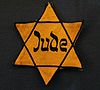 The regime showed particular hostility towards the Jews, which were the target of unending propaganda attacks. In 1933 all Jewish civil servants and academics were fired. In September 1935, the Reichstag passed the Nuremberg race laws
. Jews lost their German citizenship, and were banned from marrying non-Jewish Germans. About 500,000 individuals were affected by the new rules. About half of Germany's 500,000 Jews fled before 1939, after which escape became almost impossible.
(air force) and reintroduced universal military service. This was in breach of the Treaty of Versailles; Britain, France or Italy issued notes of protest. Hitler had the officers swear their personal allegiance to him. In 1936 German troops marched into the demilitarised Rhineland
. Britain and France did not intervene. The move strengthened Hitler's standing in Germany. His reputation swelled further with the 1936 Summer Olympics
, which were held in the same year in Berlin, and which proved another great propaganda success for the regime as orchestrated by master propagandist Joseph Goebbels
.
. It appears the role of women in Nazi Germany changed according to circumstances. Theoretically the Nazis believed that women must be subservient to men, avoid careers, devote themselves to childbearing and child-rearing, and be a helpmate of the traditional dominant father in the traditional family. However, before 1933, women played important roles in the Nazi organization and were allowed some autonomy to mobilize other women. After Hitler came to power in 1933, the activist women were replaced by bureaucratic women who emphasized feminine virtues, marriage, and childbirth. As Germany prepared for war, large numbers were incorporated into the public sector and with the need for full mobilization of factories by 1943, all women were required to register with the employment office. Hundreds of thousands of women served in the military as nurses, and support personnel, and another hundred thousand served in the Luftwaffe helping to operate the anti—aircraft systems. Women's wages remained unequal and women were denied positions of leadership or control.
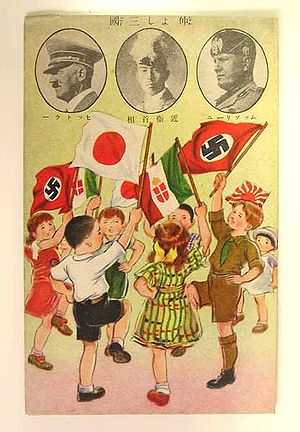 Hitler's diplomatic strategy in the 1930s was to make seemingly reasonable demands, threatening war if they were not met. When opponents tried to appease him, he accepted the gains that were offered, then went to the next target. That aggressive strategy worked as Germany pulled out of the League of Nations
(1933), rejected the Versailles Treaty and began to re-arm (1935), won back the Saar (1935), remilitarized the Rhineland (1936), formed an alliance ("axis") with Mussolini's Italy (1936), sent massive military aid to Franco in the Spanish Civil War (1936–39), seized Austria (1938), took over Czechoslovakia after the British and French appeasement of the Munich Agreement of 1938, formed a peace pact with Joseph Stalin
's Soviet Union in August 1939, and finally invaded Poland in September 1939. Britain and France declared war and World War II
began - somewhat sooner than the Nazis expected or were ready for.
After establishing the "Rome-Berlin axis" with Benito Mussolini
, and signing the Anti-Comintern Pact
with Japan – which was joined by Italy a year later in 1937 – Hitler felt able to take the offensive in foreign policy. On 12 March 1938, German troops marched into Austria, where an attempted Nazi coup had been unsuccessful in 1934. When Hitler entered Vienna
, he was greeted by loud cheers. Four weeks later, 99% of Austrians voted in favour of the annexation (Anschluss
) of their country to the German Reich. After Austria, Hitler turned to Czechoslovakia
, where the 3.5 million-strong Sudeten German minority was demanding equal rights and self-government. At the Munich Conference
of September 1938, Hitler, the Italian leader Benito Mussolini, British Prime Minister Neville Chamberlain
and French Prime Minister Édouard Daladier
agreed upon the cession of Sudeten territory to the German Reich by Czechoslovakia
. Hitler thereupon declared that all of German Reich's territorial claims had been fulfilled. However, hardly six months after the Munich Agreement, in March 1939, Hitler used the smoldering quarrel between Slovaks and Czechs as a pretext for taking over the rest of Czechoslovakia as the Protectorate of Bohemia and Moravia
. In the same month, he secured the return of Memel
from Lithuania
to Germany. Chamberlain was forced to acknowledge that his policy of appeasement
towards Hitler had failed.
 In six years, the Nazi regime prepared the country for World War II. The Nazi leadership attempted to remove or subjugate the Jewish population of Nazi Germany and later in the occupied countries through forced deportation and, ultimately, genocide
now known as the Holocaust
. A similar policy applied to the various ethnic and national groups considered subhuman
such as Poles
, Roma or Russians
. These groups were seen as threats to the purity of Germany's Aryan
race. There were also many groups, such as homosexuals, the mentally handicapped and those who were physically challenged from birth, which were singled out as being detrimental to Aryan purity.
After annexing the Sudetenland
border country of Czechoslovakia
(October 1938), and taking over the rest of the Czech lands as a protectorate (March 1939), the German Reich and the Soviet Union
invaded Poland on first September 1939 predominantly as part of the Wehrmacht operation codenamed Fall Weiss
. The invasion of Poland began World War II.
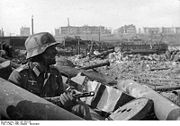 At first Germany's military moves were brilliantly successful, as in the "blitzkrieg
" invasions of Poland (1939), Norway (1940), the Low Countries
(1940), and above all the stunningly successful invasion and quick conquest of France in 1940. Hitler probably wanted peace with Britain in late 1940, but Winston Churchill
, standing alone, was dogged in his defiance. Churchill had major financial, military, and diplomatic help from President Franklin D. Roosevelt
in the U.S., another implacable foe of Hitler. Hitler's emphasis on maintaining high living standards postponed the full mobilization of the national economy until 1942, years after the great rivals Britain, Russia, and the U.S. had fully mobilized.
Germany invaded the Soviet Union
in June 1941 – weeks behind schedule – but swept forward until it reached the gates of Moscow. The tide turned in December 1941 when the invasion stalled in cold weather and the United States joined the war. After losing the Battle of Stalingrad
in 1942–43, the Germans were on the defensive. By late 1944, the United States and Great Britain were closing in on Germany in the West, while the Soviets were closing from the East. Nazi Germany collapsed when Berlin was taken by the Red Army on 2 May 1945, after a fight to the death in the city streets. Hitler committed suicide on 30 April 1945. Final German surrender was signed on 8 May 1945.
By September 1945, the German Reich (which lasted only 13 years) and its Axis
partners (Italy and Japan) had been defeated, chiefly by the forces of the Soviet Union
, the United States, and the United Kingdom. Much of Europe lay in ruins, over sixty million people had been killed (most of them civilians), including approximately six million Jews and five million non-Jews in what became known as the Holocaust. World War II resulted in the destruction of Germany's political and economic infrastructure and led directly to its partition, considerable loss of territory (especially in the east), and historical legacy of guilt and shame.
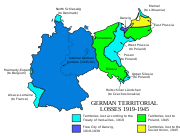 As a consequence of the defeat of Nazi Germany in 1945 and the onset of the Cold War
in 1947, the country was split between the two global blocs in the East and West, a period known as the division of Germany. Millions of refugees from eastern Europe moved west, most of them to West Germany. Two states emerged: West Germany
was a parliamentary democracy, a NATO member, a founding member of what since became the European Union
and one of the world's largest economies, while East Germany was a totalitarian Communist dictatorship that was a satellite of Moscow. With the collapse of Communism in 1989, reunion on West Germany's terms followed.
No one doubted Germany's economic and engineering prowess; the question was how long bitter memories of the war would cause Europeans to distrust Germany, and whether Germany could demonstrate it had rejected totalitarianism and militarism and embraced democracy and human rights.
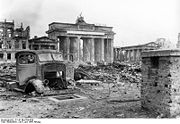 The total of German war dead was 8% to 10% out of a prewar population of 69,000,000, or between 5.5 million and seven million people. This included 4.5 million in the military, and between one and two million civilians. There was chaos as 11 million of foreign workers and POWs left, while 14 million of displaced refugees from the east and soldiers returned home.
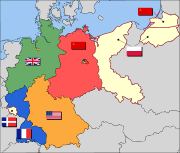 At the Potsdam Conference
, Germany was divided into four military occupation zones by the Allies and did not regain independence until 1949. The provinces east of the Oder and Neisse rivers (the Oder-Neisse line
) were transferred to Poland, Lithuania and Russia (Kaliningrad oblast
), and the 6.7 million Germans living in Poland, and the 2.5 million in Czechoslovakia, were forced to move west; most had already left when the war ended.
Denazification
removed, imprisoned or executed most top officials of the old regime, but most middle and lower ranks of civilian officialdom were not seriously affected. In accordance with the Allied agreement made at the Yalta conference
millions of POWs were used as forced labor
by the Soviet Union and other European countries.
In the East, the Soviets crushed dissent and imposed another police state, often employing ex-Nazis in the dreaded Stasi
. The Soviets extracted about 23% of the East German GNP for reparations, while in the West reparations were a minor factor.
In 1945-46 housing and food conditions were bad, as the disruption of transport, markets and finances slowed a return to normal. In the West, bombing had destroyed the fourth of the housing stock, and over 10 million refugees from the east had crowded in, most living in camps. Food production was only two-thirds of the prewar level in 1946-48, while grain and meat shipments which usually supplied 25% of the food no longer arrived from the East. Furthermore the large shipments of food seized from occupied nations that had sustained Germany during the war ended. Coal production was down 60%, which had cascading negative effects on railroads, heavy industry and heating. Industrial production fell more than half and reached prewar levels only at the end of 1949
Allied economic policy originally was one of industrial disarmament
plus building the agricultural sector. In the western sectors most of the industrial plants had minimal damage from the bombing the Allies dismantled 5% of the industrial plant for reparations. Deindustrialization became impractical and the U.S. instead called for a strong industrial base in Germany so it could stimulate European economic recovery. The U.S. shipped in food 1945-47 and made a $600 million loan in 1947 to rebuild German industry. By May 1946 the removal of machinery had ended thanks to lobbying by the U.S. Army. The Truman administration finally realised that economic recovery in Europe could not go forward without the reconstruction of the German industrial base on which it had previously been dependent. Washington decided that an "orderly, prosperous Europe requires the economic contributions of a stable and productive Germany."
a powerful secret police that infiltrated every aspect of the society.
East Germany was an Eastern bloc
state under political and military control of the Soviet Union through her occupation forces and the Warsaw Treaty
. Political power was solely executed by leading members (Politburo
) of the communist-controlled Socialist Unity Party
(SED). A Soviet-style command economy was set up, later the GDR became the most advanced Comecon
state. While East German propaganda
was based on the benefits of the GDR's social programs and the alleged constant threat of a West German invasion, many of her citizens looked to the West for political freedoms and economic prosperity.
Walter Ulbricht
(1893–1973) was the party boss 1950-71. In 1933, Ulbricht fled to Moscow, where he served as a Comintern agent loyal to Stalin. As the war was ending Stalin assigned him the job of designing the postwar German system that would centralize all power in the Communist Party. Ulbricht became deputy prime minister in 1949 and secretary (chief executive) of the Socialist Unity (Communist) party in 1950. Some 2.6 million people had fled East Germany by 1961 when he built the Berlin Wall
to stop them—shooting those who attempted it. What the GDR called the "Anti-Fascist Protective Wall" was a major embarrassment for the program during the Cold War, but it did stabilize East Germany and postpone its collapse. Ulbricht lost power in 1971, but was kept on as a nominal head of state. He was replaced because he failed to solve growing national crises, such as the worsening economy in 1969-70, the fear of another popular uprising as had occurred in 1953, and the disgruntlement between Moscow and Berlin caused by Ulbricht's détente policies toward the West. The transition to Erich Honecker
(1912–1994) led to a change in the direction of national policy and efforts by the Politburo to pay closer attention to the grievances of the proletariat. Honecker
's plans were not successful, however, with the dissent growing among East Germany's population. In 1989, severe economic problems and growing emigration towards the west were finally among the main reasons leading to this socialist regime lasting for only 40 years.
and his conservative CDU/CSU coalition. The capital was Bonn
until it was moved to Berlin in 1990.
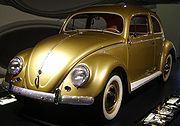 West Germany enjoyed prolonged economic growth beginning in the early 1950s (Wirtschaftswunder
or "Economic Miracle"). Industrial production doubled from 1950 to 1957, and gross national product grew at a rate of nine or 10% per year, providing the engine for economic growth of all of Western Europe. Labor union support of the new policies, postponed wage increases, minimized strikes, supported technological modernization, and enjoyed a policy of co-determination (Mitbestimmung), which involved a satisfactory grievance resolution system as well as requiring representation of workers on the boards of large corporations. The recovery was accelerated by the currency reform of June 1948, U.S. gifts of $1.4 billion Marshall Plan
aid, the breaking down of old trade barriers and traditional practices, and the opening of the global market. West Germany gained legitimacy and respect, as it shed the horrible reputation Germany had gained under the Nazis. West Germany played a central role in the creation of European cooperation; it joined NATO in 1955 and was a founding member of the European Economic Community
in 1958.
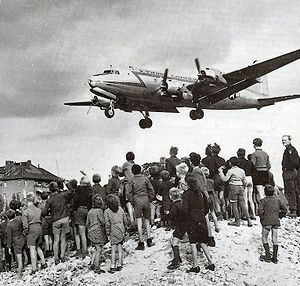 In addition, the Marshall plan forced German companies, as well as those in all of Western Europe, to modernize their business practices, and take account of the international market. Marshall plan funding helped overcome bottlenecks in the surging economy caused by remaining controls (which were removed in 1949), and Marshall Plan business reforms opened up a greatly expanded market for German exports. Overnight, consumer goods appeared in the stores, because they could be sold for realistic prices, emphasizing to Germans that their economy had turned a corner.
The success of the currency reform angered the Soviets, who cut off all road, rail and canal links between the western zones and West Berlin
. This was the Berlin Blockade
that lasted from June 24, 1948 to May 12, 1949. In response, the U.S. and Britain launched an airlift of food and coal and distributed the new currency in West Berlin as well. The city thereby became economically integrated into West Germany.
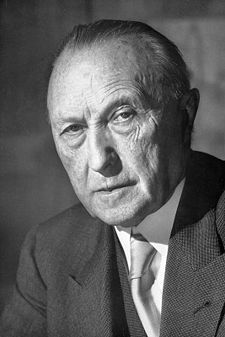 Konrad Adenauer
(1876–1967) was the dominant leader in West Germany. He was the first chancellor (top official) of the FRG, 1949–63, and until his death was the founder and leader of the Christian Democratic Union (CDU), a coalition of conservatives, ordoliberals
, and adherents of Protestant and Catholic social teaching
that dominated West Germany politics for most of its history. During his chancellorship, the West Germany economy grew quickly, and West Germany established friendly relations with France, participated in the emerging European Union
, established the Bundeswehr
, the country's armed forces, and became a pillar of NATO as well as firm ally of the United States. Adenauer's government also commenced the long process of reconciliation with the Jews and Israel
after the Holocaust.
(1897–1977) was in charge of economic policy as economics director for the British and American occupation zones and was Adenauer's long-time economics minister. Erhard's decision to lift many price controls in 1948, despite opposition from both the social democratic opposition and Allied authorities and his advocacy of free markets, helped set the Federal Republic on its strong growth from wartime devastation. Norbert Walter, a former chief economist at Deutsche Bank
, argues that "Germany owes its rapid economic advance after World War II to the system of the Social Market Economy, established by Ludwig Erhard." Erhard was politically less successful when he served as the CDU Chancellor from 1963 until 1966. Erhard followed the concept of a social market economy
, and was in close touch with professional economists. Erhard viewed the market itself as social and supported only a minimum of welfare legislation. However Erhard suffered a series of decisive defeats in his effort to create a free, competitive economy in 1957; he had to compromise on such key issues as the anti-cartel legislation. Thereafter, the West German economy evolved into a conventional west European welfare state.
Meanwhile in adopting the Godesberg Program
in 1959, the SPD largely abandoned Marxism ideas and embraced the concept of the market economy
and the welfare state
. Instead it now sought to move beyond its old working class base to appeal the full spectrum of potential voters, including the middle class and professionals. Labor unions cooperated
increasingly with industry, achieving labor representation on corporate boards and increases in wages and benefits.
 In 1966 Erhard lost support and Kurt Kiesinger (1904–1988) was elected as Chancellor by a new CDU/CSU-SPD
alliance combining the two largest parties. Socialist (SPD) leader Willy Brandt
was Deputy Federal Chancellor and Foreign Minister. The Grand Coalition lasted 1966-69 and is best known for reducing tensions with the Soviet bloc nations and establishing diplomatic relations with Czechoslovakia
, Romania
and Yugoslavia
.
The agreement with Turkey ended in 1973 but few workers returned because there were few good jobs in Turkey. By 2010 there were about 4 million people of Turkish descent in Germany. The generation born in Germany attended German schools, but had a poor command of either German or Turkish, and had either low-skilled jobs or unemployment.
 Willy Brandt
(1913–1992) was the leader of the Social Democratic Party
, 1964–87, and Chancellor 1969–1974. Under his leadership, the German government sought to reduce tensions with the Soviet Union and improve relations with the German Democratic Republic, a policy known as the Ostpolitik
. Relations between the two German states had been icy at best, with propaganda barrages in each direction. The heavy outflow of talent from the east forced the building of the Berlin Wall
in 1961, which worsened Cold War tensions and prevented East Germans from travel. Although anxious to relieve serious hardships for divided families and to reduce friction, Brandt's Ostpolitik was intent on holding to its concept of "two German states in one German nation."
Ostpolitik was opposed by the conservative elements in Germany, but won Brandt an international reputation and the Nobel Peace Prize in 1971. In September 1973, both West and East Germany were admitted to the United Nations
. The two countries exchanged permanent representatives in 1974, and, in 1987, East Germany's leader Erich Honecker
paid an official state visit to West Germany.
region was hardest hit, as its easy-to-reach coal mines petered out, and expensive German coal was no longer competitive. Likewise the Ruhr steel industry went into sharp decline, as its prices were undercut by lower-cost suppliers such as Japan. The welfare system provided a safety net for the large number of unemployed workers, and many factories reduce their labor force and began to concentrate on high-profit specialty items. After 1990 the Ruhr moved into service industries and high technology. Cleaning up the heavy air and water pollution became a major industry in its own right. Meanwhile, formerly rural Bavaria became a high-tech center of industry.
A spy scandal forced Brandt to step down as Chancellor while remaining as party leader. He was replaced by Helmut Schmidt
(b. 1918), of the SPD, who served as Chancellor 1974–1982. Schmidt continued the Ostpolitik with less enthusiasm. He had a PhD in economics and was more interested in domestic issues, such as reducing inflation. The debt grew rapidly as he borrowed to cover the cost of the ever more expensive welfare state. After 1979 foreign policy issues grew central as the Cold War turned hot again. The German peace movement mobilized hundreds of thousands of demonstrators to protest against American deployment in Europe of new medium-range missiles. Schmidt supported the deployment but was opposed by the left wing of the SPD and by Brandt.
The pro-business Free Democratic Party (FDP)
had been in coalition with the SPD, but now it changed direction. Led by Finance Minister Otto Graf Lambsdorff
(1926–2009) the FDP adopted the market-oriented "Kiel Theses" in 1977; it rejected the Keynesian emphasis on consumer demand, and proposed to reduce social welfare spending, and try to introduce policies to stimulate production and facilitate jobs. Lambsdorff argued that the result would be economic growth, which would itself solve both the social problems and the financial problems. As a consequence the FDP switched allegiance to the CDU, and Schmidt lost his parliamentary majority in 1982. For the only time in West Germany's history, the government fell on a vote of no confidence.
 Helmut Kohl
(b. 1930) brought the conservatives back to power with a CDU/CSU-FDP coalition
in 1982, and served as Chancellor until 1998. After repeated victories in 1983, 1987, 1990 and 1994 he was finally defeated by a landslide that was the biggest on record, for the left in the 1998 federal elections
, and was succeeded as Chancellor by Gerhard Schröder
of the SPD. Kohl is best known for orchestrating reunification with the approval of all the Four Powers from World War II, who still had a voice in German affairs.
 During the summer of 1989, rapid changes known as peaceful revolution or Die Wende
took place in East Germany, which quickly led to German reunification
. Growing numbers of East Germans emigrated to West Germany, many via Hungary after Hungary's reformist government opened its borders. Thousands of East Germans also tried to reach the West by staging sit-ins at West German diplomatic facilities in other East European capitals, most notably in Prague. The exodus generated demands within East Germany for political change, and mass demonstrations in several cities
continued to grow.
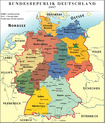 Unable to stop the growing civil unrest, Erich Honecker
was forced to resign in October, and on 9 November, East German authorities unexpectedly allowed East German citizens to enter West Berlin and West Germany. Hundreds of thousands of people took advantage of the opportunity; new crossing points were opened in the Berlin Wall and along the border with West Germany. This led to the acceleration of the process of reforms in East Germany that ended with the German reunification
that came into force on 3 October 1990.
positioned himself as a centrist "Third Way
" candidate in the mold of Britain's Tony Blair
and America's Bill Clinton
. Schroder, in March 2003, reversed his position and proposed a significant downsizing of the welfare state, known as Agenda 2010
. He had enough support to overcome opposition from the trade unions and the SPD's left wing. Agenda 2010 had five goals: tax cuts; labor market deregulation, especially relaxing rules protecting workers from dismissal and setting up Hartz concept
job training; modernizing the welfare state by reducing entitlements; decreasing bureaucratic obstacles for small businesses; and providing new low-interest loans to local governments.
led by the CDU's Angela Merkel
as chancellor. Since the 2009 elections, Merkel has headed a centre-right government of the CDU/CSU and FDP.
Together with France and other EU states, Germany has played the leading role in the European Union. Germany (especially under Chancellor Helmut Kohl
) was one of the main supporters of admitting many East European countries to the EU. Germany is at the forefront of European states seeking to exploit the momentum of monetary union to advance the creation of a more unified and capable European political, defence and security apparatus. The German chancellor Schröder expressed an interest in a permanent seat for Germany in the UN Security Council, identifying France, Russia and Japan as countries that explicitly backed Germany's bid. Germany formally adopted the Euro on January 1, 1999 after permanently fixing the Deutsche Mark rate on December 21, 1998
The German Bundeswehr
since 1990 has participated in a number of peacekeeping and disaster relief operations abroad. Since 2002, German troops formed part of the International Security Assistance Force
in the war in Afghanistan
, resulting in the first German casualties
in combat missions since World War II.
In the worldwide economic recession that began in 2008, Germany did relatively well. However, the economic instability of Greece and several other EU nations in 2010-11 forced Germany to reluctantly sponsor a massive financial rescue. In the wake of the disaster to the nuclear industry in Japan following its 2011 earthquake and tsunami, German public opinion turned sharply against Nuclear power in Germany
, which produces a fourth of the electricity supply. In response Merkel has announced plans to close down the nuclear system over the next decade, and to rely even more heavily on wind and other alternative energy sources, in addition to coal and natural gas.
point to such events of the Revolution of 1848, the authoritarian
of the Second Empire and the continuation of the Imperial elite into the Weimar and Nazi periods. Opponents such as Gerhard Ritter
of the Sonderweg theory argue that proponents of the theory are guilty of seeking selective examples, and there was much contingency and chance in German history. In addition, there was much debate within the supporters of the Sonderweg concept as for the reasons for the Sonderweg, and whether or not the Sonderweg ended in 1945.
Germany
Germany , officially the Federal Republic of Germany , is a federal parliamentary republic in Europe. The country consists of 16 states while the capital and largest city is Berlin. Germany covers an area of 357,021 km2 and has a largely temperate seasonal climate...
as a distinct region in central Europe can be traced to Roman commander Julius Caesar
Julius Caesar
Gaius Julius Caesar was a Roman general and statesman and a distinguished writer of Latin prose. He played a critical role in the gradual transformation of the Roman Republic into the Roman Empire....
, who referred to the unconquered area east of the Rhine as Germania
Germania
Germania was the Greek and Roman geographical term for the geographical regions inhabited by mainly by peoples considered to be Germani. It was most often used to refer especially to the east of the Rhine and north of the Danube...
, thus distinguishing it from Gaul
Gaul
Gaul was a region of Western Europe during the Iron Age and Roman era, encompassing present day France, Luxembourg and Belgium, most of Switzerland, the western part of Northern Italy, as well as the parts of the Netherlands and Germany on the left bank of the Rhine. The Gauls were the speakers of...
(France), which he had conquered. The victory of the Germanic tribes in the Battle of the Teutoburg Forest
Battle of the Teutoburg Forest
The Battle of the Teutoburg Forest took place in 9 CE, when an alliance of Germanic tribes led by Arminius of the Cherusci ambushed and decisively destroyed three Roman legions, along with their auxiliaries, led by Publius Quinctilius Varus.Despite numerous successful campaigns and raids by the...
(AD 9) prevented annexation by the Roman Empire
Roman Empire
The Roman Empire was the post-Republican period of the ancient Roman civilization, characterised by an autocratic form of government and large territorial holdings in Europe and around the Mediterranean....
. Following the fall of the Roman Empire, the Franks
Franks
The Franks were a confederation of Germanic tribes first attested in the third century AD as living north and east of the Lower Rhine River. From the third to fifth centuries some Franks raided Roman territory while other Franks joined the Roman troops in Gaul. Only the Salian Franks formed a...
conquered the other West Germanic tribes
West Germanic tribes
The West Germanic tribes were Germanic peoples who spoke the branch of Germanic languages known as West Germanic languages.They appear to be derived from the Jastorf culture, a Pre-Roman Iron Age offshoot of the Nordic Bronze Age culture....
. When the Frankish Empire was divided among Charlemagne
Charlemagne
Charlemagne was King of the Franks from 768 and Emperor of the Romans from 800 to his death in 814. He expanded the Frankish kingdom into an empire that incorporated much of Western and Central Europe. During his reign, he conquered Italy and was crowned by Pope Leo III on 25 December 800...
's heirs in 843, the eastern part became East Francia. In 962, Otto I became the first emperor of the Holy Roman Empire
Holy Roman Empire
The Holy Roman Empire was a realm that existed from 962 to 1806 in Central Europe.It was ruled by the Holy Roman Emperor. Its character changed during the Middle Ages and the Early Modern period, when the power of the emperor gradually weakened in favour of the princes...
, the medieval German state.
In the High Middle Ages
High Middle Ages
The High Middle Ages was the period of European history around the 11th, 12th, and 13th centuries . The High Middle Ages were preceded by the Early Middle Ages and followed by the Late Middle Ages, which by convention end around 1500....
, the dukes and princes of the empire gained power at the expense of the emperors. Martin Luther
Martin Luther
Martin Luther was a German priest, professor of theology and iconic figure of the Protestant Reformation. He strongly disputed the claim that freedom from God's punishment for sin could be purchased with money. He confronted indulgence salesman Johann Tetzel with his Ninety-Five Theses in 1517...
led the Protestant Reformation
Protestant Reformation
The Protestant Reformation was a 16th-century split within Western Christianity initiated by Martin Luther, John Calvin and other early Protestants. The efforts of the self-described "reformers", who objected to the doctrines, rituals and ecclesiastical structure of the Roman Catholic Church, led...
against the Catholic Church after 1517, as the northern states became Protestant, while the southern states remained Catholic. They clashed in the Thirty Years' War
Thirty Years' War
The Thirty Years' War was fought primarily in what is now Germany, and at various points involved most countries in Europe. It was one of the most destructive conflicts in European history....
(1618–1648), which was ruinous to the twenty million civilians. 1648 marked the effective end of the Holy Roman Empire and the beginning of the modern nation-state system, with Germany divided into numerous independent states, such as Prussia
Prussia
Prussia was a German kingdom and historic state originating out of the Duchy of Prussia and the Margraviate of Brandenburg. For centuries, the House of Hohenzollern ruled Prussia, successfully expanding its size by way of an unusually well-organized and effective army. Prussia shaped the history...
, Bavaria
Bavaria
Bavaria, formally the Free State of Bavaria is a state of Germany, located in the southeast of Germany. With an area of , it is the largest state by area, forming almost 20% of the total land area of Germany...
and Saxony
Saxony
The Free State of Saxony is a landlocked state of Germany, contingent with Brandenburg, Saxony Anhalt, Thuringia, Bavaria, the Czech Republic and Poland. It is the tenth-largest German state in area, with of Germany's sixteen states....
.
After the French Revolution
French Revolution
The French Revolution , sometimes distinguished as the 'Great French Revolution' , was a period of radical social and political upheaval in France and Europe. The absolute monarchy that had ruled France for centuries collapsed in three years...
and the Napoleonic Wars
Napoleonic Wars
The Napoleonic Wars were a series of wars declared against Napoleon's French Empire by opposing coalitions that ran from 1803 to 1815. As a continuation of the wars sparked by the French Revolution of 1789, they revolutionised European armies and played out on an unprecedented scale, mainly due to...
(1803–1815), feudalism fell away and liberalism and nationalism clashed with reaction. The 1848 March Revolution
Revolutions of 1848 in the German states
The Revolutions of 1848 in the German states, also called the March Revolution – part of the Revolutions of 1848 that broke out in many countries of Europe – were a series of loosely coordinated protests and rebellions in the states of the German Confederation, including the Austrian Empire...
failed. The Industrial Revolution
Industrial Revolution
The Industrial Revolution was a period from the 18th to the 19th century where major changes in agriculture, manufacturing, mining, transportation, and technology had a profound effect on the social, economic and cultural conditions of the times...
modernized the German economy, led to the rapid growth of cities and to the emergence of the Socialist movement
History of socialism
The history of socialism has its origins in the French Revolution of 1789 and the changes brought about by the Industrial Revolution, although it has precedents in earlier movements and ideas. The Communist Manifesto was written by Karl Marx and Frederick Engels in 1848 just before the Revolutions...
in Germany. Prussia, with its capital Berlin
History of Berlin
Berlin is the capital city of Germany. Berlin is a young city by European standards, founded in the 12th century.-Early history:*98 AD: Tacitus described the territory of Germania. What is now Berlin, in ancient times was well outside the frontiers of the Roman Empire...
, grew in power. German universities became world-class centers for science and the humanities, while music and the arts flourished. Unification was achieved with the formation of the German Empire
German Empire
The German Empire refers to Germany during the "Second Reich" period from the unification of Germany and proclamation of Wilhelm I as German Emperor on 18 January 1871, to 1918, when it became a federal republic after defeat in World War I and the abdication of the Emperor, Wilhelm II.The German...
in 1871 under the leadership of Prussian Chancellor Otto von Bismarck
Otto von Bismarck
Otto Eduard Leopold, Prince of Bismarck, Duke of Lauenburg , simply known as Otto von Bismarck, was a Prussian-German statesman whose actions unified Germany, made it a major player in world affairs, and created a balance of power that kept Europe at peace after 1871.As Minister President of...
. The Reichstag
Reichstag (German Empire)
The Reichstag was the parliament of the North German Confederation , and of the German Reich ....
, an elected parliament, had only a limited role in the imperial government.
By 1900, Germany's economy matched Britain's, allowing colonial expansion
German colonial empire
The German colonial empire was an overseas domain formed in the late 19th century as part of the German Empire. Short-lived colonial efforts by individual German states had occurred in preceding centuries, but Imperial Germany's colonial efforts began in 1884...
and a naval race. Germany led the Central Powers
Central Powers
The Central Powers were one of the two warring factions in World War I , composed of the German Empire, the Austro-Hungarian Empire, the Ottoman Empire, and the Kingdom of Bulgaria...
in the First World War (1914–1918) against France, Great Britain, Russia and (by 1917) the United States. Defeated and partly occupied, Germany was forced to pay war reparations
War reparations
War reparations are payments intended to cover damage or injury during a war. Generally, the term war reparations refers to money or goods changing hands, rather than such property transfers as the annexation of land.- History :...
by the Treaty of Versailles
Treaty of Versailles
The Treaty of Versailles was one of the peace treaties at the end of World War I. It ended the state of war between Germany and the Allied Powers. It was signed on 28 June 1919, exactly five years after the assassination of Archduke Franz Ferdinand. The other Central Powers on the German side of...
and was stripped of its colonies as well as Polish areas and Alsace-Lorraine. The German Revolution of 1918–19 deposed the emperor and the kings, leading to the establishment of the Weimar Republic
Weimar Republic
The Weimar Republic is the name given by historians to the parliamentary republic established in 1919 in Germany to replace the imperial form of government...
, an unstable parliamentary democracy.
In the early 1930s, the worldwide Great Depression
Great Depression
The Great Depression was a severe worldwide economic depression in the decade preceding World War II. The timing of the Great Depression varied across nations, but in most countries it started in about 1929 and lasted until the late 1930s or early 1940s...
hit Germany hard, as unemployment soared and people lost confidence in the government. In 1933, the Nazis under Adolf Hitler
Adolf Hitler
Adolf Hitler was an Austrian-born German politician and the leader of the National Socialist German Workers Party , commonly referred to as the Nazi Party). He was Chancellor of Germany from 1933 to 1945, and head of state from 1934 to 1945...
came to power and established a totalitarian regime. Political opponents were killed or imprisoned. Nazi Germany
Nazi Germany
Nazi Germany , also known as the Third Reich , but officially called German Reich from 1933 to 1943 and Greater German Reich from 26 June 1943 onward, is the name commonly used to refer to the state of Germany from 1933 to 1945, when it was a totalitarian dictatorship ruled by...
's aggressive foreign policy took control of Austria and parts of Czechoslovakia, and its invasion of Poland initiated the Second World War. After forming a pact with the Soviet Union in 1939, Hitler's blitzkrieg
Blitzkrieg
For other uses of the word, see: Blitzkrieg Blitzkrieg is an anglicized word describing all-motorised force concentration of tanks, infantry, artillery, combat engineers and air power, concentrating overwhelming force at high speed to break through enemy lines, and, once the lines are broken,...
swept nearly all of Western Europe. In the Holocaust
The Holocaust
The Holocaust , also known as the Shoah , was the genocide of approximately six million European Jews and millions of others during World War II, a programme of systematic state-sponsored murder by Nazi...
, six million Jews in Germany and German-occupied areas, as well as five million Poles, Romanies, Slavs, Soviets, and others were systematically killed. In 1941, however, the German invasion of the Soviet Union
Operation Barbarossa
Operation Barbarossa was the code name for Germany's invasion of the Soviet Union during World War II that began on 22 June 1941. Over 4.5 million troops of the Axis powers invaded the USSR along a front., the largest invasion in the history of warfare...
failed, and after the United States entered the war, Britain became the base for massive Anglo-American bombings of German cities. Following the Allied invasion of Normandy, the German army was pushed back on all fronts until the final collapse in May 1945.
Under occupation by the Allies, German territories were split off, denazification
Denazification
Denazification was an Allied initiative to rid German and Austrian society, culture, press, economy, judiciary, and politics of any remnants of the National Socialist ideology. It was carried out specifically by removing those involved from positions of influence and by disbanding or rendering...
took place, and the Cold War
Cold War
The Cold War was the continuing state from roughly 1946 to 1991 of political conflict, military tension, proxy wars, and economic competition between the Communist World—primarily the Soviet Union and its satellite states and allies—and the powers of the Western world, primarily the United States...
resulted in the division of the country into democratic West Germany
Germany
Germany , officially the Federal Republic of Germany , is a federal parliamentary republic in Europe. The country consists of 16 states while the capital and largest city is Berlin. Germany covers an area of 357,021 km2 and has a largely temperate seasonal climate...
and communist East Germany. Millions of ethnic Germans fled from Communist areas into West Germany, which experienced rapid economic expansion
Wirtschaftswunder
The term describes the rapid reconstruction and development of the economies of West Germany and Austria after World War II . The expression was used by The Times in 1950...
, and became the dominant economy in Western Europe. West Germany was rearmed in the 1950s under the auspices of NATO, but without access to nuclear weapons. The Franco-German friendship became the basis for the political integration of Western Europe in the European Union
European Union
The European Union is an economic and political union of 27 independent member states which are located primarily in Europe. The EU traces its origins from the European Coal and Steel Community and the European Economic Community , formed by six countries in 1958...
. In 1989, the Eastern bloc
Eastern bloc
The term Eastern Bloc or Communist Bloc refers to the former communist states of Eastern and Central Europe, generally the Soviet Union and the countries of the Warsaw Pact...
collapsed and East Germany was reunited with West Germany in 1990.
Germanic tribes 750BC-600AD
Ethnogenesis
Ethnogenesis is the process by which a group of human beings comes to be understood or to understand themselves as ethnically distinct from the wider social landscape from which their grouping emerges...
of the Germanic tribes
Germanic peoples
The Germanic peoples are an Indo-European ethno-linguistic group of Northern European origin, identified by their use of the Indo-European Germanic languages which diversified out of Proto-Germanic during the Pre-Roman Iron Age.Originating about 1800 BCE from the Corded Ware Culture on the North...
is assumed to have occurred during the Nordic Bronze Age
Nordic Bronze Age
The Nordic Bronze Age is the name given by Oscar Montelius to a period and a Bronze Age culture in Scandinavian pre-history, c. 1700-500 BC, with sites that reached as far east as Estonia. Succeeding the Late Neolithic culture, its ethnic and linguistic affinities are unknown in the absence of...
, or at the latest during the Pre-Roman Iron Age
Pre-Roman Iron Age
The Pre-Roman Iron Age of Northern Europe designates the earliest part of the Iron Age in Scandinavia, northern Germany, and the Netherlands north of the Rhine River. These regions feature many extensive archaeological excavation sites, which have yielded a wealth of artifacts...
. From southern Scandinavia and northern Germany, the tribes began expanding south, east and west in the 1st century BC, coming into contact with the Celt
Celt
The Celts were a diverse group of tribal societies in Iron Age and Roman-era Europe who spoke Celtic languages.The earliest archaeological culture commonly accepted as Celtic, or rather Proto-Celtic, was the central European Hallstatt culture , named for the rich grave finds in Hallstatt, Austria....
ic tribes of Gaul
Gaul
Gaul was a region of Western Europe during the Iron Age and Roman era, encompassing present day France, Luxembourg and Belgium, most of Switzerland, the western part of Northern Italy, as well as the parts of the Netherlands and Germany on the left bank of the Rhine. The Gauls were the speakers of...
as well as Iranian, Baltic
Balts
The Balts or Baltic peoples , defined as speakers of one of the Baltic languages, a branch of the Indo-European language family, are descended from a group of Indo-European tribes who settled the area between the Jutland peninsula in the west and Moscow, Oka and Volga rivers basins in the east...
, and Slavic
Slavic peoples
The Slavic people are an Indo-European panethnicity living in Eastern Europe, Southeast Europe, North Asia and Central Asia. The term Slavic represents a broad ethno-linguistic group of people, who speak languages belonging to the Slavic language family and share, to varying degrees, certain...
tribes in Eastern Europe
Eastern Europe
Eastern Europe is the eastern part of Europe. The term has widely disparate geopolitical, geographical, cultural and socioeconomic readings, which makes it highly context-dependent and even volatile, and there are "almost as many definitions of Eastern Europe as there are scholars of the region"...
.
Little is known about early Germanic history, except through their recorded interactions with the Roman Empire
Roman Empire
The Roman Empire was the post-Republican period of the ancient Roman civilization, characterised by an autocratic form of government and large territorial holdings in Europe and around the Mediterranean....
, etymological research and archaeological finds.
In the first years of the 1st century, Roman legions conducted a long campaign in Germania, the area north of the Upper Danube
Danube
The Danube is a river in the Central Europe and the Europe's second longest river after the Volga. It is classified as an international waterway....
and east of the Rhine, in an attempt at a further major expansion of the Empire's frontiers, and a shortening of its frontier line. They subdued several Germanic tribes, such as the Cherusci
Cherusci
The Cherusci were a Germanic tribe that inhabited parts of the northern Rhine valley and the plains and forests of northwestern Germany, in the area between present-day Osnabrück and Hanover, during the 1st century BC and 1st century AD...
. The tribes became familiar with Roman tactics of warfare while maintaining their tribal identity. Modern Germany, east of the Rhine remained outside the Roman Empire. By AD 100, the time of Tacitus
Tacitus
Publius Cornelius Tacitus was a senator and a historian of the Roman Empire. The surviving portions of his two major works—the Annals and the Histories—examine the reigns of the Roman Emperors Tiberius, Claudius, Nero and those who reigned in the Year of the Four Emperors...
' Germania
Germania (book)
The Germania , written by Gaius Cornelius Tacitus around 98, is an ethnographic work on the Germanic tribes outside the Roman Empire.-Contents:...
, Germanic tribes settled along the Rhine and the Danube (the Limes Germanicus
Limes Germanicus
The Limes Germanicus was a line of frontier fortifications that bounded the ancient Roman provinces of Germania Inferior, Germania Superior and Raetia, dividing the Roman Empire and the unsubdued Germanic tribes from the years 83 to about 260 AD...
), occupying most of the area of modern Germany; Austria, southern Bavaria
Bavaria
Bavaria, formally the Free State of Bavaria is a state of Germany, located in the southeast of Germany. With an area of , it is the largest state by area, forming almost 20% of the total land area of Germany...
and the western Rhineland
Rhineland
Historically, the Rhinelands refers to a loosely-defined region embracing the land on either bank of the River Rhine in central Europe....
, however, were Roman provinces. The 3rd century saw the emergence of a number of large West Germanic tribes: Alamanni
Alamanni
The Alamanni, Allemanni, or Alemanni were originally an alliance of Germanic tribes located around the upper Rhine river . One of the earliest references to them is the cognomen Alamannicus assumed by Roman Emperor Caracalla, who ruled the Roman Empire from 211 to 217 and claimed thereby to be...
, Franks
Franks
The Franks were a confederation of Germanic tribes first attested in the third century AD as living north and east of the Lower Rhine River. From the third to fifth centuries some Franks raided Roman territory while other Franks joined the Roman troops in Gaul. Only the Salian Franks formed a...
, Chatti
Chatti
The Chatti were an ancient Germanic tribe whose homeland was near the upper Weser. They settled in central and northern Hesse and southern Lower Saxony, along the upper reaches of the Weser River and in the valleys and mountains of the Eder, Fulda and Weser River regions, a district approximately...
, Saxons
Saxons
The Saxons were a confederation of Germanic tribes originating on the North German plain. The Saxons earliest known area of settlement is Northern Albingia, an area approximately that of modern Holstein...
, Frisii
Frisii
The Frisii were an ancient Germanic tribe living in the low-lying region between the Zuiderzee and the River Ems. In the Germanic pre-Migration Period the Frisii and the related Chauci, Saxons, and Angles inhabited the Continental European coast from the Zuyder Zee to south Jutland...
, Sicambri
Sicambri
The Sicambri were a Germanic people living on the right bank of the Rhine river, near where it passes out of Germany and enters what is now called the Netherlands at the turn of the first millennium....
, and Thuringii
Thuringii
The Thuringii or Toringi were a Germanic tribe which appeared late during the Völkerwanderung in the Harz Mountains of central Germania around 280, in a region which still bears their name to this day — Thuringia. They evidently filled a void left when the previous inhabitants — the...
. Around 260, the Germanic peoples broke through the Limes and the Danube frontier into Roman-controlled lands.
Since the 15th century German historians have celebrated
Hermannsdenkmal
The Hermannsdenkmal is a monument located in Ostwestfalen-Lippe in Germany in the Southern part of the Teutoburg Forest, which is southwest of Detmold in the district of Lippe...
the victory of Arminius
Arminius
Arminius , also known as Armin or Hermann was a chieftain of the Germanic Cherusci who defeated a Roman army in the Battle of the Teutoburg Forest...
, a chieftain of the Cherusci
Cherusci
The Cherusci were a Germanic tribe that inhabited parts of the northern Rhine valley and the plains and forests of northwestern Germany, in the area between present-day Osnabrück and Hanover, during the 1st century BC and 1st century AD...
, who in 9 AD defeated a Roman army in the Battle of the Teutoburg Forest
Battle of the Teutoburg Forest
The Battle of the Teutoburg Forest took place in 9 CE, when an alliance of Germanic tribes led by Arminius of the Cherusci ambushed and decisively destroyed three Roman legions, along with their auxiliaries, led by Publius Quinctilius Varus.Despite numerous successful campaigns and raids by the...
, as the birth of German history.
Seven large German-speaking tribes, the Visigoths, Ostrogoths, Vandals
Vandals
The Vandals were an East Germanic tribe that entered the late Roman Empire during the 5th century. The Vandals under king Genseric entered Africa in 429 and by 439 established a kingdom which included the Roman Africa province, besides the islands of Sicily, Corsica, Sardinia and the Balearics....
, Burgundians
Burgundians
The Burgundians were an East Germanic tribe which may have emigrated from mainland Scandinavia to the island of Bornholm, whose old form in Old Norse still was Burgundarholmr , and from there to mainland Europe...
, Lombards
Lombards
The Lombards , also referred to as Longobards, were a Germanic tribe of Scandinavian origin, who from 568 to 774 ruled a Kingdom in Italy...
, Saxons
Saxons
The Saxons were a confederation of Germanic tribes originating on the North German plain. The Saxons earliest known area of settlement is Northern Albingia, an area approximately that of modern Holstein...
and the Franks
Franks
The Franks were a confederation of Germanic tribes first attested in the third century AD as living north and east of the Lower Rhine River. From the third to fifth centuries some Franks raided Roman territory while other Franks joined the Roman troops in Gaul. Only the Salian Franks formed a...
moved west and took part in the transformation of the peoples
Decline of the Roman Empire
The decline of the Roman Empire refers to the gradual societal collapse of the Western Roman Empire. Many theories of causality prevail, but most concern the disintegration of political, economic, military, and other social institutions, in tandem with foreign invasions and usurpers from within the...
of the old Western Roman Empire
Western Roman Empire
The Western Roman Empire was the western half of the Roman Empire after its division by Diocletian in 285; the other half of the Roman Empire was the Eastern Roman Empire, commonly referred to today as the Byzantine Empire....
.
The Stem Duchies & Marches
The Stem DuchiesStem duchy
Stem duchies were essentially the domains of the old German tribes of the area, associated with the Frankish Kingdom, especially the East, in the Early Middle Ages. These tribes were originally the Franks, the Saxons, the Alamanni, the Burgundians, the Thuringii, and the Rugii...
(tribal duchies) in Germany was mainly the areas of the old German tribes of the region. These strains were originally the Franks, the Saxons, the Alemanni, the Burgundians
Burgundians
The Burgundians were an East Germanic tribe which may have emigrated from mainland Scandinavia to the island of Bornholm, whose old form in Old Norse still was Burgundarholmr , and from there to mainland Europe...
, the Thuringians, and the Rugians
Rugians
"Rugi" redirects here. For the Romanian villages by this name, see Păltiniş, Caraş-Severin and Turcineşti.The Rugii, also Rugians, Rygir, Ulmerugi, or Holmrygir were an East Germanic tribe migrated from southwest Norway to Pomerania around 100 AD, and from there to the Danube River valley...
. In the 5th Century the Burgundians moved into Roman territory and would have been in 443 and 458 in the area, then Lower Burgundy
Lower Burgundy
Lower Burgundy was a historical kingdom in what is now southeastern France, so-called because it was lower down the Rhone Valley than Upper Burgundy. Lower Burgundy is sometimes called the Kingdom of Arelat or the Kingdom of Cisjurane Burgundy...
. The area they had occupied in Germany, along with the Saxons
Saxons
The Saxons were a confederation of Germanic tribes originating on the North German plain. The Saxons earliest known area of settlement is Northern Albingia, an area approximately that of modern Holstein...
, was occupied by the Franks. The Rugians which Odoacer destroyed in 487 formed a new confederation of Germans in their place, the Bavarians. All of these strains in Germany were finally subdued by the Franks, the Alamanni in 496 and 505, the Thuringia
Thuringia
The Free State of Thuringia is a state of Germany, located in the central part of the country.It has an area of and 2.29 million inhabitants, making it the sixth smallest by area and the fifth smallest by population of Germany's sixteen states....
in 531.
The Franks
The Merovingian kings of the Germanic Franks conquered northern Gaul in 486 AD. In the 5th and 6th centuries the Merovingian kings conquered several other Germanic tribes and kingdoms and placed them under the control of autonomous dukes of mixed Frankish and native blood. Frankish Colonists were encouraged to move to the newly conquered territories. While the local Germanic tribes were allowed to preserve their laws, they were pressured into becoming Christians.Frankish Empire
After the fall of the Western Roman EmpireWestern Roman Empire
The Western Roman Empire was the western half of the Roman Empire after its division by Diocletian in 285; the other half of the Roman Empire was the Eastern Roman Empire, commonly referred to today as the Byzantine Empire....
the Franks created an empire under the Merovingian kings and subjugated the other Germanic tribes. Swabia
Swabia
Swabia is a cultural, historic and linguistic region in southwestern Germany.-Geography:Like many cultural regions of Europe, Swabia's borders are not clearly defined...
became a duchy under the Frankish Empire
Frankish Empire
Francia or Frankia, later also called the Frankish Empire , Frankish Kingdom , Frankish Realm or occasionally Frankland, was the territory inhabited and ruled by the Franks from the 3rd to the 10th century...
in 496, following the Battle of Tolbiac
Battle of Tolbiac
The Battle of Tolbiac was fought between the Franks under Clovis I and the Alamanni, traditionally set in 496. The site of "Tolbiac", or "Tulpiacum" is usually given as Zülpich, North Rhine-Westphalia, about 60km east of the present German-Belgian frontier, which is not implausible...
. Already king Chlothar I ruled the greater part of what is now Germany and made expeditions into Saxony
Duchy of Saxony
The medieval Duchy of Saxony was a late Early Middle Ages "Carolingian stem duchy" covering the greater part of Northern Germany. It covered the area of the modern German states of Bremen, Hamburg, Lower Saxony, North Rhine-Westphalia, and Saxony-Anhalt and most of Schleswig-Holstein...
while the Southeast of modern Germany was still under influence of the Ostrogoths. In 531 Saxons and Franks destroyed the Kingdom of Thuringia
Thuringia
The Free State of Thuringia is a state of Germany, located in the central part of the country.It has an area of and 2.29 million inhabitants, making it the sixth smallest by area and the fifth smallest by population of Germany's sixteen states....
. Saxons inhabit the area down to the Unstrut
Unstrut
The Unstrut is a river in Germany and a left tributary of the Saale. It originates in northern Thuringia near Dingelstädt and its catchment area is the whole of the Thuringian Basin...
river.
During the partition of the Frankish empire their German territories were a part of Austrasia
Austrasia
Austrasia formed the northeastern portion of the Kingdom of the Merovingian Franks, comprising parts of the territory of present-day eastern France, western Germany, Belgium, Luxembourg and the Netherlands. Metz served as its capital, although some Austrasian kings ruled from Rheims, Trier, and...
. In 718 the Franconian Mayor of the Palace
Mayor of the Palace
Mayor of the Palace was an early medieval title and office, also called majordomo, from the Latin title maior domus , used most notably in the Frankish kingdoms in the 7th and 8th centuries....
Charles Martel
Charles Martel
Charles Martel , also known as Charles the Hammer, was a Frankish military and political leader, who served as Mayor of the Palace under the Merovingian kings and ruled de facto during an interregnum at the end of his life, using the title Duke and Prince of the Franks. In 739 he was offered the...
made war against Saxony, because of its help for the Neustria
Neustria
The territory of Neustria or Neustrasia, meaning "new [western] land", originated in 511, made up of the regions from Aquitaine to the English Channel, approximating most of the north of present-day France, with Paris and Soissons as its main cities...
ns. The Franconian Carloman started in 743 a new war against Saxony, because the Saxons gave aid to Duke Odilo of Bavaria
Odilo of Bavaria
Odilo was an Alamannic nobleman, a son of Gotfrid of the house of the Agilolfings.He ruled Thurgau until 736, when with the death of Hugbert of Bavaria the older line of the Agilofing became extinct and he inherited the rulership of Bavaria, which he held until his death in 748.Odilo presided...
.
In 751 Pippin III, mayor of the palace
Mayor of the Palace
Mayor of the Palace was an early medieval title and office, also called majordomo, from the Latin title maior domus , used most notably in the Frankish kingdoms in the 7th and 8th centuries....
under the Merovingian king, himself assumed the title of king and was anointed by the Church. The Frankish kings now set up as protectors of the pope, Charles the Great launched a decades-long military campaign against their heathen rivals, the Saxons
Saxons
The Saxons were a confederation of Germanic tribes originating on the North German plain. The Saxons earliest known area of settlement is Northern Albingia, an area approximately that of modern Holstein...
and the Avars
Eurasian Avars
The Eurasian Avars or Ancient Avars were a highly organized nomadic confederacy of mixed origins. They were ruled by a khagan, who was surrounded by a tight-knit entourage of nomad warriors, an organization characteristic of Turko-Mongol groups...
. The Saxons (by the Saxon Wars
Saxon Wars
The Saxon Wars were the campaigns and insurrections of the more than thirty years from 772, when Charlemagne first entered Saxony with the intent to conquer, to 804, when the last rebellion of disaffected tribesmen was crushed. In all, eighteen battles were fought in what is now northwestern Germany...
(772–804)) and Avars were eventually overwhelmed and forcibly converted, and their lands were annexed by the Carolingian Empire
Carolingian Empire
Carolingian Empire is a historiographical term which has been used to refer to the realm of the Franks under the Carolingian dynasty in the Early Middle Ages. This dynasty is seen as the founders of France and Germany, and its beginning date is based on the crowning of Charlemagne, or Charles the...
.
Middle Ages
After the death in 768 of the Frankish King Pepin the Short, his son Charles consolidated his control over his kingdom and became known as "Charles the Great" or "Charlemagne." From 771 until his death in 814, CharlemagneCharlemagne
Charlemagne was King of the Franks from 768 and Emperor of the Romans from 800 to his death in 814. He expanded the Frankish kingdom into an empire that incorporated much of Western and Central Europe. During his reign, he conquered Italy and was crowned by Pope Leo III on 25 December 800...
extended the Carolingian empire into northern Italy and the territories of all west Germanic peoples, including the Saxons and the Bajuwari (Bavarians). In 800, Charlemagne's authority was confirmed by his coronation as emperor in Rome. Imperial strongholds (Kaiserpfalzen) became economic and cultural centres, of which Aachen
Aachen
Aachen has historically been a spa town in North Rhine-Westphalia, Germany. Aachen was a favoured residence of Charlemagne, and the place of coronation of the Kings of Germany. Geographically, Aachen is the westernmost town of Germany, located along its borders with Belgium and the Netherlands, ...
was the most famous.
Between 843 and 880, after fighting between Charlemagne's grandchildren, the Carolingian empire was partitioned into several parts in the Treaty of Verdun
Treaty of Verdun
The Treaty of Verdun was a treaty between the three surviving sons of Louis the Pious, the son and successor of Charlemagne, which divided the Carolingian Empire into three kingdoms...
(843), the Treaty of Meerssen
Treaty of Meerssen
The Treaty of Meerssen or Mersen was a partition treaty of the Carolingian Empire concluded on 8 August 870 by the two surviving sons of Emperor Louis the Pious, King Charles the Bald of West Francia and Louis the German of East Francia, at Meerssen north of Maastricht, in the present-day...
(870) and the Treaty of Ribemont
Treaty of Ribemont
There are two Treaties of Ribemont, the first is from 880 and the second is from 1179.-The treaty of 880:The Treaty of Ribemont in 880 was the last treaty on the partitions of the Frankish Empire...
. The German region developed out of the East Frankish kingdom, East Francia. From 919 to 936 the Germanic peoples (Franks
Franks
The Franks were a confederation of Germanic tribes first attested in the third century AD as living north and east of the Lower Rhine River. From the third to fifth centuries some Franks raided Roman territory while other Franks joined the Roman troops in Gaul. Only the Salian Franks formed a...
, Saxons
Saxons
The Saxons were a confederation of Germanic tribes originating on the North German plain. The Saxons earliest known area of settlement is Northern Albingia, an area approximately that of modern Holstein...
, Swabians and Bavarians) were united under Duke Henry of Saxony, who took the title of king. For the first time, the term Kingdom (Empire) of the Germans ("Regnum Teutonicorum") was applied to a Frankish kingdom, even though Teutonicorum at its founding originally meant something closer to "Realm of the Germanic peoples" or "Germanic Realm" than realm of the Germans.
Otto the Great
In 936, Otto I the GreatOtto I, Holy Roman Emperor
Otto I the Great , son of Henry I the Fowler and Matilda of Ringelheim, was Duke of Saxony, King of Germany, King of Italy, and "the first of the Germans to be called the emperor of Italy" according to Arnulf of Milan...
was crowned at Aachen; his coronation by the Pope at Rome in 962 inaugurated the Holy Roman Empire
Holy Roman Empire
The Holy Roman Empire was a realm that existed from 962 to 1806 in Central Europe.It was ruled by the Holy Roman Emperor. Its character changed during the Middle Ages and the Early Modern period, when the power of the emperor gradually weakened in favour of the princes...
, which comprised the German people. Otto strengthened the royal authority by re-asserting the old Carolingian rights over ecclesiastical appointments. Otto wrested from the nobles the powers of appointment of the bishops and abbots, who controlled large land holdings. Additionally, Otto revived the old Carolingian program of appointing missionaries in the border lands. Otto continued to support the celibacy rule for the higher clergy. Thus, the ecclesiastical appointments never became hereditary. By granting land to the abbotts and bishops he appointed, Otto actually made these bishops into "princes of the Empire" (Reichsfürsten). In this way, Otto was able to establish a national church. Outside threats to the kingdom were contained with the decisive defeat of the Magyars of Hungary at the Battle of Lechfeld
Battle of Lechfeld
The Battle of Lechfeld , often seen as the defining event for holding off the incursions of the Hungarians into Western Europe, was a decisive victory by Otto I the Great, King of the Germans, over the Hungarian leaders, the harka Bulcsú and the chieftains Lél and Súr...
in 955. The Slavs between the Elbe
Elbe
The Elbe is one of the major rivers of Central Europe. It rises in the Krkonoše Mountains of the northwestern Czech Republic before traversing much of Bohemia , then Germany and flowing into the North Sea at Cuxhaven, 110 km northwest of Hamburg...
and the Oder
Oder
The Oder is a river in Central Europe. It rises in the Czech Republic and flows through western Poland, later forming of the border between Poland and Germany, part of the Oder-Neisse line...
rivers were also subjugated. Otto marched on Rome and drove John XII from the papal throne and for years controlled the election of the pope, setting a firm precedent for imperial control of the papacy for years to come.
During the reign of Conrad II's son, Henry III
Henry III, Holy Roman Emperor
Henry III , called the Black or the Pious, was a member of the Salian Dynasty of Holy Roman Emperors...
(1039 to 1056 ), the Holy Roman Empire supported the Cluniac
Cluniac Reforms
The Cluniac Reforms were a series of changes within medieval monasticism of West focused on restoring the traditional monastic life, encouraging art, and caring for the poor. The movement is named for the Abbey of Cluny in Burgundy, where it started within the Benedictine order. The reforms were...
reform of the Church - the Peace of God
Peace and Truce of God
The Peace and Truce of God was a medieval European movement of the Catholic Church that applied spiritual sanctions in order to limit the violence of private war in feudal society. The movement constituted the first organized attempt to control civil society in medieval Europe through non-violent...
, the prohibition of simony
Simony
Simony is the act of paying for sacraments and consequently for holy offices or for positions in the hierarchy of a church, named after Simon Magus , who appears in the Acts of the Apostles 8:9-24...
(the purchase of clerical offices) and required the celibacy of priests. Imperial authority over the Pope reached its peak. In the Investiture Controversy
Investiture Controversy
The Investiture Controversy or Investiture Contest was the most significant conflict between Church and state in medieval Europe. In the 11th and 12th centuries, a series of Popes challenged the authority of European monarchies over control of appointments, or investitures, of church officials such...
which began between Henry IV
Henry IV, Holy Roman Emperor
Henry IV was King of the Romans from 1056 and Holy Roman Emperor from 1084 until his forced abdication in 1105. He was the third emperor of the Salian dynasty and one of the most powerful and important figures of the 11th century...
and Pope Gregory VII
Pope Gregory VII
Pope St. Gregory VII , born Hildebrand of Sovana , was Pope from April 22, 1073, until his death. One of the great reforming popes, he is perhaps best known for the part he played in the Investiture Controversy, his dispute with Henry IV, Holy Roman Emperor affirming the primacy of the papal...
over appointments to ecclesiastical offices, the emperor was compelled to submit to the Pope at Canossa
Canossa
Canossa is a comune and castle town in Emilia-Romagna, famous as the site where Holy Roman Emperor Henry IV did penance in 1077, standing three days bare-headed in the snow, in order to reverse his excommunication by Pope Gregory VII...
in 1077, after having been excommunicated. In 1122 a temporary reconciliation was reached between Henry V
Henry V, Holy Roman Emperor
Henry V was King of Germany and Holy Roman Emperor , the fourth and last ruler of the Salian dynasty. Henry's reign coincided with the final phase of the great Investiture Controversy, which had pitted pope against emperor...
and the Pope with the Concordat of Worms
Concordat of Worms
The Concordat of Worms, sometimes called the Pactum Calixtinum by papal historians, was an agreement between Pope Calixtus II and Holy Roman Emperor Henry V on September 23, 1122 near the city of Worms...
. The consequences of the investiture dispute were a weakening of the Ottonian church (Reichskirche), and a strengthening of the Imperial secular princes.
The time between 1096 and 1291 was the age of the crusades. Knightly religious orders were established, including the Templars
Knights Templar
The Poor Fellow-Soldiers of Christ and of the Temple of Solomon , commonly known as the Knights Templar, the Order of the Temple or simply as Templars, were among the most famous of the Western Christian military orders...
, the Knights of St John
Knights Hospitaller
The Sovereign Military Hospitaller Order of Saint John of Jerusalem of Rhodes and of Malta , also known as the Sovereign Military Order of Malta , Order of Malta or Knights of Malta, is a Roman Catholic lay religious order, traditionally of military, chivalrous, noble nature. It is the world's...
and the Teutonic Order
Teutonic Knights
The Order of Brothers of the German House of Saint Mary in Jerusalem , commonly the Teutonic Order , is a German medieval military order, in modern times a purely religious Catholic order...
.
Towns and cities
The German lands had a population of about 5 or 6 million. The great majority were farmers, typically in a state of serfdomSerfdom
Serfdom is the status of peasants under feudalism, specifically relating to Manorialism. It was a condition of bondage or modified slavery which developed primarily during the High Middle Ages in Europe and lasted to the mid-19th century...
under the control of nobles and monasteries. A few towns were starting to emerge. From 1100, new towns were founded around imperial strongholds, castles, bishops' palaces and monasteries. The towns began to establish municipal rights and liberties (see German town law
German town law
German town law or German municipal concerns concerns town privileges used by many cities, towns, and villages throughout Central and Eastern Europe during the Middle Ages.- Town law in Germany :...
). Several cities such as Cologne
Cologne
Cologne is Germany's fourth-largest city , and is the largest city both in the Germany Federal State of North Rhine-Westphalia and within the Rhine-Ruhr Metropolitan Area, one of the major European metropolitan areas with more than ten million inhabitants.Cologne is located on both sides of the...
became Imperial Free Cities, which did not depend on princes or bishops, but were immediately subject to the Emperor. The towns were ruled by patricians (merchants carrying on long-distance trade). The craftsmen formed guilds, governed by strict rules, which sought to obtain control of the towns; a few were open to women. Society was divided into sharply demarcated classes: the clergy, physicians, merchants, various guilds of artisans; full citizenship was not available to paupers. Political tensions arose from issues of taxation, public spending, regulation of business, and market supervision, as well as the limits of corporate autonomy.
Cologne's
History of Cologne
The History of Cologne, Germany's oldest major city, can be broken into several periods.- Roman period :In 39 BC, the tribe of the Ubii entered into an agreement with the Roman forces and settled on the left bank of the Rhine. Their headquarters was Oppidum Ubiorum — the settlement of the Ubii, and...
central location on the Rhine river placed it at the intersection of the major trade routes between east and west and was the basis of Cologne's growth. The economic structures of medieval and early modern Cologne were characterized by the city's status as a major harbor and transport hub upon the Rhine. It was the seat of the archbishops, who ruled the surrounding area and (from 1248 to 1880) built the great Cologne Cathedral
Cologne Cathedral
Cologne Cathedral is a Roman Catholic church in Cologne, Germany. It is the seat of the Archbishop of Cologne and the administration of the Archdiocese of Cologne. It is renowned monument of German Catholicism and Gothic architecture and is a World Heritage Site...
, with sacred relics that made it the destination for many worshippers. By 1288 the city had secured its independence from the archbishop (who relocated to Bonn), and was ruled by its burghers.
Hanseatic League
Long-distance trade in the Baltic intensified, as the major trading towns came together in the Hanseatic LeagueHanseatic League
The Hanseatic League was an economic alliance of trading cities and their merchant guilds that dominated trade along the coast of Northern Europe...
, under the leadership of Lübeck
Lübeck
The Hanseatic City of Lübeck is the second-largest city in Schleswig-Holstein, in northern Germany, and one of the major ports of Germany. It was for several centuries the "capital" of the Hanseatic League and, because of its Brick Gothic architectural heritage, is listed by UNESCO as a World...
.
History of Cologne
The History of Cologne, Germany's oldest major city, can be broken into several periods.- Roman period :In 39 BC, the tribe of the Ubii entered into an agreement with the Roman forces and settled on the left bank of the Rhine. Their headquarters was Oppidum Ubiorum — the settlement of the Ubii, and...
on the Rhine River, Hamburg
History of Hamburg
The history the Hamburg begins with its foundation in the 9th century as a mission settlement to convert the Saxons. Since the Middle Ages Hamburg was an important trading centre in Europe...
and Bremen
Bremen
The City Municipality of Bremen is a Hanseatic city in northwestern Germany. A commercial and industrial city with a major port on the river Weser, Bremen is part of the Bremen-Oldenburg metropolitan area . Bremen is the second most populous city in North Germany and tenth in Germany.Bremen is...
on the North Sea, and Lübeck on the Baltic.
The Hanseatic cities each had its own legal system and a degree of political autonomy.
Eastward expansion
The German colonisation and the chartering of new towns and villages began into largely Slav-inhabited territories east of the ElbeElbe
The Elbe is one of the major rivers of Central Europe. It rises in the Krkonoše Mountains of the northwestern Czech Republic before traversing much of Bohemia , then Germany and flowing into the North Sea at Cuxhaven, 110 km northwest of Hamburg...
, such as Bohemia
Bohemia
Bohemia is a historical region in central Europe, occupying the western two-thirds of the traditional Czech Lands. It is located in the contemporary Czech Republic with its capital in Prague...
, Silesia
Silesia
Silesia is a historical region of Central Europe located mostly in Poland, with smaller parts also in the Czech Republic, and Germany.Silesia is rich in mineral and natural resources, and includes several important industrial areas. Silesia's largest city and historical capital is Wrocław...
, Pomerania
Pomerania
Pomerania is a historical region on the south shore of the Baltic Sea. Divided between Germany and Poland, it stretches roughly from the Recknitz River near Stralsund in the West, via the Oder River delta near Szczecin, to the mouth of the Vistula River near Gdańsk in the East...
, and Livonia
Livonia
Livonia is a historic region along the eastern shores of the Baltic Sea. It was once the land of the Finnic Livonians inhabiting the principal ancient Livonian County Metsepole with its center at Turaida...
. Beginning in 1226, the Teutonic Knights
Teutonic Knights
The Order of Brothers of the German House of Saint Mary in Jerusalem , commonly the Teutonic Order , is a German medieval military order, in modern times a purely religious Catholic order...
began their conquest of Prussia. The native Baltic Prussians were conquered and Christianized by the Knights with much warfare, and numerous German towns were established along the eastern shore of the Baltic Sea.
Church and state
Henry V, Holy Roman Emperor
Henry V was King of Germany and Holy Roman Emperor , the fourth and last ruler of the Salian dynasty. Henry's reign coincided with the final phase of the great Investiture Controversy, which had pitted pope against emperor...
(1086–1125), great-grandson of Conrad II became Holy Roman Emperor in 1106 in the midst of a civil war. Hoping to gain complete control over the church inside the Empire, Henry V appointed Adalbert of Saarbruken as archbishop of Mainz in 1111 Adalbert began to assert the powers of the Church against secular authorities, that is, the Emperor. This precipitated the "Crisis of 1111", part of the long-term Investiture Controversy
Investiture Controversy
The Investiture Controversy or Investiture Contest was the most significant conflict between Church and state in medieval Europe. In the 11th and 12th centuries, a series of Popes challenged the authority of European monarchies over control of appointments, or investitures, of church officials such...
. In 1137 the magnates turned back to the Hohenstaufen family for a candidate, Conrad III
Conrad III of Germany
Conrad III was the first King of Germany of the Hohenstaufen dynasty. He was the son of Frederick I, Duke of Swabia, and Agnes, a daughter of the Salian Emperor Henry IV.-Life and reign:...
. Conrad III tried to divest Henry the Proud of his two duchies, leading to war in southern Germany as the Empire divided into two factions. The first faction called themselves the "Welfs" after Henry the Proud's family name which was the ruling dynasty in Bavaria. The other faction was known as the "Waiblings." In this early period, the Welfs generally represented ecclesiastical independence under the papacy plus "particularism" (a strengthening of the local duchies against the central imperial authority). The Waiblings on the other hand stood for control of the Church by a strong central Imperial government.
Between 1152 and 1190, during the reign of Frederick I
Frederick I, Holy Roman Emperor
Frederick I Barbarossa was a German Holy Roman Emperor. He was elected King of Germany at Frankfurt on 4 March 1152 and crowned in Aachen on 9 March, crowned King of Italy in Pavia in 1155, and finally crowned Roman Emperor by Pope Adrian IV, on 18 June 1155, and two years later in 1157 the term...
(Barbarossa), of the Hohenstaufen dynasty, an accommodation was reached with the rival Guelph party by the grant of the duchy of Bavaria to Henry the Lion
Henry the Lion
Henry the Lion was a member of the Welf dynasty and Duke of Saxony, as Henry III, from 1142, and Duke of Bavaria, as Henry XII, from 1156, which duchies he held until 1180....
, duke of Saxony
Lower Saxony
Lower Saxony is a German state situated in north-western Germany and is second in area and fourth in population among the sixteen states of Germany...
. Austria became a separate duchy by virtue of the Privilegium Minus
Privilegium Minus
The Privilegium Minus is a document issued by Emperor Frederick I on September 17, 1156. It included the elevation of the Margraviate of Austria to a Duchy, which was given as an inheritable fief to the House of Babenberg. Its recipient was Frederick's paternal uncle Margrave Henry II Jasomirgott...
in 1156. Barbarossa tried to reassert his control over Italy. In 1177 a final reconciliation was reached between the emperor and the Pope in Venice
Venice
Venice is a city in northern Italy which is renowned for the beauty of its setting, its architecture and its artworks. It is the capital of the Veneto region...
.
In 1180 Henry the Lion was outlawed and Bavaria was given to Otto of Wittelsbach
Otto I Wittelsbach, Duke of Bavaria
Otto I , called the Redhead , was Duke of Bavaria from 1180 until his death. He was the first Bavarian ruler from the House of Wittelsbach, a dynasty which reigned until the abdication of King Ludwig III of Bavaria in the German Revolution of 1918.-Biography:Duke Otto I was probably born at...
(founder of the Wittelsbach dynasty
Wittelsbach
The Wittelsbach family is a European royal family and a German dynasty from Bavaria.Members of the family served as Dukes, Electors and Kings of Bavaria , Counts Palatine of the Rhine , Margraves of Brandenburg , Counts of Holland, Hainaut and Zeeland , Elector-Archbishops of Cologne , Dukes of...
which was to rule Bavaria until 1918), while Saxony was divided.
From 1184 to 1186 the Hohenstaufen empire under Barbarossa reached its peak in the Reichsfest (imperial celebrations) held at Mainz
Mainz
Mainz under the Holy Roman Empire, and previously was a Roman fort city which commanded the west bank of the Rhine and formed part of the northernmost frontier of the Roman Empire...
and the marriage of his son Henry
Henry VI, Holy Roman Emperor
Henry VI was King of Germany from 1190 to 1197, Holy Roman Emperor from 1191 to 1197 and King of Sicily from 1194 to 1197.-Early years:Born in Nijmegen,...
in Milan to the Norman princess Constance of Sicily
Constance of Sicily
Constance of Hauteville was the heiress of the Norman kings of Sicily and the wife of Henry VI, Holy Roman Emperor...
. The power of the feudal lords was undermined by the appointment of "ministerials" (unfree servants of the Emperor) as officials. Chivalry and the court life flowered, leading to a development of German culture and literature (see Wolfram von Eschenbach
Wolfram von Eschenbach
Wolfram von Eschenbach was a German knight and poet, regarded as one of the greatest epic poets of his time. As a Minnesinger, he also wrote lyric poetry.-Life:...
).
Between 1212 and 1250 Frederick II
Frederick II, Holy Roman Emperor
Frederick II , was one of the most powerful Holy Roman Emperors of the Middle Ages and head of the House of Hohenstaufen. His political and cultural ambitions, based in Sicily and stretching through Italy to Germany, and even to Jerusalem, were enormous...
established a modern, professionally administered state from his base in Sicily
Sicily
Sicily is a region of Italy, and is the largest island in the Mediterranean Sea. Along with the surrounding minor islands, it constitutes an autonomous region of Italy, the Regione Autonoma Siciliana Sicily has a rich and unique culture, especially with regard to the arts, music, literature,...
. He resumed the conquest of Italy, leading to further conflict with the Papacy. In the Empire, extensive sovereign powers were granted to ecclesiastical and secular princes, leading to the rise of independent territorial states. The struggle with the Pope sapped the Empire's strength, as Frederick II was excommunicated three times. After his death, the Hohenstaufen dynasty fell, followed by an interregnum during which there was no Emperor.
The failure of negotiations between Emperor Louis IV
Louis IV, Holy Roman Emperor
Louis IV , called the Bavarian, of the house of Wittelsbach, was the King of Germany from 1314, the King of Italy from 1327 and the Holy Roman Emperor from 1328....
with the papacy led in 1338 to the declaration at Rhense by six electors
Prince-elector
The Prince-electors of the Holy Roman Empire were the members of the electoral college of the Holy Roman Empire, having the function of electing the Roman king or, from the middle of the 16th century onwards, directly the Holy Roman Emperor.The heir-apparent to a prince-elector was known as an...
to the effect that election by all or the majority of the electors automatically conferred the royal title and rule over the empire, without papal confirmation.
Between 1346 and 1378 Emperor Charles IV
Charles IV, Holy Roman Emperor
Charles IV , born Wenceslaus , was the second king of Bohemia from the House of Luxembourg, and the first king of Bohemia to also become Holy Roman Emperor....
of Luxembourg
Luxembourg
Luxembourg , officially the Grand Duchy of Luxembourg , is a landlocked country in western Europe, bordered by Belgium, France, and Germany. It has two principal regions: the Oesling in the North as part of the Ardennes massif, and the Gutland in the south...
, king of Bohemia, sought to restore the imperial authority.
The Golden Bull of 1356
Golden Bull of 1356
The Golden Bull of 1356 was a decree issued by the Reichstag assembly in Nuremberg headed by the Luxembourg Emperor Charles IV that fixed, for a period of more than four hundred years, important aspects of the constitutional structure of the Holy Roman Empire...
stipulated that in future the emperor was to be chosen by four secular electors (the King of Bohemia, the Count Palatine
Count palatine
Count palatine is a high noble title, used to render several comital styles, in some cases also shortened to Palatine, which can have other meanings as well.-Comes palatinus:...
of the Rhine, the Duke of Saxony
Saxony
The Free State of Saxony is a landlocked state of Germany, contingent with Brandenburg, Saxony Anhalt, Thuringia, Bavaria, the Czech Republic and Poland. It is the tenth-largest German state in area, with of Germany's sixteen states....
, and the Margrave of Brandenburg
Brandenburg
Brandenburg is one of the sixteen federal-states of Germany. It lies in the east of the country and is one of the new federal states that were re-created in 1990 upon the reunification of the former West Germany and East Germany. The capital is Potsdam...
) and three spiritual electors (the Archbishops of Mainz
Mainz
Mainz under the Holy Roman Empire, and previously was a Roman fort city which commanded the west bank of the Rhine and formed part of the northernmost frontier of the Roman Empire...
, Trier
Trier
Trier, historically called in English Treves is a city in Germany on the banks of the Moselle. It is the oldest city in Germany, founded in or before 16 BC....
, and Cologne
Cologne
Cologne is Germany's fourth-largest city , and is the largest city both in the Germany Federal State of North Rhine-Westphalia and within the Rhine-Ruhr Metropolitan Area, one of the major European metropolitan areas with more than ten million inhabitants.Cologne is located on both sides of the...
).
After the disasters of the 14th century, early-modern European society gradually came into being as a result of economic, religious and political changes. A money economy arose which provoked social discontent among knights and peasants. Gradually, a proto-capitalistic system evolved out of feudalism. The Fugger
Fugger
The Fugger family was a historically prominent group of European bankers, members of the fifteenth and sixteenth-century mercantile patriciate of Augsburg, international mercantile bankers, and venture capitalists like the Welser and the Höchstetter families. This banking family replaced the de'...
family gained prominence through commercial and financial activities and became financiers to both ecclesiastical and secular rulers.
The knightly classes found their monopoly on arms and military skill undermined by the introduction of mercenary armies and foot soldiers. Predatory activity by "robber knights" became common. From 1438 the Habsburg
Habsburg
The House of Habsburg , also found as Hapsburg, and also known as House of Austria is one of the most important royal houses of Europe and is best known for being an origin of all of the formally elected Holy Roman Emperors between 1438 and 1740, as well as rulers of the Austrian Empire and...
s, who controlled most of the southeast of the Empire (more or less modern-day Austria and Slovenia
Slovenia
Slovenia , officially the Republic of Slovenia , is a country in Central and Southeastern Europe touching the Alps and bordering the Mediterranean. Slovenia borders Italy to the west, Croatia to the south and east, Hungary to the northeast, and Austria to the north, and also has a small portion of...
, and Bohemia and Moravia
Moravia
Moravia is a historical region in Central Europe in the east of the Czech Republic, and one of the former Czech lands, together with Bohemia and Silesia. It takes its name from the Morava River which rises in the northwest of the region...
after the death of King Louis II
Louis II of Hungary and Bohemia
Louis II was King of Hungary, Bohemia and Croatia from 1516 to 1526.- Early life :Louis was the son of Ladislaus II Jagiellon and his third wife, Anne de Foix....
in 1526), maintained a constant grip on the position of the Holy Roman Emperor until 1806 (with the exception of the years between 1742 and 1745). This situation, however, gave rise to increased disunity among the Holy Roman Empires territorial rulers and prevented sections of the country from coming together and forming nations in the manner of France and England.
During his reign from 1493 to 1519, Maximilian I
Maximilian I, Holy Roman Emperor
Maximilian I , the son of Frederick III, Holy Roman Emperor and Eleanor of Portugal, was King of the Romans from 1486 and Holy Roman Emperor from 1493 until his death, though he was never in fact crowned by the Pope, the journey to Rome always being too risky...
tried to reform the Empire: an Imperial supreme court (Reichskammergericht) was established, imperial taxes were levied, the power of the Imperial Diet
Reichstag (Holy Roman Empire)
The Imperial Diet was the Diet, or general assembly, of the Imperial Estates of the Holy Roman Empire.During the period of the Empire, which lasted formally until 1806, the Diet was not a parliament in today's sense; instead, it was an assembly of the various estates of the realm...
(Reichstag) was increased. The reforms were, however, frustrated by the continued territorial fragmentation of the Empire.
Science and culture
In the 12th century, German BenedictineBenedictine
Benedictine refers to the spirituality and consecrated life in accordance with the Rule of St Benedict, written by Benedict of Nursia in the sixth century for the cenobitic communities he founded in central Italy. The most notable of these is Monte Cassino, the first monastery founded by Benedict...
abbess
Abbess
An abbess is the female superior, or mother superior, of a community of nuns, often an abbey....
Hildegard von Bingen (1098–1179) wrote several influential theological, botanical and medicinal texts, as well as letters, liturgical songs, poems, and arguably the oldest surviving morality play
Morality play
The morality play is a genre of Medieval and early Tudor theatrical entertainment. In their own time, these plays were known as "interludes", a broader term given to dramas with or without a moral theme. Morality plays are a type of allegory in which the protagonist is met by personifications of...
, while supervising brilliant miniature Illuminations. Ca. 100 years later, Walther von der Vogelweide
Walther von der Vogelweide
Walther von der Vogelweide is the most celebrated of the Middle High German lyric poets.-Life history:For all his fame, Walther's name is not found in contemporary records, with the exception of a solitary mention in the travelling accounts of Bishop Wolfger of Erla of the Passau diocese:...
(c. 1170-c. 1230) became the most celebrated of the Middle High German
Middle High German
Middle High German , abbreviated MHG , is the term used for the period in the history of the German language between 1050 and 1350. It is preceded by Old High German and followed by Early New High German...
lyric poet
Poet
A poet is a person who writes poetry. A poet's work can be literal, meaning that his work is derived from a specific event, or metaphorical, meaning that his work can take on many meanings and forms. Poets have existed since antiquity, in nearly all languages, and have produced works that vary...
s. Around 1439, Johannes Gutenberg, a citizen of Mainz
Mainz
Mainz under the Holy Roman Empire, and previously was a Roman fort city which commanded the west bank of the Rhine and formed part of the northernmost frontier of the Roman Empire...
, was the first European to use movable type
Movable type
Movable type is the system of printing and typography that uses movable components to reproduce the elements of a document ....
printing and became the global inventor of the printing press
Printing press
A printing press is a device for applying pressure to an inked surface resting upon a print medium , thereby transferring the ink...
, thereby starting the Printing Revolution. Gutenberg's inventions and works (e.g. the Gutenberg Bible
Gutenberg Bible
The Gutenberg Bible was the first major book printed with a movable type printing press, and marked the start of the "Gutenberg Revolution" and the age of the printed book. Widely praised for its high aesthetic and artistic qualities, the book has an iconic status...
) would play key roles for the development of the Reformation
Reformation
- Movements :* Protestant Reformation, an attempt by Martin Luther to reform the Roman Catholic Church that resulted in a schism, and grew into a wider movement...
and the Scientific Revolution
Scientific revolution
The Scientific Revolution is an era associated primarily with the 16th and 17th centuries during which new ideas and knowledge in physics, astronomy, biology, medicine and chemistry transformed medieval and ancient views of nature and laid the foundations for modern science...
. Around the transition from the 15th to the 16th century, Albrecht Dürer
Albrecht Dürer
Albrecht Dürer was a German painter, printmaker, engraver, mathematician, and theorist from Nuremberg. His prints established his reputation across Europe when he was still in his twenties, and he has been conventionally regarded as the greatest artist of the Northern Renaissance ever since...
from Nuremberg
Nuremberg
Nuremberg[p] is a city in the German state of Bavaria, in the administrative region of Middle Franconia. Situated on the Pegnitz river and the Rhine–Main–Danube Canal, it is located about north of Munich and is Franconia's largest city. The population is 505,664...
established his reputation across Europe as painter
Painting
Painting is the practice of applying paint, pigment, color or other medium to a surface . The application of the medium is commonly applied to the base with a brush but other objects can be used. In art, the term painting describes both the act and the result of the action. However, painting is...
, printmaker, mathematician
Mathematician
A mathematician is a person whose primary area of study is the field of mathematics. Mathematicians are concerned with quantity, structure, space, and change....
, engraver, and theorist when he was still in his twenties and secured his reputation as one of the most important figures of the Northern Renaissance
Northern Renaissance
The Northern Renaissance is the term used to describe the Renaissance in northern Europe, or more broadly in Europe outside Italy. Before 1450 Italian Renaissance humanism had little influence outside Italy. From the late 15th century the ideas spread around Europe...
.
Early modern Germany
- see List of states in the Holy Roman Empire for subdivisions and the political structure The German population reached about twenty million people; the great majority were peasant farmers.
Reformation
Indulgence
In Catholic theology, an indulgence is the full or partial remission of temporal punishment due for sins which have already been forgiven. The indulgence is granted by the Catholic Church after the sinner has confessed and received absolution...
s in the Catholic Church, and a general desire for reform.
In 1517 the Reformation
Protestant Reformation
The Protestant Reformation was a 16th-century split within Western Christianity initiated by Martin Luther, John Calvin and other early Protestants. The efforts of the self-described "reformers", who objected to the doctrines, rituals and ecclesiastical structure of the Roman Catholic Church, led...
began with the publication of Martin Luther
Martin Luther
Martin Luther was a German priest, professor of theology and iconic figure of the Protestant Reformation. He strongly disputed the claim that freedom from God's punishment for sin could be purchased with money. He confronted indulgence salesman Johann Tetzel with his Ninety-Five Theses in 1517...
's 95 Theses
95 Theses
The Ninety-Five Theses on the Power and Efficacy of Indulgences , commonly known as , was written by Martin Luther, 1517 and is widely regarded as the primary catalyst for the Protestant Reformation...
; he had posted them in the town square, and gave copies of them to German nobles, but it is debated whether he nailed them to the church door in Wittenberg
Wittenberg
Wittenberg, officially Lutherstadt Wittenberg, is a city in Germany in the Bundesland Saxony-Anhalt, on the river Elbe. It has a population of about 50,000....
as is commonly said. The list detailed 95 assertions Luther believed to show corruption and misguidance within the Catholic Church. One often cited example, though perhaps not Luther's chief concern, is a condemnation of the selling of indulgences; another prominent point within the 95 Theses is Luther's disagreement both with the way in which the higher clergy, especially the pope, used and abused power, and with the very idea of the pope.
In 1521 Luther was outlawed at the Diet of Worms
Diet of Worms
The Diet of Worms 1521 was a diet that took place in Worms, Germany, and is most memorable for the Edict of Worms , which addressed Martin Luther and the effects of the Protestant Reformation.It was conducted from 28 January to 25 May 1521, with Emperor Charles V presiding.Other Imperial diets at...
. But the Reformation spread rapidly, helped by the Emperor Charles V
Charles V, Holy Roman Emperor
Charles V was ruler of the Holy Roman Empire from 1519 and, as Charles I, of the Spanish Empire from 1516 until his voluntary retirement and abdication in favor of his younger brother Ferdinand I and his son Philip II in 1556.As...
's wars with France and the Turks
Ottoman Empire
The Ottoman EmpireIt was usually referred to as the "Ottoman Empire", the "Turkish Empire", the "Ottoman Caliphate" or more commonly "Turkey" by its contemporaries...
. Hiding in the Wartburg Castle
Wartburg Castle
The Wartburg is a castle situated on a 1230-foot precipice to the southwest of, and overlooking the town of Eisenach, in the state of Thuringia, Germany...
, Luther translated the Bible from Latin to German, establishing the basis of the German language. A curious fact is that Luther spoke a dialect which had minor importance in the German language of that time. After the publication of his Bible, his dialect suppressed the others and evolved into what is now the modern German.
In 1524 the German Peasants' War
German Peasants' War
The German Peasants' War or Great Peasants' Revolt was a widespread popular revolt in the German-speaking areas of Central Europe, 1524–1526. At its height in the spring and summer of 1525, the conflict involved an estimated 300,000 peasants: contemporary estimates put the dead at 100,000...
broke out in Swabia
Swabia
Swabia is a cultural, historic and linguistic region in southwestern Germany.-Geography:Like many cultural regions of Europe, Swabia's borders are not clearly defined...
, Franconia
Franconia
Franconia is a region of Germany comprising the northern parts of the modern state of Bavaria, a small part of southern Thuringia, and a region in northeastern Baden-Württemberg called Tauberfranken...
and Thuringia
Thuringia
The Free State of Thuringia is a state of Germany, located in the central part of the country.It has an area of and 2.29 million inhabitants, making it the sixth smallest by area and the fifth smallest by population of Germany's sixteen states....
against ruling princes and lords, following the preachings of Reformist priests. But the revolts, which were assisted by war-experienced noblemen like Götz von Berlichingen
Götz von Berlichingen
Gottfried "Götz" von Berlichingen and also known as Götz of the Iron Hand, was a German Imperial Knight and mercenary....
and Florian Geyer
Florian Geyer
Florian Geyer , also known as "Florian Geier from Giebelstadt", was a Franconian nobleman, diplomat and knight...
(in Franconia), and by the theologian Thomas Münzer (in Thuringia), were soon repressed by the territorial princes. It is estimated that as many as 100,000 German peasants were massacred during the revolt, usually after the battles had ended. With the protestation
Protestation at Speyer
On April 19, 1529 six Fürsten and 14 Imperial Free Cities, representing the Protestant minority, petitioned the Reichstag at Speyer against the Reichsacht against Martin Luther, as well as the proscription of his works and teachings, and called for the unhindered spread of the "evangelical" On...
of the Lutheran princes at the Reichstag
Reichstag (Holy Roman Empire)
The Imperial Diet was the Diet, or general assembly, of the Imperial Estates of the Holy Roman Empire.During the period of the Empire, which lasted formally until 1806, the Diet was not a parliament in today's sense; instead, it was an assembly of the various estates of the realm...
of Speyer
Second Diet of Speyer
The Diet of Speyer or the Diet of Spires was a diet of the Holy Roman Empire in 1529 in the Imperial City of Speyer . The diet condemned the results of the Diet of Speyer of 1526 and prohibited future reformation...
(1529) and rejection of the Lutheran "Augsburg Confession" at Augsburg (1530), a separate Lutheran church emerged.
From 1545 the Counter-Reformation began in Germany. The main force was provided by the Jesuit order
Society of Jesus
The Society of Jesus is a Catholic male religious order that follows the teachings of the Catholic Church. The members are called Jesuits, and are also known colloquially as "God's Army" and as "The Company," these being references to founder Ignatius of Loyola's military background and a...
, founded by the Spaniard Ignatius of Loyola
Ignatius of Loyola
Ignatius of Loyola was a Spanish knight from a Basque noble family, hermit, priest since 1537, and theologian, who founded the Society of Jesus and was its first Superior General. Ignatius emerged as a religious leader during the Counter-Reformation...
. Central and northeastern Germany were by this time almost wholly Protestant, whereas western and southern Germany remained predominantly Catholic. In 1547, Holy Roman Emperor Charles V defeated the Schmalkaldic League
Schmalkaldic League
The Schmalkaldic League was a defensive alliance of Lutheran princes within the Holy Roman Empire during the mid-16th century. Although originally started for religious motives soon after the start of the Protestant Reformation, its members eventually intended for the League to replace the Holy...
, an alliance of Protestant rulers.
The Peace of Augsburg
Peace of Augsburg
The Peace of Augsburg, also called the Augsburg Settlement, was a treaty between Charles V and the forces of the Schmalkaldic League, an alliance of Lutheran princes, on September 25, 1555, at the imperial city of Augsburg, now in present-day Bavaria, Germany.It officially ended the religious...
in 1555 brought recognition of the Lutheran faith. But the treaty also stipulated that the religion of a state was to be that of its ruler (Cuius regio, eius religio
Cuius regio, eius religio
Cuius regio, eius religio is a phrase in Latin translated as "Whose realm, his religion", meaning the religion of the ruler dictated the religion of the ruled...
).
In 1556 Charles V
Charles V, Holy Roman Emperor
Charles V was ruler of the Holy Roman Empire from 1519 and, as Charles I, of the Spanish Empire from 1516 until his voluntary retirement and abdication in favor of his younger brother Ferdinand I and his son Philip II in 1556.As...
abdicated. The Habsburg Empire was divided, as Spain
Habsburg Spain
Habsburg Spain refers to the history of Spain over the 16th and 17th centuries , when Spain was ruled by the major branch of the Habsburg dynasty...
was separated from the Imperial possessions.
In 1608/1609 the Protestant Union
Protestant Union
The Protestant Union or Evangelical Union was a coalition of Protestant German states that was formed in 1608 to defend the rights, lands and person of each member....
and the Catholic League
Catholic League (German)
The German Catholic League was initially a loose confederation of Roman Catholic German states formed on July 10, 1609 to counteract the Protestant Union , whereby the participating states concluded an alliance "for the defence of the Catholic religion and peace within the Empire." Modeled...
were formed.
Literacy
Lucas Cranach the Elder
Lucas Cranach the Elder , was a German Renaissance painter and printmaker in woodcut and engraving...
(1472–1553), the great painter patronized by the electors of Wittenberg, was a close friend of Luther, and illustrated Luther's theology for a popular audience. He dramatized Luther's views on the relationship between the Old and New Testaments, while remaining mindful of Luther's careful distinctions about proper and improper uses of visual imagery.
Thirty Years War
From 1618 to 1648 the Thirty Years' WarThirty Years' War
The Thirty Years' War was fought primarily in what is now Germany, and at various points involved most countries in Europe. It was one of the most destructive conflicts in European history....
ravaged in the Holy Roman Empire. The causes were the conflicts between Catholics and Protestants, the efforts by the various states within the Empire to increase their power and the Catholic Emperor's attempt to achieve the religious and political unity of the Empire. The immediate occasion for the war was the uprising of the Protestant nobility of Bohemia against the emperor, but the conflict was widened into a European War by the intervention of King Christian IV of Denmark
Christian IV of Denmark
Christian IV was the king of Denmark-Norway from 1588 until his death. With a reign of more than 59 years, he is the longest-reigning monarch of Denmark, and he is frequently remembered as one of the most popular, ambitious and proactive Danish kings, having initiated many reforms and projects...
(1625–29), Gustavus Adolphus of Sweden
Gustavus Adolphus of Sweden
Gustav II Adolf has been widely known in English by his Latinized name Gustavus Adolphus Magnus and variously in historical writings also as Gustavus, or Gustavus the Great, or Gustav Adolph the Great,...
(1630–48) and France under Cardinal Richelieu. Germany became the main theatre of war and the scene of the final conflict between France and the Habsburgs for predominance in Europe.
The fighting often was out of control, with marauding bands of hundreds or thousands of starving soldiers spreading plague, plunder, and murder. The armies that were under control moved back and forth across the countryside year after year, levying heavy taxes on cities, and seizing the animals and food stocks of the peasants without payment. The enormous social disruption over three decades caused a dramatic decline in population because of killings, disease, crop failures, declining birth rates and random destruction, and the out-migration of terrified people. One estimate shows a 38% drop from 16 million people in 1618 to 10 million by 1650, while another shows "only" a 20% drop from 20 million to 16 million. The Altmark
Altmark
The Altmark is a historic region in Germany, comprising the northern third of Saxony-Anhalt. As the initial territory of the Brandenburg margraves, it is sometimes referred to as the "Cradle of Prussia", as by Otto von Bismarck, a native from Schönhausen near Stendal.- Geography :The Altmark is...
and Württemberg
History of Württemberg
Württemberg developed as a political entity in south-west Germany, with the core established around Stuttgart by Count Conrad . His descendants managed to expand Württemberg, surviving Germany's religious wars, changes in imperial policy, and invasions from France. The state had a basic...
regions especially hard hit. It took generations for Germany to fully recover. The war ended in 1648 with the Peace of Westphalia
Peace of Westphalia
The Peace of Westphalia was a series of peace treaties signed between May and October of 1648 in Osnabrück and Münster. These treaties ended the Thirty Years' War in the Holy Roman Empire, and the Eighty Years' War between Spain and the Dutch Republic, with Spain formally recognizing the...
. Imperial territory was lost to France and Sweden and the Netherlands officially left the Empire. The imperial power declined further as the states' rights were increased.
Science
Decisive scientific developments took place during the 16th and 17th centuries, especially in the fields of astronomy, mathematics and physics. In 1543, astronomerAstronomer
An astronomer is a scientist who studies celestial bodies such as planets, stars and galaxies.Historically, astronomy was more concerned with the classification and description of phenomena in the sky, while astrophysics attempted to explain these phenomena and the differences between them using...
Nicolaus Copernicus
Nicolaus Copernicus
Nicolaus Copernicus was a Renaissance astronomer and the first person to formulate a comprehensive heliocentric cosmology which displaced the Earth from the center of the universe....
from Toruń
Torun
Toruń is an ancient city in northern Poland, on the Vistula River. Its population is more than 205,934 as of June 2009. Toruń is one of the oldest cities in Poland. The medieval old town of Toruń is the birthplace of the astronomer Nicolaus Copernicus....
(Thorn) published his work De revolutionibus orbium coelestium
De revolutionibus orbium coelestium
De revolutionibus orbium coelestium is the seminal work on the heliocentric theory of the Renaissance astronomer Nicolaus Copernicus...
and became the first person to formulate a comprehensive heliocentric
Heliocentrism
Heliocentrism, or heliocentricism, is the astronomical model in which the Earth and planets revolve around a stationary Sun at the center of the universe. The word comes from the Greek . Historically, heliocentrism was opposed to geocentrism, which placed the Earth at the center...
cosmology
Cosmology
Cosmology is the discipline that deals with the nature of the Universe as a whole. Cosmologists seek to understand the origin, evolution, structure, and ultimate fate of the Universe at large, as well as the natural laws that keep it in order...
which displaced the Earth
Earth
Earth is the third planet from the Sun, and the densest and fifth-largest of the eight planets in the Solar System. It is also the largest of the Solar System's four terrestrial planets...
from the center of the universe
Universe
The Universe is commonly defined as the totality of everything that exists, including all matter and energy, the planets, stars, galaxies, and the contents of intergalactic space. Definitions and usage vary and similar terms include the cosmos, the world and nature...
. Almost 70 years after Copernicus' death and building on his theories, mathematician
Mathematician
A mathematician is a person whose primary area of study is the field of mathematics. Mathematicians are concerned with quantity, structure, space, and change....
, astronomer
Astronomer
An astronomer is a scientist who studies celestial bodies such as planets, stars and galaxies.Historically, astronomy was more concerned with the classification and description of phenomena in the sky, while astrophysics attempted to explain these phenomena and the differences between them using...
and astrologer Johannes Kepler
Johannes Kepler
Johannes Kepler was a German mathematician, astronomer and astrologer. A key figure in the 17th century scientific revolution, he is best known for his eponymous laws of planetary motion, codified by later astronomers, based on his works Astronomia nova, Harmonices Mundi, and Epitome of Copernican...
from Stuttgart
Stuttgart
Stuttgart is the capital of the state of Baden-Württemberg in southern Germany. The sixth-largest city in Germany, Stuttgart has a population of 600,038 while the metropolitan area has a population of 5.3 million ....
would be a key figure in the 17th century scientific revolution
Scientific revolution
The Scientific Revolution is an era associated primarily with the 16th and 17th centuries during which new ideas and knowledge in physics, astronomy, biology, medicine and chemistry transformed medieval and ancient views of nature and laid the foundations for modern science...
. He is best known for his eponym
Eponym
An eponym is the name of a person or thing, whether real or fictitious, after which a particular place, tribe, era, discovery, or other item is named or thought to be named...
ous laws of planetary motion
Kepler's laws of planetary motion
In astronomy, Kepler's laws give a description of the motion of planets around the Sun.Kepler's laws are:#The orbit of every planet is an ellipse with the Sun at one of the two foci....
, codified by later astronomers, based on his works Astronomia nova
Astronomia nova
The Astronomia nova is a book, published in 1609, that contains the results of the astronomer Johannes Kepler's ten-year long investigation of the motion of Mars...
and Harmonices Mundi. These works also influenced contemporary scientist Galileo Galilei
Galileo Galilei
Galileo Galilei , was an Italian physicist, mathematician, astronomer, and philosopher who played a major role in the Scientific Revolution. His achievements include improvements to the telescope and consequent astronomical observations and support for Copernicanism...
and provided one of the foundations for Isaac Newton
Isaac Newton
Sir Isaac Newton PRS was an English physicist, mathematician, astronomer, natural philosopher, alchemist, and theologian, who has been "considered by many to be the greatest and most influential scientist who ever lived."...
's theory of universal gravitation
Newton's law of universal gravitation
Newton's law of universal gravitation states that every point mass in the universe attracts every other point mass with a force that is directly proportional to the product of their masses and inversely proportional to the square of the distance between them...
.
1648-1815
Brandenburg-Prussia
Brandenburg-Prussia is the historiographic denomination for the Early Modern realm of the Brandenburgian Hohenzollerns between 1618 and 1701. Based in the Electorate of Brandenburg, the main branch of the Hohenzollern intermarried with the branch ruling the Duchy of Prussia, and secured succession...
had started to rise under the Great Elector, Frederick William
Frederick William, Elector of Brandenburg
|align=right|Frederick William was Elector of Brandenburg and Duke of Prussia – and thus ruler of Brandenburg-Prussia – from 1640 until his death. A member of the House of Hohenzollern, he is popularly known as the "Great Elector" because of his military and political prowess...
. The Peace of Westphalia
Peace of Westphalia
The Peace of Westphalia was a series of peace treaties signed between May and October of 1648 in Osnabrück and Münster. These treaties ended the Thirty Years' War in the Holy Roman Empire, and the Eighty Years' War between Spain and the Dutch Republic, with Spain formally recognizing the...
in 1648 strengthened it even further, through the acquisition of East Pomerania. From 1713 to 1740, King Frederick William I
Frederick William I of Prussia
Frederick William I of the House of Hohenzollern, was the King in Prussia and Elector of Brandenburg from 1713 until his death...
, also known as the "Soldier King", established a highly centralized, militarized state with a heavily rural population of about three million (compared to the nine million in Austria).
In terms of the boundaries of 1914, Germany in 1700 had a population of 16 million, increasing slightly to 17 million by 1750, and growing more rapidly to 24 million by 1800. Wars continued, but they were no longer so devastating to the civilian population; famines and major epidemics did not occur, but increased agricultural productivity led to a higher birth rate, and a lower death rate.
Wars
Louis XIV of FranceLouis XIV of France
Louis XIV , known as Louis the Great or the Sun King , was a Bourbon monarch who ruled as King of France and Navarre. His reign, from 1643 to his death in 1715, began at the age of four and lasted seventy-two years, three months, and eighteen days...
conquered parts of Alsace and Lorraine
Alsace-Lorraine
The Imperial Territory of Alsace-Lorraine was a territory created by the German Empire in 1871 after it annexed most of Alsace and the Moselle region of Lorraine following its victory in the Franco-Prussian War. The Alsatian part lay in the Rhine Valley on the west bank of the Rhine River and east...
(1678–1681), and had invaded and devastated the Palatinate (1688–1697) in the War of Palatinian Succession
War of the Grand Alliance
The Nine Years' War – often called the War of the Grand Alliance, the War of the Palatine Succession, or the War of the League of Augsburg – was a major war of the late 17th century fought between King Louis XIV of France, and a European-wide coalition, the Grand Alliance, led by the Anglo-Dutch...
. Louis XIV benefited from the Empire's problems with the Turks, which were menacing Austria. Louis XIV ultimately had to relinquish the Palatinate.
In the War of Austrian Succession (1740–1748) Maria Theresa
Maria Theresa of Austria
Maria Theresa Walburga Amalia Christina was the only female ruler of the Habsburg dominions and the last of the House of Habsburg. She was the sovereign of Austria, Hungary, Croatia, Bohemia, Mantua, Milan, Lodomeria and Galicia, the Austrian Netherlands and Parma...
fought successfully for recognition of her succession to the throne. But in the Silesian Wars
Silesian Wars
The Silesian Wars were a series of wars between Prussia and Austria for control of Silesia. They formed parts of the larger War of the Austrian Succession and Seven Years' War. They eventually ended with Silesia being incorporated into Prussia, and Austrian recognition of this...
and in the Seven Years' War
Seven Years' War
The Seven Years' War was a global military war between 1756 and 1763, involving most of the great powers of the time and affecting Europe, North America, Central America, the West African coast, India, and the Philippines...
she had to cede Silesia to Frederick II, the Great, of Prussia
Frederick II of Prussia
Frederick II was a King in Prussia and a King of Prussia from the Hohenzollern dynasty. In his role as a prince-elector of the Holy Roman Empire, he was also Elector of Brandenburg. He was in personal union the sovereign prince of the Principality of Neuchâtel...
. After the Peace of Hubertsburg in 1763 between Austria, Prussia
Kingdom of Prussia
The Kingdom of Prussia was a German kingdom from 1701 to 1918. Until the defeat of Germany in World War I, it comprised almost two-thirds of the area of the German Empire...
and Saxony
Saxony
The Free State of Saxony is a landlocked state of Germany, contingent with Brandenburg, Saxony Anhalt, Thuringia, Bavaria, the Czech Republic and Poland. It is the tenth-largest German state in area, with of Germany's sixteen states....
, Prussia became a European great power. This gave the start to the rivalry between Prussia and Austria for the leadership of Germany.
From 1763, against resistance from the nobility and citizenry, an "enlightened absolutism
Enlightened absolutism
Enlightened absolutism is a form of absolute monarchy or despotism in which rulers were influenced by the Enlightenment. Enlightened monarchs embraced the principles of the Enlightenment, especially its emphasis upon rationality, and applied them to their territories...
" was established in Prussia and Austria, according to which the ruler governed according to the best precepts of the philosophers. The economies developed and legal reforms were undertaken, including the abolition of torture and the improvement in the status of Jews; the emancipation of the peasants slowly began. Compulsory education began.
In 1772–1795 Prussia took part in the partitions of Poland
Partitions of Poland
The Partitions of Poland or Partitions of the Polish–Lithuanian Commonwealth took place in the second half of the 18th century and ended the existence of the Polish–Lithuanian Commonwealth, resulting in the elimination of sovereign Poland for 123 years...
, occupying western territories of Polish–Lithuanian commonwealth, which led to centuries of Polish resistance against Germanization.
Smaller states
Completely overshadowed by Prussia and Austria, the smaller German states were generally characterized by political lethargy and administrative inefficiency, often compounded by rulers who were more concerned with their mistresses and their hunting dogs than with the affairs of state. The smaller states failed to form coalitions with each other, and were eventually overwhelmed by Prussia. BavariaElectorate of Bavaria
The Electorate of Bavaria was an independent hereditary electorate of the Holy Roman Empire from 1623 to 1806, when it was succeeded by the Kingdom of Bavaria....
was especially unfortunate in this regard; it was a rural land with very heavy debts and few growth centers. Saxony
Electorate of Saxony
The Electorate of Saxony , sometimes referred to as Upper Saxony, was a State of the Holy Roman Empire. It was established when Emperor Charles IV raised the Ascanian duchy of Saxe-Wittenberg to the status of an Electorate by the Golden Bull of 1356...
was in economically good shape, although its government was seriously mismanaged, and numerous wars had taken their toll. In Württemberg
History of Württemberg
Württemberg developed as a political entity in south-west Germany, with the core established around Stuttgart by Count Conrad . His descendants managed to expand Württemberg, surviving Germany's religious wars, changes in imperial policy, and invasions from France. The state had a basic...
the duke lavished funds on palaces, mistresses, great celebration, and hunting expeditions.
Hesse-Kassel
The Landgraviate of Hesse-Kassel or Hesse-Cassel was a state in the Holy Roman Empire under Imperial immediacy that came into existence when the Landgraviate of Hesse was divided in 1567 upon the death of Philip I, Landgrave of Hesse. His eldest son William IV inherited the northern half and the...
, the Landgrave Frederick II, ruled 1760-1785 as an enlightened despot, and raised money by renting soldiers (called "Hessians") to Great Britain
Great Britain
Great Britain or Britain is an island situated to the northwest of Continental Europe. It is the ninth largest island in the world, and the largest European island, as well as the largest of the British Isles...
to help fight the American Revolutionary War
American Revolutionary War
The American Revolutionary War , the American War of Independence, or simply the Revolutionary War, began as a war between the Kingdom of Great Britain and thirteen British colonies in North America, and ended in a global war between several European great powers.The war was the result of the...
. He combined Enlightenment ideas with Christian values, cameralist plans for central control of the economy, and a militaristic approach toward diplomacy.
Hanover did not have to support a lavish court—its rulers were also kings of England and resided in London. George III
George III of the United Kingdom
George III was King of Great Britain and King of Ireland from 25 October 1760 until the union of these two countries on 1 January 1801, after which he was King of the United Kingdom of Great Britain and Ireland until his death...
, elector (ruler) from 1760 to 1820, never once visited Hanover. The local nobility who ran the country opened the University of Göttingen in 1737; it soon became a world-class intellectual center.
History of Baden
The history of Baden as a state began in the 12th century, as a fief of the Holy Roman Empire. A fairly inconsequential margraviate that was divided between various branches of its ruling family for much of its history, it gained both status and territory during the Napoleonic era, when it was...
sported perhaps the best government of the smaller states. Karl Friedrich ruled well for 73 years (1738–1811) and was an enthusiast for The Enlightenment; he abolished serfdom in 1783. Many of the city-states of Germany were run by bishops, who in reality were from powerful noble families and showed scant interest in religion. None developed a significant reputation for good government.
Between 1807 and 1871, Prussia swallowed up many of the smaller states, with minimal protest, then went on to found the German Empire. In the process, Prussia became too heterogeneous, lost its identity, and by the 1930s had become an administrative shell of little importance.
Nobility
In a heavily agrarian society, land ownership played a central role. Germany's nobles, especially those in the East called JunkersJunkers
Junkers Flugzeug- und Motorenwerke AG , more commonly Junkers, was a major German aircraft manufacturer. It produced some of the world's most innovative and best-known airplanes over the course of its fifty-plus year history in Dessau, Germany. It was founded there in 1895 by Hugo Junkers,...
, dominated not only the localities, but also the Prussian court, and especially the Prussian army. Increasingly after 1815, a centralized Prussian government based in Berlin took over the powers of the nobles, which in terms of control over the peasantry had been almost absolute. To help the nobility avoid indebtedness, Berlin set up a credit institution to provide capital loans in 1809, and extended the loan network to peasants in 1849. When the German Empire was established in 1871, the Junker nobility controlled the army and the Navy, the bureaucracy, and the royal court; they generally set governmental policies.
Peasants and rural life
The emancipation of the serfs came in 1770–1830, beginning with Schleswig in 1780. The peasants were now ex-serfs and could own their land, buy and sell it, and move about freely. The nobles approved for now they could buy land owned by the peasants. The chief reformer was Baron vom Stein (1757–1831), who was influenced by The Enlightenment, especially the free market ideas of Adam Smith
Adam Smith
Adam Smith was a Scottish social philosopher and a pioneer of political economy. One of the key figures of the Scottish Enlightenment, Smith is the author of The Theory of Moral Sentiments and An Inquiry into the Nature and Causes of the Wealth of Nations...
. The end of serfdom raised the personal legal status of the peasantry. A bank was set up so that landowner could borrow government money to buy land from peasants (the peasants were not allowed to use it to borrow money to buy land until 1850). The result was that the large landowners obtained larger estates, and many peasant became landless tenants, or moved to the cities or to America. The other German states imitated Prussia after 1815. In sharp contrast to the violence that characterized land reform in the French Revolution, Germany handled it peacefully. In Schleswig the peasants, who had been influenced by the Enlightenment, played an active role; elsewhere they were largely passive. Indeed, for most peasants, customs and traditions continued largely unchanged, including the old habits of deference to the nobles whose legal authority remains quite strong over the villagers. Although the peasants were no longer tied to the same land like serfs had been, the old paternalistic relationship in East Prussia lasted into the 20th century.
The agrarian reforms in northwestern Germany in the era 1770–1870 were driven by progressive governments and local elites. They abolished feudal obligations and divided collectively owned common land into private parcels and thus created a more efficient market-oriented rural economy. It produced increased productivity and population growth. It strengthened the traditional social order because wealthy peasants obtained most of the former common land, while the rural proletariat was left without land; many left for the cities or America. Meanwhile the division of the common land served as a buffer preserving social peace between nobles and peasants. In the east the serfs were emancipated but the Junker class
Junker
A Junker was a member of the landed nobility of Prussia and eastern Germany. These families were mostly part of the German Uradel and carried on the colonization and Christianization of the northeastern European territories during the medieval Ostsiedlung. The abbreviation of Junker is Jkr...
maintained its large estates and monopolized political power.
Enlightenment
Christian Wolff (philosopher)
Christian Wolff was a German philosopher.He was the most eminent German philosopher between Leibniz and Kant...
(1679–1754) was the pioneer as a writer who expounded the Enlightenment to German readers; he legitimized German as a philosophic language.
Johann Gottfried von Herder (1744–1803) broke new ground in philosophy and poetry, as a leader of the Sturm und Drang
Sturm und Drang
Sturm und Drang is a proto-Romantic movement in German literature and music taking place from the late 1760s through the early 1780s, in which individual subjectivity and, in particular, extremes of emotion were given free expression in reaction to the perceived constraints of rationalism...
movement of proto-Romanticism. Weimar Classicism
Weimar Classicism
Weimar Classicism is a cultural and literary movement of Europe. Followers attempted to establish a new humanism by synthesizing Romantic, classical and Enlightenment ideas...
("Weimarer Klassik") was a cultural and literary movement based in Weimar that sought to establish a new humanism by synthesizing Romantic, classical and Enlightenment ideas. The movement, from 1772 until 1805, involved Herder as well as polymath Johann Wolfgang von Goethe
Johann Wolfgang von Goethe
Johann Wolfgang von Goethe was a German writer, pictorial artist, biologist, theoretical physicist, and polymath. He is considered the supreme genius of modern German literature. His works span the fields of poetry, drama, prose, philosophy, and science. His Faust has been called the greatest long...
(1749–1832) and Friedrich Schiller
Friedrich Schiller
Johann Christoph Friedrich von Schiller was a German poet, philosopher, historian, and playwright. During the last seventeen years of his life , Schiller struck up a productive, if complicated, friendship with already famous and influential Johann Wolfgang von Goethe...
(1759–1805), a poet and historian. Herder argued that every folk had its own particular identity, which was expressed in its language and culture. This legitimized the promotion of German language and culture and helped shape the development of German nationalism. Schiller's plays expressed the restless spirit of his generation, depicting the hero's struggle against social pressures and the force of destiny.
German music, sponsored by the upper classes, came of age under composers Johann Sebastian Bach
Johann Sebastian Bach
Johann Sebastian Bach was a German composer, organist, harpsichordist, violist, and violinist whose sacred and secular works for choir, orchestra, and solo instruments drew together the strands of the Baroque period and brought it to its ultimate maturity...
(1685–1750), Franz Joseph Haydn (1732–1809), and Wolfgang Amadeus Mozart
Wolfgang Amadeus Mozart
Wolfgang Amadeus Mozart , baptismal name Johannes Chrysostomus Wolfgangus Theophilus Mozart , was a prolific and influential composer of the Classical era. He composed over 600 works, many acknowledged as pinnacles of symphonic, concertante, chamber, piano, operatic, and choral music...
(1756–1791).
In remote Königsberg
Königsberg
Königsberg was the capital of East Prussia from the Late Middle Ages until 1945 as well as the northernmost and easternmost German city with 286,666 inhabitants . Due to the multicultural society in and around the city, there are several local names for it...
philosopher Immanuel Kant
Immanuel Kant
Immanuel Kant was a German philosopher from Königsberg , researching, lecturing and writing on philosophy and anthropology at the end of the 18th Century Enlightenment....
(1724–1804) tried to reconcile rationalism and religious belief, individual freedom and political authority. Kant's work contained basic tensions that would continue to shape German thought—and indeed all of European philosophy—well into the 20th century.
The German Enlightenment won the support of princes, aristocrats and the middle classes and permanently reshaped the culture.
French Revolution 1789-1815
Europe was racked by two decades of war revolving around France's efforts to spread its revolutionary ideals, and the opposition of reactionary royalty. The German lands saw armies marching back and forth, bringing devastation (albeit on a far lower scale than the Thirty Years War), but also bringing new ideas of liberty and civil rights for the people. War broke out in 1792 as Austria and Prussia invaded France, but were defeated at the Battle of Valmy
Battle of Valmy
The Battle of Valmy was the first major victory by the army of France during the French Revolution. The action took place on 20 September 1792 as Prussian troops commanded by the Duke of Brunswick attempted to march on Paris...
. Prussia and Austria ended their failed wars with France but (with Russia) partitioned Poland among themselves in 1793 and 1795. The French took control of the Rhineland, imposed French-style reforms, abolished feudalism, established constitutions, promoted freedom of religion, emancipated Jews, opened the bureaucracy to ordinary citizens of talent, and forced the nobility to share power with the rising middle class. Napoleon created the Kingdom of Westphalia
Kingdom of Westphalia
The Kingdom of Westphalia was a new country of 2.6 million Germans that existed from 1807-1813. It included of territory in Hesse and other parts of present-day Germany. While formally independent, it was a vassal state of the First French Empire, ruled by Napoleon's brother Jérôme Bonaparte...
(1807–1813) as a model state. These reforms proved largely permanent and modernized the western parts of Germany. When the French tried to impose the French language, German opposition grew in intensity. A Second Coalition of Britain, Russia, and Austria then attacked France but failed. Napoleon established direct or indirect control over most of western Europe, including the German states apart from Prussia and Austria. The old Holy Roman Empire was little more than a farce; Napoleon simply abolished it in 1806 while forming new countries under his control. In Germany Napoleon set up the Confederation of the Rhine
Confederation of the Rhine
The Confederation of the Rhine was a confederation of client states of the First French Empire. It was formed initially from 16 German states by Napoleon after he defeated Austria's Francis II and Russia's Alexander I in the Battle of Austerlitz. The Treaty of Pressburg, in effect, led to the...
comprising most of the German states except Prussia and Austria.
Prussia tried to remain neutral while imposing tight controls on dissent, but with German nationalism sharply on the rise the small nation blundered by going to war with Napoleon in 1806. Its economy was weak, its leadership poor, and the once mighty Prussian army was a hollow shell. Napoleon easily crushed it at the Battle of Jena. Napoleon occupied Berlin and Prussia paid dearly. Prussia lost its recently acquired territories in western Germany, its army was reduced to 42,000 men, no trade with Britain was allowed, and Berlin had to pay Paris heavy reparations and fund the French army of occupation . Saxony changed sides to support Napoleon and join his Confederation of the Rhine; its elector was rewarded with the title of king and given a slice of Poland taken from Prussia. After Napoleon's fiasco in Russia in 1812, including the deaths of many Germans in his invasion army, Prussia joined with Russia. Major battles followed in quick order, and when Austria switched sides to oppose Napoleon his situation grew tenuous. He was defeated in a great Battle of Leipzig
Battle of Leipzig
The Battle of Leipzig or Battle of the Nations, on 16–19 October 1813, was fought by the coalition armies of Russia, Prussia, Austria and Sweden against the French army of Napoleon. Napoleon's army also contained Polish and Italian troops as well as Germans from the Confederation of the Rhine...
in late 1813, and Napoleon's empire started to collapse. One after another the German states switched to oppose Napoleon, but he rejected peace terms. Allied armies invaded France in early 1814, Paris fell, and in April Napoleon surrendered. He returned for 100 days in 1815, but was finally defeated by the British and German armies at Waterloo. Prussia was the big winner at the Vienna peace conference, gaining extensive territory.
German Confederation
The German Confederation was the loose association of 39 states created in 1815 to coordinate the economies of separate German-speaking countries. It acted as a buffer between the powerful states of Austria and Prussia. Britain approved of it because London felt that there was need for a stable, peaceful power in central Europe that could discourage aggressive moves by France or Russia. According to Lee (1985), most historians have judged the Confederation to be weak and ineffective, as well as an obstacle to German nationalist aspirations. It collapsed because the rivalry between Prussia and Austria (known as German dualismGerman dualism
Austria and Prussia had a long running conflict and rivalry for supremacy in Central Europe during the 18th and 19th centuries, called in Germany. While wars were a part of the rivalry, it was also a race for prestige to be seen as the legitimate political force of the German-speaking peoples...
), warfare, the 1848 revolution, and the inability of the multiple members to compromise. It was replaced by the North German Confederation
North German Confederation
The North German Confederation 1866–71, was a federation of 22 independent states of northern Germany. It was formed by a constitution accepted by the member states in 1867 and controlled military and foreign policy. It included the new Reichstag, a parliament elected by universal manhood...
in 1866.
Population
The population of the German Confederation (excluding Austria) grew 60% from 1815 to 1865, from 21,000,000 to 34,000,000. The era saw the Demographic TransitionDemographic transition
The demographic transition model is the transition from high birth and death rates to low birth and death rates as a country develops from a pre-industrial to an industrialized economic system. The theory is based on an interpretation of demographic history developed in 1929 by the American...
take place in Germany. It was a transition from high birth rates and high death rates to low birth and death rates as the country developed from a pre-industrial to a modernized agriculture and supported a fast-growing industrialized urban economic system. In previous centuries, the shortage of land meant that not everyone could marry, and marriages took place after age 25. The high birthrate was offset by a very high rate of infant mortality, plus periodic epidemics and harvest failures. After 1815, increased agricultural productivity met a larger food supply, and a decline in famines, epidemics, and malnutrition. This allowed couples to marry earlier, and have more children. Arranged marriages became uncommon as young people were now allowed to choose their own marriage partners, subject to a veto by the parents. The upper and middle classes began to practice birth control, and a little later so too did the peasants.
Industrialization
Before 1850 Germany lagged far behind the leaders in industrial development, Britain, France and Belgium by a wide margin. By midcentury, the German states were catching up, and by 1900 Germany was a world leader in industrialization, along with Britain and the United States. In 1800, Germany's social structure was poorly suited to entrepreneurship or economic development. Domination by France during the era of the French Revolution (1790s to 1815), produced important institutional reforms, including the abolition of feudal restrictions on the sale of large landed estates, the reduction of the power of the guilds in the cities, and the introduction of a new, more efficient commercial law. Nevertheless, traditionalism remained strong in most of Germany. Until midcentury, the guilds, the landed aristocracy, the churches, and the government bureaucracies had so many rules and restrictions that entrepreneurship was held in low esteem, and given little opportunity to develop. From the 1830s and 1840s, Prussia, Saxony, and other states reorganized agriculture, introducing sugar beets, turnips, and potatoes, yielding a higher level of food production that enabled a surplus rural population to move to industrial areas. The beginnings of the industrial revolution in Germany came in the textile industry, and was facilitated by eliminating tariff barriers through the Zollverein, starting in 1834.Urbanization
Industrialization brought rural Germans to the factories, mines and railways. The population in 1800 was heavily rural, with only 10% of the people living in communities of 5000 or more people, and only 2% living in cities of more than 100,000. After 1815, the urban population grew rapidly, due primarily to the influx of young people from the rural areas. Berlin grew from 172,000 in 1800, to 826,000 in 1870; Hamburg grew from 130,000 to 290,000; Munich from 40,000 to 269,000; and Dresden from 60,000 to 177,000. Offsetting this growth, there was extensive emigration, especially to the United States. Emigration totaled 480,000 in the 1840s, 1,200,000 in the 1850s, and 780,000 in the 1860s.Railways
The takeoff stage of economic development came with the railroad revolution in the 1840s, which opened up new markets for local products, created a pool of middle managers, increased the demand for engineers, architects and skilled machinists and stimulated investments in coal and iron. Political disunity of three dozen states and a pervasive conservatism made it difficult to build railways in the 1830s. However, by the 1840s, trunk lines did link the major cities; each German state was responsible for the lines within its own borders. Economist Friedrich ListFriedrich List
Georg Friedrich List was a leading 19th century German economist who developed the "National System" or what some would call today the National System of Innovation...
summed up the advantages to be derived from the development of the railway system in 1841:
-
- As a means of national defence, it facilitates the concentration, distribution and direction of the army.
- It is a means to the improvement of the culture of the nation. It brings talent, knowledge and skill of every kind readily to market.
- It secures the community against dearth and famine, and against excessive fluctuation in the prices of the necessaries of life.
- It promotes the spirit of the nation, as it has a tendency to destroy the Philistine spirit arising from isolation and provincial prejudice and vanity. It binds nations by ligaments, and promotes an interchange of food and of commodities, thus making it feel to be a unit. The iron rails become a nerve system, which, on the one hand, strengthens public opinion, and, on the other hand, strengthens the power of the state for police and governmental purposes.
Lacking a technological base at first, the Germans imported their engineering and hardware from Britain, but quickly learned the skills needed to operate and expand the railways. In many cities, the new railway shops were the centres of technological awareness and training, so that by 1850, Germany was self sufficient in meeting the demands of railroad construction, and the railways were a major impetus for the growth of the new steel industry. Observers found that even as late as 1890, their engineering was inferior to Britain’s. However, German unification in 1870 stimulated consolidation, nationalisation into state-owned companies, and further rapid growth. Unlike the situation in France, the goal was support of industrialisation, and so heavy lines crisscrossed the Ruhr and other industrial districts, and provided good connections to the major ports of Hamburg and Bremen. By 1880, Germany had 9,400 locomotives pulling 43,000 passengers and 30,000 tons of freight a day, and forged ahead of France.
Science and culture
German artists and intellectuals, heavily influenced by the French Revolution and by the great German poet and writer Johann Wolfgang von GoetheJohann Wolfgang von Goethe
Johann Wolfgang von Goethe was a German writer, pictorial artist, biologist, theoretical physicist, and polymath. He is considered the supreme genius of modern German literature. His works span the fields of poetry, drama, prose, philosophy, and science. His Faust has been called the greatest long...
(1749–1832), turned to Romanticism
Romanticism
Romanticism was an artistic, literary and intellectual movement that originated in the second half of the 18th century in Europe, and gained strength in reaction to the Industrial Revolution...
after a period of Enlightenment
Age of Enlightenment
The Age of Enlightenment was an elite cultural movement of intellectuals in 18th century Europe that sought to mobilize the power of reason in order to reform society and advance knowledge. It promoted intellectual interchange and opposed intolerance and abuses in church and state...
. Philosophical thought was decisively shaped by Immanuel Kant
Immanuel Kant
Immanuel Kant was a German philosopher from Königsberg , researching, lecturing and writing on philosophy and anthropology at the end of the 18th Century Enlightenment....
(1724–1804). Ludwig van Beethoven
Ludwig van Beethoven
Ludwig van Beethoven was a German composer and pianist. A crucial figure in the transition between the Classical and Romantic eras in Western art music, he remains one of the most famous and influential composers of all time.Born in Bonn, then the capital of the Electorate of Cologne and part of...
(1770–1827) was the leading composer of Romantic music
Romantic music
Romantic music or music in the Romantic Period is a musicological and artistic term referring to a particular period, theory, compositional practice, and canon in Western music history, from 1810 to 1900....
. His use of tonal architecture in such a way as to allow significant expansion of musical forms and structures was immediately recognized as bringing a new dimension to music. His later piano music and string quartets, especially, showed the way to a completely unexplored musical universe, and influenced Franz Schubert
Franz Schubert
Franz Peter Schubert was an Austrian composer.Although he died at an early age, Schubert was tremendously prolific. He wrote some 600 Lieder, nine symphonies , liturgical music, operas, some incidental music, and a large body of chamber and solo piano music...
(1797–1828) and Robert Schumann
Robert Schumann
Robert Schumann, sometimes known as Robert Alexander Schumann, was a German composer, aesthete and influential music critic. He is regarded as one of the greatest and most representative composers of the Romantic era....
(1810–1856). In opera, a new Romantic atmosphere combining supernatural terror and melodramatic plot in a folkloric context was first successfully achieved by Carl Maria von Weber
Carl Maria von Weber
Carl Maria Friedrich Ernst von Weber was a German composer, conductor, pianist, guitarist and critic, one of the first significant composers of the Romantic school....
(1786–1826) and perfected by Richard Wagner
Richard Wagner
Wilhelm Richard Wagner was a German composer, conductor, theatre director, philosopher, music theorist, poet, essayist and writer primarily known for his operas...
(1813–1883) in his Ring Cycle. The Brothers Grimm
Brothers Grimm
The Brothers Grimm , Jacob Grimm and Wilhelm Grimm , were German academics, linguists, cultural researchers, and authors who collected folklore and published several collections of it as Grimm's Fairy Tales, which became very popular...
(1785-1863 & 1786-1859) not only wrote the popular Grimm's Fairy Tales
Grimm's Fairy Tales
Children's and Household Tales is a collection of German origin fairy tales first published in 1812 by Jacob and Wilhelm Grimm, the Brothers Grimm. The collection is commonly known today as Grimms' Fairy Tales .-Composition:...
, but were among the founding fathers of German philology and German studies
German studies
German studies is the field of humanities that researches, documents, and disseminates German language and literature in both its historic and present forms. Academic departments of German studies often include classes on German culture, German history, and German politics in addition to the...
.
At the universities high-powered professors developed international reputations, especially in the humanities led by history and philology, which brought a new historical perspective to the study of political history, theology, philosophy, language, and literature. With Georg Wilhelm Friedrich Hegel
Georg Wilhelm Friedrich Hegel
Georg Wilhelm Friedrich Hegel was a German philosopher, one of the creators of German Idealism. His historicist and idealist account of reality as a whole revolutionized European philosophy and was an important precursor to Continental philosophy and Marxism.Hegel developed a comprehensive...
(1770–1831) in philosophy, Friedrich Schleiermacher (1768–1834) in theology and Leopold von Ranke
Leopold von Ranke
Leopold von Ranke was a German historian, considered one of the founders of modern source-based history. Ranke set the standards for much of later historical writing, introducing such ideas as reliance on primary sources , an emphasis on narrative history and especially international politics .-...
(1795–1886) in history, the University of Berlin
Humboldt University of Berlin
The Humboldt University of Berlin is Berlin's oldest university, founded in 1810 as the University of Berlin by the liberal Prussian educational reformer and linguist Wilhelm von Humboldt, whose university model has strongly influenced other European and Western universities...
, founded in 1810, became the world's leading university. Von Ranke, for example, professionalized history and set the world standard for historiography. By the 1830s mathematics, physics, chemistry, and biology had emerged with world class science, led by Alexander von Humboldt
Alexander von Humboldt
Friedrich Wilhelm Heinrich Alexander Freiherr von Humboldt was a German naturalist and explorer, and the younger brother of the Prussian minister, philosopher and linguist Wilhelm von Humboldt...
(1769–1859) in natural science and Carl Friedrich Gauss
Carl Friedrich Gauss
Johann Carl Friedrich Gauss was a German mathematician and scientist who contributed significantly to many fields, including number theory, statistics, analysis, differential geometry, geodesy, geophysics, electrostatics, astronomy and optics.Sometimes referred to as the Princeps mathematicorum...
(1777–1855) in mathematics. Young intellectuals often turned to politics, but their support for the failed Revolution of 1848 forced many into exile.
Politics of restoration and revolution
Klemens Wenzel von Metternich
Prince Klemens Wenzel von Metternich was a German-born Austrian politician and statesman and was one of the most important diplomats of his era...
. The political principles agreed upon at this Congress of Vienna
Congress of Vienna
The Congress of Vienna was a conference of ambassadors of European states chaired by Klemens Wenzel von Metternich, and held in Vienna from September, 1814 to June, 1815. The objective of the Congress was to settle the many issues arising from the French Revolutionary Wars, the Napoleonic Wars,...
included the restoration, legitimacy and solidarity of rulers for the repression of revolutionary and nationalist ideas.
The German Confederation
German Confederation
The German Confederation was the loose association of Central European states created by the Congress of Vienna in 1815 to coordinate the economies of separate German-speaking countries. It acted as a buffer between the powerful states of Austria and Prussia...
(Deutscher Bund) was founded, a loose union of 39 states (35 ruling princes and 4 free cities) under Austrian leadership, with a Federal Diet (Bundestag) meeting in Frankfurt am Main. It was a loose coalition that failed to satisfy most nationalists. The member states largely went their own way, and Austria had its own interests.
In 1819 a student radical assassinated the reactionary playwright August von Kotzebue, who had scoffed at liberal student organisations. In one of the few major actions of the German Confederation, Prince Metternich called a conference that issued the repressive Carlsbad Decrees
Carlsbad Decrees
The Carlsbad Decrees were a set of reactionary restrictions introduced in the states of the German Confederation by resolution of the Bundesversammlung on 20 September 1819 after a conference held in the spa town of Carlsbad, Bohemia...
, designed to suppress liberal agitation against the conservative governments of the Germany states. The Decrees terminated the fast-fading nationalist fraternities '(Burschenschaften),' removed liberal university professors, and expanded the censorship of the press. The decrees began the "persecution of the demagogues", which was directed against individuals who were accused of spreading revolutionary and nationalist ideas. Among the persecuted were the poet Ernst Moritz Arndt
Ernst Moritz Arndt
Ernst Moritz Arndt was a German nationalistic and antisemitic author and poet. Early in his life, he fought for the abolition of serfdom, later against Napoleonic dominance over Germany, and had to flee to Sweden for some time due to his anti-French positions...
, the publisher Johann Joseph Görres and the "Father of Gymnastics" Ludwig Jahn.
In 1834 the Zollverein
Zollverein
thumb|upright=1.2|The German Zollverein 1834–1919blue = Prussia in 1834 grey= Included region until 1866yellow= Excluded after 1866red = Borders of the German Union of 1828 pink= Relevant others until 1834...
was established, a customs union between Prussia and most other German states, but excluding Austria. As industrialisation developed, the need for a unified German state with a uniform currency, legal system, and government became more and more obvious.
1848
Growing discontent with the political and social order imposed by the Congress of Vienna led to the outbreak, in 1848, of the March RevolutionRevolutions of 1848 in the German states
The Revolutions of 1848 in the German states, also called the March Revolution – part of the Revolutions of 1848 that broke out in many countries of Europe – were a series of loosely coordinated protests and rebellions in the states of the German Confederation, including the Austrian Empire...
in the German states. In May the German National Assembly (the Frankfurt Parliament
Frankfurt Parliament
The Frankfurt Assembly was the first freely elected parliament for all of Germany. Session was held from May 18, 1848 to May 31, 1849 in the Paulskirche at Frankfurt am Main...
) met in Frankfurt to draw up a national German constitution.
But the 1848 revolution turned out to be unsuccessful: King Frederick William IV of Prussia
Frederick William IV of Prussia
|align=right|Upon his accession, he toned down the reactionary policies enacted by his father, easing press censorship and promising to enact a constitution at some point, but he refused to enact a popular legislative assembly, preferring to work with the aristocracy through "united committees" of...
refused the imperial crown, the Frankfurt parliament was dissolved, the ruling princes repressed the risings by military force and the German Confederation was re-established by 1850. Many leaders went into exile, including a number who went to the United States and became a political force there.
1850s
The 1850s were a period of extreme political reaction. Dissent was vigorously suppressed, and many Germans emigrated to America following the collapse of the 1848 uprisings. Frederick William IV became extremely depressed and melancholy during this period, and was surrounded by men who advocated clericalism and absolute divine monarchy. The Prussian people once again lost interest in politics. Prussia not only expanded its territory but began to industrialize rapidly, while maintaining a strong agricultural base.Bismarck takes charge, 1862-66
William I, German Emperor
William I, also known as Wilhelm I , of the House of Hohenzollern was the King of Prussia and the first German Emperor .Under the leadership of William and his Chancellor Otto von Bismarck, Prussia achieved the unification of Germany and the...
became regent and became King William I in 1861. Although conservative, William I was far more pragmatic. His most significant accomplishment was naming Otto von Bismarck
Otto von Bismarck
Otto Eduard Leopold, Prince of Bismarck, Duke of Lauenburg , simply known as Otto von Bismarck, was a Prussian-German statesman whose actions unified Germany, made it a major player in world affairs, and created a balance of power that kept Europe at peace after 1871.As Minister President of...
as chancellor in 1862. The combination of Bismarck, Defense Minister Albrecht von Roon, and Field Marshal Helmut von Moltke set the stage for victories over Denmark, Austria and France, and led to the unification of Germany. The obstacle to German unification was Austria, and Bismarck solved the problem with a series of wars that united the German states north of Austria.
In 1863-64, disputes between Prussia and Denmark grew over Schleswig
Schleswig
Schleswig or South Jutland is a region covering the area about 60 km north and 70 km south of the border between Germany and Denmark; the territory has been divided between the two countries since 1920, with Northern Schleswig in Denmark and Southern Schleswig in Germany...
, which was not part of the German Confederation, and which Danish nationalists wanted to incorporate into the Danish kingdom. The dispute led to the short Second War of Schleswig
Second War of Schleswig
The Second Schleswig War was the second military conflict as a result of the Schleswig-Holstein Question. It began on 1 February 1864, when Prussian forces crossed the border into Schleswig.Denmark fought Prussia and Austria...
in 1864. Prussia, joined by Austria, defeated Denmark easily and occupied Jutland. The Danes were forced to cede both the duchy of Schleswig and the duchy of Holstein to Austria and Prussia. In the aftermath, the management of the two duchies caused escalating tensions between Austria and Prussia. The former wanted the duchies to become an independent entity within the German Confederation, while the latter wanted to annex them. The Seven Weeks War between Austria and Germany broke out in June 1866 and in July the two armies clashed at Sadowa-Koniggratz in Bohemia in an enormous battle involving half a million men. The Prussian breech-loading needle guns carried the day over the Austrians with their slow muzzle-loading rifles, who lost a quarter of their army in the battle. Austria ceded Venice
Venice
Venice is a city in northern Italy which is renowned for the beauty of its setting, its architecture and its artworks. It is the capital of the Veneto region...
to Italy, but Bismarck was deliberately lenient with the loser to keep alive a long-term alliance with Austria in a subordinate role. Now the French faced an increasingly strong Prussia.
North German Federation
The North German Federation was a transitional organisation that existed from 1867 to 1871, between the dissolution of the German Confederation and the founding of the German Empire. The unification of the German states
Unification of Germany
The formal unification of Germany into a politically and administratively integrated nation state officially occurred on 18 January 1871 at the Versailles Palace's Hall of Mirrors in France. Princes of the German states gathered there to proclaim Wilhelm of Prussia as Emperor Wilhelm of the German...
into a single economic, political and administrative unit excluded the Austrian territories and the Habsburgs.
German Empire
After Germany was united by Otto von Bismarck
Otto von Bismarck
Otto Eduard Leopold, Prince of Bismarck, Duke of Lauenburg , simply known as Otto von Bismarck, was a Prussian-German statesman whose actions unified Germany, made it a major player in world affairs, and created a balance of power that kept Europe at peace after 1871.As Minister President of...
into the "Second German Reich", he determined German politics until 1890. Bismarck tried to foster alliances in Europe, on one hand to contain France, and on the other hand to consolidate Germany's influence in Europe. On the domestic front Bismarck tried to stem the rise of socialism by anti-socialist laws, combined with an introduction of health care and social security. At the same time Bismarck tried to reduce the political influence of the emancipated Catholic minority in the Kulturkampf
Kulturkampf
The German term refers to German policies in relation to secularity and the influence of the Roman Catholic Church, enacted from 1871 to 1878 by the Prime Minister of Prussia, Otto von Bismarck. The Kulturkampf did not extend to the other German states such as Bavaria...
, literally "culture struggle". The Catholics only grew stronger, forming the Center (Zentrum) Party. Germany grew rapidly in industrial and economic power, matching Britain by 1900. Its highly professional army was the best in the world, but the navy could never catch up with Britain's Royal Navy.
In 1888, the young and ambitious Kaiser Wilhelm II became emperor. He could not abide advice, least of all from the most experienced politician and diplomat in Europe, so he fired Bismarck. The Kaiser opposed Bismarck's careful foreign policy and wanted Germany to pursue colonialist policies, as Britain and France had been doing for decades, as well as build a navy that could match the British. The Kaiser promoted active colonization of Africa and Asia for those areas that were not already colonies of other European powers; his record was notoriously brutal and set the stage for genocide. The Kaiser took a mostly unilateral approach in Europe with as main ally the Austro-Hungarian Empire, and an arms race with Britain, which eventually led to the situation in which the assassination of the Austrian-Hungarian crown prince could spark off World War I
World War I
World War I , which was predominantly called the World War or the Great War from its occurrence until 1939, and the First World War or World War I thereafter, was a major war centred in Europe that began on 28 July 1914 and lasted until 11 November 1918...
.
Age of Bismarck
Franco-Prussian War
The Franco-Prussian War or Franco-German War, often referred to in France as the 1870 War was a conflict between the Second French Empire and the Kingdom of Prussia. Prussia was aided by the North German Confederation, of which it was a member, and the South German states of Baden, Württemberg and...
). The debacle was swift. A succession of German victories in northeastern France followed, and one French army was besieged at Metz. After a few weeks, the main army was finally forced to capitulate in the fortress of Sedan
Battle of Sedan
The Battle of Sedan was fought during the Franco-Prussian War on 1 September 1870. It resulted in the capture of Emperor Napoleon III and large numbers of his troops and for all intents and purposes decided the war in favour of Prussia and its allies, though fighting continued under a new French...
. French Emperor Napoleon III was taken prisoner and a republic hastily proclaimed in Paris. The new government, realising that a victorious Germany would demand territorial acquisitions, resolved to fight on. They began to muster new armies, and the Germans settled down to a grim siege of Paris. The starving city surrendered in January 1871, and the Prussian army staged a victory parade in it. France was forced to pay indemnities of 5 billion francs and cede Alsace-Lorraine. It was a bitter peace that would leave the French thirsting for revenge.
During the Siege of Paris
Siege of Paris
The Siege of Paris, lasting from September 19, 1870 – January 28, 1871, and the consequent capture of the city by Prussian forces led to French defeat in the Franco-Prussian War and the establishment of the German Empire as well as the Paris Commune....
, the German princes assembled in the Hall of Mirrors of the Palace of Versailles
Palace of Versailles
The Palace of Versailles , or simply Versailles, is a royal château in Versailles in the Île-de-France region of France. In French it is the Château de Versailles....
and proclaimed the Prussian King Wilhelm I as the "German Emperor" on 18 January 1871. The German Empire was thus founded, with 25 states, three of which were Hanseatic free cities, and Bismarck, again, served as Chancellor. It was dubbed the "Little German" solution, since Austria was not included. The new empire was characterised by a great enthusiasm and vigor. There was a rash of heroic artwork in imitation of Greek and Roman styles, and the nation possessed a vigorous, growing industrial economy, while it had always been rather poor in the past. The change from the slower, more tranquil order of the old Germany was very sudden, and many, especially the nobility, resented being displaced by the new rich. And yet, the nobles clung stubbornly to power, and they, not the bourgeois, continued to be the model that everyone wanted to imitate. In imperial Germany, possessing a collection of medals or wearing a uniform was valued more than the size of one's bank account, and Berlin never became a great cultural center as London, Paris, or Vienna were. The empire was distinctly authoritarian in tone, as the 1871 constitution gave the emperor exclusive power to appoint or dismiss the chancellor. He also was supreme commander-in-chief of the armed forces and final arbiter of foreign policy. But freedom of speech, association, and religion were nonetheless guaranteed by the constitution.
Bismarck's domestic policies as Chancellor of Germany were characterised by his fight against perceived enemies of the Protestant Prussian state. In the so-called Kulturkampf
Kulturkampf
The German term refers to German policies in relation to secularity and the influence of the Roman Catholic Church, enacted from 1871 to 1878 by the Prime Minister of Prussia, Otto von Bismarck. The Kulturkampf did not extend to the other German states such as Bavaria...
(1872–1878), he tried to limit the influence of the Roman Catholic Church and of its political arm, the Catholic Centre Party, through various measures—like the introduction of civil marriage—but without much success. The Kulturkampf antagonised many Protestants as well as Catholics, and was eventually abandoned. Millions of non-Germans subjects in the German Empire, like the Polish, Danish and French minorities, were discriminated against http://germanhistorydocs.ghi-dc.org/sub_document.cfm?document_id=772http://germanhistorydocs.ghi-dc.org/sub_document.cfm?document_id=771 and a policy of Germanisation
Germanisation
Germanisation is both the spread of the German language, people and culture either by force or assimilation, and the adaptation of a foreign word to the German language in linguistics, much like the Romanisation of many languages which do not use the Latin alphabet...
was implemented.
Classes
Germany's middle-class, based in the cities, grew exponentially, although it never gained the political power it had in France, Britain or the United States. The Association of German Women's Organizations (BDF) was established in 1894 to encompass the proliferating women's organizations that had sprung up since the 1860s. From the beginning the BDF was a bourgeois organization, its members working toward equality with men in such areas as education, financial opportunities, and political life. Working-class women were not welcome; they were organized by the Socialists.The rise of the Socialist Workers' Party (later known as the Social Democratic Party of Germany
Social Democratic Party of Germany
The Social Democratic Party of Germany is a social-democratic political party in Germany...
, SPD), declared its aim to establish Peacefully a new socialist order through the transformation of existing political and social conditions. From 1878, Bismarck tried to repress the social democratic movement by outlawing the party's organisation
Anti-Socialist Laws
The Anti-Socialist Laws or Socialist Laws were a series of acts, the first of which was passed on October 19, 1878 by the German Reichstag lasting till March 31, 1881, and extended 4 times...
, its assemblies and most of its newspapers. When it finally was allowed to run candidates the Social Democrats were stronger than ever.
Bismark built on a tradition of welfare programs in Prussia and Saxony that began as early as in the 1840s. In the 1880s he introduced old age pensions, accident insurance, medical care and unemployment insurance that formed the basis of the modern European welfare state. His paternalistic programs won the support of German industry because its goals were to win the support of the working classes for the Empire and reduce the outflow of immigrants to America, where wages were higher but welfare did not exist. Bismarck further won the support of both industry and skilled workers by his high tariff policies, which protected profits and wages from American competition, although they alienated the liberal intellectuals who wanted free trade.
Kulturkampf
In 1871-1878 Bismarck launched the "KulturkampfKulturkampf
The German term refers to German policies in relation to secularity and the influence of the Roman Catholic Church, enacted from 1871 to 1878 by the Prime Minister of Prussia, Otto von Bismarck. The Kulturkampf did not extend to the other German states such as Bavaria...
" in Prussia to reduce the power of the Catholic Church in public affairs, and keep the Poles under control. Thousands of priests and bishops were harassed or imprisoned, with large fines and closures of Catholic churches and schools. The Kulturkampf did not extend to the other German states such as Bavaria
Bavaria
Bavaria, formally the Free State of Bavaria is a state of Germany, located in the southeast of Germany. With an area of , it is the largest state by area, forming almost 20% of the total land area of Germany...
. Bismarck sought to appeal to liberals and Protestants but he failed because the Catholics were unanimous in their resistance and organized themselves to fight back politically, using their strength in other states besides Prussia. German nationalists feared the Polonization of the Prussian East. Bismarck saw the Kulturkampf as a means of stopping this trend, which was led by the Catholic clergy in West Prussia, Poznania and Silesia. The Poles were subjected to harassment in the fields of education, economic activity and the administration; in German was declared to be the only official language, but in practice the Poles only adhered more closely to their traditions.
There was little or no violence, but the new Catholic Center Party
Centre Party (Germany)
The German Centre Party was a Catholic political party in Germany during the Kaiserreich and the Weimar Republic. Formed in 1870, it battled the Kulturkampf which the Prussian government launched to reduce the power of the Catholic Church...
won a fourth of the seats in the Reichstag (Imperial Parliament), and its middle position on most issues allowed it to play a decisive role in the formation of majorities. The culture war gave secularists and socialists an opportunity to attack all religions, an outcome that distressed the Protestants, including Bismarck, who was a devout pietistic Protestant. The Catholic anti-liberalism was led by Pope Pius IX
Pope Pius IX
Blessed Pope Pius IX , born Giovanni Maria Mastai-Ferretti, was the longest-reigning elected Pope in the history of the Catholic Church, serving from 16 June 1846 until his death, a period of nearly 32 years. During his pontificate, he convened the First Vatican Council in 1869, which decreed papal...
; his death in 1878 allowed Bismarck to open negotiations with Pope Leo XIII
Pope Leo XIII
Pope Leo XIII , born Vincenzo Gioacchino Raffaele Luigi Pecci to an Italian comital family, was the 256th Pope of the Roman Catholic Church, reigning from 1878 to 1903...
, and led to the abandonment of the Kulturkampf in stages in the early 1880s.
Foreign policy
Bismarck's post-1871 foreign policy was conservative and basically aimed at security and preventing the dreaded scenario of a Franco-Russian alliance, which would trap Germany between the two in a war.The Three Emperor's League (Dreikaisersbund) was signed in 1872 by Russia, Austria and Germany. It stated that republicanism and socialism were common enemies and that the three powers would discuss any matters concerning foreign policy. Bismarck needed good relations with Russia in order to keep France isolated. In 1877–1878, Russia fought a victorious war with the Ottoman Empire and attempted to impose the Treaty of San Stefano on it. This upset the British in particular, as they were long concerned with preserving the Ottoman Empire and preventing a Russian takeover of the Bosporous Straits. Germany hosted the Congress of Berlin, whereby a more moderate peace settlement was agreed to. Afterwards, Russia turned its attention eastward to Asia and remained largely inactive in European politics for the next 25 years. Germany had no direct interest in the Balkans however, which was largely an Austrian and Russian sphere of influence, although King Carol of Romania was a German prince.
In 1879, Bismarck formed a Dual Alliance of Germany and Austria-Hungary, with the aim of mutual military assistance in the case of an attack from Russia, which was not satisfied with the agreement reached at the Congress of Berlin. The establishment of the Dual Alliance led Russia to take a more conciliatory stance, and in 1887, the so-called Reinsurance Treaty
Reinsurance Treaty
The Reinsurance Treaty of June 18, 1887 was an attempt by German Chancellor Otto von Bismarck to continue to ally with Russia after the League of the Three Emperors had broken down in the aftermath of the 1885 Serbo-Bulgarian War....
was signed between Germany and Russia: in it, the two powers agreed on mutual military support in the case that France attacked Germany, or in case of an Austrian attack on Russia. In 1882, Italy joined the Dual Alliance to form a Triple Alliance
Triple Alliance (1882)
The Triple Alliance was the military alliance between Germany, Austria–Hungary, and Italy, , that lasted from 1882 until the start of World War I in 1914...
. Italy wanted to defend its interests in North Africa
North Africa
North Africa or Northern Africa is the northernmost region of the African continent, linked by the Sahara to Sub-Saharan Africa. Geopolitically, the United Nations definition of Northern Africa includes eight countries or territories; Algeria, Egypt, Libya, Morocco, South Sudan, Sudan, Tunisia, and...
against France's colonial policy. In return for German and Austrian support, Italy committed itself to assisting Germany in the case of a French military attack.
For a long time, Bismarck had refused to give in widespread public demands to give Germany "a place in the sun", through the acquisition of overseas colonies. In 1880 Bismarck gave way, and a number of colonies were established overseas: in Africa, these were Togo
Togo
Togo, officially the Togolese Republic , is a country in West Africa bordered by Ghana to the west, Benin to the east and Burkina Faso to the north. It extends south to the Gulf of Guinea, on which the capital Lomé is located. Togo covers an area of approximately with a population of approximately...
, the Cameroons
Cameroons
British Cameroons was a British Mandate territory in West Africa, now divided between Nigeria and Cameroon.The area of present-day Cameroon was claimed by Germany as a protectorate during the "Scramble for Africa" at the end of the 19th century...
, German South-West Africa
German South-West Africa
German South West Africa was a colony of Germany from 1884 until 1915, when it was taken over by South Africa and administered as South West Africa, finally becoming Namibia in 1990...
and German East Africa
German East Africa
German East Africa was a German colony in East Africa, which included what are now :Burundi, :Rwanda and Tanganyika . Its area was , nearly three times the size of Germany today....
; in Oceania
Oceania
Oceania is a region centered on the islands of the tropical Pacific Ocean. Conceptions of what constitutes Oceania range from the coral atolls and volcanic islands of the South Pacific to the entire insular region between Asia and the Americas, including Australasia and the Malay Archipelago...
, they were German New Guinea
German New Guinea
German New Guinea was the first part of the German colonial empire. It was a protectorate from 1884 until 1914 when it fell to Australia following the outbreak of the First World War. It consisted of the northeastern part of New Guinea and several nearby island groups...
, the Bismarck Archipelago
Bismarck Archipelago
The Bismarck Archipelago is a group of islands off the northeastern coast of New Guinea in the western Pacific Ocean and is part of the Islands Region of Papua New Guinea.-History:...
and the Marshall Islands
Marshall Islands
The Republic of the Marshall Islands , , is a Micronesian nation of atolls and islands in the middle of the Pacific Ocean, just west of the International Date Line and just north of the Equator. As of July 2011 the population was 67,182...
. In fact, it was Bismarck himself who helped initiate the Berlin Conference
Berlin Conference
The Berlin Conference of 1884–85 regulated European colonization and trade in Africa during the New Imperialism period, and coincided with Germany's sudden emergence as an imperial power...
of 1885. He did it to "establish international guidelines for the acquisition of African territory," (see Colonisation of Africa
Colonisation of Africa
The colonisation of Africa has a long history, the most famous phase being the European Scramble for Africa during the late 19th and early 20th century.- Ancient colonialism :...
). This conference was an impetus for the "Scramble for Africa" and "New Imperialism
New Imperialism
New Imperialism refers to the colonial expansion adopted by Europe's powers and, later, Japan and the United States, during the 19th and early 20th centuries; expansion took place from the French conquest of Algeria until World War I: approximately 1830 to 1914...
".
Bismarck dismissed by new Kaiser
Alliances and diplomacy
The young Kaiser sought aggressively to increasing Germany's influence in the world (Weltpolitik). After the removal of Bismarck, foreign policy was in the hands of the erratic Kaiser, who played an increasingly reckless hand, and the powerful foreign office, under the leadership of Friedrich von HolsteinFriedrich von Holstein
Friedrich August von Holstein was a statesman of the German Empire and served as the head of the political department of the German Foreign Office for more than thirty years.-Biography:...
. The foreign office argued that long-term coalition between France and Russia had to fall apart, secondly Russia and Britain would never get together; finally that Britain would eventually seek an alliance with Germany. Germany refused to renew its treaties with Russia. But Russia did form a closer relationship with France by the Dual Alliance of 1894
Franco-Russian Alliance
The Franco-Russian Alliance was a military alliance between the French Third Republic and the Russian Empire that ran from 1892 to 1917. The alliance ended the diplomatic isolation of France and undermined the supremacy of the German Empire in Europe...
, since both were worried about the possibilities of German aggression. Furthermore, Anglo German relations cooled as Germany aggressively tried to build a new empire and engaged in a naval race with Britain; London refused to agree to the formal alliance that Germany sought. Berlin's analysis proved mistaken on every point, leading to Germany's increasing isolation and its dependence on the Triple Alliance
Triple Alliance (1882)
The Triple Alliance was the military alliance between Germany, Austria–Hungary, and Italy, , that lasted from 1882 until the start of World War I in 1914...
, which brought together Germany, Austria-Hungary and Italy. The Triple Alliance was undermined by differences between Austria and Italy, and in 1915 Italy switched sides.
Meanwhile the German Navy under Admiral Alfred von Tirpitz
Alfred von Tirpitz
Alfred von Tirpitz was a German Admiral, Secretary of State of the German Imperial Naval Office, the powerful administrative branch of the German Imperial Navy from 1897 until 1916. Prussia never had a major navy, nor did the other German states before the German Empire was formed in 1871...
had ambitions to rival the great British Navy, and dramatically expanded its fleet in the early 20th century to protect the colonies and exert power worldwide. Tirpitz started a programme of warship construction in 1898. In 1890, Germany had gained the island of Heligoland in the North Sea from Britain in exchange for the African island of Zanzibar and proceeded to construct a great naval base there. This posed a direct threat to British hegemony on the seas, with the result that negotiations for an alliance between Germany and Britain broke down. The British however kept well ahead in the naval race by the introduction of the highly advanced new Dreadnought
Dreadnought
The dreadnought was the predominant type of 20th-century battleship. The first of the kind, the Royal Navy's had such an impact when launched in 1906 that similar battleships built after her were referred to as "dreadnoughts", and earlier battleships became known as pre-dreadnoughts...
battleship in 1907.
In the First Moroccan Crisis
First Moroccan Crisis
The First Moroccan Crisis was the international crisis over the international status of Morocco between March 1905 and May 1906. Germany resented France's increasing dominance of Morocco, and insisted on an open door policy that would allow German business access to its market...
of 1905, Germany nearly came to blows with Britain and France when the latter attempted to establish a protectorate over Morocco. The Germans were upset at having not been informed about French intentions, and declared their support for Moroccan independence. William II made a highly provocative speech regarding this. The following year, a conference was held in which all of the European powers except Austria-Hungary (by now little more than a German satellite) sided with France. A compromise was brokered by the United States where the French relinquished some, but not all, control over Morocco.
The Second Moroccan Crisis
Agadir Crisis
The Agadir Crisis, also called the Second Moroccan Crisis, or the Panthersprung, was the international tension sparked by the deployment of the German gunboat Panther, to the Moroccan port of Agadir on July 1, 1911.-Background:...
of 1911 saw another dispute over Morocco erupt when France tried to suppress a revolt there. Germany, still smarting from the previous quarrel, agreed to a settlement whereby the French ceded some territory in central Africa in exchange for Germany renouncing any right to intervene in Moroccan affairs. This confirmed French control over Morocco, which became a full protectorate of that country in 1912.
Economy
The economy continued to industrialize and urbanize, with heavy industry (coal and steel especially) becoming important in the Ruhr, and manufacturing growing in the cities, the Ruhr, and Silesia. Perkins (1981) argues that more important than Bismarck's new tariff on imported grain was the introduction of the sugar beet as a main crop. Farmers quickly abandoned traditional, inefficient practices for modern new methods, including use of new fertilizers and new tools. The knowledge and tools gained from the intensive farming of sugar and other root crops made Germany the most efficient agricultural producer in Europe by 1914. Even so farms were small in size, and women did much of the field work. An unintended consequence was the increased dependence on migratory, especially foreign, labor.Colonies
In the course of ongoing imperialistic aspirations in all European great powers, a general tendency towards colonial imperialism also existed in the German states since ca. 1848. As part of the "WeltpolitikWeltpolitik
The "Weltpolitik" strategy was adopted by Germany in the late 19th century, replacing the earlier "Realpolitik" approach.The start of this policy was signaled in 1897 with then Foreign Minister Bernhard von Bülow stating that Germany now pursued such a policy...
" (global policy), the German Empire demanded its "Platz an der Sonne" (Place in the sun). Bismark began the process, and by 1884 had acquired German New Guinea
German New Guinea
German New Guinea was the first part of the German colonial empire. It was a protectorate from 1884 until 1914 when it fell to Australia following the outbreak of the First World War. It consisted of the northeastern part of New Guinea and several nearby island groups...
. By the 1890s, German colonial expansion in Asia and the Pacific (Kiauchau
Jiaozhou Bay
The Jiaozhou Bay is a sea gulf located in Qingdao Prefecture of Shandong Province. It was a German colonial concession from 1898 until 1914....
in China, the Marianas
Mariana Islands
The Mariana Islands are an arc-shaped archipelago made up by the summits of 15 volcanic mountains in the north-western Pacific Ocean between the 12th and 21st parallels north and along the 145th meridian east...
, the Caroline Islands
Caroline Islands
The Caroline Islands are a widely scattered archipelago of tiny islands in the western Pacific Ocean, to the north of New Guinea. Politically they are divided between the Federated States of Micronesia in the eastern part of the group, and Palau at the extreme western end...
, Samoa
Samoa
Samoa , officially the Independent State of Samoa, formerly known as Western Samoa is a country encompassing the western part of the Samoan Islands in the South Pacific Ocean. It became independent from New Zealand in 1962. The two main islands of Samoa are Upolu and one of the biggest islands in...
) led to frictions with Britain, Russia, Japan and the United States. The construction of the Baghdad Railway
Baghdad Railway
The Baghdad Railway , was built from 1903 to 1940 to connect Berlin with the Ottoman Empire city of Baghdad with a line through modern-day Turkey, Syria, and Iraq....
, financed by German banks, was designed to eventually connect Germany with the Turkish Empire and the Persian Gulf
Persian Gulf
The Persian Gulf, in Southwest Asia, is an extension of the Indian Ocean located between Iran and the Arabian Peninsula.The Persian Gulf was the focus of the 1980–1988 Iran-Iraq War, in which each side attacked the other's oil tankers...
, but it also collided with British and Russian geopolitical interests. The largest colonial enterprises were in Africa, where the harsh treatment of the Nama and Herero in what is now Namibia
Namibia
Namibia, officially the Republic of Namibia , is a country in southern Africa whose western border is the Atlantic Ocean. It shares land borders with Angola and Zambia to the north, Botswana to the east and South Africa to the south and east. It gained independence from South Africa on 21 March...
in 1906-07 led to charges of genocide against the Germans.
World War I
Causes of World War I
The causes of World War I, which began in central Europe in July 1914, included many intertwined factors, such as the conflicts and hostility of the four decades leading up to the war. Militarism, alliances, imperialism, and nationalism played major roles in the conflict as well...
, which started in August 1914. Germany stood behind its ally Austria in a confrontation with Serbia, but Serbia was under the protection of Russia, which was allied to France. Germany was the leader of the Central Powers, which included Austria-Hungary, the Ottoman Empire, and later Bulgaria, arrayed against the Allies, which comprised chiefly Russia, France, Britain, and in 1915 Italy. The United States joined with the Allies in April 1917. Fighting was most ferocious on the stalemated Western Front. More wide open was the fighting on the Eastern Front, which Germany controlled by 1917 as Russia was forced out of the war.
British security issues
In explaining why neutral Britain went to war with Germany, Kennedy (1980) recognized it was critical for war that Germany become economically more powerful than Britain, but he downplays the disputes over economic trade imperialism, the Baghdad Railway, confrontations in Eastern Europe, high-charged political rhetoric and domestic pressure-groups. Germany's reliance time and again on sheer power, while Britain increasingly appealed to moral sensibilities, played a role, especially in seeing the invasion of Belgium as a necessary military tactic or a profound moral crime. The German invasion of Belgium was not important because the British decision had already been made and the British were more concerned with the fate of France (pp. 457–62). Kennedy argues that by far the main reason was London's fear that a repeat of 1870—when Prussia and the German states smashed France—would mean Germany, with a powerful army and navy, would control the English Channel, and northwest France. British policy makers insisted that would be a catastrophe for British security.Western Front
In the west, Germany sought a quick victory by encircling Paris using the Schlieffen PlanSchlieffen Plan
The Schlieffen Plan was the German General Staff's early 20th century overall strategic plan for victory in a possible future war in which the German Empire might find itself fighting on two fronts: France to the west and Russia to the east...
. But it failed due to Belgian resistance, Berlin's diversion of troops, and very stiff French resistance on the Marne
Marne
Marne is a department in north-eastern France named after the river Marne which flows through the department. The prefecture of Marne is Châlons-en-Champagne...
, north of Paris. The Western Front
Western Front
Western Front was a term used during the First and Second World Wars to describe the contested armed frontier between lands controlled by Germany to the east and the Allies to the west...
became an extremely bloody battleground until early 1918, with forces moving a few hundred yards at best. In the east there were decisive victories against the Russian army, the trapping and defeat of large parts of the Russian contingent at the Battle of Tannenberg
Battle of Tannenberg
Battle of Tannenberg may refer to :* Battle of Grunwald , also known as the First Battle of Tannenberg* Battle of Tannenberg , also known as the Second Battle of Tannenberg...
, followed by huge Austrian and German successes led to a breakdown of Russian forces in 1917 and an imposed peace on the newly created USSR under Lenin. The British imposed a tight naval blockade in the North Sea
North Sea
In the southwest, beyond the Straits of Dover, the North Sea becomes the English Channel connecting to the Atlantic Ocean. In the east, it connects to the Baltic Sea via the Skagerrak and Kattegat, narrow straits that separate Denmark from Norway and Sweden respectively...
which lasted until 1919, sharply reducing Germany's overseas access to raw materials and foodstuffs. Food scarcity became a serious problem by 1917. The entry of the United States into the war in 1917 following Germany's declaration of unrestricted submarine warfare marked a decisive turning-point against Germany.
1918
By defeating Russia in 1917 Germany was able to bring hundreds of thousands of combat troops from the east to the Western Front, giving it a numerical advantage over the Allies. By retraining the soldiers in new storm-trooper tactics, the Germans expected to unfreeze the Battlefield and win a decisive victory before the American army arrived in strength. However, the spring offensives all failed, as the Allies fell back and regrouped, and the Germans lacked the reserves necessary to consolidate their gains. In the summer, with the Americans arriving at 10,000 a day, and the German reserves exhausted, it was only a matter of time before multiple Allied offenses destroyed the German army.Meanwhile, conditions deteriorated rapidly on the home front, with severe food shortages reported in all urban areas. The causes involved the transfer of so many farmers and food workers into the military, combined with the overburdened railroad system, shortages of coal, and the British blockade that cut off imports from abroad. The winter of 1916-1917 was known as the "turnip winter," because that vegetable, usually fed to livestock, was used by people as a substitute for potatoes and meat, which were increasingly scarce. Thousands of soup kitchens were opened to feed the hungry people, who grumbled that the farmers were keeping the food for themselves. Even the army had to cut the rations for soldiers. Morale of both civilians and soldiers continued to sink.
The end of October 1918, in Kiel
Kiel
Kiel is the capital and most populous city in the northern German state of Schleswig-Holstein, with a population of 238,049 .Kiel is approximately north of Hamburg. Due to its geographic location in the north of Germany, the southeast of the Jutland peninsula, and the southwestern shore of the...
, in northern Germany, saw the beginning of the German Revolution of 1918–19. Units of the German Navy refused to set sail for a last, large-scale operation in a war which they saw as good as lost, initiating the uprising. On 3 November, the revolt spread to other cities and states of the country, in many of which workers' and soldiers' councils were established. Meanwhile, Hindenburg and the senior commanders had lost confidence in the Kaiser and his government.
The Kaiser and all German ruling princes abdicated. On 9 November 1918, the Social Democrat Philipp Scheidemann
Philipp Scheidemann
Philipp Scheidemann was a German Social Democratic politician, who proclaimed the Republic on 9 November 1918, and who became the second Chancellor of the Weimar Republic....
proclaimed a Republic. On 11 November, the Compiègne armistice
Armistice with Germany (Compiègne)
The armistice between the Allies and Germany was an agreement that ended the fighting in the First World War. It was signed in a railway carriage in Compiègne Forest on 11 November 1918 and marked a victory for the Allies and a complete defeat for Germany, although not technically a surrender...
ending the war was signed. In accordance with the Social Democratic government by early 1919 the revolution was violently put down with the aid of the nascent Reichswehr
Reichswehr
The Reichswehr formed the military organisation of Germany from 1919 until 1935, when it was renamed the Wehrmacht ....
and the Freikorps
Freikorps
Freikorps are German volunteer military or paramilitary units. The term was originally applied to voluntary armies formed in German lands from the middle of the 18th century onwards. Between World War I and World War II the term was also used for the paramilitary organizations that arose during...
.
1918 was also the year of the deadly 1918 Spanish Flu pandemic which struck hard at a population weakened by years of malnutrition.
Weimar Republic
Treaty of Versailles
The Treaty of Versailles was one of the peace treaties at the end of World War I. It ended the state of war between Germany and the Allied Powers. It was signed on 28 June 1919, exactly five years after the assassination of Archduke Franz Ferdinand. The other Central Powers on the German side of...
was signed. Germany was to cede Alsace-Lorraine, Eupen-Malmédy, North Schleswig, and the Memel
Klaipeda
Klaipėda is a city in Lithuania situated at the mouth of the Nemunas River where it flows into the Baltic Sea. It is the third largest city in Lithuania and the capital of Klaipėda County....
area. All German colonies were to be handed over to the British and French. Poland was restored and most of the provinces of Posen
Province of Posen
The Province of Posen was a province of Prussia from 1848–1918 and as such part of the German Empire from 1871 to 1918. The area was about 29,000 km2....
and West Prussia
West Prussia
West Prussia was a province of the Kingdom of Prussia from 1773–1824 and 1878–1919/20 which was created out of the earlier Polish province of Royal Prussia...
, and some areas of Upper Silesia
Upper Silesia
Upper Silesia is the southeastern part of the historical and geographical region of Silesia. Since the 9th century, Upper Silesia has been part of Greater Moravia, the Duchy of Bohemia, the Piast Kingdom of Poland, again of the Lands of the Bohemian Crown and the Holy Roman Empire, as well as of...
were reincorporated into the reformed country after plebiscites and independence uprisings. The left and right banks of the Rhine were to be permanently demilitarised. The industrially important Saarland
Saarland
Saarland is one of the sixteen states of Germany. The capital is Saarbrücken. It has an area of 2570 km² and 1,045,000 inhabitants. In both area and population, it is the smallest state in Germany other than the city-states...
was to be governed by the League of Nations
League of Nations
The League of Nations was an intergovernmental organization founded as a result of the Paris Peace Conference that ended the First World War. It was the first permanent international organization whose principal mission was to maintain world peace...
for 15 years and its coalfields administered by France. At the end of that time a plebiscite was to determine the Saar's future status. To ensure execution of the treaty's terms, Allied troops would occupy the left (German) bank of the Rhine for a period of 5–15 years. The German army was to be limited to 100,000 officers and men; the general staff was to be dissolved; vast quantities of war material were to be handed over and the manufacture of munitions rigidly curtailed. The navy was to be similarly reduced, and no military aircraft were allowed. Germany and its allies were to accept the sole responsibility of the war, in accordance with the War Guilt Clause, and were to pay financial reparations for all loss and damage suffered by the Allies.
The humiliating peace terms provoked bitter indignation throughout Germany, and seriously weakened the new democratic regime. The greatest enemies of democracy had already been constituted. In December 1918, the Communist Party of Germany
Communist Party of Germany
The Communist Party of Germany was a major political party in Germany between 1918 and 1933, and a minor party in West Germany in the postwar period until it was banned in 1956...
(KPD) was founded, and in 1919 it tried and failed to overthrow the new republic. In January 1919 the German Workers' Party was formed; it was soon taken over by Adolf Hitler
Adolf Hitler
Adolf Hitler was an Austrian-born German politician and the leader of the National Socialist German Workers Party , commonly referred to as the Nazi Party). He was Chancellor of Germany from 1933 to 1945, and head of state from 1934 to 1945...
as the National Socialist German Workers' Party (NSDAP), and the Nazis tried and failed in a coup in 1923. Both parties, as well as parties supporting the republic, built militant auxiliaries that engaged in increasingly violent street battles; in both cases electoral support increased after 1929 as the Great Depression hit the economy hard, producing many unemployed men who became available for the paramilitary units. The Nazis, with a mostly rural and lower middle class base, overthrew the Weimar regime and rules 1933-1945; the KPD with a mostly urban and working class base came to power (in the East) in 1945-1989.
On 11 August 1919 the Weimar
Weimar Republic
The Weimar Republic is the name given by historians to the parliamentary republic established in 1919 in Germany to replace the imperial form of government...
constitution came into effect, with Friedrich Ebert
Friedrich Ebert
Friedrich Ebert was a German politician of the Social Democratic Party of Germany .When Ebert was elected as the leader of the SPD after the death of August Bebel, the party members of the SPD were deeply divided because of the party's support for World War I. Ebert supported the Burgfrieden and...
as first President.
On December 30, 1918, the Communist Party of Germany
Communist Party of Germany
The Communist Party of Germany was a major political party in Germany between 1918 and 1933, and a minor party in West Germany in the postwar period until it was banned in 1956...
was founded by the Spartacus League, who had split from the Social Democratic Party during the war. It was headed by Rosa Luxemburg
Rosa Luxemburg
Rosa Luxemburg was a Marxist theorist, philosopher, economist and activist of Polish Jewish descent who became a naturalized German citizen...
and Karl Liebknecht
Karl Liebknecht
was a German socialist and a co-founder with Rosa Luxemburg of the Spartacist League and the Communist Party of Germany. He is best known for his opposition to World War I in the Reichstag and his role in the Spartacist uprising of 1919...
, and rejected the parliamentary system. In 1920, about 300.000 members from the Independent Social Democratic Party of Germany
Independent Social Democratic Party of Germany
The Independent Social Democratic Party of Germany was a short-lived political party in Germany during the Second Reich and the Weimar Republic. The organization was established in 1917 as the result of a split of left wing members of the Social Democratic Party of Germany...
joined the party, transforming it into a mass organization. The Communist Party had a following of about 10 % of the electorate.
In the first months of 1920, the Reichswehr
Reichswehr
The Reichswehr formed the military organisation of Germany from 1919 until 1935, when it was renamed the Wehrmacht ....
was to be reduced to 100,000 men, in accordance with the Treaty of Versailles. This included the dissolution of many Freikorps
Freikorps
Freikorps are German volunteer military or paramilitary units. The term was originally applied to voluntary armies formed in German lands from the middle of the 18th century onwards. Between World War I and World War II the term was also used for the paramilitary organizations that arose during...
– units made up of volunteers. In an attempt at a coup d'état in March 1920, the Kapp Putsch
Kapp Putsch
The Kapp Putsch — or more accurately the Kapp-Lüttwitz Putsch — was a 1920 coup attempt during the German Revolution of 1918–1919 aimed at overthrowing the Weimar Republic...
, extreme right-wing politician Wolfgang Kapp let Freikorps soldiers march on Berlin and proclaimed himself Chancellor of the Reich. After four days the coup d'état collapsed, due to popular opposition and lack of support by the civil servants and the officers. Other cities were shaken by strikes and rebellions, which were bloodily suppressed.
Faced with animosity from Britain and France and the retreat of American power from Europe, in 1922 Germany was the first state to establish diplomatic relations with the new Soviet Union
Soviet Union
The Soviet Union , officially the Union of Soviet Socialist Republics , was a constitutionally socialist state that existed in Eurasia between 1922 and 1991....
. Under the Treaty of Rapallo
Treaty of Rapallo, 1922
The Treaty of Rapallo was an agreement signed at the Hotel Imperiale in the Italian town of Rapallo on 16 April, 1922 between Germany and Soviet Russia under which each renounced all territorial and financial claims against the other following the Treaty of Brest-Litovsk and World War I.The two...
, Germany accorded the Soviet Union de jure recognition, and the two signatories mutually cancelled all pre-war debts and renounced war claims.
When Germany defaulted on its reparation payments, French and Belgian troops occupied the heavily industrialised Ruhr district (January 1923). The German government encouraged the population of the Ruhr to passive resistance: shops would not sell goods to the foreign soldiers, coal-mines would not dig for the foreign troops, trams in which members of the occupation army had taken seat would be left abandoned in the middle of the street. The passive resistance proved effective, insofar as the occupation became a loss-making deal for the French government. But the Ruhr fight also led to hyperinflation
Hyperinflation
In economics, hyperinflation is inflation that is very high or out of control. While the real values of the specific economic items generally stay the same in terms of relatively stable foreign currencies, in hyperinflationary conditions the general price level within a specific economy increases...
, and many who lost all their fortune would become bitter enemies of the Weimar Republic, and voters of the anti-democratic right. See 1920s German inflation.
Gustav Stresemann
was a German politician and statesman who served as Chancellor and Foreign Minister during the Weimar Republic. He was co-laureate of the Nobel Peace Prize in 1926.Stresemann's politics defy easy categorization...
to call an end to the passive resistance in the Ruhr. In November, his government introduced a new currency, the Rentenmark
German rentenmark
The Rentenmark was a currency issued on 15 November 1923 to stop the hyperinflation of 1922 and 1923 in Germany. It was subdivided into 100 Rentenpfennig.-History:...
(later: Reichsmark
German reichsmark
The Reichsmark was the currency in Germany from 1924 until June 20, 1948. The Reichsmark was subdivided into 100 Reichspfennig.-History:...
), together with other measures to stop the hyperinflation. In the following six years the economic situation improved. In 1928, Germany's industrial production even regained the pre-war levels of 1913.
On the evening of 8 November 1923, six hundred armed SA
Sturmabteilung
The Sturmabteilung functioned as a paramilitary organization of the National Socialist German Workers' Party . It played a key role in Adolf Hitler's rise to power in the 1920s and 1930s...
men surrounded a beer hall in Munich
Munich
Munich The city's motto is "" . Before 2006, it was "Weltstadt mit Herz" . Its native name, , is derived from the Old High German Munichen, meaning "by the monks' place". The city's name derives from the monks of the Benedictine order who founded the city; hence the monk depicted on the city's coat...
, where the heads of the Bavarian state and the local Reichswehr had gathered for a rally. The storm troopers were led by Adolf Hitler. Born in 1889 in Austria, a former volunteer in the German army during World War I, now a member of a new party called National Socialist German Workers' Party (NSDAP or Nazi Party), he was largely unknown until then. Hitler tried to force those present to join him and to march on to Berlin to seize power (Beer Hall Putsch
Beer Hall Putsch
The Beer Hall Putsch was a failed attempt at revolution that occurred between the evening of 8 November and the early afternoon of 9 November 1923, when Nazi Party leader Adolf Hitler, Generalquartiermeister Erich Ludendorff, and other heads of the Kampfbund unsuccessfully tried to seize power...
). Hitler was later arrested and condemned to five years in prison, but was released at the end of 1924 after less than one year of detention.
Paul von Hindenburg
Paul Ludwig Hans Anton von Beneckendorff und von Hindenburg , known universally as Paul von Hindenburg was a Prussian-German field marshal, statesman, and politician, and served as the second President of Germany from 1925 to 1934....
was elected
German presidential election, 1925
The presidential election of 1925 was the first direct election to the office of President of the Reich , Germany's head of state during the 1919-1933 Weimar Republic. The first President, Friedrich Ebert, died on 28 February, 1925...
President in 1925.
In October 1925 the Treaty of Locarno was signed by Germany, France, Belgium, Britain and Italy; it recognised Germany's borders with France and Belgium. Moreover, Britain, Italy and Belgium undertook to assist France in the case that German troops marched into the demilitarised Rheinland. Locarno paved the way for Germany's admission to the League of Nations
League of Nations
The League of Nations was an intergovernmental organization founded as a result of the Paris Peace Conference that ended the First World War. It was the first permanent international organization whose principal mission was to maintain world peace...
in 1926.
The stock market crash
Stock market crash
A stock market crash is a sudden dramatic decline of stock prices across a significant cross-section of a stock market, resulting in a significant loss of paper wealth. Crashes are driven by panic as much as by underlying economic factors...
of 1929 on Wall Street
Wall Street
Wall Street refers to the financial district of New York City, named after and centered on the eight-block-long street running from Broadway to South Street on the East River in Lower Manhattan. Over time, the term has become a metonym for the financial markets of the United States as a whole, or...
marked the beginning of the worldwide Great Depression
Great Depression
The Great Depression was a severe worldwide economic depression in the decade preceding World War II. The timing of the Great Depression varied across nations, but in most countries it started in about 1929 and lasted until the late 1930s or early 1940s...
, which hit Germany as hard as any nation. In July 1931, the Darmstätter und Nationalbank - one of the biggest German banks - failed, and, in early 1932, the number of unemployed soared to more than 6,000,000.
On top of the collapsing economy came a political crisis due to the inability by the political parties represented in the Reichstag to build a governing majority in the facing of escalating extremism from the far right (the Nazis) and the far left (the Communists). In March 1930, President Hindenburg appointed Heinrich Brüning
Heinrich Brüning
Heinrich Brüning was Chancellor of Germany from 1930 to 1932, during the Weimar Republic. He was the longest serving Chancellor of the Weimar Republic, and remains a controversial figure in German politics....
Chancellor. To push through his package of austerity measures against a majority of Social Democrats, Communists and the NSDAP (Nazis), Brüning made use of emergency decrees and dissolved Parliament. In March and April 1932, Hindenburg was re-elected in the German presidential election of 1932
German presidential election, 1932
The presidential election of 1932 was the second and final direct election to the office of President of the Reich , Germany's head of state during the 1919-1934 Weimar Republic. The incumbent President, Paul von Hindenburg, had been elected in 1925 but his seven year term expired in May...
.
The NSDAP was the largest party in the national elections of 1932. On 31 July 1932 the NSDAP had received 37.3% of the votes, and in the election on 6 November 1932 it received less, but still the largest share, 33.1, making it the biggest party in the Reichstag. The Communist KPD came third, with 15%. Together, the anti-democratic parties of far right and far left were now able to hold the majority of seats in Parliament, but they were at sword's point with each other, fighting it out in the streets. The NSDAP was particularly successful among Protestants; among unemployed young voters; among the petite bourgeoisie
Petite bourgeoisie
Petit-bourgeois or petty bourgeois is a term that originally referred to the members of the lower middle social classes in the 18th and early 19th centuries...
(lower middle class) which had lost its assets in the hyperinflation of 1923; and among the rural population. It was weakest in Catholic areas and in large cities. On 30 January 1933, pressured by former Chancellor Franz von Papen
Franz von Papen
Lieutenant-Colonel Franz Joseph Hermann Michael Maria von Papen zu Köningen was a German nobleman, Roman Catholic monarchist politician, General Staff officer, and diplomat, who served as Chancellor of Germany in 1932 and as Vice-Chancellor under Adolf Hitler in 1933–1934...
and other conservatives, President Hindenburg appointed Hitler Chancellor.
Weimar Republic Results of Elections 1919–1933, Elections 1932, 1933
Science and culture
The Weimar years saw a flowering of German science and high culture, before the Nazi regime resulted in a decline in the scientific and cultural life in Germany and forced many renowned scientists and writers to flee.German recipients dominated the Nobel prizes in science
Nobel laureates by country
Laureates of the Nobel Prize listed by country. Listings for Economics refer to the Nobel Memorial Prize in Economic Sciences. The Nobel prize has been awarded 853 times, of which 23 awards were to organizations....
. Germany dominated the world of physics before 1933, led by Hermann von Helmholtz
Hermann von Helmholtz
Hermann Ludwig Ferdinand von Helmholtz was a German physician and physicist who made significant contributions to several widely varied areas of modern science...
, Joseph von Fraunhofer
Joseph von Fraunhofer
Joseph von Fraunhofer was a German optician. He is known for the discovery of the dark absorption lines known as Fraunhofer lines in the Sun's spectrum, and for making excellent optical glass and achromatic telescope objectives.-Biography:Fraunhofer was born in Straubing, Bavaria...
, Daniel Gabriel Fahrenheit, Wilhelm Conrad Röntgen
Wilhelm Conrad Röntgen
Wilhelm Conrad Röntgen was a German physicist, who, on 8 November 1895, produced and detected electromagnetic radiation in a wavelength range today known as X-rays or Röntgen rays, an achievement that earned him the first Nobel Prize in Physics in 1901....
, Albert Einstein
Albert Einstein
Albert Einstein was a German-born theoretical physicist who developed the theory of general relativity, effecting a revolution in physics. For this achievement, Einstein is often regarded as the father of modern physics and one of the most prolific intellects in human history...
, Max Planck
Max Planck
Max Karl Ernst Ludwig Planck, ForMemRS, was a German physicist who actualized the quantum physics, initiating a revolution in natural science and philosophy. He is regarded as the founder of the quantum theory, for which he received the Nobel Prize in Physics in 1918.-Life and career:Planck came...
and Werner Heisenberg
Werner Heisenberg
Werner Karl Heisenberg was a German theoretical physicist who made foundational contributions to quantum mechanics and is best known for asserting the uncertainty principle of quantum theory...
. Chemistry likewise was dominated by German professors and researchers at the great chemical companies such as BASF
BASF
BASF SE is the largest chemical company in the world and is headquartered in Germany. BASF originally stood for Badische Anilin- und Soda-Fabrik . Today, the four letters are a registered trademark and the company is listed on the Frankfurt Stock Exchange, London Stock Exchange, and Zurich Stock...
and Bayer
Bayer
Bayer AG is a chemical and pharmaceutical company founded in Barmen , Germany in 1863. It is headquartered in Leverkusen, North Rhine-Westphalia, Germany and well known for its original brand of aspirin.-History:...
and persons like Fritz Haber
Fritz Haber
Fritz Haber was a German chemist, who received the Nobel Prize in Chemistry in 1918 for his development for synthesizing ammonia, important for fertilizers and explosives. Haber, along with Max Born, proposed the Born–Haber cycle as a method for evaluating the lattice energy of an ionic solid...
. Theoretical mathematicians included Carl Friedrich Gauss
Carl Friedrich Gauss
Johann Carl Friedrich Gauss was a German mathematician and scientist who contributed significantly to many fields, including number theory, statistics, analysis, differential geometry, geodesy, geophysics, electrostatics, astronomy and optics.Sometimes referred to as the Princeps mathematicorum...
in the 19th century and David Hilbert
David Hilbert
David Hilbert was a German mathematician. He is recognized as one of the most influential and universal mathematicians of the 19th and early 20th centuries. Hilbert discovered and developed a broad range of fundamental ideas in many areas, including invariant theory and the axiomatization of...
in the 20th century. Carl Benz, the inventor of the automobile, was one of the pivotal figures of engineering.
Among the most important German writers were Thomas Mann
Thomas Mann
Thomas Mann was a German novelist, short story writer, social critic, philanthropist, essayist, and 1929 Nobel Prize laureate, known for his series of highly symbolic and ironic epic novels and novellas, noted for their insight into the psychology of the artist and the intellectual...
(1875–1955), Hermann Hesse
Hermann Hesse
Hermann Hesse was a German-Swiss poet, novelist, and painter. In 1946, he received the Nobel Prize in Literature...
(1877–1962) and Bertolt Brecht
Bertolt Brecht
Bertolt Brecht was a German poet, playwright, and theatre director.An influential theatre practitioner of the 20th century, Brecht made equally significant contributions to dramaturgy and theatrical production, the latter particularly through the seismic impact of the tours undertaken by the...
(1898–1956). The pessimistic historian Oswald Spengler
Oswald Spengler
Oswald Manuel Arnold Gottfried Spengler was a German historian and philosopher whose interests also included mathematics, science, and art. He is best known for his book The Decline of the West , published in 1918, which puts forth a cyclical theory of the rise and decline of civilizations...
wrote The Decline of the West
The Decline of the West
The Decline of the West , or The Downfall of the Occident, is a two-volume work by Oswald Spengler, the first volume of which was published in the summer of 1918...
(198-23) on the inevitable decay of Western Civilization, and influenced intellectuals in Germany such as Martin Heidegger
Martin Heidegger
Martin Heidegger was a German philosopher known for his existential and phenomenological explorations of the "question of Being."...
, Max Scheler
Max Scheler
Max Scheler was a German philosopher known for his work in phenomenology, ethics, and philosophical anthropology...
, and the Frankfurt School
Frankfurt School
The Frankfurt School refers to a school of neo-Marxist interdisciplinary social theory, particularly associated with the Institute for Social Research at the University of Frankfurt am Main...
, as well as intellectuals around the world.
After 1933, Nazi proponents of "Aryan physics," led by the Nobel Prize-winners Johannes Stark
Johannes Stark
Johannes Stark was a German physicist, and Physics Nobel Prize laureate who was closely involved with the Deutsche Physik movement under the Nazi regime.-Early years:...
and Philipp Lenard
Philipp Lenard
Philipp Eduard Anton von Lenard , known in Hungarian as Lénárd Fülöp Eduárd Antal, was a Hungarian - German physicist and the winner of the Nobel Prize for Physics in 1905 for his research on cathode rays and the discovery of many of their properties...
, attacked Einstein's theory of relativity as a degenerate example of Jewish materialism in the realm of science. Many scientists and humanists emigrated; Einstein moved permanently to the U.S. but some of the others returned after 1945.
Nazi Germany
The Nazi regime restored economic prosperity and ended mass unemployment using heavy spending on the military, while suppressing labor unions and strikes. The return of prosperity gave the Nazi Party enormous popularity, with only minor, isolated and subsequently unsuccessful cases of resistance among the German populationGerman Resistance
The German resistance was the opposition by individuals and groups in Germany to Adolf Hitler or the National Socialist regime between 1933 and 1945. Some of these engaged in active plans to remove Adolf Hitler from power and overthrow his regime...
over the 13 years of rule. The Gestapo
Gestapo
The Gestapo was the official secret police of Nazi Germany. Beginning on 20 April 1934, it was under the administration of the SS leader Heinrich Himmler in his position as Chief of German Police...
(secret police) under Heinrich Himmler
Heinrich Himmler
Heinrich Luitpold Himmler was Reichsführer of the SS, a military commander, and a leading member of the Nazi Party. As Chief of the German Police and the Minister of the Interior from 1943, Himmler oversaw all internal and external police and security forces, including the Gestapo...
destroyed the liberal, Socialist and Communist opposition and persecuted the Jews, trying to force them into exile, while taking their property. The Party took control of the courts, local government, and all civic organizations except the Protestant and Catholic churches. All expressions of public opinion were controlled by Hitler's propaganda minister, Joseph Goebbels
Joseph Goebbels
Paul Joseph Goebbels was a German politician and Reich Minister of Propaganda in Nazi Germany from 1933 to 1945. As one of Adolf Hitler's closest associates and most devout followers, he was known for his zealous oratory and anti-Semitism...
, who made effective use of film, mass rallies, and Hitler's hypnotic speaking. The Nazi state idolized Hitler as its Führer (leader), putting all powers in his hands. Nazi propaganda centered on Hitler and was quite effective in creating what historians called the "Hitler Myth"--that Hitler was all-wise and that any mistakes or failures by others would be corrected when brought to his attention. In fact Hitler had a narrow range of interests and decision making was diffused among overlapping, feuding power centers; on some issues he was passive, simply assenting to pressures from whomever had his ear. All top officials reported to Hitler and followed his basic policies, but they had considerable autonomy on a daily basis.
Establishment of the Nazi regime
In order to secure a majority for his NSDAP in the Reichstag, Hitler called for new elections. On the evening of 27 February 1933, a fireReichstag fire
The Reichstag fire was an arson attack on the Reichstag building in Berlin on 27 February 1933. The event is seen as pivotal in the establishment of Nazi Germany....
was set in the Reichstag building. Hitler swiftly blamed an alleged Communist uprising, and convinced President Hindenburg to sign the Reichstag Fire Decree
Reichstag Fire Decree
The Reichstag Fire Decree is the common name of the Decree of the Reich President for the Protection of People and State issued by German President Paul von Hindenburg in direct response to the Reichstag fire of 27 February 1933. The decree nullified many of the key civil liberties of German...
. This decree, which would remain in force until 1945, repealed important political and human rights of the Weimar constitution. Communist agitation was banned, but at this time not the Communist Party itself.
Eleven thousand Communists and Socialists were arrested and brought into concentration camps, where they were at the mercy of the Gestapo
Gestapo
The Gestapo was the official secret police of Nazi Germany. Beginning on 20 April 1934, it was under the administration of the SS leader Heinrich Himmler in his position as Chief of German Police...
, the newly established secret police force (9,000 were found guilty and most executed). Communist Reichstag deputies were taken into protective custody (despite their constitutional privileges).
Despite the terror and unprecedented propaganda, the last free General Elections of 5 March 1933, while resulting in 43.9% failed to bring the majority for the NSDAP that Hitler had hoped for. Together with the German National People's Party
German National People's Party
The German National People's Party was a national conservative party in Germany during the time of the Weimar Republic. Before the rise of the NSDAP it was the main nationalist party in Weimar Germany composed of nationalists, reactionary monarchists, völkisch, and antisemitic elements, and...
(DNVP), however, he was able to form a slim majority government. With accommodations to the Catholic Centre Party
Centre Party (Germany)
The German Centre Party was a Catholic political party in Germany during the Kaiserreich and the Weimar Republic. Formed in 1870, it battled the Kulturkampf which the Prussian government launched to reduce the power of the Catholic Church...
, Hitler succeeded in convincing a required two-thirds of a rigged Parliament to pass the Enabling act of 1933 which gave his government full legislative power. Only the Social Democrats voted against the Act. The Enabling Act formed the basis for the dictatorship, dissolution of the Länder
States of Germany
Germany is made up of sixteen which are partly sovereign constituent states of the Federal Republic of Germany. Land literally translates as "country", and constitutionally speaking, they are constituent countries...
; the trade unions and all political parties other than the Nazi Party were suppressed. A centralised totalitarian state was established, no longer based on the liberal Weimar
Weimar Republic
The Weimar Republic is the name given by historians to the parliamentary republic established in 1919 in Germany to replace the imperial form of government...
constitution. Germany left the League of Nations
League of Nations
The League of Nations was an intergovernmental organization founded as a result of the Paris Peace Conference that ended the First World War. It was the first permanent international organization whose principal mission was to maintain world peace...
. The coalition parliament was rigged on this fateful 23 March 1933 by defining the absence of arrested and murdered deputies as voluntary and therefore cause for their exclusion as wilful absentees. Subsequently in July the Centre Party was voluntarily dissolved in a quid pro quo with the Pope
Holy See
The Holy See is the episcopal jurisdiction of the Catholic Church in Rome, in which its Bishop is commonly known as the Pope. It is the preeminent episcopal see of the Catholic Church, forming the central government of the Church. As such, diplomatically, and in other spheres the Holy See acts and...
under the anti-communist Pope Pius XI
Pope Pius XI
Pope Pius XI , born Ambrogio Damiano Achille Ratti, was Pope from 6 February 1922, and sovereign of Vatican City from its creation as an independent state on 11 February 1929 until his death on 10 February 1939...
for the Reichskonkordat
Reichskonkordat
The Reichskonkordat is a treaty that was agreed between the Holy See and Nazi government, that guarantees the rights of the Catholic Church in Germany. It was signed on July 20, 1933 by Secretary of State Eugenio Pacelli and Vice Chancellor Franz von Papen on behalf of Pope Pius XI and President...
; and by these manoeuvres Hitler achieved movement of these Catholic voters into the Nazi party, and a long-awaited international diplomatic acceptance of his regime. It is interesting to note however that according to Professor Dick Geary the Nazis gained a larger share of their vote in Protestant than in Catholic areas of Germany in elections held between 1928 to November 1932 The Communist Party was proscribed in April 1933 . On the weekend of 30 June 1934, he gave order to the SS
Schutzstaffel
The Schutzstaffel |Sig runes]]) was a major paramilitary organization under Adolf Hitler and the Nazi Party. Built upon the Nazi ideology, the SS under Heinrich Himmler's command was responsible for many of the crimes against humanity during World War II...
to seize Röhm and his lieutenants, and to execute them without trial (known as the Night of the Long Knives
Night of the Long Knives
The Night of the Long Knives , sometimes called "Operation Hummingbird " or in Germany the "Röhm-Putsch," was a purge that took place in Nazi Germany between June 30 and July 2, 1934, when the Nazi regime carried out a series of political murders...
). Upon Hindenburg's death on 2 August 1934, Hitler's cabinet passed a law proclaiming the presidency vacant and transferred the role and powers of the head of state to Hitler as Führer und Reichskanzler (leader and chancellor).
However, many leaders of the Nazi SA were disappointed. The Chief of Staff of the SA, Ernst Röhm
Ernst Röhm
Ernst Julius Röhm, was a German officer in the Bavarian Army and later an early Nazi leader. He was a co-founder of the Sturmabteilung , the Nazi Party militia, and later was its commander...
, was pressing for the SA to be incorporated into the army. Hitler had long been at odds with Röhm and felt increasingly threatened by these plans and in the "Night of the Long Knives
Night of the Long Knives
The Night of the Long Knives , sometimes called "Operation Hummingbird " or in Germany the "Röhm-Putsch," was a purge that took place in Nazi Germany between June 30 and July 2, 1934, when the Nazi regime carried out a series of political murders...
" in 1934 killed Röhm and the top SA leaders using their notorious homosexuality as an excuse.
The SS became an independent organisation under the command of the Reichsführer SS Heinrich Himmler
Heinrich Himmler
Heinrich Luitpold Himmler was Reichsführer of the SS, a military commander, and a leading member of the Nazi Party. As Chief of the German Police and the Minister of the Interior from 1943, Himmler oversaw all internal and external police and security forces, including the Gestapo...
. He would become the supervisor of the Gestapo
Gestapo
The Gestapo was the official secret police of Nazi Germany. Beginning on 20 April 1934, it was under the administration of the SS leader Heinrich Himmler in his position as Chief of German Police...
and of the concentration camps, soon also of the ordinary police. Hitler also established the Waffen-SS
Waffen-SS
The Waffen-SS was a multi-ethnic and multi-national military force of the Third Reich. It constituted the armed wing of the Schutzstaffel or SS, an organ of the Nazi Party. The Waffen-SS saw action throughout World War II and grew from three regiments to over 38 divisions, and served alongside...
as a separate troop.
Jews
Racial policy of Nazi Germany
The racial policy of Nazi Germany was a set of policies and laws implemented by Nazi Germany, asserting the superiority of the "Aryan race", and based on a specific racist doctrine which claimed scientific legitimacy...
. Jews lost their German citizenship, and were banned from marrying non-Jewish Germans. About 500,000 individuals were affected by the new rules. About half of Germany's 500,000 Jews fled before 1939, after which escape became almost impossible.
Military
Hitler re-established the LuftwaffeLuftwaffe
Luftwaffe is a generic German term for an air force. It is also the official name for two of the four historic German air forces, the Wehrmacht air arm founded in 1935 and disbanded in 1946; and the current Bundeswehr air arm founded in 1956....
(air force) and reintroduced universal military service. This was in breach of the Treaty of Versailles; Britain, France or Italy issued notes of protest. Hitler had the officers swear their personal allegiance to him. In 1936 German troops marched into the demilitarised Rhineland
Remilitarization of the Rhineland
The Remilitarization of the Rhineland by the German Army took place on 7 March 1936 when German military forces entered the Rhineland. This was significant because it violated the terms of the Locarno Treaties and was the first time since the end of World War I that German troops had been in this...
. Britain and France did not intervene. The move strengthened Hitler's standing in Germany. His reputation swelled further with the 1936 Summer Olympics
1936 Summer Olympics
The 1936 Summer Olympics, officially known as the Games of the XI Olympiad, was an international multi-sport event which was held in 1936 in Berlin, Germany. Berlin won the bid to host the Games over Barcelona, Spain on April 26, 1931, at the 29th IOC Session in Barcelona...
, which were held in the same year in Berlin, and which proved another great propaganda success for the regime as orchestrated by master propagandist Joseph Goebbels
Joseph Goebbels
Paul Joseph Goebbels was a German politician and Reich Minister of Propaganda in Nazi Germany from 1933 to 1945. As one of Adolf Hitler's closest associates and most devout followers, he was known for his zealous oratory and anti-Semitism...
.
Women
Historians have paid special attention to the efforts by Nazi Germany to reverse the gains women made before 1933, especially in the relatively liberal Weimar RepublicWeimar Republic
The Weimar Republic is the name given by historians to the parliamentary republic established in 1919 in Germany to replace the imperial form of government...
. It appears the role of women in Nazi Germany changed according to circumstances. Theoretically the Nazis believed that women must be subservient to men, avoid careers, devote themselves to childbearing and child-rearing, and be a helpmate of the traditional dominant father in the traditional family. However, before 1933, women played important roles in the Nazi organization and were allowed some autonomy to mobilize other women. After Hitler came to power in 1933, the activist women were replaced by bureaucratic women who emphasized feminine virtues, marriage, and childbirth. As Germany prepared for war, large numbers were incorporated into the public sector and with the need for full mobilization of factories by 1943, all women were required to register with the employment office. Hundreds of thousands of women served in the military as nurses, and support personnel, and another hundred thousand served in the Luftwaffe helping to operate the anti—aircraft systems. Women's wages remained unequal and women were denied positions of leadership or control.
Foreign policy
League of Nations
The League of Nations was an intergovernmental organization founded as a result of the Paris Peace Conference that ended the First World War. It was the first permanent international organization whose principal mission was to maintain world peace...
(1933), rejected the Versailles Treaty and began to re-arm (1935), won back the Saar (1935), remilitarized the Rhineland (1936), formed an alliance ("axis") with Mussolini's Italy (1936), sent massive military aid to Franco in the Spanish Civil War (1936–39), seized Austria (1938), took over Czechoslovakia after the British and French appeasement of the Munich Agreement of 1938, formed a peace pact with Joseph Stalin
Joseph Stalin
Joseph Vissarionovich Stalin was the Premier of the Soviet Union from 6 May 1941 to 5 March 1953. He was among the Bolshevik revolutionaries who brought about the October Revolution and had held the position of first General Secretary of the Communist Party of the Soviet Union's Central Committee...
's Soviet Union in August 1939, and finally invaded Poland in September 1939. Britain and France declared war and World War II
World War II
World War II, or the Second World War , was a global conflict lasting from 1939 to 1945, involving most of the world's nations—including all of the great powers—eventually forming two opposing military alliances: the Allies and the Axis...
began - somewhat sooner than the Nazis expected or were ready for.
After establishing the "Rome-Berlin axis" with Benito Mussolini
Benito Mussolini
Benito Amilcare Andrea Mussolini was an Italian politician who led the National Fascist Party and is credited with being one of the key figures in the creation of Fascism....
, and signing the Anti-Comintern Pact
Anti-Comintern Pact
The Anti-Comintern Pact was an Anti-Communist pact concluded between Nazi Germany and the Empire of Japan on November 25, 1936 and was directed against the Communist International ....
with Japan – which was joined by Italy a year later in 1937 – Hitler felt able to take the offensive in foreign policy. On 12 March 1938, German troops marched into Austria, where an attempted Nazi coup had been unsuccessful in 1934. When Hitler entered Vienna
Vienna
Vienna is the capital and largest city of the Republic of Austria and one of the nine states of Austria. Vienna is Austria's primary city, with a population of about 1.723 million , and is by far the largest city in Austria, as well as its cultural, economic, and political centre...
, he was greeted by loud cheers. Four weeks later, 99% of Austrians voted in favour of the annexation (Anschluss
Anschluss
The Anschluss , also known as the ', was the occupation and annexation of Austria into Nazi Germany in 1938....
) of their country to the German Reich. After Austria, Hitler turned to Czechoslovakia
Czechoslovakia
Czechoslovakia or Czecho-Slovakia was a sovereign state in Central Europe which existed from October 1918, when it declared its independence from the Austro-Hungarian Empire, until 1992...
, where the 3.5 million-strong Sudeten German minority was demanding equal rights and self-government. At the Munich Conference
Munich Agreement
The Munich Pact was an agreement permitting the Nazi German annexation of Czechoslovakia's Sudetenland. The Sudetenland were areas along Czech borders, mainly inhabited by ethnic Germans. The agreement was negotiated at a conference held in Munich, Germany, among the major powers of Europe without...
of September 1938, Hitler, the Italian leader Benito Mussolini, British Prime Minister Neville Chamberlain
Neville Chamberlain
Arthur Neville Chamberlain FRS was a British Conservative politician who served as Prime Minister of the United Kingdom from May 1937 to May 1940. Chamberlain is best known for his appeasement foreign policy, and in particular for his signing of the Munich Agreement in 1938, conceding the...
and French Prime Minister Édouard Daladier
Édouard Daladier
Édouard Daladier was a French Radical politician and the Prime Minister of France at the start of the Second World War.-Career:Daladier was born in Carpentras, Vaucluse. Later, he would become known to many as "the bull of Vaucluse" because of his thick neck and large shoulders and determined...
agreed upon the cession of Sudeten territory to the German Reich by Czechoslovakia
Czechoslovakia
Czechoslovakia or Czecho-Slovakia was a sovereign state in Central Europe which existed from October 1918, when it declared its independence from the Austro-Hungarian Empire, until 1992...
. Hitler thereupon declared that all of German Reich's territorial claims had been fulfilled. However, hardly six months after the Munich Agreement, in March 1939, Hitler used the smoldering quarrel between Slovaks and Czechs as a pretext for taking over the rest of Czechoslovakia as the Protectorate of Bohemia and Moravia
Protectorate of Bohemia and Moravia
The Protectorate of Bohemia and Moravia was the majority ethnic-Czech protectorate which Nazi Germany established in the central parts of Bohemia, Moravia and Czech Silesia in what is today the Czech Republic...
. In the same month, he secured the return of Memel
Klaipėda Region
The Klaipėda Region or Memel Territory was defined by the Treaty of Versailles in 1920 when it was put under the administration of the Council of Ambassadors...
from Lithuania
Lithuania
Lithuania , officially the Republic of Lithuania is a country in Northern Europe, the biggest of the three Baltic states. It is situated along the southeastern shore of the Baltic Sea, whereby to the west lie Sweden and Denmark...
to Germany. Chamberlain was forced to acknowledge that his policy of appeasement
Appeasement
The term appeasement is commonly understood to refer to a diplomatic policy aimed at avoiding war by making concessions to another power. Historian Paul Kennedy defines it as "the policy of settling international quarrels by admitting and satisfying grievances through rational negotiation and...
towards Hitler had failed.
Genocide
Genocide is defined as "the deliberate and systematic destruction, in whole or in part, of an ethnic, racial, religious, or national group", though what constitutes enough of a "part" to qualify as genocide has been subject to much debate by legal scholars...
now known as the Holocaust
The Holocaust
The Holocaust , also known as the Shoah , was the genocide of approximately six million European Jews and millions of others during World War II, a programme of systematic state-sponsored murder by Nazi...
. A similar policy applied to the various ethnic and national groups considered subhuman
Untermensch
Untermensch is a term that became infamous when the Nazi racial ideology used it to describe "inferior people", especially "the masses from the East," that is Jews, Gypsies, Poles along with other Slavic people like the Russians, Serbs, Belarussians and Ukrainians...
such as Poles
Poles
thumb|right|180px|The state flag of [[Poland]] as used by Polish government and diplomatic authoritiesThe Polish people, or Poles , are a nation indigenous to Poland. They are united by the Polish language, which belongs to the historical Lechitic subgroup of West Slavic languages of Central Europe...
, Roma or Russians
Russians
The Russian people are an East Slavic ethnic group native to Russia, speaking the Russian language and primarily living in Russia and neighboring countries....
. These groups were seen as threats to the purity of Germany's Aryan
Aryan
Aryan is an English language loanword derived from Sanskrit ārya and denoting variously*In scholarly usage:**Indo-Iranian languages *in dated usage:**the Indo-European languages more generally and their speakers...
race. There were also many groups, such as homosexuals, the mentally handicapped and those who were physically challenged from birth, which were singled out as being detrimental to Aryan purity.
After annexing the Sudetenland
Sudetenland
Sudetenland is the German name used in English in the first half of the 20th century for the northern, southwest and western regions of Czechoslovakia inhabited mostly by ethnic Germans, specifically the border areas of Bohemia, Moravia, and those parts of Silesia being within Czechoslovakia.The...
border country of Czechoslovakia
Czechoslovakia
Czechoslovakia or Czecho-Slovakia was a sovereign state in Central Europe which existed from October 1918, when it declared its independence from the Austro-Hungarian Empire, until 1992...
(October 1938), and taking over the rest of the Czech lands as a protectorate (March 1939), the German Reich and the Soviet Union
Soviet Union
The Soviet Union , officially the Union of Soviet Socialist Republics , was a constitutionally socialist state that existed in Eurasia between 1922 and 1991....
invaded Poland on first September 1939 predominantly as part of the Wehrmacht operation codenamed Fall Weiss
Fall Weiß (1939)
Fall Weiss was the Nazi strategic plan for the invasion of Poland. The German military High Command finalized its operational orders on 15 June 1939 and the invasion commenced on 1 September, precipitating World War II.- Plan details :The origins of the plan went back to 1928 when Werner von...
. The invasion of Poland began World War II.
World War II
Blitzkrieg
For other uses of the word, see: Blitzkrieg Blitzkrieg is an anglicized word describing all-motorised force concentration of tanks, infantry, artillery, combat engineers and air power, concentrating overwhelming force at high speed to break through enemy lines, and, once the lines are broken,...
" invasions of Poland (1939), Norway (1940), the Low Countries
Low Countries
The Low Countries are the historical lands around the low-lying delta of the Rhine, Scheldt, and Meuse rivers, including the modern countries of Belgium, the Netherlands, Luxembourg and parts of northern France and western Germany....
(1940), and above all the stunningly successful invasion and quick conquest of France in 1940. Hitler probably wanted peace with Britain in late 1940, but Winston Churchill
Winston Churchill
Sir Winston Leonard Spencer-Churchill, was a predominantly Conservative British politician and statesman known for his leadership of the United Kingdom during the Second World War. He is widely regarded as one of the greatest wartime leaders of the century and served as Prime Minister twice...
, standing alone, was dogged in his defiance. Churchill had major financial, military, and diplomatic help from President Franklin D. Roosevelt
Franklin D. Roosevelt
Franklin Delano Roosevelt , also known by his initials, FDR, was the 32nd President of the United States and a central figure in world events during the mid-20th century, leading the United States during a time of worldwide economic crisis and world war...
in the U.S., another implacable foe of Hitler. Hitler's emphasis on maintaining high living standards postponed the full mobilization of the national economy until 1942, years after the great rivals Britain, Russia, and the U.S. had fully mobilized.
Germany invaded the Soviet Union
Operation Barbarossa
Operation Barbarossa was the code name for Germany's invasion of the Soviet Union during World War II that began on 22 June 1941. Over 4.5 million troops of the Axis powers invaded the USSR along a front., the largest invasion in the history of warfare...
in June 1941 – weeks behind schedule – but swept forward until it reached the gates of Moscow. The tide turned in December 1941 when the invasion stalled in cold weather and the United States joined the war. After losing the Battle of Stalingrad
Battle of Stalingrad
The Battle of Stalingrad was a major battle of World War II in which Nazi Germany and its allies fought the Soviet Union for control of the city of Stalingrad in southwestern Russia. The battle took place between 23 August 1942 and 2 February 1943...
in 1942–43, the Germans were on the defensive. By late 1944, the United States and Great Britain were closing in on Germany in the West, while the Soviets were closing from the East. Nazi Germany collapsed when Berlin was taken by the Red Army on 2 May 1945, after a fight to the death in the city streets. Hitler committed suicide on 30 April 1945. Final German surrender was signed on 8 May 1945.
By September 1945, the German Reich (which lasted only 13 years) and its Axis
Axis Powers
The Axis powers , also known as the Axis alliance, Axis nations, Axis countries, or just the Axis, was an alignment of great powers during the mid-20th century that fought World War II against the Allies. It began in 1936 with treaties of friendship between Germany and Italy and between Germany and...
partners (Italy and Japan) had been defeated, chiefly by the forces of the Soviet Union
Soviet Union
The Soviet Union , officially the Union of Soviet Socialist Republics , was a constitutionally socialist state that existed in Eurasia between 1922 and 1991....
, the United States, and the United Kingdom. Much of Europe lay in ruins, over sixty million people had been killed (most of them civilians), including approximately six million Jews and five million non-Jews in what became known as the Holocaust. World War II resulted in the destruction of Germany's political and economic infrastructure and led directly to its partition, considerable loss of territory (especially in the east), and historical legacy of guilt and shame.
Germany 1945-1990
Cold War
The Cold War was the continuing state from roughly 1946 to 1991 of political conflict, military tension, proxy wars, and economic competition between the Communist World—primarily the Soviet Union and its satellite states and allies—and the powers of the Western world, primarily the United States...
in 1947, the country was split between the two global blocs in the East and West, a period known as the division of Germany. Millions of refugees from eastern Europe moved west, most of them to West Germany. Two states emerged: West Germany
West Germany
West Germany is the common English, but not official, name for the Federal Republic of Germany or FRG in the period between its creation in May 1949 to German reunification on 3 October 1990....
was a parliamentary democracy, a NATO member, a founding member of what since became the European Union
European Union
The European Union is an economic and political union of 27 independent member states which are located primarily in Europe. The EU traces its origins from the European Coal and Steel Community and the European Economic Community , formed by six countries in 1958...
and one of the world's largest economies, while East Germany was a totalitarian Communist dictatorship that was a satellite of Moscow. With the collapse of Communism in 1989, reunion on West Germany's terms followed.
No one doubted Germany's economic and engineering prowess; the question was how long bitter memories of the war would cause Europeans to distrust Germany, and whether Germany could demonstrate it had rejected totalitarianism and militarism and embraced democracy and human rights.
Post-war chaos
Potsdam Conference
The Potsdam Conference was held at Cecilienhof, the home of Crown Prince Wilhelm Hohenzollern, in Potsdam, occupied Germany, from 16 July to 2 August 1945. Participants were the Soviet Union, the United Kingdom, and the United States...
, Germany was divided into four military occupation zones by the Allies and did not regain independence until 1949. The provinces east of the Oder and Neisse rivers (the Oder-Neisse line
Oder-Neisse line
The Oder–Neisse line is the border between Germany and Poland which was drawn in the aftermath of World War II. The line is formed primarily by the Oder and Lusatian Neisse rivers, and meets the Baltic Sea west of the seaport cities of Szczecin and Świnoujście...
) were transferred to Poland, Lithuania and Russia (Kaliningrad oblast
Kaliningrad Oblast
Kaliningrad Oblast is a federal subject of Russia situated on the Baltic coast. It has a population of The oblast forms the westernmost part of the Russian Federation, but it has no land connection to the rest of Russia. Since its creation it has been an exclave of the Russian SFSR and then the...
), and the 6.7 million Germans living in Poland, and the 2.5 million in Czechoslovakia, were forced to move west; most had already left when the war ended.
Denazification
Denazification
Denazification was an Allied initiative to rid German and Austrian society, culture, press, economy, judiciary, and politics of any remnants of the National Socialist ideology. It was carried out specifically by removing those involved from positions of influence and by disbanding or rendering...
removed, imprisoned or executed most top officials of the old regime, but most middle and lower ranks of civilian officialdom were not seriously affected. In accordance with the Allied agreement made at the Yalta conference
Yalta Conference
The Yalta Conference, sometimes called the Crimea Conference and codenamed the Argonaut Conference, held February 4–11, 1945, was the wartime meeting of the heads of government of the United States, the United Kingdom, and the Soviet Union, represented by President Franklin D...
millions of POWs were used as forced labor
Foreign forced labor in the Soviet Union
Foreign forced labor was used by the Soviet Union during and in the aftermath of the World War II, which continued up to 1950s.There have been two categories of foreigners amassed for forced labor: prisoners of war and civilians...
by the Soviet Union and other European countries.
In the East, the Soviets crushed dissent and imposed another police state, often employing ex-Nazis in the dreaded Stasi
Stasi
The Ministry for State Security The Ministry for State Security The Ministry for State Security (German: Ministerium für Staatssicherheit (MfS), commonly known as the Stasi (abbreviation , literally State Security), was the official state security service of East Germany. The MfS was headquartered...
. The Soviets extracted about 23% of the East German GNP for reparations, while in the West reparations were a minor factor.
In 1945-46 housing and food conditions were bad, as the disruption of transport, markets and finances slowed a return to normal. In the West, bombing had destroyed the fourth of the housing stock, and over 10 million refugees from the east had crowded in, most living in camps. Food production was only two-thirds of the prewar level in 1946-48, while grain and meat shipments which usually supplied 25% of the food no longer arrived from the East. Furthermore the large shipments of food seized from occupied nations that had sustained Germany during the war ended. Coal production was down 60%, which had cascading negative effects on railroads, heavy industry and heating. Industrial production fell more than half and reached prewar levels only at the end of 1949
Allied economic policy originally was one of industrial disarmament
Industrial plans for Germany
The Industrial plans for Germany were designs the Allies considered imposing on Germany in the aftermath of World War II to reduce and manage Germany's industrial capacity.-Background:...
plus building the agricultural sector. In the western sectors most of the industrial plants had minimal damage from the bombing the Allies dismantled 5% of the industrial plant for reparations. Deindustrialization became impractical and the U.S. instead called for a strong industrial base in Germany so it could stimulate European economic recovery. The U.S. shipped in food 1945-47 and made a $600 million loan in 1947 to rebuild German industry. By May 1946 the removal of machinery had ended thanks to lobbying by the U.S. Army. The Truman administration finally realised that economic recovery in Europe could not go forward without the reconstruction of the German industrial base on which it had previously been dependent. Washington decided that an "orderly, prosperous Europe requires the economic contributions of a stable and productive Germany."
East Germany
In 1949 the Soviet zone became the "Deutsche Demokratische Republik" - "DDR" ("German Democratic Republic" - "GDR", simply often "East Germany"), under control of the German Communist Party. Neither country had a significant army until the 1950s, but East Germany built the StasiStasi
The Ministry for State Security The Ministry for State Security The Ministry for State Security (German: Ministerium für Staatssicherheit (MfS), commonly known as the Stasi (abbreviation , literally State Security), was the official state security service of East Germany. The MfS was headquartered...
a powerful secret police that infiltrated every aspect of the society.
East Germany was an Eastern bloc
Eastern bloc
The term Eastern Bloc or Communist Bloc refers to the former communist states of Eastern and Central Europe, generally the Soviet Union and the countries of the Warsaw Pact...
state under political and military control of the Soviet Union through her occupation forces and the Warsaw Treaty
Warsaw Pact
The Warsaw Treaty Organization of Friendship, Cooperation, and Mutual Assistance , or more commonly referred to as the Warsaw Pact, was a mutual defense treaty subscribed to by eight communist states in Eastern Europe...
. Political power was solely executed by leading members (Politburo
Politburo
Politburo , literally "Political Bureau [of the Central Committee]," is the executive committee for a number of communist political parties.-Marxist-Leninist states:...
) of the communist-controlled Socialist Unity Party
Socialist Unity Party of Germany
The Socialist Unity Party of Germany was the governing party of the German Democratic Republic from its formation on 7 October 1949 until the elections of March 1990. The SED was a communist political party with a Marxist-Leninist ideology...
(SED). A Soviet-style command economy was set up, later the GDR became the most advanced Comecon
Comecon
The Council for Mutual Economic Assistance , 1949–1991, was an economic organisation under hegemony of Soviet Union comprising the countries of the Eastern Bloc along with a number of communist states elsewhere in the world...
state. While East German propaganda
Communist propaganda
Communist propaganda is propaganda aimed to advance the ideology of communism, communist worldview and interests of the communist movement.A Bolshevik theoretician, Nikolai Bukharin, in his The ABC of Communism wrote:...
was based on the benefits of the GDR's social programs and the alleged constant threat of a West German invasion, many of her citizens looked to the West for political freedoms and economic prosperity.
Walter Ulbricht
Walter Ulbricht
Walter Ulbricht was a German communist politician. As First Secretary of the Socialist Unity Party from 1950 to 1971 , he played a leading role in the creation of the Weimar-era Communist Party of Germany and later in the early development and...
(1893–1973) was the party boss 1950-71. In 1933, Ulbricht fled to Moscow, where he served as a Comintern agent loyal to Stalin. As the war was ending Stalin assigned him the job of designing the postwar German system that would centralize all power in the Communist Party. Ulbricht became deputy prime minister in 1949 and secretary (chief executive) of the Socialist Unity (Communist) party in 1950. Some 2.6 million people had fled East Germany by 1961 when he built the Berlin Wall
Berlin Wall
The Berlin Wall was a barrier constructed by the German Democratic Republic starting on 13 August 1961, that completely cut off West Berlin from surrounding East Germany and from East Berlin...
to stop them—shooting those who attempted it. What the GDR called the "Anti-Fascist Protective Wall" was a major embarrassment for the program during the Cold War, but it did stabilize East Germany and postpone its collapse. Ulbricht lost power in 1971, but was kept on as a nominal head of state. He was replaced because he failed to solve growing national crises, such as the worsening economy in 1969-70, the fear of another popular uprising as had occurred in 1953, and the disgruntlement between Moscow and Berlin caused by Ulbricht's détente policies toward the West. The transition to Erich Honecker
Erich Honecker
Erich Honecker was a German communist politician who led the German Democratic Republic as General Secretary of the Socialist Unity Party from 1971 until 1989, serving as Head of State as well from Willi Stoph's relinquishment of that post in 1976....
(1912–1994) led to a change in the direction of national policy and efforts by the Politburo to pay closer attention to the grievances of the proletariat. Honecker
Erich Honecker
Erich Honecker was a German communist politician who led the German Democratic Republic as General Secretary of the Socialist Unity Party from 1971 until 1989, serving as Head of State as well from Willi Stoph's relinquishment of that post in 1976....
's plans were not successful, however, with the dissent growing among East Germany's population. In 1989, severe economic problems and growing emigration towards the west were finally among the main reasons leading to this socialist regime lasting for only 40 years.
West Germany
In 1949 the three western occupation zones (American, British and French) formed the "Federal Republic of Germany" (FRG, West Germany) under Chancellor Konrad AdenauerKonrad Adenauer
Konrad Hermann Joseph Adenauer was a German statesman. He was the chancellor of the West Germany from 1949 to 1963. He is widely recognised as a person who led his country from the ruins of World War II to a powerful and prosperous nation that had forged close relations with old enemies France,...
and his conservative CDU/CSU coalition. The capital was Bonn
Bonn
Bonn is the 19th largest city in Germany. Located in the Cologne/Bonn Region, about 25 kilometres south of Cologne on the river Rhine in the State of North Rhine-Westphalia, it was the capital of West Germany from 1949 to 1990 and the official seat of government of united Germany from 1990 to 1999....
until it was moved to Berlin in 1990.
Economic miracle
Wirtschaftswunder
The term describes the rapid reconstruction and development of the economies of West Germany and Austria after World War II . The expression was used by The Times in 1950...
or "Economic Miracle"). Industrial production doubled from 1950 to 1957, and gross national product grew at a rate of nine or 10% per year, providing the engine for economic growth of all of Western Europe. Labor union support of the new policies, postponed wage increases, minimized strikes, supported technological modernization, and enjoyed a policy of co-determination (Mitbestimmung), which involved a satisfactory grievance resolution system as well as requiring representation of workers on the boards of large corporations. The recovery was accelerated by the currency reform of June 1948, U.S. gifts of $1.4 billion Marshall Plan
Marshall Plan
The Marshall Plan was the large-scale American program to aid Europe where the United States gave monetary support to help rebuild European economies after the end of World War II in order to combat the spread of Soviet communism. The plan was in operation for four years beginning in April 1948...
aid, the breaking down of old trade barriers and traditional practices, and the opening of the global market. West Germany gained legitimacy and respect, as it shed the horrible reputation Germany had gained under the Nazis. West Germany played a central role in the creation of European cooperation; it joined NATO in 1955 and was a founding member of the European Economic Community
European Economic Community
The European Economic Community The European Economic Community (EEC) The European Economic Community (EEC) (also known as the Common Market in the English-speaking world, renamed the European Community (EC) in 1993The information in this article primarily covers the EEC's time as an independent...
in 1958.
1948 currency reform
The most dramatic and successful policy event was the currency reform of 1948. Since the 1930s, prices and wages had been controlled, but money had been plentiful. That meant that people had accumulated large paper assets, and that official prices and wages did not reflect reality, as the black market dominated the economy and more than half of all transactions were taking place unofficially. On June 21, 1948 the Western Allies withdrew the old currency and replaced it with the new Deutsche Mark at the rate of one new per 10 old. This wiped out 90% of government and private debt, as well as private savings. Prices were decontrolled, and labor unions agreed to accept a 15% wage increase, despite the 25% rise in prices. The result was the prices of German export products held steady, while profits and earnings from exports soared, and were poured back into the economy. The currency reforms were simultaneous with the $1.4 billion in Marshall plan money coming in from the United States, which primarily was used for investment.The success of the currency reform angered the Soviets, who cut off all road, rail and canal links between the western zones and West Berlin
West Berlin
West Berlin was a political exclave that existed between 1949 and 1990. It comprised the western regions of Berlin, which were bordered by East Berlin and parts of East Germany. West Berlin consisted of the American, British, and French occupation sectors, which had been established in 1945...
. This was the Berlin Blockade
Berlin Blockade
The Berlin Blockade was one of the first major international crises of the Cold War and the first resulting in casualties. During the multinational occupation of post-World War II Germany, the Soviet Union blocked the Western Allies' railway and road access to the sectors of Berlin under Allied...
that lasted from June 24, 1948 to May 12, 1949. In response, the U.S. and Britain launched an airlift of food and coal and distributed the new currency in West Berlin as well. The city thereby became economically integrated into West Germany.
Adenauer
Konrad Adenauer
Konrad Hermann Joseph Adenauer was a German statesman. He was the chancellor of the West Germany from 1949 to 1963. He is widely recognised as a person who led his country from the ruins of World War II to a powerful and prosperous nation that had forged close relations with old enemies France,...
(1876–1967) was the dominant leader in West Germany. He was the first chancellor (top official) of the FRG, 1949–63, and until his death was the founder and leader of the Christian Democratic Union (CDU), a coalition of conservatives, ordoliberals
Ordoliberalism
Ordoliberalism is a school of liberalism that emphasised the need for the state to ensure that the free market produces results close to its theoretical potential . The theory was developed by German economists and legal scholars such as Walter Eucken, Franz Böhm, Hans Grossmann-Doerth and Leonhard...
, and adherents of Protestant and Catholic social teaching
Catholic social teaching
Catholic social teaching is a body of doctrine developed by the Catholic Church on matters of poverty and wealth, economics, social organization and the role of the state...
that dominated West Germany politics for most of its history. During his chancellorship, the West Germany economy grew quickly, and West Germany established friendly relations with France, participated in the emerging European Union
European Union
The European Union is an economic and political union of 27 independent member states which are located primarily in Europe. The EU traces its origins from the European Coal and Steel Community and the European Economic Community , formed by six countries in 1958...
, established the Bundeswehr
Bundeswehr
The Bundeswehr consists of the unified armed forces of Germany and their civil administration and procurement authorities...
, the country's armed forces, and became a pillar of NATO as well as firm ally of the United States. Adenauer's government also commenced the long process of reconciliation with the Jews and Israel
Israel
The State of Israel is a parliamentary republic located in the Middle East, along the eastern shore of the Mediterranean Sea...
after the Holocaust.
Erhard
Ludwig ErhardLudwig Erhard
Ludwig Wilhelm Erhard was a German politician affiliated with the CDU and Chancellor of West Germany from 1963 until 1966. He is notable for his leading role in German postwar economic reform and economic recovery , particularly in his role as Minister of Economics under Chancellor Konrad Adenauer...
(1897–1977) was in charge of economic policy as economics director for the British and American occupation zones and was Adenauer's long-time economics minister. Erhard's decision to lift many price controls in 1948, despite opposition from both the social democratic opposition and Allied authorities and his advocacy of free markets, helped set the Federal Republic on its strong growth from wartime devastation. Norbert Walter, a former chief economist at Deutsche Bank
Deutsche Bank
Deutsche Bank AG is a global financial service company with its headquarters in Frankfurt, Germany. It employs more than 100,000 people in over 70 countries, and has a large presence in Europe, the Americas, Asia Pacific and the emerging markets...
, argues that "Germany owes its rapid economic advance after World War II to the system of the Social Market Economy, established by Ludwig Erhard." Erhard was politically less successful when he served as the CDU Chancellor from 1963 until 1966. Erhard followed the concept of a social market economy
Social market economy
The social market economy is the main economic model used in West Germany after World War II. It is based on the economic philosophy of Ordoliberalism from the Freiburg School...
, and was in close touch with professional economists. Erhard viewed the market itself as social and supported only a minimum of welfare legislation. However Erhard suffered a series of decisive defeats in his effort to create a free, competitive economy in 1957; he had to compromise on such key issues as the anti-cartel legislation. Thereafter, the West German economy evolved into a conventional west European welfare state.
Meanwhile in adopting the Godesberg Program
Godesberg Program
The Godesberg Program was the party program outline of the political course of Germany's social-democratic party, the SPD. It was ratified on November 15, 1959, at an SPD party convention in the town of Bad Godesberg, which is today part of Bonn....
in 1959, the SPD largely abandoned Marxism ideas and embraced the concept of the market economy
Market economy
A market economy is an economy in which the prices of goods and services are determined in a free price system. This is often contrasted with a state-directed or planned economy. Market economies can range from hypothetically pure laissez-faire variants to an assortment of real-world mixed...
and the welfare state
Welfare state
A welfare state is a "concept of government in which the state plays a key role in the protection and promotion of the economic and social well-being of its citizens. It is based on the principles of equality of opportunity, equitable distribution of wealth, and public responsibility for those...
. Instead it now sought to move beyond its old working class base to appeal the full spectrum of potential voters, including the middle class and professionals. Labor unions cooperated
Social corporatism
Social corporatism is a form of economic tripartite corporatism supported by social democratic political parties based upon "social partnership" between capital and labour interest groups as well as between the market economy and state regulation that is considered a compromise to regulate conflict...
increasingly with industry, achieving labor representation on corporate boards and increases in wages and benefits.
Grand coalition
Social Democratic Party of Germany
The Social Democratic Party of Germany is a social-democratic political party in Germany...
alliance combining the two largest parties. Socialist (SPD) leader Willy Brandt
Willy Brandt
Willy Brandt, born Herbert Ernst Karl Frahm , was a German politician, Mayor of West Berlin 1957–1966, Chancellor of West Germany 1969–1974, and leader of the Social Democratic Party of Germany 1964–1987....
was Deputy Federal Chancellor and Foreign Minister. The Grand Coalition lasted 1966-69 and is best known for reducing tensions with the Soviet bloc nations and establishing diplomatic relations with Czechoslovakia
Czechoslovakia
Czechoslovakia or Czecho-Slovakia was a sovereign state in Central Europe which existed from October 1918, when it declared its independence from the Austro-Hungarian Empire, until 1992...
, Romania
Romania
Romania is a country located at the crossroads of Central and Southeastern Europe, on the Lower Danube, within and outside the Carpathian arch, bordering on the Black Sea...
and Yugoslavia
Socialist Federal Republic of Yugoslavia
The Socialist Federal Republic of Yugoslavia was the Yugoslav state that existed from the abolition of the Yugoslav monarchy until it was dissolved in 1992 amid the Yugoslav Wars. It was a socialist state and a federation made up of six socialist republics: Bosnia and Herzegovina, Croatia,...
.
Guest workers
With a booming economy short of unskilled workers, especially after the Berlin Wall cut off the steady flow of East Germans, the FRG negotiated migration agreements with Italy (1955), Spain (1960), Greece (1960), and Turkey (1961) that brought in hundreds of thousands of temporary guest workers, "Gastarbeiter." In 1968 the FRG signed a guest worker agreement with Yugoslavia, that employed additional guest workers. They were young men who were paid full-scale wages and benefits, but were expected to return home in a few years.The agreement with Turkey ended in 1973 but few workers returned because there were few good jobs in Turkey. By 2010 there were about 4 million people of Turkish descent in Germany. The generation born in Germany attended German schools, but had a poor command of either German or Turkish, and had either low-skilled jobs or unemployment.
Brandt and Ostpolitik
Willy Brandt
Willy Brandt, born Herbert Ernst Karl Frahm , was a German politician, Mayor of West Berlin 1957–1966, Chancellor of West Germany 1969–1974, and leader of the Social Democratic Party of Germany 1964–1987....
(1913–1992) was the leader of the Social Democratic Party
Social Democratic Party of Germany
The Social Democratic Party of Germany is a social-democratic political party in Germany...
, 1964–87, and Chancellor 1969–1974. Under his leadership, the German government sought to reduce tensions with the Soviet Union and improve relations with the German Democratic Republic, a policy known as the Ostpolitik
Ostpolitik
Neue Ostpolitik , or Ostpolitik for short, refers to the normalization of relations between the Federal Republic of Germany and Eastern Europe, particularly the German Democratic Republic beginning in 1969...
. Relations between the two German states had been icy at best, with propaganda barrages in each direction. The heavy outflow of talent from the east forced the building of the Berlin Wall
Berlin Wall
The Berlin Wall was a barrier constructed by the German Democratic Republic starting on 13 August 1961, that completely cut off West Berlin from surrounding East Germany and from East Berlin...
in 1961, which worsened Cold War tensions and prevented East Germans from travel. Although anxious to relieve serious hardships for divided families and to reduce friction, Brandt's Ostpolitik was intent on holding to its concept of "two German states in one German nation."
Ostpolitik was opposed by the conservative elements in Germany, but won Brandt an international reputation and the Nobel Peace Prize in 1971. In September 1973, both West and East Germany were admitted to the United Nations
United Nations
The United Nations is an international organization whose stated aims are facilitating cooperation in international law, international security, economic development, social progress, human rights, and achievement of world peace...
. The two countries exchanged permanent representatives in 1974, and, in 1987, East Germany's leader Erich Honecker
Erich Honecker
Erich Honecker was a German communist politician who led the German Democratic Republic as General Secretary of the Socialist Unity Party from 1971 until 1989, serving as Head of State as well from Willi Stoph's relinquishment of that post in 1976....
paid an official state visit to West Germany.
Economic crisis of 1970s
After 1973, Germany was hard hit by a worldwide economic crisis, soaring oil prices, and stubbornly high unemployment, which jumped from 300,000 in 1973 to 1.1 million in 1975. The RuhrRuhr
The Ruhr is a medium-size river in western Germany , a right tributary of the Rhine.-Description:The source of the Ruhr is near the town of Winterberg in the mountainous Sauerland region, at an elevation of approximately 2,200 feet...
region was hardest hit, as its easy-to-reach coal mines petered out, and expensive German coal was no longer competitive. Likewise the Ruhr steel industry went into sharp decline, as its prices were undercut by lower-cost suppliers such as Japan. The welfare system provided a safety net for the large number of unemployed workers, and many factories reduce their labor force and began to concentrate on high-profit specialty items. After 1990 the Ruhr moved into service industries and high technology. Cleaning up the heavy air and water pollution became a major industry in its own right. Meanwhile, formerly rural Bavaria became a high-tech center of industry.
A spy scandal forced Brandt to step down as Chancellor while remaining as party leader. He was replaced by Helmut Schmidt
Helmut Schmidt
Helmut Heinrich Waldemar Schmidt is a German Social Democratic politician who served as Chancellor of West Germany from 1974 to 1982. Prior to becoming chancellor, he had served as Minister of Defence and Minister of Finance. He had also served briefly as Minister of Economics and as acting...
(b. 1918), of the SPD, who served as Chancellor 1974–1982. Schmidt continued the Ostpolitik with less enthusiasm. He had a PhD in economics and was more interested in domestic issues, such as reducing inflation. The debt grew rapidly as he borrowed to cover the cost of the ever more expensive welfare state. After 1979 foreign policy issues grew central as the Cold War turned hot again. The German peace movement mobilized hundreds of thousands of demonstrators to protest against American deployment in Europe of new medium-range missiles. Schmidt supported the deployment but was opposed by the left wing of the SPD and by Brandt.
The pro-business Free Democratic Party (FDP)
Free Democratic Party (Germany)
The Free Democratic Party , abbreviated to FDP, is a centre-right classical liberal political party in Germany. It is led by Philipp Rösler and currently serves as the junior coalition partner to the Union in the German federal government...
had been in coalition with the SPD, but now it changed direction. Led by Finance Minister Otto Graf Lambsdorff
Otto Graf Lambsdorff
Otto Friedrich Wilhelm Freiherr von der Wenge Graf Lambsdorff, known as Otto Graf Lambsdorff, was a German politician of the Free Democratic Party.- Biography :...
(1926–2009) the FDP adopted the market-oriented "Kiel Theses" in 1977; it rejected the Keynesian emphasis on consumer demand, and proposed to reduce social welfare spending, and try to introduce policies to stimulate production and facilitate jobs. Lambsdorff argued that the result would be economic growth, which would itself solve both the social problems and the financial problems. As a consequence the FDP switched allegiance to the CDU, and Schmidt lost his parliamentary majority in 1982. For the only time in West Germany's history, the government fell on a vote of no confidence.
Kohl
Helmut Kohl
Helmut Josef Michael Kohl is a German conservative politician and statesman. He was Chancellor of Germany from 1982 to 1998 and the chairman of the Christian Democratic Union from 1973 to 1998...
(b. 1930) brought the conservatives back to power with a CDU/CSU-FDP coalition
Cabinet Kohl I
The first cabinet led by Helmut Kohl was sworn in on October 4, 1982 and took power on March 29, 1983.The cabinet was the first cabinet to be formed after a constructive vote of no confidence...
in 1982, and served as Chancellor until 1998. After repeated victories in 1983, 1987, 1990 and 1994 he was finally defeated by a landslide that was the biggest on record, for the left in the 1998 federal elections
German federal election, 1998
A German federal election was conducted on September 27, 1998, to elect members to the 14th Bundestag, the parliament of the Federal Republic of Germany.- Issues and campaign :...
, and was succeeded as Chancellor by Gerhard Schröder
Gerhard Schröder
Gerhard Fritz Kurt Schröder is a German politician, and was Chancellor of Germany from 1998 to 2005. A member of the Social Democratic Party of Germany , he led a coalition government of the SPD and the Greens. Before becoming a full-time politician, he was a lawyer, and before becoming Chancellor...
of the SPD. Kohl is best known for orchestrating reunification with the approval of all the Four Powers from World War II, who still had a voice in German affairs.
Reunification
Die Wende
marks the complete process of the change from socialism and planned economy to market economy and capitalism in East Germany around the years 1989 and 1990. It encompasses several processes and events which later have become synonymous with the overall process...
took place in East Germany, which quickly led to German reunification
German reunification
German reunification was the process in 1990 in which the German Democratic Republic joined the Federal Republic of Germany , and when Berlin reunited into a single city, as provided by its then Grundgesetz constitution Article 23. The start of this process is commonly referred by Germans as die...
. Growing numbers of East Germans emigrated to West Germany, many via Hungary after Hungary's reformist government opened its borders. Thousands of East Germans also tried to reach the West by staging sit-ins at West German diplomatic facilities in other East European capitals, most notably in Prague. The exodus generated demands within East Germany for political change, and mass demonstrations in several cities
Monday demonstrations in East Germany
The Monday demonstrations in East Germany in 1989 and 1990 were a series of peaceful political protests against the authoritarian communist government of the German Democratic Republic that took place every Monday evening.- Overview :...
continued to grow.
Erich Honecker
Erich Honecker was a German communist politician who led the German Democratic Republic as General Secretary of the Socialist Unity Party from 1971 until 1989, serving as Head of State as well from Willi Stoph's relinquishment of that post in 1976....
was forced to resign in October, and on 9 November, East German authorities unexpectedly allowed East German citizens to enter West Berlin and West Germany. Hundreds of thousands of people took advantage of the opportunity; new crossing points were opened in the Berlin Wall and along the border with West Germany. This led to the acceleration of the process of reforms in East Germany that ended with the German reunification
German reunification
German reunification was the process in 1990 in which the German Democratic Republic joined the Federal Republic of Germany , and when Berlin reunited into a single city, as provided by its then Grundgesetz constitution Article 23. The start of this process is commonly referred by Germans as die...
that came into force on 3 October 1990.
Recent history (1990 to present)
The SPD in coalition with the Greens won the elections of 1998. SPD leader Gerhard SchröderGerhard Schröder
Gerhard Fritz Kurt Schröder is a German politician, and was Chancellor of Germany from 1998 to 2005. A member of the Social Democratic Party of Germany , he led a coalition government of the SPD and the Greens. Before becoming a full-time politician, he was a lawyer, and before becoming Chancellor...
positioned himself as a centrist "Third Way
Third way (centrism)
The Third Way refers to various political positions which try to reconcile right-wing and left-wing politics by advocating a varying synthesis of right-wing economic and left-wing social policies. Third Way approaches are commonly viewed from within the first- and second-way perspectives as...
" candidate in the mold of Britain's Tony Blair
Tony Blair
Anthony Charles Lynton Blair is a former British Labour Party politician who served as the Prime Minister of the United Kingdom from 2 May 1997 to 27 June 2007. He was the Member of Parliament for Sedgefield from 1983 to 2007 and Leader of the Labour Party from 1994 to 2007...
and America's Bill Clinton
Bill Clinton
William Jefferson "Bill" Clinton is an American politician who served as the 42nd President of the United States from 1993 to 2001. Inaugurated at age 46, he was the third-youngest president. He took office at the end of the Cold War, and was the first president of the baby boomer generation...
. Schroder, in March 2003, reversed his position and proposed a significant downsizing of the welfare state, known as Agenda 2010
Agenda 2010
The Agenda 2010 is a series of reforms planned and executed by the German government which are aimed at reforming the German social system and labour market. The declared aim of Agenda 2010 is to improve economic growth and thus reduce unemployment....
. He had enough support to overcome opposition from the trade unions and the SPD's left wing. Agenda 2010 had five goals: tax cuts; labor market deregulation, especially relaxing rules protecting workers from dismissal and setting up Hartz concept
Hartz concept
The Hartz concept is a set of recommendations that resulted from a commission on reforms to the German labour market in 2002. Named after the head of the commission, Peter Hartz, it went on to become part of the German government's Agenda 2010 series of reforms, known as Hartz I - Hartz IV...
job training; modernizing the welfare state by reducing entitlements; decreasing bureaucratic obstacles for small businesses; and providing new low-interest loans to local governments.
Merkel
From 2005 to 2009, Germany was ruled by a grand coalitionGrand coalition
A grand coalition is an arrangement in a multi-party parliamentary system in which the two largest political parties of opposing political ideologies unite in a coalition government...
led by the CDU's Angela Merkel
Angela Merkel
Angela Dorothea Merkel is the current Chancellor of Germany . Merkel, elected to the Bundestag from Mecklenburg-Vorpommern, has been the chairwoman of the Christian Democratic Union since 2000, and chairwoman of the CDU-CSU parliamentary coalition from 2002 to 2005.From 2005 to 2009 she led a...
as chancellor. Since the 2009 elections, Merkel has headed a centre-right government of the CDU/CSU and FDP.
Together with France and other EU states, Germany has played the leading role in the European Union. Germany (especially under Chancellor Helmut Kohl
Helmut Kohl
Helmut Josef Michael Kohl is a German conservative politician and statesman. He was Chancellor of Germany from 1982 to 1998 and the chairman of the Christian Democratic Union from 1973 to 1998...
) was one of the main supporters of admitting many East European countries to the EU. Germany is at the forefront of European states seeking to exploit the momentum of monetary union to advance the creation of a more unified and capable European political, defence and security apparatus. The German chancellor Schröder expressed an interest in a permanent seat for Germany in the UN Security Council, identifying France, Russia and Japan as countries that explicitly backed Germany's bid. Germany formally adopted the Euro on January 1, 1999 after permanently fixing the Deutsche Mark rate on December 21, 1998
The German Bundeswehr
Bundeswehr
The Bundeswehr consists of the unified armed forces of Germany and their civil administration and procurement authorities...
since 1990 has participated in a number of peacekeeping and disaster relief operations abroad. Since 2002, German troops formed part of the International Security Assistance Force
International Security Assistance Force
The International Security Assistance Force is a NATO-led security mission in Afghanistan established by the United Nations Security Council on 20 December 2001 by Resolution 1386 as envisaged by the Bonn Agreement...
in the war in Afghanistan
War in Afghanistan (2001–present)
The War in Afghanistan began on October 7, 2001, as the armed forces of the United States of America, the United Kingdom, Australia, and the Afghan United Front launched Operation Enduring Freedom...
, resulting in the first German casualties
German Armed Forces casualties in Afghanistan
With a contingent of 5,350 soldiers and policemen, Germany is one of the main contributors of troops to coalition operations in Afghanistan. Although German troops mainly operate in the comparatively quiet north of the country, the Bundeswehr has suffered a number of casualties during participation...
in combat missions since World War II.
In the worldwide economic recession that began in 2008, Germany did relatively well. However, the economic instability of Greece and several other EU nations in 2010-11 forced Germany to reluctantly sponsor a massive financial rescue. In the wake of the disaster to the nuclear industry in Japan following its 2011 earthquake and tsunami, German public opinion turned sharply against Nuclear power in Germany
Nuclear power in Germany
Nuclear power in Germany accounted for 23% of national electricity consumption, before the permanent shutdown of 8 plants in March 2011. German nuclear power began with research reactors in the 1950s and 1960s with the first commercial plant coming online in 1969...
, which produces a fourth of the electricity supply. In response Merkel has announced plans to close down the nuclear system over the next decade, and to rely even more heavily on wind and other alternative energy sources, in addition to coal and natural gas.
Sonderweg debate
A major historiographical debate about the German history concerns the Sonderweg, the alleged “special path” that separated German history from the normal course of historical development, and whether or not Nazi Germany was the inevitable result of the Sonderweg. Proponents of the Sonderweg theory such as Fritz FischerFritz Fischer
Fritz Fischer was a German historian best known for his analysis of the causes of World War I. Fischer has been described by The Encyclopedia of Historians and Historical Writing as the most important German historian of the 20th century.-Biography:Fischer was born in Ludwigsstadt in Bavaria. His...
point to such events of the Revolution of 1848, the authoritarian
Authoritarianism
Authoritarianism is a form of social organization characterized by submission to authority. It is usually opposed to individualism and democracy...
of the Second Empire and the continuation of the Imperial elite into the Weimar and Nazi periods. Opponents such as Gerhard Ritter
Gerhard Ritter
Gerhard Georg Bernhard Ritter was a conservative German historian.-Before the Third Reich:...
of the Sonderweg theory argue that proponents of the theory are guilty of seeking selective examples, and there was much contingency and chance in German history. In addition, there was much debate within the supporters of the Sonderweg concept as for the reasons for the Sonderweg, and whether or not the Sonderweg ended in 1945.
Historians
- Johann Gustav DroysenJohann Gustav DroysenJohann Gustav Droysen was a German historian. His history of Alexander the Great was the first work representing a new school of German historical thought that idealized power held by so-called "great" men...
(1808–1884) - Johann Gottlieb FichteJohann Gottlieb FichteJohann Gottlieb Fichte was a German philosopher. He was one of the founding figures of the philosophical movement known as German idealism, a movement that developed from the theoretical and ethical writings of Immanuel Kant...
(1762–1814) - Johann Gottfried HerderJohann Gottfried HerderJohann Gottfried von Herder was a German philosopher, theologian, poet, and literary critic. He is associated with the periods of Enlightenment, Sturm und Drang, and Weimar Classicism.-Biography:...
(1744–1803) - Karl Lamprecht (1856–1945)
- Gottfried LeibnizGottfried LeibnizGottfried Wilhelm Leibniz was a German philosopher and mathematician. He wrote in different languages, primarily in Latin , French and German ....
(1646–1716) - Karl MarxKarl MarxKarl Heinrich Marx was a German philosopher, economist, sociologist, historian, journalist, and revolutionary socialist. His ideas played a significant role in the development of social science and the socialist political movement...
(1818–1883) - Samuel von PufendorfSamuel von PufendorfBaron Samuel von Pufendorf was a German jurist, political philosopher, economist, statesman, and historian. His name was just Samuel Pufendorf until he was ennobled in 1684; he was made a Freiherr a few months before his death in 1694...
(1632–1694) - Leopold von RankeLeopold von RankeLeopold von Ranke was a German historian, considered one of the founders of modern source-based history. Ranke set the standards for much of later historical writing, introducing such ideas as reliance on primary sources , an emphasis on narrative history and especially international politics .-...
(1795–1886) - Friedrich Carl von SavignyFriedrich Carl von SavignyFriedrich Carl von Savigny was one of the most respected and influential 19th-century jurists and historians.-Early life and education:...
(1779–1861)- German Historical SchoolGerman Historical SchoolThe German Historical School of Law is a 19th century intellectual movement in the study of German law. With Romanticism as its background, it emphasized the historical limitations of the law...
- German Historical School
- Beatus RhenanusBeatus RhenanusBeatus Rhenanus , also known as Beatus Bild, was an Alsatian humanist, religious reformer, and classical scholar....
(also known as Beatus Bild) (1485–1547) - Heinrich von TreitschkeHeinrich von TreitschkeHeinrich Gotthard von Treitschke was a nationalist German historian and political writer during the time of the German Empire.-Early life and teaching career:...
(1834–1896)
20th century scholars in Germany
- Bielefeld SchoolBielefeld SchoolThe Bielefeld School is a group of German historians based originally at Bielefeld University who promote social history and political history using quantification and the methods of political science and sociology. The leaders include Hans-Ulrich Wehler, Jürgen Kocka and Reinhart Koselleck...
quantitative social history - Martin BroszatMartin BroszatMartin Broszat was a German historian specializing in modern German social history whose work has been described by The Encyclopedia of Historians as indispensable for any serious study of the Third Reich. Broszat was born in Leipzig, Germany and studied history at the University of Leipzig and...
, Nazi era - Werner ConzeWerner ConzeWerner Conze was a German historian in Nazi Germany and in post-World War II Germany. He was one of the notable members of the Schieder commission. He came from a family of academics and lawyers...
- Fritz FischerFritz FischerFritz Fischer was a German historian best known for his analysis of the causes of World War I. Fischer has been described by The Encyclopedia of Historians and Historical Writing as the most important German historian of the 20th century.-Biography:Fischer was born in Ludwigsstadt in Bavaria. His...
- World War I - Klaus HildebrandKlaus HildebrandKlaus Hildebrand is a German conservative historian whose area of expertise is 19th-20th century German political and military history.- Biography :...
- Andreas HillgruberAndreas HillgruberAndreas Fritz Hillgruber was a conservative German historian. Hillgruber was influential as a military and diplomatic historian.At his death in 1989, the American historian Francis L...
- Eberhard JäckelEberhard JäckelEberhard Jäckel is a Social Democratic German historian, noted for his studies of Adolf Hitler's role in German history. Jäckel sees Hitler as being the historical equivalent to the Chernobyl disaster.-Career:...
- Nazi era - Jürgen KockaJürgen KockaJürgen Kocka is a German historian.A university professor and former president of the Social Science Research Center Berlin , Kocka is a major figure in the new Social History, especially as represented by the Bielefeld School...
- Bielefeld school; social history - Hartmut Kaelble
- Friedrich MeineckeFriedrich MeineckeFriedrich Meinecke was a liberal German historian, probably the most famous German historian of his generation. As a representative of an older tradition still writing after World War II, he was an important figure to the end of his life.-Life:Meinecke was born in Salzwedel in the Province of Saxony...
(1862–1954) - Hans MommsenHans MommsenHans Mommsen is a left-wing German historian. He is the twin brother of the late Wolfgang Mommsen.-Biography:He was born in Marburg, the son of the historian Wilhelm Mommsen and great-grandson of the Roman historian Theodor Mommsen. He studied German, history and philosophy at the University of...
- Wolfgang MommsenWolfgang MommsenWolfgang Justin Mommsen was a German historian. He was the twin brother of Hans Mommsen.-Biography:He was born in Marburg, the son of the historian Wilhelm Mommsen. He was educated at the University of Marburg, University of Cologne and University of Leeds between 1951–1959...
- Thomas NipperdeyThomas NipperdeyThomas Nipperdey was a German historian best known for his monumental and exhaustive studies of Germany from 1800 to 1918. As a close albeit critical follower of Leopold von Ranke's famous ideal of writing "history exactly as it happened," Nipperdey sought comprehensive coverage of every major...
(1927–1992) 1800 to 1918 - Ernst NolteErnst NolteErnst Nolte is a German historian and philosopher. Nolte’s major interest is the comparative studies of Fascism and Communism. He is Professor Emeritus of Modern History at the Free University of Berlin, where he taught from 1973 to 1991. He was previously a Professor at the University of Marburg...
- Detlev PeukertDetlev PeukertDetlev Peukert was a German historian, noted for his studies of the relationship between what he called the "spirit of science" and the Holocaust and in social history and the Weimar Republic. Peukert taught modern history at the University of Essen and served as director of the Research Institute...
- Gerhard RitterGerhard RitterGerhard Georg Bernhard Ritter was a conservative German historian.-Before the Third Reich:...
- Oswald SpenglerOswald SpenglerOswald Manuel Arnold Gottfried Spengler was a German historian and philosopher whose interests also included mathematics, science, and art. He is best known for his book The Decline of the West , published in 1918, which puts forth a cyclical theory of the rise and decline of civilizations...
- world history - Michael SturmerMichael StürmerMichael Stürmer is a right-wing German historian best known for his role in the Historikerstreit of the 1980s, for his geographical interpretation of German history and for an admiring 2008 biography of the Russian leader Vladimir Putin .Born in Kassel, Germany, Stürmer received his education in...
-20c; geography - Klemens von Klemperer - Nazi era
- Hans-Ulrich WehlerHans-Ulrich WehlerHans-Ulrich Wehler is a German historian known for his role in promoting social history through the "Bielefeld School", and for his critical studies of 19th century Germany.-Career:...
Bielefeld School; new social history; 19c - Michael WolffsohnMichael WolffsohnMichael Wolffsohn is an Israeli-born German historian. Wolffsohn was born in Tel Aviv, in what was then the British Mandate of Palestine and today is Israel. His parents were German Jews who fled in 1939....
- Rainer ZitelmannRainer ZitelmannRainer Zitelmann is a German historian, journalist and management consultant.- Life :Zitelmann studied history and political sciences at the Darmstadt University of Applied Sciences and completed his doctorate in 1986 under Prof. Dr...
- Nazi era
outside Germany
- Thomas CarlyleThomas CarlyleThomas Carlyle was a Scottish satirical writer, essayist, historian and teacher during the Victorian era.He called economics "the dismal science", wrote articles for the Edinburgh Encyclopedia, and became a controversial social commentator.Coming from a strict Calvinist family, Carlyle was...
(1795–1881) - Frederick the Great - Alan BullockAlan BullockAlan Louis Charles Bullock, Baron Bullock , was a British historian, who wrote an influential biography of Adolf Hitler and many other works.-Early life and career:...
- Hitler - Gordon A. CraigGordon A. CraigGordon Alexander Craig was a Scottish-American historian of German history and of diplomatic history.-Early life:...
- Army, politics - Richard J. EvansRichard J. EvansRichard John Evans is a British academic and historian, prominently known for his history of Germany.-Life:Evans was born in London, of Welsh parentage, and is now Regius Professor of Modern History at the University of Cambridge and President of Wolfson College...
- Nazi era - Ian KershawIan KershawSir Ian Kershaw is a British historian of 20th-century Germany whose work has chiefly focused on the period of the Third Reich...
, Hitler - Claudia KoonzClaudia KoonzClaudia Ann Koonz is an American feminist historian of Nazi Germany. Her principal area of interest is the experience of women during the Nazi era.-Career overview:...
- Women in Nazi era - Timothy MasonTimothy MasonTimothy Wright Mason was a British Marxist historian of Nazi Germany.-Life and work:He was born in Birkenhead, the child of school-teachers and was educated at Birkenhead School and Oxford University. He taught at Oxford from 1971–1984 and was twice married. He helped to found the...
-Nazis - George MosseGeorge MosseGeorge Lachmann Mosse was a German-born American social and cultural historian. Mosse authored 25 books on a variety of fields, from English constitutional law, Lutheran theology, to the history of fascism, Jewish history, and the history of masculinity...
--19c-20c culture - Steven OzmentSteven OzmentSteven E. Ozment is an American historian of early modern and modern Germany, the European family, and the Protestant Reformation....
Reformation - Hans RothfelsHans RothfelsHans Rothfels was a nationalist conservative German historian. He supported an idea of authoritarian German state, dominance of Germany over Europe and was hostile to Germany's eastern neighbours...
- military - Fritz SternFritz SternFritz Richard Stern is a German-born American historian of German history, Jewish history, and historiography. He is a University Professor Emeritus and a former provost at New York's Columbia University...
- cultural - Henry Ashby TurnerHenry Ashby TurnerHenry Ashby Turner, Jr. was an American historian of Germany who was a professor at Yale University for over forty years...
- 20c esp business
Holocaust
- Yehuda BauerYehuda BauerYehuda Bauer is a historian and scholar of the Holocaust. He is a Professor of Holocaust Studies at the Avraham Harman Institute of Contemporary Jewry at the Hebrew University of Jerusalem.-Biography:...
- Martin BroszatMartin BroszatMartin Broszat was a German historian specializing in modern German social history whose work has been described by The Encyclopedia of Historians as indispensable for any serious study of the Third Reich. Broszat was born in Leipzig, Germany and studied history at the University of Leipzig and...
- Christopher BrowningChristopher BrowningChristopher Robert Browning is an American historian of the Holocaust.-Education:Browning received his bachelor's degree from Oberlin College in 1968 and his doctorate from the University of Wisconsin–Madison in 1975. He taught at Pacific Lutheran University from 1974 to 1999, eventually becoming...
- Lucy DawidowiczLucy DawidowiczLucy Schildkret Dawidowicz was an American historian and an author of books on modern Jewish history, in particular books on the Holocaust.-Life:...
- Norman FinkelsteinNorman FinkelsteinNorman Gary Finkelstein is an American political scientist, activist and author. His primary fields of research are the Israeli-Palestinian conflict and the politics of the Holocaust. He is a graduate of Binghamton University and received his Ph.D in Political Science from Princeton University...
- Henry FriedlanderHenry FriedlanderHenry Friedlander is a Jewish historian of the Holocaust noted for his arguments in favor of broadening the scope of casualties of the Holocaust....
- Saul FriedländerSaul FriedländerSaul Friedländer is an award-winning Israeli historian and currently a professor of history at UCLA.-Biography:...
- Daniel GoldhagenDaniel GoldhagenDaniel Jonah Goldhagen is an American author and former Associate Professor of Political Science and Social Studies at Harvard University. Goldhagen reached international attention and broad criticism as the author of two controversial books about the Holocaust, Hitler's Willing Executioners and...
- Raul HilbergRaul HilbergRaul Hilberg was an Austrian-born American political scientist and historian. He was widely considered to be the world's preeminent scholar of the Holocaust, and his three-volume, 1,273-page magnum opus, The Destruction of the European Jews, is regarded as a seminal study of the Nazi Final...
- Michael MarrusMichael MarrusMichael Robert Marrus is a Canadian historian of France, the Holocaust and Jewish history. He was born in Toronto and received his BA at the University of Toronto in 1963 and his MA and PhD at the University of California, Berkeley in 1964 and 1968...
- Hans MommsenHans MommsenHans Mommsen is a left-wing German historian. He is the twin brother of the late Wolfgang Mommsen.-Biography:He was born in Marburg, the son of the historian Wilhelm Mommsen and great-grandson of the Roman historian Theodor Mommsen. He studied German, history and philosophy at the University of...
- R. J. RummelR. J. RummelRudolph Joseph Rummel is professor emeritus of political science at the University of Hawaii. He has spent his career assembling data on collective violence and war with a view toward helping their resolution or elimination...
See also
- Medieval East Colonisation by German noblemen and farmers
- German exodus from Eastern EuropeGerman exodus from Eastern EuropeThe German exodus from Eastern Europe describes the dramatic reduction of ethnic German populations in lands to the east of present-day Germany and Austria. The exodus began in the aftermath of World War I and was implicated in the rise of Nazism. It culminated in expulsions of Germans from...
- History of AustriaHistory of AustriaThe history of Austria covers the history of the current country of Austria and predecessor states, from the Iron Age, through to a sovereign state, annexation by the German Third Reich, partition after the Second World War and later developments until the present day...
- History of BelgiumHistory of BelgiumThe history of Belgium, from pre-history to the present day, is intertwined with the histories of its European neighbours, in particular those of the Netherlands and Luxembourg...
- History of the Czech Republic
- History of DenmarkHistory of DenmarkThe history of Denmark dates back about 12,000 years, to the end of the last ice age, with the earliest evidence of human inhabitation. The Danes were first documented in written sources around 500 AD, including in the writings of Jordanes and Procopius. With the Christianization of the Danes c...
- History of German settlement in Eastern EuropeHistory of German settlement in Eastern EuropeThe presence of German-speaking populations in Central and Eastern Europe is rooted in centuries of history, with the settling in northeastern Europe of Germanic peoples predating even the founding of the Roman Empire...
- History of EuropeHistory of EuropeHistory of Europe describes the history of humans inhabiting the European continent since it was first populated in prehistoric times to present, with the first human settlement between 45,000 and 25,000 BC.-Overview:...
- History of the European UnionHistory of the European UnionThe European Union is a geo-political entity covering a large portion of the European continent. It is founded upon numerous treaties and has undergone expansions that have taken it from 7 member states to 27, a majority of states in Europe....
- History of FranceHistory of FranceThe history of France goes back to the arrival of the earliest human being in what is now France. Members of the genus Homo entered the area hundreds of thousands years ago, while the first modern Homo sapiens, the Cro-Magnons, arrived around 40,000 years ago...
- History of IsraelHistory of IsraelThe State of Israel declared independence on May 14, 1948 after almost two millennia of Jewish dispersal and persecution around the Mediterranean. From the late 19th century the Zionist movement worked towards the goal of recreating a homeland for the Jewish people...
- History of ItalyHistory of ItalyItaly, united in 1861, has significantly contributed to the political, cultural and social development of the entire Mediterranean region. Many cultures and civilizations have existed there since prehistoric times....
- History of the NetherlandsHistory of the NetherlandsThe history of the Netherlands is the history of a maritime people thriving on a watery lowland river delta at the edge of northwestern Europe. When the Romans and written history arrived in 57 BC, the country was sparsely populated by various tribal groups at the periphery of the empire...
- History of LuxembourgHistory of LuxembourgThe history of Luxembourg is inherently entwined with the histories of surrounding countries, peoples, and ruling dynasties. Over time, the territory of Luxembourg has been eroded, whilst its ownership has changed repeatedly, and its political independence has grown gradually.'Although recorded...
- History of PolandHistory of PolandThe History of Poland is rooted in the arrival of the Slavs, who gave rise to permanent settlement and historic development on Polish lands. During the Piast dynasty Christianity was adopted in 966 and medieval monarchy established...
- History of RussiaHistory of RussiaThe history of Russia begins with that of the Eastern Slavs and the Finno-Ugric peoples. The state of Garðaríki , which was centered in Novgorod and included the entire areas inhabited by Ilmen Slavs, Veps and Votes, was established by the Varangian chieftain Rurik in 862...
- History of SwedenHistory of SwedenModern Sweden started out of the Kalmar Union formed in 1397 and by the unification of the country by King Gustav Vasa in the 16th century. In the 17th century Sweden expanded its territories to form the Swedish empire. Most of these conquered territories had to be given up during the 18th century...
- History of SwitzerlandHistory of SwitzerlandSince 1848, the Swiss Confederation has been a federal state of relatively autonomous cantons, some of which have a history of confederacy that goes back more than 700 years, arguably putting them among the world's oldest surviving republics. For the time before 1291, this article summarizes...
- List of Chancellors of Germany
- List of German monarchs
- List of Presidents of Germany
- Military history of GermanyMilitary history of GermanyWhile German-speaking people have a long history, Germany as a nation-state dates only from 1871. Earlier periods are subject to definition debates. The Franks, for instance, were a union of Germanic tribes; nevertheless, some of the Franks later identified themselves as Dutch, Flemish, French...
- Names of Germany for terminology applied to Germany
- Politics of GermanyPolitics of GermanyThe Federal Republic of Germany is a federal parliamentary republic, based on representative democracy. The Chancellor is the head of government, while the President of Germany is the head of state, which is a ceremonial role but with substantial reserve powers.Executive power is vested in the...
- Territorial changes of GermanyTerritorial changes of GermanyThe territorial changes of Germany refer to the changes in the borders and territory of Germany from its formation in 1871 to the present. Modern Germany was formed in 1871 when Otto von Bismarck unified most of the German-speaking states into the German Empire...
Surveys
- Biesinger, Joseph A. Germany: a reference guide from the Renaissance to the present (2006)
- Bithell, Jethro, ed. Germany: A Companion to German Studies (5th ed. 1955), 578pp; essays on German literature, music, philosophy, art and, especially, history. online edition
- Buse, Dieter K. ed. Modern Germany: An Encyclopedia of History, People, and Culture 1871-1990 (2 vol 1998)
- Clark, Christopher. Iron Kingdom: The Rise and Downfall of Prussia, 1600-1947 (2006)
- Detwiler, Donald S. Germany: A Short History (3rd ed. 1999) 341pp; online edition
- Fulbrook, Mary. A Concise History of Germany (2004)
- Holborn, Hajo. A History of Modern Germany (3 vol 1959-64); vol 1: The Reformation; vol 2: 1648-1840; vol 3. 1840-1945
- Maehl, William Harvey. Germany in Western Civilization (1979), 833pp; focus on politics and diplomacy
- Ozment, Steven. A Mighty Fortress: A New History of the German People (2005), focus on cultural history
- Raff, Diether. History of Germany from the Medieval Empire to the Present (1988) 507pp
- Reinhardt, Kurt F. Germany: 2000 Years (2 vols., 1961), stress on cultural topics
- Sagarra, Eda. A Social History of Germany 1648-1914 (2002)
- Schulze, HagenHagen SchulzeHagen Schulze is a German historian currently working at the Free University of Berlin. He specializes in early modern and modern German and European history, particularly in comparative European nationalisms.-Life:...
, and Deborah Lucas Schneider. Germany: A New History (2001) - Taylor, A. J. P. The Course of German History: A Survey of the Development of German History since 1815. (2001). 280pp; online edition
- Watson, Peter. The German Genius (2010). 992 pp covers many thinkers, writers, scientists etc. since 1750; ISBN 9780743285537
Medieval
- Arnold, Benjamin. Medieval Germany, 500-1300: A Political Interpretation (1998)
- Arnold, Benjamin. Power and Property in Medieval Germany: Economic and Social Change, C.900-1300 (Oxford University Press, 2004) online edition
- Barraclough, Geoffrey. The Origins of Modern Germany (2d ed., 1947)
- Fuhrmann, Horst, and Timothy Reuter. Germany in the High Middle Ages: c.1050-1200 (1986)
- Haverkamp, Alfred, Helga Braun, and Richard Mortimer. Medieval Germany 1056-1273 (1992)
- Innes; Matthew. State and Society in the Early Middle Ages: The Middle Rhine Valley, 400-1000 (Cambridge U.P. 2000) online edition
- Jeep, John M. Medieval Germany: An Encyclopedia (2001), 928pp, 650 articles by 200 scholars cover AD 500 to 1500
- Nicholas, David. The Northern Lands: Germanic Europe, c.1270–c.1500 (Wiley-Blackwell, 2009). 410 pages.
- Reuter, Timothy. Germany in the Early Middle Ages, C. 800-1056 (1991)
Reformation
see also Martin LutherMartin Luther
Martin Luther was a German priest, professor of theology and iconic figure of the Protestant Reformation. He strongly disputed the claim that freedom from God's punishment for sin could be purchased with money. He confronted indulgence salesman Johann Tetzel with his Ninety-Five Theses in 1517...
- Bainton, Roland H. Here I Stand: A Life of Martin Luther (1978; reprinted 1995)
- Dickens, A. G. Martin Luther and the Reformation (1969), basic introduction
- Holborn, Hajo. A History of Modern Germany: vol 1: The Reformation (1959)
- Junghans, Helmar. Martin Luther: Exploring His Life and Times, 1483–1546. (book plus CD ROM) (1998)
- MacCulloch, Diarmaid. The Reformation (2005), influential recent survey
- Ranke, Leopold von. History of the Reformation in Germany (1905) 792 pp; by Germany's foremost scholar complete text online free
- Smith, Preserved. The Age of the Reformation (1920) 861 pages; complete text online free
Early Modern to 1815
- Asprey, Robert B. Frederick the Great: The Magnificent Enigma (2007)
- Atkinson, C.T. A history of Germany, 1715-1815 (1908) old; focus on political-military-diplomatic history of Germany and Austria online edition
- Clark, Christopher. Iron Kingdom: The Rise and Downfall of Prussia, 1600-1947 (2006)
- Gagliardo, John G. Germany under the Old Regime, 1600-1790 (1991) online edition
- Heal, Bridget. The Cult of the Virgin Mary in Early Modern Germany: Protestant and Catholic Piety, 1500-1648 (2007)
- Holborn, Hajo. A History of Modern Germany: vol 2: 1648-1840 (1962)
- Hughes, Michael. Early Modern Germany, 1477-1806 (1992)
- Ozment, Steven. Flesh and Spirit: Private Life in Early Modern Germany (2001)
1815–1890
- Blackbourn, David. The Long Nineteenth Century: A History of Germany, 1780-1918 (1998) excerpt and text search
- Blackbourn, David, and Geoff Eley. The Peculiarities of German History: Bourgeois Society and Politics in Nineteenth-Century Germany (1984) online edition
- Brose, Eric Dorn. German History, 1789-1871: From the Holy Roman Empire to the Bismarckian Reich. (1997) online edition
- Nipperdey, Thomas. Germany from Napoleon to Bismarck (1996), very dense coverage of every aspect of German society, economy and government
- Pflanze Otto, ed. The Unification of Germany, 1848-1871 (1979), essays by historians
- Sheehan, James J. German History, 1770-1866 (1993), the major survey in English
- Steinberg, Jonathan. Bismarck: A Life (2011)
- Taylor, A.J.P. Bismarck: The Man and the Statesman (1967) online edition
- Wehler, Hans-Ulrich. The German Empire 1871-1918 (1984)
1890–1933
- Berghahn, Volker Rolf. Modern Germany: society, economy, and politics in the twentieth century (1987) ACLS E-book
- Berghahn, Volker Rolf. Imperial Germany, 1871-1914: Economy, Society, Culture, and Politics (2nd ed. 2005)
- Cecil, Lamar. Wilhelm II: Prince and Emperor, 1859-1900 (1989) online edition; vol2: Wilhelm II: Emperor and Exile, 1900-1941 (1996) online edition
- Craig, Gordon A. Germany, 1866-1945 (1978) online edition
- Herwig, Holger H. The First World War: Germany and Austria–Hungary 1914–1918 (1996), ISBN 0340573481
- Kolb, Eberhard. The Weimar Republic (2005)
- Mommsen, Wolfgang J. Imperial Germany 1867-1918: Politics, Culture and Society in an Authoritarian State (1995)
- Peukert, Detlev. The Weimar Republic (1993)
- Retallack, James. Imperial Germany, 1871-1918 (Oxford University Press, 2008)
- Scheck, Raffael. “Lecture Notes, Germany and Europe, 1871-1945” (2008) full text online, a brief textbook by a leading scholar
Surveys
- Burleigh, Michael. The Third Reich: A New History. (2000). 864 pp. Stress on antisemitism;
- Evans, Richard J. The Coming of the Third Reich: A History. 2004. 622 pp., a major scholarly survey; The Third Reich in Power: 1933-1939. (2005). 800 pp.; The Third Reich at war 1939-1945 (2009)
- Overy, Richard. The Dictators: Hitler's Germany and Stalin's Russia (2004). comparative history
- Roderick, Stacke. Hitler's Germany: Origins, Interpretations, Legacies (1999)
- Zentner, Christian and Bedürftig, Friedemann, eds. The Encyclopedia of the Third Reich. (2 vol. 1991). 1120 pp.; see Encyclopedia of the Third ReichEncyclopedia of the Third ReichThe Encyclopedia of the Third Reich is a two-volume text edited by Christian Zenter and Friedemann Bedürftig.The Encyclopedia of Third Reich is considered one of the leading source materials for information about Nazi Germany and the reign of Adolf Hitler and the National Socialist German Workers...
Special topics
- Bullock, Alan. Hitler: A Study in Tyranny, (1962) online edition
- Friedlander, Saul. Nazi Germany and the Jews, 1933-1945 (2009) abridged version of the standard two volume history
- Kershaw, Ian. Hitler, 1889-1936: Hubris. vol. 1. 1999. 700 pp. ; vol 2: Hitler, 1936-1945: Nemesis. 2000. 832 pp.; the leading scholarly biography.
- Koonz, Claudia. Mothers in the Fatherland: Women, Family Life, and Nazi Ideology, 1919-1945. (1986). 640 pp. The major study
- Speer, Albert. Inside the Third Reich: Memoirs 1970.
- Stibbe, Matthew. Women in the Third Reich, 2003, 208 pp.
- Tooze, Adam. The Wages of Destruction: The Making and Breaking of the Nazi Economy (2007), highly influential new study; online review by Richard Tilly; summary of reviews
- Thomsett, Michael C. The German Opposition to Hitler: The Resistance, the Underground, and Assassination Plots, 1938-1945 (2nd ed 2007) 278 pages
Since 1945
- Bark, Dennis L., and David R. Gress. A History of West Germany Vol 1: From Shadow to Substance, 1945-1963 (1992); ISBN 9780631167877; vol 2: Democracy and Its Discontents 1963-1988 (1992) ISBN 9780631167884
- Berghahn, Volker Rolf. Modern Germany: society, economy, and politics in the twentieth century (1987) ACLS E-book online
- Hanrieder, Wolfram F. Germany, America, Europe: Forty Years of German Foreign Policy (1989) ISBN 0300040229
- Jarausch, Konrad H.After Hitler: Recivilizing Germans, 1945-1995 (2008)
- Junker, Detlef, ed. The United States and Germany in the Era of the Cold War (2 vol 2004), 150 short essays by scholars covering 1945-1990 excerpt and text search vol 1; excerpt and text search vol 2
- Schwarz, Hans-Peter. Konrad Adenauer: A German Politician and Statesman in a Period of War, Revolution and Reconstruction (2 vol 1995) excerpt and text search vol 2; also full text vol 1; and full text vol 2
- Smith, Gordon, ed, Developments in German Politics (1992) ISBN 0822312662, broad survey of reunified nation
- Weber, Jurgen. Germany, 1945-1990 (Central European University Press, 2004) online edition
GDR
- Fulbrook, Mary. Anatomy of a Dictatorship: Inside the GDR, 1949-1989 (1998)
- Jarausch, Konrad H.. and Eve Duffy. Dictatorship As Experience: Towards a Socio-Cultural History of the GDR (1999)
- Jarausch, Konrad H., and Volker Gransow, eds. Uniting Germany: Documents and Debates, 1944-1993 (1994), primary sources on reunification
- Pritchard, Gareth. The Making of the GDR, 1945-53 (2004)
- Ross, Corey. The East German Dictatorship: Problems and Perspectives in the Interpretation of the GDR (2002)
- Steiner, André. The Plans That Failed: An Economic History of East Germany, 1945-1989 (2010)
Historiography
- Berghahn, Volker R., and Simone Lassig, eds. Biography between Structure and Agency: Central European Lives in International Historiography (2008)
- Evans, Richard J. Rereading German History: From Unification to Reunification, 1800-1996 (1997) online edition
- Hagemann, Karen, and Jean H. Quataert, eds. Gendering Modern German History: Rewriting Historiography (2008)
- Hagemann, Karen. "From the Margins to the Mainstream? Women's and Gender History in Germany," Journal of Women's History, Spring 2007, Vol. 19 Issue 1, pp 193–199
- Jarausch, Konrad H., and Michael Geyer, eds. Shattered Past: Reconstructing German Histories (2003)
- Klessmann, Christoph. The Divided Past: Rewriting Post-War German History (2001) online edition
- Lehmann, Hartmut, and James Van Horn Melton, eds. Paths of Continuity: Central European Historiography from the 1930s to the 1950s (2003)
- Perkins, J. A. "Dualism in German Agrarian Historiography, Comparative Studies in Society and History, Apr 1986, Vol. 28 Issue 2, pp 287–330,
- Stuchtey, Benedikt, and Peter Wende, eds. British and German Historiography, 1750-1950: Traditions, Perceptions, and Transfers (2000)