

Torun

Encyclopedia
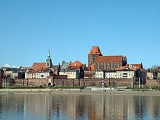
Toruń AUD is an ancient city in northern Poland
, on the Vistula
River. Its population is more than 205,934 as of June 2009. Toruń is one of the oldest cities in Poland. The medieval old town of Toruń is the birthplace of the astronomer Nicolaus Copernicus
.
In 1997 the medieval part of the city was designated a UNESCO
World Heritage Site. In 2007 the Old Town in Toruń was added to the list of Seven Wonders of Poland
. National Geographic Polska rated the old town market and the Gothic town hall as one of the "30 Most Beautiful Places in the World." In 2010 Forbes
magazine ranked Toruń as number one of the "Polish Cities Attractive for Business". In 2009 it was listed as one of the "Best Cities to Live in Poland", in a ranking published by Przekrój
.
Previously it was the capital of the Toruń Voivodeship
(1975–98) and the Pomeranian Voivodeship
(1921–45). Since 1999, Toruń has been a seat of the self-government of the Kujawy-Pomerania Province
and, as such, is one of its two capitals (together with Bydgoszcz). The cities and neighboring counties form the Bydgoszcz-Toruń
bi-polar metropolitan area. In September 2004, Bydgoszcz Medical School joined Toruń's Nicolaus Copernicus University
as its Collegium Medicum.
 The first settlement in the vicinity is dated by archaeologists to 1100 BC (Lusatian culture
). It is alleged that during early medieval times, in the 7th-13th centuries, it was the location of an old Slavonic settlement, at a ford in the Vistula river.
The city itself, however, was founded when the Teutonic Knights
built a castle in the vicinity of the former Slavonic settlement in the years 1230-31. On 28 December 1233, the Teutonic Knights Hermann von Salza
and Hermann Balk
signed the foundation charters for Thorn and Chełmno. Named after the city where the signing took place, the original document (lost in 1244) granting the city rights was called Kulmer Handfeste. The set of rights in general is known as Kulm law. In 1236, due to frequent flooding, it was relocated to the present site of the Old Town. In 1263 Franciscan
monks settled in the city, followed in 1239 by Dominicans
. In 1264 the nearby New Town was founded. In 1280, the city (or as it was then, both cities) joined the mercantile Hanseatic League
, and thus became an important medieval trade centre.
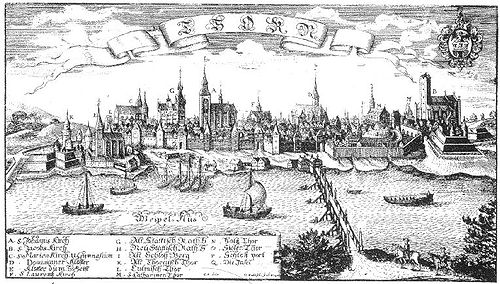
The First Peace of Thorn ending the Polish–Lithuanian–Teutonic War was signed in the city in February 1411. In 1440, the gentry of Thorn formed the Prussian Confederation
, and in 1454 rose with the Confederation against the Monastic state of the Teutonic Knights
in the Thirteen Years' War. After almost 200 years, New and Old Town amalgamated in 1454. The Poles destroyed the Teutonic castle. The Thirteen Years' War ended in 1466 with the Second Peace of Thorn, in which the Teutonic Order ceded their control over western provinces, henceforth Royal Prussia
. Toruń became part of Kingdom of Poland.
 In 1557, during the Protestant Reformation
, the city adopted Protestantism
, while most Polish cities remained Roman Catholic
. Under Mayor Heinrich Stroband (1586–1609), the city became centralized. Administrative power passed into the hands of the city council. In 1595 Jesuits arrived to promote the Counter-Reformation
, taking control of St. John's Church. The Protestant city officials tried to limit the influx of Catholics into the city, as Catholics (Jesuits and Dominican
monks) already controlled most of the churches, leaving only St. Mary's to Protestant citizens.
In 1677 the Prussian historian and educator Christoph Hartknoch
was invited to be director of the Thorn Gymnasium
, a post which he held until his death in 1687. Hartknoch wrote histories of Prussia
, including the cities of Royal Prussia
.
During the Great Northern War
(1700–21), the restoration of Augustus the Strong as King of Poland was prepared in the town
by Russian Tsar Peter the Great
. In the second half of the 17th century, tensions between Catholics and Protestants grew, similarly to religious wars throughout Europe. In the early 18th century about 50 percent of the populace, especially the gentry and middle class, were German-speaking Protestants. Their influence was subsequently pushed back after the Tumult of Thorn of 1724.
In 1793 the Kingdom of Prussia
annexed the city following the Second Partition of Poland
. In 1807 Napoleon
conquered part of the territory and made the city part of the Duchy of Warsaw
. It was ruled by King Frederick Augustus I
of Saxony
, but Prussia regained control after Napoleon's defeat in 1814. In 1870 French
prisoners of war
taken during the Franco-Prussian War
were directed to build a chain of forts surrounding the town
. The following year the city, along with the rest of Prussia, became part of the new German Empire
.
Toruń was part of the area subject to Prussian and later German attempts to Germanise the province. Toruń became a center of resistance to Germanization and Kulturkampf
by Poles, who established a Polish-language newspaper, Gazeta Toruńska. In 1875 a Polish Scientific Society was established, and in 1884 a secret organization dedicated to the restoration of Poland. According to the Treaty of Versailles
following World War I
in 1919, Toruń was part of the Polish Corridor
assigned to Poland
. It became the capital of the then-Pomeranian Voivodeship. The local populace had to acquire Polish citizenship or leave the country. This led to a significant decline of ethnic Germans, whose number within the town decreased from 30,509 in 1910 to 2,255 in 1926 and further to 2,057 in 1934.
In 1925, the Baltic Institute was established in the city, and worked on documenting Polish heritage and history in Pomerania. In general, the interwar period was a time of significant urban development in Toruń. Major investments were completed in areas such as transportation (new streets, tramway lines and the Piłsudski Bridge), residential development (many new houses, particularly in Bydgoskie Przedmieście) and public buildings.
Nazi Germany
annexed the city after the Invasion of Poland
in 1939, and administered it as part of Danzig-West Prussia.Poles and Jews were classified as untermenschen by German authorities, with their fate being slavery and extermination. During World War II
, the Germans used the chain of forts as POW camps, known collectively as Stalag XX-A
. The city escaped significant destruction during the war. In 1945 it was taken by the Soviet
Red Army
. As before the war, it was returned to Poland. The remaining ethnic German population was expelled
, primarily to East Germany, between 1945 and 1947.
After World War II, the population increased more than twofold and industry developed significantly. The founding of the Nicolaus Copernicus University
in 1945 was significant. Over the years, it has become one of the best universities in Poland. The university has strongly influenced the intellectual, artistic and cultural life of the city, as well as its perception by non-locals. The university was founded by Polish professors formerly associated with the University of Wilno
. After the war, they were forced to move to post-1945 Poland.
Since 1989, when local and regional self-government was gradually reintroduced and the market economy was introduced, Toruń, like other cities in Poland, has undergone deep social and economic transformations. Locals debate whether the changes have been as successful as they had hoped for, but Toruń has recently reclaimed its strong position as a regional leader, together with Bydgoszcz.
Toruń was a royal city, subject to the kings of Poland. Latin
documents and coins usually spelled it Thorun, Thorunium, civitas Thorunensis, or civitas Torunensis, and after the 15th century, the current Polish
name Toruń.
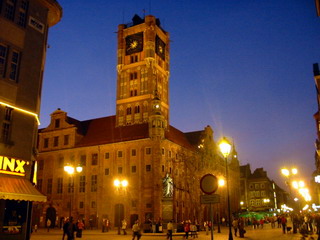
Listed on the UNESCO list of World Heritage Sites since 1997, Toruń has many monuments of architecture beginning from the Middle Ages
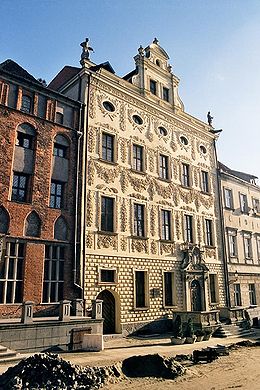
, including 200 military structures. The city is famous for having preserved almost intact its medieval spatial layout and many Gothic buildings, all built from brick
, including monumental churches, the Town Hall and many burgher houses. The most interesting monuments are:
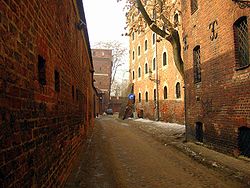

Toruń, unlike many other historic cities in Poland, escaped substantial destruction in World War II. Particularly left intact was the Old Town, all of whose important architectural monuments are originals, not reconstructions.
Major renovation projects have been undertaken in recent years to improve the condition and external presentation of the Old Town. Besides the renovation of various buildings, projects such as the reconstruction of the pavement of the streets and squares (reversing them to their historical appearance), and the introduction of new plants, trees and objects of 'small architecture', are underway.
Numerous buildings and other constructions, including the city walls along the boulevard, are illuminated at night, creating an impressive effect - probably unique among Polish cities with respect to the size of Toruń's Old Town and the scale of the illumination project itself.
 The most recent statistics show a decrease in the population of the city, to 205,934 in the middle of 2009. This is mainly because quite a large number of citizens have been moving to nearby communities, adjacent to the formal administrative area of Toruń, but still outside it. As a result Toruń is surrounded by a belt of densely-populated settlements, whose inhabitants work, shop and entertain in the city proper, but do not officially live there.
In recent years, a discussion has been taking place as to whether or not these surrounding communities should be incorporated into the city's administrative area. This seems rather inevitable in the longer term, though many say Toruń has almost reached the limit of its development within the city's boundary.
 Inside the city itself, most of the population is concentrated on the right (northern) bank of the Vistula river. Two of the most densely populated areas are Rubinkowo and Na Skarpie, housing projects built mostly in the 1970s and 80s, located between the central and easternmost districts; their total population is about 70,000.
Toruń and Bydgoszcz together make up a bipolar metroplex which, including those cities' counties and a number of smaller towns, may have a population of as much as 800,000. Thus the area contains about one third of the population of the Kuyavia-Pomerania region (which has about 2.1 million inhabitants).
Some groups of Japanese, Ukrainian and Vietnamese people live in Toruń now. The Japanese diaspora is the largest visible minority in the city; it stems from the management of businesses opened in recent years by Japanese companies such as Sharp
. In additional to Japanese managers, engineers, translators, and their families; there are Japanese language teachers working at the local university and language schools, and people who have married locals and stayed in Toruń.
The mass transit system is composed of 5 tram lines and about 40 bus lines, covering the city and some of the neighbouring communities.
Toruń is situated at a major road junction, one of the most important in Poland. The A1 highway
reaches Toruń, and a southern beltway surrounds the city. Besides these, the European route E75
and a number of domestic roads (numbered 10, 15, and 80) run through the city.
With three main railway stations (Toruń Główny, Toruń Miasto and Toruń Wschodni), the city is a major rail junction, with two important lines crossing there (Warszawa–Bydgoszcz and Wrocław–Olsztyn
). Two other lines stem from Toruń, toward Malbork
and Sierpc
.
The rail connection with Bydgoszcz is run under a name "BiT City" as a "metropolitan rail". Its main purpose is to allow traveling between and within these cities using one ticket. A joint venture of Toruń, Bydgoszcz, Solec Kujawski
and the voivodeship, it is considered as important in integrating Bydgoszcz-Toruń
metropolitan area. A major modernization of BiT City railroute, as well as a purchase of completely new vehicles to serve the line, is planned for 2008 and 2009. Technically, it will allow to travel between Toruń-East and Bydgoszcz-Airport stations at a speed of 120 km/h in a time of approximately half an hour. In a few years' time "BiT City" will be integrated with local transportation systems of Toruń and Bydgoszcz, thus creating a uniform metropolitan transportation network - with all necessary funds having been secured in 2008.
Since September 2008, the "one-ticket" solution has been introduced also as regards a rail connection with Włocławek, as a "regional ticket". The same is planned for connection with Grudziądz
.
Two bus depots serve to connect the city with other towns and cities in Poland.
As of 2008, a small sport airfield exists in Toruń; however, a modernization of the airport is seriously considered with a number of investors interested in it. Independently of this, Bydgoszcz-Szwederowo airport, located about 50 km from Toruń city center, serves the whole Bydgoszcz-Toruń
metropolitan area, with a number of regular flights to European cities.
In 2006, construction of new plants owned by Sharp Corporation and other companies of mainly Japanese origin has started in the neighboring community of Łysomice (about 10 km from city center). The facilities under construction are located in a newly-created special economic zone. As a result of cooperation of the companies mentioned above, a vast high-tech complex is to be constructed in the next few years, providing as many as 10,000 jobs (a prediction for 2010) at the cost of about 450 million euros. As of 2008, the creation of another special economic zone is being considered, this time inside city limits.
Thanks to its architectural heritage Toruń is visited by more than 1.5 million tourists a year (1.6 million in 2007). This makes tourism an important branch of the local economy, although time spent in the city by individual tourists or the number of hotels which can serve them are still not considered satisfactory. Major investments in renovation of the city's monuments, building new hotels (including high-standard ones), improvement in promotion, as well as launching new cultural and scientific events and facilities, give very good prospects for Toruń's tourism.
In recent years Toruń has been a site of intense building construction investments, mainly residential and in its transportation network. The latter has been possible partly due to the use of European Union funds assigned for new member states. Toruń city county generates by far the highest number of new dwellings built each year among all Kuyavian-Pomeranian counties, both relative to its population as well as in absolute values. It has led to almost complete rebuilding of some districts. As of 2008, many major constructions are either under development or are to be launched soon - the value of some of them exceeding 100 million euros. They include a new speedway stadium, major shopping and entertainment centers, a commercial complex popularly called a "New Center of Toruń", a music theater, a center of contemporary art, hotels, office buildings, facilities for the Nicolaus Copernicus University, roads and tram routes, sewage and fresh water delivery systems, residential projects, the possibility of a new bridge over the Vistula, and more. Construction of the A1 motorway and the BiT City fast metropolitan railway also directly affects the city.
About 25,000 local firms are registered in Toruń.
A building called Baj Pomorski has recently been completely reconstructed. It is now one of the most modern cultural facilities in the city, with its front elevation in the shape of a gigantic chest of drawers. It is located at the south-east edge of the Old Town.
Toruń has a number (2) of cinemas including a Cinema City
, which has over 2,000 seats.
Over ten major museums document the history of Toruń and the region. Among others, the "House of Kopernik" and the accompanying museum commemorate Nicolaus Copernicus
and his revolutionary work, the university museum reveals the history of the city's academic past.
The Center of Contemporary Art (Centrum Sztuki Współczesnej - CSW) opened in June 2008 and is one of the most important cultural facilities of this kind in Poland. The modern building is located in the very center of the city, adjacent to the Old Town.
The Toruń Symphonic Orchestra (formerly the Toruń Chamber Orchestra) is well-rooted in the Toruń cultural landscape.
Toruń is equipped with a planetarium
(located downtown) and an astronomical observatory (located in nearby community of Piwnice). The latter boasts the largest radio telescope
in the Eastern part of Central Europe with a diameter of 32 m (104.99 ft), second only to the Effelsberg
100 m (328.08 ft) radio telescope.
Toruń is well known for Toruń gingerbread
, a type of pierniki often made in elaborate moulds.
The largest institution of higher education in Toruń, Nicolaus Copernicus University in Toruń
serves over 40 thousand students and was founded in 1945, based on the Toruń Scientific Society, Stefan Batory University in Wilno, and Jan Kazimierz University in Lvov. The existence of a high-ranked and high-profiled university with so many students plays a great role the city's position and importance in general, as well as in creating an image of Toruń's streets and clubs filled with crowds of young people. It also has a serious influence on local economy.
Other public institutions of higher education:
There are also a number of private higher education facilities:
In addition, there are a number of other healthcare facilities in the city.
.
Ślimak Getyński (Goettingen Helix, German: Goettingen Schnecke) is one of the lanes connecting Piłsudski Bridge / John Paul II Avenue with Philadelphia Boulevard at their downtown interchange. It honours the relationship with Göttingen, its name derived from the street's half-circular shape (Polish word ślimak meaning "snail").
with:
Poland
Poland , officially the Republic of Poland , is a country in Central Europe bordered by Germany to the west; the Czech Republic and Slovakia to the south; Ukraine, Belarus and Lithuania to the east; and the Baltic Sea and Kaliningrad Oblast, a Russian exclave, to the north...
, on the Vistula
Vistula
The Vistula is the longest and the most important river in Poland, at 1,047 km in length. The watershed area of the Vistula is , of which lies within Poland ....
River. Its population is more than 205,934 as of June 2009. Toruń is one of the oldest cities in Poland. The medieval old town of Toruń is the birthplace of the astronomer Nicolaus Copernicus
Nicolaus Copernicus
Nicolaus Copernicus was a Renaissance astronomer and the first person to formulate a comprehensive heliocentric cosmology which displaced the Earth from the center of the universe....
.
In 1997 the medieval part of the city was designated a UNESCO
UNESCO
The United Nations Educational, Scientific and Cultural Organization is a specialized agency of the United Nations...
World Heritage Site. In 2007 the Old Town in Toruń was added to the list of Seven Wonders of Poland
Seven Wonders of Poland
The Seven Wonders of Poland is a list of cultural wonders located in Poland.The creation of the list was supported by the newspaper Rzeczpospolita. Initially over 400 national monuments were listed by internet users as candidates, however in the second round of selections a board of experts...
. National Geographic Polska rated the old town market and the Gothic town hall as one of the "30 Most Beautiful Places in the World." In 2010 Forbes
Forbes
Forbes is an American publishing and media company. Its flagship publication, the Forbes magazine, is published biweekly. Its primary competitors in the national business magazine category are Fortune, which is also published biweekly, and Business Week...
magazine ranked Toruń as number one of the "Polish Cities Attractive for Business". In 2009 it was listed as one of the "Best Cities to Live in Poland", in a ranking published by Przekrój
Przekrój
Przekrój is the oldest Polish weekly newsmagazine, established in 1945 in Krakow and since 2001 published in Warsaw. Przekrój was created by M. Eile who, until 1969, was the first editor-in-chief of the magazine...
.
Previously it was the capital of the Toruń Voivodeship
Torun Voivodeship
Toruń Voivodeship was a unit of administrative division and local government in Poland in the years 1975–1998, superseded by the Kuyavian-Pomeranian Voivodeship. Its capital city was Toruń.-Major cities and towns :...
(1975–98) and the Pomeranian Voivodeship
Pomeranian Voivodeship
Pomeranian Voivodeship, or Pomerania Province , is a voivodeship, or province, in north-central Poland. It comprises most of Pomerelia , as well as an area east of the Vistula River...
(1921–45). Since 1999, Toruń has been a seat of the self-government of the Kujawy-Pomerania Province
Kuyavian-Pomeranian Voivodeship
-Transportation:Transportation infrastructure is of critical importance to the voivodeship's economy. Kuyavia-Pomerania is a major node point in the Polish transportation system. Railway lines from the South and East pass through Bydgoszcz in order to reach the major ports on the Baltic Sea...
and, as such, is one of its two capitals (together with Bydgoszcz). The cities and neighboring counties form the Bydgoszcz-Toruń
Bydgoszcz-Torun
Bydgoszcz–Toruń metropolitan area is the name of the bi-polar agglomeration in the middle of the Vistula river created by 2 cities: Bydgoszcz and Toruń. The distance between the built-up areas of the cities is about 30 km...
bi-polar metropolitan area. In September 2004, Bydgoszcz Medical School joined Toruń's Nicolaus Copernicus University
Nicolaus Copernicus University in Torun
Nicolaus Copernicus University in Toruń is located in Toruń, Poland. It was named after Nicolaus Copernicus who was born in this town in 1473.-The beginnings of higher education in Toruń:...
as its Collegium Medicum.
History
Lusatian culture
The Lusatian culture existed in the later Bronze Age and early Iron Age in most of today's Poland, parts of Czech Republic and Slovakia, parts of eastern Germany and parts of Ukraine...
). It is alleged that during early medieval times, in the 7th-13th centuries, it was the location of an old Slavonic settlement, at a ford in the Vistula river.
The city itself, however, was founded when the Teutonic Knights
Teutonic Knights
The Order of Brothers of the German House of Saint Mary in Jerusalem , commonly the Teutonic Order , is a German medieval military order, in modern times a purely religious Catholic order...
built a castle in the vicinity of the former Slavonic settlement in the years 1230-31. On 28 December 1233, the Teutonic Knights Hermann von Salza
Hermann von Salza
Hermann von Salza was the fourth Grand Master of the Teutonic Knights, serving from 1210 to 1239...
and Hermann Balk
Hermann Balk
Hermann Balk , also known as Hermann von Balk or Hermann Balke, was a Knight-Brother of the Teutonic Order and its first Landmeister, or Provincial Master, in both Prussia and Livonia. From 1219 to 1227, he served as the Deutschmeister in the Order's Province of Alemannia...
signed the foundation charters for Thorn and Chełmno. Named after the city where the signing took place, the original document (lost in 1244) granting the city rights was called Kulmer Handfeste. The set of rights in general is known as Kulm law. In 1236, due to frequent flooding, it was relocated to the present site of the Old Town. In 1263 Franciscan
Franciscan
Most Franciscans are members of Roman Catholic religious orders founded by Saint Francis of Assisi. Besides Roman Catholic communities, there are also Old Catholic, Anglican, Lutheran, ecumenical and Non-denominational Franciscan communities....
monks settled in the city, followed in 1239 by Dominicans
Dominican Order
The Order of Preachers , after the 15th century more commonly known as the Dominican Order or Dominicans, is a Catholic religious order founded by Saint Dominic and approved by Pope Honorius III on 22 December 1216 in France...
. In 1264 the nearby New Town was founded. In 1280, the city (or as it was then, both cities) joined the mercantile Hanseatic League
Hanseatic League
The Hanseatic League was an economic alliance of trading cities and their merchant guilds that dominated trade along the coast of Northern Europe...
, and thus became an important medieval trade centre.
The First Peace of Thorn ending the Polish–Lithuanian–Teutonic War was signed in the city in February 1411. In 1440, the gentry of Thorn formed the Prussian Confederation
Prussian Confederation
The Prussian Confederation was an organization formed in 1440 by a group of 53 gentry and clergy and 19 cities in Prussia to oppose the monastic state of the Teutonic Knights. It was based on the basis of an earlier similar organization, the Lizard Union...
, and in 1454 rose with the Confederation against the Monastic state of the Teutonic Knights
Monastic State of the Teutonic Knights
The State of the Teutonic Order, , also Monastic State of the Teutonic Knights or Ordensstaat , was formed in 1224 during the Northern Crusades, the Teutonic Knights' conquest of the pagan West-Baltic Old Prussians in the 13th century....
in the Thirteen Years' War. After almost 200 years, New and Old Town amalgamated in 1454. The Poles destroyed the Teutonic castle. The Thirteen Years' War ended in 1466 with the Second Peace of Thorn, in which the Teutonic Order ceded their control over western provinces, henceforth Royal Prussia
Royal Prussia
Royal Prussia was a Region of the Kingdom of Poland and of the Polish-Lithuanian Commonwealth . Polish Prussia included Pomerelia, Chełmno Land , Malbork Voivodeship , Gdańsk , Toruń , and Elbląg . It is distinguished from Ducal Prussia...
. Toruń became part of Kingdom of Poland.
Protestant Reformation
The Protestant Reformation was a 16th-century split within Western Christianity initiated by Martin Luther, John Calvin and other early Protestants. The efforts of the self-described "reformers", who objected to the doctrines, rituals and ecclesiastical structure of the Roman Catholic Church, led...
, the city adopted Protestantism
Protestantism
Protestantism is one of the three major groupings within Christianity. It is a movement that began in Germany in the early 16th century as a reaction against medieval Roman Catholic doctrines and practices, especially in regards to salvation, justification, and ecclesiology.The doctrines of the...
, while most Polish cities remained Roman Catholic
Roman Catholic Church
The Catholic Church, also known as the Roman Catholic Church, is the world's largest Christian church, with over a billion members. Led by the Pope, it defines its mission as spreading the gospel of Jesus Christ, administering the sacraments and exercising charity...
. Under Mayor Heinrich Stroband (1586–1609), the city became centralized. Administrative power passed into the hands of the city council. In 1595 Jesuits arrived to promote the Counter-Reformation
Counter-Reformation
The Counter-Reformation was the period of Catholic revival beginning with the Council of Trent and ending at the close of the Thirty Years' War, 1648 as a response to the Protestant Reformation.The Counter-Reformation was a comprehensive effort, composed of four major elements:#Ecclesiastical or...
, taking control of St. John's Church. The Protestant city officials tried to limit the influx of Catholics into the city, as Catholics (Jesuits and Dominican
Dominican Order
The Order of Preachers , after the 15th century more commonly known as the Dominican Order or Dominicans, is a Catholic religious order founded by Saint Dominic and approved by Pope Honorius III on 22 December 1216 in France...
monks) already controlled most of the churches, leaving only St. Mary's to Protestant citizens.
In 1677 the Prussian historian and educator Christoph Hartknoch
Christoph Hartknoch
Christoph Hartknoch was a Prussian historian and educator.- Biography :Hartknoch was born in Jablonken near Ortelsburg in the Duchy of Prussia. His father, Stephan Hartknoch of Lyck , is recorded to have been married for 100 years and to have lived to the age of 130...
was invited to be director of the Thorn Gymnasium
Gymnasium (school)
A gymnasium is a type of school providing secondary education in some parts of Europe, comparable to English grammar schools or sixth form colleges and U.S. college preparatory high schools. The word γυμνάσιον was used in Ancient Greece, meaning a locality for both physical and intellectual...
, a post which he held until his death in 1687. Hartknoch wrote histories of Prussia
Prussia
Prussia was a German kingdom and historic state originating out of the Duchy of Prussia and the Margraviate of Brandenburg. For centuries, the House of Hohenzollern ruled Prussia, successfully expanding its size by way of an unusually well-organized and effective army. Prussia shaped the history...
, including the cities of Royal Prussia
Royal Prussia
Royal Prussia was a Region of the Kingdom of Poland and of the Polish-Lithuanian Commonwealth . Polish Prussia included Pomerelia, Chełmno Land , Malbork Voivodeship , Gdańsk , Toruń , and Elbląg . It is distinguished from Ducal Prussia...
.
During the Great Northern War
Great Northern War
The Great Northern War was a conflict in which a coalition led by the Tsardom of Russia successfully contested the supremacy of the Swedish Empire in northern Central Europe and Eastern Europe. The initial leaders of the anti-Swedish alliance were Peter I the Great of Russia, Frederick IV of...
(1700–21), the restoration of Augustus the Strong as King of Poland was prepared in the town
Treaty of Thorn (1709)
The Treaty of Thorn was concluded on 9 October 1709 between Augustus the Strong and Peter the Great in Thorn , during the Great Northern War...
by Russian Tsar Peter the Great
Peter I of Russia
Peter the Great, Peter I or Pyotr Alexeyevich Romanov Dates indicated by the letters "O.S." are Old Style. All other dates in this article are New Style. ruled the Tsardom of Russia and later the Russian Empire from until his death, jointly ruling before 1696 with his half-brother, Ivan V...
. In the second half of the 17th century, tensions between Catholics and Protestants grew, similarly to religious wars throughout Europe. In the early 18th century about 50 percent of the populace, especially the gentry and middle class, were German-speaking Protestants. Their influence was subsequently pushed back after the Tumult of Thorn of 1724.
In 1793 the Kingdom of Prussia
Kingdom of Prussia
The Kingdom of Prussia was a German kingdom from 1701 to 1918. Until the defeat of Germany in World War I, it comprised almost two-thirds of the area of the German Empire...
annexed the city following the Second Partition of Poland
Partitions of Poland
The Partitions of Poland or Partitions of the Polish–Lithuanian Commonwealth took place in the second half of the 18th century and ended the existence of the Polish–Lithuanian Commonwealth, resulting in the elimination of sovereign Poland for 123 years...
. In 1807 Napoleon
Napoleon I of France
Napoleon Bonaparte was a French military and political leader during the latter stages of the French Revolution.As Napoleon I, he was Emperor of the French from 1804 to 1815...
conquered part of the territory and made the city part of the Duchy of Warsaw
Duchy of Warsaw
The Duchy of Warsaw was a Polish state established by Napoleon I in 1807 from the Polish lands ceded by the Kingdom of Prussia under the terms of the Treaties of Tilsit. The duchy was held in personal union by one of Napoleon's allies, King Frederick Augustus I of Saxony...
. It was ruled by King Frederick Augustus I
Frederick Augustus I of Saxony
Frederick Augustus I was King of Saxony from the House of Wettin. He was also Elector Frederick Augustus III of Saxony and Duke Frederick Augustus I of Warsaw...
of Saxony
Saxony
The Free State of Saxony is a landlocked state of Germany, contingent with Brandenburg, Saxony Anhalt, Thuringia, Bavaria, the Czech Republic and Poland. It is the tenth-largest German state in area, with of Germany's sixteen states....
, but Prussia regained control after Napoleon's defeat in 1814. In 1870 French
French people
The French are a nation that share a common French culture and speak the French language as a mother tongue. Historically, the French population are descended from peoples of Celtic, Latin and Germanic origin, and are today a mixture of several ethnic groups...
prisoners of war
Prisoner of war
A prisoner of war or enemy prisoner of war is a person, whether civilian or combatant, who is held in custody by an enemy power during or immediately after an armed conflict...
taken during the Franco-Prussian War
Franco-Prussian War
The Franco-Prussian War or Franco-German War, often referred to in France as the 1870 War was a conflict between the Second French Empire and the Kingdom of Prussia. Prussia was aided by the North German Confederation, of which it was a member, and the South German states of Baden, Württemberg and...
were directed to build a chain of forts surrounding the town
Torun Fortress
Toruń Fortress , built from 1872–1894 by the Kingdom of Prussia and located in Toruń , is one of the largest fortresses in Central and Eastern Europe. The fortress complex – a chain of forts surrounding the city, as well as numerous smaller fortifications supplementing it – was intended to defend...
. The following year the city, along with the rest of Prussia, became part of the new German Empire
German Empire
The German Empire refers to Germany during the "Second Reich" period from the unification of Germany and proclamation of Wilhelm I as German Emperor on 18 January 1871, to 1918, when it became a federal republic after defeat in World War I and the abdication of the Emperor, Wilhelm II.The German...
.
Toruń was part of the area subject to Prussian and later German attempts to Germanise the province. Toruń became a center of resistance to Germanization and Kulturkampf
Kulturkampf
The German term refers to German policies in relation to secularity and the influence of the Roman Catholic Church, enacted from 1871 to 1878 by the Prime Minister of Prussia, Otto von Bismarck. The Kulturkampf did not extend to the other German states such as Bavaria...
by Poles, who established a Polish-language newspaper, Gazeta Toruńska. In 1875 a Polish Scientific Society was established, and in 1884 a secret organization dedicated to the restoration of Poland. According to the Treaty of Versailles
Treaty of Versailles
The Treaty of Versailles was one of the peace treaties at the end of World War I. It ended the state of war between Germany and the Allied Powers. It was signed on 28 June 1919, exactly five years after the assassination of Archduke Franz Ferdinand. The other Central Powers on the German side of...
following World War I
World War I
World War I , which was predominantly called the World War or the Great War from its occurrence until 1939, and the First World War or World War I thereafter, was a major war centred in Europe that began on 28 July 1914 and lasted until 11 November 1918...
in 1919, Toruń was part of the Polish Corridor
Polish Corridor
The Polish Corridor , also known as Danzig Corridor, Corridor to the Sea or Gdańsk Corridor, was a territory located in the region of Pomerelia , which provided the Second Republic of Poland with access to the Baltic Sea, thus dividing the bulk of Germany from the province of East...
assigned to Poland
Second Polish Republic
The Second Polish Republic, Second Commonwealth of Poland or interwar Poland refers to Poland between the two world wars; a period in Polish history in which Poland was restored as an independent state. Officially known as the Republic of Poland or the Commonwealth of Poland , the Polish state was...
. It became the capital of the then-Pomeranian Voivodeship. The local populace had to acquire Polish citizenship or leave the country. This led to a significant decline of ethnic Germans, whose number within the town decreased from 30,509 in 1910 to 2,255 in 1926 and further to 2,057 in 1934.
In 1925, the Baltic Institute was established in the city, and worked on documenting Polish heritage and history in Pomerania. In general, the interwar period was a time of significant urban development in Toruń. Major investments were completed in areas such as transportation (new streets, tramway lines and the Piłsudski Bridge), residential development (many new houses, particularly in Bydgoskie Przedmieście) and public buildings.
Nazi Germany
Nazi Germany
Nazi Germany , also known as the Third Reich , but officially called German Reich from 1933 to 1943 and Greater German Reich from 26 June 1943 onward, is the name commonly used to refer to the state of Germany from 1933 to 1945, when it was a totalitarian dictatorship ruled by...
annexed the city after the Invasion of Poland
Invasion of Poland (1939)
The Invasion of Poland, also known as the September Campaign or 1939 Defensive War in Poland and the Poland Campaign in Germany, was an invasion of Poland by Germany, the Soviet Union, and a small Slovak contingent that marked the start of World War II in Europe...
in 1939, and administered it as part of Danzig-West Prussia.Poles and Jews were classified as untermenschen by German authorities, with their fate being slavery and extermination. During World War II
World War II
World War II, or the Second World War , was a global conflict lasting from 1939 to 1945, involving most of the world's nations—including all of the great powers—eventually forming two opposing military alliances: the Allies and the Axis...
, the Germans used the chain of forts as POW camps, known collectively as Stalag XX-A
Stalag XX-A
Stalag XX-A was a German World War II PoW Camp located in Thorn/Toruń, Poland. It was not a single camp and contained as many as 20,000 men at its peak. The main camp was located in a complex of fifteen forts that surrounded the whole of the city...
. The city escaped significant destruction during the war. In 1945 it was taken by the Soviet
Soviet Union
The Soviet Union , officially the Union of Soviet Socialist Republics , was a constitutionally socialist state that existed in Eurasia between 1922 and 1991....
Red Army
Red Army
The Workers' and Peasants' Red Army started out as the Soviet Union's revolutionary communist combat groups during the Russian Civil War of 1918-1922. It grew into the national army of the Soviet Union. By the 1930s the Red Army was among the largest armies in history.The "Red Army" name refers to...
. As before the war, it was returned to Poland. The remaining ethnic German population was expelled
Expulsion of Germans after World War II
The later stages of World War II, and the period after the end of that war, saw the forced migration of millions of German nationals and ethnic Germans from various European states and territories, mostly into the areas which would become post-war Germany and post-war Austria...
, primarily to East Germany, between 1945 and 1947.
After World War II, the population increased more than twofold and industry developed significantly. The founding of the Nicolaus Copernicus University
Nicolaus Copernicus University in Torun
Nicolaus Copernicus University in Toruń is located in Toruń, Poland. It was named after Nicolaus Copernicus who was born in this town in 1473.-The beginnings of higher education in Toruń:...
in 1945 was significant. Over the years, it has become one of the best universities in Poland. The university has strongly influenced the intellectual, artistic and cultural life of the city, as well as its perception by non-locals. The university was founded by Polish professors formerly associated with the University of Wilno
Vilnius University
Vilnius University is the oldest university in the Baltic states and one of the oldest in Eastern Europe. It is also the largest university in Lithuania....
. After the war, they were forced to move to post-1945 Poland.
Since 1989, when local and regional self-government was gradually reintroduced and the market economy was introduced, Toruń, like other cities in Poland, has undergone deep social and economic transformations. Locals debate whether the changes have been as successful as they had hoped for, but Toruń has recently reclaimed its strong position as a regional leader, together with Bydgoszcz.
Etymology
Early documents record the city's name as Thorun (1226, 1466), Turon, Turun, Toron, Thoron and Thorn.Toruń was a royal city, subject to the kings of Poland. Latin
Latin
Latin is an Italic language originally spoken in Latium and Ancient Rome. It, along with most European languages, is a descendant of the ancient Proto-Indo-European language. Although it is considered a dead language, a number of scholars and members of the Christian clergy speak it fluently, and...
documents and coins usually spelled it Thorun, Thorunium, civitas Thorunensis, or civitas Torunensis, and after the 15th century, the current Polish
Polish language
Polish is a language of the Lechitic subgroup of West Slavic languages, used throughout Poland and by Polish minorities in other countries...
name Toruń.
Polish
- It may come from the Polish word tor, which means "track (of the Vistula river)". Toruń would mean "town on the track".
- It may have been originally Tarnów, based on the Polish word tarnina, a kind of river plant. There are many cities in Poland with a similar derivationTarnówTarnów is a city in southeastern Poland with 115,341 inhabitants as of June 2009. The city has been situated in the Lesser Poland Voivodeship since 1999, but from 1975 to 1998 it was the capital of the Tarnów Voivodeship. It is a major rail junction, located on the strategic east-west connection...
.
Other
- Some scholars, such as Jan MiodekJan MiodekJan Miodek , Professor of Wroclaw University, is a Polish linguist in the normative tradition....
, claim that "Toruń" does not have any etymological meaning. - It may come from the personal name ToronToronToron, now Tibnin or Tebnine in southern Lebanon, was a major Crusader castle, built in the Lebanon mountains on the road from Tyre to Damascus....
and mean "Toron's town". - It may be derived from the Teutonic Castle of Toron, located in the mountains of present-day LebanonLebanonLebanon , officially the Republic of LebanonRepublic of Lebanon is the most common term used by Lebanese government agencies. The term Lebanese Republic, a literal translation of the official Arabic and French names that is not used in today's world. Arabic is the most common language spoken among...
.
Sights
Listed on the UNESCO list of World Heritage Sites since 1997, Toruń has many monuments of architecture beginning from the Middle Ages
Middle Ages
The Middle Ages is a periodization of European history from the 5th century to the 15th century. The Middle Ages follows the fall of the Western Roman Empire in 476 and precedes the Early Modern Era. It is the middle period of a three-period division of Western history: Classic, Medieval and Modern...
, including 200 military structures. The city is famous for having preserved almost intact its medieval spatial layout and many Gothic buildings, all built from brick
Brick
A brick is a block of ceramic material used in masonry construction, usually laid using various kinds of mortar. It has been regarded as one of the longest lasting and strongest building materials used throughout history.-History:...
, including monumental churches, the Town Hall and many burgher houses. The most interesting monuments are:
- Gothic churches:
- The Cathedral of SS. John the Evangelist and John the BaptistCathedral Basilica of St. John the Baptist and St. John the Evangelist, TorunChurch of St. John the Baptist and St. John the Evangelist, since 1935 Minor Basilica, since 1992 the Cathedral of Toruń Diocese, former main parish church of Old Town of Toruń. One of three gothic churches of the town, built from brick, an aisled hall with a monumental west tower. The first church...
, an aisled hall church built in the 14th century and extended in the 15th century; outstanding Gothic sculptures and paintings inside (Moses, St. Mary Magdalene, gravestone of Johann von Soest), Renaissance and Baroque epitaphs and altars (amongst them the epitaph of Copernicus from 1580) - St. Mary's church, a formerly Franciscan aisled hall built in the 14th century
- St. James's church (often mistakenly called St Jacob's), a basilica from the 14th century, with monumental wall paintings and Gothic stalls
- The Cathedral of SS. John the Evangelist and John the Baptist
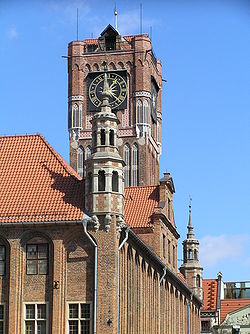
- The Old Town Hall, begun in 1274, extended and rebuilt between 1391 and 1399, and extended at the end of the 16th century; one of the most monumental town halls in Central Europe
- City fortifications, begun in the 13th century, extended between the 14th and 15th centuries, mostly demolished in the 19th century, but partially preserved with a few city gates and watchtowers (among them the so-called Leaning Tower) from the Vistula side. See also: Toruń FortressTorun FortressToruń Fortress , built from 1872–1894 by the Kingdom of Prussia and located in Toruń , is one of the largest fortresses in Central and Eastern Europe. The fortress complex – a chain of forts surrounding the city, as well as numerous smaller fortifications supplementing it – was intended to defend...
- A 15th-century Gothic house (now a museum) where Copernicus was reputedly born
- Ruins of 13th-century Teutonic Knights' castle
- House at the sign of the Star , previously Gothic, briefly owned by Filip CallimachusFilip CallimachusFilippo Buonaccorsi, called "Callimachus" was an Italian humanist and writer.-Life:...
, then rebuilt in the 16th century and in 1697, with a richly-decorated stucco façade and wooden spiral stairs - Toruń has the largest number of preserved Gothic houses in Poland, many with Gothic wall paintings or wood-beam ceilings from the 16th to the 18th centuries
Toruń, unlike many other historic cities in Poland, escaped substantial destruction in World War II. Particularly left intact was the Old Town, all of whose important architectural monuments are originals, not reconstructions.
Major renovation projects have been undertaken in recent years to improve the condition and external presentation of the Old Town. Besides the renovation of various buildings, projects such as the reconstruction of the pavement of the streets and squares (reversing them to their historical appearance), and the introduction of new plants, trees and objects of 'small architecture', are underway.
Numerous buildings and other constructions, including the city walls along the boulevard, are illuminated at night, creating an impressive effect - probably unique among Polish cities with respect to the size of Toruń's Old Town and the scale of the illumination project itself.
Population
In recent years, a discussion has been taking place as to whether or not these surrounding communities should be incorporated into the city's administrative area. This seems rather inevitable in the longer term, though many say Toruń has almost reached the limit of its development within the city's boundary.
Toruń and Bydgoszcz together make up a bipolar metroplex which, including those cities' counties and a number of smaller towns, may have a population of as much as 800,000. Thus the area contains about one third of the population of the Kuyavia-Pomerania region (which has about 2.1 million inhabitants).
Some groups of Japanese, Ukrainian and Vietnamese people live in Toruń now. The Japanese diaspora is the largest visible minority in the city; it stems from the management of businesses opened in recent years by Japanese companies such as Sharp
Sharp Corporation
is a Japanese multinational corporation that designs and manufactures electronic products. Headquartered in Abeno-ku, Osaka, Japan, Sharp employs more than 55,580 people worldwide as of June 2011. The company was founded in September 1912 and takes its name from one of its founder's first...
. In additional to Japanese managers, engineers, translators, and their families; there are Japanese language teachers working at the local university and language schools, and people who have married locals and stayed in Toruń.
Transport
The transportation network in the city itself has been a subject of much criticism for years. Although the city proper is not very large, the underdeveloped street and road network is a source of problems. It has to deal not only with a traffic generated by Toruń itself, but also with heavy transit and metropolitan traffic. Even the construction of new wide avenues, both by reconstructing existing streets and by construction of others from scratch, has not been enough. The most serious problem, however, is that only a single car traffic bridge crosses the Vistula river inside the city's boundaries. The construction of beltways, and thus the reduction of the inflow of vehicles into the city, has helped significantly, but still the existence of only one downtown bridge causes serious transportation difficulties, especially traffic jams. The construction of another bridge, located 4 km (2.49 mi) east of the existing one, has been prepared and was to start in 2009, and most of the necessary funds were to be secured by the end of 2008. Yet, political rivalries and technical difficulties prevented constructions to go on as planned. As of July 2010, the new bridge was still lagging in a planning stage.The mass transit system is composed of 5 tram lines and about 40 bus lines, covering the city and some of the neighbouring communities.
Toruń is situated at a major road junction, one of the most important in Poland. The A1 highway
Highway
A highway is any public road. In American English, the term is common and almost always designates major roads. In British English, the term designates any road open to the public. Any interconnected set of highways can be variously referred to as a "highway system", a "highway network", or a...
reaches Toruń, and a southern beltway surrounds the city. Besides these, the European route E75
European route E75
European route E 75 is part of the International E-road network, which is a series of main roads in Europe.The E 75 starts from Vardø, Norway in the Barents Sea and runs south through Finland, Poland, Czech Republic, Slovakia, Hungary, Serbia and Republic of Macedonia to Sitia, Greece on...
and a number of domestic roads (numbered 10, 15, and 80) run through the city.
With three main railway stations (Toruń Główny, Toruń Miasto and Toruń Wschodni), the city is a major rail junction, with two important lines crossing there (Warszawa–Bydgoszcz and Wrocław–Olsztyn
Olsztyn
Olsztyn is a city in northeastern Poland, on the Łyna River. Olsztyn has been the capital of the Warmian-Masurian Voivodeship since 1999. It was previously in the Olsztyn Voivodeship...
). Two other lines stem from Toruń, toward Malbork
Malbork
Malbork is a town in northern Poland in the Żuławy region , with 38,478 inhabitants . Situated in the Pomeranian Voivodeship since 1999, it was previously assigned to Elbląg Voivodeship...
and Sierpc
Sierpc
Sierpc is a town in Poland, in the north-west part of the Masovian Voivodeship, about 125 km northwest of Warsaw. It is the capital of Sierpc County. Its population is 18,777 . It is located near the national road No 10, which connects Warsaw and Toruń...
.
The rail connection with Bydgoszcz is run under a name "BiT City" as a "metropolitan rail". Its main purpose is to allow traveling between and within these cities using one ticket. A joint venture of Toruń, Bydgoszcz, Solec Kujawski
Solec Kujawski
Solec Kujawski is a town with 15,505 inhabitants and an area of 176 km², situated 14 kilometres southeast of Bydgoszcz in Poland at . Solec Kujawski belongs to the Kuyavian-Pomeranian Voivodeship...
and the voivodeship, it is considered as important in integrating Bydgoszcz-Toruń
Bydgoszcz-Torun
Bydgoszcz–Toruń metropolitan area is the name of the bi-polar agglomeration in the middle of the Vistula river created by 2 cities: Bydgoszcz and Toruń. The distance between the built-up areas of the cities is about 30 km...
metropolitan area. A major modernization of BiT City railroute, as well as a purchase of completely new vehicles to serve the line, is planned for 2008 and 2009. Technically, it will allow to travel between Toruń-East and Bydgoszcz-Airport stations at a speed of 120 km/h in a time of approximately half an hour. In a few years' time "BiT City" will be integrated with local transportation systems of Toruń and Bydgoszcz, thus creating a uniform metropolitan transportation network - with all necessary funds having been secured in 2008.
Since September 2008, the "one-ticket" solution has been introduced also as regards a rail connection with Włocławek, as a "regional ticket". The same is planned for connection with Grudziądz
Grudziadz
Grudziądz is a city in northern Poland on the Vistula River, with 96 042 inhabitants . Situated in the Kuyavian-Pomeranian Voivodeship , the city was previously in the Toruń Voivodeship .- History :-Early history:...
.
Two bus depots serve to connect the city with other towns and cities in Poland.
As of 2008, a small sport airfield exists in Toruń; however, a modernization of the airport is seriously considered with a number of investors interested in it. Independently of this, Bydgoszcz-Szwederowo airport, located about 50 km from Toruń city center, serves the whole Bydgoszcz-Toruń
Bydgoszcz-Torun
Bydgoszcz–Toruń metropolitan area is the name of the bi-polar agglomeration in the middle of the Vistula river created by 2 cities: Bydgoszcz and Toruń. The distance between the built-up areas of the cities is about 30 km...
metropolitan area, with a number of regular flights to European cities.
Economy
Although a medium-sized city, Toruń is the site of headquarters of some of the largest and most influential companies in Poland, or at least of their subsidiaries. The official unemployment rate, as of September 2008, is 5.4%.In 2006, construction of new plants owned by Sharp Corporation and other companies of mainly Japanese origin has started in the neighboring community of Łysomice (about 10 km from city center). The facilities under construction are located in a newly-created special economic zone. As a result of cooperation of the companies mentioned above, a vast high-tech complex is to be constructed in the next few years, providing as many as 10,000 jobs (a prediction for 2010) at the cost of about 450 million euros. As of 2008, the creation of another special economic zone is being considered, this time inside city limits.
Thanks to its architectural heritage Toruń is visited by more than 1.5 million tourists a year (1.6 million in 2007). This makes tourism an important branch of the local economy, although time spent in the city by individual tourists or the number of hotels which can serve them are still not considered satisfactory. Major investments in renovation of the city's monuments, building new hotels (including high-standard ones), improvement in promotion, as well as launching new cultural and scientific events and facilities, give very good prospects for Toruń's tourism.
In recent years Toruń has been a site of intense building construction investments, mainly residential and in its transportation network. The latter has been possible partly due to the use of European Union funds assigned for new member states. Toruń city county generates by far the highest number of new dwellings built each year among all Kuyavian-Pomeranian counties, both relative to its population as well as in absolute values. It has led to almost complete rebuilding of some districts. As of 2008, many major constructions are either under development or are to be launched soon - the value of some of them exceeding 100 million euros. They include a new speedway stadium, major shopping and entertainment centers, a commercial complex popularly called a "New Center of Toruń", a music theater, a center of contemporary art, hotels, office buildings, facilities for the Nicolaus Copernicus University, roads and tram routes, sewage and fresh water delivery systems, residential projects, the possibility of a new bridge over the Vistula, and more. Construction of the A1 motorway and the BiT City fast metropolitan railway also directly affects the city.
About 25,000 local firms are registered in Toruń.
Culture
Toruń has two drama theatres (Teatr im. Wilama Horzycy with three stages and Teatr Wiczy), two children's theatres (Baj Pomorski and Zaczarowany Świat), two music theatres (Mała Rewia, Studencki Teatr Tańca), and numerous other theatre groups. The city hosts, among others events, the international theatre festival, "Kontakt", annually in MayA building called Baj Pomorski has recently been completely reconstructed. It is now one of the most modern cultural facilities in the city, with its front elevation in the shape of a gigantic chest of drawers. It is located at the south-east edge of the Old Town.
Toruń has a number (2) of cinemas including a Cinema City
Cinema City Poland
Cinema City is a brand of multiplex cinemas in eastern and central Europe, run by the Israeli company Cinema City International . In Europe it has cinemas in Hungary, Poland and the Czech Republic. In Poland Cinema City has almost 40% of the multiplex market, with Multikino its major competitor...
, which has over 2,000 seats.
Over ten major museums document the history of Toruń and the region. Among others, the "House of Kopernik" and the accompanying museum commemorate Nicolaus Copernicus
Nicolaus Copernicus
Nicolaus Copernicus was a Renaissance astronomer and the first person to formulate a comprehensive heliocentric cosmology which displaced the Earth from the center of the universe....
and his revolutionary work, the university museum reveals the history of the city's academic past.
The Center of Contemporary Art (Centrum Sztuki Współczesnej - CSW) opened in June 2008 and is one of the most important cultural facilities of this kind in Poland. The modern building is located in the very center of the city, adjacent to the Old Town.
The Toruń Symphonic Orchestra (formerly the Toruń Chamber Orchestra) is well-rooted in the Toruń cultural landscape.
Toruń is equipped with a planetarium
Planetarium
A planetarium is a theatre built primarily for presenting educational and entertaining shows about astronomy and the night sky, or for training in celestial navigation...
(located downtown) and an astronomical observatory (located in nearby community of Piwnice). The latter boasts the largest radio telescope
Radio telescope
A radio telescope is a form of directional radio antenna used in radio astronomy. The same types of antennas are also used in tracking and collecting data from satellites and space probes...
in the Eastern part of Central Europe with a diameter of 32 m (104.99 ft), second only to the Effelsberg
Effelsberg
The Effelsberg 100-m Radio Telescope is a radio telescope in the Ahrgebirge in Bad Münstereifel, district of Euskirchen, North Rhine-Westphalia, Germany.- Geography :...
100 m (328.08 ft) radio telescope.
Toruń is well known for Toruń gingerbread
Torun gingerbread
Toruń gingerbread is a traditional Polish gingerbread that has been produced since the Middle Ages in the city of Toruń .-Varieties:...
, a type of pierniki often made in elaborate moulds.
Education
Over thirty elementary and primary schools and over ten high schools make up the educational base of Toruń. Besides these, students can also attend a handful of private schools.The largest institution of higher education in Toruń, Nicolaus Copernicus University in Toruń
Nicolaus Copernicus University in Torun
Nicolaus Copernicus University in Toruń is located in Toruń, Poland. It was named after Nicolaus Copernicus who was born in this town in 1473.-The beginnings of higher education in Toruń:...
serves over 40 thousand students and was founded in 1945, based on the Toruń Scientific Society, Stefan Batory University in Wilno, and Jan Kazimierz University in Lvov. The existence of a high-ranked and high-profiled university with so many students plays a great role the city's position and importance in general, as well as in creating an image of Toruń's streets and clubs filled with crowds of young people. It also has a serious influence on local economy.
Other public institutions of higher education:
- Wyższe Seminarium Duchowne (a section of the Theological Faculty of the Nicolaus Copernicus University)
- The Teacher Training College - Nauczycielskie Kolegium Języków Obcych (affiliated to the Nicolaus Copernicus University)
- College of Fashion (Kolegium Mody)
- University of Warmia and Mazury in OlsztynUniversity of Warmia and Mazury in OlsztynThe University of Warmia and Mazury in Olsztyn was established on September 1, 1999, in accordance with the new Statute of Sejm signed by the President of the Republic of Poland, Aleksander Kwaśniewski, as well as the Minister of National Education, Mirosław Handke, in August of the same year. Its...
- Faculty of Geodesy and Land Management Department in Toruń - College of Social Work - Kolegium Pracowników Służb Społecznych
- University of Gdańsk - College of Language
There are also a number of private higher education facilities:
- Toruń School of Banking - Wyższa Szkoła Bankowa
- The University of Social & Medial Culture in Toruń - Wyższa Szkoła Kultury Społecznej i Medialnej (affiliate to the Radio MaryjaRadio MaryjaRadio Maryja is a Polish religious, conservative, anti-post-Communist and pro-life Roman Catholic radio station and media group, describing itself as patriotic. It was founded in Toruń, Poland, on December 9, 1991 and has been run since its inception by the Redemptorist rector doctor Tadeusz...
) - Toruńska Szkoła Wyższa
- Wyższa Szkoła Filologii Hebrajskiej (Higher School of Hebrew Philology)
- Toruń School of Entrepreneurship - Toruńska Wyższa Szkoła Przedsiębiorczości
Healthcare
Six hospitals of various specializations provide medical service for Toruń itself, its surrounding area and to the region in general. The two largest of these hospitals, recently run by the voivodeship, are to be taken over by Nicolaus Copernicus University and run as its clinical units. At least one of them is to change its status in 2008, with the formal procedures being very advanced.In addition, there are a number of other healthcare facilities in the city.
Media
- TV Stations:
- TVNTVN (Poland)TVN is a major Polish commercial television network. The broadcaster was co-founded by Polish businessmen Mariusz Walter and Jan Wejchert. The network launched on October 3, 1997. TVN belongs to the TVN S.A...
/TVN24 - regional office, - TVP InfoTVP InfoTVP Info is a Polish news channel, which replaced TVP3. It is run by the public broadcaster, TVP and dedicated to the country's regions. It had regional branches in most of the major Polish cities and, similarly to the France 3 in France or Rai Tre in Italy, for couple of hours every day it...
- Oddział w Bydgoszczy, Redakcja Terenowa w Toruniu, - Telewizja TrwamTelewizja TrwamTV Trwam is a Polish TV channel located in Toruń, Poland, belongs to the Lux Veritatis Foundation. The station is owned by the Warsaw Province of the Congregation of the Most Holy Redeemer, and is financed through donations from its audience - "The Radio Maryja Family"; this is unlike most Polish...
- Podróże TV,
- Telewizja Kablowa ToruńTelewizja Kablowa TorunTelewizja Toruń is a local Polish TV station that was founded in 1992. It has 120,000 viewers. The TV Toruń is also an internet and telephone provider for the city of Toruń....
- Telewizja TAT Studio Region ,
- Telewizja Petrus
- TVN
- Radio Stations:
- Polskie RadioPolskie RadioPolskie Radio Spółka Akcyjna is Poland's national publicly funded radio broadcasting organization.- History :Polskie Radio was founded on 18 August 1925 and began making regular broadcasts from Warsaw on 18 April 1926....
Pomorza i Kujaw, - Radio ESKA, - which plays international hits, along with Polish music.
- Radio GRA,
- Radio Plus,
- Radio Sfera,
- WAWA,
- RMF FMRMF FMRMF FM - the most popular and the first commercial radio station in Poland. RMF FM started broadcasting on 15 January 1990 in Kraków. The current director is Tadeusz Sołtys. The radio is wholly owned by the German Bauer Verlagsgruppe.-Frequency FM in Poland:-External links:*...
- Radio MaryjaRadio MaryjaRadio Maryja is a Polish religious, conservative, anti-post-Communist and pro-life Roman Catholic radio station and media group, describing itself as patriotic. It was founded in Toruń, Poland, on December 9, 1991 and has been run since its inception by the Redemptorist rector doctor Tadeusz...
- a radio station that is centered around religious observances, such as mass, and prayer, in Polish.
- Polskie Radio
- Press
- daily newspapers: Nasz Dziennik, RzeczpospolitaRzeczpospolitaRzeczpospolita is a traditional name of the Polish State, usually referred to as Rzeczpospolita Polska . It comes from the words: "rzecz" and "pospolita" , literally, a "common thing". It comes from latin word "respublica", meaning simply "republic"...
, Gazeta WyborczaGazeta WyborczaGazeta Wyborcza is a leading Polish newspaper. It covers the gamut of political, international and general news. Like all the Polish newspapers, it is printed on compact-sized paper, and is published by the multimedia corporation Agora SA...
Toruń, Gazeta Pomorska, Nowości, MetroMetro InternationalMetro International is a Swedish media company based in Luxembourg that publishes the Metro newspapers. Metro International's advertising sales have grown at a compound annual growth rate of 41% since launch of the first newspaper edition in 1995. It is a freesheet, meaning that distribution is... - Weekly magazines: Niedziela, City Toruń, Teraz Toruń,
- Other: Undergrunt, Immuniet, Ilustrator
- daily newspapers: Nasz Dziennik, Rzeczpospolita
Sports clubs
- Unibax ToruńKS TorunKS Toruń is a Polish speedway team from Toruń, Poland. Formerly known as Apator Toruń .- Team Information :* Full name: Klub Sportowy Toruń Unibax SA* Address: 87-100 Toruń, ul. Pera Jonssona 7...
- motorcycle speedwayMotorcycle speedwayMotorcycle speedway, usually referred to as speedway, is a motorcycle sport involving four and sometimes up to six riders competing over four anti-clockwise laps of an oval circuit. Speedway motorcycles use only one gear and have no brakes and racing takes place on a flat oval track usually...
who ride in the Speedway EkstraligaSpeedway EkstraligaThe Speedway Ekstraliga is the top division of speedway in Poland. It has been called the "richest and most popular speedway league in the world" and attracts riders from all over the world...
, Polish ChampionsTeam Speedway Polish ChampionshipThe Team Speedway Polish Championship is an annual speedway event held each year in different polish clubs organized by the Polish Motor Union since 1948....
four times - Toruński Klub PiłkarskiTorunski KPElana Toruń is a Polish football club based in Toruń. As of the 2010/11 season the team competes in the II Liga, which sits at the 3rd tier of the Polish football league system.-History:...
(former ZKS Elana Toruń) - football (2nd division in Poland) - Nesta Toruń - ice hockey (premier league in Poland)
- Pomorzanin Toruń - field hockey (premier league in Poland), football (4th division in Poland), box
- Nestle-Pacyfic - cycling
- Toruński Klub Bowlingowy - bowling
- Energa Toruń - basketball (women premier league in Poland)
- TKS-T Budowlani Toruń - volleyball (women 1st league in Poland)
- Siden Polski Cukier Toruń - basketball (men 1st league in Poland)
International relations
Bulwar Filadelfijski (Philadelphia Boulevard), both a 2 km long street running mostly between Vistula River and walls of the Old Town, and the boulevard itself (bearing the same name), honours sister relationship with Philadelphia, PennsylvaniaPennsylvania
The Commonwealth of Pennsylvania is a U.S. state that is located in the Northeastern and Mid-Atlantic regions of the United States. The state borders Delaware and Maryland to the south, West Virginia to the southwest, Ohio to the west, New York and Ontario, Canada, to the north, and New Jersey to...
.
Ślimak Getyński (Goettingen Helix, German: Goettingen Schnecke) is one of the lanes connecting Piłsudski Bridge / John Paul II Avenue with Philadelphia Boulevard at their downtown interchange. It honours the relationship with Göttingen, its name derived from the street's half-circular shape (Polish word ślimak meaning "snail").
Twin towns — Sister cities
Toruń is twinnedTown twinning
Twin towns and sister cities are two of many terms used to describe the cooperative agreements between towns, cities, and even counties in geographically and politically distinct areas to promote cultural and commercial ties.- Terminology :...
with:
| Philadelphia Philadelphia, Pennsylvania Philadelphia is the largest city in the Commonwealth of Pennsylvania and the county seat of Philadelphia County, with which it is coterminous. The city is located in the Northeastern United States along the Delaware and Schuylkill rivers. It is the fifth-most-populous city in the United States,... , United States United States The United States of America is a federal constitutional republic comprising fifty states and a federal district... , since 1977 Göttingen Göttingen Göttingen is a university town in Lower Saxony, Germany. It is the capital of the district of Göttingen. The Leine river runs through the town. In 2006 the population was 129,686.-General information:... , Germany Germany Germany , officially the Federal Republic of Germany , is a federal parliamentary republic in Europe. The country consists of 16 states while the capital and largest city is Berlin. Germany covers an area of 357,021 km2 and has a largely temperate seasonal climate... , since 1978 Leiden, Netherlands Netherlands The Netherlands is a constituent country of the Kingdom of the Netherlands, located mainly in North-West Europe and with several islands in the Caribbean. Mainland Netherlands borders the North Sea to the north and west, Belgium to the south, and Germany to the east, and shares maritime borders... , since 1988 Hämeenlinna Hämeenlinna Hämeenlinna is a city and municipality of about inhabitants in the heart of the historical province of Häme in the south of Finland and is the birthplace of composer Jean Sibelius. Today, it belongs to the region of Tavastia Proper, and until 2010 it was the residence city for the Governor of the... , Finland Finland Finland , officially the Republic of Finland, is a Nordic country situated in the Fennoscandian region of Northern Europe. It is bordered by Sweden in the west, Norway in the north and Russia in the east, while Estonia lies to its south across the Gulf of Finland.Around 5.4 million people reside... , since 1989 Kaliningrad Kaliningrad Kaliningrad is a seaport and the administrative center of Kaliningrad Oblast, the Russian exclave between Poland and Lithuania on the Baltic Sea... , Russian Federation Russia Russia or , officially known as both Russia and the Russian Federation , is a country in northern Eurasia. It is a federal semi-presidential republic, comprising 83 federal subjects... , since 1995 |
Čadca Cadca Čadca is a district town in northern Slovakia, near the border with Poland and the Czech Republic.-Geography:It is located south of the Jablunkov Pass, surrounded by the Javorníky, Kysucké Beskydy and Turzovská vrchovina mountain ranges. It lies in the valley of the Kysuca river, around 30 km... , Slovakia Slovakia The Slovak Republic is a landlocked state in Central Europe. It has a population of over five million and an area of about . Slovakia is bordered by the Czech Republic and Austria to the west, Poland to the north, Ukraine to the east and Hungary to the south... , since 1996 Swindon Swindon Swindon is a large town within the borough of Swindon and ceremonial county of Wiltshire, in South West England. It is midway between Bristol, west and Reading, east. London is east... , United Kingdom United Kingdom The United Kingdom of Great Britain and Northern IrelandIn the United Kingdom and Dependencies, other languages have been officially recognised as legitimate autochthonous languages under the European Charter for Regional or Minority Languages... , since 2003 Novo Mesto Novo Mesto Novo Mesto is a city and municipality in southeastern Slovenia, close to the border with Croatia. The town is traditionally considered the economic and cultural centre of the historic Lower Carniola region.-Geography:... , Slovenia Slovenia Slovenia , officially the Republic of Slovenia , is a country in Central and Southeastern Europe touching the Alps and bordering the Mediterranean. Slovenia borders Italy to the west, Croatia to the south and east, Hungary to the northeast, and Austria to the north, and also has a small portion of... , since 2005 Lutsk Lutsk Lutsk is a city located by the Styr River in northwestern Ukraine. It is the administrative center of the Volyn Oblast and the administrative center of the surrounding Lutskyi Raion within the oblast... , Ukraine Ukraine Ukraine is a country in Eastern Europe. It has an area of 603,628 km², making it the second largest contiguous country on the European continent, after Russia... , since 2008 Guilin Guilin Guilin is a prefecture-level city in the northeast of the Guangxi Zhuang Autonomous Region of far southern China, sitting on the west bank of the Li River. Its name means "forest of Sweet Osmanthus", owing to the large number of fragrant Sweet Osmanthus trees located in the city... , China China Chinese civilization may refer to:* China for more general discussion of the country.* Chinese culture* Greater China, the transnational community of ethnic Chinese.* History of China* Sinosphere, the area historically affected by Chinese culture... , since 2010 |
National senators
- Andrzej PersonAndrzej Person-References:...
(Senate) - Jan WyrowińskiJan WyrowinskiJan Wyrowiński is a Polish politician and Kashubian activist. He was the chairman of Kashubian-Pomeranian Association in the period 1994-1999.-References:...
(Senate) - Michał Wojtczak (Senate)
European deputies
Current Member of the European Parliament (MEP) elected from the Kuyavian-Pomeranian constituency:- Tadeusz ZwiefkaTadeusz ZwiefkaTadeusz Antoni Zwiefka is a Polish journalist and politician. Since 2004, member of the European Parliament.- Biography :Tadeusz Zwiefka comes from Tuchola in Kuyavian-Pomeranian Voivodship, he worked in Szczecin and Warsaw, and today he lives in Poznań....
, EPP-ED
Miscellanea
- Depending on the method of calculation, the Geographic Center of Europe may be at Toruń.
Districts
- Bielany
- Bielawy
- Bydgoskie
- Chełmińskie
- Czerniewice
- Grębocin
- Jakubskie
- Kaszczorek
- Mokre
- Podgórz
- Rubinkowo
- Rudak
- Skarpa
- Starówka
- Stawki
- Wrzosy
- Wrzosy II
External links
- New discovered original WW2 colour photo of Toruń Poland 1939
- Toruń's virtual tour
- Municipal website
- VisitTorun.pl tourism
- "Moj Toruń" - Toruń my City
- cowtoruniu.pl events, info, photo galeries, from Toruń
- podkopcem.pl - cultural & entertainment events in Toruń (events for non-Polish speakers marked and translated into )
- Toruń Daily Photo - original and first English blog written by a New Zealand citizen of Toruń
- Toruń Observer Daily Photo blog site
- Toruń Trips tourism / / Collective Economics School in Toruń "Virtual" Toruń THORN a. d. Weichsel / Westpreussen Ansichtskarten von Thorn (old postcards) / Heritage Fortress Park AB IV Battery / Skansen Fortyfikacji Pancernej Twierdzy Toruń http://www.toruncity.pl/