
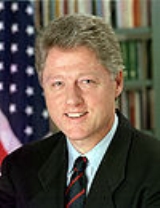
Encyclopedia
William Jefferson "Bill" Clinton was the 42nd
President of the United States, serving from 1993 to 2001. Before his election as President, Clinton served nearly 12 years as the 50th and 52nd Governor of
Arkansas. His wife,
Hillary Rodham Clinton, is the junior
United States Senator from
New York, where they both reside. Clinton founded and heads the
William J. Clinton Foundation.
Early life
William Jefferson Blythe III was born in
Hope, Arkansas, and raised in
Hot Springs, Arkansas. He was named after his father, William Jefferson Blythe, Jr., a traveling salesman who died in a car accident three months before he was born. His mother, born Virginia Dell Cassidy , remarried in 1950 to Roger Clinton. Roger Clinton owned an automobile dealership business with his brother, Raymond. The young Billy, as he was called, was raised by his mother and stepfather, assuming his last name "Clinton" throughout elementary school but not formally changing it until he was 14. Clinton grew up in a traditional, albeit blended, family; however, according to Clinton, his stepfather was a gambler and an alcoholic who regularly abused Clinton's mother and sometimes Clinton's half-brother Roger, Jr.
Bill Clinton as a child went to St. John's Catholic School and Ramble Elementary School. While at Hot Springs High School, Clinton was an excellent student and a talented
saxophonist. He considered dedicating his life to music, but a visit to the
White House to meet then-President
John F. Kennedy following his election as a Boys Nation Senator led him to pursue a career in politics. Clinton was a member of Youth Order of
DeMolay but never actually became a
Freemason.
Clinton received a Bachelor of Science in Foreign Service degree from the
Edmund A. Walsh School of Foreign Service at
Georgetown University in
Washington D.C., where he became a brother of
Alpha Phi Omega, worked for Senator
J. William Fulbright, was elected to
Phi Beta Kappa and won a
Rhodes Scholarship to
University College, Oxford. While at Oxford, he played
rugby union as a lock, and later in life he played for the Little Rock Rugby club in Arkansas. There he also participated in the
Vietnam War protest movement. After Oxford, Clinton obtained a Juris Doctor degree from
Yale Law School in 1973. While at Yale, he began dating classmate
Hillary Rodham. They married in 1975 and their only child,
Chelsea, was born in 1980. Clinton is a member of
Kappa Kappa Psi National Honorary Band Fraternity, Inc.
Arkansas political career
In 1974, his first year as a
University of Arkansas law professor, Clinton ran for the
House of Representatives. The incumbent, John Paul Hammerschmidt, defeated Clinton with 52% of the vote. In 1976, Clinton was elected Attorney General of
Arkansas without opposition in the general election.
In 1978, Bill Clinton was first elected Governor of Arkansas, the youngest to be elected governor since 1938. His first term was fraught with difficulties, including an unpopular motor vehicle tax and popular anger over the escape of
Cuban prisoners detained in Fort Chaffee in 1980.
In the 1980 election, Clinton was defeated in his bid for a second term by
Republican challenger Frank D. White. As he once joked, he was the youngest ex-governor in the nation's history. But in 1982, Clinton won his old job back, and over the next decade he helped Arkansas transform its economy. He became a leading figure among the New Democrats, a branch of the Democratic Party that called for welfare reform and smaller government, a policy supported by both Democrats and Republicans alike.
Clinton's approach mollified conservative criticism during his terms as governor. However, personal and business transactions made by the Clintons during this period became the basis of the Whitewater investigation, which dogged his later presidential Administration. After very extensive investigation over several years, no indictments were made against the Clintons related to the years in Arkansas.
Campaign for the Democratic Nomination
There was some media speculation in 1987 that Clinton would enter the race for
1988 Democratic presidential nomination after
then-New York Governor Mario Cuomo declined to run and Democratic frontrunner
Gary Hart bowed out due to revelations about marital infidelity. Often referred to as the "Boy Governor" at the time because of his youthful appearance, Clinton decided to remain as Arkansas Governor and postpone his presidential ambitions until 1992. Presenting himself as a moderate and a member of the New Democrat wing of the Democratic Party, he headed the moderate Democratic Leadership Council in 1990 and 1991.
In 1992, Clinton was the early favorite of Democratic Party insiders and elected officials for the presidential nomination, therefore he was able to rack up scores of Super Delegates even before the first nominating contests were conducted. In spite of this, Clinton began his 1992 presidential quest on a sour note by finishing near the back of the pack in the Iowa caucus, which was largely uncontested due to the presence of favorite-son Senator
Tom Harkin, who was the easy winner. Clinton’s real trouble, however, began during New Hampshire Primary campaign, when revelations of a possible extramarital affair with Gennifer Flowers began to surface. Clinton and his wife Hillary decided to go on
60 Minutes following the
Super Bowl to rebut those charges of infidelity, which had started to take their toll, as Clinton had fallen way behind former
Massachusetts Senator
Paul Tsongas in the New Hampshire polls. In fact, his campaign was beginning to unravel. Their TV appearance was a calculated risk, but it seemed to pay off as Clinton regained some of his lost footing. He still finished second to Tsongas in the New Hampshire Primary, but the media viewed it as a moral victory for Clinton, since he came within single digits of winning after trailing badly in the polls. Clinton shrewdly labeled himself “The Comeback Kid” on election night to help foster this perception and came out of New Hampshire on a roll. Tsongas, on the other hand, picked up little or no momentum from his victory.
Clinton used his new-found momentum to storm to through the Southern primaries, including the big prizes of
Florida and
Texas, and build up a sizable delegate lead over his opponents in the race for the 1992 Democratic presidential nomination. However, there were still some doubts as to whether he could secure the nomination, as former
California Governor
Jerry Brown was scoring victories in other parts of the country and Clinton had yet to win a significant contest outside of his native South. With no major Southern state remaining on the primary calendar, Clinton set his sights on the delegate-rich New York Primary, which was to be his proving ground. Much to the surprise of some, Clinton scored a resounding victory in
New York. It was a watershed moment for him, as he had finally broken through and shed his image as a regional candidate and as centrist Democrat whose standing with Northern liberals was questionable. Having been transformed into the consensus candidate, he took on an air of inevitability and was able to cruise to the nomination, topping it off with a victory on Brown’s home turf in the California Primary.
Presidential election
Clinton won the
1992 Presidential election against Republican George H. W. Bush and billionaire populist
H. Ross Perot, who ran as an independent on a platform focusing on domestic issues; a large part of his success was Bush's steep decline in public approval. Previously described as "unbeatable" because of his approval ratings in the 80% range during the
Persian Gulf conflict, Bush saw his public approval rating drop to just over 40% by election time.
Additionally, Bush reneged on his promise not to raise taxes when he compromised with Democrats in an attempt to lower the Federal deficits. This hurt him among conservatives. Clinton capitalized on Bush's policy switch, repeatedly condemning the President for failing to keep his promise.
Finally, Bush's coalition was in disarray. Conservatives had been united by anti-
communism, but with the end of the
Cold War, old rivalries re-emerged. The Republican Convention of 1992 was dominated by evangelical Christians, alarming some moderate voters who thought the Republican Party had been taken over by religious conservatives. All this worked in Clinton's favor. Clinton could point to his moderate, 'New Democrat' record as governor of Arkansas. Liberal Democrats were impressed by Clinton's academic credentials, his 1960s-era protest record, and support for social causes such as a woman's right to choose. Many Democrats who had supported
Ronald Reagan and Bush in previous elections switched their allegiance to the more moderate Clinton.
His election ended an era of Republican rule, including 12 consecutive years in the
White House and 20 of the previous 24 years. That election also brought the Democrats full control of the political branches of the federal government, including both houses of Congress as well as the presidency, for the first time since 1980.
Presidency, 1993-2001
Significant events of the first term
Shortly after taking office, Clinton signed the Family and Medical Leave Act of 1993, which required large employers to allow their employees to take unpaid leave because of pregnancy or serious medical condition. While this action was popular, Clinton's attempt to fulfill another campaign promise of allowing openly
gay men and lesbians serving in the armed forces was the subject of criticism. His handling of the issue garnered criticism from both the left and the right . After much debate, the Congress - which has sole power under the U.S. Constitution to regulate the armed forces - implemented the "
Don't Ask, Don't Tell" policy, stating that homosexual men and women may serve in the military as long as their sexuality is kept secret. By 1999, Clinton said he didn't "think any serious person could say" that the policy was not "out of whack". Some gay rights advocates criticized Clinton for not going far enough and accused him of making his campaign promise simply to get votes and contributions. These advocates felt Clinton should have integrated the military by executive order, noting that President
Harry Truman ended segregation of the armed forces in that manner. Clinton's defenders argued that an executive order might have prompted the then-Democrat-controlled Senate to write the exclusion of gays into law, potentially making it even harder to integrate the military in the future.
Critics, however, said that the issue was one that should be experimented on in society as a whole, not in the military. The military's goal was not to be a "social Petri dish," but to defend the nation.
Clinton promoted another controversial issue during this period: that of free trade. In 1993, Clinton supported the
North American Free Trade Agreement for ratification by the U.S. Senate. Despite being negotiated by his Republican predecessor, Clinton strongly supported free trade measures. Opposition came from both anti-trade Republicans, protectionist Democrats and supporters of Ross Perot. Ultimately, the treaty was ratified.
Also, the
Brady Bill, which imposed a five-day waiting period on handgun purchases. President Clinton expanded the
Earned Income Tax Credit, which benefits working class families with dependent children.
One of the most prominent items on Clinton's legislative agenda, however, was a health care reform plan, the result of a taskforce headed by
Hillary Clinton, aimed at achieving universal coverage via a national healthcare plan. Though initially well-received in political circles, it was ultimately doomed by well-organized opposition from conservatives, the
American Medical Association, and the health insurance industry. Despite his party holding a majority in the House and Senate, the effort to create a national healthcare system ultimately died under heavy public pressure. It was the first major legislative defeat of Clinton's administration.
Two months later, after two years of Democratic party control under Clinton's leadership, the
mid-term elections in 1994 proved disastrous for the Democrats. This was the first time the democratic party had lost control of both houses of Congress in 40 years
In August of 1993, Clinton signed the Omnibus Budget Reconciliation Act of 1993 which passed Congress without a single Republican vote. It raised taxes on the wealthiest 1.2% of taxpayers, while cutting taxes on 15 million low-income families and making tax cuts available to 90 percent of small businesses. Additionally, it mandated that the budget be balanced over a number of years, and the implementation of spending restraints.
Significant events of the second term
In the
1996 presidential election a few months later, Clinton was re-elected, receiving 49.2% of the popular vote over Republican
Bob Dole and
Reform candidate
Ross Perot , becoming the first Democrat to win reelection to the presidency since Franklin Roosevelt. The Republicans lost a few seats in the House and gained a few in the Senate, but overall retained control of the Congress. Although he did not win a clear majority of the popular vote, Clinton received over 70% of the electoral college vote.
Throughout 1998, there was a controversy over Clinton's relationship with a young White House intern,
Monica Lewinsky. Clinton initially denied the affair while testifying in the Paula Jones sexual harassment lawsuit. The opposing lawyers asked the president about it during his deposition. He stated "I have never had sexual relations with Monica Lewinsky. I've never had an affair with her." Four days later he also said, "There is not a sexual relationship, an improper sexual relationship, or any other kind of improper relationship."
Clinton then appeared on national television on January 26 and stated: "Listen to me, I'm going to say this again. I did not have sexual relations with that woman, Miss Lewinsky." However, after it was revealed that investigators had obtained a semen-stained dress as well as testimony from Lewinsky, Clinton changed tactics and admitted that an improper relationship with Lewinsky had taken place: "Indeed I did have a relationship with Miss Lewinsky that was not appropriate. In fact, it was wrong. It constituted a critical lapse in judgment and a personal failure on my part for which I am solely and completely responsible."
Faced with overwhelming evidence, he apologized to the nation, agreed to pay a $25,000 court fine, settled his sexual harassment lawsuit with
Paula Jones for $850,000 and was temporarily disbarred from practicing law in Arkansas and before the U.S. Supreme Court. He was not tried for perjury in a court. However, he did admit to "testifying falsely" in a carefully worded statement as part of a deal to avoid indictment for perjury.
In a lame duck session after the 1998 elections, the Republican-controlled House voted to impeach Clinton. The next year, the Senate voted to acquit Clinton of what many have alleged were politically-motivated charges.
In the closing year of his Administration, Clinton attempted to address the
Arab-Israeli conflict. After initial successes such as the Oslo accords of the early 90's, the situation had quietly deteriorated, breaking down completely with the start of the
Second Intifada. Clinton brought Israeli Prime Minister Ehud Barak and Palestinian Authority Chairman
Yasser Arafat together at
Camp David. However, these negotiations proved unsuccessful.
Clinton remained popular with the public throughout his two terms as President, ending his presidential career with a 65% approval rating, the highest end-of-term approval rating of any President since
Eisenhower. In addition to his political skills, Clinton also benefited from a boom of the US economy. Under Clinton, the United States had a projected federal budget surplus for the first time since 1969.
Legislation and programs
Major legislation signed
- 1993-02-05 - The Family and Medical Leave Act of 1993
- 1993-08-10 - Omnibus Budget Reconciliation Act of 1993 - Raised income tax rates; income tax, top rate: 39.6%; corporate tax: 35%
- 1993-09-21 - creation of the AmeriCorps volunteer program
- 1993-11-30 - Brady Bill
- 1994-09-13 - Violent Crime Control and Law Enforcement Act, part of an omnibus crime bill, the federal death penalty was expanded to some 60 different offenses
- 1996-02-01 - Communications Decency Act
- 1996-02-08 - Telecom Reform Act: eliminated major ownership restrictions for radio and television groups.
- 1996-02-26 - Personal Responsibility and Work Opportunity Reconciliation Act, a welfare reform bill
- 1996-03-14 - authorized $100 million counter-terrorism agreement with Israel to track down and root out terrorists.
- 1996-04-09 - Line Item Veto Act
- 1996-04-24 - Anti-Terrorism and Effective Death Penalty Act
- 1996-08-20 - Minimum wage Increase Act
- 1996-09-21 - Defense of Marriage Act, allowed states to refuse recognition of certain same-sex marriages, and defined marriage as between a male and female for purposes of federal law
- 1997-08-05 - Taxpayer Relief Act of 1997
- 1998-10-28 - Digital Millennium Copyright Act
- 1998-10-31 - Iraq Liberation Act
Major legislation vetoed
- national budget
- H.R. 1833, partial birth abortion ban
- Twice vetoed welfare reform before signing
- the Private Securities Litigation Reform Act. Congress overrode the veto, however, to enact the bill into law.
Proposals not passed by Congress
Initiatives
Cabinet
Supreme Court appointments
Clinton appointed the following justices to the
Supreme Court:
- Ruth Bader Ginsburg - 1993, making Clinton the first Democratic president to appoint a female Supreme Court justice.
- Stephen Breyer - 1994
The economy
Clinton's presidency included the longest period of economic growth in America's history, credited in large part to budget reforms as well as the peace dividend following the demise of the Soviet Union. After numerous reports revealed that the federal budget deficit would be far greater than expected, President Clinton quickly made cutting the deficit a high priority. Clinton submitted a budget that would cut the deficit by $500 billion over five years by reducing $255 billion of spending and raising taxes on the wealthiest 1.2% of Americans. It also imposed a new energy tax on all Americans and subjected about a quarter of those receiving Social Security payments to higher taxes on their benefits.
Republican Congressional leaders launched an aggressive opposition against the bill, claiming that the tax increase would only make matters worse. Republicans were united in this opposition, as it were, and every Republican in both houses of Congress voted against the proposal. In fact, it took Vice President Gore's tie-breaking vote in the Senate to pass the bill. After extensive lobbying by the Clinton Administration, the House narrowly voted in favor of the bill by a vote of 218 to 216. The budget package expanded the
Earned Income Tax Credit